
Vietnam Battery Market Size, Share, Trends and Forecast by Battery Technology, Application, and Region, 2026-2034
Vietnam Battery Market Summary:
The Vietnam battery market size was valued at USD 587.1 Million in 2025 and is projected to reach USD 952.4 Million by 2026-2034, growing at a compound annual growth rate of 5.52% from 2026-2034.
The market is driven by rapid expansion of electric vehicle (EV) adoption, growing renewable energy installations, and increasing demand from telecommunications infrastructure development nationwide. Government incentives promoting clean energy transitions and sustainable transportation solutions further accelerate overall market growth trajectory. Rising industrialization and rapid urbanization continue to boost energy storage requirements across various industrial and commercial sectors, creating favorable conditions for strengthening Vietnam battery market share.
Key Takeaways and Insights:
- By Battery Technology: Lead-acid battery dominates the market with a share of 48% in 2025, driven by widespread use in automotive starting, lighting, and ignition, cost-effectiveness, established manufacturing, and extensive replacement availability.
- By Application: Automotive leads the market with a share of 33% in 2025, owing to expanding vehicle production, rising two-wheeler adoption, growing commercial fleets, and demand for conventional and EV batteries.
- Key Players: The Vietnam battery market exhibits a moderately consolidated competitive landscape, with established domestic manufacturers competing alongside multinational corporations. Market participants focus on capacity expansion, technological innovation, and strategic partnerships to strengthen distribution networks and enhance product portfolios across diverse application segments.
The Vietnam battery market is experiencing robust growth propelled by the country's accelerating transition toward sustainable energy solutions and electric mobility. Government initiatives promoting renewable energy adoption and EV penetration are creating substantial demand for advanced battery technologies. The expanding telecommunications infrastructure requires reliable backup power solutions, while the growing data center industry necessitates uninterruptible power supply systems. Rising consumer electronics consumption, coupled with increasing industrial automation, further stimulates battery demand across multiple applications. Additionally, Vietnam's strategic positioning as a manufacturing hub attracts investments in battery production facilities, strengthening the domestic supply chain and enhancing market accessibility. As per sources, in August 2025, Fluence Energy and ACE Engineering launched a 35 GWh automated battery storage manufacturing facility in Bac Giang, Vietnam, strengthening local production capacity and supporting global energy storage supply chains.
Vietnam Battery Market Trends:
Expansion of Electric Two-Wheeler Infrastructure
Vietnam is witnessing significant growth in electric two-wheeler adoption as urban consumers increasingly prefer eco-friendly transportation alternatives. The development of battery swapping networks and charging infrastructure across major cities facilitates convenient EV usage. As per sources, in 2025, VinFast will launch its first battery-swapping electric motorbike, Evo Max, and install 1,000 swapping stations, scaling to 50,000 by year-end to support nationwide EV adoption. Further, government subsidies and tax incentives encourage manufacturers to expand electric two-wheeler production capacities. Urban traffic congestion and rising fuel costs motivate consumers to transition toward electric mobility solutions. Domestic manufacturers are investing in localized battery production to reduce import dependence and offer competitive pricing structures that appeal to cost-conscious consumers.
Integration of Renewable Energy Storage Systems
The renewable energy sector is driving substantial demand for advanced battery storage solutions as Vietnam expands solar and wind power installations. Grid-scale energy storage systems enable efficient management of intermittent renewable energy generation while ensuring stable electricity supply. According to sources, in August 2025, VinEnergo signed agreements to install 43 MWp of rooftop solar systems integrated with 45 MWh battery energy storage at VinFast and two battery plants in Ha Tinh, supporting Vietnam’s clean energy transition. Moreover, industrial and commercial facilities increasingly adopt battery storage to optimize energy consumption patterns and reduce peak demand charges. Technological advancements in battery management systems enhance operational efficiency and extend equipment lifespans. The government's commitment to achieving carbon neutrality targets accelerates investments in utility-scale energy storage projects across multiple regions.
Advancement in Battery Recycling Technologies
Environmental sustainability concerns are promoting development of comprehensive battery recycling infrastructure throughout Vietnam. Advanced recycling technologies enable recovery of valuable materials including lithium, cobalt, and nickel from end-of-life batteries. According to sources, in July 2025, Ho Chi Minh City announced plans to establish an EV battery recycling center with a 3,000 metric tons per year, capable of recovering up to 95 % of valuable metals from used batteries. Furthermore, regulatory frameworks mandating responsible battery disposal encourage manufacturers to establish collection and recycling networks. Circular economy principles guide investments in material recovery facilities that reduce raw material import requirements. Research institutions collaborate with industry partners to develop innovative recycling processes that minimize environmental impact while maximizing resource utilization.
Market Outlook 2026-2034:
The Vietnam battery market revenue is projected to experience substantial expansion during the forecast period, driven by accelerating EV adoption and expanding renewable energy installations. Government policies supporting clean energy transitions and sustainable transportation create favorable market conditions. Increasing investments in domestic manufacturing capacities strengthen supply chain resilience while reducing import dependence. Growing demand from telecommunications, data centers, and consumer electronics sectors further contributes to market expansion. Technological advancements enabling higher energy density and improved safety characteristics enhance product competitiveness and consumer acceptance across various application segments. The market generated a revenue of USD 587.1 Million in 2025 and is projected to reach a revenue of USD 952.4 Million by 2034, growing at a compound annual growth rate of 5.52% from 2026-2034.
Vietnam Battery Market Report Segmentation:
|
Segment Category |
Leading Segment |
Market Share |
| Battery Technology | Lead-acid Battery | 48% |
| Application |
Automotive |
33% |
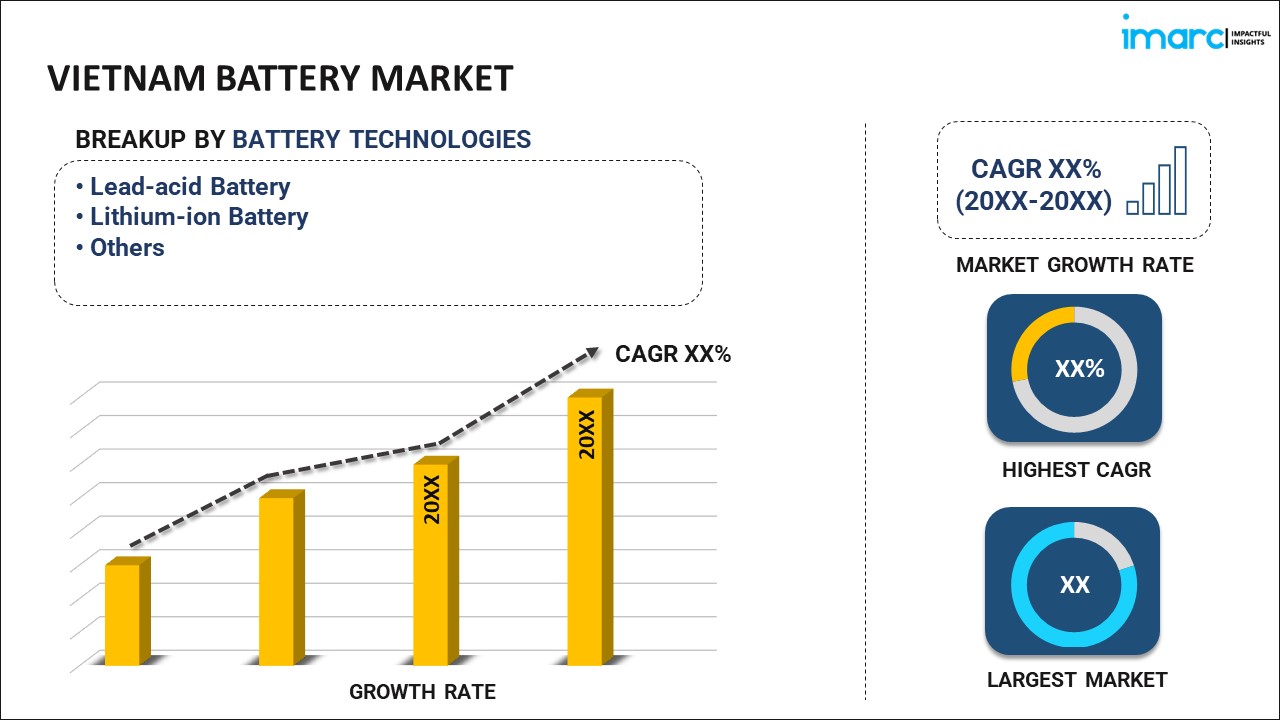
Battery Technology Insights:
To get detailed segment analysis of this market, Request Sample
- Lead-acid Battery
- Lithium-ion Battery
- Others
Lead-acid battery dominates with a market share of 48% of the total Vietnam battery market in 2025.
The lead-acid battery maintains its dominant position within the Vietnam battery market, primarily driven by extensive utilization in automotive starting, lighting, and ignition applications. As per sources, in 2025, Shupai Power Supply Vietnam officially completed the topping-out ceremony for its office and dormitory buildings, marking a significant milestone in the construction of its 2.7 Million kVAh annual lead-acid battery production facility. Moreover, these batteries provide the essential high current required to start internal combustion engines, making them indispensable across cars, motorcycles, light trucks, and heavy-duty commercial vehicles. The established manufacturing infrastructure and widespread supplier networks ensure cost-effective production and readily available replacement units throughout urban and rural areas.
Additionally, lead-acid batteries maintain significant usage across uninterruptible power supply systems, telecommunications backup power, and various industrial equipment, owing to their proven reliability, recyclability, and lower upfront costs compared to advanced alternatives. Manufacturers are actively implementing technological enhancements to improve cycle life, reduce maintenance requirements, and optimize overall performance. These measures ensure that lead-acid batteries remain competitive and continue to serve price-sensitive market segments across a wide range of industries throughout Vietnam.
Application Insights:
- Automotive
- Data Centers
- Telecommunication
- Energy Storage
- Others
Automotive leads with a share of 33% of the total Vietnam battery market in 2025.
The automotive remains the dominant application in the Vietnam battery market, fueled by the expanding vehicle production ecosystem and increasing two-wheeler adoption across provinces. Batteries are essential for starting engines, powering electrical systems, and supporting auxiliary components, while growing commercial fleets for logistics and transportation generate continuous replacement demand through the aftermarket channel. This combination of personal and commercial vehicle growth ensures sustained, robust market activity throughout Vietnam’s automotive battery landscape.
Furthermore, the accelerating transition toward electric mobility is creating additional opportunities within the automotive segment as manufacturers develop battery systems for electric vehicles (EVs) and hybrid models. According to sources, in 2025, FPT Retail signed an MoU with V-Green JSC to install VinFast electric car chargers and motorbike battery swap stations nationwide, starting operations in November 2025. Further, original equipment manufacturers are strengthening partnerships with battery suppliers to ensure reliable component sourcing for expanding production volumes. The government's supportive policies for EV adoption and infrastructure development are expected to sustain growth momentum within this application category throughout the forecast period.
Regional Insights:
To get detailed regional analysis of this market, Request Sample
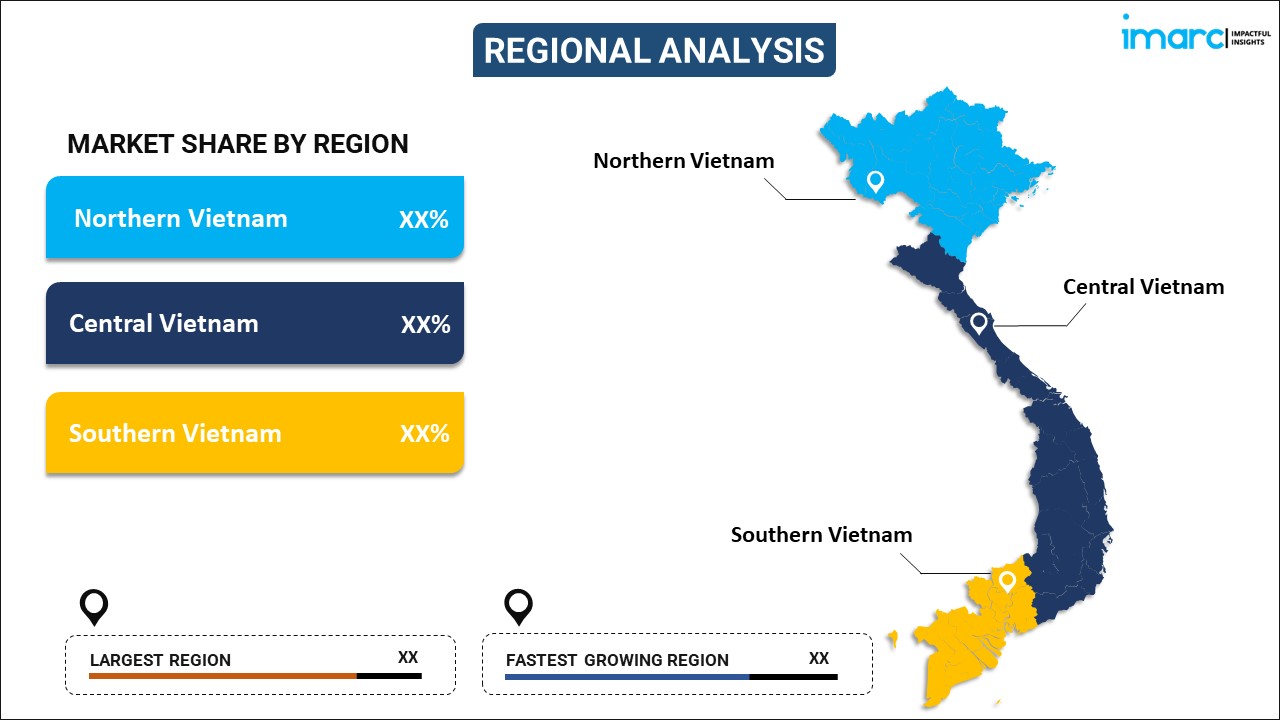
- Northern Vietnam
- Central Vietnam
- Southern Vietnam
Northern Vietnam represents a significant battery market driven by Hanoi's industrial concentration and expanding manufacturing sector. The region benefits from established automotive and electronics industries requiring reliable battery supplies. Government investments in transportation infrastructure and renewable energy projects stimulate demand. Growing urbanization and rising consumer electronics consumption further accelerate market expansion across multiple product categories.
Central Vietnam demonstrates emerging battery market potential supported by developing industrial zones and expanding tourism infrastructure. The region's renewable energy installations, particularly solar and wind projects, create demand for energy storage solutions. Growing telecommunications infrastructure requirements and expanding commercial activities drive battery consumption. Strategic coastal positioning facilitates import logistics while supporting future manufacturing investments.
Southern Vietnam dominates the national battery market, anchored by Ho Chi Minh City's economic significance and industrial concentration. The region hosts major manufacturing facilities, technology parks, and commercial centers requiring diverse battery applications. Higher population density and consumer spending power drive demand for EVs and electronics. Established logistics infrastructure supports efficient distribution networks connecting production facilities with domestic and export markets.
Market Dynamics:
Growth Drivers:
Why is the Vietnam Battery Market Growing?
Accelerating Electric Vehicle Adoption
Vietnam's EV market is experiencing remarkable growth as consumers increasingly embrace sustainable transportation alternatives. Government policies including tax exemptions, registration fee waivers, and purchase subsidies significantly reduce EV ownership costs. In March 2025, Vietnam extended a 100 % registration fee exemption for electric vehicles until February 2027, encouraging EV adoption and supporting the country’s green transportation transition. Moreover, urban traffic congestion and rising fuel expenses motivate consumers to consider electric mobility solutions offering lower operating costs. Domestic manufacturers are expanding electric two-wheeler and automobile production capacities to meet growing demand. The development of charging infrastructure networks across major cities addresses range anxiety concerns and facilitates practical EV usage for daily commuting and commercial applications.
Expanding Renewable Energy Installations
Vietnam's commitment to achieving ambitious renewable energy targets drives substantial demand for advanced battery storage solutions. Solar and wind power installations require efficient energy storage systems to manage generation intermittency and ensure grid stability. In November 2025, Vietnam announced plans to deploy 10,000–16,300 MW of battery storage by 2030 to stabilise its renewable power grid, support solar and wind integration, and achieve net-zero emissions by 2050. Moreover, government policies supporting renewable energy development attract domestic and foreign investments in utility-scale storage projects. Industrial and commercial facilities increasingly adopt battery systems to optimize energy consumption patterns and reduce electricity costs. The transition toward distributed energy resources creates opportunities for residential battery in vietnam and commercial storage applications that enhance energy independence and reliability.
Growing Telecommunications Infrastructure
The expansion of telecommunications networks across Vietnam necessitates reliable backup power solutions ensuring continuous service availability. Mobile network operators require extensive battery installations supporting base stations and switching facilities throughout the country. As per source, in 2025, Vietnam’s major telecom operators Viettel, VNPT and MobiFone deployed around 11,000 5G base stations, covering all provinces and reaching about 26 percent of the population. Moreover, the rollout of advanced network technologies demands enhanced power backup capabilities with improved energy efficiency characteristics. Data center growth in response to digital transformation trends creates additional demand for uninterruptible power supply systems. Remote area coverage expansion requires robust battery solutions capable of extended operation during grid outages or unstable power supply conditions.
Market Restraints:
What Challenges the Vietnam Battery Market is Facing?
High Initial Investment Costs
Advanced battery technologies particularly lithium-ion systems require substantial upfront investments that challenge adoption among cost-sensitive consumers and smaller enterprises. The capital-intensive nature of battery production facilities limits domestic manufacturing expansion and maintains import dependence. Financing constraints restrict access to modern battery technologies for applications where initial costs represent significant adoption barriers.
Limited Recycling Infrastructure
Vietnam's battery recycling infrastructure remains underdeveloped, creating environmental concerns regarding end-of-life battery disposal and material recovery. The absence of comprehensive collection networks challenges proper battery disposal practices. Insufficient recycling capacity results in valuable material losses and environmental contamination risks that may prompt stricter regulatory requirements.
Supply Chain Dependencies
Vietnam remains dependent on imported raw materials including lithium, cobalt, and nickel essential for advanced battery production. Global supply chain disruptions and commodity price volatility impact domestic manufacturing costs and product availability. Limited domestic mineral resources constrain vertical integration opportunities and maintain vulnerability to international market fluctuations affecting production economics.
Competitive Landscape:
The Vietnam battery market features a dynamic competitive environment characterized by both established international manufacturers and emerging domestic producers competing across multiple segments. Market participants differentiate through product innovation, pricing strategies, and distribution network expansion. Strategic partnerships between battery manufacturers and end-use industries facilitate customized solution development addressing specific application requirements. Investment in research and development capabilities enables continuous product improvement and technology advancement. Manufacturing capacity expansion initiatives strengthen market positioning while improving supply chain resilience. Distribution network optimization enhances market reach across urban and rural regions. Quality certification and after-sales service capabilities increasingly influence competitive positioning as customers prioritize reliability and technical support.
Recent Developments:
- In September 2025, CoreMax Group inaugurated a $65.3 Million lithium-ion battery material plant in Quang Ninh, producing high-purity nickel and cobalt sulphate crystals. The facility strengthens Vietnam’s industrial growth, integrates into the global supply chain, and supports local employment and export development, marking a key milestone in the country’s battery sector.
Vietnam Battery Market Report Coverage:
| Report Features | Details |
|---|---|
| Base Year of the Analysis | 2025 |
| Historical Period | 2020-2025 |
| Forecast Period | 2026-2034 |
| Units | Million USD |
| Scope of the Report | Exploration of Historical and Forecast Trends, Industry Catalysts and Challenges, Segment-Wise Historical and Predictive Market Assessment:
|
| Battery Technologies Covered | Lead-acid Battery, Lithium-ion Battery, Others |
| Applications Covered | Automotive, Data Centers, Telecommunication, Energy Storage, Others |
| Regions Covered | Northern Vietnam, Central Vietnam, Southern Vietnam |
| Customization Scope | 10% Free Customization |
| Post-Sale Analyst Support | 10-12 Weeks |
| Delivery Format | PDF and Excel through Email (We can also provide the editable version of the report in PPT/Word format on special request) |
Frequently Asked Questions About the Vietnam Battery Market Report
The Vietnam battery market size was valued at USD 587.1 Million in 2025.
The Vietnam battery market is expected to grow at a compound annual growth rate of 5.52% from 2026-2034 to reach USD 952.4 Million by 2034.
Lead-acid battery held the largest Vietnam battery market share driven by extensive automotive applications, cost-effectiveness, established manufacturing infrastructure, and widespread distribution networks supporting replacement demand across urban and rural regions.
Key factors driving the Vietnam battery market include rapid EV adoption, growing renewable energy installations, expanding telecommunications networks, rising industrialization, and government policies supporting sustainable energy and clean transportation, collectively strengthening demand across automotive, energy storage, and industrial applications.
Major challenges include high upfront vehicle costs, limited charging infrastructure in remote areas, inconsistent government incentives, long battery replacement times, supply chain constraints, and low consumer awareness about electric mobility benefits.
Need more help?
- Speak to our experienced analysts for insights on the current market scenarios.
- Include additional segments and countries to customize the report as per your requirement.
- Gain an unparalleled competitive advantage in your domain by understanding how to utilize the report and positively impacting your operations and revenue.
- For further assistance, please connect with our analysts.
 Request Customization
 Speak to an Analyst
 Request Brochure
 Inquire Before Buying
Benefits of Customization
- Personalize this research
- Triangulate with your data
- Get data as per your format and definition
- Gain a deeper dive into a specific application, geography, customer, or competitor
- Any level of personalization
Get in Touch With Us
UNITED STATES
Phone: +1-201-971-6302
INDIA
Phone: +91-120-433-0800
UNITED KINGDOM
Phone: +44-753-714-6104
Email: [email protected]
Client Testimonials




.webp)




.webp)













Related Reports

Choose your plan
*Please note that the prices mentioned below are starting prices for each bundle type. Kindly contact our team for further details.*
Single User License
- 1 User License, Access on 2 Devices
- PDF Report + Excel Dataset (Password Protected)
- Lifetime Access
- No Printing Rights
- 10% Free Report Customization
- 10–12 Weeks of Analyst Support
Five User License
- Access for 5 Users, 2 Devices per User
- PDF Report + Excel Dataset (Password Protected)
- Lifetime Access
- Dedicated Account Manager
- 12–14 Weeks of Analyst Support
- No Printing Rights
- 15% Free Report Customization
- 25% Discount on Your Next Purchase
Corporate User License
- Unlimited User Access (Within Your Organization)
- PDF Report + Excel Dataset
- Lifetime Access
- Dedicated Account Manager
- 14–20 Weeks of Analyst Support
- No Printing Rights
- 20% Free Report Customization
- 30% Discount on Your Next Purchase
Essential Insights
What's included:
3 reports
- Lifetime Access
- PDF Reports
- Excel Datasets
- 2 Weeks of Free Analyst Support
- 2 User Licenses
- Access on 2 Devices
- Printing Rights
- Complimentary PowerPoint (PPT) Version
- Complimentary License Upgrade
Professional Access
What's included:
5 reports
- Lifetime Access
- PDF Reports
- Excel Datasets
- 8 Weeks of Free Analyst Support
- 2 User Licenses
- Access on 2 Devices
- Printing Rights
- Complimentary PowerPoint (PPT) Version
- Complimentary License Upgrade
Business Advantage
What's included:
8 reports
- Lifetime Access
- PDF Reports
- Excel Datasets
- 14 Weeks of Free Analyst Support
- 2 User Licenses
- Access on 2 Devices
- Printing Rights
- Complimentary PowerPoint (PPT) Version
- Complimentary License Upgrade
Enterprise Intelligence
What's included:
10 reports
- Lifetime Access
- PDF Reports
- Excel Datasets
- 20 Weeks of Free Analyst Support
- 2 User Licenses
- Access on 2 Devices
- Printing Rights
- Complimentary PowerPoint (PPT) Version
- Complimentary License Upgrade