
Vietnam Blockchain in Fintech Market Size, Share, Trends and Forecast by Industry, Application, End User, and Region, 2026-2034
Vietnam Blockchain in Fintech Market Summary:
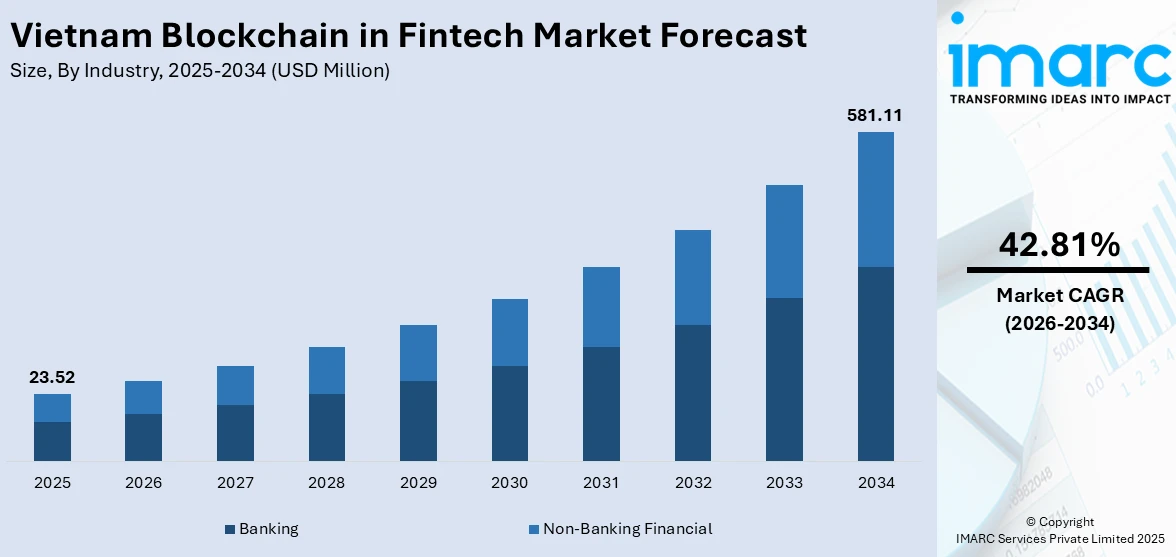
The Vietnam blockchain in fintech market size was valued at USD 23.52 Million in 2025 and is projected to reach USD 581.11 Million by 2034, growing at a compound annual growth rate of 42.81% from 2026-2034.
The Vietnam blockchain in fintech market is experiencing robust momentum as financial institutions increasingly integrate distributed ledger technology into core operations. Rising demand for transparent, secure, and efficient financial services is accelerating adoption across banking and non-banking segments. Supportive government initiatives, expanding digital infrastructure, and a young, technology-oriented population are reinforcing the shift toward blockchain-powered financial solutions, strengthening the Vietnam blockchain in fintech market share.
Key Takeaways and Insights:
- By Industry: Banking dominates the market with a share of 54.6% in 2025, owing to the accelerating adoption of distributed ledger technology for interbank transfers, cross-border settlements, and digital asset management within commercial banking operations across Vietnam.
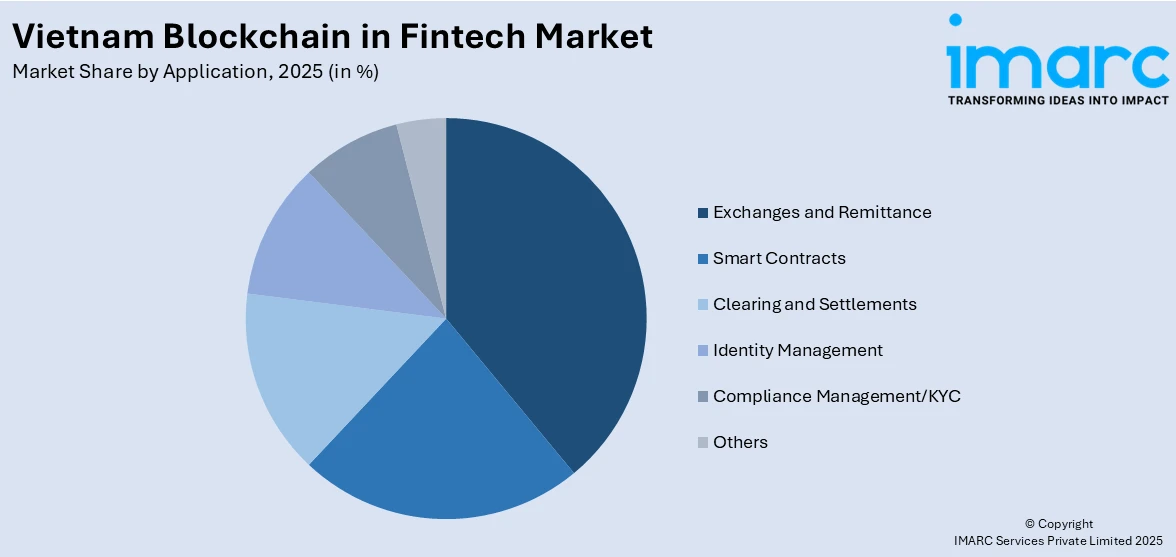
- By Application: Exchanges and remittance lead the market with a share of 38.9% in 2025, driven by the growing demand for cost-effective, transparent, and real-time cross-border payment solutions leveraging blockchain technology to serve overseas remittance flows and digital currency exchanges.
- By End User: Large enterprises hold the largest segment with a market share of 57.2% in 2025, reflecting the capacity of established financial institutions and corporations to invest in blockchain infrastructure, pilot programs, and enterprise-grade distributed ledger platforms.
- By Region: Southern Vietnam represents the leading region with 46.8% share in 2025, driven by the concentration of fintech startups, major banking headquarters, and the establishment of the International Financial Centre in Ho Chi Minh City fostering blockchain innovation.
- Key Players: Key players drive the Vietnam blockchain in fintech market by investing in distributed ledger infrastructure, forming strategic technology partnerships, expanding digital asset platforms, and collaborating with regulators to build secure, scalable, and compliant blockchain ecosystems across the financial services landscape.
To get more information on this market Request Sample
The Vietnam blockchain in fintech market is advancing as banks, non-banking financial institutions, and technology enterprises accelerate the integration of distributed ledger solutions into payment processing, identity verification, and compliance workflows. A major factor shaping this progress is the government's strategic commitment to blockchain development as a national priority, with comprehensive policy frameworks aimed at positioning the country as a regional leader in blockchain technology. These initiatives envision building robust blockchain infrastructure, establishing innovation centres, and fostering a broad ecosystem spanning finance, banking, logistics, and public services. Growing demand for efficient cross-border payment channels, increasing digital asset adoption among the population, and the rising interest from international blockchain platforms are creating a favourable environment for sustained market expansion. Supportive regulatory developments, expanding fintech partnerships, and rising institutional investment in blockchain infrastructure are contributing to a more dynamic and competitive landscape for blockchain-powered financial services. The convergence of a young, technology-oriented population, expanding digital connectivity, and proactive government engagement is reinforcing the shift toward decentralised financial solutions, strengthening long-term growth prospects across the country.
Vietnam Blockchain in Fintech Market Trends:
Rising Integration of Blockchain in Digital Payment Infrastructure
Vietnam is witnessing a growing convergence of blockchain technology with its rapidly expanding digital payment ecosystem. Financial institutions and fintech platforms are leveraging distributed ledger solutions to enhance transaction security, reduce processing times, and lower intermediary costs. The widespread adoption of mobile wallets, the expansion of national interbank payment systems, and the increasing penetration of digital transactions across urban and rural areas are creating fertile ground for blockchain integration into mainstream payment rails. As consumers and businesses increasingly embrace cashless transactions, the underlying infrastructure presents significant opportunities for distributed ledger enhancement. Government-led cashless economy targets and expanding QR code acceptance are reinforcing the Vietnam blockchain in fintech market growth.
Development of Domestically Built Blockchain Platforms
Vietnam is prioritizing technological self-reliance in blockchain by developing homegrown platforms tailored to national requirements. Domestic enterprises are building foundational blockchain networks integrated with government identity systems and banking infrastructure, aiming to support public services, regulated digital finance, and enterprise applications. The push toward indigenous blockchain solutions reflects the government's broader digital sovereignty agenda and supports the creation of a secure, scalable national blockchain ecosystem. By mastering core blockchain technology domestically, the country aims to reduce dependence on foreign platforms, strengthen data security, and ensure that critical financial infrastructure remains under national oversight. These efforts are fostering a more resilient and self-sufficient blockchain environment across the financial sector.
Expanding Regulatory Frameworks for Digital Assets and Blockchain
Vietnam is steadily building a comprehensive legal framework to govern blockchain and digital asset activities within its financial sector. Regulatory advancements are creating a more transparent and structured environment for blockchain adoption, with legislative milestones formally recognising digital assets and establishing clear legal corridors for blockchain-based financial services. These developments provide market participants with greater clarity on operational requirements, licensing procedures, and compliance obligations. The introduction of sandbox mechanisms and pilot programs for digital asset exchanges is further strengthening investor confidence and institutional participation, enabling enterprises to test innovative blockchain solutions under regulatory oversight before full-scale commercial deployment. This progressive approach to regulation is positioning Vietnam as a forward-thinking market that balances innovation with prudent governance.
Market Outlook 2026-2034:
Vietnam's blockchain in fintech market is poised for sustained advancement, supported by policy continuity, expanding digital infrastructure, and rising institutional interest in distributed ledger technologies. The government's national blockchain strategy, combined with the establishment of international financial centers in Ho Chi Minh City and Da Nang, is expected to attract significant domestic and foreign investment into blockchain-based financial services. Increasing demand for secure cross-border payment channels, expanding digital asset adoption, and the development of domestically built blockchain infrastructure are anticipated to drive higher revenue streams and foster a more competitive, mature, and sustainable blockchain-powered fintech landscape across the country. Strategic partnerships between local institutions and global blockchain enterprises are further expected to accelerate technology transfer, enhance compliance frameworks, and broaden the range of blockchain applications in Vietnam's financial sector. The market generated a revenue of USD 23.52 Million in 2025 and is projected to reach a revenue of USD 581.11 Million by 2034, growing at a compound annual growth rate of 42.81% from 2026-2034.
Vietnam Blockchain in Fintech Market Report Segmentation:
|
Segment Category |
Leading Segment |
Market Share |
|
Industry |
Banking |
54.6% |
|
Application |
Exchanges and Remittance |
38.9% |
|
End User |
Large Enterprises |
57.2% |
|
Region |
Southern Vietnam |
46.8% |
Industry Insights:
- Banking
- Non-Banking Financial
Banking dominates with a market share of 54.6% of the total Vietnam blockchain in fintech market in 2025.
The banking sector is the primary driver of blockchain adoption in Vietnam's fintech landscape, leveraging distributed ledger technology for interbank money transfers, international payment processing, electronic invoice tracking, and digital asset tokenization. Commercial banks are investing heavily in blockchain infrastructure to reduce transaction costs, eliminate intermediaries, and enhance operational transparency. The sector's dominance is supported by the State Bank of Vietnam's proactive stance on fintech innovation, including the development of sandbox frameworks that enable banks to pilot blockchain-based solutions within a regulated environment, strengthening confidence and scalability across the industry.
Major Vietnamese banks are actively forming strategic partnerships with international blockchain enterprises to accelerate technology deployment and strengthen operational capabilities. These collaborations are enabling domestic financial institutions to access global expertise in digital asset management, compliance technology, and distributed ledger solutions. By leveraging the technical knowledge and infrastructure of established international blockchain platforms, banks are enhancing their capacity to develop regulated trading systems, improve transaction security, and streamline cross-border settlement processes. Such partnerships are also facilitating knowledge transfer in areas including regulatory compliance, risk management, and platform scalability, further consolidating the banking sector's leadership in blockchain adoption across the country.
Application Insights:
Access the comprehensive market breakdown Request Sample
- Smart Contracts
- Exchanges and Remittance
- Clearing and Settlements
- Identity Management
- Compliance Management/KYC
- Others
Exchanges and remittance lead with a share of 38.9% of the total Vietnam blockchain in fintech market in 2025.
Blockchain-based exchanges and remittance services are the largest application segment, driven by Vietnam's position as one of the world's top 10 remittance-receiving countries. The demand for faster, cheaper, and more transparent cross-border payment channels is propelling the adoption of distributed ledger technology in money transfer and digital currency exchange platforms. Blockchain-powered remittance solutions reduce transaction fees, shorten processing times from days to minutes, and provide end-to-end traceability, making them increasingly attractive for individual consumers and businesses handling international fund flows.
The growing scale of remittance inflows into Vietnam is reinforcing the segment's expansion, as the country consistently ranks among the world's leading recipients of overseas fund transfers. This sustained volume of cross-border money flows creates a strong foundation for blockchain-based remittance platforms that offer faster processing, greater transparency, and lower transaction costs compared to conventional banking channels. Additionally, the increasing number of Vietnamese freelancers operating on global digital platforms and the rising inbound tourism flows are generating sustained demand for efficient, low-cost, blockchain-enabled payment solutions. The convergence of these diverse cross-border financial activities underscores the need for modernized payment infrastructure capable of handling high volumes with minimal friction, further strengthening the position of exchanges and remittance as the leading application segment.
End User Insights:
- Small and Medium Size Enterprises (SMEs)
- Large Enterprises
Large enterprises hold the largest segment with a 57.2% share of the total Vietnam blockchain in fintech market in 2025.
Large enterprises dominate blockchain adoption in Vietnam's fintech sector due to their greater financial capacity to invest in enterprise-grade distributed ledger platforms, pilot programs, and dedicated technology teams. Major banks, securities firms, and insurance companies are integrating blockchain into core operations including payment processing, trade settlement, identity verification, and regulatory compliance. The scale of operations and transaction volumes within large enterprises makes blockchain implementation commercially viable, enabling measurable cost reductions and efficiency gains across complex multi-party financial workflows.
The involvement of large financial institutions in blockchain infrastructure development is intensifying, with major banks and securities firms establishing dedicated subsidiaries and platforms focused on digital asset services and distributed ledger applications. These institutions are committing substantial capital toward building proprietary blockchain trading systems, custody solutions, and tokenization frameworks that align with emerging regulatory requirements. Large enterprises benefit from established regulatory relationships, compliance frameworks, and technology partnerships that enable them to navigate the evolving legal landscape and deploy blockchain solutions at scale. Their ability to attract top-tier technical talent, invest in robust cybersecurity measures, and engage directly with policymakers further strengthens their competitive advantage in shaping the blockchain fintech ecosystem.
Regional Insights:
- Northern Vietnam
- Central Vietnam
- Southern Vietnam
Southern Vietnam represents the leading region with a 46.8% share of the total Vietnam blockchain in fintech market in 2025.
Southern Vietnam leads the blockchain in fintech market, anchored by Ho Chi Minh City's status as the country's financial and commercial capital. The region concentrates the majority of fintech startups, blockchain development firms, banking headquarters, and venture capital activity. The establishment of the Vietnam International Financial Centre (VIFC) in Ho Chi Minh City under National Assembly Resolution 222/2025/QH15 is further positioning the region as a strategic hub for blockchain-powered financial innovation.
The region benefits from advanced digital infrastructure, a dense concentration of technology talent, and strong international connectivity. In November 2025, Ho Chi Minh City's Department of Finance signed a cooperation agreement with Binance to support blockchain infrastructure development, regulatory sandbox frameworks, and digital asset ecosystem building for the International Financial Centre. These developments are accelerating institutional participation, attracting global blockchain enterprises, and strengthening Southern Vietnam's position as the primary engine of blockchain fintech growth.
Market Dynamics:
Growth Drivers:
Why is the Vietnam Blockchain in Fintech Market Growing?
Government-Led National Blockchain Strategy and Regulatory Support
The Vietnamese government has positioned blockchain as a strategic national technology, providing strong institutional support that is accelerating adoption across the financial sector. Comprehensive national strategies have established clear targets for blockchain infrastructure development, research centers, workforce training, and ecosystem building across banking, finance, logistics, and public services. These strategic frameworks are complemented by high-level policy resolutions on breakthroughs in science, technology, innovation, and national digital transformation, which identify blockchain as a priority technology for long-term development. Regulatory milestones are further strengthening the market environment. Legislative advancements have formally recognized digital assets and created a legal corridor for blockchain-based financial activities, providing clarity for institutions seeking to integrate distributed ledger solutions into their operations. Additionally, government-authorized pilot programs for digital asset issuance, trading, and service provision under regulatory oversight are enabling institutions to develop blockchain solutions within a controlled and compliant framework. The introduction of sandbox mechanisms allows financial enterprises to test innovative blockchain applications while maintaining adherence to evolving compliance standards. These policy developments are building institutional confidence and attracting both domestic and international investment into Vietnam's blockchain fintech ecosystem, establishing a supportive foundation for sustained market growth.
Expanding Digital Infrastructure and High Cryptocurrency Adoption
Vietnam's rapidly expanding digital infrastructure and exceptionally high cryptocurrency adoption rates are creating a strong foundation for blockchain-based fintech growth. The country's young, technology-oriented population, combined with widespread smartphone penetration and extensive mobile internet coverage, is driving demand for innovative digital financial services. Majority of the Vietnamese adults' own smartphones, and the government's cashless economy targets are accelerating the shift toward digital transactions, creating a receptive environment for blockchain integration into payment, lending, and investment platforms. Vietnam's cryptocurrency adoption ranks among the highest globally, reflecting strong grassroots engagement with blockchain technology. According to industry report, the total value of cryptocurrency received in Vietnam reached USD 244 Billion in December 2024, marking a 55% increase compared to the previous period and placing the country third in the Asia-Pacific region. This substantial retail activity demonstrates a technologically engaged population already familiar with blockchain concepts, lowering adoption barriers for institutional blockchain fintech solutions and supporting the development of regulated digital asset infrastructure.
Growing Demand for Efficient Cross-Border Payment Solutions
The increasing need for faster, cheaper, and more transparent cross-border payment channels is driving blockchain adoption in Vietnam's financial sector. As a major recipient of overseas remittances, a growing hub for international tourism, and home to a rising number of digital freelancers operating on global platforms, Vietnam requires efficient payment infrastructure that can handle high volumes of international fund flows. Traditional correspondent banking systems involve multiple intermediaries, high fees, and processing times measured in days, creating strong incentives for blockchain-based alternatives that offer near-instant settlement and significantly reduced costs. Industry stakeholders are actively exploring blockchain and stablecoin solutions for cross-border payments. At a September 2025 seminar on cross-border payments organized by the Vietnam Blockchain and Digital Asset Association (VBA), experts highlighted that global cross-border payment flows reached nearly USD 200 Trillion in 2024 and could climb to USD 320 Trillion by 2032, underscoring the massive opportunity for blockchain-enabled solutions. The introduction of stablecoin pilot programs within Da Nang's sandbox framework is providing practical data to assess the feasibility of blockchain-powered payment infrastructure, further driving market growth.
Market Restraints:
What Challenges the Vietnam Blockchain in Fintech Market is Facing?
Evolving and Incomplete Regulatory Framework
Despite significant progress, Vietnam's regulatory framework for blockchain and digital assets remains under development, creating uncertainty for market participants. The absence of finalized guidelines for digital asset classification, licensing requirements, and operational standards makes it challenging for financial institutions and blockchain enterprises to plan long-term investments. Sandbox mechanisms, while promising, are still in pilot stages, and the timeline for transitioning from controlled testing to full regulatory approval remains unclear. This evolving legal landscape can deter risk-averse institutional investors and slow the pace of large-scale blockchain deployment across the financial sector.
Cybersecurity Risks and Data Protection Concerns
The increasing digitization of financial services through blockchain technology exposes institutions and users to heightened cybersecurity threats, including hacking, fraud, and data breaches. As blockchain platforms handle sensitive financial data and high-value transactions, ensuring robust security protocols becomes critical. The growing sophistication of cyber-attacks targeting fintech platforms, combined with the relatively nascent state of cybersecurity talent and infrastructure in Vietnam, poses significant challenges for maintaining trust and operational integrity in blockchain-based financial systems.
Shortage of Specialized Blockchain Talent
The limited availability of skilled blockchain developers, architects, and compliance specialists in Vietnam constrains the pace of technology deployment across the financial sector. While the country has a growing technology workforce, specialized expertise in distributed ledger systems, smart contract development, and blockchain security remains scarce relative to market demand. Universities and training institutions are only beginning to incorporate blockchain curricula, and the competition for qualified talent from international markets further intensifies the challenge for domestic financial institutions seeking to build and maintain blockchain infrastructure.
Competitive Landscape:
The Vietnam blockchain in fintech market is becoming increasingly competitive as banks, securities firms, fintech startups, and international technology enterprises expand their blockchain capabilities across the country. Market participants are focusing on developing proprietary blockchain platforms, forming strategic technology partnerships, securing regulatory approvals, and investing in digital asset infrastructure to capture emerging opportunities. Competition is driven by investments in enterprise-grade distributed ledger solutions, compliance technology, and localized blockchain networks that meet the requirements of the evolving regulatory environment. Strategic collaborations between domestic financial institutions and global blockchain enterprises are accelerating technology transfer, enhancing operational capabilities, and fostering innovation across payment processing, digital asset management, and cross-border settlement services. As a result, market players are continually refining their strategies to strengthen market positioning and capitalize on Vietnam's growing shift toward blockchain-powered financial services.
Recent Developments:
- In September 2025, the Vietnam Blockchain and Digital Asset Association (VBA), KuCoin Group, and 1Matrix Company entered into a strategic memorandum of understanding to form a joint venture in Vietnam focusing on blockchain infrastructure, pilot trading platforms, digital payment solutions, and risk management tools compliant with international standards.
- In May 2025, 1Matrix JSC launched Vietnam's first domestically developed Layer 1 blockchain network, designed to support public services, regulated digital finance, and enterprise applications. The platform is part of an ecosystem including Techcombank, One Mount Group, and Masterise Group, and aims to advance Vietnam's position as a regional blockchain technology leader.
Vietnam Blockchain in Fintech Market Report Coverage:
|
Report Features |
Details |
|
Base Year of the Analysis |
2025 |
|
Historical Period |
2020-2025 |
|
Forecast Period |
2026-2034 |
|
Units |
Million USD |
|
Scope of the Report |
Exploration of Historical Trends and Market Outlook, Industry Catalysts and Challenges, Segment-Wise Historical and Future Market Assessment:
|
|
Industries Covered |
Banking, Non-Banking Financial |
|
Applications Covered |
Smart Contracts, Exchanges and Remittance, Clearing and Settlements, Identity Management, Compliance Management/KYC, Others |
|
End Users Covered |
Small and Medium Size Enterprises (SMEs), Large Enterprises |
|
Regions Covered |
Northern Vietnam, Central Vietnam, Southern Vietnam |
|
Customization Scope |
10% Free Customization |
|
Post-Sale Analyst Support |
10-12 Weeks |
|
Delivery Format |
PDF and Excel through Email (We can also provide the editable version of the report in PPT/Word format on special request) |
Frequently Asked Questions About the Vietnam Blockchain in Fintech Market Report
The Vietnam blockchain in fintech market size was valued at USD 23.52 Million in 2025.
The Vietnam blockchain in fintech market is expected to grow at a compound annual growth rate of 42.81% from 2026-2034 to reach USD 581.11 Million by 2034.
Banking dominated the market with a share of 54.6%, driven by accelerating adoption of distributed ledger technology for interbank transfers, international payment processing, and digital asset management across Vietnam's commercial banking sector.
Key factors driving the Vietnam blockchain in fintech market include supportive government blockchain strategies, expanding digital infrastructure, high cryptocurrency adoption rates, growing demand for efficient cross-border payments, and increasing institutional investment in distributed ledger platforms.
Major challenges include an evolving and incomplete regulatory framework, cybersecurity risks and data protection concerns, shortage of specialized blockchain talent, high implementation costs, and the need for greater interoperability between blockchain platforms.
Need more help?
- Speak to our experienced analysts for insights on the current market scenarios.
- Include additional segments and countries to customize the report as per your requirement.
- Gain an unparalleled competitive advantage in your domain by understanding how to utilize the report and positively impacting your operations and revenue.
- For further assistance, please connect with our analysts.
 Request Customization
 Speak to an Analyst
 Request Brochure
 Inquire Before Buying
Benefits of Customization
- Personalize this research
- Triangulate with your data
- Get data as per your format and definition
- Gain a deeper dive into a specific application, geography, customer, or competitor
- Any level of personalization
Get in Touch With Us
UNITED STATES
Phone: +1-201-971-6302
INDIA
Phone: +91-120-433-0800
UNITED KINGDOM
Phone: +44-753-714-6104
Email: [email protected]
Client Testimonials




.webp)




.webp)













Related Reports

Choose your plan
*Please note that the prices mentioned below are starting prices for each bundle type. Kindly contact our team for further details.*
Single User License
- 1 User License, Access on 2 Devices
- PDF Report + Excel Dataset (Password Protected)
- Lifetime Access
- No Printing Rights
- 10% Free Report Customization
- 10–12 Weeks of Analyst Support
Five User License
- Access for 5 Users, 2 Devices per User
- PDF Report + Excel Dataset (Password Protected)
- Lifetime Access
- Dedicated Account Manager
- 12–14 Weeks of Analyst Support
- No Printing Rights
- 15% Free Report Customization
- 25% Discount on Your Next Purchase
Corporate User License
- Unlimited User Access (Within Your Organization)
- PDF Report + Excel Dataset
- Lifetime Access
- Dedicated Account Manager
- 14–20 Weeks of Analyst Support
- No Printing Rights
- 20% Free Report Customization
- 30% Discount on Your Next Purchase
Essential Insights
What's included:
3 reports
- Lifetime Access
- PDF Reports
- Excel Datasets
- 2 Weeks of Free Analyst Support
- 2 User Licenses
- Access on 2 Devices
- Printing Rights
- Complimentary PowerPoint (PPT) Version
- Complimentary License Upgrade
Professional Access
What's included:
5 reports
- Lifetime Access
- PDF Reports
- Excel Datasets
- 8 Weeks of Free Analyst Support
- 2 User Licenses
- Access on 2 Devices
- Printing Rights
- Complimentary PowerPoint (PPT) Version
- Complimentary License Upgrade
Business Advantage
What's included:
8 reports
- Lifetime Access
- PDF Reports
- Excel Datasets
- 14 Weeks of Free Analyst Support
- 2 User Licenses
- Access on 2 Devices
- Printing Rights
- Complimentary PowerPoint (PPT) Version
- Complimentary License Upgrade
Enterprise Intelligence
What's included:
10 reports
- Lifetime Access
- PDF Reports
- Excel Datasets
- 20 Weeks of Free Analyst Support
- 2 User Licenses
- Access on 2 Devices
- Printing Rights
- Complimentary PowerPoint (PPT) Version
- Complimentary License Upgrade