
Vietnam Contact Center Software Market Size, Share, Trends and Forecast by Component, Deployment Mode, Enterprise Size, End Use, and Region, 2026-2034
Vietnam Contact Center Software Market Overview:
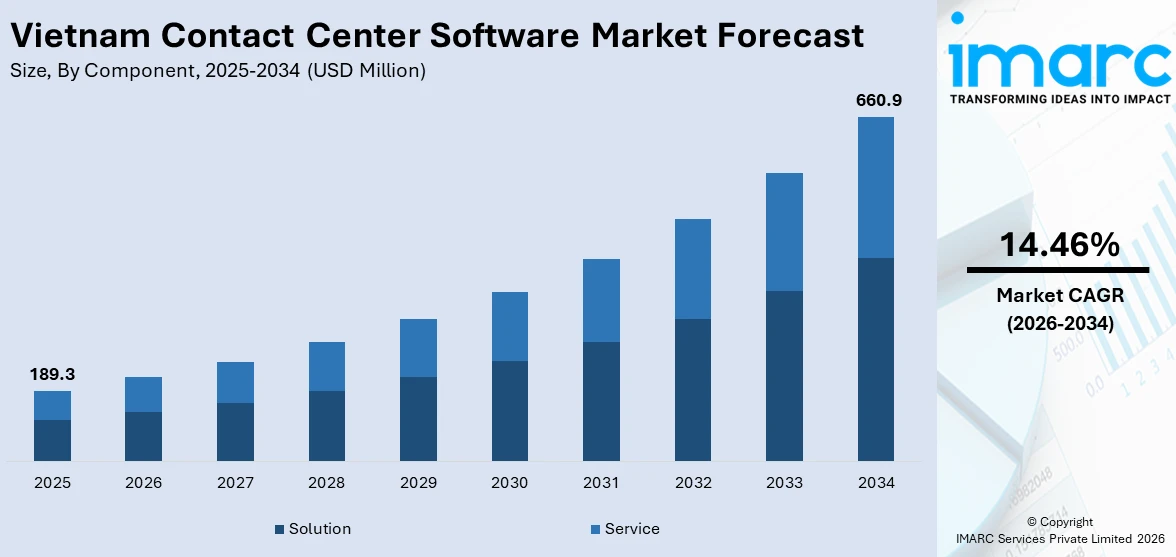
The Vietnam contact center software market size reached USD 189.3 Million in 2025. Looking forward, the market is expected to reach USD 660.9 Million by 2034, exhibiting a growth rate (CAGR) of 14.46% during 2026-2034. The market is driven by rapid digital transformation, rising customer experience expectations, and the expansion of e-commerce, telecom, and financial services. Pressure for omnichannel communication, along with a need for remote agent support, is driving the migration from legacy systems to flexible, scalable platforms. Local language processing abilities and regulatory compliance functionalities are also making newer solutions more appealing, further fueling the expansion of Vietnam contact center software market share.
|
Report Attribute
|
Key Statistics
|
|---|---|
|
Base Year
|
2025
|
|
Forecast Years
|
2026-2034
|
|
Historical Years
|
2020-2025
|
| Market Size in 2025 | USD 189.3 Million |
| Market Forecast in 2034 | USD 660.9 Million |
| Market Growth Rate 2026-2034 | 14.46% |
Vietnam Contact Center Software Market Trends:
AI‑Powered Automation and Conversational Interfaces
One of the key trends in Vietnam is the increased adoption of artificial intelligence, particularly voice AI and conversational virtual agents, in contact center software. Vietnamese companies such as EM&AI are quickly introducing technologies that enable voice assistants, conversational robots, and interactive voice response (IVR) solutions to move away from basic "press 1, press 2" architectures toward more natural, context‐sensitive conversation. The aspiration is to pass routine Tier‑1 questions to virtual agents, allowing humans to tackle more intricate issues. These applications are being used increasingly for tele sales, lead qualification of customer calls, and for initial troubleshooting. Real‑time agent support tools, listening to calls and providing response suggestions or surfacing knowledge base items during a call, are also becoming widespread. This AI/automation trend is particularly valuable in Vietnam due to large numbers of incoming calls in telecommunications, e-commerce, banking and insurance industries where speed and customer experience are crucial differentiators among providers vying for the middle-class and tech-savvy consumers, which further supports the Vietnam contact center software market growth.
To get more information on this market Request Sample
Shift Toward Cloud, Omnichannel and Remote Agent Support
Another significant trend in the Vietnam contact center software market is the shift from on‑premises to cloud‑based solutions, coupled with omnichannel customer service and remote agents. Most businesses are implementing software which incorporates voice, email, live chat, messaging apps (popular local ones included), as well as social media onto singular dashboards so that customers can change channels without context loss. The COVID-19 pandemic significantly hastened remote agent uptake, as contact centers previously depending solely on brick‑and‑mortar offices have had to configure monitoring, workforce management, and collaboration tools so that agents may work remotely. This is particularly relevant to Vietnam, where major city infrastructure is cloud-ready yet rural and provincial towns are experiencing connectivity and power issues, which are being met by vendors with hybrid deployment and offline failback capabilities. Cloud deployments also enable companies to scale up rapidly during high usage (promotional periods, festivals, sales) without capital expenditures on hardware.
Regulatory, Linguistic, Talent and Cultural Factors
Vietnam's contact center software market also mirrors regulatory, language, and talent ecosystem trends that are very region‑specific. Regulators are increasingly tightening requirements around consumer protection and data privacy, driving software providers to design in robust security, logging, compliance, and data sovereignty capabilities. Language-wise, Vietnam is nuanced, as there are different dialects, accents, tones, and regional vocabulary, which impact the performance of speech recognition, automatic transcription, and conversational AI solutions. Vendors are adapting their voice AI capabilities to accommodate Vietnamese dialectal variation and achieve satisfactory accuracy for customers regionally. Young IT workers who are often English‑savvy and incentivized are available in abundance, which is one strength, yet there is also high worker turnover, so assistive tools for agent training, in‑call coaching, and assessment are increasingly integrated into contact center platforms. Apart from this, Vietnamese customers often expect a mix of politeness, respect, and personalization, so software that supports personalization, sentiment analysis, and emotional intelligence in customer interactions is gaining traction.
Vietnam Contact Center Software Market Segmentation:
IMARC Group provides an analysis of the key trends in each segment of the market, along with forecasts at the country and regional levels for 2026-2034. Our report has categorized the market based on component, deployment mode, enterprise size, and end use.
Component Insights:
- Solution
- Automatic Call Distribution (ACD)
- Call Recording
- Computer Telephony Integration (CTI)
- Customer Collaboration
- Dialer
- Interactive Voice Responses (IVR)
- Others
- Service
- Integration and Deployment
- Support and Maintenance
- Training and Consulting
- Managed Services
The report has provided a detailed breakup and analysis of the market based on the component. This includes solution (automatic call distribution (ACD), call recording, computer telephony integration (CTI), customer collaboration, dialer, interactive voice responses (IVR), and others) and service (integration and deployment, support and maintenance, training and consulting, and managed services).
Deployment Mode Insights:
- On-premises
- Cloud-based
A detailed breakup and analysis of the market based on the deployment mode has also been provided in the report. This includes on-premises and cloud-based.
Enterprise Size Insights:
- Large Enterprises
- Small and Medium-sized Enterprises
The report has provided a detailed breakup and analysis of the market based on the enterprise size. This includes large enterprises, and small and medium-sized enterprises.
End Use Insights:
Access the comprehensive market breakdown Request Sample
- BFSI
- Consumer Goods and Retail
- Government
- Healthcare
- IT and Telecom
- Travel and Hospitality
- Others
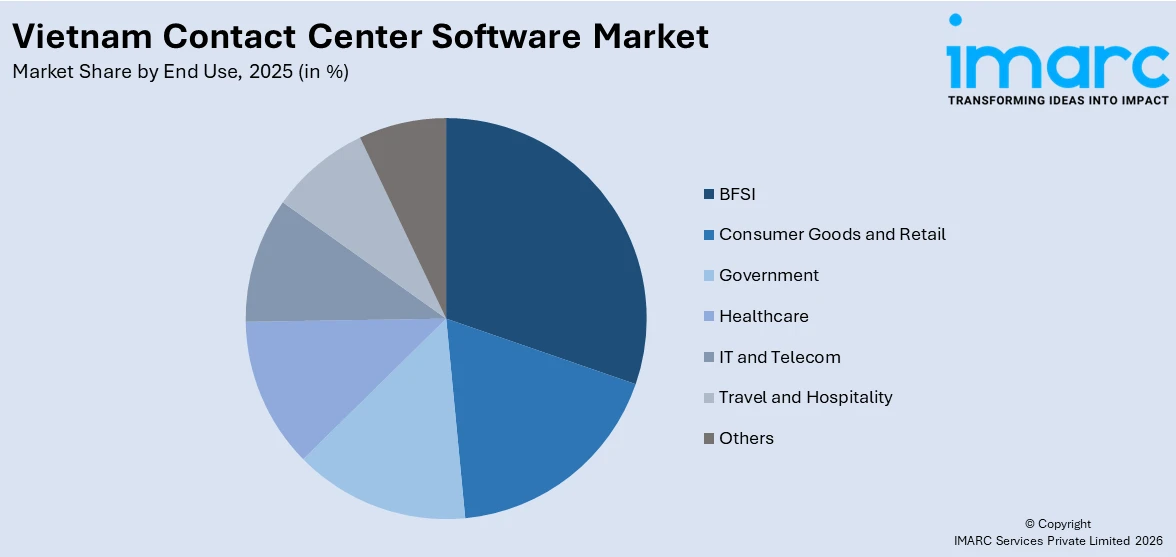
A detailed breakup and analysis of the market based on the end use has also been provided in the report. This includes BFSI, consumer goods and retail, government, healthcare, IT and telecom, travel and hospitality, and others.
Regional Insights:
- Northern Vietnam
- Central Vietnam
- Southern Vietnam
The report has also provided a comprehensive analysis of all the major regional markets, which include Northern Vietnam, Central Vietnam, and Southern Vietnam.
Competitive Landscape:
The market research report has also provided a comprehensive analysis of the competitive landscape. Competitive analysis such as market structure, key player positioning, top winning strategies, competitive dashboard, and company evaluation quadrant has been covered in the report. Also, detailed profiles of all major companies have been provided.
Vietnam Contact Center Software Market News:
- In February 2025, transcosmos technology Vietnam co., ltd. revealed the establishment of a new business site in Hue City, central Vietnam, to meet the increasing demand for its services. This new base will assist transcosmos Group in providing ideal one-stop solutions for clients by creating platforms that support the Group's expansion of various outsourcing services like contact centers, BPO, digital marketing, and e-commerce, both in Japan and internationally.
Vietnam Contact Center Software Market Report Coverage:
| Report Features | Details |
|---|---|
| Base Year of the Analysis | 2025 |
| Historical Period | 2020-2025 |
| Forecast Period | 2026-2034 |
| Units | Million USD |
| Scope of the Report |
Exploration of Historical Trends and Market Outlook, Industry Catalysts and Challenges, Segment-Wise Historical and Future Market Assessment:
|
| Components Covered |
|
| Deployment Modes Covered | On-premises, Cloud-based |
| Enterprise Sizes Covered | Large Enterprises, Small and Medium-sized Enterprises |
| End Uses Covered | BFSI, Consumer Goods and Retail, Government, Healthcare, IT and Telecom, Travel and Hospitality, Others |
| Regions Covered | Northern Vietnam, Central Vietnam, Southern Vietnam |
| Customization Scope | 10% Free Customization |
| Post-Sale Analyst Support | 10-12 Weeks |
| Delivery Format | PDF and Excel through Email (We can also provide the editable version of the report in PPT/Word format on special request) |
Key Questions Answered in This Report:
- How has the Vietnam contact center software market performed so far and how will it perform in the coming years?
- What is the breakup of the Vietnam contact center software market on the basis of component?
- What is the breakup of the Vietnam contact center software market on the basis of deployment mode?
- What is the breakup of the Vietnam contact center software market on the basis of enterprise size?
- What is the breakup of the Vietnam contact center software market on the basis of end use?
- What is the breakup of the Vietnam contact center software market on the basis of region?
- What are the various stages in the value chain of the Vietnam contact center software market?
- What are the key driving factors and challenges in the Vietnam contact center software market?
- What is the structure of the Vietnam contact center software market and who are the key players?
- What is the degree of competition in the Vietnam contact center software market?
Key Benefits for Stakeholders:
- IMARC’s industry report offers a comprehensive quantitative analysis of various market segments, historical and current market trends, market forecasts, and dynamics of the Vietnam contact center software market from 2020-2034.
- The research report provides the latest information on the market drivers, challenges, and opportunities in the Vietnam contact center software market.
- Porter's five forces analysis assist stakeholders in assessing the impact of new entrants, competitive rivalry, supplier power, buyer power, and the threat of substitution. It helps stakeholders to analyze the level of competition within the Vietnam contact center software industry and its attractiveness.
- Competitive landscape allows stakeholders to understand their competitive environment and provides an insight into the current positions of key players in the market.
Need more help?
- Speak to our experienced analysts for insights on the current market scenarios.
- Include additional segments and countries to customize the report as per your requirement.
- Gain an unparalleled competitive advantage in your domain by understanding how to utilize the report and positively impacting your operations and revenue.
- For further assistance, please connect with our analysts.
 Request Customization
 Speak to an Analyst
 Request Brochure
 Inquire Before Buying
Benefits of Customization
- Personalize this research
- Triangulate with your data
- Get data as per your format and definition
- Gain a deeper dive into a specific application, geography, customer, or competitor
- Any level of personalization
Get in Touch With Us
UNITED STATES
Phone: +1-201-971-6302
INDIA
Phone: +91-120-433-0800
UNITED KINGDOM
Phone: +44-753-714-6104
Email: [email protected]
Client Testimonials




.webp)




.webp)













Related Reports

Choose your plan
*Please note that the prices mentioned below are starting prices for each bundle type. Kindly contact our team for further details.*
Single User License
- 1 User License, Access on 2 Devices
- PDF Report + Excel Dataset (Password Protected)
- Lifetime Access
- No Printing Rights
- 10% Free Report Customization
- 10–12 Weeks of Analyst Support
Five User License
- Access for 5 Users, 2 Devices per User
- PDF Report + Excel Dataset (Password Protected)
- Lifetime Access
- Dedicated Account Manager
- 12–14 Weeks of Analyst Support
- No Printing Rights
- 15% Free Report Customization
- 25% Discount on Your Next Purchase
Corporate User License
- Unlimited User Access (Within Your Organization)
- PDF Report + Excel Dataset
- Lifetime Access
- Dedicated Account Manager
- 14–20 Weeks of Analyst Support
- No Printing Rights
- 20% Free Report Customization
- 30% Discount on Your Next Purchase
Essential Insights
What's included:
3 reports
- Lifetime Access
- PDF Reports
- Excel Datasets
- 2 Weeks of Free Analyst Support
- 2 User Licenses
- Access on 2 Devices
- Printing Rights
- Complimentary PowerPoint (PPT) Version
- Complimentary License Upgrade
Professional Access
What's included:
5 reports
- Lifetime Access
- PDF Reports
- Excel Datasets
- 8 Weeks of Free Analyst Support
- 2 User Licenses
- Access on 2 Devices
- Printing Rights
- Complimentary PowerPoint (PPT) Version
- Complimentary License Upgrade
Business Advantage
What's included:
8 reports
- Lifetime Access
- PDF Reports
- Excel Datasets
- 14 Weeks of Free Analyst Support
- 2 User Licenses
- Access on 2 Devices
- Printing Rights
- Complimentary PowerPoint (PPT) Version
- Complimentary License Upgrade
Enterprise Intelligence
What's included:
10 reports
- Lifetime Access
- PDF Reports
- Excel Datasets
- 20 Weeks of Free Analyst Support
- 2 User Licenses
- Access on 2 Devices
- Printing Rights
- Complimentary PowerPoint (PPT) Version
- Complimentary License Upgrade