
Vietnam Digital Payment Market Size, Share, Trends and Forecast by Component, Payment Mode, Deployment Type, End Use Industry, and Region, 2026-2034
Vietnam Digital Payment Market Summary:
The Vietnam digital payment market size was valued at USD 566.8 Million in 2025 and is projected to reach USD 1,720.9 Million by 2034, growing at a compound annual growth rate of 13.13% from 2026-2034.
The Vietnam digital payment market is experiencing robust growth driven by increasing smartphone penetration, expanding internet connectivity, and the government's strong push toward a cashless economy. Rising e-commerce activities, growing consumer preference for convenient transaction methods, and rapid fintech innovation are accelerating market expansion. Enhanced digital infrastructure and supportive regulatory frameworks are further strengthening the Vietnam digital payment market share.
Key Takeaways and Insights:
-
By Component: Solutions dominate the market with a share of 59% in 2025, driven by the increasing demand for integrated payment processing platforms, robust security features, and scalable application program interfaces that enable seamless transactions across multiple channels.
-
By Payment Mode: Digital wallets lead the market with a share of 36% in 2025, owing to widespread adoption among tech-savvy consumers, extensive merchant networks, promotional incentives, and the convenience of conducting instant peer-to-peer transfers and bill payments.
-
By Deployment Type: Cloud-based exhibits a clear dominance in the market with 71% share in 2025, reflecting the banking sector's preference for scalable, cost-effective infrastructure that enables rapid deployment of digital services and real-time transaction processing capabilities.
-
By End Use Industry: BFSI represents the biggest segment with a market share of 20% in 2025, as financial institutions continue investing heavily in digital transformation, mobile banking applications, and secure payment infrastructure to meet evolving customer expectations.
-
By Region: Northern Vietnam is the largest region with 42% share in 2025, driven by the concentration of major banking headquarters, fintech startups, technology infrastructure, and the presence of Hanoi as the administrative and economic hub.
-
Key Players: Key players drive the Vietnam digital payment market by expanding service portfolios, enhancing security technologies, and strengthening nationwide digital infrastructure. Their investments in mobile applications, QR code payment solutions, and strategic partnerships with banks boost adoption and ensure consistent service availability across diverse consumer segments.
The Vietnam digital payment market is advancing rapidly as the government, financial institutions, and technology companies collaborate to build a comprehensive cashless ecosystem. The State Bank of Vietnam has implemented robust regulatory frameworks, including Decree 52/2024/ND-CP on non-cash payments, which formally recognizes e-wallets and prepaid cards as legal payment instruments. According to the State Bank of Vietnam, the total value of non-cash payment transactions reached over 295.2 quadrillion VND (approximately USD 11.3 Trillion) in 2024, representing 26 times the national GDP. Growing consumer confidence in digital transactions, supported by enhanced biometric authentication requirements and fraud prevention measures, is strengthening market adoption. The proliferation of super-apps combining payments, shopping, and financial services creates seamless user experiences that drive engagement. Expanding merchant acceptance networks, particularly among small and medium enterprises, coupled with cross-border payment interoperability initiatives within ASEAN, position Vietnam as an emerging regional hub for digital payment innovation.
Vietnam Digital Payment Market Trends:
Cross-Border QR Payment Interoperability Expansion
Vietnam is rapidly expanding cross-border QR payment connectivity with regional partners to facilitate seamless international transactions. The National Payment Corporation of Vietnam has established bilateral payment linkages with Thailand and Laos, with plans to extend connectivity to China, Japan, and South Korea. In December 2025, NAPAS officially launched the Vietnam-China cross-border QR payment service in collaboration with UnionPay International, enabling Chinese tourists to pay directly at Vietnamese merchants using VietQR Global codes. This initiative promotes local currency usage, supports tourism growth, and strengthens regional financial integration.
Super-App Ecosystem Development and Financial Services Integration
Vietnam's digital payment landscape is increasingly dominated by super-apps that integrate multiple financial services within unified platforms. Leading e-wallets are evolving beyond basic payment functions to offer comprehensive financial ecosystems including micro-loans, insurance products, investment services, and bill payments. These platforms are transforming into all-in-one financial hubs that address diverse consumer needs within single applications. The super-app model drives user engagement through loyalty programs, cross-selling opportunities, and seamless integration with e-commerce and social commerce platforms, creating stickier customer relationships.
Mandatory Biometric Authentication for Enhanced Security
Vietnam has implemented comprehensive biometric authentication requirements to strengthen digital payment security and combat fraud. Under Circular 17/2024/TT-NHNN, customers must verify their identity through biometric features matched against chip-based ID cards and the National Population Database for electronic transactions. The regulation mandates facial recognition for transactions exceeding VND 10 Million and cumulative daily transfers above VND 20 Million. This initiative supports the government's data cleansing efforts, with approximately 122 credit institutions now reporting to the State Bank's fraud monitoring system, significantly reducing unauthorized transaction risks.
Market Outlook 2026-2034:
The Vietnam digital payment market is poised for substantial expansion as digital transformation initiatives accelerate across all economic sectors. Government policies continue to prioritize cashless payment adoption, setting ambitious targets for non-cash transactions across public and private sectors. The market generated a revenue of USD 566.8 Million in 2025 and is projected to reach a revenue of USD 1,720.9 Million by 2034, growing at a compound annual growth rate of 13.13% from 2026-2034. Continued investments in payment infrastructure, the expansion of VietQR acceptance networks, and the rollout of advanced tokenization technologies will drive market penetration. Strategic partnerships between domestic banks, international card networks, and fintech companies are expected to enhance service offerings and expand digital payment accessibility to underserved populations in rural and remote areas across Vietnam.
Vietnam Digital Payment Market Report Segmentation:
| Segment Category | Leading Segment | Market Share |
|---|---|---|
| Component | Solutions | 59% |
| Payment Mode | Digital Wallets | 36% |
| Deployment Type | Cloud-based | 71% |
| End Use Industry | BFSI | 20% |
| Region | Northern Vietnam | 42% |
Component Insights:
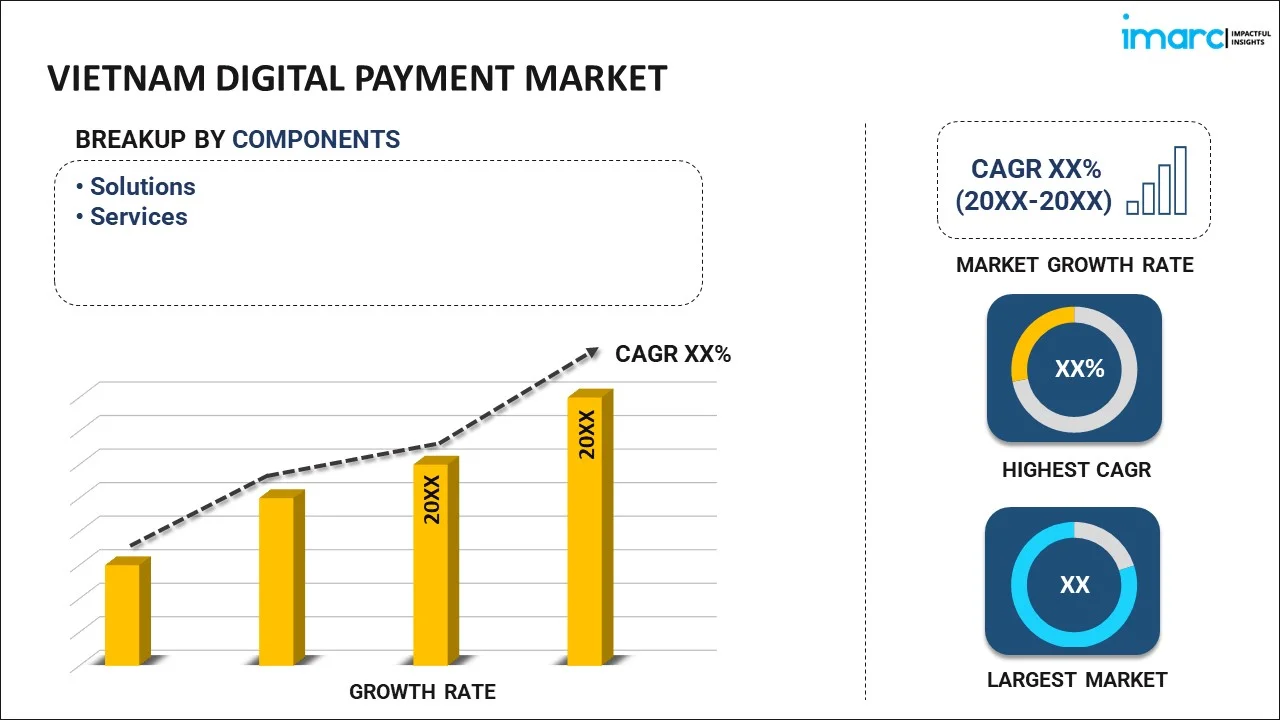
To get detailed segment analysis of this market, Request Sample
- Solutions
- Application Program Interface
- Payment Gateway
- Payment Processing
- Payment Security and Fraud Management
- Transaction Risk Management
- Others
- Services
- Professional Services
- Managed Services
Solutions dominate with a market share of 59% of the total Vietnam digital payment market in 2025.
The solutions segment encompasses comprehensive payment platforms including application program interfaces, payment gateways, payment processing systems, security and fraud management tools, and transaction risk management capabilities. Financial institutions and payment service providers are increasingly investing in integrated solution suites that enable seamless transaction processing across multiple channels. In April 2025, IDEMIA Secure Transactions partnered with the National Payment Corporation of Vietnam to integrate advanced tokenization technology across more than 40 banks, enabling secure contactless and in-app payment experiences for Vietnamese consumers while supporting the government's cashless payment objectives.
The demand for sophisticated payment solutions is further driven by the rapid expansion of e-commerce activities and the need for robust security infrastructure. Payment gateways and processing systems must accommodate high transaction volumes while maintaining compliance with evolving regulatory requirements. Vietnam's implementation of Circular 64/2024 on open APIs establishes technical standards for secure data sharing between banks and technology companies, creating opportunities for solution providers to develop innovative payment products. The solutions segment benefits from continuous technological advancements in artificial intelligence, machine learning, and real-time analytics that enhance fraud detection and customer experience optimization.
Payment Mode Insights:
- Bank Cards
- Digital Currencies
- Digital Wallets
- Net Banking
- Others
Digital wallets lead with a share of 36% of the total Vietnam digital payment market in 2025.
Digital wallets have emerged as the preferred payment method among Vietnamese consumers due to their convenience, security features, and extensive merchant acceptance networks. Leading e-wallet providers have established comprehensive ecosystems that integrate payments with lifestyle services including transportation, food delivery, and entertainment. The growing user base reflects strong consumer preference for mobile-first financial solutions that simplify daily transactions. The segment benefits from aggressive promotional campaigns, cashback incentives, and loyalty programs that drive user acquisition and retention across urban and rural markets.
The digital wallet ecosystem continues to evolve with enhanced functionality including buy-now-pay-later services, investment products, and micro-lending capabilities. Super-app models adopted by leading providers create multiple revenue streams while increasing customer engagement through unified platform experiences. QR code payments facilitated by digital wallets represent the fastest-growing transaction segment in Vietnam, with volumes increasing by more than 81% in the first quarter of 2025 compared to the previous year. Strategic partnerships between e-wallet providers and international card networks are expanding acceptance points and enabling cross-border payment capabilities for Vietnamese travelers and international visitors.
Deployment Type Insights:
- Cloud-based
- On-premises
Cloud-based exhibits a clear dominance with a 71% share of the total Vietnam digital payment market in 2025.
Cloud-based deployment models are increasingly preferred by Vietnamese financial institutions seeking scalable, cost-effective infrastructure to support digital transformation initiatives. The State Bank of Vietnam's Banking Sector Digital Transformation Plan targets digitizing at least 50% of banking operations and ensuring 70% of customer transactions occur through online channels by 2025. In 2024, Vietnam International Bank became the first domestic institution to operate the Temenos R23 core banking system on Amazon Web Services cloud infrastructure, demonstrating the growing confidence in cloud-based solutions for mission-critical payment processing applications among major financial institutions.
Cloud infrastructure enables financial institutions to rapidly deploy new payment services, scale capacity dynamically during peak transaction periods, and reduce operational costs associated with maintaining on-premises data centers. The adoption of API-first architectures and microservices frameworks facilitates integration with third-party applications, enabling banks to participate in open banking ecosystems. Cloud platforms also provide advanced security features including real-time fraud detection, automated compliance monitoring, and disaster recovery capabilities that meet regulatory requirements. Digital-only banking platforms built on cloud infrastructure, such as TNEX developed on Mambu's API-first cloud platform, demonstrate the viability of cloud-native approaches for consumer-focused financial services.
End Use Industry Insights:
- BFSI
- Healthcare
- IT and Telecom
- Media and Entertainment
- Retail and E-commerce
- Transportation
- Others
BFSI represents the leading segment with a 20% share of the total Vietnam digital payment market in 2025.
The BFSI sector leads digital payment adoption in Vietnam as financial institutions invest heavily in technological infrastructure to enhance customer experiences and operational efficiency. Commercial banks and credit institutions report that over 90% of their transactions are now conducted via digital channels, reflecting the successful digitization of core banking services. Financial institutions are increasingly adopting modern card management systems enabling real-time payment processing, instant fraud prevention, and integration with global digital wallets, demonstrating the sector's commitment to technological advancement.
The BFSI sector's digital transformation is supported by regulatory initiatives that establish clear frameworks for electronic banking services, payment agency operations, and data security requirements. Recent legislation provides additional regulations governing e-banking services and payment intermediary activities. Financial institutions are leveraging digital payment infrastructure to expand service offerings including mobile lending, wealth management, and insurance distribution through unified digital platforms. The sector's focus on financial inclusion is driving investments in mobile money services targeting unbanked populations, primarily serving users in rural and remote areas.
Regional Insights:
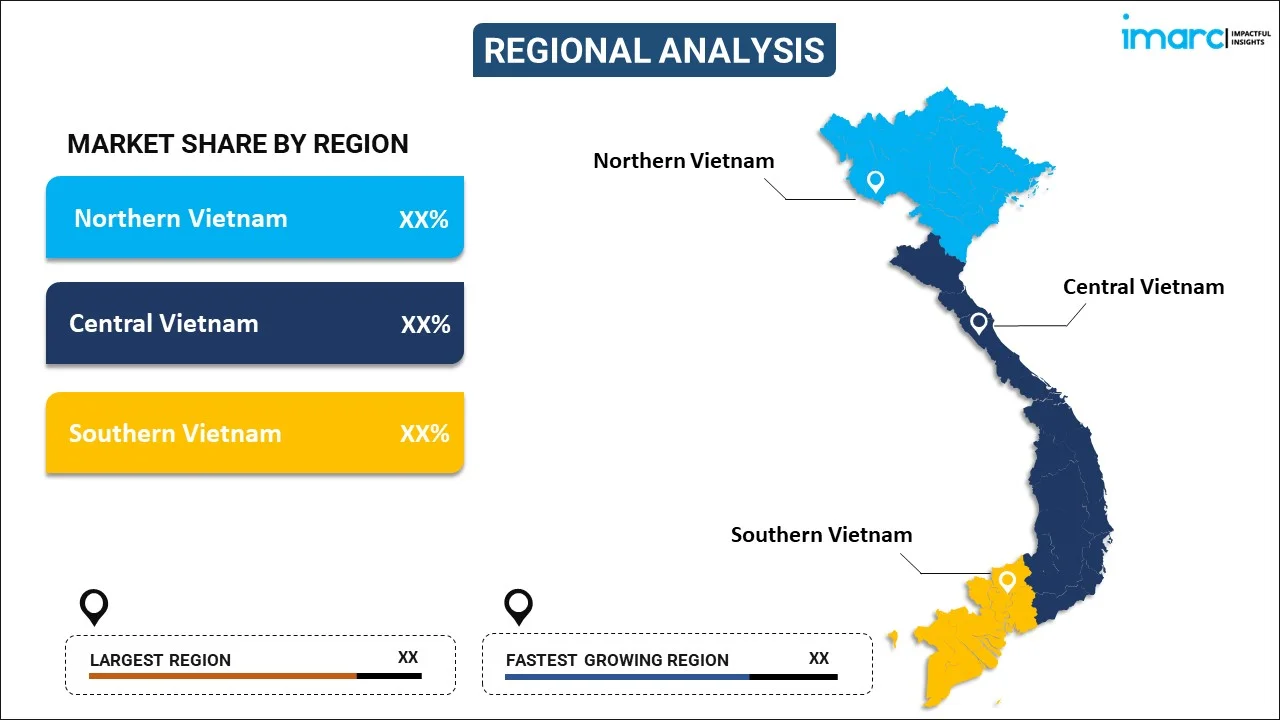
To get detailed regional analysis of this market, Request Sample
- Northern Vietnam
- Central Vietnam
- Southern Vietnam
Northern Vietnam holds the largest share with 42% of the total Vietnam digital payment market in 2025.
Northern Vietnam leads market share due to Hanoi's concentration of banking headquarters, regulatory bodies, and fintech innovation centers. The region benefits from superior digital infrastructure, higher financial literacy rates, and the presence of major technology companies driving payment innovation. Government initiatives piloting cashless public transportation systems demonstrate regional leadership in digital payment adoption, serving as models for nationwide implementation. The capital city's role as the administrative center ensures proximity to policymakers and early access to regulatory sandbox programs that enable testing of innovative payment solutions.
Northern Vietnam's established telecommunications networks and widespread broadband connectivity create favorable conditions for digital payment service deployment. The region attracts significant investment in fintech startups and technology ventures, fostering a competitive ecosystem that accelerates product development and service enhancement. Educational institutions in the region produce skilled technology professionals who support the growing digital payment industry. Urban consumers in Northern Vietnam demonstrate strong adoption rates for mobile banking applications, e-wallets, and contactless payment methods, establishing consumption patterns that influence nationwide digital payment trends and merchant acceptance strategies.
Market Dynamics:
Growth Drivers:
Why is the Vietnam Digital Payment Market Growing?
Government Initiatives and Regulatory Support for Cashless Economy Transition
The Vietnamese government has implemented comprehensive policies and regulatory frameworks to accelerate the transition toward a cashless economy. National financial inclusion strategies establish ambitious growth targets for cashless payment transactions, reflecting strong institutional commitment to digital transformation. Recent regulatory updates modernize the legal framework for non-cash payments by formally recognizing e-wallets and prepaid cards as legitimate payment instruments while establishing clear definitions for electronic money. The State Bank of Vietnam's digital transformation initiatives set ambitious targets to digitize banking operations and ensure the majority of customer transactions occur through digital channels. Annual government-led campaigns promote digital payment awareness and adoption among consumers and businesses nationwide. Central bank authorities continue launching initiatives emphasizing the role of non-cash payments in driving digital economic development, supported by coordinated efforts across ministries, local authorities, and financial sector stakeholders to build safer and more convenient payment environments. These policy measures create a supportive ecosystem that encourages innovation while maintaining consumer protection standards. The alignment of regulatory frameworks with technological advancements ensures that payment service providers can introduce new solutions within clearly defined operational boundaries, fostering market confidence and sustainable growth.
Rapid Smartphone Penetration and Digital Infrastructure Expansion
Vietnam's expanding digital infrastructure and high smartphone penetration rates create favorable conditions for digital payment adoption across diverse demographic segments. The country has achieved extensive mobile network coverage across provinces with ongoing investments in next-generation infrastructure deployment. The young, tech-savvy population demonstrates strong preferences for mobile-first financial services, with widespread smartphone ownership among younger demographics. Growing bank account ownership reflects substantial progress in financial inclusion, expanding the addressable market for digital payment services. Government partnerships with telecommunications providers extend internet connectivity to rural and remote areas through various infrastructure initiatives. National digital transformation plans aim to ensure universal access to high-speed internet services at affordable prices within the coming years. Expanded connectivity enables payment service providers to reach previously underserved populations, driving transaction volumes and market growth across all geographic regions. The convergence of improved telecommunications infrastructure, rising device ownership, and increasing digital literacy creates a supportive environment for sustained digital payment expansion throughout Vietnam.
E-commerce Boom and Social Commerce Integration
The rapid expansion of e-commerce activities in Vietnam creates substantial demand for convenient, secure digital payment solutions that enable seamless online transactions. Vietnamese consumers have shifted decisively toward mobile shopping, with app-based checkouts accounting for a majority of online transactions. Social commerce storefronts embedded within popular platforms simplify one-click purchasing experiences, reducing friction in the customer journey from product discovery to payment completion. Payment providers are prioritizing API-first architectures that integrate easily with e-commerce platforms and social media applications, ensuring high authorization rates and frictionless consumer experiences. E-wallet providers bundle seller dashboards, logistics booking, and buy-now-pay-later options to capture transaction share from traditional cash-on-delivery methods. The integration of payment services within super-app ecosystems enables consumers to complete purchases without leaving their preferred platforms. Livestream commerce and social selling through popular applications create additional demand for embedded payment APIs that confirm orders within chat threads and social media interfaces.
Market Restraints:
What Challenges the Vietnam Digital Payment Market is Facing?
Rising Cybersecurity Threats and Online Fraud Incidents
The rapid growth of digital payments has been accompanied by an increase in cybersecurity threats and sophisticated fraud schemes targeting consumers and financial institutions. Cyberattacks are becoming more professional and personalized through artificial intelligence-enabled phishing campaigns, deepfake technologies, and advanced social engineering tactics. Financial fraud and brand impersonation schemes have tripled, with cybercriminals creating fraudulent websites that mimic legitimate banking and payment platforms. These security concerns can undermine consumer confidence in digital payment systems and require substantial investments in fraud prevention technologies and consumer education initiatives.
Digital Infrastructure Gaps in Rural and Remote Areas
Despite significant progress in expanding digital connectivity, substantial infrastructure gaps persist in rural and remote areas of Vietnam, limiting digital payment adoption among certain population segments. Cash remains the dominant payment method in regions with patchy network coverage and lower smartphone penetration rates. Agricultural households and small merchants in remote areas often resist digital payment adoption due to transaction fees and unfamiliarity with electronic systems. These geographic disparities create challenges for payment service providers seeking to achieve nationwide coverage and may slow overall market growth until infrastructure investments address connectivity gaps.
Digital Literacy and Consumer Trust Barriers
Varying levels of digital literacy and financial technology understanding across demographic groups present challenges for broader digital payment adoption. Older consumers and populations with limited exposure to digital services may experience difficulties navigating payment applications and understanding security features. Building trust in digital payment systems requires sustained educational efforts and demonstration of reliable, secure transaction experiences. The complexity of multiple payment platforms and authentication requirements can create confusion among users, potentially discouraging adoption. Addressing these barriers requires coordinated efforts between payment providers, financial institutions, and government agencies to improve financial literacy and build consumer confidence.
Competitive Landscape:
The Vietnam digital payment market exhibits moderate fragmentation with domestic e-wallet providers, commercial banks, and international payment networks competing for market share. Leading players focus on expanding user bases through promotional incentives, strategic partnerships, and continuous feature enhancements. Competition is intensifying as super-app models integrate multiple financial services within unified platforms, creating comprehensive ecosystems that increase customer stickiness. Banks are modernizing core payment infrastructure through cloud migrations and API integrations to compete with agile fintech challengers. Strategic collaborations between domestic payment schemes and international card networks expand acceptance points and enable cross-border transaction capabilities. Market participants differentiate through superior user experiences, enhanced security features, merchant services, and value-added offerings including lending, insurance, and investment products integrated within payment platforms.
Vietnam Digital Payment Market Report Coverage:
| Report Features | Details |
|---|---|
| Base Year of the Analysis | 2025 |
| Historical Period | 2020-2025 |
| Forecast Period | 2026-2034 |
| Units | Million USD |
| Scope of the Report | Exploration of Historical and Forecast Trends, Industry Catalysts and Challenges, Segment-Wise Historical and Predictive Market Assessment:
|
| Components Covered |
|
| Payment Modes Covered | Bank Cards, Digital Currencies, Digital Wallets, Net Banking, Others |
| Deployment Types Covered | Cloud-based, On-premises |
| End Use Industries Covered | BFSI, Healthcare, IT and Telecom, Media and Entertainment, Retail and E-commerce, Transportation, Others |
| Regions Covered | Northern Vietnam, Central Vietnam, Southern Vietnam |
| Customization Scope | 10% Free Customization |
| Post-Sale Analyst Support | 10-12 Weeks |
| Delivery Format | PDF and Excel through Email (We can also provide the editable version of the report in PPT/Word format on special request) |
Frequently Asked Questions About the Vietnam Digital Payment Market Report
The Vietnam digital payment market size was valued at USD 566.8 Million in 2025.
The Vietnam digital payment market is expected to grow at a compound annual growth rate of 13.13% from 2026-2034 to reach USD 1,720.9 Million by 2034.
Solutions dominated the market with a share of 59%, driven by increasing demand for integrated payment processing platforms, robust security features, and scalable APIs enabling seamless multi-channel transactions.
Key factors driving the Vietnam digital payment market include supportive government policies promoting cashless economy, rapid smartphone penetration, expanding e-commerce activities, enhanced digital infrastructure, and strategic partnerships between banks and fintech companies.
Major challenges include rising cybersecurity threats and sophisticated fraud schemes, digital infrastructure gaps in rural areas, varying levels of digital literacy among population segments, and the need for sustained consumer education to build trust in electronic payment systems.
Need more help?
- Speak to our experienced analysts for insights on the current market scenarios.
- Include additional segments and countries to customize the report as per your requirement.
- Gain an unparalleled competitive advantage in your domain by understanding how to utilize the report and positively impacting your operations and revenue.
- For further assistance, please connect with our analysts.
 Request Customization
 Speak to an Analyst
 Request Brochure
 Inquire Before Buying
Benefits of Customization
- Personalize this research
- Triangulate with your data
- Get data as per your format and definition
- Gain a deeper dive into a specific application, geography, customer, or competitor
- Any level of personalization
Get in Touch With Us
UNITED STATES
Phone: +1-201-971-6302
INDIA
Phone: +91-120-433-0800
UNITED KINGDOM
Phone: +44-753-714-6104
Email: [email protected]
Client Testimonials




.webp)




.webp)













Related Reports

Choose your plan
*Please note that the prices mentioned below are starting prices for each bundle type. Kindly contact our team for further details.*
Single User License
- 1 User License, Access on 2 Devices
- PDF Report + Excel Dataset (Password Protected)
- Lifetime Access
- No Printing Rights
- 10% Free Report Customization
- 10–12 Weeks of Analyst Support
Five User License
- Access for 5 Users, 2 Devices per User
- PDF Report + Excel Dataset (Password Protected)
- Lifetime Access
- Dedicated Account Manager
- 12–14 Weeks of Analyst Support
- No Printing Rights
- 15% Free Report Customization
- 25% Discount on Your Next Purchase
Corporate User License
- Unlimited User Access (Within Your Organization)
- PDF Report + Excel Dataset
- Lifetime Access
- Dedicated Account Manager
- 14–20 Weeks of Analyst Support
- No Printing Rights
- 20% Free Report Customization
- 30% Discount on Your Next Purchase
Essential Insights
What's included:
3 reports
- Lifetime Access
- PDF Reports
- Excel Datasets
- 2 Weeks of Free Analyst Support
- 2 User Licenses
- Access on 2 Devices
- Printing Rights
- Complimentary PowerPoint (PPT) Version
- Complimentary License Upgrade
Professional Access
What's included:
5 reports
- Lifetime Access
- PDF Reports
- Excel Datasets
- 8 Weeks of Free Analyst Support
- 2 User Licenses
- Access on 2 Devices
- Printing Rights
- Complimentary PowerPoint (PPT) Version
- Complimentary License Upgrade
Business Advantage
What's included:
8 reports
- Lifetime Access
- PDF Reports
- Excel Datasets
- 14 Weeks of Free Analyst Support
- 2 User Licenses
- Access on 2 Devices
- Printing Rights
- Complimentary PowerPoint (PPT) Version
- Complimentary License Upgrade
Enterprise Intelligence
What's included:
10 reports
- Lifetime Access
- PDF Reports
- Excel Datasets
- 20 Weeks of Free Analyst Support
- 2 User Licenses
- Access on 2 Devices
- Printing Rights
- Complimentary PowerPoint (PPT) Version
- Complimentary License Upgrade