
Vietnam Enterprise Artificial Intelligence Market Size, Share, Trends and Forecast by Component, Deployment Mode, Technology, Organization Size, Industry Vertical, and Region, 2026-2034
Vietnam Enterprise Artificial Intelligence Market Summary:
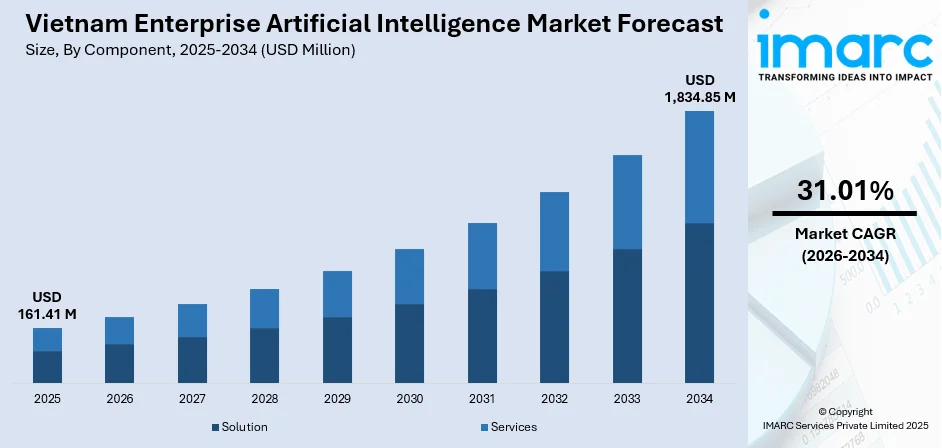
The Vietnam enterprise artificial intelligence market size was valued at USD 161.41 Million in 2025 and is projected to reach USD 1,834.85 Million by 2034, growing at a compound annual growth rate of 31.01% from 2026-2034.
The Vietnam enterprise artificial intelligence market is experiencing robust expansion as organizations across diverse sectors increasingly leverage AI technologies to enhance operational efficiency, automate processes, and gain competitive advantages. Growing digital transformation initiatives, supportive government policies promoting technology adoption, and rising demand for intelligent automation solutions are driving widespread AI implementation. Strategic foreign investments, expanding cloud infrastructure, and the emergence of locally developed AI platforms are strengthening the ecosystem, while increasing enterprise awareness of AI benefits is accelerating adoption and contributing to the Vietnam enterprise artificial intelligence market share.
Key Takeaways and Insights:
-
By Component: Solution dominates the market with a share of 65% in 2025, driven by enterprise demand for comprehensive AI platforms integrating machine learning, analytics, and automation capabilities.
-
By Deployment Mode: Cloud leads the market with 70% share in 2025, reflecting enterprise preference for scalable, cost-effective infrastructure enabling flexible AI workload management.
-
By Technology: Machine learning holds the largest share at 42% in 2025, owing to its versatility in automating processes and generating predictive business insights.
-
By Organization Size: Large enterprises account for 65% market share in 2025, supported by substantial IT budgets and resources enabling comprehensive AI implementation strategies.
-
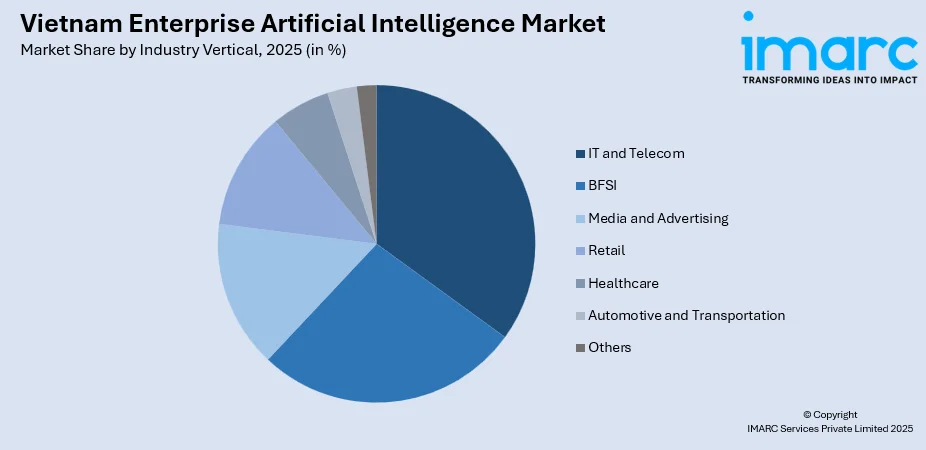
By Industry Vertical: IT and telecom represents the largest vertical with 24% share in 2025, driven by major operators investing heavily in AI-powered infrastructure and digital services.
-
Key Players: The market exhibits a competitive landscape with domestic technology leaders investing significantly in AI research, cloud infrastructure expansion, and strategic international partnerships to strengthen market positioning.
To get more information on this market Request Sample
The Vietnam enterprise artificial intelligence market is advancing rapidly as businesses recognize AI's transformative potential for enhancing productivity and customer engagement. The government's National Strategy on Research, Development and Application of Artificial Intelligence until 2030 establishes a comprehensive framework supporting AI ecosystem development, talent cultivation, and infrastructure investment. Leading technology corporations are driving innovation through localized large language models and enterprise-grade solutions tailored to Vietnamese business requirements. Strategic partnerships between domestic firms and global technology leaders are accelerating AI deployment across multiple sectors. In June 2025, Qualcomm officially launched its AI Research and Development Center in Vietnam, staffed by scientists and AI experts working in Hanoi and Ho Chi Minh City, focusing on generative and agentic AI solutions for smartphones, personal computers, extended reality, automotive, and IoT applications, underscoring the growing international confidence in the Vietnam enterprise artificial intelligence market growth.
Vietnam Enterprise Artificial Intelligence Market Trends:
Accelerating Digital Transformation Across Industries
Vietnamese enterprises are rapidly embracing digital transformation initiatives, positioning artificial intelligence as a critical enabler for achieving operational excellence and competitive differentiation. Organizations across banking, retail, manufacturing, and healthcare are implementing AI-powered solutions to automate routine processes, enhance decision-making capabilities, and deliver personalized customer experiences. This transformation is reshaping traditional business models and creating new value propositions. In August 2025, Viettel inaugurated the An Khanh Data Centre valued at approximately VND 17.5 Trillion (USD 665 Million), meeting international Uptime Tier III standards and integrating proprietary AI solutions to support enterprise digital transformation initiatives nationwide.
Expansion of AI-Powered Cloud Infrastructure
The deployment of cloud-based AI infrastructure is accelerating as enterprises seek scalable, cost-effective solutions for managing complex AI workloads. Cloud computing platforms are enabling organizations to access advanced AI capabilities without substantial capital expenditure on physical infrastructure. Domestic technology providers are expanding AI-ready cloud offerings while international hyperscalers are establishing local presence to serve growing enterprise demand. The convergence of cloud computing and AI is redefining digital transformation pathways, with AI-as-a-Service emerging as a dominant business model particularly suited for small and medium-sized enterprises seeking affordable AI adoption strategies.
Rising Adoption of Enterprise AI Applications
Enterprises across Vietnam are increasingly integrating AI applications into core business functions including customer service, supply chain management, and financial operations. AI-powered chatbots and virtual assistants are transforming customer engagement while predictive analytics and anomaly detection are optimizing logistics and inventory management. The growing confidence in AI capabilities is driving broader implementation across organizational functions. Recent surveys indicate that approximately eighty percent of Vietnamese businesses have utilized AI within the past year, exceeding the regional average and demonstrating strong enterprise appetite for intelligent automation solutions.
Market Outlook 2026-2034:
The Vietnam enterprise artificial intelligence market is poised for substantial expansion as digital transformation initiatives accelerate and enterprises increasingly recognize AI as essential for competitive positioning. Government commitment to establishing comprehensive AI legal frameworks, strategic investments in research infrastructure, and growing international technology partnerships will continue strengthening the ecosystem. The market generated a revenue of USD 161.41 Million in 2025 and is projected to reach a revenue of USD 1,834.85 Million by 2034, growing at a compound annual growth rate of 31.01% from 2026-2034.
Vietnam Enterprise Artificial Intelligence Market Report Segmentation:
| Segment Category | Leading Segment | Market Share |
|---|---|---|
| Component | Solution | 65% |
| Deployment Mode | Cloud | 70% |
| Technology | Machine Learning | 42% |
| Organization Size | Large Enterprises | 65% |
| Industry Vertical | IT and Telecom | 24% |
Component Insights:
- Solution
- Services
Solution dominates with a market share of 65% of the total Vietnam enterprise artificial intelligence market in 2025.
The solution segment's leadership position reflects strong enterprise demand for comprehensive AI platforms that integrate machine learning capabilities, natural language processing, computer vision, and advanced analytics functionalities. Organizations are prioritizing turnkey solutions that enable rapid deployment while offering customization options for industry-specific requirements. These platforms facilitate process automation, data analysis, and intelligent decision support across diverse business functions, driving significant adoption among enterprises seeking immediate operational improvements.
Vietnamese enterprises are increasingly selecting integrated AI solutions that provide end-to-end capabilities from data ingestion through actionable insights generation. Leading domestic technology providers have developed enterprise-grade platforms incorporating locally optimized large language models designed for Vietnamese language processing and business contexts.
Deployment Mode Insights:
- Cloud
- On-premises
Cloud leads the market with a share of 70% of the total Vietnam enterprise artificial intelligence market in 2025.
Cloud dominance reflects enterprise preference for scalable, flexible infrastructure that reduces capital expenditure requirements while enabling rapid AI capability deployment. Cloud platforms provide organizations access to high-performance computing resources essential for training and running complex AI models without substantial hardware investments. The pay-as-you-go model particularly appeals to enterprises seeking to experiment with AI applications before committing to large-scale implementations.
The expansion of domestic cloud infrastructure is accelerating enterprise AI adoption by addressing data sovereignty concerns and providing low-latency access to computing resources. Vietnam now hosts over forty cloud service providers including major domestic operators actively investing in AI-ready infrastructure.
Technology Insights:
- Natural Language Processing (NLP)
- Machine Learning
- Computer Vision
- Speech Recognition
- Others
Machine learning holds the largest share at 42% of the total Vietnam enterprise artificial intelligence market in 2025.
Machine learning's market leadership stems from its versatility and applicability across virtually all enterprise functions and industry sectors. The technology enables organizations to automate processes, analyze large datasets, and generate predictive insights critical for competitive advantage. Machine learning algorithms power diverse applications from customer behavior prediction and fraud detection to demand forecasting and quality control, making it indispensable for businesses seeking operational efficiency improvements.
Vietnamese enterprises are increasingly deploying machine learning solutions to extract actionable insights from growing data volumes and automate complex decision processes. The technology's ability to continuously improve performance through exposure to new data makes it particularly valuable for dynamic business environments. Leading domestic technology corporations have developed machine learning platforms optimized for local market requirements, with capabilities spanning supervised and unsupervised learning, deep learning, and reinforcement learning methodologies.
Organization Size Insights:
- Large Enterprises
- Small and Medium-sized Enterprises
Large enterprises account for the highest revenue share of 65% of the total Vietnam enterprise artificial intelligence market in 2025.
Large enterprises dominate the market owing to substantial IT budgets, dedicated technology teams, and strategic imperatives driving comprehensive AI implementation programs. These organizations possess the financial resources and technical capabilities necessary for deploying enterprise-wide AI solutions addressing complex operational requirements. Large enterprises typically maintain dedicated AI research teams and can invest in customized solutions tailored to specific business processes and competitive positioning objectives.
Major Vietnamese corporations across telecommunications, banking, retail, and manufacturing sectors are leading AI adoption with significant investments in infrastructure and talent development. These organizations serve as ecosystem anchors, driving demand for AI solutions while contributing to local technology capability building through partnerships and knowledge transfer. Multinational corporations operating in Vietnam, along with leading state-owned enterprises, maintain dedicated AI initiatives aimed at enhancing operational efficiency and customer experience.
Industry Vertical Insights:
Access the comprehensive market breakdown Request Sample
- BFSI
- Media and Advertising
- IT and Telecom
- Retail
- Healthcare
- Automotive and Transportation
- Others
IT and telecom represents the largest segment with a market share of 24% of the total Vietnam enterprise artificial intelligence market in 2025.
The IT and telecom sector's leadership reflects the intensive AI investments by major telecommunications operators and technology service providers seeking to enhance infrastructure capabilities and customer service quality. These organizations are deploying AI across network optimization, predictive maintenance, customer relationship management, and service automation functions. The sector's technology-centric nature facilitates rapid AI adoption while substantial customer bases provide extensive data assets enabling sophisticated AI model development.
Major Vietnamese telecommunications operators are transforming into technology companies with AI as a central capability pillar. These enterprises are investing heavily in AI data centers, developing proprietary AI platforms, and forming strategic international partnerships to accelerate innovation. The sector's AI investments extend beyond internal operations to include AI-as-a-Service offerings enabling other industries to access advanced capabilities through cloud-based platforms and managed services.
Regional Insights:
- Northern Vietnam
- Central Vietnam
- Southern Vietnam
Northern Vietnam, anchored by Hanoi, serves as the political and administrative center driving significant AI adoption among government institutions, state-owned enterprises, and educational establishments. The region hosts major international AI research centers from NVIDIA and Qualcomm, benefiting from government digital transformation initiatives and strong university-industry collaborations fostering innovation ecosystems.
Central Vietnam, led by Da Nang, is emerging as a secondary technology nucleus with smart city pilot programs showcasing integrated AI solutions across flood monitoring, traffic optimization, and e-government services. The region attracts growing technology investments as municipalities implement digital transformation projects requiring AI-powered urban management and citizen service platforms.
Southern Vietnam with Ho Chi Minh City functioning as the nation's economic and commercial hub hosting dense concentrations of multinational corporations, technology startups, and enterprise headquarters. The region's robust technological infrastructure, established innovation ecosystem, and substantial skilled technology workforce create favorable conditions for enterprise AI implementation.
Market Dynamics:
Growth Drivers:
Why is the Vietnam Enterprise Artificial Intelligence Market Growing?
Strategic Government Initiatives and Policy Support
The Vietnamese government has established comprehensive policy frameworks positioning artificial intelligence as a strategic priority for national development and economic competitiveness. The National Strategy on Research, Development and Application of Artificial Intelligence until 2030 outlines ambitious targets for building AI research capacity, cultivating specialized talent, and promoting widespread adoption across public and private sectors. Government initiatives encompass tax incentives for technology investments, regulatory sandboxes enabling controlled innovation, and public-private partnerships fostering ecosystem development. Resolution No. 57-NQ/TW issued on December 22, 2024, by the Political Bureau outlines four pillars driving digital technology innovation including flexible governance encouraging innovation, integrated infrastructure development, high-quality workforce investment, and enhanced intellectual property protection through regulatory updates. These coordinated policy measures are creating favorable conditions for enterprises to invest in AI capabilities while building confidence in the long-term viability of AI adoption strategies.
Foreign Direct Investment and Global Technology Partnerships
Vietnam has emerged as a strategic destination for international technology investments, attracting major global corporations establishing AI research and development facilities within the country. These investments bring advanced technological capabilities, management expertise, and global market connections that accelerate domestic AI ecosystem development. Strategic partnerships between Vietnamese enterprises and international technology leaders enable knowledge transfer, technology access, and collaborative innovation programs that strengthen local capabilities. In December 2024, NVIDIA announced the establishment of the Vietnam Research and Development Center in collaboration with the Vietnamese government, focusing on AI software development, engaging with over one hundred Vietnamese AI startups through its Inception program, and partnering with sixty-five universities nationwide. Such investments signal strong international confidence in Vietnam's AI potential while providing critical infrastructure and expertise supporting market growth.
Expanding Digital Infrastructure and 5G Deployment
The accelerated deployment of digital infrastructure, particularly fifth-generation mobile networks, is creating essential technical foundations enabling advanced AI applications across enterprise environments. High-speed, low-latency connectivity facilitates real-time AI processing, edge computing deployments, and Internet of Things integrations that expand AI application possibilities. The expansion of data center capacity and cloud infrastructure provides enterprises with scalable computing resources necessary for AI workload execution. Vietnam's telecommunications operators have deployed approximately eleven thousand 5G base stations nationwide as of 2025, with coverage reaching approximately twenty-six percent of the population spanning all provinces and key urban centers. Government investment in 5G infrastructure development supports the growth of AI services by providing enhanced network capabilities essential for latency-sensitive AI applications across manufacturing, healthcare, and smart city implementations.
Market Restraints:
What Challenges the Vietnam Enterprise Artificial Intelligence Market is Facing?
Skilled AI Workforce Shortage
Despite growing demand for AI capabilities, Vietnam faces a significant shortage of specialized AI professionals with expertise in machine learning, deep learning, and data science disciplines. The current workforce meets only a fraction of industry requirements, creating talent competition that increases implementation costs and extends project timelines for enterprises pursuing AI initiatives.
Data Privacy and Security Concerns
Concerns regarding data protection, privacy compliance, and cybersecurity vulnerabilities present barriers to AI adoption among risk-conscious enterprises. The absence of comprehensive data protection legislation creates uncertainty around compliance requirements, while growing awareness of AI-related security risks prompts cautious approaches to implementation among organizations handling sensitive information.
Limited Technological Infrastructure in Non-Urban Areas
Infrastructure gaps outside major metropolitan areas limit AI adoption potential for enterprises operating across geographically dispersed locations. Inconsistent connectivity, limited computing resources, and reduced access to technical support services in regional areas constrain the scalability of AI implementations for organizations seeking nationwide digital transformation.
Competitive Landscape:
The Vietnam enterprise artificial intelligence market exhibits an evolving competitive landscape characterized by the interplay between established domestic technology conglomerates and emerging specialized AI providers. Market participants are differentiating through development of localized AI solutions incorporating Vietnamese language capabilities, industry-specific applications, and integration with established enterprise systems. Competition is intensifying as organizations invest in research and development infrastructure, expand cloud and data center capacities, and form strategic partnerships with international technology leaders. Competitive dynamics are shaped by the ability to deliver solutions addressing local business requirements while maintaining technological sophistication matching global standards. The market rewards participants demonstrating innovation in AI model development, comprehensive service delivery capabilities, and strong relationships with enterprise customers across multiple industry verticals.
Vietnam Enterprise Artificial Intelligence Market Report Coverage:
| Report Features | Details |
|---|---|
| Base Year of the Analysis | 2025 |
| Historical Period | 2020-2025 |
| Forecast Period | 2026-2034 |
| Units | Million USD |
| Scope of the Report |
Exploration of Historical Trends and Market Outlook, Industry Catalysts and Challenges, Segment-Wise Historical and Future Market Assessment:
|
| Components Covered | Solution, Services |
| Deployment Modes Covered | Cloud, On-premises |
| Technologies Covered | Natural Language Processing (NLP), Machine Learning, Computer Vision, Speech Recognition, Others |
| Organization Sizes Covered | Large Enterprises, Small and Medium-sized Enterprises |
| Industry Verticals Covered | BFSI, Media and Advertising, IT and Telecom, Retail, Healthcare, Automotive and Transportation, Others |
| Regions Covered | Northern Vietnam, Central Vietnam, Southern Vietnam |
| Customization Scope | 10% Free Customization |
| Post-Sale Analyst Support | 10-12 Weeks |
| Delivery Format | PDF and Excel through Email (We can also provide the editable version of the report in PPT/Word format on special request) |
Frequently Asked Questions About the Vietnam Enterprise Artificial Intelligence Market Report
The Vietnam enterprise artificial intelligence market size was valued at USD 161.41 Million in 2025.
The Vietnam enterprise artificial intelligence market is expected to grow at a compound annual growth rate of 31.01% from 2026-2034 to reach USD 1,834.85 Million by 2034.
Solution, commanding 65% market share, leads the Vietnam enterprise artificial intelligence market due to enterprise demand for comprehensive AI platforms integrating machine learning, analytics, and automation capabilities.
Key factors driving the Vietnam enterprise artificial intelligence market include strategic government initiatives promoting AI adoption, foreign direct investment from global technology leaders, expanding digital infrastructure and 5G deployment, and growing enterprise demand for operational efficiency.
Major challenges include skilled AI workforce shortage limiting implementation capacity, data privacy and security concerns creating adoption hesitancy, and limited technological infrastructure in non-urban areas constraining geographic expansion of AI implementations.
Need more help?
- Speak to our experienced analysts for insights on the current market scenarios.
- Include additional segments and countries to customize the report as per your requirement.
- Gain an unparalleled competitive advantage in your domain by understanding how to utilize the report and positively impacting your operations and revenue.
- For further assistance, please connect with our analysts.
 Request Customization
 Speak to an Analyst
 Request Brochure
 Inquire Before Buying
Benefits of Customization
- Personalize this research
- Triangulate with your data
- Get data as per your format and definition
- Gain a deeper dive into a specific application, geography, customer, or competitor
- Any level of personalization
Get in Touch With Us
UNITED STATES
Phone: +1-201-971-6302
INDIA
Phone: +91-120-433-0800
UNITED KINGDOM
Phone: +44-753-714-6104
Email: [email protected]
Client Testimonials




.webp)




.webp)













Related Reports

Choose your plan
*Please note that the prices mentioned below are starting prices for each bundle type. Kindly contact our team for further details.*
Single User License
- 1 User License, Access on 2 Devices
- PDF Report + Excel Dataset (Password Protected)
- Lifetime Access
- No Printing Rights
- 10% Free Report Customization
- 10–12 Weeks of Analyst Support
Five User License
- Access for 5 Users, 2 Devices per User
- PDF Report + Excel Dataset (Password Protected)
- Lifetime Access
- Dedicated Account Manager
- 12–14 Weeks of Analyst Support
- No Printing Rights
- 15% Free Report Customization
- 25% Discount on Your Next Purchase
Corporate User License
- Unlimited User Access (Within Your Organization)
- PDF Report + Excel Dataset
- Lifetime Access
- Dedicated Account Manager
- 14–20 Weeks of Analyst Support
- No Printing Rights
- 20% Free Report Customization
- 30% Discount on Your Next Purchase
Essential Insights
What's included:
3 reports
- Lifetime Access
- PDF Reports
- Excel Datasets
- 2 Weeks of Free Analyst Support
- 2 User Licenses
- Access on 2 Devices
- Printing Rights
- Complimentary PowerPoint (PPT) Version
- Complimentary License Upgrade
Professional Access
What's included:
5 reports
- Lifetime Access
- PDF Reports
- Excel Datasets
- 8 Weeks of Free Analyst Support
- 2 User Licenses
- Access on 2 Devices
- Printing Rights
- Complimentary PowerPoint (PPT) Version
- Complimentary License Upgrade
Business Advantage
What's included:
8 reports
- Lifetime Access
- PDF Reports
- Excel Datasets
- 14 Weeks of Free Analyst Support
- 2 User Licenses
- Access on 2 Devices
- Printing Rights
- Complimentary PowerPoint (PPT) Version
- Complimentary License Upgrade
Enterprise Intelligence
What's included:
10 reports
- Lifetime Access
- PDF Reports
- Excel Datasets
- 20 Weeks of Free Analyst Support
- 2 User Licenses
- Access on 2 Devices
- Printing Rights
- Complimentary PowerPoint (PPT) Version
- Complimentary License Upgrade