
Vietnam Lithium Sulfur Battery Market Size, Share, Trends and Forecast by Battery Capacity, Type, Application, and Region, 2026-2034
Vietnam Lithium Sulfur Battery Market Summary:
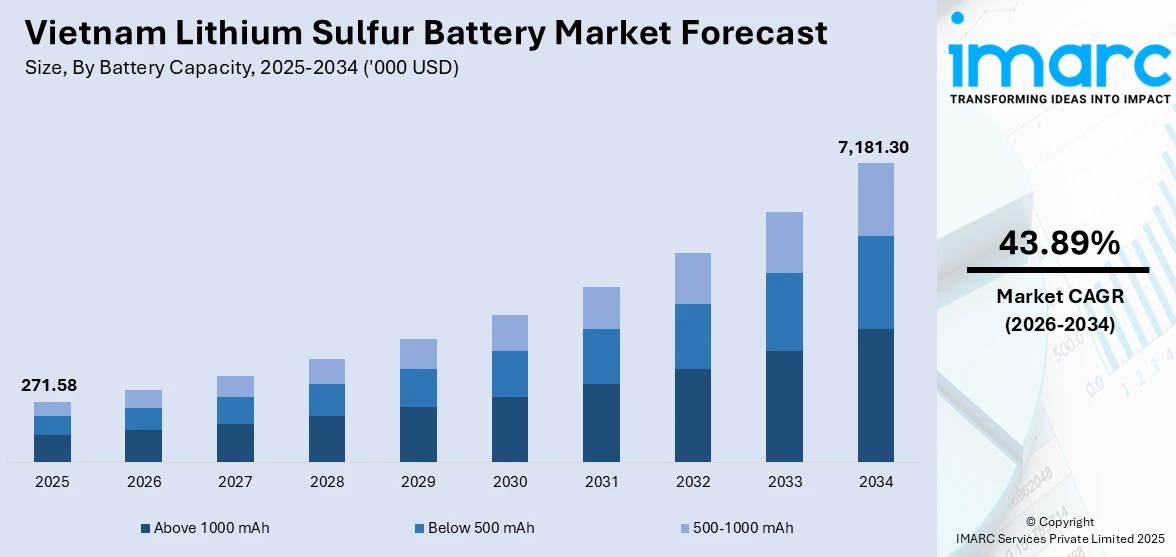
The Vietnam lithium sulfur battery market size was valued at USD 271.58 Thousand in 2025 and is projected to reach USD 7,181.30 Thousand by 2034, growing at a compound annual growth rate of 43.89% from 2026-2034.
The Vietnam lithium sulfur battery market is driven by the growing demand for high-energy-density storage solutions across consumer electronics, electric mobility, and defense applications. The country’s expanding electronics manufacturing ecosystem, increasing government focus on renewable energy integration, and rising adoption of lightweight battery technologies are accelerating interest in next-generation chemistries. Additionally, Vietnam’s strategic position as a global electronics production hub, coupled with favorable investment policies and the emergence of domestic battery supply chains, is creating a supportive environment for the adoption and commercialization of lithium sulfur battery technologies across multiple end-use sectors, thereby reinforcing Vietnam lithium sulfur battery market share.
Key Takeaways and Insights:
- By Battery Capacity: Above 1000 mAh dominates the market with a share of 49.3% in 2025, driven by the growing demand for high-capacity energy storage across electric vehicles and industrial equipment applications.
- By Type: High energy density leads the market with a share of 63.8% in 2025, owing to its superior power-to-weight ratio that meets the performance requirements of advanced portable electronics and aerospace systems.
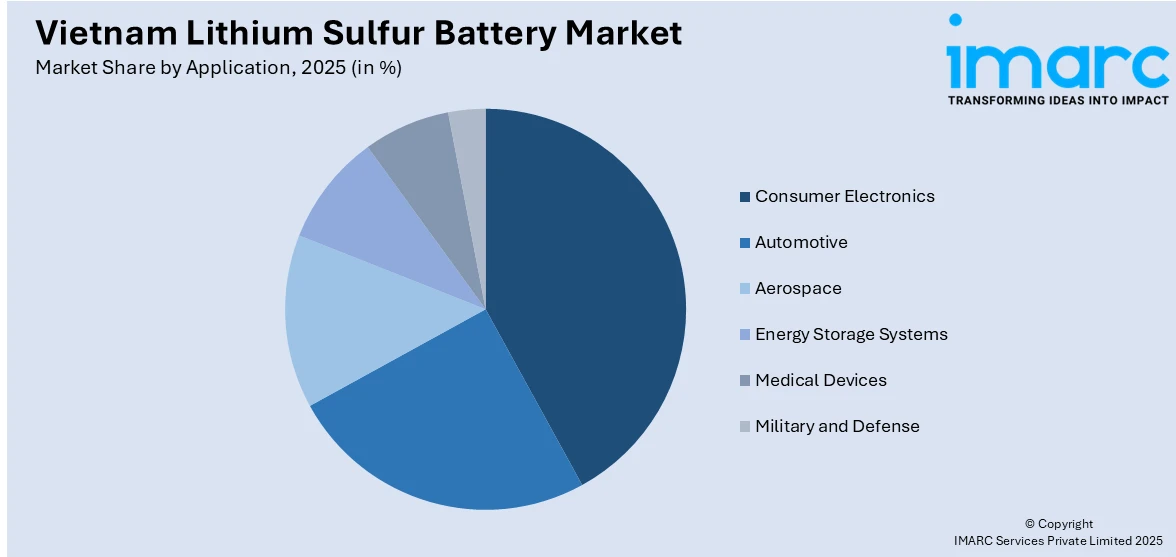
- By Application: Consumer electronics represents the largest segment with a market share of 41.6% in 2025, supported by Vietnam’s position as a major global hub for electronics manufacturing and assembly.
- By Region: Southern Vietnam dominates the market with a share of 45.9% in 2025, attributable to the concentration of major industrial zones, technology parks, and electronics manufacturing facilities in the Ho Chi Minh City metropolitan area.
- Key Players: The Vietnam lithium sulfur battery market exhibits a nascent yet increasingly competitive landscape, with global battery technology developers, multinational electronics corporations, and emerging domestic innovators competing to establish early-mover advantages in this high-growth segment.
To get more information on this market Request Sample
The Vietnam lithium sulfur battery market is evolving rapidly as the country solidifies its position as a key player in the global electronics and energy storage supply chain. The convergence of favorable government policies, expanding foreign direct investment in advanced manufacturing, and increasing domestic demand for lightweight and high-performance battery solutions is catalyzing market growth. Vietnam’s National Power Development Plan VIII has prioritized renewable energy integration and battery energy storage system deployment, creating additional demand vectors for advanced battery chemistries. For instance, Sunwoda Electronic announced plans in July 2024 to invest approximately USD 275 million to build a consumer lithium battery manufacturing plant in Bac Giang province, Vietnam, targeting the production of battery cells and finished battery products to serve global electronics brands. This investment reflects the broader trend of battery manufacturers establishing production capabilities in Vietnam, thereby strengthening the domestic ecosystem for advanced battery technologies, including lithium sulfur variants.
Vietnam Lithium Sulfur Battery Market Trends:
Advancements in Cathode and Electrolyte Engineering
Ongoing research breakthroughs in sulfur cathode design and solid-state electrolyte formulations are addressing the historical limitations of lithium sulfur batteries, including polysulfide shuttling and limited cycle life. These innovations are enhancing energy density retention and operational longevity, making the technology increasingly viable for commercial deployment. For instance, in March 2024, researchers at the University of California, San Diego developed a sulfur-iodine crystal cathode material that increased electrical conductivity by eleven orders of magnitude compared to conventional sulfur cathodes, published in the journal Nature, representing a significant step toward practical solid-state lithium sulfur battery commercialization.
Growing Electronics Manufacturing Ecosystem Driving Demand
Vietnam’s emergence as a global electronics manufacturing hub is generating substantial demand for advanced battery technologies that offer superior energy density in compact form factors. The country’s expanding production base for smartphones, laptops, wearable devices, and other consumer electronics requires next-generation battery solutions. For instance, Samsung SDI commenced production of its advanced 46-series cylindrical battery cells at its Vietnamese subsidiary in March 2025, marking the company’s first overseas shipment of this format and underscoring Vietnam’s growing importance as a strategic location for advanced battery manufacturing.
Government Policies Supporting Renewable Energy and Battery Storage Integration
The Vietnamese government’s strategic emphasis on expanding renewable energy capacity and integrating battery energy storage systems is creating favorable conditions for the adoption of advanced battery chemistries. National policies targeting clean energy transition are driving investment in energy storage infrastructure. Vietnam’s revised National Power Development Plan VIII, approved under Decision No. 768/2025, expanded the country’s generation capacity targets and prioritized the deployment of distributed battery energy storage systems ranging from 10,500 to over 14,000 megawatts to support the integration of large-scale solar and wind energy projects.
Market Outlook 2026-2034:
The Vietnam lithium sulfur battery market is poised for substantial expansion during the forecast period, underpinned by accelerating demand across consumer electronics, electric mobility, and energy storage applications. The country’s strategic positioning within global supply chains, combined with sustained investment in advanced battery manufacturing infrastructure, is expected to drive robust market growth. Rising adoption of lightweight, high-energy-density battery technologies across aerospace, defense, and medical device sectors will further diversify demand streams. The market generated a revenue of USD 271.58 Thousand in 2025 and is projected to reach a revenue of USD 7,181.30 Thousand by 2034, growing at a compound annual growth rate of 43.89% from 2026-2034.
Vietnam Lithium Sulfur Battery Market Report Segmentation:
|
Segment Category |
Leading Segment |
Market Share |
|
Battery Capacity |
Above 1000 mAh |
49.3% |
|
Type |
High Energy Density |
63.8% |
|
Application |
Consumer Electronics |
41.6% |
|
Region |
Southern Vietnam |
45.9% |
Battery Capacity Insights:
- Below 500 mAh
- 500-1000 mAh
- Above 1000 mAh
Above 1000 mAh dominates the market with a share of 49.3% of the total Vietnam lithium sulfur battery market in 2025.
The above 1000 mAh battery capacity segment leads the Vietnam lithium sulfur battery market, driven by the expanding requirements for high-capacity energy storage in electric vehicles, industrial power systems, and grid-scale energy storage applications. Larger capacity lithium sulfur batteries offer distinct advantages in applications where extended runtime and sustained power delivery are critical, making them the preferred choice for automotive and heavy-duty applications. The ongoing shift toward electrification across Vietnam’s transportation and industrial sectors is generating increasing demand for batteries that can deliver higher energy per unit weight.
The prominence of this segment is further strengthened by Vietnam’s strategic focus on electric vehicle production and energy storage infrastructure. As lithium-sulfur battery technology continues to advance and overcome performance challenges, high-capacity solutions are poised to see increasing demand. Local initiatives, including the establishment of new lithium-ion cell facilities and partnerships between domestic and international battery firms, reflect the broader momentum in Vietnam’s battery manufacturing ecosystem, creating an enabling environment for the development and commercialization of next-generation, high-capacity battery technologies.
Type Insights:
- Low Energy Density
- High Energy Density
High energy density leads with a share of 63.8% of the total Vietnam lithium sulfur battery market in 2025.
The high energy density segment commands the largest share of the Vietnam lithium sulfur battery market, reflecting the fundamental technological advantage that lithium sulfur chemistry offers over conventional lithium-ion batteries. With theoretical energy densities reaching approximately five times those of traditional lithium-ion cells, high-energy-density lithium-sulfur batteries are particularly suited for applications in consumer electronics, aerospace, and defense, where maximizing energy output while minimizing weight is paramount.
This segment’s dominance is fueled by the ongoing miniaturization of consumer electronics and the rising need for lightweight, high-performance power sources in aerospace and unmanned systems. Vietnam’s defense modernization efforts and growing aerospace sector are supporting steady demand for high-energy-density batteries. Advances in lithium-sulfur technology and ongoing pilot shipments to key global manufacturers underscore the sector’s commercialization momentum, highlighting the increasing adoption of high-energy-density battery solutions in both domestic and international markets.
Application Insights:
Access the comprehensive market breakdown Request Sample
- Automotive
- Aerospace
- Consumer Electronics
- Energy Storage Systems
- Medical Devices
- Military and Defense
Consumer electronics represent the highest revenue with a 41.6% share of the total Vietnam lithium sulfur battery market in 2025.
The consumer electronics segment holds the largest share of the Vietnam lithium sulfur battery market, supported by the country’s established position as one of the world’s leading electronics manufacturing hubs. Vietnam hosts production facilities for major global technology brands, generating consistent demand for advanced battery technologies that can deliver higher energy density in increasingly compact device form factors. The proliferation of smartphones, tablets, wearable devices, and portable computing equipment drives the need for batteries with superior performance characteristics.
The segment’s leadership is strengthened by sustained investments from international battery manufacturers in Vietnam’s production ecosystem. Companies like Sunwoda Battery Vietnam are expanding facilities to enhance lithium battery output for consumer electronics, including headphones, mobile devices, and computers. These developments highlight the alignment between Vietnam’s electronics manufacturing sector and the rising demand for next-generation lithium-sulfur battery technologies, reinforcing the country’s position as a key hub for advanced battery production and innovation.
Regional Insights:
- Northern Vietnam
- Central Vietnam
- Southern Vietnam
Southern Vietnam exhibits a clear dominance with a 45.9% share of the total Vietnam lithium sulfur battery market in 2025.
Southern Vietnam leads the lithium sulfur battery market, driven by the concentration of major industrial zones, technology parks, and electronics manufacturing clusters in and around the Ho Chi Minh City metropolitan area. The region benefits from well-developed logistics infrastructure, proximity to international shipping routes, and a large, skilled workforce, making it the preferred location for advanced manufacturing operations. The presence of numerous foreign-invested enterprises in electronics and technology sectors creates a robust demand base for high-performance battery solutions.
The increasing per capita incomes and consumer electronics penetration are further helping the region to take a lead in the market over others in the country. The industrial ecosystem in Southern Vietnam has the entire scope of battery-related activities, including the manufacturing of components all the way to assembling the completed products, which will enable the incorporation of new battery technologies. The innovation infrastructure in the region, such as research institutions and technology incubators, creates a favorable environment for dealing with and developing the advanced lithium sulfur battery applications in various industry segments.
Market Dynamics:
Growth Drivers:
Why is the Vietnam Lithium Sulfur Battery Market Growing?
Expanding Consumer Electronics Manufacturing Ecosystem
The lithium sulfur battery market depends on the fast-growing consumer electronics manufacturing industry in Vietnam. The manufacturing of smartphones, laptops, tablets, and wearables has developed into a significant center in the country with huge foreign investment by technology firms. The demand is a trend, and lithium sulfur technology has the benefits of producing more efficient batteries with higher energy density and smaller form factors as demanded by this ecosystem. The use of lithium sulfur solutions is gaining momentum due to the trend toward miniaturizing devices and consumers' expectations that the battery can last longer. The strategic synergy between Vietnam's electronics industry and next-generation battery technologies is evident from the expansion of production capacity for consumer batteries.
Government Commitment to Renewable Energy and Energy Storage Deployment
The government policies of Vietnam that support the development of renewable energy and energy storage facilities are creating a favorable environment for the adoption of advanced batteries. National programs that focus on a shift to clean energy sources rather than fossil fuels are driving the demand for high-performance storage systems that guarantee stability in the grid and enable the integration of renewable sources. These favorable policies stimulate battery research, manufacturing, and implementation. With a greater focus on distributed energy storage and significant solar and wind initiatives, the government is creating a definite roadmap to have energy storage technologies, such as lithium sulfur cells, as a major contributor to the transformation of the country to a more sustainable and reliable energy ecosystem.
Rising Electric Vehicle Adoption and Battery Supply Chain Localization
The rapid growth of electric vehicle adoption in Vietnam, paired with efforts to localize battery supply chains, is driving interest in next-generation battery technologies. As domestic EV production expands, manufacturers are seeking advanced chemistries that provide higher energy density, longer driving range, and reduced weight, making lithium sulfur technology an attractive solution. Localized battery manufacturing capabilities strengthen the foundation for future lithium sulfur production and deployment. Strategic collaborations and joint ventures between automotive and battery companies are enhancing domestic production capacity, supporting the integration of advanced batteries into vehicles, and creating a robust ecosystem for long-term adoption of innovative energy storage solutions.
Market Restraints:
What Challenges the Vietnam Lithium Sulfur Battery Market is Facing?
Limited Cycling Stability and Commercial Maturity
Lithium sulfur batteries continue to face significant technical challenges related to cycling stability and operational lifespan, which constrain their commercial adoption. The polysulfide shuttle effect and cathode degradation during repeated charge-discharge cycles reduce battery performance over time, limiting practical applications requiring long-term reliability. These inherent material science challenges necessitate continued research investment and delay widespread commercialization timelines.
Underdeveloped Domestic Research and Development Infrastructure
Vietnam’s research and development ecosystem for advanced battery technologies remains in early development stages compared to established markets. Limited domestic expertise in lithium sulfur battery design, materials science, and manufacturing processes creates a dependency on foreign technology transfer and partnerships. The absence of a mature domestic research infrastructure constrains the pace of innovation and indigenous technology development in the lithium sulfur battery segment.
High Production Costs and Scalability Constraints
The current production costs associated with lithium sulfur battery manufacturing remain significantly higher than those of established lithium-ion alternatives, presenting a barrier to widespread market penetration. Scaling production from laboratory and pilot stages to commercial volumes requires substantial capital investment and manufacturing process optimization. These economic constraints limit the near-term competitiveness of lithium sulfur batteries across price-sensitive application segments.
Competitive Landscape:
The Vietnam lithium sulfur battery market competitive landscape is characterized by a nascent yet rapidly evolving structure, with participation from global battery technology pioneers, multinational electronics manufacturers, and emerging domestic entities. The market is currently in its formative stage, with competitive dynamics shaped primarily by technology licensing agreements, strategic partnerships, and foreign direct investment in battery manufacturing infrastructure. Market participants are focusing on establishing early technological footholds through collaborative research initiatives and pilot production programs. The competitive environment is expected to intensify as lithium sulfur battery technology matures and transitions from research and development toward commercial-scale production, with companies competing based on energy density performance, cycling stability improvements, manufacturing cost efficiency, and supply chain integration capabilities.
Vietnam Lithium Sulfur Battery Market Report Coverage:
|
Report Features |
Details |
|
Base Year of the Analysis |
2025 |
|
Historical Period |
2020-2025 |
|
Forecast Period |
2026-2034 |
|
Units |
USD Thousand |
|
Scope of the Report |
Exploration of Historical Trends and Market Outlook, Industry Catalysts and Challenges, Segment-Wise Historical and Future Market Assessment:
|
|
Battery Capacity Covered |
Below 500 mAh, 500-1000 mAh, Above 1000 mAh |
|
Type Covered |
Low Energy Density, High Energy Density |
|
Application Covered |
Automotive, Aerospace, Consumer Electronics, Energy Storage Systems, Medical Devices, Military and Defense |
|
Region Covered |
Northern Vietnam, Central Vietnam, Southern Vietnam |
|
Customization Scope |
10% Free Customization |
|
Post-Sale Analyst Support |
10-12 Weeks |
|
Delivery Format |
PDF and Excel through Email (We can also provide the editable version of the report in PPT/Word format on special request) |
Frequently Asked Questions About the Vietnam Lithium Sulfur Battery Market Report
The Vietnam lithium sulfur battery market size was valued at USD 271.58 Thousand in 2025.
The Vietnam lithium sulfur battery market is expected to grow at a compound annual growth rate of 43.89% from 2026-2034 to reach USD 7,181.30 Thousand by 2034.
Above 1000 mAh dominated the Vietnam lithium sulfur battery market with a share of 49.3% in 2025, driven by expanding requirements for high-capacity energy storage across electric vehicles, industrial applications, and grid-scale energy storage systems.
Key factors driving the Vietnam lithium sulfur battery market include the expanding consumer electronics manufacturing ecosystem, government commitment to renewable energy and energy storage deployment, rising electric vehicle adoption, and ongoing advancements in cathode and electrolyte engineering.
Major challenges include limited cycling stability and commercial maturity of lithium sulfur technology, underdeveloped domestic research and development infrastructure, high production costs relative to established lithium-ion alternatives, scalability constraints in transitioning from pilot to commercial production, and supply chain dependencies on foreign technology transfer.
Need more help?
- Speak to our experienced analysts for insights on the current market scenarios.
- Include additional segments and countries to customize the report as per your requirement.
- Gain an unparalleled competitive advantage in your domain by understanding how to utilize the report and positively impacting your operations and revenue.
- For further assistance, please connect with our analysts.
 Request Customization
 Speak to an Analyst
 Request Brochure
 Inquire Before Buying
Benefits of Customization
- Personalize this research
- Triangulate with your data
- Get data as per your format and definition
- Gain a deeper dive into a specific application, geography, customer, or competitor
- Any level of personalization
Get in Touch With Us
UNITED STATES
Phone: +1-201-971-6302
INDIA
Phone: +91-120-433-0800
UNITED KINGDOM
Phone: +44-753-714-6104
Email: [email protected]
Client Testimonials




.webp)




.webp)













Related Reports

Choose your plan
*Please note that the prices mentioned below are starting prices for each bundle type. Kindly contact our team for further details.*
Single User License
- 1 User License, Access on 2 Devices
- PDF Report + Excel Dataset (Password Protected)
- Lifetime Access
- No Printing Rights
- 10% Free Report Customization
- 10–12 Weeks of Analyst Support
Five User License
- Access for 5 Users, 2 Devices per User
- PDF Report + Excel Dataset (Password Protected)
- Lifetime Access
- Dedicated Account Manager
- 12–14 Weeks of Analyst Support
- No Printing Rights
- 15% Free Report Customization
- 25% Discount on Your Next Purchase
Corporate User License
- Unlimited User Access (Within Your Organization)
- PDF Report + Excel Dataset
- Lifetime Access
- Dedicated Account Manager
- 14–20 Weeks of Analyst Support
- No Printing Rights
- 20% Free Report Customization
- 30% Discount on Your Next Purchase
Essential Insights
What's included:
3 reports
- Lifetime Access
- PDF Reports
- Excel Datasets
- 2 Weeks of Free Analyst Support
- 2 User Licenses
- Access on 2 Devices
- Printing Rights
- Complimentary PowerPoint (PPT) Version
- Complimentary License Upgrade
Professional Access
What's included:
5 reports
- Lifetime Access
- PDF Reports
- Excel Datasets
- 8 Weeks of Free Analyst Support
- 2 User Licenses
- Access on 2 Devices
- Printing Rights
- Complimentary PowerPoint (PPT) Version
- Complimentary License Upgrade
Business Advantage
What's included:
8 reports
- Lifetime Access
- PDF Reports
- Excel Datasets
- 14 Weeks of Free Analyst Support
- 2 User Licenses
- Access on 2 Devices
- Printing Rights
- Complimentary PowerPoint (PPT) Version
- Complimentary License Upgrade
Enterprise Intelligence
What's included:
10 reports
- Lifetime Access
- PDF Reports
- Excel Datasets
- 20 Weeks of Free Analyst Support
- 2 User Licenses
- Access on 2 Devices
- Printing Rights
- Complimentary PowerPoint (PPT) Version
- Complimentary License Upgrade