
Vietnam Microfinance Software Market Size, Share, Trends and Forecast by Platform, Deployment, Operating System, Application, and Region, 2026-2034
Vietnam Microfinance Software Market Summary:
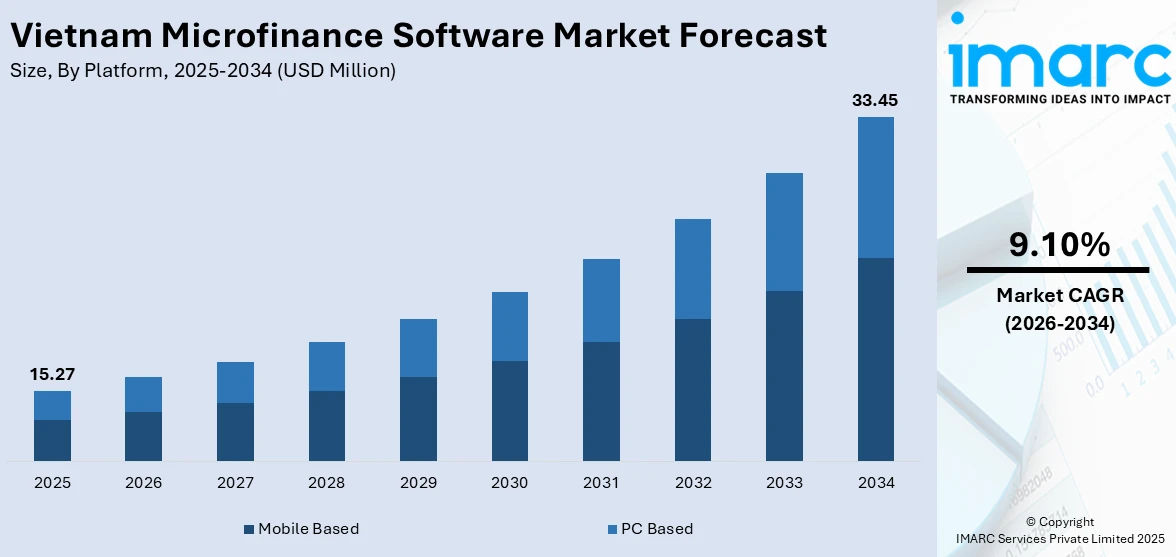
The Vietnam microfinance software market size was valued at USD 15.27 Million in 2025 and is projected to reach USD 33.45 Million by 2034, growing at a compound annual growth rate of 9.10% from 2026-2034.
The market is driven by the increasing demand for digital financial inclusion among underserved populations, rising smartphone penetration across rural communities, and the growing adoption of cloud-based lending platforms by microfinance institutions. Government-led digital transformation initiatives and expanding mobile-first financial ecosystems are further accelerating demand for scalable microfinance solutions. The integration of artificial intelligence (AI) and data analytics into lending workflows is enhancing operational efficiency, supporting the continued expansion of the Vietnam microfinance software market share.
Key Takeaways and Insights:
- By Platform: Mobile based dominates the market with a share of 61.4% in 2025, driven by Vietnam's widespread smartphone adoption and the preference for mobile-first financial access among underserved rural populations.
- By Deployment: Cloud leads the market with a share of 58.7% in 2025, owing to its superior scalability, reduced infrastructure investment requirements, and ability to rapidly deploy compliant software solutions.
- By Operating System: Android represents the largest segment with a market share of 64.9% in 2025, driven by the overwhelming prevalence of affordable Android-based smartphones across Vietnam among lower and middle-income demographics.
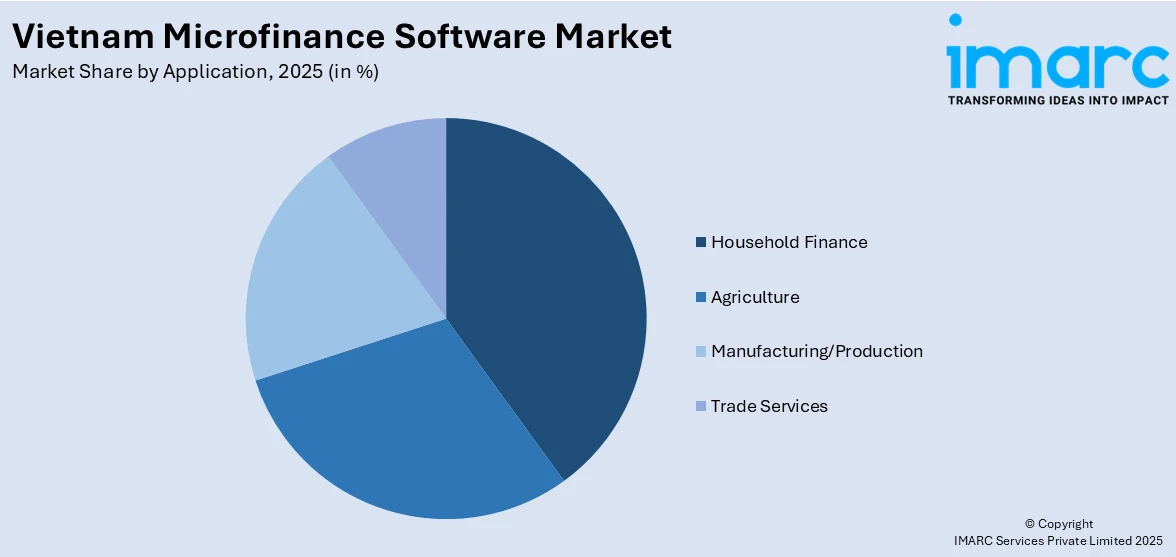
- By Application: Household finance dominates the market with a share of 36.2% in 2025, owing to growing demand for personal budgeting, micro-savings, and affordable micro-lending tools among Vietnamese households.
- By Region: Southern Vietnam leads the market with a share of 48.5% in 2025, driven by concentration of economic activity in Ho Chi Minh City, higher digital infrastructure maturity, and financially active consumers.
- Key Players: The Vietnam microfinance software market features a moderately fragmented landscape, with domestic software developers and international fintech solution providers competing across platform capabilities, deployment models, and application-specific functionalities, fostering continuous innovation.
To get more information on this market Request Sample
The Vietnam microfinance software market is experiencing robust growth, propelled by the country's ambitious digital transformation agenda and the expanding need for inclusive financial services. The Vietnamese government's sustained commitment to financial inclusion, particularly among rural and underbanked populations, has created a favorable environment for the adoption of technology-driven microfinance solutions. According to reports, Vietnam Centre for the Fourth Industrial Revolution partnered with Ant International to drive fintech innovation and build platforms supporting SMEs and digital finance in Ho Chi Minh City. Moreover, rising smartphone penetration and deepening internet connectivity across both urban and rural areas are enabling microfinance institutions to extend their reach through mobile and cloud-based platforms. The growing recognition of data analytics and AI as tools for credit scoring and risk assessment is encouraging institutions to modernize their software infrastructure.
Vietnam Microfinance Software Market Trends:
Integration of Artificial Intelligence and Machine Learning in Credit Assessment
Microfinance institutions across Vietnam are increasingly embedding AI and machine learning (ML) capabilities into their software platforms to enhance credit evaluation and risk management processes. These technologies enable the analysis of alternative data sources, including mobile usage patterns and transaction histories, to assess borrower creditworthiness more accurately. In October 2025, Ho Chi Minh City‑based AI startup iNexus secured $650,000 in funding to develop AI solutions that help financial institutions modernize credit approval and risk management, signaling strong investor confidence in tech‑driven lending innovation in Vietnam’s finance sector. This shift is reducing reliance on traditional collateral-based lending models and expanding access to credit for previously excluded segments.
Expansion of Mobile-First and Super App Financial Ecosystems
Vietnam's rapidly evolving mobile-first financial ecosystem is driving a significant shift in how microfinance software is designed and deployed. As per sources, Zalopay served 16 million users and partnered with over 52,000 merchants nationwide, expanding mobile lending and payment integration across Vietnam. The proliferation of integrated digital platforms is enabling microfinance institutions to embed lending, savings, and repayment functionalities within broader consumer-facing applications. This trend is enhancing user engagement and simplifying the borrower experience by offering financial services within familiar digital environments. The convergence of mobile payments, micro-lending, and household financial management tools within unified platforms is encouraging software providers to develop modular and interoperable solutions.
Adoption of Regulatory Technology for Compliance and Governance
The growing complexity of Vietnam's financial regulatory framework is driving demand for regulatory technology solutions within microfinance software platforms. Institutions are increasingly seeking software that can automate compliance monitoring, reporting, and anti-money laundering processes to meet evolving government standards. As per sources, in 2025, Vietnam’s Government officially implemented Decree 94/2025/ND-CP establishing a regulatory sandbox for fintech solutions, including credit scoring, open APIs and P2P lending, under the State Bank’s oversight to balance innovation and compliance. The implementation of electronic know-your-customer verification and digital identity authentication capabilities is enabling microfinance providers to train clients onboard more efficiently while maintaining rigorous compliance standards.
Market Outlook 2026-2034:
The Vietnam microfinance software market is positioned for sustained revenue growth over the forecast period, driven by the continued expansion of digital financial inclusion initiatives and the deepening adoption of cloud-based and mobile-first lending platforms. Revenue generation is expected to accelerate as microfinance institutions increasingly invest in advanced software solutions incorporating AI, data analytics, and regulatory technology capabilities. Growing smartphone penetration across underserved rural regions is anticipated to expand the addressable market significantly. The market generated a revenue of USD 15.27 Million in 2025 and is projected to reach a revenue of USD 33.45 Million by 2034, growing at a compound annual growth rate of 9.10% from 2026-2034.
Vietnam Microfinance Software Market Report Segmentation:
|
Segment Category |
Leading Segment |
Market Share |
|
Platform |
Mobile Based |
61.4% |
|
Deployment |
Cloud |
58.7% |
|
Operating System |
Android |
64.9% |
|
Application |
Household Finance |
36.2% |
|
Region |
Southern Vietnam |
48.5% |
Platform Insights:
- Mobile Based
- PC Based
Mobile based dominates with a market share of 61.4% of the total Vietnam microfinance software market in 2025.
The mobile based holds the leading position in the Vietnam microfinance software market, reflecting the country's mobile-first digital culture and widespread smartphone adoption. In 2025, Zalopay launched its flexible installment payment and cash loan services on mobile, offering credit limits up to 30 million VND and extending digital lending access to remote users. Moreover, microfinance institutions are prioritizing mobile platform development to reach borrowers in remote and semi-urban areas where traditional banking infrastructure remains limited.
The leading position of mobile platforms is further reinforced by the integration of mobile money services and digital wallet functionalities, which allow microfinance clients to manage their finances within a single application. Software providers are continuously enhancing mobile user interfaces to ensure seamless navigation across varying levels of digital literacy. The expansion of mobile network coverage and the declining cost of smartphones are expected to sustain this segment's leading position throughout the forecast period.
Deployment Insights:
- On-Premise
- Cloud
Cloud leads with a share of 58.7% of the total Vietnam microfinance software market in 2025.
Cloud holds the leading position in the Vietnam microfinance software market, driven by its ability to offer scalable, cost-efficient, and rapidly deployable solutions for institutions of varying sizes. In November 2025, VPBank migrated over 18 million customer accounts and millions of loan records to a fully cloud‑native core banking system using Red Hat OpenShift, enabling faster product delivery and enhanced digital services. Cloud platforms reduce upfront infrastructure costs, enabling small microfinance and fintech lenders in Vietnam to expand and reach unbanked populations.
The leading position of cloud deployment is also supported by the growing availability of local and international cloud service providers, enhanced data security protocols, and increasing acceptance of software-as-a-service models within the financial sector. Cloud platforms facilitate real-time data access, centralized management, and seamless software updates, enabling microfinance institutions to maintain operational agility and regulatory compliance. The Vietnamese government's supportive stance toward cloud adoption within financial services is expected to further strengthen this segment.
Operating System Insights:
- Android
- IOS
- Windows
Android exhibits a clear dominance with a 64.9% share of the total Vietnam microfinance software market in 2025.
Android holds the leading position in the Vietnam microfinance software market, reflecting its overwhelming share of the country's smartphone ecosystem. In November 2025, Xiaomi surpassed Apple to secure second place in Vietnam’s smartphone market with 19% market share, reinforcing the dominance of Android devices among Vietnamese consumers. Moreover, the affordability and wide availability of Android-based devices across all income levels make it the primary platform through which Vietnamese consumers access microfinance services.
Android's open-source architecture provides software developers with greater flexibility in customizing microfinance applications to suit local market requirements, including language localization and integration with domestic payment systems. The operating system's compatibility with a broad range of device specifications ensures that microfinance applications function effectively even on lower-end smartphones prevalent among target user demographics. The continued expansion of Android's device ecosystem in Vietnam is expected to reinforce this segment's leading market position.
Application Insights:
Access the comprehensive market breakdown Request Sample
- Agriculture
- Manufacturing/Production
- Trade Services
- Household Finance
Household finance leads with a market share of 36.2% of the total Vietnam microfinance software market in 2025.
The household finance holds the leading position in the Vietnam microfinance software market, driven by the growing demand among Vietnamese households for digital tools that facilitate personal budgeting, micro-savings, and access to affordable credit. As financial literacy improves and digital payment adoption increases, households are increasingly turning to microfinance platforms to manage daily expenses, plan for future needs, and access small-scale lending products that support economic resilience and upward mobility. The rising awareness of structured financial planning is further reinforcing household-level adoption of microfinance software solutions.
Microfinance software providers are developing specialized household finance modules that offer intuitive budgeting dashboards, automated savings features, and micro-loan management tools tailored to the needs of low and middle-income families. The integration of household finance functionalities within broader mobile financial platforms is enhancing user engagement and encouraging habitual usage among diverse consumer segments. As Vietnam's middle class continues to expand and consumer financial awareness deepens, this segment is expected to maintain its leading position, attracting sustained investment in product innovation and user experience enhancement.
Regional Insights:
- Northern Vietnam
- Central Vietnam
- Southern Vietnam
Southern Vietnam dominates with a market share of 48.5% of the total Vietnam microfinance software market in 2025.
Southern Vietnam holds the leading regional position in the microfinance software market, anchored by the economic dynamism of Ho Chi Minh City and the densely populated Mekong Delta region. The concentration of financial institutions, fintech startups, and technology infrastructure in the southern region creates a fertile environment for the development and deployment of advanced microfinance software solutions. Higher levels of digital adoption and financial activity among southern populations further reinforce this region's leading market position.
The region benefits from a well-established ecosystem of technology parks, innovation hubs, and academic institutions that support talent development and software innovation. The Mekong Delta's large agricultural community also drives demand for microfinance software solutions tailored to smallholder farmers and rural micro-enterprises. Government initiatives aimed at expanding digital financial services across southern provinces are expected to sustain regional growth, while ongoing urbanization continues to generate new opportunities for microfinance software providers.
Market Dynamics:
Growth Drivers:
Why is the Vietnam Microfinance Software Market Growing?
Accelerating Government-Led Financial Inclusion Initiatives
The Vietnamese government has placed financial inclusion at the center of its national development strategy, implementing comprehensive policies and regulatory frameworks designed to extend formal financial services to the country's large unbanked and underbanked population. According to reports, in March 2025, Prime Minister Phạm Minh Chính emphasized delivering financial inclusion through digital platforms at the second National Steering Committee on Financial Inclusion meeting in Hà Nội. Moreover, the national financial inclusion strategy and associated digital transformation programs are creating a supportive environment for microfinance institutions to adopt software solutions enabling efficient service delivery to underserved communities. Regulatory sandbox mechanisms and streamlined licensing processes are encouraging fintech innovators to develop microfinance software platforms tailored to local market conditions and diverse borrower requirements.
Rapid Expansion of Digital Infrastructure and Mobile Connectivity
Vietnam's ongoing investment in digital infrastructure, including the expansion of broadband networks, mobile connectivity, and data center capacity, is creating foundational conditions necessary for widespread microfinance software adoption. As per sources, in 2025, Vietnam achieved mobile broadband coverage of over 99.8% of the population, supporting 119 million subscribers and strengthening access to digital financial services. The increasing availability of affordable smartphones and mobile data plans is enabling millions of previously disconnected individuals to access digital financial services for the first time. Telecommunications operators are extending coverage to rural and remote areas, reducing the digital divide and expanding the addressable market for microfinance software solutions while enabling institutions to deliver services at scale across geographically dispersed operations.
Rising Entrepreneurial Activity Among Micro and Small Enterprises
The rapid growth of micro and small enterprises across Vietnam is generating significant demand for accessible and affordable digital lending solutions provided through microfinance software platforms. As per sources, in June 2025, Vietnamese banks and fintechs leveraged a national data integration initiative, enabling platforms like MISA Lending to disburse digital loans worth 22.5 trillion dong, with unsecured credit access rates 10 times higher than traditional models. Emerging entrepreneurs in sectors such as agriculture, retail trade, and cottage industries require flexible financing options that traditional banking channels often fail to provide. Microfinance software solutions are bridging this gap by enabling institutions to offer tailored loan products, simplified application processes, and expedited disbursement mechanisms that support the working capital and expansion needs of Vietnam's expanding entrepreneurial ecosystem.
Market Restraints:
What Challenges the Vietnam Microfinance Software Market is Facing?
Limited Digital Literacy Among Target Borrower Populations
Despite the rapid expansion of smartphone penetration and mobile connectivity, significant portions of Vietnam's rural and lower-income populations continue to face challenges related to digital literacy and technology adoption. Many potential microfinance borrowers remain unfamiliar with digital platforms and may lack the confidence or skills necessary to navigate mobile-based financial applications effectively, limiting overall software adoption rates.
Data Privacy and Cybersecurity Concerns
The growing volume of sensitive personal and financial data processed through microfinance software platforms raises significant concerns regarding data privacy, cybersecurity, and regulatory compliance. Microfinance institutions operating in Vietnam must navigate an evolving regulatory landscape governing data protection and electronic transactions, which can create uncertainty and increase compliance costs, potentially slowing adoption among risk-averse borrowers and institutions.
High Initial Implementation and Integration Costs
The deployment of comprehensive microfinance software solutions often requires substantial upfront investment in technology infrastructure, system integration, staff training, and ongoing maintenance. For smaller microfinance institutions and community-based lending organizations with constrained budgets, these costs can represent a significant barrier to adoption, while the complexity of integrating new platforms with existing legacy systems further limits transformation.
Competitive Landscape:
The Vietnam microfinance software market is characterized by a moderately fragmented competitive landscape, with participation from both domestic technology developers and international fintech solution providers. Market participants are competing across multiple dimensions, including platform functionality, deployment flexibility, user experience design, and regulatory compliance capabilities. The competitive environment is shaped by the increasing convergence of microfinance software with broader digital financial ecosystems, encouraging providers to develop modular and interoperable solutions that integrate with mobile payment platforms, digital wallets, and banking infrastructure. Strategic partnerships between software developers, microfinance institutions, and telecommunications providers are emerging as a key competitive strategy for expanding market reach.
Recent Developments:
-
In November 2024, VietCredit’s digital lending brand Tin Vay expanded across major Vietnamese fintech platforms including MoMo, Viettel Money, and Zalo, using AI‑driven software to automate loan approvals and broaden access to micro‑lending services for underbanked and low‑income users nationwide.
Vietnam Microfinance Software Market Report Coverage:
|
Report Features |
Details |
|
Base Year of the Analysis |
2025 |
|
Historical Period |
2020-2025 |
|
Forecast Period |
2026-2034 |
|
Units |
Million USD |
|
Scope of the Report |
Exploration of Historical Trends and Market Outlook, Industry Catalysts and Challenges, Segment-Wise Historical and Future Market Assessment:
|
|
Platforms Covered |
Mobile Based, PC Based |
|
Deployments Covered |
On-Premise, Cloud |
|
Operating Systems Covered |
Android, IOS, Windows |
|
Applications Covered |
Agriculture, Manufacturing/Production, Trade Services, Household Finance |
|
Regions Covered |
Northern Vietnam, Central Vietnam, Southern Vietnam |
|
Customization Scope |
10% Free Customization |
|
Post-Sale Analyst Support |
10-12 Weeks |
|
Delivery Format |
PDF and Excel through Email (We can also provide the editable version of the report in PPT/Word format on special request) |
Frequently Asked Questions About the Vietnam Microfinance Software Market Report
The Vietnam microfinance software market size was valued at USD 15.27 Million in 2025.
The Vietnam microfinance software market is expected to grow at a compound annual growth rate of 9.10% from 2026-2034 to reach USD 33.45 Million by 2034.
Mobile based held the largest market share, driven by Vietnam's widespread smartphone penetration, mobile-first digital culture, and the growing demand for accessible and convenient financial services among underserved and rural populations seeking seamless lending and repayment solutions.
Key factors driving the Vietnam microfinance software market include accelerating government-led financial inclusion initiatives, rapid expansion of digital infrastructure and mobile connectivity, and growing demand for data-driven lending and risk management solutions.
Major challenges include limited digital literacy among target borrower populations, data privacy and cybersecurity concerns, high initial implementation and integration costs, evolving regulatory compliance requirements, and the complexity of integrating new platforms with legacy systems.
Need more help?
- Speak to our experienced analysts for insights on the current market scenarios.
- Include additional segments and countries to customize the report as per your requirement.
- Gain an unparalleled competitive advantage in your domain by understanding how to utilize the report and positively impacting your operations and revenue.
- For further assistance, please connect with our analysts.
 Request Customization
 Speak to an Analyst
 Request Brochure
 Inquire Before Buying
Benefits of Customization
- Personalize this research
- Triangulate with your data
- Get data as per your format and definition
- Gain a deeper dive into a specific application, geography, customer, or competitor
- Any level of personalization
Get in Touch With Us
UNITED STATES
Phone: +1-201-971-6302
INDIA
Phone: +91-120-433-0800
UNITED KINGDOM
Phone: +44-753-714-6104
Email: [email protected]
Client Testimonials




.webp)




.webp)













Related Reports

Choose your plan
*Please note that the prices mentioned below are starting prices for each bundle type. Kindly contact our team for further details.*
Single User License
- 1 User License, Access on 2 Devices
- PDF Report + Excel Dataset (Password Protected)
- Lifetime Access
- No Printing Rights
- 10% Free Report Customization
- 10–12 Weeks of Analyst Support
Five User License
- Access for 5 Users, 2 Devices per User
- PDF Report + Excel Dataset (Password Protected)
- Lifetime Access
- Dedicated Account Manager
- 12–14 Weeks of Analyst Support
- No Printing Rights
- 15% Free Report Customization
- 25% Discount on Your Next Purchase
Corporate User License
- Unlimited User Access (Within Your Organization)
- PDF Report + Excel Dataset
- Lifetime Access
- Dedicated Account Manager
- 14–20 Weeks of Analyst Support
- No Printing Rights
- 20% Free Report Customization
- 30% Discount on Your Next Purchase
Essential Insights
What's included:
3 reports
- Lifetime Access
- PDF Reports
- Excel Datasets
- 2 Weeks of Free Analyst Support
- 2 User Licenses
- Access on 2 Devices
- Printing Rights
- Complimentary PowerPoint (PPT) Version
- Complimentary License Upgrade
Professional Access
What's included:
5 reports
- Lifetime Access
- PDF Reports
- Excel Datasets
- 8 Weeks of Free Analyst Support
- 2 User Licenses
- Access on 2 Devices
- Printing Rights
- Complimentary PowerPoint (PPT) Version
- Complimentary License Upgrade
Business Advantage
What's included:
8 reports
- Lifetime Access
- PDF Reports
- Excel Datasets
- 14 Weeks of Free Analyst Support
- 2 User Licenses
- Access on 2 Devices
- Printing Rights
- Complimentary PowerPoint (PPT) Version
- Complimentary License Upgrade
Enterprise Intelligence
What's included:
10 reports
- Lifetime Access
- PDF Reports
- Excel Datasets
- 20 Weeks of Free Analyst Support
- 2 User Licenses
- Access on 2 Devices
- Printing Rights
- Complimentary PowerPoint (PPT) Version
- Complimentary License Upgrade