
Vietnam Mining Automation Market Size, Share, Trends and Forecast by Solution, Technique, Application, and Region, 2026-2034
Vietnam Mining Automation Market Summary:
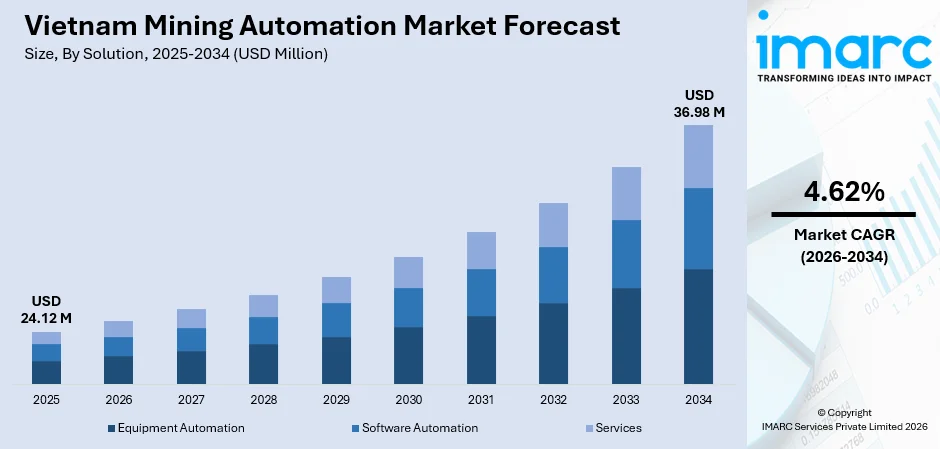
The Vietnam mining automation market size was valued at USD 24.12 Million in 2025 and is projected to reach USD 36.98 Million by 2034, growing at a compound annual growth rate of 4.62% from 2026-2034.
The Vietnam mining automation market is gaining momentum as the country's mining sector embraces digital transformation, advanced equipment technologies, and integrated software solutions to enhance operational efficiency and safety. Expanding coal and bauxite extraction activities, supportive government regulatory reforms, and growing emphasis on sustainable mining practices are collectively strengthening demand for automation across surface and underground mining operations. Strategic international partnerships and rising foreign direct investment in the mineral sector further contribute to accelerating the Vietnam mining automation market share.
Key Takeaways and Insights:
- By Solution: Equipment automation dominates the market with a share of 42.3% in 2025, owing to the increasing deployment of autonomous trucks, remote control equipment, and teleoperated mining machinery that enhance productivity and reduce human exposure to hazardous mining environments.
- By Technique: Surface mining automation leads the market with a share of 59.1% in 2025, driven by the prevalence of large-scale open-pit coal and bauxite mining operations across northern and central highland regions that benefit significantly from automated hauling, drilling, and loading systems.
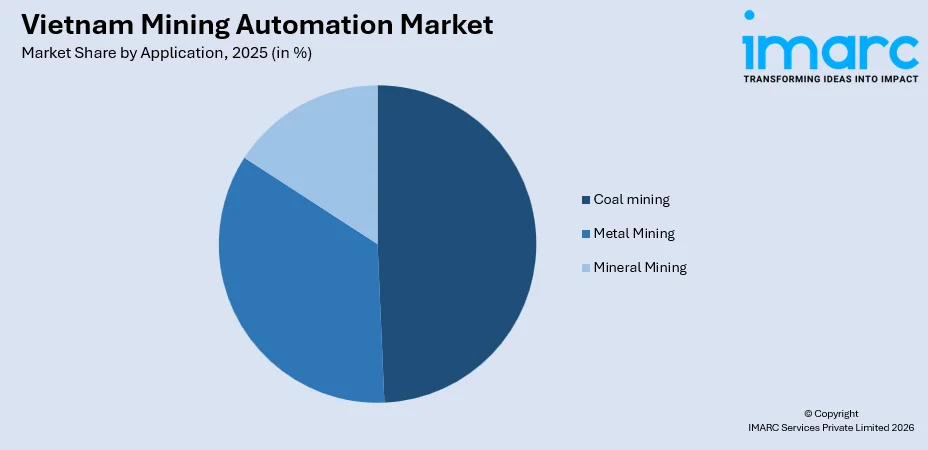
- By Application: Coal mining represents the largest segment with a market share of 46.7% in 2025, reflecting coal's dominant role in Vietnam's energy mix and the pressing need for automation to improve extraction efficiency, operational safety, and environmental compliance across the country's extensive coal mining operations.
- By Region: Northern Vietnam comprises the largest region with 39.4% share in 2025, driven by the concentration of major coal mining operations in Quang Ninh province and the presence of key mineral extraction and processing facilities in the broader northern provinces.
- Key Players: The market is emerging and moderately competitive, with global technology providers, equipment manufacturers, and local system integrators competing for contracts. Competition centers on cost efficiency, safety enhancement, and productivity gains. Partnerships with state-owned mining firms and customized solutions for coal and mineral operations are key differentiators.
To get more information on this market Request Sample
The Vietnam mining automation market is supported by the country's vast mineral resource base and an evolving regulatory landscape that encourages technological modernization. Vietnam possesses over 5,000 mines containing 60 different types of minerals, including coal, bauxite, iron ore, rare earths, and titanium, creating extensive demand for automation across diverse extraction and processing operations. In January 2025, Vinacomin, the country's largest mining conglomerate, announced plans to sell 50 million tonnes of coal and generate 172.8 Trillion VND (USD 6.78 Billion) in revenue for 2025 while advancing digital transformation and database connectivity across all operational fields. The enactment of the government initiatives, further strengthened the regulatory framework by mandating modern technology usage, promoting sustainable extraction, and encouraging foreign participation through joint ventures, creating a conducive environment for broader automation adoption.
Vietnam Mining Automation Market Trends:
Integration of artificial intelligence and IoT in mining operations
Vietnam's mining industry is implementing artificial intelligence and Internet of Things sensors and real-time data analytics to improve its extraction operations and equipment monitoring and predictive maintenance systems. The technologies enable mining operators to achieve two objectives which include decreasing unexpected equipment downtime and enhancing their ability to use resources. Vietnam's mining industry showed increased adoption of automation technologies and artificial intelligence and Internet of Things systems which improved operational performance and drove market expansion for mining automation solutions in both surface and underground mining operations.
Advancement of sustainable and green mining practices
Environmental sustainability is becoming a central focus for Vietnam's mining industry as stricter regulatory requirements compel operators to adopt cleaner technologies and minimize ecological impact. Mining companies are investing in energy-efficient automated equipment, emission reduction systems, and waste management solutions. For instance, in January 2026, TKV invested VND 11.77 Trillion in 2025, exceeding plans and launching 12 key projects, mainly in coal mining and processing. For 2026, it plans over VND 12.2 Trillion, prioritizing sustainable development, stricter investment discipline, and efficient coal operations.
Expansion of strategic mineral exploration and deep processing
Vietnam is actively expanding its mineral exploration activities and investing in deep processing capabilities to capture greater value from its abundant natural resources. This expansion requires advanced automated systems for exploration, extraction, and processing operations. In October 2025, Duc Giang Chemicals Group signed a memorandum of understanding to invest approximately VND 58,000 Billion (USD 2.2 Billion) in an integrated bauxite-alumina-aluminum complex in Lam Dong province, with an implementation timeline from 2025 to 2030.
Market Outlook 2026-2034:
The Vietnam mining automation market is poised for consistent expansion throughout the forecast period, driven by growing mineral extraction activities, regulatory modernization, and technological advancement across the sector. In parallel, the enactment of the 2024 Law on Geology and Minerals is creating a more transparent and investment-friendly regulatory environment, while major mining investments in coal, bauxite, and rare earth sectors are expanding the operational base for automation solutions. For example, in 2025, Vietnam National Coal and Mineral Industries Group (TKV) proposed an investment of VND 30,000 Billion (USD 1.13 Billion) to develop a second alumina plant in Nhan Co, designed with an annual capacity of 2 million tons. Rising emphasis on worker safety, digital transformation initiatives by state-owned enterprises, and international technology partnerships are expected to sustain demand for automated equipment, advanced software systems, and specialized consulting services throughout the forecast period. The market generated a revenue of USD 24.12 Million in 2025 and is projected to reach a revenue of USD 36.98 Million by 2034, growing at a compound annual growth rate of 4.62% from 2026-2034.
Vietnam Mining Automation Market Report Segmentation:
|
Segment Category |
Leading Segment |
Market Share |
|
Solution |
Equipment Automation |
42.3% |
|
Technique |
Surface Mining Automation |
59.1% |
|
Application |
Coal Mining |
46.7% |
|
Region |
Northern Vietnam |
39.4% |
Solution Insights:
- Software Automation
- Services
- Implementation and Maintenance
- Training
- Consulting
- Equipment Automation
- Autonomous Trucks
- Remote Control Equipment
- Teleoperated Mining Equipment
Equipment automation dominates with a market share of 42.3% of the total Vietnam mining automation market in 2025.
The equipment automation segment leads Vietnam's mining automation market as mining operators increasingly invest in autonomous trucks, remote control machinery, and teleoperated systems to enhance extraction efficiency and minimize worker exposure to hazardous underground and open-pit environments. The deployment of automated hauling, drilling, and loading equipment across large-scale coal and bauxite mining operations is accelerating, driven by the need to improve productivity while addressing labor shortages and safety concerns. As of end-2024, approximately 690 autonomous trucks utilizing Caterpillar's Command for hauling solution were operating globally, with the company targeting over 2,000 units by 2030, reflecting the rapid worldwide adoption trajectory.
Vietnam's mining equipment market is responding to these global automation trends as domestic operators seek to modernize aging fleets and integrate digital control systems. The state-approved investment of USD 8 Billion into bauxite development in Dak Nong and Lam Dong provinces has accelerated procurement cycles for large excavators, 90-tonne haul trucks, and high-throughput crushers needed for open-pit operations. Automated drilling rigs and remote-controlled loaders are increasingly deployed to ensure precision, reduce operational risks, and support Vietnam's transition toward safer, more efficient mining practices.
Technique Insights:
- Underground Mining Automation
- Surface Mining Automation
Surface mining automation leads with a share of 59.1% of the total Vietnam mining automation market in 2025.
Surface mining automation holds the dominant position in Vietnam's mining automation landscape, reflecting the country's reliance on large-scale open-pit coal extraction in Quang Ninh province and expansive bauxite strip mining operations across the Central Highlands. Automated hauling systems, GPS-guided drilling rigs, and remote-operated excavators are increasingly deployed across these sites to optimize material movement, reduce cycle times, and enhance safety.
The growing scale of surface mining operations in Vietnam necessitates comprehensive automation solutions that integrate fleet management software, real-time monitoring systems, and autonomous vehicle technologies. Large-scale investment projects requiring significant earth-moving capacity are creating demand for automated haul truck systems and intelligent dispatch solutions. Vietnam's coal is majorly extracted through surface mining methods in northern provinces, underscoring the significant operational base that drives continued investment in surface mining automation technologies.
Application Insights:
Access the comprehensive market breakdown Request Sample
- Metal Mining
- Mineral Mining
- Coal Mining
Coal mining is the largest segment, accounting for 46.7% of the total Vietnam mining automation market in 2025.
Coal mining represents the foundational application segment for mining automation in Vietnam, as coal remains the country's most extensively extracted mineral resource and a critical component of the national energy mix. The imperative to improve extraction efficiency, ensure worker safety in increasingly deeper operations, and comply with environmental regulations is driving adoption of automated drilling, hauling, and monitoring systems across coal mines. In January 2025, Vinacomin announced targets to produce over 38 million tonnes of raw coal and sell 50 million tonnes in 2025, while implementing plans to advance digital transformation and streamline operations across its member companies.
Vietnam's coal mining sector is concentrated in Quang Ninh province, where both surface and underground operations coexist, creating diverse requirements for automation solutions ranging from autonomous trucks for open-pit operations to remote-controlled equipment for deep-shaft mining. The government's National Power Development Plan continues to position coal-fired power as a major electricity contributor through 2030, sustaining operational volumes that drive automation demand. Coal accounted for 57.2% of Vietnam's electricity supply in the first four months of 2025, reinforcing the sector's scale and strategic importance that underpins investment in automated mining technologies.
Regional Insights:
- Northern Vietnam
- Central Vietnam
- Southern Vietnam
Northern Vietnam comprises the largest region with a 39.4% share of the total Vietnam mining automation market in 2025.
Northern Vietnam leads the mining automation market, anchored by the concentration of major coal mining operations in Quang Ninh province, which houses the country's most extensive anthracite coal deposits and the operational headquarters of Vinacomin. The region's established mining infrastructure, dense network of surface and underground coal mines, and proximity to key transportation corridors create strong demand for equipment automation, fleet management software, and operational consulting services. Over the past eight years, the Vietnamese government has discovered 110 new mineral deposits in the northwest of Vietnam through the comprehensive Northwest Project geological survey, further expanding the mineral extraction base that drives automation adoption across northern provinces.
Market Dynamics:
Growth Drivers:
Why is the Vietnam Mining Automation Market Growing?
Rising demand for operational safety and efficiency in mining
Vietnam's mining sector is experiencing growing pressure to enhance worker safety and operational efficiency, particularly as coal mining operations extend to deeper underground levels and surface mining activities expand across remote regions. Automation technologies, including remote-controlled equipment, collision avoidance systems, and real-time monitoring platforms, significantly reduce human exposure to hazardous conditions while improving extraction precision and throughput. Vinacomin's coal output for electricity production reached 39.8 million tonnes in 2023, the highest level ever recorded, demonstrating the operational scale that necessitates automated safety solutions. The increasing complexity of mining operations, combined with labor shortages in technically demanding roles, is compelling operators to invest in autonomous equipment and digital management systems.
Government regulatory reforms promoting technology adoption
Vietnam's regulatory landscape is undergoing significant transformation with the enactment of the 2024 Law on Geology and Minerals, which took effect on July 1, 2025. This landmark legislation mandates the use of modern technology and equipment for mineral exploration and extraction, promotes sustainable practices, and encourages foreign participation through joint ventures and inter-governmental agreements. These regulatory reforms create a favorable environment for automation adoption by establishing clear standards for operational technology usage while providing incentives for investment in advanced mining equipment and digital solutions. High-tech mineral processing ventures, particularly those linked to battery materials and advanced refining, enjoy a 10% corporate tax rate for up to 15 years, encouraging operators to invest in automated processing systems.
Expanding mineral extraction activities and strategic investments
Vietnam's mining sector is witnessing substantial investment in expanding mineral extraction capabilities, particularly in coal, bauxite, and rare earth minerals, each requiring increasingly sophisticated automation solutions. These large-scale projects generate significant demand for automated hauling, drilling, processing, and monitoring systems. For example, in 2025, Duc Giang Chemicals signed an MoU to study a USD 2.2 Billion bauxite–alumina–aluminum complex in Lam Dong, targeting 2 million tons of alumina and 500,000 tons of aluminum annually by 2030, with funding from internal resources and bank loans. The scale and complexity of these investments necessitate comprehensive automation integration from initial mine development through ongoing extraction and processing operations. International technology partnerships with Japan, South Korea, and Australia are facilitating knowledge transfer and equipment procurement, further accelerating automation deployment across Vietnam's expanding mining operations.
Market Restraints:
What Challenges the Vietnam Mining Automation Market is Facing?
Shortage of skilled automation workforce and technical expertise
Vietnam's mining sector faces a significant shortage of skilled labor and technical expertise in operating and maintaining advanced automation systems, including autonomous vehicles, AI-powered analytics platforms, and remote-control equipment. The limited availability of professionals trained in chemical metallurgy, digital mining technologies, and equipment programming constrains the pace of automation adoption and increases operational dependence on foreign technology partnerships.
Infrastructure limitations in remote mining regions
Many of Vietnam's mining operations are located in geographically challenging and remote areas where power grid capacity, digital connectivity, and transportation infrastructure remain underdeveloped. Industrial electricity prices, and energy costs can represent substantial share of total expenses for aluminum and tungsten production. These infrastructure gaps limit the deployment of power-intensive automated equipment and constrain the real-time data transmission capabilities essential for advanced automation systems.
High capital investment requirements and cost sensitivity
The implementation of comprehensive mining automation solutions requires substantial upfront capital investment in specialized equipment, software systems, integration services, and ongoing maintenance. Many Vietnamese mining enterprises, particularly smaller private operators, face financial constraints that limit their ability to procure and deploy advanced automation technologies. The complexity of downstream processing systems and long payback periods deter smaller firms from making full-scale automation investments.
Competitive Landscape:
The Vietnam mining automation market features a competitive landscape shaped by the presence of global automation technology providers and equipment manufacturers serving the country's expanding mining sector. International companies bring advanced autonomous vehicle systems, integrated software platforms, and consulting expertise, while domestic operators increasingly collaborate through joint ventures and technology partnerships. Competition centers on delivering tailored solutions that address Vietnam's specific operational requirements, including tropical climate conditions, diverse mineral types, and varying mine geometries. Strategic alliances with state-owned enterprises like Vinacomin and partnerships with international mining technology providers are key competitive strategies shaping market positioning and market share distribution.
Recent Developments:
- In February 2026, Hon Gai Coal Sorting Company accelerated key investments to modernize coal processing and transport. Its 8.9 km conveyor system linking mines to Lang Khanh Port is nearing completion and will operate by June 2026. In 2025, it invested nearly VND 400 Billion, achieving 10.6 million tons coal consumption and strong revenue growth.
- In February 2026, Vietnam invested USD 2.3 Billion to expand Lam Dong alumina plants, adding 2.4 million tonnes annual capacity by 2030. Supported by 5.8 billion tonnes of bauxite reserves, the projects will incorporate modern automation, process control, and energy-efficient systems to optimize recovery and environmental compliance, strengthening vertical integration and export competitiveness.
Vietnam Mining Automation Market Report Coverage:
|
Report Features |
Details |
|
Base Year of the Analysis |
2025 |
|
Historical Period |
2020-2025 |
|
Forecast Period |
2026-2034 |
|
Units |
Million USD |
|
Scope of the Report |
Exploration of Historical Trends and Market Outlook, Industry Catalysts and Challenges, Segment-Wise Historical and Future Market Assessment:
|
|
Solutions Covered |
|
|
Techniques Covered |
Underground Mining Automation, Surface Mining Automation |
|
Applications Covered |
Metal Mining, Mineral Mining, Coal Mining |
|
Regions Covered |
Northern Vietnam, Central Vietnam, Southern Vietnam |
|
Customization Scope |
10% Free Customization |
|
Post-Sale Analyst Support |
10-12 Weeks |
|
Delivery Format |
PDF and Excel through Email (We can also provide the editable version of the report in PPT/Word format on special request) |
Frequently Asked Questions About the Vietnam Mining Automation Market Report
The Vietnam mining automation market size was valued at USD 24.12 Million in 2025.
The Vietnam mining automation market is expected to grow at a compound annual growth rate of 4.62% from 2026-2034 to reach USD 36.98 Million by 2034.
Equipment automation dominated the market with a share of 42.3%, driven by increasing deployment of autonomous trucks, remote control equipment, and teleoperated mining systems to improve productivity and safety across mining operations.
Key factors driving the Vietnam mining automation market include rising demand for operational safety and efficiency, government regulatory reforms promoting technology adoption, and expanding mineral extraction investments in coal, bauxite, and rare earth sectors.
Major challenges include shortage of skilled automation workforce and technical expertise, infrastructure limitations in remote mining regions including power grid constraints, high capital investment requirements, and cost sensitivity among smaller mining operators.
Need more help?
- Speak to our experienced analysts for insights on the current market scenarios.
- Include additional segments and countries to customize the report as per your requirement.
- Gain an unparalleled competitive advantage in your domain by understanding how to utilize the report and positively impacting your operations and revenue.
- For further assistance, please connect with our analysts.
 Request Customization
 Speak to an Analyst
 Request Brochure
 Inquire Before Buying
Benefits of Customization
- Personalize this research
- Triangulate with your data
- Get data as per your format and definition
- Gain a deeper dive into a specific application, geography, customer, or competitor
- Any level of personalization
Get in Touch With Us
UNITED STATES
Phone: +1-201-971-6302
INDIA
Phone: +91-120-433-0800
UNITED KINGDOM
Phone: +44-753-714-6104
Email: [email protected]
Client Testimonials




.webp)




.webp)













Related Reports

Choose your plan
*Please note that the prices mentioned below are starting prices for each bundle type. Kindly contact our team for further details.*
Single User License
- 1 User License, Access on 2 Devices
- PDF Report + Excel Dataset (Password Protected)
- Lifetime Access
- No Printing Rights
- 10% Free Report Customization
- 10–12 Weeks of Analyst Support
Five User License
- Access for 5 Users, 2 Devices per User
- PDF Report + Excel Dataset (Password Protected)
- Lifetime Access
- Dedicated Account Manager
- 12–14 Weeks of Analyst Support
- No Printing Rights
- 15% Free Report Customization
- 25% Discount on Your Next Purchase
Corporate User License
- Unlimited User Access (Within Your Organization)
- PDF Report + Excel Dataset
- Lifetime Access
- Dedicated Account Manager
- 14–20 Weeks of Analyst Support
- No Printing Rights
- 20% Free Report Customization
- 30% Discount on Your Next Purchase
Essential Insights
What's included:
3 reports
- Lifetime Access
- PDF Reports
- Excel Datasets
- 2 Weeks of Free Analyst Support
- 2 User Licenses
- Access on 2 Devices
- Printing Rights
- Complimentary PowerPoint (PPT) Version
- Complimentary License Upgrade
Professional Access
What's included:
5 reports
- Lifetime Access
- PDF Reports
- Excel Datasets
- 8 Weeks of Free Analyst Support
- 2 User Licenses
- Access on 2 Devices
- Printing Rights
- Complimentary PowerPoint (PPT) Version
- Complimentary License Upgrade
Business Advantage
What's included:
8 reports
- Lifetime Access
- PDF Reports
- Excel Datasets
- 14 Weeks of Free Analyst Support
- 2 User Licenses
- Access on 2 Devices
- Printing Rights
- Complimentary PowerPoint (PPT) Version
- Complimentary License Upgrade
Enterprise Intelligence
What's included:
10 reports
- Lifetime Access
- PDF Reports
- Excel Datasets
- 20 Weeks of Free Analyst Support
- 2 User Licenses
- Access on 2 Devices
- Printing Rights
- Complimentary PowerPoint (PPT) Version
- Complimentary License Upgrade