
Vietnam Software Defined Networking Market Size, Share, Trends and Forecast by Component, Organization Size, Application, End-Use Industry, and Region, 2026-2034
Vietnam Software Defined Networking Market Summary:
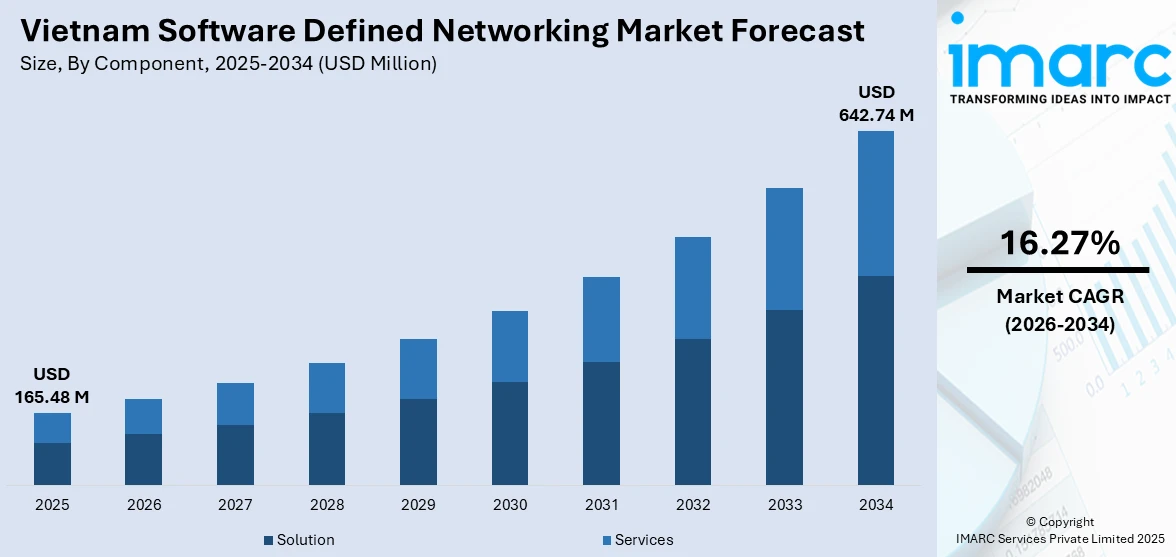
The Vietnam software defined networking market size was valued at USD 165.48 Million in 2025 and is projected to reach USD 642.74 Million by 2034, growing at a compound annual growth rate of 16.27% from 2026-2034.
The Vietnam software defined networking market is experiencing robust expansion, driven by accelerating digital transformation initiatives across enterprises and the government sector. The proliferation of cloud computing services, increasing adoption of virtualized network infrastructure, and growing demand for agile network management solutions are propelling market growth. Rising investments in telecommunications modernization and data center development further support the expanding market share.
Key Takeaways and Insights:
- By Component: Solution dominates the market with a share of 68.9% in 2025, owing to comprehensive integration capabilities that combine software defined networking (SDN) controllers, physical network infrastructure, and automation platforms. Growing enterprise demand for centralized network management is fueling market expansion.
- By Organization Size: Large enterprises lead the market with a share of 63.7% in 2025. This dominance is driven by substantial information technology (IT) infrastructure investments, complex network requirements, and advanced digital transformation capabilities that enable comprehensive SDN deployment.
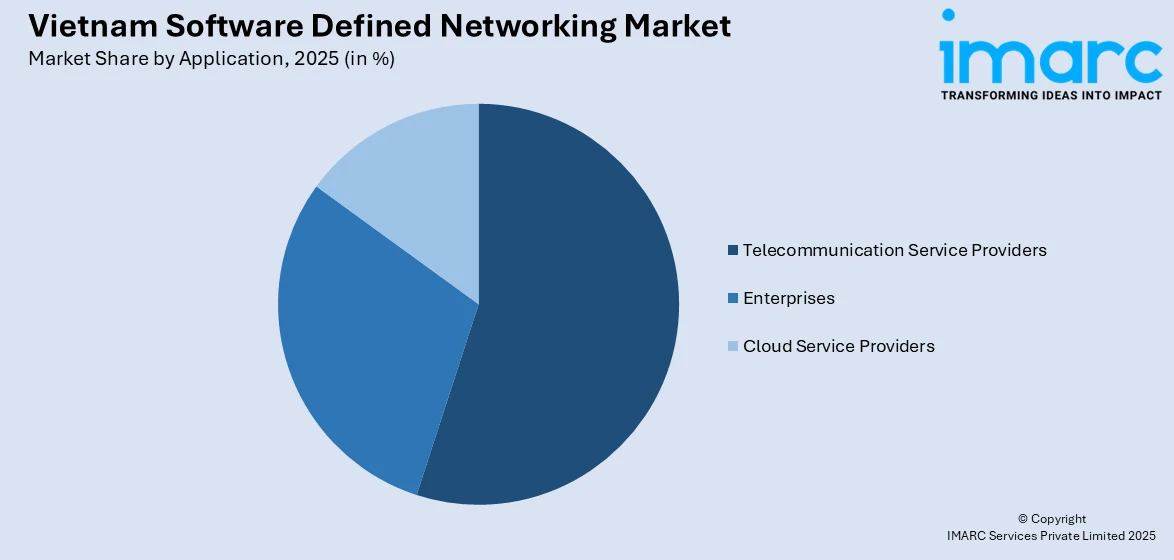
- By Application: Telecommunication service providers comprise the largest segment with a market share of 46.8% in 2025, reflecting critical requirements for network slicing, dynamic traffic management, and scalable infrastructure to support nationwide connectivity services.
- By End-Use Industry: IT and telecom exhibit a clear dominance with 40.8% share in 2025, driven by intensive data center operations, cloud service deployments, and telecommunications infrastructure modernization requirements across Vietnam.
- By Region: Southern Vietnam represents the largest region with 48.7% share in 2025, driven by the concentration of technology enterprises and data centers in Ho Chi Minh City metropolitan area, higher foreign direct investments (FDIs), and advanced digital infrastructure development.
- Key Players: Key players drive the Vietnam software defined networking market by expanding solution portfolios, developing advanced network virtualization technologies, and strengthening strategic partnerships with local telecommunications operators. Their investments in research and development (R&D), localized manufacturing, and technical support infrastructure boost awareness, accelerate adoption, and ensure consistent product availability across enterprise segments.
To get more information on this market Request Sample
The Vietnam software defined networking market is propelled by the government's ambitious digital transformation agenda and substantial telecommunications infrastructure investments. Enterprises across various sectors are increasingly adopting SDN solutions to achieve greater network flexibility, reduce operational costs, and support cloud-first strategies. The telecommunications sector represents a primary growth catalyst as major operators modernize their infrastructure to deliver next-generation services. In June 2024, Cisco launched its Country Digital Acceleration program in Vietnam, collaborating with public and private enterprises to advance digitization across national infrastructure, enterprise transformation, and public sector modernization. The expanding data center ecosystem in Ho Chi Minh City and Hanoi creates sustained demand for SDN capabilities that enable efficient resource allocation, automated provisioning, and enhanced security management. Additionally, increasing cybersecurity requirements and regulatory compliance mandates are driving organizations towards centralized network control architectures that SDN solutions provide.
Vietnam Software Defined Networking Market Trends:
Accelerated 5G Network Deployment Driving SDN Adoption
The rapid commercialization of fifth-generation mobile networks across Vietnam is creating substantial demand for SDN solutions that enable efficient network slicing and dynamic resource management. In 2024, Vietnam possessed merely 184 functioning 5G base stations across the country. By January 2026, that figure surged to more than 35,000, nearly a 200-fold rise, indicating a swift enhancement in the nation's digital infrastructure. Telecommunications operators are implementing SDN architectures to support diverse service requirements, ranging from enhanced mobile broadband to ultra-reliable low-latency communications. The technology enables operators to create virtualized network segments tailored to specific applications, including smart manufacturing, connected healthcare, and autonomous transportation systems, driving unprecedented flexibility in service delivery.
Integration of Network Function Virtualization with SDN Platforms
Organizations across Vietnam are increasingly combining network function virtualization with SDN to achieve comprehensive infrastructure modernization. This convergence allows enterprises to decouple network functions from proprietary hardware, enabling deployment as software instances on standard servers. The approach significantly reduces capital expenditure while improving operational agility through automated service provisioning. Vietnamese enterprises are leveraging combined SDN-network functions virtualization (NFV) architectures to support hybrid cloud strategies, remote workforce connectivity, and edge computing deployments that require flexible bandwidth allocation.
Emergence of Artificial Intelligence (AI)-Powered Network Management Solutions
The integration of AI and machine learning (ML) capabilities into SDN platforms is transforming network operations across Vietnam. As per IMARC Group, the Vietnam AI market size reached USD 752.5 Million in 2024. These intelligent systems enable predictive analytics for capacity planning, automated threat detection and response, and self-healing network configurations that minimize service disruptions. Vietnamese telecommunications operators and large enterprises are adopting AI-enhanced SDN solutions to optimize traffic routing, reduce operational overhead, and improve overall network performance while addressing the growing complexity of multi-cloud and hybrid infrastructure environments.
Market Outlook 2026-2034:
The Vietnam software defined networking market demonstrates promising growth prospects throughout the forecast period, supported by accelerating digital transformation initiatives and substantial infrastructure investments. Government policies promoting broadband expansion, data localization requirements, and technology sector development create favorable conditions for SDN adoption across enterprise and telecommunications segments. The market generated a revenue of USD 165.48 Million in 2025 and is projected to reach a revenue of USD 642.74 Million by 2034, growing at a compound annual growth rate of 16.27% from 2026-2034. The expansion of hyperscale data centers, increasing cloud service adoption, and modernization of telecommunications infrastructure will drive sustained demand for SDN solutions that enable centralized management and automated operations.
Vietnam Software Defined Networking Market Report Segmentation:
|
Segment Category |
Leading Segment |
Market Share |
|
Component |
Solution |
68.9% |
|
Organization Size |
Large Enterprises |
63.7% |
|
Application |
Telecommunication Service Providers |
46.8% |
|
End-Use Industry |
IT and Telecom |
40.8% |
|
Region |
Southern Vietnam |
48.7% |
Component Insights:
- Solution
- Physical Network Infrastructure
- SDN Controller
- SDN Application
- Others
- Services
- Integration and Deployment
- Training and Consulting
- Support and Maintenance
Solution dominates with a market share of 68.9% of the total Vietnam software defined networking market in 2025.
Solution encompasses comprehensive SDN packages that include SDN controllers, physical network infrastructure components, and integrated management platforms enabling centralized network orchestration. Vietnamese enterprises prefer solution-based deployments as they provide complete functionality for network abstraction, programmability, and automation under unified management consoles. Organizations benefit from streamlined procurement, simplified vendor management, and cohesive support structures that solution packages provide compared to piecemeal component acquisitions. These bundled offerings also reduce integration risks and deployment timelines, enabling faster realization of operational efficiencies and network agility.
The growth of the segment in Vietnam is accelerated by increasing complexity of enterprise network environments and demand for automated operations. Large telecommunications operators and data center providers require sophisticated SDN solutions capable of managing multi-tenant environments, supporting network slicing for differentiated services, and enabling rapid service provisioning. Government-led digital transformation initiatives are further encouraging adoption of advanced networking architectures. Additionally, rising cloud adoption is increasing the need for scalable, software-driven network control.
Organization Size Insights:
- Small and Medium Enterprises
- Large Enterprises
Large enterprises lead with a share of 63.7% of the total Vietnam software defined networking market in 2025.
Large enterprises represent the dominant adopters of SDN in Vietnam due to substantial IT infrastructure investments, complex network requirements spanning multiple locations, and dedicated technical teams capable of managing sophisticated deployments. These organizations operate extensive data center facilities, support large employee bases with diverse connectivity needs, and require advanced security controls that SDN architectures provide. In August 2025, the Ministry of Public Security inaugurated National Data Center No.1 in Vietnam, officially unveiling its main data infrastructure.
The digital transformation priorities of large Vietnamese enterprises drive continued SDN investments as organizations modernize legacy network infrastructure to support cloud migration initiatives, remote workforce connectivity, and advanced application deployments. Major corporations across the banking, telecommunications, and manufacturing sectors leverage SDN to achieve operational efficiency improvements, reduce network provisioning time, and enhance security posture through centralized policy management. These factors collectively reinforce large enterprises’ ability to justify higher upfront deployment costs in exchange for long-term scalability, flexibility, and performance gains.
Application Insights:
Access the comprehensive market breakdown Request Sample
- Enterprises
- Telecommunication Service Providers
- Cloud Service Providers
Telecommunication service providers exhibit a clear dominance with a 46.8% share of the total Vietnam software defined networking market in 2025.
Telecommunication service providers constitute the primary adopters of SDN in Vietnam, driven by critical requirements for network slicing capabilities, dynamic bandwidth allocation, and efficient management of nationwide connectivity infrastructure. Major operators are implementing SDN architectures to support fifth-generation mobile network deployments and deliver differentiated services to enterprise customers. Vietnam targets 5G coverage for 99% of its population by 2030, aiming for an average speed of 100 Mbps by 2025.
The telecommunications sector's SDN adoption is accelerated by government initiatives promoting broadband expansion and digital infrastructure development. SDN enables operators to rapidly provision services, optimize network resource utilization, and reduce operational expenditure through automation. The technology supports critical applications, including mobile virtual network operator enablement, enterprise connectivity services, and content delivery optimization. Additionally, SDN improves service reliability and fault management by enabling real-time network monitoring and centralized control. This flexibility allows telecom service providers to respond faster to traffic surges, enterprise demands, and evolving service-level requirements.
End-Use Industry Insights:
- BFSI
- IT and Telecom
- Consumer Goods
- Government and Defense
- Healthcare
- Others
IT and telecom comprise the leading segment with a 40.8% share of the total Vietnam software defined networking market in 2025.
IT and telecom demonstrate the highest adoption rates for SDN in Vietnam, driven by intensive data center operations, cloud service infrastructure requirements, and network management complexity inherent to connectivity service provision. As per IMARC Group, the Vietnam telecom market size was valued at USD 6.6 Billion in 2025. Organizations in this sector manage extensive infrastructure supporting millions of subscribers, enterprise clients, and cloud tenants requiring reliable, scalable network architectures.
The sector's SDN adoption is reinforced by technology refresh cycles and competitive pressure to deliver innovative services. Major telecom operators and technology companies leverage SDN to optimize network operations, reduce time-to-market for new services, and improve customer experience through enhanced connectivity reliability. The growing shift towards virtualization and software defined data centers further strengthens SDN relevance within the sector. Increasing reliance on hybrid and multi-cloud environments also necessitates flexible and centrally managed network control.
Regional Insights:
- Northern Vietnam
- Central Vietnam
- Southern Vietnam
Southern Vietnam represents the leading segment with a 48.7% share of the total Vietnam software defined networking market in 2025.
Southern Vietnam commands the largest regional share of the market, anchored by Ho Chi Minh City's position as the country's primary technology and commercial hub. The region hosts the highest concentration of data centers, multinational enterprise operations, and technology service providers requiring advanced networking infrastructure. In March 2025, Saigon Asset Management (SAM), located in Ho Chi Minh City, initiated a USD 1.5 Billion project for a data center in Binh Duong province, seeking to leverage Vietnam’s increasing need for digital infrastructure. The data center, featuring a planned capacity of 150 MW, will span 50 hectares at the VSIP and is anticipated to start operations in two years.
The region benefits from substantial FDI in technology infrastructure, established connectivity with international submarine cable systems, and a robust ecosystem of technology enterprises driving SDN adoption. The region's economic dynamism and technology sector growth sustain strong demand for SDN solutions. Rapid urbanization and smart city initiatives across Southern Vietnam are further accelerating demand for scalable, software-driven network architectures. Additionally, the presence of skilled IT talent and system integrators supports faster SDN deployment and operational optimization across enterprises.
Market Dynamics:
Growth Drivers:
Why is the Vietnam Software Defined Networking Market Growing?
Government Digital Transformation Initiatives
The Vietnamese government's comprehensive digital transformation program represents a primary catalyst for SDN adoption across the public and private sectors. National policies mandate extensive digitization of administrative procedures, establishment of integrated government information systems, and development of digital infrastructure supporting economic modernization. These initiatives require sophisticated networking capabilities that SDN architectures provide, including centralized management, automated provisioning, and enhanced security controls. Vietnam aimed to ensure that all administrative procedures that met eligibility criteria were completely accessible online by the end of 2025, according to a new action plan endorsed by Prime Minister Pham Minh Chinh, who led the Steering Committee for Science, Technology, Innovation, Digital Transformation, and Project 06, driving substantial investments in networking infrastructure across ministries, provincial authorities, and affiliated agencies. Public sector SDN deployments create demonstration effects encouraging enterprise adoption while establishing standards and best practices for network modernization.
Rapid Telecommunications Infrastructure Modernization
The accelerated deployment of fifth-generation mobile networks and fiber optic infrastructure across Vietnam creates substantial demand for SDN solutions enabling efficient network management. As per IMARC Group, the Vietnam 5G infrastructure market size reached USD 105.01 Million in 2025. Telecommunications operators are implementing SDN architectures to support network slicing, dynamic resource allocation, and automated service provisioning required for next-generation connectivity services. The technology enables operators to create differentiated service tiers, optimize spectrum utilization, and reduce operational expenditure through centralized management. Government policies actively support telecommunications infrastructure development through financial incentives. This regulatory support accelerates network modernization investments and corresponding SDN deployments. The telecommunications sector's transformation from hardware-centric to software defined architectures represents a fundamental shift, enabling greater operational flexibility, faster service innovation, and improved cost efficiency across carrier networks.
Expanding Data Center Ecosystem and Cloud Adoption
The rapid expansion of data center infrastructure across Vietnam represents a significant growth driver for SDN, as facilities require advanced networking capabilities for efficient operations. Major investments in hyperscale data centers, colocation facilities, and enterprise data centers create sustained demand for SDN solutions, enabling automated provisioning, multi-tenant management, and dynamic resource allocation. The data center ecosystem benefits from regulatory reforms, including removal of foreign equity limitations effective January 2024, encouraging international investments in digital infrastructure development. Cloud service adoption among Vietnamese enterprises accelerates SDN requirements as organizations implement hybrid and multi-cloud architectures demanding sophisticated network orchestration capabilities. SDN enables seamless connectivity between on-premises infrastructure and public cloud resources while providing consistent security policy enforcement across distributed environments. The expanding cloud computing market reinforces data center investments and corresponding networking infrastructure modernization throughout the country.
Market Restraints:
What Challenges the Vietnam Software Defined Networking Market is Facing?
Shortage of Skilled Networking Professionals
The Vietnam software defined networking market faces constraints from a significant shortage of qualified IT professionals with expertise in advanced networking technologies. Organizations struggle to recruit and retain personnel capable of designing, implementing, and managing software defined network architectures. This skills gap increases reliance on external vendors and system integrators, often raising deployment costs and extending implementation timelines.
Escalating Cybersecurity Threats and Vulnerabilities
The increasing sophistication and frequency of cyberattacks targeting Vietnamese organizations create challenges for SDN deployments that centralize network control functions. Security concerns regarding SDN controller vulnerabilities, potential single points of failure, and attack surface expansion require substantial investments in protective measures. A report from the National Cybersecurity Association (NCA) indicated that 46.15% of Vietnamese organizations and businesses surveyed encountered at least one cyberattack in 2024, highlighting critical security challenges that complicate SDN adoption decisions.
Integration Complexity with Legacy Infrastructure
Vietnamese enterprises encounter significant technical challenges when integrating SDN solutions with existing legacy network infrastructure and applications. Many organizations operate heterogeneous environments combining equipment from multiple vendors with varying protocol support and management interfaces. The complexity of migration planning, interoperability testing, and phased deployment execution increases implementation timelines and costs, potentially deterring organizations from pursuing comprehensive SDN transformations in favor of incremental modernization approaches.
Competitive Landscape:
The Vietnam software defined networking market exhibits a competitive landscape, characterized by the presence of established global technology vendors alongside regional system integrators and emerging local providers. Market participants compete through comprehensive solution portfolios, strategic partnerships with telecommunications operators, and localized technical support capabilities. Leading vendors differentiate through continuous technology innovation, professional services expertise, and ability to deliver end-to-end solutions addressing complex enterprise requirements. The competitive environment intensifies as major international vendors establish local manufacturing facilities and expand partner ecosystems to capture growing market opportunities. Strategic collaborations between global technology providers and Vietnamese telecommunications operators facilitate knowledge transfer, skills development, and accelerated SDN adoption.
Vietnam Software Defined Networking Market Report Coverage:
|
Report Features |
Details |
|
Base Year of the Analysis |
2025 |
|
Historical Period |
2020-2025 |
|
Forecast Period |
2026-2034 |
|
Units |
USD Million |
|
Scope of the Report |
Exploration of Historical Trends and Market Outlook, Industry Catalysts and Challenges, Segment-Wise Historical and Future Market Assessment:
|
|
Components Covered |
|
|
Organization Sizes Covered |
Small and Medium Enterprises, Large Enterprises |
|
Applications Covered |
Enterprises, Telecommunication Service Providers, Cloud Service Providers |
|
End-Use Industries Covered |
BFSI, IT and Telecom, Consumer Goods, Government and Defense, Healthcare, Others |
|
Regions Covered |
Northern Vietnam, Central Vietnam, Southern Vietnam |
|
Customization Scope |
10% Free Customization |
|
Post-Sale Analyst Support |
10-12 Weeks |
|
Delivery Format |
PDF and Excel through Email (We can also provide the editable version of the report in PPT/Word format on special request) |
Frequently Asked Questions About the Vietnam Software Defined Networking Market Report
The Vietnam software defined networking market size was valued at USD 165.48 Million in 2025.
The Vietnam software defined networking market is expected to grow at a compound annual growth rate of 16.27% from 2026-2034 to reach USD 642.74 Million by 2034.
Solution dominated the market with a share of 68.9%, driven by end-to-end comprehensive integration capabilities that combine SDN controllers, physical network infrastructure, and automation platforms enabling centralized management.
Key factors driving the Vietnam software defined networking market include government digital transformation initiatives, rapid telecommunications infrastructure modernization with 5G deployment, expanding data center ecosystem, and increasing cloud computing adoption.
Major challenges include shortage of skilled networking professionals, escalating cybersecurity threats requiring robust security measures, integration complexity with legacy infrastructure, and high initial implementation costs for comprehensive deployments.
Need more help?
- Speak to our experienced analysts for insights on the current market scenarios.
- Include additional segments and countries to customize the report as per your requirement.
- Gain an unparalleled competitive advantage in your domain by understanding how to utilize the report and positively impacting your operations and revenue.
- For further assistance, please connect with our analysts.
 Request Customization
 Speak to an Analyst
 Request Brochure
 Inquire Before Buying
Benefits of Customization
- Personalize this research
- Triangulate with your data
- Get data as per your format and definition
- Gain a deeper dive into a specific application, geography, customer, or competitor
- Any level of personalization
Get in Touch With Us
UNITED STATES
Phone: +1-201-971-6302
INDIA
Phone: +91-120-433-0800
UNITED KINGDOM
Phone: +44-753-714-6104
Email: [email protected]
Client Testimonials




.webp)




.webp)













Related Reports

Choose your plan
*Please note that the prices mentioned below are starting prices for each bundle type. Kindly contact our team for further details.*
Single User License
- 1 User License, Access on 2 Devices
- PDF Report + Excel Dataset (Password Protected)
- Lifetime Access
- No Printing Rights
- 10% Free Report Customization
- 10–12 Weeks of Analyst Support
Five User License
- Access for 5 Users, 2 Devices per User
- PDF Report + Excel Dataset (Password Protected)
- Lifetime Access
- Dedicated Account Manager
- 12–14 Weeks of Analyst Support
- No Printing Rights
- 15% Free Report Customization
- 25% Discount on Your Next Purchase
Corporate User License
- Unlimited User Access (Within Your Organization)
- PDF Report + Excel Dataset
- Lifetime Access
- Dedicated Account Manager
- 14–20 Weeks of Analyst Support
- No Printing Rights
- 20% Free Report Customization
- 30% Discount on Your Next Purchase
Essential Insights
What's included:
3 reports
- Lifetime Access
- PDF Reports
- Excel Datasets
- 2 Weeks of Free Analyst Support
- 2 User Licenses
- Access on 2 Devices
- Printing Rights
- Complimentary PowerPoint (PPT) Version
- Complimentary License Upgrade
Professional Access
What's included:
5 reports
- Lifetime Access
- PDF Reports
- Excel Datasets
- 8 Weeks of Free Analyst Support
- 2 User Licenses
- Access on 2 Devices
- Printing Rights
- Complimentary PowerPoint (PPT) Version
- Complimentary License Upgrade
Business Advantage
What's included:
8 reports
- Lifetime Access
- PDF Reports
- Excel Datasets
- 14 Weeks of Free Analyst Support
- 2 User Licenses
- Access on 2 Devices
- Printing Rights
- Complimentary PowerPoint (PPT) Version
- Complimentary License Upgrade
Enterprise Intelligence
What's included:
10 reports
- Lifetime Access
- PDF Reports
- Excel Datasets
- 20 Weeks of Free Analyst Support
- 2 User Licenses
- Access on 2 Devices
- Printing Rights
- Complimentary PowerPoint (PPT) Version
- Complimentary License Upgrade