
Wine Production Machinery Market Size, Share, Trends and Forecast by Type, Application, and Region, 2026-2034
Wine Production Machinery Market Size and Share:
The global wine production machinery market size was valued at USD 2.49 Billion in 2025. Looking forward, IMARC Group estimates the market to reach USD 3.53 Billion by 2034, exhibiting a CAGR of 3.58% from 2026-2034. Europe currently dominates the market, holding a market share of 37.2% in 2025. The market growth is driven by the heightened consumption of wine in the region among the masses, recent technological advancements in manufacturing facilities, imposition of stringent quality standards, availability of various high-quality variants in the market, and rising need for biodynamic varieties, all expanding the wine production machinery market share.
Increasing wine consumption across the globe is motivating wineries to increase production and modernize production equipment, thus boosting the demand for advanced wine production equipment. Wine production companies are increasingly looking to invest in advanced wine production equipment, including crushing, pressing, and bottling. Apart from this, heightened demand for premium and craft wines is motivating small and medium-sized wine production companies to invest in advanced and compact wine production equipment. Stringent hygiene and sustainability practices are further motivating wine production companies to invest in advanced and eco-friendly wine production equipment, including energy-saving and water-saving cleaning equipment. Advancements in technology, including sensors and monitoring, are further supporting the wine production machinery market growth.
The United States has emerged as a major region in the wine production machinery market owing to many factors. The country hosts over 11,000 bonded wineries as of 2024, according to the Alcohol and Tobacco Tax and Trade Bureau (TTB), spanning regions from California's Napa and Sonoma valleys to emerging wine corridors in Oregon, Washington, and New York. This extensive winery landscape generates consistent demand for advanced production equipment across all stages of the winemaking process. American producers are increasingly investing in automation-enabled fermentation tanks, precision temperature control systems, and sophisticated filtration equipment to meet growing demand for premium and craft wines. Wine tourism also plays a meaningful role, with agri-wine estates investing in on-site production machinery to enable direct-to-consumer engagement and small-batch specialty production. Regulatory requirements enforced by the Food and Drug Administration and the TTB regarding hygiene standards, labeling accuracy, and food safety compliance are further incentivizing wineries across the United States to modernize their production machinery.
To get more information on this market Request Sample
Wine Production Machinery Market Trends:
Adoption of Smart Fermentation Technologies
The integration of smart technologies into fermentation systems represents one of the most transformative developments reshaping the wine production machinery industry. IoT-enabled fermentation tanks equipped with sensors capable of continuously monitoring temperature, pH levels, dissolved oxygen concentrations, and fermentation kinetics in real time are becoming increasingly standard across modern wineries. These connected systems allow winemakers to remotely adjust fermentation parameters, detect anomalies early, and ensure batch-to-batch consistency without requiring constant manual oversight. Cloud-based data platforms aggregate sensor readings over multiple harvest cycles, enabling producers to refine fermentation protocols based on historical performance patterns and varietal-specific requirements. Automation in fermentation management significantly reduces human error while maintaining the nuanced quality attributes expected in premium wine production. For instance, Bouchaine Vineyards in California's Napa Valley deployed Cisco's Industrial Asset Vision IoT sensors across its estate to monitor temperature, humidity, and soil moisture in real time, enabling precision grape cultivation decisions that directly improve fermentation input quality. This adoption of data-driven fermentation monitoring reflects a broader industry movement toward intelligent winemaking that balances artisanal tradition with industrial-scale efficiency across farm wineries and commercial operations globally.
Rising Demand for Sustainable Winery Equipment
Sustainability considerations are increasingly influencing purchasing decisions among winery operators globally, driving substantial demand for energy-efficient, water-conserving, and environmentally compliant wine production machinery. Equipment manufacturers are responding to this shift by engineering systems that incorporate closed-loop water recycling, reduced-energy refrigeration compressors, solar-compatible control panels, and biodegradable lubricants compatible with food-grade manufacturing standards. Regulatory frameworks in the European Union, particularly directives governing industrial energy consumption and wastewater management, are compelling wineries to replace aging infrastructure with certified eco-efficient alternatives. Many producers are also pursuing environmental certifications such as ISO 14001 and organic wine production credentials, which necessitate the deployment of specialized machinery minimizing chemical inputs and contamination risks throughout the production process. The wine production machinery market trends toward sustainability align with broader consumer preferences for eco-conscious products. According to the International Organisation of Vine and Wine (OIV), global wine production in 2024 reached 225.8 million hectoliters, with premiumization accelerating as producers pivot toward quality-over-quantity strategies, further reinforcing the need for precision, low-intervention, and sustainable production machinery that supports artisanal winemaking at reduced environmental cost.
Growth of Micro-Winery and Boutique Equipment
The rapid proliferation of micro-wineries, urban wineries, and boutique estate producers worldwide is generating substantial new demand for compact, modular, and multifunctional wine production machinery designed for smaller-scale operations. Unlike large commercial wineries that require high-throughput, fixed-capacity industrial equipment, micro and boutique producers need flexible systems capable of handling multiple grape varietals, adapting to seasonal production fluctuations, and fitting within space-constrained facilities. Equipment manufacturers are responding by developing compact crushing and pressing units, variable-capacity fermentation tanks with adjustable lid systems, and small-footprint filtration assemblies that can be configured and reconfigured across different production runs. This growing segment also includes urban winery operations located within city environments, where noise reduction, sanitation compliance, and aesthetic equipment design carry additional importance. The wine production machinery market outlook for boutique equipment is notably positive as premiumization drives new entrants into craft winemaking. In March 2024, the International Wines for Climate Action (IWCA) allowed smaller wineries to seek “affiliation.” Three months later, Sarah Neish examines the significance of the change for inclusivity in the ever-complex landscape of sustainable certification.
Wine Production Machinery Industry Segmentation:
IMARC Group provides an analysis of the key trends in each segment of the global wine production machinery market, along with forecast at the global, regional, and country levels from 2026-2034. The market has been categorized based on type and application.
Analysis by Type:
To get detailed segment analysis of this market Request Sample
- Tanks and Fermenters
- Crushing and Pressing Equipment
- Temperature Control Equipment
- Filtration Equipment
- Others
Temperature control equipment holds 29.6% of the market share. Temperature control equipment forms an indispensable component of modern winemaking operations due to its critical influence on fermentation stability, sensory profile development, and microbial management throughout the production cycle. Precise cooling and heating systems embedded within fermentation tanks allow winemakers to regulate must temperature within tight tolerances, ensuring yeast activity remains optimal and undesired microbial populations are effectively suppressed. These systems also serve a critical function during the cold stabilization phase, where wines are chilled to precipitate tartrate crystals before filtration and bottling, protecting final product clarity. The market for this segment is strongly supported by the increasing production of premium white and sparkling wines, which require especially controlled low-temperature fermentation environments to preserve delicate aromatic compounds. Winery operators in Europe and North America are progressively upgrading legacy temperature management systems with digitally controlled, IoT-integrated units that provide automated precision responses to real-time conditions. According to various research reports, Europe dominated the wine processing equipment landscape, reflecting the region's investment in high-specification temperature management infrastructure supporting both heritage estates and modern premium producers pursuing quality differentiation.

Analysis by Application:
- Farm Winery
- Urban Winery
- Micro-Winery
- Others
Farm winery leads the market with a share of 41.8%. Farm wineries represent the dominant application segment owing to their comprehensive production scope, vertical integration from vineyard to bottle, and consistent investment in specialized machinery that handles every stage of the winemaking process on-site. These operations, ranging from family-owned estate wineries to mid-scale regional producers, require a full spectrum of equipment including grape receiving systems, crushing and pressing units, fermentation tanks, temperature control infrastructure, filtration systems, and bottling lines. The increasing consumer demand for terroir-specific, estate-grown wines with authentic provenance has reinforced farm winery expansion globally, particularly across Europe, North America, and Australia. Operators in this segment are increasingly investing in automation-enabled machinery to reduce harvest-season labor intensity while maintaining quality standards. In April 2025, Paul Mueller Company announced a USD 17.9 million, 20,000-square-foot expansion of its manufacturing facilities, broadening its production capacity for stainless steel processing equipment and enabling access to new food and beverage processing segments, including wine production machinery for farm winery applications. This investment reflects growing supplier confidence in sustained demand from the farm winery segment as global wine premiumization continues to drive estate-level equipment upgrades across key producing regions.
Regional Analysis:
To get more information on the regional analysis of this market Request Sample
- North America
- United States
- Canada
- Asia Pacific
- China
- Japan
- India
- South Korea
- Australia
- Indonesia
- Others
- Europe
- Germany
- France
- United Kingdom
- Italy
- Spain
- Russia
- Others
- Latin America
- Brazil
- Mexico
- Others
- Middle East and Africa
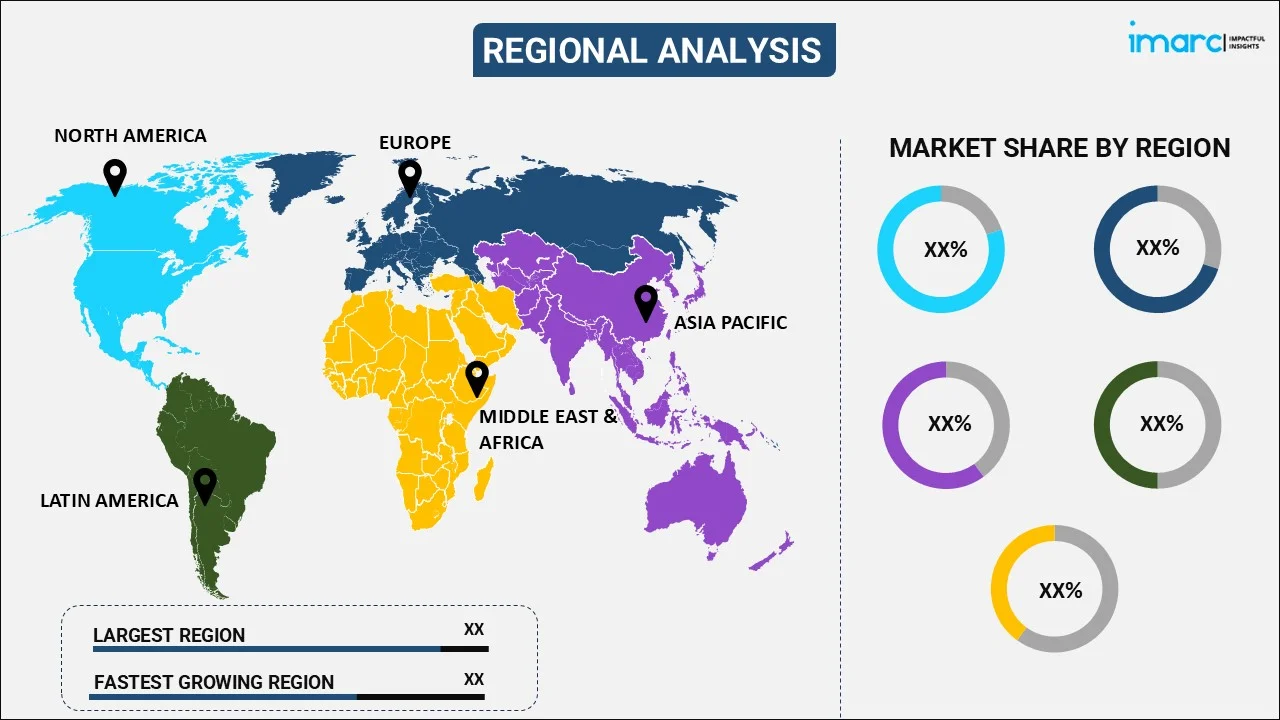
Europe, accounting for 37.2% of the share, enjoys the leading position in the market. The region’s commanding market position is rooted in its centuries-long winemaking heritage, which sustains an unparalleled density of wineries ranging from small family estates to large cooperative productions and industrial-scale commercial facilities. Apart from this, leading wine-producing nations including Italy, France, Spain, Germany, and Portugal continuously invest in upgrading their winery infrastructure to maintain competitiveness in both domestic and export markets. The European Union's comprehensive regulatory environment governing wine quality classifications, hygiene standards, and sustainability targets requires producers to adopt modern, compliance-ready equipment. Additionally, EU sustainability directives accelerating the transition to low-energy production systems and water recycling technologies are driving replacement cycles for aging equipment across the region. The ongoing resilience and expansion of European winery operations underpin sustained regional demand for advanced wine production machinery across all equipment categories.
Key Regional Takeaways:
North America Wine Production Machinery Market Analysis
North America represents a significant and technologically advanced regional market for wine production machinery, characterized by strong adoption of automation, precision fermentation technologies, and increasing investment in winery modernization. The United States and Canada together host a substantial and growing base of commercial wineries, craft producers, and boutique estate operations that collectively demand diverse machinery across all production stages. In 2025, the Honourable Marie-Claude Bibeau, Minister of Agriculture and Agri-Food, revealed specifics of a new two-year Wine Sector Support Program, offering up to $166 million that will equip wineries with essential resources to remain innovative and competitive, enabling them to seize new opportunities. California remains the dominant wine-producing state, accounting for the majority of US wine output, with Napa Valley, Sonoma, and the Central Valley featuring some of the most technologically advanced winery facilities in the world. Government support programs including the United States Department of Agriculture's Specialty Crop Block Grants facilitate equipment investment among smaller producers. Canada's wine regions in British Columbia and Ontario have also demonstrated significant machinery investment to support premium icewine and varietal wine production. The wine production machinery wine production machinery market forecast for North America remains positive given the sustained consumer interest in American craft and premium wines.
United States Wine Production Machinery Market Analysis
The United States stands as a primary driver of the North American wine production machinery market, supported by an extensive and diverse winery network spanning coastal, mountain, and inland production regions. American winery operators demonstrate consistent appetite for technologically advanced production equipment, particularly in fermentation management, automated bottling, precision filtration, and temperature control systems that support both high-volume commercial production and small-batch artisanal winemaking. The country's wine industry is strongly influenced by premiumization trends, with producers across California, Oregon, and Washington investing in high-precision machinery capable of producing wines that compete effectively in international markets. Wine tourism contributes meaningfully to farm winery investment in on-site equipment, as estate producers require complete production infrastructure to offer authentic vineyard-to-glass visitor experiences. Regulatory requirements from both federal food safety authorities and state-level environmental agencies further compel wineries to maintain up-to-date, compliant production machinery, driving replacement and upgrade cycles across the American wine production machinery landscape.
Europe Wine Production Machinery Market Analysis
Europe maintains its commanding leadership in the global wine production machinery market, driven by the unparalleled scale and diversity of its wine industry encompassing thousands of individual estates, cooperative cellars, and industrial producers across Italy, France, Spain, Germany, and Portugal. The region benefits from strong demand for modernization as a large proportion of European winery infrastructure was established several decades ago and requires replacement to remain competitive and compliant with contemporary quality and sustainability standards. EU environmental directives mandating reduced energy consumption and wastewater management compliance are actively stimulating equipment replacement cycles, particularly for temperature control systems, fermentation infrastructure, and filtration units. Wine exports from Europe to international markets including Asia and North America reinforce the need for consistent product quality, which in turn drives investment in automated and precision machinery.
Asia-Pacific Wine Production Machinery Market Analysis
Asia-Pacific represents the fastest-growing regional market for wine production machinery, driven by rapid expansion of wine consumption across China, Japan, India, and Australia, combined with growing domestic production ambitions in emerging wine regions. China's wine production centers in Ningxia, Xinjiang, and Shandong continue to attract investment in European-standard winery equipment as producers seek to elevate quality benchmarks. Australia remains a major equipment market, with large-scale commercial operations modernizing infrastructure to enhance export competitiveness. In 2025, the harvest in the southern hemisphere rose by 7 per cent, spurred by gains in Australia (up 11 per cent), reinforcing active investment in harvest and processing equipment to maximize output during the recovery vintage and support the nation's growing premium wine export profile globally.
Latin America Wine Production Machinery Market Analysis
Latin America presents meaningful growth opportunities for the wine production machinery market, anchored by Argentina and Chile as the region's largest wine producers and supported by growing operations in Brazil and Mexico. Investment in modern winery equipment is driven by rising export ambitions across South American producers seeking to compete in international premium wine segments. Apart from this, Argentina produced large quantities of wine, confirming its position as South America's largest producer and sustaining significant demand for fermentation, pressing, and temperature control equipment across the region's established wine-producing provinces.
Middle East and Africa Wine Production Machinery Market Analysis
The Middle East and Africa region represents an emerging market for wine production machinery, with South Africa leading regional demand due to its well-established wine industry concentrated in the Cape Winelands. South Africa's producers are increasingly investing in automated and precision equipment to support wine exports to Europe, Asia, and North America. According to the OIV's November 2025 production estimates, South Africa's wine output is projected to increase in 2025, marking an improvement over 2024, indicating active vineyard and winery recovery that supports renewed machinery investment across the region's expanding premium wine production sector.
Competitive Landscape:
The global wine production machinery market is characterized by a fragmented competitive landscape with numerous international and regional players competing across product categories including fermentation tanks, temperature control systems, filtration units, and automated bottling equipment. Leading companies differentiate through technological innovation, product customization, sustainability credentials, and after-sales service networks that cater to wineries ranging from boutique micro-producers to large-scale commercial operations. Major manufacturers are increasingly incorporating IoT integration, predictive maintenance capabilities, and energy-efficient design features into their equipment portfolios to address growing winery demand for smart, sustainable production systems. Strategic investments in R&D, capacity expansion, and distribution partnerships across key wine-producing regions including Europe, North America, and Asia-Pacific are enabling established players to strengthen market positioning while new regional entrants introduce cost-competitive solutions targeting emerging wine markets.
The report provides a comprehensive analysis of the competitive landscape in the wine production machinery market with detailed profiles of all major companies, including:
- Agrovin
- Criveller Group
- Della Toffola Pacific
- Grapeworks Pty Ltd.
- GW Kent Inc
- Love Brewing Limited
- Northern Brewer LLC
- Paul Mueller Company
- Vitikit Limited
Wine Production Machinery Market Report Scope:
| Report Features | Details |
|---|---|
| Base Year of the Analysis | 2025 |
| Historical Period | 2020-2025 |
| Forecast Period | 2026-2034 |
| Units | Billion USD |
| Scope of the Report | Exploration of Historical Trends and Market Outlook, Industry Catalysts and Challenges, Segment-Wise Historical and Future Market Assessment:
|
| Types Covered | Tanks and Fermenters, Crushing and Pressing Equipment, Temperature Control Equipment, Filtration Equipment, Others |
| Applications Covered | Farm Winery, Urban Winery, Micro-Winery, Others |
| Regions Covered | Asia Pacific, Europe, North America, Latin America, Middle East and Africa |
| Countries Covered | United States, Canada, Germany, France, United Kingdom, Italy, Spain, Russia, China, Japan, India, South Korea, Australia, Indonesia, Brazil, Mexico |
| Companies Covered | Agrovin, Criveller Group, Della Toffola Pacific, Grapeworks Pty Ltd., GW Kent Inc, Love Brewing Limited, Northern Brewer LLC, Paul Mueller Company, Vitikit Limited, etc. |
| Customization Scope | 10% Free Customization |
| Post-Sale Analyst Support | 10-12 Weeks |
| Delivery Format | PDF and Excel through Email (We can also provide the editable version of the report in PPT/Word format on special request) |
Key Benefits for Stakeholders:
- IMARC’s report offers a comprehensive quantitative analysis of various market segments, historical and current market trends, market forecasts, and dynamics of the wine production machinery market from 2020-2034.
- The research study provides the latest information on the market drivers, challenges, and opportunities in the global wine production machinery market.
- The study maps the leading, as well as the fastest-growing, regional markets. It further enables stakeholders to identify the key country-level markets within each region.
- Porter's Five Forces analysis assists stakeholders in assessing the impact of new entrants, competitive rivalry, supplier power, buyer power, and the threat of substitution. It helps stakeholders to analyze the level of competition within the wine production machinery industry and its attractiveness.
- Competitive landscape allows stakeholders to understand their competitive environment and provides an insight into the current positions of key players in the market.
Frequently Asked Questions About the Wine Production Machinery Market Report
The wine production machinery market was valued at USD 2.49 Billion in 2025.
The wine production machinery market is projected to exhibit a CAGR of 3.58% during 2026-2034, reaching a value of USD 3.53 Billion by 2034.
The wine production machinery market is primarily driven by rising global wine consumption, rapid adoption of automation and IoT-enabled production technologies, increasing investment in winery expansion across emerging regions, growing demand for premium and organic wines, stringent quality and food safety regulations compelling equipment modernization, and the proliferation of new boutique and micro-winery operations worldwide.
Europe currently dominates the wine production machinery market, accounting for a share of 37.2%. The region benefits from its deep-rooted winemaking heritage, a high density of established wineries requiring continuous equipment investment, strong regulatory frameworks governing quality and sustainability, and sustained demand for technologically advanced production machinery across Italy, France, Spain, Germany, and other leading wine-producing nations.
Some of the major players in the wine production machinery market include Agrovin, Criveller Group, Della Toffola Pacific, Grapeworks Pty Ltd., GW Kent Inc, Love Brewing Limited, Northern Brewer LLC, Paul Mueller Company, Vitikit Limited, etc.
Need more help?
- Speak to our experienced analysts for insights on the current market scenarios.
- Include additional segments and countries to customize the report as per your requirement.
- Gain an unparalleled competitive advantage in your domain by understanding how to utilize the report and positively impacting your operations and revenue.
- For further assistance, please connect with our analysts.
 Request Customization
 Speak to an Analyst
 Request Brochure
 Inquire Before Buying
Benefits of Customization
- Personalize this research
- Triangulate with your data
- Get data as per your format and definition
- Gain a deeper dive into a specific application, geography, customer, or competitor
- Any level of personalization
Get in Touch With Us
UNITED STATES
Phone: +1-201-971-6302
INDIA
Phone: +91-120-433-0800
UNITED KINGDOM
Phone: +44-753-714-6104
Email: [email protected]
Client Testimonials




.webp)




.webp)













Related Reports

Choose your plan
*Please note that the prices mentioned below are starting prices for each bundle type. Kindly contact our team for further details.*
Single User License
- 1 User License, Access on 2 Devices
- PDF Report + Excel Dataset (Password Protected)
- Lifetime Access
- No Printing Rights
- 10% Free Report Customization
- 10–12 Weeks of Analyst Support
Five User License
- Access for 5 Users, 2 Devices per User
- PDF Report + Excel Dataset (Password Protected)
- Lifetime Access
- Dedicated Account Manager
- 12–14 Weeks of Analyst Support
- No Printing Rights
- 15% Free Report Customization
- 25% Discount on Your Next Purchase
Corporate User License
- Unlimited User Access (Within Your Organization)
- PDF Report + Excel Dataset
- Lifetime Access
- Dedicated Account Manager
- 14–20 Weeks of Analyst Support
- No Printing Rights
- 20% Free Report Customization
- 30% Discount on Your Next Purchase
Essential Insights
What's included:
3 reports
- Lifetime Access
- PDF Reports
- Excel Datasets
- 2 Weeks of Free Analyst Support
- 2 User Licenses
- Access on 2 Devices
- Printing Rights
- Complimentary PowerPoint (PPT) Version
- Complimentary License Upgrade
Professional Access
What's included:
5 reports
- Lifetime Access
- PDF Reports
- Excel Datasets
- 8 Weeks of Free Analyst Support
- 2 User Licenses
- Access on 2 Devices
- Printing Rights
- Complimentary PowerPoint (PPT) Version
- Complimentary License Upgrade
Business Advantage
What's included:
8 reports
- Lifetime Access
- PDF Reports
- Excel Datasets
- 14 Weeks of Free Analyst Support
- 2 User Licenses
- Access on 2 Devices
- Printing Rights
- Complimentary PowerPoint (PPT) Version
- Complimentary License Upgrade
Enterprise Intelligence
What's included:
10 reports
- Lifetime Access
- PDF Reports
- Excel Datasets
- 20 Weeks of Free Analyst Support
- 2 User Licenses
- Access on 2 Devices
- Printing Rights
- Complimentary PowerPoint (PPT) Version
- Complimentary License Upgrade