
Paper Cups Market Size, Share, Trends and Forecast by Cup Type, Wall Type, Application, End User, Distribution Channel, and Region, 2026-2034
Global Paper Cups Market Size, Share, Trends & Forecast (2026-2034)
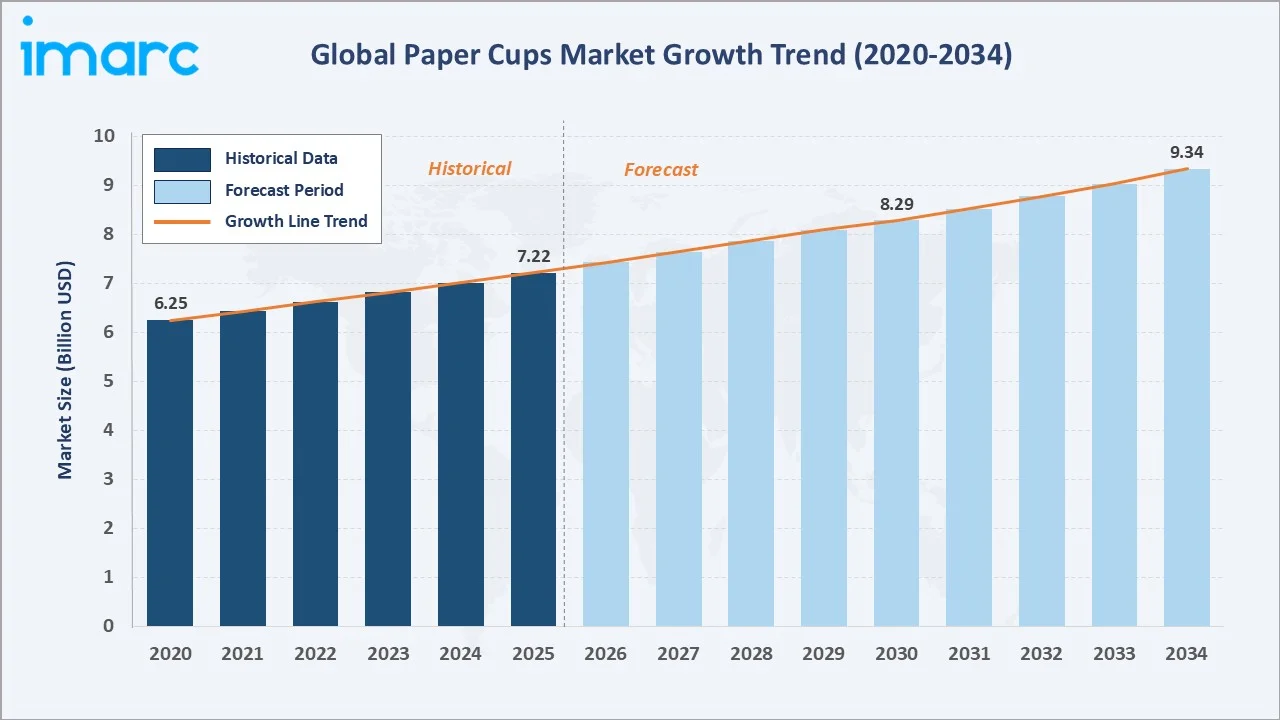
The global paper cups market grew from USD 7.22 Billion in 2025 to USD 7.48 Billion in 2026 and is projected to reach USD 9.34 Billion by 2034, exhibiting a CAGR of 2.82% during the forecast period 2026-2034. Rising environmental consciousness, accelerating plastic bans across major economies, and growing quick-service restaurant (QSR) penetration are fuelling paper cups market growth.
Market Snapshot
|
Metric |
Value |
|
Base Year Market Size (2025) |
USD 7.22 Billion |
| Market Size (2026) | USD 7.48 Billion |
| Forecast Market Size (2034) |
USD 9.34 Billion |
| CAGR (2026-2034) |
2.82% |
|
Base Year |
2025 |
|
Historical Period |
2020-2025 |
|
Forecast Period |
2026-2034 |
|
Largest Region |
Asia Pacific (38.5% share, 2025) |
|
Fastest Growing Region |
Asia Pacific |
|
Leading Cup Type |
Hot Paper Cups (62.4%, 2025) |
|
Leading Wall Type |
Single Wall (52.5%, 2025) |
The global paper cups market growth trajectory from 2020 through 2034 reflects historical expansion fuelled by sustainability transitions and forecast acceleration driven by QSR proliferation, on-the-go beverage culture, and eco-compliant packaging mandates across major economies.
To get more information on this market, Request Sample
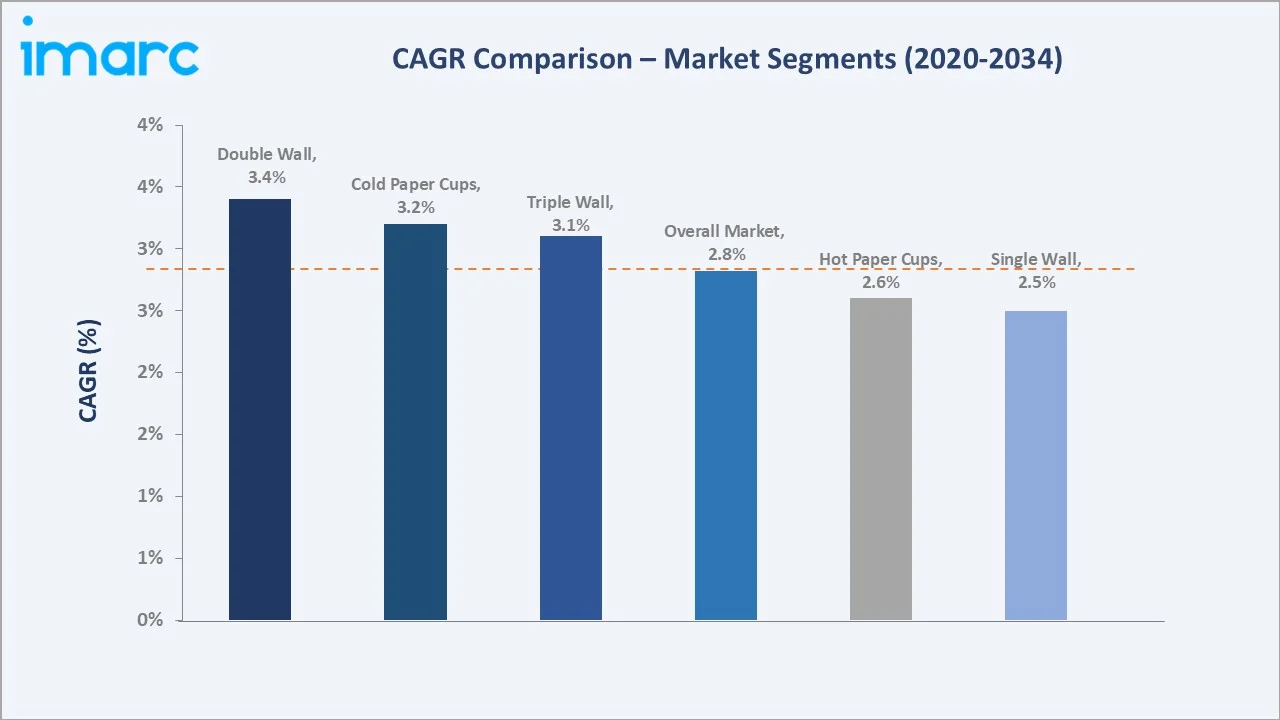
Segment-level CAGR comparisons highlight cold paper cup adoption and double-wall format expansion as the fastest-growing sub-categories within the global paper cups market forecast through 2034.
Executive Summary
The global paper cups market is undergoing a structural transformation, driven by accelerating single-use plastic bans, rising foodservice demand, and technological innovation in sustainable cup coatings. The market expanded from USD 7.22 Billion in 2025 to an estimated USD 7.48 Billion in 2026, the market is forecast to reach USD 9.34 Billion by 2034 at a CAGR of 2.82%. The market's steady growth is underpinned by expanding QSR chains globally, increasing consumer preference for hygienic single-use packaging, and a rising wave of government-backed plastic reduction mandates.
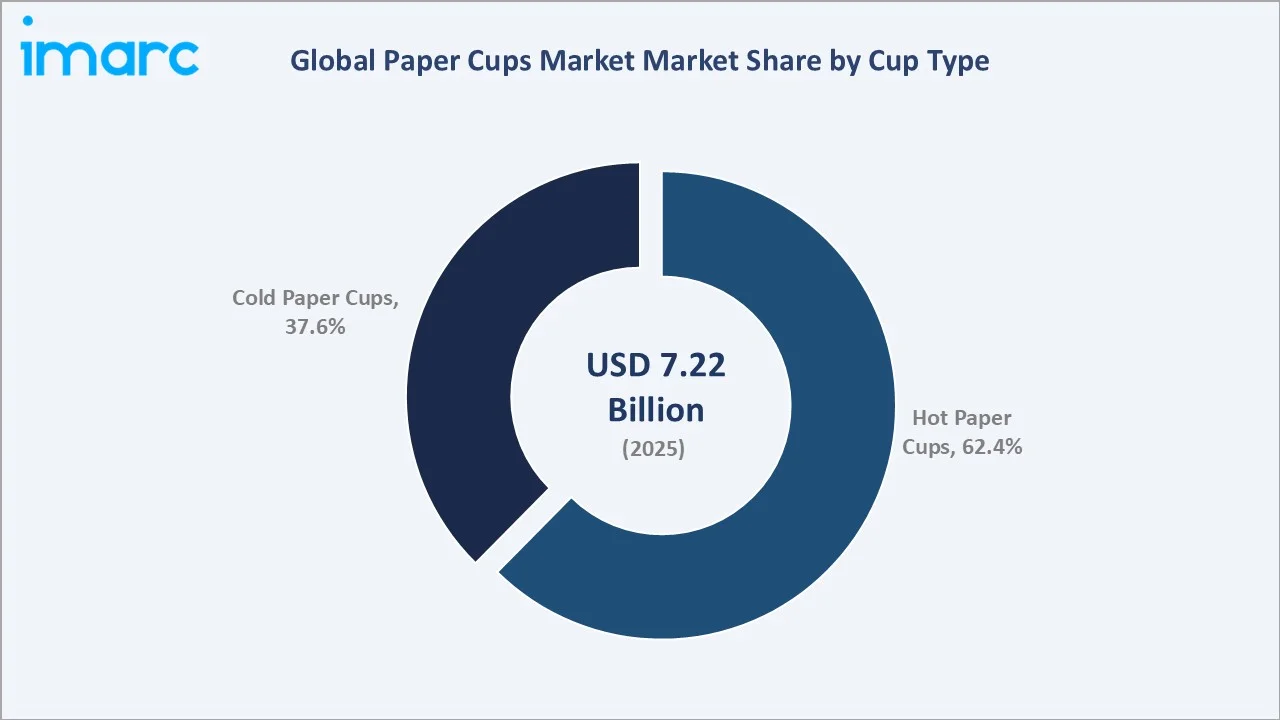
Hot paper cups command 62.4% share in 2025, driven by robust takeaway coffee and tea consumption and large-format chain standardization. Single-wall cups represent the dominant wall-type at 52.5%, while double-wall formats are the fastest-growing sub-segment, advancing at an estimated CAGR of 3.4% through 2034, driven by consumer preference for better insulation and comfort during hot beverage service.
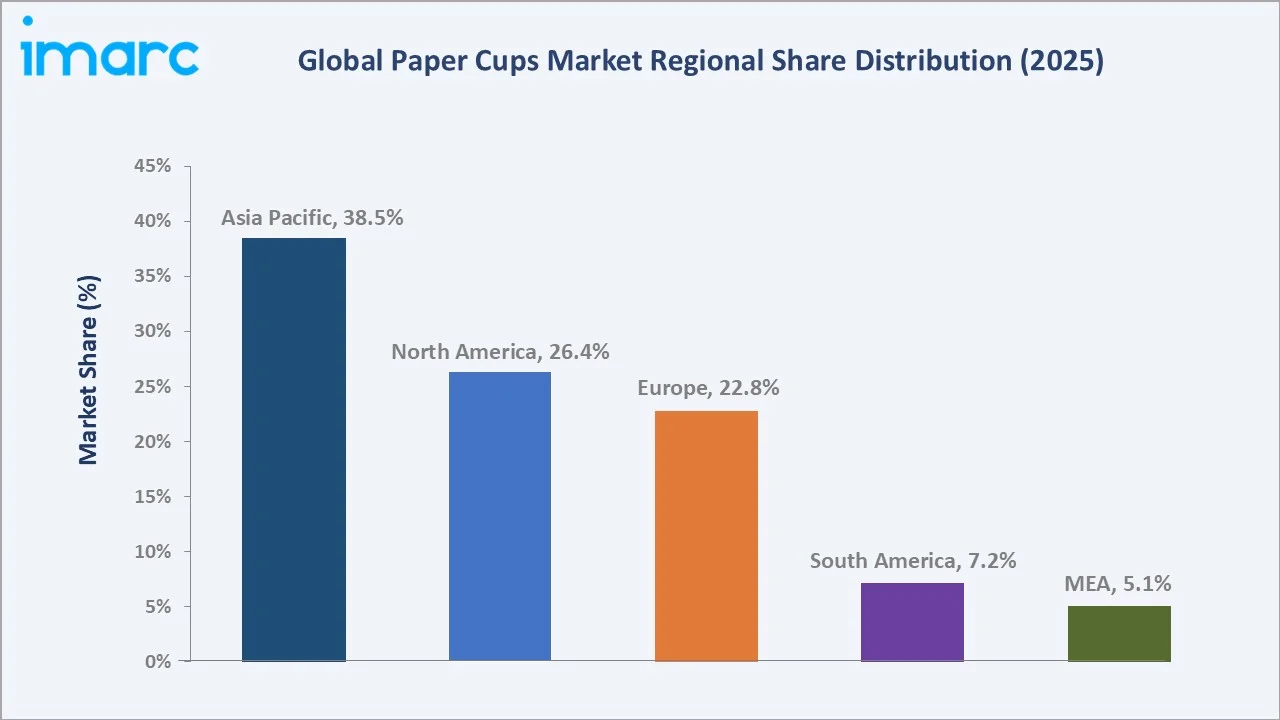
Asia Pacific leads with 38.5% global revenue share in 2025, supported by urbanization, rapid QSR expansion in China and India, and government-led plastic bans. North America holds 26.4% and Europe 22.8%. The paper cups market outlook remains positive as bio-based coatings, recyclable fiber formats, and digital printing innovations converge across all major markets, positioning the sector for sustained, compliance-driven growth through 2034.
Key Market Insights
|
Insight |
Data |
|
Largest Cup Type |
Hot Paper Cups – 62.4% share (2025) |
|
Second Cup Type |
Cold Paper Cups – 37.6% share (2025) |
|
Largest Wall Type |
Single Wall – 52.5% share (2025) |
|
Fastest Growing Wall Type |
Double Wall – ~3.4% CAGR (2026-2034) |
|
Leading Region |
Asia Pacific – 38.5% revenue share (2025) |
|
Fastest Growing Region |
Asia Pacific |
|
Top Companies |
Huhtamaki, Dart Container Corporation, Graphic Packaging International, LLC, Stora Enso, Georgia-Pacific, Go-Pak Group, and Seda International Packaging Group |
|
Key Market Opportunity |
Bio-coated & home-compostable cup formats |
Key Analytical Observations Supporting The Above Data:
- Hot Paper Cups' 62.4% dominance in 2025 reflects robust coffee and tea takeaway culture globally. Two-thirds of American adults drink coffee each day (66%), with the majority of servings taken away from home, directly sustaining hot cup volume demand.
- Cold Paper Cups' 37.6% share is expanding, led by cold specialty beverage trends in QSRs. In February 2025, Graphic Packaging International launched its redesigned Cold&Go insulated paper cup to tackle condensation and insulation challenges.
- Single Wall cups command 52.5% due to their cost-effectiveness and widespread adoption in high-volume institutional settings such as offices, hospitals, and fast-food restaurants. Budget-driven procurement sustains their dominance.
- Asia Pacific's 38.5% leadership is anchored by China's massive foodservice sector and India's rapid QSR expansion. The region dominates global paper cup shipment volume, driven by urbanization, takeaway culture, and rising beverage consumption across key markets.
- Double Wall cups are the fastest-growing wall-type as consumer preference shifts toward improved heat retention and comfort. McDonald's targets 50,000 global outlets by 2027, sustaining bulk demand for high-performance cup formats.
Global Paper Cups Market Overview
Paper cups are disposable single-use containers manufactured from food-grade paperboard, typically coated with polyethylene (PE), polylactic acid (PLA), or aqueous barrier materials to prevent liquid absorption. The global market encompasses hot paper cups, cold paper cups, and specialty formats designed for coffee, tea, cold beverages, and institutional beverage dispensing across foodservice, healthcare, education, and office environments.
The industry operates at the intersection of foodservice expansion, environmental policy shifts, and packaging innovation. Growth is supported by macroeconomic drivers including urbanization, rising disposable incomes in emerging markets, accelerating plastic bans, and the widening global QSR footprint. Simultaneously, the market is undergoing a structural shift toward bio-coated, fully recyclable, and home-compostable cup formats, redefining product development strategies and procurement decisions across the global paper cups market trends landscape.
Market Dynamics
To evaluate market opportunities, Request Sample
Market Drivers
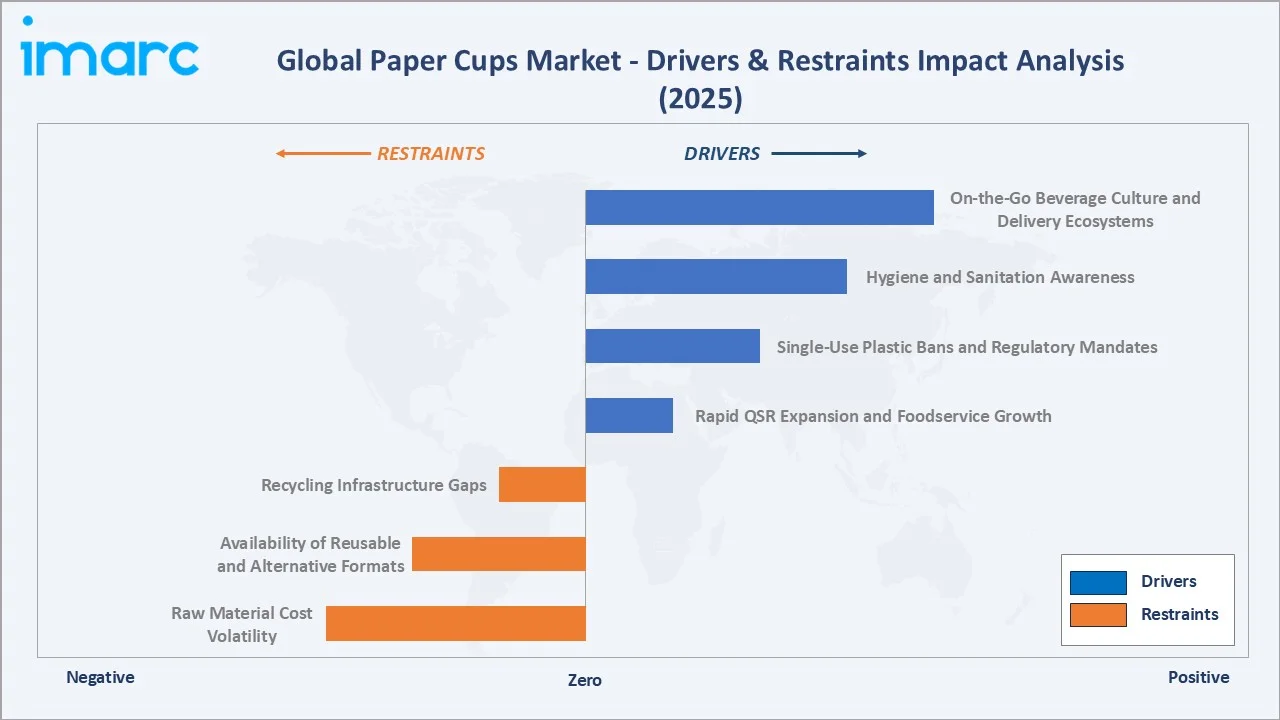
- Rapid QSR Expansion and Foodservice Growth: The proliferation of quick-service restaurants, cafés, and delivery-first food brands is the single largest structural driver of paper cup demand. McDonald's targets 50,000 global outlets by 2027, including 1,000 new China locations in 2025. Franchise analysts project 20,000 net new QSR units in 2025 alone, each generating continuous demand for branded hot and cold paper cups across dine-in, drive-thru, and delivery formats.
- Single-Use Plastic Bans and Regulatory Mandates: Government-mandated restrictions on plastic cups and packaging are accelerating the structural shift toward fiber-based alternatives. The EU Packaging and Packaging Waste Regulation mandates full recyclability and sets a 5% waste reduction target by 2030. India banned single-use plastics effective July 1, 2022, and South Australia banned plastic beverage containers from September 2024, redirecting demand systematically toward paper cup formats.
- Hygiene and Sanitation Awareness: Post-pandemic hygiene consciousness has entrenched consumer preference for single-use, disposable beverage containers. Paper cups eliminate cross-contamination risks in high-traffic public settings, institutional catering, healthcare, and office environments. This behavioral shift has reinforced paper cups as the default service format across a wide range of institutional categories.
- On-the-Go Beverage Culture and Delivery Ecosystems: The global surge in food delivery apps and take-away consumption is continuously amplifying paper cup demand. Delivery platforms, which have expanded from restaurant food into convenience and grocery segments, increasingly adopt foodservice-grade lid and insulation specifications, rallying sustained volume toward hot and cold paper cup formats.
Market Restraints
- Raw Material Cost Volatility: Fluctuating pulp and virgin fiber prices, compounded by polyethylene coating costs, directly inflate paper cup production economics. Supply chain disruptions in 2024–2025 have increased input cost pressure for manufacturers in cost-sensitive emerging markets.
- Availability of Reusable and Alternative Formats: Growing consumer adoption of reusable cups and stainless-steel tumblers, particularly in sustainability-conscious developed markets, is creating headwinds for disposable paper cup volume in retail and office channels.
- Recycling Infrastructure Gaps: Many municipal systems still lack the equipment to effectively delaminate cup fiber from PE or barrier coatings, resulting in technically recyclable cups ending in landfill. This limits the sustainability narrative and creates procurement hesitation among ESG-focused institutional buyers.
Market Opportunities
- Bio-Based Coating Innovation: The commercialization of PLA, aqueous mineral coatings, and PHA (polyhydroxyalkanoate) liners is creating a high-margin growth tier within the paper cup market. In May 2025, Starbucks EMEA launched a home-compostable hot cup with a mineral-based coating across select European markets, demonstrating scale economics for major chains and creating a replicable model for global adoption.
- Customization and Digital Printing for Brand Visibility: QSR operators and hospitality brands are increasingly leveraging high-definition digital printing on cup surfaces as a cost-effective brand activation tool. Custom cup formats with seasonal themes and limited-edition designs are delivering margin premiums for converters, with incremental share gains projected through the forecast period.
- Emerging Market Institutional Demand: Rapid healthcare expansion, education infrastructure development, and corporate office buildouts across India, Southeast Asia, and Sub-Saharan Africa are creating large-volume, price-sensitive demand pools for standard single-wall paper cups, representing significant distribution expansion opportunities for regional manufacturers.
Market Challenges
- Competitive Pressure from Low-Cost Regional Manufacturers: High-volume paper cup producers in China and India are intensifying price competition across commodity cup formats, compressing margins for global brands targeting cost-sensitive institutional segments in emerging economies.
- Complex Recyclability Claims and Greenwashing Risk: The proliferation of cup formats marketed as "compostable" or "recyclable" that require specialized industrial processing creates consumer confusion and regulatory risk. EU circular-economy rules are tightening scrutiny on end-of-life pathways, and corporate buyers increasingly demand verifiable evidence of regional cup recovery before awarding contracts.
Emerging Market Trends
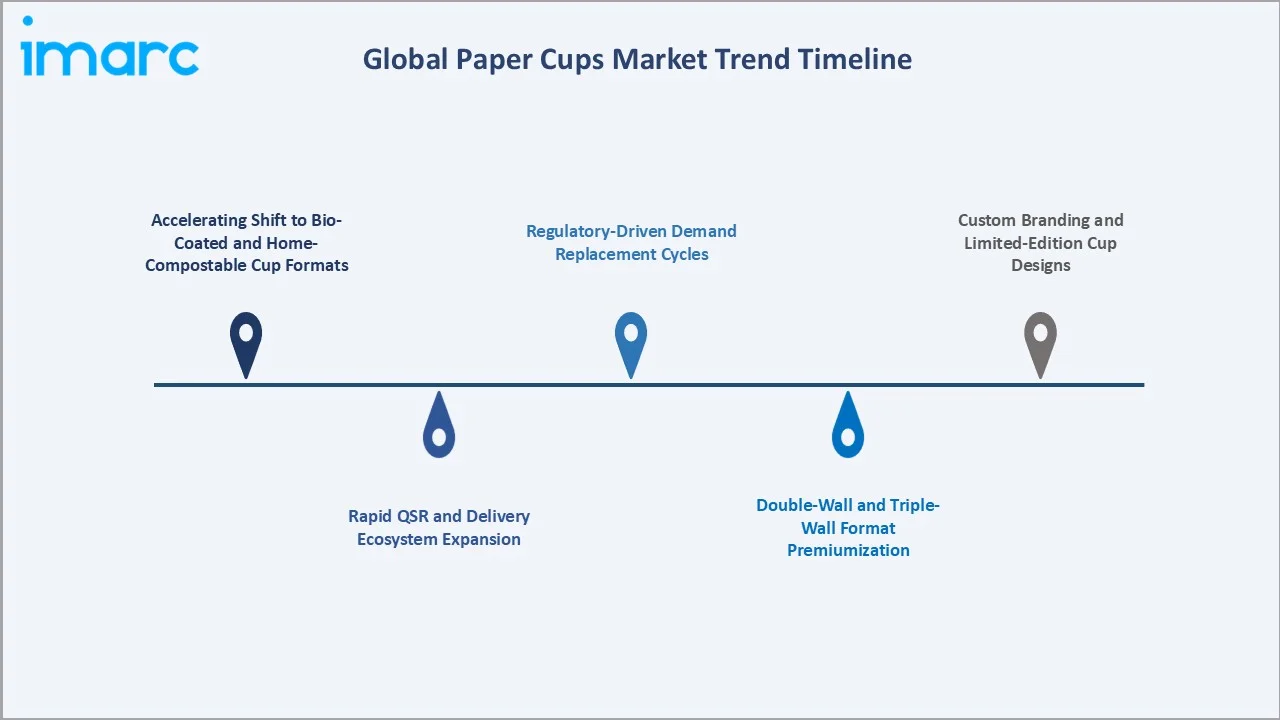
1. Accelerating Shift to Bio-Coated and Home-Compostable Cup Formats
Advanced barrier coatings are replacing traditional PE liners across premium cup formats. EarthCoating reduces plastic use significantly versus conventional PE-lined cups and is widely accepted across paper mills, supporting recyclability. Leading brands have also begun rolling out mineral-coated, home-compostable cups across key markets, confirming commercial-scale viability and creating adoption pressure across the broader foodservice supply chain.
2. Rapid QSR and Delivery Ecosystem Expansion
The accelerating growth of food delivery platforms and QSR chain rollouts is fundamentally widening the addressable market for branded paper cups. With franchise expansion driving a rising number of QSR establishments and increasing overall industry output, each new outlet adds sustained, recurring demand for both hot and cold cup SKUs. Automation in back-of-house QSR operations further boosts service throughput without additional labor, multiplying packaging volume per counter.
3. Double-Wall and Triple-Wall Format Premiumization
Consumer demand for improved heat insulation, enhanced grip, and reduced reliance on cardboard sleeves is driving a structural shift toward double-wall and triple-wall cup formats in premium coffee chains and upscale hospitality. Double-wall cups are expected to outpace overall market growth, reflecting strong adoption across the hot beverage segment. This premiumization trend is enabling manufacturers to capture higher average selling prices within the category.
4. Regulatory-Driven Demand Replacement Cycles
Government-mandated plastic restrictions are creating predictable, policy-driven replacement cycles that enable converters to rationalize capital investment in new forming lines. Regulatory measures such as single-use cup surcharges and recyclability mandates are systematically positioning paper cups as the most compliant single-use alternative, generating structural volume uplift across European markets.
5. Custom Branding and Limited-Edition Cup Designs
The growing use of paper cups as brand marketing vehicles is expanding average revenues per unit. High-definition digital printing technology enables small-batch, customized branding for local cafés and pop-up events, while large chains leverage seasonal and limited-edition designs to enhance consumer engagement. Custom-print event and catering disposable cups are delivering margin premiums and are projected to capture incremental share within the commercial cup market over the forecast period.
Industry Value Chain Analysis
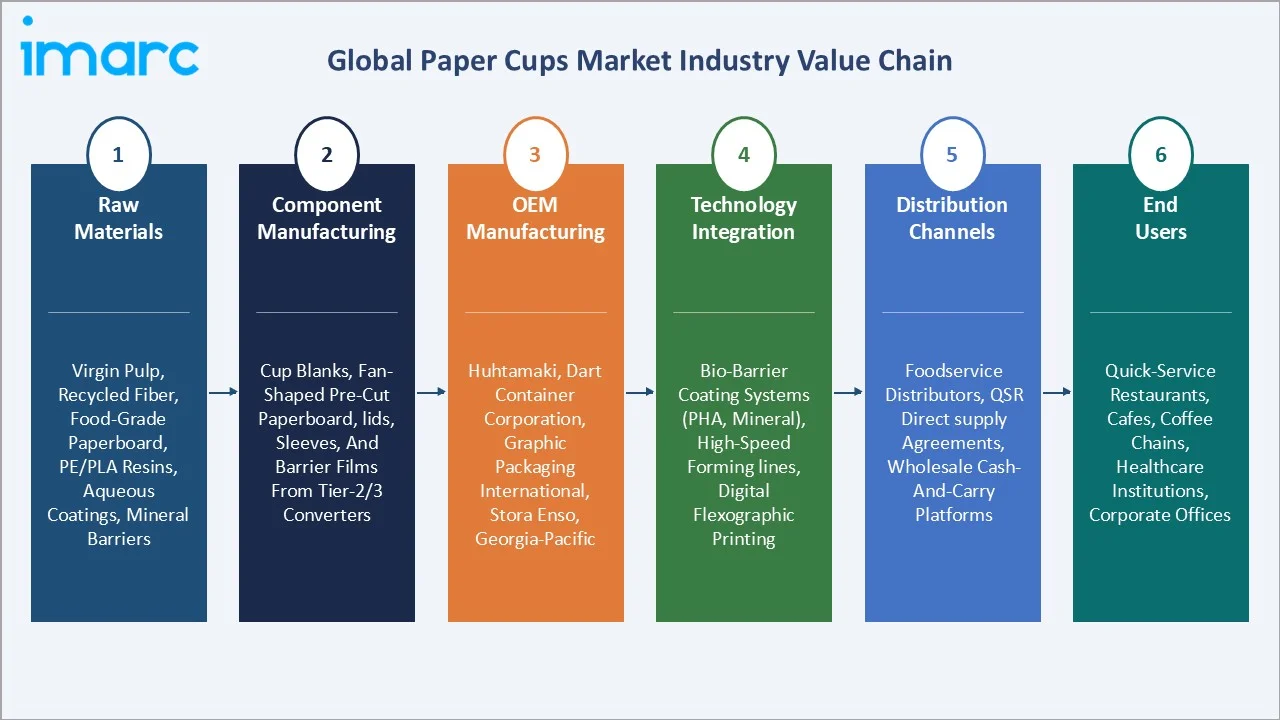
The global paper cups industry value chain spans six integrated stages from raw material supply through end-consumer usage. Each stage presents distinct competitive dynamics and technology investment requirements relevant to the overall paper cups industry analysis.
|
Value Chain Stage |
Key Participants / Description |
|
Raw Materials |
Virgin pulp, recycled fiber, food-grade paperboard, PE/PLA resins, aqueous coatings, mineral barriers, water-based inks – sourced from forestry groups and specialty chemical suppliers |
|
Component Manufacturing |
Cup blanks, fan-shaped pre-cut paperboard, lids, sleeves, and barrier films – produced by Tier-2/Tier-3 converters in China, Germany, India, and the United States |
|
OEM Manufacturing |
Huhtamaki, Dart Container Corporation, Graphic Packaging International, LLC, Stora Enso, Georgia-Pacific, Go-Pak Group, and Seda International Packaging Group |
|
Technology Integration |
Bio-barrier coating systems (PHA, mineral), high-speed forming lines, digital flexographic printing, and compostability certification ( EN 13432, ASTM D6400) |
|
Distribution Channels |
Foodservice distributors, QSR direct supply agreements, wholesale cash-and-carry, e-commerce bulk platforms, and institutional procurement portals |
|
End Users |
Quick-service restaurants, cafés, coffee chains, healthcare institutions, corporate offices, educational establishments, and households |
OEM manufacturers hold the highest strategic value by integrating paperboard substrates, barrier technologies, and branding capabilities into turnkey, food-safe solutions. Meanwhile, e-commerce bulk platforms and direct QSR supply channels are reshaping distribution dynamics, enabling manufacturers to bypass intermediaries and capture stronger margin positions.
Technology Landscape in the Paper Cups Industry
Advanced Barrier Coating Technologies
PE coating remains the dominant cup lining technology for liquid resistance, but the market is transitioning rapidly toward bio-based alternatives. PLA coatings from corn-starch derivatives are gaining mainstream adoption in North American and European markets where industrial composting infrastructure is expanding. Aqueous mineral coatings, as deployed by Starbucks EMEA in May 2025 in collaboration with Transcend Packaging and Metsä Board, replace plastic liners entirely while maintaining liquid resistance and enabling home-compostable end-of-life treatment.
High-Speed Cup Forming and Automation
Modern paper cup forming lines are achieving high throughput rates, supported by computer vision-based quality inspection, automated stacking, and AI-driven defect detection. Manufacturers investing in next-generation forming equipment are reducing per-unit production costs while improving dimensional consistency, which is critical for automated dispensing systems used in corporate catering and healthcare environments.
Digital and Flexographic Printing Innovation
Advanced digital printing platforms are enabling photographic-quality, full-bleed cup designs with rapid changeover between SKUs. This supports small-batch custom branding for independent cafés and fast seasonal design updates for QSR chains. Eco-solvent and water-based inks are replacing solvent-based systems across premium manufacturers, aligning printing operations with food-contact regulatory requirements in the EU and North America.
Market Segmentation Analysis
The report covers the following segments:
| Segment Category | Leading Segment | Market Share | Year |
|---|---|---|---|
| Cup Type | Hot Paper Cups | 62.4% | 2025 |
| Wall Type | Single Wall | 52.5% | 2025 |
| Application | Tea and Coffee | 🔒 | 2025 |
| End User | Coffee and Tea Shops | 🔒 | 2025 |
| Distribution Channel | Institutional Sales | 🔒 | 2025 |
| Region | Asia Pacific | 38.5% | 2025 |

By Cup Type
To access detailed market analysis, Request Sample
Hot paper cups represent the largest cup type segment with a 62.4% share in 2025. Demand is driven by strong global coffee and tea consumption culture, particularly the rapid proliferation of coffee chains. Double-wall and sleeve-integrated hot cup designs are gaining traction in premium segments, commanding higher average selling prices and improved insulation performance.
By Wall Type
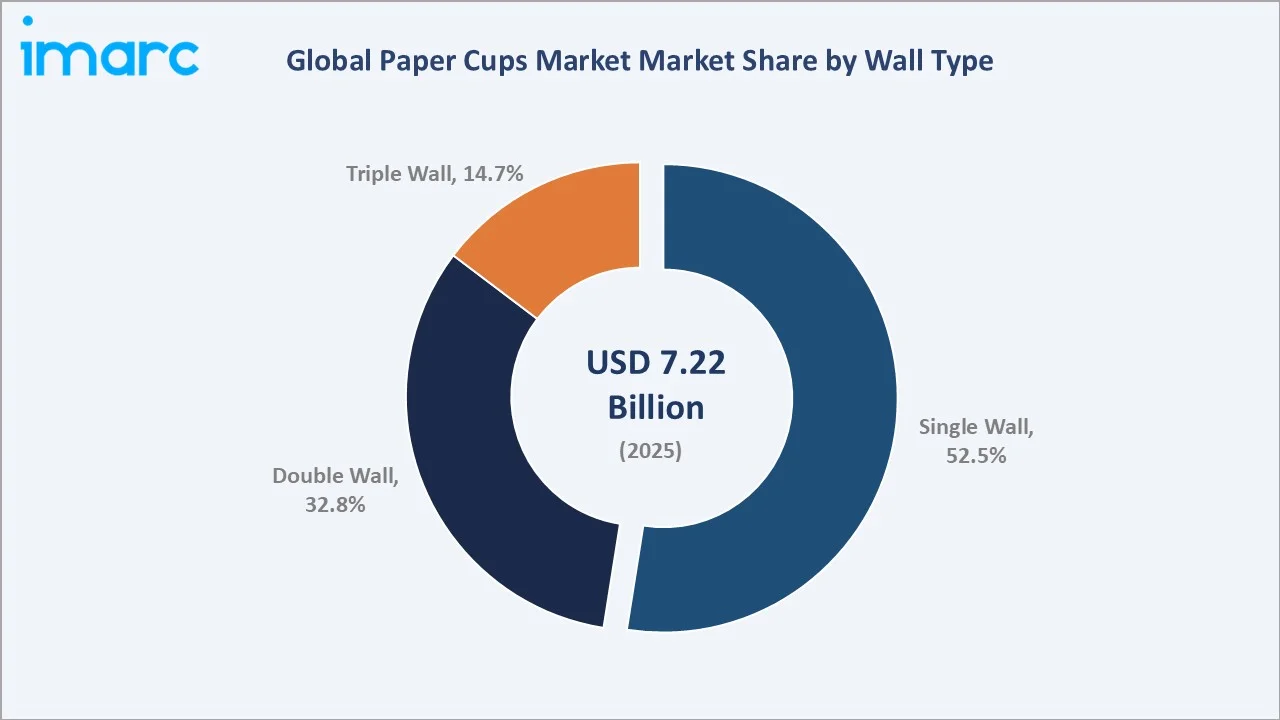
Single-wall paper cups represent the largest wall-type segment with a 52.5% share in 2025. Their cost-effectiveness, lightweight construction, and suitability for short-duration beverage service make them the preferred format for high-volume institutional procurement in fast-food outlets, schools, hospitals, and corporate cafeterias. Single-wall cups dominate the cold beverage sub-segment and institutional water dispensing applications globally, where per-unit cost and operational efficiency are primary procurement criteria.
Regional Market Insights
|
Region |
Share (2025) |
Key Growth Drivers |
|
Asia Pacific |
38.5% |
China QSR expansion, India plastic bans, urbanization, growing coffee culture in Southeast Asia |
|
North America |
26.4% |
High coffee consumption, stringent plastic regulations, major QSR headquarters, sustainability mandates |
|
Europe |
22.8% |
EU Packaging Regulation 2024, compostable cup adoption, HORECA sector demand, green building standards |
|
South America |
7.2% |
Brazil and Colombia café culture, urban middle-class growth, foodservice formalization |
|
Middle East & Africa |
5.1% |
GCC hospitality expansion, Africa QSR rollouts, government plastic reduction initiatives |
Asia Pacific commands 38.5% global revenue share in 2025, representing the largest and fastest-growing regional market. China is the single most important national market, combining a massive organized foodservice sector with rapidly expanding coffee chain penetration.
North America holds 26.4% of global revenue, anchored by the U.S. market's status as the world's largest single-country paper cup consumer. Europe holds 22.8%, characterized by the EU Packaging and Packaging Waste Regulation (March 2024) mandating full recyclability and a 5% waste reduction target by 2030.
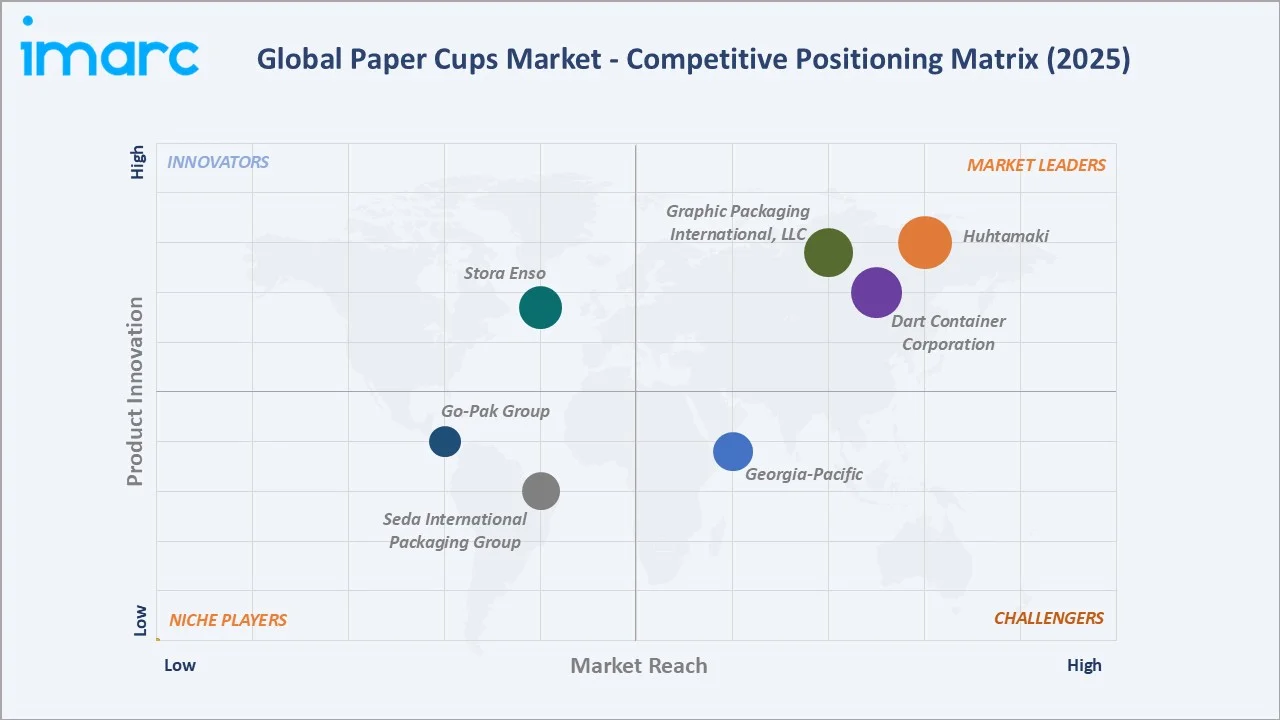
Competitive Landscape
|
Company Name |
Key Brand(s) |
Market Position |
Core Strength |
|
Huhtamaki |
Chinet |
Leader |
Global scale, sustainable packaging, broad product range |
|
Dart Container Corporation |
Solo |
Leader |
High-volume production, North America dominance, cost leadership |
|
Graphic Packaging International, LLC |
Cold&Go, ecotainer |
Leader |
Innovative barrier technologies, QSR partnerships, sustainability |
|
Stora Enso |
Cupforma |
Challenger |
Renewable fiber innovation, EU market leadership, eco certifications |
|
Georgia-Pacific |
Dixie |
Challenger |
Brand recognition, retail strength, institutional channel depth |
|
Go-Pak Group |
Aqueous Hot Cup, Edenware and more |
Challenger |
UK/Europe specialty cups, nimble custom formats |
|
Seda International Packaging Group |
Seda |
Emerging |
European convertor with niche QSR and private-label specialization |
The global paper cups market's compe=\titive landscape is moderately fragmented, with global packaging conglomerates competing alongside regional specialists and high-volume Asian converters. Leading players compete on product innovation, sustainable material adoption, distribution reach, food-safety certification, and QSR supply chain integration. Strategic acquisitions are reshaping the competitive landscape.
Key Company Profiles
Huhtamäki
Huhtamäki is a global food packaging specialist headquartered in Espoo, Finland. Founded in 1920, serving foodservice, retail, and healthcare packaging markets with a comprehensive portfolio of fiber-based, sustainable packaging solutions.
- Product & Platform Portfolio: Huhtamäki's paper cup portfolio encompasses hot cups, cold cups, double-wall formats, and compostable fiber-based cup lines under the Huhtamaki brand. The company offers PLA-coated and fully recyclable cup designs certified to major international sustainability standards.
- Recent Developments: In 2025, Huhtamaki announced the launch of its ‘ProDairy’ recyclable single-coated paper cups designed for yogurt and dairy applications. The solution reduces plastic content to below 10% while maintaining high performance and food safety standards, and is fully recyclable within European waste streams. The innovation also incorporates proprietary sealing and barrier technologies to ensure product integrity, supporting the shift toward low-plastic, fiber-based dairy packaging solutions.
- Strategic Focus: Huhtamäki's strategy centers on sustainable packaging innovation, renewable fiber adoption, and expanding its compostable cup platform across key regulated markets in Europe and North America, where circular-economy compliance is becoming a standard procurement requirement.
Dart Container Corporation
Dart Container Corporation is one of the world's largest manufacturers of single-use foodservice packaging, headquartered in Mason, Michigan, USA. The company serves QSR chains, institutional foodservice, and retail markets with a broad range of foam, plastic, and paper cup products.
- Product & Platform Portfolio: Dart's paper cup portfolio includes its Solo-branded paper hot cups, cold beverage cups, and lids, spanning standard single-wall formats through premium insulated designs. The company serves high-volume QSR and institutional markets with standardized, cost-efficient cup SKUs.
- Recent Developments: In 2025, Dart Container Corporation has received industry recognition for its sustainable packaging innovations, including paper cups. Certifications and endorsements from organizations such as TÜV Austria and the Association of Plastic Recyclers highlight the recyclability and compostability of its fibre-based cup solutions. The recognition reinforces the company’s focus on developing environmentally compliant paper cup products aligned with evolving sustainability standards in foodservice packaging.
- Strategic Focus: Dart Container Corporation’s strategy focuses on maintaining North American market leadership through production scale advantages, cost-efficient manufacturing, and expanding its sustainable cup portfolio to meet the growing demand for recyclable and compostable foodservice packaging.
Graphic Packaging International, LLC
Graphic Packaging International, LLC is a leading global provider of paperboard packaging solutions, headquartered in Atlanta, Georgia, USA. The company serves major consumer goods, foodservice, and beverage brands with innovative fiber-based packaging across multiple product categories.
- Product & Platform Portfolio: Graphic Packaging's paper cup offerings include hot cups, cold cups, and the Cold&Go insulated cold beverage cup platform, featuring enhanced condensation control and improved insulation for on-the-go cold drinks served at QSRs and convenience stores.
- Recent Developments: In 2025, Graphic Packaging International introduced an upgraded version of its Cold&Go insulated paper cup, designed to enhance performance for cold beverages. The redesigned cup delivers significantly improved insulation—nearly three times that of traditional plastic alternatives—while reducing condensation by over 40%, improving handling and consumer experience. It also offers strong structural integrity and lid retention, making it well-suited for takeaway and delivery applications in QSR and foodservice channels.
- Strategic Focus: Graphic Packaging's strategy centers on barrier technology innovation, sustainable coating solutions, and strengthening its QSR supply chain partnerships, leveraging its integrated paperboard manufacturing platform to offer differentiated, high-performance cup solutions.
Market Concentration Analysis
The global paper cups market exhibits moderate fragmentation. The top five players — Huhtamaki, Dart Container Corporation, Graphic Packaging International, LLC, Stora Enso, Georgia-Pacific — collectively account for an estimated 30–38% of global market revenue in 2025. The remaining market share is distributed across regional converters in China, India, the EU, and the United States, along with niche specialty manufacturers serving compostable and custom-print segments.
The market is experiencing a bifurcated competitive dynamic. At the premium and sustainability-compliant tier, consolidation is occurring around bio-barrier technology leadership, QSR long-term supply agreements, and EU recyclability certification. Simultaneously, Chinese and Indian manufacturers are intensifying competition in the commodity single-wall cup segment, increasingly targeting international export markets with cost-competitive, design-improved products.
Investment & Growth Opportunities
Fastest-Growing Segments
Cold paper cups are the highest-growth format sub-segment, driven by specialty cold beverage trends and QSR iced drink standardization. Double-wall hot cups are the fastest-growing wall-type at an estimated 3.4% CAGR through 2034. Compostable and bio-coated cup formats represent the highest-margin technology growth opportunity within the broader market.
Emerging Market Expansion
India represents the highest-potential emerging market, driven by the enforcement of single-use plastic bans, rapid QSR chain rollouts, and rising per-capita beverage consumption. Southeast Asia's growing coffee-shop culture, GCC hospitality mega-projects, and Sub-Saharan Africa's urban foodservice formalization collectively represent significant volume growth opportunities for paper cup manufacturers with established local distribution and regulatory compliance capabilities.
Venture and Strategic Investment Trends
Strategic acquisitions and technology investments are the primary capital deployment themes in the paper cups market. Investment is focused on bio-barrier coating R&D, high-speed sustainable forming line equipment, digital printing platform development, and certified compostable cup supply chain infrastructure. The structural shift from plastic to fiber-based beverage packaging, mandated by regulation across numerous major economies, provides a durable, policy-anchored growth thesis for long-term capital commitments in the paper cups manufacturing sector.
Future Market Outlook (2026-2034)
The global paper cups market forecast projects steady value expansion from USD 7.22 Billion in 2025 to USD 7.48 Billion in 2026 the market is projected to reach USD 9.34 Billion by 2034 at a CAGR of 2.82%. Asia Pacific will retain regional leadership while accelerating structurally, supported by QSR expansion and plastic ban enforcement. North America and Europe will sustain premium value growth through sustainability-driven format upgrades and regulatory compliance investment cycles.
Three key shifts will reshape the paper cups market through 2034. Bio-coated, home-compostable cup formats will transition from premium niche to mainstream procurement standard across QSR and institutional channels as composting infrastructure scales and regulatory mandates tighten.
Double-wall and specialty cup formats will erode single-wall market dominance in hot beverage categories as consumer preference for insulation and handle comfort intensifies. Meanwhile, manufacturers that successfully achieve verifiable end-of-life circularity — through certified compostable coatings or industrial recycling partnerships — will command meaningful price premiums and preferred supplier status with ESG-committed QSR and institutional buyers through 2034.
Research Methodology
Primary Research
Primary research encompassed structured interviews conducted in 2024-2025 with paper cups industry stakeholders, including product development managers at OEM cup manufacturers, procurement directors at major QSR chains, sustainability officers at foodservice distributors, and institutional investors in packaging sector companies. Primary insights validated market sizing, segmentation estimates, and technology adoption timelines.
Secondary Research
Secondary sources include National Coffee Association (NCA) consumption data, EU Packaging and Packaging Waste Regulation publications (March 2024), industry association data from European Paper Packaging Alliance, company annual reports, trade publications including Packaging Digest, FoodService Packaging Magazine, and Sustainable Packaging Coalition reports, and regional QSR industry databases.
Forecasting Models
Market size estimations and growth projections were derived using a combination of top-down and bottom-up forecasting models, incorporating GDP growth rates, urbanization indices, QSR outlet expansion data, regulatory policy impact models, and historical market evolution patterns. Scenario analysis (base, optimistic, and conservative cases) was performed to account for macroeconomic uncertainty and regulatory timeline variability.
Paper Cups Market Report Scope:
| Report Features | Details |
|---|---|
| Base Year of the Analysis | 2025 |
| Historical Period | 2020-2025 |
| Forecast Period | 2026-2034 |
| Units | Billion USD |
| Scope of the Report | Exploration of Historical Trends and Market Outlook, Industry Catalysts and Challenges, Segment-Wise Historical and Future Market Assessment:
|
| Cup Types Covered | Cold Paper Cups, Hot Paper Cups |
| Wall Types Covered | Single Wall, Double Wall, Triple Wall |
| Applications Covered | Tea and Coffee, Chilled Food and Beverage, Other Food and Beverages |
| End Users Covered | Coffee and Tea Shops, QSR and Other Fast Food Shops, Offices and Educational Institutions, Residential Use, Others |
| Distribution Channels Covered | Institutional Sales, Retail Sales |
| Regions Covered | Asia Pacific, Europe, North America, South America, Middle East and Africa |
| Companies Covered | Huhtamaki, Dart Container Corporation, Graphic Packaging International, LLC, Stora Enso, Georgia-Pacific, Go-Pak Group, Seda International Packaging Group., etc. |
| Customization Scope | 10% Free Customization |
| Post-Sale Analyst Support | 10-12 Weeks |
| Delivery Format | PDF and Excel through Email (We can also provide the editable version of the report in PPT/Word format on special request) |
Key Benefits for Stakeholders:
- IMARC’s industry report offers a comprehensive quantitative analysis of various market segments, historical and current market trends, market forecasts, and dynamics of the paper cups market from 2020-2034.
- The research report provides the latest information on the market drivers, challenges, and opportunities in the global paper cups market.
- The study maps the leading, as well as the fastest-growing, regional markets.
- Porter's five forces analysis assists stakeholders in assessing the impact of new entrants, competitive rivalry, supplier power, buyer power, and the threat of substitution. It helps stakeholders to analyze the level of competition within the paper cups industry and its attractiveness.
- The competitive landscape allows stakeholders to understand their competitive environment and provides insight into the current positions of key players in the market.
Frequently Asked Questions About the Paper Cups Market Report
The global paper cups market size is estimated at USD 7.48 Billion in 2026, driven by expanding QSR chains, rising beverage-on-the-go culture, and accelerating transition from plastic to fiber-based cup formats globally. .
The market is projected to reach USD 9.34 Billion by 2034, growing at a CAGR of 2.82% during 2026–2034, supported by regulatory plastic bans, bio-coating innovation, and sustained QSR demand expansion across emerging markets.
Hot paper cups lead with a 62.4% share in 2025, driven by global coffee and tea consumption, large-scale QSR chain standardization, and sustained takeaway beverage culture across North America, Europe, and Asia Pacific.
Double-wall paper cups are the fastest-growing wall-type segment, advancing at approximately 3.4% CAGR through 2034, driven by consumer demand for improved heat retention and the elimination of cardboard cup sleeves in premium QSR service.
Asia Pacific dominates with a 38.5% share in 2025, driven by China's massive organized foodservice sector, India's plastic ban enforcement since 2022, and rapid QSR expansion across Southeast Asian urban markets.
Key drivers include global QSR chain expansion, accelerating single-use plastic bans across 30+ economies, rising on-the-go beverage consumption, hygiene awareness, and growing adoption of bio-coated and compostable cup formats.
Major players include Huhtamaki, Dart Container Corporation, Graphic Packaging International, LLC, Stora Enso, Georgia-Pacific, Go-Pak Group, and Seda International Packaging Group.
Bio-coated and compostable cup formats using PLA, PHA, and mineral-based barriers are the fastest-growing technology sub-segment, gaining significant traction across premium QSR and institutional procurement channels.
Key opportunities include bio-barrier coating R&D, double-wall cup manufacturing capacity, digital printing platform development, and emerging market distribution infrastructure in India, Southeast Asia, and GCC regions.
Key challenges include recycling infrastructure gaps in emerging markets, raw material cost volatility, competition from reusable formats, and regulatory scrutiny of compostability claims that require verifiable end-of-life pathway evidence.
The global paper cups market was valued at USD 6.28 Billion in 2020, with growth subsequently driven by pandemic-era hygiene preferences, accelerating plastic bans, and sustained QSR reopening and expansion through 2025.
The global paper cups market is projected to reach approximately USD 8.29 Billion by 2030, reflecting steady CAGR growth driven by regulatory compliance, QSR volume expansion, and the transition to sustainable bio-coated cup formats.
Need more help?
- Speak to our experienced analysts for insights on the current market scenarios.
- Include additional segments and countries to customize the report as per your requirement.
- Gain an unparalleled competitive advantage in your domain by understanding how to utilize the report and positively impacting your operations and revenue.
- For further assistance, please connect with our analysts.
 Request Customization
 Speak to an Analyst
 Request Brochure
 Inquire Before Buying
Benefits of Customization
- Personalize this research
- Triangulate with your data
- Get data as per your format and definition
- Gain a deeper dive into a specific application, geography, customer, or competitor
- Any level of personalization
Get in Touch With Us
UNITED STATES
Phone: +1-201-971-6302
INDIA
Phone: +91-120-433-0800
UNITED KINGDOM
Phone: +44-753-714-6104
Email: [email protected]
Client Testimonials




.webp)




.webp)













Related Reports

Choose your plan
*Please note that the prices mentioned below are starting prices for each bundle type. Kindly contact our team for further details.*
Single User License
- 1 User License, Access on 2 Devices
- PDF Report + Excel Dataset (Password Protected)
- Lifetime Access
- No Printing Rights
- 10% Free Report Customization
- 10–12 Weeks of Analyst Support
Five User License
- Access for 5 Users, 2 Devices per User
- PDF Report + Excel Dataset (Password Protected)
- Lifetime Access
- Dedicated Account Manager
- 12–14 Weeks of Analyst Support
- No Printing Rights
- 15% Free Report Customization
- 25% Discount on Your Next Purchase
Corporate User License
- Unlimited User Access (Within Your Organization)
- PDF Report + Excel Dataset
- Lifetime Access
- Dedicated Account Manager
- 14–20 Weeks of Analyst Support
- No Printing Rights
- 20% Free Report Customization
- 30% Discount on Your Next Purchase
Essential Insights
What's included:
3 reports
- Lifetime Access
- PDF Reports
- Excel Datasets
- 2 Weeks of Free Analyst Support
- 2 User Licenses
- Access on 2 Devices
- Printing Rights
- Complimentary PowerPoint (PPT) Version
- Complimentary License Upgrade
Professional Access
What's included:
5 reports
- Lifetime Access
- PDF Reports
- Excel Datasets
- 8 Weeks of Free Analyst Support
- 2 User Licenses
- Access on 2 Devices
- Printing Rights
- Complimentary PowerPoint (PPT) Version
- Complimentary License Upgrade
Business Advantage
What's included:
8 reports
- Lifetime Access
- PDF Reports
- Excel Datasets
- 14 Weeks of Free Analyst Support
- 2 User Licenses
- Access on 2 Devices
- Printing Rights
- Complimentary PowerPoint (PPT) Version
- Complimentary License Upgrade
Enterprise Intelligence
What's included:
10 reports
- Lifetime Access
- PDF Reports
- Excel Datasets
- 20 Weeks of Free Analyst Support
- 2 User Licenses
- Access on 2 Devices
- Printing Rights
- Complimentary PowerPoint (PPT) Version
- Complimentary License Upgrade