
Brazil Switchgear Market Size, Share, Trends and Forecast by Type, End Use Industry, and Region, 2026-2034
Brazil Switchgear Market Size, Share, Trends & Forecast (2026-2034)
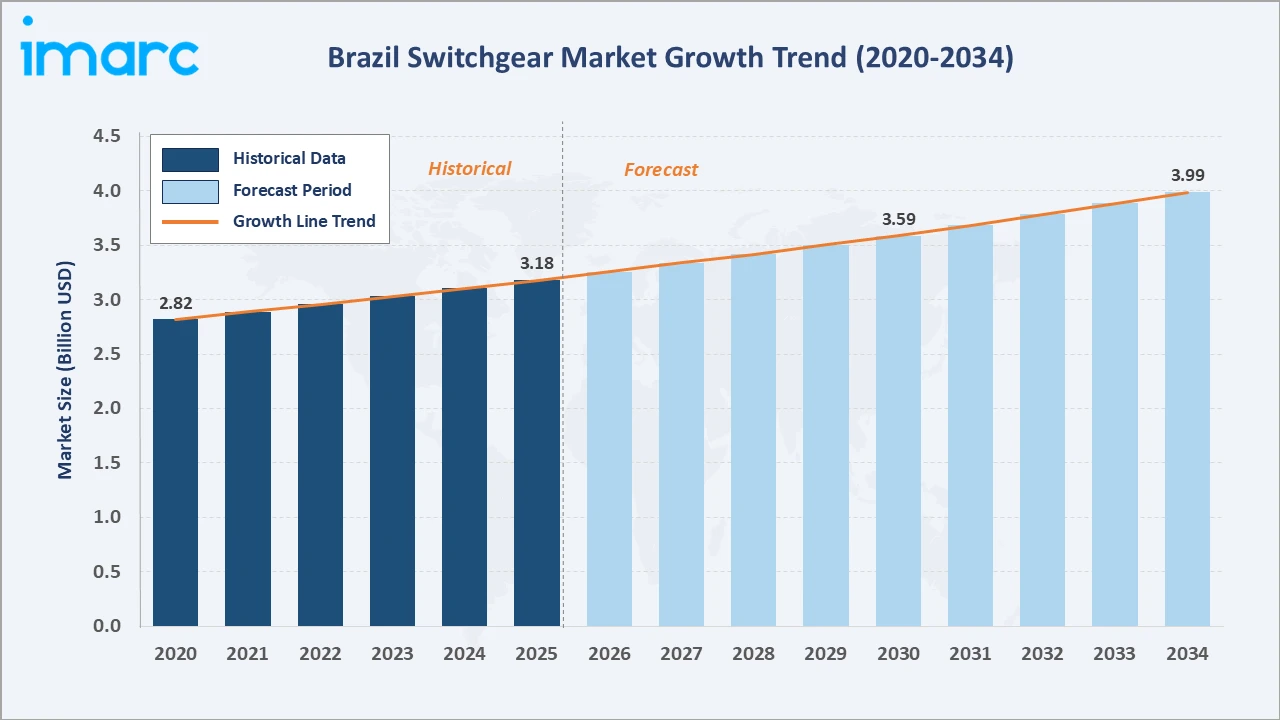
The Brazil switchgear market size increased from USD 3.18 Billion in 2025 to USD 3.28 Billion in 2026 and is projected to reach USD 3.99 Billion by 2034, growing at a CAGR of 2.45% during 2026-2034. The market is driven by expanding electrical infrastructure investment, grid modernization, and rising integration of wind and solar power into the national grid. Brazil's total renewable energy installed capacity has expanded steadily, directly increasing demand for switchgear systems capable of managing variable renewable power inputs.
The Voltage category dominates the type segment at 41.8%. The Industrial end use industry leads at 49.3%. Southeast commands 44.6% of the regional market.
Market Snapshot
|
Metric |
Value |
|
Base Year Market Size (2025) |
USD 3.18 Billion |
|
Market Size (2026) |
USD 3.28 Billion |
|
Forecast Market Size (2034) |
USD 3.99 Billion |
|
CAGR (2026-2034) |
2.45% |
|
Base Year |
2025 |
|
Historical Period |
2020-2025 |
|
Forecast Period |
2026-2034 |
|
Dominant Type Category |
Voltage (41.8%, 2025) |
|
Dominant End Use Industry |
Industrial (49.3%, 2025) |
|
Leading Region |
Southeast (44.6%, 2025) |
The market expanded from USD 2.82 Billion in 2020 to USD 3.18 Billion in 2025 and an estimated USD 3.28 Billion in 2026, anchored at USD 3.59 Billion in 2030 and forecast to reach USD 3.99 Billion by 2034. Growth has been supported by consistent investment in power infrastructure modernization, expanding renewable energy capacity, and rising regulatory emphasis on electrical installation safety, all of which sustain steady switchgear replacement and new-installation demand across the historical and forecast periods.
To get more information on this market, Request Sample
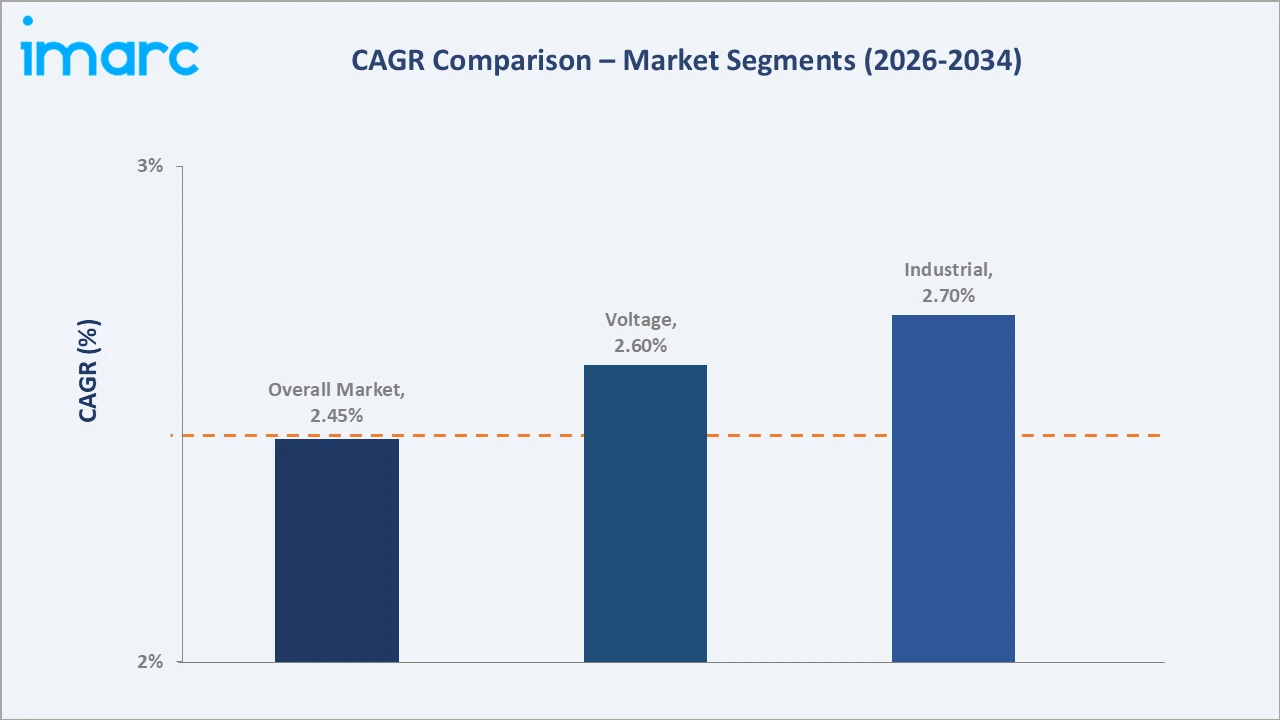
Within the type segment, Voltage grows broadly in line with the overall market as it spans low-, medium-, and high-voltage applications across all end use industries. Industrial, the leading end use industry, is expected to grow marginally above the overall market CAGR as manufacturing, mining, and agribusiness facilities continue to expand and modernize their electrical infrastructure.
Executive Summary
The Brazil switchgear market, which increased from USD 3.18 Billion in 2025 to an estimated USD 3.28 Billion in 2026, reflecting the country's sustained investment in power infrastructure modernization and the expansion of electricity distribution networks. Switchgear systems, comprising disconnect switches, fuses, and circuit breakers, form an essential component of the power value chain, protecting and isolating electrical equipment while ensuring stable, uninterrupted power supply. The market is projected to reach USD 3.99 Billion by 2034.
The Voltage category, at 41.8%, dominates the type segment by spanning the broadest set of applications across residential, commercial, industrial, and utility-scale power distribution. The Industrial end use industry, at 49.3%, leads through Brazil's diversified manufacturing base, mining operations, and agribusiness mechanization. Southeast, at 44.6%, leads regionally through its concentration of industrial, commercial, and residential infrastructure activity.
Key Market Insights
|
Insight |
Data |
|
Dominant Type Category |
Voltage - 41.8% share (2025) |
|
Dominant End Use Industry |
Industrial - 49.3% market share (2025) |
|
Leading Region |
Southeast - 44.6% market share (2025) |
|
Market Opportunity |
Smart and digital switchgear; SF6-free GIS technology; renewable grid integration; microgrid deployment |
Key Analytical Observations Supporting the Above Data:
- Voltage at 41.8%: The voltage category dominates as it provides the broadest addressable application base across residential low-voltage circuits, industrial medium-voltage networks, and utility-scale high-voltage transmission, sustaining consistent demand across virtually every end use industry.
- Industrial at 49.3%: The industrial segment leads due to Brazil's diverse manufacturing base, mining operations, and agribusiness mechanization, all of which require high-capacity, reliable switchgear to manage complex electrical loads and minimize costly downtime.
- Southeast at 44.6%: Southeast leads through its concentration of industrial, commercial, and residential infrastructure activity, supported by the region's established manufacturing base and ongoing urban development projects.
Brazil Switchgear Market Overview
The Brazil switchgear market encompasses the design, manufacture, and supply of electrical disconnect switches, fuses, and circuit breakers used to control, protect, and isolate equipment within power distribution systems. The market spans low-, medium-, and high-voltage switchgear used across transmission networks and industrial applications, alongside gas-insulated and air-insulated switchgear technologies suited to differing operational and environmental requirements.
The ecosystem integrates raw material and component suppliers, switchgear manufacturers, system integrators and distributors, utility and industrial end users, and regulatory bodies overseeing electrical safety standards. Macroeconomic factors shaping the market include rising energy demand, renewable energy expansion, urban infrastructure investment, and continuous government regulation of electrical installation safety.
Brazil's power sector has undergone substantial structural change over the past decade, with growing shares of wind and solar generation requiring corresponding upgrades to switching, protection, and control equipment throughout the distribution network. This transition, combined with ongoing urbanization and industrial expansion, continues to broaden the addressable base for switchgear manufacturers across every major end use category and region of the country.
Market Dynamics
To evaluate market opportunities, Request Sample
Market Drivers
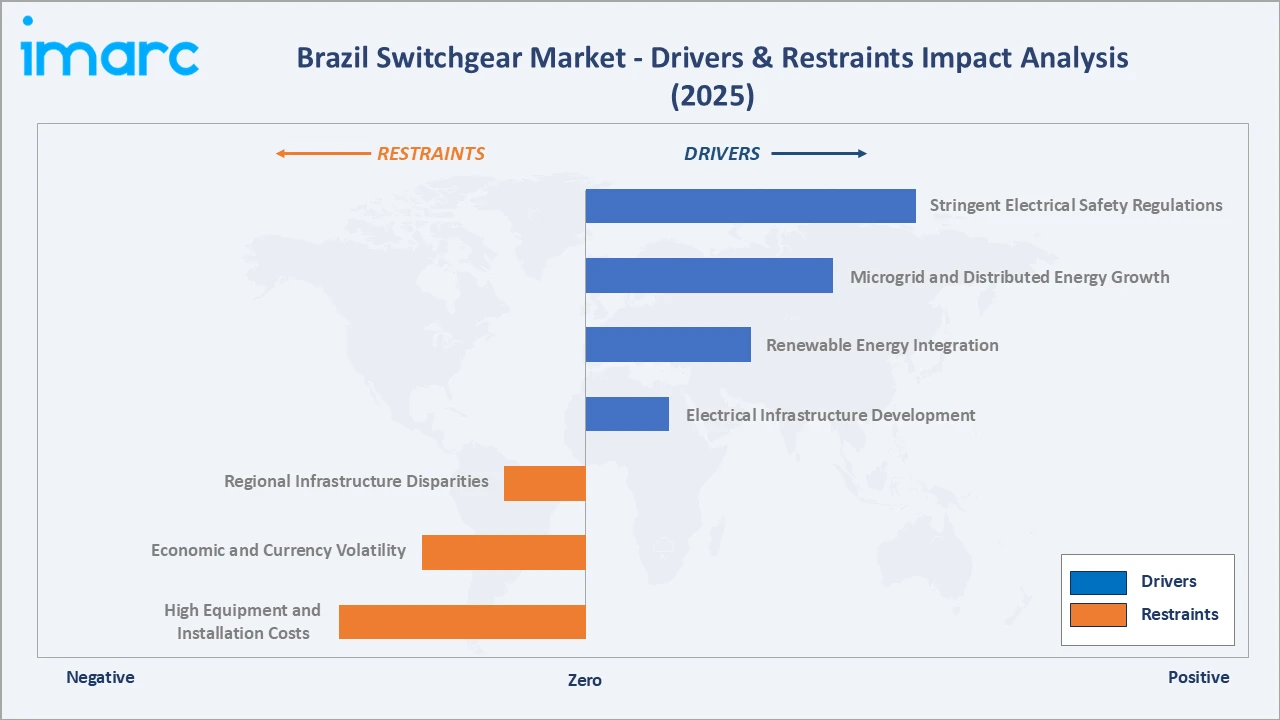
- Electrical Infrastructure Development: Brazil's growing emphasis on electrical infrastructure development is a primary factor driving market growth. Rising energy demand, which has expanded substantially over the past two decades, is necessitating expansion and modernization of transmission and distribution networks. This sustained infrastructure build-out directly increases the need for reliable, code-compliant switchgear systems across utility and industrial installations.
- Renewable Energy Integration: Brazil's expanding wind and solar capacity is driving demand for advanced switchgear capable of managing the variable power inputs associated with renewable generation. As solar and wind installations continue scaling across multiple regions, grid operators increasingly require intelligent switchgear solutions to ensure efficient integration and stable distribution of this variable power into the national grid.
- Microgrid and Distributed Energy Growth: The emergence of microgrids and distributed energy systems, particularly through programs supporting decentralized solar installations, is catalyzing demand for intelligent switchgear solutions. These small-scale, self-sustaining energy networks rely on advanced switchgear for efficient power distribution, enabling reliable operation even as they progressively multiply across urban and rural areas.
- Stringent Electrical Safety Regulations: Brazilian regulatory agencies are imposing stricter standards and norms to ensure the safety of electrical installations, catalyzing demand for modern switchgear systems that adhere to these evolving standards. Compliance with these regulations also necessitates continuous research and development efforts by manufacturers, spurring further innovation and periodic replacement cycles across the installed base.
Market Restraints
- High Equipment and Installation Costs: Advanced switchgear systems, particularly gas-insulated variants, require significant capital investment in equipment procurement, specialized installation, and skilled technical labor. These high upfront costs can slow adoption among smaller industrial and commercial operators, particularly outside Brazil's more developed industrial corridors, and may extend equipment replacement cycles beyond optimal technical lifespans.
- Economic and Currency Volatility: Brazil's periodic macroeconomic fluctuations and currency volatility can delay infrastructure investment decisions across both public and private sectors. Import-dependent components used in advanced switchgear manufacturing are particularly exposed to exchange-rate swings, which can affect procurement timing and overall project budgets for utility and industrial buyers alike.
- Regional Infrastructure Disparities: Uneven grid infrastructure development across Brazil's regions, particularly in the North and Central-West, can constrain switchgear deployment where supporting transmission and distribution networks remain comparatively underdeveloped. Addressing these disparities requires coordinated public and private investment, which can extend project timelines and limit the near-term pace of regional market expansion.
Market Opportunities
- Smart and Digital Switchgear Adoption: The growing incorporation of IoT capabilities and data analytics into switchgear products presents a significant opportunity for manufacturers. Remote monitoring, predictive maintenance, and real-time diagnostics enhance equipment reliability and reduce downtime, creating scope for premium digital switchgear offerings across utility and large industrial accounts.
- SF6-Free and Eco-Friendly GIS Technology: The transition toward sulfur hexafluoride-free gas-insulated switchgear technology offers manufacturers an opportunity to align with tightening environmental regulations while differentiating their portfolios. As sustainability considerations increasingly influence procurement decisions, eco-friendly switchgear solutions are well positioned to capture incremental demand across Brazil's regulated utility segment.
Market Challenges
- Skilled Labor Shortages: The installation and maintenance of advanced switchgear systems require specialized technical expertise that remains in limited supply across parts of Brazil. This shortage can extend project timelines, increase labor costs, and constrain the pace at which utilities and industrial operators can deploy and service modern switchgear infrastructure.
- Competitive Pricing Pressure from Regional Manufacturers: Established regional manufacturers offering cost-competitive switchgear solutions create pricing pressure for international suppliers operating in Brazil. This dynamic can compress margins for global players while requiring continuous investment in localized manufacturing and service capabilities to remain competitive on both price and delivery timelines.
Emerging Market Trends
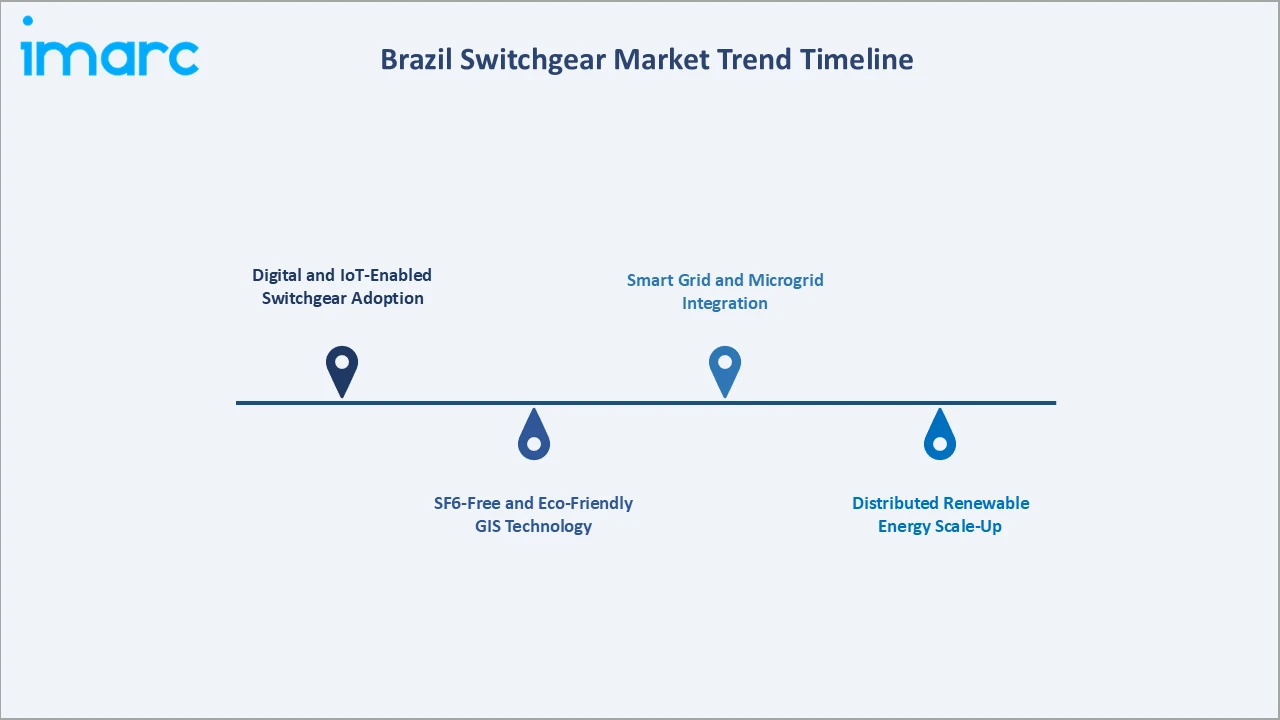
1. Digital and IoT-Enabled Switchgear Adoption
The incorporation of IoT capabilities and data analytics into switchgear products is enabling remote monitoring, predictive maintenance, and real-time diagnostics. This digital transformation is enhancing the reliability and performance of switchgear equipment while reducing downtime and maintenance costs across utility and industrial installations.
2. SF6-Free and Eco-Friendly GIS Technology
Manufacturers are increasingly introducing SF6-free gas-insulated switchgear technologies that reduce environmental impact while maintaining operational reliability. As Brazilian regulators tighten environmental standards, this shift is expected to accelerate across medium- and high-voltage applications over the forecast period.
3. Smart Grid and Microgrid Integration
The integration of switchgear into smart grid and microgrid architectures is expanding as utilities modernize aging infrastructure. Intelligent switchgear supports real-time load management and improved fault isolation, positioning it as a foundational component of Brazil's evolving grid modernization initiatives.
4. Distributed Renewable Energy Scale-Up
The continued scale-up of distributed solar and wind installations is driving demand for switchgear solutions capable of managing variable, bidirectional power flows. This trend is particularly pronounced in regions with substantial renewable capacity additions, where grid stability increasingly depends on advanced switching and protection equipment.
Industry Value Chain Analysis
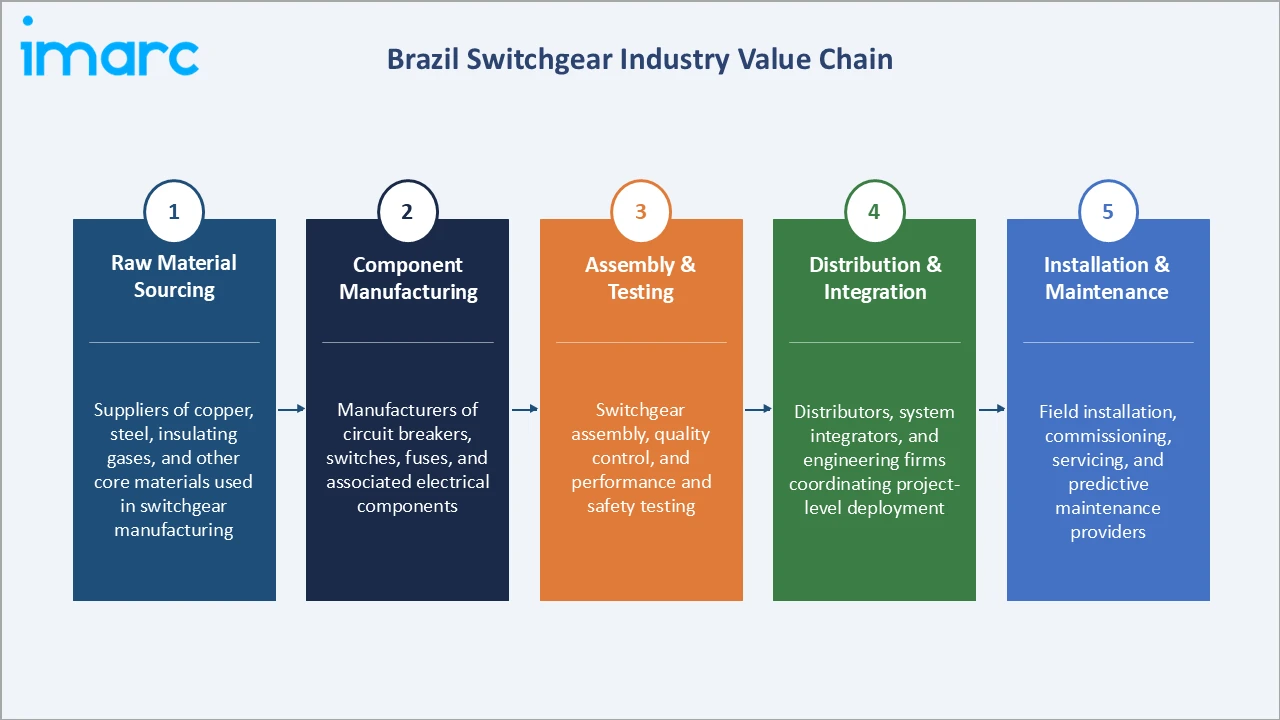
The Brazil switchgear value chain integrates raw material sourcing, component manufacturing, assembly and testing, distribution and integration, and installation and maintenance. Each stage contributes to the reliability and safety of the final installed system, with quality control and testing playing a particularly critical role given the safety-critical nature of switchgear applications.
|
Stage |
Key Participants |
|
Raw Material Sourcing |
Suppliers of copper, steel, insulating gases, and other core materials used in switchgear manufacturing |
|
Component Manufacturing |
Manufacturers of circuit breakers, switches, fuses, and associated electrical components |
|
Assembly & Testing |
Switchgear assembly, quality control, and performance and safety testing |
|
Distribution & Integration |
Distributors, system integrators, and engineering firms coordinating project-level deployment |
|
Installation & Maintenance |
Field installation, commissioning, servicing, and predictive maintenance providers |
The assembly and testing stage is the value chain's most quality-critical juncture, given the safety implications of switchgear failure in live electrical systems. The distribution and integration stage is increasingly shaped by the shift toward digitally enabled, remotely monitored switchgear systems, which require closer coordination between manufacturers, integrators, and end users. Installation and maintenance providers are also playing a growing role as utilities and industrial operators shift toward predictive, condition-based servicing models rather than fixed-interval maintenance schedules.
Technology Landscape in the Brazil Switchgear Industry
Gas-Insulated Switchgear (GIS) Technology
Gas-insulated switchgear technology offers a compact footprint, high reliability, and strong performance in space-constrained installations. GIS systems are increasingly favored for urban substations and industrial facilities where space limitations make air-insulated designs less practical, supporting growing adoption across Brazil's medium- and high-voltage applications.
Air-Insulated Switchgear (AIS) Technology
Air-insulated switchgear technology offers a cost-effective, low-maintenance alternative to gas-insulated systems, well suited to applications where space is not a primary constraint. AIS systems remain widely used across Brazil's utility and industrial installations due to lower upfront cost, ease of servicing, and a long operational track record.
SF6-Free and Digital Switchgear Technology
SF6-free switchgear technology, using pure air or vacuum-based insulation combined with digital monitoring capabilities, is emerging as a key alternative to traditional sulfur hexafluoride-based systems. This reflects a broader industry shift toward eco-friendly, digitally enabled switchgear technologies as global regulations increasingly restrict SF6 use. Wider adoption of SF6-free and digitally monitored switchgear is expected to accelerate across Brazil as manufacturers localize these technologies to align with tightening environmental standards and utilities' growing demand for real-time asset monitoring.
Market Segmentation Analysis
The report covers the following segments:
|
Segment Category |
Leading Segment |
Market Share |
Year |
|
Type |
Voltage |
41.8% |
2025 |
|
End Use Industry |
Industrial |
49.3% |
2025 |
|
Region |
Southeast |
44.6% |
2025 |

By Type
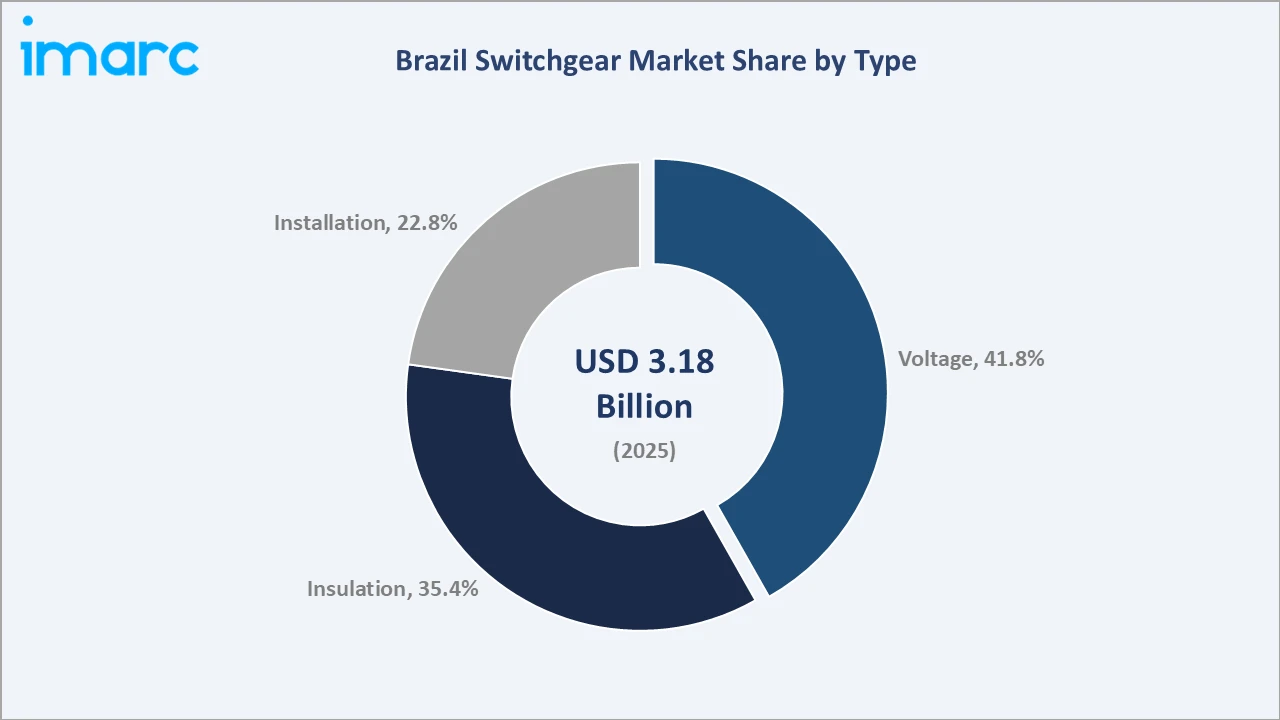
The type segment is categorized into voltage, insulation, and installation. Voltage leads at 41.8% in 2025, reflecting its application across the full spectrum of power distribution, from residential low-voltage circuits to industrial and utility-scale high-voltage transmission networks.
To access detailed market analysis, Request Sample
Insulation follows at 35.4%, encompassing gas-insulated switchgear (GIS), air-insulated switchgear (AIS), and other insulation technologies suited to varying environmental and space requirements. Installation, covering indoor and outdoor configurations, accounts for 22.8%, reflecting the smaller but steady demand for setup-specific switchgear adapted to differing operational and climatic conditions across Brazil.
By End Use Industry
Industrial leads the end use industry segment at 49.3%, driven by the expansion of manufacturing facilities, mining operations, and agro-industrial infrastructure that require high-capacity switchgear to manage complex electrical loads.
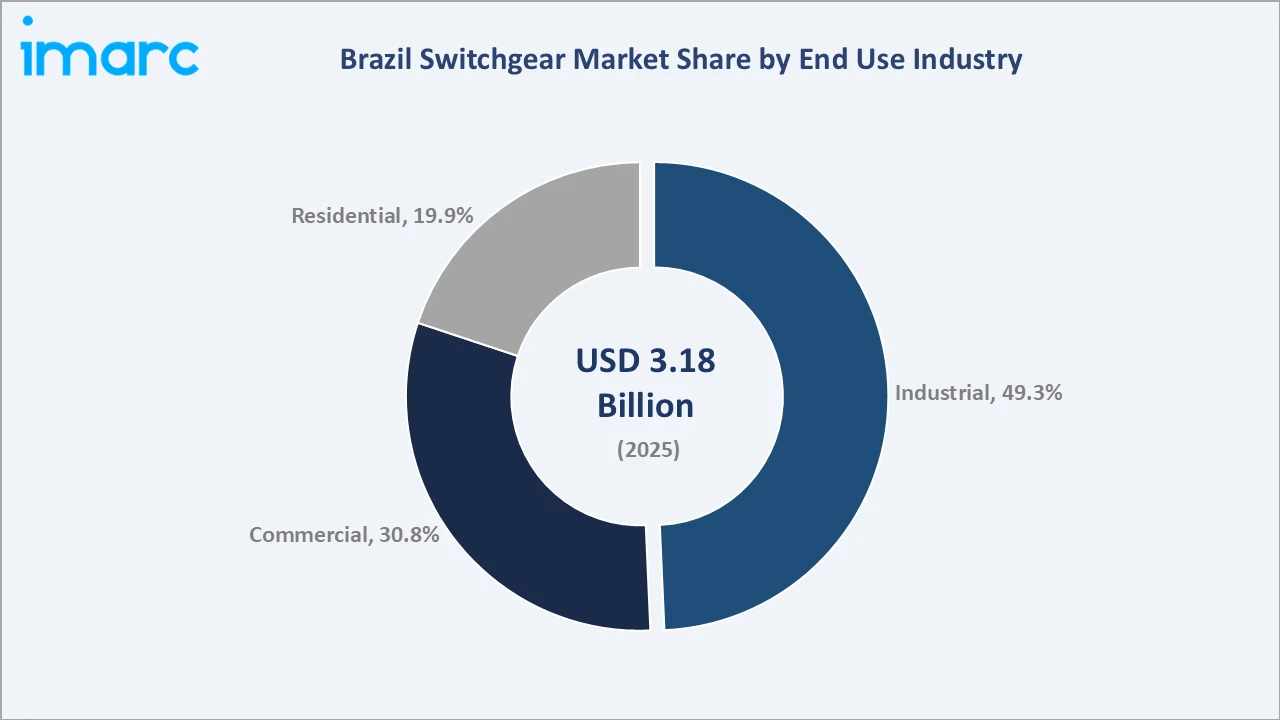
Commercial follows at 30.8%, supported by urban expansion and construction of commercial complexes requiring reliable electrical distribution systems. Residential accounts for 19.9%, reflecting growing adoption of electrical appliances and smart home technologies that necessitate robust, safety-compliant switchgear solutions.
Regional Market Insights
|
Region |
Share (2025) |
Key Market Drivers & Characteristics |
|
Southeast |
44.6% |
Largest regional market, supported by concentrated industrial activity, established manufacturing infrastructure, and ongoing urban and commercial development |
|
South |
21.8% |
Diversified industrial base and steady demand from manufacturing and agribusiness activities requiring reliable electrical infrastructure |
|
Northeast |
15.7% |
Growing renewable energy capacity additions requiring advanced switchgear to manage variable power inputs and support grid stability |
|
Central-West |
9.6% |
Agricultural hub with expanding mechanization and agro-industrial facility development driving steady infrastructure investment |
|
North |
8.3% |
Emerging market supported by gradual urbanization and incremental electrical infrastructure expansion and modernization |
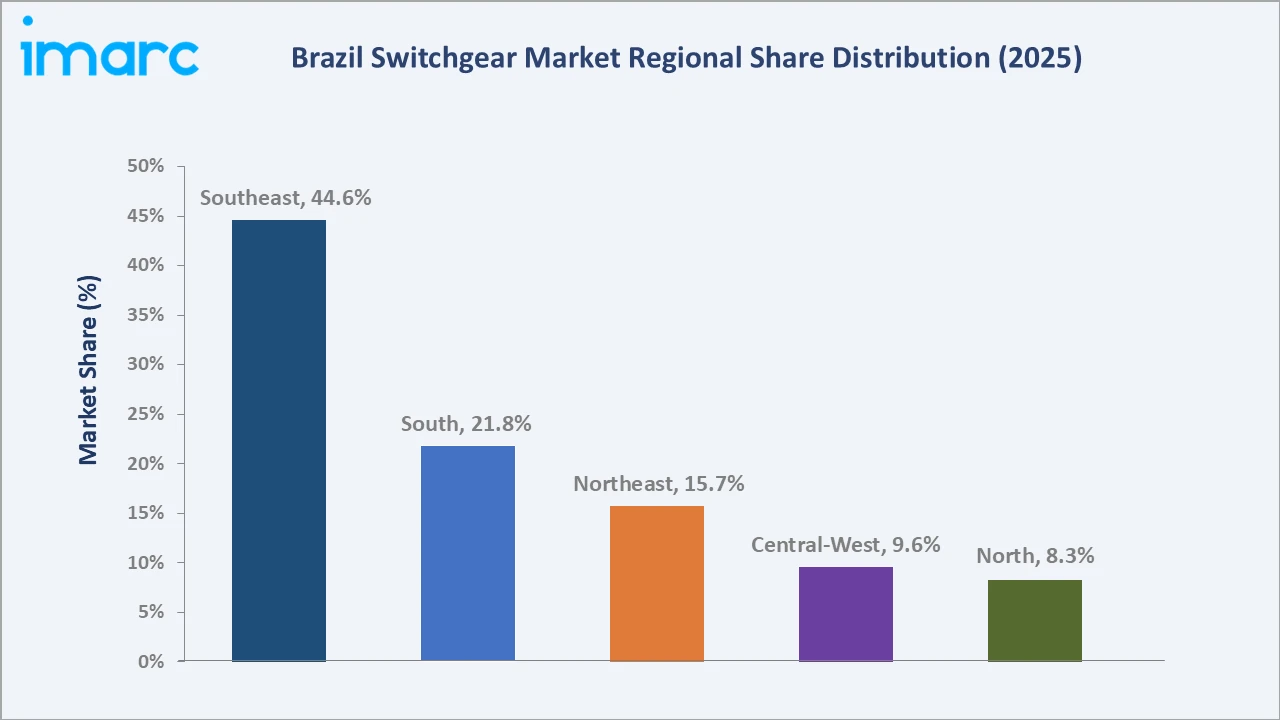
Southeast, at 44.6%, leads through its concentration of industrial, commercial, and residential infrastructure activity. South, at 21.8%, reflects diversified industrial demand, while Northeast's 15.7% share is increasingly anchored by renewable capacity additions. Central-West and North, at 9.6% and 8.3% respectively, represent smaller but steadily growing markets tied to agribusiness mechanization and gradual regional urbanization.
Competitive Landscape
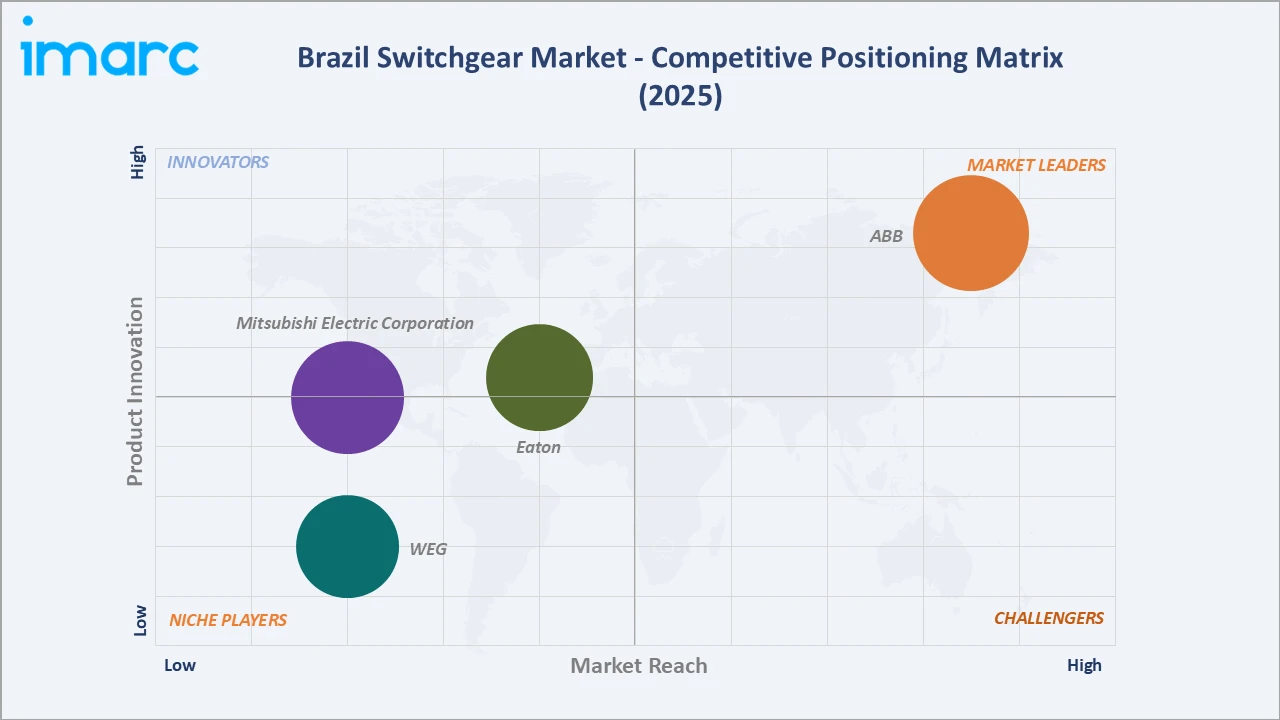
The Brazil switchgear market competitive landscape is moderately consolidated, comprising global electrical equipment conglomerates alongside established regional manufacturers. Competition is centered on product reliability, technological innovation, digital monitoring capabilities, and distribution network strength across Brazil's diverse geographic terrain.
|
Company Name |
Key Products |
Market Position |
Core Strength |
|
ABB |
Low voltage switchgear, Medium voltage switchgear |
Market Leader |
ABB specializes in eco-friendly, digitally enabled switchgear solutions for utility and industrial applications. |
|
Eaton |
Low and Medium Voltage Switchgear |
Established Player |
Eaton provides a broad portfolio of power distribution and protection equipment. |
|
Mitsubishi Electric Corporation |
High-Voltage Switchgear Systems |
Established Player |
Mitsubishi Electric Corporation specializes in high-reliability switchgear for utility and industrial applications. |
|
WEG |
Low and Medium Voltage Switchgear |
Niche Player |
WEG is a Brazil-based manufacturer with strong domestic distribution and localized production capabilities. |
Key players include ABB, Eaton, Mitsubishi Electric Corporation, WEG, and others.
Key Company Profiles
ABB
ABB is a global technology company with a strong presence in the Brazil switchgear market through its portfolio of digitally enabled, eco-friendly switchgear systems.
- Key Products: Gas-Insulated and Air-Insulated Switchgear
- Recent Developments: In February 2026, ABB announced the expansion of its low-voltage switchgear manufacturing capacity across Europe by increasing production of its MNS low-voltage switchgear by 120% at its facilities in Brno, Czech Republic, and Rakovski, Bulgaria. The capacity expansion is aimed at meeting the growing demand for reliable low-voltage power distribution solutions driven by industrial electrification, data centers, infrastructure modernization, and the energy transition across Europe.
- Strategic Focus: Expanding digital and sustainable switchgear offerings to support Brazil's grid modernization and renewable energy integration initiatives. The company is also strengthening its local manufacturing and service footprint to improve delivery timelines and reduce dependence on imported components across its Brazilian operations.
Eaton
Eaton Corporation plc is a global intelligent power management company with a strong presence in Brazil through its low- and medium-voltage switchgear portfolio.
- Key Products: Low and Medium Voltage Switchgear
- Strategic Focus: Expanding switchgear manufacturing capacity to meet rising demand from AI-driven data centers, industrial electrification, and grid modernization. The company is also broadening its digital power management portfolio, including Brightlayer monitoring systems, to support utilities and industrial customers seeking improved asset visibility and reliability.
Market Concentration Analysis
The Brazil switchgear market is moderately concentrated, with a small group of global electrical equipment manufacturers accounting for a significant share of total revenue, alongside a meaningful presence of established regional manufacturers. Market concentration is expected to remain broadly stable over the forecast period, as global suppliers continue to invest in local manufacturing and service capabilities while regional players defend their position through cost competitiveness and distribution reach.
Consolidation pressure is likely to remain limited through the forecast period, as the scale of Brazil's ongoing infrastructure investment supports steady demand growth across both global and regional suppliers. Regional manufacturers with strong domestic production capabilities are expected to retain a durable share of lower- and medium-voltage applications, while global Tier-1 suppliers continue to lead in high-voltage, digitally enabled, and environmentally compliant product categories.
Investment & Growth Opportunities
Highest Growth Segments
The Industrial end use industry and the Voltage type category represent the highest-value investment vectors through 2034, supported by sustained industrial electrification, renewable energy integration, and continuous grid modernization investment across Brazil's power infrastructure.
Emerging Investment Opportunities
Digital and SF6-free switchgear technologies represent the market's highest-growth emerging investment opportunities, as utilities and industrial operators increasingly prioritize predictive maintenance capabilities and environmentally compliant equipment amid tightening regulatory standards.
Investment Themes
- Digital Switchgear Manufacturing Investment: Investment in IoT-enabled, digitally monitored switchgear manufacturing capacity represents a structural opportunity as Brazilian utilities and large industrial operators increasingly prioritize remote diagnostics and predictive maintenance capabilities to reduce unplanned downtime.
- SF6-Free GIS Technology Localization: Localizing production of SF6-free gas-insulated switchgear technology within Brazil offers manufacturers a durable cost and regulatory-compliance advantage as environmental standards continue to tighten across the region's utility and industrial segments.
Future Market Outlook (2026-2034)
The Brazil switchgear market is projected to grow from USD 3.18 Billion in 2025 to USD 3.28 Billion in 2026, reaching USD 3.99 Billion by 2034, delivering a 2.45% CAGR over the forecast period. The market's anchor value of USD 3.59 Billion in 2030 reflects steady, infrastructure-driven expansion rather than the disruptive growth patterns seen in some adjacent technology markets. Digital and smart switchgear technologies are expected to see wider adoption as utilities and industrial operators prioritize real-time monitoring and predictive maintenance capabilities.
Renewable energy integration, particularly in regions with substantial wind and solar capacity additions, will continue to drive demand for switchgear solutions capable of managing variable power inputs and ensuring grid stability through the forecast period. SF6-free gas-insulated switchgear technology is expected to gain wider mainstream adoption as environmental regulations tighten, while continued urbanization and industrial expansion across Brazil's regions will sustain steady, broad-based demand growth through 2034.
Three structural factors underpin the market's outlook through 2034: continued grid modernization investment by utilities seeking to reduce transmission and distribution losses, the steady scale-up of distributed and utility-scale renewable generation requiring compatible switching infrastructure, and tightening regulatory standards that are progressively shifting procurement toward digitally enabled, environmentally compliant switchgear technologies across all major end use industries.
Research Methodology
Primary Research
Primary research comprised structured interviews with industry stakeholders, including utility infrastructure planners, switchgear manufacturers, system integrators, and electrical engineering specialists across Brazil's power sector.
Secondary Research
Secondary research encompassed company annual reports, energy consumption and demand data from recognized international agencies, renewable capacity statistics from national and international bodies, and Brazilian regulatory publications on electrical infrastructure and safety standards. Trade association publications, industry conference proceedings, and government infrastructure investment disclosures were also reviewed to validate demand assumptions across each regional and end use market.
Forecasting Models
Market revenue forecasts were developed using a bottom-up approach incorporating historical market trends from 2020 to 2025, regional infrastructure investment patterns, and forward-looking assumptions on renewable energy integration and industrial electrification through 2034.
Brazil Switchgear Market Report Coverage:
| Report Features | Details |
|---|---|
| Base Year of the Analysis | 2025 |
| Historical Period | 2020-2025 |
| Forecast Period | 2026-2034 |
| Units | Billion USD |
| Scope of the Report | Exploration of Historical and Forecast Trends, Industry Catalysts and Challenges, Segment-Wise Historical and Predictive Market Assessment:
|
| Types Covered |
|
| End Use Industries Covered | Commercial, Residential, Industrial |
| Regions Covered | Southeast, South, Northeast, North, Central-West |
| Companies Covered | ABB, Eaton, Mitsubishi Electric Corporation, WEG, etc. |
| Customization Scope | 10% Free Customization |
| Post-Sale Analyst Support | 10-12 Weeks |
| Delivery Format | PDF and Excel through Email (We can also provide the editable version of the report in PPT/Word format on special request) |
Key Benefits for Stakeholders:
- IMARC’s industry report offers a comprehensive quantitative analysis of various market segments, historical and current market trends, market forecasts, and dynamics of the Brazil switchgear market from 2020-2034.
- The research report provides the latest information on the market drivers, challenges, and opportunities in the Brazil switchgear market.
- Porter's five forces analysis assist stakeholders in assessing the impact of new entrants, competitive rivalry, supplier power, buyer power, and the threat of substitution. It helps stakeholders to analyze the level of competition within the Brazil switchgear industry and its attractiveness.
- Competitive landscape allows stakeholders to understand their competitive environment and provides an insight into the current positions of key players in the market.
Frequently Asked Questions About the Brazil Switchgear Market Report
The Brazil switchgear market size is estimated at USD 3.28 Billion in 2026, driven by the Voltage type category leading at 41.8%, the Industrial end use industry leading at 49.3%, and Southeast commanding 44.6% of regional market share.
The Brazil switchgear market grows at 2.45% CAGR during 2026-2034, reaching USD 3.99 Billion by 2034. This growth reflects continued grid modernization, renewable energy integration, and steady industrial and urban infrastructure investment across the country.
The Voltage category leads at 41.8%, capturing the broadest application base across residential, commercial, industrial, and utility-scale power distribution. This segment grows broadly in line with the overall market through sustained infrastructure investment.
Industrial leads at 49.3% through the highest concentration of high-capacity electrical load requirements and compounding manufacturing, mining, and agribusiness demand, creating sustained procurement expansion across the forecast period.
Southeast leads at 44.6% through its concentration of industrial, commercial, and residential infrastructure activity, followed by South at 21.8% and Northeast at 15.7% through growing renewable energy capacity additions.
Leading companies include ABB, Eaton, Mitsubishi Electric Corporation, WEG, and others.
The Brazil switchgear market is projected to reach approximately USD 3.59 Billion by 2030, with SF6-free gas-insulated switchgear technology gaining wider adoption and digital, IoT-enabled switchgear becoming increasingly standard across new utility and industrial installations.
Two priority investment opportunities stand out: digital and IoT-enabled switchgear manufacturing capacity, and localized SF6-free gas-insulated switchgear technology production aligned with Brazil's tightening environmental regulations.
Need more help?
- Speak to our experienced analysts for insights on the current market scenarios.
- Include additional segments and countries to customize the report as per your requirement.
- Gain an unparalleled competitive advantage in your domain by understanding how to utilize the report and positively impacting your operations and revenue.
- For further assistance, please connect with our analysts.
 Request Customization
 Speak to an Analyst
 Request Brochure
 Inquire Before Buying
Benefits of Customization
- Personalize this research
- Triangulate with your data
- Get data as per your format and definition
- Gain a deeper dive into a specific application, geography, customer, or competitor
- Any level of personalization
Get in Touch With Us
UNITED STATES
Phone: +1-201-971-6302
INDIA
Phone: +91-120-433-0800
UNITED KINGDOM
Phone: +44-753-714-6104
Email: [email protected]
Client Testimonials




.webp)




.webp)













Related Reports

Choose your plan
*Please note that the prices mentioned below are starting prices for each bundle type. Kindly contact our team for further details.*
Single User License
- 1 User License, Access on 2 Devices
- PDF Report + Excel Dataset (Password Protected)
- Lifetime Access
- No Printing Rights
- 10% Free Report Customization
- 10–12 Weeks of Analyst Support
Five User License
- Access for 5 Users, 2 Devices per User
- PDF Report + Excel Dataset (Password Protected)
- Lifetime Access
- Dedicated Account Manager
- 12–14 Weeks of Analyst Support
- No Printing Rights
- 15% Free Report Customization
- 25% Discount on Your Next Purchase
Corporate User License
- Unlimited User Access (Within Your Organization)
- PDF Report + Excel Dataset
- Lifetime Access
- Dedicated Account Manager
- 14–20 Weeks of Analyst Support
- No Printing Rights
- 20% Free Report Customization
- 30% Discount on Your Next Purchase
Essential Insights
What's included:
3 reports
- Lifetime Access
- PDF Reports
- Excel Datasets
- 2 Weeks of Free Analyst Support
- 2 User Licenses
- Access on 2 Devices
- Printing Rights
- Complimentary PowerPoint (PPT) Version
- Complimentary License Upgrade
Professional Access
What's included:
5 reports
- Lifetime Access
- PDF Reports
- Excel Datasets
- 8 Weeks of Free Analyst Support
- 2 User Licenses
- Access on 2 Devices
- Printing Rights
- Complimentary PowerPoint (PPT) Version
- Complimentary License Upgrade
Business Advantage
What's included:
8 reports
- Lifetime Access
- PDF Reports
- Excel Datasets
- 14 Weeks of Free Analyst Support
- 2 User Licenses
- Access on 2 Devices
- Printing Rights
- Complimentary PowerPoint (PPT) Version
- Complimentary License Upgrade
Enterprise Intelligence
What's included:
10 reports
- Lifetime Access
- PDF Reports
- Excel Datasets
- 20 Weeks of Free Analyst Support
- 2 User Licenses
- Access on 2 Devices
- Printing Rights
- Complimentary PowerPoint (PPT) Version
- Complimentary License Upgrade