
Europe Commercial Printing Market Size, Share, Trends and Forecast by Technology, Print Type, Application, and Country, 2026-2034
Europe Commercial Printing Market Size, Share, Trends & Forecast (2026-2034)
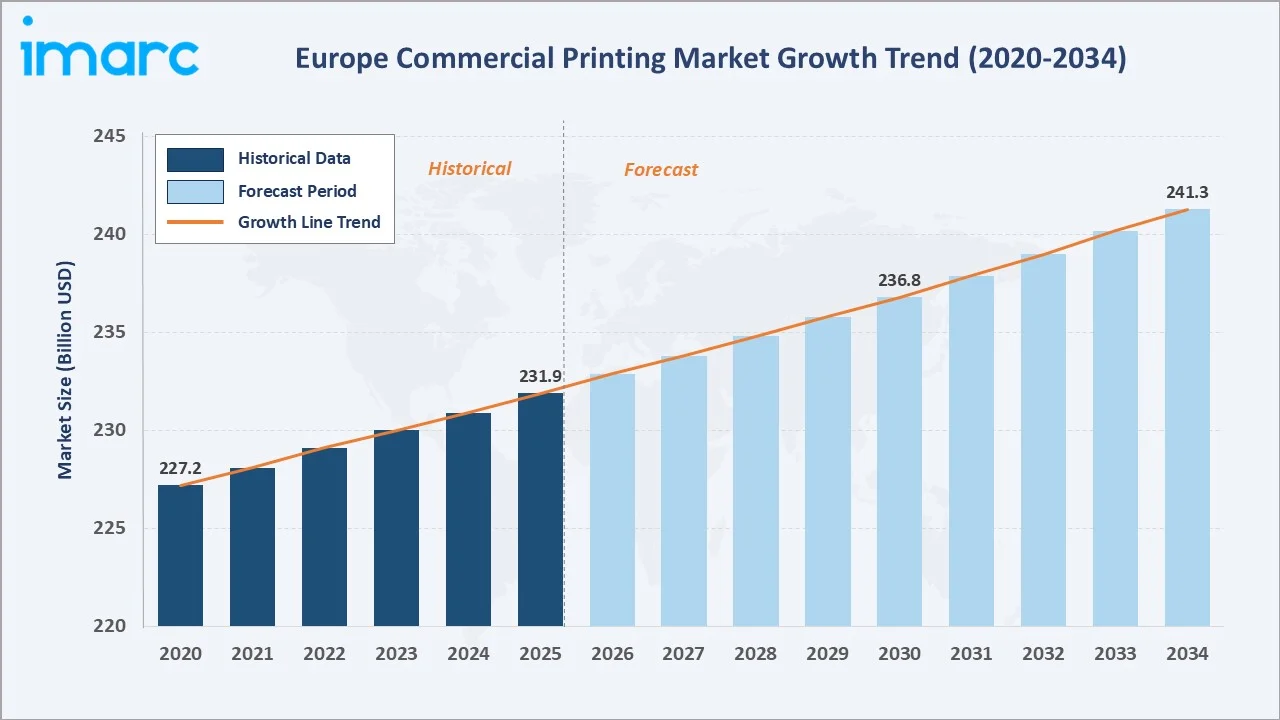
The Europe commercial printing market grew from USD 231.9 Billion in 2025 to USD 233.4 Billion in 2026 and is projected to reach USD 241.3 Billion by 2034. The market’s modest growth reflects the increasing shift toward digital media and online communication, which continues to influence demand for traditional commercial printing services. Image leads the print type segment at 46.3%, packaging dominates the application segment at 52.6%, and Germany holds 26.8% country-wise share.
Market Snapshot
|
Metric |
Value |
| Base Year Market Size (2025) |
USD 231.9 Billion |
| Market Size (2026) | USD 233.4 Billion |
|
Forecast Market Size (2034) |
USD 241.3 Billion |
|
Base Year |
2025 |
|
Historical Period |
2020-2025 |
|
Forecast Period |
2026-2034 |
|
Largest Country |
Germany (26.8%, 2025) |
|
Second Largest Country |
United Kingdom (20.7%, 2025) |
|
Leading Print Type |
Image (46.3%, 2025) |
|
Leading Application |
Packaging (52.6%, 2025) |
The Europe commercial printing market advanced from USD 227.2 Billion in 2020 to USD 231.9 Billion in 2025 and an estimated USD 233.4 Billion in 2026, supported by steady packaging demand and gradual digital press adoption despite softening publishing volumes. Anchored at USD 236.8 Billion in 2030, the climb to USD 241.3 Billion by 2034 reflects continued but modest expansion as sustainability regulation reshapes production across converters.
To get more information on this market, Request Sample
Executive Summary
The Europe commercial printing industry size is progressing along a measured growth path, expanding from USD 227.2 Billion in 2020 to USD 233.4 Billion in 2026, and is projected to reach USD 241.3 Billion by 2034. The industry has shifted decisively toward packaging-led production as advertising and publishing print volumes contract under digital substitution. Sustainability regulation, workflow automation, and short-run digital printing are reshaping how converters compete, while packaging printers benefit from steady e-commerce-driven order flow across the region's major economies.
Image leads the print type segment at 46.3% in 2025, supported by continued demand for labels, packaging graphics, and promotional print. Packaging leads the application segment at 52.6%, reflecting the region's expanding parcel and consumer-goods shipment volumes. Germany commands a 26.8% market share, supported by its strong manufacturing base and established retail sector.
Key Market Insights
|
Insight |
Data |
|
Leading Print Type |
Image - 46.3% share (2025) |
|
Second Largest Print Type |
Pattern - 28.7% share (2025) |
|
Leading Application |
Packaging - 52.6% share (2025) |
|
Second Largest Application |
Advertising - 27.8% share (2025) |
|
Leading Country |
Germany - 26.8% share (2025) |
|
Second Largest Country |
United Kingdom - 20.7% share (2025) |
|
Top Companies |
Bertelsmann SE & Co. KGaA, Cimpress plc, Smurfit Westrock plc, Mondi plc, Amcor plc |
Key Analytical Observations Expanding On the Data Above:
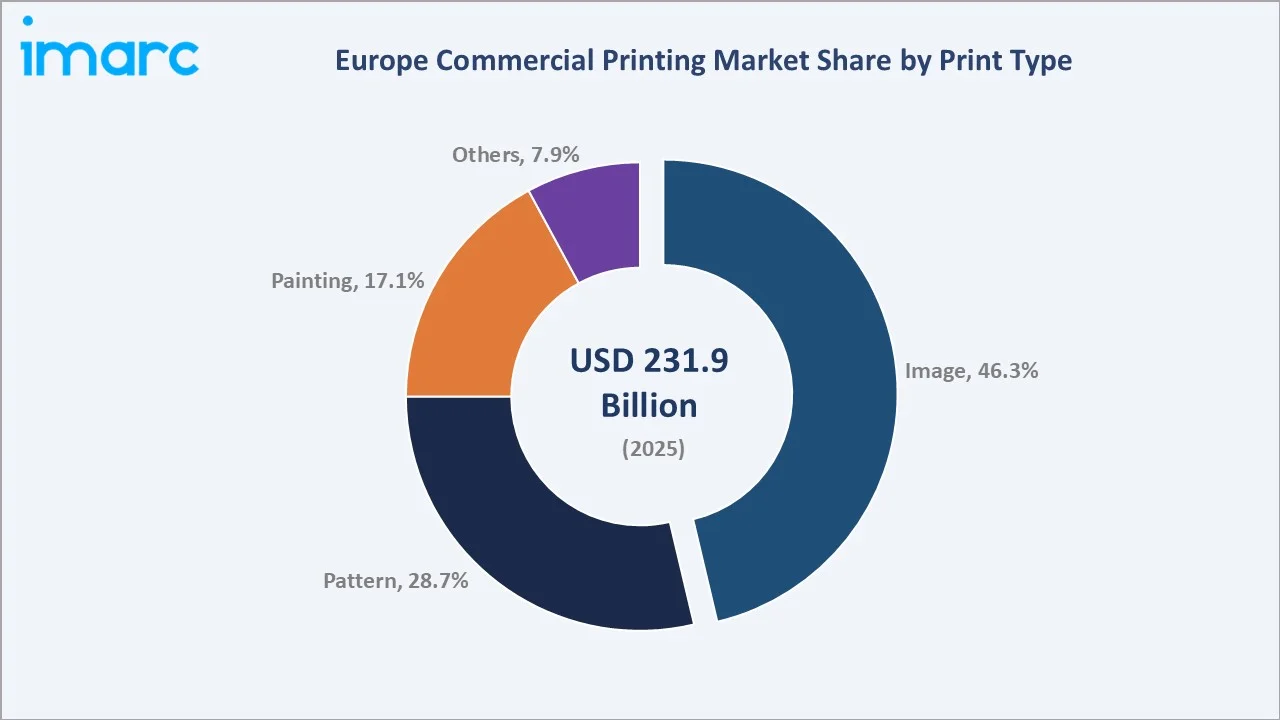
- Image dominance at 46.3% is supported by sustained demand for packaging graphics, product labels, and photo-realistic promotional print across consumer goods and retail categories.
- Pattern at 28.7% remains significant across textile-adjacent packaging, decorative substrates, and specialty commercial print applications.
- Packaging leadership at 52.6% reflects structural e-commerce growth, rising demand for product presentation, and the continued need for printed packaging across the retail and consumer goods sectors.
- Advertising share at 27.8% is supported by continued spending on promotional materials, point-of-sale displays, direct mail, and other targeted print advertising formats.
- Germany at 26.8% is anchored by a large industrial base, advanced press technology, and strong automotive and pharmaceutical packaging demand.
Europe Commercial Printing Market Overview
Commercial printing covers the reproduction of images, patterns, paintings, and other visual content onto paper, board, film, and specialty substrates for packaging, advertising, and publishing use. The market spans offset, digital, flexographic, and gravure processes serving brand owners, retailers, publishers, and advertising agencies across the region.
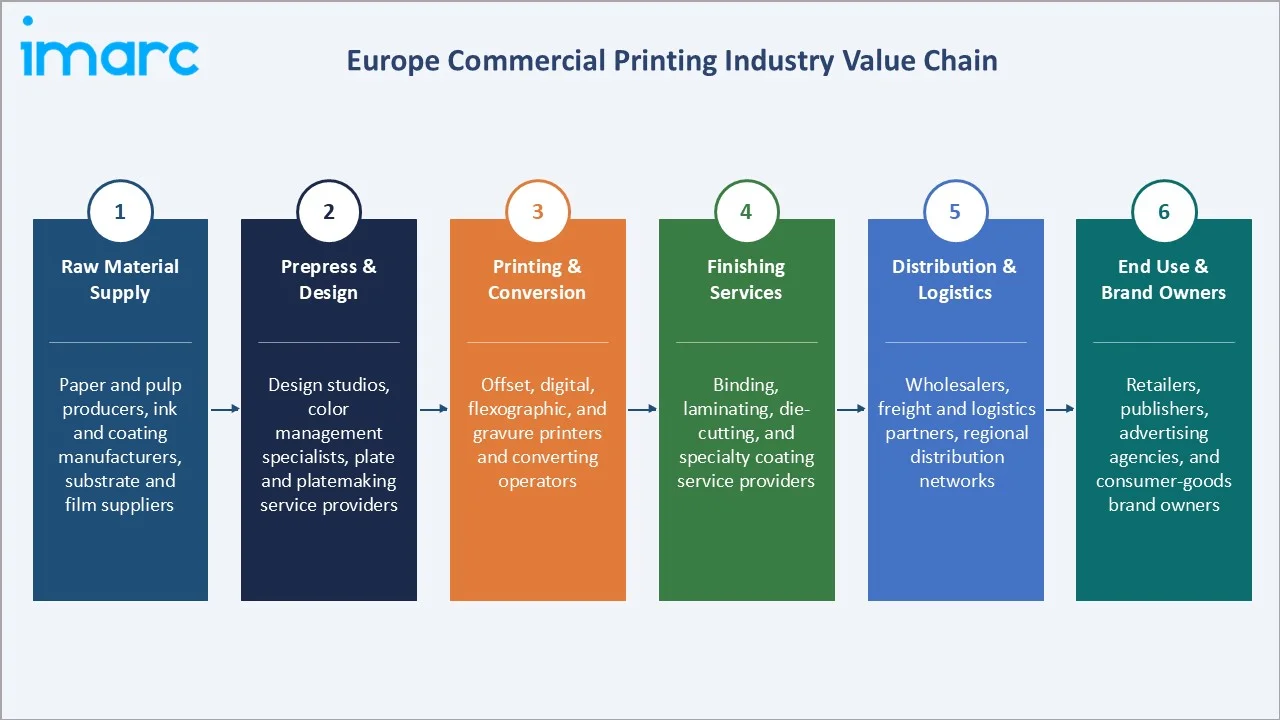
The European ecosystem integrates raw material suppliers, prepress and design studios, printers and converters, distribution and logistics networks, and regulatory bodies overseeing packaging waste and recyclability standards. Macroeconomic factors, including energy costs, industrial output, and consumer spending on packaged goods, directly influence converter volumes and capital investment in press technology across the region.
Market Dynamics
To evaluate market opportunities, Request Sample
Market Drivers
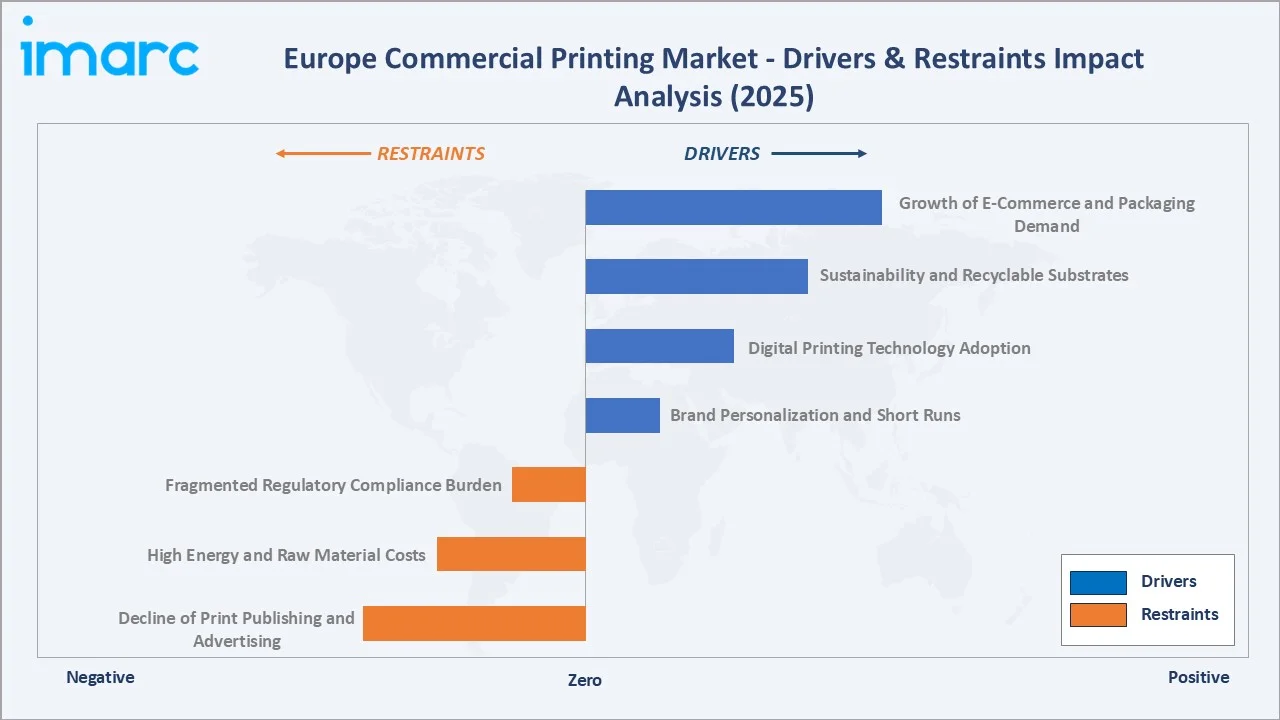
- Growth of E-Commerce and Packaging Demand: Rising parcel volumes and packaged-goods shipments are lifting demand for corrugated, label, and flexible packaging print across the commercial printing industry in Europe, spanning retail and consumer categories.
- Sustainability and Recyclable Substrates: Increasing sustainability requirements are pushing brand owners toward recyclable and mono-material substrates, favoring converters with sustainable ink and material capabilities.
- Digital Printing Technology Adoption: Short-run, variable-data digital presses are expanding capacity for personalized packaging and promotional print. At FESPA 2025 in Berlin, EFI showcased advanced digital printing solutions for signage and packaging, underscoring accelerating technology investment.
- Brand Personalization and Short Runs: Retailers and consumer brands are increasingly commissioning shorter, more frequent print runs to support localized campaigns and seasonal packaging variants.
Market Restraints
- Decline of Print Publishing and Advertising: Digital media substitution continues to erode volumes in newspapers, magazines, and traditional advertising print, placing structural pressure on publication and advertising print segments even as packaging paper and board output holds broadly stable.
- High Energy and Raw Material Costs: Energy-intensive printing and paper-making operations remain exposed to elevated European electricity and gas prices relative to global competitors, compressing converter margins.
- Fragmented Regulatory Compliance Burden: Overlapping national and EU-level packaging, labelling, and environmental rules raise compliance costs, particularly for small and mid-sized printing businesses operating across multiple markets.
Market Opportunities
- Sustainable Packaging Innovation: Growing brand demand for recyclable, fiber-based, and mono-material packaging print, as shown by the Europe commercial printing industry analysis, creates opportunities for converters investing early in compliant substrates and inks.
- Digital Workflow and Automation Services: Managed print, automated prepress, and cloud-based color management services present recurring-revenue opportunities beyond traditional press output.
Market Challenges
- Overcapacity in Legacy Offset and Gravure: Structural decline in publication print volumes leaves some legacy web offset and gravure capacity underutilized, pressuring pricing across the region.
- Skilled Labor Availability: An aging workforce and limited entry of new technical talent constrain capacity expansion at several regional print and finishing operations.
Emerging Market Trends
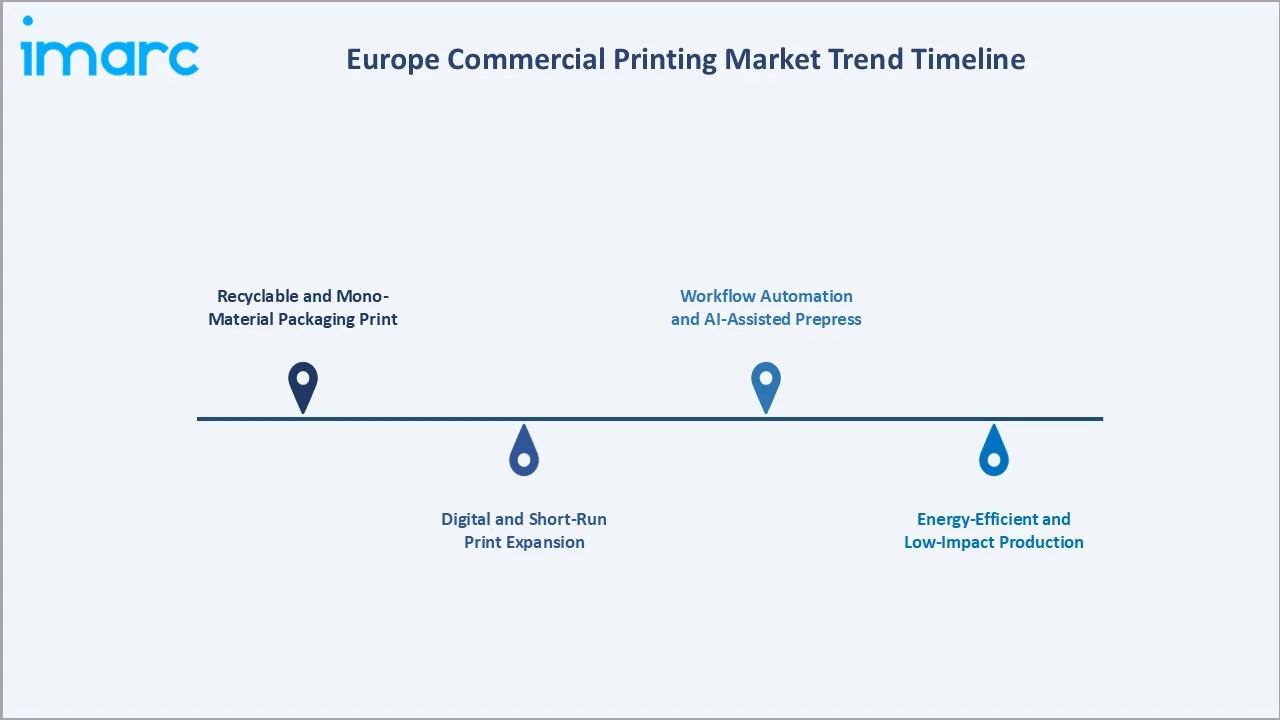
1. Recyclable and Mono-Material Packaging Print
Converters are shifting toward mono-material and fiber-based packaging substrates, driven by growing sustainability requirements, improved recyclability, and increasing demand for environmentally responsible packaging solutions.
2. Digital and Short-Run Print Expansion
Variable-data digital presses are steadily displacing conventional offset runs for personalized packaging, promotional inserts, and localized campaign material, supporting faster turnaround, lower setup waste, and broader Europe commercial printing industry growth across mid-sized converters.
3. Workflow Automation and AI-Assisted Prepress
Automated color management, AI-assisted imposition, and cloud-based job routing are reducing prepress turnaround times, enabling converters to absorb shorter, more frequent order batches without proportional increases in headcount.
4. Energy-Efficient and Low-Impact Production
Rising energy costs are accelerating investment in energy-efficient presses, heat-recovery systems, and lower-temperature curing inks, helping converters manage operating costs while meeting tightening environmental performance expectations.
Industry Value Chain Analysis
The Europe commercial printing value chain spans six stages from raw material supply through end-use delivery to brand owners and publishers. Printing and conversion, along with prepress and design, capture the highest value-add, while distribution and finishing capabilities increasingly determine converter competitiveness in a packaging-led market.
|
Stage |
Key Players / Examples |
|
Raw Material Supply |
Paper and pulp producers, ink and coating manufacturers, substrate and film suppliers |
|
Prepress & Design |
Design studios, color management specialists, plate and platemaking service providers |
|
Printing & Conversion |
Offset, digital, flexographic, and gravure printers and converting operators |
|
Finishing Services |
Binding, laminating, die-cutting, and specialty coating service providers |
|
Distribution & Logistics |
Wholesalers, freight and logistics partners, regional distribution networks |
|
End Use & Brand Owners |
Retailers, publishers, advertising agencies, and consumer-goods brand owners |
Vertically integrated players with in-house prepress, sustainable substrate sourcing, and finishing capability are positioned to capture greater value than converters reliant on third-party inputs at multiple value chain stages.
Technology Landscape in the Europe Commercial Printing Industry
Digital Printing and Variable Data Systems
Modern digital presses are enabling converters to produce shorter, more frequent runs with variable data, supporting personalized packaging, promotional inserts, and localized advertising material without the setup costs typical of long offset runs.
Sustainable Substrates and Inks
Material science advances in recyclable coatings, water-based and UV-curable inks, and mono-material laminate structures are helping converters meet recyclability targets while maintaining print quality and barrier performance for packaging applications.
Workflow Automation and Color Management
Cloud-based job routing and AI-assisted color matching are shortening prepress cycles, allowing mid-sized converters to compete on turnaround time against larger, more automated operations.
Smart Connectivity and Traceability
Serialization, QR-based traceability, and connected packaging features are gaining adoption as brand owners seek supply chain transparency and consumer engagement tools embedded directly within printed packaging and labels.
Market Segmentation Analysis
The report covers the following segments:
|
Segment Category |
Leading Segment |
Market Share |
Year |
|
Technology |
Lithographic Printing |
🔒 |
2025 |
|
Print Type |
Image |
46.3% |
2025 |
|
Application |
Packaging |
52.6% |
2025 |
|
Country |
Germany |
26.8% |
2025 |

By Print Type
Image commands a 46.3% majority share in 2025, driven by sustained demand for packaging graphics, product labels, and photo-realistic promotional print across consumer goods, retail, and food and beverage categories. The segment benefits from continued investment in high-resolution digital and offset press technology across the region.
To access detailed market analysis, Request Sample
Pattern follows at 28.7%, supported by decorative packaging, specialty substrates, and textile-adjacent commercial print applications.
By Application
Packaging leads the application segment with 52.6% share in 2025, reflecting the region's expanding e-commerce, food and beverage, and consumer-goods shipment volumes. The segment benefits from resilient reorder cycles and growing demand for sustainable, print-optimized packaging formats.
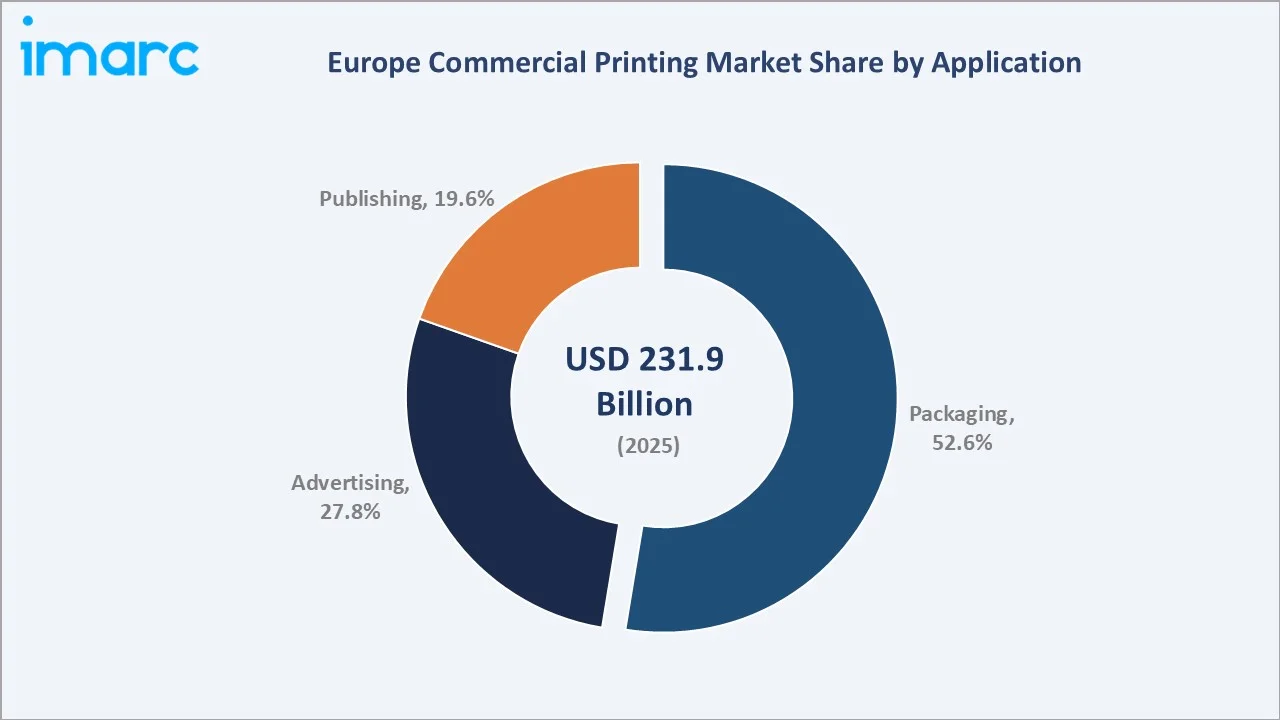
Advertising at 27.8% follows, supported by continued demand for direct mail, promotional materials, and point-of-sale print despite the growing shift toward digital advertising channels.
Regional Market Insights
|
Country |
Share (2025) |
Key Growth Drivers |
|
Germany |
26.8% |
Large industrial base, advanced press technology, strong automotive and pharmaceutical packaging demand |
|
United Kingdom |
20.7% |
Established publishing sector, mature converter base, growing e-commerce packaging volumes |
|
France |
19.3% |
Diversified packaging and luxury goods print demand, steady advertising and retail print activity |
|
Italy |
14.8% |
Strong packaging design heritage, export-oriented food and beverage packaging production |
|
Spain |
9.6% |
Expanding food and beverage packaging exports, modernizing converter base, rising digital press adoption |
|
Others |
8.8% |
Gradual digital adoption, smaller-scale converters, expanding regional packaging demand |
Germany at 26.8% in 2025 leads the country-wise landscape, anchored by a robust manufacturing base, advanced printing technology, and consistent demand for high-quality packaging across the automotive and pharmaceutical sectors. The country's emphasis on innovation and production efficiency continues to reinforce its regional leadership position.
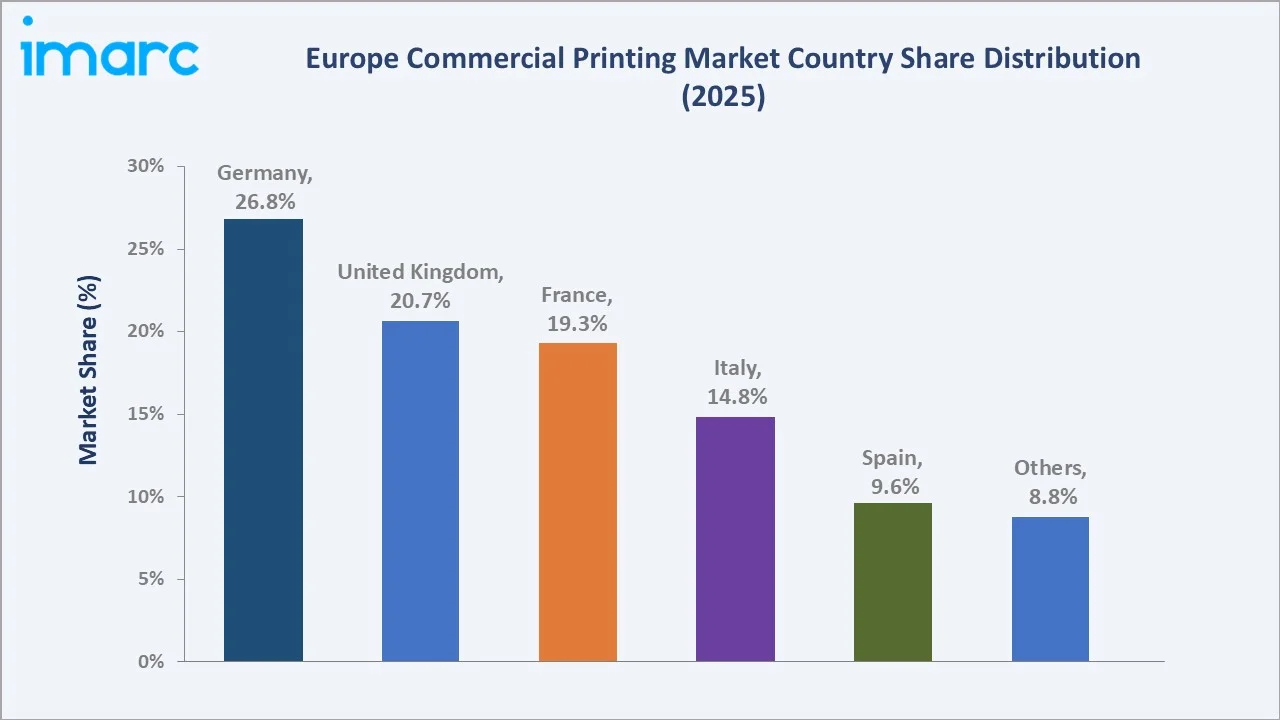
Spain at 9.6% is the fastest growing country in the region. Expanding food and beverage packaging exports, a modernizing converter base, and rising digital press adoption are accelerating growth through 2034.
Competitive Landscape
The Europe commercial printing market is moderately fragmented, with large integrated groups leading scale and technology investment while regional converters compete on service depth and niche substrate capability. Brand strength, sustainability credentials, and production technology form the key competitive differentiators across the industry.
|
Company Name |
Brand / Key Product |
Position |
Strategic Focus |
|
Bertelsmann SE & Co. KGaA |
Mohn Media, GGP Media |
Leader |
Broad-scale offset printing and direct-marketing group with integrated print services across Europe |
|
Cimpress plc |
Vistaprint |
Leader |
Mass-customization and online print platform serving small business and personalized print demand |
|
Smurfit Westrock plc |
Smurfit Kappa |
Challenger |
Integrated paper-based packaging group focused on sustainable, print-optimized packaging solutions |
|
Mondi plc |
Mondi Packaging Products & Solutions |
Challenger |
Packaging and paper group focused on sustainable substrates and printing paper production |
|
Amcor plc |
AmLite |
Challenger |
Flexible packaging group focused on printed packaging and material innovation |
Key players include Bertelsmann SE & Co. KGaA, Cimpress plc, Smurfit Westrock plc, Mondi plc, and Amcor plc, among others.
-1-1.webp)
Key Company Profiles
Bertelsmann SE & Co. KGaA
Bertelsmann SE & Co. KGaA, headquartered in Gütersloh, Germany, is a leading media, services, and education conglomerate. Its print and direct-marketing activities are bundled under a dedicated division that combines several German offset printing businesses, including Mohn Media and GGP Media, with digital marketing and direct-mail services.
- Product Portfolio: Offset printing for publishing, catalogues, and advertising inserts through Mohn Media and GGP Media, alongside prepress, digital marketing, and direct-mail services.
- Recent Developments: The firm continues to optimize its printing operations and adapt production capacities to changing demand across publishing and commercial print markets.
- Strategic Focus: Concentrating offset printing capacity and integrated marketing services at its core plants while adapting to structural decline in traditional publication print.
Cimpress plc
Cimpress plc, headquartered in Dundalk, Ireland, is a global leader in mass customization of printed products, operating a portfolio of online print brands serving small businesses across Europe and beyond.
- Product Portfolio: Business cards, marketing materials, packaging, signage, and promotional products delivered through web-to-print platforms, led by its Vistaprint brand.
- Recent Developments: The company continues to expand its portfolio of European online print brands and manufacturing capacity to serve growing small-business demand for personalized print.
- Strategic Focus: Scaling web-to-print mass customization across European brands while deepening design and fulfilment automation for small-business customers.
Smurfit Westrock plc
Smurfit Westrock plc, headquartered in Dublin, Ireland, is a global leader in paper-based packaging, combining a strong legacy European position with an expanded international footprint.
- Product Portfolio: Corrugated packaging, containerboard, folding cartons, and printed retail-ready packaging solutions for consumer and industrial customers, led by its Smurfit Kappa brand.
- Recent Developments: The company continues to progress network integration and design-led packaging development to strengthen its combined European and global manufacturing base.
- Strategic Focus: Building integration and scale advantages from its merger to expand sustainable, print-optimized packaging capability.
Market Concentration Analysis
The Europe commercial printing market is moderately fragmented, with the top four groups, including Bertelsmann SE & Co. KGaA, Cimpress plc, Smurfit Westrock plc, and Mondi plc, accounting for a meaningful but non-dominant share of regional output, alongside thousands of small and mid-sized independent printers and converters.
Barriers to entry include capital-intensive press technology, sustainable substrate sourcing, and compliance capability across overlapping EU and national packaging regulations, favoring well-capitalized incumbents with diversified portfolios.
Consolidation is gradually accelerating as smaller offset operators exit declining publication print segments, while larger packaging-focused groups acquire capacity and sustainable material capability.
Investment & Growth Opportunities
Fastest-Growing Segments
Packaging expands fastest among application segments, driven by sustained e-commerce and consumer-goods shipment growth, while image leads print type growth, supported by continued demand for packaging graphics and labels.
Emerging Markets
Spain is the fastest growing country, anchored by expanding food and beverage packaging exports and a modernizing converter base. The market represents meaningful opportunity for groups able to deliver sustainable, export-ready packaging print capability.
Venture & Investment Trends
Investment is concentrated in recyclable substrate technology, digital press capacity, and workflow automation platforms. Capital is also flowing into packaging design and traceability services that align with tightening EU sustainability and labelling requirements.
Future Market Outlook (2026-2034)
The Europe commercial printing market is forecast to expand from USD 231.9 Billion in 2025 to an estimated USD 233.4 Billion in 2026 and further to USD 241.3 Billion by 2034, adding roughly USD 9.4 Billion in incremental market value over the forecast period.
Three forces will shape the market through 2034: continued structural decline in advertising and publishing print as digital substitution persists; steady, e-commerce-driven expansion of packaging print supported by tightening EU packaging regulation; and gradual adoption of digital, automated, and energy-efficient production technology across converters.
By 2034, the Europe commercial printing market is expected to be defined by packaging-led production, sustainable substrate adoption, and digitally enabled short-run capability. Printers are also expected to prioritize automation and flexible production technologies to improve efficiency and respond to evolving customer requirements.
Research Methodology
Primary Research
Primary research included structured interviews with converter executives, packaging designers, press technology suppliers, and brand-owner procurement leads, validating market sizing, segment mix, and country-level demand patterns.
Secondary Research
Secondary sources included Eurostat trade and e-commerce statistics, European Commission packaging regulation publications, Confederation of European Paper Industries production data, and annual reports and investor presentations from listed printing and packaging groups.
Forecasting Models
Market forecasts used top-down and bottom-up models combining historical production data, packaging and e-commerce demand indicators, regulatory transition timelines, and macroeconomic variables. Scenario analysis addressed energy cost trajectories, regulatory pace, and substrate substitution trends.
Europe Commercial Printing Market Report Scope:
| Report Features | Details |
|---|---|
| Base Year of the Analysis | 2025 |
| Historical Period | 2020-2025 |
| Forecast Period | 2026-2034 |
| Units | Billion USD |
| Scope of the Report |
Exploration of Historical Trends and Market Outlook, Industry Catalysts and Challenges, Segment-Wise Historical and Future Market Assessment:
|
| Technologies Covered | Lithographic Printing, Digital Printing, Flexographic Printing, Screen Printing, Gravure Printing, Others |
| Print Types Covered | Image, Painting, Pattern, Others |
| Applications Covered | Packaging, Advertising, Publishing |
| Countries Covered | Germany, France, United Kingdom, Italy, Spain, Others |
| Companies Covered | Bertelsmann SE & Co. KGaA, Cimpress plc, Smurfit Westrock plc, Mondi plc, Amcor plc, etc. |
| Customization Scope | 10% Free Customization |
| Post-Sale Analyst Support | 10-12 Weeks |
| Delivery Format | PDF and Excel through Email (We can also provide the editable version of the report in PPT/Word format on special request) |
Key Benefits for Stakeholders:
- IMARC’s report offers a comprehensive quantitative analysis of various market segments, historical and current market trends, market forecasts, and dynamics of the Europe commercial printing market from 2020-2034.
- The Europe commercial printing market research report provides the latest information on the market drivers, challenges, and opportunities in the regional market.
- Porter's five forces analysis assist stakeholders in assessing the impact of new entrants, competitive rivalry, supplier power, buyer power, and the threat of substitution. It helps stakeholders to analyze the level of competition within the Europe commercial printing industry and its attractiveness.
- Competitive landscape allows stakeholders to understand their competitive environment and provides an insight into the current positions of key players in the market.
Frequently Asked Questions About the Europe Commercial Printing Market Report
The Europe commercial printing market size is estimated at USD 233.4 Billion in 2026, supported by steady packaging demand and gradual digital press adoption across converters.
Image leads the print type segment at 46.3% in 2025, driven by sustained demand for packaging graphics, product labels, and photo-realistic promotional print.
Packaging dominates the application segment at 52.6% in 2025, fueled by rising e-commerce order volumes and consumer-goods shipment growth across the region.
Germany commands 26.8% in 2025, led by a strong industrial base, advanced press technology, and robust automotive and pharmaceutical packaging demand.
Spain at 9.6% share is the fastest growing country, supported by expanding food and beverage packaging exports and a modernizing converter base.
Leading players include Bertelsmann SE & Co. KGaA, Cimpress plc, Smurfit Westrock plc, Mondi plc, and Amcor plc, among others.
Rising e-commerce order volumes are sustaining demand for printed packaging, labels, and inserts, with EU online enterprise sales share climbing steadily over the past decade.
Digital presses, workflow automation, and AI-assisted prepress are enabling shorter, more frequent print runs, helping converters serve personalized packaging and promotional print demand efficiently.
Need more help?
- Speak to our experienced analysts for insights on the current market scenarios.
- Include additional segments and countries to customize the report as per your requirement.
- Gain an unparalleled competitive advantage in your domain by understanding how to utilize the report and positively impacting your operations and revenue.
- For further assistance, please connect with our analysts.
 Request Customization
 Speak to an Analyst
 Request Brochure
 Inquire Before Buying
Benefits of Customization
- Personalize this research
- Triangulate with your data
- Get data as per your format and definition
- Gain a deeper dive into a specific application, geography, customer, or competitor
- Any level of personalization
Get in Touch With Us
UNITED STATES
Phone: +1-201-971-6302
INDIA
Phone: +91-120-433-0800
UNITED KINGDOM
Phone: +44-753-714-6104
Email: [email protected]
Client Testimonials




.webp)




.webp)













Related Reports

Choose your plan
*Please note that the prices mentioned below are starting prices for each bundle type. Kindly contact our team for further details.*
Single User License
- 1 User License, Access on 2 Devices
- PDF Report + Excel Dataset (Password Protected)
- Lifetime Access
- No Printing Rights
- 10% Free Report Customization
- 10–12 Weeks of Analyst Support
Five User License
- Access for 5 Users, 2 Devices per User
- PDF Report + Excel Dataset (Password Protected)
- Lifetime Access
- Dedicated Account Manager
- 12–14 Weeks of Analyst Support
- No Printing Rights
- 15% Free Report Customization
- 25% Discount on Your Next Purchase
Corporate User License
- Unlimited User Access (Within Your Organization)
- PDF Report + Excel Dataset
- Lifetime Access
- Dedicated Account Manager
- 14–20 Weeks of Analyst Support
- No Printing Rights
- 20% Free Report Customization
- 30% Discount on Your Next Purchase
Essential Insights
What's included:
3 reports
- Lifetime Access
- PDF Reports
- Excel Datasets
- 2 Weeks of Free Analyst Support
- 2 User Licenses
- Access on 2 Devices
- Printing Rights
- Complimentary PowerPoint (PPT) Version
- Complimentary License Upgrade
Professional Access
What's included:
5 reports
- Lifetime Access
- PDF Reports
- Excel Datasets
- 8 Weeks of Free Analyst Support
- 2 User Licenses
- Access on 2 Devices
- Printing Rights
- Complimentary PowerPoint (PPT) Version
- Complimentary License Upgrade
Business Advantage
What's included:
8 reports
- Lifetime Access
- PDF Reports
- Excel Datasets
- 14 Weeks of Free Analyst Support
- 2 User Licenses
- Access on 2 Devices
- Printing Rights
- Complimentary PowerPoint (PPT) Version
- Complimentary License Upgrade
Enterprise Intelligence
What's included:
10 reports
- Lifetime Access
- PDF Reports
- Excel Datasets
- 20 Weeks of Free Analyst Support
- 2 User Licenses
- Access on 2 Devices
- Printing Rights
- Complimentary PowerPoint (PPT) Version
- Complimentary License Upgrade