
Europe Flat Glass Market Size, Share, Trends and Forecast by Technology, Product Type, Raw Material, End Use, Type, End Use Industry, and Country, 2026-2034
Europe Flat Glass Market Size, Share, Trends & Forecast (2026-2034)
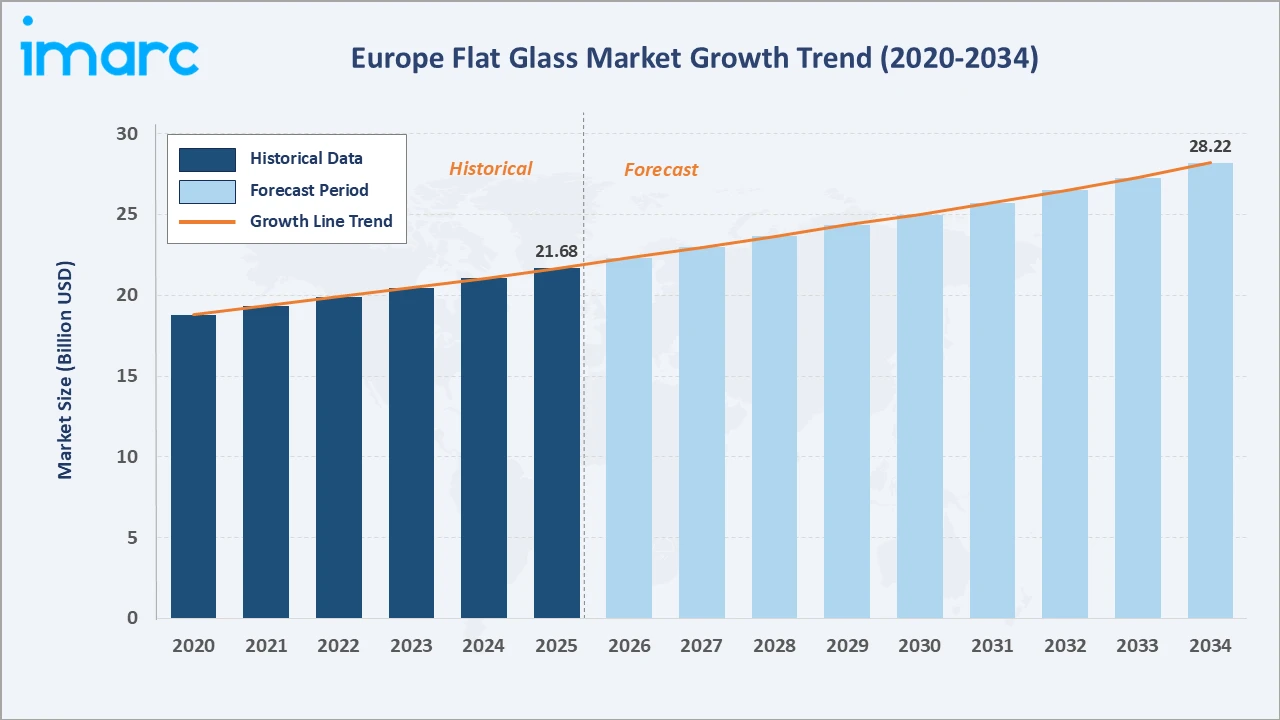
The Europe flat glass market grew from USD 21.68 Billion in 2025 to USD 22.48 Billion in 2026 and is projected to reach USD 28.22 Billion by 2034, growing at a CAGR of 2.88% during 2026-2034. Approximately 10 million tonnes of flat glass are introduced into the market each year, with the building and construction sector accounting for nearly 80% of total consumption. The market is driven by rising construction and renovation activities, increasing demand for energy-efficient buildings, and the growing adoption of high-performance glazing solutions. Float glass leads at 75.0% by technology, sand dominates at 45.0% of raw material inputs, and Germany commands the largest regional share at 25.0% in 2025.
Market Snapshot
|
Metric |
Value |
|
Base Year Market Size (2025) |
USD 21.68 Billion |
|
Market Size (2026) |
USD 22.48 Billion |
|
Forecast Market Size (2034) |
USD 28.22 Billion |
|
CAGR (2026-2034) |
2.88% |
|
Base Year |
2025 |
|
Historical Period |
2020-2025 |
|
Forecast Period |
2026-2034 |
|
Dominant Technology |
Float Glass (75.0%, 2025) |
|
Leading Raw Material |
Sand (45.0%, 2025) |
|
Leading Country |
Germany (25.0%, 2025) |
The Europe flat glass market expanded from USD 18.81 Billion in 2020 to USD 21.68 Billion in 2025, and further to USD 22.48 Billion in 2026, reflecting sustained demand across construction, automotive, and specialty glass applications. The market is projected to reach USD 24.99 Billion by 2030 before reaching USD 28.22 Billion by 2034.
To get more information on this market, Request Sample
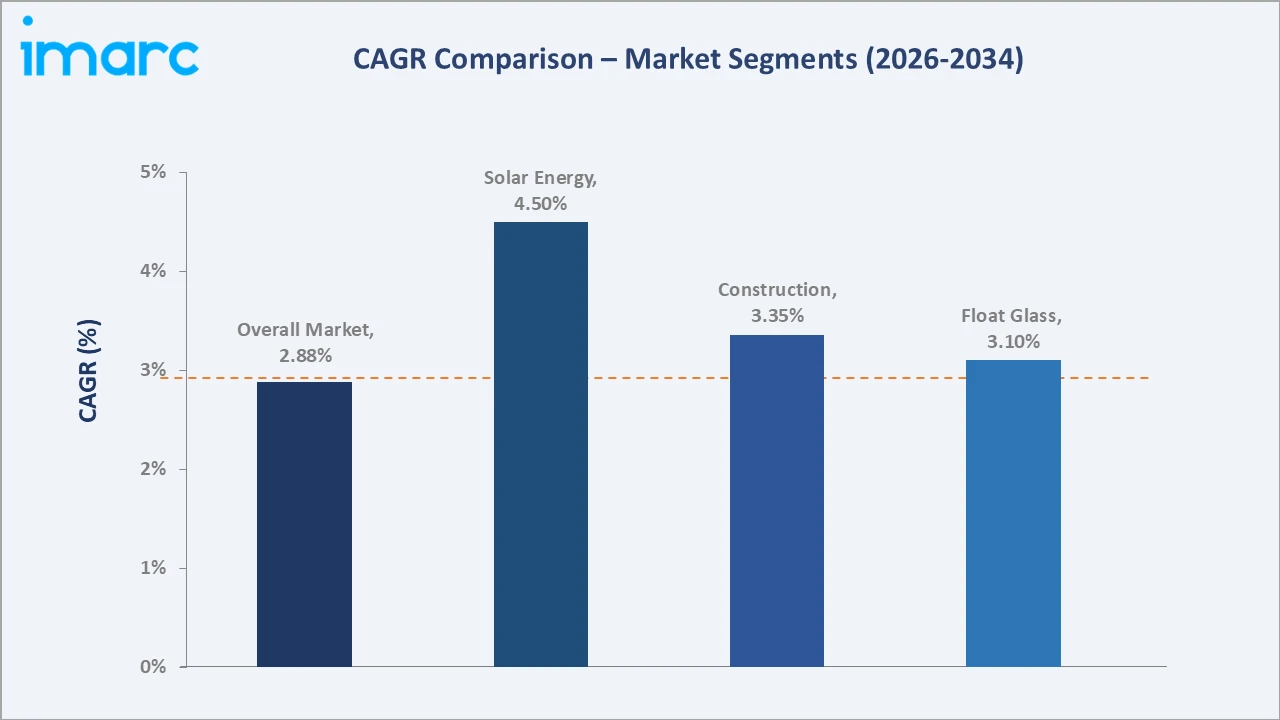
Float glass maintains a CAGR of approximately 3.1%, as premium architectural and solar applications favor high-quality float glass variants. Construction end use, at 3.35% CAGR, reflects EU energy mandate-driven renovation demand. Solar energy applications project the strongest growth at 4.5% CAGR, supported by the EU solar target of 750 GW by 2030.
Executive Summary
The Europe flat glass market is on a consistent growth trajectory, underpinned by EU-mandated energy performance standards for buildings, growing residential and commercial construction activity, and accelerating adoption of solar photovoltaic systems requiring high-quality glass. The market is reflecting steady demand across construction, automotive, and specialty glass segments. Europe added approximately 56 GW of solar installations in 2023, creating a structurally growing demand stream for flat glass in solar applications.
Float glass at 75.0% dominates the technology segment, reflecting its widespread adoption as the foundational flat glass production method for virtually all end-use applications. Sand at 45.0% represents the primary raw material input, while recycled glass at 15.0% is gaining share as EU circular economy policies reshape raw material strategies. Germany leads regionally at 25.0%, anchored by its advanced manufacturing base, strong construction sector, and robust automotive demand.
Key Market Insights
|
Insight |
Data |
|
Dominant Technology |
Float Glass – 75.0% share (2025) |
|
Leading Raw Material |
Sand – 45.0% share (2025) |
|
Leading Country |
Germany – 25.0% (2025) |
|
Key Market Opportunity |
EU Green Deal renovation wave is creating sustained high-performance glazing demand, expanding the European flat glass market through 2034. |
Key Analytical Observations Supporting the Above Data:
- Float Glass at 75.0%: Float glass dominates because the float process produces optically clear, flat glass with consistent thickness at high production volumes, making it the most cost-effective technology for architectural, automotive, and solar applications across Europe.
- Sand at 45.0%: Sand constitutes the primary raw material in flat glass production due to its high silicon dioxide content. European producers maintain domestic silica sand supply chains, partially insulating them from global price volatility.
- Germany at 25.0%: Germany's regional leadership reflects its dual role as a major flat glass consuming market and a global center for precision glass processing, with concentrated automotive manufacturing, advanced construction activity, and high-value glazing applications.
Europe Flat Glass Market Overview
The Europe flat glass market encompasses the production, processing, and distribution of primary flat glass products manufactured through float, sheet, and rolled glass processes. Core product categories include basic float glass, toughened safety glass, laminated glass, coated glass with solar control or low-emissivity properties, insulated glass units, and extra-clear glass for specialty applications.
The European flat glass industry serves a broad ecosystem spanning raw material extractors, primary glass manufacturers, glass processors and fabricators, wholesale distributors, and end-use sectors including construction, automotive, solar energy, and electronics. Construction remains the dominant end-use sector, driven by new build activity and energy renovation requirements.
Market Dynamics
To evaluate market opportunities, Request Sample
Market Drivers
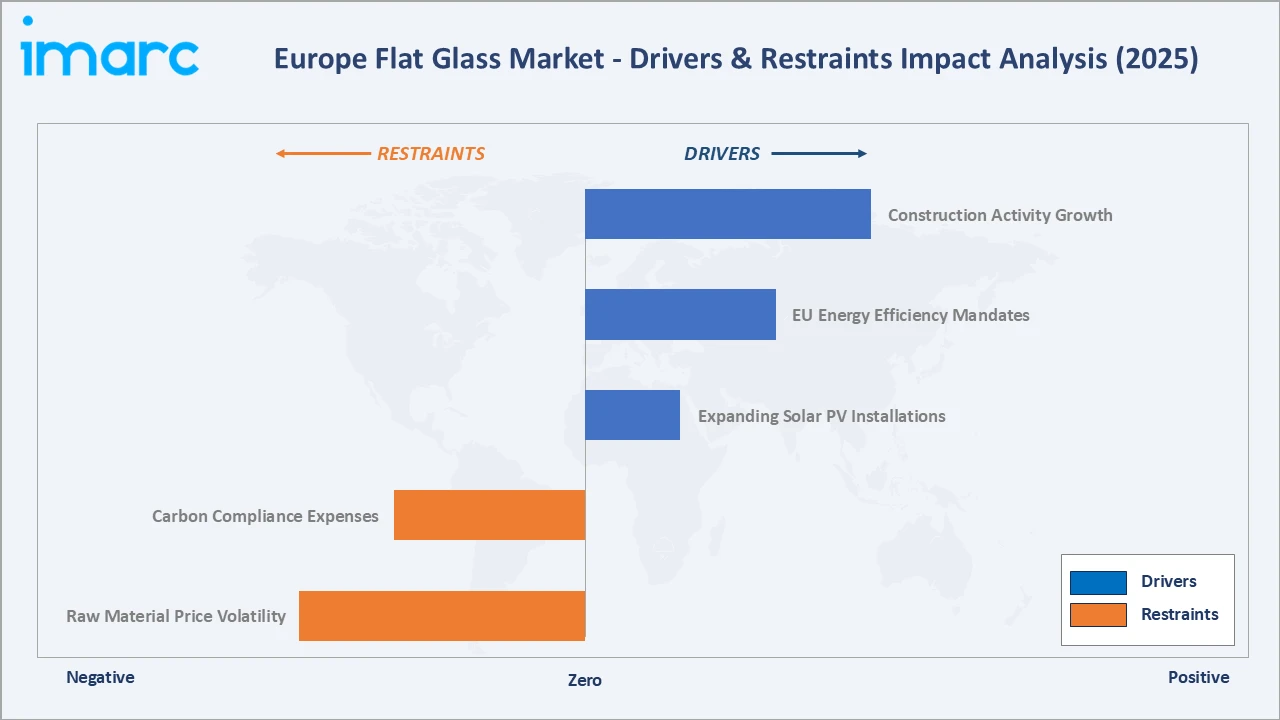
- Construction Activity Growth: According to Eurofer, EU construction output is projected to increase by 1.5% in 2026, followed by stronger growth of 2.9% in 2027, compared with 1.3% growth recorded in 2025, driven by residential housing completions and commercial real estate development. New builds and major renovation projects generate consistent flat glass demand across windows, facades, and interior glazing applications.
- EU Energy Efficiency Mandates: Starting in 2030, all new buildings will be required to meet the more stringent zero-emission building standard, replacing the existing nearly-zero-energy building requirement. This directly drives demand for high-performance insulating glass units and low-emissivity coated glass enabling building energy savings.
- Expanding Solar PV Installations: Europe installed 56 GW of new solar capacity in 2023. Each GW of solar capacity requires substantial volumes of tempered solar glass, creating a growing, policy-backed demand stream for flat glass manufacturers.
Market Restraints
- Carbon Compliance Expenses: European flat glass manufacturers are subject to EU Emissions Trading System requirements. Carbon allowance costs represent a growing share of production costs, compressing margins and requiring capital investment in decarbonization without proportional short-term revenue increases.
- Raw Material Price Volatility: Soda ash prices experienced significant fluctuations in recent years, impacting production cost predictability for glass manufacturers and complicating long-term pricing agreements with construction and automotive sector customers.
Market Opportunities
- Smart and Electrochromic Glass: Building automation integration is driving adoption of electrochromic glass that dynamically changes light transmission. Smart glass reduces HVAC energy loads in commercial buildings and supports EU green building certification requirements, growing at high single-digit annual rates in Europe.
- Recycled Glass Circular Economy: EU circular economy regulations are increasing recycled content requirements for glass products. According to the Glass Packaging Institute, incorporating 10% cullet into the batch mix can reduce energy costs by approximately 2–3%, providing cost and carbon reduction benefits for manufacturers investing in recycling infrastructure.
Market Challenges
- Import Competition: Flat glass imports from non-EU producers, particularly in the solar glass segment, create ongoing pricing pressure on European manufacturers. Price competition from subsidized production limits margin expansion for domestic flat glass producers.
- Skilled Labor Availability: Advanced glass processing and fabrication requires specialized technical expertise. The European manufacturing sector faces a skills gap in precision glass processing, constraining capacity expansion for specialty glass products and high-value fabrication operations.
Emerging Market Trends
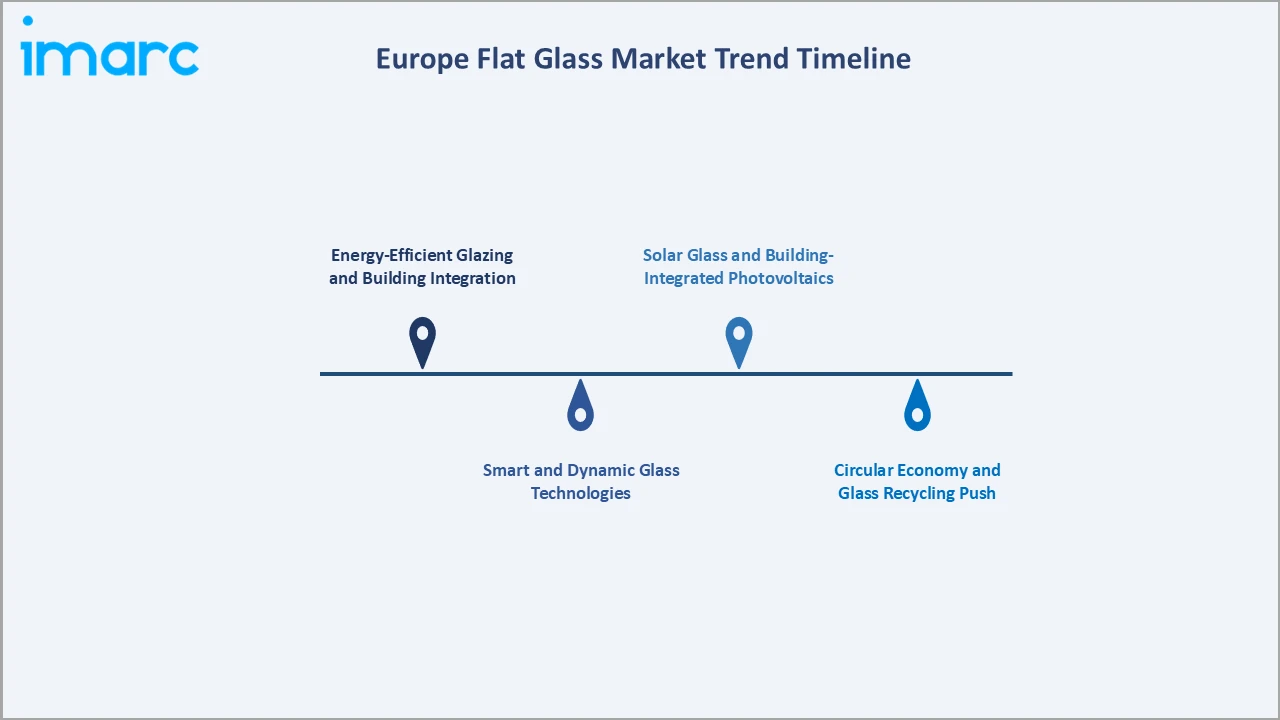
1. Energy-Efficient Glazing and Building Integration
EU building energy performance standards are accelerating the replacement of conventional glazing with high-performance triple-glazed insulated glass units featuring low-emissivity coatings. These products reduce building heat loss compared to older glazing, making them essential components in nearly zero-energy buildings across Europe. Growing renovation mandates are sustaining long-term demand for high-specification glazing products.
2. Smart and Dynamic Glass Technologies
Electrochromic and switchable glass technologies are gaining commercial traction in European commercial buildings and luxury residential projects. These products dynamically control solar heat gain and light transmission, reducing HVAC energy consumption and eliminating the need for external shading systems. Pilot projects across major European cities are demonstrating measurable energy savings and tenant comfort improvements.
3. Solar Glass and Building-Integrated Photovoltaics
Building-integrated photovoltaics (BIPV) represents a convergence of flat glass and solar energy, where glass panels serve as structural building elements and electricity generators simultaneously. European architectural projects increasingly specify BIPV facade systems, creating demand for specialized solar glass with both structural performance and electrical generation capability.
4. Circular Economy and Glass Recycling Push
EU circular economy legislation is driving mandatory recycled glass content targets for flat glass production. Manufacturers are investing in closed-loop recycling systems and establishing collection networks for post-consumer and post-industrial glass cullet. Increased cullet usage reduces both raw material costs and carbon emissions, aligning production economics with sustainability commitments and evolving regulatory requirements across European markets.
Industry Value Chain Analysis
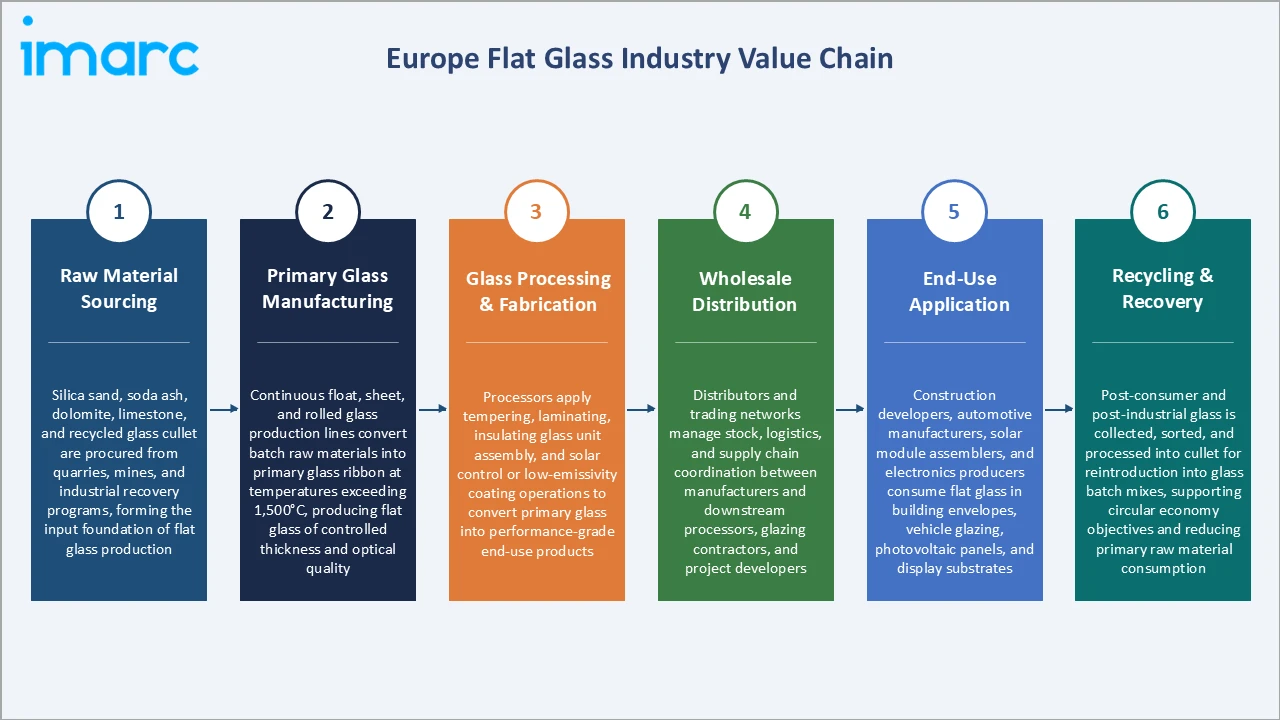
The European flat glass value chain is structured across six integrated stages from raw material sourcing through end-of-life recycling. Each stage creates distinct value through processing, formulation, distribution, and technical application, with the highest value addition occurring at the manufacturing and coating stage where product quality, optical performance, and technical precision create durable competitive advantages.
|
Stage |
Description |
|
Raw Material Sourcing |
Silica sand, soda ash, dolomite, limestone, and recycled glass cullet are procured from quarries, mines, and industrial recovery programs, forming the input foundation of flat glass production. |
|
Primary Glass Manufacturing |
Continuous float, sheet, and rolled glass production lines convert batch raw materials into primary glass ribbon at temperatures exceeding 1,500°C, producing flat glass of controlled thickness and optical quality. |
|
Glass Processing & Fabrication |
Processors apply tempering, laminating, insulating glass unit assembly, and solar control or low-emissivity coating operations to convert primary glass into performance-grade end-use products. |
|
Wholesale Distribution |
Distributors and trading networks manage stock, logistics, and supply chain coordination between manufacturers and downstream processors, glazing contractors, and project developers. |
|
End-Use Application |
Construction developers, automotive manufacturers, solar module assemblers, and electronics producers consume flat glass in building envelopes, vehicle glazing, photovoltaic panels, and display substrates. |
|
Recycling & Recovery |
Post-consumer and post-industrial glass is collected, sorted, and processed into cullet for reintroduction into glass batch mixes, supporting circular economy objectives and reducing primary raw material consumption. |
The manufacturing stage holds the greatest strategic value, as large-scale float glass operations benefit from continuous production economics, consistent optical quality, and established long-term supply relationships with construction and automotive customers. The processing and fabrication stage adds significant incremental value through technical transformation, with toughening, laminating, and coating operations creating specialized products that command higher price points than commodity primary float glass.
Technology Landscape in the Europe Flat Glass Industry
Float Glass Production Advancement
Modern float lines achieve ribbon widths exceeding 3.3 meters with glass thicknesses from 0.4 mm to 25 mm, covering applications from ultra-thin electronics glass to structural architectural panels. Continuous process improvements are reducing specific energy consumption per ton of glass produced, while advanced tin bath management systems improve surface quality and optical clarity for high-value coated glass applications.
Low-Emissivity and Solar Control Coatings
Magnetron sputter coating technology enables deposition of multi-layer thin-film coatings on float glass that selectively reflect infrared radiation while transmitting visible light. These low-emissivity coatings are essential for EU building energy performance compliance, reducing glass U-values to below 1.0 W/m²K in triple-glazed insulated glass units compared to 5.8 W/m²K for conventional single-pane clear glass, delivering substantial building energy savings.
Recycled Glass and Decarbonization Technologies
Hydrogen combustion and electric boosting are emerging as decarbonization technologies for glass melting furnaces. European glass producers are investing in oxy-fuel combustion and electrification of melting processes to reduce carbon intensity per ton of glass produced. Cullet rates targeting 50% recycled content in flat glass production are reducing both raw material and energy requirements, supporting manufacturers' carbon reduction commitments under EU ETS frameworks.
Market Segmentation Analysis
The report covers the following segments:
| Segment Category | Leading Segment | Market Share | Year |
|---|---|---|---|
| Technology | Float Glass | 75.0% | 2025 |
| Product Type | Insulated | 🔒 | 2025 |
| Raw Material | Sand | 45.0% | 2025 |
| End Use | Solar Control | 🔒 | 2025 |
| Type | Fabricated | 🔒 | 2025 |
| End Use Industry | Construction | 🔒 | 2025 |
| Country | Germany | 25.0% | 2025 |

By Technology
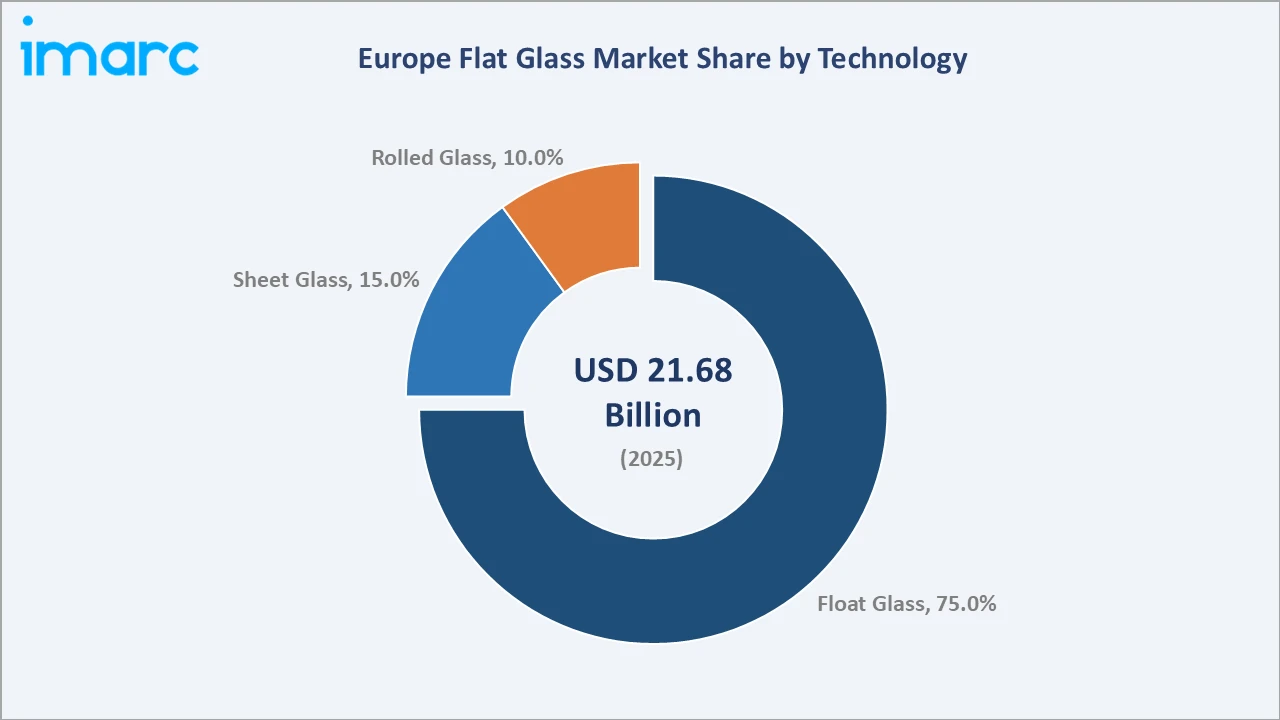
Float glass leads at 75.0% in 2025, reflecting its fundamental role as the primary production method for flat glass across all end-use applications. The float process produces optically flat, distortion-free glass by floating molten glass on a bath of molten tin, creating a continuous ribbon with precise thickness control. This technological advantage underpins its dominant market position in architectural glazing, automotive glass, solar glass, and electronic display substrates across the European market.
To access detailed market analysis, Request Sample
Sheet glass at 15.0% serves applications requiring thinner glass or lower optical precision, where float glass production economics are not justified for the end-use application. Rolled glass at 10.0% is primarily used in applications requiring textured or patterned glass surfaces, including decorative architectural applications, greenhouse glazing, and certain solar thermal collector panels where diffuse light transmission provides performance benefits.
By Raw Material
Sand at 45.0% dominates as the primary raw material for flat glass production, providing the silicon dioxide content that forms the fundamental structural network of glass. European silica sand deposits in Germany, France, and the United Kingdom support significant domestic supply capability, partially insulating European glass producers from global silica sand supply disruptions and price fluctuations in international markets.
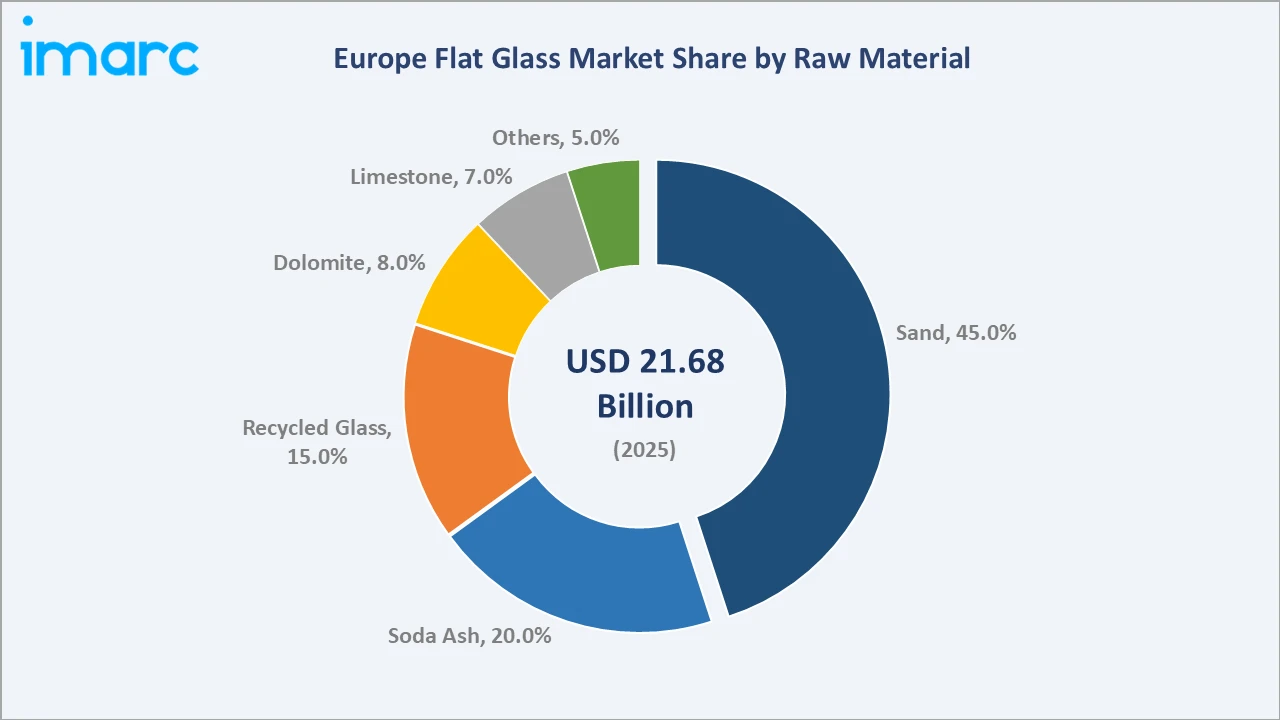
Soda ash at 20.0% is the second-largest raw material input, acting as a flux that lowers the glass batch melting temperature, reducing energy consumption in furnace operations. Recycled glass at 15.0% is gaining importance as EU circular economy regulations promote higher cullet usage rates across European glass production. Dolomite at 8.0% and limestone at 7.0% contribute calcium and magnesium oxide components that enhance chemical durability and mechanical strength, while others at 5.0% include specialty additives for color control, refining agents, and performance modifiers.
Regional Market Insights
| Country | Share (2025) | Key Drivers & Characteristics |
|---|---|---|
| Germany | 25.0% | Advanced manufacturing base, large-scale residential and commercial construction activity, and strong demand for precision glass processing and specialty coated glass products. |
| France | 17.0% | Active construction and renovation markets, growing solar energy installation programs, and strong architectural glass specification culture across residential and commercial segments. |
| United Kingdom | 16.0% | Steady commercial real estate activity, residential construction programs, and energy renovation demand for improved building thermal performance and insulated glazing. |
| Italy | 13.0% | Design-intensive architectural glass applications, active residential renovation market, and established glass processing and fabrication industry serving domestic and export demand. |
| Spain | 10.0% | Growing construction sector recovery, expanding solar energy installations, and residential building renovation driving above-average flat glass demand growth relative to European average. |
| Others | 19.0% | Including Poland, the Netherlands, Belgium, and other European countries with diverse construction, automotive, and industrial flat glass demand across manufacturing and commercial sectors. |
Germany's regional leadership at 25.0% reflects its dual role as a major flat glass consuming market and a global center for precision glass processing. France at 17.0% benefits from active construction policy support and a growing renewable energy installation pipeline that is steadily expanding solar glass demand. The United Kingdom at 16.0% maintains consistent demand from commercial renovation programs and residential energy improvement initiatives tied to national net-zero building performance commitments.
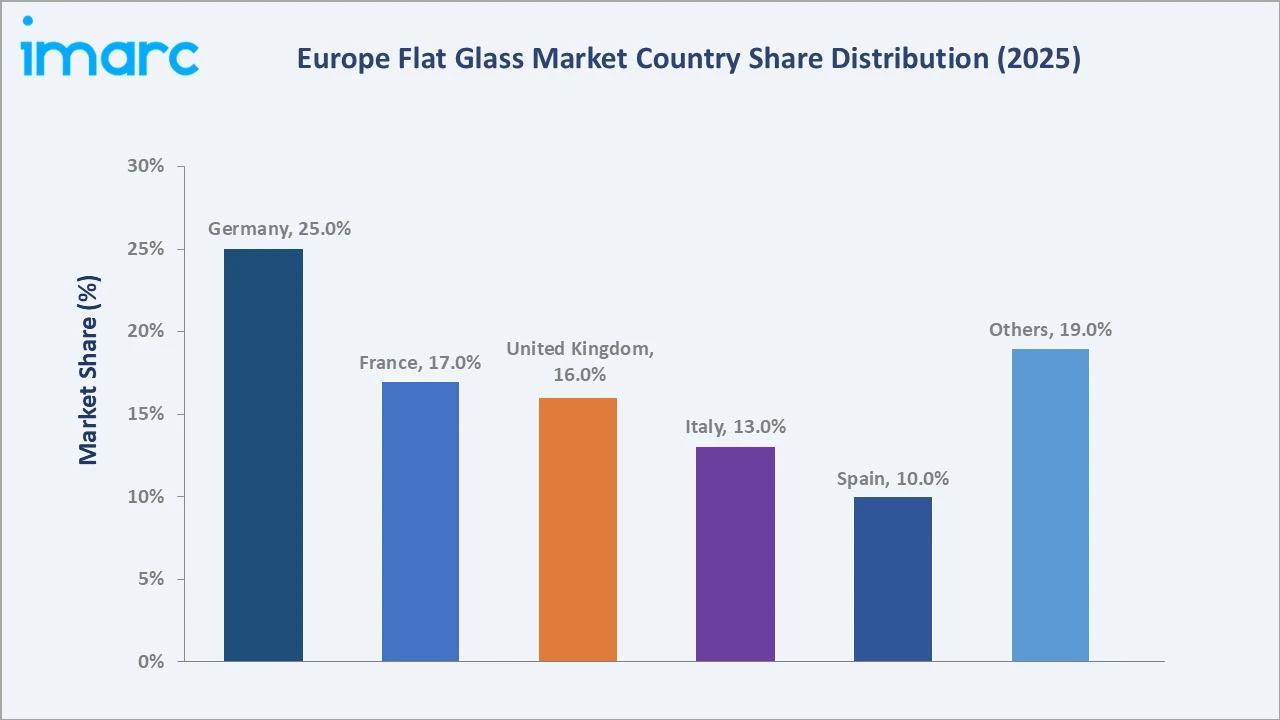
Italy at 13.0% is anchored by a design-intensive architectural glass specification culture and a well-established glass processing sector. Spain at 10.0% is the fastest-growing major European flat glass market, driven by construction sector recovery and accelerating solar energy installations under national renewable energy programs. The others category at 19.0% represents the aggregate of smaller European markets including Poland, the Netherlands, and Belgium, where emerging construction and industrial demand is generating incremental growth.
Competitive Landscape
The Europe flat glass market exhibits high concentration at the primary manufacturing level, where a small number of large integrated glass producers operate continuous float glass lines serving pan-European demand. The downstream processing and fabrication segment is considerably more fragmented, with numerous regional processors converting primary float glass into end-use products for local construction and automotive markets.
| Company | Key Products | Market Position | Core Strength |
|---|---|---|---|
| AGC Inc. | Planibel Clear, Stopray Vision, Matelac | Market Leader | AGC Inc., operating primarily through its European subsidiary AGC Glass Europe, is one of the top flat glass manufacturers in Europe. |
| Saint-Gobain | PLANITHERM TOTAL +, SGG Diamant | Market Leader | Saint-Gobain is one of the top flat glass manufacturers in Europe, playing a leading role in production, sustainable construction, and industry decarbonization. |
| Şişecam | Şişecam Clear, Şişecam Climax, Şişecam Deco Lacquered, Şişecam Deco Mirrored Patterned | Established Player | Şişecam is one of the largest flat glass producers in Europe, playing a major role in the continent's architectural, industrial, and solar energy glass sectors. |
Competition in the European flat glass market is evolving as large players invest in high-performance coated glass capabilities and solar glass processing to address the growing premium segment driven by EU building energy mandates. Smaller specialized processors focus on regional leadership positions and niche product differentiation in insulating glass units, specialty coatings, and architectural design glass to maintain competitive viability against larger integrated players.
Key Company Profiles
AGC Inc.
AGC Inc. is a leading glass producer with significant flat glass manufacturing operations across Europe, the company serves construction, automotive, solar, and specialty glass markets through an integrated production and coating platform. Its broad product range spans architectural glazing, automotive glass, and solar applications, supported by an established European distribution network and technical service infrastructure that enables close collaboration with construction and industrial customers.
- Key Products: Planibel Clear, Stopray Vision, Matelac.
- Strategic Focus: Expanding high-performance coated and specialty glass solutions for energy-efficient buildings and solar applications while progressively reducing manufacturing carbon intensity through energy-efficient production technologies and increased recycled glass integration.
Saint-Gobain
Saint-Gobain is a materials company with a comprehensive European flat glass portfolio spanning construction glass, solar glass, and specialty glazing products; the company serves construction, automotive, and solar markets through an extensive pan-European manufacturing and distribution network. Its integrated product development capabilities and technical expertise support its position as a leading flat glass supplier across major European markets.
- Key Products: PLANITHERM TOTAL +, SGG Diamant
- Strategic Focus: Driving sustainable building solutions through high-performance glazing systems, energy-efficient glass product development, and circular economy initiatives targeting increased recycled glass content across European manufacturing operations.
Market Concentration Analysis
The Europe flat glass market exhibits high concentration at the primary manufacturing level, where significant capital investment requirements for float glass production create substantial barriers to entry. A small number of large integrated producers account for the majority of European primary float glass production capacity, as individual float glass production lines require investment of several hundred million euros, making new market entry economically prohibitive for most potential entrants and protecting incumbent producers from competitive displacement.
The downstream glass processing and fabrication segment presents a contrasting competitive structure, with a large and fragmented population of regional processors across European markets. This fragmentation creates ongoing consolidation opportunities for well-capitalized processors seeking to achieve regional scale and develop branded product portfolios in high-growth categories such as insulating glass units, energy-efficient coated glass assemblies, and specialty architectural glass. The divergence between concentrated primary manufacturing and fragmented downstream processing is a defining structural characteristic of the European flat glass industry.
Investment & Growth Opportunities
Highest Growth Segments
Float glass growing at a CAGR of approximately 3.1%, construction end use, at 3.35% CAGR, and solar energy applications project the strongest growth at 4.5% CAGR.
Investment Themes
- High-Performance Building Glass: EU renovation wave targets are creating decade-long demand growth for energy-efficient glazing products. Investment in triple-glazed insulated glass unit production capacity and advanced low-emissivity glass products offers long-term demand visibility backed by regulatory mandates and national building upgrade programs.
- Decarbonized Glass Manufacturing: European glass manufacturers are investing in hydrogen combustion, electric melting, and increased cullet usage to meet EU carbon reduction targets. These investments create differentiated low-carbon product credentials increasingly valued by sustainability-focused developers and public procurement programs across Europe.
Future Market Outlook (2026-2034)
The Europe flat glass market grew from USD 21.68 Billion in 2025 to USD 22.48 Billion in 2026 and is projected to reach USD 28.22 Billion by 2034, exhibiting a CAGR of 2.88% during 2026-2034. The market is expected to reach an intermediate milestone of approximately USD 24.99 Billion by 2030, as EU building renovation programs reach scale and solar energy glass demand continues to grow across major European markets.
Three structural forces will define the Europe flat glass market through 2034. First, EU energy performance mandates for buildings will sustain replacement demand for high-performance glazing across the large European building stock, providing a regulatory demand floor independent of broader construction cycles. Second, the European solar energy expansion will create growing demand for solar glass that exceeds the growth rate of the overall market. Third, smart glass and advanced coating technologies will progressively shift value toward higher-margin specialty glass products, improving the revenue quality of the European flat glass industry beyond the projected volume CAGR through 2034.
Research Methodology
Primary Research
Primary research comprised structured consultations with flat glass manufacturing executives, construction sector procurement managers, building product distributors, glazing contractors, and energy performance consultants. These discussions validated market sizing estimates, assessed technology adoption rates, identified regulatory drivers, and provided insights into competitive positioning and product development priorities across the European flat glass sector.
Secondary Research
Secondary research drew on published data including European construction sector statistics, EU energy performance regulation documentation, solar energy installation databases, company annual reports and investor presentations, industry association publications, and trade data covering European flat glass production and trade flows. Historical market data spanning 2020 through 2025 was cross-validated across multiple primary and secondary sources to ensure consistency and accuracy.
Forecasting Models
Market forecasts were developed using bottom-up and top-down modeling approaches incorporating historical market growth rates, construction sector outlook projections, EU energy renovation program timelines, solar energy capacity addition forecasts, automotive glass demand models, and macroeconomic indicators including European GDP growth expectations and construction investment projections through 2034.
Europe Flat Glass Market Report:
| Report Features | Details |
|---|---|
| Base Year of the Analysis | 2025 |
| Historical Period | 2020-2025 |
| Forecast Period | 2026-2034 |
| Units | Billion USD |
| Scope of the Report |
Exploration of Historical Trends and Market Outlook, Industry Catalysts and Challenges, Segment-Wise Historical and Future Market Assessment:
|
| Technologies Covered | Float Glass, Sheet Glass, Rolled Glass |
| Product Types Covered | Basic Float Glass, Toughened Glass, Coated Glass, Laminated Glass, Insulated, Extra Clear Glass, Others |
| Raw Materials Covered | Sand, Soda Ash, Recycled Glass, Dolomite, Limestone, Others |
| End Uses Covered | Safety and Security, Solar Control, Others |
| Types Covered | Fabricated, Non-Fabricated |
| End Use Industries Covered | Construction, Automotive, Solar Energy, Electronics, Others |
| Countries Covered | Germany, France, United Kingdom, Italy, Spain, Others |
| Companies Covered | AGC Inc., Saint-Gobain, Şişecam, etc. |
| Customization Scope | 10% Free Customization |
| Post-Sale Analyst Support | 10-12 Weeks |
| Delivery Format | PDF and Excel through Email (We can also provide the editable version of the report in PPT/Word format on special request) |
Key Benefits for Stakeholders:
- IMARC’s industry report offers a comprehensive quantitative analysis of various market segments, historical and current market trends, market forecasts, and dynamics of the Europe flat glass market from 2020-2034.
- The research report provides the latest information on the market drivers, challenges, and opportunities in the Europe flat glass market.
- The study maps the leading, as well as the fastest-growing, markets. It further enables stakeholders to identify the key country-level markets within the region.
- Porter's five forces analysis assists stakeholders in assessing the impact of new entrants, competitive rivalry, supplier power, buyer power, and the threat of substitution. It helps stakeholders to analyze the level of competition within the Europe flat glass industry and its attractiveness.
- The competitive landscape allows stakeholders to understand their competitive environment and provides insight into the current positions of key players in the market.
Frequently Asked Questions About the Europe Flat Glass Market Report
The Europe flat glass market was valued at USD 22.48 Billion in 2026, supported by active construction, automotive, and solar energy demand across major European economies.
The Europe flat glass market is projected to grow at a CAGR of 2.88% during 2026-2034, reaching USD 28.22 Billion by 2034, driven by EU energy mandates and solar expansion.
Float glass leads with a 75.0% market share in 2025, as it is the most efficient and cost-effective production method for high-quality flat glass across all end-use applications.
Sand leads with 45.0% of raw material inputs in 2025, providing the silicon dioxide content that forms the structural foundation of all flat glass products.
Germany holds the largest country-level share at 25.0% in 2025, driven by its automotive industry, advanced construction sector, and concentration of glass processing operations.
Leading companies include AGC Inc., Saint-Gobain, and Şişecam, among others.
Smart glass technologies, building-integrated photovoltaics, and EU circular economy recycling programs represent key growth opportunities backed by regulatory support and sustainability demand.
The market is projected to reach USD 28.22 Billion by 2034, growing at a CAGR of 2.88%, driven by energy renovation programs, solar glass demand, and smart glazing adoption.
Need more help?
- Speak to our experienced analysts for insights on the current market scenarios.
- Include additional segments and countries to customize the report as per your requirement.
- Gain an unparalleled competitive advantage in your domain by understanding how to utilize the report and positively impacting your operations and revenue.
- For further assistance, please connect with our analysts.
 Request Customization
 Speak to an Analyst
 Request Brochure
 Inquire Before Buying
Benefits of Customization
- Personalize this research
- Triangulate with your data
- Get data as per your format and definition
- Gain a deeper dive into a specific application, geography, customer, or competitor
- Any level of personalization
Get in Touch With Us
UNITED STATES
Phone: +1-201-971-6302
INDIA
Phone: +91-120-433-0800
UNITED KINGDOM
Phone: +44-753-714-6104
Email: [email protected]
Client Testimonials




















Related Reports

Choose your plan
*Please note that the prices mentioned below are starting prices for each bundle type. Kindly contact our team for further details.*
Single User License
- 1 User License, Access on 2 Devices
- PDF Report + Excel Dataset (Password Protected)
- Lifetime Access
- No Printing Rights
- 10% Free Report Customization
- 10–12 Weeks of Analyst Support
Five User License
- Access for 5 Users, 2 Devices per User
- PDF Report + Excel Dataset (Password Protected)
- Lifetime Access
- Dedicated Account Manager
- 12–14 Weeks of Analyst Support
- No Printing Rights
- 15% Free Report Customization
- 25% Discount on Your Next Purchase
Corporate User License
- Unlimited User Access (Within Your Organization)
- PDF Report + Excel Dataset
- Lifetime Access
- Dedicated Account Manager
- 14–20 Weeks of Analyst Support
- No Printing Rights
- 20% Free Report Customization
- 30% Discount on Your Next Purchase
Essential Insights
What's included:
3 reports
- Lifetime Access
- PDF Reports
- Excel Datasets
- 2 Weeks of Free Analyst Support
- 2 User Licenses
- Access on 2 Devices
- Printing Rights
- Complimentary PowerPoint (PPT) Version
- Complimentary License Upgrade
Professional Access
What's included:
5 reports
- Lifetime Access
- PDF Reports
- Excel Datasets
- 8 Weeks of Free Analyst Support
- 2 User Licenses
- Access on 2 Devices
- Printing Rights
- Complimentary PowerPoint (PPT) Version
- Complimentary License Upgrade
Business Advantage
What's included:
8 reports
- Lifetime Access
- PDF Reports
- Excel Datasets
- 14 Weeks of Free Analyst Support
- 2 User Licenses
- Access on 2 Devices
- Printing Rights
- Complimentary PowerPoint (PPT) Version
- Complimentary License Upgrade
Enterprise Intelligence
What's included:
10 reports
- Lifetime Access
- PDF Reports
- Excel Datasets
- 20 Weeks of Free Analyst Support
- 2 User Licenses
- Access on 2 Devices
- Printing Rights
- Complimentary PowerPoint (PPT) Version
- Complimentary License Upgrade