
Europe Railroad Market Size, Share, Trends and Forecast by Type, Distance, End Use, and Country, 2026-2034
Europe Railroad Market Size, Share, Trends & Forecast (2026-2034)
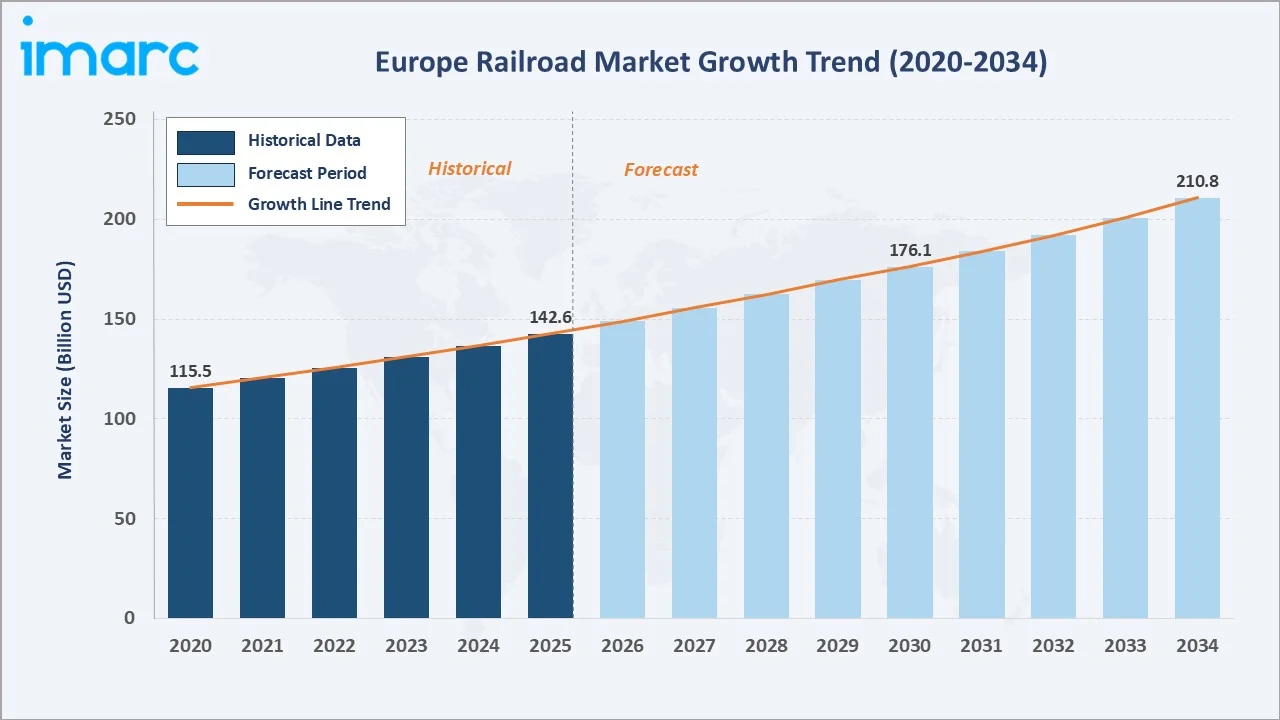
The Europe railroad market grew from USD 142.6 Billion in 2025 to USD 148.8 Billion in 2026 and is projected to reach USD 210.8 Billion by 2034, growing at a CAGR of 4.31% during 2026-2034. The market is driven by the European Union Green Deal modal shift mandate and strong post-COVID passenger traffic recovery across national rail networks. The European Rail Joint Undertaking has proposed an EUR 18 Billion coordinated investment program from 2028 to 2034 to modernize rail systems, underscoring the structural policy commitment to rail as the backbone of sustainable European mobility. Passenger rail leads at 56.8% by type, long-distance rail dominates at 61.5% by distance, and Germany commands the largest country share at 24.8% in 2025.
Market Snapshot
|
Metric |
Value |
|
Base Year Market Size (2025) |
USD 142.6 Billion |
|
Market Size (2026) |
USD 148.8 Billion |
|
Forecast Market Size (2034) |
USD 210.8 Billion |
|
CAGR (2026-2034) |
4.31% |
|
Base Year |
2025 |
|
Historical Period |
2020-2025 |
|
Forecast Period |
2026-2034 |
|
Dominant Type |
Passenger Rail (56.8%, 2025) |
|
Dominant Distance |
Long Distance (61.5%, 2025) |
|
Leading Country |
Germany (24.8%, 2025) |
The Europe railroad market grew from USD 115.5 Billion in 2020 to USD 142.6 Billion in 2025, and further to USD 148.8 Billion in 2026, reflecting sustained infrastructure investment, recovering passenger volumes, and growing rail freight demand supported by European decarbonization policy. The market is projected to reach USD 176.1 Billion by 2030 before reaching USD 210.8 Billion by 2034.
To get more information on this market, Request Sample
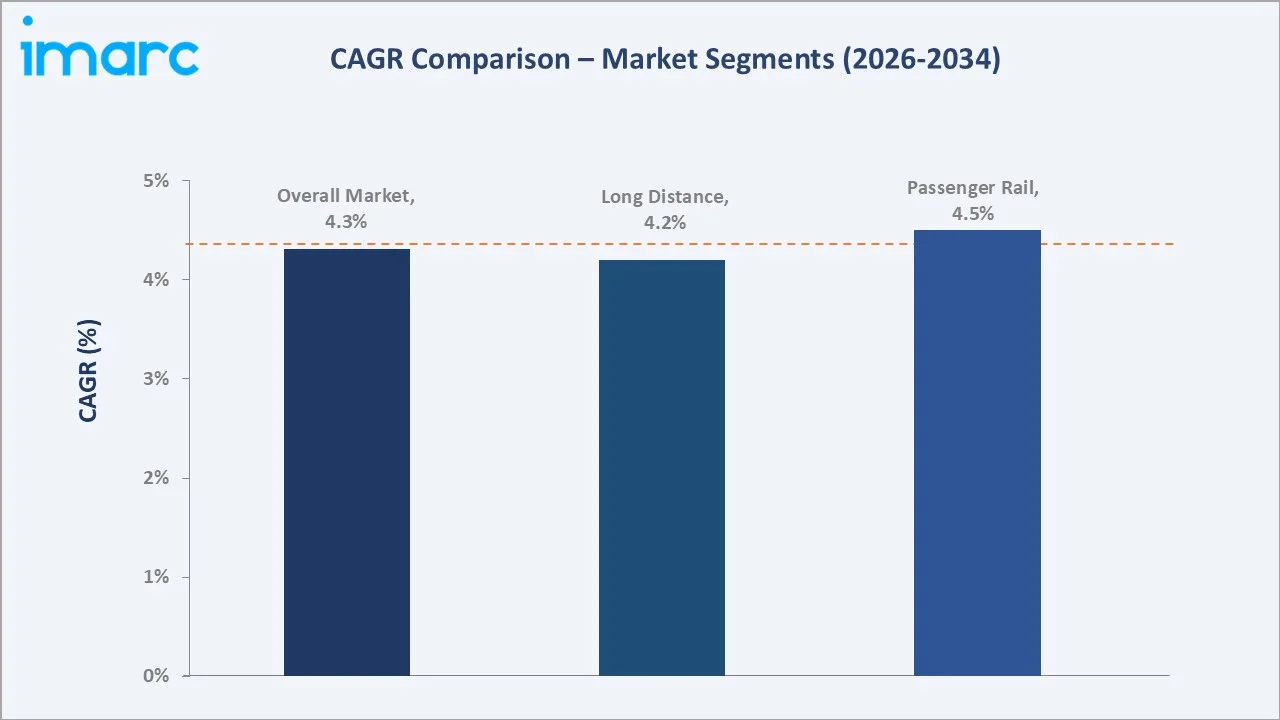
Passenger rail is projected to grow at a 4.5% CAGR, driven by high-speed network expansion, night train revival, and post-COVID demand recovery sustained by rising air travel costs and environmental preferences. Long-distance rail at 4.2% CAGR benefits from high-speed rail investment across Germany, France, Italy, and Spain. The overall market CAGR of 4.31% reflects Europe structural commitment to rail as the primary sustainable long-distance transport mode through 2034.
Executive Summary
The Europe railroad market is on a sustained growth trajectory, underpinned by the European Union Green Deal commitment to double rail freight traffic and significantly increase high-speed passenger rail usage, large-scale TEN-T infrastructure investment programs across member states, and the accelerating deployment of the European Rail Traffic Management System (ERTMS) that is progressively creating a unified, interoperable European rail network. The market expanded significantly, supported by post-COVID passenger recovery, Recovery and Resilience Facility infrastructure investment across Southern and Eastern Europe, and growing rail freight modal shift demand from road haulage.
Passenger rail at 56.8% leads the market, reflecting the primacy of national and international passenger services in European rail economics, with high-speed rail in France, Germany, Italy, and Spain generating the highest per-kilometer revenue. Long distance leads at 61.5%. Germany leads with a 24.8% market share, reflecting its position as Europe largest national rail market by infrastructure scale, passenger volume, and freight tonnage, operating through Deutsche Bahn largest national integrated rail network.
Key Market Insights
|
Insight |
Data |
|
Dominant Type |
Passenger Rail - 56.8% share (2025) |
|
Dominant Distance |
Long Distance - 61.5% share (2025) |
|
Leading Country |
Germany - 24.8% (2025) |
|
Key Market Opportunity |
EUR 18 Billion EU-Rail coordinated investment program 2028-2034 and TEN-T core network completion mandate creating structural long-term demand across infrastructure, rolling stock, and signalling. |
Key Analytical Observations Supporting the Above Data:
- Passenger Rail at 56.8%: Passenger rail dominates the European railroad market because national passenger rail services, from urban commuter networks to high-speed intercity lines, generate the majority of rail operating revenues across the five largest European markets.
- Long Distance at 61.5%: Long-distance rail dominates because high-speed rail services generate the highest revenue density in the European rail market, with premium fares significantly above short-distance suburban and regional service revenue per passenger-kilometer.
- Germany at 24.8%: Germany leads because Deutsche Bahn operates Europe largest national rail network by track length and annual train-kilometers, encompassing high-speed, intercity, regional, suburban, and freight operations that together generate the highest single-country rail revenue in Europe.
Europe Railroad Market Overview
The Europe railroad market encompasses all revenue-generating activities within the rail transport sector across European countries, including passenger rail operations spanning high-speed, intercity, regional, and suburban services, rail freight operations covering bulk, automotive, intermodal, and general cargo, infrastructure management and maintenance generating access charge revenue, and associated rolling stock leasing, signalling system supply, and digital rail technology services. The market is structured across three operational layers: infrastructure managers who own, maintain, and charge access to rail networks; train operating companies that operate passenger and freight services on those networks; and rolling stock manufacturers and technology suppliers that enable the market.
Market Dynamics
To evaluate market opportunities, Request Sample
Market Drivers
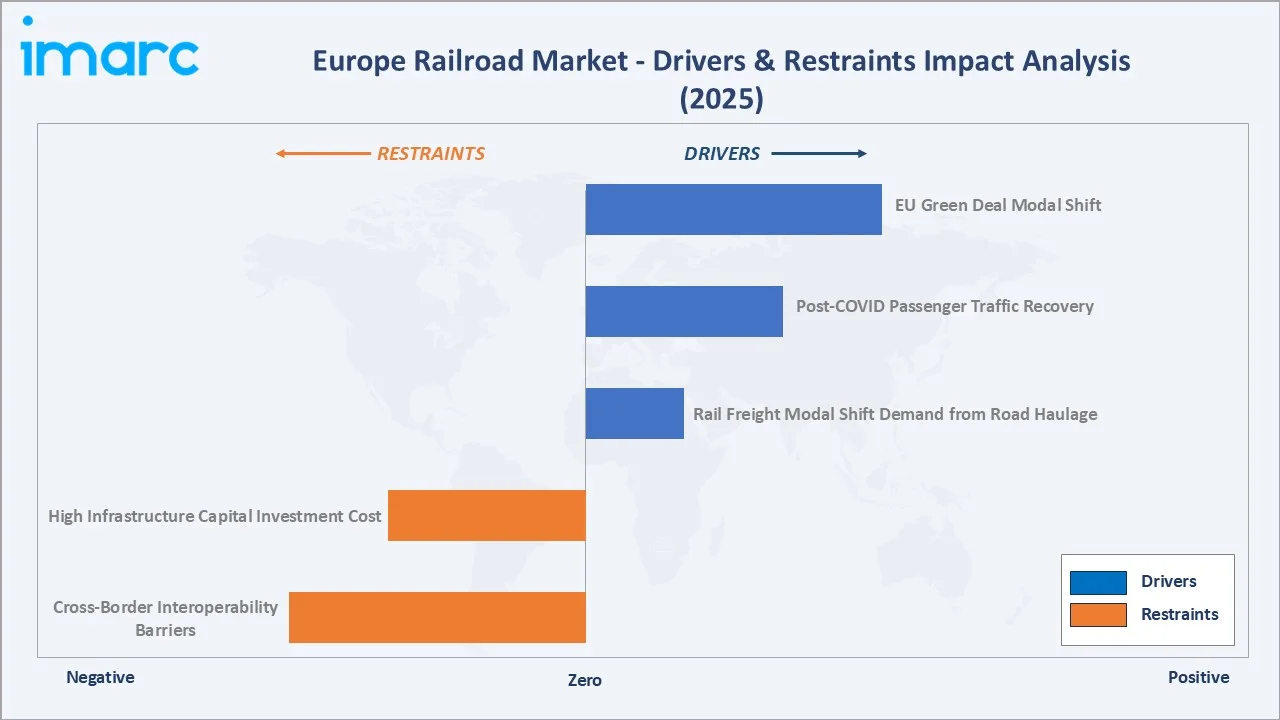
- EU Green Deal Modal Shift: The European Green Deal commits to doubling rail freight traffic by 2050. The EU Green Deal’s modal-shift objectives encourage the movement of passengers and freight from road transport toward rail, which produces lower emissions per passenger and tonne-kilometre. This is driving investment in rail infrastructure, electrification, intermodal freight networks, and high-speed passenger services across Europe, supporting long-term railroad market growth.
- Post-COVID Passenger Traffic Recovery: European rail passenger numbers have fully recovered and exceeded pre-COVID 2019 levels, with Trenitalia ranked as Europe best train operator and Eurostar carried 20 million passengers in 2025, a significant increase from the pandemic trough. The combination of rising short-haul aviation costs, growing environmental travel preferences, and expanded high-speed rail route networks is sustaining above-trend passenger demand growth across all major European markets.
- Rail Freight Modal Shift Demand from Road Haulage: EU decarbonization policy creates structural economic pressure on road haulage through carbon pricing under the Emissions Trading System and road charging mechanisms, progressively improving the competitive economics of rail freight for medium and long-distance cargo movements. The Digital Automatic Coupler (DAC) program will enable automated train formation that significantly reduces freight operating costs.
Market Restraints
- High Infrastructure Capital Investment Cost: Rail infrastructure investment requires multi-decade capital commitments at very high per-kilometer costs, with major projects demonstrating the cost overrun and schedule risk inherent in large rail infrastructure development. These cost pressures constrain the pace of network expansion despite policy mandates.
- Cross-Border Interoperability Barriers: Despite decades of EU harmonization efforts, technical differences in train control systems, electrification voltages, loading gauges, and safety certification requirements across European national rail networks continue to impose costs and delays on cross-border rail operations.
Market Opportunities
- Private Passenger Open Access Market Development: The liberalization of European passenger rail markets is enabling private operators to compete with incumbents on profitable high-speed and intercity routes. This competition is expanding total passenger capacity, improving service quality, and reducing fares, stimulating demand that grows the overall market beyond what incumbents alone would generate.
- Expansion of Cross-Border Rail Connectivity: In October 2025, Leo Express signed a 10-year agreement with Renfe’s leasing subsidiary for three Talgo VI passenger-coach sets. The deal supports a planned Prague–Bratislava service in Q2 2026 and strengthens Leo Express’s presence in Central Europe. The launch highlights opportunities to expand international passenger rail services by connecting major European cities through efficient cross-border routes. This can support demand for modern rolling stock, leasing services, and integrated rail networks, creating opportunities for operators and rail infrastructure providers.
Market Challenges
- Workforce Shortages Across Rail Operations: European rail operators face significant workforce shortages in train drivers, signalling engineers, infrastructure maintenance technicians, and digital rail specialists, with industrial action by rail workers disrupting services. These workforce constraints limit the pace of service expansion and increase operating costs through premium wages and overtime payments.
- Public Financing Pressures and Subsidy Dependence: Many European rail operations, particularly regional and commuter services, are financially dependent on public service obligation subsidies that are subject to government budget constraints. Fiscal consolidation pressures across European governments are creating uncertainty about future subsidy levels, particularly in France and Germany, where rail financing reform is actively debated.
Emerging Market Trends
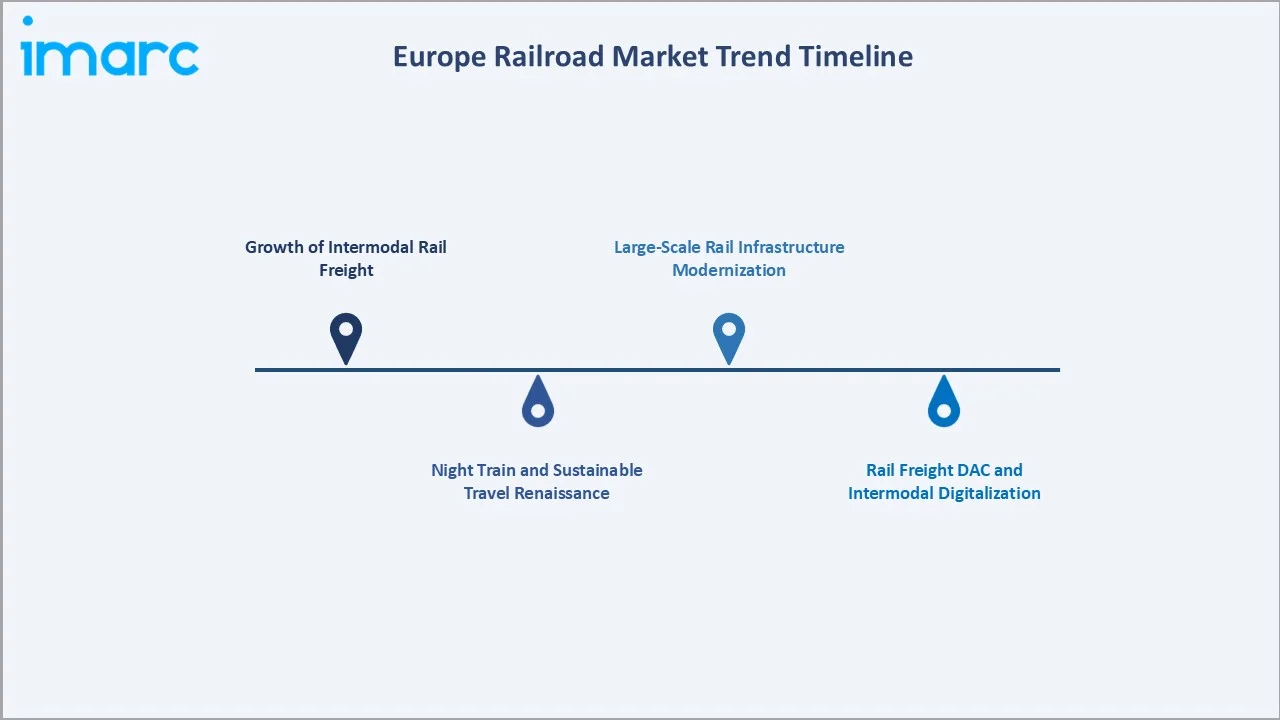
1. Growth of Intermodal Rail Freight
Companies are increasingly developing rail corridors that connect ports with inland markets, supporting more efficient and potentially lower-emission supply chains. In August 2026, DP World completed its first shipment of finished vehicles through a new intermodal rail corridor connecting Zeebrugge in Belgium with Aiud in Romania, establishing a new logistics link between Western and Southeastern Europe. The launch reflects the growing shift toward intermodal rail freight solutions for moving vehicles and other goods across European borders.
2. Night Train and Sustainable Travel Renaissance
The resurgence of night trains reflects growing consumer interest in sustainable and convenient alternatives to short-haul air travel. European rail operators are expanding overnight routes that connect major cities while reducing the need for daytime travel and additional accommodation costs. This trend is encouraging investment in modern sleeper coaches, upgraded rail infrastructure, and cross-border services.
3. Large-Scale Rail Infrastructure Modernization
In July 2026, Hungary’s government approved a HUF 3,550 billion (about EUR 9.76 billion) rail modernization program through 2035. The initiative includes acquiring at least 35 InterCity trains and 42 HÉV trainsets, upgrading rail lines and stations, restoring regional routes, and planning high-speed connections to Vienna and Warsaw. The investment reflects a growing European trend toward upgrading aging rail infrastructure and expanding modern passenger fleets to improve connectivity and service quality. Government-backed spending on trains, stations, regional routes, and high-speed corridors is creating opportunities for rail manufacturers, infrastructure providers, and technology suppliers.
4. Rail Freight DAC and Intermodal Digitalization
The Digital Automatic Coupler program under the European DAC Delivery Programme is advancing toward standardized deployment across European rail freight wagons, enabling individual wagon telemetry, automated train formation, and predictive maintenance that will transform rail freight economics. Combined with deployment on freight corridors and the regulations merging core network corridors with rail freight corridors, these developments are creating the technical foundation for a genuinely competitive pan-European rail freight network by the early 2030s.
Industry Value Chain Analysis
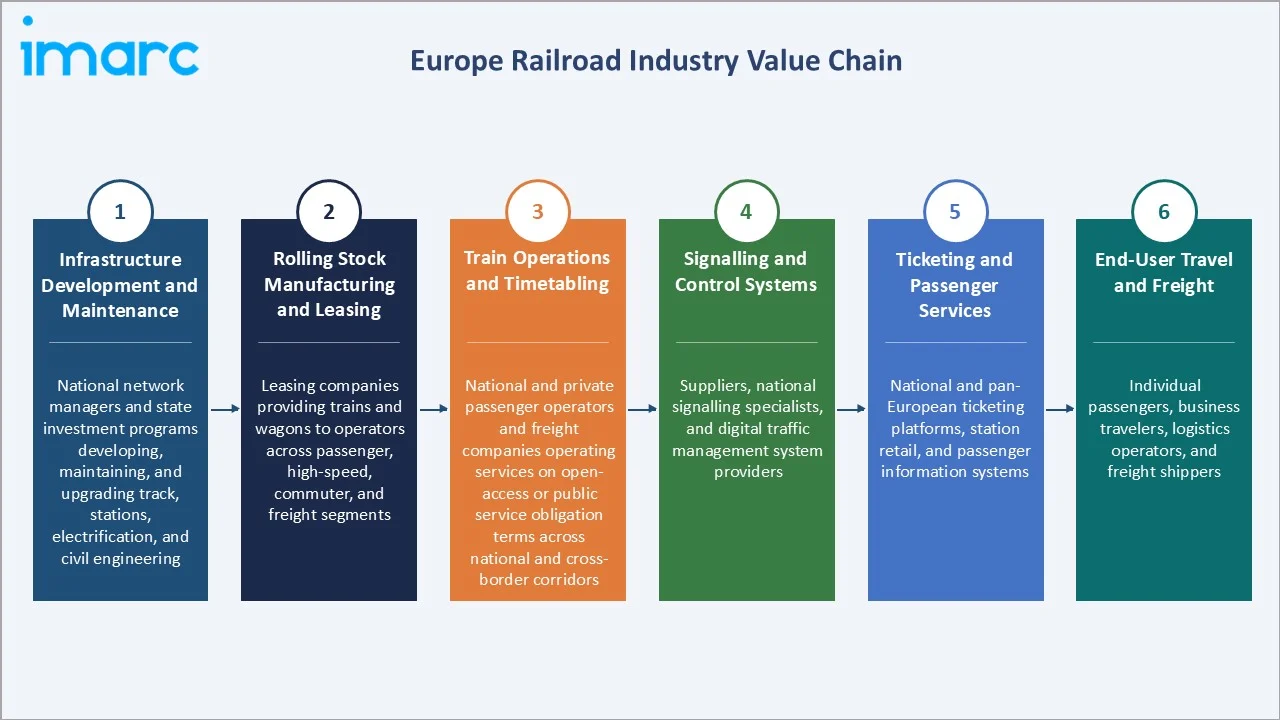
The Europe railroad market value chain spans six integrated stages from infrastructure development through end-user travel and freight. The train operations stage captures the highest commercial value in the chain, as passenger and freight train operating companies generate the direct customer-facing revenue that underpins all other value chain activities, while benefiting from the capital investment of infrastructure managers and rolling stock lessors.
|
Stage |
Key Participants |
|
Infrastructure Development and Maintenance |
National network managers and state investment programs developing, maintaining, and upgrading track, stations, electrification, and civil engineering. |
|
Rolling Stock Manufacturing and Leasing |
Leasing companies providing trains and wagons to operators across passenger, high-speed, commuter, and freight segments. |
|
Train Operations and Timetabling |
National and private passenger operators and freight companies operating services on open-access or public service obligation terms across national and cross-border corridors. |
|
Signalling and Control Systems |
Suppliers, national signalling specialists, and digital traffic management system providers. |
|
Ticketing and Passenger Services |
National and pan-European ticketing platforms, station retail, and passenger information systems. |
|
End-User Travel and Freight |
Individual passengers, business travelers, logistics operators, and freight shippers. |
The train operations stage is the highest value-added stage in the railroad value chain. National incumbent operators and open-access entrants capture direct customer revenue through ticket sales and freight contracts, with high-speed passenger operations commanding premium pricing that sustains the economics of the entire rail ecosystem, from infrastructure access charge revenues to rolling stock procurement demand.
Technology Landscape in the Europe Railroad Industry
High-Speed Rail Rolling Stock and Propulsion Technology
Next-generation high-speed rolling stock platforms are being procured across European rail markets, competing for large fleet orders across national operators. Hydrogen and battery-electric propulsion variants are being developed for non-electrified lines, enabling emissions-free operation across the European network without requiring full electrification investment.
Digital Automatic Coupler and Freight Digitalization
Digital Automatic Couplers (DAC) are transforming freight rail by automating train coupling and uncoupling, reducing manual operations and improving safety and efficiency. Combined with digital systems, DACs can enable automated brake testing, wagon identification, and real-time data exchange. This supports faster freight handling, shorter turnaround times, and greater interoperability across European rail networks.
Autonomous and Remote-Operated Train Technology
Autonomous and remote-operated train technologies are gaining attention as rail operators seek to improve operational efficiency, safety, and service reliability. These systems use automation, sensors, communication networks, and control technologies to reduce the need for manual intervention. Adoption is particularly relevant for metro, urban rail, freight, and controlled railway environments, supporting the broader digital transformation of the rail industry.
Market Segmentation Analysis
The report covers the following segments:
|
Segment Category |
Leading Segment |
Market Share |
Year |
|
Type |
Passenger Rail |
56.8% |
2025 |
|
Distance |
Long Distance |
61.5% |
2025 |
|
End Use |
🔒 |
🔒 |
2025 |
|
Country |
Germany |
24.8% |
2025 |

By Type
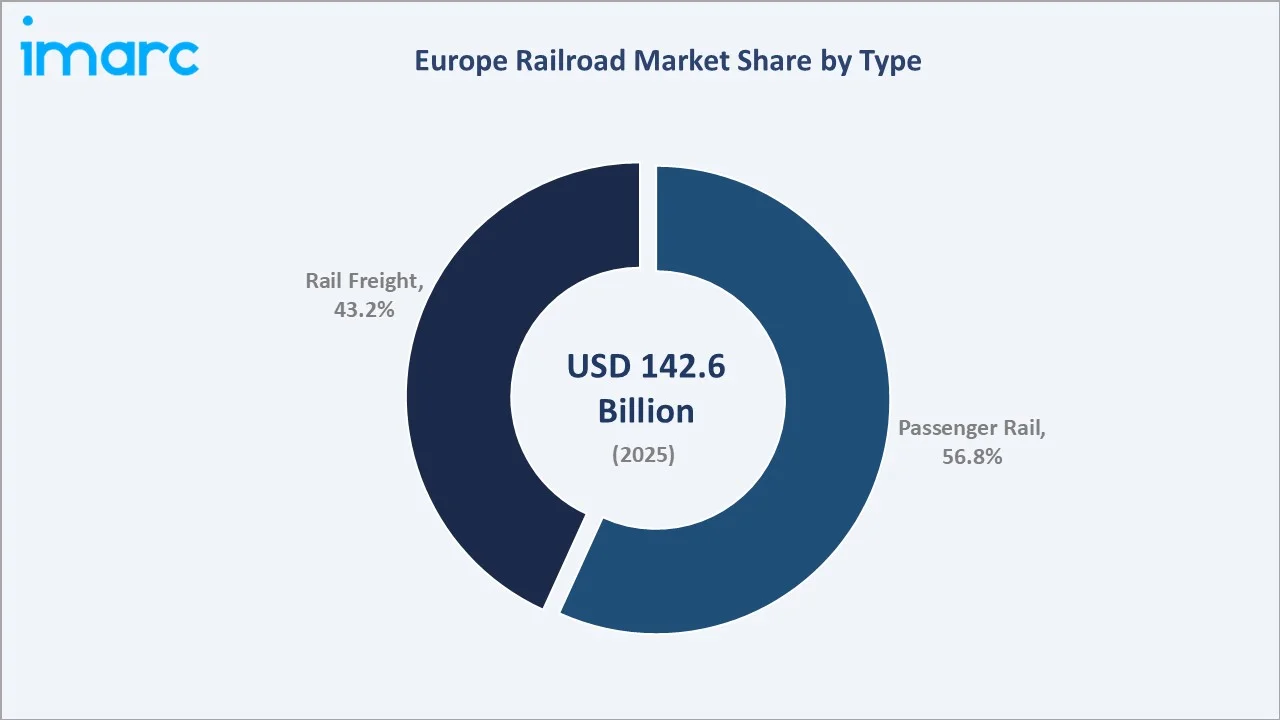
Passenger rail leads at 56.8% in 2025, reflecting the dominance of national passenger services, high-speed, intercity, regional, and suburban services in generating European rail revenues across the largest markets. Rail freight at 43.2% serves the backbone logistics requirements of European manufacturing and commodity supply chains.
To access detailed market analysis, Request Sample
By Distance
Long-distance rail leads at 61.5% in 2025, driven by the revenue intensity of high-speed intercity services where fare premiums, higher occupancy rates, and greater train frequencies combine to generate significantly more revenue per route-kilometer than short-distance operations.
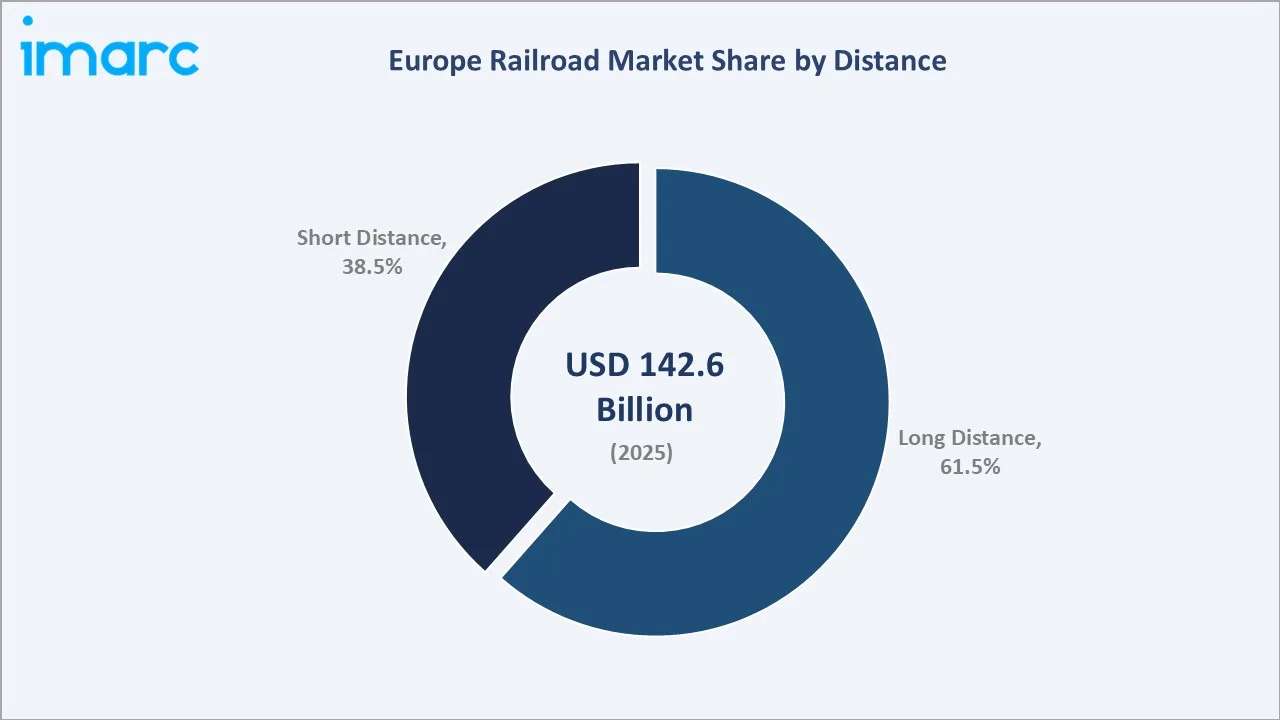
Short-distance rail at 38.5% encompasses regional and commuter services that collectively carry the highest passenger volumes in absolute terms but at lower fare yields than long-distance. Urban and suburban commuter networks provide the majority of European rail passenger journeys by volume. These services operate predominantly under public service obligation contracts that provide revenue certainty but limit upside pricing flexibility for operators.
Regional Market Insights
|
Country |
Share (2025) |
Key Europe Railroad Market Drivers & Characteristics |
|
Germany |
24.8% |
Reflecting one of the largest European integrated rail networks, Europe largest rail freight market by tonnage, significant ICE high-speed passenger operations, and substantial infrastructure investment commitments. |
|
France |
20.7% |
Reflecting European high-speed rail system, strong cross-border international traffic, and growing open-access competition on premium routes. |
|
United Kingdom |
18.6% |
Reflecting a large and diverse rail market undergoing structural transformation with half of passenger operators now in public ownership, active rolling stock procurement programs, and continued strong commuter demand in major cities. |
|
Italy |
14.3% |
Reflecting a high-speed network, infrastructure investment supported by funds among the largest in Europe and growing private competition. |
|
Spain |
10.5% |
Reflecting a high-speed network, one of the longest high-speed rail networks globally, ongoing international expansion, and substantial investments. |
|
Others |
11.1% |
Reflecting a diverse group of growing European rail markets, collectively representing significant infrastructure investment and growing passenger and freight demand. |
Germany commanding 24.8% of the European railroad market reflects the scale of Europe largest integrated rail operator, combining long-distance ICE passenger services, the most extensive European regional rail network, and Europe largest rail freight operators.
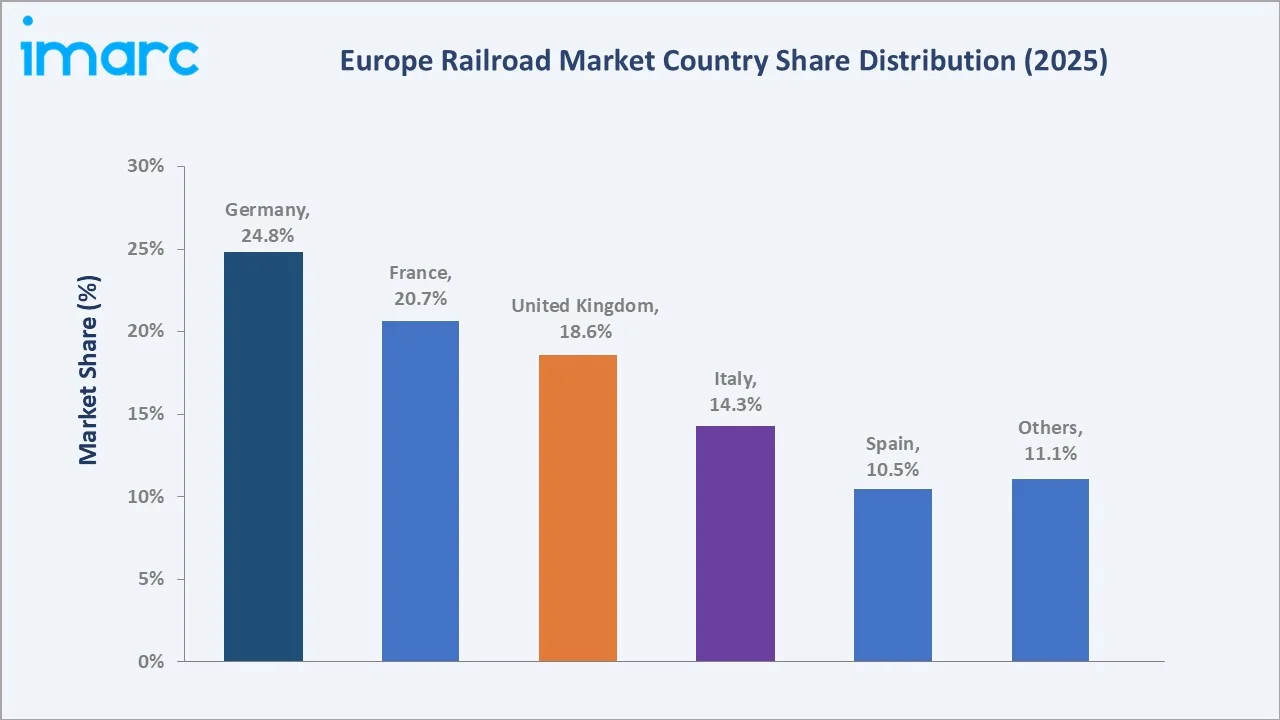
France at 20.7% benefits from network technical excellence and the track renewal contracts that underpin sustained infrastructure investment. The UK at 18.6% is a market in structural transformation, with the public ownership shift creating new investment planning frameworks. Italy at 14.3% and Spain at 10.5% reflect the major TEN-T beneficiaries in Southern Europe, with both countries receiving among the largest rail investment allocations in the EU. Others at 11.1%.
Competitive Landscape
The Europe railroad market competitive landscape is structured across three tiers: national incumbent operators who dominate national passenger and freight markets through integrated network access and government backing, rolling stock manufacturers competing for large fleet procurement programs across national operators, and emerging open-access passenger operators who are entering profitable high-speed corridors.
|
Company |
Key Offerings |
Market Position |
Core Strength |
|
Deutsche Bahn AG |
ICE and Intercity Trains, DB Cargo |
Market Leader |
Deutsche Bahn AG serves as the backbone of Germany's transportation system and acts as a major player in the broader European rail network. |
|
SNCF Group |
Eurostar, TGV Lyria, Ouigo España, TGV Inoui |
Market Leader |
SNCF Group is a major leader in European rail, driving cross-border high-speed passenger travel, international freight logistics, and sustainable mobility solutions. |
|
FS Italiane Group |
Trenitalia |
Established Player |
Operates high-speed services through Trenitalia France on various routes backed by a strategic joint venture aiming for expansion into the UK market. |
|
ALSTOM SA |
Avelia trains, Coradia regional trains, Citadis trams |
Established Player |
Alstom SA is a major leader in Europe's railway sector, providing comprehensive manufacturing, digital signaling, infrastructure, and maintenance solutions. |
|
Hitachi, Ltd. |
ETR1000 – Frecciarossa, AT400 |
Innovator |
Hitachi, Ltd. plays a major role in Europe's railway sector through Hitachi Rail, supplying high-speed rolling stock, advanced digital signaling, and sustainable hybrid-electric propulsion systems. |
The competitive landscape is evolving as open-access liberalization progressively erodes incumbent national monopolies in passenger rail, while rolling stock manufacturers consolidate following the various acquisitions.
Key Company Profiles
Deutsche Bahn AG
Deutsche Bahn AG is Germany’s state-owned railway company and one of Europe’s major providers of passenger and freight rail services. The company operates long-distance, regional, and urban rail services, alongside extensive rail infrastructure and logistics operations. DB also supports cross-border rail connectivity through its European network and partnerships. Its activities in infrastructure modernization, digitalization, fleet development, and sustainable mobility contribute to the broader development of the European railroad market.
- Key Offerings: ICE and Intercity Trains, DB Cargo.
- Strategic Focus: Focuses on modernizing rail infrastructure, expanding digital technologies, and improving network capacity and service reliability across its operations. The company also emphasizes sustainable mobility, fleet renewal, and stronger cross-border rail connectivity to support the evolving European railroad market.
SNCF Group
SNCF Group is a major French railway group providing passenger and freight transportation, rail infrastructure, and related mobility services across Europe. The group operates high-speed, regional, and urban rail services and has a significant presence in international markets. Its activities cover passenger mobility, logistics, infrastructure management, and railway solutions. SNCF Group continues to support the development of European rail networks through investments in modernization, digitalization, fleet renewal, and sustainable transportation.
- Key Offerings: Eurostar, TGV Lyria, Ouigo España, TGV Inoui.
- Strategic Focus: Focuses on expanding sustainable passenger mobility, modernizing rail infrastructure, and renewing its rolling-stock fleet across European markets. Its strategy also emphasizes digitalization, operational efficiency, international connectivity, and development of low-carbon rail transportation solutions.
Market Concentration Analysis
The Europe railroad market is moderately concentrated at the national level, where single incumbent operators dominate their respective national markets for both passenger and freight rail. However, liberalization is progressively reducing national concentration as open-access operators enter profitable passenger corridors, private freight operators compete alongside incumbent state freight subsidiaries, and cross-border services create pan-European competition.
Market concentration in infrastructure management is determined by EU regulation rather than competition, as national infrastructure managers are natural monopolies regulated through access charging frameworks. The TEN-T Regulation strengthens European coordination requirements while preserving national infrastructure management structures, ensuring that concentration at this level remains structurally determined through 2034.
Investment & Growth Opportunities
Highest Growth Segments
ERTMS signalling infrastructure and onboard unit supply represents the largest single equipment investment opportunity, with EU-Rail proposing EUR 18 Billion in coordinated digital rail investment from 2028 to 2034. International high-speed rail expansion and new cross-border corridor services represent the highest revenue-growth opportunity. Open-access passenger rail in liberalizing markets represents the highest margin growth opportunity for operators with competitive rolling stock and proven brand credentials.
Investment Themes
- High-Speed Rolling Stock Fleet Renewal: The aging of first-generation high-speed fleets across France, Spain, and Germany is driving large-scale rolling stock renewal programs that represent multi-billion euro procurement opportunities for Alstom and Siemens Mobility.
- Rail Freight Digital Platform Development: Investment in DAC deployment, freight wagon telemetry, and digital freight operations management platforms that enable rail freight to compete on service quality as well as cost against road haulage represents a transformative commercial opportunity, with EU-Rail DAC program investment supporting the initial deployment that makes commercial-scale digital freight operations viable across European corridors.
Future Market Outlook (2026-2034)
The Europe railroad market stood at USD 142.6 Billion in 2025 and is projected to grow from USD 148.8 Billion in 2026 to USD 210.8 Billion by 2034, exhibiting a CAGR of 4.31% during the forecast period. The market is expected to reach an intermediate milestone of approximately USD 176.1 Billion by 2030, as TEN-T core network completion deadlines drive peak infrastructure investment, EU-Rail's proposed EUR 18 Billion digital rail program moves from proposal toward implementation, and open-access passenger rail liberalization expands the addressable passenger service market across multiple European countries.
Three structural forces will define the European railroad market through 2034. First, the European Union Green Deal modal shift mandate creates policy-backed demand foundations that transcend short-term economic cycles. Second, the ERTMS deployment mandate across the TEN-T core network will drive sustained infrastructure and rolling stock technology investments, creating a generational wave of signalling, rolling stock, and digital operations management procurement that directly expands market revenues across the infrastructure technology segment. Third, the progressive liberalization of European passenger rail markets will expand total passenger rail capacity and demand on profitable corridors, growing the overall market beyond what incumbents alone would provide while simultaneously improving service quality and price competitiveness that further stimulates demand.
Research Methodology
Primary Research
Primary research comprised structured consultations with senior executives at European national rail operators, infrastructure managers, rolling stock manufacturers, ERTMS signalling suppliers, rail freight operators, transportation policy experts, and investor relations teams at publicly listed rail technology companies. These discussions validated market sizing assumptions, assessed country-level demand dynamics, identified infrastructure investment pipeline visibility, and provided forward-looking perspectives on liberalization and technology adoption trends across the European railroad market.
Secondary Research
Secondary research drew on IMARC Group market data, TEN-T progress reports, EU-Rail Joint Undertaking publications, annual rail operator rankings, national rail regulatory authority annual reviews, and industry publications. Historical market data spanning 2020 through 2025 was cross-validated across regulatory and commercial data sources.
Forecasting Models
Market forecasts incorporated TEN-T investment commitment analysis by country, EU Green Deal modal shift policy impact modeling, deployment timeline projections and associated equipment market sizing, high-speed rail capacity expansion schedules across national operators, open-access market liberalization adoption scenario modeling, rail freight modal shift projections under EU carbon pricing scenarios, and macroeconomic indicators including European GDP growth and industrial production forecasts through 2034.
Europe Railroad Report Coverage:
| Report Features | Details |
|---|---|
| Base Year of the Analysis | 2025 |
| Historical Period | 2020-2025 |
| Forecast Period | 2026-2034 |
| Units | Billion USD |
| Scope of the Report | Exploration of Historical and Forecast Trends, Industry Catalysts and Challenges, Segment-Wise Historical and Predictive Market Assessment:
|
| Types Covered | Rail Freight, Passenger Rail |
| Distances Covered | Long Distance, Short Distance |
| End Uses Covered | Mining, Construction, Agriculture, Others |
| Countries Covered | Germany, France, United Kingdom, Italy, Spain, Others |
| Companies Covered | Deutsche Bahn AG, SNCF Group, FS Italiane Group, ALSTOM SA, Hitachi, Ltd., etc. |
| Customization Scope | 10% Free Customization |
| Post-Sale Analyst Support | 10-12 Weeks |
| Delivery Format | PDF and Excel through Email (We can also provide the editable version of the report in PPT/Word format on special request) |
Key Benefits for Stakeholders:
- IMARC’s report offers a comprehensive quantitative analysis of various market segments, historical and current market trends, market forecasts, and dynamics of the Europe railroad market from 2020-2034.
- The research study provides the latest information on the market drivers, challenges, and opportunities in the Europe railroad market.
- Porter's five forces analysis assist stakeholders in assessing the impact of new entrants, competitive rivalry, supplier power, buyer power, and the threat of substitution. It helps stakeholders to analyze the level of competition within the Europe railroad industry and its attractiveness.
- Competitive landscape allows stakeholders to understand their competitive environment and provides an insight into the current positions of key players in the market.
Frequently Asked Questions About the Europe Railroad Market Report
The Europe railroad market reached USD 148.8 Billion in 2026, driven by sustained TEN-T infrastructure investment, post-COVID passenger traffic recovery, EU Green Deal modal shift policy, and growing rail freight demand supported by decarbonization economic pressure on road haulage.
The market is projected to grow at a CAGR of 4.31% during 2026-2034, supported by TEN-T core network completion investment, ERTMS deployment, high-speed rail fleet renewal, open-access liberalization expanding passenger capacity, and EU Green Deal freight modal shift demand.
The market is projected to reach approximately USD 176.1 Billion by 2030, driven by TEN-T core network deadline-driven infrastructure investment, peak deployment expenditure, EU-Rail EUR 18 Billion digital rail program commencement, and continued high-speed passenger rail expansion.
Passenger rail leads with a 56.8% share in 2025, reflecting the revenue dominance of high-speed intercity services that generate premium fare yields significantly above freight revenue per train-kilometer, supported by sustained post-COVID demand recovery.
Long distance leads with a 61.5% share in 2025, driven by the revenue concentration of high-speed rail services where premium intercity fares, high train occupancies, and frequent service frequencies generate disproportionately high revenue per route-kilometer compared to short-distance commuter and regional services.
Germany leads with a 24.8% share in 2025, driven by Deutsche Bahn position as Europe largest integrated rail operator, the largest European rail freight market by tonnage, and the infrastructure investment programs committed by the German federal government.
Key players include Deutsche Bahn AG, SNCF Group, FS Italiane Group, ALSTOM SA, and Hitachi, Ltd., among others.
The market is projected to reach USD 210.8 Billion by 2034, driven by full TEN-T core network implementation, sustained high-speed rail expansion, liberalized passenger rail market growth, digital freight operations scaling through DAC deployment, and EU modal shift policy progressively redirecting transport demand from road and aviation to rail.
Need more help?
- Speak to our experienced analysts for insights on the current market scenarios.
- Include additional segments and countries to customize the report as per your requirement.
- Gain an unparalleled competitive advantage in your domain by understanding how to utilize the report and positively impacting your operations and revenue.
- For further assistance, please connect with our analysts.
 Request Customization
 Speak to an Analyst
 Request Brochure
 Inquire Before Buying
Benefits of Customization
- Personalize this research
- Triangulate with your data
- Get data as per your format and definition
- Gain a deeper dive into a specific application, geography, customer, or competitor
- Any level of personalization
Get in Touch With Us
UNITED STATES
Phone: +1-201-971-6302
INDIA
Phone: +91-120-433-0800
UNITED KINGDOM
Phone: +44-753-714-6104
Email: [email protected]
Client Testimonials




.webp)




.webp)













Related Reports

Choose your plan
*Please note that the prices mentioned below are starting prices for each bundle type. Kindly contact our team for further details.*
Single User License
- 1 User License, Access on 2 Devices
- PDF Report + Excel Dataset (Password Protected)
- Lifetime Access
- No Printing Rights
- 10% Free Report Customization
- 10–12 Weeks of Analyst Support
Five User License
- Access for 5 Users, 2 Devices per User
- PDF Report + Excel Dataset (Password Protected)
- Lifetime Access
- Dedicated Account Manager
- 12–14 Weeks of Analyst Support
- No Printing Rights
- 15% Free Report Customization
- 25% Discount on Your Next Purchase
Corporate User License
- Unlimited User Access (Within Your Organization)
- PDF Report + Excel Dataset
- Lifetime Access
- Dedicated Account Manager
- 14–20 Weeks of Analyst Support
- No Printing Rights
- 20% Free Report Customization
- 30% Discount on Your Next Purchase
Essential Insights
What's included:
3 reports
- Lifetime Access
- PDF Reports
- Excel Datasets
- 2 Weeks of Free Analyst Support
- 2 User Licenses
- Access on 2 Devices
- Printing Rights
- Complimentary PowerPoint (PPT) Version
- Complimentary License Upgrade
Professional Access
What's included:
5 reports
- Lifetime Access
- PDF Reports
- Excel Datasets
- 8 Weeks of Free Analyst Support
- 2 User Licenses
- Access on 2 Devices
- Printing Rights
- Complimentary PowerPoint (PPT) Version
- Complimentary License Upgrade
Business Advantage
What's included:
8 reports
- Lifetime Access
- PDF Reports
- Excel Datasets
- 14 Weeks of Free Analyst Support
- 2 User Licenses
- Access on 2 Devices
- Printing Rights
- Complimentary PowerPoint (PPT) Version
- Complimentary License Upgrade
Enterprise Intelligence
What's included:
10 reports
- Lifetime Access
- PDF Reports
- Excel Datasets
- 20 Weeks of Free Analyst Support
- 2 User Licenses
- Access on 2 Devices
- Printing Rights
- Complimentary PowerPoint (PPT) Version
- Complimentary License Upgrade