
Europe Self Storage Market Size, Share, Trends and Forecast by Storage Unit Size, End Use, and Country, 2026-2034
Europe Self Storage Market Size, Share, Trends & Forecast (2026-2034)
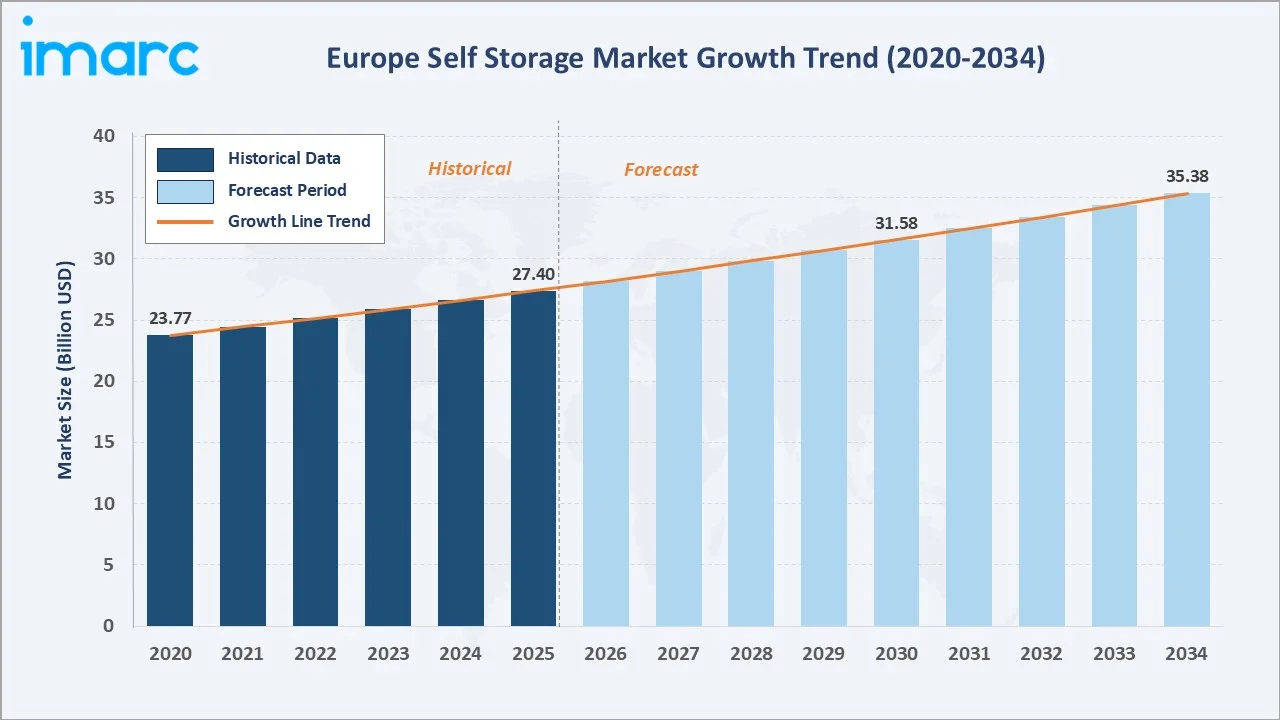
The Europe self storage market grew from USD 27.40 Billion in 2025 to USD 28.19 Billion in 2026 and is projected to reach USD 35.38 Billion by 2034, exhibiting a CAGR of 2.88% during 2026-2034. Rising residential mobility and flexible month-to-month lease models are reinforcing the growth. Purpose-built facilities in dense catchments continue to attract institutional capital across the region.
Medium storage unit leads the storage unit size segment at 45.7%, personal dominates the end use segment at 55.3%, and United Kingdom commands a 39.2% country share.
Market Snapshot
|
Metric |
Value |
|
Base Year Market Size (2025) |
USD 27.40 Billion |
| Market Size (2026) | USD 28.19 Billion |
|
Forecast Market Size (2034) |
USD 35.38 Billion |
|
CAGR (2026-2034) |
2.88% |
|
Base Year |
2025 |
|
Historical Period |
2020-2025 |
|
Forecast Period |
2026-2034 |
|
Largest Country |
United Kingdom (39.2%, 2025) |
|
Second Largest Country |
Germany (19.8%, 2025) |
|
Leading Storage Unit Size |
Medium Storage Unit (45.7%, 2025) |
|
Leading End Use |
Personal (55.3%, 2025) |
The Europe self storage market expanded from USD 23.77 Billion in 2020 to USD 27.40 Billion in 2025 and an estimated USD 28.19 Billion in 2026, supported by sustained urban migration and steady growth in small-business storage demand. Anchored at USD 31.58 Billion in 2030, the path to USD 35.38 Billion by 2034 rests on new site development in under-supplied countries and wider digital customer acquisition.
To get more information on this market, Request Sample
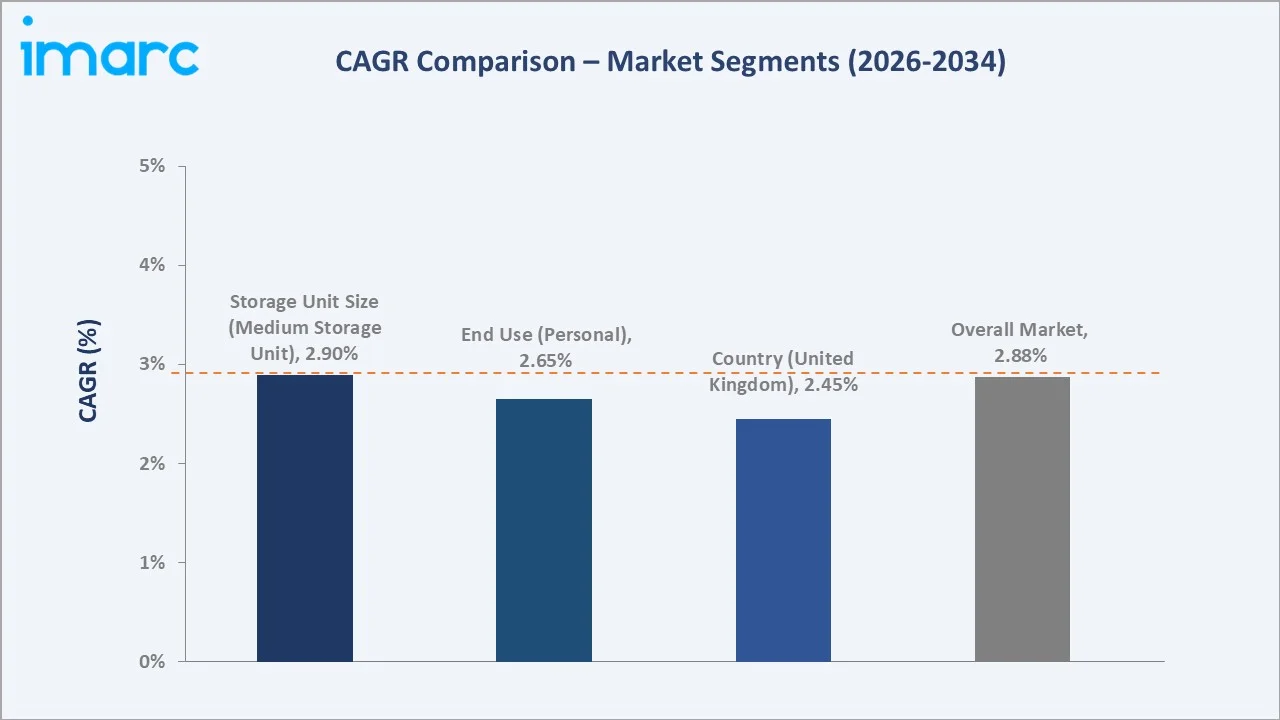
CAGR trajectories across storage unit size, end use, and country markets show Spain, Italy, and small storage unit expanding faster than the overall 2.88% market CAGR, supported by rising urbanization, limited living space, and growing demand for flexible storage solutions among households and businesses.
Executive Summary
The Europe self storage market is on a sustained growth trajectory from USD 23.77 Billion in 2020 to USD 28.19 Billion in 2026 and is projected to reach USD 35.38 Billion by 2034. Demand has broadened from short-term household overflow to structured, longer-cycle use by consumers and small firms. Smaller homes, frequent relocation, and online-led booking journeys have turned storage into a mainstream urban service.
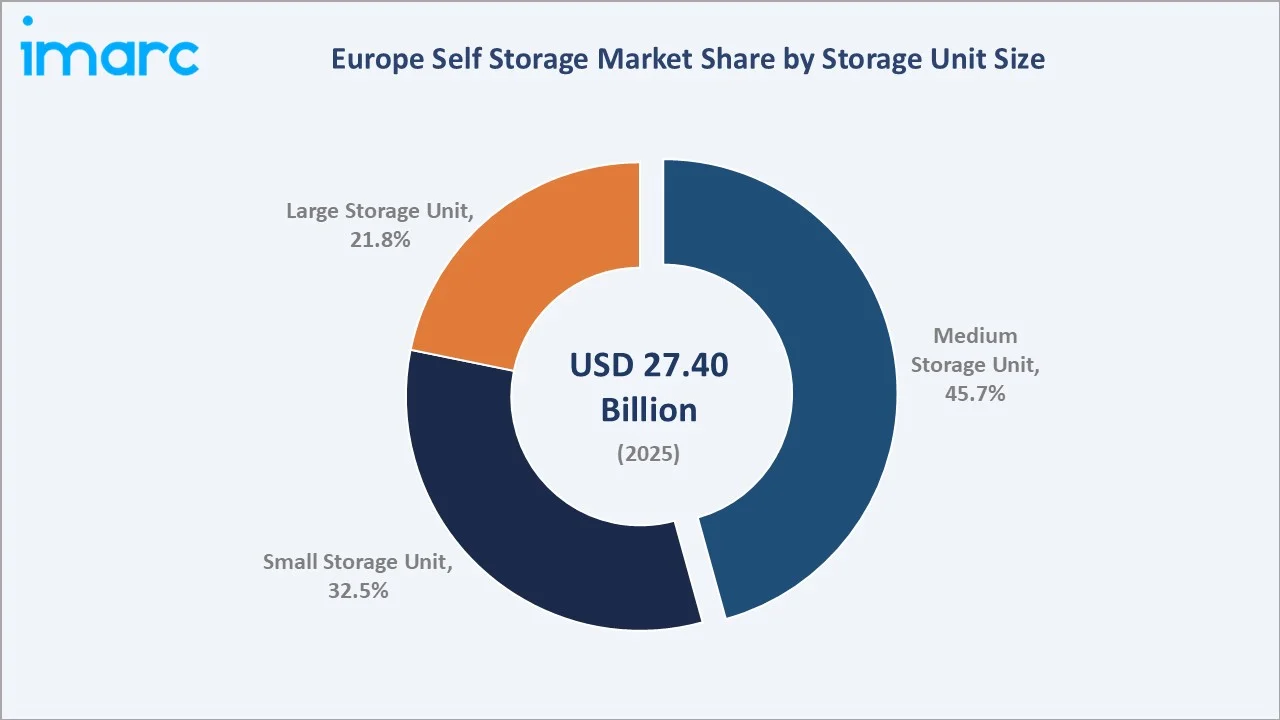
Medium storage unit dominates the storage unit size segment at 45.7% in 2025, balancing affordability with usable capacity for household contents. Personal leads end use at 55.3%, supported by moving, renovation, and downsizing cycles. United Kingdom holds 39.2% of the country share, reflecting deep supply base and strong institutional investment in the industry.
Key Market Insights
|
Insight |
Data |
|
Leading Storage Unit Size |
Medium Storage Unit - 45.7% share (2025) |
|
Second Largest Storage Unit Size |
Small Storage Unit - 32.5% share (2025) |
|
Leading End Use |
Personal - 55.3% share (2025) |
|
Second Largest End Use |
Business - 44.7% share (2025) |
|
Leading Country |
United Kingdom - 39.2% share (2025) |
|
Second Largest Country |
Germany - 19.8% share (2025) |
|
Top Companies |
Safestore Holdings plc, Shurgard Self Storage Ltd., Big Yellow Group PLC, Groupe Rousselet |
Key Analytical Observations Expanding On the Data Above:
- Medium storage unit leadership at 45.7% reflects its fit with the volume of a typical two-bedroom or three-bedroom household move, offering enough capacity for furniture and boxes without the cost step-up of larger rooms.
- Small storage unit share at 32.5% is anchored in compact city living and solo households. Its affordability and suitability for storing personal belongings, seasonal items, and household goods further support demand in urban areas.
- Personal dominance at 55.3% is driven by relocation, renovation, separation, and downsizing events that create temporary storage needs, many of which extend into longer tenancies once customers settle in.
- Business use at 44.7% is expanding as small retailers, tradespeople, and online sellers replace conventional warehouse leases with flexible rooms close to their customers and job sites.
- United Kingdom at 39.2% leads the country landscape, supported by high consumer awareness and a mature investment market for purpose-built storage assets.
Europe Self Storage Market Overview
Self storage refers to the rental of secure, individually accessible rooms inside purpose-built or converted facilities. Customers store household goods, business inventory, records, and equipment on flexible terms. The European market spans small, medium, and large unit formats serving both personal and business users.
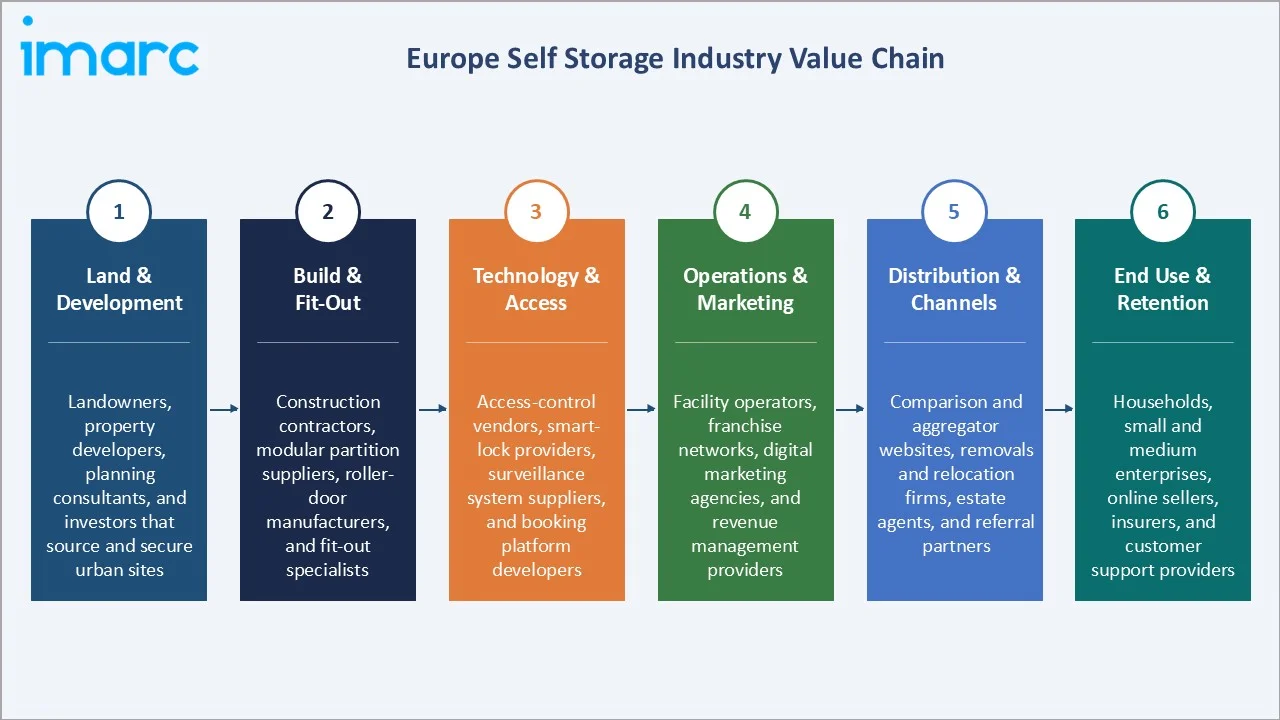
The ecosystem links site developers and construction partners, facility operators, access-control and booking technology vendors, real estate investors and planning authorities, removals firms and comparison platforms, and support providers covering insurance, security, and facility management. Housing supply, interest rates, and urban planning rules shape how quickly new capacity reaches the market.
Market Dynamics
To evaluate market opportunities, Request Sample
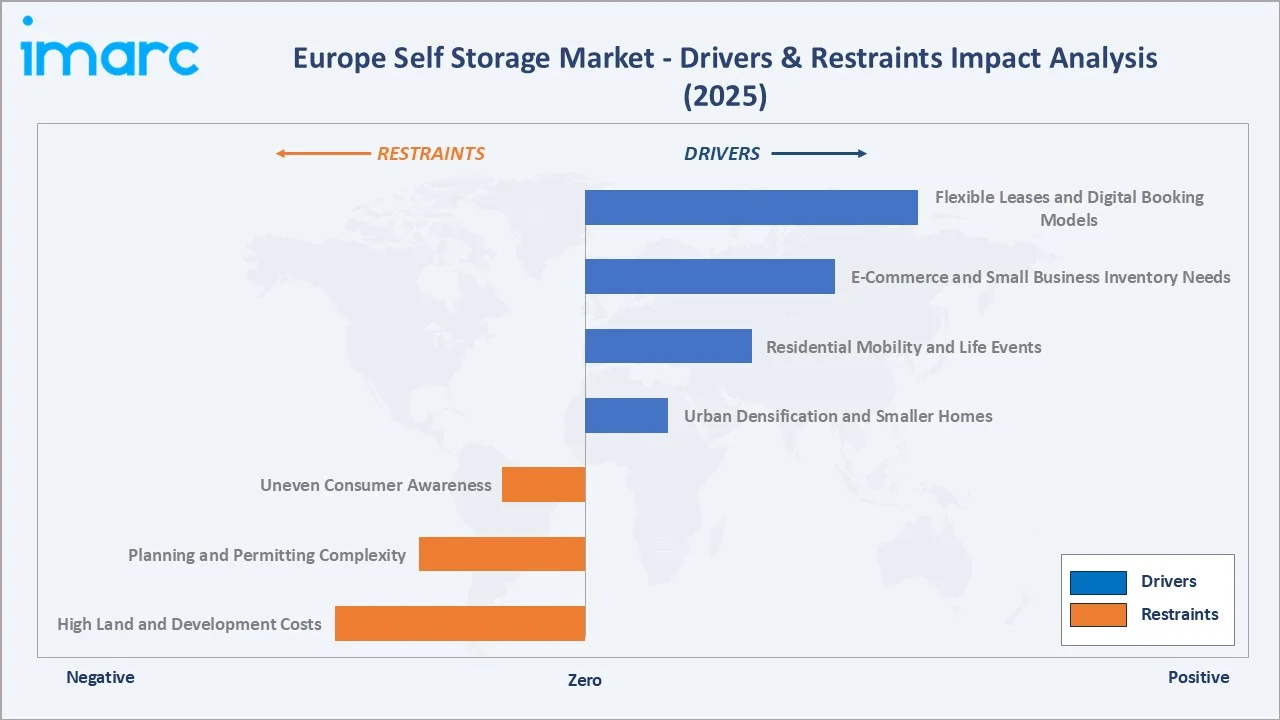
Market Drivers
- Urban Densification and Smaller Homes: New apartments in major European cities are being delivered with less storage space per resident. Households turn to external rooms to hold seasonal items, sports gear, and furniture that no longer fits.
- Residential Mobility and Life Events: Moving, renovation, separation, and bereavement create predictable storage needs. Rental-heavy housing markets in Germany and the Nordics generate frequent moves, lifting short-cycle demand across urban catchments.
- E-Commerce and Small Business Inventory Needs: As per IMARC Group, the Europe e-commerce market was valued at USD 4.29 Trillion in 2025. Online sellers and service firms use storage rooms as low-cost, close-to-market inventory space. The flexibility to scale storage capacity with changing stock levels further supports demand among growing businesses.
- Flexible Leases and Digital Booking Models: Month-to-month contracts, online reservation, and remote entry have removed friction from the purchase journey. Customers can compare, book, and access a unit without visiting a sales office.
Market Restraints
- High Land and Development Costs: Prime urban plots suitable for storage compete directly with residential and logistics uses. Elevated land values and construction costs lengthen payback periods and slow new site delivery.
- Planning and Permitting Complexity: Zoning rules in many European cities do not treat self storage as a distinct use class. Operators face lengthy consent processes and inconsistent interpretations across local authorities.
- Uneven Consumer Awareness: In several markets, households remain unfamiliar with paid external storage. Limited awareness restrains conversion even where urban space pressures are evident.
Market Opportunities
- Under-Penetrated Markets: Spain, Italy, Portugal, and Poland offer far lower supply per capita than the United Kingdom. New sites in these cities can capture first-mover advantages in dense residential catchments.
- Business and Fulfilment Storage: Purpose-designed rooms with loading access, longer opening hours, and parcel handling let operators serve online sellers and trades, lifting average tenancy length and revenue per square meter.
Market Challenges
- Energy Costs and Operating Overheads: Lighting, climate control, and security systems make energy a meaningful cost line. Volatile tariffs pressure margins, particularly at older, less efficient facilities.
- Competition for Prime Sites: Logistics, residential, and data center developers serving the Europe storage in big data market bid for the same well-connected urban land. Securing visible, easily accessible plots is becoming harder in core cities.
Emerging Market Trends
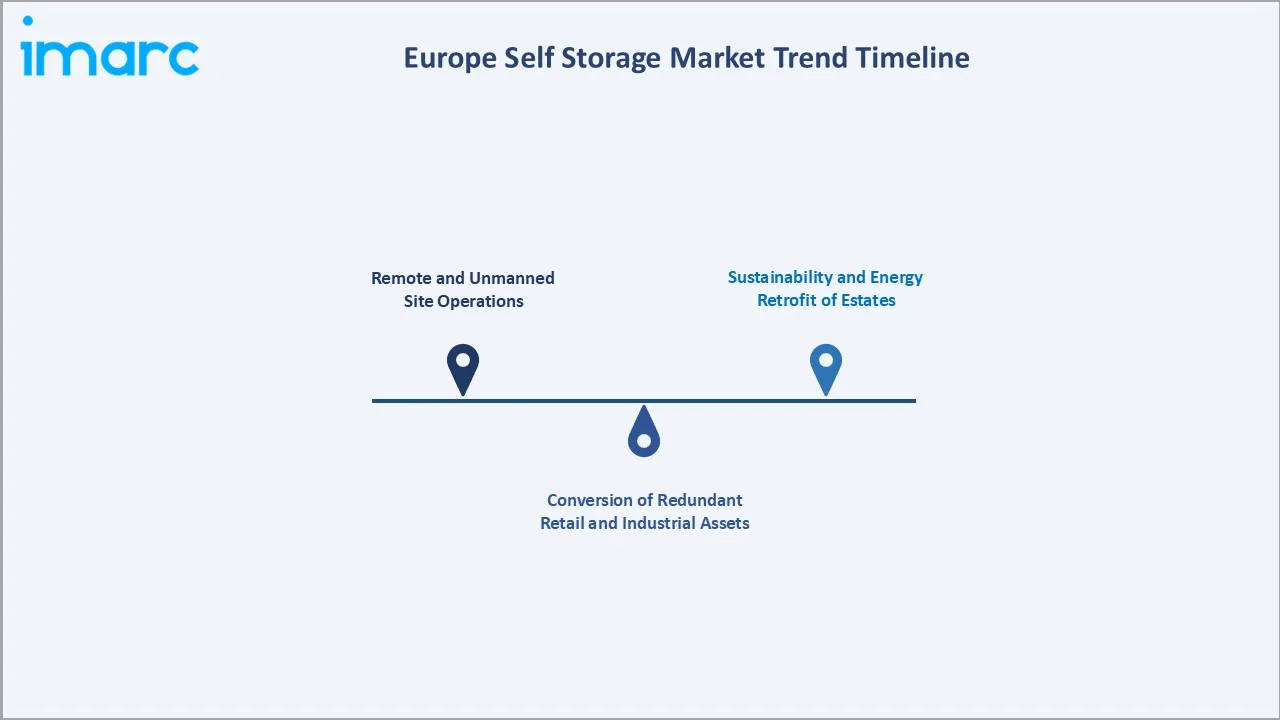
1. Remote and Unmanned Site Operations
Operators are running smaller facilities without permanent on-site staff, using app-based entry, video surveillance, and centralized call teams. The model lowers the break-even occupancy for secondary towns and makes smaller catchments viable for expansion.
2. Conversion of Redundant Retail and Industrial Assets
Vacant retail parks, older warehouses, and light industrial units are being converted into storage facilities. Conversion shortens delivery timelines against ground-up construction and gives operators well-located space at a lower entry cost.
3. Sustainability and Energy Retrofit of Estates
Rooftop solar, LED retrofits, and smart building controls are becoming standard across larger portfolios. Energy performance influences both operating costs and the valuation of assets held by listed and institutional owners.
Industry Value Chain Analysis
The Europe self storage value chain runs across six stages, from land assembly through customer retention. Site selection, operations, and digital marketing capture the highest value-add, while build quality and access technology increasingly determine long-run competitive position.
|
Stage |
Key Players / Examples |
|
Land & Development |
Landowners, property developers, planning consultants, and investors that source and secure urban sites |
|
Build & Fit-Out |
Construction contractors, modular partition suppliers, roller-door manufacturers, and fit-out specialists |
|
Technology & Access |
Access-control vendors, smart-lock providers, surveillance system suppliers, and booking platform developers |
|
Operations & Marketing |
Facility operators, franchise networks, digital marketing agencies, and revenue management providers |
|
Distribution & Channels |
Comparison and aggregator websites, removals and relocation firms, estate agents, and referral partners |
|
End Use & Retention |
Households, small and medium enterprises, online sellers, insurers, and customer support providers |
Vertically integrated owner-operators that control land, brand, and technology tend to capture more value than franchise or asset-light models that depend on third-party sites and systems.
Technology Landscape in the Europe Self Storage Industry
Access Control and Smart Site Infrastructure
Bluetooth and app-based entry, individual door alarms, and networked cameras have replaced key-and-padlock systems at newer sites. Centralized dashboards let a single team supervise multiple facilities and respond to alerts in real time.
Digital Booking, CRM, and Revenue Management
Online reservation, e-signature contracts, and automated payments support most new rentals. Integrated CRM platforms track enquiry sources, while revenue management tools, built on the analytics and data-management stack that also serves the France data analysis storage management market, set unit-level prices based on availability and local competition.
Data Analytics, Automation, and Building Systems
Operators use demand analytics to guide site selection and unit mix decisions. Smart lighting, climate sensors, and metering systems reduce energy use, while automated arrears management and chatbots lower the cost of servicing each customer.
Market Segmentation Analysis
The report covers the following segments:
|
Segment Category |
Leading Segment |
Market Share |
Year |
|
Storage Unit Size |
Medium Storage Unit |
45.7% |
2025 |
|
End Use |
Personal |
55.3% |
2025 |
|
Country |
United Kingdom |
39.2% |
2025 |

By Storage Unit Size
Medium storage unit holds a 45.7% share in 2025. The format suits household moves, part-home renovations, and small business stock, offering enough volume for furniture and boxes at a price point most customers accept for extended tenancies.
To access detailed market analysis, Request Sample
Small storage unit accounts for 32.5% in 2025, driven by compact city apartments, solo occupiers, and document storage for micro-businesses.
By End Use
Personal commands 55.3% of the market in 2025. Relocation, renovation, family change, and downsizing create the bulk of enquiries, and a meaningful share of these short-term users convert into long-stay customers once their storage becomes routine.
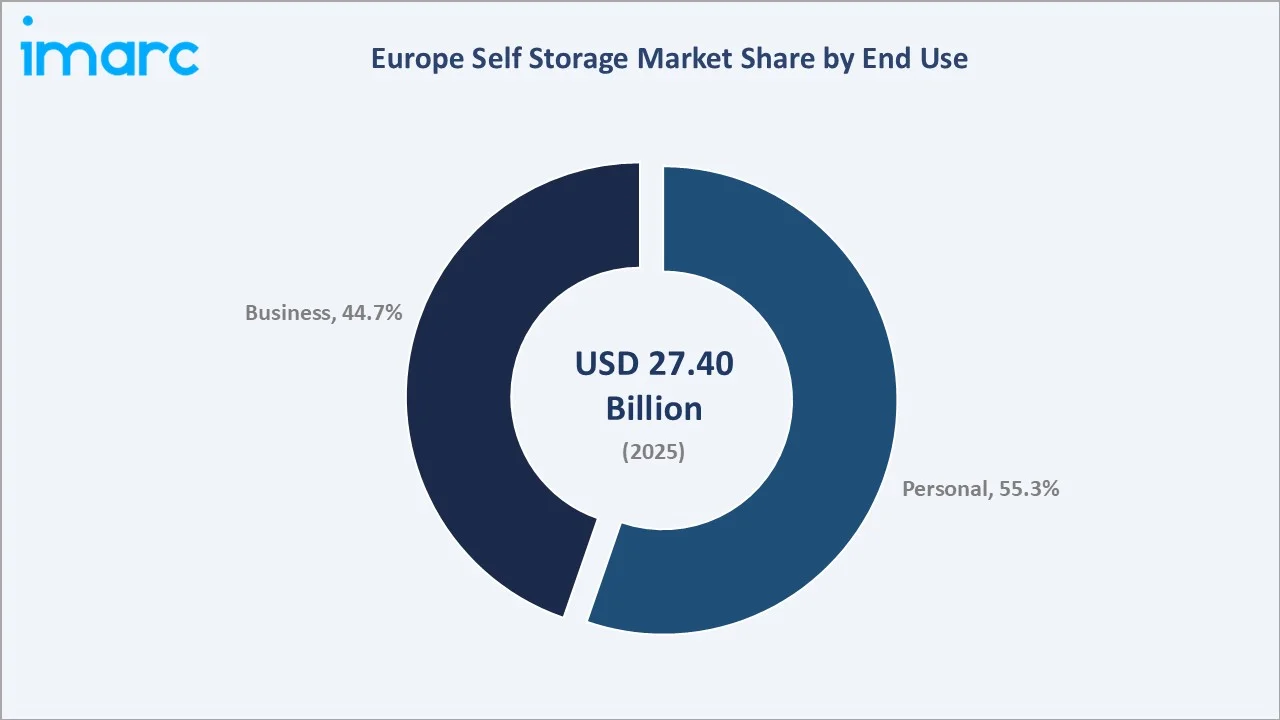
Business holds 44.7% in 2025 and is growing the fastest. Online sellers, tradespeople, service firms, and pharmaceutical or professional practices value flexible terms, urban proximity, and the absence of long commercial lease commitments, while records handling increasingly splits between physical rooms and the Europe digital storage devices market.
Regional Market Insights
|
Country |
Share (2025) |
Key Growth Drivers |
|
United Kingdom |
39.2% |
Mature operator base, high consumer awareness, dense urban catchments, and deep institutional investment |
|
Germany |
19.8% |
Large rental housing market, frequent relocation, strong SME base, and expanding metropolitan networks |
|
France |
15.7% |
Constrained city-center living space, active franchise networks, and steady household relocation activity |
|
Italy |
10.6% |
Rising urban awareness, historic city-center space constraints, and growing small-business adoption |
|
Spain |
7.8% |
Low supply per capita, rapid network expansion, tourism-linked demand, and rising consumer familiarity |
|
Others |
7.0% |
Early-stage adoption across Nordic, Benelux, and Central European cities with new site development |
United Kingdom at 39.2% in 2025 leads the country landscape, anchored by London and large regional cities. A long-established operator base, purpose-built estates, and strong customer awareness support sustained leadership across both personal and business demand.
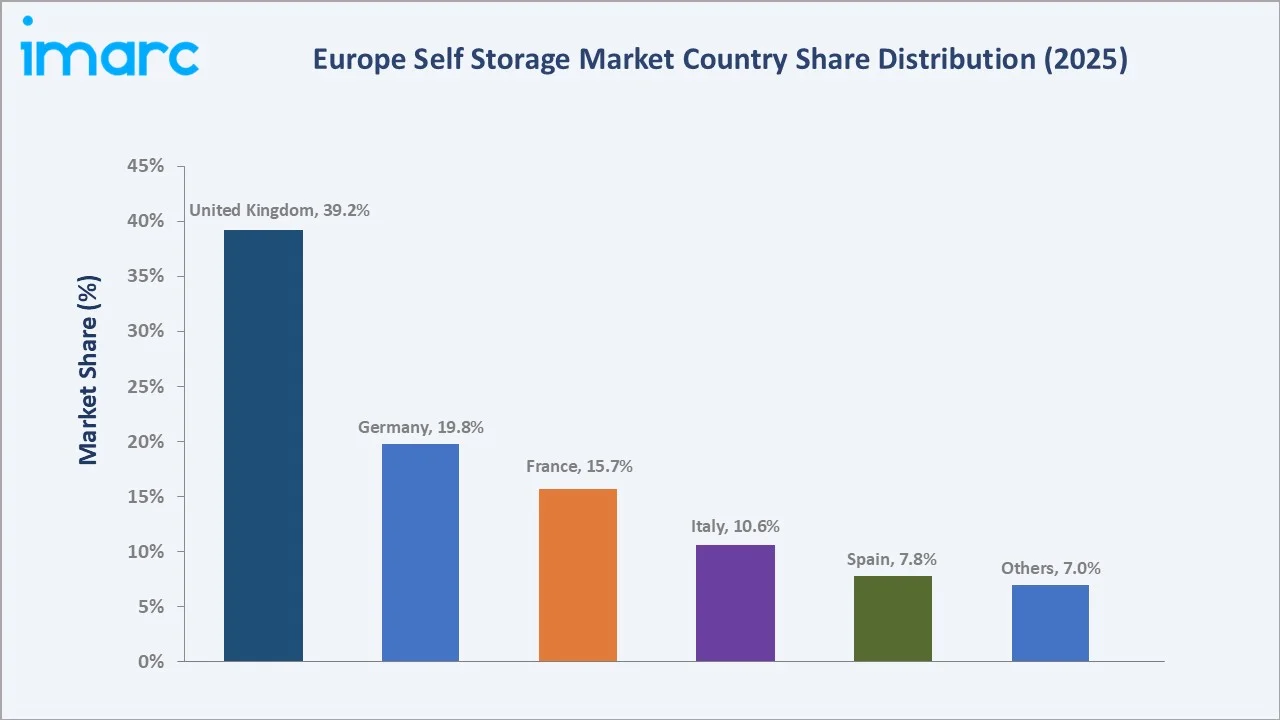
Spain at 7.8% is the fastest growing country market. Low supply per capita, accelerating network rollouts in Madrid, Barcelona, and Valencia, and rising awareness among urban households are driving expansion through 2034.
Competitive Landscape
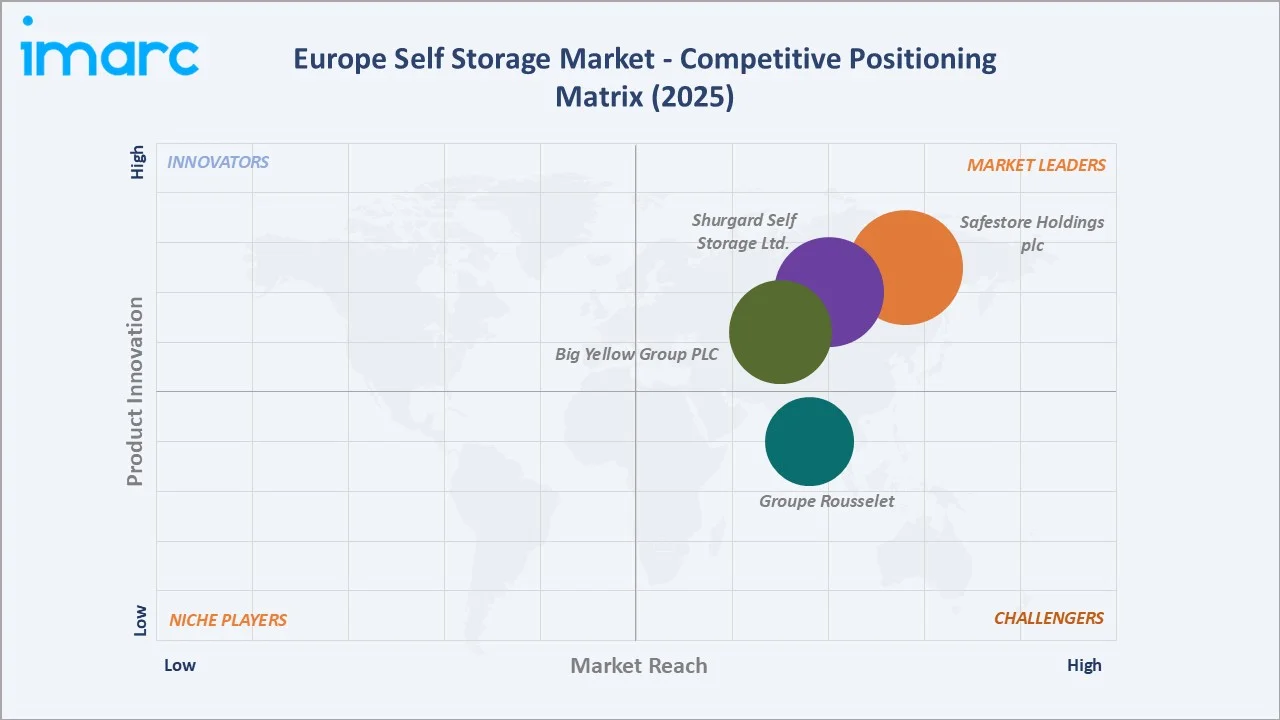
The Europe self storage market is moderately fragmented. A small group of listed and institutionally backed operators leads on scale and brand recognition, while regional chains and independents hold significant combined share. Site quality, catchment density, digital acquisition, and access technology form the main competitive moats.
|
Company Name |
Brand / Key Product |
Position |
Strategic Focus |
|
Safestore Holdings plc |
Safestore, Une Pièce en Plus |
Leader |
Expanding lettable space across core and newer country markets through development and selective acquisition |
|
Shurgard Self Storage Ltd. |
Shurgard |
Leader |
Scaling an owned estate across multiple countries and integrating acquired portfolios to a single brand standard |
|
Big Yellow Group PLC |
Big Yellow Self Storage |
Leader |
Developing purpose-built, high-visibility sites in dense catchments supported by a long-term pipeline |
|
Groupe Rousselet |
HOMEBOX |
Challenger |
Broadening multi-country coverage through owned sites and franchise partnerships |
Key players include Safestore Holdings plc, Shurgard Self Storage Ltd., Big Yellow Group PLC, and Groupe Rousselet, among others.
Key Company Profiles
Safestore Holdings plc
Safestore Holdings plc is a publicly listed self storage owner-operator headquartered in the United Kingdom. The group develops, owns, and manages purpose-built facilities that serve household and business customers under long-established regional brands.
- Product Portfolio: Household and business storage rooms in a wide range of sizes on flexible monthly terms, supported by packing materials, storage insurance, and business services such as document storage.
- Recent Developments: The company continues to enhance its storage portfolio through facility development, expansion, and operational improvements.
- Strategic Focus: Expanding lettable space in established and newer country markets through development, extensions, and selective acquisition, while strengthening digital customer acquisition.
Shurgard Self Storage Ltd.
Shurgard Self Storage Ltd. is a listed European self storage owner-operator. The company develops and manages its own facilities and applies a single, consistent brand and building standard across every market it serves.
- Product Portfolio: Self storage rooms for household and business customers, offered with online reservation, flexible rental terms, storage insurance, and moving and packing supplies.
- Recent Developments: The company continues to invest in facility expansion, network development, and improvements to its customer experience.
- Strategic Focus: Scaling an owned estate across multiple countries through development and redevelopment, and integrating acquired portfolios to a single brand standard.
Big Yellow Group PLC
Big Yellow Group PLC is a listed United Kingdom real estate investment trust specializing in purpose-built self storage. The company concentrates on highly visible, well-specified facilities in dense urban catchments, developing and operating its estate in-house.
- Product Portfolio: Household and business storage rooms across a broad range of sizes, complemented by business support services, storage insurance, and packaging materials.
- Recent Developments: The company continues to expand and enhance its facility network while improving operational efficiency and customer services.
- Strategic Focus: Developing purpose-built, high-visibility sites in dense catchments supported by a long-term development pipeline and disciplined capital allocation.
Market Concentration Analysis
The Europe self storage market is moderately concentrated at the top and fragmented below it. A handful of listed and institutionally backed operators control a disproportionate share of purpose-built space, while hundreds of regional chains and single-site independents serve the remainder of demand.
Barriers to entry are structural rather than technological. Securing visible urban plots, obtaining planning consent, funding construction, and absorbing a multi-year lease-up period favor well-capitalized owners with development expertise and access to long-term capital.
European self-storage market consolidation trends and opportunities continue to build, as larger operators acquire regional chains to enter new cities quickly. Conversion of redundant retail and industrial assets is also drawing new capital into the sector across several areas.
Investment & Growth Opportunities
Fastest-Growing Segments
Small storage unit is the fastest expanding storage unit size category, supported by compact urban living and solo households. Business is the fastest growing end use, as online sellers and trades shift from conventional warehouse leases to flexible rooms near their customers.
Emerging Markets
Spain and Italy offer the strongest growth headroom, with supply per capita well below United Kingdom levels. Growing urbanization, rising residential mobility, and increasing awareness of self-storage solutions are expected to support market expansion in these countries, as well as in smaller high-income markets such as the Switzerland self storage market.
Venture & Investment Trends
Capital is flowing into ground-up development in under-supplied cities, conversion of redundant retail and industrial buildings, and platform acquisitions of regional chains. Technology investment is concentrated in access control, revenue management, and remote site operation.
Future Market Outlook (2026-2034)
The Europe self storage market is forecast to expand from USD 27.40 Billion in 2025 to an estimated USD 28.19 Billion in 2026 and is forecast to reach USD 35.38 Billion by 2034 at a CAGR of 2.88%, adding close to USD 7.98 Billion in market value over the forecast period.
Four forces will shape the market through 2034: continued urban densification and shrinking dwelling size; the shift of small business inventory into flexible storage; the spread of remote-managed, technology-led site formats; and consolidation of regional operators into larger multi-country platforms.
By 2034, the market is expected to benefit from sustained demand for flexible storage, particularly in densely populated urban areas and among small businesses seeking cost-efficient space.
Research Methodology
Primary Research
Primary research included structured interviews with facility operators, development and asset managers, access-technology vendors, removals firms, and real estate investors, validating market sizing, unit mix, pricing behavior, and country-level demand patterns.
Secondary Research
Secondary sources included Eurostat housing and household statistics, national statistical offices, industry association surveys, municipal planning records, and the annual reports, investor presentations, and press releases of listed and privately held operators.
Forecasting Models
Forecasts combined top-down and bottom-up models built on urban household counts, storage space per capita, occupancy and rate trends, and development pipelines. Scenario analysis addressed construction cost movements, interest rate paths, and planning approval timelines.
Europe Self Storage Market Report Scope:
| Report Features | Details |
|---|---|
| Base Year of the Analysis | 2025 |
| Historical Period | 2020-2025 |
| Forecast Period | 2026-2034 |
| Units | Billion USD |
| Scope of the Report |
Exploration of Historical Trends and Market Outlook, Industry Catalysts and Challenges, Segment-Wise Historical and Future Market Assessment:
|
| Storage Unit Sizes Covered | Small Storage Unit, Medium Storage Unit, Large Storage Unit |
| End Uses Covered | Personal, Business |
| Countries Covered | Germany, France, United Kingdom, Italy, Spain, Others |
| Companies Covered | Safestore Holdings plc, Shurgard Self Storage Ltd., Big Yellow Group PLC, Groupe Rousselet, etc. |
| Customization Scope | 10% Free Customization |
| Post-Sale Analyst Support | 10-12 Weeks |
| Delivery Format | PDF and Excel through Email (We can also provide the editable version of the report in PPT/Word format on special request) |
Frequently Asked Questions About the Europe Self Storage Market Report
The Europe self storage market size is estimated at USD 28.19 Billion in 2026, supported by urban densification, frequent household relocation, and rising storage adoption among small businesses.
The market is projected to grow at a CAGR of 2.88% from 2026-2034, reaching USD 35.38 Billion, aided by new site development and wider digital customer acquisition.
Medium storage unit leads the market with a 45.7% share in 2025, matching the volume of a typical household move and offering the best balance of usable capacity and monthly cost.
Personal dominates with a 55.3% share in 2025, driven by household relocation, home renovation, family change, and downsizing events across major European cities.
United Kingdom commands 39.2% in 2025, supported by a mature operator base, dense urban catchments, and strong consumer awareness of paid storage.
Spain, at 7.8% share in 2025, is the fastest growing country market, helped by low supply per capita and rapid network expansion in Madrid, Barcelona, and Valencia.
Leading players include Safestore Holdings plc, Shurgard Self Storage Ltd., Big Yellow Group PLC, and Groupe Rousselet, among others.
Smaller urban homes, frequent relocation, growing small-business inventory needs, and flexible month-to-month contracts with online booking are the principal demand drivers across the region.
High land and construction costs, complex planning approvals, uneven consumer awareness in some countries, and rising energy and operating overheads constrain the pace of new supply.
Need more help?
- Speak to our experienced analysts for insights on the current market scenarios.
- Include additional segments and countries to customize the report as per your requirement.
- Gain an unparalleled competitive advantage in your domain by understanding how to utilize the report and positively impacting your operations and revenue.
- For further assistance, please connect with our analysts.
 Request Customization
 Speak to an Analyst
 Request Brochure
 Inquire Before Buying
Benefits of Customization
- Personalize this research
- Triangulate with your data
- Get data as per your format and definition
- Gain a deeper dive into a specific application, geography, customer, or competitor
- Any level of personalization
Get in Touch With Us
UNITED STATES
Phone: +1-201-971-6302
INDIA
Phone: +91-120-433-0800
UNITED KINGDOM
Phone: +44-753-714-6104
Email: [email protected]
Client Testimonials




.webp)




.webp)













Related Reports

Choose your plan
*Please note that the prices mentioned below are starting prices for each bundle type. Kindly contact our team for further details.*
Single User License
- 1 User License, Access on 2 Devices
- PDF Report + Excel Dataset (Password Protected)
- Lifetime Access
- No Printing Rights
- 10% Free Report Customization
- 10–12 Weeks of Analyst Support
Five User License
- Access for 5 Users, 2 Devices per User
- PDF Report + Excel Dataset (Password Protected)
- Lifetime Access
- Dedicated Account Manager
- 12–14 Weeks of Analyst Support
- No Printing Rights
- 15% Free Report Customization
- 25% Discount on Your Next Purchase
Corporate User License
- Unlimited User Access (Within Your Organization)
- PDF Report + Excel Dataset
- Lifetime Access
- Dedicated Account Manager
- 14–20 Weeks of Analyst Support
- No Printing Rights
- 20% Free Report Customization
- 30% Discount on Your Next Purchase
Essential Insights
What's included:
3 reports
- Lifetime Access
- PDF Reports
- Excel Datasets
- 2 Weeks of Free Analyst Support
- 2 User Licenses
- Access on 2 Devices
- Printing Rights
- Complimentary PowerPoint (PPT) Version
- Complimentary License Upgrade
Professional Access
What's included:
5 reports
- Lifetime Access
- PDF Reports
- Excel Datasets
- 8 Weeks of Free Analyst Support
- 2 User Licenses
- Access on 2 Devices
- Printing Rights
- Complimentary PowerPoint (PPT) Version
- Complimentary License Upgrade
Business Advantage
What's included:
8 reports
- Lifetime Access
- PDF Reports
- Excel Datasets
- 14 Weeks of Free Analyst Support
- 2 User Licenses
- Access on 2 Devices
- Printing Rights
- Complimentary PowerPoint (PPT) Version
- Complimentary License Upgrade
Enterprise Intelligence
What's included:
10 reports
- Lifetime Access
- PDF Reports
- Excel Datasets
- 20 Weeks of Free Analyst Support
- 2 User Licenses
- Access on 2 Devices
- Printing Rights
- Complimentary PowerPoint (PPT) Version
- Complimentary License Upgrade