
Analytics as a Service (AaaS) Market Size, Share, Trends and Forecast by Type, Component, Deployment Type, Enterprise Size, Industry Vertical, and Region, 2026-2034
Analytics as a Service (AaaS) Market Size and Share:
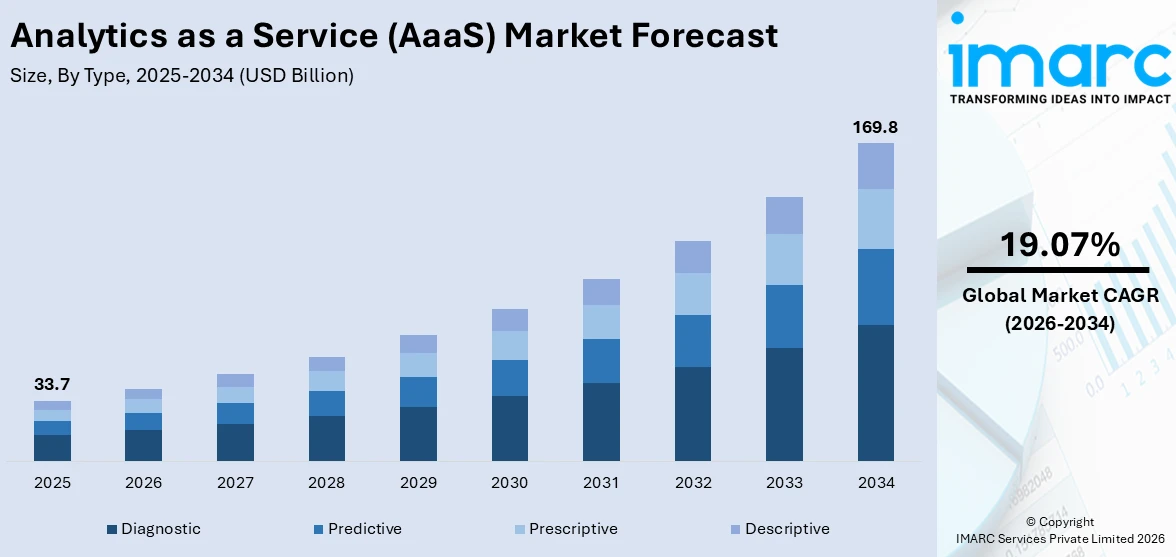
The global analytics as a service (AaaS) market size was valued at USD 33.7 Billion in 2025. Looking forward, IMARC Group estimates the market to reach USD 169.8 Billion by 2034, exhibiting a CAGR of 19.07% from 2026-2034. North America currently dominates the market, holding a market share of 32% in 2025. The region benefits from advanced technological infrastructure, extensive cloud adoption across enterprises, significant investments in artificial intelligence (AI) and machine learning (ML) capabilities, and a strong ecosystem of analytics providers, all contributing to the analytics as a service (AaaS) market share.
The global analytics as a service (AaaS) market is propelled by the exponential growth in data volumes generated across industries, driven by the proliferation of digital platforms, IoT devices, and social media interactions. Organizations are increasingly recognizing the value of data-driven decision-making, fueling demand for scalable, cloud-based analytics solutions that eliminate the need for heavy upfront infrastructure investments. Additionally, the expanding digital transformation initiatives across sectors such as healthcare, retail, and manufacturing are creating sustained demand for advanced analytics capabilities. The integration of AI and ML into analytics platforms is further enhancing their appeal by enabling predictive and prescriptive insights that optimize operations and customer engagement, thereby supporting the analytics as a service (AaaS) market growth.
The United States has emerged as a major region in the analytics as a service (AaaS) market owing to many factors. The country’s mature technology ecosystem, high digital adoption rates, and robust venture capital funding landscape are creating a favorable environment for AaaS expansion. Enterprises across banking, healthcare, and retail are increasingly leveraging cloud-based analytics to improve operational efficiency and customer experience. Furthermore, federal and state-level digital transformation programs are encouraging government agencies to adopt cloud analytics solutions, while the growing emphasis on regulatory compliance and data governance is propelling investments in advanced analytics platforms across the country. In 2025, CBTS, a major provider of AI-ready IT services across North America, announced the launch of its Data Analytics Service, suite-of-solutions, created to aid enterprise organizations reveal the full potential of their data and fast-track their journey toward AI-driven innovation.
To get more information on this market Request Sample
Analytics as a Service (AaaS) Market Trends:
Surging Enterprise Demand for Real-Time Insights
The escalating need for real-time data insights is significantly propelling the analytics as a service market. Organizations across industries are recognizing that timely access to actionable intelligence is essential for maintaining operational agility and competitive positioning. As business operations become increasingly complex and data-intensive, companies require analytics platforms capable of processing and interpreting information instantaneously to support rapid decision-making. This demand is particularly evident in sectors such as financial services, where real-time fraud detection and risk assessment are critical. The retail sector is similarly embracing real-time analytics to optimize inventory management, personalize customer interactions, and enhance supply chain visibility. Additionally, the growing adoption of edge computing and stream processing technologies is enabling organizations to analyze data closer to its source, reducing latency and enhancing the speed and accuracy of business-critical insights. IMARC Group predicts that the global edge computing market is projected to attain USD 114.4 Billion by 2033.
Rising Integration of AI and ML
The rapid integration of artificial intelligence and machine learning into analytics platforms is reshaping the analytics as a service (AaaS) market outlook. AaaS providers are embedding advanced AI capabilities to deliver predictive and prescriptive insights, enabling businesses to anticipate market trends, consumer behaviors, and operational risks with greater accuracy. These technologies are transforming analytics from retrospective reporting tools into proactive decision-support systems that drive strategic planning and resource allocation. The growing availability of pre-built AI models and automated ML workflows is lowering the barrier to entry, allowing organizations of varying sizes and technical maturity to benefit from sophisticated analytics. Moreover, the convergence of generative AI with analytics platforms is enabling natural language querying and automated insight generation, further democratizing data access across organizational hierarchies. In 2025, Oracle declared the general availability of the Oracle AI Data Platform, a holistic platform aimed at assisting customers in securely linking top-tier generative AI models with their enterprise data, applications, and workflows. Oracle AI Data Platform streamlines the complete process from raw data to production-ready AI by integrating automated data ingestion, semantic enhancement, and vector indexing alongside built-in generative AI capabilities.
Expanding Adoption of Hybrid Cloud Analytics
The increasing adoption of hybrid and multi-cloud deployment models is acting as a key catalyst for the analytics as a service (AaaS) market forecast. Enterprises are moving beyond single-cloud strategies to embrace hybrid architectures that combine the scalability of public clouds with the security and control of private infrastructure. This approach enables organizations to optimize data processing across multiple environments while meeting regulatory compliance requirements and data sovereignty mandates. The flexibility offered by hybrid cloud analytics allows businesses to allocate workloads based on cost, performance, and security considerations, supporting diverse analytics use cases from real-time processing to long-term data warehousing. For Furthermore, the emergence of cross-cloud frameworks and unified data platforms is simplifying the management of analytics as a service (AaaS) market trends, making it easier to integrate data across disparate cloud environments. In 2025, HPE revealed a groundbreaking vision for hybrid IT operations, emphasizing utmost simplicity via GreenLake Intelligence, an innovative AI framework designed for hybrid operations. By integrating agentic AIOps throughout nearly every infrastructure layer, HPE is evolving GreenLake cloud into an agentic-AI-driven hybrid cloud.
Analytics as a Service (AaaS) Industry Segmentation:
IMARC Group provides an analysis of the key trends in each segment of the global analytics as a service (AaaS) market, along with forecast at the global, regional, and country levels from 2026-2034. The market has been categorized based on type, component, deployment type, enterprise size, and industry vertical.
Analysis by Type:
- Predictive
- Prescriptive
- Diagnostic
- Descriptive
Diagnostic holds 30% of the market share. Diagnostic analytics involves examining historical data to understand the root causes behind specific outcomes or events, providing organizations with deeper visibility into operational performance and process inefficiencies. Enterprises across sectors rely on diagnostic analytics to investigate anomalies in financial transactions, assess the reasons behind customer churn, identify equipment failures in manufacturing, and evaluate the effectiveness of marketing campaigns. The growing adoption of diagnostic analytics within healthcare is particularly notable, as providers use these tools to analyze patient outcomes and optimize treatment protocols. For instance, in 2025, healthcare stands out with high growth in AI adoption, with breakthrough applications in diagnostics and patient management driving substantial investments. Additionally, the integration of machine learning algorithms with diagnostic analytics platforms is enhancing accuracy in anomaly detection and pattern identification, thereby enabling more informed corrective action across enterprise operations.
Analysis by Component:
Access the comprehensive market breakdown Request Sample
- Solutions
- Services
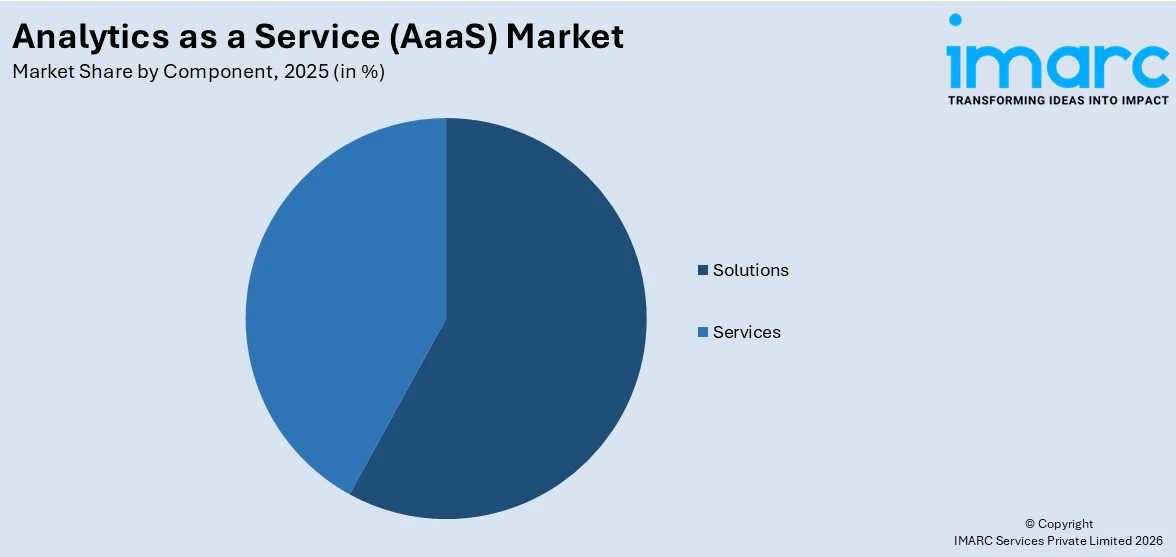
Solutions leads the market with a share of 58%. Analytics solutions encompass the software platforms, dashboards, data visualization tools, and integrated analytics engines that organizations deploy to collect, process, and interpret vast datasets. The dominance of solutions is driven by their ability to offer scalable, customizable, and ready-to-deploy analytics capabilities that address diverse business requirements across industries. Enterprises favor integrated analytics solutions because they enable operational efficiency improvements, cost reductions, and enhanced decision-making without the need for extensive in-house technical expertise. The growing emphasis on self-service analytics, where business users can generate insights without relying on data science teams, is further propelling the demand for comprehensive analytics platforms. For instance, the solution segment is expected to contribute a major portion in the global AaaS market share in 2025, driven by enterprises seeking competitive advantages through data-driven operational optimization. Moreover, the incorporation of AI-powered features into analytics solutions is accelerating adoption across both large enterprises and mid-sized organizations.
Analysis by Deployment Type:
- Private Cloud
- Public Cloud
- Hybrid Cloud
Public Cloud dominates the market, with a share of 49%. Public cloud platforms offer unmatched scalability, cost efficiency, and accessibility, making them the preferred deployment model for analytics workloads. Organizations leverage public cloud infrastructure to process and analyze vast datasets without significant capital expenditure on physical hardware, benefiting from pay-as-you-go pricing models that align costs with actual usage. The ability to rapidly scale computing resources up or down based on demand is particularly valuable for analytics applications that experience fluctuating data volumes. Furthermore, public cloud providers continuously invest in advanced security protocols, compliance certifications, and data encryption technologies, addressing enterprise concerns around data protection. The integration of AI and machine learning services natively within public cloud environments further strengthens their appeal for analytics deployments.

Analysis by Enterprise Size:
- Small and Medium-sized Enterprises
- Large Enterprises
Large Enterprises represents the leading segment, with a market share of 65%. Large enterprises generate and process enormous volumes of structured and unstructured data across complex operational environments, necessitating robust, enterprise-grade analytics capabilities. These organizations invest heavily in advanced analytics platforms to optimize supply chain management, enhance customer engagement strategies, improve risk assessment frameworks, and support strategic planning across global operations. The scale and complexity of their data ecosystems drive demand for sophisticated AaaS solutions that can integrate seamlessly with existing IT infrastructure. For instance, in 2025, senior enterprise leaders identified AI as defining the future of competition for the next decade, underscoring the priority placed on analytics-driven transformation by large organizations. Additionally, large enterprises benefit from dedicated analytics teams and established data governance frameworks that enable them to maximize the value derived from cloud-based analytics services across multiple business units and geographic regions.
Analysis by Industry Vertical:
- BFSI
- Retail
- Government and Public Sector
- IT and Telecommunication
- Healthcare
- Manufacturing
- Others
BFSI holds 20% of the market share. The banking, financial services, and insurance sector stands as the leading adopter of analytics as a service, driven by the critical need for real-time fraud detection, regulatory compliance management, risk assessment, and personalized customer engagement. Financial institutions process enormous volumes of transactional data daily and require advanced analytics capabilities to identify suspicious patterns, assess creditworthiness, and optimize portfolio management. The growing complexity of regulatory environments, including anti-money laundering and know-your-customer requirements, is compelling institutions to invest in sophisticated analytics solutions that automate compliance processes. For instance, in 2025, financial institutions are adopting multi-cloud and hybrid analytics models to gain flexibility across service providers while ensuring resilience and data sovereignty. Additionally, the increasing adoption of AI-powered predictive analytics in insurance underwriting and wealth management is creating new avenues for operational efficiency and revenue growth within the sector.
Regional Analysis:
To get more information on the regional analysis of this market Request Sample
- North America
- United States
- Canada
- Asia Pacific
- China
- Japan
- India
- South Korea
- Australia
- Indonesia
- Others
- Europe
- Germany
- France
- United Kingdom
- Italy
- Spain
- Russia
- Others
- Latin America
- Brazil
- Mexico
- Others
- Middle East and Africa
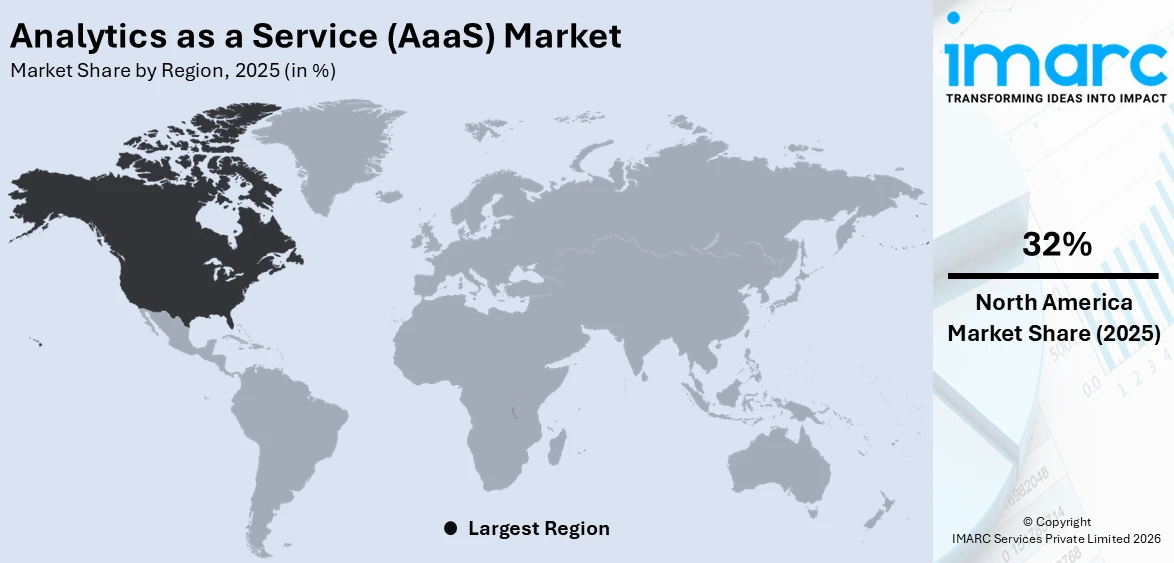
North America, accounting for 32% of the share, enjoys the leading position in the market. The region benefits from a highly developed technology infrastructure, widespread enterprise cloud adoption, and the presence of major global analytics and cloud service providers. Businesses across the United States and Canada are at the forefront of digital transformation, investing heavily in AI-driven analytics, big data platforms, and hybrid cloud architectures to maintain competitive advantages. The strong regulatory environment and growing emphasis on data-driven governance are further accelerating analytics adoption. For instance, in 2025, Model N, the frontrunner in revenue optimization and compliance for life sciences and high-tech firms, unveiled Data nSights, a comprehensive data and analytics solution. Data nSights offers prompt access to curated, AI-driven, and analytics-ready data, featuring no-code data exploration and an expanding collection of in-depth insights for revenue management in life sciences. Additionally, the robust venture capital ecosystem and thriving startup culture in the region continue to fuel innovation in analytics technologies, driving the development of next-generation AaaS platforms.
Key Regional Takeaways:
United States Analytics as a Service (AaaS) Market Analysis
The United States represents the largest national market for analytics as a service, supported by its advanced digital infrastructure, high enterprise technology spending, and the presence of leading cloud hyperscalers including Amazon Web Services, Microsoft Azure, and Google Cloud. American enterprises are aggressively adopting analytics solutions to enhance operational efficiency, drive customer personalization, and gain competitive intelligence across rapidly evolving markets. The financial services, healthcare, and retail sectors are particularly active in deploying cloud-based analytics for fraud detection, patient outcome optimization, and demand forecasting respectively. Federal and state-level digital modernization programs are also encouraging analytics adoption within government agencies to improve public service delivery and policy effectiveness. The country’s robust data privacy regulations, including state-level legislation modeled after comprehensive frameworks, are driving demand for analytics platforms with embedded compliance and governance capabilities. Furthermore, the growing integration of generative AI technologies into analytics workflows is enabling organizations to automate complex analytical tasks, reducing time-to-insight and empowering non-technical users to interact with data through natural language interfaces. IMARC Group predicts that the US generative AI market is projected to attain USD 18.82 Billion by 2033.
Europe Analytics as a Service (AaaS) Market Analysis
The European analytics as a service market is experiencing steady expansion, driven by stringent data protection regulations, digital transformation initiatives, and the growing emphasis on sustainability reporting and regulatory compliance. The General Data Protection Regulation continues to shape how organizations collect, store, and analyze data, compelling enterprises to adopt analytics platforms with robust security and privacy features. Key economies including Germany, France, and the United Kingdom are investing in cloud-based analytics to improve manufacturing efficiency, financial risk management, and public sector service delivery. The European Commission’s Digital Strategy aims to ensure that 75% of European businesses adopt cloud-based services, big data, and artificial intelligence by 2030, creating a substantial growth trajectory for AaaS providers. Additionally, the growing emphasis on ESG reporting and green compliance frameworks is driving demand for analytics solutions that can track environmental and sustainability metrics. The expansion of major global AaaS providers into European markets, coupled with the region’s strong data science talent pool, continues to support adoption across both large enterprises and small and medium-sized businesses.
Asia-Pacific Analytics as a Service (AaaS) Market Analysis
The Asia-Pacific analytics as a service market is witnessing rapid growth, fueled by accelerating digital transformation, increasing internet penetration, and government-led technology modernization programs across major economies. Countries including China, India, Japan, and South Korea are investing heavily in cloud infrastructure and AI capabilities to support enterprise analytics adoption across manufacturing, telecommunications, and financial services. The proliferation of IoT devices and the expansion of e-commerce platforms are generating massive data volumes that require scalable analytics solutions. For instance, India committed Over Rs 10,300 Crore to its IndiaAI Mission in 2025, aimed at strengthening the national AI and data analytics ecosystem. Additionally, the growing presence of global cloud providers establishing regional data centers across Asia-Pacific is improving data sovereignty compliance and reducing latency, making cloud-based analytics more accessible to organizations across the region.
Latin America Analytics as a Service (AaaS) Market Analysis
The Latin American analytics as a service market is gaining momentum, supported by growing cloud adoption, expanding digital economies, and increasing enterprise awareness of data-driven decision-making. Brazil and Mexico are leading the regional adoption, with enterprises in banking, retail, and telecommunications deploying analytics platforms to enhance customer engagement and operational efficiency. Government digital transformation programs across the region are creating additional demand for cloud-based analytics solutions. For instance, Brazil’s national AI strategy, launched in 2024, allocated significant resources to promote advanced analytics and AI integration across public and private sectors. The improving telecommunications infrastructure and declining cloud service costs are further enabling smaller enterprises across the region to access enterprise-grade analytics capabilities.
Middle East and Africa Analytics as a Service (AaaS) Market Analysis
The Middle East and Africa analytics as a service market is experiencing emerging growth, driven by ambitious national digital transformation programs, expanding cloud infrastructure, and increasing investments in smart city initiatives. Countries including the UAE, Saudi Arabia, and South Africa are leading regional adoption as governments and enterprises invest in analytics to support economic diversification, operational modernization, and enhanced public service delivery. For instance, Saudi Arabia’s Vision 2030 strategy includes dedicated programs for AI and data analytics adoption across government and private sector entities, with substantial funding directed toward technology infrastructure. The growing availability of local data center facilities from major cloud providers is improving service accessibility and data compliance, encouraging broader analytics adoption across the region.
Competitive Landscape:
The analytics as a service market is characterized by intense competition among established technology companies, cloud hyperscalers, and specialized analytics providers. Leading companies are investing heavily in expanding their analytics portfolios by integrating advanced artificial intelligence, machine learning, and generative AI capabilities to deliver more comprehensive and differentiated solutions. Strategic partnerships, mergers, and acquisitions are key strategies being employed to enhance technological capabilities and expand market reach. Companies are also focusing on vertical-specific analytics offerings tailored to industries such as healthcare, financial services, and manufacturing to capture niche market segments. Furthermore, providers are investing in low-code and no-code analytics tools to democratize data access and attract a broader base of enterprise users. The competitive landscape is also shaped by the growing importance of data security, privacy compliance, and hybrid deployment flexibility as enterprises evaluate analytics providers.
The report provides a comprehensive analysis of the competitive landscape in the analytics as a service (AaaS) market with detailed profiles of all major companies, including:
- Amazon Web Services, Inc
- Cloudera, Inc
- Google LLC
- Hewlett Packard Enterprise Development LP
- Infosys Limited
- International Business Machines Corporation
- Microsoft Corporation
- Oracle Corporation
- ScienceSoft USA Corporation
- Sisense Ltd
- Teradata
- TIBCO Software Inc. (Cloud Software Group, Inc)
Latest News and Developments:
- May 2025: IBM and Oracle expanded their decades-long strategic partnership to bring IBM’s watsonx AI portfolio to Oracle Cloud Infrastructure, enabling enterprises to build and manage multi-agentic AI workflows across both Oracle and non-Oracle applications.
- January 2025: Hakuhodo DY Media Partners Inc. and Hakuhodo DY ONE Inc. have revealed a significant upgrade to their exclusive Analytics AaaS solution, now driven by Google’s open-source Marketing Mix Modeling (MMM) tool, Meridian (*1). This innovative solution––Analytics AasS driven by Meridian––utilizes Google’s cutting-edge measurement technology to enhance ad performance and marketing ROI for advertisers in Japan and the APAC region.
Analytics as a Service (AaaS) Market Report Scope:
| Report Features | Details |
|---|---|
| Base Year of the Analysis | 2025 |
| Historical Period | 2020-2025 |
| Forecast Period | 2026-2034 |
| Units | Billion USD |
| Scope of the Report | Exploration of Historical Trends and Market Outlook, Industry Catalysts and Challenges, Segment-Wise Historical and Future Market Assessment:
|
| Types Covered | Predictive, Prescriptive, Diagnostic, Descriptive |
| Components Covered | Solutions, Services |
| Deployment Types Covered | Private Cloud, Public Cloud, Hybrid Cloud |
| Enterprise Sizes Covered | Small and Medium-sized Enterprises, Large Enterprises |
| Industry Verticals Covered | BFSI, Retail, Government and Public Sector, IT and Telecommunication, Healthcare, Manufacturing, Others |
| Regions Covered | Asia Pacific, Europe, North America, Latin America, Middle East and Africa |
| Countries Covered | United States, Canada, Germany, France, United Kingdom, Italy, Spain, Russia, China, Japan, India, South Korea, Australia, Indonesia, Brazil, Mexico |
| Companies Covered | Amazon Web Services, Inc, Cloudera, Inc, Google LLC, Hewlett Packard Enterprise Development LP, Infosys Limited, International Business Machines Corporation, Microsoft Corporation, Oracle Corporation, ScienceSoft USA Corporation, Sisense Ltd, Teradata, TIBCO Software Inc. (Cloud Software Group, Inc), etc. |
| Customization Scope | 10% Free Customization |
| Post-Sale Analyst Support | 10-12 Weeks |
| Delivery Format | PDF and Excel through Email (We can also provide the editable version of the report in PPT/Word format on special request) |
Key Benefits for Stakeholders:
- IMARC’s report offers a comprehensive quantitative analysis of various market segments, historical and current market trends, market forecasts, and dynamics of the analytics as a service (AaaS) market from 2020-2034.
- The research study provides the latest information on the market drivers, challenges, and opportunities in the global analytics as a service (AaaS) market.
- The study maps the leading, as well as the fastest-growing, regional markets. It further enables stakeholders to identify the key country-level markets within each region.
- Porter's Five Forces analysis assists stakeholders in assessing the impact of new entrants, competitive rivalry, supplier power, buyer power, and the threat of substitution. It helps stakeholders to analyze the level of competition within the analytics as a service (AaaS) industry and its attractiveness.
- Competitive landscape allows stakeholders to understand their competitive environment and provides an insight into the current positions of key players in the market.
Frequently Asked Questions About the Analytics as a Service (AaaS) Market Report
The analytics as a service (AaaS) market was valued at USD 33.7 Billion in 2025.
The analytics as a service (AaaS) market is projected to exhibit a CAGR of 19.07% during 2026-2034, reaching a value of USD 169.8 Billion by 2034.
The analytics as a service (AaaS) market is driven by the exponential growth in enterprise data volumes, accelerating digital transformation initiatives, rising demand for real-time and predictive insights, widespread adoption of cloud computing, and the increasing integration of artificial intelligence and machine learning technologies into analytics platforms across industries.
North America currently dominates the analytics as a service (AaaS) market, accounting for a share of 32%. The region benefits from advanced technology infrastructure, high enterprise cloud adoption rates, significant investments in AI and analytics capabilities, and the presence of leading global cloud and analytics providers.
Some of the major players in the analytics as a service (AaaS) market include Amazon Web Services, Inc, Cloudera, Inc, Google LLC, Hewlett Packard Enterprise Development LP, Infosys Limited, International Business Machines Corporation, Microsoft Corporation, Oracle Corporation, ScienceSoft USA Corporation, Sisense Ltd, Teradata, TIBCO Software Inc. (Cloud Software Group, Inc), etc.
Need more help?
- Speak to our experienced analysts for insights on the current market scenarios.
- Include additional segments and countries to customize the report as per your requirement.
- Gain an unparalleled competitive advantage in your domain by understanding how to utilize the report and positively impacting your operations and revenue.
- For further assistance, please connect with our analysts.
 Request Customization
 Speak to an Analyst
 Request Brochure
 Inquire Before Buying
Benefits of Customization
- Personalize this research
- Triangulate with your data
- Get data as per your format and definition
- Gain a deeper dive into a specific application, geography, customer, or competitor
- Any level of personalization
Get in Touch With Us
UNITED STATES
Phone: +1-201-971-6302
INDIA
Phone: +91-120-433-0800
UNITED KINGDOM
Phone: +44-753-714-6104
Email: [email protected]
Client Testimonials




.webp)




.webp)













Related Reports

Choose your plan
*Please note that the prices mentioned below are starting prices for each bundle type. Kindly contact our team for further details.*
Single User License
- 1 User License, Access on 2 Devices
- PDF Report + Excel Dataset (Password Protected)
- Lifetime Access
- No Printing Rights
- 10% Free Report Customization
- 10–12 Weeks of Analyst Support
Five User License
- Access for 5 Users, 2 Devices per User
- PDF Report + Excel Dataset (Password Protected)
- Lifetime Access
- Dedicated Account Manager
- 12–14 Weeks of Analyst Support
- No Printing Rights
- 15% Free Report Customization
- 25% Discount on Your Next Purchase
Corporate User License
- Unlimited User Access (Within Your Organization)
- PDF Report + Excel Dataset
- Lifetime Access
- Dedicated Account Manager
- 14–20 Weeks of Analyst Support
- No Printing Rights
- 20% Free Report Customization
- 30% Discount on Your Next Purchase
Essential Insights
What's included:
3 reports
- Lifetime Access
- PDF Reports
- Excel Datasets
- 2 Weeks of Free Analyst Support
- 2 User Licenses
- Access on 2 Devices
- Printing Rights
- Complimentary PowerPoint (PPT) Version
- Complimentary License Upgrade
Professional Access
What's included:
5 reports
- Lifetime Access
- PDF Reports
- Excel Datasets
- 8 Weeks of Free Analyst Support
- 2 User Licenses
- Access on 2 Devices
- Printing Rights
- Complimentary PowerPoint (PPT) Version
- Complimentary License Upgrade
Business Advantage
What's included:
8 reports
- Lifetime Access
- PDF Reports
- Excel Datasets
- 14 Weeks of Free Analyst Support
- 2 User Licenses
- Access on 2 Devices
- Printing Rights
- Complimentary PowerPoint (PPT) Version
- Complimentary License Upgrade
Enterprise Intelligence
What's included:
10 reports
- Lifetime Access
- PDF Reports
- Excel Datasets
- 20 Weeks of Free Analyst Support
- 2 User Licenses
- Access on 2 Devices
- Printing Rights
- Complimentary PowerPoint (PPT) Version
- Complimentary License Upgrade