
Architectural Services Market Size, Share, Trends and Forecast by Service Type, End Use, and Region, 2026-2034
Architectural Services Market Size, Share, Trends & Forecast (2026-2034)
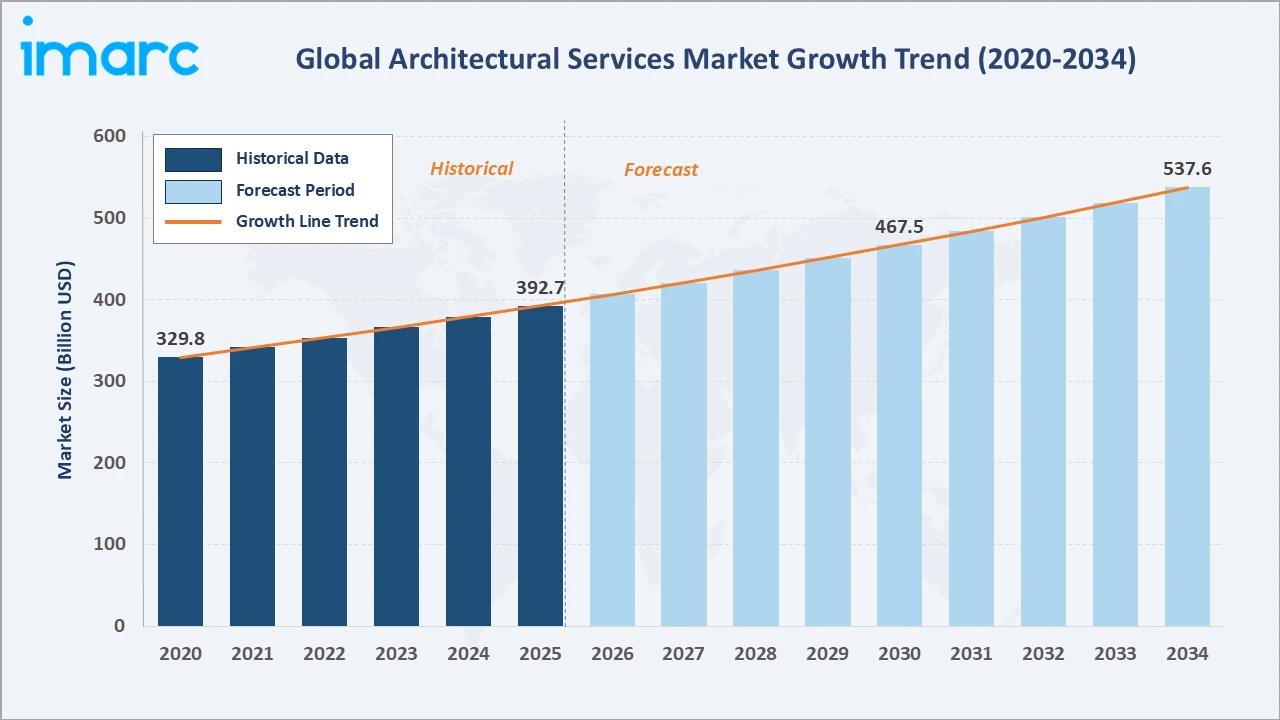
The global architectural services market reached USD 392.7 Billion in 2025 and is projected to reach USD 537.6 Billion by 2034, exhibiting a CAGR of 3.45% during 2026-2034. Buildings and construction form a major pillar of the global economy, accounting for approximately 11-13% of global GDP. Around half of the buildings expected to exist by 2050 have yet to be constructed or renovated. This outlook is driving demand for architectural services by increasing the need for sustainable building design, energy-efficient renovation, urban planning, and climate-resilient infrastructure. Architects are also playing a growing role in green certification, adaptive reuse, digital building modelling, and compliance with stricter environmental standards. Construction and project management services lead the service type at 31.8%, residential leads end use at 34.9%, and Asia-Pacific accounts for the largest regional share at 39.6%.
Market Snapshot
|
Metric |
Value |
|
Market Size (2025) |
USD 392.7 Billion |
|
Forecast Market Size (2034) |
USD 537.6 Billion |
|
CAGR (2026-2034) |
3.45% |
|
Base Year |
2025 |
|
Historical Period |
2020-2025 |
|
Forecast Period |
2026-2034 |
|
Dominant Service Type |
Construction and Project Management Services – 31.8% (2025) |
|
Dominant End Use |
Residential – 34.9% (2025) |
|
Leading Region |
Asia-Pacific – 39.6% (2025) |
The global architectural services market grew from USD 329.8 Billion in 2020 to USD 392.7 Billion in 2025, driven by post-pandemic construction activity resumption, government infrastructure stimulus programs across major economies, the growing complexity of building typologies requiring integrated architectural and engineering services, and the digital transformation of the architecture profession through BIM, parametric design, and AI-assisted workflows. The market is projected to reach USD 467.5 Billion by 2030 and USD 537.6 Billion by 2034.
To get more information on this market, Request Sample
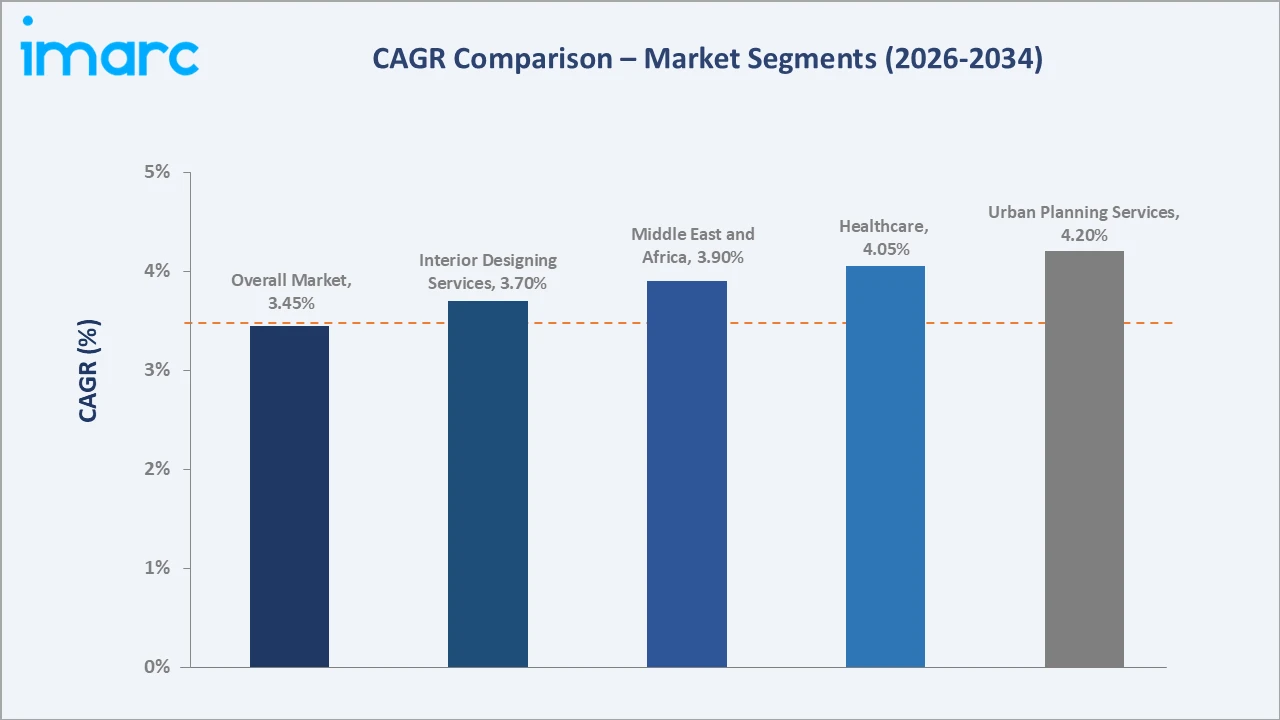
Urban planning services grow at ~4.20% CAGR through smart city programs across Asia-Pacific and the Middle East, climate adaptation master planning, and the development of new urban districts requiring integrated planning frameworks. Healthcare end use grows at ~4.05% CAGR through the global post-pandemic healthcare infrastructure investment wave, aging population-driven hospital capacity expansion, and the specialized architectural knowledge required for healthcare facility design. Middle East and Africa grow at ~3.90% CAGR through Saudi Vision 2030 giga-projects, UAE mega-development, and African infrastructure investment acceleration. Interior designing services grow at ~3.70% CAGR through the workplace redesign wave responding to hybrid work, luxury residential interior design demand, and hospitality interior renewal programs.
Executive Summary
The global architectural services market occupies a unique position at the intersection of creative design, technical engineering, regulatory compliance, and project management, where the progressive complexity of client requirements, the escalating performance expectations of sustainable buildings, and the technological transformation of design workflows are simultaneously elevating the value proposition of comprehensive architectural services and expanding the total addressable market beyond what pure construction volume growth would imply. Architectural services have historically been correlated with construction spending; however, the growing sophistication of architectural scope is expanding the fee opportunity per project independent of overall market growth. Market value reached USD 392.7 Billion in 2025, forecast at USD 537.6 Billion by 2034.
Construction and project management services lead at 31.8% (2025) through the integrated delivery model that major architecture firms have progressively adopted, where comprehensive project management from concept through construction completion is provided as an integrated service alongside design, reducing client coordination burden and improving project outcome predictability. Residential end use segment leads at 34.9% (2025) and Asia-Pacific leads regionally at 39.6% (2025).
Key Market Insights
|
Insight |
Data |
|
Dominant Service Type |
Construction & Project Management Services – 31.8% share (2025) |
|
Dominant End Use |
Residential – 34.9% share (2025) |
|
Leading Region |
Asia-Pacific – 39.6% share (2025) |
|
Market Opportunity |
Asia-Pacific smart city urban planning; MEA Vision 2030 mega-project architecture; AI-driven parametric design platform differentiation; net-zero building advisory specialty; healthcare architecture for aging global population |
Key Analytical Observations:
- Construction and Project Management Services at 31.8% (2025): The construction and project management services segment's leading position reflects the structural shift in client procurement preferences away from fragmented professional services engagement toward integrated project delivery models where a single professional services firm coordinates all design and project execution disciplines.
- Residential End Use at 34.9%: Residential end use dominates the global architectural services market through the combination of mass housing programs in Asia-Pacific, premium luxury residential architecture in high-income markets, and mixed-use residential development that integrates retail, hospitality, and amenity programming requiring comprehensive architectural services beyond pure housing design.
- Asia-Pacific at 39.6% (2025): Asia-Pacific leads due to rapid urbanization, large-scale infrastructure development, and rising residential and commercial construction across China, India, and Southeast Asia. Growing smart-city investments and demand for sustainable, energy-efficient buildings further support regional dominance.
Architectural Services Market Overview
The global architectural services market encompasses professional services provided by licensed architects and multidisciplinary design firms spanning the full spectrum of built environment design: from individual building design through urban scale master planning, infrastructure design, interior design, and the project management services that bring designed environments from concept to constructed reality. The market is measured by the fee revenue earned by architectural firms for professional design and consulting services, distinct from the broader construction sector value that architectural projects generate. Architectural services are regulated in all major markets through licensed profession frameworks that mandate educational qualifications, examination requirements, and professional conduct standards for practicing architects. Macroeconomic factors include rapid urbanization, increasing infrastructure investment, growth in residential and commercial construction, rising government spending on public infrastructure, expanding real estate development, increasing adoption of sustainable building practices, and favorable economic growth.
Market Dynamics
To evaluate market opportunities, Request Sample
Market Drivers
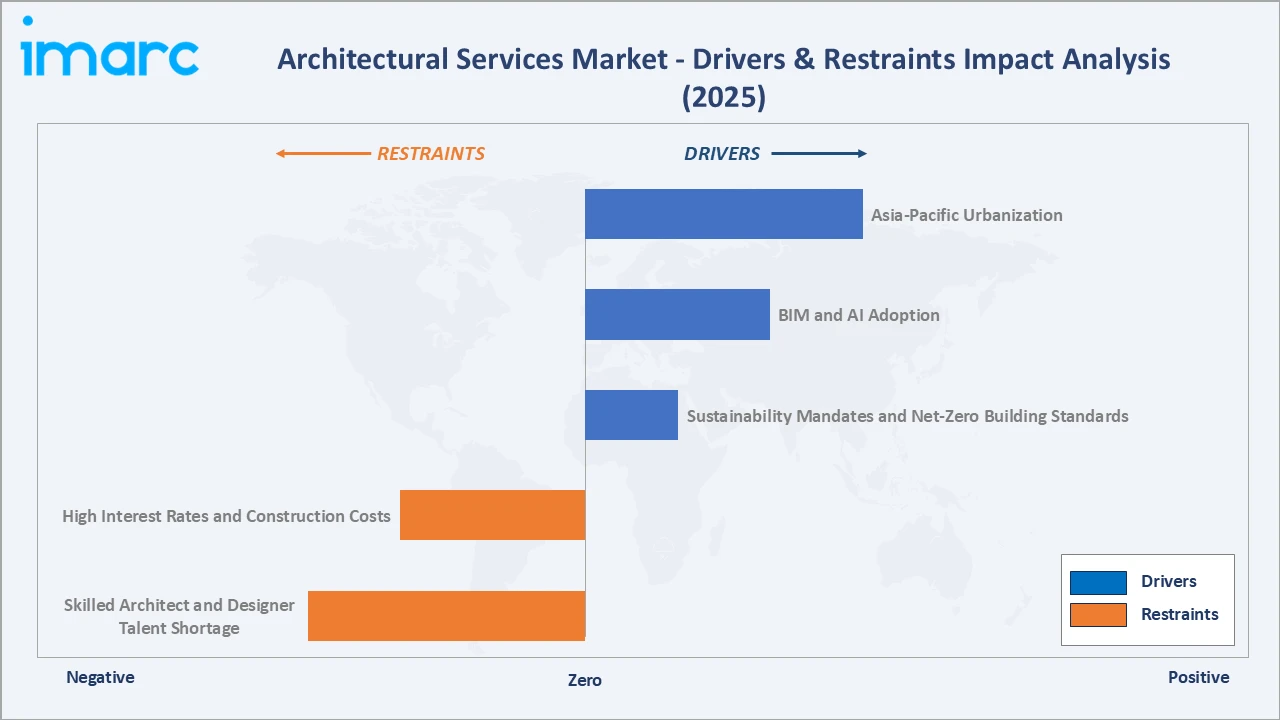
- Asia-Pacific Urbanization: Asia-Pacific's architectural services market dominance at 39.6% reflects the structural reality that the largest construction market operates in the region, with China’s large-scale urban renewal program projected to require at least 15 trillion yuan (USD 2.2 trillion) in investment between 2026 and 2030, under India’s Union Budget 2026–27, the capital expenditure allocation for infrastructure was raised to Rs. 12.22 lakh crore (US$132.8 billion), and Southeast Asian nations each experiencing construction sector growth annually as their economies urbanize and middle classes expand. Smart cities generate architectural services demand across urban design, public facility design, transportation hub architecture, and smart city technology integration that international and domestic Indian architectural firms are actively serving.
- BIM and AI Adoption: BIM-mandated projects require architectural firms to invest in digital modeling infrastructure, staff training, and BIM management processes that increase delivery quality while simultaneously justifying higher professional fees for the more technically comprehensive service. In February 2024, OpenSpace launched OpenSpace BIM+, a new solution designed to improve collaboration between Virtual Design and Construction teams and on-site personnel. Using AI and computer vision, the platform automatically aligns 360-degree site images with BIM models, simplifying field-to-office coordination and supporting more efficient project monitoring and issue resolution.
- Sustainability Mandates and Net-Zero Building Standards: The global regulatory push toward net-zero carbon buildings is creating specialized architectural advisory and design service demand that sustainable building expertise requires. Architecture firms with established sustainability competencies can command fee premiums over equivalent-scope projects for conventional design, reflecting the additional design analysis, performance modeling, and certification management that sustainable building specifications require.
Market Restraints
- High Interest Rates and Construction Costs: The significant increase in global interest rates has materially suppressed private sector construction investment by increasing the financing cost of development projects to levels that reduce project viability. Higher construction costs from labor shortage inflation, material price increases, and supply chain disruptions have further reduced the number of projects proceeding from design to construction, creating a pipeline conversion challenge for architectural firms where completed designs do not proceed to construction commission as frequently as in lower-cost periods.
- Skilled Architect and Designer Talent Shortage: The global architectural profession faces a structural talent shortage. The talent shortage is most acute at the senior project architect and design director level, where experienced practitioners with 10-20 years of specialist sector knowledge are insufficient to meet market demand and cannot be quickly replaced through training programs. Remote work normalization in architectural practice post-COVID partially addresses the talent shortage by enabling firms to access architect talent in lower-cost locations without requiring physical relocation but creates new challenges for design coordination quality and firm culture maintenance.
Market Opportunities
- AI-Powered Architectural Practice and Design Platform Differentiation: The rapid development of generative AI and large language model-based design tools creates an opportunity for architecture firms with the capital and technical expertise to invest in proprietary AI design capabilities to differentiate their service offering, improve delivery efficiency, and create productivity advantages that justify competitive fee positioning. In March 2025, cove launched Cove Architecture, a full-service architectural practice powered by artificial intelligence.
- Healthcare Architecture for Aging Global Populations: The combination of global population aging, the chronic underfunding of healthcare infrastructure in most countries, and the increasing evidence that well-designed healthcare environments improve patient outcomes creates a sustained, long-term growth driver for specialized healthcare architecture that is substantially insulated from construction market cyclicality. Architecture firms that invest in healthcare design specialty will access one of the most defensible and professionally rewarding architectural market niches available in the forecast period.
Market Challenges
- Fee Pressure from Digital Platform Competition and Commoditization: Online architectural design platforms and AI-powered design generation tools are creating downward fee pressure in the entry-level residential and small commercial architectural services market, where standardized design templates, automated planning application preparation, and AI floor plan generation increasingly provide lower-cost alternatives to traditional residential architectural services for clients whose projects do not require the complex design judgment that AI-generated designs cannot yet provide.
- Climate Change and Disaster Risk Implications for Building Design Standards: The escalating severity and frequency of climate-related extreme weather events are creating progressively more demanding design requirements for buildings in climate-exposed regions, where energy performance, structural resilience, and environmental sustainability standards imposed by post-disaster code revisions increase design complexity and project duration.
Emerging Market Trends
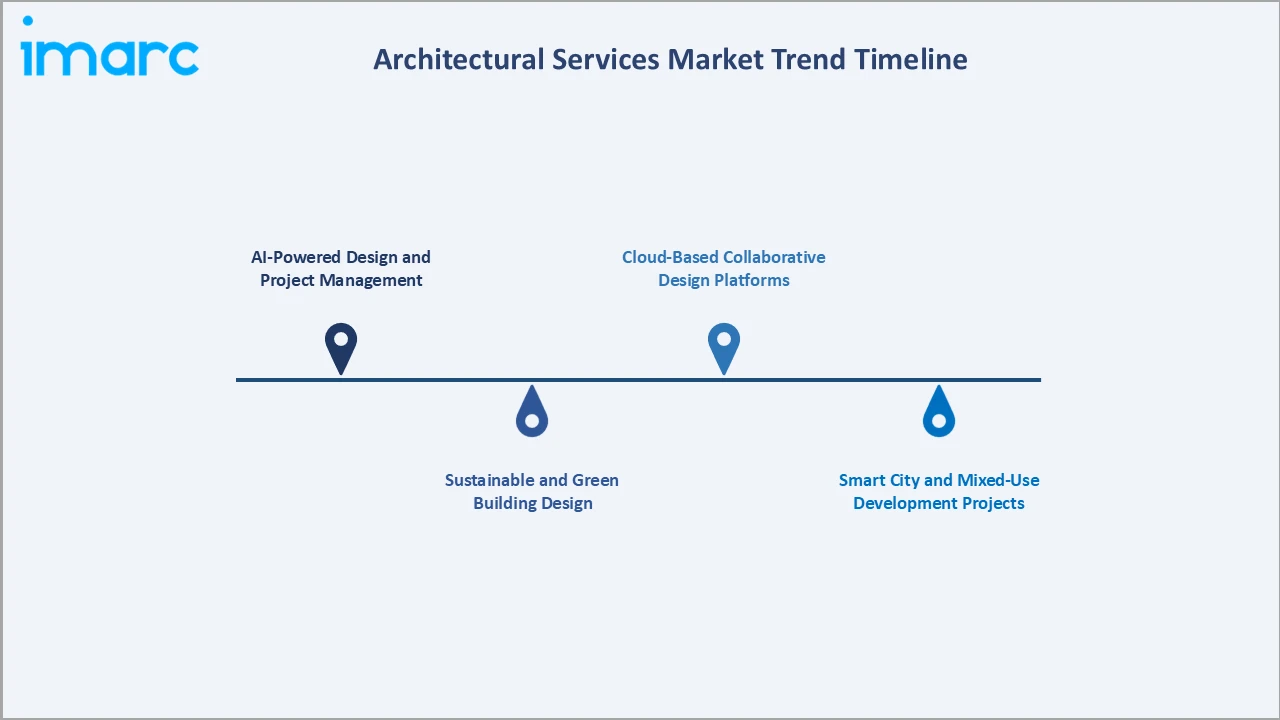
1. AI-Powered Design and Project Management
Artificial intelligence is transforming architectural workflows by automating design generation, space planning, and project analysis. AI-driven tools improve design accuracy, optimize resource allocation, and reduce project timelines. Firms are increasingly integrating predictive analytics and computer vision to enhance collaboration between office and field teams. This trend is improving productivity while enabling faster and more informed design decisions.
2. Sustainable and Green Building Design
Growing environmental regulations and corporate sustainability goals are driving demand for energy-efficient and low-carbon buildings. Architectural firms are increasingly incorporating passive design principles, renewable energy integration, recycled materials, and green building certifications into projects. In June 2026, Watts introduced a LEED v5 Product Selection Tool to help architects, engineers, designers, specifiers, and sustainability professionals identify suitable products across its brand portfolio. The tool simplifies navigation of updated LEED v5 credit categories and performance requirements, supporting product selection for buildings seeking certification and related sustainability credits. Sustainable architecture is becoming a key differentiator in both public and private sector developments.
3. Smart City and Mixed-Use Development Projects
Rapid urbanization is increasing investment in smart cities and integrated mixed-use developments. India’s Smart Cities Mission made significant progress across 100 participating cities. As of May 9, 2025, 7,555 projects, representing 94% of the 8,067 planned projects, had been completed, with an investment of ₹1.51 lakh crore. A further 512 projects valued at ₹13,043 crore were in advanced implementation stages, bringing the total program value to approximately ₹1.64 lakh crore. These projects emphasize connectivity, sustainability, and efficient land utilization, creating new opportunities for multidisciplinary architectural services.
4. Cloud-Based Collaborative Design Platforms
Cloud-enabled design software is improving collaboration among architects, engineers, contractors, and clients across multiple locations. Real-time document sharing, design reviews, and project tracking enhance workflow efficiency while reducing communication delays. These platforms also facilitate remote project management and seamless coordination throughout the design process.
Industry Value Chain Analysis
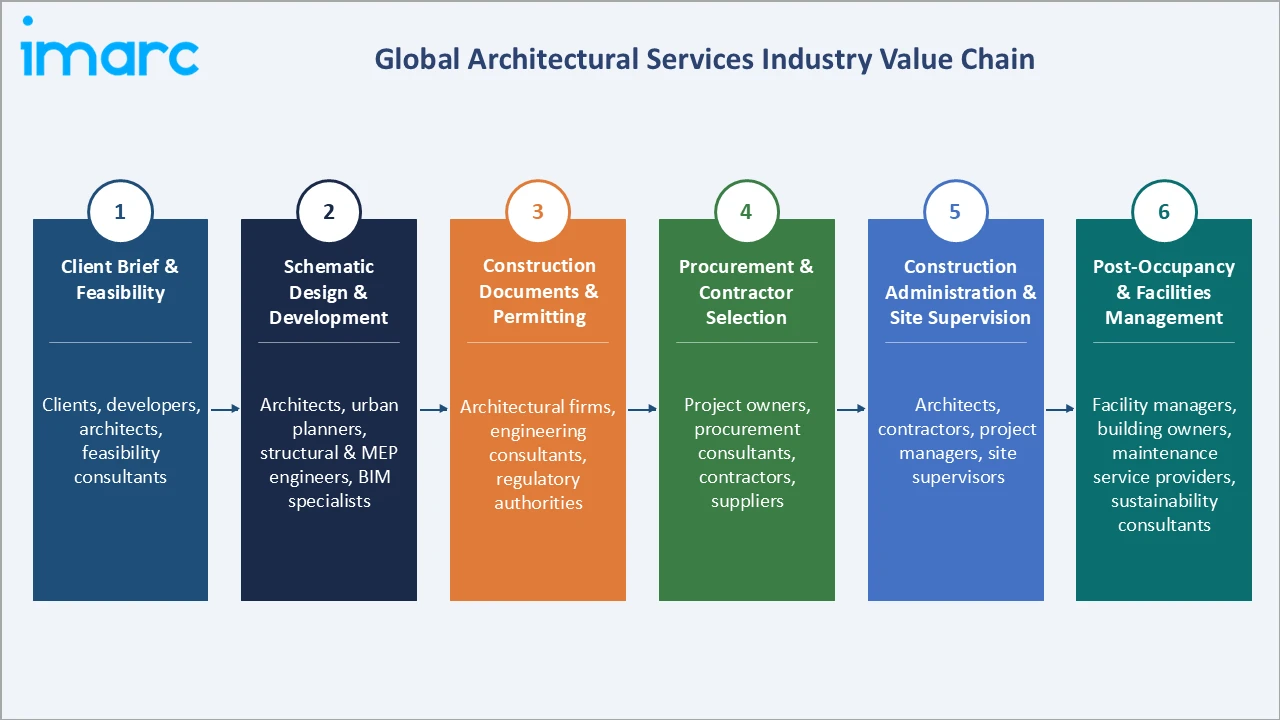
The architectural services value chain integrates client brief & feasibility, schematic design & design development, construction documents & permitting, procurement & contractor selection, construction administration & site supervision, and post-occupancy & facilities management.
|
Stage |
Key Participants |
|
Client Brief & Feasibility |
Clients, developers, architects, feasibility consultants. |
|
Schematic Design & Development |
Architects, urban planners, structural & MEP engineers, BIM specialists. |
|
Construction Documents & Permitting |
Architectural firms, engineering consultants, regulatory authorities. |
|
Procurement & Contractor Selection |
Project owners, procurement consultants, contractors, suppliers. |
|
Construction Administration & Site Supervision |
Architects, contractors, project managers, site supervisors. |
|
Post-Occupancy & Facilities Management |
Facility managers, building owners, maintenance service providers, sustainability consultants. |
The schematic design & development stage is the most value-added phase in the architectural services value chain, as it defines the building's functionality, aesthetics, sustainability, and cost efficiency. Decisions made during this stage significantly influence project quality, regulatory compliance, construction costs, and long-term operational performance.
Technology Landscape in the Architectural Services Industry
Building Information Modeling (BIM)
Building Information Modeling (BIM) enables architects, engineers, and contractors to collaborate on a unified digital model throughout the project lifecycle. It improves design accuracy, minimizes rework, enhances clash detection, and streamlines documentation. In June 2026, OFA Group launched its QikBIM AI Platform, making its advanced BIM automation technology available worldwide. Offered through a subscription-based SaaS model, the platform is designed for architects, engineers, developers, contractors, and other design professionals seeking to streamline BIM workflows. BIM also supports cost estimation, scheduling, and facility management, making it a core technology in modern architectural projects.
Digital Twin Technology
Digital twins create virtual replicas of physical buildings that continuously receive operational data from sensors and connected systems. Architects and facility managers use them to monitor building performance, optimize maintenance, and improve energy efficiency throughout the asset's lifecycle. The technology also supports renovation and operational planning.
Reality Capture and 3D Laser Scanning
Reality capture technologies, including drones, LiDAR, and 3D laser scanning, create highly accurate digital representations of existing buildings and construction sites. They improve site surveys, renovation planning, progress monitoring, and quality control. Integration with BIM enhances project accuracy and efficiency.
Market Segmentation Analysis
The report covers the following segments:
|
egment Category |
Leading Segment |
Market Share |
Year |
|
Service Type |
Construction and Project Management Services |
31.8% |
2025 |
|
End Use |
Residential |
34.9% |
2025 |
|
Region |
Asia-Pacific |
39.6% |
2025 |

By Service Type
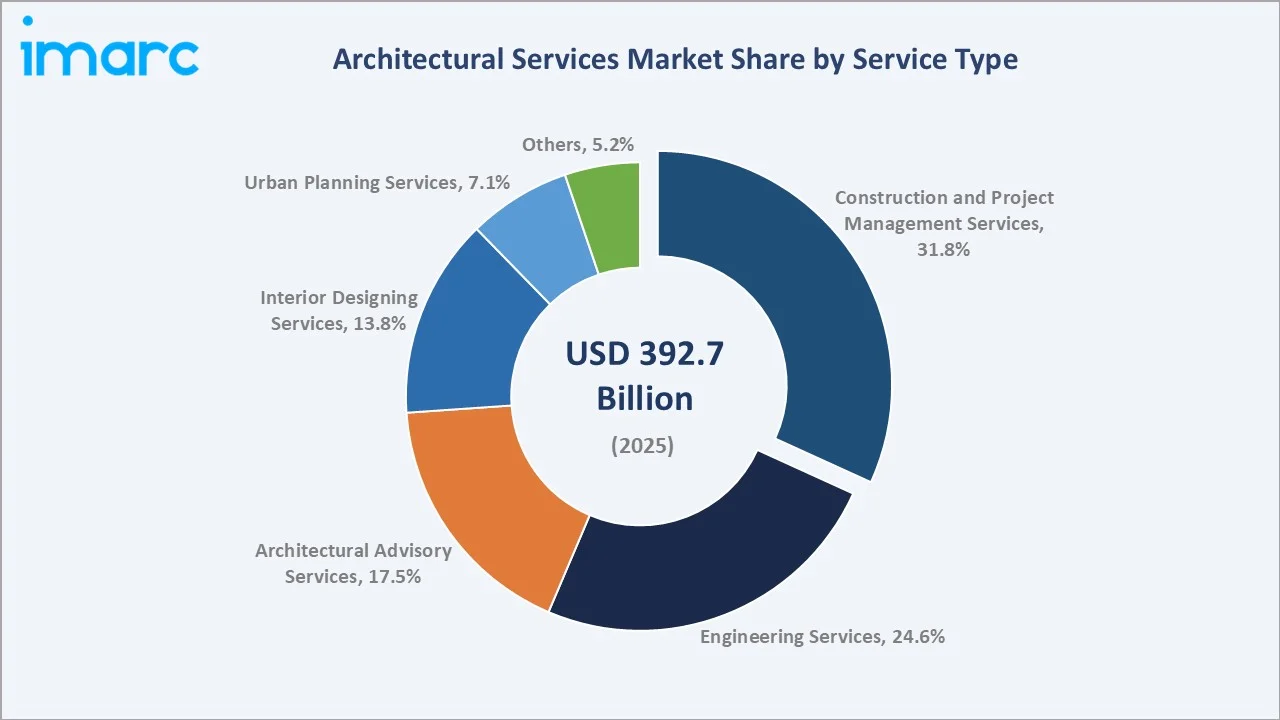
Construction and project management services lead at 31.8% (2025) through the integrated delivery model that architecture firms provide, capturing comprehensive project management alongside design from clients seeking single-source professional services. Engineering services at 24.6% reflect multidisciplinary architecture firm growth and the structural, MEP, and civil engineering integration that complex buildings require. Architectural advisory services at 17.5% encompass the growing pre-design and post-occupancy consulting market that architecture firms serve as standalone service lines beyond traditional design commissions.
To access detailed market analysis, Request Sample
Interior designing services at 13.8% serve corporate workplace redesign, luxury residential interiors, and hospitality interior renovation markets. Urban planning services at 7.1%, growing fastest at ~4.20% CAGR, serve smart city development, urban regeneration master planning, and new urban district design globally. Others at 5.2% encompasses heritage conservation, landscape architecture, specialist technical consulting, and advisory building technology services.
By End Use
Residential end use leads at 34.9% through Asia-Pacific mass housing, luxury residential development, and mixed-use residential tower design globally. Industrial at 18.7% serves e-commerce fulfilment, semiconductor fab, pharmaceutical manufacturing, and data center architectural markets. Government at 12.8% encompasses civic building, infrastructure, military, and public facility architectural services procured through public tender processes.
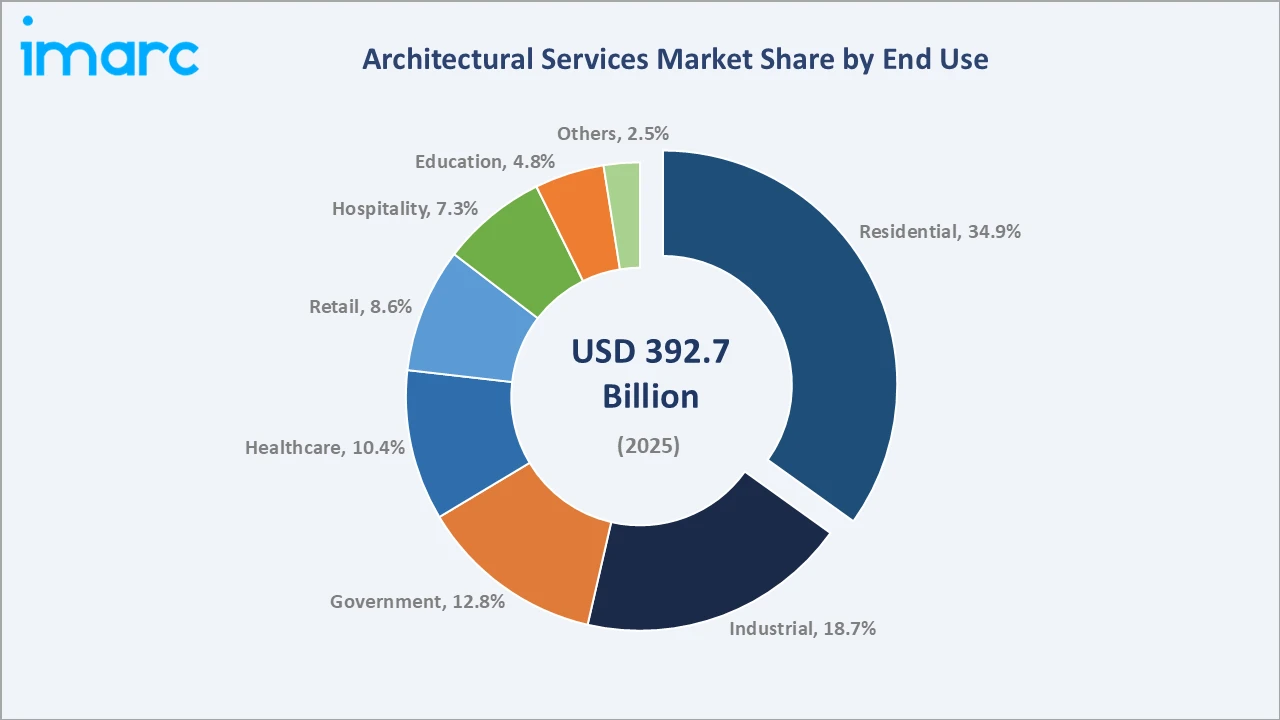
Healthcare at 10.4%, growing at ~4.05% CAGR, serves hospitals, clinics, behavioral health, and medical research facilities design globally. Retail at 8.6% serves mixed-use development, flagship store design, and retail park architectural markets globally. Hospitality at 7.3% encompasses hotel, resort, and entertainment venue architectural design globally. Education at 4.8% serves K-12 school, higher education campus, and research facility architectural design. Others at 2.5% include religious facilities, cultural institutions, and transportation infrastructure.
Regional Market Insights
|
Region |
Share (2025) |
Key Architectural Services Market Drivers & Characteristics |
|
Asia-Pacific |
39.6% |
Rapid urbanization, large-scale infrastructure investment, smart city initiatives, and strong residential and commercial construction activity drive regional growth. |
|
North America |
26.1% |
High demand for sustainable building design, renovation projects, digital design technologies, and commercial real estate development supports market expansion. |
|
Europe |
21.9% |
Stringent environmental regulations, green building adoption, heritage restoration, and energy-efficient renovation projects contribute to steady market demand. |
|
Latin America |
7.0% |
Growing urban development, public infrastructure investments, and expanding residential construction are creating opportunities for architectural service providers. |
|
Middle East and Africa |
5.4% |
Large-scale mixed-use developments, tourism projects, smart cities, and government-backed infrastructure investments are driving architectural services demand. |
Asia-Pacific's 39.6% market dominance is supported by rapid urbanization, extensive infrastructure development, and strong residential and commercial construction activity across China, India, and Southeast Asia. North America's 26.1% share reflects its high adoption of digital design technologies, sustainable architecture, and renovation projects.
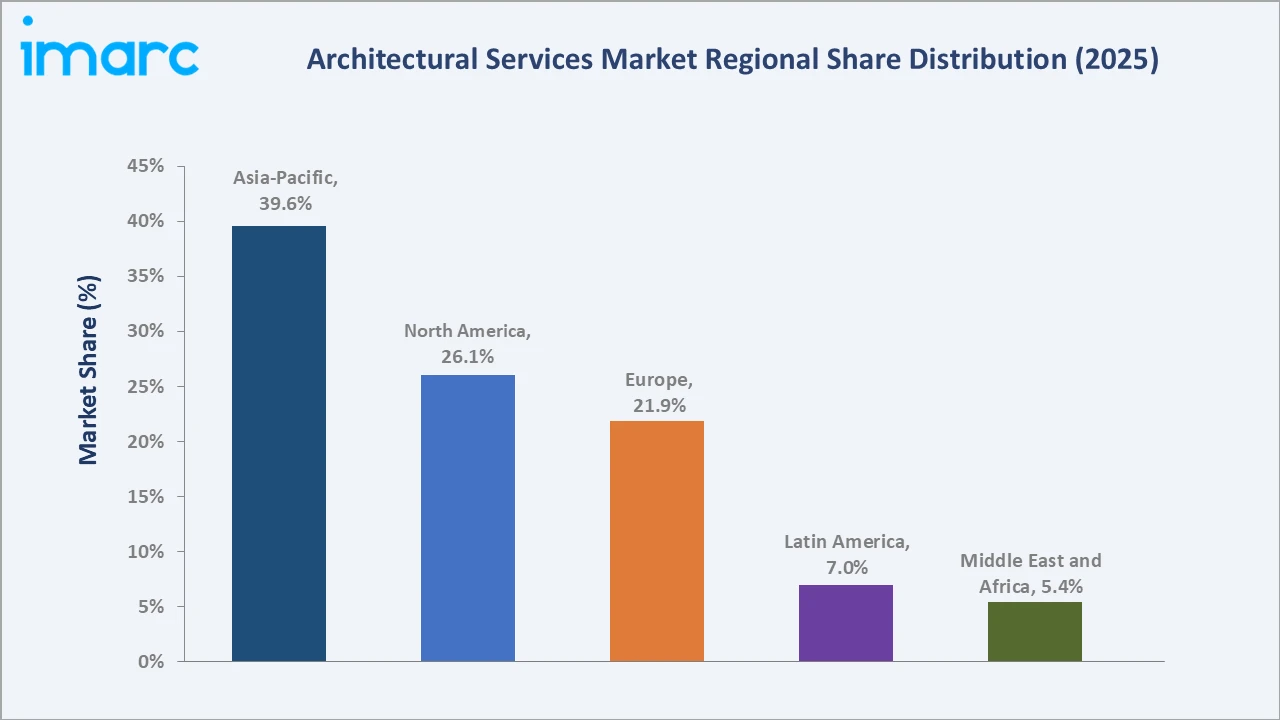
Europe's 21.9% share continues to experience steady growth, driven by stringent environmental regulations, green building standards, and building retrofit initiatives. Latin America’s 7.0% is witnessing increasing demand as governments invest in urban infrastructure and affordable housing projects. The Middle East and Africa’s 5.4% share at the market's fastest secondary CAGR (~3.90%) reflects the extraordinary scale and ambition of Saudi Vision 2030 architectural commissions that are attracting the architectural elite to the region with project briefs of unprecedented scope and complexity.
Competitive Landscape
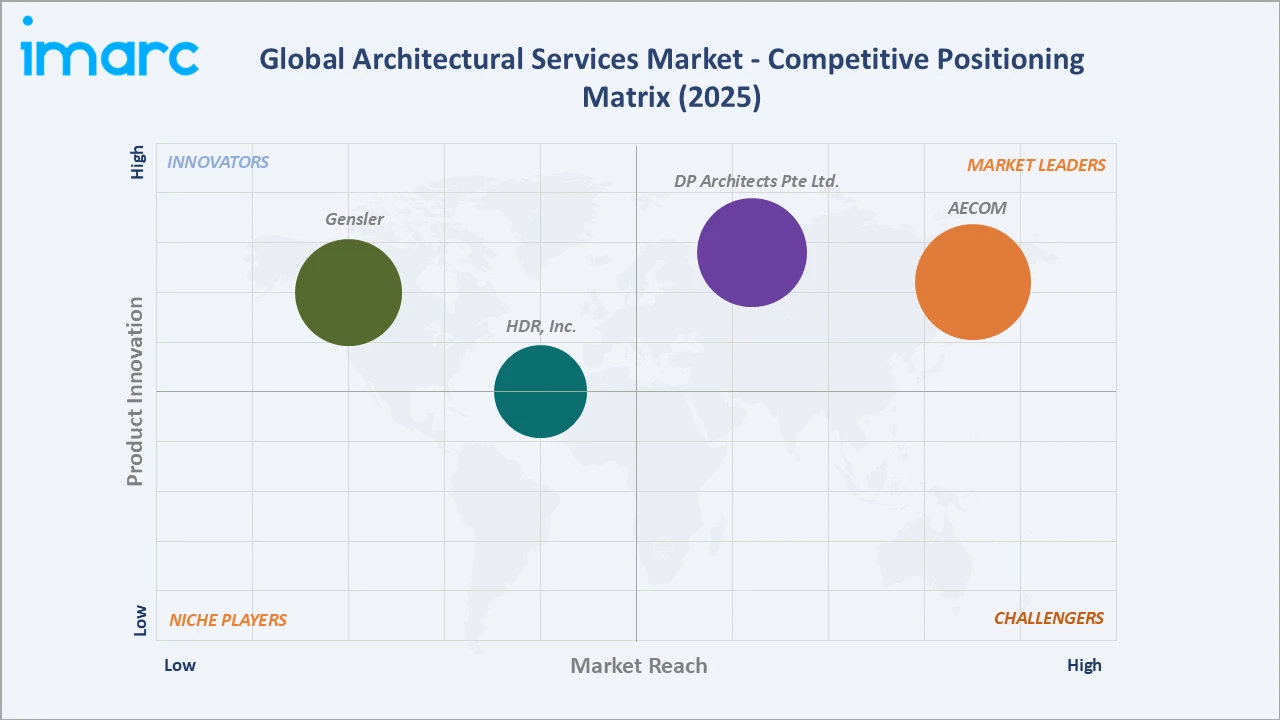
The architectural services market is highly competitive, with the presence of global design firms, regional consultancies, and specialized architectural practices competing across residential, commercial, industrial, and infrastructure projects. Companies differentiate themselves through expertise in sustainable design, Building Information Modeling (BIM), AI-driven design solutions, and integrated engineering capabilities.
|
Company |
Key Services |
Market Position |
Core Strength |
|
AECOM |
Architecture, Urbanism + Planning, Interior Architecture, Asset Advisory |
Market Leader |
AECOM functions as a multidisciplinary global infrastructure and design firm. In architectural services, they provide end-to-end solutions operating on a massive scale across commercial, healthcare, and public sectors. |
|
DP Architects Pte Ltd. |
Project Management Consultancy, Interior Design & Spatial Planning, Engineering & Building Services Design |
Market Leader |
DP Architects Pte Ltd. is a leading multinational design consultancy that provides end-to-end architectural and master planning services. |
|
Gensler |
Architecture, Cities & Urban Design, Interior Design |
Innovator |
Gensler is one of the largest architecture and design firms, operating globally to deliver comprehensive services ranging from master planning and interior design to urban spaces and large-scale megaprojects. |
|
HDR, Inc. |
Architectural Design, Building Engineering, Infrastructure Design, Interior Design, Landscape Architecture, Lighting Design |
Established Player |
HDR, Inc. integrates architecture, engineering, and consulting to create complex, sustainable spaces across sectors like science, education, and civic infrastructure. |
Strategic partnerships, geographic expansion, and investments in digital technologies are key competitive strategies. Increasing demand for green buildings and smart infrastructure is further encouraging innovation and service diversification across the market.
Key Company Profiles
AECOM
AECOM is a leading infrastructure consulting firm providing architecture, engineering, design, planning, and project management services across residential, commercial, industrial, transportation, water, energy, and government sectors. The company delivers integrated solutions throughout the project lifecycle, from planning and design to construction management and operations. Leveraging digital technologies, Building Information Modeling (BIM), and sustainable design expertise, AECOM supports complex infrastructure and building projects worldwide.
- Key Services: Architecture, Urbanism + Planning, Interior Architecture, Asset Advisory.
- Strategic Focus: Delivering integrated architecture, engineering, and project management solutions for complex infrastructure and building projects worldwide. The company emphasizes sustainable and resilient design, leveraging Building Information Modeling (BIM), digital twins, AI-enabled technologies, and data-driven project delivery to improve efficiency and project outcomes.
Gensler
Gensler is one of the largest architecture, design, and planning firms, providing services across commercial, residential, hospitality, healthcare, education, retail, mixed-use, and workplace sectors. The company delivers integrated architectural, interior design, urban planning, and consulting solutions with a strong emphasis on innovation, sustainability, and user-centered design. Leveraging digital technologies and research-driven design methodologies, Gensler helps clients create high-performance and future-ready built environments. Its extensive global presence and multidisciplinary expertise make it a leading participant in the architectural services market.
- Key Services: Architecture, Cities & Urban Design, Interior Design.
- Strategic Focus: Delivering innovative, human-centered, and sustainable architectural solutions across commercial, residential, mixed-use, healthcare, and workplace developments. The firm emphasizes digital design technologies, including Building Information Modeling (BIM), data-driven analytics, and workplace strategy to enhance project outcomes.
Market Concentration Analysis
The global architectural services market is highly fragmented at the overall market level, with thousands of national, regional, and boutique practices serving local and specialized markets, while demonstrating moderate concentration in specific project typology niches. Healthcare architecture exhibits the highest niche concentration. Iconic landmark architecture is effectively oligopolistic among the top 10-15 globally recognized design practices. The overall top 4 companies set likely represents 5-8% of total global architectural services revenue, reflecting the fundamental fragmentation.
Investment & Growth Opportunities
Highest Growth Segments
Urban planning services (~4.20% CAGR), healthcare end use (~4.05% CAGR), MEA region (~3.90% CAGR), interior designing services (~3.70% CAGR), and Asia-Pacific market (~4.00% CAGR) represent the global architectural services market's highest-growth investment vectors through 2034.
Investment Themes
- Healthcare architecture specialty development: Growing investment in healthcare infrastructure is increasing demand for specialized architectural expertise in hospitals, clinics, laboratories, and medical campuses. This is encouraging firms to expand capabilities in patient-centered, technology-enabled, and regulatory-compliant healthcare facility design.
- AI and technology platform differentiation: Architectural firms are investing in AI-powered design tools, BIM platforms, digital twins, and cloud-based collaboration solutions to improve project efficiency and design accuracy. These technology investments create a competitive advantage by accelerating project delivery, reducing costs, and enhancing client engagement.
Future Market Outlook (2026-2034)
The global architectural services market is projected to grow from USD 392.7 Billion in 2025 to USD 537.6 Billion by 2034, delivering a 3.45% CAGR that reflects the sustained intersection of demographic, regulatory, and technological forces that simultaneously expand the addressable market for architectural services and increase the value per project that sophisticated design delivery commands. The anchor value of USD 467.5 Billion in 2030 is modest by construction market boom standards but remarkably resilient for a professional services sector navigating high-interest rate environments, construction cost inflation, and technology-driven competitive disruption.
Three structural forces define the market's trajectory through the forecast period. First, Asia-Pacific's continued urbanization at scale, where India's addition of urban residents, China's urban renewal and smart city investment sustaining architectural services demand despite residential market adjustments, and Southeast Asia's rapid middle-class urbanization generating quality-oriented housing and commercial construction demand, ensures that Asia-Pacific retains and potentially increases its 39.6% global architectural services market share through the forecast period. Second, the global regulatory push toward net-zero buildings and sustainable construction is systematically expanding the technical scope and the corresponding fee opportunity of architectural services delivery. Third, the technology transformation of architectural practice is creating productivity improvements that enable architecture firms to serve more clients, deliver more project types, and access geographically broader markets with equivalent professional headcount, sustaining revenue growth above the organic construction market CAGR through efficiency-driven capacity expansion.
Research Methodology
Primary Research
Primary research comprised in-depth interviews with architecture firm principals and business development directors, institutional building owner representatives, industry association representatives, and architecture market analysts. Discussions validated market size estimates, segment share dynamics, competitive positioning, regional growth patterns, and technology adoption impact assessment.
Secondary Research
Secondary research encompassed architecture firm revenue and market data, professional fee benchmarking, annual revenue ranking, corporate communications, project portfolio documentation, global construction market data, and urbanization analysis.
Forecasting Models
Forecasting models were developed using historical global architectural services market data, construction sector expenditure forecasting by region, architectural fee rate modeling by project typology, BIM mandate adoption timeline and fee impact analysis, sustainability standard tightening fee premium modeling, AI productivity improvement scenario analysis, regional CAGR differential estimation, and architecture firm M&A activity impact modeling. Both top-down and bottom-up approaches were validated through primary research.
Architectural Services Market Report Coverage:
| Report Features | Details |
|---|---|
| Base Year of the Analysis | 2025 |
| Historical Period | 2020-2025 |
| Forecast Period | 2026-2034 |
| Units | Billion USD |
| Scope of the Report |
Exploration of Historical Trends and Market Outlook, Industry Catalysts and Challenges, Segment-Wise Historical and Future Market Assessment:
|
| Service Types Covered | Architectural Advisory Services, Construction and Project Management Services, Engineering Services, Interior Designing Services, Urban Planning Services, and Others |
| End Uses Covered | Education, Government, Healthcare, Hospitality, Industrial, Residential, Retail, and Others |
| Regions Covered | Asia Pacific, Europe, North America, Latin America, Middle East and Africa |
| Countries Covered | United States, Canada, Germany, France, United Kingdom, Italy, Spain, Russia, China, Japan, India, South Korea, Australia, Indonesia, Brazil, Mexico |
| Companies Covered | AECOM, DP Architects Pte Ltd., Gensler, HDR Inc., etc. |
| Customization Scope | 10% Free Customization |
| Post-Sale Analyst Support | 10-12 Weeks |
| Delivery Format | PDF and Excel through Email (We can also provide the editable version of the report in PPT/Word format on special request) |
Frequently Asked Questions About the Architectural Services Market Report
The global architectural services market reached USD 392.7 Billion in 2025, driven by Asia-Pacific urbanization, Saudi Vision 2030 NEOM and Red Sea Project architectural commissions, infrastructure programs generating government architectural services demand, BIM mandate adoption, and post-pandemic healthcare infrastructure investment accelerating hospital architecture globally.
The market grows at 3.45% CAGR during 2026-2034, reaching USD 537.6 Billion by 2034. Growth will be supported by urbanization, infrastructure investment, sustainable construction, and increasing adoption of digital design technologies.
Construction and project management services lead at 31.8% (2025) through the integrated delivery model that major architecture firms adopt for complex institutional and infrastructure projects, providing single-source design and project management that reduces client coordination burden.
Residential leads at 34.9% (2025) through Asia-Pacific mass housing programs, luxury residential development, and mixed-use residential tower design.
Asia-Pacific leads at 39.6% (2025) through China's largest construction market, India's Smart Cities Mission and National Infrastructure Pipeline, Southeast Asia's rapid urbanization, and Singapore's hub position hosting global architecture firm Asia-Pacific headquarters.
Leading companies include AECOM, DP Architects Pte Ltd., Gensler, and HDR, Inc., among others.
The market is projected to reach approximately USD 467.5 Billion by 2030, driven by India's urbanization acceleration requiring massive new construction, EU near-zero energy building mandate for all new buildings creating sustainable architecture fee premiums, Saudi Vision 2030 construction programs reaching peak delivery phases, BIM Level 3 and AI design tool adoption improving architecture firm productivity and project delivery capacity, healthcare architecture boom through aging global population hospital investment, and Asia-Pacific smart city urban planning generating multi-year planning and design commission pipelines.
Top opportunities include healthcare architecture specialization, AI and BIM technology platform investment, India market entry and expansion, net-zero carbon design advisory, MEA mega-project positioning, and digital twin building design integration.
Need more help?
- Speak to our experienced analysts for insights on the current market scenarios.
- Include additional segments and countries to customize the report as per your requirement.
- Gain an unparalleled competitive advantage in your domain by understanding how to utilize the report and positively impacting your operations and revenue.
- For further assistance, please connect with our analysts.
 Request Customization
 Speak to an Analyst
 Request Brochure
 Inquire Before Buying
Benefits of Customization
- Personalize this research
- Triangulate with your data
- Get data as per your format and definition
- Gain a deeper dive into a specific application, geography, customer, or competitor
- Any level of personalization
Get in Touch With Us
UNITED STATES
Phone: +1-201-971-6302
INDIA
Phone: +91-120-433-0800
UNITED KINGDOM
Phone: +44-753-714-6104
Email: [email protected]
Client Testimonials




.webp)




.webp)













