
Argentina Mobile Wallet Market Size, Share, Trends and Forecast by Type, Ownership, Technology, Vertical, and Region, 2026-2034
Argentina Mobile Wallet Market Summary:
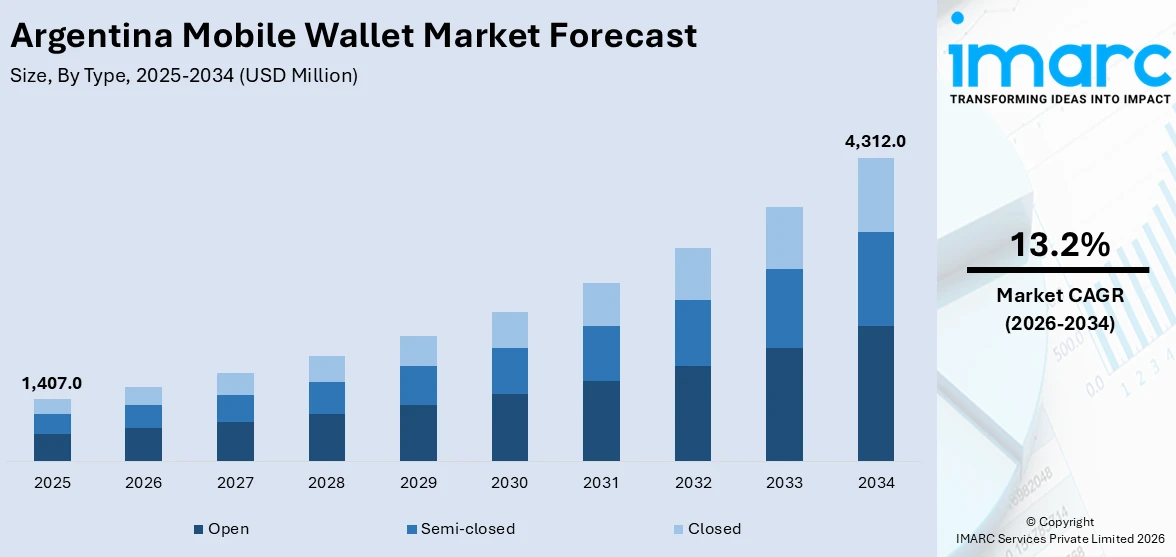
The Argentina mobile wallet market size was valued at USD 1,407 Million in 2025 and is projected to reach USD 4,312 Million by 2034, growing at a compound annual growth rate of 13.2% from 2026-2034.
The market is driven by rising smartphone penetration and the growing adoption of digital payment solutions across diverse consumer segments. The expanding e-commerce ecosystem, coupled with increasing consumer preference for contactless and secure transaction methods, continues to accelerate market expansion. Government initiatives promoting financial inclusion and cashless economies further support widespread mobile wallet adoption. Enhanced security features, including biometric authentication and multi-factor verification, are strengthening consumer confidence in digital payment platforms, contributing to Argentina mobile wallet market share growth.
Key Takeaways and Insights:
-
By Type: Open dominates the market with a share of 46% in 2025, driven by their ability to facilitate transactions across multiple merchants and platforms, allowing users to withdraw cash and transfer funds seamlessly between different financial ecosystems.
-
By Ownership: Banks leads the market with a share of 42% in 2025, owing to established customer trust, extensive branch networks, robust security infrastructure, and regulatory compliance capabilities that enable seamless integration with existing financial services.
-
By Technology: Optical/QR code represents the largest segment with a market share of 36% in 2025, driven by the widespread adoption of internet-based payment solutions and the proliferation of smartphones enabling seamless digital transactions across urban and rural populations throughout the country.
-
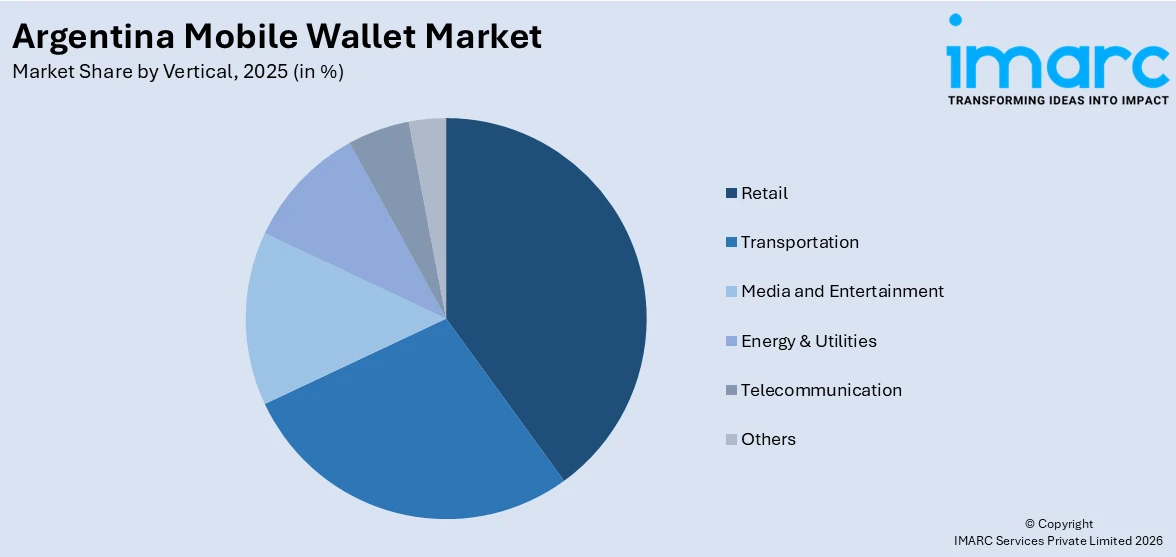
By Vertical: Retail dominates the market with a share of 35% in 2025, owing to the expanding e-commerce ecosystem, increasing merchant acceptance of QR code payments, and consumer preference for convenient checkout experiences at both online and physical retail establishments.
-
Key Players: The Argentina mobile wallet market is moderately consolidated, with fintech and traditional banks competing, differentiating via integrated financial services, strategic merchant partnerships, and enhanced user experience across digital payment platforms. Some of the key players operating in the market include EBANX, Ohana, Mercado Pago (MercadoLibre SRL), PayPal Argentina S.R.L. (PayPal Holdings, Inc.), TodoPago, and VALEpei.
To get more information on this market Request Sample
The Argentina mobile wallet market is experiencing robust growth, propelled by the convergence of technological advancement and shifting consumer payment preferences. The increasing penetration of smartphones and improved internet connectivity has created a conducive environment for digital payment adoption across diverse demographic segments. The expanding retail sector, particularly the e-commerce ecosystem, has necessitated the integration of seamless payment solutions that offer enhanced convenience and transaction speed. Additionally, the implementation of interoperable QR code systems has simplified merchant acceptance nationwide, reducing barriers for small and medium enterprises to participate in the digital economy. In November 2025, Argentina’s Central Bank reported interoperable QR payments rising 54% year-on-year, reaching 71.6 Million transactions, with 98.2% of digital retail payments initiated via QR codes nationwide. Moreover, consumer inclination toward secure, contactless payment methods has intensified demand for mobile wallets equipped with advanced authentication technologies, positioning these platforms as essential tools for modern financial transactions.
Argentina Mobile Wallet Market Trends:
Integration of Advanced Authentication Technologies
Mobile wallet providers are increasingly incorporating sophisticated biometric authentication features, including fingerprint sensors, facial recognition, and voice verification systems, to enhance transaction security and user confidence. These advanced security measures address consumer concerns regarding data protection and fraudulent activities, creating a more trustworthy digital payment ecosystem. The adoption of multi-factor authentication protocols ensures that sensitive financial information remains protected while maintaining seamless user experiences. As cybersecurity threats continue evolving, wallet providers are investing substantially in encryption technologies and real-time fraud detection algorithms to safeguard user transactions and personal data. As per sources, Mercado Pago announced plans to seek a banking licence in Argentina to expand its fully digital services, strengthen credit and investment offerings, and accelerate mobile wallet–led financial inclusion.
Expansion of Interoperable Payment Infrastructure
The development of nationwide interoperable payment systems has significantly transformed the mobile wallet landscape in Argentina, enabling seamless transactions across different platforms and financial institutions. This infrastructure advancement allows consumers to conduct instant transfers and payments regardless of their wallet provider, fostering greater financial inclusion and accessibility. The standardization of QR code payment protocols has accelerated merchant adoption, particularly among small businesses previously unable to access traditional card payment terminals. In August 2025, Argentina registered 71.4 Million interoperable payment-by-transfer transactions, growing 45.8% year-on-year, with nearly 98% initiated through standardized QR codes, reflecting strong nationwide adoption. Moreover, these interoperability initiatives are bridging urban-rural payment divides and creating unified digital payment experiences across the country.
Rise of Embedded Financial Services Within Wallet Ecosystems
Mobile wallet platforms are evolving beyond basic payment functionalities to offer comprehensive financial service ecosystems encompassing savings accounts, micro-lending, investment options, and insurance products. This transformation positions mobile wallets as complete financial management tools that address diverse consumer needs within single applications. The integration of artificial intelligence and machine learning enables personalized financial recommendations and automated savings features that enhance user engagement and retention. These embedded financial services particularly benefit underbanked populations, providing access to credit and investment opportunities previously unavailable through traditional banking channels. According to sources, Mercado Libre reported nearly 67 Million unique buyers, underscoring broad user engagement across its commerce and embedded financial services ecosystem.
Market Outlook 2026-2034:
The Argentina mobile wallet market is positioned for substantial revenue expansion throughout the forecast period, supported by continued digital transformation across financial services and retail sectors. Increasing consumer adoption of contactless payment methods, combined with expanding merchant acceptance networks, will drive sustained market revenue growth. Government initiatives promoting financial inclusion and cashless transactions are expected to accelerate market penetration across underserved regions. The integration of innovative technologies including artificial intelligence and cloud computing will enhance service offerings and user experiences, contributing to robust revenue generation through expanded user bases and increased transaction volumes. The market generated a revenue of USD 1,407 Million in 2025 and is projected to reach a revenue of USD 4,312 Million by 2034, growing at a compound annual growth rate of 13.2% from 2026-2034.
Argentina Mobile Wallet Market Report Segmentation:
|
Segment Category |
Leading Segment |
Market Share |
|
Type |
Open |
46% |
|
Ownership |
Banks |
42% |
|
Technology |
Optical/QR Code |
36% |
|
Vertical |
Retail |
35% |
Type Insights:
- Open
- Semi-closed
- Closed
Open dominates with a market share of 46% of the total Argentina mobile wallet market in 2025.
Open have established market dominance by offering comprehensive financial functionality that extends beyond basic payment processing. These wallets enable users to conduct transactions across unlimited merchants, withdraw cash from ATMs, transfer funds to bank accounts, and access a full spectrum of financial services. The flexibility inherent in open wallets addresses diverse consumer needs ranging from daily retail purchases to peer-to-peer transfers and bill payments, driving widespread adoption across demographic segments.
The regulatory framework supporting open wallet operations has matured significantly, providing clear guidelines for operators while ensuring consumer protection. Financial institutions and licensed payment service providers leverage their existing infrastructure and customer relationships to scale open wallet offerings rapidly. Enhanced security protocols including multi-factor authentication, biometric verification, and real-time fraud detection systems have strengthened consumer confidence. The integration with government benefit disbursement programs has further expanded the addressable market by onboarding previously unbanked populations into the digital payment ecosystem.
Ownership Insights:
- Banks
- Telecom Companies
- Device Manufacturers
- Tech Companies
Banks leads with a share of 42% of the total Argentina mobile wallet market in 2025.
Banks maintain their dominant position in mobile wallet ownership through strategic leverage of established brand trust, regulatory compliance expertise, and extensive customer databases. Traditional banks have accelerated digital transformation initiatives by launching sophisticated mobile wallet applications that integrate seamlessly with existing account infrastructure. The ability to offer credit products, savings instruments, and investment options within wallet interfaces creates differentiated value propositions that pure play fintech competitors struggle to match without banking licenses.
Banks benefit from pre-existing know-your-customer compliance frameworks that streamline onboarding while meeting stringent regulatory requirements. Their established merchant relationships facilitate rapid acceptance network expansion, while correspondent banking relationships enable cross-border payment capabilities. Moreover, collaborative initiatives among banking consortiums have yielded interoperable payment solutions that enhance user utility while distributing development costs. The integration of advanced analytics and artificial intelligence enables personalized financial management features that strengthen customer engagement and reduce churn across digital banking platforms.
Technology Insights:
- Near Field Communication
- Optical/QR Code
- Digital Only
- Text-Based
Optical/QR code exhibits a clear dominance with a 36% share of the total Argentina mobile wallet market in 2025.
Optical and QR code have emerged as the dominant payment methodology due to its minimal infrastructure requirements and universal smartphone compatibility. Merchants can accept QR-based payments using only printed codes or basic smartphone applications, eliminating the need for expensive point-of-sale terminal investments. This accessibility has democratized digital payment acceptance among micro, small, and medium enterprises that previously relied exclusively on cash transactions. The standardization of interoperable QR code formats enables customers to pay using their preferred wallet application regardless of merchant wallet provider.
Government-backed interoperable payment initiatives have accelerated QR code adoption by mandating standardized formats that ensure cross-platform compatibility. As per records, in 2025, Argentina’s QR payments grew 93.3% year-on-year, accounting for 11.7% of total transactions, driven by interoperable payment systems and expanding use across retail and public transport. Real-time payment settlement through QR-initiated transactions provides immediate fund availability to merchants, addressing liquidity concerns that previously deterred small business adoption. Enhanced security features including dynamic QR codes that expire after single use and encrypted payment tokens protect against fraud while maintaining transaction convenience. The integration of QR payment capabilities across public transportation networks and government service portals has normalized usage patterns across diverse consumer segments.
Vertical Insights:
Access the comprehensive market breakdown Request Sample
- Retail
- Transportation
- Media and Entertainment
- Energy & Utilities
- Telecommunication
- Others
Retail leads with a share of 35% of the total Argentina mobile wallet market in 2025.
Retail maintains leadership within the Argentina mobile wallet market, driven by the substantial expansion of e-commerce platforms and increasing consumer adoption of digital payment methods for everyday purchases. Mobile wallets have become integral to retail transactions, offering consumers convenient checkout experiences while enabling merchants to streamline payment processing and reduce cash handling requirements. The integration of loyalty programs, discount offerings, and cashback rewards within retail-focused wallet features enhances consumer engagement and transaction frequency.
Retailers across various segments, from large supermarket chains to small neighborhood stores, are increasingly accepting mobile wallet payments through QR code systems and near-field communication terminals. In March 2025, interoperable QR payments in Argentina reached 72.3 Million transactions worth ARS1,295.3 Billion, highlighting widespread adoption of mobile wallets across merchants and retail sectors nationwide. Further, this widespread merchant acceptance has created a self-reinforcing cycle where consumer convenience drives further retailer adoption, expanding the overall market ecosystem. The retail segment benefits from ongoing infrastructure investments that simplify merchant onboarding and reduce transaction costs, making digital payment acceptance accessible to businesses of all sizes throughout Argentina.
Regional Insights:
- Buenos Aires Region
- Litoral Region
- Northern Region
- Cordoba Region
- Cuyo Region
- Patagonia Region
Buenos Aires region dominates the Argentina mobile wallet market, accounting for the largest share of digital transactions nationwide. The metropolitan area benefits from superior digital infrastructure, high smartphone penetration rates, and a tech-savvy consumer population embracing contactless payment solutions. Concentrated fintech ecosystem and extensive merchant acceptance networks further strengthen the region's market leadership position.
Litoral region demonstrates significant mobile wallet growth, driven by increasing urbanization and expanding commercial activities along the Paraná River corridor. Cities including Rosario and Santa Fe exhibit strong digital payment adoption supported by university populations and growing retail sectors. Cross-border commerce with neighboring Brazil creates demand for interoperable payment solutions facilitating regional trade and tourism transactions.
Northern region presents emerging opportunities for mobile wallet expansion, with digital payment adoption accelerating through financial inclusion initiatives targeting underserved populations. Infrastructure development projects improving internet connectivity are enabling broader access to digital financial services. Regional agricultural and tourism sectors increasingly utilize mobile wallet solutions for business transactions and visitor payments.
Cordoba region represents a significant mobile wallet market characterized by strong technology sector presence and educated consumer demographics embracing digital innovations. The region's thriving startup ecosystem and university networks drive early adoption of fintech solutions. Industrial and agricultural commerce increasingly integrates mobile payment systems to streamline supply chain transactions and improve operational efficiency.
Cuyo region exhibits growing mobile wallet penetration supported by expanding tourism activities, particularly wine industry visitors requiring convenient payment options. Regional commerce benefits from QR code payment systems enabling merchant acceptance without expensive terminal infrastructure. Agricultural sector digitalization initiatives promote mobile wallet adoption for supplier payments and harvest-related transactions.
Patagonia region presents unique market dynamics with mobile wallet adoption driven by tourism industry requirements and challenges associated with cash distribution across remote areas. Low-cost QR payment acceptance circumvents card terminal logistics in sparsely populated territories. Government-subsidized connectivity projects expanding bandwidth availability enable wallet providers to extend services and promotional campaigns throughout the region.
Market Dynamics:
Growth Drivers:
Why is the Argentina Mobile Wallet Market Growing?
Rising Smartphone Penetration and Internet Connectivity
The proliferation of smartphones across Argentina has created a substantial foundation for mobile wallet adoption, enabling consumers to access digital payment services through personal devices. Improved internet infrastructure, including expanded mobile network coverage and increased fixed broadband availability, ensures reliable connectivity necessary for seamless digital transactions. In October 2025, Argentina had 41.6 Million internet users, with online penetration reaching 90.6 percent, supporting widespread smartphone adoption and enabling access to mobile wallet services. Younger demographics particularly embrace smartphone-based financial services, driving generational shifts toward cashless payment preferences. The affordability of smartphones has democratized access to digital payment technologies, extending mobile wallet reach beyond urban centers to suburban and rural populations previously excluded from digital financial ecosystems.
Expansion of E-commerce and Digital Retail Ecosystems
The substantial growth of e-commerce platforms in Argentina has necessitated convenient, secure digital payment solutions that mobile wallets readily provide. Online retail expansion creates continuous demand for integrated payment methods offering seamless checkout experiences and purchase protection features. Consumer expectations for instant, frictionless transactions have elevated mobile wallets as preferred payment instruments for digital commerce activities. The integration of mobile wallets with major e-commerce marketplaces and delivery applications reinforces their position as essential tools for modern consumer purchasing behaviors. Retail sector digitalization initiatives further accelerate merchant acceptance of mobile wallet payments across physical and online channels.
Government Initiatives Promoting Financial Inclusion and Cashless Economy
Government policies encouraging digital payment adoption and financial inclusion have created favorable regulatory environments for mobile wallet market expansion. In April 2024, the BCRA launched interoperable QR codes, instant pull transfers, and electronic time deposits (CEDIPs) to improve digital payments, enhance transaction security, and promote financial inclusion in Argentina. Initiatives promoting interoperable payment systems enable seamless transactions across different platforms and financial institutions, reducing friction in digital payment adoption. Regulatory frameworks supporting fintech innovation encourage market entry by new providers while ensuring consumer protection standards. Public sector digitalization efforts, including electronic benefit disbursements and tax payment systems, familiarize populations with digital financial services. These coordinated policy approaches address infrastructure gaps and promote digital literacy, accelerating mobile wallet penetration across diverse socioeconomic segments.
Market Restraints:
What Challenges the Argentina Mobile Wallet Market is Facing?
Infrastructure Limitations in Remote Regions
Insufficient internet connectivity and telecommunications infrastructure in remote and rural areas constrain mobile wallet adoption beyond urban centers. Network reliability issues create transaction failures that undermine consumer confidence in digital payment systems. Infrastructure development requires substantial investments that may not deliver immediate commercial returns in sparsely populated regions.
Consumer Security and Privacy Concerns
Persistent consumer concerns regarding data security, transaction fraud, and privacy protection present barriers to broader mobile wallet adoption. High-profile security incidents and data breaches erode public trust in digital financial platforms despite advancing authentication technologies. Consumer education requirements regarding security best practices and fraud prevention add friction to user onboarding processes.
Digital Literacy Gaps Among Older Demographics
Limited digital literacy among older population segments creates resistance to mobile wallet adoption and preference for traditional cash transactions. Technology adoption barriers require targeted education initiatives and simplified user interfaces to address generational digital divides. The persistence of cash-based habits among certain demographics slows overall market transition toward digital payment methods.
Competitive Landscape:
The Argentina mobile wallet market exhibits a moderately consolidated competitive structure characterized by established fintech platforms competing alongside traditional financial institutions and emerging technology providers. Market leaders differentiate through comprehensive service ecosystems encompassing payments, transfers, lending, and investment functionalities within unified platforms. Strategic partnerships between wallet providers, merchants, and financial institutions expand acceptance networks and enhance service offerings. Competition increasingly centers on user experience optimization, feature innovation, and loyalty program development to drive customer acquisition and retention. Regulatory requirements for interoperability are reshaping competitive dynamics, enabling smaller providers to compete through specialized value propositions while reducing market entry barriers. Investment in security technologies and fraud prevention capabilities represents a key competitive differentiator as providers seek to build consumer trust and platform reliability.
Some of the key players include:
- EBANX
- Ohana
- Mercado Pago (MercadoLibre SRL)
- PayPal Argentina S.R.L. (PayPal Holdings, Inc.)
- TodoPago
- VALEpei
Recent Developments:
-
In October 2025, Binance launched QR-based crypto payments in Argentina via Binance Pay, allowing users to pay instantly at any QR-enabled merchant with over 100 cryptocurrencies. The feature is fee-free, converts payments to pesos automatically, and aims to integrate digital assets into everyday retail transactions.
Report Coverage:
| Report Features | Details |
|---|---|
| Base Year of the Analysis | 2025 |
| Historical Period | 2020-2025 |
| Forecast Period | 2026-2034 |
| Units | Million USD |
| Segment Coverage | Type, Ownership, Technology, Vertical |
| Companies Covered | EBANX, Ohana, Mercado Pago (MercadoLibre SRL), PayPal Argentina S.R.L. (PayPal Holdings, Inc.), TodoPago, and VALEpei |
| Customization Scope | 10% Free Customization |
| Post-Sale Analyst Support | 10-12 Weeks |
| Delivery Format | PDF and Excel through Email (We can also provide the editable version of the report in PPT/Word format on special request) |
Frequently Asked Questions About the Argentina Mobile Wallet Market Report
The Argentina mobile wallet market size was valued at USD 1,407 Million in 2025.
The Argentina mobile wallet market is expected to grow at a compound annual growth rate of 13.2% from 2026-2034 to reach USD 4,312 Million by 2034.
Open held the largest share due to their broad functionality, allowing users to transact across multiple merchants, withdraw cash, and transfer funds seamlessly. Their versatility meets diverse consumer financial needs, supporting convenience, interoperability, and widespread adoption across retail, services, and digital payment ecosystems.
Key factors driving the Argentina mobile wallet market include rising smartphone penetration, expanding e-commerce ecosystem, government financial inclusion initiatives, enhanced security features including biometric authentication, and increasing consumer preference for contactless payment solutions.
Major challenges include infrastructure limitations in remote regions, consumer security and privacy concerns, digital literacy gaps among older demographics, persistent cash preference in certain segments, economic volatility affecting consumer spending, and cybersecurity threats requiring continuous investment.
Need more help?
- Speak to our experienced analysts for insights on the current market scenarios.
- Include additional segments and countries to customize the report as per your requirement.
- Gain an unparalleled competitive advantage in your domain by understanding how to utilize the report and positively impacting your operations and revenue.
- For further assistance, please connect with our analysts.
 Request Customization
 Speak to an Analyst
 Request Brochure
 Inquire Before Buying
Benefits of Customization
- Personalize this research
- Triangulate with your data
- Get data as per your format and definition
- Gain a deeper dive into a specific application, geography, customer, or competitor
- Any level of personalization
Get in Touch With Us
UNITED STATES
Phone: +1-201-971-6302
INDIA
Phone: +91-120-433-0800
UNITED KINGDOM
Phone: +44-753-714-6104
Email: [email protected]
Client Testimonials




.webp)




.webp)













Related Reports

Choose your plan
*Please note that the prices mentioned below are starting prices for each bundle type. Kindly contact our team for further details.*
Single User License
- 1 User License, Access on 2 Devices
- PDF Report + Excel Dataset (Password Protected)
- Lifetime Access
- No Printing Rights
- 10% Free Report Customization
- 10–12 Weeks of Analyst Support
Five User License
- Access for 5 Users, 2 Devices per User
- PDF Report + Excel Dataset (Password Protected)
- Lifetime Access
- Dedicated Account Manager
- 12–14 Weeks of Analyst Support
- No Printing Rights
- 15% Free Report Customization
- 25% Discount on Your Next Purchase
Corporate User License
- Unlimited User Access (Within Your Organization)
- PDF Report + Excel Dataset
- Lifetime Access
- Dedicated Account Manager
- 14–20 Weeks of Analyst Support
- No Printing Rights
- 20% Free Report Customization
- 30% Discount on Your Next Purchase
Essential Insights
What's included:
3 reports
- Lifetime Access
- PDF Reports
- Excel Datasets
- 2 Weeks of Free Analyst Support
- 2 User Licenses
- Access on 2 Devices
- Printing Rights
- Complimentary PowerPoint (PPT) Version
- Complimentary License Upgrade
Professional Access
What's included:
5 reports
- Lifetime Access
- PDF Reports
- Excel Datasets
- 8 Weeks of Free Analyst Support
- 2 User Licenses
- Access on 2 Devices
- Printing Rights
- Complimentary PowerPoint (PPT) Version
- Complimentary License Upgrade
Business Advantage
What's included:
8 reports
- Lifetime Access
- PDF Reports
- Excel Datasets
- 14 Weeks of Free Analyst Support
- 2 User Licenses
- Access on 2 Devices
- Printing Rights
- Complimentary PowerPoint (PPT) Version
- Complimentary License Upgrade
Enterprise Intelligence
What's included:
10 reports
- Lifetime Access
- PDF Reports
- Excel Datasets
- 20 Weeks of Free Analyst Support
- 2 User Licenses
- Access on 2 Devices
- Printing Rights
- Complimentary PowerPoint (PPT) Version
- Complimentary License Upgrade