
Asia Pacific Biodiesel Market Size, Share, Trends and Forecast by Feedstock, Application, Type, Production Technology, and Country, 2026-2034
Asia Pacific Biodiesel Market Size, Share, Trends & Forecast (2026-2034)
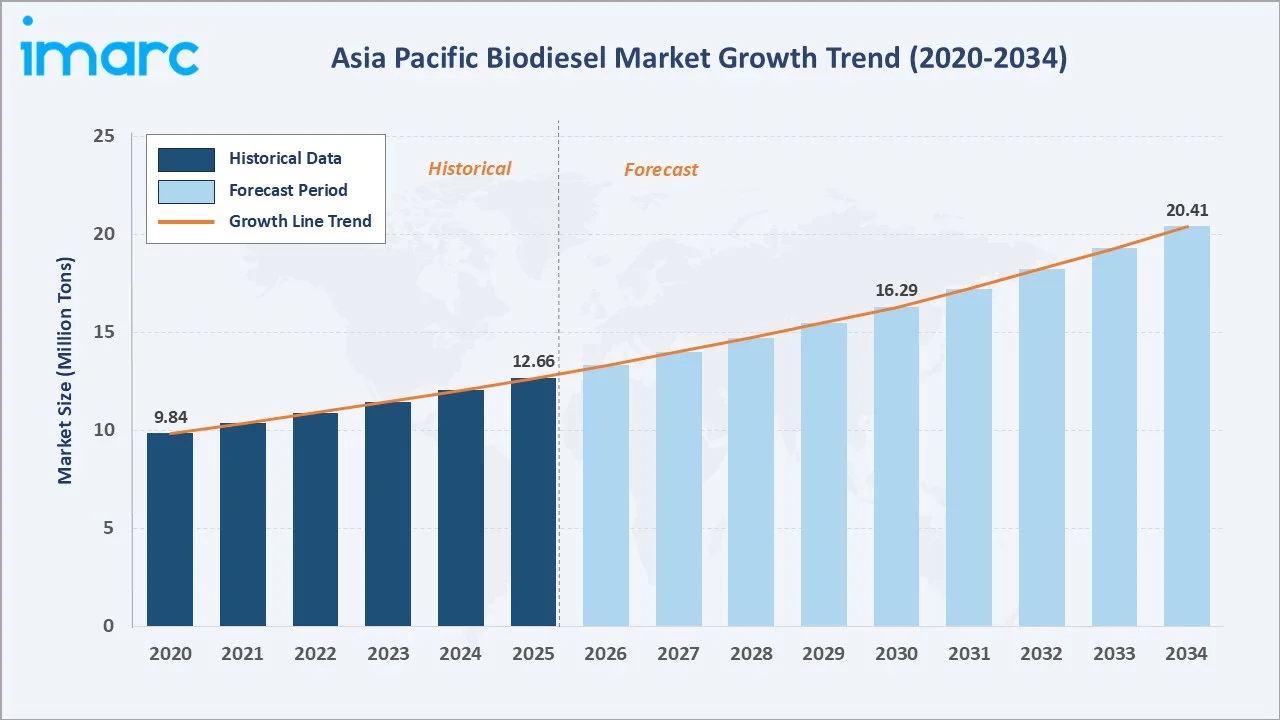
The Asia Pacific biodiesel market reached a volume of 12.66 Million Tons in 2025 and is projected to attain 20.41 Million Tons by 2034, exhibiting a CAGR of 5.18% during 2026-2034. Rising national blending mandates, surging energy security priorities, and expanding feedstock availability are the primary drivers shaping the market growth.
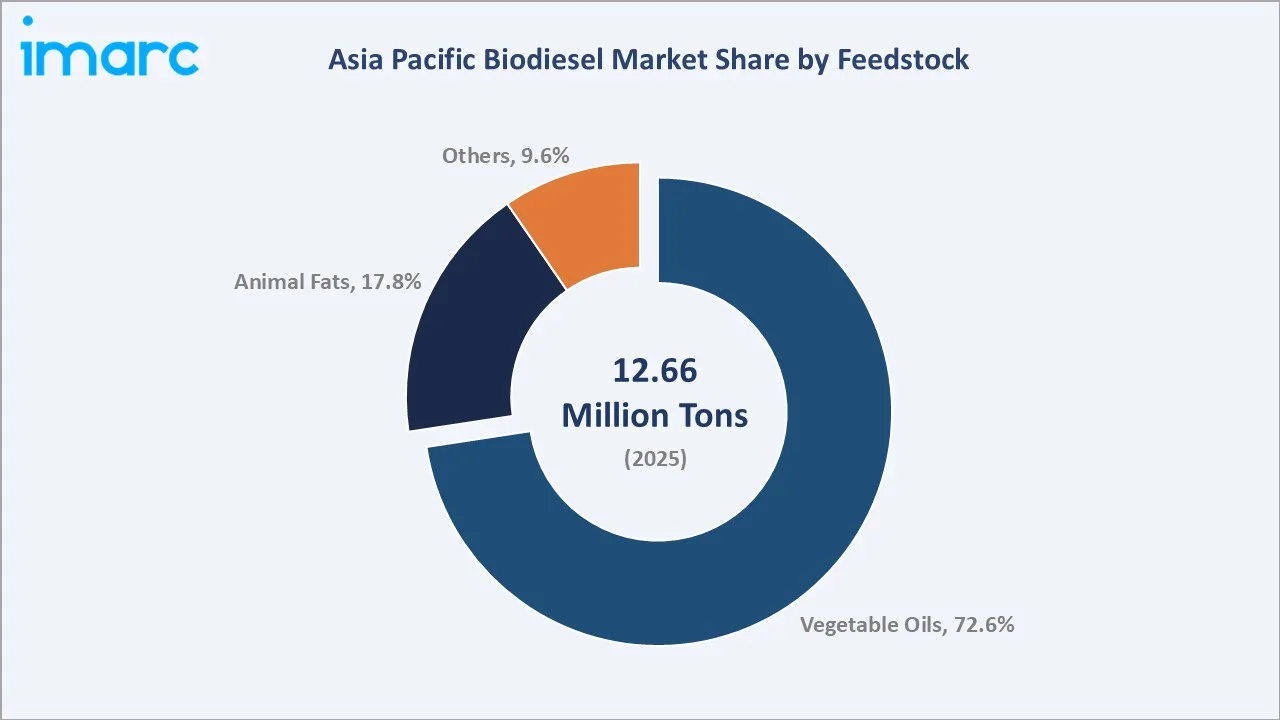
Vegetable oils lead the feedstock segment at 72.6%, fuel dominates the application segment at 78.4%, and China commands 32.8% country share.
Market Snapshot
|
Metric |
Value |
|
Market Size (2025) |
12.66 Million Tons |
|
Forecast Market Size (2034) |
20.41 Million Tons |
|
CAGR (2026-2034) |
5.18% |
|
Base Year |
2025 |
|
Historical Period |
2020-2025 |
|
Forecast Period |
2026-2034 |
|
Largest Country |
China (32.8%, 2025) |
|
Second Largest Country |
Indonesia (18.6%, 2025) |
|
Leading Feedstock |
Vegetable Oils (72.6%, 2025) |
|
Leading Application |
Fuel (78.4%, 2025) |
The Asia Pacific biodiesel market expanded from 9.84 Million Tons in 2020 to 12.66 Million Tons in 2025, driven by widening blending mandates, growing feedstock processing capacity, and steady policy support for cleaner transport fuel across the region. Anchored at 16.29 Million Tons in 2030, the forecast to 20.41 Million Tons by 2034 is supported by expanding waste-based feedstock adoption, growing power generation demand, and a more structured regulatory environment across member economies.
To get more information on this market, Request Sample
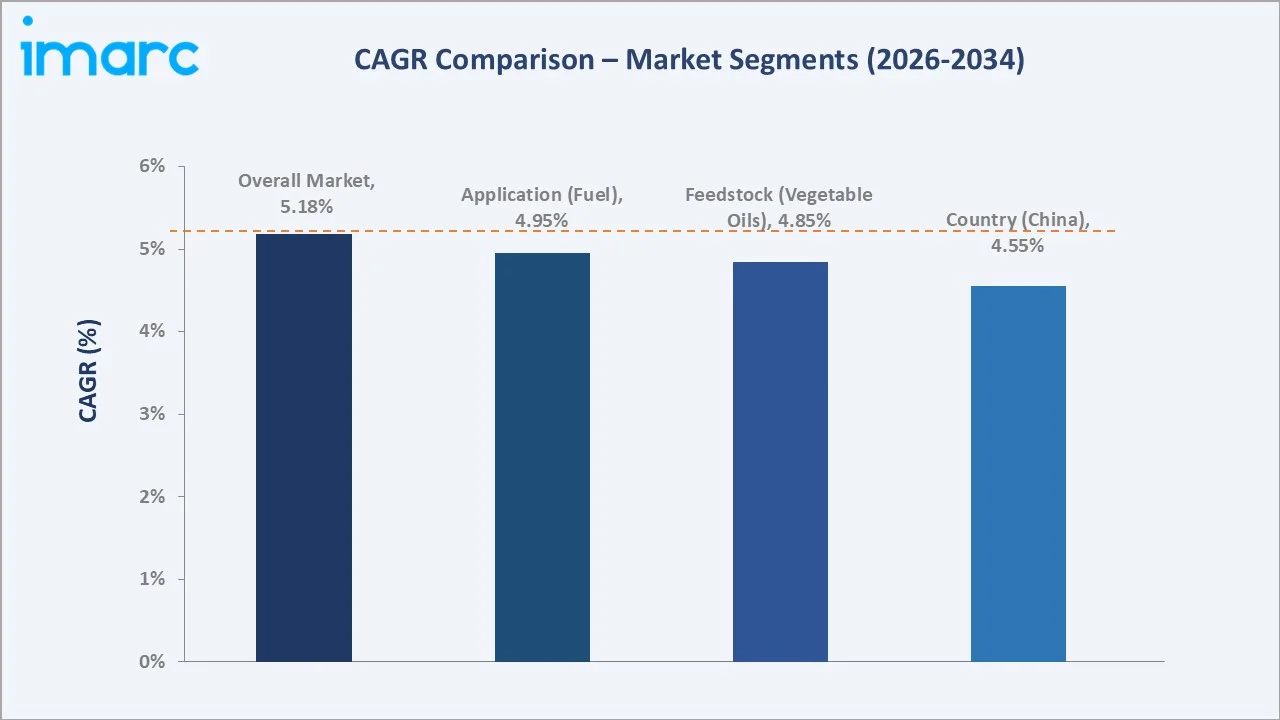
CAGR trajectories across feedstock, application, and country sub-segments show India and animal fats expanding faster than the overall 5.18% market CAGR, driven by rising blending mandates, diversifying feedstock supply, and growing power generation demand across the region.
Executive Summary
The Asia Pacific biodiesel market is on a steady growth trajectory from 9.84 Million Tons in 2020 to 20.41 Million Tons by 2034. The industry has moved from a fragmented, feedstock-constrained base toward a policy-anchored, blend-mandate-led production model spanning China, Indonesia, India, Japan, South Korea, Australia, and others.
Vegetable oils dominate the feedstock segment at 72.6% in 2025, supported by large-scale palm and soybean oil processing infrastructure across Indonesia, Malaysia, and China. Fuel leads the application segment at 78.4%, fueled by nationwide blending mandates and diesel substitution targets. China commands 32.8% of the country share, led by large-scale production capacity, an extensive used cooking oil collection network, and strong domestic energy security priorities.
Key Market Insights
|
Insight |
Data |
|
Leading Feedstock |
Vegetable Oils - 72.6% share (2025) |
|
Second Largest Feedstock |
Animal Fats - 17.8% share (2025) |
|
Leading Application |
Fuel - 78.4% share (2025) |
|
Second Largest Application |
Power Generation - 15.2% share (2025) |
|
Leading Country |
China - 32.8% share (2025) |
|
Second Largest Country |
Indonesia - 18.6% share (2025) |
|
Top Companies |
Wilmar International, PT Pertamina, Apical Group, Bharat Petroleum Corporation Limited |
Key Analytical Observations Expanding On the Data Above:
- Vegetable oils dominance at 72.6% is supported by large-scale palm and soybean oil processing infrastructure, established supply chains across Indonesia and Malaysia, and consistent cost-competitiveness against animal-fat and waste-based alternatives.
- Animal fats share at 17.8% is sustained by expanding rendering infrastructure and growing utilization of tallow and other by-products from the region's large livestock and food processing industries.
- Fuel leadership at 78.4% reflects widespread diesel-substitution mandates and the priority governments place on reducing transport-sector emissions and import dependence.
- Power generation share at 15.2% is expanding as utilities and industrial operators adopt biodiesel blends to diversify generation fuel and meet emission-reduction targets.
- China at 32.8% leads country share, anchored by extensive used cooking oil collection programs, large-scale refining capacity, and a growing export orientation toward global renewable fuel markets.
Asia Pacific Biodiesel Market Overview
Biodiesel refers to a renewable, biodegradable fuel produced through the transesterification of vegetable oils, animal fats, and used cooking oil into fatty acid methyl esters suitable for blending with or substituting conventional diesel. It is increasingly adopted as a lower-carbon alternative to petroleum-based diesel, particularly in road transportation, industrial equipment, and distributed power generation.
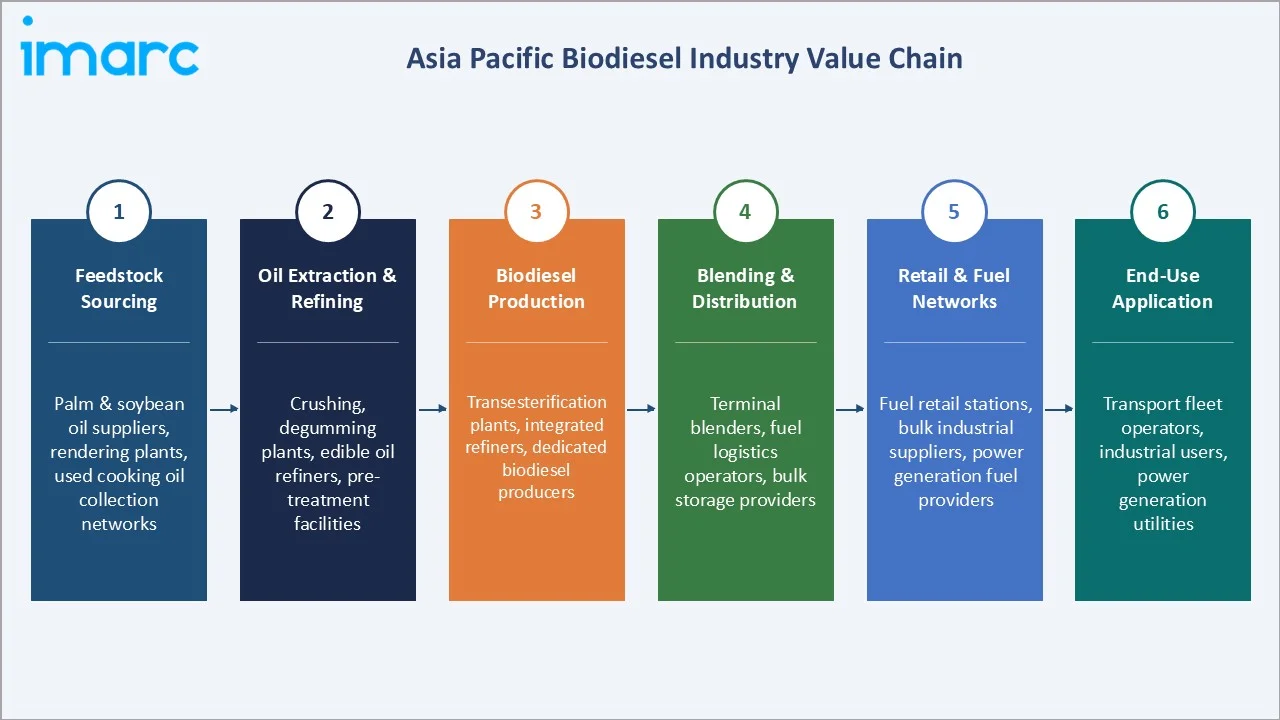
The Asia Pacific ecosystem integrates feedstock suppliers, oil extraction and refining operators, biodiesel producers, fuel blenders and distributors, regulatory authorities setting national blending mandates, and end users across transport, industrial, and power generation segments. Macroeconomic factors, including crude oil price volatility, palm oil export policy, and national energy security priorities, continue to shape production economics and regional trade flows.
Market Dynamics
To evaluate market opportunities, Request Sample
Market Drivers
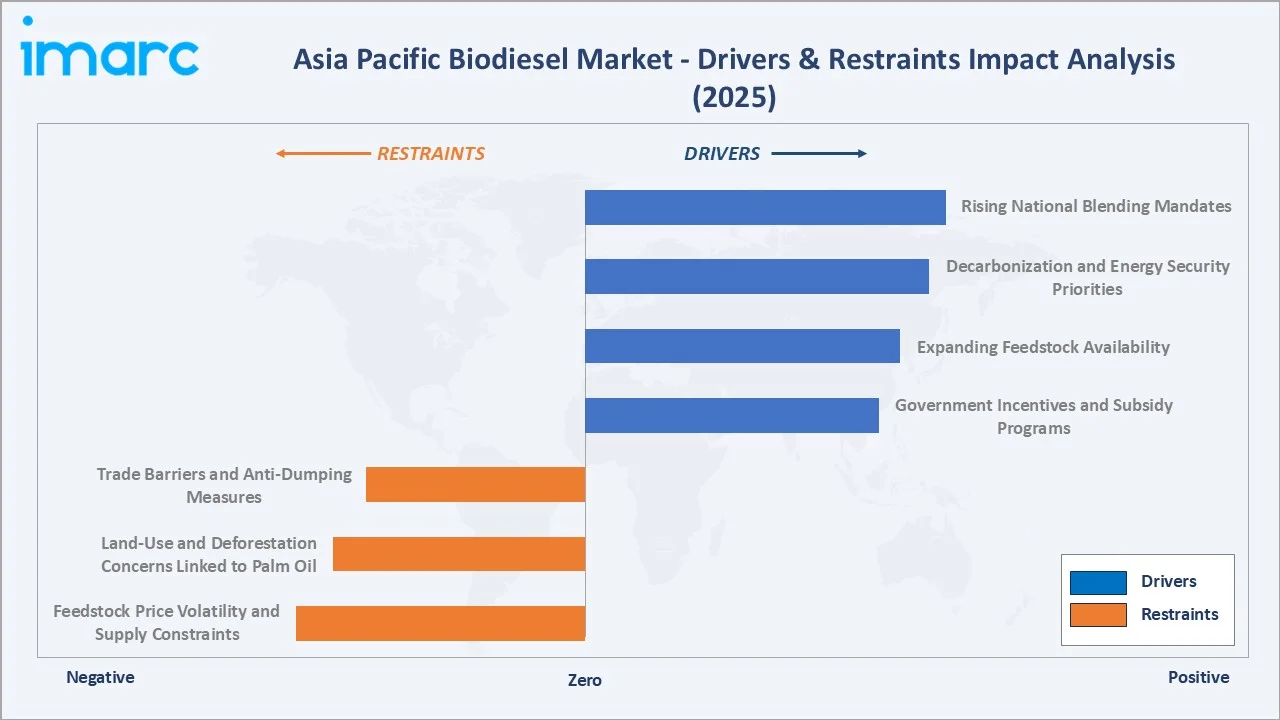
- Rising National Blending Mandates: Governments across the region are progressively raising mandatory blending ratios to reduce diesel imports and strengthen domestic energy security, creating sustained baseline demand for biodiesel producers. As of May 1, 2024, Thailand's B20 mandate required diesel fuel to contain 19-20% biodiesel, significantly boosting local production and blending infrastructure investment.
- Decarbonization and Energy Security Priorities: Growing emphasis on reducing transport-sector emissions and lowering dependence on imported crude oil is encouraging governments to expand biofuel programs and incentivize domestic production capacity.
- Expanding Feedstock Availability: Growth in palm oil output, rising used cooking oil collection networks, and increasing rendering capacity for animal fats are broadening the feedstock base available to producers across the region.
- Government Incentives and Subsidy Programs: Subsidy schemes, tax incentives, and price-support mechanisms in several countries are helping offset feedstock cost volatility and encouraging continued investment in production capacity.
Market Restraints
- Feedstock Price Volatility and Supply Constraints: Fluctuating vegetable oil and animal fat prices, driven by weather variability and competing food-sector demand, create margin pressure and complicate long-term production planning for biodiesel producers.
- Land-Use and Deforestation Concerns Linked to Palm Oil: Sustainability scrutiny of palm oil expansion continues to shape certification requirements and export market access, adding compliance complexity for producers reliant on palm-based feedstock.
- Trade Barriers and Anti-Dumping Measures: Evolving trade policy actions in key export destinations are reshaping regional production and export strategies, requiring producers to diversify their target markets.
Market Opportunities
- Waste-to-Energy Feedstock Expansion: Scaling used cooking oil collection and processing infrastructure presents opportunities for producers to diversify away from vegetable-oil dependence while addressing sustainability concerns.
- Power Generation and Industrial Blending: Rising interest in biodiesel-fueled power generation among utilities and industrial operators is opening new demand channels beyond conventional transport fuel applications.
Market Challenges
- Limited Blending Infrastructure: Uneven distribution and storage infrastructure across smaller markets constrains the pace at which higher blending mandates can be implemented nationwide.
- Competing Feedstock Demand: Vegetable oils and animal fats face parallel demand from food, oleochemical, and other industrial sectors, creating ongoing feedstock allocation pressure for biodiesel producers.
Emerging Market Trends
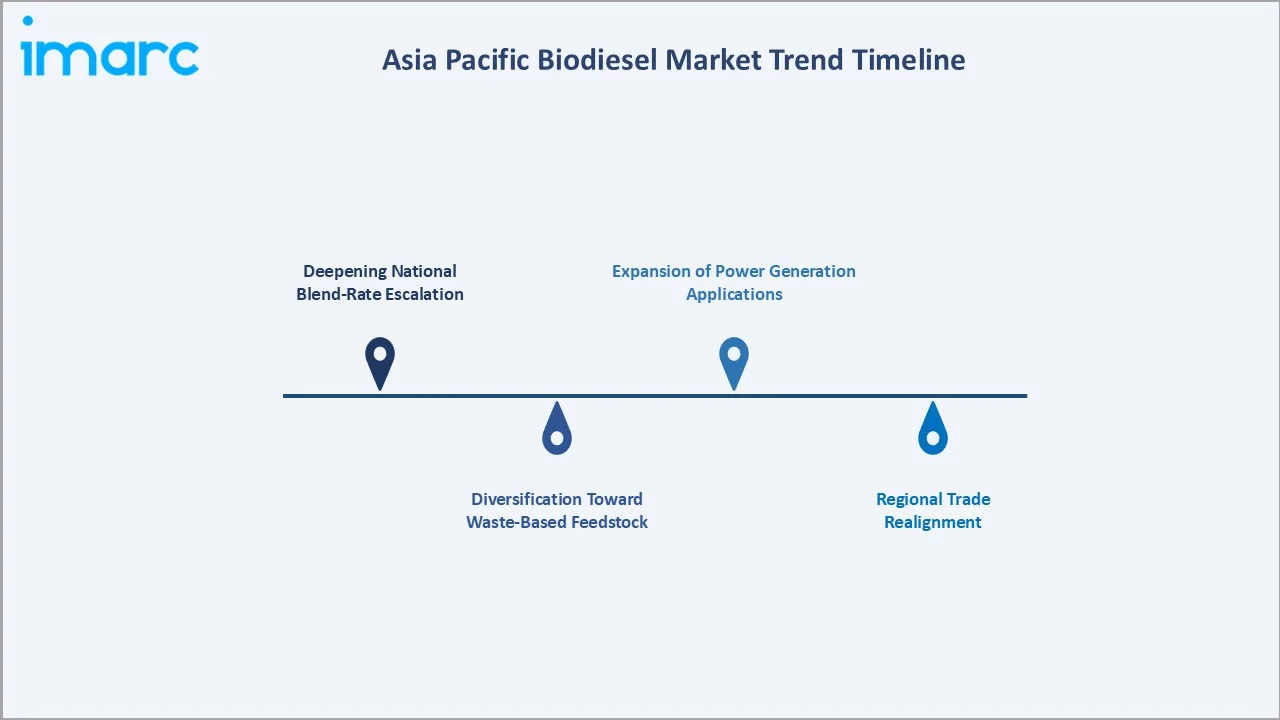
1. Deepening National Blend-Rate Escalation
Countries across the region are progressively raising mandatory blend ratios, moving from single-digit blends toward higher B20 and B40-equivalent targets. India's National Policy on Biofuels (NPB) targets 5% biodiesel blending in diesel by 2030, reflecting the broader regional shift toward structured, phased blend-rate escalation.
2. Diversification Toward Waste-Based Feedstock
Producers are increasingly investing in used cooking oil collection networks and animal-fat processing capacity to reduce reliance on vegetable oils and address sustainability certification requirements from export markets.
3. Expansion of Power Generation Applications
Utilities and industrial operators are piloting biodiesel blends for backup and distributed power generation, supported by emission-reduction targets and growing fuel-flexibility requirements across the region.
4. Regional Trade Realignment
Evolving trade policy actions in key export destinations are prompting producers to redirect volumes toward regional Asia Pacific markets and pursue new bilateral trade partnerships within the region.
Industry Value Chain Analysis
The Asia Pacific biodiesel value chain spans six stages from feedstock sourcing through end-use application. Feedstock sourcing and biodiesel production capture the highest value-add, while blending, distribution, and quality-compliance capabilities increasingly determine sustainable competitive position in this mandate-driven category.
|
Stage |
Key Players / Examples |
|
Feedstock Sourcing |
Palm and soybean oil suppliers, rendering plants, used cooking oil collection networks, and agricultural cooperatives supplying vegetable oils and animal fats |
|
Oil Extraction & Refining |
Crushing and degumming plants, edible oil refiners, and pre-treatment facilities preparing feedstock for conversion |
|
Biodiesel Production |
Transesterification plants, integrated refiners, and dedicated biodiesel producers operating across the region |
|
Blending & Distribution |
Terminal blenders, fuel logistics operators, and bulk storage providers managing distribution to retail and industrial channels |
|
Retail & Fuel Networks |
Fuel retail stations, bulk industrial suppliers, and power generation fuel providers delivering blended fuel to end users |
|
End-Use Application |
Transport fleet operators, industrial users, and power generation utilities consuming blended biodiesel fuel |
Vertically integrated players, particularly those combining feedstock sourcing with in-house processing and distribution capability, are positioned to capture greater value than participants reliant on third-party feedstock supply.
Technology Landscape in the Asia Pacific Biodiesel Industry
Transesterification and Process Efficiency
Producers are adopting improved catalytic transesterification processes and continuous-flow reactor designs to raise conversion efficiency and reduce processing costs across varying feedstock qualities.
Feedstock Diversification and Waste-Processing Technology
Advances in used cooking oil pre-treatment and animal-fat conditioning technology are enabling producers to process lower-quality and more variable feedstock streams without compromising fuel specification standards.
Blending Infrastructure and Quality Monitoring
Investment in automated blending terminals and in-line quality monitoring systems is helping distributors maintain consistent blend ratios and meet evolving national fuel specification requirements as mandated blend levels rise.
Market Segmentation Analysis
The report covers the following segments:
|
Segment Category |
Leading Segment |
Market Share |
Year |
|
Feedstock |
Vegetable Oils |
72.6% |
2025 |
|
Application |
Fuel |
78.4% |
2025 |
|
Type |
🔒 |
🔒 |
2025 |
|
Production Technology |
🔒 |
🔒 |
2025 |
|
Country |
China |
32.8% |
2025 |

By Feedstock
Vegetable oils command a 72.6% majority share in 2025, driven by established palm and soybean oil supply chains, cost-competitive processing economics, and deep integration with the region's edible oil industry. The segment benefits from mature infrastructure and reliable large-scale feedstock availability across Indonesia, Malaysia, and China.
To access detailed market analysis, Request Sample
Animal fats at 17.8% in 2025 are supported by expanding rendering capacity and growing utilization of tallow and other livestock by-products.
By Application
Fuel dominates with 78.4% share in 2025, reflecting the direct link between national diesel-blending mandates and transport-sector fuel demand across the region. The segment remains the default consumption channel given regulatory blend-rate requirements in nearly every major country market.
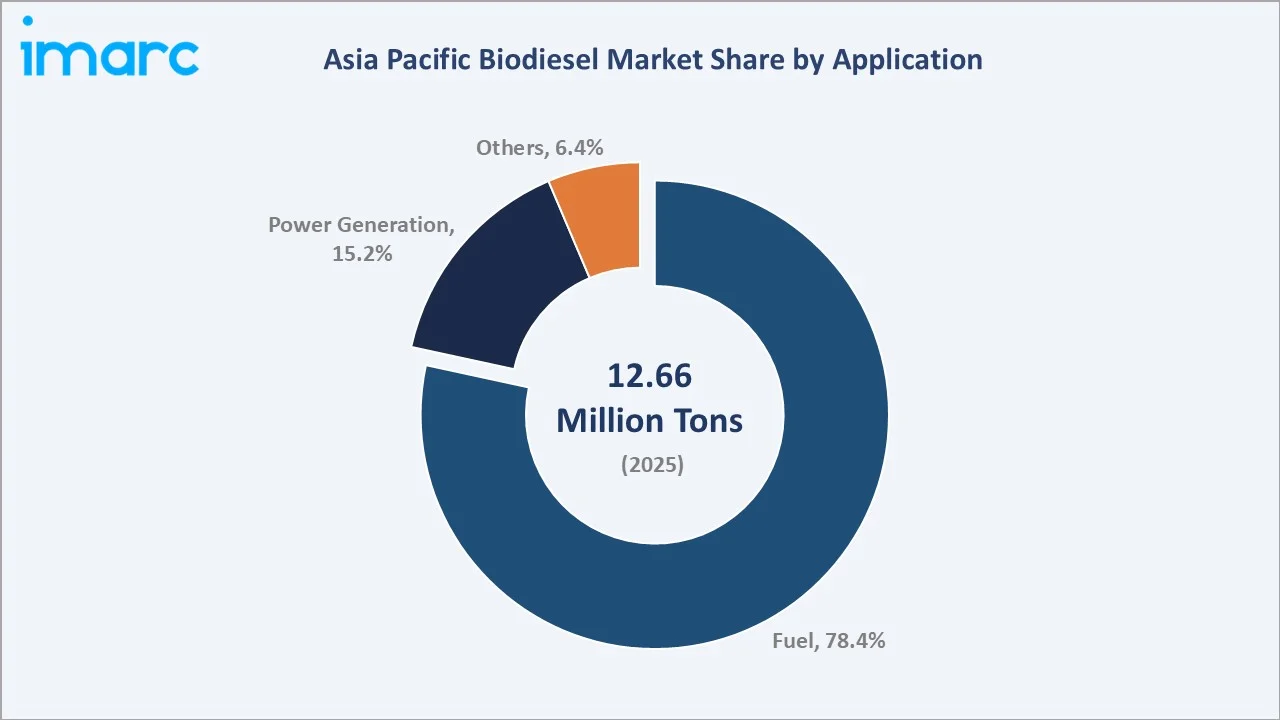
Power generation at 15.2% is expanding through utility and industrial-operator adoption of biodiesel blends for backup and distributed generation.
Regional Market Insights
|
Country |
Share (2025) |
Key Growth Drivers |
|
China |
32.8% |
Large-scale refining capacity, extensive used cooking oil collection networks, and strong domestic energy security priorities |
|
Indonesia |
18.6% |
Abundant palm oil feedstock, aggressive national blending mandates, and integrated production and export infrastructure |
|
India |
16.9% |
Expanding waste-oil collection programs, rising diesel demand, and phased national blending-mandate escalation |
|
Japan |
11.4% |
Established fuel-quality standards, growing import reliance, and steady industrial and power generation demand |
|
South Korea |
8.7% |
Government-backed renewable fuel targets and expanding industrial blending infrastructure |
|
Australia |
5.8% |
Growing feedstock processing investment and emerging state-level renewable fuel incentive programs |
|
Others |
5.8% |
Gradual policy development and emerging feedstock processing capacity across smaller regional markets |
China at 32.8% in 2025 leads the country landscape, anchored by extensive used cooking oil collection infrastructure, large-scale refining capacity, and a growing export orientation toward global renewable fuel markets. The country's scale advantages and integrated feedstock-to-production capability support sustained leadership across both domestic and export-oriented volumes.
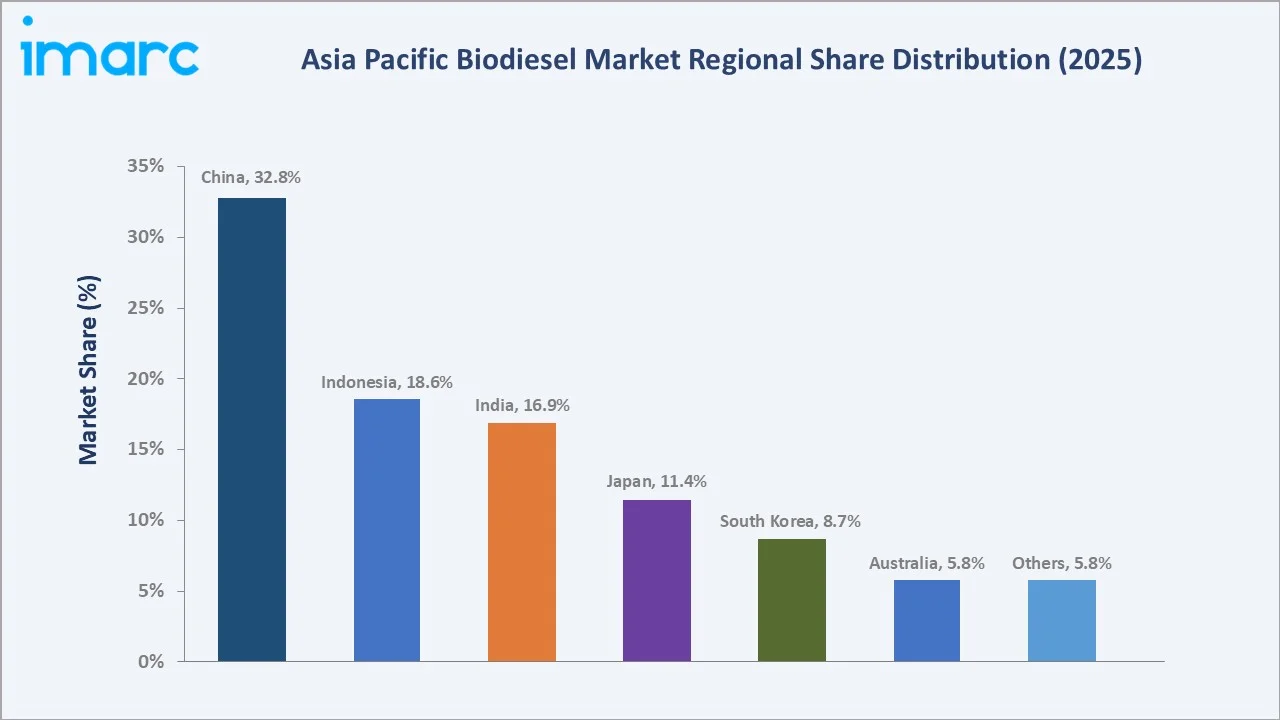
India at 16.9% is among the fastest growing countries, anchored by rapid expansion of used cooking oil collection programs, rising diesel demand, and phased escalation of national blending mandates. These dynamics represent significant untapped opportunity for producers able to scale feedstock aggregation and processing capacity.
Competitive Landscape
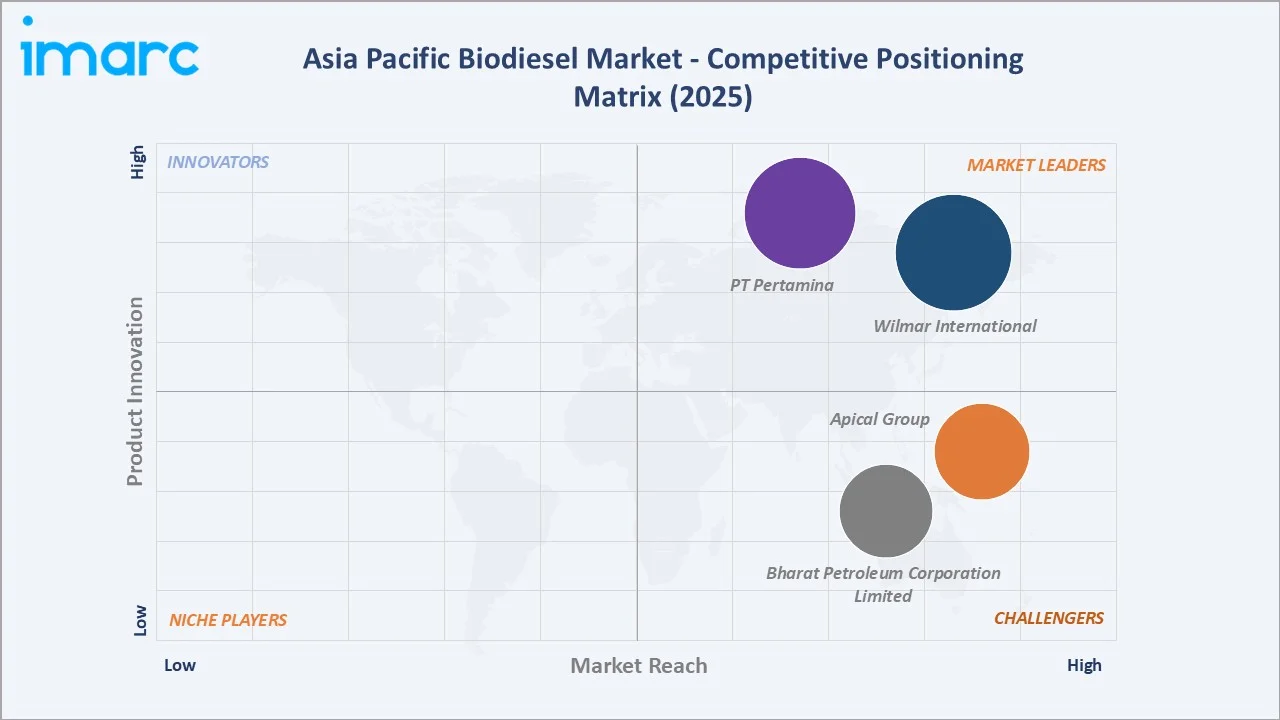
The Asia Pacific biodiesel market is moderately fragmented, with large integrated agribusiness and energy companies leading production scale while regional and state-linked operators compete on feedstock access and domestic market presence. Feedstock integration, refining scale, and regulatory relationships form the key competitive moats across the region.
|
Company Name |
Brand / Key Product |
Position |
Strategic Focus |
|
Wilmar International |
Wilmarin |
Leader |
Palm oil-integrated biodiesel producer with regional processing scale |
|
PT Pertamina |
Biosolar B40 (via Pertamina Patra Niaga) |
Leader |
State-integrated producer scaling domestic blending mandate compliance |
|
Apical Group |
Apical Biodiesel |
Challenger |
Palm oil-integrated producer and Indonesia's second-largest biodiesel exporter |
|
Bharat Petroleum Corporation Limited |
UCO-Based Biodiesel |
Challenger |
State-linked refiner expanding domestic blending and UCO co-processing capability |
Key players include Wilmar International, PT Pertamina, Apical Group, and Bharat Petroleum Corporation Limited, among others.
Key Company Profiles
Wilmar International
Wilmar International is a Singapore-headquartered agribusiness group and the world's leading producer of palm-based biodiesel, with integrated refining and biodiesel operations in Malaysia and Indonesia.
- Product Portfolio: Palm oil-based biodiesel produced through the company's integrated refining network, supplying both domestic blending programs and export markets.
- Recent Developments: The company continues to strengthen its integrated palm oil and biodiesel operations across Asia Pacific, supported by rising regional demand for renewable fuels and national blending programs.
- Strategic Focus: Scaling integrated palm oil-to-biodiesel production capacity and expanding presence across regional blending programs.
PT Pertamina
PT Pertamina is Indonesia's state-owned integrated energy company. Its downstream fuel subsidiary, Pertamina Patra Niaga, produces and distributes palm-based biodiesel blends in compliance with Indonesia's national mandate.
- Product Portfolio: Palm oil-based biodiesel blends distributed through Pertamina Patra Niaga's nationwide retail and industrial fuel network.
- Recent Developments: The company continues to scale blending infrastructure and product offerings to support Indonesia's national biodiesel mandate.
- Strategic Focus: Supporting national energy security priorities through integrated feedstock sourcing, refining, and nationwide blending mandate compliance.
Bharat Petroleum Corporation Limited
Bharat Petroleum Corporation Limited is an Indian state-linked oil marketing company that procures and blends used cooking oil-based biodiesel through joint industry tenders with fellow oil marketing companies.
- Product Portfolio: Biodiesel blends distributed through the company's nationwide fuel retail and industrial supply network, sourced via joint oil-marketing-company procurement tenders.
- Recent Developments: The company continues to expand its feedstock sourcing and blending capability in line with national biofuel policy targets.
- Strategic Focus: Scaling domestic feedstock aggregation and blending infrastructure to support national biofuel policy compliance.
Market Concentration Analysis
The Asia Pacific biodiesel market is moderately concentrated, with a handful of large integrated agribusiness and energy companies, including Wilmar International and PT Pertamina, accounting for a substantial share of regional production capacity through feedstock-integrated operations.
Barriers to entry include the capital intensity of large-scale refining infrastructure, the need for reliable feedstock aggregation networks, and the ability to navigate evolving national blending mandate and sustainability certification requirements. These factors favor well-capitalized incumbents with established feedstock supply relationships and diversified production bases.
Consolidation is gradually advancing as larger operators acquire feedstock aggregation networks and processing assets to secure supply chain control. Strategic partnerships between producers, fuel distributors, and government energy agencies are further reinforcing competitive positioning across the region's mandate-driven segments.
Investment & Growth Opportunities
Fastest-Growing Segments
Animal fats expand fastest within the feedstock segment, driven by growing rendering capacity and increasing utilization of tallow and other livestock by-products as producers diversify beyond vegetable oils. Power generation is the next-fastest application, supported by expanding utility and industrial-operator adoption of biodiesel blends.
Emerging Markets
India is the fastest growing country, anchored by rapid expansion of used cooking oil collection programs, rising diesel demand, and phased escalation of national blending mandates. The market represents significant untapped opportunity for producers able to scale feedstock aggregation and localized processing capacity.
Venture & Investment Trends
Investment is concentrated in feedstock aggregation infrastructure, waste-oil processing technology, and blending terminal capacity expansion. Capital is also flowing toward sustainability certification programs that support continued export market access for regional producers.
Future Market Outlook (2026-2034)
The Asia Pacific biodiesel market is forecast to expand from 12.66 Million Tons in 2025 to 20.41 Million Tons by 2034 at a CAGR of 5.18%, adding roughly 7.75 Million Tons in incremental annual market volume over the forecast period.
Three forces will shape the market through 2034: progressively escalating national blending mandates; deeper integration of waste-based and diversified feedstock streams; and the gradual expansion of biodiesel applications beyond transport fuel into power generation and industrial use.
By 2034, the Asia Pacific biodiesel market is expected to be defined by mandate-anchored production growth, with feedstock diversification and power generation applications collectively accounting for a meaningfully higher share of overall activity. Regulatory escalation, sustainability certification, and expanding blending infrastructure are expected to further accelerate the evolution of a mature, integrated regional biodiesel ecosystem.
Research Methodology
Primary Research
Primary research included structured interviews with biodiesel producers, feedstock suppliers, fuel distributors, regulatory specialists, and industry association representatives, validating market sizing, feedstock mix, and country-level demand evolution.
Secondary Research
Secondary sources included national energy ministry publications, biofuel blending mandate notifications, trade and customs data, and annual reports, press releases, and investor presentations from listed producers across the region.
Forecasting Models
Market forecasts used top-down and bottom-up models combining national blending mandate trajectories, feedstock availability projections, production capacity data, and macroeconomic variables. Scenario analysis addressed regulatory pace, feedstock price volatility, and trade policy developments.
Report Coverage:
| Report Features | Details |
|---|---|
| Base Year of the Analysis | 2025 |
| Historical Period | 2020-2025 |
| Forecast Period | 2026-2034 |
| Units | Million Tons |
| Scope of the Report | Exploration of Historical Trends and Market Outlook, Industry Catalysts and Challenges, Segment-Wise Historical and Future Market Assessment:
|
| Feedstocks Covered | Vegetable Oils, Animal Fats, Others |
| Applications Covered | Fuel, Power Generation, Others |
| Types Covered | B100, B20, B10, B5 |
| Production Technologies Covered | Conventional Alcohol Trans-esterification, Pyrolysis, Hydro Heating |
| Countries Covered | China, India, Japan, Australia, South Korea, Indonesia, Others |
| Companies Covered | Wilmar International, PT Pertamina, Apical Group, Bharat Petroleum Corporation Limited, etc. |
| Customization Scope | 10% Free Customization |
| Post-Sale Analyst Support | 10-12 Weeks |
| Delivery Format | PDF and Excel through Email (We can also provide the editable version of the report in PPT/Word format on special request) |
Frequently Asked Questions About the Asia Pacific Biodiesel Market Report
The Asia Pacific biodiesel market reached a volume of 12.66 Million Tons in 2025, driven by rising national blending mandates, expanding feedstock availability, and growing energy security priorities.
The market is projected to grow at a CAGR of 5.18% from 2026-2034, reaching 20.41 Million Tons, supported by escalating blending mandates and feedstock diversification.
Vegetable oils lead at 72.6% in 2025, driven by established palm and soybean oil supply chains and deep integration with the region's edible oil processing industry.
Fuel dominates at 78.4% in 2025, reflecting the direct link between national diesel-blending mandates and transport-sector fuel demand across the region.
China commands 32.8% share in 2025, led by large-scale refining capacity and extensive used cooking oil collection networks.
India, with 16.9% share in 2025, is among the fastest growing countries, supported by phased national blending mandate escalation.
Leading players include Wilmar International, PT Pertamina, Apical Group, and Bharat Petroleum Corporation Limited, among others.
Escalating national blending mandates are setting a rising demand floor, prompting producers to expand refining and feedstock aggregation capacity across the region.
Growing used cooking oil and animal-fat processing capacity is reducing reliance on vegetable oils and helping producers meet sustainability certification requirements.
Need more help?
- Speak to our experienced analysts for insights on the current market scenarios.
- Include additional segments and countries to customize the report as per your requirement.
- Gain an unparalleled competitive advantage in your domain by understanding how to utilize the report and positively impacting your operations and revenue.
- For further assistance, please connect with our analysts.
 Request Customization
 Speak to an Analyst
 Request Brochure
 Inquire Before Buying
Benefits of Customization
- Personalize this research
- Triangulate with your data
- Get data as per your format and definition
- Gain a deeper dive into a specific application, geography, customer, or competitor
- Any level of personalization
Get in Touch With Us
UNITED STATES
Phone: +1-201-971-6302
INDIA
Phone: +91-120-433-0800
UNITED KINGDOM
Phone: +44-753-714-6104
Email: [email protected]
Client Testimonials




.webp)




.webp)













Related Reports

Choose your plan
*Please note that the prices mentioned below are starting prices for each bundle type. Kindly contact our team for further details.*
Single User License
- 1 User License, Access on 2 Devices
- PDF Report + Excel Dataset (Password Protected)
- Lifetime Access
- No Printing Rights
- 10% Free Report Customization
- 10–12 Weeks of Analyst Support
Five User License
- Access for 5 Users, 2 Devices per User
- PDF Report + Excel Dataset (Password Protected)
- Lifetime Access
- Dedicated Account Manager
- 12–14 Weeks of Analyst Support
- No Printing Rights
- 15% Free Report Customization
- 25% Discount on Your Next Purchase
Corporate User License
- Unlimited User Access (Within Your Organization)
- PDF Report + Excel Dataset
- Lifetime Access
- Dedicated Account Manager
- 14–20 Weeks of Analyst Support
- No Printing Rights
- 20% Free Report Customization
- 30% Discount on Your Next Purchase
Essential Insights
What's included:
3 reports
- Lifetime Access
- PDF Reports
- Excel Datasets
- 2 Weeks of Free Analyst Support
- 2 User Licenses
- Access on 2 Devices
- Printing Rights
- Complimentary PowerPoint (PPT) Version
- Complimentary License Upgrade
Professional Access
What's included:
5 reports
- Lifetime Access
- PDF Reports
- Excel Datasets
- 8 Weeks of Free Analyst Support
- 2 User Licenses
- Access on 2 Devices
- Printing Rights
- Complimentary PowerPoint (PPT) Version
- Complimentary License Upgrade
Business Advantage
What's included:
8 reports
- Lifetime Access
- PDF Reports
- Excel Datasets
- 14 Weeks of Free Analyst Support
- 2 User Licenses
- Access on 2 Devices
- Printing Rights
- Complimentary PowerPoint (PPT) Version
- Complimentary License Upgrade
Enterprise Intelligence
What's included:
10 reports
- Lifetime Access
- PDF Reports
- Excel Datasets
- 20 Weeks of Free Analyst Support
- 2 User Licenses
- Access on 2 Devices
- Printing Rights
- Complimentary PowerPoint (PPT) Version
- Complimentary License Upgrade