
Asia Pacific Green Cement Market Size, Share, Trends and Forecast by Product Type, End Use Industry, and Country, 2026-2034
Asia Pacific Green Cement Market Size, Share, Trends & Forecast (2026-2034)
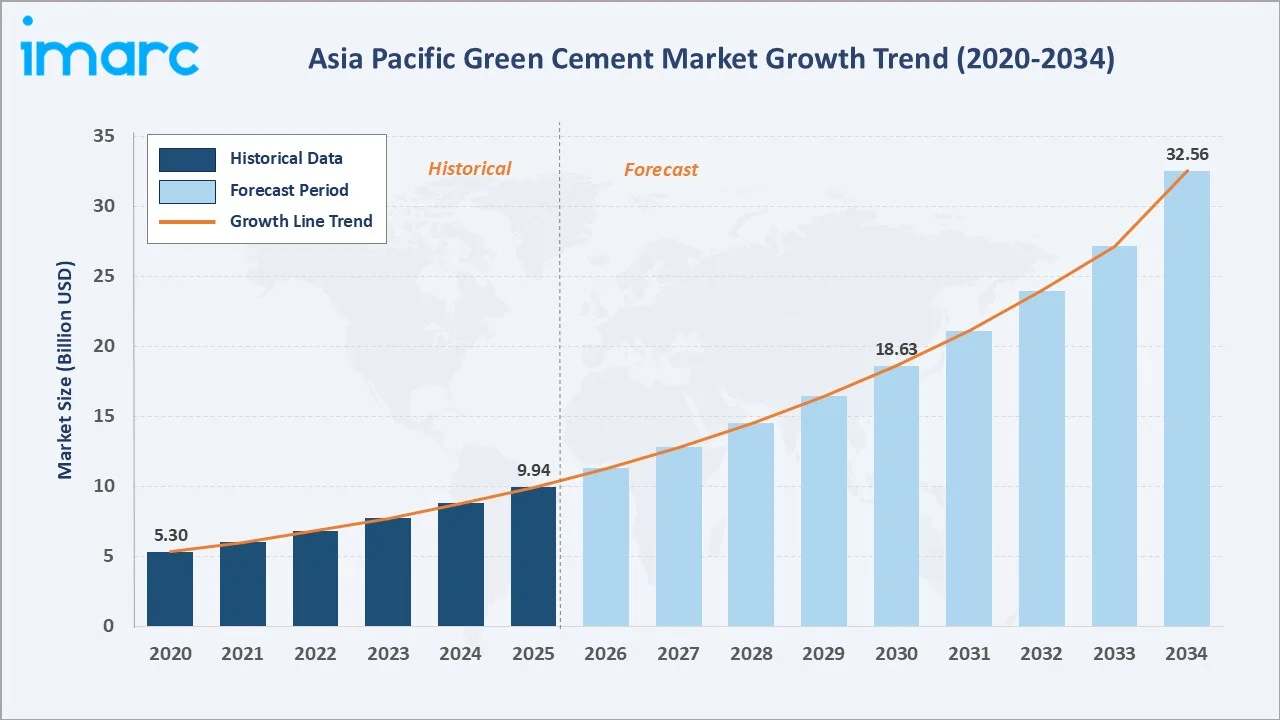
The Asia Pacific green cement market reached USD 9.94 Billion in 2025 and is projected to reach USD 32.56 Billion by 2034, exhibiting a growth rate (CAGR) of 13.39% during 2026-2034. The market is driven by rapid urbanization and stringent government regulations promoting sustainable construction, alongside growing awareness of carbon emission reduction and the cost-effectiveness of industrial waste-based cement formulations.
Fly Ash-Based cement dominates the product type segment at 34.7% in 2025, reflecting its wide availability as a coal combustion byproduct and superior pozzolanic properties. Residential construction leads at 38.6%, underpinned by expanding green building certification mandates across the asia pacific cement market. China leads regionally at 35.8%, anchored by its massive construction sector and government-mandated carbon neutrality targets.
Market Snapshot
|
Metric |
Value |
|
Market Size (2025) |
USD 9.94 Billion |
|
Forecast Market Size (2034) |
USD 32.56 Billion |
|
CAGR (2026-2034) |
13.39% |
|
Base Year |
2025 |
|
Historical Period |
2020-2025 |
|
Forecast Period |
2026-2034 |
|
Dominant Product Type |
Fly Ash-Based (34.7%, 2025) |
|
Dominant End Use Industry |
Residential (38.6%, 2025) |
|
Leading Country |
China (35.8%, 2025) |
The market expanded from an estimated USD 5.30 Billion in 2020 to USD 9.94 Billion in 2025, driven by rising government focus on sustainable infrastructure and the increasing incorporation of supplementary cementitious materials. The market is anchored at an estimated USD 18.63 Billion in 2030 and is forecast to reach USD 32.56 Billion by 2034, with growth accelerating as clinker-free blends gain wider regulatory acceptance.
To get more information on this market, Request Sample
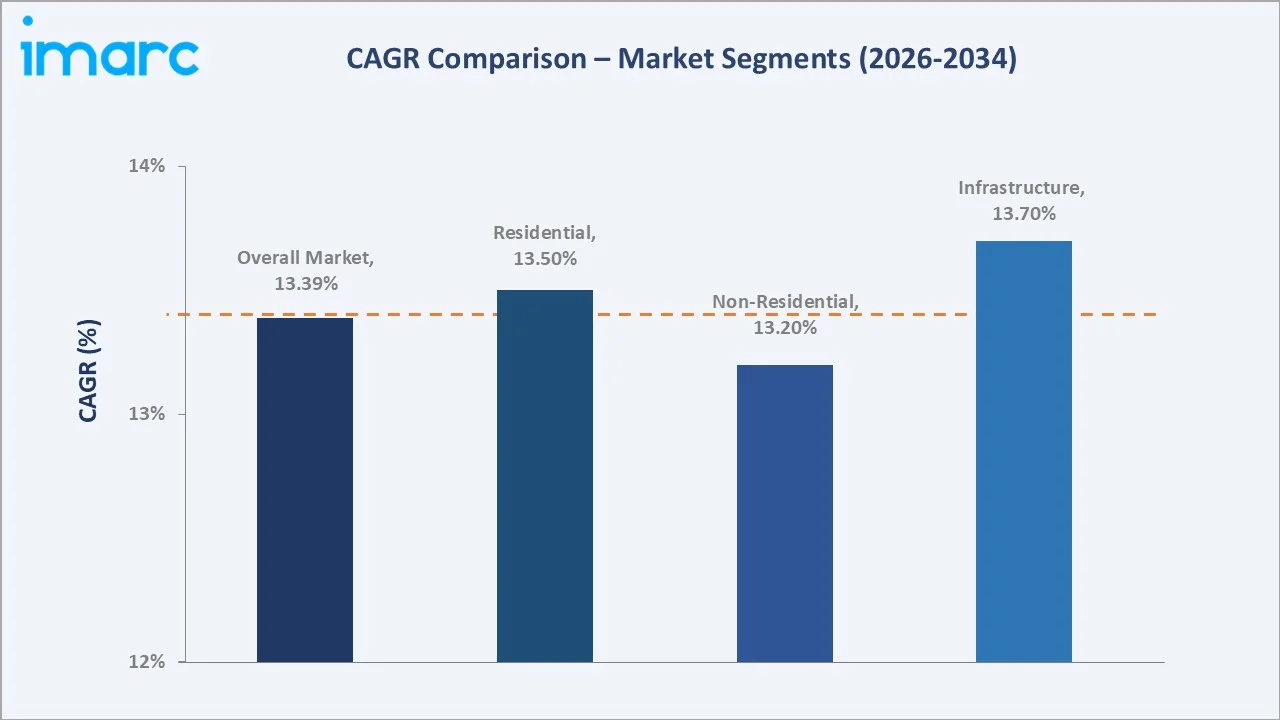
Fly Ash-Based and Silica Fume-Based variants are set to grow fastest through 2034, outpacing the overall market CAGR of 13.39% as low-carbon regulatory targets tighten. Infrastructure-directed green cement also grows above the market average as governments accelerate public works programs mandating sustainable materials across the asia pacific cement market.
Executive Summary
The Asia Pacific green cement market reached USD 9.94 Billion in 2025, representing one of the world's most dynamic sustainable construction materials markets, underpinned by the region's massive infrastructure pipeline and increasingly stringent carbon regulations. Green cement serves as a cornerstone material in the region's transition to low-carbon construction. The market is projected to reach USD 32.56 Billion by 2034.
Fly Ash-Based cement at 34.7% dominates by leveraging abundant coal combustion byproduct availability and proven performance across China, India, and Southeast Asia. Residential construction at 38.6% leads end use demand through expanding green building certification programs. China at 35.8% leads nationally through its world's-largest construction sector, government-mandated sustainability targets, and deep fly ash and slag industrial supply chains.
Key Market Insights
|
Insight |
Data |
|
Dominant Product Type |
Fly Ash-Based – 34.7% share (2025) |
|
Dominant End Use Industry |
Residential – 38.6% share (2025) |
|
Leading Country |
China – 35.8% share (2025) |
|
Market Opportunity |
LC3 cement adoption; carbon capture integration; green building certification-driven procurement; infrastructure-grade slag cement expansion |
Key Analytical Observations Supporting the Above Data:
- Fly Ash-Based at 34.7%: This segment dominates as fly ash is the most widely available and cost-effective supplementary cementitious material across China, India, and Southeast Asia, enabling large-scale clinker substitution in infrastructure and residential concrete applications. Its wide availability from coal power generation and superior pozzolanic performance reinforce segment dominance, while expanding thermal power capacity in developing APAC markets continues to broaden supply.
- Residential at 38.6%: The residential segment leads through expanding green building codes and growing homeowner and developer awareness of sustainable materials in China and India, where urbanization drives massive new housing construction incorporating low-carbon cement. Government-backed housing programs increasingly mandate blended cement specifications, creating sustained procurement growth across both mass-market and premium residential development tiers.
- China at 35.8%: China dominates through its world-leading construction sector, government-mandated carbon neutrality pathway, and abundant industrial byproduct supply chains generating fly ash and slag at massive scale. National policies including mandatory clinker substitution targets and green building certification standards in public infrastructure projects further concentrate market volume within the country through the forecast period.
Asia Pacific Green Cement Market Overview
The Asia Pacific green cement market encompasses the design, manufacture, and distribution of sustainable cement formulations utilizing industrial waste materials such as fly ash, blast furnace slag, silica fume, and limestone calcined clay to reduce clinker content and minimize carbon emissions. Products range from mass-market fly ash and slag blends for infrastructure applications to premium low-carbon formulations for green building certification compliance.
The ecosystem integrates raw material and industrial byproduct suppliers, cement manufacturers and blending plants, certification bodies, distributors, and construction project buyers across residential, non-residential, and infrastructure end use segments. Regulatory frameworks and national green building standards across China, India, Japan, South Korea, and Southeast Asia shape market adoption and product development priorities.
Market Dynamics
To evaluate market opportunities, Request Sample
Market Drivers
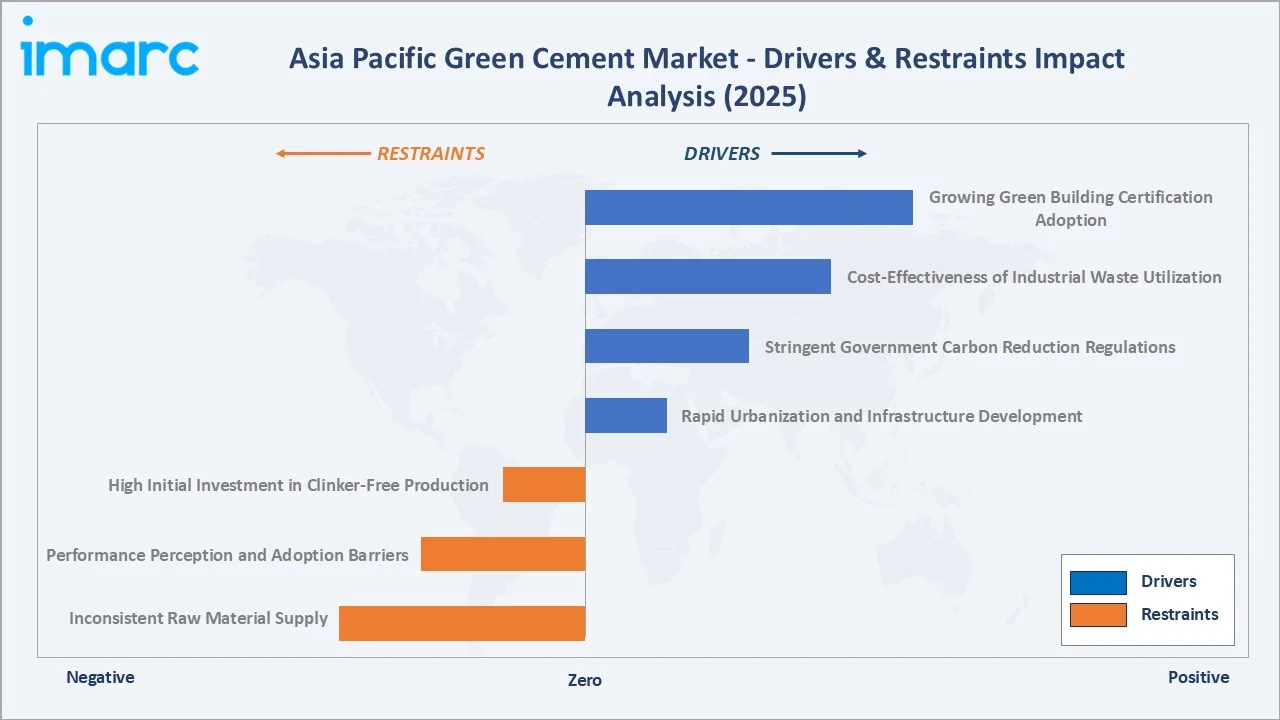
- Rapid Urbanization and Infrastructure Development: Asia Pacific's sustained urban population growth is generating unprecedented demand for construction materials across residential housing, commercial buildings, and public infrastructure, creating structural demand for green cement as governments mandate sustainable procurement standards. Government investment in national infrastructure programs across China, India, and Indonesia is directly mandating sustainable material specifications in public project procurement frameworks. The resulting construction pipeline is expected to absorb increasing volumes of fly ash-based and slag-based cement formulations through the forecast period.
- Stringent Government Carbon Reduction Regulations: National carbon neutrality commitments across China, Japan, South Korea, and India have introduced binding regulations requiring reduced clinker content in construction cement, directly stimulating green cement adoption across the region's largest construction markets. Emission trading schemes and green procurement mandates are compelling both public and private project developers to specify certified low-carbon cement products. Regulatory timelines are accelerating the commercial transition from ordinary Portland cement toward supplementary cementitious material-based alternatives.
- Cost-Effectiveness of Industrial Waste Utilization: Fly ash, blast furnace slag, and silica fume are available as industrial byproducts at minimal cost, enabling green cement producers to reduce production costs while meeting performance specifications for residential and infrastructure applications. The proximity of fly ash and slag supply chains to major cement production hubs in China and India further lowers logistics costs, reinforcing the economic competitiveness of green cement. This cost advantage is widening as carbon pricing mechanisms impose additional costs on high-clinker cement manufacturing.
- Growing Green Building Certification Adoption: Expanding LEED, BREEAM, and national green building rating systems mandate the use of low-carbon construction materials, creating contractual demand for green cement formulations across high-value commercial and residential development projects. Developer commitments to sustainability ratings in commercial office, hospitality, and mixed-use sectors translate into binding green cement procurement requirements at the project specification stage. The proliferation of certification schemes across APAC markets is broadening the addressable demand base for certified green cement products.
Market Restraints
- Inconsistent Raw Material Supply: The availability of fly ash, slag, and silica fume depends on industrial production cycles in power generation and steel manufacturing, creating supply variability that can constrain green cement production capacity and regional distribution. Thermal power phase-down programs across several APAC markets are expected to reduce fly ash availability over the medium term, increasing pressure on producers to develop alternative supplementary cementitious material strategies. This structural supply challenge is driving investment in LC3 technology as a more geographically distributed raw material alternative.
- Performance Perception and Adoption Barriers: Widespread misconceptions about the structural performance of supplementary cementitious material-based cements relative to traditional Portland cement continue to slow adoption among conservative contractors, project developers, and structural engineers across APAC markets. Resistance from established procurement practices and lack of standardized regional testing protocols for green cement performance create additional adoption friction beyond initial cost considerations. Industry education initiatives and third-party performance certification are gradually addressing these perceptions, but market penetration in cost-sensitive tiers remains constrained.
- High Initial Investment in Clinker-Free Production: Transitioning existing cement plants to produce slag-based or LC3 formulations requires substantial capital investment in specialized processing equipment, blending infrastructure, and quality control systems, creating adoption barriers for smaller regional producers. The capital intensity of clinker-free production technology limits market entry and expansion for mid-tier manufacturers lacking access to project financing or technology licensing partnerships. Green cement capacity expansion thus remains concentrated among large, vertically integrated producers with the balance sheet capacity to fund multi-year transition programs.
Market Opportunities
- LC3 and Next-Generation Clinker-Free Cement: Limestone Calcined Clay Cement (LC3) technology offers a transformative low-cost, low-carbon alternative applicable to regions with limited fly ash or slag availability, representing a major emerging opportunity across South and Southeast Asian markets. LC3 reduces clinker content by up to 50% using widely available kaolinite clay and limestone, enabling producers to achieve substantial carbon reductions without dependence on industrial byproduct supply chains. The scalability of LC3 across diverse geological contexts positions it as the region's most strategically versatile green cement technology.
- Carbon Capture and Utilization Integration: The integration of carbon capture and utilization (CCU) technologies in green cement production presents a significant opportunity to achieve net-negative emissions certification and command premium pricing in regulated markets across Asia Pacific. Producers who successfully deploy CCU capabilities will gain preferred supplier status in government-mandated net-zero infrastructure procurement programs, creating durable competitive differentiation. Growing regulatory expectations around scope 1 and scope 2 emission disclosures from construction project developers are expected to rapidly expand the addressable market for CCU-certified green cement.
Market Challenges
- Regulatory Fragmentation Across Markets: Differing national standards for supplementary cementitious material content, carbon certification requirements, and green building specifications across APAC countries create compliance complexity for manufacturers seeking to operate across multiple regional markets simultaneously. Producers are required to maintain parallel product certification programs for each major country market, adding operational overhead that disadvantages smaller and regionally focused producers relative to multinational conglomerates. Harmonization of regional green cement standards remains incomplete through the near-term forecast horizon.
- Price Competition from Traditional Cement: Persistent pricing pressure from conventional Portland cement producers, particularly in cost-sensitive emerging markets including Indonesia, Vietnam, and the Philippines, limits green cement's price premium and constrains margins for producers investing in sustainable formulation development. The lack of universal carbon pricing mechanisms across APAC markets means that the environmental cost savings of green cement are not consistently reflected in price signals that would incentivize end-user switching. Producers must rely on regulatory mandates and certification requirements rather than market price signals alone to drive volume adoption.
Emerging Market Trends
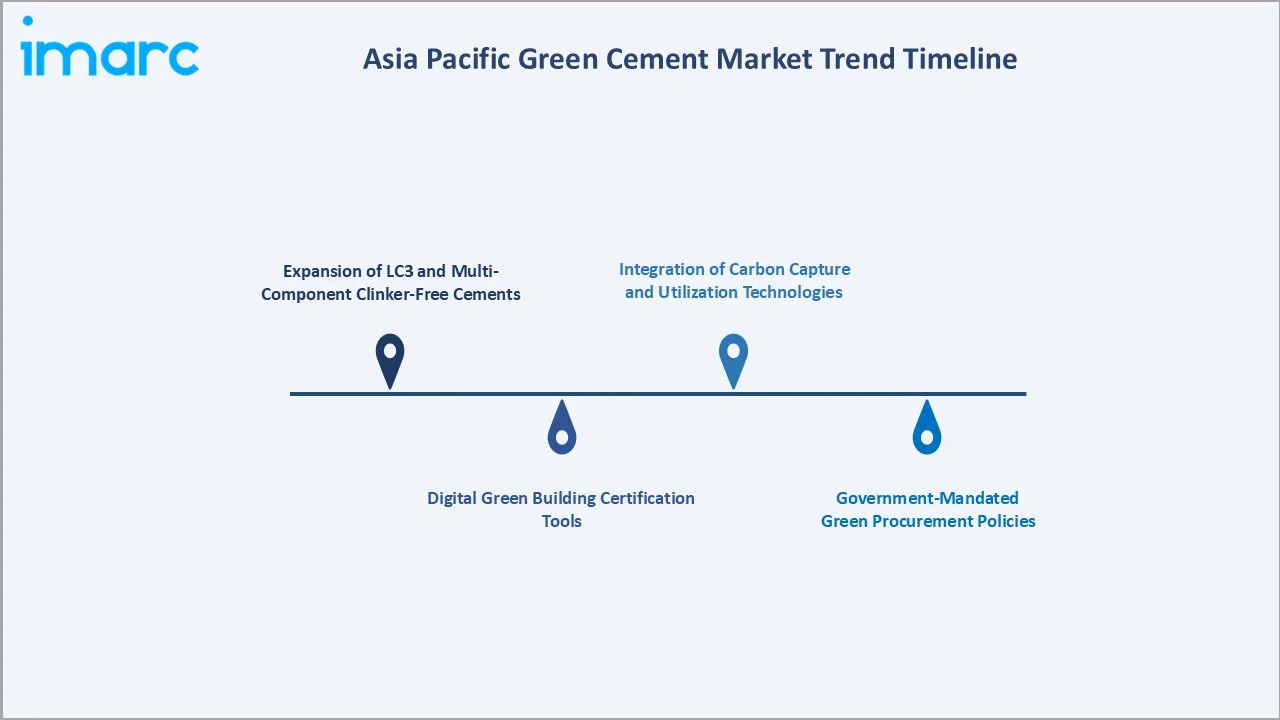
1. Expansion of LC3 and Multi-Component Clinker-Free Cements
Limestone Calcined Clay Cement is gaining significant traction across India and Southeast Asia as a low-cost, low-carbon alternative that reduces clinker content by up to 50% without requiring fly ash or slag availability, making it applicable across geographies with limited industrial byproduct supply chains. The scalability and geological versatility of LC3 are driving both research investment and pilot commercialization across multiple APAC markets.
2. Integration of Carbon Capture and Utilization Technologies
Leading producers are integrating CCU technologies into cement manufacturing, injecting captured CO2 into concrete mixes or mineralizing it within cement formulations to achieve net-negative carbon certification, a capability increasingly required under evolving Asia Pacific green procurement standards. These technologies represent the frontier of sustainable cement innovation and are expected to achieve broader commercial deployment through the forecast period.
3. Digital Green Building Certification Tools
Digital platforms enabling real-time carbon tracking and green building compliance verification for cement procurement are emerging across the region, with companies such as ACC Limited launching dedicated mobile applications to accelerate mainstream adoption among contractors and developers. These tools are reducing the information asymmetry that has historically slowed green cement specification among smaller project developers.
4. Government-Mandated Green Procurement Policies
National infrastructure agencies across China, India, and South Korea are increasingly mandating certified green cement in government-funded construction projects, creating binding procurement-driven demand that accelerates adoption of fly ash-based and slag-based cement. These policies establish minimum supplementary cementitious material content thresholds for public contracts, directly expanding the addressable green cement market in infrastructure-heavy budget cycles.
Industry Value Chain Analysis
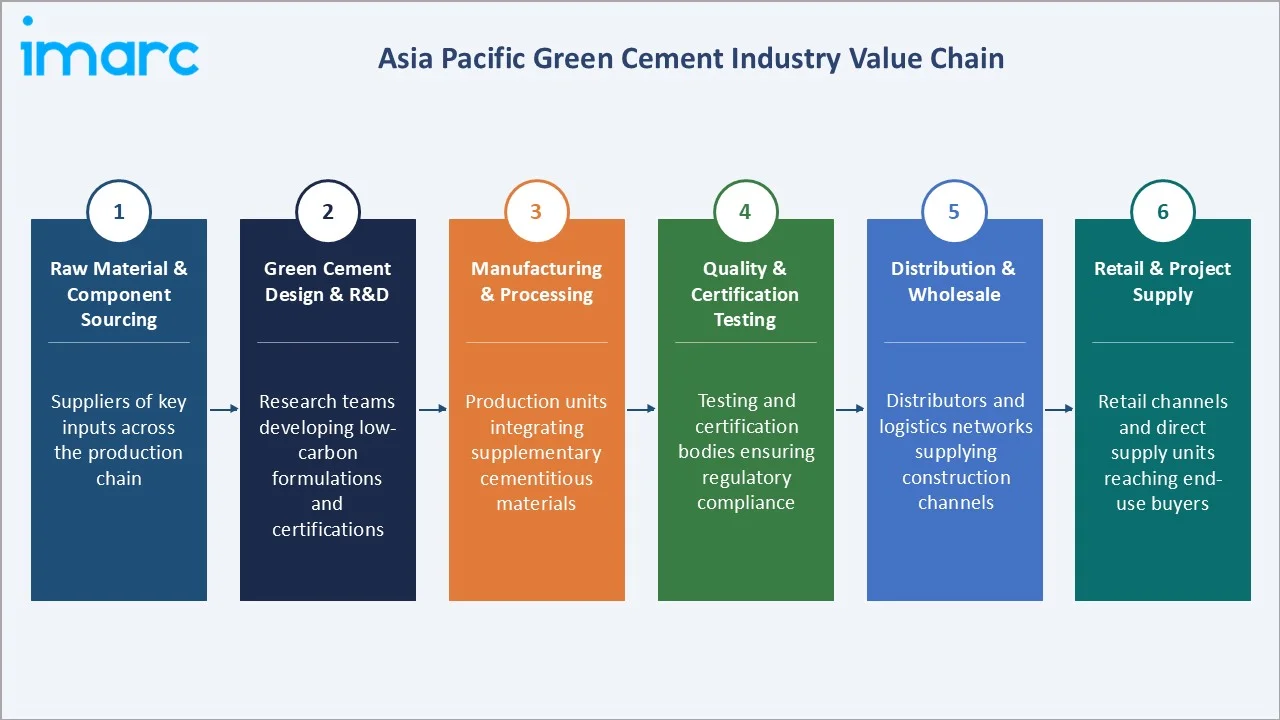
The Asia Pacific green cement value chain spans industrial byproduct raw material sourcing, green formulation design and certification, manufacturing and blending, quality and compliance testing, distribution and logistics, and retail and project supply, with sustainability credentials embedded at every stage of the production and delivery process.
|
Stage |
Key Participants |
|
Raw Material & Component Sourcing |
Suppliers of key inputs across the production chain |
|
Green Cement Design & R&D |
Research teams developing low-carbon formulations and certifications |
|
Manufacturing & Processing |
Production units integrating supplementary cementitious materials |
|
Quality & Certification Testing |
Testing and certification bodies ensuring regulatory compliance |
|
Distribution & Wholesale |
Distributors and logistics networks supplying construction channels |
|
Retail & Project Supply |
Retail channels and direct supply units reaching end-use buyers |
The manufacturing and processing stage is the value chain's most capital-intensive tier, requiring specialized blending equipment and clinker-reduction technology to produce certified green cement at commercial scale. The quality and certification testing stage is equally critical, as national and international green building standards require third-party verification of carbon content and structural performance compliance across all product types.
Technology Landscape in the Asia Pacific Green Cement Industry
Supplementary Cementitious Material (SCM) Blending Technology
Advanced SCM blending systems enable precise proportioning of fly ash, slag, silica fume, and limestone at commercial scale, reducing clinker-to-cement ratios by 30–60% while maintaining structural performance specifications. This technology underpins the dominant fly ash-based and slag-based product segments and is well-established across major Asia Pacific production facilities.
Limestone Calcined Clay Cement (LC3) Production
LC3 technology calcines low-grade kaolinite clay at moderate temperatures and blends it with limestone to replace up to 50% of clinker content, producing a cement with significantly lower embodied carbon that does not depend on fly ash or slag availability. Its applicability across diverse geological contexts is expanding green cement reach into geographies previously constrained by industrial byproduct supply chain limitations.
Carbon Capture and Utilization in Cement Manufacturing
Emerging CCU technologies, including direct CO2 injection into concrete mixes and mineral carbonation within cement formulations, are enabling cement producers to achieve net-negative carbon certifications increasingly required under evolving Asia Pacific green procurement standards. These technologies represent the frontier of sustainable cement innovation and are expected to achieve broader commercial deployment across the region.
Market Segmentation Analysis
The report covers the following segments:
|
Segment Category |
Leading Segment |
Market Share |
Year |
|
Product Type |
Fly Ash-Based |
34.7% |
2025 |
|
End Use Industry |
Residential |
38.6% |
2025 |
|
Country |
China |
35.8% |
2025 |

By Product Type
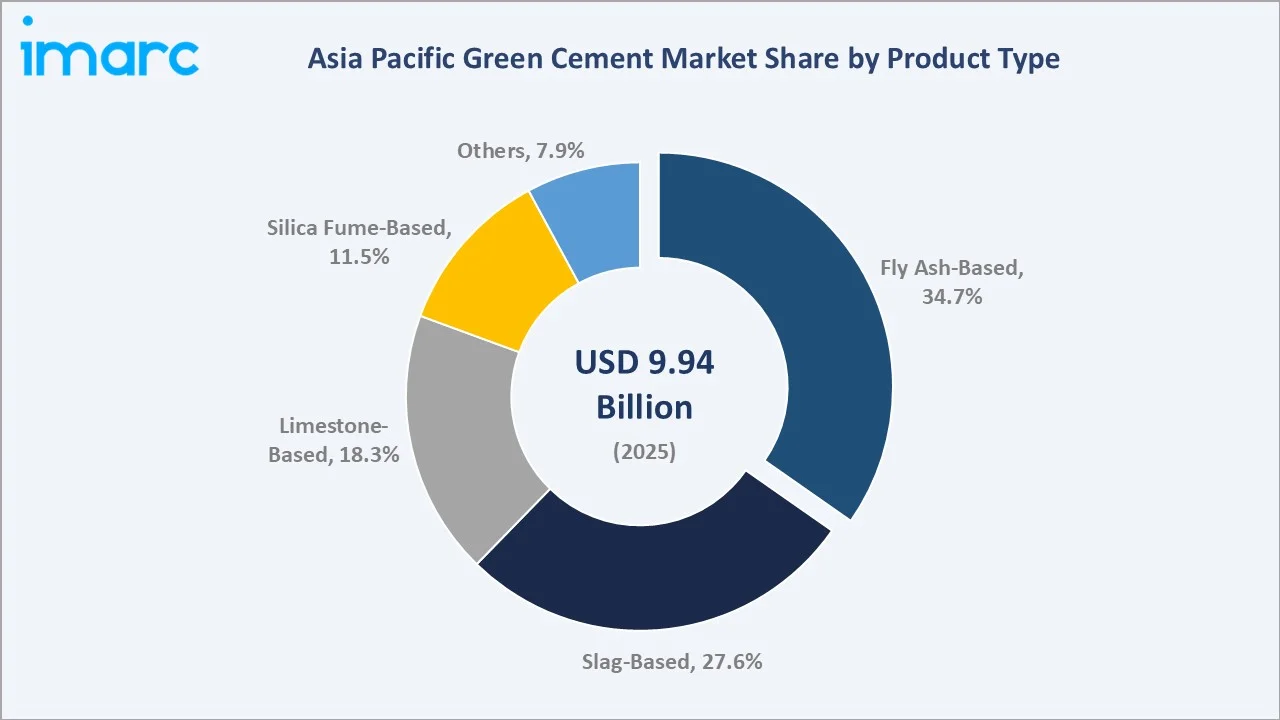
Fly Ash-Based cement leads at 34.7% in 2025, encompassing green cement formulations utilizing coal combustion byproduct fly ash as the primary supplementary cementitious material — the most commercially significant and widely available green cement variant across the Asia Pacific region.
To access detailed market analysis, Request Sample
Slag-Based cement follows at 27.6%, driven by abundant blast furnace slag availability and strong performance in infrastructure-grade concrete. Limestone-Based cement at 18.3% is gaining traction through LC3 adoption, while Silica Fume-Based cement at 11.5% serves premium high-performance concrete applications. Others account for 7.9%.
By End Use Industry
Residential construction leads at 38.6% in 2025, driven by expanding green building codes and growing developer adoption of low-carbon cement across China, India, and Southeast Asia.
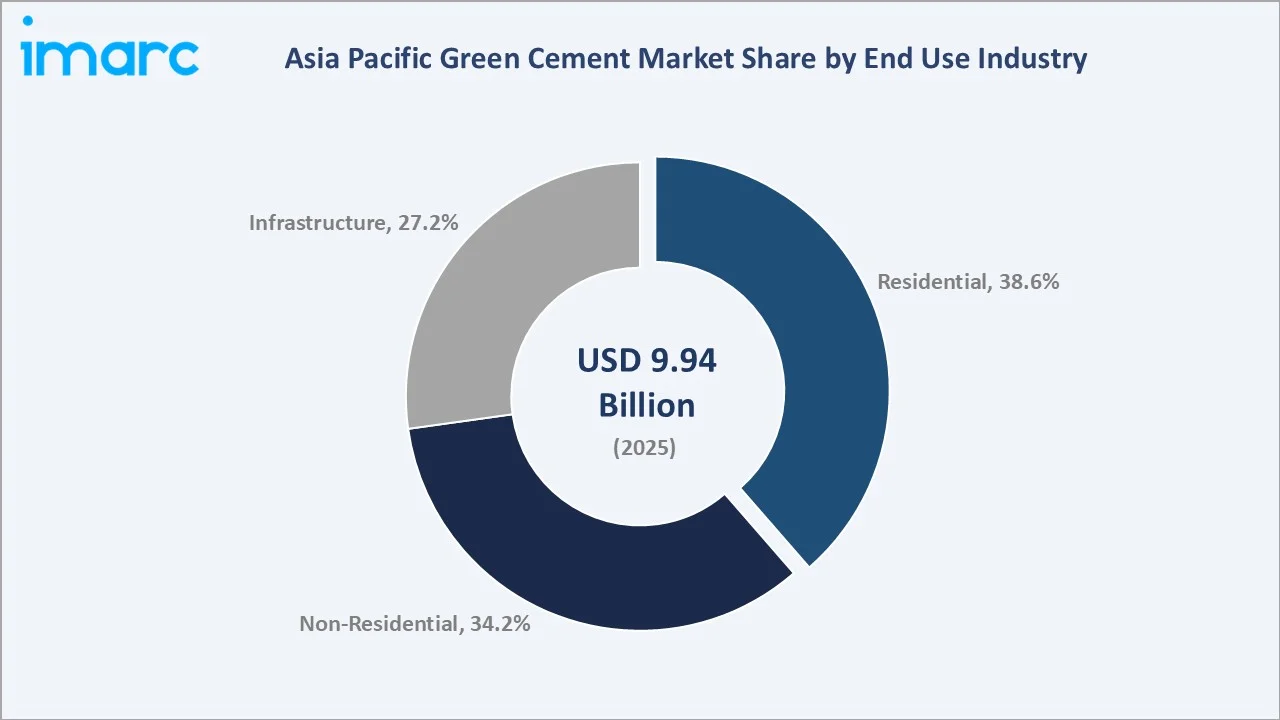
Non-Residential construction holds 34.2% through corporate sustainability commitments and green procurement mandates for commercial and institutional building projects. Infrastructure at 27.2% represents a growing segment as national governments mandate green cement in road, bridge, dam, and public works construction projects across the region.
Regional Market Insights
|
Country |
Share (2025) |
Key Characteristics |
|
China |
35.8% |
Driven by rapid urbanization, massive infrastructure investment, and strong government sustainability mandates |
|
India |
18.7% |
Supported by government green building initiatives, large-scale housing programs, and growing fly ash availability |
|
Japan |
13.6% |
Driven by stringent environmental regulations, post-earthquake rebuilding, and demand for low-carbon materials |
|
South Korea |
9.8% |
Supported by green building certification requirements and industrial demand for slag-based cement variants |
|
Indonesia |
8.2% |
Driven by expanding national infrastructure programs and rising domestic construction activity |
|
Australia |
5.7% |
Supported by national carbon-reduction targets and sustainable construction industry standards |
|
Others |
8.2% |
Includes Vietnam, Thailand, Malaysia, and other emerging markets benefiting from urbanization and infrastructure growth |
China, at 35.8%, leads through its world's-largest construction sector, government-mandated carbon neutrality pathway, and abundant industrial byproduct supply chains generating fly ash and slag for green cement production at massive scale. India, at 18.7%, follows on accelerating green building adoption, extensive fly ash availability from thermal power plants, and large-scale housing programs integrating blended cement specifications.
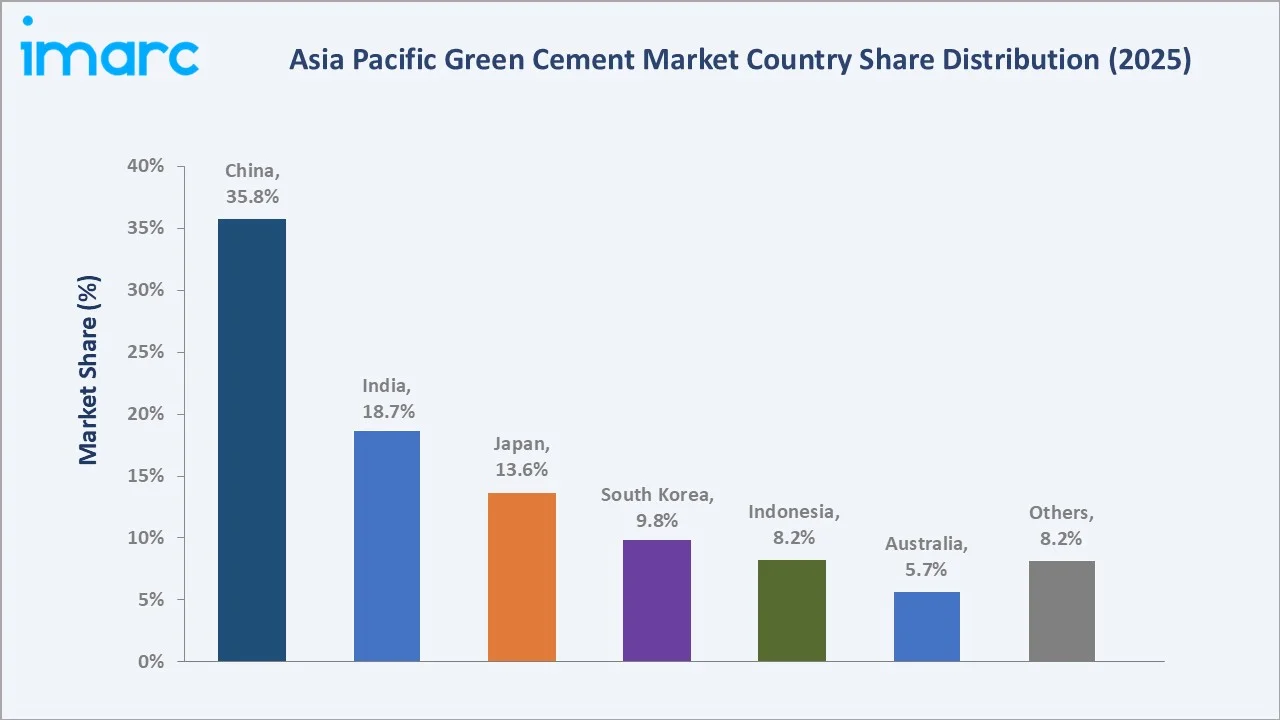
Japan, at 13.6%, reflects strict environmental regulations and Taiheiyo Cement's leadership in recycled-material-based eco-cement formulations. South Korea at 9.8% and Indonesia at 8.2% benefit from industrial byproduct availability and expanding national infrastructure programs respectively. Australia at 5.7% is supported by carbon reduction targets and sustainable construction industry standards governing major commercial development projects.
Competitive Landscape
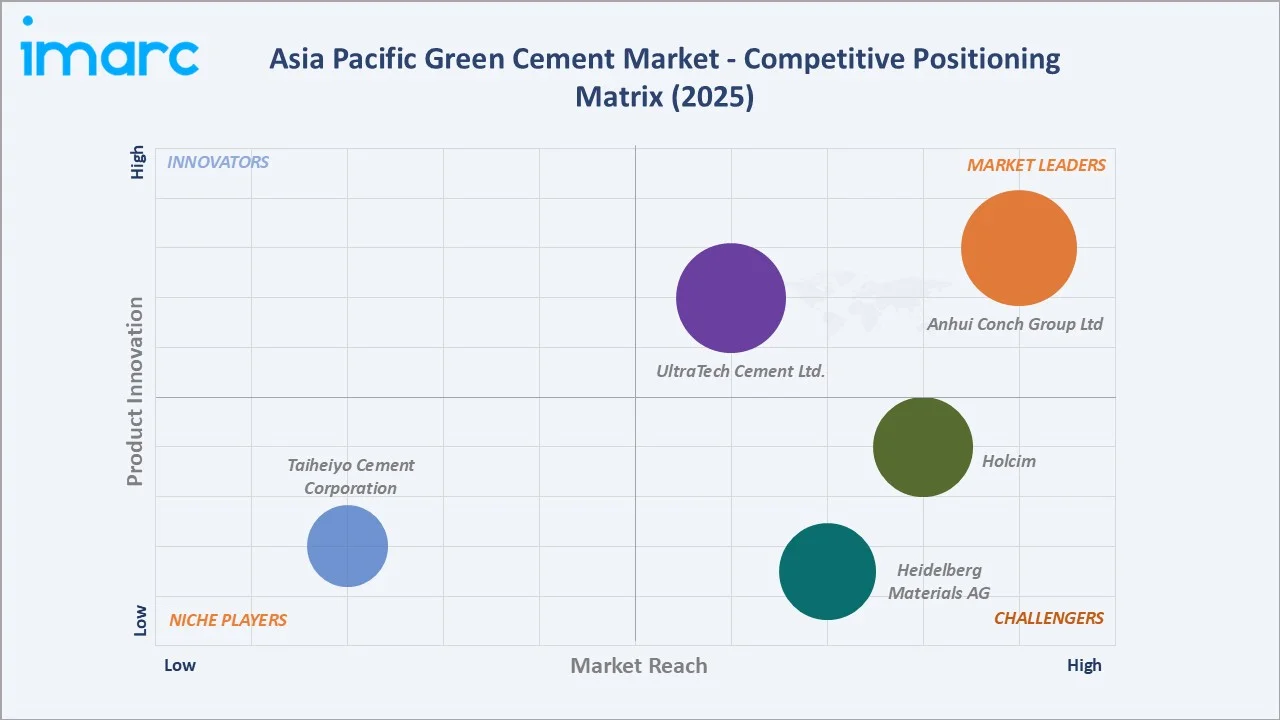
The Asia Pacific green cement market competitive landscape is highly competitive, with global and regional producers vying for market leadership. It features three distinct competitive tiers: major regional conglomerates with vertically integrated operations and extensive industrial byproduct supply chains, global multinational cement leaders deploying proprietary low-carbon technologies, and specialized green cement innovators focused on novel clinker-free formulations.
|
Company Name |
Key Products |
Market Position |
Core Strength |
|
Anhui Conch Group Ltd |
Slag-Based Green Cement, Fly Ash Blended Cement |
Market Leader |
Anhui Conch is the largest cement producer in Asia, with extensive green cement initiatives across its manufacturing network. |
|
UltraTech Cement Ltd. |
Fly Ash-Based Cement, Slag Cement, Composite Cement |
Market Leader |
UltraTech Cement Limited operating under Aditya Birla Management Corporation holds India's dominant green cement position through its broad blended-cement portfolio and regional expansion. |
|
Holcim |
ECOPact Green Concrete, Slag-Based Cement, LC3 Cement |
Strong Challenger |
Holcim Ltd leads globally in sustainable cement innovation, bringing LC3 and ECOPact low-carbon formulations to the Asia Pacific market. |
|
Heidelberg Materials AG |
Limestone Calcined Clay Cement, Fly Ash Blends |
Strong Challenger |
Heidelberg Materials AG advances green cement through low-clinker technologies and sustainable raw material substitution programs. |
|
Taiheiyo Cement Corporation |
Eco-Cement, Fly Ash Cement, Slag Cement |
Niche Leader |
Taiheiyo Cement Corporation specializes in recycled-material-based cement under Japan's rigorous eco-cement regulatory framework. |
Key players include Anhui Conch Group Ltd, UltraTech Cement Ltd., Holcim, Heidelberg Materials AG, Taiheiyo Cement Corporation, and others.
Key Company Profiles
Anhui Conch Group Ltd
Anhui Conch Group Ltd, operating through Anhui Conch Cement Co., Ltd., is China's largest cement producer and a dominant force in the Asia Pacific green cement market through its extensive fly ash and slag blended cement production programs and its commitment to reducing clinker-to-cement ratios across its national manufacturing network. The company operates one of the largest carbon capture pilot projects in the global cement industry, positioning it as a regional leader in next-generation low-carbon cement manufacturing.
- Key Products: Slag-Based Blended Cement, Fly Ash Blended Cement, Low-Carbon Portland Composite Cement.
- Strategic Focus: Expanding low-clinker production capacity and advancing carbon capture technology deployment across its China manufacturing facilities while increasing green cement export volumes across Southeast Asia. The company is investing in digital quality control systems and third-party green certification programs to reinforce its market leadership position in the sustainable construction materials segment.
UltraTech Cement Limited
UltraTech Cement Limited, operating under Aditya Birla Management Corporation, is India's largest cement company and a leading Asia Pacific green cement producer through its comprehensive portfolio of fly ash-based, slag-based, and composite blended cement products serving residential, commercial, and infrastructure markets. In May 2024, UltraTech announced the acquisition of a slag processing plant in Thailand, enhancing its Southeast Asian low-carbon cement production capability and regional distribution reach.
- Key Products: UltraTech Premium, UltraTech Super, UltraTech Concrete Plus – all blended formulations incorporating fly ash or slag as primary supplementary cementitious materials.
- Strategic Focus: Regional expansion across Southeast Asia through slag processing capacity acquisition and digital customer engagement platforms promoting green cement adoption among builders and contractors. UltraTech is developing direct partnerships with large residential and infrastructure developers to embed its blended cement specifications into long-term procurement agreements, securing volume growth ahead of regulatory mandates.
Market Concentration Analysis
The Asia Pacific green cement market is moderately concentrated at the regional conglomerate level, with the key players commanding leading shares in China and India through strong industrial byproduct supply integration and vertically integrated distribution. Global multinationals Holcim and Heidelberg Materials hold differentiated positions through proprietary LC3 and carbon capture technologies. Market concentration is expected to remain broadly stable through the forecast period as regulatory compliance barriers sustain the competitive advantage of established large-scale producers.
Investment & Growth Opportunities
Highest Growth Segments
Silica Fume-Based cement (~15.1% CAGR) and Infrastructure end use (~13.7% CAGR) represent the market's highest-growth investment vectors through 2034, outpacing the overall market average of 13.39% as high-performance concrete demand and government infrastructure program mandates compound faster than the broader green cement market.
Emerging Investment Opportunities
LC3 cement production capacity and carbon capture-integrated manufacturing represent the market's highest-differentiation emerging opportunities, supported by tightening carbon regulations and growing green building certification demand across the Asia Pacific region. Fly ash-based cement capacity expansion in Southeast Asia also represents a structurally growing opportunity as construction activity accelerates.
Investment Themes
- LC3 Production Capacity Investment: Capacity investment in Limestone Calcined Clay Cement production offers access to geographically underserved APAC markets where fly ash and slag are scarce, positioning early movers favorably ahead of tightening clinker substitution mandates and green procurement requirements in public infrastructure programs.
- Carbon Capture Technology Licensing: Investment in CCU technology licensing and deployment creates a net-negative carbon certification capability that commands premium pricing and preferred supplier status in government-mandated green infrastructure procurement programs, establishing durable competitive differentiation across the region.
Future Market Outlook (2026-2034)
The Asia Pacific green cement market is projected to grow from USD 9.94 Billion in 2025 to USD 32.56 Billion by 2034, delivering a robust 13.39% CAGR over the forecast period. The market's anchor value of an estimated USD 18.63 Billion in 2030 reflects a sustainable construction materials sector in accelerating structural expansion, with fly ash-based and slag-based cement formulations anchoring growth while LC3 and CCU-integrated products emerge as premium differentiators.
Research Methodology
Primary Research
Primary research comprised structured interviews with senior cement manufacturer executives, construction industry procurement leads, green building certification specialists, and industry association representatives across the Asia Pacific green cement value chain, providing first-hand insight into demand trends, regulatory impacts, and competitive positioning.
Secondary Research
Secondary research encompassed company annual reports, national cement association data, government sustainability policy documents, green building certification body publications, and carbon regulation disclosures, cross-verified across multiple independent sources to ensure data reliability across historical and forecast periods.
Forecasting Models
Market revenue forecasts were developed using a bottom-up construction demand model incorporating regional urbanization trends, per-capita construction spending, green building certification adoption rates, and regulatory clinker substitution mandates, with segment and country-level adjustments reflecting national sustainability policy timelines.
Report Coverage:
| Report Features | Details |
|---|---|
| Base Year of the Analysis | 2025 |
| Historical Period | 2020-2025 |
| Forecast Period | 2026-2034 |
| Units | Billion USD |
| Scope of the Report | Exploration of Historical Trends and Market Outlook, Industry Catalysts and Challenges, Segment-Wise Historical and Future Market Assessment:
|
| Product Types Covered | Fly Ash-Based, Slag-Based, Limestone-Based, Silica Fume-Based, Others |
| End Use Industries Covered | Residential, Non-Residential, Infrastructure |
| Countries Covered | China, Japan, India, South Korea, Australia, Indonesia, Others |
| Companies Covered | Anhui Conch Group Ltd, UltraTech Cement Ltd., Holcim, Heidelberg Materials AG, Taiheiyo Cement Corporation, etc. |
| Customization Scope | 10% Free Customization |
| Post-Sale Analyst Support | 10-12 Weeks |
| Delivery Format | PDF and Excel through Email (We can also provide the editable version of the report in PPT/Word format on special request) |
Frequently Asked Questions About the Asia Pacific Green Cement Market Report
The Asia Pacific green cement market reached USD 9.94 Billion in 2025, driven by Fly Ash-Based cement dominant at 34.7%, Residential construction leading at 38.6%, strong government carbon reduction mandates, and the region's large and rapidly growing sustainable construction materials adoption base.
The Asia Pacific green cement market grows at a 13.39% CAGR during 2026-2034, reaching USD 32.56 Billion by 2034. This growth reflects accelerating regulatory mandates, expanding green building certification programs, and deepening industrial byproduct supply chain integration across the region's major construction markets.
Fly Ash-Based cement leads at 34.7%, capturing the region's dominant supplementary cementitious material segment through broad industrial byproduct availability and proven mass-concrete performance. This segment grows at an above-market CAGR through 2034 as fly ash supply from thermal power generation continues to expand.
Residential construction leads at 38.6% through expanding green building certification mandates and growing homeowner and developer adoption of low-carbon cement formulations, driven by China and India's massive residential construction pipelines and government affordable housing programs.
China leads at 35.8% through its world's-largest construction sector, government-mandated carbon neutrality targets, and abundant fly ash and slag industrial byproduct supply chains enabling green cement production at unmatched scale, with strong secondary contribution from India at 18.7%.
Leading companies include Anhui Conch Group Ltd, UltraTech Cement Ltd., Holcim, Heidelberg Materials AG, Taiheiyo Cement Corporation, and others.
Need more help?
- Speak to our experienced analysts for insights on the current market scenarios.
- Include additional segments and countries to customize the report as per your requirement.
- Gain an unparalleled competitive advantage in your domain by understanding how to utilize the report and positively impacting your operations and revenue.
- For further assistance, please connect with our analysts.
 Request Customization
 Speak to an Analyst
 Request Brochure
 Inquire Before Buying
Benefits of Customization
- Personalize this research
- Triangulate with your data
- Get data as per your format and definition
- Gain a deeper dive into a specific application, geography, customer, or competitor
- Any level of personalization
Get in Touch With Us
UNITED STATES
Phone: +1-201-971-6302
INDIA
Phone: +91-120-433-0800
UNITED KINGDOM
Phone: +44-753-714-6104
Email: [email protected]
Client Testimonials




.webp)




.webp)













Related Reports

Choose your plan
*Please note that the prices mentioned below are starting prices for each bundle type. Kindly contact our team for further details.*
Single User License
- 1 User License, Access on 2 Devices
- PDF Report + Excel Dataset (Password Protected)
- Lifetime Access
- No Printing Rights
- 10% Free Report Customization
- 10–12 Weeks of Analyst Support
Five User License
- Access for 5 Users, 2 Devices per User
- PDF Report + Excel Dataset (Password Protected)
- Lifetime Access
- Dedicated Account Manager
- 12–14 Weeks of Analyst Support
- No Printing Rights
- 15% Free Report Customization
- 25% Discount on Your Next Purchase
Corporate User License
- Unlimited User Access (Within Your Organization)
- PDF Report + Excel Dataset
- Lifetime Access
- Dedicated Account Manager
- 14–20 Weeks of Analyst Support
- No Printing Rights
- 20% Free Report Customization
- 30% Discount on Your Next Purchase
Essential Insights
What's included:
3 reports
- Lifetime Access
- PDF Reports
- Excel Datasets
- 2 Weeks of Free Analyst Support
- 2 User Licenses
- Access on 2 Devices
- Printing Rights
- Complimentary PowerPoint (PPT) Version
- Complimentary License Upgrade
Professional Access
What's included:
5 reports
- Lifetime Access
- PDF Reports
- Excel Datasets
- 8 Weeks of Free Analyst Support
- 2 User Licenses
- Access on 2 Devices
- Printing Rights
- Complimentary PowerPoint (PPT) Version
- Complimentary License Upgrade
Business Advantage
What's included:
8 reports
- Lifetime Access
- PDF Reports
- Excel Datasets
- 14 Weeks of Free Analyst Support
- 2 User Licenses
- Access on 2 Devices
- Printing Rights
- Complimentary PowerPoint (PPT) Version
- Complimentary License Upgrade
Enterprise Intelligence
What's included:
10 reports
- Lifetime Access
- PDF Reports
- Excel Datasets
- 20 Weeks of Free Analyst Support
- 2 User Licenses
- Access on 2 Devices
- Printing Rights
- Complimentary PowerPoint (PPT) Version
- Complimentary License Upgrade