
Asia Pacific Industrial Gases Market Size, Share, Trends and Forecast by Type, Application, Supply Mode, and Country, 2026-2034
Asia Pacific Industrial Gases Market Size, Share, Trends & Forecast (2026-2034)
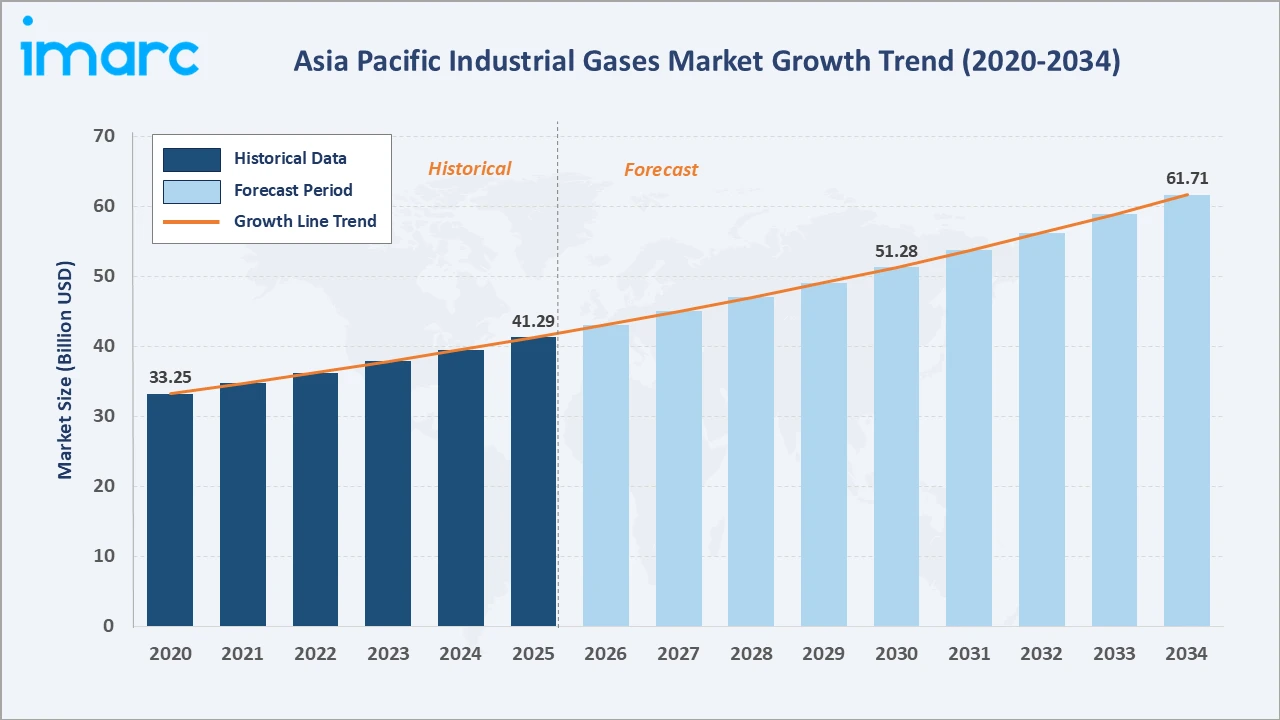
The Asia Pacific industrial gases market size increased from USD 41.29 Billion in 2025 to USD 43.60 Billion in 2026 and is projected to reach USD 61.71 Billion by 2034, growing at a CAGR of 4.43% during 2026-2034. Growth is driven by expanding steel and metallurgy output, rising healthcare gas demand, semiconductor fabrication expansion, and increasing adoption of on-site and bulk gas generation across the region. Nitrogen leads the type segment at 43.8%, manufacturing leads applications at 38.6%, and China commands 40.8% of the regional market. Sustained infrastructure investment across China, India, and Southeast Asia is expected to keep underlying gas demand resilient through the forecast period.
Market Snapshot
|
Metric |
Value |
|
Base Year Market Size (2025) |
USD 41.29 Billion |
| Market Size (2026) | USD 43.60 Billion |
|
Forecast Market Size (2034) |
USD 61.71 Billion |
|
CAGR (2026-2034) |
4.43% |
|
Base Year |
2025 |
|
Historical Period |
2020-2025 |
|
Forecast Period |
2026-2034 |
|
Dominant Type |
Nitrogen (43.8%, 2025) |
|
Dominant Application |
Manufacturing (38.6%, 2025) |
|
Leading Country |
China (40.8%, 2025) |
The market expanded from an estimated USD 33.25 Billion in 2020 to USD 41.29 Billion in 2025 and an estimated USD 43.60 Billion in 2026, anchored at USD 51.28 Billion in 2030 and forecast to reach USD 61.71 Billion by 2034. Demand recovered steadily post-pandemic as manufacturing, metallurgy, and healthcare gas consumption normalized across major APAC economies, with year-on-year growth remaining broadly consistent with the market's long-run compound trajectory.
To get more information on this market, Request Sample
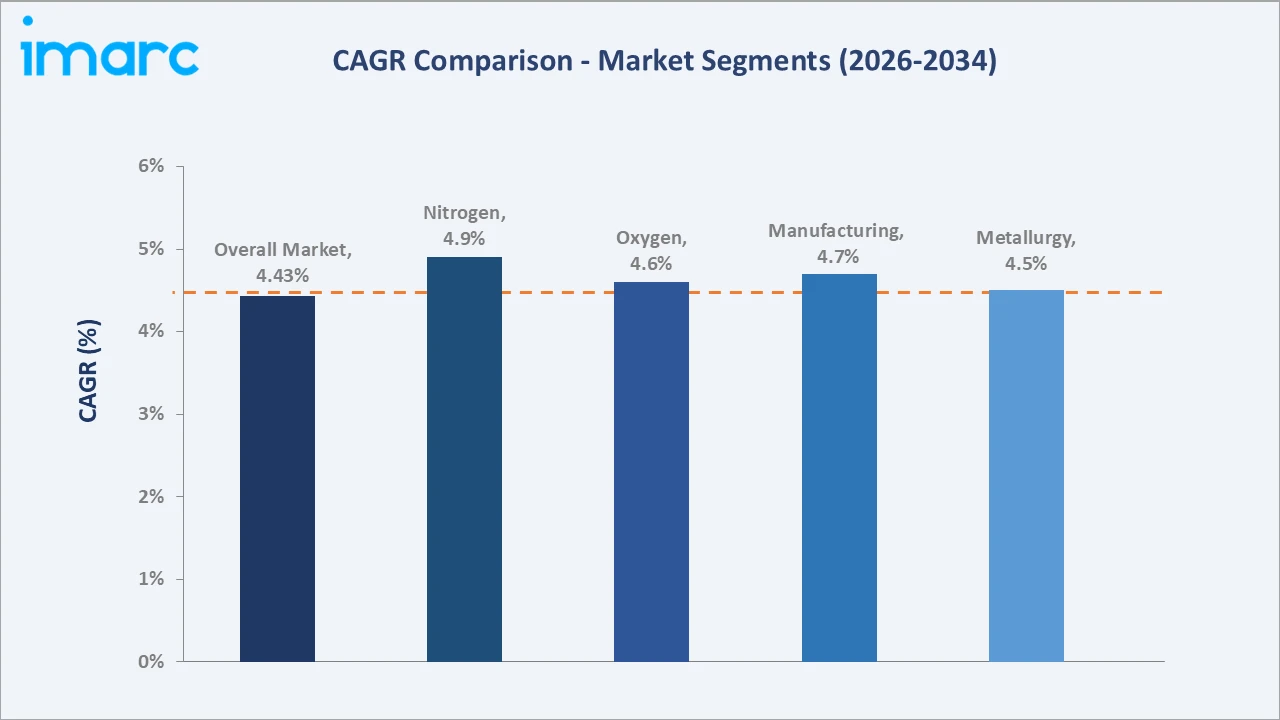
Nitrogen grows at approximately 4.9% CAGR as high-purity nitrogen demand from electronics and food packaging expands across the region. Manufacturing applications grow at approximately 4.7% CAGR, supported by rising industrial output and welding, cutting, and inerting gas consumption across the region's factories, while oxygen demand tracks closely with steel and healthcare sector expansion.
Executive Summary
The Asia Pacific industrial gases market expanded from USD 41.29 Billion in 2025 to an estimated USD 43.60 Billion in 2026, underpinned by the region's manufacturing scale, expanding metallurgy output, and growing healthcare infrastructure. Industrial gases including nitrogen, oxygen, carbon dioxide, argon, and hydrogen support inerting, cutting, welding, respiratory, and chemical processing applications across a broad base of end-use industries. The market is projected to reach USD 61.71 Billion by 2034, reflecting sustained industrial and healthcare demand growth.
Nitrogen at 43.8% dominates the type segment through widespread use in food preservation, electronics purging, and chemical inerting. Manufacturing at 38.6% leads applications through broad-based industrial gas consumption spanning welding, cutting, and general process inerting. China at 40.8% leads regionally through its unmatched manufacturing and steel production base, followed by Japan and India as the next-largest national markets.
Key Market Insights
|
Insight |
Data |
|
Dominant Type |
Nitrogen - 43.8% market share (2025) |
|
Dominant Application |
Manufacturing - 38.6% market share (2025) |
|
Leading Country |
China - 40.8% market share (2025) |
|
Market Opportunity |
Hydrogen fuel-gas scale-up; on-site generation systems; semiconductor-grade gas purity; medical oxygen network expansion |
Key Analytical Observations Supporting the Above Data:
- Nitrogen at 43.8%: Nitrogen dominates due to its broad inert-gas applicability across food preservation, electronics purging, and chemical processing, supported by low cost and wide cryogenic air separation availability.
- Manufacturing at 38.6%: The manufacturing segment leads through extensive use of oxygen, nitrogen, and argon in welding, cutting, metal fabrication, and general industrial processing across the region's factory base.
- China at 40.8%: China leads regionally due to its unmatched steel, chemicals, and electronics manufacturing scale, generating the region's largest industrial gas consumption base.
Industrial Gases Market Overview
The Asia Pacific industrial gases market covers the production, distribution, and supply of atmospheric and process gases including nitrogen, oxygen, carbon dioxide, argon, and hydrogen, serving manufacturing, metallurgy, energy, chemicals, and healthcare end-users across packaged, bulk, and on-site supply modes. The APAC industrial gases market continues to expand alongside the region's broader industrial and healthcare infrastructure investment.
The ecosystem integrates air separation unit operators, gas distribution and logistics providers, end-use industries, and regulatory bodies overseeing gas safety and quality standards. Rising industrialization, healthcare investment, and semiconductor manufacturing are the region's key macroeconomic growth drivers, alongside expanding government support for cleaner energy and hydrogen infrastructure. Trade policy, energy pricing, and cross-border logistics regulation also shape supplier investment decisions, particularly for multinational producers coordinating supply across several APAC countries simultaneously.
Market Dynamics
To evaluate market opportunities, Request Sample
Market Drivers
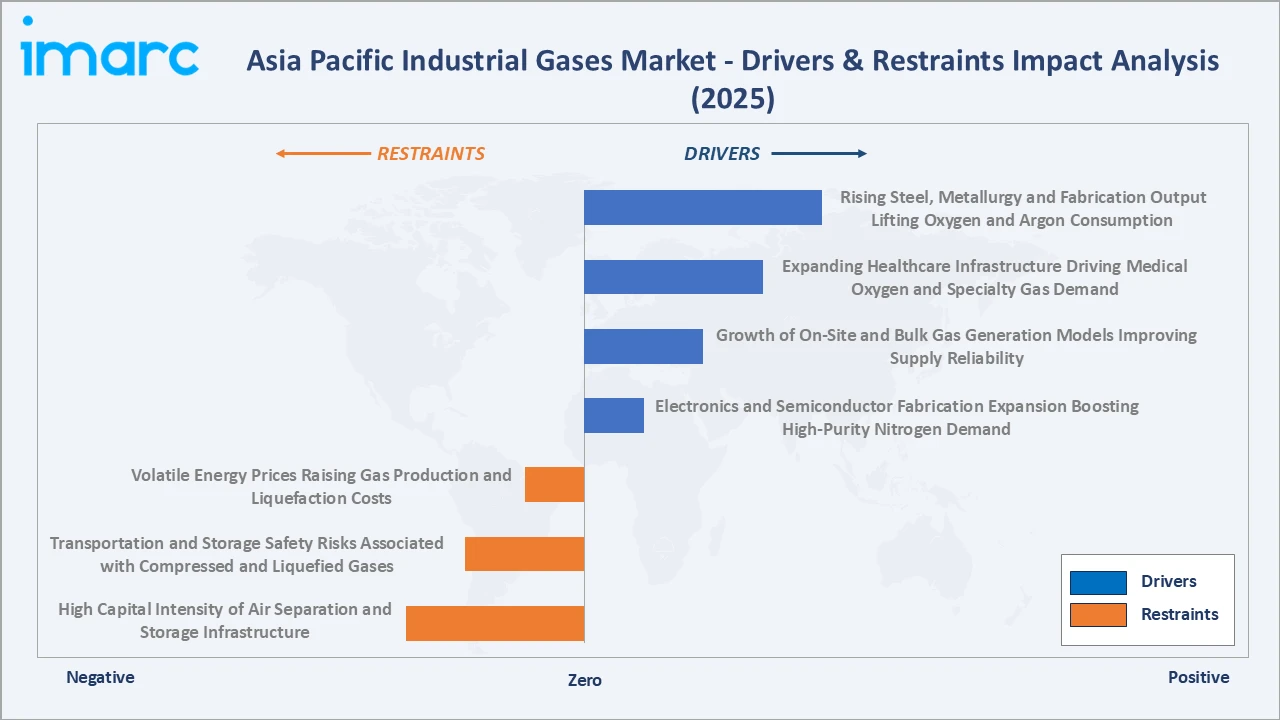
- Rising Steel, Metallurgy and Fabrication Output Lifting Oxygen and Argon Consumption: Expanding steel and metal fabrication output across China, India, and South Korea is lifting consumption of oxygen and argon used in cutting, welding, and blast furnace processes, directly increasing industrial gas demand. Continued capacity additions in electric arc furnace and basic oxygen furnace steelmaking are reinforcing this demand base across the region's largest producing economies. Fabricators are also increasingly adopting oxy-fuel and plasma cutting technologies, further widening the addressable market for merchant and on-site industrial gas supply.
- Expanding Healthcare Infrastructure Driving Medical Oxygen and Specialty Gas Demand: Growing hospital capacity and rising respiratory and surgical care needs are increasing medical oxygen and specialty gas demand, supported by government healthcare infrastructure investment across the region. Post-pandemic investment in intensive care and respiratory support capacity has left many APAC health systems with structurally higher medical oxygen procurement baselines. Expanding diagnostic imaging and anesthesia services in tier-two and tier-three cities is further broadening the medical gas customer base beyond metropolitan hospital networks.
- Growth of On-Site and Bulk Gas Generation Models Improving Supply Reliability: Increasing adoption of on-site nitrogen and oxygen generation systems is improving supply reliability and reducing logistics costs for large industrial consumers, encouraging wider gas outsourcing. Modular pressure swing adsorption and membrane-based units are lowering the entry threshold for mid-sized manufacturers to install captive generation capacity. Gas majors are responding with long-term build-own-operate contracts that lock in multi-year volume commitments while insulating customers from cylinder logistics disruptions.
- Electronics and Semiconductor Fabrication Expansion Boosting High-Purity Nitrogen Demand: Rapid semiconductor and display manufacturing capacity growth in China, Japan, South Korea, and Taiwan is boosting demand for ultra-high-purity nitrogen and specialty process gases. New wafer fabrication plants require dedicated on-site nitrogen generation and bulk specialty gas supply agreements, creating high-value, long-duration contracts for qualified suppliers. Rising investment in advanced packaging and display panel production is further diversifying the specialty gas demand base beyond traditional logic and memory fabrication.
Market Restraints
- High Capital Intensity of Air Separation and Storage Infrastructure: Air separation unit construction and cryogenic storage infrastructure require substantial upfront capital, limiting new entrant participation and slowing regional capacity expansion. Long payback periods on large-scale air separation investments discourage smaller regional players from committing to greenfield capacity, concentrating expansion among well-capitalized multinational producers. Financing conditions in emerging APAC markets can further raise the effective cost of capital for new gas production infrastructure.
- Transportation and Storage Safety Risks Associated with Compressed and Liquefied Gases: Compressed and liquefied gas handling carries inherent safety risks, requiring strict regulatory compliance and specialized logistics that raise operating costs for suppliers. Cross-border transport of cryogenic and compressed gases must satisfy varying national safety codes, adding administrative complexity for suppliers operating across multiple APAC jurisdictions. Incident-related reputational and liability exposure also encourages conservative capacity utilization, which can constrain short-term supply flexibility during demand spikes.
- Volatile Energy Prices Raising Gas Production and Liquefaction Costs: Gas liquefaction and separation are energy-intensive processes, making production costs sensitive to electricity and fuel price volatility across the region. Periods of elevated natural gas and electricity pricing directly compress air separation margins, particularly for producers without long-term power purchase agreements. This volatility also complicates long-term contract pricing negotiations with large industrial customers seeking multi-year cost certainty.
Market Opportunities
- Green Hydrogen and Refuelling Infrastructure Expansion: Expansion of green hydrogen production and hydrogen refuelling infrastructure across Japan, South Korea, and China. Government-backed hydrogen roadmaps are accelerating electrolyzer deployment and refuelling station rollouts, creating new upstream production and distribution opportunities for established gas suppliers. Early movers that secure long-term offtake agreements with steel and transport customers stand to capture a disproportionate share of this emerging demand pool.
- Ultra-High-Purity Specialty Gas Demand from Electronics Fabrication: Rising demand for ultra-high-purity specialty gases from advanced semiconductor and display fabrication facilities. Suppliers investing in dedicated electronics-grade purification and on-site delivery infrastructure are positioned to capture premium pricing relative to standard industrial gas grades. Continued fabrication capacity additions across the region's semiconductor clusters are expected to sustain this opportunity through the forecast period.
Market Challenges
- Intensifying Price Competition Pressuring Commoditized Segment Margins: Intensifying price competition among regional and multinational suppliers is pressuring margins in commoditized gas segments. Regional producers with lower-cost domestic air separation capacity are increasingly able to undercut multinational suppliers on standard nitrogen and oxygen pricing. This dynamic is prompting global majors to differentiate through value-added services such as remote tank monitoring and guaranteed supply reliability.
- Supply Chain Complexity Across Dispersed Regulatory Regimes: Supply chain and logistics complexity across geographically dispersed APAC markets with varied regulatory regimes remains a persistent challenge. Suppliers must navigate differing import duties, safety certifications, and cylinder standards across individual APAC countries, raising the operational overhead of regional expansion. Building resilient multi-country distribution networks requires sustained investment that can strain smaller regional operators relative to multinational competitors.
Emerging Market Trends
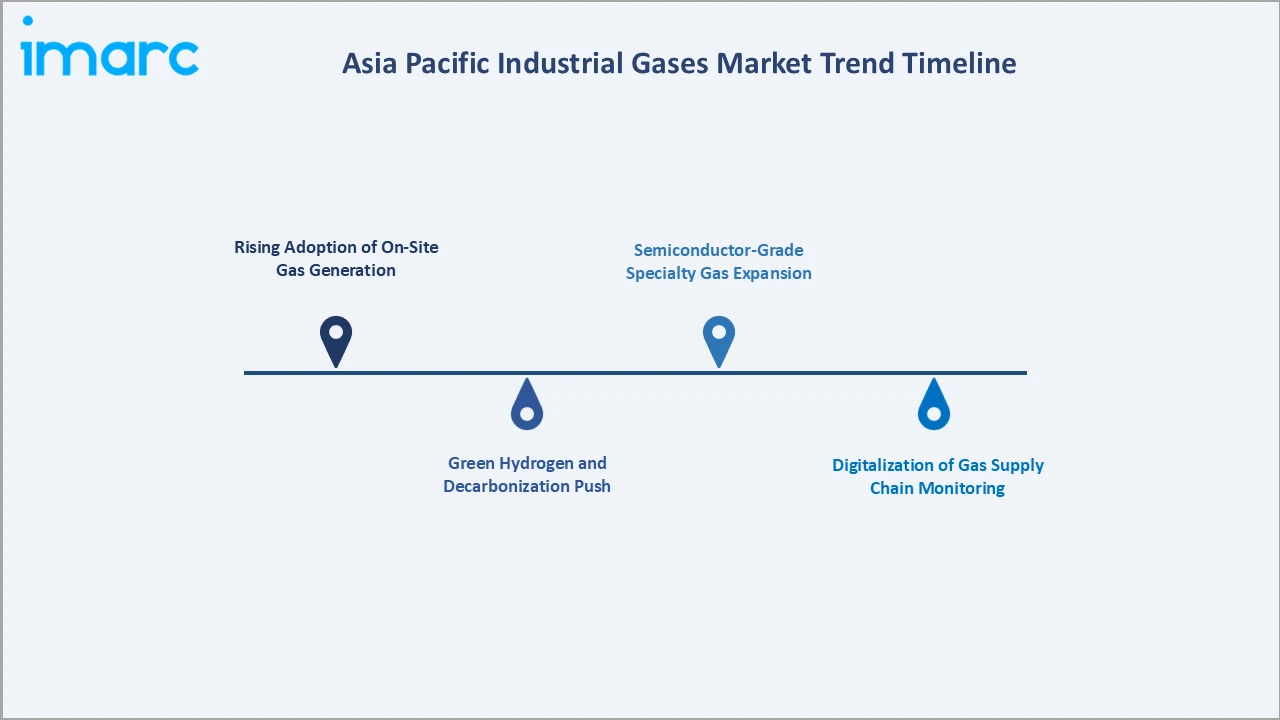
Rising Adoption of On-Site Gas Generation
Large industrial consumers are increasingly installing on-site nitrogen and oxygen generation units, reducing dependence on merchant gas delivery and improving supply continuity for continuous manufacturing operations. This shift is also encouraging suppliers to redesign commercial models around long-term capacity contracts.
Green Hydrogen and Decarbonization Push
Regional governments are backing green hydrogen production to decarbonize steel, chemicals, and refining, creating new demand pools for hydrogen production, storage, and distribution infrastructure across APAC. Pilot-scale electrolyzer projects are expected to reach commercial scale within the current decade.
Digitalization of Gas Supply Chain Monitoring
Suppliers are deploying IoT-enabled tank monitoring and predictive delivery systems to optimize bulk and packaged gas logistics, reducing stockouts and improving customer service levels. These platforms are also enabling more accurate demand forecasting across distributed customer networks.
Semiconductor-Grade Specialty Gas Expansion
Growing wafer fabrication capacity across China, Japan, South Korea, and Taiwan is driving investment in ultra-high-purity nitrogen, argon, and specialty gas production tailored to electronics manufacturing. Suppliers are co-locating purification facilities near major fabrication clusters to shorten delivery lead times.
Industry Value Chain Analysis
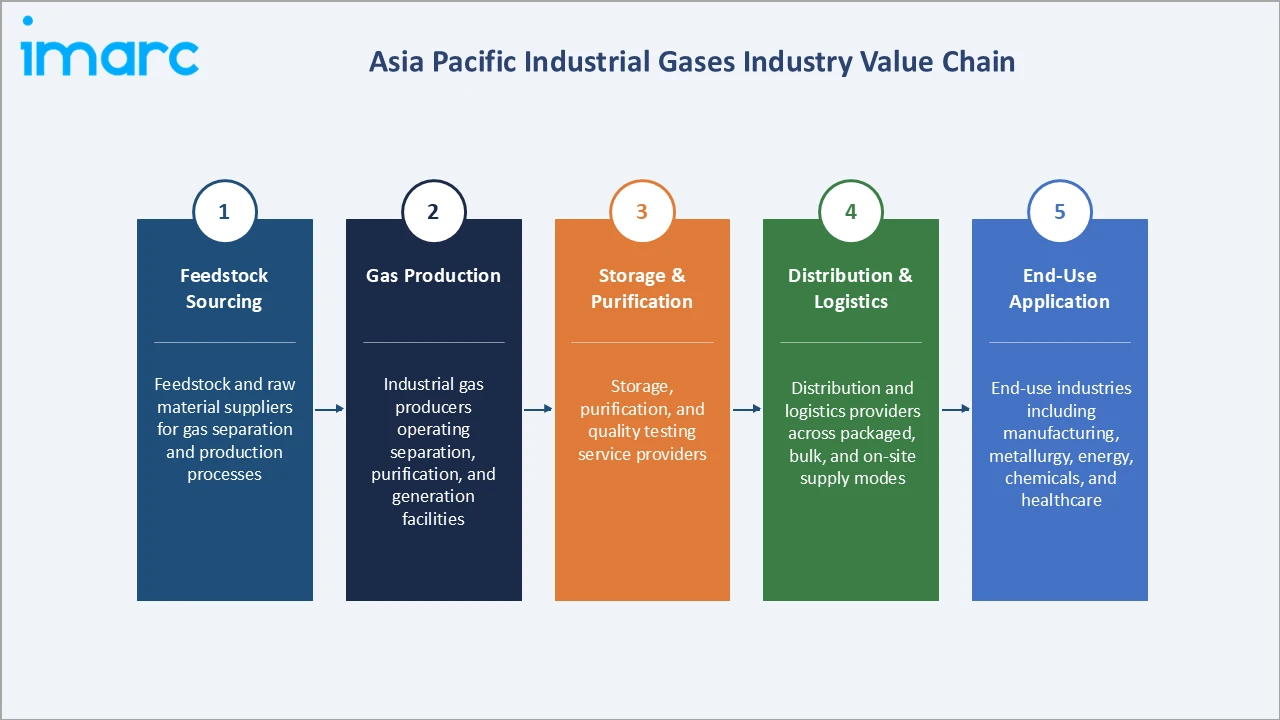
The industrial gases value chain spans feedstock sourcing, gas separation and production, storage and distribution, and end-use application across manufacturing, metallurgy, energy, chemicals, and healthcare sectors.
|
Stage |
Key Participants |
|
Feedstock Sourcing |
Feedstock and raw material suppliers for gas separation and production processes |
|
Gas Production |
Industrial gas producers operating separation, purification, and generation facilities |
|
Storage & Purification |
Storage, purification, and quality testing service providers |
|
Distribution & Logistics |
Distribution and logistics providers across packaged, bulk, and on-site supply modes |
|
End-Use Application |
End-use industries including manufacturing, metallurgy, energy, chemicals, and healthcare |
On-site and bulk supply modes are progressively displacing packaged cylinder delivery for large-volume industrial consumers, reshaping the value chain's commercial and logistics architecture across the region.
Technology Landscape
Cryogenic Air Separation Technology
Cryogenic air separation remains the dominant production technology for bulk nitrogen, oxygen, and argon, offering the highest purity and volume efficiency for large-scale industrial and healthcare gas supply. Continued investment in larger single-train air separation units is helping regional producers achieve lower per-unit production costs across China, India, and Japan.
Pressure Swing & Vacuum Swing Adsorption
Pressure and vacuum swing adsorption technologies are increasingly deployed for mid-scale on-site nitrogen and oxygen generation, offering lower capital requirements and faster deployment than cryogenic plants. Their modular design is particularly well suited to mid-sized manufacturing and healthcare facilities seeking captive gas supply without large upfront infrastructure investment.
Steam Methane Reforming for Hydrogen Production
Steam methane reforming remains the primary commercial hydrogen production route across the region, though electrolyzer-based green hydrogen capacity is scaling rapidly under national decarbonization roadmaps. Suppliers are increasingly pairing reforming capacity with carbon capture to serve customers seeking lower-carbon hydrogen supply.
Market Segmentation Analysis
The report covers the following segments:
|
Segment Category |
Leading Segment |
Market Share |
Year |
|
Type |
Nitrogen |
43.8% |
2025 |
|
Application |
Manufacturing |
38.6% |
2025 |
|
Supply Mode |
Packaged |
🔒 |
2025 |
|
Country |
China |
40.8% |
2025 |

By Type
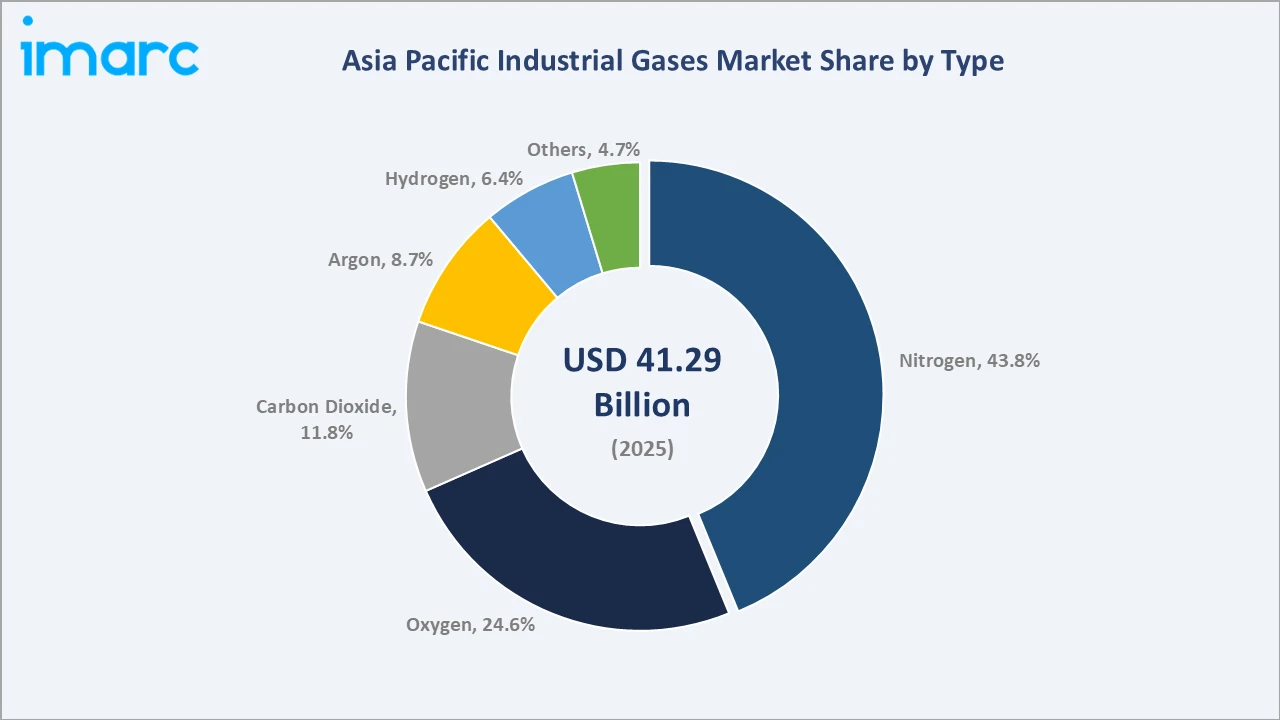
Nitrogen leads the type segment at 43.8% in 2025, driven by its extensive use in food preservation, electronics purging, and chemical inerting applications across the region's manufacturing base.
To access detailed market analysis, Request Sample
Oxygen at 24.6% serves steel-making and healthcare applications. Carbon dioxide at 11.8% supports food carbonation and chemical processing. Argon at 8.7% and hydrogen at 6.4% serve welding and emerging clean-energy applications respectively, while the remaining others category covers specialty and rare industrial gases.
By Application
Manufacturing leads applications at 38.6% in 2025, reflecting broad-based industrial gas consumption across welding, cutting, inerting, and general processing operations region-wide.
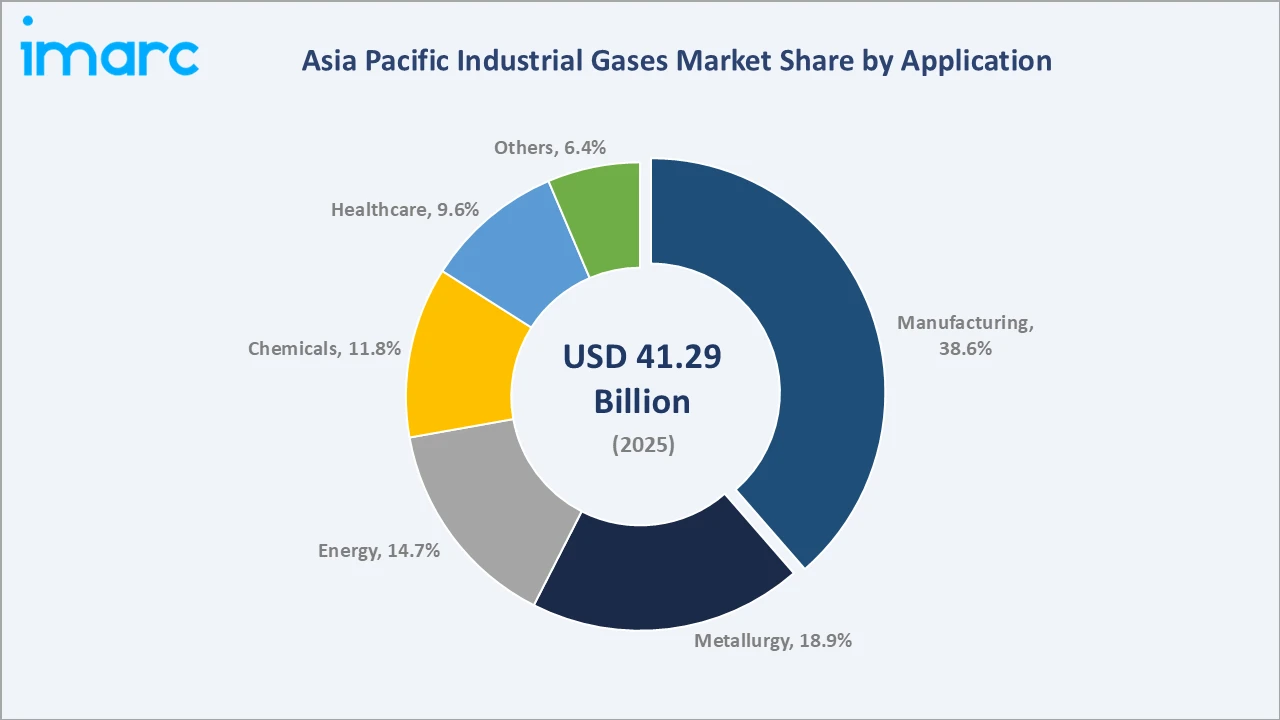
Metallurgy at 18.9% reflects steel and non-ferrous metal processing demand. Energy at 14.7% and chemicals at 11.8% support refining and petrochemical operations, while healthcare at 9.6% captures medical gas consumption across hospitals and diagnostic centers.
Regional Market Insights
|
Country |
Share (2025) |
Key Market Characteristics |
|
China |
40.8% |
Supported by large-scale manufacturing, steel, and chemicals production |
|
Japan |
15.7% |
Supported by electronics manufacturing and specialty gas production |
|
India |
14.8% |
Supported by expanding steel, healthcare, and industrial capacity |
|
South Korea |
9.8% |
Supported by semiconductor and metal fabrication demand |
|
Australia |
7.6% |
Supported by mining, healthcare, and food processing demand |
|
Indonesia |
6.3% |
Supported by growing manufacturing and healthcare investment |
|
Others |
5.0% |
Supported by the growing healthcare investment |
China at 40.8% leads through its unmatched manufacturing scale, while Japan at 15.7% reflects specialty gas and electronics leadership. India at 14.8% shows the fastest structural growth potential from expanding steel and healthcare demand.
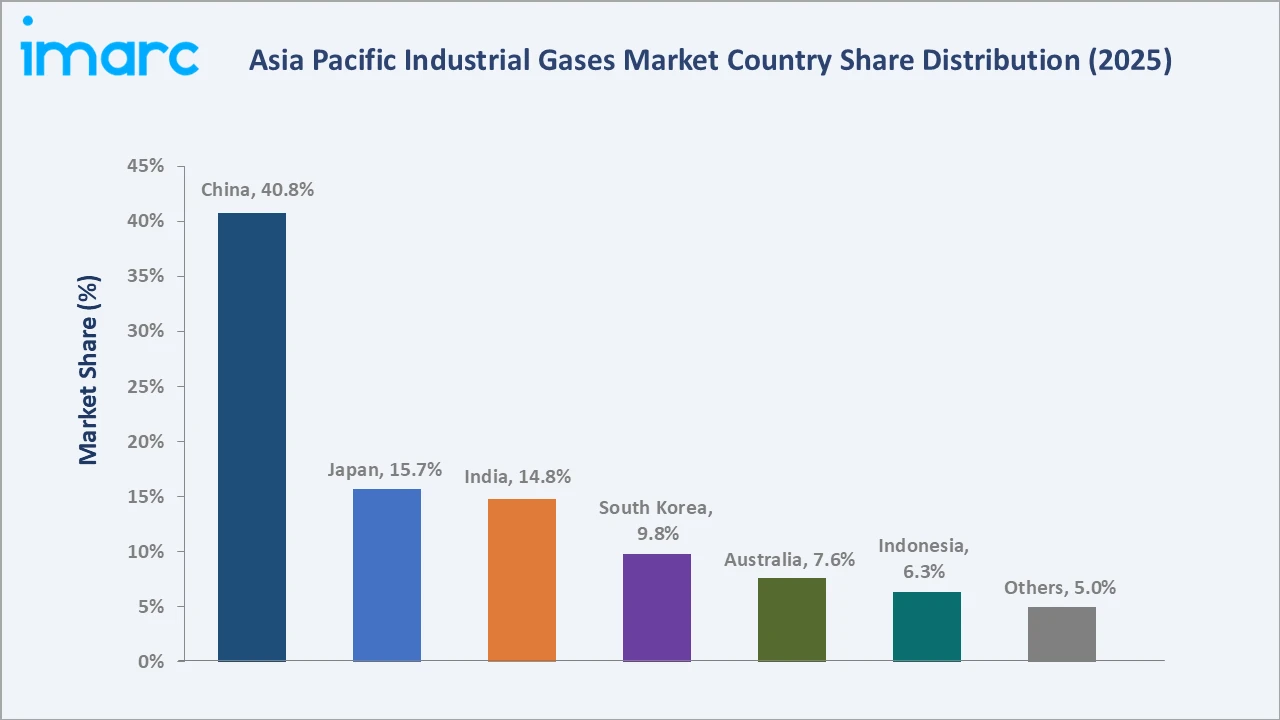
South Korea at 9.8% and Australia at 7.6% reflect semiconductor and mining-linked demand respectively, while Indonesia at 6.3% and other markets represent the region's earlier-stage but expanding industrial gas consumption base.
Competitive Landscape
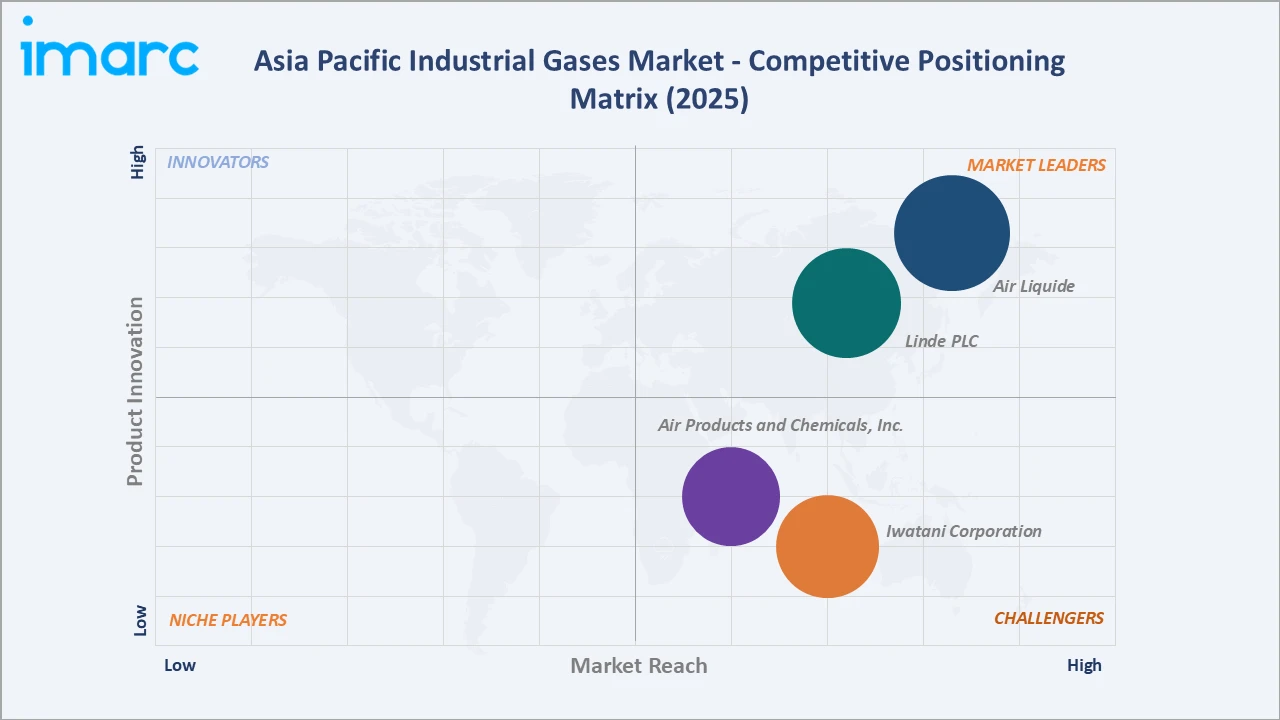
The Asia Pacific industrial gases market is moderately concentrated, led by global multinational gas majors alongside strong Japanese and Indian regional producers competing across packaged, bulk, and on-site supply modes.
|
Company Name |
Key Products |
Market Position |
Core Strength |
|
Air Liquide |
Industrial & Medical Gases, ASU Systems |
Market Leader |
One of the largest industrial gas company with an extensive APAC air separation network |
|
Linde PLC |
Bulk & Packaged Gases, On-Site Generation |
Market Leader |
Leading on-site and merchant gas supply portfolio across major APAC economies |
|
Air Products and Chemicals, Inc. |
Hydrogen, Syngas, ASU Plants |
Strong Challenger |
Hydrogen production and gasification technology leadership |
|
Iwatani Corporation |
LPG, Hydrogen, Industrial Gases |
Challenger |
Hydrogen station network and diversified energy-gas business in Japan |
Key players include Air Liquide, Linde PLC, Air Products and Chemicals, Inc., Iwatani Corporation, and others.
Key Company Profiles
Air Liquide
Air Liquide is a global leader in industrial and medical gases, with a broad air separation and hydrogen production footprint across the Asia Pacific region.
- Key Products: Industrial & Medical Gases, Air Separation Unit Systems.
- Strategic Focus: Expanding on-site generation, hydrogen infrastructure, and specialty gas supply for electronics and healthcare customers across APAC. The company continues to prioritize long-term on-site contracts with steel, chemical, and electronics manufacturers seeking reliable captive gas supply. It is also scaling its regional hydrogen production and distribution network to support decarbonization commitments among industrial and mobility customers.
Linde PLC
Linde is a global industrial gas major with an extensive bulk, packaged, and on-site supply network spanning China, India, Japan, South Korea, and Southeast Asia.
- Key Products: Bulk & Packaged Gases, On-Site Generation Systems.
- Strategic Focus: Scaling on-site generation contracts and clean hydrogen production capacity across major APAC industrial hubs. Linde is prioritizing build-own-operate agreements with large steel and chemical customers to secure multi-year volume commitments across the region. The company is also expanding its digital remote-monitoring platform to strengthen customer retention across its packaged and bulk gas distribution network.
Market Concentration Analysis
The APAC industrial gases market is moderately concentrated, with the key players collectively accounting for a significant share of regional bulk and on-site gas supply. Regional producers maintain strong country-level positions, particularly in Japan and India, sustaining competitive intensity across packaged and bulk gas segments. Concentration levels vary meaningfully by country, with China and India hosting a larger number of mid-sized domestic producers competing alongside multinational majors, while Japan and South Korea remain comparatively more consolidated around a small number of established suppliers. This variation in market structure shapes pricing dynamics and contract negotiation leverage differently across the region's individual national markets.
Investment & Growth Opportunities
Highest Growth Segments
Hydrogen production (~6-8% CAGR from a smaller base), on-site generation contracts, and semiconductor-grade specialty gases represent the fastest-growing investment vectors through 2034, outpacing the region's overall 4.43% market CAGR.
Emerging Investment Opportunities
On-site generation infrastructure for large steel, chemical, and electronics customers represents a high-value investment opportunity, offering suppliers long-term contracted revenue and reduced logistics cost exposure compared with merchant gas delivery.
Investment Themes
- Green Hydrogen Capacity Build-Out: Green hydrogen production capacity build-out across Japan, South Korea, and China to support decarbonization mandates and emerging fuel-cell demand. Investors backing early-stage electrolyzer manufacturing and refuelling infrastructure are positioned to benefit from first-mover advantages as national roadmaps mature.
- India Steel and Healthcare Demand Growth: India's expanding steel and healthcare infrastructure investment is creating sustained bulk oxygen and nitrogen demand growth through 2034. Suppliers establishing early on-site partnerships with large steel producers and hospital networks stand to secure durable long-term volume contracts.
Future Market Outlook (2026-2034)
The Asia Pacific industrial gases market is projected to grow from USD 41.29 Billion in 2025 to USD 43.60 Billion in 2026, reaching USD 61.71 Billion by 2034, delivering a 4.43% CAGR. On-site generation is expected to become the dominant supply mode for large industrial consumers, hydrogen infrastructure will scale meaningfully, and specialty gas demand from electronics manufacturing will continue outpacing the broader market through the forecast period.
China is expected to retain its position as the region's largest market through 2034, supported by continued manufacturing and steel sector expansion, while India is projected to post the fastest incremental demand growth among major economies as its industrial and healthcare infrastructure investment accelerates. Japan and South Korea are likely to see slower but steady volume growth, increasingly weighted toward higher-value specialty and electronics-grade gas supply rather than commoditized bulk products. Overall, the APAC industrial gases market is expected to remain one of the most resilient regional gas markets globally through the forecast period.
Research Methodology
Primary Research
Primary research comprised structured interviews with industrial gas producers, distribution partners, and end-use procurement leads across China, Japan, India, and South Korea.
Secondary Research
Secondary research encompassed company annual reports, national industrial production statistics, trade association data, and regulatory filings across major APAC gas-consuming industries.
Forecasting Models
Market forecasts were developed using a bottom-up model incorporating end-use industry production volumes, gas consumption intensity by application, and supply-mode pricing differentials across countries.
Report Coverage:
| Report Features | Details |
|---|---|
| Base Year of the Analysis | 2025 |
| Historical Period | 2020-2025 |
| Forecast Period | 2026-2034 |
| Units | Billion USD |
| Scope of the Report |
Exploration of Historical Trends and Market Outlook, Industry Catalysts and Challenges, Segment-Wise Historical and Future Market Assessment:
|
| Types Covered | Nitrogen, Oxygen, Carbon Dioxide, Argon, Hydrogen, Others |
| Applications Covered | Manufacturing, Metallurgy, Energy, Chemicals, Healthcare, Others |
| Supply Modes Covered | Packaged, Bulk, On-Site |
| Countries Covered | China, Japan, India, South Korea, Australia, Indonesia, Others |
| Companies Covered | Air Liquide, Linde PLC, Air Products and Chemicals Inc., Iwatani Corporation |
| Customization Scope | 10% Free Customization |
| Post-Sale Analyst Support | 10-12 Weeks |
| Delivery Format | PDF and Excel through Email (We can also provide the editable version of the report in PPT/Word format on special request) |
Frequently Asked Questions About the Asia Pacific Industrial Gases Market Report
The market reached USD 41.29 Billion in 2025 and is estimated at USD 43.60 Billion in 2026, led by nitrogen at 43.8% share, manufacturing applications at 38.6%, and China commanding 40.8% of regional demand. It is projected to reach USD 61.71 Billion by 2034, growing at a 4.43% CAGR during 2026-2034.
The pandemic temporarily disrupted manufacturing and logistics activity, but medical oxygen demand surged sharply, offsetting broader industrial softness. The market has since normalized, with industrial and healthcare gas consumption both resuming steady growth.
China, Japan, India, South Korea, Australia, and Indonesia are the key regional markets, with China leading at 40.8% share in 2025 followed by Japan and India.
By type, the market is segmented into nitrogen, oxygen, carbon dioxide, argon, hydrogen, and others, with nitrogen leading at 43.8% share in 2025.
By application, the market is segmented into manufacturing, metallurgy, energy, chemicals, healthcare, and others, with manufacturing leading at 38.6% share in 2025.
Key drivers include rising steel and metallurgy output, expanding healthcare infrastructure, on-site generation growth, and semiconductor fabrication expansion. Key challenges include high capital intensity, safety and logistics complexity, and volatile energy prices.
The key companies include Air Liquide, Linde PLC, Air Products and Chemicals, Inc., Iwatani Corporation, and others.
Competition is moderate to high, with multinational majors competing against strong regional producers across packaged, bulk, and on-site supply modes, particularly in Japan and India.
Need more help?
- Speak to our experienced analysts for insights on the current market scenarios.
- Include additional segments and countries to customize the report as per your requirement.
- Gain an unparalleled competitive advantage in your domain by understanding how to utilize the report and positively impacting your operations and revenue.
- For further assistance, please connect with our analysts.
 Request Customization
 Speak to an Analyst
 Request Brochure
 Inquire Before Buying
Benefits of Customization
- Personalize this research
- Triangulate with your data
- Get data as per your format and definition
- Gain a deeper dive into a specific application, geography, customer, or competitor
- Any level of personalization
Get in Touch With Us
UNITED STATES
Phone: +1-201-971-6302
INDIA
Phone: +91-120-433-0800
UNITED KINGDOM
Phone: +44-753-714-6104
Email: [email protected]
Client Testimonials




.webp)




.webp)













Related Reports

Choose your plan
*Please note that the prices mentioned below are starting prices for each bundle type. Kindly contact our team for further details.*
Single User License
- 1 User License, Access on 2 Devices
- PDF Report + Excel Dataset (Password Protected)
- Lifetime Access
- No Printing Rights
- 10% Free Report Customization
- 10–12 Weeks of Analyst Support
Five User License
- Access for 5 Users, 2 Devices per User
- PDF Report + Excel Dataset (Password Protected)
- Lifetime Access
- Dedicated Account Manager
- 12–14 Weeks of Analyst Support
- No Printing Rights
- 15% Free Report Customization
- 25% Discount on Your Next Purchase
Corporate User License
- Unlimited User Access (Within Your Organization)
- PDF Report + Excel Dataset
- Lifetime Access
- Dedicated Account Manager
- 14–20 Weeks of Analyst Support
- No Printing Rights
- 20% Free Report Customization
- 30% Discount on Your Next Purchase
Essential Insights
What's included:
3 reports
- Lifetime Access
- PDF Reports
- Excel Datasets
- 2 Weeks of Free Analyst Support
- 2 User Licenses
- Access on 2 Devices
- Printing Rights
- Complimentary PowerPoint (PPT) Version
- Complimentary License Upgrade
Professional Access
What's included:
5 reports
- Lifetime Access
- PDF Reports
- Excel Datasets
- 8 Weeks of Free Analyst Support
- 2 User Licenses
- Access on 2 Devices
- Printing Rights
- Complimentary PowerPoint (PPT) Version
- Complimentary License Upgrade
Business Advantage
What's included:
8 reports
- Lifetime Access
- PDF Reports
- Excel Datasets
- 14 Weeks of Free Analyst Support
- 2 User Licenses
- Access on 2 Devices
- Printing Rights
- Complimentary PowerPoint (PPT) Version
- Complimentary License Upgrade
Enterprise Intelligence
What's included:
10 reports
- Lifetime Access
- PDF Reports
- Excel Datasets
- 20 Weeks of Free Analyst Support
- 2 User Licenses
- Access on 2 Devices
- Printing Rights
- Complimentary PowerPoint (PPT) Version
- Complimentary License Upgrade