
Asia Pacific Textile Recycling Market Size, Share, Trends and Forecast by Product Type, Textile Waste, Distribution Channel, End Use, and Country, 2026-2034
Asia Pacific Textile Recycling Market Size, Share, Trends & Forecast (2026-2034)
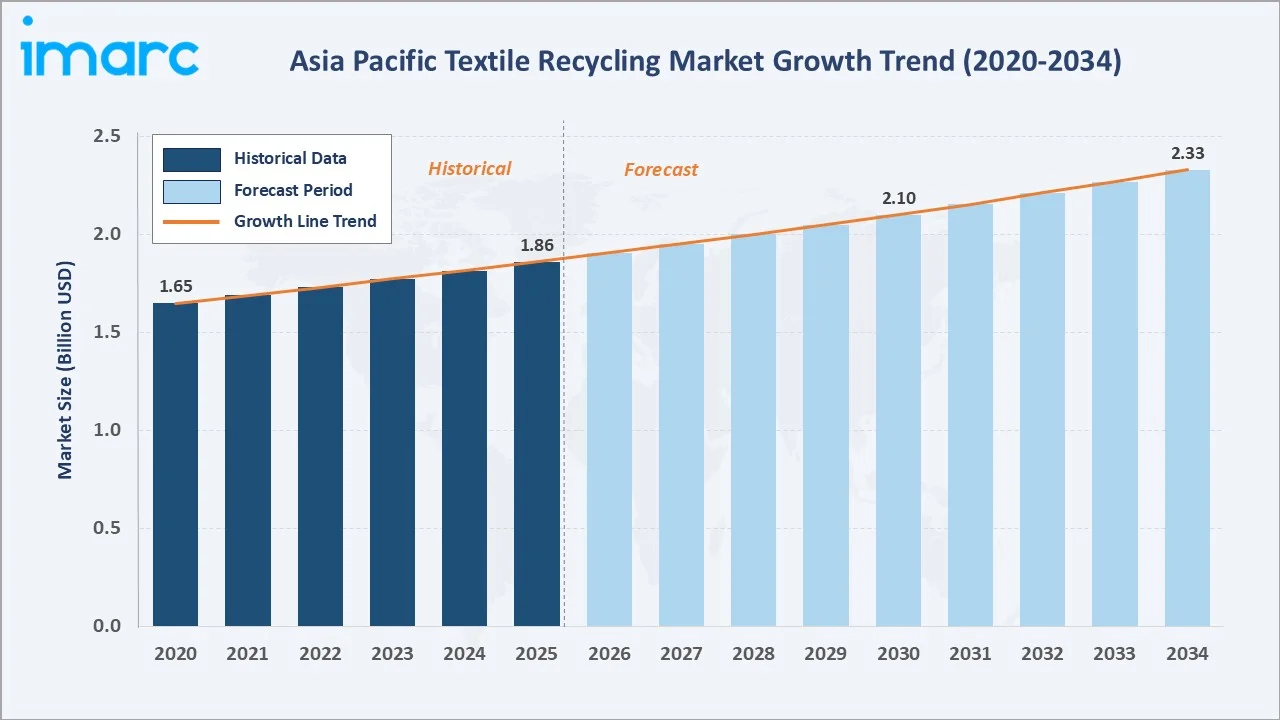
The Asia Pacific textile recycling market was valued at USD 1.86 Billion in 2025 and is projected to reach USD 2.33 Billion by 2034, exhibiting a CAGR of 2.41% during 2026-2034. Expanding textile waste volumes, tightening extended producer responsibility regulations, and rising consumer awareness of sustainable fashion are the primary drivers shaping the market growth.
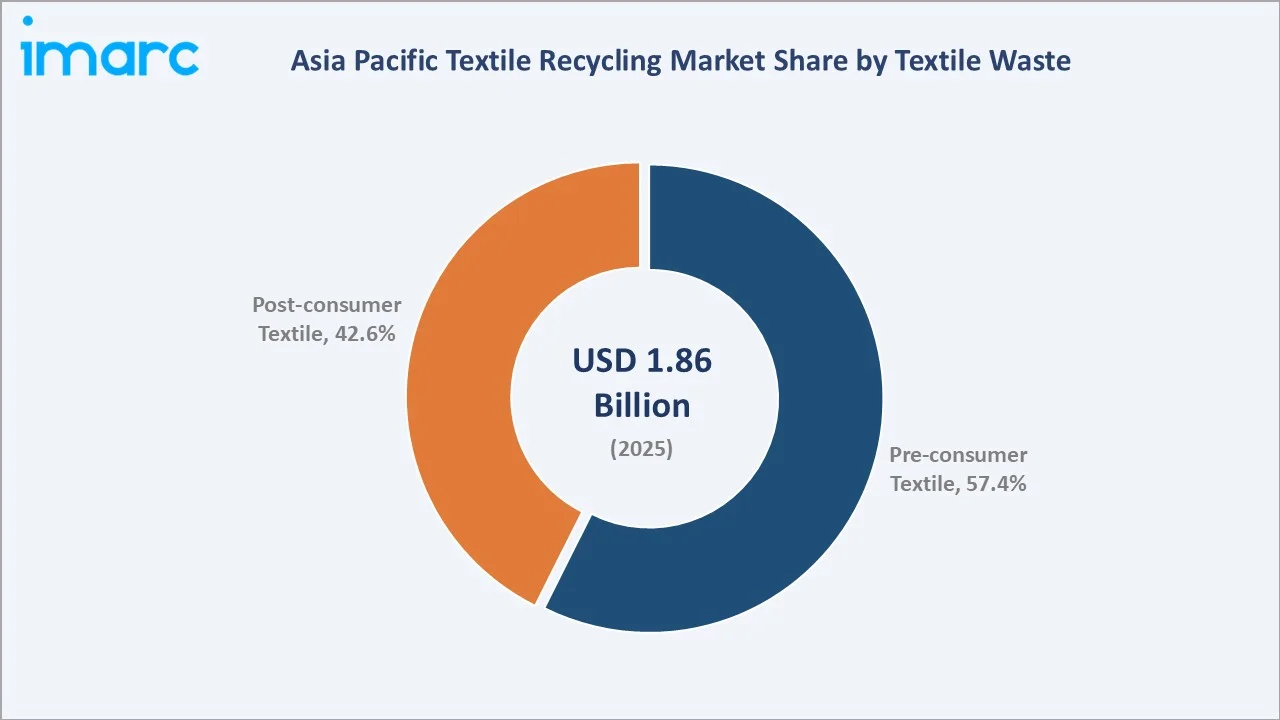
Pre-consumer textile leads the textile waste segment at 57.4%, retail and departmental stores dominate distribution channel at 54.8%, and China commands 43.7% country share.
Market Snapshot
|
Metric |
Value |
|
Market Size (2025) |
USD 1.86 Billion |
|
Forecast Market Size (2034) |
USD 2.33 Billion |
|
CAGR (2026-2034) |
2.41% |
|
Base Year |
2025 |
|
Historical Period |
2020-2025 |
|
Forecast Period |
2026-2034 |
|
Largest Country |
China (43.7%, 2025) |
|
Second Largest Country |
Japan (15.6%, 2025) |
|
Leading Textile Waste |
Pre-consumer Textile (57.4%, 2025) |
|
Leading Distribution Channel |
Retail and Departmental Stores (54.8%, 2025) |
The Asia Pacific textile recycling market expanded from USD 1.65 Billion in 2020 to USD 1.86 Billion in 2025, driven by rising textile waste generation, growing sorting infrastructure, and early-stage regulatory support. Anchored at USD 2.10 Billion in 2030, the forecast to USD 2.33 Billion by 2034 is supported by expanding chemical recycling capacity and strengthening circular economy policy frameworks.
To get more information on this market, Request Sample
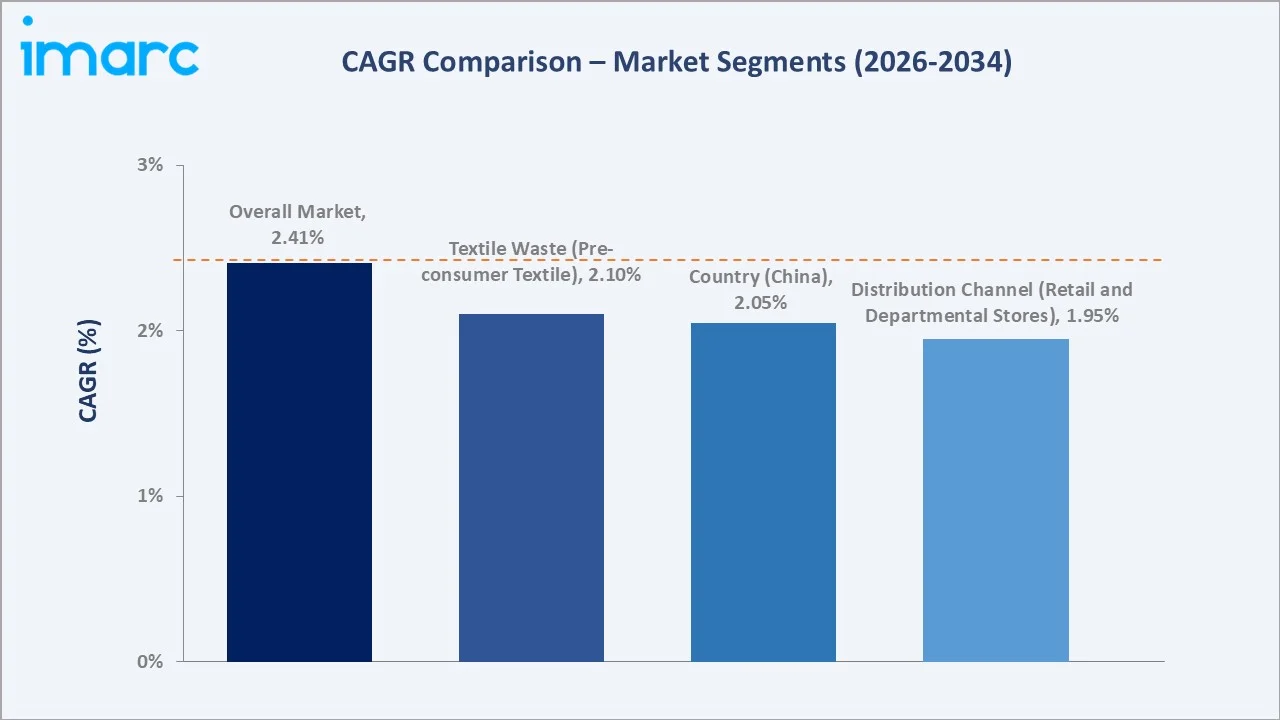
CAGR trajectories across textile waste, distribution channel, and country-level segments show India and online channel expanding faster than the overall 2.41% market CAGR, driven by expanding domestic textile manufacturing, e-commerce-led collection models, and rising post-consumer recycling initiatives.
Executive Summary
The Asia Pacific textile recycling market is on a steady growth trajectory from USD 1.65 Billion in 2020 to USD 2.33 Billion by 2034. The industry has moved from informal waste disposal toward structured collection, sorting, and fiber regeneration systems across major textile manufacturing economies. Rising regulatory pressure, expanding brand take-back programs, and growing consumer demand for sustainable apparel are encouraging investment in mechanical and chemical recycling capacity.
Pre-consumer textile dominates the textile waste segment at 57.4% in 2025, fueled by large volumes of cutting scraps and defective fabric generated across regional garment manufacturing hubs. Retail and departmental stores lead distribution channel at 54.8%, supported by their extensive collection networks, broad consumer reach, and growing availability of textile recycling and take-back programs. China commands 43.7% market share, led by large-scale manufacturing output and growing investment in fiber-to-fiber recycling technology.
Key Market Insights
|
Insight |
Data |
|
Leading Textile Waste |
Pre-consumer Textile - 57.4% share (2025) |
|
Second Largest Textile Waste |
Post-consumer Textile - 42.6% share (2025) |
|
Leading Distribution Channel |
Retail and Departmental Stores - 54.8% share (2025) |
|
Second Largest Distribution Channel |
Online Channel - 45.2% share (2025) |
|
Leading Country |
China - 43.7% share (2025) |
|
Second Largest Country |
Japan - 15.6% share (2025) |
|
Top Companies |
Teijin Limited, Aditya Birla Group, Hyosung TNC Corporation, Usha Yarns Ltd. |
Key Analytical Observations Expanding On the Data Above:
- Pre-consumer textile dominance at 57.4% is supported by high volumes of cutting scraps and defective fabric generated across regional apparel and home-textile manufacturing hubs, offering recyclers a relatively uniform, contamination-free feedstock.
- Post-consumer textile share at 42.6% is expanding as brand-led take-back schemes, municipal collection drives, and resale platforms channel more discarded garments into formal recycling streams.
- Retail and departmental store leadership at 54.8% reflects established store-based collection bins, in-store take-back counters, and long-standing retailer partnerships with regional recyclers.
- Online channel share at 45.2% is growing quickly as e-commerce platforms and direct-to-consumer resale and recycling programs simplify garment drop-off and mail-back logistics for urban consumers.
- China at 43.7% dominates country-wise share, anchored by expanding EPR enforcement and growing chemical recycling capacity.
Asia Pacific Textile Recycling Market Overview
Textile recycling converts pre-consumer manufacturing waste and post-consumer discarded garments into reusable fibers, yarns, and raw materials through mechanical shredding, chemical depolymerization, or fiber regeneration. The market spans cotton, polyester, wool, and blended-fiber recycling across apparel, home textile, and industrial end uses.
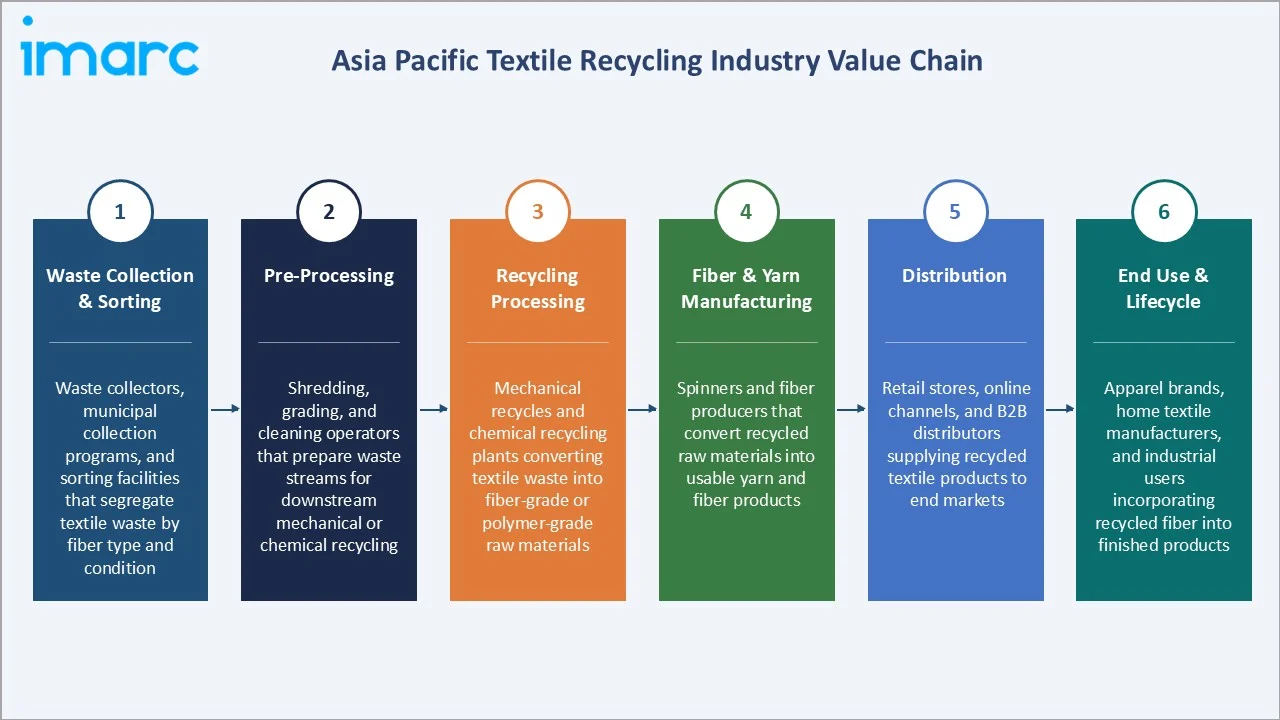
The Asia Pacific textile recycling ecosystem integrates waste collectors and sorting facilities, mechanical and chemical recycling processors, fiber and yarn manufacturers, apparel and textile brands, retail and online distribution channels, and regulatory bodies overseeing EPR frameworks, enabling the transition from linear consumption toward circular material flows.
Market Dynamics
To evaluate market opportunities, Request Sample
Market Drivers
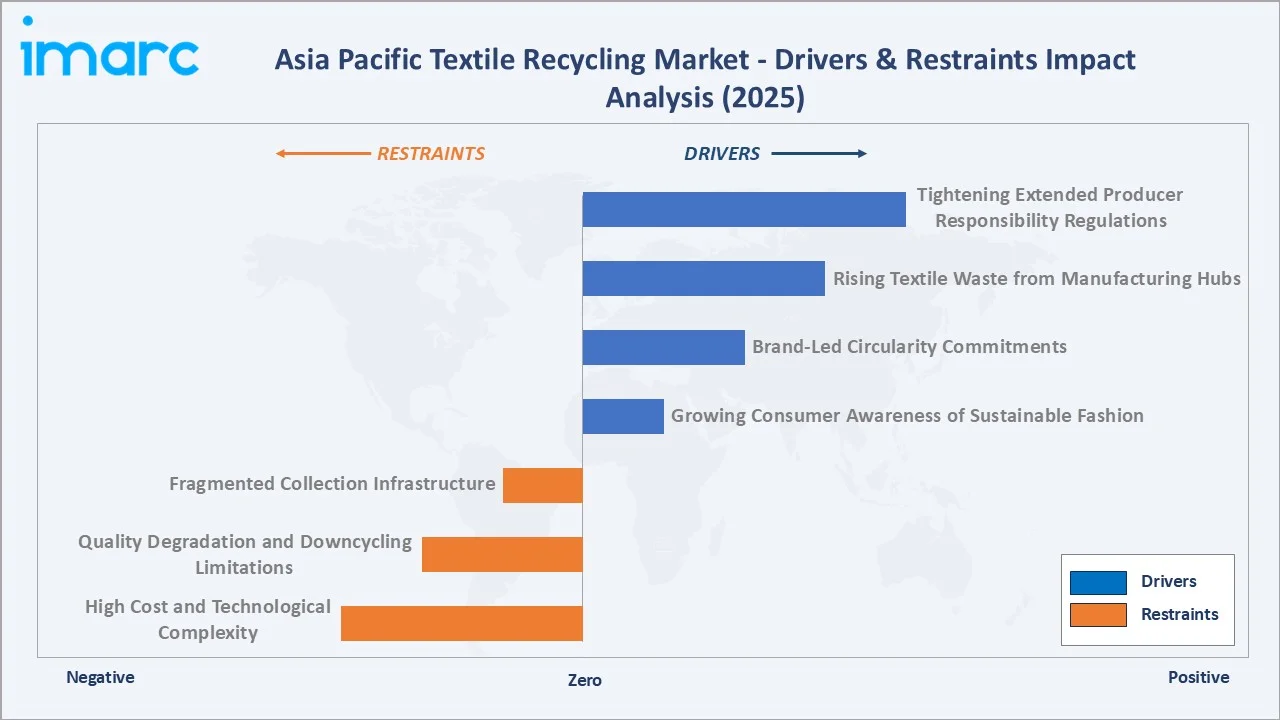
- Tightening Extended Producer Responsibility Regulations: Governments across China, Japan, and South Korea are introducing EPR mandates that require manufacturers and retailers to fund and manage post-consumer textile collection, pushing formal recycling volumes higher across the region.
- Rising Textile Waste from Manufacturing Hubs: As per PIB, in 2025, India's textile industry generated 7.8 Million Tons of manufacturing scraps, creating a large, relatively contamination-free pre-consumer feedstock base that supports steady recycler throughput.
- Brand-Led Circularity Commitments: Global and regional apparel brands are setting recycled-content targets and launching in-store take-back programs, encouraging integration of recycled fiber into mainstream product lines.
- Growing Consumer Awareness of Sustainable Fashion: Expanding digital access and sustainability messaging are lifting consumer preference for recycled and upcycled apparel across urban markets in China, Japan, South Korea, and Australia.
Market Restraints
- High Cost and Technological Complexity: Chemical recycling processes capable of handling blended fibers require significant capital investment, limiting adoption among small and mid-sized regional recyclers.
- Quality Degradation and Downcycling Limitations: Mechanically recycled fibers often lose strength and length, restricting their use to lower-value applications rather than closed-loop, fiber-to-fiber production.
- Fragmented Collection Infrastructure: Inconsistent collection and sorting coverage across urban and rural areas limits the volume of textile waste that reaches formal recycling channels across much of the region.
Market Opportunities
- Chemical Recycling Capacity Expansion: Growing investment in depolymerization and fiber-to-fiber regeneration technology presents opportunities for processors to supply premium recycled fiber to brand-led sustainability programs.
- Digital Take-Back and Resale Platforms: Expanding e-commerce infrastructure creates opportunities for online-led collection models that reduce logistics friction for urban consumers and improve post-consumer feedstock quality.
Market Challenges
- Blended-Fiber Separation Difficulty: The prevalence of cotton-polyester and other blended fabrics complicates mechanical and chemical separation, raising processing costs and limiting recycled-fiber purity.
- Inconsistent Regional Regulatory Frameworks: Differing waste management and EPR policies across countries create compliance complexity for recyclers and brands operating across multiple Asia Pacific markets.
Emerging Market Trends
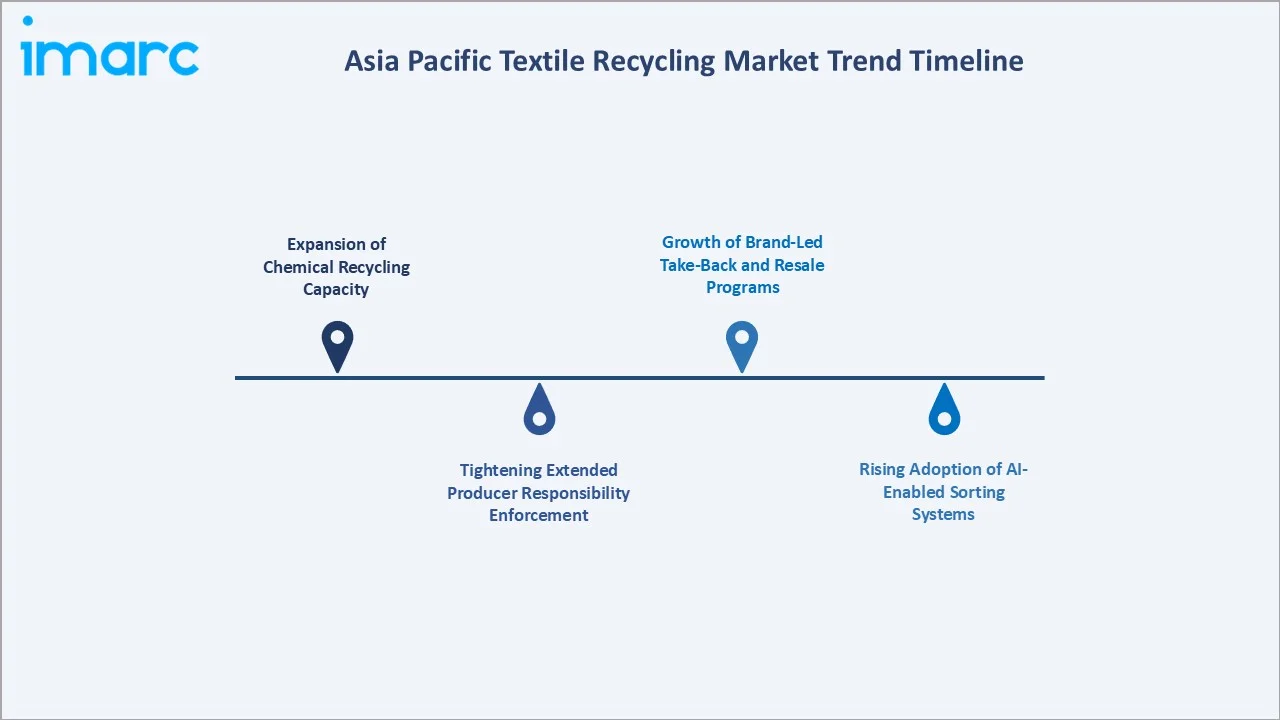
1. Expansion of Chemical Recycling Capacity
Regional processors are scaling depolymerization technology capable of converting blended and colored textile waste into virgin-quality fiber. This shift is expanding the addressable feedstock base beyond single-fiber, contamination-free waste streams.
2. Tightening Extended Producer Responsibility Enforcement
Governments across the region are tightening enforcement of textile waste recycling targets, reflecting broader national circularity goals that are reshaping compliance obligations for manufacturers and retailers.
3. Growth of Brand-Led Take-Back and Resale Programs
Apparel brands are increasingly operating in-store and digital take-back schemes, feeding higher volumes of post-consumer garments into formal recycling channels while building consumer loyalty around circularity.
4. Rising Adoption of AI-Enabled Sorting Systems
Near-infrared and AI-based optical sorting technologies are improving fiber-type identification accuracy, reducing manual labor dependence, and enabling recyclers to process higher waste volumes with more consistent output quality.
Industry Value Chain Analysis
The Asia Pacific textile recycling value chain spans six stages from waste collection through end-use and lifecycle management. Recycling processing and fiber manufacturing capture the highest value-add, while collection and sorting infrastructure increasingly determines feedstock quality and processor competitiveness.
|
Stage |
Key Players / Examples |
|
Waste Collection & Sorting |
Waste collectors, municipal collection programs, and sorting facilities that segregate textile waste by fiber type and condition |
|
Pre-Processing |
Shredding, grading, and cleaning operators that prepare waste streams for downstream mechanical or chemical recycling |
|
Recycling Processing |
Mechanical recyclers and chemical recycling plants converting textile waste into fiber-grade or polymer-grade raw materials |
|
Fiber & Yarn Manufacturing |
Spinners and fiber producers that convert recycled raw materials into usable yarn and fiber products |
|
Distribution |
Retail and departmental stores, online channels, and B2B distributors supplying recycled textile products to end markets |
|
End Use & Lifecycle |
Apparel brands, home textile manufacturers, and industrial users incorporating recycled fiber into finished products |
Processors with proprietary chemical recycling technology are positioned to capture greater value than those reliant on third-party collection networks.
Technology Landscape in the Asia Pacific Textile Recycling Industry
Mechanical and Chemical Recycling Technologies
Mechanical recycling remains the dominant method for single-fiber textile waste, shredding fabric into reusable fiber. Chemical recycling, including depolymerization, is gaining traction for blended and colored waste streams.
AI-Enabled Sorting and Automation
Near-infrared spectroscopy and AI-driven optical sorting systems are improving fiber-composition identification, enabling processors to route waste more accurately and reduce contamination in recycled output.
Recycled Fiber and Material Innovation
Processors are developing fiber-to-fiber regeneration methods that preserve polymer quality across cycles, narrowing the performance gap between recycled and virgin fiber for premium apparel.
Digital Traceability Systems
Blockchain-based and digital tracking tools are being deployed to verify recycled-content claims, supporting brand compliance and strengthening buyer confidence across the value chain.
Market Segmentation Analysis
The report covers the following segments:
|
Segment Category |
Leading Segment |
Market Share |
Year |
|
Product Type |
Polyester & Polyester Fibre Recycling |
🔒 |
2025 |
|
Textile Waste |
Pre-consumer Textile |
57.4% |
2025 |
|
Distribution Channel |
Retail and Departmental Stores |
54.8% |
2025 |
|
End Use |
Apparel |
🔒 |
2025 |
|
Country |
China |
43.7% |
2025 |

By Textile Waste
Pre-consumer textile commands a 57.4% majority share in 2025, driven by large, relatively uniform volumes of cutting scraps and defective fabric generated across regional garment and home-textile manufacturing operations. The segment benefits from lower contamination levels and predictable supply from manufacturing partners.
To access detailed market analysis, Request Sample
Post-consumer textile at 42.6% in 2025 is expanding through municipal collection drives, brand take-back schemes, and resale platforms that channel discarded garments into formal recycling streams. The segment remains an important growth avenue as post-consumer collection infrastructure matures across the region.
By Distribution Channel
Retail and departmental stores lead distribution channel with 54.8% share in 2025, supported by established in-store collection bins and long-standing retailer partnerships with regional recyclers across mature textile markets.
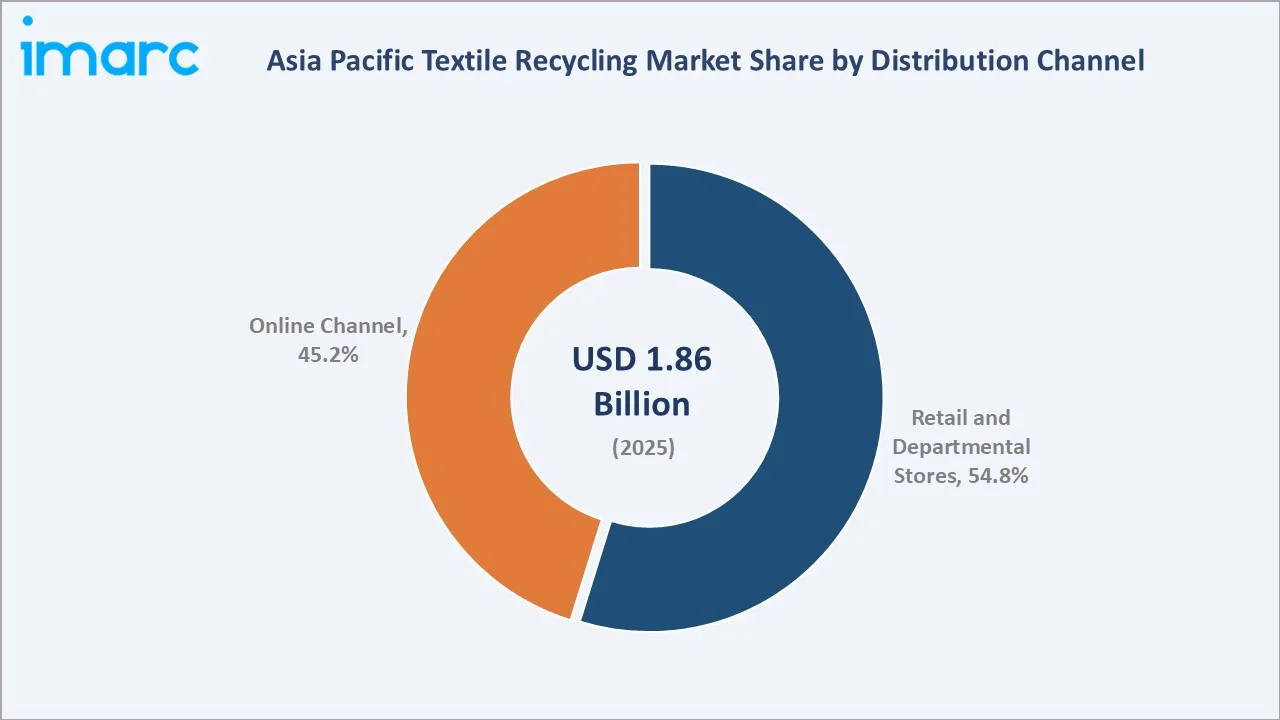
Online channel at 45.2% is expanding rapidly as e-commerce platforms and direct-to-consumer resale and recycling programs simplify garment drop-off and mail-back logistics, particularly among younger, digitally engaged urban consumers.
Regional Market Insights
|
Country |
Share (2025) |
Key Growth Drivers |
|
China |
43.7% |
Large-scale textile manufacturing base, expanding EPR enforcement, and growing chemical recycling investment |
|
Japan |
15.6% |
Mature recycling infrastructure and established brand-led take-back programs |
|
India |
13.8% |
Expanding domestic garment manufacturing and rising formal recycling investment |
|
South Korea |
9.8% |
Advanced fiber manufacturing base and growing sustainable fashion demand |
|
Australia |
6.7% |
Established collection networks and supportive state-level waste policy |
|
Indonesia |
5.4% |
Expanding textile export base and rising government focus on waste management |
|
Others |
5.0% |
Gradual formalization of collection and recycling infrastructure |
China at 43.7% in 2025 dominates the market, anchored by its leading textile manufacturing and export base. Large-scale pre-consumer waste generation, tightening EPR enforcement, and growing chemical recycling investment support sustained regional leadership.
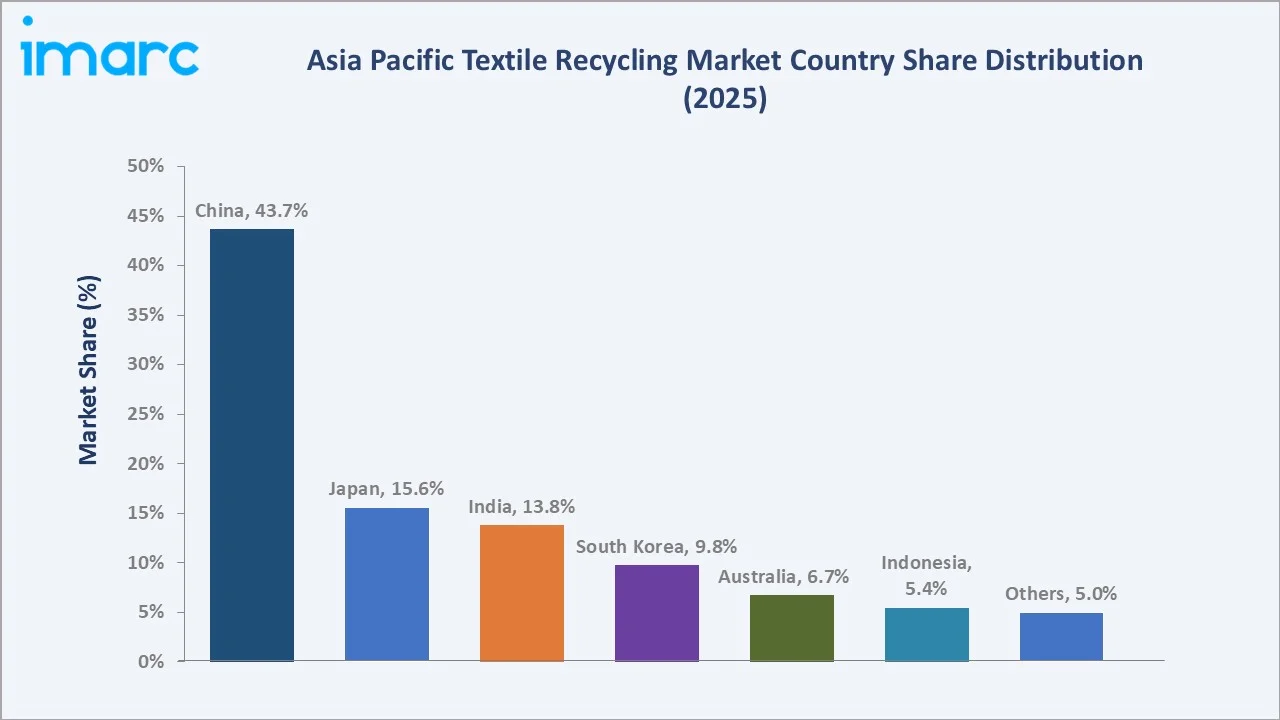
India, at 13.8% share, is the fastest growing market. Expanding domestic garment manufacturing capacity, government-backed textile infrastructure programs, and rising formal recycling investment are accelerating regional expansion through 2034.
Competitive Landscape
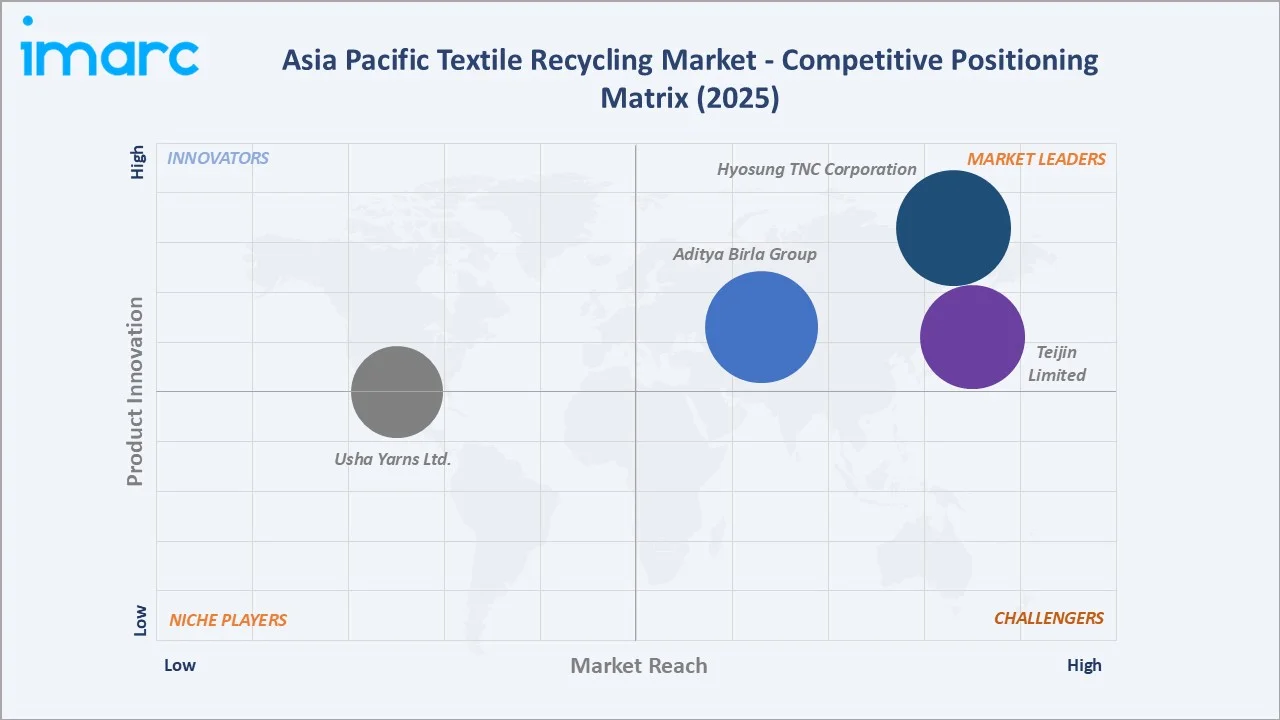
The Asia Pacific textile recycling market is moderately fragmented, with established regional processors leading technology depth and manufacturing scale, while specialized recyclers compete on niche fiber-recovery capabilities. Technology depth, feedstock access, and regulatory readiness form the key competitive moats.
|
Company Name |
Brand / Key Product |
Position |
Strategic Focus |
|
Teijin Limited |
ECOPET - Recycled Polyester Fiber |
Leader |
Chemical and mechanical recycling technology leadership with regional manufacturing partnerships |
|
Aditya Birla Group |
Liva Reviva |
Leader |
Sustainable and recycled-content cellulosic fiber scale-up across regional manufacturing operations |
|
Hyosung TNC Corporation |
regen |
Leader |
Recycled polyester capacity expansion supporting regional apparel brand demand |
|
Usha Yarns Ltd. |
Recycled Cotton Rich Yarn |
Emerging |
Regional recycled yarn manufacturing focused on the Indian textile industry |
Key players include Teijin Limited, Aditya Birla Group, Hyosung TNC Corporation, and Usha Yarns Ltd., among others.
Key Company Profiles
Teijin Limited
Teijin Limited is a Japan-headquartered materials group with an established fibers and textiles business, operating in the Asia Pacific textile recycling market through its recycled polyester fiber product line.
- Product Portfolio: ECOPET - Recycled Polyester Fiber, produced through mechanical and chemical recycling processes for apparel, sportswear, and industrial applications.
- Recent Developments: Teijin Limited continues to expand its recycled polyester capabilities and develop technologies that support the use of recycled materials across its fiber and textile businesses.
- Strategic Focus: Strengthening recycling technology leadership and expanding regional manufacturing partnerships to support the supply of recycled fiber across Asia Pacific.
Aditya Birla Group
Aditya Birla Group is a diversified global conglomerate with a presence in sustainable and recycled-content fiber manufacturing, serving apparel and textile markets across the Asia Pacific region.
- Product Portfolio: Liva Reviva recycled cellulosic fiber for apparel and home textile applications.
- Recent Developments: The group has continued to expand its recycled-content fiber capacity and certification coverage across its regional manufacturing operations.
- Strategic Focus: Scaling sustainable and recycled-content fiber production to meet regional and global brand sustainability commitments.
Hyosung TNC Corporation
Hyosung TNC Corporation is a South Korea-headquartered fiber manufacturer producing a range of textile materials, including recycled fiber for regional and global apparel markets.
- Product Portfolio: regen recycled polyester fiber and yarn for apparel, footwear, and industrial textile applications.
- Recent Developments: The company has continued expanding its recycled fiber production capacity and certification coverage to meet rising regional brand demand.
- Strategic Focus: Expanding recycled polyester production capacity and deepening brand partnerships across regional supply chains.
Market Concentration Analysis
The Asia Pacific textile recycling market is moderately fragmented, with the leading processors, including Teijin Limited, Aditya Birla Group, and Hyosung TNC Corporation, accounting for a meaningful share of regional recycled-fiber output through diversified manufacturing and technology partnerships.
Barriers to entry include the high capital cost of chemical recycling infrastructure, the need for contamination-controlled feedstock, and the ability to navigate differing regional EPR frameworks, favoring established processors with integrated collection relationships and proprietary technology.
Consolidation is gradually accelerating as larger processors acquire specialized recycling technology and smaller recyclers partner with fiber manufacturers for broader distribution access. Strategic partnerships between recyclers, brands, and sorting operators are reinforcing competitive positioning.
Investment & Growth Opportunities
Fastest-Growing Segments
Online channel, expanding above the overall market rate, is the fastest-growing segment, driven by digital take-back platforms and improving collection logistics. Post-consumer textile is the next-fastest textile waste category, supported by expanding brand take-back programs.
Emerging Markets
India is the fastest growing market, anchored by expanding domestic garment manufacturing and rising formal recycling investment. Indonesia also presents significant untapped opportunity as its textile export base continues to expand.
Venture & Investment Trends
Investment is concentrated in chemical recycling technology, AI-enabled sorting, and digital traceability platforms. Capital is also flowing into blended-fiber separation technology addressing a persistent technical bottleneck.
Future Market Outlook (2026-2034)
The Asia Pacific textile recycling market is forecast to expand from USD 1.86 Billion in 2025 to USD 2.33 Billion by 2034 at a CAGR of 2.41%, adding roughly USD 0.47 Billion in incremental market value over the forecast period.
Three forces will shape the market through 2034: expanding blended-fiber chemical recycling capacity, tightening EPR and recycled-content regulations, and deeper integration between digital collection platforms and formal recycling infrastructure.
By 2034, the Asia Pacific textile recycling market is expected to be defined by higher-quality, closed-loop fiber regeneration, with post-consumer textile and the online distribution channel accounting for a meaningfully higher share of overall market activity than today.
Research Methodology
Primary Research
Primary research included structured interviews with recycling plant operators, textile executives, apparel sustainability leads, and regulatory specialists, validating market sizing, segment mix, and regional demand patterns.
Secondary Research
Secondary sources included environment ministry publications, EPR policy documents, industry association data, and sustainability disclosures from listed textile manufacturers and recyclers.
Forecasting Models
Forecasts used top-down and bottom-up models combining waste generation volumes, recycling capacity utilization, regulatory transition scenarios, and macroeconomic variables.
Report Coverage:
| Report Features | Details |
|---|---|
| Base Year of the Analysis | 2025 |
| Historical Period | 2020-2025 |
| Forecast Period | 2026-2034 |
| Units | Billion USD |
| Scope of the Report | Exploration of Historical Trends and Market Outlook, Industry Catalysts and Challenges, Segment-Wise Historical and Future Market Assessment:
|
| Product Types Covered | Cotton Recycling, Wool Recycling, Polyester & Polyester Fibre Recycling, Nylon & Nylon Fibre Recycling, Others |
| Textile Wastes Covered | Pre-consumer Textile, Post-consumer Textile |
| Distribution Channels Covered | Online Channel, Retail & Departmental Stores |
| End Uses Covered | Apparel, Industrial, Home Furnishings, Non-woven, Others |
| Countries Covered | China, Japan, India, South Korea, Australia, Indonesia, Others |
| Companies Covered | Teijin Limited, Aditya Birla Group, Hyosung TNC Corporation, Usha Yarns Ltd., etc. |
| Customization Scope | 10% Free Customization |
| Post-Sale Analyst Support | 10-12 Weeks |
| Delivery Format | PDF and Excel through Email (We can also provide the editable version of the report in PPT/Word format on special request) |
Frequently Asked Questions About the Asia Pacific Textile Recycling Market Report
The Asia Pacific textile recycling market was valued at USD 1.86 Billion in 2025, driven by rising textile waste volumes, tightening EPR regulation, and growing brand-led circularity commitments.
The market is projected to grow at a CAGR of 2.41% from 2026-2034, reaching USD 2.33 Billion, supported by expanding chemical recycling capacity and recycled-content adoption.
Pre-consumer textile leads the textile waste segment at 57.4% in 2025, driven by high volumes of cutting scraps and defective fabric generated across regional garment manufacturing hubs.
Retail and departmental stores dominate distribution channel at 54.8% in 2025, supported by established in-store collection bins and long-standing retailer partnerships with regional recyclers.
China commands 43.7% share in 2025, led by its large-scale textile manufacturing base and expanding EPR enforcement.
India is the fastest growing regional market, supported by expanding domestic garment manufacturing and rising formal recycling investment.
Leading players include Teijin Limited, Aditya Birla Group, Hyosung TNC Corporation, and Usha Yarns Ltd., among others.
Chemical recycling enables processing of blended and colored textile waste into higher-quality fiber, expanding the addressable feedstock base beyond single-fiber materials.
High technology costs, quality degradation in mechanically recycled fiber, and fragmented collection infrastructure remain key restraints across the region.
Need more help?
- Speak to our experienced analysts for insights on the current market scenarios.
- Include additional segments and countries to customize the report as per your requirement.
- Gain an unparalleled competitive advantage in your domain by understanding how to utilize the report and positively impacting your operations and revenue.
- For further assistance, please connect with our analysts.
 Request Customization
 Speak to an Analyst
 Request Brochure
 Inquire Before Buying
Benefits of Customization
- Personalize this research
- Triangulate with your data
- Get data as per your format and definition
- Gain a deeper dive into a specific application, geography, customer, or competitor
- Any level of personalization
Get in Touch With Us
UNITED STATES
Phone: +1-201-971-6302
INDIA
Phone: +91-120-433-0800
UNITED KINGDOM
Phone: +44-753-714-6104
Email: [email protected]
Client Testimonials




.webp)




.webp)













Related Reports

Choose your plan
*Please note that the prices mentioned below are starting prices for each bundle type. Kindly contact our team for further details.*
Single User License
- 1 User License, Access on 2 Devices
- PDF Report + Excel Dataset (Password Protected)
- Lifetime Access
- No Printing Rights
- 10% Free Report Customization
- 10–12 Weeks of Analyst Support
Five User License
- Access for 5 Users, 2 Devices per User
- PDF Report + Excel Dataset (Password Protected)
- Lifetime Access
- Dedicated Account Manager
- 12–14 Weeks of Analyst Support
- No Printing Rights
- 15% Free Report Customization
- 25% Discount on Your Next Purchase
Corporate User License
- Unlimited User Access (Within Your Organization)
- PDF Report + Excel Dataset
- Lifetime Access
- Dedicated Account Manager
- 14–20 Weeks of Analyst Support
- No Printing Rights
- 20% Free Report Customization
- 30% Discount on Your Next Purchase
Essential Insights
What's included:
3 reports
- Lifetime Access
- PDF Reports
- Excel Datasets
- 2 Weeks of Free Analyst Support
- 2 User Licenses
- Access on 2 Devices
- Printing Rights
- Complimentary PowerPoint (PPT) Version
- Complimentary License Upgrade
Professional Access
What's included:
5 reports
- Lifetime Access
- PDF Reports
- Excel Datasets
- 8 Weeks of Free Analyst Support
- 2 User Licenses
- Access on 2 Devices
- Printing Rights
- Complimentary PowerPoint (PPT) Version
- Complimentary License Upgrade
Business Advantage
What's included:
8 reports
- Lifetime Access
- PDF Reports
- Excel Datasets
- 14 Weeks of Free Analyst Support
- 2 User Licenses
- Access on 2 Devices
- Printing Rights
- Complimentary PowerPoint (PPT) Version
- Complimentary License Upgrade
Enterprise Intelligence
What's included:
10 reports
- Lifetime Access
- PDF Reports
- Excel Datasets
- 20 Weeks of Free Analyst Support
- 2 User Licenses
- Access on 2 Devices
- Printing Rights
- Complimentary PowerPoint (PPT) Version
- Complimentary License Upgrade