
Asia Pacific Wi-Fi Chipset Market Size, Share, Trends and Forecast by Product, Band, MIMO Configuration, and Country, 2026-2034
Asia Pacific Wi-Fi Chipset Market Size, Share, Trends & Forecast (2026-2034)
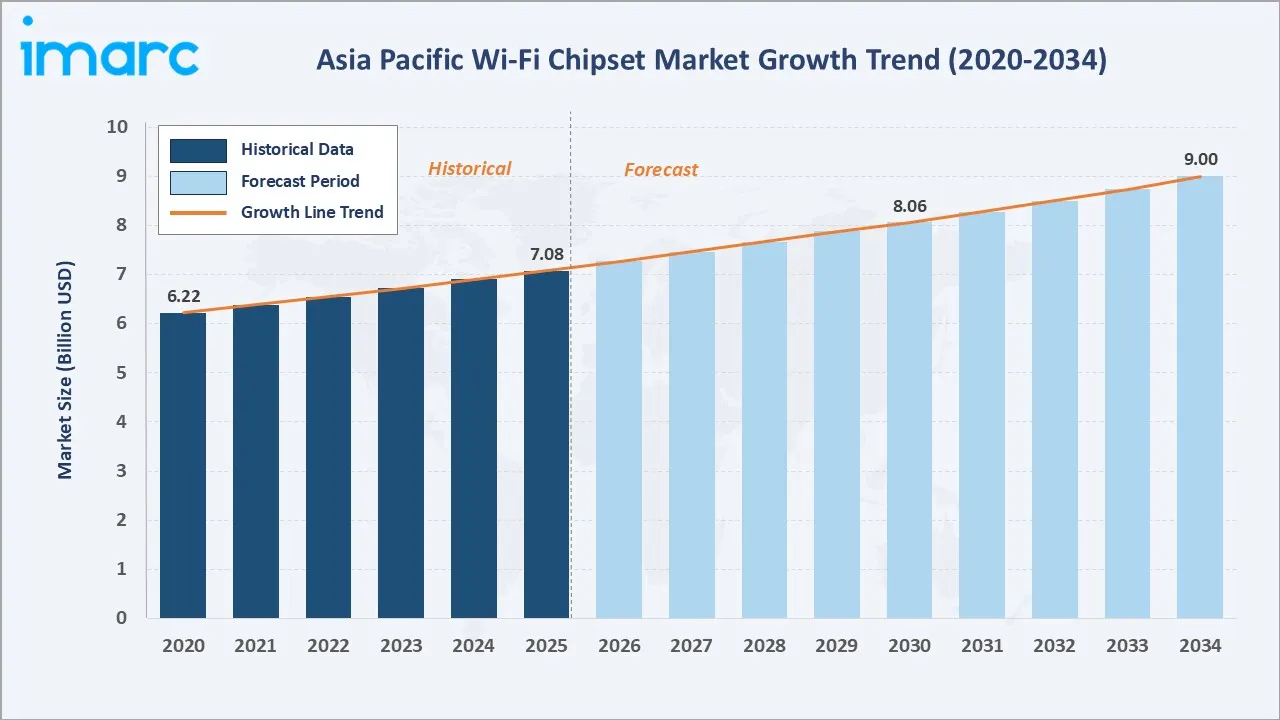
The Asia Pacific Wi-Fi chipset market grew from USD 7.08 Billion in 2025 to USD 7.26 Billion in 2026 and is projected to reach USD 9.00 Billion by 2034, growing at a CAGR of 2.63% during 2026-2034. The market is propelled by rising IoT device penetration, growing enterprise Wi-Fi 6 and Wi-Fi 7 adoption, and government-backed digital connectivity programs across the region. Dual band leads at 58.6% by band type, SU-MIMO dominates at 56.8% by MIMO configuration, and China commands the largest regional share at 36.5% in 2025.
Market Snapshot
|
Metric |
Value |
|
Base Year Market Size (2025) |
USD 7.08 Billion |
|
Market Size (2026) |
USD 7.26 Billion |
|
Forecast Market Size (2034) |
USD 9.00 Billion |
|
CAGR (2026-2034) |
2.63% |
|
Base Year |
2025 |
|
Historical Period |
2020-2025 |
|
Forecast Period |
2026-2034 |
| Dominant Band |
Dual Band (58.6%, 2025) |
| Dominant MIMO Configuration |
SU-MIMO (56.8%,, 2025) |
|
Leading Country |
China (36.5%, 2025) |
The Asia Pacific Wi-Fi chipset market grew from USD 6.22 Billion in 2020 to USD 7.08 Billion in 2025, and further to USD 7.26 Billion in 2026, reflecting sustained demand for wireless connectivity across consumer electronics, enterprise networks, and industrial IoT. The market is projected to reach USD 8.06 Billion by 2030 before reaching USD 9.00 Billion by 2034.
To get more information on this market, Request Sample
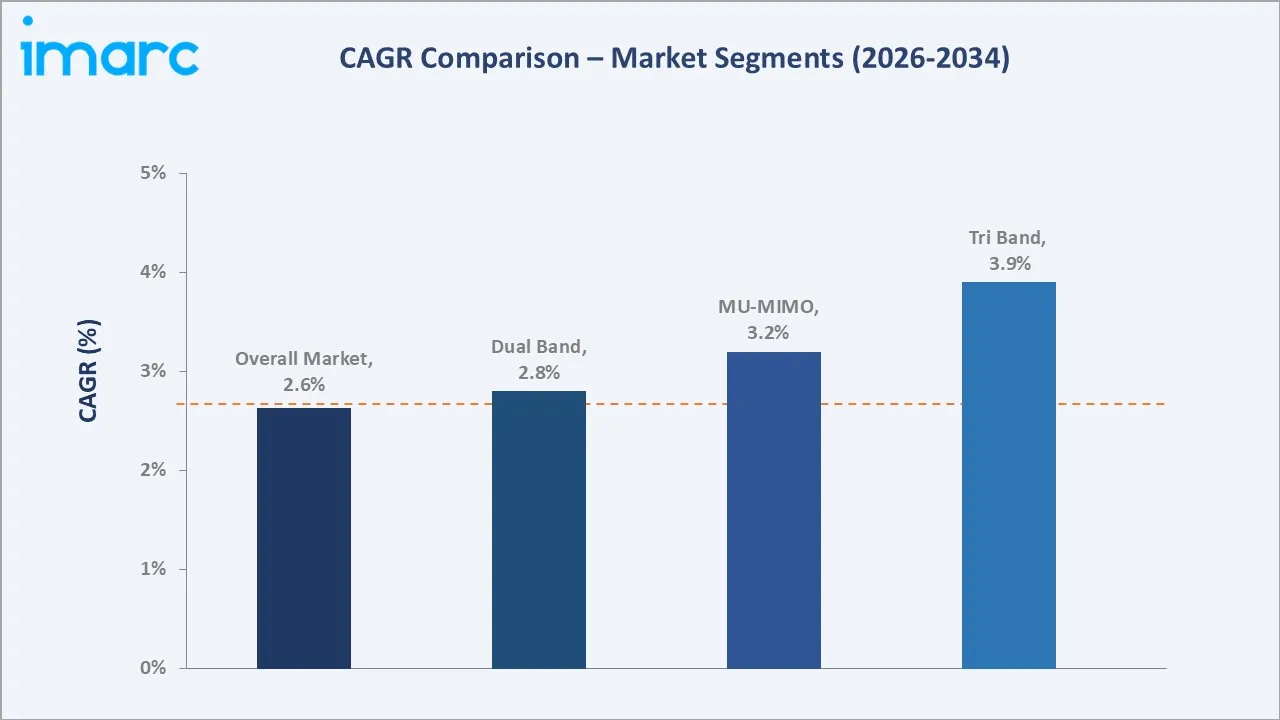
Tri band chipsets are growing at a 3.9% CAGR as Wi-Fi 7 adoption accelerates across high-density enterprise environments, smart offices, and premium residential gateways requiring simultaneous multi-band performance. MU-MIMO configuration, at a 3.2% CAGR, benefits from enterprise access point upgrades supporting multiple concurrent device connections. Dual Band is growing at a 2.8% CAGR, driven by continued replacement demand across consumer and SMB segments.
Executive Summary
The Asia Pacific Wi-Fi chipset market is on a measured but sustained growth trajectory, supported by the widespread proliferation of smart devices, accelerating enterprise wireless network upgrades, and government-led broadband expansion programs across both developed and emerging economies in the region.
Dual band at 58.6% remains the dominant band configuration, reflecting the broad installed base of dual-band routers, access points, and connected devices across residential and commercial applications. SU-MIMO at 56.8% retains the majority MIMO share. China leads regionally at 36.5%.
Key Market Insights
|
Insight |
Data |
|
Dominant Band |
Dual Band – 58.6% share (2025) |
|
Dominant MIMO Configuration |
SU-MIMO – 56.8% share (2025) |
|
Leading Country |
China – 36.5% (2025) |
| Key Market Opportunity | Wi-Fi 7 technology transition and industrial IoT expansion are creating multi-year upgrade demand across enterprise, manufacturing, and smart city segments. |
Key Analytical Observations:
- Dual Band at 58.6%: Dual Band chipsets dominate because they serve the broadest range of consumer devices, from smartphones and laptops to smart TVs and home routers, offering a balance of performance and cost that makes them the default choice for mass-market connectivity applications across the region.
- SU-MIMO at 56.8%: SU-MIMO retains majority share reflecting the large installed base of consumer-grade devices and entry-level enterprise equipment; however, the approaching parity with MU-MIMO (43.2%) signals an accelerating technology shift driven by enterprise Wi-Fi 6 and Wi-Fi 7 deployments.
- China at 36.5%: China's regional leadership is underpinned by its position as the largest consumer electronics manufacturing hub, combined with large-scale domestic smart home deployments, 5G Wi-Fi offloading infrastructure, and government-backed digital city programs.
Asia Pacific Wi-Fi Chipset Market Overview
The Asia Pacific Wi-Fi chipset market encompasses the design, manufacturing, and distribution of semiconductor integrated circuits enabling wireless LAN connectivity across consumer, enterprise, and industrial applications. Core product categories include single-band, dual-band, and tri-band chipsets supporting Wi-Fi standards from Wi-Fi 5 through Wi-Fi 7, as well as combo chipsets integrating Wi-Fi with Bluetooth and other wireless technologies.
The market serves a broad ecosystem spanning consumer electronics manufacturers, networking equipment OEMs, enterprise infrastructure vendors, IoT device makers, and telecom operators. Macroeconomic tailwinds including rising per-capita digital device ownership, enterprise digital transformation, and government broadband universalization programs across South and Southeast Asia are sustaining consistent demand growth.
Market Dynamics
To evaluate market opportunities, Request Sample
Market Drivers
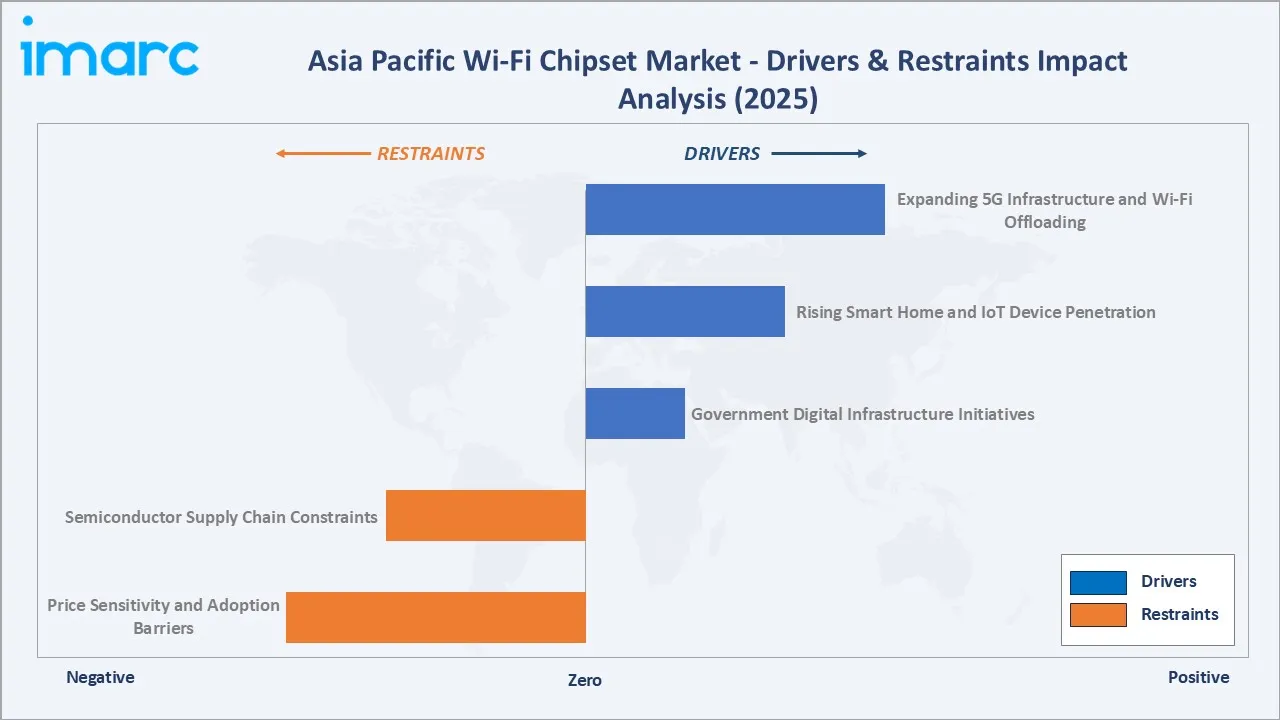
- Expanding 5G Infrastructure and Wi-Fi Offloading: As of February 28, 2025, telecom service providers had installed approximately 469,000 5G Base Transceiver Stations (BTSs) across India, representing one of the fastest 5G network rollouts in the country. Telecom operators across Asia Pacific are rapidly deploying 5G networks and relying on Wi-Fi offloading to manage mobile data traffic, requiring dense Wi-Fi access point installations in public venues, residential buildings, and commercial facilities. This directly stimulates demand for dual-band and tri-band chipsets capable of handling high-density concurrent connections.
- Rising Smart Home and IoT Device Penetration: Asia Pacific's smart home market is expanding rapidly, with connected devices including smart speakers, security cameras, smart appliances, and mesh routers requiring Wi-Fi chipsets at every node. Consumer demand for seamless multi-device connectivity is driving upgrades from single-band to dual-band and tri-band solutions.
- Government Digital Infrastructure Initiatives: The Government of India launched the National Broadband Mission 2.0 on January 17, 2025, to accelerate digital infrastructure expansion, bridge the digital divide, and ensure high-speed broadband access nationwide. Meanwhile, the Pradhan Mantri Gramin Digital Saksharta Abhiyan (PMGDISHA) trained 6.39 crore individuals against its target of 6 crore rural households, with training and certification concluding on March 31, 2024. National broadband programs across emerging Asia Pacific economies are extending internet access to underserved regions, driving ISP deployments of Wi-Fi-enabled CPE devices and creating volume demand for cost-effective single-band and dual-band chipsets.
Market Restraints
- Semiconductor Supply Chain Constraints: The Wi-Fi chipset market is subject to supply chain disruptions across the semiconductor ecosystem, including raw material shortages, wafer fabrication capacity limitations, and packaging constraints that affect chipset availability and procurement timelines for networking equipment manufacturers.
- Price Sensitivity and Adoption Barriers: Price sensitivity in cost-driven market segments constrains the transition from entry-level to higher-performance chipset configurations, particularly in volume-driven consumer and SME segments where budget constraints limit upgrade cycles.
Market Opportunities
- Wi-Fi 7 Technology Transition: The commercial rollout of Wi-Fi 7 is creating a significant chipset upgrade cycle across premium consumer devices, enterprise access points, and industrial wireless systems. Multi-link operation, expanded channel bandwidth, and advanced modulation capabilities are driving adoption across high-value segments throughout the region.
- Smart City and Industrial IoT Applications: Expanding smart city deployments and Industry 4.0 manufacturing automation are driving demand for ruggedized, low-latency industrial-grade Wi-Fi chipsets, opening a high-value niche segment beyond traditional consumer and enterprise applications.
Market Challenges
- Technology Lifecycle Compression: The rapid evolution of wireless standards creates compressed product lifecycle windows for chipset vendors, requiring continuous investment in next-generation silicon development while managing the depreciation of existing product lines across diversified customer bases.
- Regulatory Compliance Complexity: Chipset vendors operating across multiple Asia Pacific jurisdictions must manage diverse spectrum allocation policies, device certification requirements, and radio frequency regulations, increasing compliance costs and time-to-market across regional markets.
Emerging Market Trends
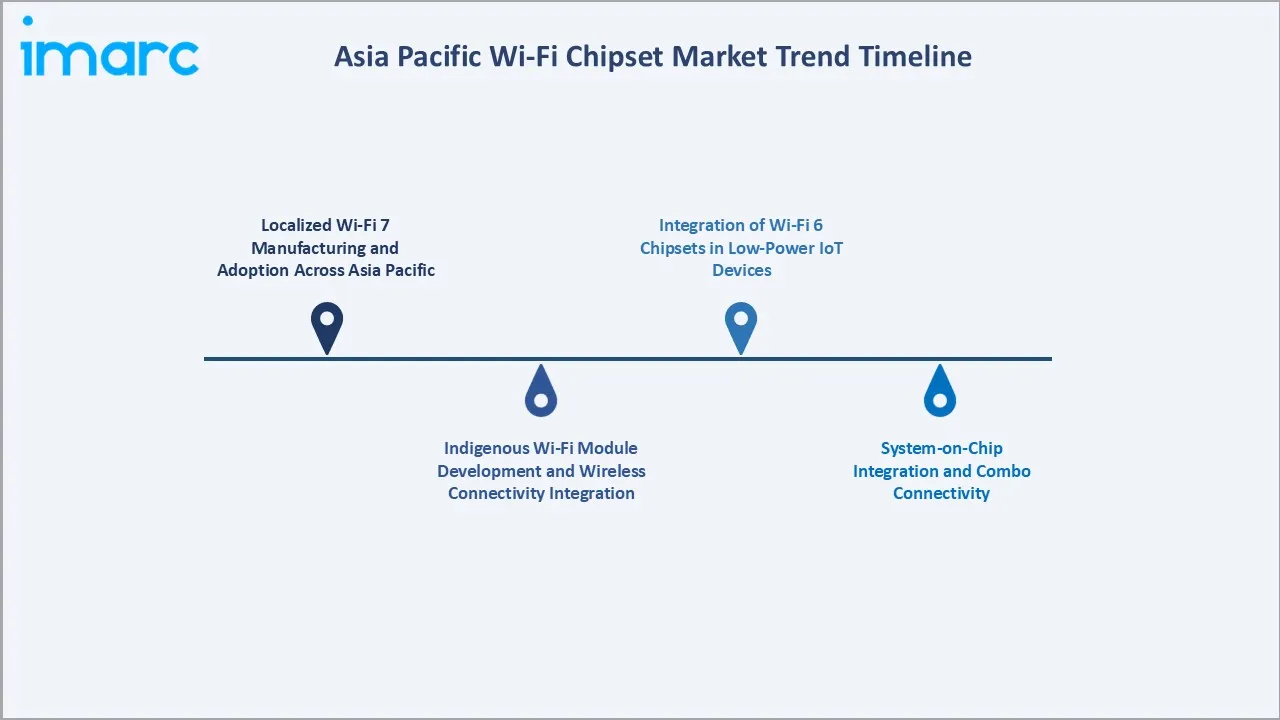
1. Localized Wi-Fi 7 Manufacturing and Adoption Across Asia Pacific
The localization of Wi-Fi 7 manufacturing and the availability of the lower 6 GHz spectrum are accelerating the adoption of advanced wireless connectivity solutions across Asia Pacific. In May 2026, TP-Link India commenced local manufacturing of its Wi-Fi 7 product portfolio, starting with the Omada EAP770 enterprise access point, following India's January 2026 delicensing of the lower 6 GHz spectrum band. The company plans to gradually expand domestic production to meet local demand and serve selected international markets.
2. Indigenous Wi-Fi Module Development and Wireless Connectivity Integration
The development of locally manufactured Wi-Fi modules across Asia Pacific is supporting the integration of wireless connectivity into surveillance systems, IP cameras, and smart devices. In August 2026, IndieSemiC launched its Made-in-India ISC-8188-B Wi-Fi module to enable wireless connectivity in IP cameras, surveillance systems, and other vision devices. The module functions as a USB-to-Wi-Fi bridge, allowing manufacturers to integrate wireless capabilities without redesigning existing hardware.
3. Integration of Wi-Fi 6 Chipsets in Low-Power IoT Devices
In December 2025, Renesas Electronics Corporation introduced the RA6W1 dual-band Wi-Fi 6 wireless microcontroller and the RA6W2 MCU integrating Wi-Fi 6 and Bluetooth Low Energy. Designed for low-power IoT applications across smart homes, industrial, medical, and consumer sectors, the company also launched integrated modules featuring built-in antennas and pre-validated wireless connectivity. The integration of Wi-Fi 6 and Bluetooth Low Energy technologies is supporting the development of energy-efficient, connected devices across the Asia Pacific region.
4. System-on-Chip Integration and Combo Connectivity
The consolidation of Wi-Fi, Bluetooth, and Thread functionality into single SoC platforms is gaining momentum across the IoT and smart home device segments. Combo chipsets reduce device bill-of-materials cost, power consumption, and board footprint, making them increasingly attractive for cost-sensitive connected device categories including wearables, smart home sensors, and residential IoT hubs.
Industry Value Chain Analysis
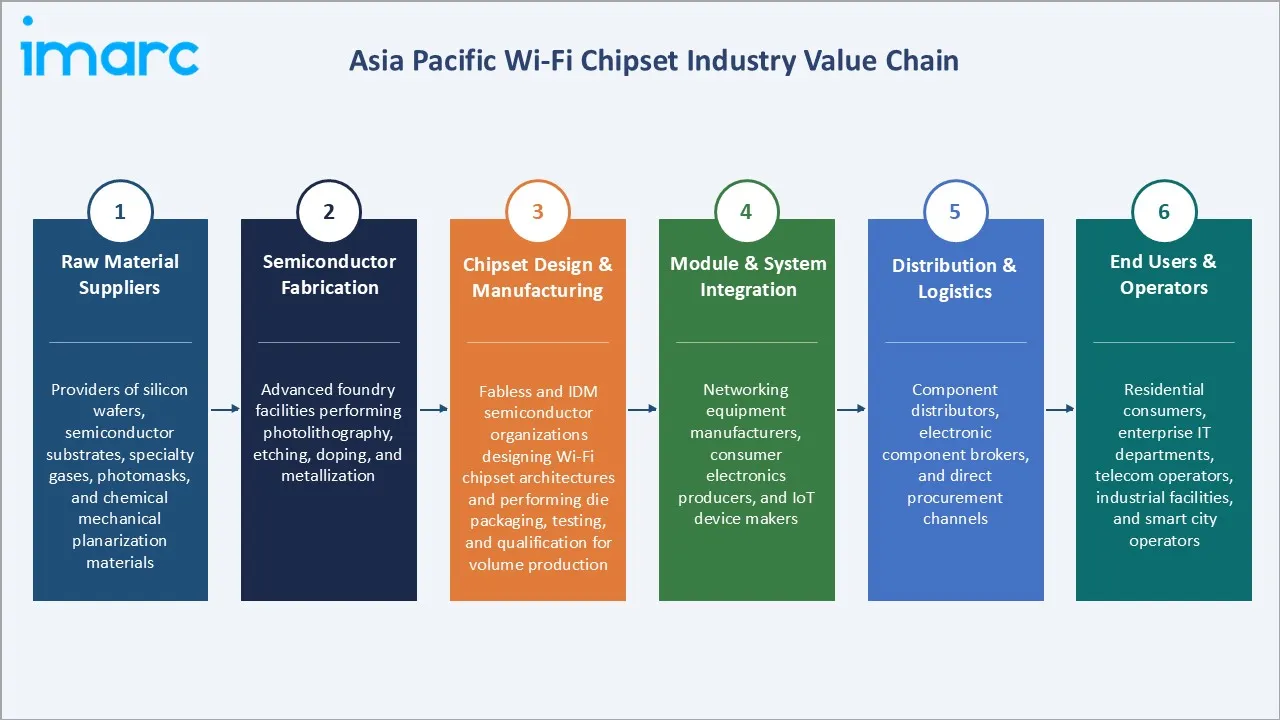
The Asia Pacific Wi-Fi chipset value chain is structured across six integrated stages from raw material sourcing to end-user deployment. Each stage creates distinct value through materials processing, wafer fabrication, chipset design, system integration, distribution, and final end-user adoption.
|
Stage |
Key Participants |
| Raw Material Suppliers | Providers of silicon wafers, semiconductor substrates, specialty gases, photomasks, and chemical mechanical planarization materials. |
| Semiconductor Fabrication | Advanced foundry facilities performing photolithography, etching, doping, and metallization. |
| Chipset Design & Manufacturing | Fabless and IDM semiconductor organizations designing Wi-Fi chipset architectures and performing die packaging, testing, and qualification for volume production. |
| Module & System Integration | Networking equipment manufacturers, consumer electronics producers, and IoT device makers. |
| Distribution & Logistics | Component distributors, electronic component brokers, and direct procurement channels. |
| End Users & Operators | Residential consumers, enterprise IT departments, telecom operators, industrial facilities, and smart city operators. |
The chipset design and manufacturing stage holds the greatest strategic value in the value chain. Semiconductor fabrication requires sustained capital expenditure at advanced process nodes, creating high barriers to entry. Distribution is progressively shifting toward direct OEM procurement and digital channels, improving supply chain responsiveness and efficiency.
Technology Landscape in the Asia Pacific Wi-Fi Chipset Industry
Advanced MIMO and Beamforming Technologies
MU-MIMO technology is evolving toward higher spatial stream counts in Wi-Fi 7, supporting a greater number of simultaneous user transmissions. Combined with improved beamforming algorithms and enhanced OFDMA scheduling, advanced MIMO technologies enable higher aggregate throughput and more efficient spectrum utilization in dense multi-device environments such as enterprise campuses, hospitality venues, and smart stadiums.
System-on-Chip Integration and Combo Chipsets
Leading chipset vendors are consolidating Wi-Fi, Bluetooth, and Thread functionality into single SoC platforms to reduce device BOM cost, power consumption, and board footprint. This integration trend is particularly relevant for IoT devices, smart home hubs, and wearables where space and power constraints are critical design parameters for product commercialization.
Power Optimization and Target Wake Time
Target Wake Time (TWT), introduced in Wi-Fi 6 and enhanced in Wi-Fi 7, allows devices to schedule communication windows, dramatically reducing power consumption for battery-powered IoT sensors and wearables. Power optimization at the chipset level is a key differentiator for IoT-focused vendors, supporting the expanding addressable market in low-power connected devices across smart home and industrial segments.
Market Segmentation Analysis
The report covers the following segments:
|
Segment Category |
Leading Segment |
Market Share |
Year |
| Product | Smartphones | 🔒 | 2025 |
| Band | Dual Band | 58.6% | 2025 |
| MIMO Configuration | SU-MIMO | 56.8% | 2025 |
| Country | China | 36.5% | 2025 |

By Band
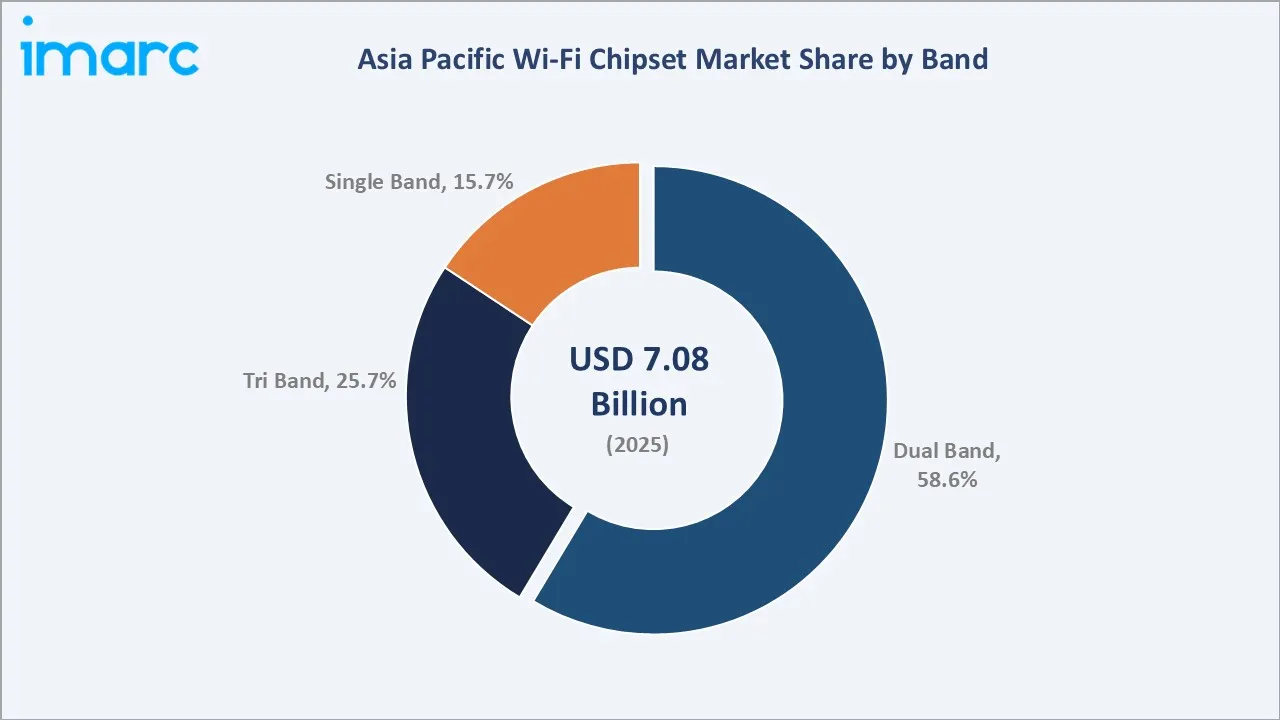
Dual band leads at 58.6% in 2025, reflecting its status as the standard configuration for mainstream consumer routers, access points, smartphones, and laptops across Asia Pacific. Dual band chipsets operating on 2.4 GHz and 5 GHz simultaneously offer a balance of range, speed, and device compatibility that makes them the default choice for mass-market Wi-Fi deployments.
To access detailed market analysis, Request Sample
Tri band at 25.7% is the fastest growing band segment, driven by its adoption in Wi-Fi 7 chipsets and premium mesh networking systems that require a dedicated 6 GHz backhaul link for optimal performance. Single band at 15.7% serves cost-sensitive IoT devices and legacy connected equipment, primarily in emerging markets and low-complexity smart home applications.
By MIMO Configuration
SU-MIMO leads at 56.8% in 2025, retaining its majority share through the broad installed base of consumer devices and entry-level enterprise equipment that operate on single-user spatial multiplexing. SU-MIMO chipsets are the prevalent choice for cost-sensitive consumer electronics, basic residential routers, and IoT devices where multi-user concurrent transmission is not required.
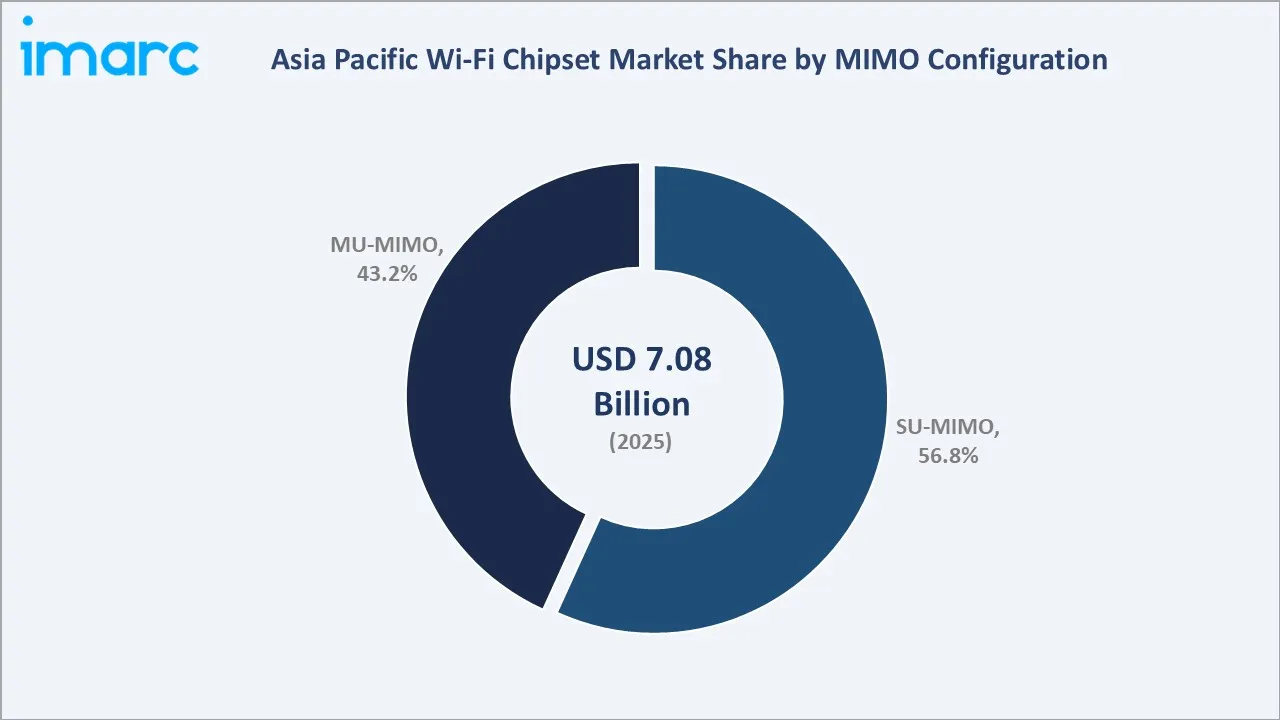
MU-MIMO at 43.2% reflects the accelerating enterprise access point upgrade cycle to Wi-Fi 6 and Wi-Fi 7 standards that mandate multi-user transmission capability. MU-MIMO enables simultaneous data transmission to multiple devices, improving effective throughput in high-density environments such as offices, airports, retail stores, and hospitality venues.
Regional Market Insights
| Country |
Share (2025) |
Key Drivers & Characteristics |
| China | 36.5% | Leading share driven by the largest consumer electronics manufacturing base, extensive smart home deployments, 5G-Wi-Fi integration programs, and massive enterprise and public network infrastructure investments. |
| Japan | 17.8% | High Wi-Fi density driven by premium consumer electronics demand, advanced enterprise network infrastructure, early Wi-Fi 7 adoption in high-rise urban buildings, and smart factory deployments across manufacturing industries. |
| India | 14.6% | Fastest growing major market driven by national broadband expansion programs, rising smartphone penetration, growing enterprise IT investment, and ISP deployments of Wi-Fi-enabled CPE equipment across urban and semi-urban areas. |
| South Korea | 12.7% | Advanced Wi-Fi adoption driven by high-density urban living requiring mesh networks, early enterprise Wi-Fi 6/7 rollouts, and strong government digital connectivity investment in smart city infrastructure. |
| Australia | 7.8% | Mature market with sustained enterprise Wi-Fi upgrade activity, smart home adoption, and growing demand for high-performance tri-band chipsets in residential and hospitality applications. |
| Indonesia | 5.9% | Emerging market with accelerating Wi-Fi adoption driven by rising smartphone penetration, expanding ISP broadband deployments, and growing digital commerce infrastructure requiring campus Wi-Fi solutions. |
| Others | 4.7% | Markets including Vietnam, Philippines, Thailand, and Malaysia contributing growing volume demand driven by digital transformation, smart city programs, and expanding consumer electronics consumption. |
China holds the largest regional share at 36.5% in 2025, underpinned by its role as the largest consumer electronics manufacturing hub, combined with sustained demand from smart home deployments, enterprise Wi-Fi upgrades, and government-backed digital connectivity programs at scale. Japan accounts for 17.8% of regional demand, supported by high Wi-Fi density in premium consumer electronics, advanced enterprise network infrastructure, and early adoption of Wi-Fi 7 technology across high-rise urban residential buildings and smart manufacturing facilities.
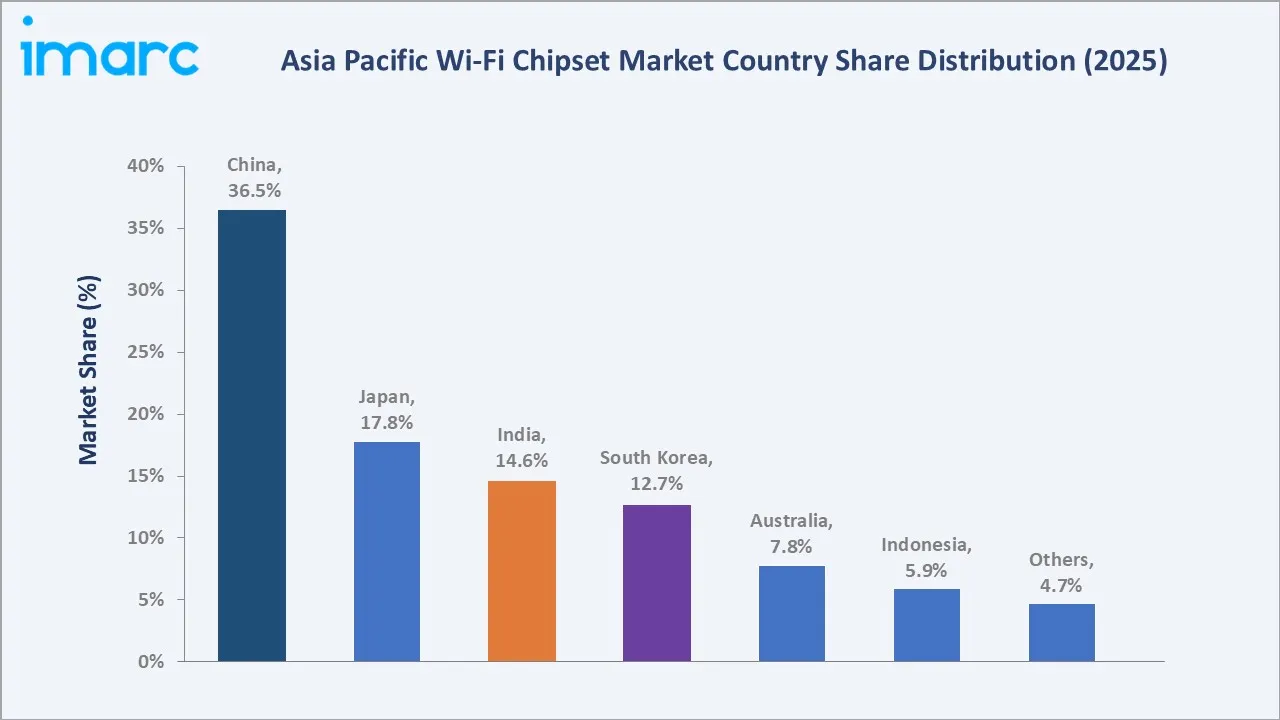
India represents 14.6% of the market and is the fastest-growing major geography in Asia Pacific. South Korea contributes 12.7%, driven by high-density urban apartment living has created strong adoption of mesh networking systems. Australia represents 7.8% of the market, characterized by mature enterprise Wi-Fi upgrade cycles and growing residential demand for tri-band chipsets in smart home and hospitality applications. Indonesia at 5.9% and the remaining markets (4.7%) represent emerging growth fronts driven by increasing broadband penetration, digital commerce infrastructure, and expanding smartphone adoption.
Competitive Landscape
The Asia Pacific Wi-Fi chipset market is moderately concentrated, with a small number of global semiconductor leaders commanding the majority of the premium and mid-range chipset segments, while a larger ecosystem of regional and specialist vendors competes across specific niches, including low-power IoT, industrial wireless, and cost-sensitive consumer applications.
|
Company |
Key Offerings |
Market Position |
Core Strength |
| Qualcomm Technologies, Inc. | FastConnect Series | Market Leader | Qualcomm Technologies, Inc. is a dominant market leader in the Asia-Pacific (APAC) Wi-Fi chipset landscape and plays a critical role as an architectural pioneer and key component supplier in APAC. |
| MediaTek | MediaTek MT7612E | Established Player | MediaTek plays a leading role in the APAC Wi-Fi chipset market by driving next-generation wireless standards, powering high-volume consumer and enterprise electronics. |
| Realtek Semiconductor Corp | RTL8195AM | Established Player | Realtek Semiconductor Corp. is a major mass-market supplier of cost-efficient communication network ICs and Wi-Fi chipsets. |
| NXP Semiconductors | NXP IW623 | Innovator | NXP Semiconductors plays a critical role in the Asia-Pacific Wi-Fi chipset and wireless ecosystem by supplying high-performance Wi-Fi 6, Wi-Fi 6E, and multi-protocol SoCs. |
| Espressif Systems | ESP32-S Series, ESP32-P Series, ESP32-C Series | Innovator | Espressif Systems plays a major role in the Asia-Pacific Wi-Fi microcontroller (MCU) and Internet of Things (IoT) chipset market, driven by low-cost integration, open-source software, and rapid expansion into Wi-Fi 6, 6E, and multi-protocol connectivity. |
Competition in the Asia Pacific Wi-Fi chipset market is intensifying as established leaders accelerate Wi-Fi 7 silicon roadmaps and emerging regional vendors capture growing IoT market share through cost-optimized, developer-friendly platforms. The competitive divide between premium enterprise-focused leaders and IoT-focused innovators is expected to persist through 2034.
Key Company Profiles
Qualcomm Technologies, Inc.
Qualcomm Technologies, Inc. is a leading semiconductor company specializing in wireless technology and integrated semiconductor solutions. Its FastConnect series serve a wide range of applications from flagship smartphones to enterprise access points and residential Wi-Fi gateways, combining Wi-Fi, Bluetooth, and cellular modem functionality in integrated solutions.
- Key Offerings: FastConnect Series.
- Strategic Focus: Strengthening integrated modem-Wi-Fi solutions for 5G smartphones, expanding IPQ enterprise platform for Wi-Fi 7 access point deployments, growing presence in automotive and industrial wireless IoT applications.
MediaTek
MediaTek is a fabless semiconductor company, with a broad portfolio spanning mobile SoCs, Wi-Fi chipsets, smart home, and broadband technologies. Its Wi-Fi platform targets mainstream consumer routers, smart home devices, and mid-range enterprise applications, offering competitive performance-per-dollar for cost-sensitive Asia Pacific markets.
- Key Offerings: MediaTek MT7612E
- Strategic Focus: Expanding Wi-Fi 7 chipset market share in Asia Pacific through competitive pricing and strong OEM partnerships; deepening integration of Wi-Fi with its mobile SoC platform for flagship Android devices.
Market Concentration Analysis
The Asia Pacific Wi-Fi chipset market exhibits moderate to high concentration in the premium and enterprise segments. A small number of established global semiconductor leaders command the majority of revenue from high-performance Wi-Fi 6 and Wi-Fi 7 chipset categories. This concentration reflects the significant R&D investment, advanced fabrication process node access, and broad customer ecosystem relationships required to develop and sustain competitive next-generation Wi-Fi chipset platforms.
The consumer and IoT chipset segments present a more fragmented competitive landscape, with a larger number of mid-tier and specialist vendors competing on cost, power efficiency, developer ecosystem support, and application-specific performance. Consolidation activity remains limited in these segments, as the diversity of end-use applications and device form factors supports a broad range of chipset providers. The overall market structure is expected to remain moderately concentrated at the premium tier while fragmentation persists across volume IoT and consumer categories through 2034.
Investment & Growth Opportunities
Fastest Growing Segments
Tri band chipsets at a 3.9% CAGR represent the highest growth segment, driven by Wi-Fi 7 adoption and mesh networking expansion. MU-MIMO at 3.2% CAGR is the second highest, as enterprise access point upgrades accelerate. Industrial IoT Wi-Fi chipsets, while a niche segment, offer premium pricing and strong demand visibility from smart manufacturing and logistics applications across the region.
Investment Themes
- Wi-Fi 7 Chipset R&D and Commercialization: Investment in Wi-Fi 7 silicon development and manufacturing is the highest-priority theme for established vendors, with the technology transition expected to drive premium chipset replacement demand through 2028 across consumer and enterprise segments.
- Emerging Market Infrastructure: High-growth Asia Pacific economies offer significant volume growth opportunities as broadband penetration expands, with ISP and enterprise Wi-Fi infrastructure deployments creating sustained demand for cost-competitive dual-band chipsets in these markets.
- Industrial and Automotive Wi-Fi: Smart factory automation, connected vehicle infotainment, and industrial IoT applications represent emerging high-value chipset demand segments where differentiated performance, reliability, and long-term supply commitments command premium pricing.
Future Market Outlook (2026-2034)
The Asia Pacific Wi-Fi chipset market grew from USD 7.08 Billion in 2025 to USD 7.26 Billion in 2026 and is projected to reach USD 9.00 Billion by 2034, exhibiting a CAGR of 2.63% during 2026-2034. The market is expected to reach an intermediate milestone of approximately USD 8.06 Billion by 2030, as Wi-Fi 7 commercial deployments reach scale across developed Asia Pacific markets and India's rapidly growing digital infrastructure drives above-average demand growth from 2026 onward.
Three structural forces will define the Asia Pacific Wi-Fi chipset market through 2034. First, the Wi-Fi 7 technology transition will drive a multi-year upgrade cycle across consumer, enterprise, and industrial segments, shifting the mix toward higher-value tri-band and MU-MIMO chipsets and expanding per-unit revenue for leading vendors. Second, the rapid expansion of IoT and smart infrastructure applications will broaden the addressable chipset market beyond traditional router and client device categories, creating new demand from industrial automation, smart city, and automotive connectivity segments. Third, accelerating digitalization across emerging Asia Pacific markets will contribute incremental volume demand that sustains aggregate market growth.
Research Methodology
Primary Research
Primary research comprised structured consultations with Wi-Fi chipset design engineers, networking equipment procurement managers, enterprise IT infrastructure directors, telecommunications operators, and consumer electronics manufacturing executives across Asia Pacific. These discussions validated market sizing estimates, assessed technology adoption timelines, and identified competitive positioning dynamics across the chipset value chain.
Secondary Research
Secondary research drew on Wi-Fi Alliance certification data, semiconductor company annual reports and investor presentations, government broadband policy documents, IDC and industry analyst publications on wireless networking markets, and trade press covering semiconductor and networking technology sectors across Asia Pacific.
Forecasting Models
Market forecasts were developed using bottom-up and top-down modeling incorporating historical chipset shipment data, device attachment rate analysis, Wi-Fi standard adoption S-curves, enterprise network refresh cycle modeling, regional device ownership and broadband penetration projections, semiconductor capacity and pricing trend analysis, and macroeconomic indicators including GDP growth, digital device penetration, and ICT investment rates across Asia Pacific economies.
Asia Pacific Wi-Fi Chipset Market Report Coverage:
| Report Features | Details |
|---|---|
| Base Year of the Analysis | 2025 |
| Historical Period | 2020-2025 |
| Forecast Period | 2026-2034 |
| Units | Billion USD |
| Scope of the Report |
Exploration of Historical Trends and Market Outlook, Industry Catalysts and Challenges, Segment-Wise Historical and Future Market Assessment:
|
| Products Covered | Smartphones, Tablets, PCs, Access Point Equipment, Connected Home Devices, Others |
| Bands Covered | Single Band, Dual Band, Tri Band |
| MIMO Configurations Covered | SU-MIMO, MU-MIMO |
| Countries Covered | China, Japan, India, South Korea, Australia, Indonesia, Others |
| Companies Covered | Qualcomm Technologies, Inc., MediaTek, Realtek Semiconductor Corp, NXP Semiconductors, Espressif Systems, etc. |
| Customization Scope | 10% Free Customization |
| Post-Sale Analyst Support | 10-12 Weeks |
| Delivery Format | PDF and Excel through Email (We can also provide the editable version of the report in PPT/Word format on special request) |
Frequently Asked Questions About the Asia Pacific Wi-Fi Chipset Market Report
The Asia Pacific Wi-Fi chipset market reached USD 7.26 Billion in 2026, driven by smart home expansion, enterprise Wi-Fi upgrades, and growing IoT device connectivity demand.
The market is projected to grow at a CAGR of 2.63% during 2026-2034, supported by Wi-Fi 7 adoption, IoT proliferation, and government digital infrastructure programs.
The market is projected to reach approximately USD 8.06 Billion by 2030, driven by Wi-Fi 7 commercial scale-up, enterprise network upgrades, and India's digital expansion.
The market is projected to reach USD 9.00 Billion by 2034, supported by IoT growth, smart factory deployments, and ongoing Wi-Fi standard evolution.
Dual band leads with a 58.6% share in 2025, reflecting broad adoption across consumer electronics, residential routers, and SMB networking applications.
SU-MIMO leads at 56.8% in 2025, though MU-MIMO is growing rapidly at 43.2% as enterprise Wi-Fi 6 and Wi-Fi 7 deployments expand across the region.
China leads with a 36.5% share in 2025, driven by its consumer electronics manufacturing base and large-scale smart home and enterprise deployments.
Key players include Qualcomm Technologies, Inc., MediaTek, Realtek Semiconductor Corp., NXP Semiconductors, and Espressif Systems, among others.
India is the fastest-growing major market, driven by national broadband expansion, rising smartphone penetration, and growing enterprise IT investment.
Need more help?
- Speak to our experienced analysts for insights on the current market scenarios.
- Include additional segments and countries to customize the report as per your requirement.
- Gain an unparalleled competitive advantage in your domain by understanding how to utilize the report and positively impacting your operations and revenue.
- For further assistance, please connect with our analysts.
 Request Customization
 Speak to an Analyst
 Request Brochure
 Inquire Before Buying
Benefits of Customization
- Personalize this research
- Triangulate with your data
- Get data as per your format and definition
- Gain a deeper dive into a specific application, geography, customer, or competitor
- Any level of personalization
Get in Touch With Us
UNITED STATES
Phone: +1-201-971-6302
INDIA
Phone: +91-120-433-0800
UNITED KINGDOM
Phone: +44-753-714-6104
Email: [email protected]
Client Testimonials























Related Reports

Choose your plan
*Please note that the prices mentioned below are starting prices for each bundle type. Kindly contact our team for further details.*
Single User License
- 1 User License, Access on 2 Devices
- PDF Report + Excel Dataset (Password Protected)
- Lifetime Access
- No Printing Rights
- 10% Free Report Customization
- 10–12 Weeks of Analyst Support
Five User License
- Access for 5 Users, 2 Devices per User
- PDF Report + Excel Dataset (Password Protected)
- Lifetime Access
- Dedicated Account Manager
- 12–14 Weeks of Analyst Support
- No Printing Rights
- 15% Free Report Customization
- 25% Discount on Your Next Purchase
Corporate User License
- Unlimited User Access (Within Your Organization)
- PDF Report + Excel Dataset
- Lifetime Access
- Dedicated Account Manager
- 14–20 Weeks of Analyst Support
- No Printing Rights
- 20% Free Report Customization
- 30% Discount on Your Next Purchase
Essential Insights
What's included:
3 reports
- Lifetime Access
- PDF Reports
- Excel Datasets
- 2 Weeks of Free Analyst Support
- 2 User Licenses
- Access on 2 Devices
- Printing Rights
- Complimentary PowerPoint (PPT) Version
- Complimentary License Upgrade
Professional Access
What's included:
5 reports
- Lifetime Access
- PDF Reports
- Excel Datasets
- 8 Weeks of Free Analyst Support
- 2 User Licenses
- Access on 2 Devices
- Printing Rights
- Complimentary PowerPoint (PPT) Version
- Complimentary License Upgrade
Business Advantage
What's included:
8 reports
- Lifetime Access
- PDF Reports
- Excel Datasets
- 14 Weeks of Free Analyst Support
- 2 User Licenses
- Access on 2 Devices
- Printing Rights
- Complimentary PowerPoint (PPT) Version
- Complimentary License Upgrade
Enterprise Intelligence
What's included:
10 reports
- Lifetime Access
- PDF Reports
- Excel Datasets
- 20 Weeks of Free Analyst Support
- 2 User Licenses
- Access on 2 Devices
- Printing Rights
- Complimentary PowerPoint (PPT) Version
- Complimentary License Upgrade