
Australia Cigarette Lighter Market Size, Share, Trends and Forecast by Product Type, Material Type, Distribution Channel, and Region, 2026-2034
Australia Cigarette Lighter Market Summary:
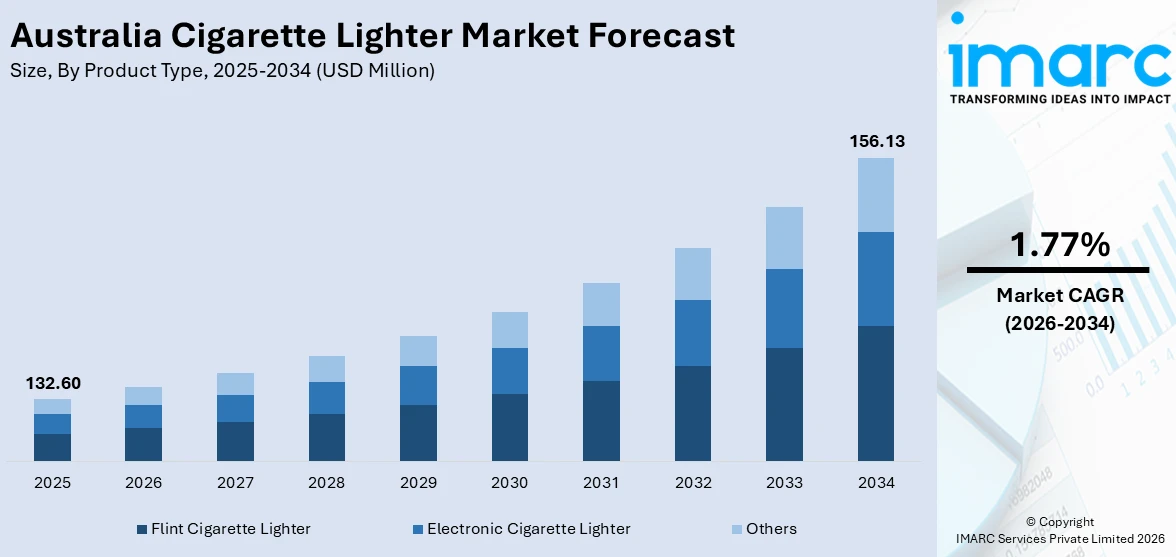
The Australia cigarette lighter market size was valued at USD 132.60 Million in 2025 and is projected to reach USD 156.13 Million by 2034, growing at a compound annual growth rate of 1.77% from 2026-2034.
The Australia cigarette lighter market is driven by evolving consumer preferences toward safer and more sustainable lighting solutions. Expanding retail distribution networks, increasing demand for premium and lifestyle-oriented lighter designs, and growing non-tobacco applications are collectively contributing to steady market expansion. Technological innovations in flameless and rechargeable models, coupled with heightened awareness around product safety standards, continue to shape the Australia cigarette lighter market share.
Key Takeaways and Insights:
- By Product Type: Flint cigarette lighter dominates the market with a share of 58.5% in 2025, owing to its widespread affordability, reliable flint-and-steel ignition mechanism, and deep-rooted consumer familiarity that reinforces consistent repurchase behavior across diverse retail channels.
- By Material Type: Plastic leads the market with a share of 56.8% in 2025. This dominance is driven by cost-effective manufacturing processes, lightweight portability, ergonomic design flexibility, and extensive availability across supermarkets and convenience outlets nationwide.
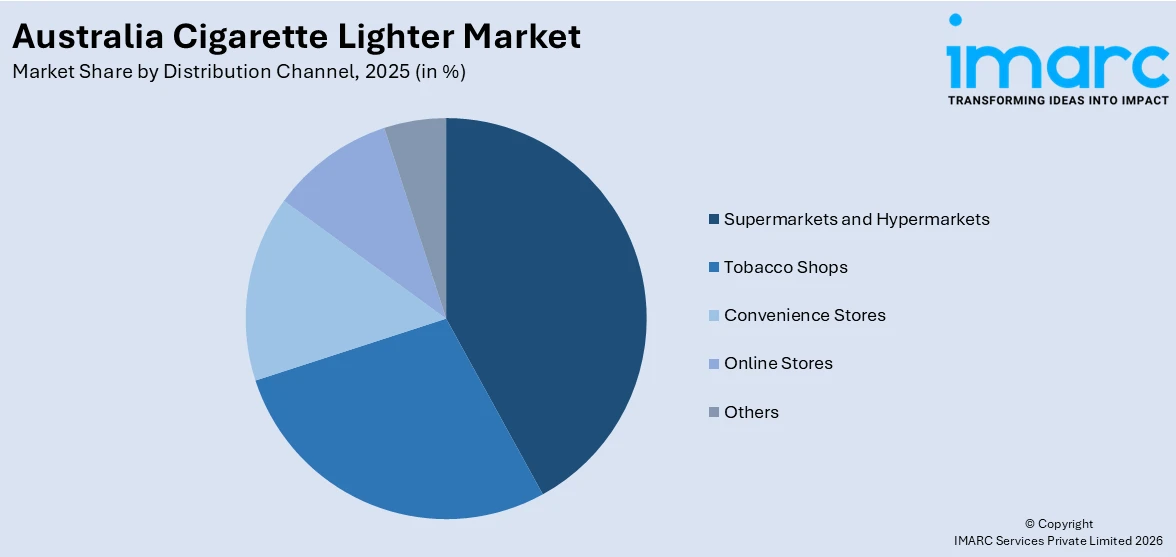
- By Distribution Channel: Supermarkets and hypermarkets hold the largest segment with a market share of 41.5% in 2025, reflecting the convenience of bundling lighter purchases with everyday grocery shopping and the extensive nationwide reach of major retail chains.
- By Region: Australia Capital Territory & New South Wales represents the largest region with 35.5% share in 2025, driven by the concentration of Australia's largest urban population in the Greater Sydney metropolitan area, higher disposable incomes, and a dense network of retail establishments.
- Key Players: Key players drive the Australia cigarette lighter market by expanding product portfolios, improving safety technologies, investing in sustainable materials, and strengthening nationwide distribution through retail partnerships and digital channels to boost accessibility and adoption.
To get more information on this market Request Sample
The Australia cigarette lighter market is moving ahead steadily as the demand for the product is increasing from consumers not only for smoking purposes but also for various other uses in the household, kitchen, and outdoor settings. The companies are also focusing on incorporating advanced safety features such as child-safety locks, flame control, and auto-shutoff in their products due to the strict regulatory environment that is imposing tougher norms on tobacco products and accessories. At the same time, the increasing awareness about the environment among Australian consumers is leading to a surge in the demand for lighters that have refillable and rechargeable designs, which will help reduce plastic waste. The trend of premiumization is also gaining popularity as consumers are increasingly showing a preference for collectible or designer lighters over generic ones.
Australia Cigarette Lighter Market Trends:
Rising adoption of rechargeable and flameless lighter technologies
The Australia cigarette lighter market is witnessing increasing consumer preference for rechargeable and flameless ignition systems, particularly USB-powered arc and plasma models. These battery-operated alternatives offer wind-resistant, reusable performance that appeals to environmentally aware consumers seeking cost-effective modern solutions. A growing proportion of new lighter product launches are incorporating USB-based recharging or plasma arc ignition, reflecting the accelerating shift toward technology-driven lighting solutions that complement both indoor and outdoor applications across the Australia cigarette lighter market growth.
Growing emphasis on premium and lifestyle-driven lighter designs
A pronounced premiumization trend is reshaping consumer preferences within the Australian lighter market, as buyers increasingly favor collectible, artistically designed, and brand-collaborative products over generic alternatives. Zippo released its 2025 Collectible of the Year featuring three region-specific versions, including an Armor High Polish Gold Plate case exclusively for the Asia Pacific market, showcasing advanced Deep Carve and Laser 360-degree engraving techniques. This lifestyle-oriented purchasing behavior is prompting manufacturers to invest in limited-edition releases, designer collaborations, and visually distinctive products.
Expansion of non-tobacco applications driving diversified demand
The functional scope of cigarette lighters in Australia is broadening considerably beyond traditional smoking use, with household, culinary, outdoor recreational, and emergency preparedness applications fueling diversified demand. A significant portion of lighter demand now originates from non-tobacco applications, including kitchen use, candle lighting, and outdoor activities. This expanding utility base is encouraging manufacturers to develop multipurpose and hybrid lighter models designed for dual candle and torch functionality, catering to evolving consumer needs across diverse lifestyle segments.
Market Outlook 2026-2034:
The Australian cigarette lighter market is set to witness positive growth during the forecast period, driven by changing consumer behavior, innovation, and the increasing use of cigarette lighters in various applications. The companies are now focusing on developing cigarette lighters that meet the increasing regulatory requirements and environmental awareness of the Australian market. The growing retail infrastructure, including the major supermarket chains and convenience stores, is also ensuring easy access to the product. In addition, the growing interest in premium, collectible, and lifestyle cigarette lighters is opening up new revenue streams. The trend of using cigarette lighters for non-tobacco purposes and the combination of lighter and other products is also boosting the future demand in the Australian market. The market generated a revenue of USD 132.60 Million in 2025 and is projected to reach a revenue of USD 156.13 Million by 2034, growing at a compound annual growth rate of 1.77% from 2026-2034.
Australia Cigarette Lighter Market Report Segmentation:
| Segment Category | Leading Segment | Market Share |
|---|---|---|
|
Product Type |
Flint Cigarette Lighter |
58.5% |
|
Material Type |
Plastic |
56.8% |
|
Distribution Channel |
Supermarkets and Hypermarkets |
41.5% |
|
Region |
Australia Capital Territory & New South Wales |
35.5% |
Product Type Insights:
- Flint Cigarette Lighter
- Electronic Cigarette Lighter
- Others
Flint cigarette lighter dominates with a market share of 58.5% of the total Australia cigarette lighter market in 2025.
The flint cigarette lighter segment maintains its commanding position in the Australian market, driven by the enduring reliability and simplicity of the traditional flint-and-steel ignition mechanism that consumers have trusted for decades. These lighters offer consistent flame production, mechanical durability, and an intuitive user experience that appeals to a broad demographic across both urban and regional areas. Globally, gas-based lighters, which include flint models, accounted for approximately 58% of total lighter unit shipments in 2024, underscoring the sustained preference for this ignition format in mature consumer markets.
The widespread availability of flint cigarette lighters across supermarkets, convenience stores, tobacco shops, and online platforms further reinforces their market dominance in Australia. Manufacturers continue to enhance these models with improved child-resistant mechanisms, leak-proof fuel chambers, and ergonomic designs that align with evolving safety expectations. Leading global lighter manufacturers maintain flint-based disposable models as central to their product portfolios, continuously investing in quality improvements and expanded distribution to sustain consumer loyalty and reinforce the segment's enduring commercial relevance across the Australian market.
Material Type Insights:
- Metal
- Plastic
- Others
Plastic leads with a share of 56.8% of the total Australia cigarette lighter market in 2025.
Plastic continues to be the leading material in the Australian cigarette lighter market due to its cost-effectiveness, versatility, and light weight, which makes it ideal for mass production. Disposable plastic lighters are the most accessible and affordable option for consumers, who can enjoy their functionality at a competitive price. The largest share of the global lighter market is comprised of disposable lighters, which are made from plastic materials, thus establishing the material's importance in mass-producing lighters.
The sustainability trend is increasingly affecting the plastic lighter market, as companies are responding to environmental concerns by developing innovative products made from recycled and bio-attributed materials. The largest players in the industry are launching eco-friendly lighter products made from recycled metal materials, recycled packaging, and international sustainability certification, which is a major move towards reducing the environmental impact of disposable lighter production. This shows that plastic lighter companies are actively working to address environmental concerns while continuing to provide consumers with the affordability and convenience that remain the cornerstone of the market.
Distribution Channel Insights:
Access the comprehensive market breakdown Request Sample
- Tobacco Shops
- Supermarkets and Hypermarkets
- Convenience Stores
- Online Stores
- Others
Supermarkets and hypermarkets hold the largest share at 41.5% of the total Australia cigarette lighter market in 2025.
Supermarkets and hypermarkets serve as the primary distribution channel for cigarette lighters in Australia, benefiting from their extensive nationwide footprint, established logistics capabilities, and high consumer footfall that naturally integrates lighter purchases with routine grocery shopping. National chains maintain prominent shelf placement for lighters alongside tobacco products and household essentials, ensuring consistent product visibility and impulse purchasing. The dominance of major grocery retailers across the Australian retail landscape further strengthens lighter accessibility for consumers nationwide.
The dominance of supermarkets in lighter distribution is further strengthened by their capacity to accommodate diverse product ranges, from economy disposable lighters to branded and premium options. Improving economic conditions and rising consumer confidence are supporting sustained spending on everyday accessories through organized retail formats. The convenience of one-stop shopping, expanding store networks in suburban and regional areas, and growing investment in smaller-format urban outlets continue to reinforce this channel's leading position in the Australian lighter market.
Regional Insights:
- Australia Capital Territory & New South Wales
- Victoria & Tasmania
- Queensland
- Northern Territory & Southern Australia
- Western Australia
Australia Capital Territory & New South Wales represents the leading segment with a 35.5% share of the total Australia cigarette lighter market in 2025.
Australia Capital Territory and New South Wales commands the largest regional share of the cigarette lighter market, driven by its status as the most populous state in Australia. The Greater Sydney metropolitan area represents a significant concentration of consumer purchasing power, with a dense network of supermarkets, convenience stores, and specialty tobacco retailers ensuring comprehensive lighter accessibility across urban and suburban precincts. The region's strong economic base and high urbanization further support sustained consumer demand.
The region's economic strength further underpins its market leadership, with New South Wales accounting for the largest share of Australia's national gross domestic product. This substantial economic output translates into higher disposable incomes and greater consumer spending on both everyday and premium lighter products. The presence of a diverse, multicultural population base and vibrant hospitality, outdoor recreation, and tourism sectors creates additional demand for lighters across non-tobacco utility applications, reinforcing the region's dominant position in the national market.
Market Dynamics:
Growth Drivers:
Why is the Australia Cigarette Lighter Market Growing?
Expanding retail infrastructure and organized distribution networks
The growing presence of organized retail infrastructure in Australia is creating a solid base for the development of the cigarette lighter market. The emergence of supermarket chains, convenience stores, and specialty retail stores ensures that the product is widely available and accessible to consumers in both urban and rural settings. Large retailers like Woolworths, Coles, and ALDI have large store networks that make it easy for consumers to purchase lighters as impulse buys or as part of their regular shopping. ALDI Australia has opened a new store in Woolooware Bay, New South Wales, in 2024 as part of the Bay Central shopping center development. This has increased consumer touch points in the southern Sydney region. The trend of investing in smaller format stores and metro convenience stores is further expanding the distribution base, catering to the needs of busy urban consumers who are looking for convenient purchasing options. E-commerce is also on the rise, with the internet contributing an increasingly larger share of lighter sales, allowing manufacturers to tap into new markets beyond their physical store presence.
Heightened consumer focus on safety features and regulatory compliance
The increasing demand from consumers for safer lighting products is pressuring manufacturers to develop lighting products with sophisticated safety features that will increase the attractiveness of the product and thus contribute to the expansion of the market. Child-safety features, leak-proof fuel chambers, push-button ignition systems, safety caps, and auto-shutoff systems are being incorporated into modern lighter designs. The regulatory framework is thus pushing manufacturers to invest in product innovation and quality assurance, leading to the development of safer and more reliable lighter products that consumers can trust. The regulatory framework is also a deterrent to the entry of low-quality imported products, thus favoring established brands that have strict safety testing standards.
Diversification into non-tobacco and multi-use applications
The expanding scope of lighter applications beyond traditional tobacco use is creating substantial new demand streams that support overall market growth. Household use for candle lighting, culinary applications for gas stoves and barbecues, outdoor recreational activities including camping and hiking, and emergency preparedness kits are all contributing to broader lighter consumption patterns. The majority of lighter demand globally now originates from non-tobacco applications, reflecting a fundamental shift in the product's positioning from a smoking accessory to a versatile utility tool. This diversification reduces the market's dependency on declining smoking prevalence and opens opportunities for purpose-built product designs, such as extended-reach candle lighters and windproof outdoor models. Manufacturers are responding by developing multipurpose lighter variants, with new lighter stock-keeping units introduced in 2024 designed for dual candle and torch functionality, enabling broader consumer appeal and increased average selling prices.
Market Restraints:
What Challenges the Australia Cigarette Lighter Market is Facing?
Declining smoking prevalence and stringent anti-tobacco regulations
Australia's comprehensive public health campaigns, graphic warning labels, plain packaging laws, and progressive excise tax increases continue to drive down smoking rates, directly impacting traditional lighter demand. The daily smoking rate among Australians fell to approximately 8.3% in 2023, reflecting decades of sustained tobacco control efforts. Stricter regulations, including bans on menthol flavors and crush ball accessories that came into full effect from July 2025, further discourage smoking initiation and reduce the consumer base for traditional lighters.
Environmental concerns surrounding disposable plastic lighters
Growing environmental awareness among Australian consumers is creating headwinds for the disposable plastic lighter segment, as sustainability-conscious buyers increasingly question single-use plastic products. The environmental footprint of non-recyclable lighter casings and residual butane fuel raises ecological concerns, prompting regulatory scrutiny and shifting consumer preferences toward reusable, refillable, and rechargeable alternatives that align with broader circular economy principles.
Volatility in raw material and butane fuel pricing
Fluctuations in butane and plastic resin pricing pose persistent challenges for lighter manufacturers, as sharp input cost increases within short periods can significantly erode profit margins, particularly for smaller-scale producers. This price volatility complicates production planning, inventory management, and retail pricing strategies, creating uncertainty across the supply chain and limiting the ability of manufacturers to maintain competitive pricing while sustaining product quality standards.
Competitive Landscape:
The Australia cigarette lighter market features a moderately consolidated competitive landscape, with established global manufacturers and regional distributors vying for market share through product differentiation, safety innovation, and distribution expansion. Companies are focusing on diversifying their product portfolios to include premium, collectible, and eco-conscious lighter models alongside traditional disposable options. Competition is further driven by investments in sustainable manufacturing practices, advanced safety certifications, and strategic retail partnerships that enhance brand visibility. Collaborative initiatives with lifestyle brands and cultural collaborations are emerging as key strategies for premium positioning, while pricing competitiveness and broad retail availability remain critical for mass-market segments.
Australia Cigarette Lighter Market Report Coverage:
| Report Features | Details |
|---|---|
| Base Year of the Analysis | 2025 |
| Historical Period | 2020-2025 |
| Forecast Period | 2026-2034 |
| Units | Million USD |
| Scope of the Report |
Exploration of Historical Trends and Market Outlook, Industry Catalysts and Challenges, Segment-Wise Historical and Future Market Assessment:
|
| Product Types Covered | Flint Cigarette Lighter, Electronica Cigarette Lighter, Others |
| Material Types Covered | Metal, Plastic, Others |
| Distribution Channels Covered | Tobacco Shops, Supermarkets and Hypermarkets, Convenience Stores, Online Stores, Others |
| Regions Covered | Australia Capital Territory & New South Wales, Victoria & Tasmania, Queensland, Northern Territory & Southern Australia, Western Australia |
| Customization Scope | 10% Free Customization |
| Post-Sale Analyst Support | 10-12 Weeks |
| Delivery Format | PDF and Excel through Email (We can also provide the editable version of the report in PPT/Word format on special request) |
Frequently Asked Questions About the Australia Cigarette Lighter Market Report
The Australia cigarette lighter market size was valued at USD 132.60 Million in 2025.
The Australia cigarette lighter market is expected to grow at a compound annual growth rate of 1.77% from 2026-2034 to reach USD 156.13 Million by 2034.
Flint cigarette lighter dominated the market with a share of 58.5%, driven by its affordable pricing, reliable flint-and-steel ignition mechanism, widespread retail availability, and deep-rooted consumer familiarity across Australian markets.
Key factors driving the Australia cigarette lighter market include expanding retail infrastructure, growing demand for safety-compliant lighter products, rising non-tobacco utility applications, premiumization trends, and increasing adoption of rechargeable technologies.
Major challenges include declining smoking prevalence due to stringent anti-tobacco regulations, growing environmental concerns over disposable plastic lighters, raw material price volatility, and increasing competition from rechargeable and electronic lighter alternatives.
Need more help?
- Speak to our experienced analysts for insights on the current market scenarios.
- Include additional segments and countries to customize the report as per your requirement.
- Gain an unparalleled competitive advantage in your domain by understanding how to utilize the report and positively impacting your operations and revenue.
- For further assistance, please connect with our analysts.
 Request Customization
 Speak to an Analyst
 Request Brochure
 Inquire Before Buying
Benefits of Customization
- Personalize this research
- Triangulate with your data
- Get data as per your format and definition
- Gain a deeper dive into a specific application, geography, customer, or competitor
- Any level of personalization
Get in Touch With Us
UNITED STATES
Phone: +1-201-971-6302
INDIA
Phone: +91-120-433-0800
UNITED KINGDOM
Phone: +44-753-714-6104
Email: [email protected]
Client Testimonials




.webp)




.webp)













Related Reports

Choose your plan
*Please note that the prices mentioned below are starting prices for each bundle type. Kindly contact our team for further details.*
Single User License
- 1 User License, Access on 2 Devices
- PDF Report + Excel Dataset (Password Protected)
- Lifetime Access
- No Printing Rights
- 10% Free Report Customization
- 10–12 Weeks of Analyst Support
Five User License
- Access for 5 Users, 2 Devices per User
- PDF Report + Excel Dataset (Password Protected)
- Lifetime Access
- Dedicated Account Manager
- 12–14 Weeks of Analyst Support
- No Printing Rights
- 15% Free Report Customization
- 25% Discount on Your Next Purchase
Corporate User License
- Unlimited User Access (Within Your Organization)
- PDF Report + Excel Dataset
- Lifetime Access
- Dedicated Account Manager
- 14–20 Weeks of Analyst Support
- No Printing Rights
- 20% Free Report Customization
- 30% Discount on Your Next Purchase
Essential Insights
What's included:
3 reports
- Lifetime Access
- PDF Reports
- Excel Datasets
- 2 Weeks of Free Analyst Support
- 2 User Licenses
- Access on 2 Devices
- Printing Rights
- Complimentary PowerPoint (PPT) Version
- Complimentary License Upgrade
Professional Access
What's included:
5 reports
- Lifetime Access
- PDF Reports
- Excel Datasets
- 8 Weeks of Free Analyst Support
- 2 User Licenses
- Access on 2 Devices
- Printing Rights
- Complimentary PowerPoint (PPT) Version
- Complimentary License Upgrade
Business Advantage
What's included:
8 reports
- Lifetime Access
- PDF Reports
- Excel Datasets
- 14 Weeks of Free Analyst Support
- 2 User Licenses
- Access on 2 Devices
- Printing Rights
- Complimentary PowerPoint (PPT) Version
- Complimentary License Upgrade
Enterprise Intelligence
What's included:
10 reports
- Lifetime Access
- PDF Reports
- Excel Datasets
- 20 Weeks of Free Analyst Support
- 2 User Licenses
- Access on 2 Devices
- Printing Rights
- Complimentary PowerPoint (PPT) Version
- Complimentary License Upgrade