
Automotive Balance Shaft Market Size, Share, Trends and Forecast by Vehicle Type, Manufacturing Process, Engine Type, and Region, 2026-2034
Automotive Balance Shaft Market Size, Share, Trends & Forecast (2026-2034)
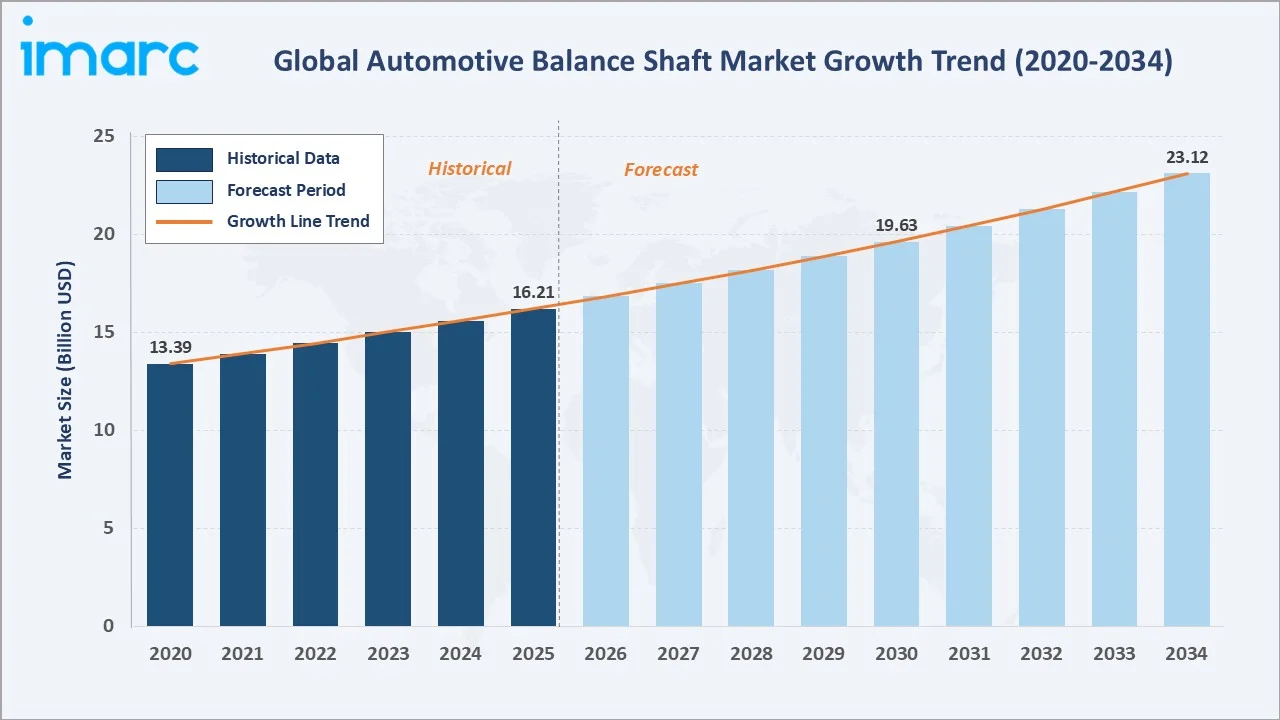
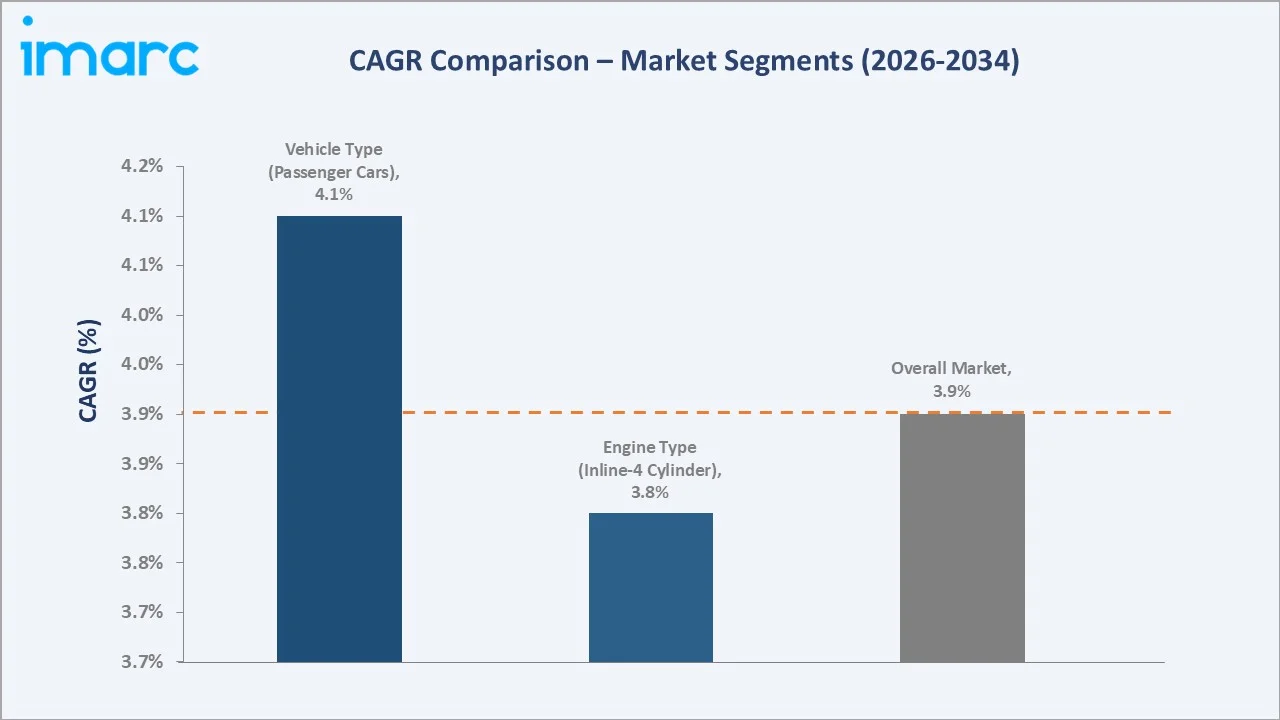
The global automotive balance shaft market reached USD 16.21 Billion in 2025 and is projected to reach USD 23.12 Billion by 2034, growing at a CAGR of 3.90% during 2026-2034. The market is driven by rising passenger vehicle production, engine-downsizing trends, stricter NVH regulations, and demand for refined, fuel-efficient internal combustion engines.
Passenger Cars dominate vehicle type at 78.0%. Inline-4 Cylinder Engine leads engine type at 49.0%. Asia-Pacific commands 43.0% of the global market share.
Market Snapshot
|
Metric |
Value |
|
Market Size (2025) |
USD 16.21 Billion |
|
Forecast Market Size (2034) |
USD 23.12 Billion |
|
CAGR (2026-2034) |
3.90% |
|
Base Year |
2025 |
|
Historical Period |
2020-2025 |
|
Forecast Period |
2026-2034 |
|
Dominant Vehicle Type |
Passenger Cars (78.0%, 2025) |
|
Dominant Engine Type |
Inline-4 Cylinder Engine (49.0%, 2025) |
|
Leading Region |
Asia-Pacific (43.0%, 2025) |
The market expanded from USD 13.39 Billion in 2020 to USD 16.21 Billion in 2025, growing steadily through consistent passenger-vehicle production and tightening NVH standards. The market is forecast to reach USD 19.63 Billion in 2030 and USD 23.12 Billion by 2034.
To get more information on this market, Request Sample
Passenger Cars at 78.0% dominate as the world's largest ICE vehicle segment, driven by compact 3-/4-cylinder turbocharged engine proliferation. The Inline-4 Cylinder Engine at 49.0% reflects the dominant passenger-car powertrain architecture requiring dual balance shafts. Asia-Pacific at 43.0% leads through high-volume ICE passenger-car production and precision balance shaft manufacturing capability across the region.
Executive Summary
The global automotive balance shaft market reached USD 16.21 Billion in 2025, representing a stable, high-volume automotive component market underpinned by sustained demand for ICE passenger vehicles worldwide. The market is projected to reach USD 23.12 Billion by 2034.
Passenger Cars at 78.0% dominate by capturing the world's largest balance shaft procurement category through passenger-car ICE production volume. Inline-4 Cylinder Engine at 49.0% leads by encompassing the dominant balance-shaft-requiring engine architecture across compact, mid-size, and crossover passenger vehicles. Asia-Pacific at 43.0% leads globally through its combined ICE passenger-car and CV production scale and precision manufacturing base.
Key Market Insights
|
Insight |
Data |
|
Dominant Vehicle Type |
Passenger Cars – 78.0% share (2025) |
|
Dominant Engine Type |
Inline-4 Cylinder Engine – 49.0% market share (2025) |
|
Leading Region |
Asia-Pacific – 43.0% market share (2025) |
|
Market Opportunity |
Forged lightweight hollow shafts; hybrid powertrain integration; EV-transition repositioning; emerging-market ICE volume growth |
Key Analytical Observations Supporting the Above Data:
- Passenger Cars at 78.0%: The passenger-car segment dominates as it represents the world's highest-volume vehicle category using balance shafts. Compact and mid-size passenger cars with 3- and 4-cylinder engines universally incorporate dual balance shafts for vibration elimination, driving sustained high-volume procurement from automotive OEMs globally.
- Inline-4 Cylinder Engine at 49.0%: The Inline-4 Cylinder Engine segment dominates as the most widely adopted passenger-car engine architecture globally. Four-cylinder engines universally require dual balance shafts to cancel second-order inertia forces, making every Inline-4 engine a guaranteed balance shaft demand unit across all passenger-car model segments.
- Asia-Pacific at 43.0%: Asia-Pacific leads through its position as the world's largest automotive production region, with high-volume ICE passenger-car output, strong precision component manufacturing capability, and growing engine production across key economies driving sustained balance shaft procurement volumes.
Automotive Balance Shaft Market Overview
The global automotive balance shaft market encompasses the design, manufacture, and supply of precision balance shaft systems used in internal combustion engines across passenger cars, light commercial vehicles, and heavy commercial vehicles. Balance shafts cancel second-order vibration in 3- and 4-cylinder engines, reducing NVH and improving ride comfort and engine refinement for vehicle end users.
The ecosystem integrates steel forging and casting suppliers, precision machining specialists, balance shaft module manufacturers, NVH testing equipment providers, engine OEM assembly operations, and regulatory bodies setting NVH and emission standards. Macroeconomic factors include passenger-vehicle sales volumes, fuel-efficiency regulations, engine architecture trends, and automotive production investment cycles.
Market Dynamics
To evaluate market opportunities, Request Sample
Market Drivers
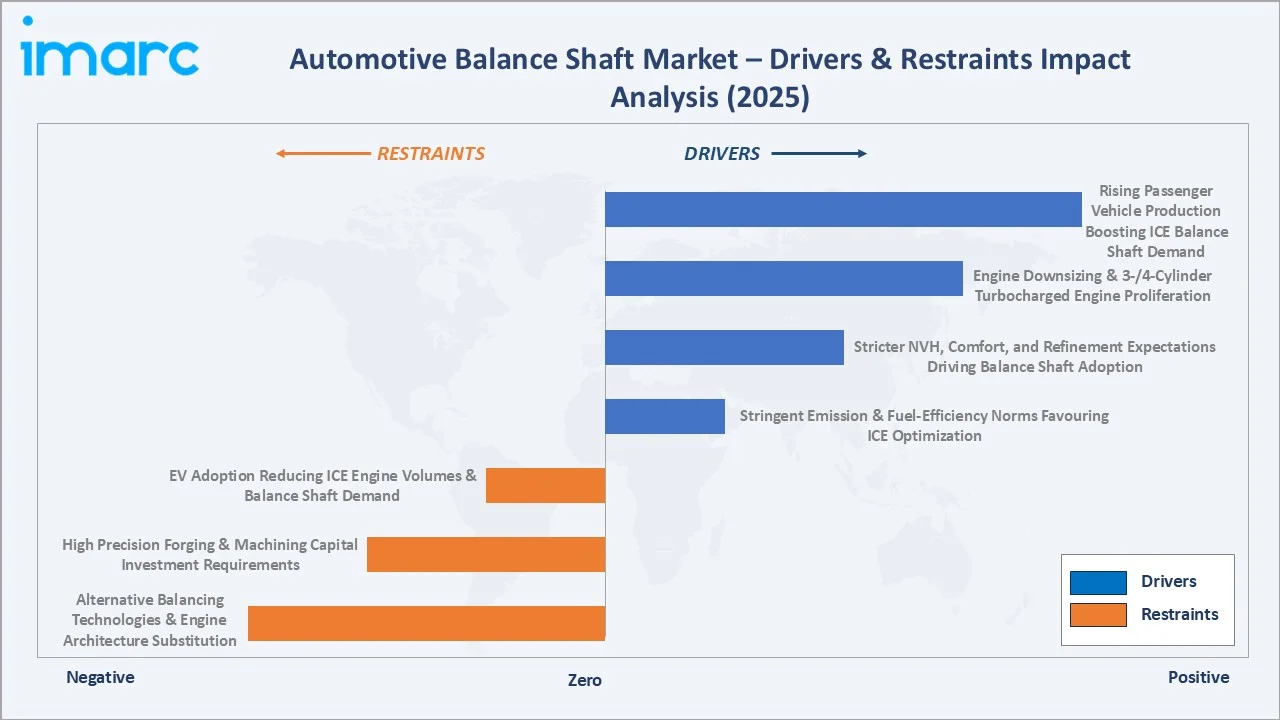
- Rising Passenger Vehicle Production Boosting ICE Balance Shaft Demand: Rising global passenger vehicle production directly increases demand for automotive balance shafts, as every 3- and 4-cylinder ICE vehicle requires balance shaft systems. Global passenger-car production sustained above 70 million units in 2025, generating high-volume balance shaft procurement across automotive Tier-1 suppliers and component manufacturers worldwide.
- Engine Downsizing and 3-/4-Cylinder Turbocharged Engine Proliferation: Engine downsizing trends are accelerating adoption of 3- and 4-cylinder turbocharged engines across the passenger-car market, replacing larger 6-cylinder engines that do not require balance shafts. Each downsized engine application creates additional balance shaft demand, expanding the total addressable market through engine-architecture transitions across global automotive OEM programs.
- Stricter NVH, Comfort, and Refinement Expectations Driving Balance Shaft Adoption: Rising consumer expectations for cabin quietness, ride smoothness, and engine refinement are compelling OEMs to adopt balance shafts even where previously optional. Advanced forged and hollow balance shaft designs delivering superior NVH performance are being specified across new passenger-car platforms, broadening adoption beyond traditional mandatory engine-architecture applications.
- Stringent Emission and Fuel-Efficiency Norms Favouring ICE Optimization: Stringent global emission and fuel-efficiency regulations incentivize ICE optimization as automakers develop cleaner, more efficient combustion engines to meet interim regulatory targets. Optimized 4-cylinder engines meeting these standards universally incorporate dual balance shafts, sustaining regulatory-driven demand across new passenger-car engine programs through the forecast period.
Market Restraints
- EV Adoption Reducing ICE Engine Volumes and Balance Shaft Demand: Rising battery electric vehicle adoption is progressively reducing ICE production volumes, as BEVs do not require balance shafts. Accelerating EV penetration across major automotive markets is expected to reduce the total number of ICE engines produced, creating a structural headwind for balance shaft demand growth through 2034.
- High Precision Forging and Machining Capital Investment Requirements: Automotive balance shaft manufacture requires significant capital investment in precision forging lines, CNC machining centres, dynamic balancing equipment, and NVH testing facilities. These high upfront requirements limit new market entry, slow capacity expansion by existing players, and increase unit costs, constraining market supply responsiveness to demand growth.
- Alternative Balancing Technologies and Engine Architecture Substitution: Emerging alternative engine balancing approaches including active engine mounts, crankshaft counterweight optimization, and electronic cancellation systems offer OEMs vibration management without dedicated balance shafts. Increasing adoption in cost-sensitive vehicle segments can reduce balance shaft fitment rates per engine produced, moderating market volume growth.
Market Opportunities
- Forged Lightweight Hollow Balance Shaft Development for Fuel-Efficiency and Weight Reduction: Forged lightweight hollow balance shaft designs offer OEMs weight reduction, improved fuel efficiency, and enhanced NVH performance versus conventional solid designs. Growing OEM demand for lightweight powertrain components across new passenger-car platforms creates significant product-upgrade opportunities for balance shaft manufacturers capable of delivering precision hollow-forged designs at competitive supply costs.
- Hybrid and Mild-Hybrid Powertrain Balance Shaft Integration as HEV Production Scales: Hybrid electric and mild-hybrid powertrain production growth creates sustained balance shaft demand as these platforms retain 3- and 4-cylinder ICE engines requiring balance shaft systems. As global HEV and MHEV production scales through 2034, balance shaft manufacturers serving hybrid programs benefit from a structural demand tailwind partially offsetting pure BEV displacement of ICE volumes.
Market Challenges
- Domestic Supplier Development Creating Competitive Pressure on Established International Tier-1 Suppliers: Domestic balance shaft manufacturers in key producing markets are developing precision forging and machining capabilities targeting international Tier-1 quality levels at competitive cost structures. Their growing competitiveness in major automotive production markets creates pricing pressure and market-share risk for established international balance shaft suppliers relying on long-term OEM program revenues.
- EV Transition Supply-Chain Repositioning Creating Investment and Planning Uncertainty: The pace of EV adoption uncertainty makes long-term balance shaft manufacturing investment planning difficult, as OEM electrification timelines and ICE phase-out schedules vary by market and manufacturer. This creates capital allocation risk for manufacturers considering capacity expansion, as the investment horizon for new ICE engine programs shortens relative to historical automotive component investment cycles.
Emerging Market Trends
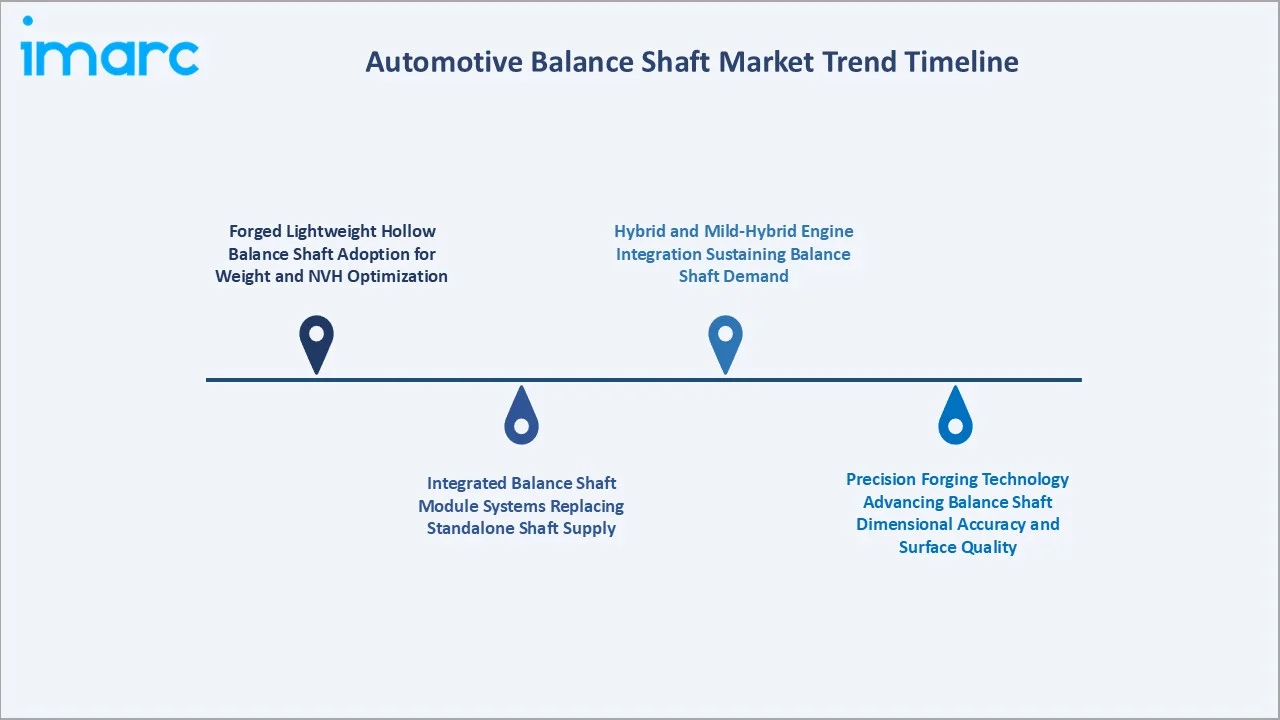
1. Forged Lightweight Hollow Balance Shaft Adoption for Weight and NVH Optimization
Automakers are increasingly specifying forged hollow balance shafts over conventional solid designs to achieve vehicle weight reduction targets. Hollow forged shafts deliver equivalent NVH performance at 15-20% lower mass, supporting fuel-efficiency targets. Leading suppliers are investing in hollow forging capability to secure next-generation OEM engine programs specifying lightweight powertrain components.
2. Integrated Balance Shaft Module Systems Replacing Standalone Shaft Supply
OEMs are shifting from standalone balance shaft procurement to fully integrated module supply, combining bearing carriers, oil pumps, and chain-drive assemblies in a single unit. Integrated modules reduce OEM engine assembly complexity, lower total system cost, and improve NVH performance. Suppliers offering complete module solutions are gaining competitive advantage in next-generation engine program sourcing.
3. Precision Forging Technology Advancing Balance Shaft Dimensional Accuracy and Surface Quality
Advances in closed-die forging technology and CNC finish-machining are enabling tighter dimensional tolerances and superior surface finishes on balance shafts. Higher precision reduces residual vibration, extends bearing life, and improves engine refinement. OEMs specifying tighter NVH standards in new engine programs are increasingly requiring precision-forged balance shafts over cast alternatives.
4. Hybrid and Mild-Hybrid Engine Integration Sustaining Balance Shaft Demand
Hybrid electric and mild-hybrid powertrain programs retaining 3- and 4-cylinder ICE engines are sustaining balance shaft demand through the EV transition period. HEV and MHEV architectures require balance shafts for ICE NVH management, and their growing production volumes through 2034 provide a partial demand offset to ICE-only vehicle decline, becoming a key growth vector for leading manufacturers.
Industry Value Chain Analysis
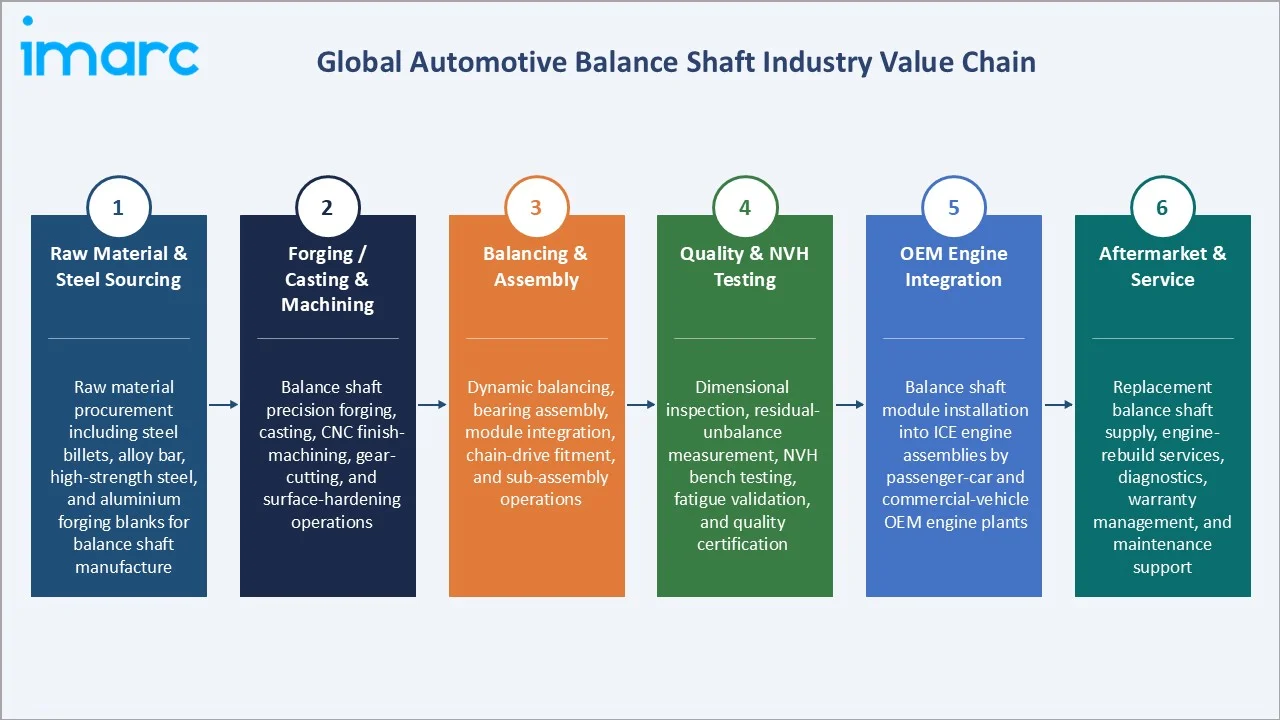
The automotive balance shaft value chain integrates steel billet and forging blank sourcing, precision forging and casting, CNC machining and hardening, dynamic balancing and assembly, NVH and quality testing, OEM engine integration, and aftermarket service. The commercial structure is progressively shifting toward integrated module supply as the primary format, replacing standalone shaft delivery as the dominant OEM procurement model.
|
Stage |
Key Participants |
|
Raw Material & Steel Sourcing |
Raw material procurement including steel billets, alloy bar, high-strength steel, and aluminium forging blanks for balance shaft manufacture |
|
Forging / Casting & Machining |
Balance shaft precision forging, casting, CNC finish-machining, gear-cutting, and surface-hardening operations |
|
Balancing & Assembly |
Dynamic balancing, bearing assembly, module integration, chain-drive fitment, and sub-assembly operations |
|
Quality & NVH Testing |
Dimensional inspection, residual-unbalance measurement, NVH bench testing, fatigue validation, and quality certification |
|
OEM Engine Integration |
Balance shaft module installation into ICE engine assemblies by passenger-car and commercial-vehicle OEM engine plants |
|
Aftermarket & Service |
Replacement balance shaft supply, engine-rebuild services, diagnostics, warranty management, and maintenance support |
The raw material and steel sourcing tier is the value chain's most cost-sensitive stage, where high-strength steel alloy pricing directly impacts OEM supply economics and sourcing strategies.
Technology Landscape in the Automotive Balance Shaft Industry
Precision Closed-Die Forging Technology
Precision closed-die forging technology enables near-net-shape balance shaft manufacture with superior metallurgical grain structure, tensile strength, and fatigue resistance versus casting alternatives. Forged balance shafts deliver longer service life, tighter tolerances, and better NVH performance, making them the preferred OEM specification for passenger-car engine programs globally across all vehicle segments.
Hollow Balance Shaft Forging Technology
Hollow balance shaft forging technology produces lightweight shafts with optimized mass distribution, reducing engine weight and improving fuel efficiency. Advanced hollow forging processes achieve wall thicknesses and dimensional consistency comparable to solid forgings, meeting OEM structural and fatigue requirements across passenger-car engine programs specifying weight-reduction targets for new platform development.
High-Speed Dynamic Balancing and NVH Validation Technology
High-speed dynamic balancing and NVH validation technology enables manufacturers to certify shaft assemblies to sub-gram·mm residual unbalance specifications. Advanced balancing machines with in-line correction capability and NVH test benches with real-time vibration analysis are becoming standard in production lines, ensuring every unit meets tightening OEM NVH specifications before engine assembly.
Market Segmentation Analysis
The report covers the following segments:
|
Segment Category |
Leading Segment |
Market Share |
Year |
|
Vehicle Type |
Passenger Cars |
78.0% |
2025 |
|
Manufacturing Process |
🔒 |
🔒 |
2025 |
|
Engine Type |
Inline-4 Cylinder Engine |
49.0% |
2025 |
|
Region |
Asia-Pacific |
43.0% |
2025 |

By Vehicle Type
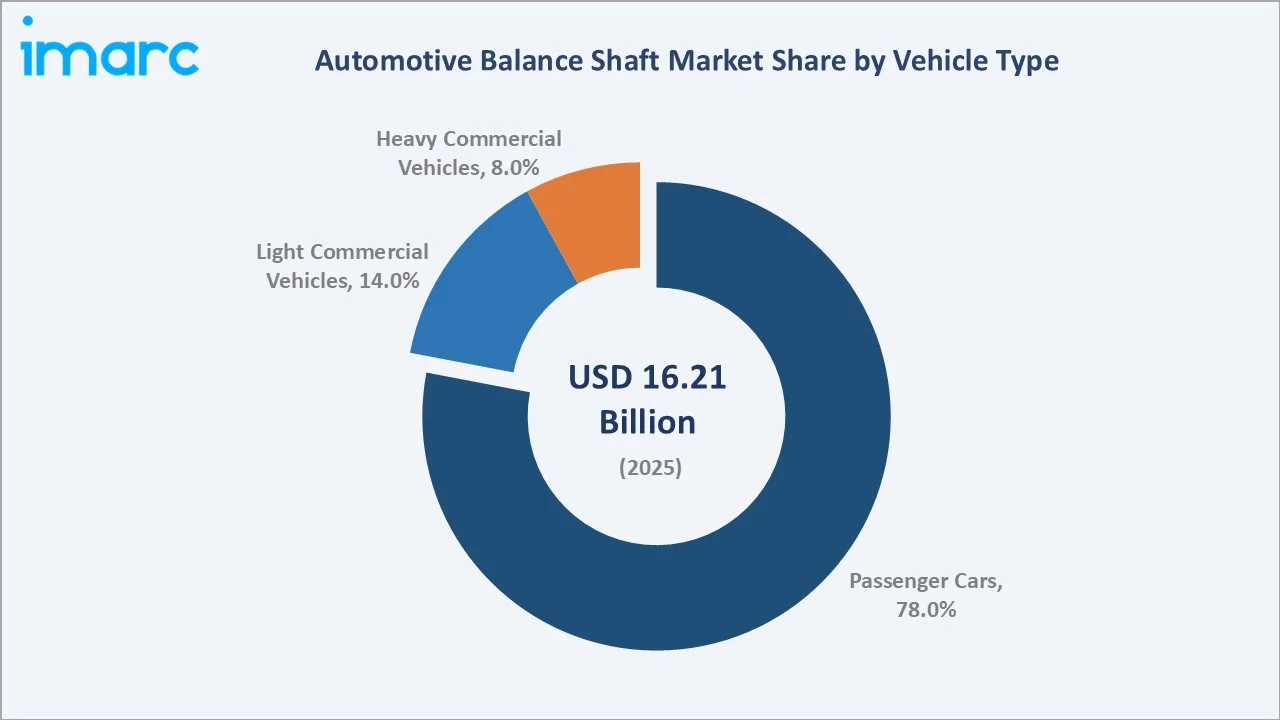
Passenger Cars lead at 78.0% in 2025, representing the world's dominant balance shaft application through universal 3- and 4-cylinder engine adoption across compact, mid-size, and crossover vehicle segments.
To access detailed market analysis, Request Sample
Light Commercial Vehicles at 14.0% capture the medium-volume balance shaft segment through van and light-truck production using 4-cylinder engines. Heavy Commercial Vehicles at 8.0% represent the smallest application segment, as large-displacement diesel engines in heavy trucks do not typically require balance shafts, limiting HCV fitment to specific downsized engine applications in newer platforms.
By Engine Type
Inline-4 Cylinder Engine leads at 49.0% in 2025, encompassing the dominant global passenger-car engine architecture that universally requires dual balance shafts to cancel second-order vibration.
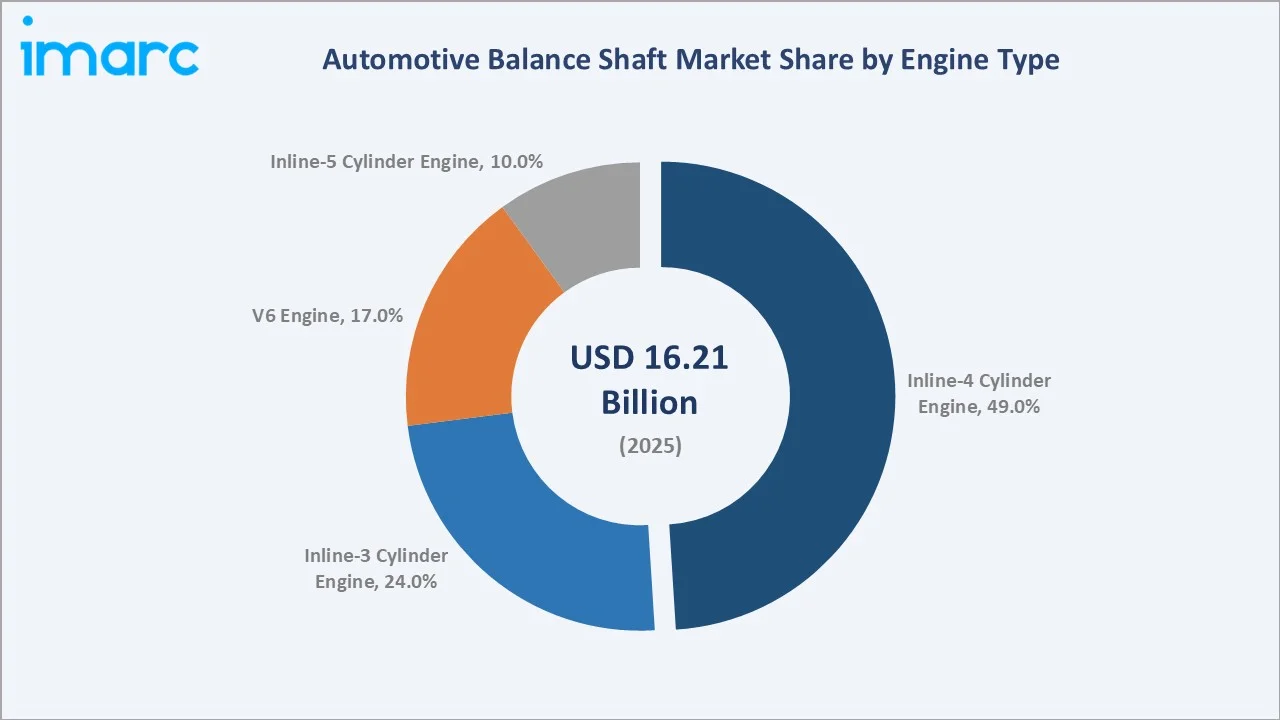
Inline-3 Cylinder Engine at 24.0% captures the fastest-growing engine type as 3-cylinder turbocharged engines proliferate across city cars, compact hatchbacks, and mild-hybrid platforms. V6 Engine at 17.0% reflects balance shaft applications in larger passenger cars and premium SUVs.
Regional Market Insights
|
Region |
Share (2025) |
Key Automotive Balance Shaft Market Drivers & Characteristics |
|
Asia-Pacific |
43.0% |
Driven by large-scale passenger-car and commercial-vehicle production, growing ICE engine output, supportive automotive policies, and established precision forging and machining supplier networks |
|
Europe |
27.0% |
Driven by premium passenger-car demand, engine-downsizing and NVH regulatory requirements, and strong automotive engineering and component manufacturing capabilities |
|
North America |
20.0% |
Supported by substantial passenger-car and light-truck production, high turbocharged engine content, and well-developed Tier-1 automotive supplier ecosystems |
|
Latin America |
6.0% |
Driven by growing automotive production, increasing adoption of downsized turbocharged engines, and expanding local vehicle assembly operations |
|
Middle East and Africa |
4.0% |
Emerging with increasing vehicle demand, rising automotive assembly activity, and growing interest in locally sourced engine components |
Asia-Pacific, at 43.0%, leads through its large-scale passenger-car production base, established precision balance shaft manufacturing capabilities, and growing engine output across major automotive economies in the region. Europe, at 27.0%, reflects strong passenger-car NVH regulation requirements, deep engine-downsizing program adoption, and automotive engineering leadership driving precision balance shaft demand.
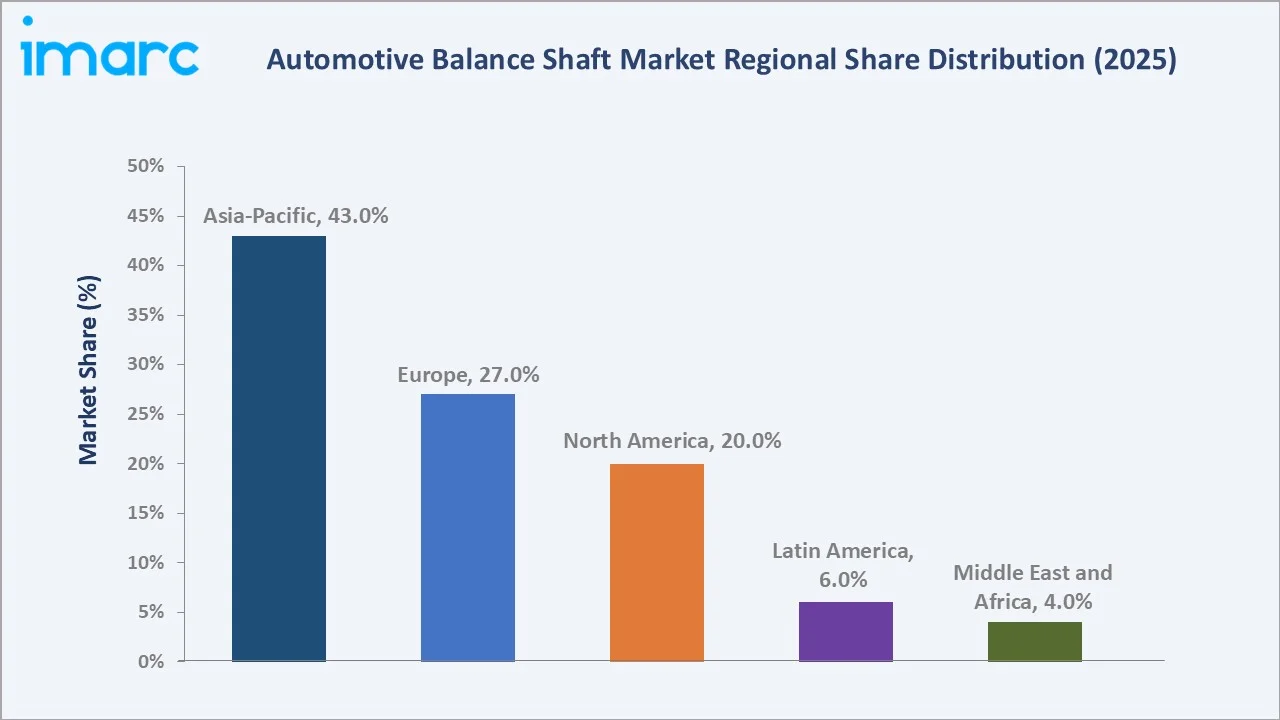
North America, at 20.0%, reflects substantial passenger-car and light-truck production with high turbocharged Inline-4 engine content and strong Tier-1 supplier capability.
Competitive Landscape
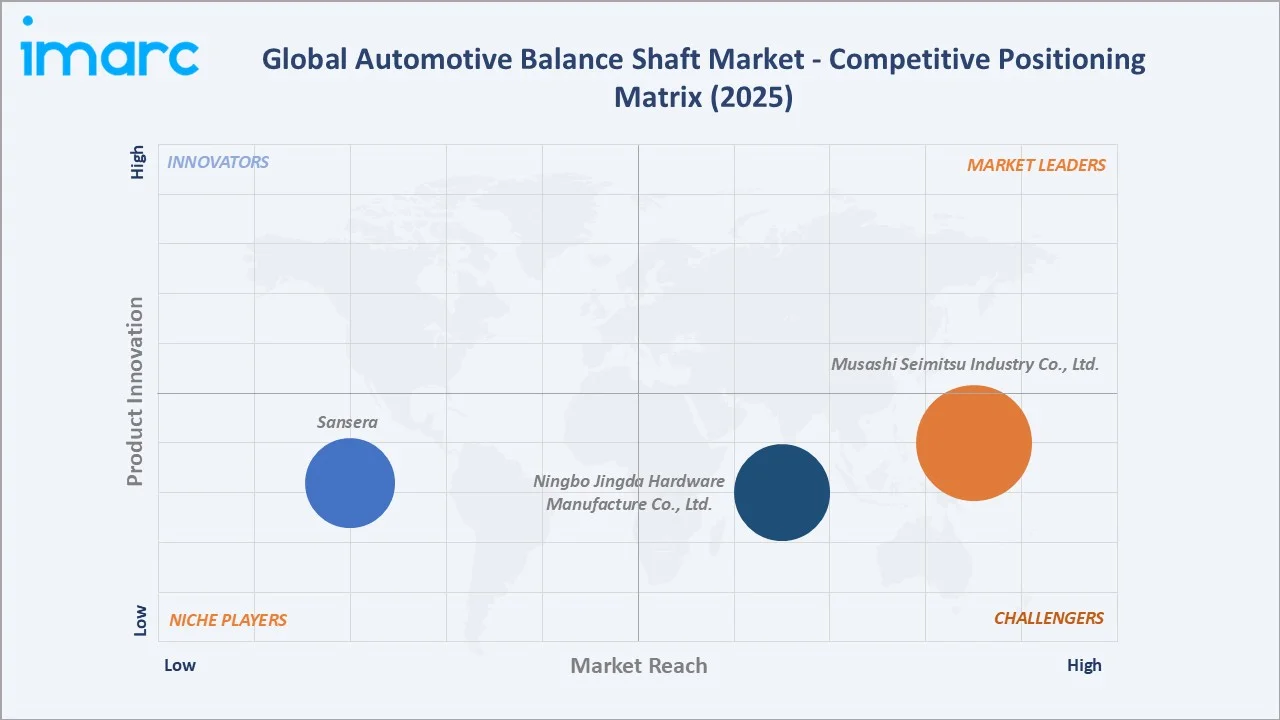
The global automotive balance shaft market competitive landscape is moderately concentrated with three distinct tiers: precision forging and integrated module Tier-1 suppliers, specialised balance shaft manufacturers, and emerging cost-competitive domestic suppliers across key automotive production markets.
|
Company Name |
Key Products |
Market Position |
Core Strength |
|
Musashi Seimitsu Industry Co., Ltd. |
Precision Balance Shafts, Engine Components |
Strong Challenger |
Musashi Seimitsu specializes in high-precision balance shaft manufacture for compact and mid-size engine platforms. |
|
Ningbo Jingda Hardware Manufacture Co., Ltd. |
Balance Shaft Components |
Niche Player |
Ningbo Jingda Hardware is a cost-competitive Chinese balance shaft component manufacturer serving domestic and export OEMs. |
|
Sansera |
Precision Forged Engine Components, Balance Shafts |
Strong Challenger |
Sansera specializes in precision-forged engine components including balance shafts for passenger-car and two-wheeler OEMs. |
Key players include Musashi Seimitsu Industry Co., Ltd., Ningbo Jingda Hardware Manufacture Co., Ltd., Sansera, and others.
Key Company Profiles
Musashi Seimitsu Industry Co., Ltd.
Musashi Seimitsu Industry Co., Ltd. is a Japan-based precision automotive component manufacturer with deep expertise in balance shaft production for compact and mid-size passenger-car engines, supplying major OEM engine programs with high-precision forged balance shaft assemblies.
- Key Products: Precision Balance Shafts, Engine Components
- Strategic Focus: Expanding precision-forged balance shaft supply for hybrid and downsized ICE engine programs, developing hollow and lightweight forged shaft designs for OEM weight-reduction program requirements across Asian and global passenger-car markets.
Sansera
Sansera is an India-based precision-forged automotive component manufacturer with strong expertise in balance shaft and engine component production, supplying passenger-car, two-wheeler, and commercial-vehicle OEM programs with high-precision forged and machined assemblies across India, Europe, and global markets.
- Key Products: Precision Forged Engine Components, Balance Shafts, Connecting Rods, Rocker Arms
- Strategic Focus: Expanding precision-forged balance shaft supply across passenger-car and two-wheeler OEM programs globally, scaling non-automotive and xEV-compatible component offerings, and growing aerospace and advanced manufacturing capabilities while sustaining ICE balance shaft program revenues.
Market Concentration Analysis
The automotive balance shaft market is moderately concentrated, with the top five players collectively accounting for approximately 55-65% of global revenue. The majority of OEMs rely on external Tier-1 suppliers for balance shaft module procurement across their engine programs.
Market concentration is gradually declining as domestic suppliers in key automotive production markets develop precision forging capability and cost-competitive module integration for local OEM programs. New entrants from emerging automotive manufacturing markets are also gaining traction through competitive cost structures and growing quality certifications for passenger-car balance shaft applications.
Investment & Growth Opportunities
Highest Growth Segments
Inline-3 Cylinder Engine balance shafts (~4.6% CAGR) represent the highest-growth engine-type segment as 3-cylinder turbocharged engine proliferation accelerates globally. Light Commercial Vehicle balance shaft supply (~4.3% CAGR) grows as LCV engine downsizing to 4-cylinder platforms expands. Hybrid and mild-hybrid powertrain balance shaft integration (~5.5% CAGR from growing base) is the highest strategic-value growth vector through 2034.
Emerging Investment Opportunities
Hollow forged balance shaft manufacturing capability represents the market's highest-value product-technology investment opportunity, as OEM programs specifying hollow shafts carry premium pricing versus solid-forged equivalents. The estimated hollow forged shaft opportunity represents 20-30% of total balance shaft procurement value by 2034, creating a significant addressable premium sub-segment for precision forging-capable manufacturers.
Investment Themes
- Hollow forging technology investment: Establishing hollow balance shaft forging capability to serve OEM lightweighting specifications across new passenger-car engine programs, capturing premium pricing versus solid-forged shaft supply and securing next-generation engine program technical approval for weight-optimized platforms targeting stricter fuel-efficiency standards through 2034.
- Integrated balance shaft module development: Investing in complete balance shaft module assembly including oil pumps, bearing carriers, and chain-drive systems to shift from commodity shaft supply to integrated module Tier-1 positioning, commanding higher per-unit revenue and creating long-term OEM program lock-in through system-level integration complexity.
Future Market Outlook (2026-2034)
The global automotive balance shaft market is projected to grow from USD 16.21 Billion in 2025 to USD 23.12 Billion by 2034, delivering a 3.90% CAGR over the forecast period. The market's anchor value of USD 19.63 Billion in 2030 represents a balance shaft industry sustaining moderate growth through the ICE-to-EV transition, supported by hybrid program demand partially offsetting pure ICE production volume moderation across key global markets.
Three structural forces define balance shaft market growth through 2034. Sustained ICE and hybrid vehicle production across automotive markets creates a large and slowly evolving global demand base. Engine downsizing depth expands balance-shaft-mandatory 3- and 4-cylinder engine volumes, partly offsetting absolute ICE production decline. Integrated module and hollow shaft premiumization creates per-unit revenue growth above volume growth, sustaining supplier revenue expansion even as unit volumes moderate through the latter part of the forecast period.
Research Methodology
Primary Research
Primary research comprised structured interviews with 45+ industry stakeholders (2025), including Chief Engineering Officers, OEM engine program managers, Tier-1 balance shaft supply chain directors, precision forging technology specialists, and automotive NVH testing engineers covering passenger-car, LCV, and HCV engine program supply chains globally.
Secondary Research
Secondary research encompassed company annual reports; global vehicle production data from industry bodies; automotive powertrain forecast studies; SAE International engine-downsizing research papers 2024; regional automotive manufacturing association statistics; and global automotive balance shaft market forecast studies 2025. Over 55 secondary sources were reviewed and triangulated for this report.
Forecasting Models
Market revenue forecasts were developed using an engine-production-based bottom-up model comprising: (i) global ICE vehicle production forecast by vehicle type; (ii) balance shaft fitment rate per engine architecture; (iii) average balance shaft system revenue per vehicle type; (iv) product-mix adjustment for hollow versus solid and module versus standalone shaft pricing. Historical data was triangulated against three independent market data sources.
Report Coverage:
| Report Features | Details |
|---|---|
| Base Year of the Analysis | 2025 |
| Historical Period | 2020-2025 |
| Forecast Period | 2026-2034 |
| Units | Billion USD |
| Scope of the Report | Exploration of Historical Trends and Market Outlook, Industry Catalysts and Challenges, Segment-Wise Historical and Future Market Assessment:
|
| Vehicle Types Coverage | Passenger Cars, Light Commercial Vehicle, Heavy Commercial Vehicle |
| Manufacturing Processes Coverage | Forging, Casting |
| Engine Types Coverage | Inline-3 Cylinder Engine, Inline-4 Cylinder Engine, Inline-5 Cylinder Engine, V6 Engine |
| Regions Covered | Asia Pacific, Europe, North America, Latin America, Middle East and Africa |
| Countries Covered | United States, Canada, Germany, France, United Kingdom, Italy, Spain, Russia, China, Japan, India, South Korea, Australia, Indonesia, Brazil, Mexico |
| Companies Covered | Musashi Seimitsu Industry Co., Ltd., Ningbo Jingda Hardware Manufacture Co., Ltd., Sansera, etc. |
| Customization Scope | 10% Free Customization |
| Post-Sale Analyst Support | 10-12 Weeks |
| Delivery Format | PDF and Excel through Email (We can also provide the editable version of the report in PPT/Word format on special request) |
Frequently Asked Questions About the Automotive Balance Shaft Market Report
The global automotive balance shaft market reached USD 16.21 Billion in 2025, driven by Passenger Cars at 78.0%, Inline-4 Cylinder Engine at 49.0%, and Asia-Pacific commanding 43.0% market share through the region's combined ICE passenger-car production scale and precision balance shaft manufacturing capability.
The automotive balance shaft market grows at 3.90% CAGR during 2026-2034, reaching USD 23.12 Billion by 2034. This growth reflects sustained ICE and hybrid vehicle production, engine-downsizing expanding balance-shaft-mandatory volumes, and integrated module and hollow shaft premiumization driving per-unit revenue growth across the forecast period.
Passenger Cars lead at 78.0%, capturing the world's largest ICE vehicle segment requiring dual balance shaft systems in every 3- and 4-cylinder engine. Passenger Cars sustain leadership through high-volume global production across compact, mid-size, and crossover segments where Inline-4 and Inline-3 engine architectures are universally specified by automotive OEMs.
Inline-4 Cylinder Engine leads at 49.0% through universal dual balance shaft specification requirements across all passenger-car Inline-4 engine applications globally. The segment grows steadily as engine downsizing converts formerly larger-engine vehicle segments to 4-cylinder turbocharged powertrains requiring balance shafts across all market categories.
Asia-Pacific leads at 43.0% through its large-scale ICE passenger-car production base, established precision balance shaft manufacturing capabilities, and growing engine output across major automotive economies, generating the world's highest regional balance shaft procurement volumes.
Leading companies include Musashi Seimitsu Industry Co., Ltd., Ningbo Jingda Hardware Manufacture Co., Ltd., Sansera, and others.
The automotive balance shaft market is projected to reach approximately USD 19.63 Billion by 2030, with hollow forged balance shafts gaining mainstream OEM adoption, integrated module supply formats becoming standard for new engine programs, and hybrid powertrain balance shaft demand providing a structural growth offset to ICE-only vehicle production moderation.
Need more help?
- Speak to our experienced analysts for insights on the current market scenarios.
- Include additional segments and countries to customize the report as per your requirement.
- Gain an unparalleled competitive advantage in your domain by understanding how to utilize the report and positively impacting your operations and revenue.
- For further assistance, please connect with our analysts.
 Request Customization
 Speak to an Analyst
 Request Brochure
 Inquire Before Buying
Benefits of Customization
- Personalize this research
- Triangulate with your data
- Get data as per your format and definition
- Gain a deeper dive into a specific application, geography, customer, or competitor
- Any level of personalization
Get in Touch With Us
UNITED STATES
Phone: +1-201-971-6302
INDIA
Phone: +91-120-433-0800
UNITED KINGDOM
Phone: +44-753-714-6104
Email: [email protected]
Client Testimonials




.webp)




.webp)













Related Reports

Choose your plan
*Please note that the prices mentioned below are starting prices for each bundle type. Kindly contact our team for further details.*
Single User License
- 1 User License, Access on 2 Devices
- PDF Report + Excel Dataset (Password Protected)
- Lifetime Access
- No Printing Rights
- 10% Free Report Customization
- 10–12 Weeks of Analyst Support
Five User License
- Access for 5 Users, 2 Devices per User
- PDF Report + Excel Dataset (Password Protected)
- Lifetime Access
- Dedicated Account Manager
- 12–14 Weeks of Analyst Support
- No Printing Rights
- 15% Free Report Customization
- 25% Discount on Your Next Purchase
Corporate User License
- Unlimited User Access (Within Your Organization)
- PDF Report + Excel Dataset
- Lifetime Access
- Dedicated Account Manager
- 14–20 Weeks of Analyst Support
- No Printing Rights
- 20% Free Report Customization
- 30% Discount on Your Next Purchase
Essential Insights
What's included:
3 reports
- Lifetime Access
- PDF Reports
- Excel Datasets
- 2 Weeks of Free Analyst Support
- 2 User Licenses
- Access on 2 Devices
- Printing Rights
- Complimentary PowerPoint (PPT) Version
- Complimentary License Upgrade
Professional Access
What's included:
5 reports
- Lifetime Access
- PDF Reports
- Excel Datasets
- 8 Weeks of Free Analyst Support
- 2 User Licenses
- Access on 2 Devices
- Printing Rights
- Complimentary PowerPoint (PPT) Version
- Complimentary License Upgrade
Business Advantage
What's included:
8 reports
- Lifetime Access
- PDF Reports
- Excel Datasets
- 14 Weeks of Free Analyst Support
- 2 User Licenses
- Access on 2 Devices
- Printing Rights
- Complimentary PowerPoint (PPT) Version
- Complimentary License Upgrade
Enterprise Intelligence
What's included:
10 reports
- Lifetime Access
- PDF Reports
- Excel Datasets
- 20 Weeks of Free Analyst Support
- 2 User Licenses
- Access on 2 Devices
- Printing Rights
- Complimentary PowerPoint (PPT) Version
- Complimentary License Upgrade