
Automotive Climate Control Market Size, Share, Trends and Forecast by Technology, Component, Vehicle Type, Distribution Channel, and Region, 2026-2034
Automotive Climate Control Market Size, Share, Trends & Forecast (2026-2034)
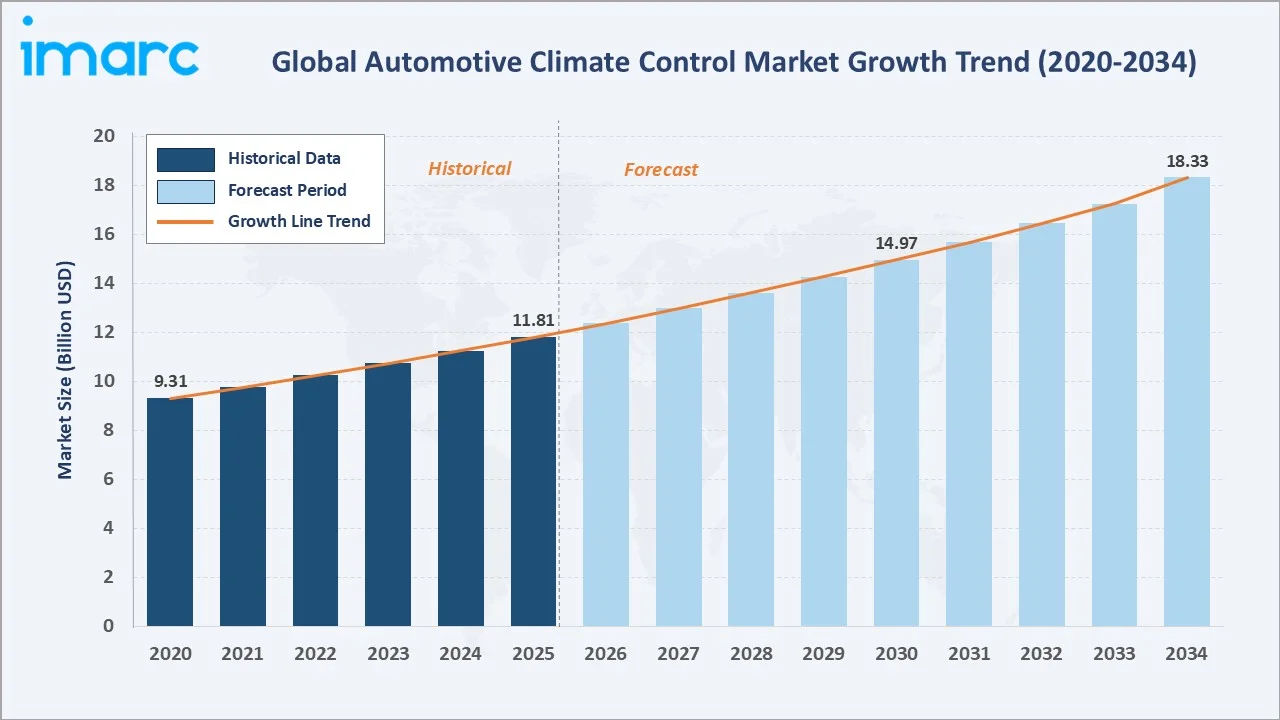
The global automotive climate control market reached USD 11.81 Billion in 2025 and is projected to reach USD 18.33 Billion by 2034, growing at a CAGR of 4.86% during 2026-2034. The market is driven by rising vehicle production, increasing consumer demand for in-cabin comfort, integration of smart and connected climate systems, and expanding EV adoption requiring advanced thermal management.
Automatic climate control systems dominate at 62.0%, passenger cars lead at 71.0%, and Asia Pacific commands 38.0% of global market share.
Market Snapshot
|
Metric |
Value |
|
Market Size (2025) |
USD 11.81 Billion |
|
Forecast Market Size (2034) |
USD 18.33 Billion |
|
CAGR (2026-2034) |
4.86% |
|
Base Year |
2025 |
|
Historical Period |
2020-2025 |
|
Forecast Period |
2026-2034 |
|
Dominant Technology |
Automatic (62.0%, 2025) |
|
Dominant Vehicle Type |
Passenger Cars (71.0%, 2025) |
|
Leading Region |
Asia Pacific (38.0%, 2025) |
The market expanded from USD 9.31 Billion in 2020 to USD 11.81 Billion in 2025, driven by increasing vehicle production in Asia Pacific, rapid adoption of automatic climate control in passenger vehicles, and rising consumer expectations for personalized cabin environments. The market is anchored at USD 14.97 Billion in 2030 and forecast to reach USD 18.33 Billion by 2034.
To get more information on this market, Request Sample
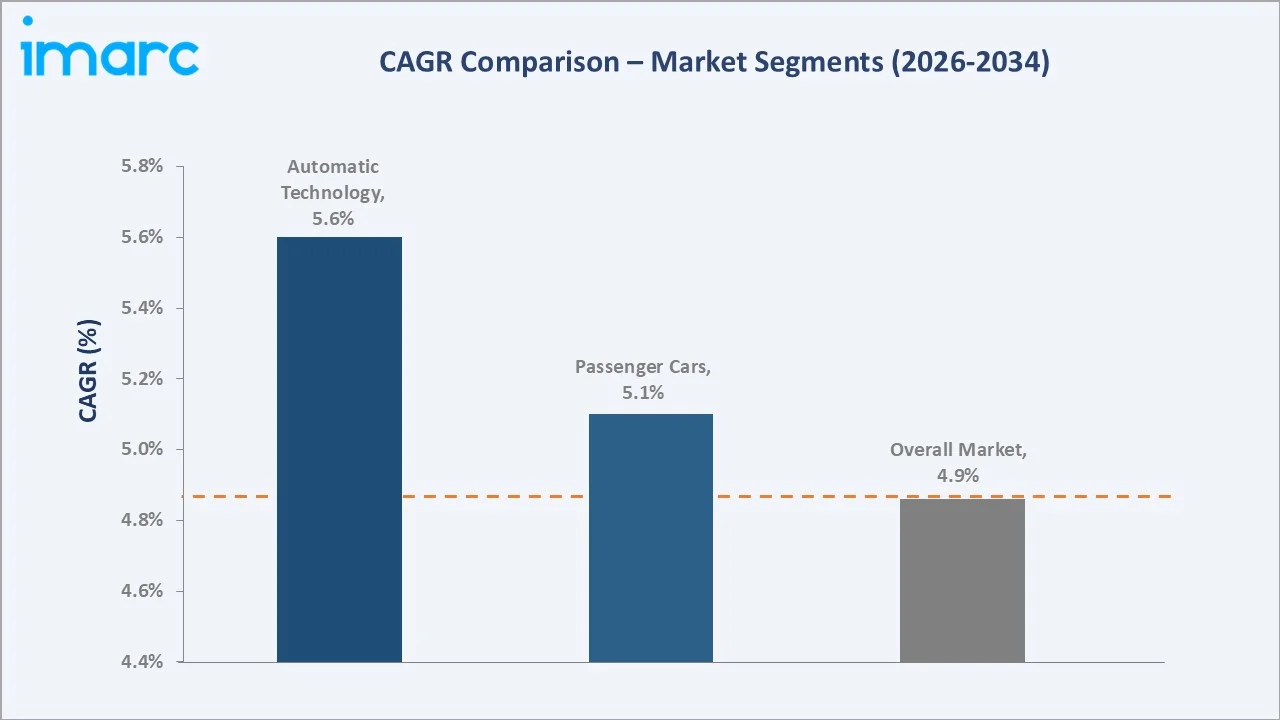
The automatic climate control segment grows fastest at approximately 5.60% CAGR, driven by OEM integration in mid-range and premium vehicles. Passenger cars at 71.0% dominate the vehicle type segment as higher vehicle volumes and consumer preference for thermal comfort drive system adoption across global automotive OEMs throughout the forecast period.
Executive Summary
The global automotive climate control market reached USD 11.81 Billion in 2025, representing a mature yet consistently growing sector within the broader automotive systems industry driven by rising vehicle production, electrification, and consumer demand for enhanced in-vehicle comfort experiences. The market is projected to reach USD 18.33 Billion by 2034, anchored at USD 14.97 Billion in 2030.
Automatic technology at 62.0% dominates by capturing premium and mid-range vehicle segments where driver convenience and personalization are prioritized. Passenger vehicles at 71.0% lead vehicle type through the highest global production volumes and accelerating OEM integration of advanced climate systems as standard equipment. Asia Pacific at 38.0% commands the largest regional share through China and India's vehicle production scale.
Key Market Insights
|
Insight |
Data |
|
Dominant Technology |
Automatic – 62.0% share (2025) |
|
Dominant Vehicle Type |
Passenger Cars – 71.0% market share (2025) |
|
Leading Region |
Asia Pacific – 38.0% market share (2025) |
|
Market Opportunity |
EV thermal management integration; smart AI-based climate systems; connected vehicle ecosystem |
Key Analytical Observations Supporting the Above Data:
- Automatic at 62.0%: Automatic climate control systems dominate as they offer greater driver convenience with pre-set temperature preferences requiring minimal interaction. Automakers are integrating automatic systems in mid-segment vehicles, significantly expanding adoption beyond the premium segment.
- Passenger Cars at 71.0%: Passenger cars lead due to the highest global vehicle production volumes and increasing consumer expectations for in-cabin comfort. With global car production exceeding 70 million units annually, passenger vehicles generate substantial demand for integrated climate control systems.
- Asia Pacific at 38.0%: Asia Pacific dominates due to its large-scale vehicle manufacturing base, growing consumer middle class, and rapid vehicle electrification, particularly in China, Japan, India, and South Korea.
Automotive Climate Control Market Overview
The global automotive climate control market encompasses the design, manufacture, and supply of all thermal comfort systems installed in passenger cars, light commercial vehicles, and heavy commercial vehicles including compressors, condensers, evaporators, relays, control valves, and integrated HVAC assemblies. The market serves both OEM vehicle manufacturing and aftermarket replacement channels across global geographies.
The ecosystem integrates raw material suppliers, component manufacturers, HVAC system integrators, automotive OEMs, and aftermarket service providers. Macroeconomic factors include rising disposable incomes, vehicle ownership growth, government EV incentives, emission standards, and consumer expectations for in-cabin thermal comfort and energy efficiency.
Market Dynamics
To evaluate market opportunities, Request Sample
Market Drivers
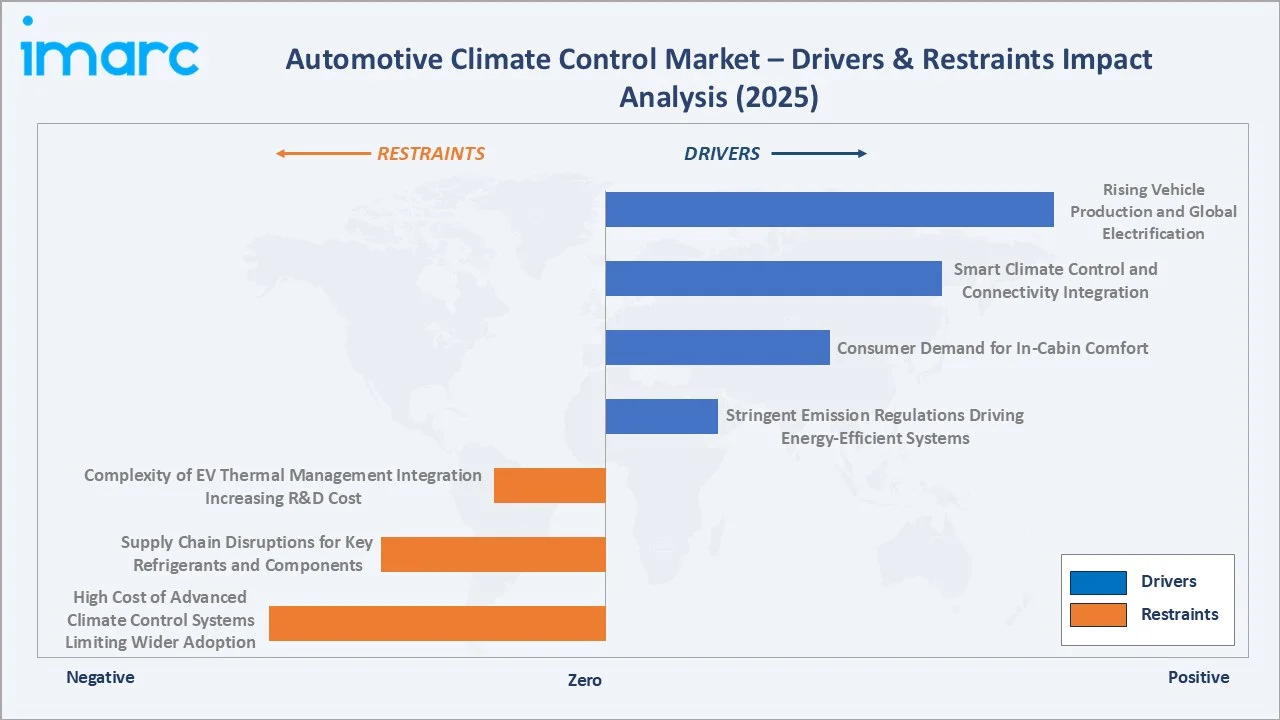
- Rising Vehicle Production and Global Electrification: Global vehicle production growth, particularly in the Asia Pacific, is directly expanding demand for climate control systems installed in every vehicle manufactured. The transition toward electric vehicles creates incremental demand for advanced thermal management systems capable of managing cabin heating and cooling without combustion engine waste heat, driving adoption of heat pump-based climate systems at premium price points.
- Consumer Demand for In-Cabin Comfort: Rising consumer expectations for enhanced comfort, convenience, and personalized driving experiences are supporting demand for advanced automotive climate control systems. Features such as faster cabin cooling and heating, multi-zone climate control, improved air quality management, and reduced cabin noise are becoming increasingly important purchasing considerations. This trend is encouraging automakers to develop innovative climate solutions that enhance passenger comfort across diverse climatic conditions.
- Smart Climate Control and Connectivity Integration: Automotive manufacturers are increasingly integrating climate control systems with connected vehicle technologies and digital cockpit platforms. Smart climate systems enable remote operation, personalized temperature settings, occupancy-based climate adjustment, and seamless integration with vehicle infotainment systems. Advances in artificial intelligence, sensors, and connectivity are further enhancing the ability of climate systems to optimize energy consumption while improving user convenience and comfort.
- Stringent Emission Regulations Driving Energy-Efficient Systems: Governments and regulatory authorities worldwide are implementing stricter fuel-efficiency and emission standards, encouraging the adoption of energy-efficient automotive climate control technologies. Automakers are focusing on reducing the energy consumption of heating, ventilation, and air conditioning (HVAC) systems through advanced compressors, eco-friendly refrigerants, improved insulation, and intelligent control systems. These developments support regulatory compliance while enhancing overall vehicle efficiency and sustainability.
Market Restraints
- High Cost of Advanced Climate Control Systems Limiting Wider Adoption: Advanced automatic, multi-zone, and EV-compatible climate systems involve higher material and engineering costs compared to conventional manual systems. These cost premiums limit penetration in budget vehicle segments and price-sensitive emerging markets where consumers prioritize affordability over enhanced climate features.
- Supply Chain Disruptions for Key Refrigerants and Components: Transitions from high-GWP refrigerants such as R-134a to low-GWP alternatives like R-1234yf, combined with semiconductor shortages affecting electronic control units, have created periodic supply chain constraints that increase production costs and delay OEM vehicle launch timelines.
- Complexity of EV Thermal Management Integration Increasing R&D Cost: Battery electric vehicles require climate systems to manage both cabin comfort and battery thermal regulation simultaneously, increasing engineering complexity. Integration of heat pump systems, thermal energy storage, and battery thermal management within a unified architecture raises development costs and requires specialized expertise beyond standard automotive HVAC capabilities.
Market Opportunities
- EV Heat Pump Climate System Development: The transition to battery electric vehicles creates a structural opportunity for EV-optimized climate systems using heat pump technology that delivers cabin heating efficiency 2–3x higher than resistive heating, directly extending BEV driving range and supporting OEM range performance claims across global markets.
- Smart and Personalized Multi-Zone Climate Systems: The growing adoption of connected vehicle platforms and over-the-air software updates creates opportunities for intelligent climate systems that learn individual passenger preferences, optimize energy consumption, and enable remote pre-conditioning via smartphone applications across all vehicle segments.
Market Challenges
- Refrigerant Regulation Compliance Across Multiple Jurisdictions: Simultaneously complying with varying refrigerant regulations across the EU, US, Japan, and emerging markets creates engineering complexity and inventory management challenges for global climate system manufacturers supplying OEMs across multiple vehicle platforms and geographic markets.
- Integration Complexity in Autonomous Vehicle Platforms: Next-generation autonomous vehicle platforms demand climate systems that operate without driver interaction while managing diverse passenger comfort zones, integrating with vehicle management systems, and maintaining energy efficiency targets, requiring significant R&D investment beyond current standard climate architectures.
Emerging Market Trends
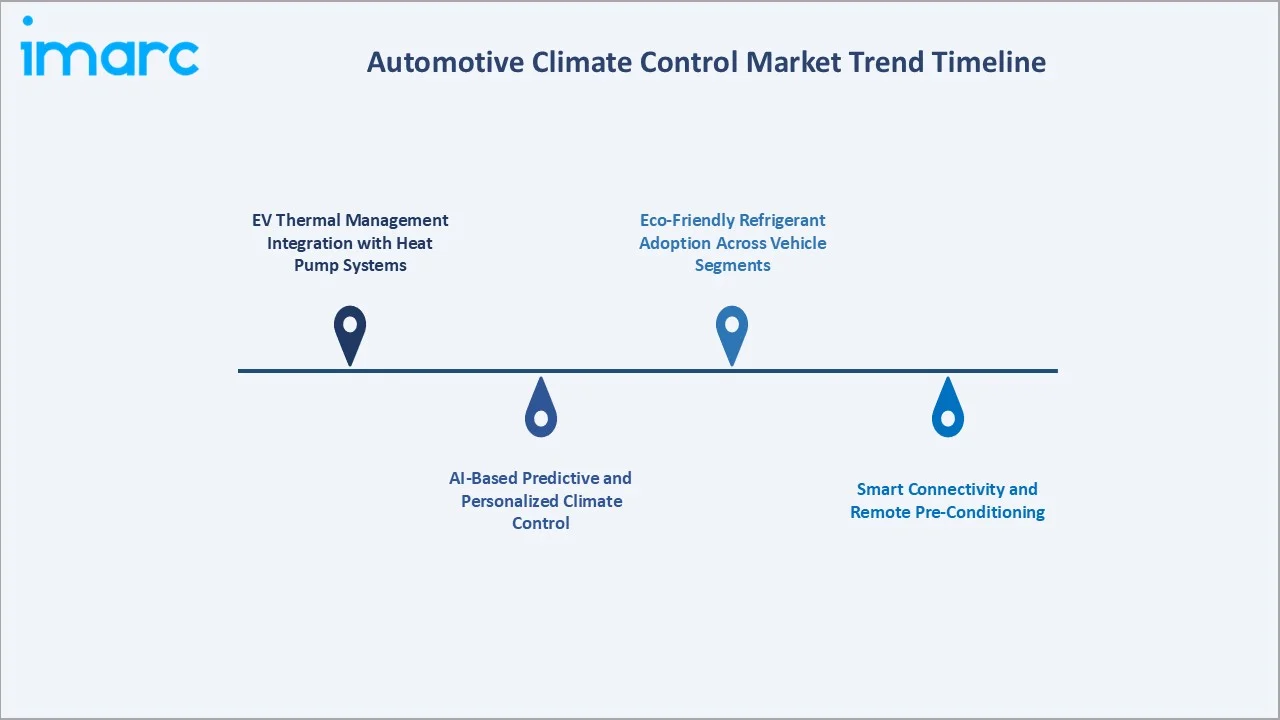
1. EV Thermal Management Integration with Heat Pump Systems
Battery electric vehicle adoption is driving integration of heat pump-based climate systems that simultaneously manage cabin temperature and battery thermal regulation. Heat pumps improve climate system energy efficiency by 2–3x in heating mode compared to resistive heaters, directly supporting BEV range optimization. Major OEMs including Tesla, Volkswagen, and Hyundai have incorporated heat pump systems in their flagship BEV platforms, establishing this technology as the emerging standard for next-generation electric vehicles.
2. AI-Based Predictive and Personalized Climate Control
Automotive OEMs are integrating AI algorithms that analyze driver behavior, passenger preferences, ambient conditions, and route data to pre-condition cabin environments and optimize energy consumption. These intelligent systems can reduce climate control energy use by 10–15% through predictive adjustments, improving overall vehicle efficiency ratings and contributing to range extension across both BEV and hybrid vehicle platforms.
3. Smart Connectivity and Remote Pre-Conditioning
Growing smartphone integration and connected vehicle ecosystems are enabling remote climate pre-conditioning via mobile applications. In May 2025, Apple's next-generation CarPlay system with integrated climate control launched in Porsche and Aston Martin vehicles, establishing a new benchmark for connected cabin climate management that is expected to cascade into mainstream vehicle segments through the forecast period.
4. Eco-Friendly Refrigerant Adoption Across Vehicle Segments
Regulatory transitions from R-134a to R-1234yf across Europe, North America, and progressively Asia Pacific are reshaping refrigerant supply chains and compressor designs. Voltas introduced IoT-enabled solutions featuring eco-friendly refrigerant adoption and advanced inverter technology, reflecting industry momentum toward sustainable climate system architectures compliant with evolving global environmental standards.
Industry Value Chain Analysis
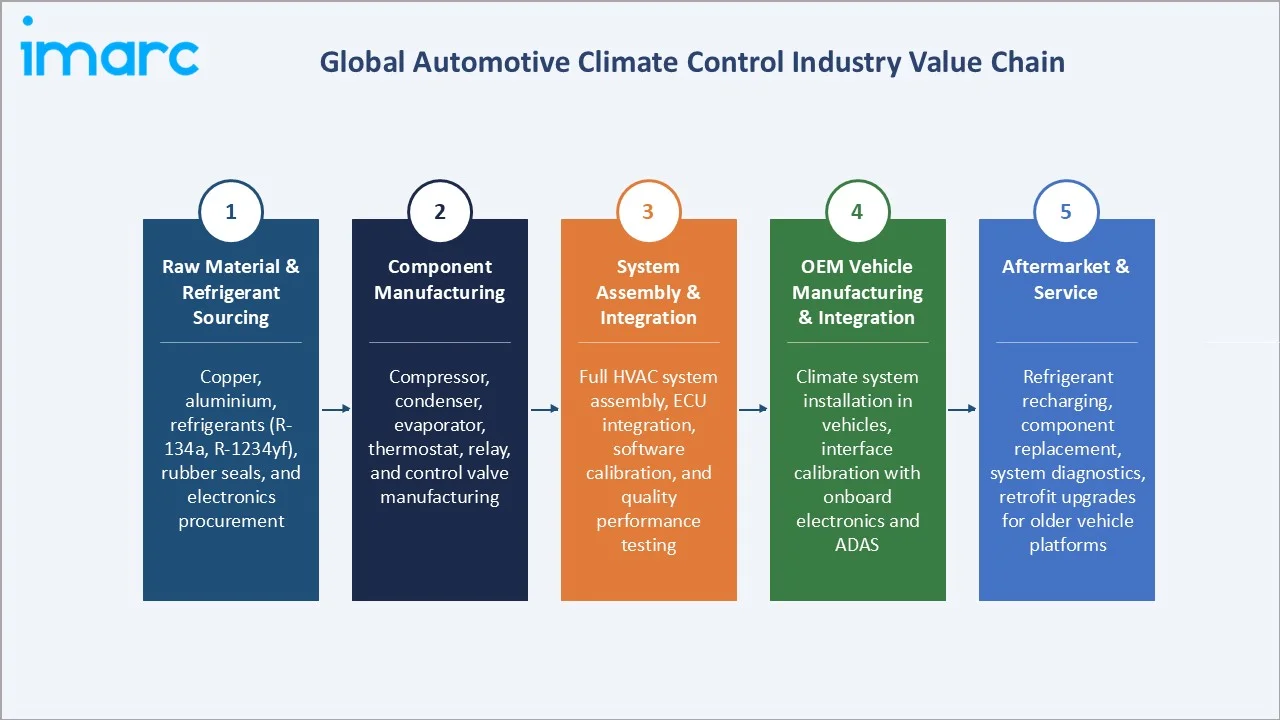
The automotive climate control value chain integrates raw material and refrigerant sourcing, component manufacturing, system assembly and integration, OEM vehicle manufacturing, and aftermarket services. The value chain is progressively consolidating toward integrated HVAC module assembly as the primary commercial format, with Tier-1 suppliers expanding their scope from individual component supply to complete system delivery.
|
Stage |
Key Participants & Activities |
|
Raw Material & Refrigerant Sourcing |
Copper, aluminium, steel, refrigerant gases (R-134a, R-1234yf), rubber seals, and electronics components procurement |
|
Component Manufacturing |
Compressor production, condenser fabrication, evaporator and thermostat assembly, relay and control valve manufacturing |
|
System Assembly & Integration |
Full HVAC/climate control system assembly, ECU integration, software calibration, quality performance testing |
|
OEM Vehicle Manufacturing & Integration |
Climate control system installation during vehicle manufacturing, interface calibration with onboard electronics and ADAS systems |
|
Aftermarket & Service |
Refrigerant recharging, component replacement, system diagnostics, retrofit upgrades for older vehicle platforms |
Technology Landscape in the Automotive Climate Control Industry
Automatic Climate Control Technology
Automatic climate control systems use sensors, electronic control units, and software algorithms to maintain pre-set cabin temperatures with minimal driver intervention. These systems integrate cabin temperature sensors, humidity sensors, solar load sensors, and air quality monitors to deliver optimized thermal comfort and are becoming standard equipment across mid-range and premium vehicle segments globally as ECU costs continue declining.
Manual Climate Control Systems
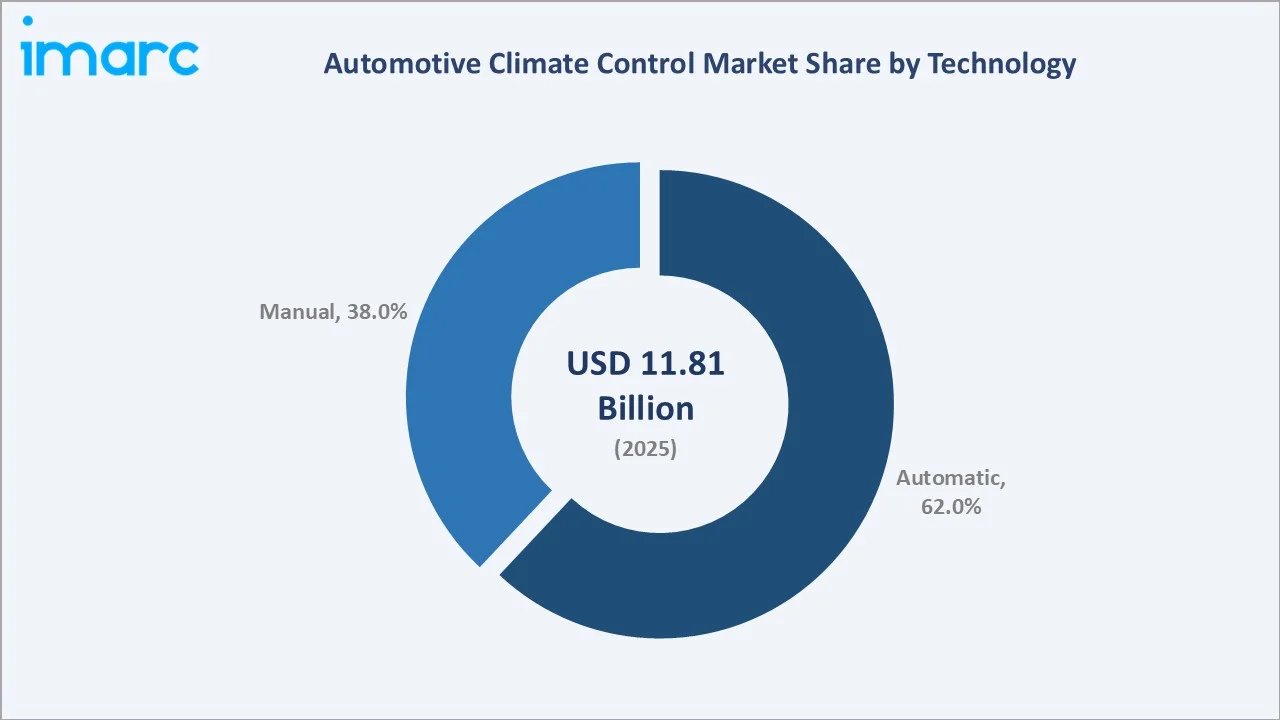
Manual climate control requires direct driver adjustment of fan speed, temperature, and airflow direction. These systems remain cost-effective solutions for entry-level vehicles and are widely deployed across budget automotive segments in emerging markets, where price sensitivity limits the adoption of advanced automatic systems. Manual systems continue to represent approximately 38.0% of the global market share in 2025.
Heat Pump Climate Technology for Electric Vehicles
Heat pump technology for EVs reverses the refrigeration cycle to extract ambient thermal energy for cabin heating, delivering 2–3x the thermal output per unit of electrical energy compared to resistive heating. This technology is critical for extending BEV driving range in cold climates and is being adopted by major OEMs including Tesla, Volkswagen, BMW, and Hyundai across their flagship electric vehicle portfolios.
Market Segmentation Analysis
The report covers the following segments:
|
Segment Category |
Leading Segment |
Market Share |
Year |
|
Technology |
Automatic |
62.0% |
2025 |
|
Component |
Compressor |
🔒 |
2025 |
|
Vehicle Type |
Passenger Cars |
71.0% |
2025 |
|
Distribution Channel |
OEMs |
🔒 |
2025 |
|
Region |
Asia Pacific |
38.0% |
2025 |

By Technology
The Automatic segment leads at 62.0% in 2025, driven by OEM integration in mid-range and premium vehicles, growing consumer expectations for convenience and personalization, and the declining cost of electronic control units that enable automatic system deployment across broader vehicle segments globally. The segment is forecast to grow at approximately 5.60% CAGR through 2034.
To access detailed market analysis, Request Sample
The Manual segment at 38.0% retains significance in entry-level passenger vehicles and commercial vehicles across price-sensitive markets in Asia Pacific, Latin America, and Africa where cost-effective system solutions dominate OEM procurement decisions and affordability remains the primary consumer purchase driver for these vehicle categories.
By Vehicle Type
Passenger Cars lead at 71.0% through the highest global vehicle production volumes, increasing consumer demand for comfort, and rapid integration of automatic and connected climate systems as standard equipment across vehicle segments. The segment's growth is reinforced by the expanding EV passenger vehicle fleet requiring advanced thermal management systems incorporating heat pump and multi-zone climate architectures.
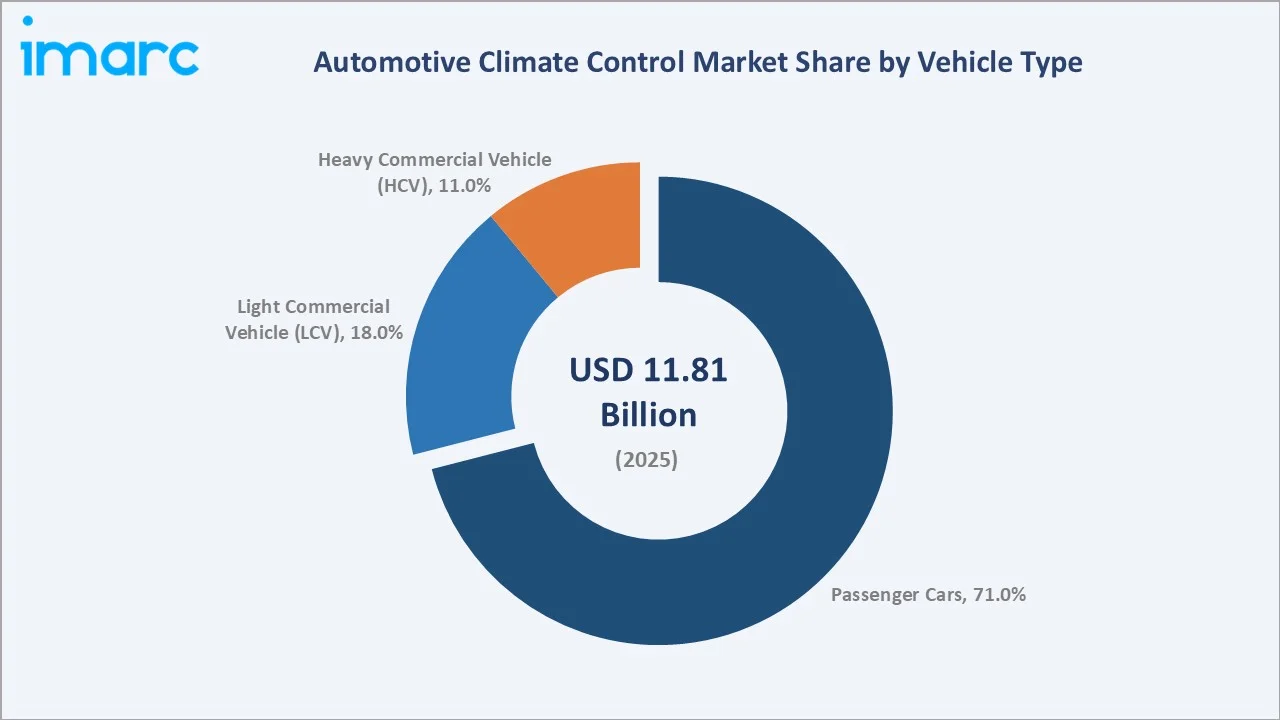
Light Commercial Vehicles at 18.0% represent growing demand as fleet operators prioritize driver comfort in last-mile delivery and logistics vehicles. Heavy Commercial Vehicles at 11.0% reflect robust systems designed for long-haul driver well-being and meet regulatory requirements for cabin comfort and air quality in commercial vehicle segments across major global markets.
Regional Market Insights
|
Region |
Share (2025) |
Key Drivers & Characteristics |
|
Asia Pacific |
38.0% |
Driven by rising vehicle production in China, India, and Japan, coupled with growing consumer demand for comfort features and government support for EV adoption. |
|
Europe |
27.0% |
Driven by stringent EU emission regulations, growing EV fleet adoption, and consumer preference for energy-efficient cabin climate systems. |
|
North America |
22.0% |
Supported by high vehicle ownership, demand for luxury vehicles with advanced automatic climate control, and growth in EV and SUV segments. |
|
Latin America |
7.0% |
Driven by growing vehicle ownership, rising consumer aspirations, and increasing penetration of mid-range vehicles with improved comfort systems. |
|
Middle East and Africa |
6.0% |
Extreme climatic conditions make climate control systems essential; increasing vehicle sales and infrastructure investments are supporting adoption. |
Asia Pacific, at 38.0%, leads through China's vehicle production scale, India's rapidly growing passenger car market, and Japan's technology leadership in climate system integration. The region benefits from government EV incentives that also drive adoption of advanced thermal management systems incorporating heat pump and multi-zone climate technologies across passenger and commercial vehicle platforms.
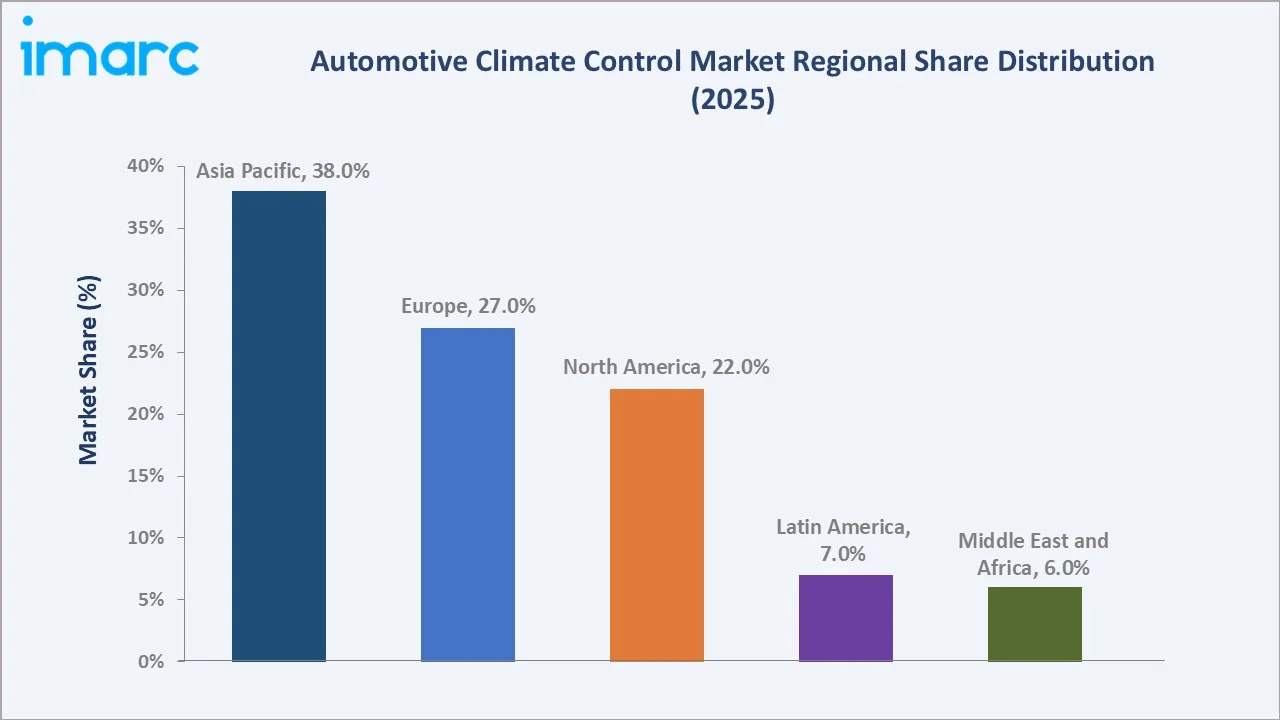
Europe, at 27.0%, reflects stringent EU CO2 regulations driving EV adoption and demand for energy-efficient heat pump climate systems. North America, at 22.0%, demonstrates strong demand for automatic and luxury climate systems driven by high vehicle ownership and premium vehicle sales growth.
Competitive Landscape
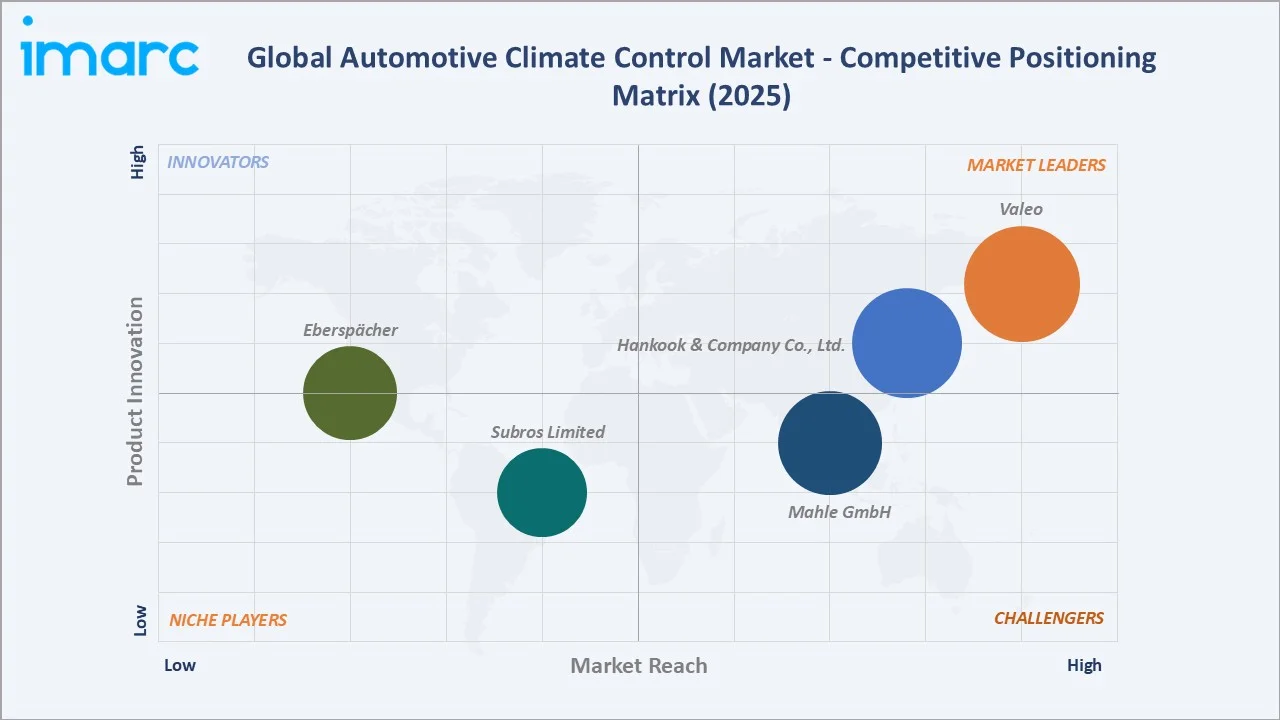
The global automotive climate control market competitive landscape is moderately concentrated, with global full-system HVAC Tier-1 suppliers, specialized thermal technology companies, and regional OEM-dedicated suppliers constituting the primary competitive tiers. Continued OEM electrification investments and EV-specific thermal management requirements are reshaping competitive dynamics across all market tiers.
|
Company Name |
Key Products |
Market Position |
Core Strength |
|
Valeo |
Thermal Systems, EV Heat Pump HVAC, Air Conditioning Compressors |
Market Leader |
Valeo is a leading French automotive supplier specialising in thermal management and climate systems for conventional and electric vehicles, including advanced heat pump solutions. |
|
Mahle GmbH |
Air Management, Thermal Management, HVAC Systems |
Strong Challenger |
Mahle GmbH develops integrated air and thermal management systems with increasing focus on energy-efficient climate solutions for hybrid and battery electric vehicles. |
|
Hankook & Company Co., Ltd. |
Compressors, Thermal & Energy Management, HVAC Modules |
Market Leader |
Hanon Systems specialises in thermal and energy management technologies for automotive OEMs globally, with deep expertise in EV-compatible climate systems. |
|
Eberspächer |
Auxiliary Heaters, Vehicle Climate Systems |
Established Player |
Eberspächer Group provides vehicle climate and heating solutions including parking heaters and auxiliary heating systems for commercial and passenger vehicles. |
|
Subros Limited |
Automotive Air Conditioning Systems, Compressors |
Niche Player |
Subros Limited is a leading Indian manufacturer of automotive thermal products including AC systems and compressors, primarily serving passenger car OEMs in South Asia. |
Key players include Valeo, Mahle GmbH, Hankook & Company Co., Ltd., Eberspächer, Subros Limited, and others.
Key Company Profiles
Valeo
Valeo is a French multinational automotive supplier with a leading position in thermal management and climate control systems for both conventional and electric vehicles, supplying to major OEMs across multiple vehicle platforms and global manufacturing regions.
- Key Products: Automotive HVAC systems, EV thermal systems including heat pumps, air conditioning compressors, cabin heaters, and integrated thermal management modules.
- Strategic Focus: Accelerating development of integrated EV thermal management systems combining cabin climate control and battery thermal regulation to serve next-generation BEV and PHEV vehicle platforms across global automotive markets.
Mahle GmbH
Mahle GmbH is a German automotive Tier-1 supplier specializing in air management and thermal management systems, with an increasing strategic focus on energy-efficient climate technologies for electrified vehicle platforms serving OEM customers across European, Asian, and North American manufacturing markets.
- Key Products: HVAC systems, air management modules, thermal management systems for EVs, refrigerant compressors.
- Strategic Focus: Developing thermally integrated solutions for battery electric and hybrid vehicles, combining climate control with battery thermal management to maximize EV efficiency and support OEM range performance targets.
Market Concentration Analysis
The automotive climate control market is moderately concentrated at the full-system HVAC Tier-1 level. The top three companies collectively account for approximately 45–55% of global passenger car climate system revenue. OEM captive assembly accounts for an estimated 10–15% of global system supply, primarily in Japan and certain Korean vehicle platforms.
Market concentration is stable over the forecast period, with global Tier-1 suppliers maintaining strong positions through continuous technology investment in EV thermal management, while regional suppliers expand in cost-sensitive segments across Asia Pacific and Latin America, driven by OEM localization requirements and competitive pricing advantages.
Investment & Growth Opportunities
Highest Growth Segments
Automatic climate control segment at approximately 5.60% CAGR, EV heat pump systems at approximately 8–10% CAGR, passenger vehicle HVAC integration at approximately 5.10% CAGR, AI-based predictive climate systems, and connected climate control solutions represent the highest-growth investment vectors through 2034 in the global automotive climate control market.
Emerging Investment Opportunities
EV thermal management integration represents the market's highest emerging opportunity, as every BEV platform requires a dedicated climate system capable of managing both cabin comfort and battery temperature without combustion engine heat. EV heat pump systems at 2–3x the energy efficiency of resistive heaters create premium pricing opportunities for Tier-1 suppliers with proven EV thermal management technology and established OEM relationships.
Investment Themes
- EV Heat Pump Technology Vertical Integration: Investment in EV-compatible heat pump systems combining cabin climate control and battery thermal management creates a sustainable competitive advantage as BEV production scales globally through 2034 and OEMs prioritize suppliers with complete integrated thermal management solutions.
- Asia Pacific Climate System Manufacturing Expansion: India's rapidly growing passenger car market and China's continued EV expansion create strong rationale for regional climate system manufacturing investment to serve OEM localization requirements, reduce import exposure, and capture high-growth emerging market demand.
Future Market Outlook (2026-2034)
The global automotive climate control market is projected to grow from USD 11.81 Billion in 2025 to USD 18.33 Billion by 2034, delivering a 4.86% CAGR over the forecast period. The market's anchor value of USD 14.97 Billion in 2030 reflects an industry at an accelerating technology inflection point driven by vehicle electrification and the premiumization of cabin climate systems.
Three structural forces define market growth through 2034 with high confidence. Global vehicle production growth creates a foundational demand pool as every vehicle manufactured requires a climate control system. EV platform expansion drives premiumization of climate systems toward integrated thermal management architectures with heat pump technology. Consumer expectations for personalized, connected, and energy-efficient cabin environments accelerate adoption of automatic and AI-enhanced climate systems across all vehicle segments and price tiers globally.
Research Methodology
Primary Research
Primary research comprised structured interviews with 45+ industry stakeholders in 2025, including HVAC system engineers, OEM procurement leads, refrigerant transition specialists, EV thermal management experts, and aftermarket climate service providers across global automotive manufacturing regions.
Secondary Research
Secondary research encompassed company annual reports, IEA Global EV Outlook, OICA vehicle production data, Society of Automotive Engineers technical papers on EV thermal management, EU refrigerant regulation documentation, automotive market forecast databases, and government EV policy publications across major markets. Over 55 secondary sources were reviewed and cross-validated.
Forecasting Models
Market revenue forecasts developed using vehicle production-based bottom-up model incorporating: global vehicle production forecast by type; climate control system attachment rate per vehicle type; average system price by technology and vehicle category; and regional weighting for technology mix and premium penetration. Historical CAGR validated against 2020–2025 market data anchored at USD 9.31 Billion in 2020.
Automotive Climate Control Market Report Scope:
| Report Features | Details |
|---|---|
| Base Year of the Analysis | 2025 |
| Historical Period | 2020-2025 |
| Forecast Period | 2026-2034 |
| Units | Billion USD |
| Scope of the Report | Exploration of Historical Trends and Market Outlook, Industry Catalysts and Challenges, Segment-Wise Historical and Predictive Market Assessment:
|
| Technologies Covered | Automatic, Manual |
| Components Covered | Condenser, Compressor, Relays and Control Valves, Evaporators and Thermostats, Drier/Receiver, Others |
| Vehicle Types Covered | Passenger Cars, Light Commercial Vehicle (LCV), Heavy Commercial Vehicle (HCV) |
| Distribution Channels Covered | OEMs, Aftermarket |
| Regions Covered | Asia Pacific, Europe, North America, Latin America, Middle East and Africa |
| Countries Covered | United States, Canada, Germany, France, United Kingdom, Italy, Spain, Russia, China, Japan, India, South Korea, Australia, Indonesia, Brazil, Mexico |
| Companies Covered |
Valeo, Mahle GmbH, Hankook & Company Co., Ltd., Eberspächer, Subros Limited, etc. |
| Customization Scope | 10% Free Customization |
| Post-Sale Analyst Support | 10-12 Weeks |
| Delivery Format | PDF and Excel through Email (We can also provide the editable version of the report in PPT/Word format on special request) |
Key Benefits for Stakeholders:
- IMARC's industry report offers a comprehensive quantitative analysis of various market segments, historical and current market trends, market forecasts, and dynamics of the automotive climate control market from 2020-2034.
- The research report provides the latest information on the market drivers, challenges, and opportunities in the global automotive climate control market.
- The study maps the leading, as well as the fastest-growing, regional markets. It further enables stakeholders to identify the key country-level markets within each region.
- Porter's five forces analysis assists stakeholders in assessing the impact of new entrants, competitive rivalry, supplier power, buyer power, and the threat of substitution. It helps stakeholders to analyze the level of competition within the automotive climate control industry and its attractiveness.
- The competitive landscape allows stakeholders to understand their competitive environment and provides insight into the current positions of key players in the market.
Frequently Asked Questions About the Automotive Climate Control Market Report
The global automotive climate control market reached USD 11.81 Billion in 2025, expanding from USD 9.31 Billion in 2020. The market is driven by the Automatic technology segment at 62.0%, Passenger Cars leading at 71.0%, and Asia Pacific commanding 38.0% market share through China, Japan, and India's combined vehicle production scale.
The market grows at 4.86% CAGR during 2026-2034, reaching USD 18.33 Billion by 2034 from USD 11.81 Billion in 2025. This growth reflects global vehicle production expansion, increasing EV adoption driving premium thermal management demand, and rising consumer expectations for smart and connected in-cabin climate systems.
Automatic climate control leads at 62.0% in 2025, driven by OEM integration across mid-range and premium vehicles, declining electronic control unit costs, and growing consumer preference for convenient pre-set temperature management systems that minimize driver interaction.
Passenger cars lead at 71.0% through the highest global vehicle production volumes, increasing standard equipment integration of automatic systems, and growing EV passenger car fleets requiring advanced thermal management incorporating heat pump technology and multi-zone climate architectures.
Asia Pacific leads at 38.0% through China's vehicle production dominance, India's rapidly growing passenger car market, and Japan's technology leadership in thermal management systems. The region benefits from large-scale vehicle manufacturing infrastructure and growing middle-class demand for enhanced comfort features.
Leading companies include Valeo, Mahle GmbH, Hankook & Company Co., Ltd., Eberspächer, Subros Limited, and others.
The market is projected to reach approximately USD 14.97 Billion by 2030, with EV heat pump systems reaching mainstream adoption, AI-based predictive climate systems becoming standard in premium vehicles, and Asia Pacific expanding its leadership position through continued vehicle electrification investments.
Key investment opportunities include EV heat pump thermal management systems, AI-based personalized climate control technologies, connected remote pre-conditioning platforms, energy-efficient eco-refrigerant system manufacturing, and Asia Pacific regional manufacturing capacity expansion to serve OEM localization requirements and capture high-growth demand.
Need more help?
- Speak to our experienced analysts for insights on the current market scenarios.
- Include additional segments and countries to customize the report as per your requirement.
- Gain an unparalleled competitive advantage in your domain by understanding how to utilize the report and positively impacting your operations and revenue.
- For further assistance, please connect with our analysts.
 Request Customization
 Speak to an Analyst
 Request Brochure
 Inquire Before Buying
Benefits of Customization
- Personalize this research
- Triangulate with your data
- Get data as per your format and definition
- Gain a deeper dive into a specific application, geography, customer, or competitor
- Any level of personalization
Get in Touch With Us
UNITED STATES
Phone: +1-201-971-6302
INDIA
Phone: +91-120-433-0800
UNITED KINGDOM
Phone: +44-753-714-6104
Email: [email protected]
Client Testimonials




.webp)




.webp)













Related Reports

Choose your plan
*Please note that the prices mentioned below are starting prices for each bundle type. Kindly contact our team for further details.*
Single User License
- 1 User License, Access on 2 Devices
- PDF Report + Excel Dataset (Password Protected)
- Lifetime Access
- No Printing Rights
- 10% Free Report Customization
- 10–12 Weeks of Analyst Support
Five User License
- Access for 5 Users, 2 Devices per User
- PDF Report + Excel Dataset (Password Protected)
- Lifetime Access
- Dedicated Account Manager
- 12–14 Weeks of Analyst Support
- No Printing Rights
- 15% Free Report Customization
- 25% Discount on Your Next Purchase
Corporate User License
- Unlimited User Access (Within Your Organization)
- PDF Report + Excel Dataset
- Lifetime Access
- Dedicated Account Manager
- 14–20 Weeks of Analyst Support
- No Printing Rights
- 20% Free Report Customization
- 30% Discount on Your Next Purchase
Essential Insights
What's included:
3 reports
- Lifetime Access
- PDF Reports
- Excel Datasets
- 2 Weeks of Free Analyst Support
- 2 User Licenses
- Access on 2 Devices
- Printing Rights
- Complimentary PowerPoint (PPT) Version
- Complimentary License Upgrade
Professional Access
What's included:
5 reports
- Lifetime Access
- PDF Reports
- Excel Datasets
- 8 Weeks of Free Analyst Support
- 2 User Licenses
- Access on 2 Devices
- Printing Rights
- Complimentary PowerPoint (PPT) Version
- Complimentary License Upgrade
Business Advantage
What's included:
8 reports
- Lifetime Access
- PDF Reports
- Excel Datasets
- 14 Weeks of Free Analyst Support
- 2 User Licenses
- Access on 2 Devices
- Printing Rights
- Complimentary PowerPoint (PPT) Version
- Complimentary License Upgrade
Enterprise Intelligence
What's included:
10 reports
- Lifetime Access
- PDF Reports
- Excel Datasets
- 20 Weeks of Free Analyst Support
- 2 User Licenses
- Access on 2 Devices
- Printing Rights
- Complimentary PowerPoint (PPT) Version
- Complimentary License Upgrade