
Automotive Electronic Control Unit (ECU) Market Size, Share, Trends and Forecast by Capacity, Vehicle Type, Propulsion, Application, and Region, 2026-2034
Global Automotive Electronic Control Unit (ECU) Market Size, Share, Trends & Forecast (2026-2034)
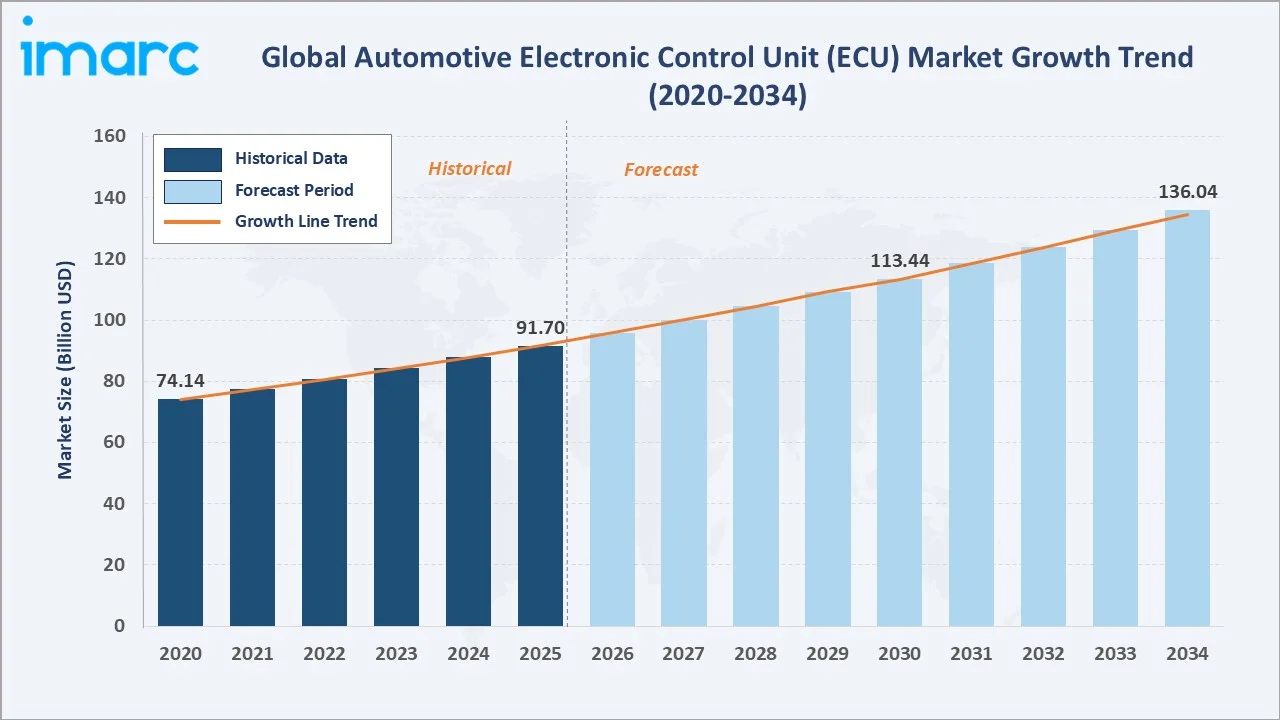
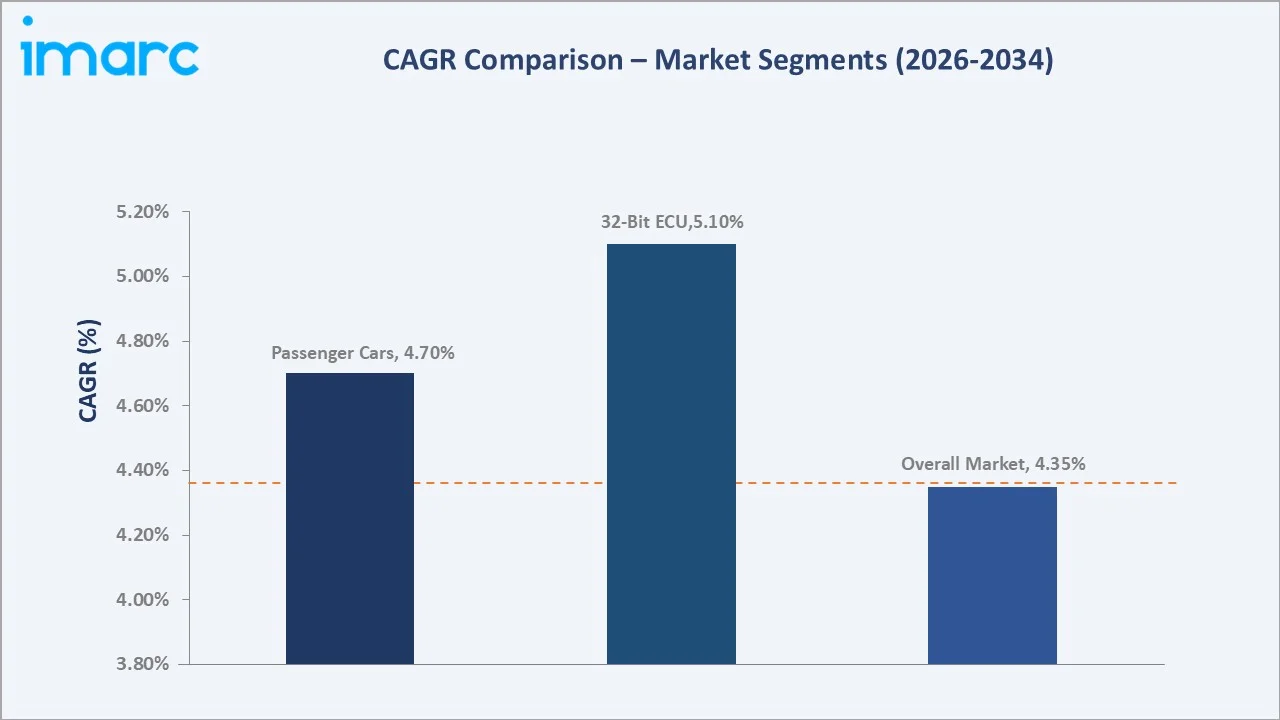
The global automotive electronic control unit (ECU) market reached USD 91.70 Billion in 2025 and is projected to reach USD 136.04 Billion by 2034, growing at a CAGR of 4.35% during 2026-2034. Rapid adoption of advanced driver-assistance systems (ADAS) and autonomous driving technologies requiring sophisticated multi-ECU processing capability, stricter global emission regulations mandating ECU-managed powertrain optimization, and the expansion of connected vehicle and V2X communication systems are the primary growth catalysts.
Market Snapshot
|
Metric |
Value |
|
Market Size (2025) |
USD 91.70 Billion |
|
Forecast Market Size (2034) |
USD 136.04 Billion |
|
CAGR (2026-2034) |
4.35% |
|
Base Year |
2025 |
|
Historical Period |
2020-2025 |
|
Forecast Period |
2026-2034 |
Asia-Pacific leads regionally with a 41.0% share in 2025, driven by the world’s largest automotive production base across China, Japan, South Korea, and India, China’s dominant position in global EV manufacturing that significantly increases ECU content per vehicle through battery management system (BMS) ECUs. Passenger cars at 76.0% lead the vehicle type segment, reflecting the primacy of passenger vehicle production in global automotive output and the high and rapidly escalating ECU content per vehicle driven by ADAS, infotainment, and electrification feature adoption.
To get more information on this market, Request Sample
The global automotive ECU market is driven by the following structural demand forces: the ADAS and autonomous driving technology adoption that requires exponentially more ECU processing capability per vehicle as safety automation levels advance from Level 1 to Level 2+ and beyond; and the electric vehicle transition that multiplies the ECU count per vehicle through dedicated BMS, motor control, inverter control, and thermal management ECU requirements that do not exist in conventional ICE vehicles.
Executive Summary
The global automotive electronic control unit (ECU) market is experiencing sustained growth, driven by the automotive industry’s most significant technological transformation in a century, the simultaneous transition from internal combustion engines to electrification, from human driving to automation, and from isolated vehicle systems to connected, software-managed platforms. The market was valued at USD 91.70 Billion in 2025 and is forecast to reach USD 136.04 Billion by 2034, growing at a CAGR of 4.35%.
A modern premium passenger vehicle contains 70–150 individual ECUs, compared to fewer than 5 in a 1980s vehicle, and this number is growing as ADAS features, electrification, infotainment complexity, and connectivity requirements each add new ECU types and processing demands. Battery electric vehicles add 5–10 additional ECUs versus equivalent ICE vehicles for BMS, motor control, inverter control, DC-DC converter management, and thermal management functions.
Passenger cars lead at 76.0%, 32-Bit ECU at 52.0%, and Asia-Pacific at 41.0%. Moreover, key players compete across ECU processing capability, application breadth, OEM relationship depth, software capability, and ISO 26262 functional safety certification expertise.
Key Market Insights
|
Insight |
Data |
|
Largest Vehicle Type |
Passenger Cars – 76.0% share (2025) |
|
Second Largest Vehicle Type |
Commercial Vehicles – 24.0% share (2025) |
|
Largest Capacity |
32-Bit ECU – 52.0% share (2025) |
|
Second Largest Capacity |
64-Bit ECU – 30.0% share (2025) |
|
Leading Region |
Asia-Pacific – 41.0% share (2025) |
|
Key Market Players |
Robert Bosch GmbH, Continental AG, DENSO CORPORATION, ZF Friedrichshafen AG, NXP Semiconductors N.V. |
Key Analytical Observations Supporting the Above Data:
- Passenger Cars at 76.0% share (2025) lead the vehicle type segment as the global passenger vehicle production base is approximately 4× larger than the commercial vehicle production base, and as passenger vehicles have consistently higher average ECU content per vehicle driven by consumer electronics feature integration (infotainment, climate, comfort), ADAS safety feature mandates, and the faster EV adoption rate in passenger versus commercial vehicle segments.
- 32-Bit ECU at 52.0% share (2025) leads the capacity segment as it represents the current automotive processing performance optimum for the largest volume ECU application categories: engine management, transmission control, body control modules, ADAS Level 1–2 processing, and gateway ECUs.
- 64-Bit ECU at 30.0% (2025) is expected to be one of the fastest-growing capacity segments, driven by the computational requirements of ADAS Level 2+ and Level 3 sensor fusion, AI-based object recognition, and high-performance domain ECU architectures that consolidate multiple legacy 32-bit ECU functions into fewer, higher-performance processing nodes.
- Asia-Pacific’s 41.0% share (2025) reflects its structural dominance in global automotive production combined with the region’s exceptional EV production growth that amplifies ECU revenue per vehicle above the global average, and Japan’s and South Korea’s roles as home markets for world-leading ECU Tier-1 suppliers including DENSO and Hyundai Mobis.
Global automotive electronic control unit (ECU) Market Overview
An automotive electronic control unit (ECU) is an embedded electronic system that controls one or more specific subsystems in a motor vehicle, processing input signals from sensors, applying control algorithms, and generating output signals to actuators that control vehicle functions. Modern vehicles contain dozens to over 100 individual ECUs managing functions including engine management, transmission control, anti-lock braking, electronic stability control, airbag deployment, ADAS sensor processing, infotainment, body electrical functions, climate control, battery management, and vehicle-to-everything communication.
Macroeconomic drivers include the European Union’s General Safety Regulation mandating ADAS features including autonomous emergency braking, lane departure warning, intelligent speed assistance, and driver drowsiness detection in all new vehicles from 2024–2026, creating mandatory ECU content additions across all vehicles sold in Europe; and the US NHTSA’s proposed rulemaking for automatic emergency braking standards that would mandate ADAS ECU inclusion across all light vehicles sold in the US market.
Market Dynamics
To evaluate market opportunities, Request Sample
Market Drivers
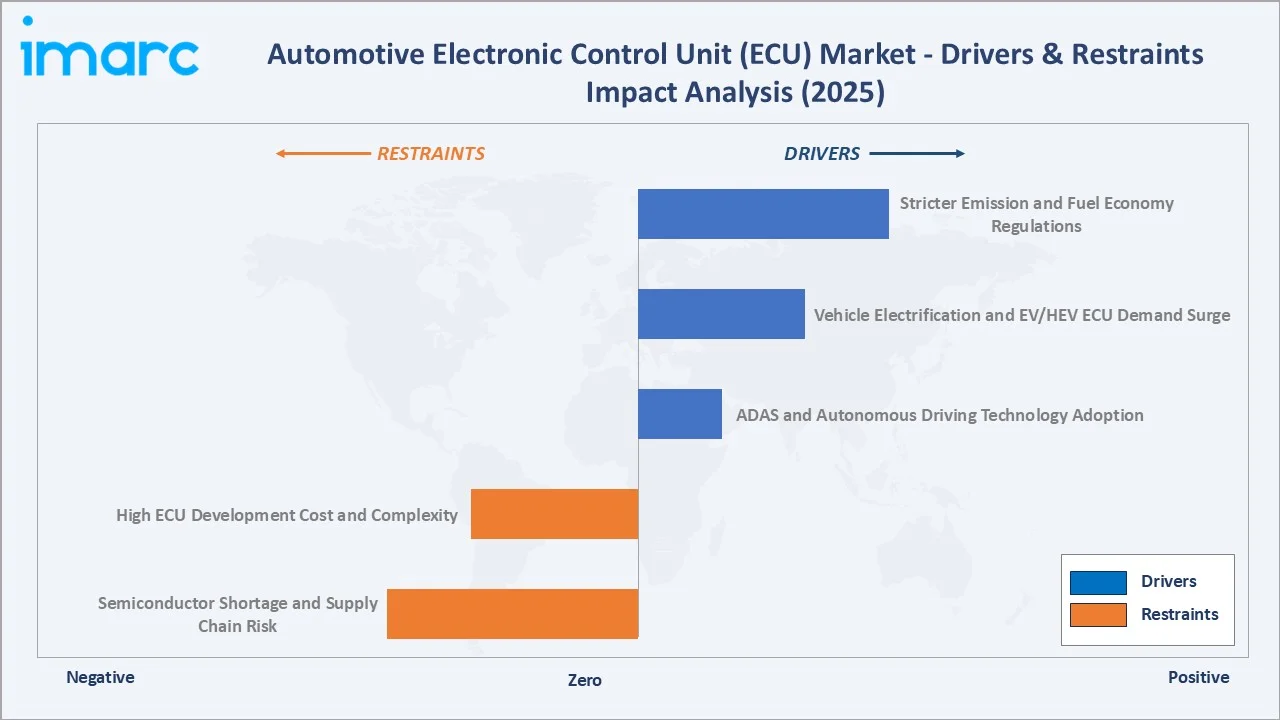
- ADAS and Autonomous Driving Technology Adoption: The progressive adoption of ADAS features creates exponentially increasing ECU processing requirements at each level advance. A Level 0 vehicle requires minimal ADAS ECU capability; a Level 2 vehicle requires a dedicated ADAS ECU processing camera, radar, and ultrasonic sensor fusion in real time; and a Level 3+ vehicle requires multiple high-performance 64-bit domain ECUs with GPU acceleration for lidar and camera AI processing.
- Vehicle Electrification and EV/HEV ECU Demand Surge: The global transition to battery electric and hybrid vehicles creates a structural uplift in ECU content per vehicle across multiple dedicated EV-specific ECU categories: battery management system (BMS) ECUs monitoring individual cell voltages, temperatures, and state of charge; motor control units (MCUs) managing torque delivery from electric motors; thermal management ECUs controlling battery temperature; and vehicle energy management ECUs optimizing regenerative braking and powertrain efficiency.
- Stricter Emission and Fuel Economy Regulations: The global tightening of vehicle emission standards requires increasingly sophisticated ECU-managed powertrain calibration, exhaust aftertreatment control, and on-board diagnostics systems that must monitor and record emission system performance in real time. Each emission standard step change requires ECU software and hardware updates that increase the processing requirements and communication capabilities of powertrain ECUs, driving ECU upgrade cycles that generate incremental revenue.
Market Restraints
- Semiconductor Shortage and Supply Chain Risk: The 2020–2022 global automotive semiconductor shortage demonstrated the vulnerability of the ECU supply chain to concentrated semiconductor manufacturing capacity. Automotive-grade semiconductor fabrication requires specialized 90nm–200nm process nodes at dedicated facilities, with lead times of 26–52 weeks, creating supply rigidity that cannot absorb demand spikes generated by vehicle production recovery or new feature content mandates.
- High ECU Development Cost and Complexity: The development of a new automotive ECU typically requires USD 5–50 Million in development investment over 3–5 years. This high development cost creates significant barriers for new entrants, limits the number of qualified ECU suppliers capable of meeting OEM technical and quality requirements, and creates long qualification timelines that slow the adoption of new ECU technologies even when commercially compelling.
Market Opportunities
- Software-Defined Vehicle Architecture Transition: The automotive industry’s transition from a hardware-defined architecture with dozens of single-function ECUs to a software-defined vehicle (SDV) platform with fewer, high-performance domain or zonal ECUs capable of receiving new functionality through OTA software updates represents the most significant structural revenue opportunity for ECU Tier-1 suppliers.
- AI and Machine Learning Integration in ADAS ECUs: The integration of neural processing unit (NPU) hardware accelerators and machine learning inference engines into ADAS domain ECUs is creating a new ultra-high-performance ECU category commanding premium pricing. Nvidia’s DRIVE platform and Qualcomm’s Snapdragon Ride represent the AI-integrated ADAS ECU category growing at above-market rates as Level 2+ and Level 3 automated driving features proliferate across premium and volume vehicle segments.
Market Challenges
- ECU Architecture Transition Disruption: The automotive industry’s shift from traditional distributed ECU architectures with 70–150 specialized ECUs to domain-based and zonal architectures with 5–20 high-performance computing nodes is disrupting established ECU supplier business models and creating winner-take-more competitive dynamics where suppliers that win domain ECU platform positions capture more total ECU revenue per vehicle.
- OEM Vertical Integration in Software-Defined Vehicle ECUs: Major automotive OEMs including Tesla, Volkswagen, GM, Toyota, and BMW are progressively investing in in-house ECU software capability and increasingly in ECU hardware design, seeking to reduce dependence on Tier-1 ECU suppliers and capture the software value that increasingly differentiates vehicle performance and creates recurring subscription revenue. This OEM insourcing trend creates risk for traditional ECU Tier-1 suppliers whose value proposition was comprehensive hardware-software ECU system delivery.
Emerging Market Trends
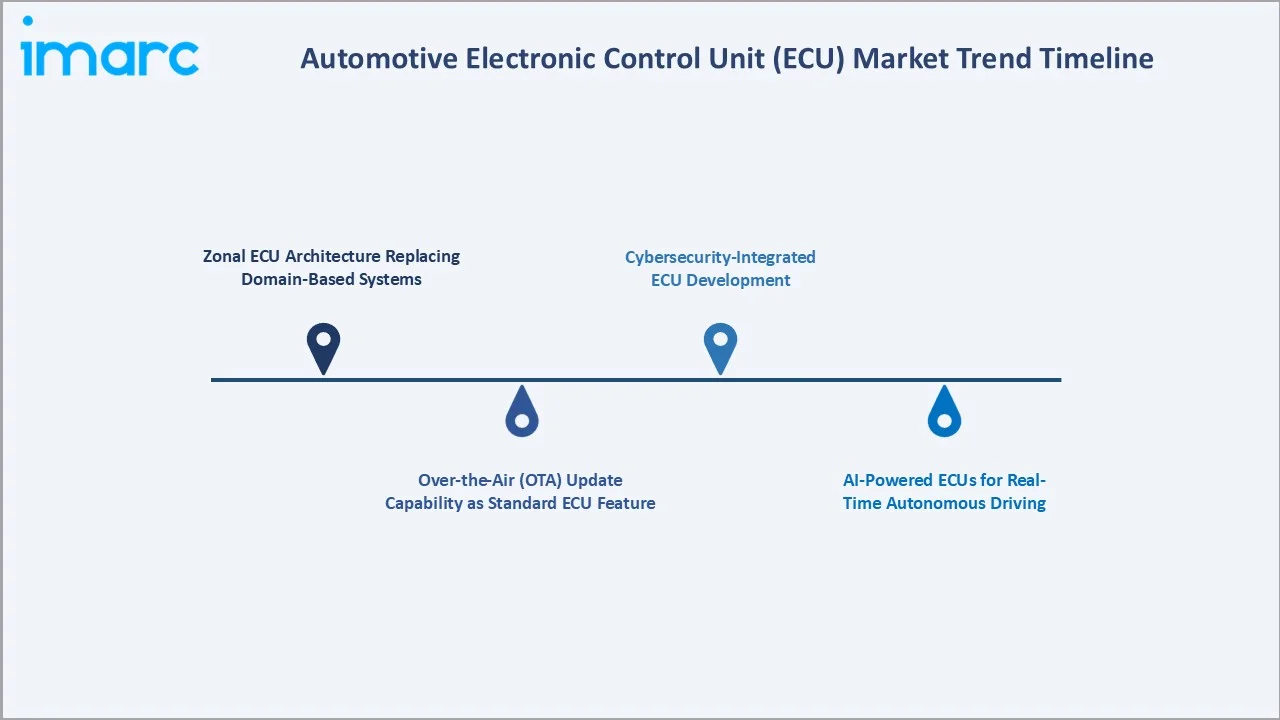
1. Zonal ECU Architecture Replacing Domain-Based Systems
The next-generation vehicle electrical architecture is transitioning from domain-based ECU organization to zonal architecture, where high-performance zonal ECUs manage all vehicle functions in a defined physical zone of the vehicle. Zonal ECU architectures reduce wiring harness length and weight by 30–50%, simplify the vehicle electrical architecture, and enable more efficient over-the-air software management. Mercedes-Benz’s MB.OS architecture and Hyundai’s High-Performance Onboard Computing platform are commercial implementations of zonal ECU architecture entering production through 2025–2028.
2. Over-the-Air (OTA) Update Capability as Standard ECU Feature
The capability for vehicle ECUs to receive software updates wirelessly is transitioning from a Tesla-pioneered premium feature to an industry standard requirement. UNECE WP.29 Software Update Regulations (R156) mandate OTA-capable ECU architectures for all new vehicle type approvals in regulated markets from July 2022. OTA ECU update capability requires gateway ECUs with secure OTA management, sufficient on-ECU flash memory for dual-bank update storage, and vehicle state management systems that ensure safe update execution, collectively increasing the technical specification and unit cost of ECUs across all vehicle categories.
3. AI-Powered ECUs for Real-Time Autonomous Driving
The deployment of AI accelerator hardware within ADAS and autonomous driving ECUs is enabling a new generation of real-time object recognition, scene understanding, and driving decision algorithms that were computationally infeasible on conventional ECU microcontrollers. Mobileye’s EyeQ Ultra delivering 176 TOPS of AI inference in a single ECU package and Nvidia’s DRIVE Thor platform at 2,000 TOPS exemplify the AI-integrated ADAS ECU category.
4. Cybersecurity-Integrated ECU Development
The mandatory implementation of ISO 21434 cybersecurity lifecycle management for automotive ECU development is fundamentally changing ECU development processes, adding secure boot, hardware security module (HSM) integration, encrypted communications, intrusion detection, and regular cybersecurity update capabilities as standard ECU requirements. These cybersecurity requirements add 10–15% to ECU development cost and are increasingly influencing ECU hardware selection toward microcontrollers with integrated HSM hardware.
Industry Value Chain Analysis
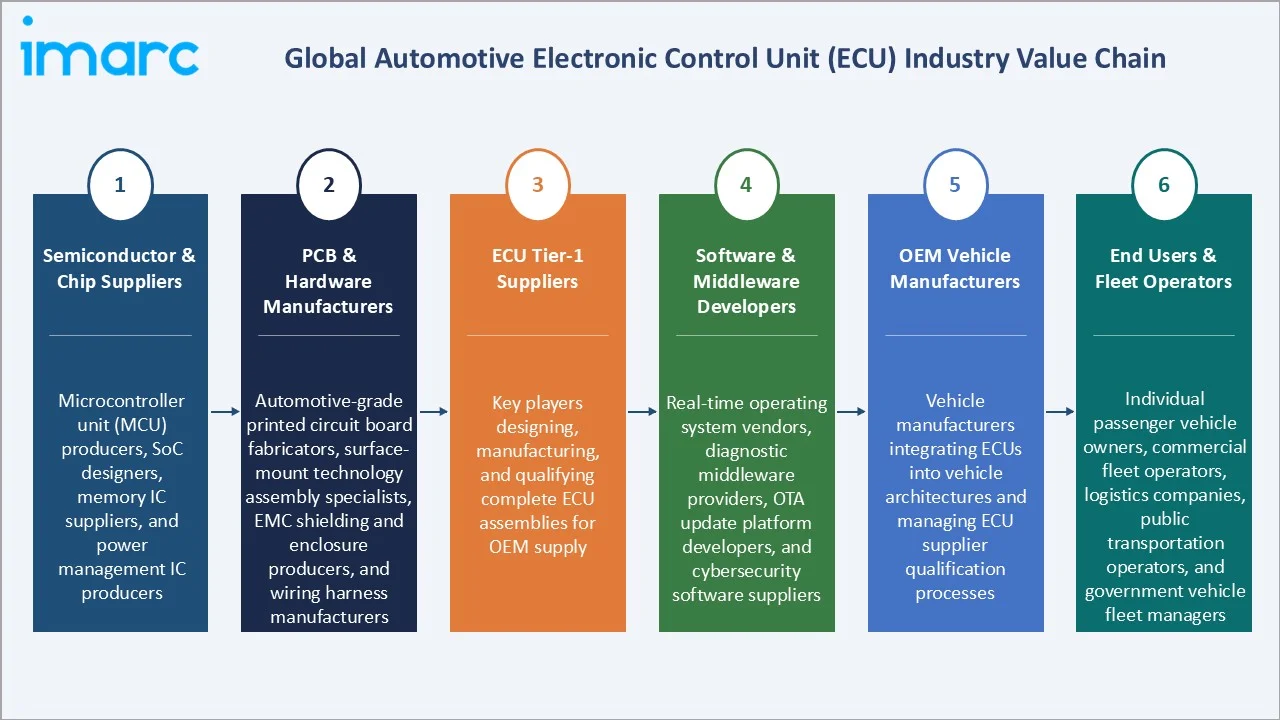
The global automotive electronic control unit (ECU) market value chain spans from semiconductor and electronic component supply through ECU hardware and software development, OEM vehicle integration, dealer and aftermarket service, and end-user vehicle operation.
|
Stage |
Key Players / Examples |
|
Semiconductor & Chip Suppliers |
Microcontroller unit (MCU) producers, SoC designers, memory IC suppliers, and power management IC producers |
|
PCB & Hardware Manufacturers |
Automotive-grade printed circuit board fabricators, surface-mount technology assembly specialists, EMC shielding and enclosure producers, and wiring harness manufacturers |
|
ECU Tier-1 Suppliers |
Key players designing, manufacturing, and qualifying complete ECU assemblies for OEM supply |
|
Software & Middleware Developers |
Real-time operating system vendors, diagnostic middleware providers, OTA update platform developers, and cybersecurity software suppliers |
|
OEM Vehicle Manufacturers |
Vehicle manufacturers integrating ECUs into vehicle architectures and managing ECU supplier qualification processes |
|
End Users & Fleet Operators |
Individual passenger vehicle owners, commercial fleet operators, logistics companies, public transportation operators, and government vehicle fleet managers |
Technology Landscape in the Global Automotive Electronic Control Unit (ECU) Industry
32-Bit Microcontroller Technology for Automotive ECU
32-bit automotive microcontrollers from NXP, Renesas, Infineon, and STMicroelectronics are the standard processing technology for the dominant share of automotive ECU applications. These devices provide the combination of real-time deterministic processing required for safety-critical vehicle control applications, AUTOSAR Classic software compatibility for standardized ECU development, ISO 26262 ASIL-D functional safety certification for the highest safety integrity level applications, and the peripheral integration required for modern vehicle communication architectures.
64-Bit High-Performance Computing for Domain ECUs
64-bit application processors and SoCs are enabling the domain ECU and zonal ECU architectures that consolidate multiple legacy 32-bit ECU functions into high-performance computing nodes. NXP’s S32G vehicle network processors and Nvidia’s Orin and Thor platforms represent the automotive 64-bit SoC landscape powering the next generation of domain controllers for ADAS, infotainment, cockpit domain, and central gateway functions. These SoCs run AUTOSAR Adaptive operating systems alongside Linux-based infotainment environments and hypervisor-managed consolidated ECU function execution.
AUTOSAR Standardization and Software-Defined ECU Platforms
The AUTOSAR’s Classic Platform and Adaptive Platform are providing the standardized software architecture foundation that enables automotive ECU software portability across different hardware suppliers, reducing OEM dependency on single-supplier ECU solutions. The AUTOSAR Adaptive Platform’s service-oriented architecture enables OTA-updatable ECU software that can receive new features post-vehicle sale, creating the software-defined vehicle model where ECU hardware serves as a platform for continuously updated software capabilities.
Market Segmentation Analysis
The report covers the following segments:
|
Segment Category |
Leading Segment |
Market Share |
Year |
|
Vehicle Type |
Passenger Cars |
76.0% |
2025 |
|
Capacity |
32-Bit ECU |
52.0% |
2025 |
|
Application |
ADAS and Safety System |
🔒 |
2025 |
|
Propulsion |
Internal Combustion Engine |
🔒 |
2025 |
|
Region |
Asia-Pacific |
41.0% |
2025 |

By Vehicle Type
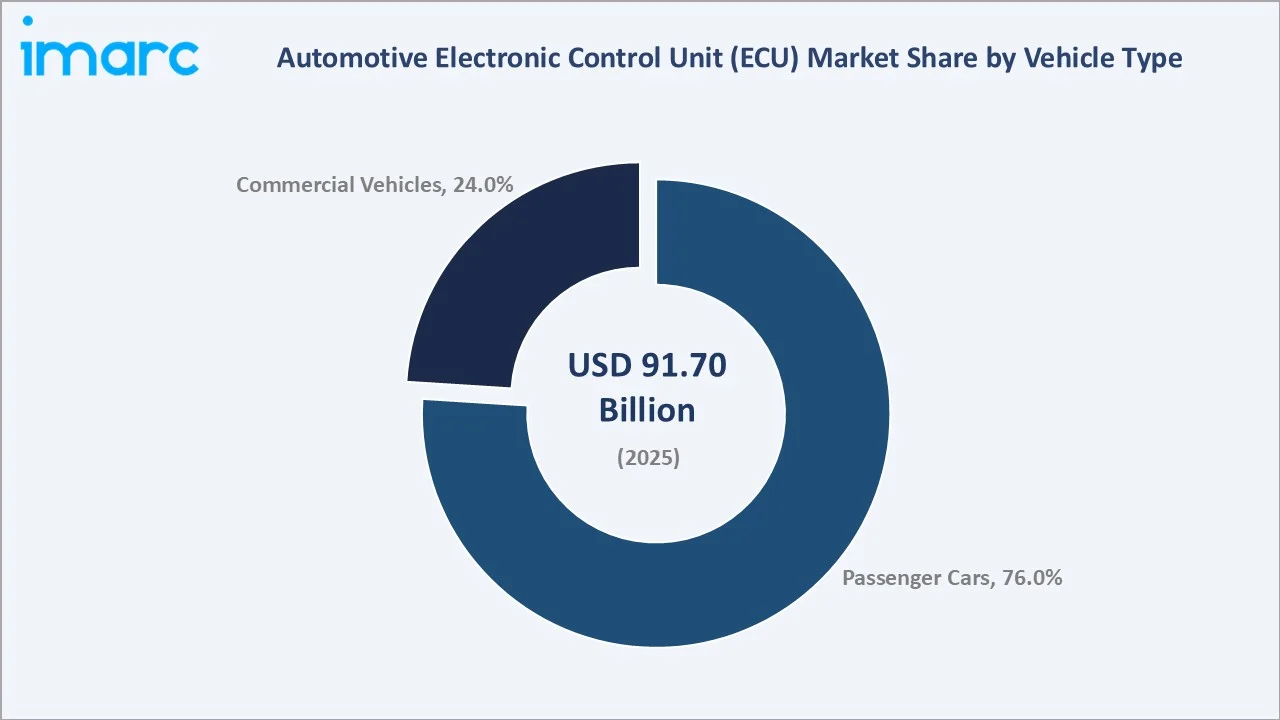
Passenger cars lead with a 76.0% share of the global automotive ECU market in 2025, reflecting both the much larger global passenger vehicle production volume and the significantly higher ECU content per vehicle driven by consumer electronics and ADAS feature adoption. Premium passenger vehicles including BMW, Mercedes-Benz, and Audi models deploy 100–150+ ECUs managing powertrain, chassis, ADAS, infotainment, connectivity, body comfort, and safety functions.
To access detailed market analysis, Request Sample
Commercial vehicles at 24.0% share (2025) serve the truck, bus, and specialty vehicle segments where ECU requirements are increasingly sophisticated but have historically lagged passenger vehicle ECU content per unit. Euro 7 emission regulation for heavy-duty vehicles, EU mandatory ADAS features for heavy commercial vehicles, and fleet telematics and remote diagnostics ECU requirements are each contributing to above-market ECU content growth in the commercial vehicle segment.
By Capacity
32-Bit ECU leads with a 52.0% share in 2025, reflecting its coverage of the widest range of automotive ECU applications that collectively represent the highest-volume ECU deployment categories in modern vehicles. ISO 26262 ASIL-D certified 32-bit microcontrollers from the Infineon AURIX Tricore and Renesas RH850 product families are the standard components for safety-critical automotive ECU applications requiring the highest functional safety integrity levels.
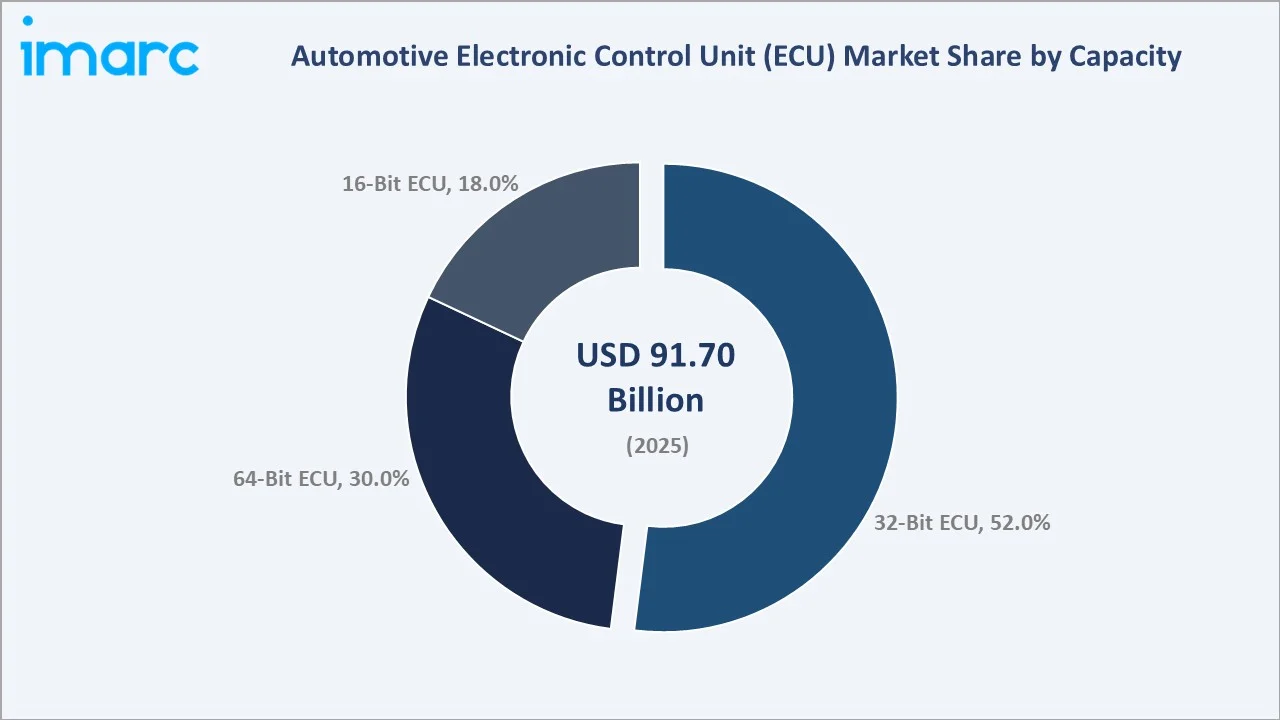
64-Bit ECU at 30.0% is growing rapidly as domain ECU architectures replace legacy distributed 32-bit ECU systems and as ADAS Level 2+ through Level 3 processing requirements exceed 32-bit MCU performance ceilings. 16-Bit ECU at 18.0% serves legacy body control, comfort, and low-complexity control applications in existing vehicle programs and in cost-sensitive vehicle segments where 16-bit MCU capability is sufficient for the required control functions.
Regional Market Insights
Asia-Pacific’s dominant position (41.0%, 2025) is anchored by China’s structural role as the world’s largest automotive production market, manufacturing approximately 34.53 million units vehicles annually, and by the region’s accelerated EV adoption trajectory creating significant ECU revenue uplift per vehicle versus the ICE average.
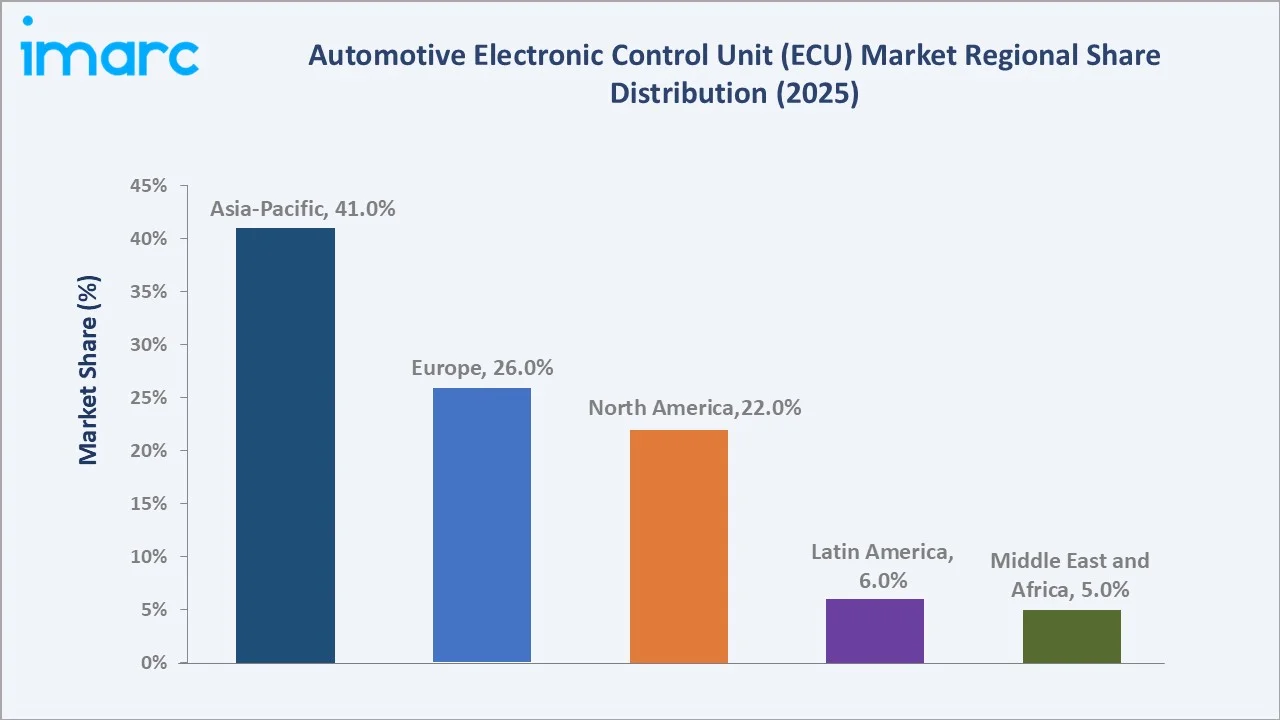
Europe at 26.0% share (2025) reflects the region’s role as the home market of two of the world’s three largest ECU Tier-1 suppliers (Robert Bosch GmbH and Continental AG) and as the origin of many of the most demanding automotive ECU regulations. North America at 22.0% reflects the US market’s rapid ADAS adoption, Aptiv’s US headquarters and major ECU production facilities, and the accelerating EV transition driven by IRA incentives.
|
Region |
Share (2025) |
Key Growth Drivers |
|
Asia-Pacific |
41.0% |
World’s largest automotive production base in China, Japan, South Korea, India, and ASEAN markets; China’s dominance in EV production creating exponential ECU demand per vehicle; and India’s rapidly growing automotive ECU market |
|
Europe |
26.0% |
Stringent Euro 6d and emerging Euro 7 emission standards compelling ECU-managed powertrain optimization; leading ECU Tier-1 supplier headquarters concentration; and premium OEM demand for high-performance ECU systems |
|
North America |
22.0% |
Large passenger vehicle and commercial vehicle market with high ADAS feature adoption rate; US government investment in EV infrastructure creating BMS ECU demand; and growing autonomous driving development activity at technology-automotive OEM partnerships |
|
Latin America |
6.0% |
Growing vehicle production in Brazil and Mexico, expansion of ECU content in locally manufactured vehicles, increasing OEM investment in regional manufacturing, and growing hybrid and EV model introduction expanding ECU content per vehicle in the region |
|
Middle East & Africa |
5.0% |
Expanding vehicle import and locally assembled vehicle fleet, GCC government fleet electrification programs, South Africa’s vehicle assembly sector creating ECU integration demand, and growing automotive after-sales ECU replacement and programming market |
Competitive Landscape
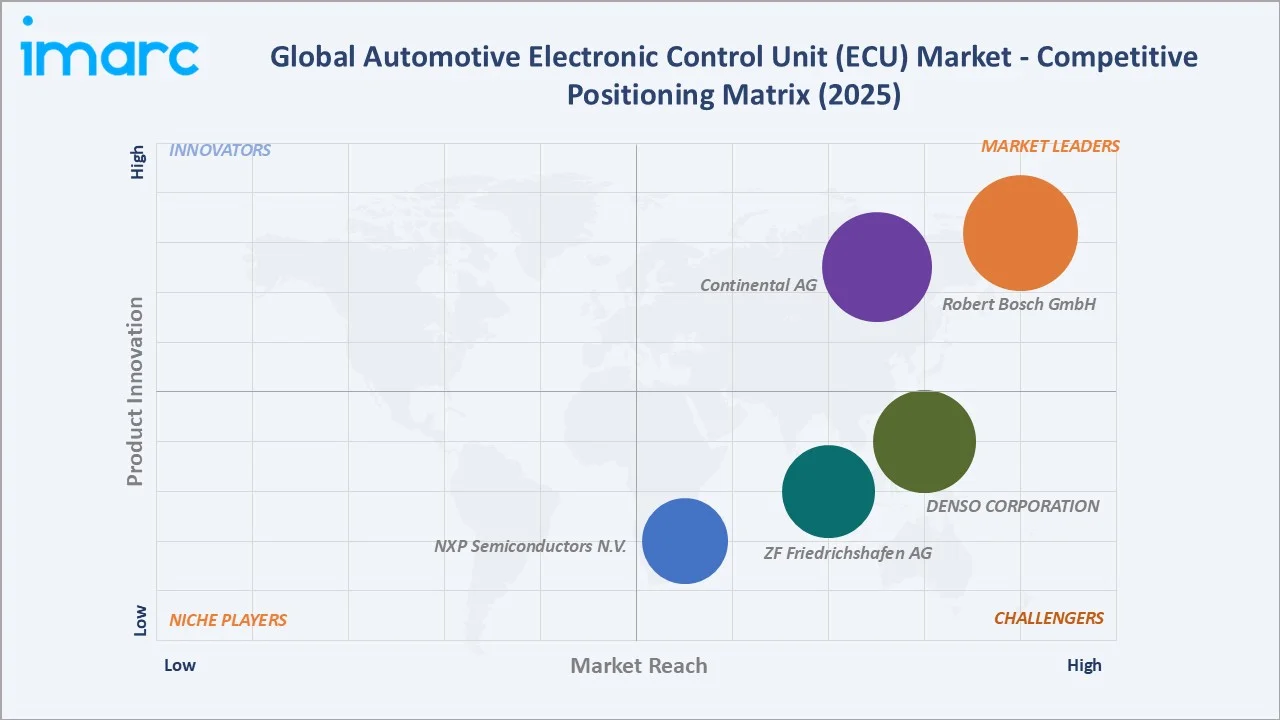
The global automotive electronic control unit (ECU) market is highly concentrated, with top players collectively accounting for approximately 55–60% of total global ECU revenues. The market’s concentration is reinforced by the enormous development investment required for each ECU category, the years-long OEM qualification processes for safety-critical ECU products, and the established relationships between Tier-1 ECU suppliers and OEM engineering teams.
|
Company Name |
Key Products |
Market Position |
Core Strength |
|
Robert Bosch GmbH |
Electronic ECUs, Vehicle Control Unit |
Market Leader |
Market leader in powertrain, ADAS, and body ECU categories; pioneering software-defined vehicle ECU architecture |
|
Continental AG |
Zone Control Units, ADAS domain controllers, Transmission ECUs, Braking ECUs, Instrument Cluster and HMI computing units |
Market Leader |
Domain and zonal ECU architecture leadership; strong ADAS and autonomous driving ECU development; Vehicle Networking and Information segment leader |
|
DENSO CORPORATION |
DENSO Engine Electronic Control Unit(ECU) |
Strong Challenger |
World-class powertrain ECU manufacturing at scale; deep electrification ECU capability for HEV and BEV platforms; strong Asia-Pacific supply relationships |
|
ZF Friedrichshafen AG |
Electronic Control Units, eDCU Electric Drive Control Unit |
Challenger |
Integrated chassis and braking system ECU expertise; growing ADAS sensor fusion ECU capability; strong commercial vehicle ECU market presence |
|
NXP Semiconductors N.V. |
Automotive MCUs, S32 Arm Cortex Microcontrollers and Arm Cortex Processors |
Challenger |
S32 automotive processing platform powering millions of ECU designs by Tier-1 suppliers; strong AUTOSAR-compliant MCU portfolio |
The competitive landscape is being reshaped by the software-defined vehicle transition, which is elevating software capability as the primary competitive differentiation dimension alongside traditional hardware manufacturing excellence.
Key Company Profiles
Robert Bosch GmbH
Robert Bosch GmbH is one of the world’s largest automotive suppliers and the leading ECU manufacturer globally, producing ECU units across powertrain, chassis, ADAS, body, and infotainment categories.
- Product Portfolio: Electronic ECUs and Vehicle Control Unit.
- Recent Developments: In September 2025, Robert Bosch GmbH announced plans to integrate NVIDIA DRIVE AGX Thor into its next-generation ADAS compute platform and software-defined vehicle architectures. The collaboration combines NVIDIA’s AI-powered centralized computing with Bosch’s safety, ECU, sensor, and system-integration expertise to support scalable assisted and automated driving solutions for automakers.
- Strategic Focus: Software-defined vehicle central computing platform development; ADAS Level 2+ and Level 3 ECU system leadership; EV powertrain ECU and BMS capability expansion; cybersecurity ISO 21434 compliance integration across ECU portfolio.
Continental AG
Continental AG is one of the world’s largest automotive suppliers and a leading ECU Tier-1 supplier across the Vehicle Networking and Information (VNI) and Autonomous Mobility and Safety (AMS) business segments.
- Product Portfolio: Zone Control Units, ADAS domain controllers, Transmission ECUs, Braking ECUs, and Instrument Cluster and HMI computing units.
- Recent Developments: In April 2024, Continental AG announced the series introduction of Zone Control Units (ZCUs) for European and Asian automakers, forming the middle tier of server-based E/E vehicle architectures. The ZCUs connect sensors, actuators, and high-performance computers, helping reduce vehicle electronics complexity, streamline wiring, support cybersecurity, and enable over-the-air software updates.
- Strategic Focus: Zonal and domain ECU platform for Software-Defined Vehicle; ADAS Level 2+ through Level 3 domain controller leadership; automotive Ethernet and high-speed communication ECU gateway capability; cybersecurity compliance integration.
Market Concentration Analysis
The global automotive electronic control unit (ECU) market exhibits high concentration at the Tier-1 system supplier level, with top players collectively holding approximately 55–60% of global ECU revenues. The ECU market’s concentration is structurally reinforced by the technical depth required for ISO 26262 functional safety certification, the years-long OEM qualification processes for each ECU family, the proprietary diagnostic and calibration toolchains that create integration dependency, and the long vehicle program lifecycles (5–8 years) over which ECU supplier relationships are fixed after initial development selection.
The software-defined vehicle transition is the primary force capable of disrupting established concentration, as it creates new entry opportunities for technology companies with AI and software capabilities that traditional ECU hardware suppliers do not possess.
Investment & Growth Opportunities
Fastest Growing Segments
64-Bit ECU capacity (~6–7% CAGR), ADAS level 2+ through Level 3 domain ECUs (~8–10% annual growth), EV battery management system ECUs (~9–12% CAGR from EV adoption), and software-defined vehicle zonal computing ECUs represent the highest-growth investment vectors within the global automotive ECU market through 2034. OTA-capable ECU architectures and cybersecurity-integrated ECU development capability are structural investment requirements for all ECU categories through the forecast period.
Emerging Trends
The software-defined vehicle revolution is creating a winner-take-most dynamic at the domain and zonal ECU computing platform level, where automotive OEMs are making 10-year+ architectural commitments to ECU platform suppliers that will define ECU revenue concentration for a vehicle generation. Automotive-grade chiplet and advanced packaging technology is enabling next-generation ECU SoC designs that combine CPU, GPU, NPU, memory, and communication interfaces in compact multi-chip packages that deliver unprecedented TOPS-per-watt performance for ADAS and autonomous driving ECU applications.
Technology Investment Trends
- AI accelerator integration into ADAS ECUs is attracting the largest automotive ECU technology R&D investment, with top players each partnering with AI semiconductor providers including Nvidia, Qualcomm, and Mobileye to integrate neural processing capabilities into next-generation domain controller ECU products.
- Automotive Ethernet ECU communication investment is accelerating as vehicle bandwidth requirements for ADAS sensor data, OTA update, and infotainment streaming exceed the capacity of traditional CAN FD bus architectures, requiring ECU design transitions to 100BASE-T1, 1000BASE-T1, and 10GBASE-T1 automotive Ethernet communication interfaces.
Future Market Outlook (2026-2034)
The global automotive electronic control unit (ECU) market is positioned for sustained growth through 2034. From USD 91.70 Billion in 2025, the market is projected to reach USD 136.04 Billion by 2034, representing total incremental value creation of USD 44.34 Billion at a CAGR of 4.35%.
This growth is underpinned by regulatory mandates in all major markets creating non-discretionary ECU content additions for ADAS, emission management, and connected vehicle functions; the EV transition creating additional ECU categories per vehicle; and the software-defined vehicle architecture shift creating higher-value domain and zonal ECU replacement for legacy distributed ECU systems.
The market’s competitive dynamics will continue to be shaped by the tension between established Tier-1 ECU supplier scale advantages and the software capability required for next-generation SDV ECU platforms, OEM insourcing of ECU software development, semiconductor supplier influence through automotive MCU and SoC platform development, and the potential disruption of technology companies with AI and connectivity capabilities entering the automotive computing platform market.
Research Methodology
Primary Research
Primary research comprised structured interviews with over 70 industry participants in 2024–2025, including automotive ECU manufacturer engineering and sales executives, automotive OEM electronic architecture engineers, automotive semiconductor company product managers, automotive software development tool vendors, ISO 26262 functional safety consultants, and automotive cybersecurity regulation experts. Expert input validated market sizing, segment growth rates, and regional demand estimates.
Secondary Research
Secondary research encompassed ECU company annual reports and investor presentations, European Automobile Manufacturers’ Association (ACEA) production statistics, China Association of Automobile Manufacturers (CAAM) NEV data, OICA global vehicle production statistics, UNECE WP.29 regulatory publications, ISO 26262 and ISO 21434 standard documents, semiconductor company automotive segment revenue filings, and industry publications including Automotive World, Automotive Electronics, IEEE Transactions on Vehicular Technology, and AEMC industry association reports.
Forecasting Models
Market size estimations were derived using top-down and bottom-up forecasting, incorporating global vehicle production volume projections by region and segment, ECU content per vehicle escalation modelling by ADAS level and propulsion type, ECU capacity mix shift projections from 16-bit to 32-bit and 64-bit, regulatory mandate timeline analysis for ADAS and emission ECU content, and EV adoption rate scenario modelling.
Automotive Electronic Control Unit (ECU) Market Report Coverage:
| Report Features | Details |
|---|---|
| Base Year of the Analysis | 2025 |
| Historical Period | 2020-2025 |
| Forecast Period | 2026-2034 |
| Units | Billion USD |
| Scope of the Report |
Exploration of Historical Trends and Market Outlook, Industry Catalysts and Challenges, Segment-Wise Historical and Future Market Assessment:
|
| Capacities Covered | 16-Bit ECU, 32-Bit ECU, 64-Bit ECU |
| Vehicle Types Covered | Passenger Cars, Commercial Vehicles |
| Propulsions Covered | Internal Combustion Engine, Hybrid, Battery Electric Vehicle |
| Applications Covered | ADAS and Safety System, Body Control and Comfort System, Infotainment and Communication System, Powertrain System, Others |
| Regions Covered | Asia Pacific, Europe, North America, Latin America, Middle East and Africa |
| Countries Covered | United States, Canada, Germany, France, United Kingdom, Italy, Spain, Russia, China, Japan, India, South Korea, Australia, Indonesia, Brazil, Mexico |
| Companies Covered |
Robert Bosch GmbH, Continental AG, DENSO CORPORATION, ZF Friedrichshafen AG, NXP Semiconductors N.V., etc. |
| Customization Scope | 10% Free Customization |
| Post-Sale Analyst Support | 10-12 Weeks |
| Delivery Format | PDF and Excel through Email (We can also provide the editable version of the report in PPT/Word format on special request) |
Frequently Asked Questions About the Automotive Electronic Control Unit (ECU) Market Report
The global automotive electronic control unit (ECU) market reached USD 91.70 Billion in 2025 and is projected to reach USD 136.04 Billion by 2034.
The market is expected to grow at a CAGR of 4.35% during 2026-2034, driven by ADAS and autonomous driving technology adoption, vehicle electrification creating new ECU categories, stricter emission regulations, and connected vehicle expansion.
Asia-Pacific leads with a 41.0% share in 2025, driven by China’s position as the world’s largest automotive producer and leading EV market, Japan’s ECU Tier-1 supplier leadership through DENSO and Panasonic, and South Korea’s growing automotive electronics industry.
Passenger cars lead with a 76.0% share in 2025, reflecting the much larger global passenger vehicle production volume versus commercial vehicles and the higher ECU content per vehicle driven by ADAS features, electrification, infotainment, and connectivity adoption in passenger car segments.
32-Bit ECU leads with a 52.0% share in 2025, reflecting its coverage of the widest range of automotive ECU application categories including engine management, transmission control, chassis systems, ADAS Level 1–2, and body control applications.
Some of the key players include Robert Bosch GmbH, Continental AG, DENSO CORPORATION, ZF Friedrichshafen AG, and NXP Semiconductors N.V.
Key drivers include ADAS and autonomous driving technology adoption requiring sophisticated ECU processing, vehicle electrification creating new BMS and motor control ECU categories per EV platform, stricter emission and fuel economy regulations driving powertrain ECU updates, and connected vehicle and V2X communication expansion.
Key opportunities include AI-integrated ADAS domain ECU development, EV battery management system ECU capability expansion, zonal ECU architecture platform development for software-defined vehicles, and commercial vehicle ECU content expansion driven by Euro 7 and autonomous platooning technology development.
Need more help?
- Speak to our experienced analysts for insights on the current market scenarios.
- Include additional segments and countries to customize the report as per your requirement.
- Gain an unparalleled competitive advantage in your domain by understanding how to utilize the report and positively impacting your operations and revenue.
- For further assistance, please connect with our analysts.
 Request Customization
 Speak to an Analyst
 Request Brochure
 Inquire Before Buying
Benefits of Customization
- Personalize this research
- Triangulate with your data
- Get data as per your format and definition
- Gain a deeper dive into a specific application, geography, customer, or competitor
- Any level of personalization
Get in Touch With Us
UNITED STATES
Phone: +1-201-971-6302
INDIA
Phone: +91-120-433-0800
UNITED KINGDOM
Phone: +44-753-714-6104
Email: [email protected]
Client Testimonials




.webp)




.webp)













Related Reports

Choose your plan
*Please note that the prices mentioned below are starting prices for each bundle type. Kindly contact our team for further details.*
Single User License
- 1 User License, Access on 2 Devices
- PDF Report + Excel Dataset (Password Protected)
- Lifetime Access
- No Printing Rights
- 10% Free Report Customization
- 10–12 Weeks of Analyst Support
Five User License
- Access for 5 Users, 2 Devices per User
- PDF Report + Excel Dataset (Password Protected)
- Lifetime Access
- Dedicated Account Manager
- 12–14 Weeks of Analyst Support
- No Printing Rights
- 15% Free Report Customization
- 25% Discount on Your Next Purchase
Corporate User License
- Unlimited User Access (Within Your Organization)
- PDF Report + Excel Dataset
- Lifetime Access
- Dedicated Account Manager
- 14–20 Weeks of Analyst Support
- No Printing Rights
- 20% Free Report Customization
- 30% Discount on Your Next Purchase
Essential Insights
What's included:
3 reports
- Lifetime Access
- PDF Reports
- Excel Datasets
- 2 Weeks of Free Analyst Support
- 2 User Licenses
- Access on 2 Devices
- Printing Rights
- Complimentary PowerPoint (PPT) Version
- Complimentary License Upgrade
Professional Access
What's included:
5 reports
- Lifetime Access
- PDF Reports
- Excel Datasets
- 8 Weeks of Free Analyst Support
- 2 User Licenses
- Access on 2 Devices
- Printing Rights
- Complimentary PowerPoint (PPT) Version
- Complimentary License Upgrade
Business Advantage
What's included:
8 reports
- Lifetime Access
- PDF Reports
- Excel Datasets
- 14 Weeks of Free Analyst Support
- 2 User Licenses
- Access on 2 Devices
- Printing Rights
- Complimentary PowerPoint (PPT) Version
- Complimentary License Upgrade
Enterprise Intelligence
What's included:
10 reports
- Lifetime Access
- PDF Reports
- Excel Datasets
- 20 Weeks of Free Analyst Support
- 2 User Licenses
- Access on 2 Devices
- Printing Rights
- Complimentary PowerPoint (PPT) Version
- Complimentary License Upgrade