
Automotive Heat Shield Market Size, Share, Trends and Forecast by Material, Product, Application, Vehicle Type, and Region, 2026-2034
Automotive Heat Shield Market Size, Share, Trends & Forecast (2026-2034)
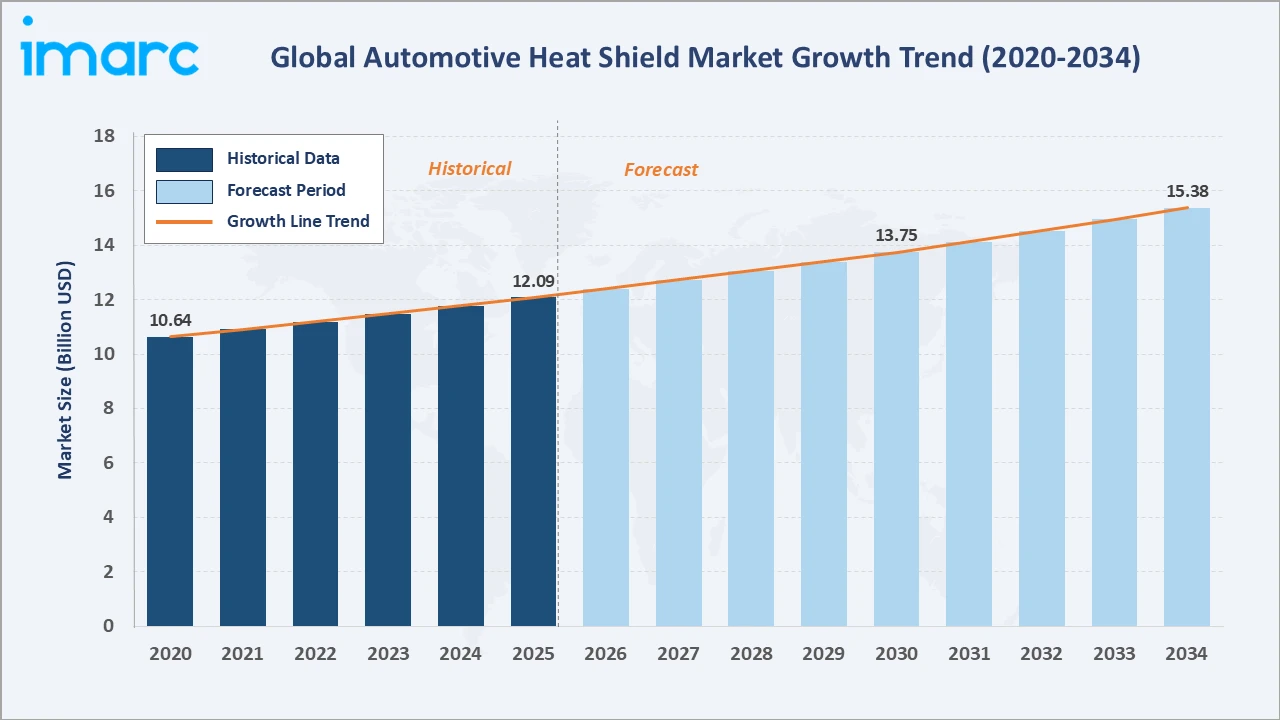
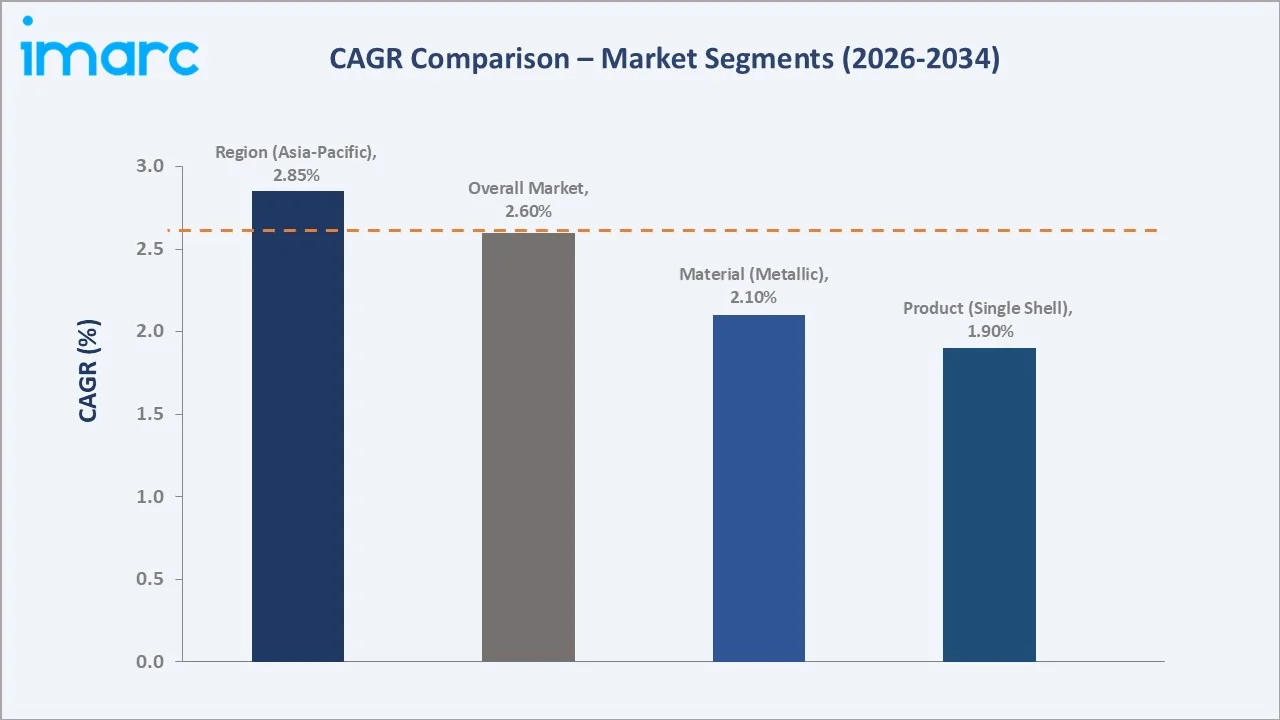
The automotive heat shield market was valued at USD 12.09 Billion in 2025 and is projected to reach USD 15.38 Billion by 2034, exhibiting a CAGR of 2.60% during 2026-2034. Growth is primarily driven by rising global vehicle production, alongside tightening emission regulations and expanding thermal-protection requirements for hybrid and electric powertrains.
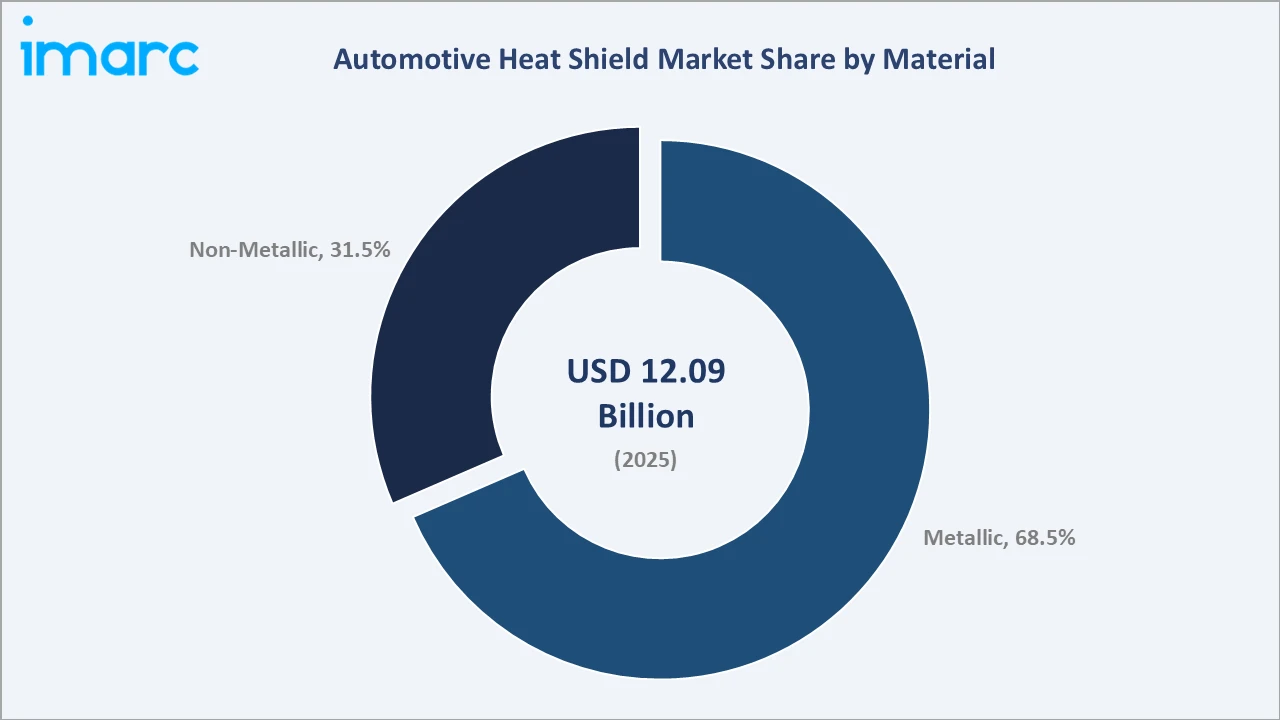
Metallic leads the material segment at 68.5% share, single shell dominates the product segment at 44.7% share, and Asia-Pacific commands 42.8% of the regional share in 2025.
Market Snapshot
|
Metric |
Value |
|
Market Size (2025) |
USD 12.09 Billion |
|
Forecast Market Size (2034) |
USD 15.38 Billion |
|
CAGR (2026-2034) |
2.60% |
|
Base Year |
2025 |
|
Historical Period |
2020-2025 |
|
Forecast Period |
2026-2034 |
|
Largest Region |
Asia-Pacific (42.8%, 2025) |
|
Second Largest Region |
Europe (24.1%, 2025) |
|
Leading Material |
Metallic (68.5%, 2025) |
|
Leading Product |
Single Shell (44.7%, 2025) |
The automotive heat shield market expanded from USD 10.64 Billion in 2020 to USD 12.09 Billion in 2025, supported by steady growth in global vehicle production and increasing regulatory emphasis on thermal and emission management. Anchored at USD 13.75 Billion in 2030, the forecast to USD 15.38 Billion by 2034 is underpinned by rising electrification, lightweight material adoption, and expanding underbody protection requirements across passenger and commercial vehicles.
To get more information on this market, Request Sample
CAGR trajectories across material, product, and regional sub-segments show non-metallic, sandwich type, and Latin America expanding faster than the overall 2.60% market CAGR, driven by lightweighting priorities, electric vehicle (EV) thermal-management requirements, and rising vehicle assembly activity in emerging markets.
Executive Summary
The automotive heat shield market is on a steady growth path, expanding from USD 10.64 Billion in 2020 to USD 15.38 Billion by 2034. The industry has evolved from basic single-layer metallic shields toward multilayer, composite, and lightweight designs suited to combustion, hybrid, and electric drivetrains. Rising vehicle production, stricter emission norms, and growing underhood thermal loads from turbocharged engines are encouraging OEMs to adopt advanced shielding solutions.
Metallic dominates the material segment at 68.5% in 2025, supported by superior heat resistance, durability, and cost efficiency in engine-compartment and exhaust applications. Single shell leads the product segment at 44.7%, reflecting its simplicity and widespread use in cost-sensitive vehicle platforms. Asia-Pacific commands 42.8% of the regional share, led by large-scale vehicle manufacturing hubs, high production volumes, and expanding EV output across the region.
Key Market Insights
|
Insight |
Data |
|
Leading Material |
Metallic - 68.5% share (2025) |
|
Second Largest Material |
Non-Metallic - 31.5% share (2025) |
|
Leading Product |
Single Shell - 44.7% share (2025) |
|
Second Largest Product |
Double Shell - 33.2% share (2025) |
|
Leading Region |
Asia-Pacific - 42.8% share (2025) |
|
Second Largest Region |
Europe - 24.1% share (2025) |
|
Top Companies |
Autoneum, Dana Incorporated, Tenneco Inc., ElringKlinger AG, Sumitomo Electric Industries, Ltd. |
Key Analytical Observations Supporting the Above Data:
- Metallic dominance at 68.5% is supported by superior heat resistance, structural durability, and cost efficiency, making metallic shields the preferred choice for engine-compartment, exhaust, and turbocharger applications across most vehicle platforms.
- Non-metallic share at 31.5% is expanding as OEMs prioritize lightweighting, with composite and multilayer non-metallic shields increasingly used in weight-sensitive and electrified vehicle applications.
- Single shell leadership at 44.7% reflects the format's simple construction and cost efficiency, making it the default choice for moderate-temperature zones and high-volume passenger vehicle platforms.
- Double shell at 33.2% is expanding in high-temperature zones such as turbocharger and under-bonnet applications that require layered insulation for enhanced thermal protection.
- Asia-Pacific at 42.8% leads the regional landscape, anchored by large-scale vehicle manufacturing hubs across China, Japan, South Korea, and India. OICA data revealed that India became the third-largest producer of passenger cars globally in 2025, surpassing Germany and following only China and Japan.
Automotive Heat Shield Market Overview
An automotive heat shield is a component designed to protect vehicle systems, wiring, and occupants from heat generated by the engine, exhaust, turbocharger, and other high-temperature sources. The market spans metallic and non-metallic materials, structured across single shell, double shell, and sandwich type product designs used in engine compartment, exhaust, under-bonnet, and underbody applications.
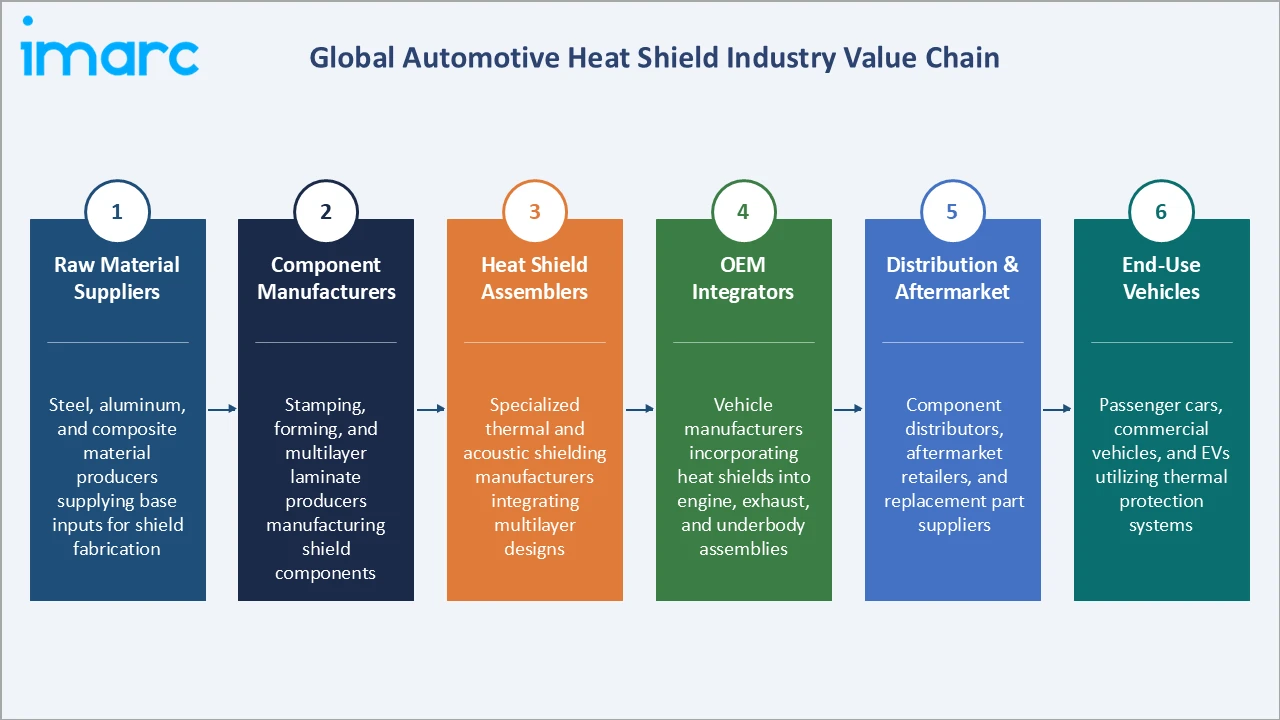
The ecosystem integrates raw material suppliers, component manufacturers, heat shield assemblers, and vehicle OEMs across passenger, commercial, and EV segments. Rising global vehicle production, tightening emission regulations, and electrification of powertrains continue to shape demand, while raw material pricing and manufacturing costs influence supplier strategies across regions.
Market Dynamics
To evaluate market opportunities, Request Sample
Market Drivers
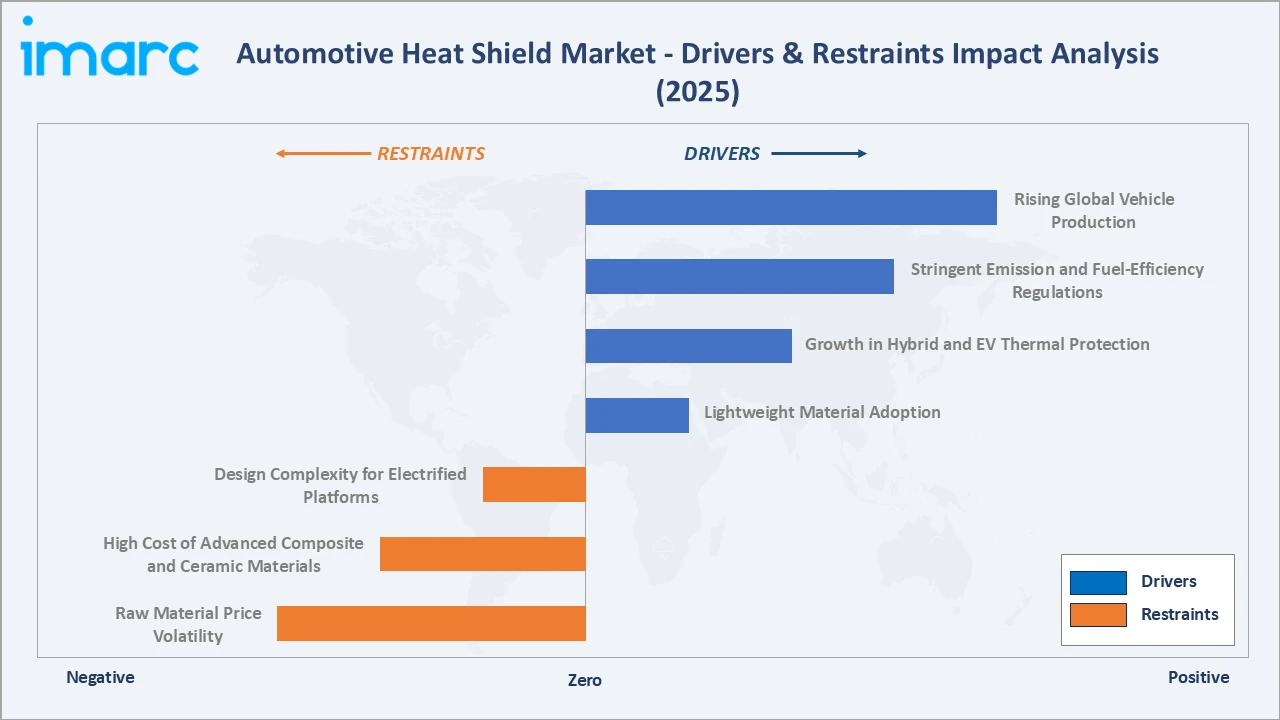
- Rising Global Vehicle Production: Sustained growth in passenger and commercial vehicle production across major manufacturing hubs continues to expand the installed base requiring engine, exhaust, and underbody thermal protection. As per IMARC Group, the global commercial vehicles market size was valued at USD 862.0 Billion in 2025.
- Stringent Emission and Fuel-Efficiency Regulations: Regulatory standards across Europe, North America, and Asia are pushing automakers to manage underhood temperatures more effectively, supporting demand for advanced heat shielding as part of broader emission-compliance strategies.
- Growth in Hybrid and EV Thermal Protection: Battery packs, power-electronics modules, and motor assemblies in electrified vehicles require dedicated thermal barriers, creating a new and fast-growing application base beyond traditional engine-compartment shielding.
- Lightweight Material Adoption: Automakers are increasingly adopting lightweight aluminum and composite heat shields to reduce vehicle weight while maintaining effective thermal insulation, supporting fuel efficiency and overall vehicle performance.
Market Restraints
- Raw Material Price Volatility: Fluctuations in the prices of aluminum, stainless steel, and other key raw materials increase production costs for automotive heat shield manufacturers and create pricing uncertainty across the supply chain.
- High Cost of Advanced Composite and Ceramic Materials: Non-metallic and ceramic-coated shielding solutions offer performance advantages but carry higher material and processing costs, limiting broader adoption in cost-sensitive vehicle segments.
- Design Complexity for Electrified Platforms: Battery and power-electronics shielding requires custom engineering for varying pack architectures, increasing design cycles and qualification costs for suppliers serving multiple OEM platforms.
Market Opportunities
- Growth in Electric and Hybrid Vehicle Thermal Management: Expanding electric and hybrid vehicle production is creating new demand for dedicated battery, motor, and power-electronics shielding solutions beyond traditional engine-compartment applications.
- Expansion of Lightweight and Recyclable Shielding Materials: Growing OEM focus on sustainability and lightweighting is opening opportunities for suppliers offering recyclable composites and lower-mass multilayer shield designs.
Market Challenges
- Intense Price Competition Among Component Suppliers: A large base of regional and global manufacturers is intensifying pricing pressure, particularly in cost-sensitive single-shell and metallic shield segments.
- Balancing Weight Reduction with Thermal Performance: Suppliers must continually optimize material selection and design to reduce component weight without compromising thermal protection, requiring sustained investment in engineering and testing capability.
Emerging Market Trends
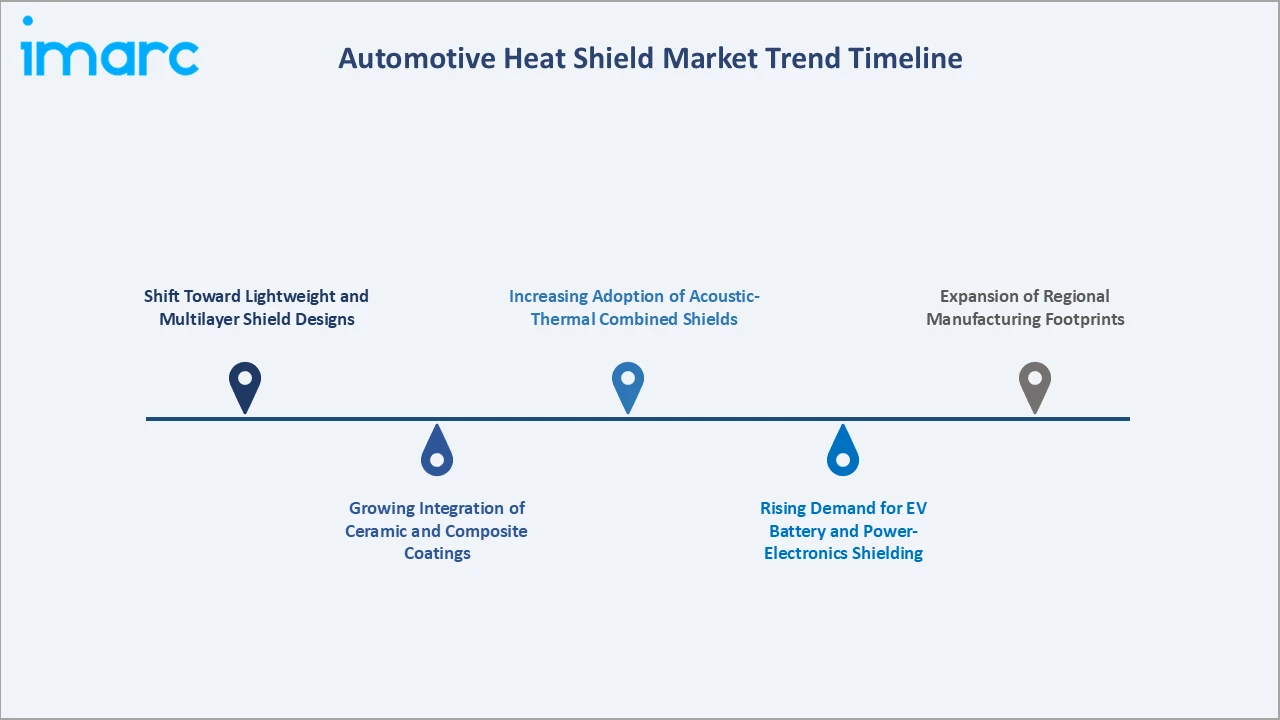
1. Shift Toward Lightweight and Multilayer Shield Designs
Suppliers are increasingly replacing single-layer metallic shields with multilayer and composite designs that reduce component weight while maintaining thermal performance, supporting OEM fuel-efficiency and emission targets.
2. Growing Integration of Ceramic and Composite Coatings
Ceramic thermal-barrier coatings, traditionally used in performance and motorsport applications, are increasingly being adapted for mainstream passenger and commercial vehicles seeking enhanced heat reflection in compact underhood spaces.
3. Rising Demand for EV Battery and Power-Electronics Shielding
Global electric car sales exceeded 20 Million units in 2025, according to the International Energy Agency, intensifying demand for dedicated battery and power-electronics thermal protection across new vehicle platforms.
4. Increasing Adoption of Acoustic-Thermal Combined Shields
Sandwich type shields that combine acoustic dampening with thermal insulation are gaining preference among premium and electrified vehicle manufacturers seeking space-efficient, multifunctional components.
5. Expansion of Regional Manufacturing Footprints
Suppliers are broadening production capacity across Asia-Pacific and emerging markets to remain close to expanding vehicle assembly operations and reduce logistics costs for high-volume shield components.
Industry Value Chain Analysis
The automotive heat shield market value chain spans six stages, from raw material supply through end-use vehicle integration. Component manufacturing and heat shield assembly capture the highest engineering value-add, while OEM integration and compliance capability increasingly determine sustainable competitive position across the industry.
|
Stage |
Key Players / Examples |
|
Raw Material Suppliers |
Steel, aluminum, and composite material producers supplying base inputs for shield fabrication |
|
Component Manufacturers |
Stamping, forming, and multilayer laminate producers manufacturing shield components |
|
Heat Shield Assemblers |
Specialized thermal and acoustic shielding manufacturers integrating multilayer designs |
|
OEM Integrators |
Vehicle manufacturers incorporating heat shields into engine, exhaust, and underbody assemblies |
|
Distribution & Aftermarket |
Component distributors, aftermarket retailers, and replacement part suppliers |
|
End-Use Vehicles |
Passenger cars, commercial vehicles, and EVs utilizing thermal protection systems |
Vertically integrated suppliers with in-house material engineering and design-validation capability are positioned to capture greater value than partners reliant on third-party component sourcing.
Technology Landscape in the Automotive Heat Shield Market
Material Innovation
Suppliers are advancing multilayer aluminum, stainless steel, and composite laminate technologies that improve heat reflection and durability while reducing overall component mass. Improved material performance is also extending component lifespan under demanding operating conditions.
Lightweighting and Multilayer Design
Multilayer and sandwich type constructions are increasingly engineered to combine thermal insulation with acoustic dampening, reducing the number of components required per vehicle platform. These designs also support vehicle weight reduction without compromising thermal protection.
EV Thermal Management Technology
Dedicated battery and power-electronics shielding technologies are being developed to manage thermal loads specific to electric drivetrains, supporting safety and performance requirements unique to electrified platforms. Manufacturers are increasingly optimizing shield designs to accommodate compact EV architectures.
Manufacturing Automation and Simulation
Digital simulation and automated stamping and forming processes are enabling suppliers to accelerate design validation and improve consistency across high-volume production programs. Advanced manufacturing techniques are also helping reduce production waste and improve operational efficiency.
Market Segmentation Analysis
The report covers the following segments:
|
Segment Category |
Leading Segment |
Market Share |
Year |
|
Material |
Metallic |
68.5% |
2025 |
|
Product |
Single Shell |
44.7% |
2025 |
|
Application |
🔒 |
🔒 |
2025 |
|
Vehicle Type |
🔒 |
🔒 |
2025 |
|
Region |
Asia-Pacific |
42.8% |
2025 |

By Material
Metallic commands a 68.5% majority share in 2025, driven by its superior heat resistance, structural durability, and cost efficiency across engine-compartment, exhaust, and turbocharger applications. The segment benefits from established manufacturing processes and broad OEM familiarity.
To access detailed market analysis, Request Sample
Non-metallic at 31.5% in 2025 is expanding through composite and multilayer laminate designs that reduce component weight. The segment is gaining traction in electrified and premium vehicle platforms where lightweighting and acoustic performance are priorities.
By Product
Single shell dominates with 44.7% share in 2025, reflecting its simple construction, cost efficiency, and suitability for moderate-temperature zones across high-volume passenger vehicle platforms. The format remains the default choice for cost-sensitive applications.
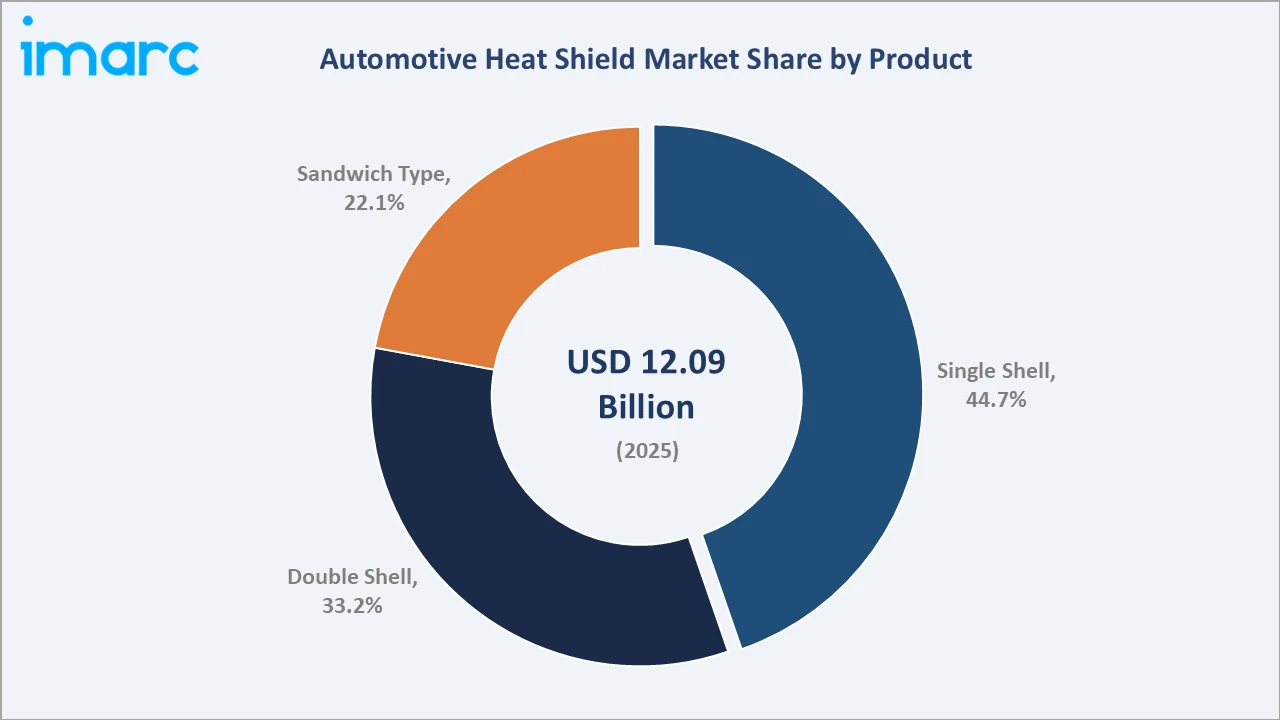
Double shell at 33.2% is expanding through use in high-temperature zones such as turbocharger and under-bonnet applications, where its layered insulation provides enhanced thermal protection.
Regional Market Insights
|
Region |
Share (2025) |
Key Growth Drivers |
|
Asia-Pacific |
42.8% |
Large vehicle production base, expanding OEM manufacturing capacity, and rising EV output |
|
Europe |
24.1% |
Stringent emission regulations, established OEM base, and strong demand for lightweight shielding materials |
|
North America |
20.3% |
High light-truck and SUV production, growing electrification, and advanced manufacturing infrastructure |
|
Latin America |
7.1% |
Expanding vehicle assembly operations, rising commercial vehicle demand, and growing regional OEM investment |
|
Middle East and Africa |
5.7% |
Growing vehicle imports, expanding aftermarket demand, and gradual increase in local assembly activity |
Asia-Pacific at 42.8% in 2025 leads the regional landscape, anchored by large-scale vehicle manufacturing hubs across China, Japan, South Korea, and India. High production volumes, expanding EV output, and a dense OEM and supplier base support sustained regional leadership.
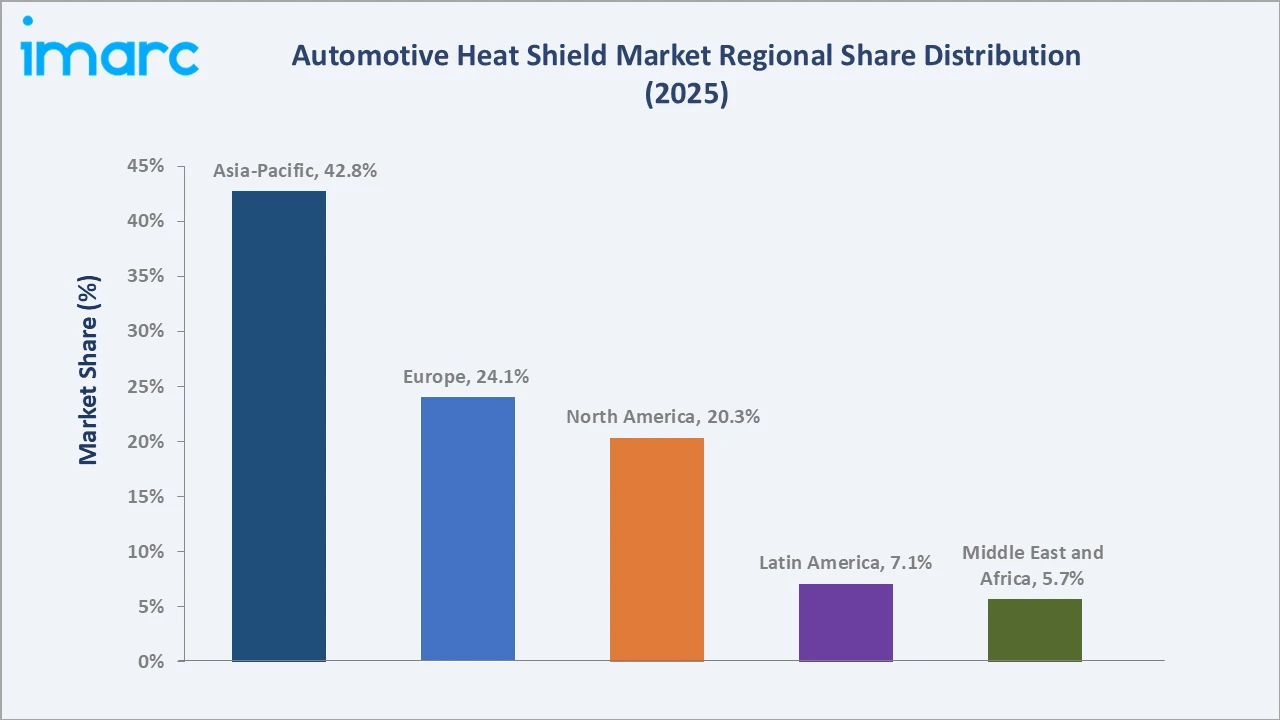
Europe at 24.1% is the second largest region, supported by a strong automotive manufacturing base, stringent vehicle emission regulations, and widespread adoption of advanced thermal management technologies. The region also benefits from continued investment in lightweight vehicle technologies and premium automotive production.
Competitive Landscape
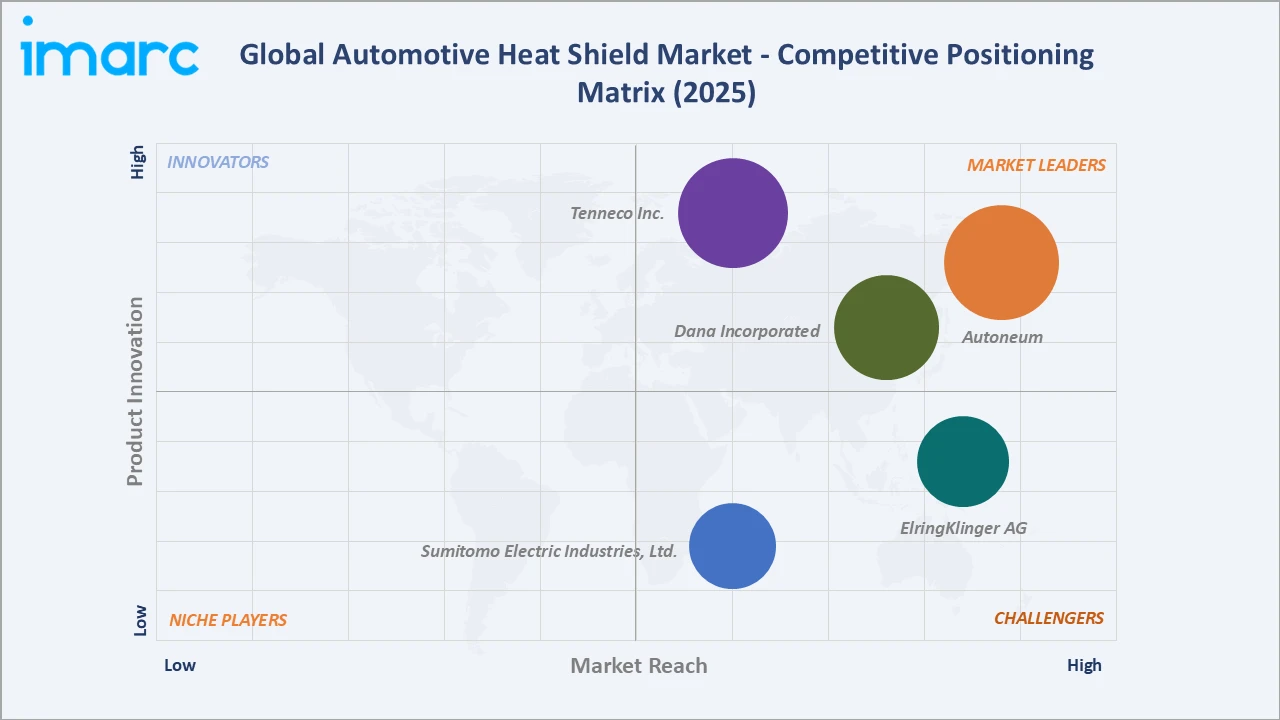
The automotive heat shield market is moderately fragmented, with established global suppliers competing alongside regional manufacturers. Engineering capability, material innovation, OEM qualification, and multi-regional manufacturing scale form the key competitive moats in this industry.
|
Company Name |
Brand / Key Product |
Position |
Strategic Focus |
|
Autoneum |
RIMIC Heat Protection and Noise Absorption Heatshields |
Leader |
Lightweight material innovation and expansion of electrified-vehicle shielding solutions |
|
Dana Incorporated |
Victor Reinz Thermal Acoustic Protective Shielding (TAPS) |
Leader |
Expanding thermal-management capabilities for electrified and hybrid powertrains |
|
Tenneco Inc. |
ThermShield™ |
Leader |
Regulatory-aligned thermal and exhaust system integration across vehicle types |
|
ElringKlinger AG |
ElroShield Shielding Systems |
Challenger |
Development of lightweight, multi-material shielding for combustion and hybrid platforms |
|
Sumitomo Electric Industries, Ltd. |
Sumitomo Riko |
Challenger |
Expansion of thermal insulation product lines across the Asia-Pacific OEM base |
Key players include Autoneum, Dana Incorporated, Tenneco Inc., ElringKlinger AG, and Sumitomo Electric Industries, Ltd., among others.
Key Company Profiles
Autoneum
Autoneum is a Switzerland -headquartered automotive supplier specializing in acoustic and thermal management solutions for vehicles, serving light-vehicle manufacturers across major global markets.
- Product Portfolio: Heatshields and related acoustic-thermal components designed for engine bay and underbody applications across EVs and hybrid vehicles.
- Recent Developments: The company continues to expand its thermal management portfolio through ongoing product innovation, manufacturing enhancements, and collaborations with automotive manufacturers to support evolving vehicle efficiency and electrification requirements.
- Strategic Focus: Advancing lightweight thermal management solutions, expanding heat shield technologies for electrified vehicles, and strengthening partnerships with global automotive OEMs.
Dana Incorporated
Dana Incorporated is a United States -based supplier of power-conveyance and thermal-management technologies, serving OEMs across passenger, commercial, and off-highway vehicle segments.
- Product Portfolio: Victor Reinz Thermal Acoustic Protective Shielding (TAPS), designed for engine, exhaust, underbody, and electrified vehicle thermal management applications.
- Recent Developments: The company continues to broaden its thermal-management offering to support electrified and hybrid vehicle platforms.
- Strategic Focus: Expanding integrated thermal-management solutions, strengthening support for electrified vehicle platforms, and enhancing collaboration with OEMs across global automotive markets.
Tenneco Inc.
Tenneco Inc. is a diversified United States -based automotive supplier with a significant presence in exhaust and emission-control systems.
- Product Portfolio: ThermShield™ multi-layer wrappable insulation for high-temperature exhaust components.
- Recent Developments: The company continues to align its thermal-management portfolio with tightening global regulatory standards.
- Strategic Focus: Expanding advanced thermal-management technologies, strengthening exhaust and heat shielding solutions, and supporting OEM demand across conventional, hybrid, and EV platforms.
Market Concentration Analysis
The automotive heat shield market is moderately fragmented, with established global suppliers competing alongside regional manufacturers. Leading players, including Autoneum, Dana Incorporated, and Tenneco Inc., maintain strong OEM relationships supported by engineering scale and multi-regional manufacturing.
Barriers to entry include the need for OEM qualification, capital-intensive manufacturing, and material engineering expertise, favoring established suppliers with long-standing automotive partnerships. Strict quality certification requirements and long vehicle qualification cycles further reinforce these entry barriers.
Consolidation continues gradually as suppliers expand thermal-management portfolios to serve electrified vehicle platforms, while regional players strengthen their position through cost-competitive manufacturing and localized supply. Strategic partnerships and targeted capacity expansions continue to shape the competitive landscape.
Investment & Growth Opportunities
Fastest-Growing Segments
Non-metallic at 31.5% share and sandwich type at 22.1% share are gaining ground faster than the overall market, driven by lightweighting priorities and rising demand for combined acoustic-thermal solutions in electrified and premium vehicle platforms.
Emerging Markets
Latin America represents significant untapped opportunity, supported by expanding vehicle assembly operations, increasing commercial vehicle demand, and rising OEM investment across the region. Growing localization of automotive component manufacturing is further creating opportunities for heat shield suppliers to expand their regional footprint.
Venture & Investment Trends
Investment activity is concentrated in lightweight composite material development, ceramic coating technology, and dedicated EV battery and power-electronics shielding solutions, reflecting the industry's shift toward electrified-platform thermal management.
Future Market Outlook (2026-2034)
The automotive heat shield market is forecast to expand from USD 12.09 Billion in 2025 to USD 15.38 Billion by 2034 at a CAGR of 2.60%, adding roughly USD 3.29 Billion in incremental market value over the forecast period.
Three forces will shape the market through 2034: continued growth in global vehicle production and electrification; tightening emission and safety regulations across major markets; and ongoing shift toward lightweight, multilayer, and recyclable shielding materials.
By 2034, the market is expected to be defined by broader adoption of lightweight, high-performance thermal shielding solutions, deeper integration with electrified vehicle platforms, and increased use of advanced materials that enhance thermal efficiency, durability, and sustainability across global vehicle production.
Research Methodology
Primary Research
Primary research included structured interviews with component engineering leads, automotive OEM procurement specialists, materials suppliers, and industry association representatives, validating market sizing, regional demand, and segment-level trends.
Secondary Research
Secondary sources included publications from international motor vehicle manufacturing associations, government emission and fuel-efficiency regulatory documents, commodity exchange data for key raw materials, and company annual reports and investor presentations from listed suppliers.
Forecasting Models
Market forecasts used top-down and bottom-up models combining global vehicle production trends, material and product mix evolution, regional manufacturing capacity, and regulatory transition scenarios. Sensitivity analysis addressed raw material price volatility and electrification pace.
Automotive Heat Shield Market Report Scope:
| Report Features | Details |
|---|---|
| Base Year of the Analysis | 2025 |
| Historical Period | 2020-2025 |
| Forecast Period | 2026-2034 |
| Units | Billion USD |
| Scope of the Report | Exploration of Historical Trends and Market Outlook, Industry Catalysts and Challenges, Segment-Wise Historical and Future Market Assessment:
|
| Materials Covered | Metallic, Non-Metallic |
| Products Covered | Single Shell, Double Shell, Sandwich Type |
| Applications Covered | Exhaust System, Turbocharger, Under Bonnet, Engine Compartment, Under Chassis, Others |
| Vehicle Types Covered | Passenger Car, Commercial Vehicles, Others |
| Regions Covered | Asia Pacific, Europe, North America, Latin America, Middle East and Africa |
| Countries Covered | United States, Canada, Germany, France, United Kingdom, Italy, Spain, Russia, China, Japan, India, South Korea, Australia, Indonesia, Brazil, Mexico |
| Companies Covered | Autoneum, Dana Incorporated, Tenneco Inc., ElringKlinger AG, Sumitomo Electric Industries, Ltd., etc. |
| Customization Scope | 10% Free Customization |
| Post-Sale Analyst Support | 10-12 Weeks |
| Delivery Format | PDF and Excel through Email (We can also provide the editable version of the report in PPT/Word format on special request) |
Key Benefits for Stakeholders:
- IMARC’s industry report offers a comprehensive quantitative analysis of various market segments, historical and current market trends, market forecasts, and dynamics of the automotive heat shield market from 2020-2034.
- The research report provides the latest information on the market drivers, challenges, and opportunities in the global automotive heat shield market.
- The study maps the leading, as well as the fastest-growing, regional markets. It further enables stakeholders to identify the key country-level markets within each region.
- Porter's five forces analysis assists stakeholders in assessing the impact of new entrants, competitive rivalry, supplier power, buyer power, and the threat of substitution. It helps stakeholders to analyze the level of competition within the automotive heat shield industry and its attractiveness.
- The competitive landscape allows stakeholders to understand their competitive environment and provides insight into the current positions of key players in the market.
Frequently Asked Questions About the Automotive Heat Shield Market Report
The automotive heat shield market was valued at USD 12.09 Billion in 2025, driven by rising global vehicle production, tightening emission regulations, and growing electrified-vehicle thermal-protection needs.
The market is projected to grow at a CAGR of 2.60% from 2026-2034, reaching USD 15.38 Billion, supported by expanding vehicle production and rising electrification.
Metallic leads the material segment at 68.5% share in 2025, driven by its superior heat resistance, structural durability, and cost efficiency. It remains the preferred choice for engine-compartment, exhaust, and turbocharger applications across most vehicle platforms.
Single shell dominates the product segment at 44.7% share in 2025, reflecting its simple construction and cost efficiency. It remains the default choice for moderate-temperature zones across high-volume passenger vehicle platforms.
Asia-Pacific commands 42.8% in 2025, led by large-scale vehicle manufacturing hubs across China, Japan, South Korea, and India.
Leading players include Autoneum, Dana Incorporated, Tenneco Inc., ElringKlinger AG, and Sumitomo Electric Industries, Ltd., among others.
Rising global vehicle production, tightening emission regulations, and surging thermal-protection needs of hybrid and electric powertrains are the primary growth drivers.
Electrified vehicles require dedicated battery and power-electronics shielding, creating a fast-growing application base beyond traditional engine-compartment thermal protection.
Raw material price volatility, particularly in aluminum and stainless steel, along with the high cost of advanced composite materials, restrain broader adoption of premium shielding solutions.
Need more help?
- Speak to our experienced analysts for insights on the current market scenarios.
- Include additional segments and countries to customize the report as per your requirement.
- Gain an unparalleled competitive advantage in your domain by understanding how to utilize the report and positively impacting your operations and revenue.
- For further assistance, please connect with our analysts.
 Request Customization
 Speak to an Analyst
 Request Brochure
 Inquire Before Buying
Benefits of Customization
- Personalize this research
- Triangulate with your data
- Get data as per your format and definition
- Gain a deeper dive into a specific application, geography, customer, or competitor
- Any level of personalization
Get in Touch With Us
UNITED STATES
Phone: +1-201-971-6302
INDIA
Phone: +91-120-433-0800
UNITED KINGDOM
Phone: +44-753-714-6104
Email: [email protected]
Client Testimonials




.webp)




.webp)













Related Reports

Choose your plan
*Please note that the prices mentioned below are starting prices for each bundle type. Kindly contact our team for further details.*
Single User License
- 1 User License, Access on 2 Devices
- PDF Report + Excel Dataset (Password Protected)
- Lifetime Access
- No Printing Rights
- 10% Free Report Customization
- 10–12 Weeks of Analyst Support
Five User License
- Access for 5 Users, 2 Devices per User
- PDF Report + Excel Dataset (Password Protected)
- Lifetime Access
- Dedicated Account Manager
- 12–14 Weeks of Analyst Support
- No Printing Rights
- 15% Free Report Customization
- 25% Discount on Your Next Purchase
Corporate User License
- Unlimited User Access (Within Your Organization)
- PDF Report + Excel Dataset
- Lifetime Access
- Dedicated Account Manager
- 14–20 Weeks of Analyst Support
- No Printing Rights
- 20% Free Report Customization
- 30% Discount on Your Next Purchase
Essential Insights
What's included:
3 reports
- Lifetime Access
- PDF Reports
- Excel Datasets
- 2 Weeks of Free Analyst Support
- 2 User Licenses
- Access on 2 Devices
- Printing Rights
- Complimentary PowerPoint (PPT) Version
- Complimentary License Upgrade
Professional Access
What's included:
5 reports
- Lifetime Access
- PDF Reports
- Excel Datasets
- 8 Weeks of Free Analyst Support
- 2 User Licenses
- Access on 2 Devices
- Printing Rights
- Complimentary PowerPoint (PPT) Version
- Complimentary License Upgrade
Business Advantage
What's included:
8 reports
- Lifetime Access
- PDF Reports
- Excel Datasets
- 14 Weeks of Free Analyst Support
- 2 User Licenses
- Access on 2 Devices
- Printing Rights
- Complimentary PowerPoint (PPT) Version
- Complimentary License Upgrade
Enterprise Intelligence
What's included:
10 reports
- Lifetime Access
- PDF Reports
- Excel Datasets
- 20 Weeks of Free Analyst Support
- 2 User Licenses
- Access on 2 Devices
- Printing Rights
- Complimentary PowerPoint (PPT) Version
- Complimentary License Upgrade