
Bone Anchored Hearing Aids Market Report by Raw Material (Titanium Alloy, Ceramics Composites, and Others), Hearing Loss Type (Sensorineural Hearing Loss, Conductive Hearing Loss, Mixed Hearing Loss, Single Sided Deafness), End User (Pediatrics, Adults, Geriatrics), and Region 2026-2034
Market Overview:
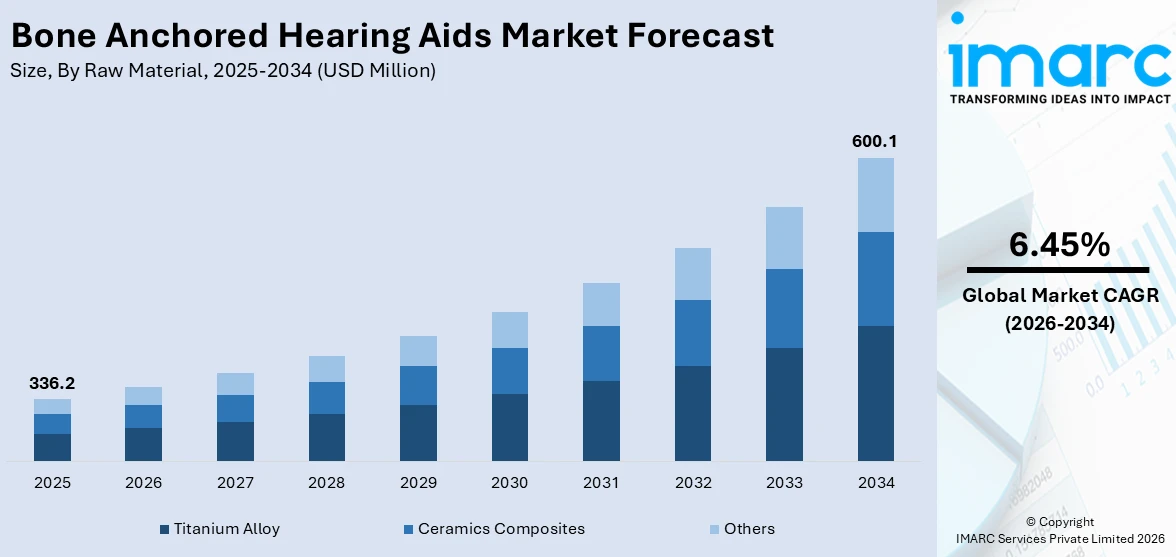
The global bone anchored hearing aids market size reached USD 336.2 Million in 2025. Looking forward, IMARC Group expects the market to reach USD 600.1 Million by 2034, exhibiting a growth rate (CAGR) of 6.45% during 2026-2034.
|
Report Attribute
|
Key Statistics
|
|---|---|
|
Base Year
|
2025
|
|
Forecast Years
|
2026-2034
|
|
Historical Years
|
2020-2025
|
|
Market Size in 2025
|
USD 336.2 Million |
|
Market Forecast in 2034
|
USD 600.1 Million |
| Market Growth Rate 2026-2034 | 6.45% |
A bone anchored hearing aid (BAHA) is a surgical, implantable device used to treat individuals with different types of hearing loss. It has a titanium screw anchored to the mastoid bone behind the ear, which is connected to a small detachable sound processor through an abutment that propagates sound directly to the inner ear, bypassing skin impedance and subcutaneous tissues. It provides better sound quality and greater comfort compared to conventional hearing devices. Compared to the BTE (behind-the-ear hearing aids), it does not cause skin irritation, requires less energy, reduces aural discharge, and is gaining traction worldwide among children and adults with single-sided deafness and conductive or mixed hearing loss.
To get more information on this market Request Sample
As the risk of developing hearing impairment increases with age, the rising geriatric population represents one of the key factors bolstering the market growth. Moreover, the growing instances of hearing loss in pediatrics, along with the high risk of surgery, are escalating the demand for soft band BAHA that acts as a non-surgical solution for a limited period. Additionally, governing agencies of several countries are implementing rules and regulations that require neonates to be screened for hearing loss. This trend, along with the availability of better reimbursement coverage, is impacting the market growth positively. Apart from this, robotic platforms and surgical navigation systems are gaining popularity around the world to reduce BAHA surgical complications. The market players are also introducing advanced products to expand their consumer base. For instance, MED-EL, a company that manufactures hearing implants, launched ADHEAR. This non-implanted BAHA device is suitable for all ages and provides effortless hearing and reliable listening.
Key Market Segmentation:
IMARC Group provides an analysis of the key trends in each sub-segment of the global bone anchored hearing aids market report, along with forecasts at the global, regional and country level from2026-2034. Our report has categorized the market based on raw material, hearing loss type and end user.

Breakup by Raw Material:
- Titanium Alloy
- Ceramics Composites
- Others
Breakup by Hearing Loss Type:
- Sensorineural Hearing Loss
- Conductive Hearing Loss
- Mixed Hearing Loss
- Single Sided Deafness
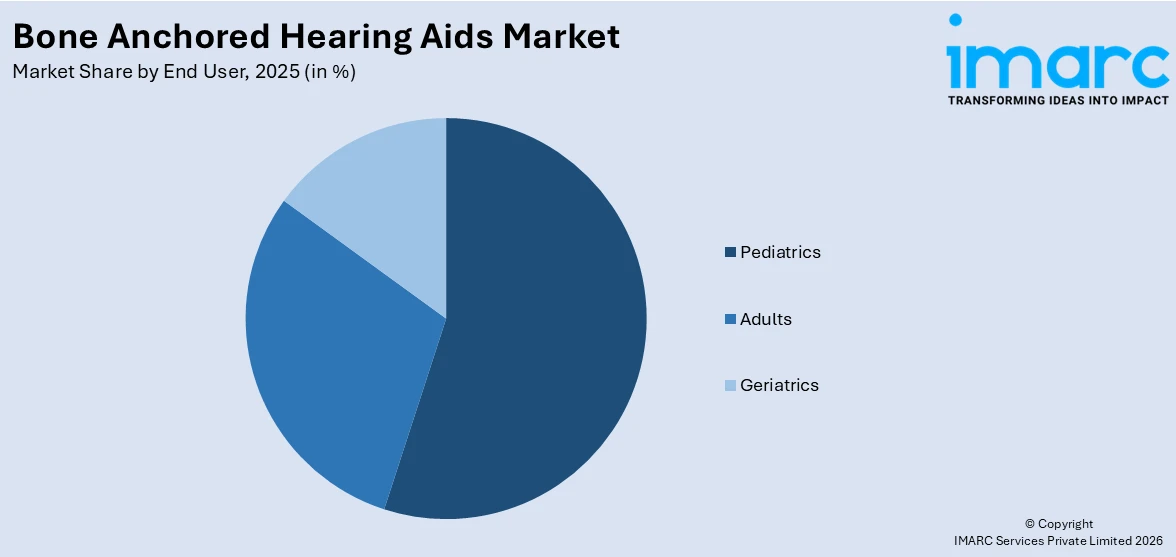
Breakup by End User:
Access the comprehensive market breakdown Request Sample
- Pediatrics
- Adults
- Geriatrics
Breakup by Region:
- North America
- United States
- Canada
- Asia-Pacific
- China
- Japan
- India
- South Korea
- Australia
- Indonesia
- Others
- Europe
- Germany
- France
- United Kingdom
- Italy
- Spain
- Russia
- Others
- Latin America
- Brazil
- Mexico
- Others
- Middle East and Africa
Competitive Landscape:
The competitive landscape of the industry has also been examined along with the profiles of the key players being Auditdata A/S, Cochlear Ltd., Demant A/S, GN Hearing A/S (GN Store Nord A/S), Natus Medical Incorporated, Sonova Holding AG, Starkey Hearing Technologies and Widex A/S.
Report Coverage:
| Report Features | Details |
|---|---|
| Base Year of the Analysis | 2025 |
| Historical Period | 2020-2025 |
| Forecast Period | 2026-2034 |
| Units | Million USD |
| Segment Coverage | Raw Material, Hearing Loss Type, End User, Region |
| Region Covered | Asia Pacific, Europe, North America, Latin America, Middle East and Africa |
| Countries Covered | United States, Canada, Germany, France, United Kingdom, Italy, Spain, Russia, China, Japan, India, South Korea, Australia, Indonesia, Brazil, Mexico |
| Companies Covered | Auditdata A/S, Cochlear Ltd., Demant A/S, GN Hearing A/S (GN Store Nord A/S), Natus Medical Incorporated, Sonova Holding AG, Starkey Hearing Technologies and Widex A/S |
| Customization Scope | 10% Free Customization |
| Post-Sale Analyst Support | 10-12 Weeks |
| Delivery Format | PDF and Excel through Email (We can also provide the editable version of the report in PPT/Word format on special request) |
Key Questions Answered in This Report:
- How has the global bone anchored hearing aids market performed so far and how will it perform in the coming years?
- What has been the impact of COVID-19 on the global bone anchored hearing aids market?
- What are the key regional markets?
- What is the breakup of the market based on the raw material?
- What is the breakup of the market based on the hearing loss type?
- What is the breakup of the market based on the end user?
- What are the various stages in the value chain of the industry?
- What are the key driving factors and challenges in the industry?
- What is the structure of the global bone anchored hearing aids market and who are the key players?
- What is the degree of competition in the industry?
Need more help?
- Speak to our experienced analysts for insights on the current market scenarios.
- Include additional segments and countries to customize the report as per your requirement.
- Gain an unparalleled competitive advantage in your domain by understanding how to utilize the report and positively impacting your operations and revenue.
- For further assistance, please connect with our analysts.
 Request Customization
 Speak to an Analyst
 Request Brochure
 Inquire Before Buying
Benefits of Customization
- Personalize this research
- Triangulate with your data
- Get data as per your format and definition
- Gain a deeper dive into a specific application, geography, customer, or competitor
- Any level of personalization
Get in Touch With Us
UNITED STATES
Phone: +1-201-971-6302
INDIA
Phone: +91-120-433-0800
UNITED KINGDOM
Phone: +44-753-714-6104
Email: [email protected]
Client Testimonials




.webp)




.webp)













Related Reports

Choose your plan
*Please note that the prices mentioned below are starting prices for each bundle type. Kindly contact our team for further details.*
Single User License
- 1 User License, Access on 2 Devices
- PDF Report + Excel Dataset (Password Protected)
- Lifetime Access
- No Printing Rights
- 10% Free Report Customization
- 10–12 Weeks of Analyst Support
Five User License
- Access for 5 Users, 2 Devices per User
- PDF Report + Excel Dataset (Password Protected)
- Lifetime Access
- Dedicated Account Manager
- 12–14 Weeks of Analyst Support
- No Printing Rights
- 15% Free Report Customization
- 25% Discount on Your Next Purchase
Corporate User License
- Unlimited User Access (Within Your Organization)
- PDF Report + Excel Dataset
- Lifetime Access
- Dedicated Account Manager
- 14–20 Weeks of Analyst Support
- No Printing Rights
- 20% Free Report Customization
- 30% Discount on Your Next Purchase
Essential Insights
What's included:
3 reports
- Lifetime Access
- PDF Reports
- Excel Datasets
- 2 Weeks of Free Analyst Support
- 2 User Licenses
- Access on 2 Devices
- Printing Rights
- Complimentary PowerPoint (PPT) Version
- Complimentary License Upgrade
Professional Access
What's included:
5 reports
- Lifetime Access
- PDF Reports
- Excel Datasets
- 8 Weeks of Free Analyst Support
- 2 User Licenses
- Access on 2 Devices
- Printing Rights
- Complimentary PowerPoint (PPT) Version
- Complimentary License Upgrade
Business Advantage
What's included:
8 reports
- Lifetime Access
- PDF Reports
- Excel Datasets
- 14 Weeks of Free Analyst Support
- 2 User Licenses
- Access on 2 Devices
- Printing Rights
- Complimentary PowerPoint (PPT) Version
- Complimentary License Upgrade
Enterprise Intelligence
What's included:
10 reports
- Lifetime Access
- PDF Reports
- Excel Datasets
- 20 Weeks of Free Analyst Support
- 2 User Licenses
- Access on 2 Devices
- Printing Rights
- Complimentary PowerPoint (PPT) Version
- Complimentary License Upgrade