
Brazil Board Games Market Size, Share, Trends and Forecast by Product Type, Game Type, Age Group, Distribution Channel, and Region, 2026-2034
Brazil Board Games Market Size, Share, Trends & Forecast (2026-2034)
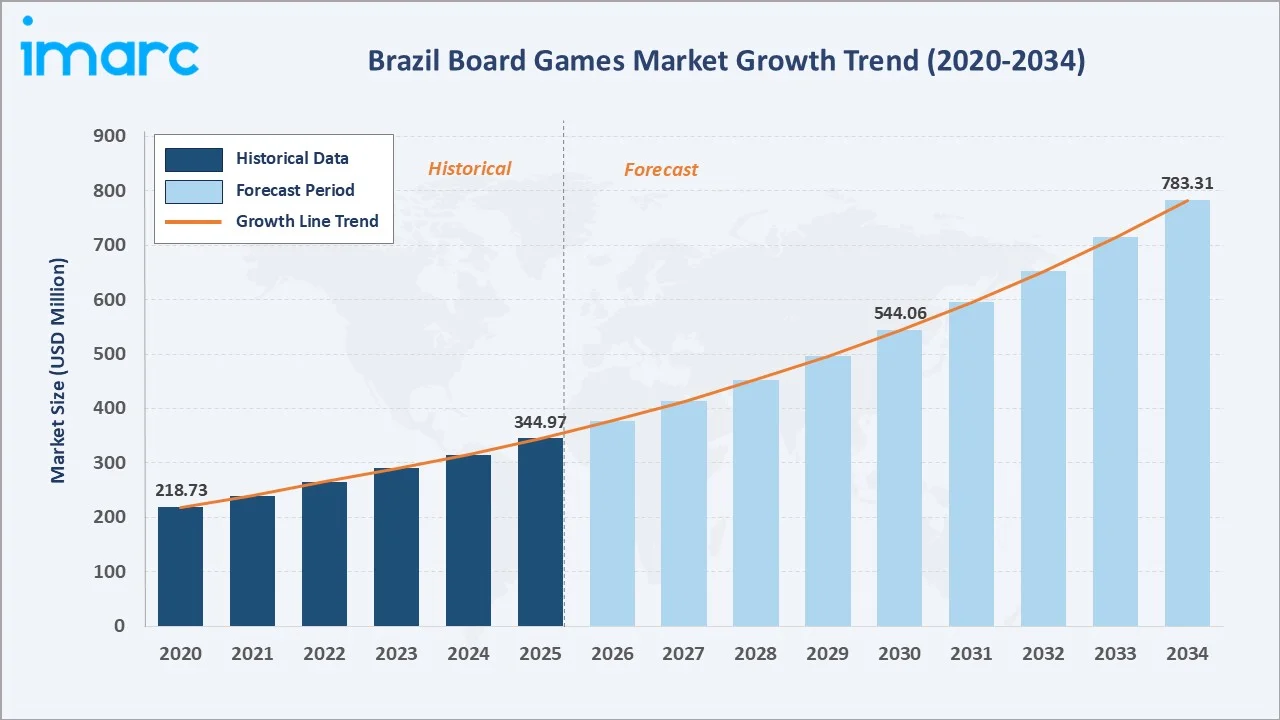
The Brazil board games market size increased from USD 344.97 Million in 2025 to USD 377.88 Million in 2026 and is projected to reach USD 783.31 Million by 2034, exhibiting a CAGR of 9.54% during 2026-2034. Rising hobbyist culture, expanding e-commerce, growing demand for family entertainment, and increased Portuguese-language localization of international titles are collectively driving the Brazil board games market growth. Specialty Stores lead distribution with a 33.4% share in 2025, while the Above 12 Years age segment accounts for 46.3% of total demand. The Southeast region commands a 45.8% revenue share in 2025, anchored by São Paulo and Rio de Janeiro retail density.
Market Snapshot
|
Metric |
Value |
|
Base Year Market Size (2025) |
USD 344.97 Million |
| Market Size (2026) | USD 377.88 Million |
|
Forecast Market Size (2034) |
USD 783.31 Million |
|
CAGR (2026-2034) |
9.54% |
|
Base Year |
2025 |
|
Historical Period |
2020-2025 |
|
Forecast Period |
2026-2034 |
|
Largest Region |
Southeast (45.8% share, 2025) |
|
Fastest Growing Region |
Northeast |
|
Leading Distribution Channel |
Specialty Stores (33.4%, 2025) |
|
Leading Age Group |
Above 12 Years (46.3%, 2025) |
The chart below illustrates Brazil's board games market trajectory from 2020–2034, with hobbyist adoption fueling the historical curve and digital retail expansion supporting the forecast.
To get more information on this market, Request Sample
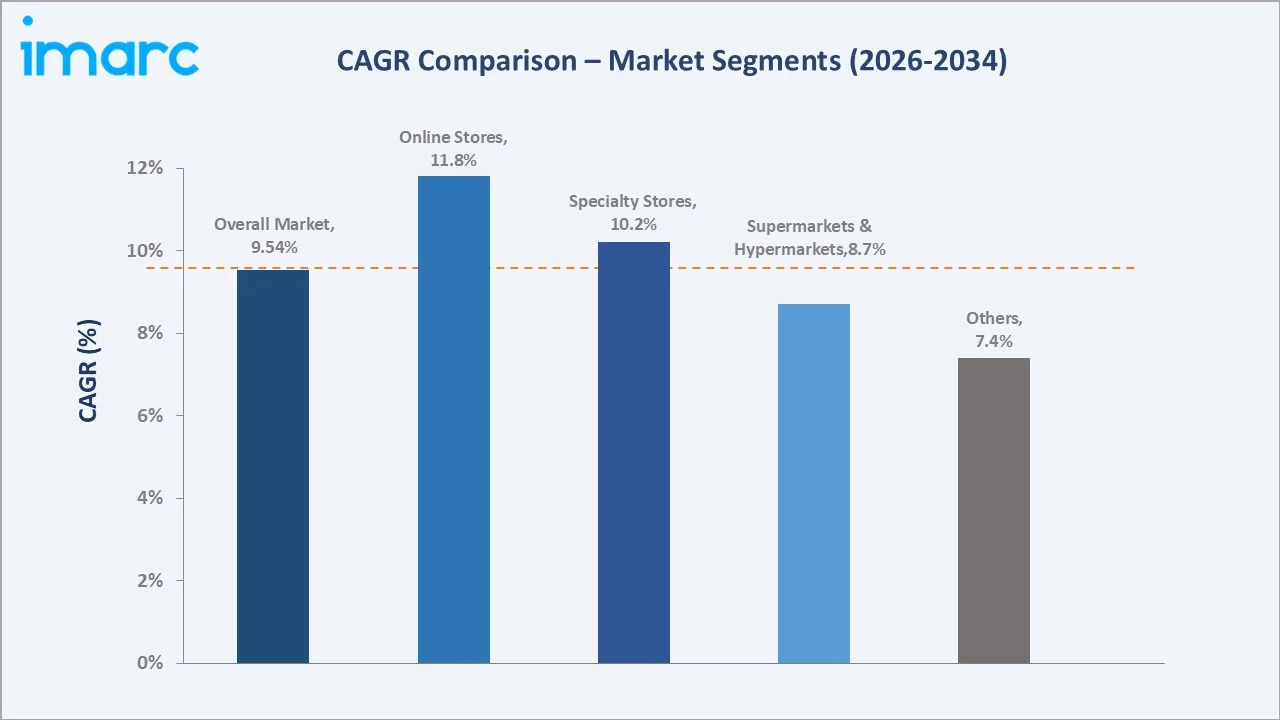
CAGR analysis identifies Online Stores and Specialty Stores as the fastest-growing distribution segments through 2034.
Executive Summary
The Brazil board games market is being reshaped by hobbyist community expansion, digital retail acceleration, and Portuguese-language localization of premium international titles. The market grew from USD 344.97 Million in 2025 to USD 377.88 Million in 2026 and is projected to reach USD 783.31 Million by 2034, at a 9.54% CAGR.
Specialty stores hold a 33.4% share in 2025, supported by experiential retail and tournament culture in São Paulo and Rio de Janeiro. Online stores follow at 25.7% but grow fastest, propelled by Mercado Livre and Amazon Brazil. The Above 12 Years cohort dominates with 46.3%, reflecting Brazil's deep hobbyist segment. Key trends include strategy game adoption, crowdfunding-led launches, and rising local manufacturing.
Southeast Brazil leads with a 45.8% share in 2025, driven by metropolitan retail density and discretionary income. The South follows at 19.6%, supported by gaming clubs in Curitiba and Porto Alegre. The Northeast accounts for 15.7% and is the fastest-growing region, fueled by e-commerce penetration in Salvador, Recife, and Fortaleza.
Key Market Insights
|
Insight |
Data |
|
Largest Distribution Channel |
Specialty Stores – 33.4% share (2025) |
|
Fastest Growing Channel |
Online Stores – 25.7% share (2025) |
|
Leading Age Group |
Above 12 Years – 46.3% share (2025) |
|
Second Age Segment |
5–12 Years – 28.7% share (2025) |
|
Leading Region |
Southeast – 45.8% (2025) |
|
Fastest Growing Region |
Northeast – 15.7% (2025) |
|
Top Companies |
Asmodee Brasil, Grok Games, Devir Livraria, The Estrela Brinquedos Store, and Grow Store |
|
Key Opportunity |
Hybrid digital-physical formats and local manufacturing |
Key Analytical Observations Supporting the Data Above:
- Specialty stores' 33.4% share in 2025 reflects experiential retail strength, where in-store gaming sessions and curated catalogs drive higher per-customer transaction values than mass channels.
- Supermarkets and hypermarkets at 29.6% in 2025 anchor the family and impulse-purchase segment, with major chains such as Carrefour, Grupo Pão de Açúcar, and Extra Hipermercados offering popular titles like Banco Imobiliário and War.
- Online stores' 25.7% share in 2025 signals rapid channel migration, with Mercado Livre and Amazon Brazil capturing hobbyist demand through wider catalogs and competitive pricing on imported titles.
- The Above 12 Years cohort's 46.3% dominance reflects Brazil's mature hobbyist base, with adult-oriented strategy and miniatures titles representing the highest-value transactions per unit sold.
- Southeast's 45.8% revenue share reflects São Paulo and Rio de Janeiro's concentration of disposable income, retail density, and gaming community events such as Diversão Offline and Brasil Game Show.
- Galápagos Jogos, acquired by Asmodee, plays a leading role in localizing international titles into Portuguese, including Catan, Ticket to Ride, and Dungeons & Dragons 5th Edition.
Brazil Board Games Market Overview
Brazil's board games market spans tabletop, card and dice, collectible card, miniature, and role-playing categories sold through specialty hobby stores, supermarkets, online platforms, and direct-to-consumer crowdfunding. The ecosystem includes Brazilian publishers, international licensors, contract manufacturers, logistics providers, and a vibrant community of designers and reviewers.
Applications span family entertainment, school-based educational use, hobbyist clubs, and competitive tournaments. Macroeconomic influences include disposable income trends, Real-Dollar exchange volatility affecting imported title pricing, and regulatory factors such as INMETRO certification. Brazil hosts South America's largest board games market, concentrated in metropolitan corridors and growing in Tier-2 cities through online retail.
Market Dynamics
To evaluate market opportunities, Request Sample
Market Drivers
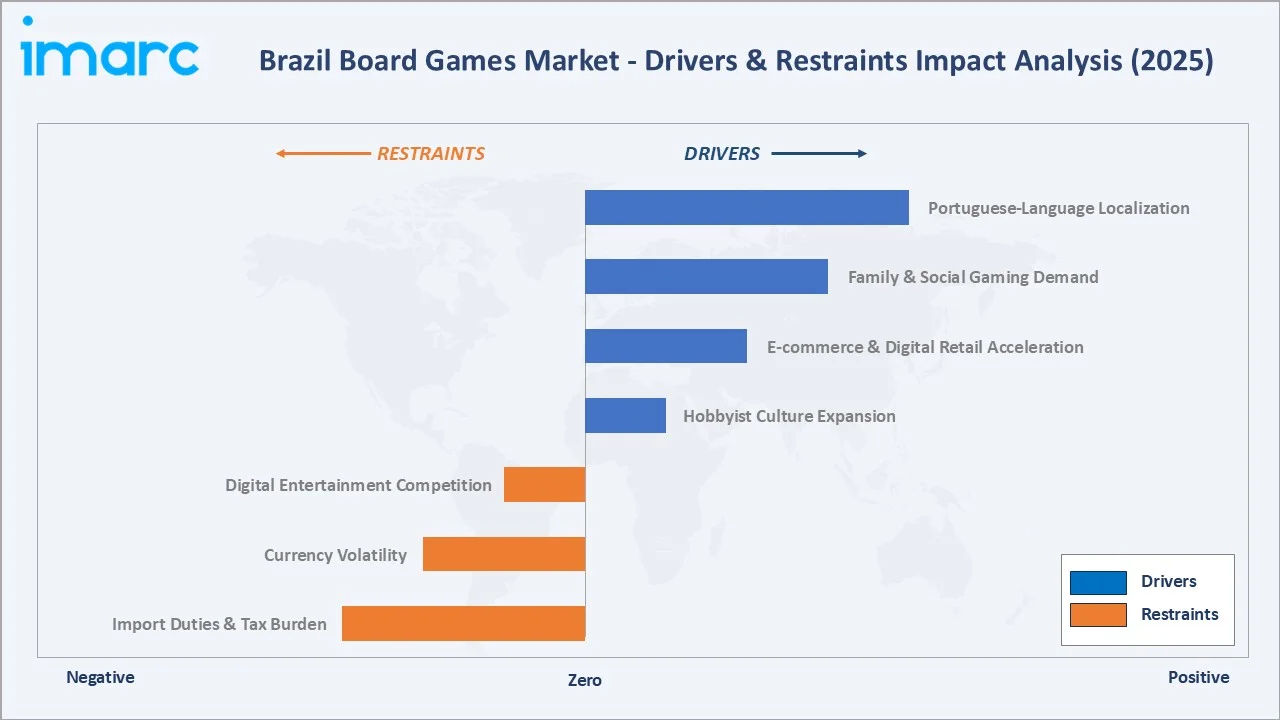
- Hobbyist Culture Expansion: Brazil’s hobby gaming community is expanding, supported by events like Diversão Offline, one of Latin America’s largest tabletop conventions, and crowdfunding via Catarse, which has enabled the launch of numerous locally developed board games.
- E-commerce and Digital Retail Acceleration: Online channels are increasingly important in Brazil’s board game market, with platforms like Mercado Livre and Amazon Brazil improving accessibility, particularly for consumers in smaller cities through wider product availability and delivery networks.
- Family and Social Gaming Demand: Board games are gaining popularity as social and screen-free entertainment among Brazilian families. Titles such as Catan, Uno, and Banco Imobiliário remain widely recognized and commonly sold across retail channels.
- Portuguese-Language Localization: Galápagos and Grok have localized hundreds of international titles into Portuguese, removing language friction and expanding the market beyond bilingual hobbyist cores.
Market Restraints
- Import Duties and Tax Burden: Brazil imposes high import taxes, including IPI and ICMS, which significantly increase retail prices of imported board games. These cumulative taxes can substantially raise costs, limit affordability and slowing adoption beyond major urban markets.
- Currency Volatility: Fluctuations of the Brazilian Real against the US Dollar increase costs for imported games and components, impacting pricing and margins for distributors and publishers, particularly during periods of currency depreciation in recent years.
- Digital Entertainment Competition: Digital entertainment, including mobile gaming and streaming, competes with board games for consumer attention. Brazil has a large and growing gaming market, attracting younger audiences and influencing spending toward digital platforms over physical tabletop games.
Market Opportunities
- Local Manufacturing Expansion: Brazil’s board game market is seeing gradual interest in local production to reduce import dependency and costs. While partnerships and investments are emerging, the market still relies heavily on imports, indicating early stage but growing domestic manufacturing potential.
- Educational Channel Penetration: Brazilian publishers such as Estrela and Grow Jogos e Brinquedos are expanding educational board games aligned with learning outcomes, supporting adoption in schools and among younger age groups.
- Hybrid Digital-Physical Formats: Hybrid board games integrating apps and physical gameplay are gaining traction. Titles like Mansions of Madness illustrate this trend, enhancing engagement through digital features and appealing to tech-savvy consumers seeking interactive gaming experiences.
Market Challenges
- Distribution and Logistics Complexity: Brazil’s large geography and uneven infrastructure create distribution challenges, especially beyond the Southeast. High transportation and last-mile delivery costs in remote regions limit market reach and increase retail prices for lower-value board games.
- Counterfeit and Grey Market Imports: Counterfeit and parallel imports of popular board games affect legitimate sales in Brazil, particularly in informal retail and online marketplaces, reducing revenues for authorized distributors and publishers.
- Regulatory Compliance Costs: Regulatory requirements such as certification by INMETRO, age labeling, and packaging standards increase time-to-market and compliance costs, posing challenges for smaller publishers entering the Brazilian market.
Emerging Market Trends
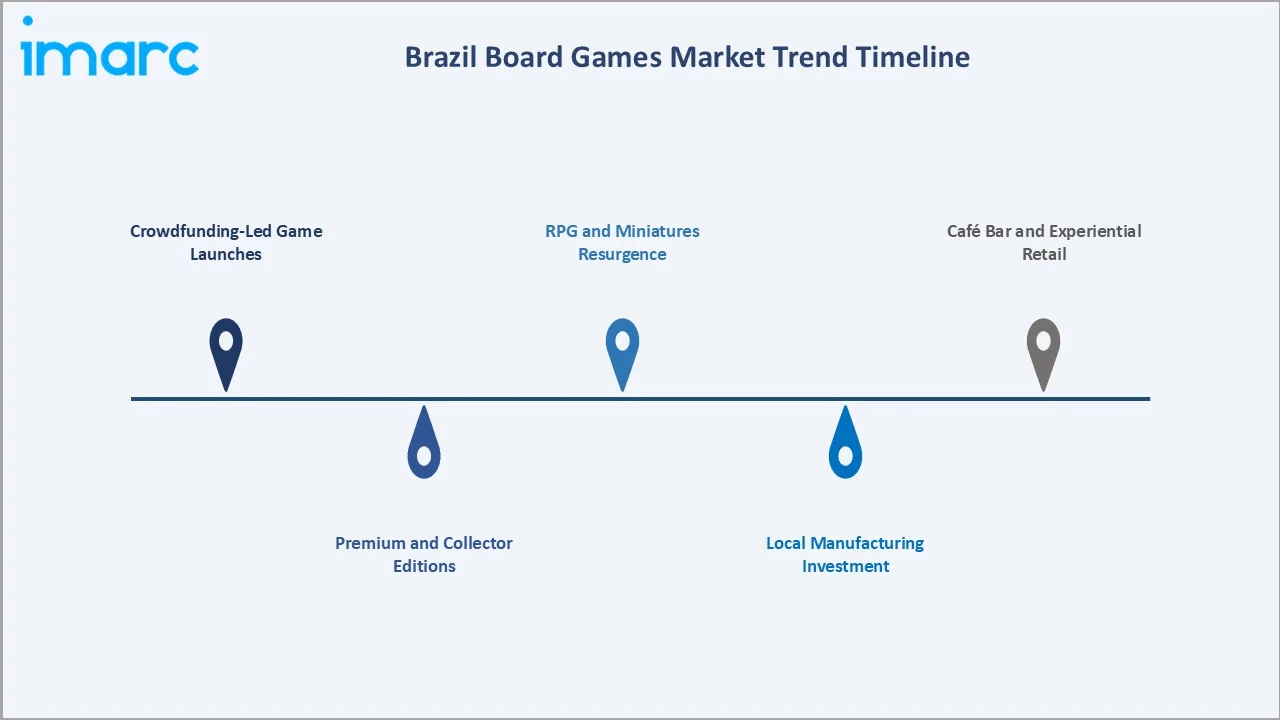
1. Crowdfunding-Led Game Launches
Brazilian creators increasingly use Catarse and Kickstarter to launch board games. Growing campaign activity highlights rising consumer willingness to pre-order and support locally developed titles.
2. Premium and Collector Editions
Premium board game editions with deluxe components and exclusives are rising in Brazil’s hobby segment. While exact pricing multiples vary, industry observations confirm higher-priced collector editions frequently sell out quickly due to limited print runs and strong enthusiast demand.
3. Local Manufacturing Investment
Panda Game Manufacturing's 2025 Brazil JV with Kawagraf marks the first major foreign investment in Brazilian board game production. The facility supports cardboard, paper, and wooden components for both domestic and export markets.
4. RPG and Miniatures Resurgence
Dungeons & Dragons returned to Brazil through Galápagos in 2025 after a brief Wizards of the Coast withdrawal. Miniature games such as Warhammer 40,000 maintain dedicated communities, with painting and tournament culture supporting recurring spend.
5. Café Bar and Experiential Retail
Board game cafés are expanding across cities like São Paulo, Curitiba, and Belo Horizonte. These venues combine gaming, food, and retail, helping introduce new players and drive repeat purchases in the hobby board games segment.
Industry Value Chain Analysis
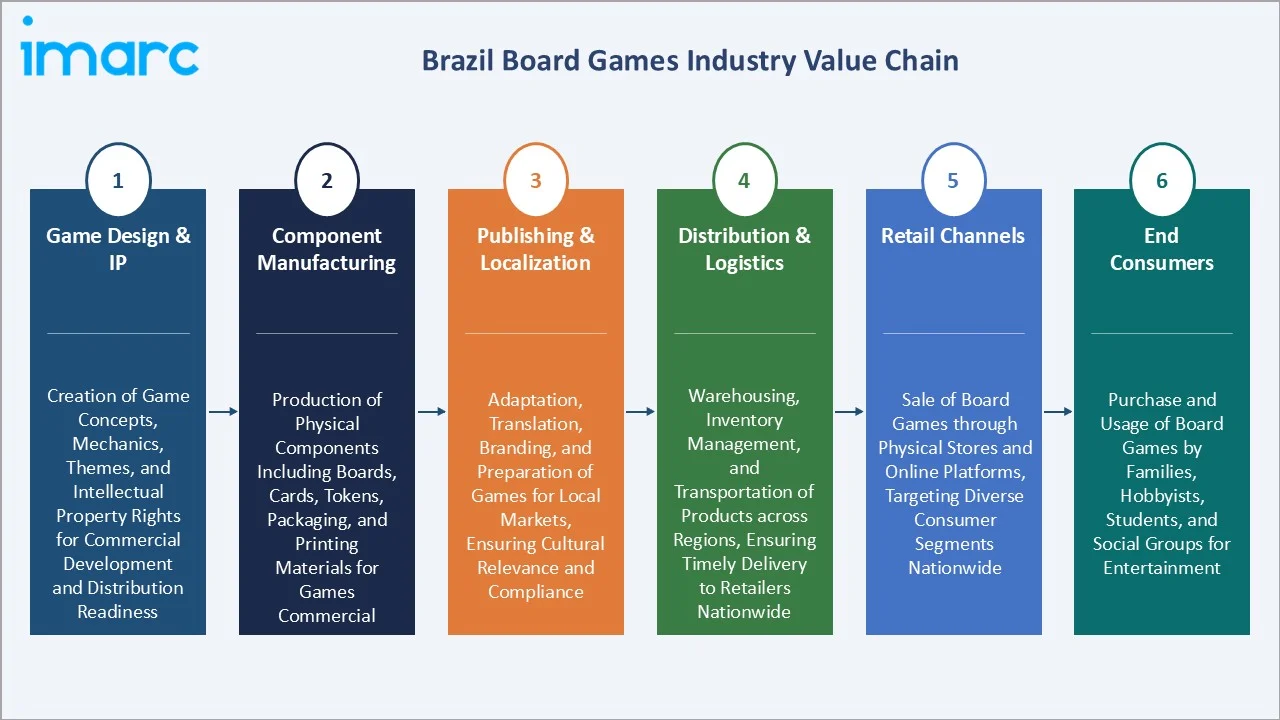
The Brazil board games value chain spans game design through end-consumer fulfillment, with each stage exhibiting distinct competitive dynamics, margin structures, and cost pressures shaped by Brazil's import regime and logistics geography.
|
Stage |
Key Players / Examples |
|
Game Design & IP |
Creation of game concepts, mechanics, themes, and intellectual property rights for commercial development and distribution readiness |
|
Component Manufacturing |
Production of physical components including boards, cards, tokens, packaging, and printing materials for games commercial |
|
Publishing & Localization |
Adaptation, translation, branding, and preparation of games for local markets, ensuring cultural relevance and compliance |
|
Distribution & Logistics |
Warehousing, inventory management, and transportation of products across regions, ensuring timely delivery to retailers nationwide |
|
Retail Channels |
Sale of board games through physical stores and online platforms, targeting diverse consumer segments nationwide |
|
End Consumers |
Purchase and usage of board games by families, hobbyists, students, and social groups for entertainment |
Tier-1 publishers like Galápagos and Grok capture the highest value position by combining licensing access, localization expertise, and direct hobby retail relationships. Their portfolio breadth enables marketing leverage and shelf-space dominance across both online and offline channels.
Technology Landscape in the Brazil Board Games Industry
Component Materials Innovation
Sustainable cardstock, FSC-certified paper, and recycled plastic miniatures are gaining traction among premium publishers. Galápagos and Grok have committed to sustainable-material adoption across reprints, responding to environmentally conscious hobbyist segments.
Companion App Integration
Companion app integration is expanding in modern board games, offering features like narration, scoring, and gameplay automation. These apps enhance immersion, streamline setup, and support hybrid physical-digital experiences, particularly in premium and hobbyist titles, though pricing impact varies across publishers.
Print-on-Demand and Crowdfunded Production
Print-on-demand platforms enable Brazilian designers to test small-batch titles before mass production. Crowdfunding via Catarse provides pre-funded production runs that de-risk launches for emerging publishers under capital constraints.
E-commerce Personalization and Recommendation
Marketplaces including Mercado Livre and Amazon Brazil deploy recommendation engines that surface board games based on browsing history and complementary purchase patterns, supporting category discovery for non-hobbyist buyers.
Market Segmentation Analysis
The report covers the following segments:
| Segment Category | Leading Segment | Market Share | Year |
|---|---|---|---|
| Product Type | 🔒 | 🔒 | 2025 |
| Game Type | 🔒 | 🔒 | 2025 |
| Age Group | Above 12 Years | 46.3% | 2025 |
| Distribution Channel | Specialty Stores | 33.4% | 2025 |
| Region | Southeast | 45.8% | 2025 |

By Distribution Channel
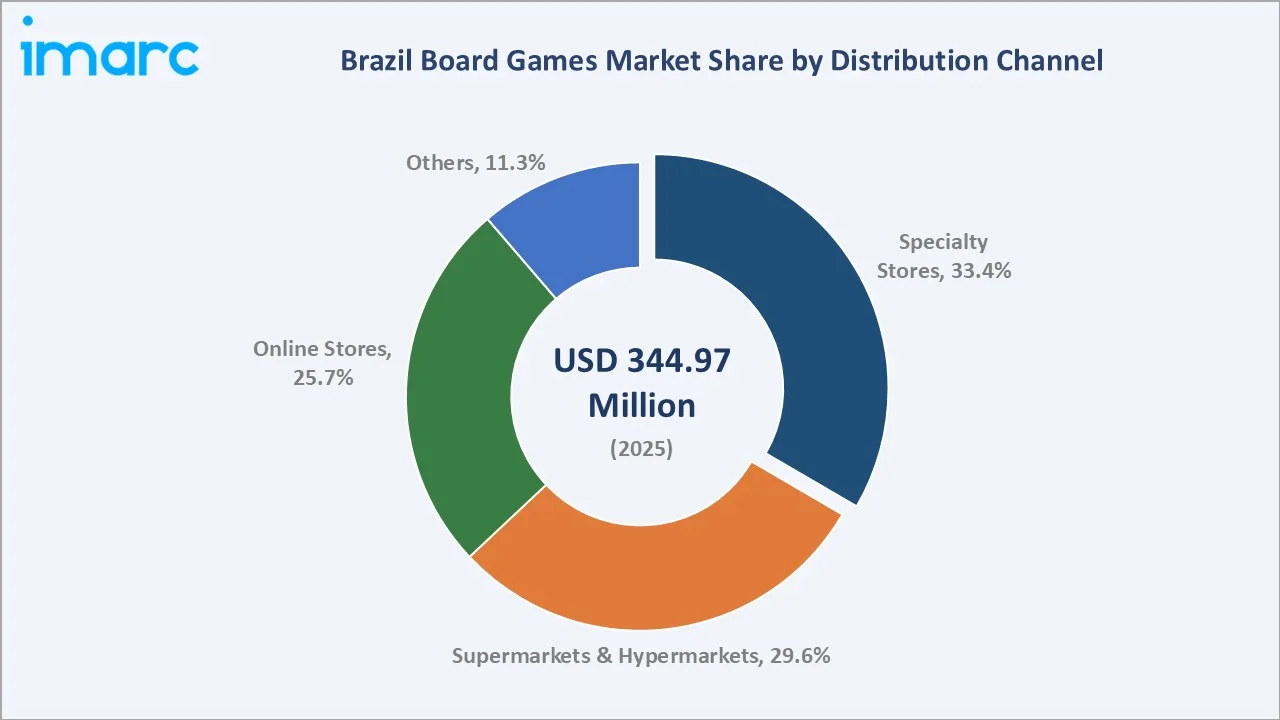
Specialty stores hold a 33.4% share in 2025, anchored by curated catalogs, in-store demos, and event hosting that drive higher attach rates per visit. Stores including Pittas Board Games (São Paulo) and Black Cat offer gaming-cafe formats supporting community building.
To access detailed market analysis, Request Sample
Supermarkets and hypermarkets account for 29.6% in 2025, dominating mass-market and family titles such as Banco Imobiliário, Detetive, and Imagem & Ação. Carrefour, Pão de Açúcar, and Extra remain leading retail chains stocking board games at scale. Online stores represent 25.7% in 2025 and grow fastest at an estimated 11.8% CAGR through 2034. Mercado Livre and Amazon Brazil dominate the channel, while specialized hobby e-tailers including Loja Galápagos and BG Express serve premium buyers. Other channels – capturing 11.3% in 2025 – include department stores, bookstores such as Livraria Cultura, and direct crowdfunded fulfillment via Catarse, increasingly a meaningful primary channel for original Brazilian designs.
By Age Group
The Above 12 Years cohort dominates with 46.3% in 2025, reflecting Brazil's mature hobbyist base. This segment drives demand for strategy games such as Catan and Wingspan, RPGs including D&D, and miniature systems like Warhammer.
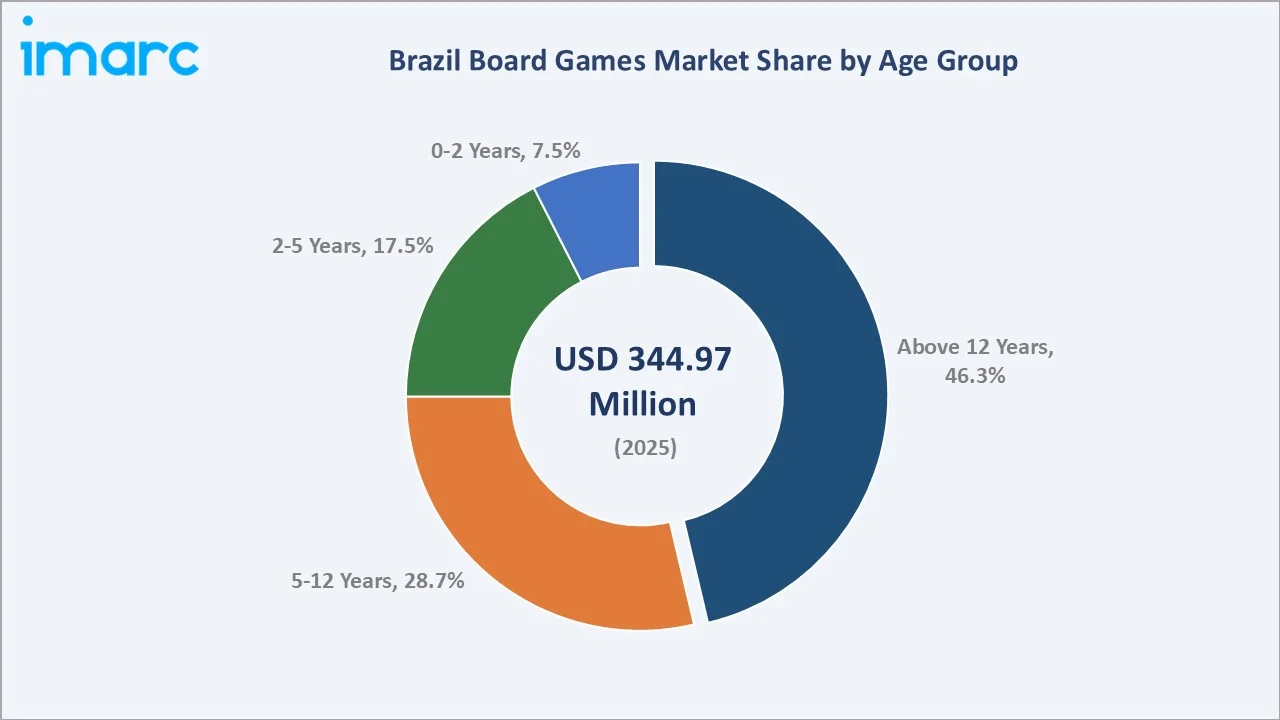
The 5–12 Years segment holds 28.7% in 2025, driven by school engagement, family-oriented purchases, and educational board games from companies such as Estrela and Grow. Popular titles include Detetive and Cara a Cara, alongside curriculum-aligned learning games. The 2–5 Years cohort accounts for 17.5% in 2025, supported by demand for simple, visually engaging games focused on colors, matching, and cooperation, with strong offerings from Estrela and imported brands distributed by Devir. The 0–2 Years group represents 7.5% in 2025, consisting mainly of tactile and early-development products. Growth in this segment remains moderate due to limited gameplay complexity before children transition into more interactive categories within the 2–5 Years age group.
Regional Market Insights
|
Region |
Share (2025) |
Key Growth Drivers |
|
Southeast |
45.8% |
São Paulo and Rio de Janeiro retail concentration; high disposable income; presence of Galápagos and Grok HQs; major events (Brasil Game Show, Diversão Offline) |
|
South |
19.6% |
Strong gaming clubs in Curitiba and Porto Alegre; European-influenced strategy game culture; concentration of premium specialty retail |
|
Northeast |
15.7% |
Rapid e-commerce penetration in Salvador, Recife, Fortaleza; rising middle-class disposable income; emerging hobbyist communities |
|
Central-West |
10.4% |
Brasília administrative population, school program demand; growing Goiânia retail base; family-oriented mass-market dominance |
|
North |
8.5% |
Manaus free-trade zone advantages; growing online channel penetration overcoming logistics constraints; family-segment focus |
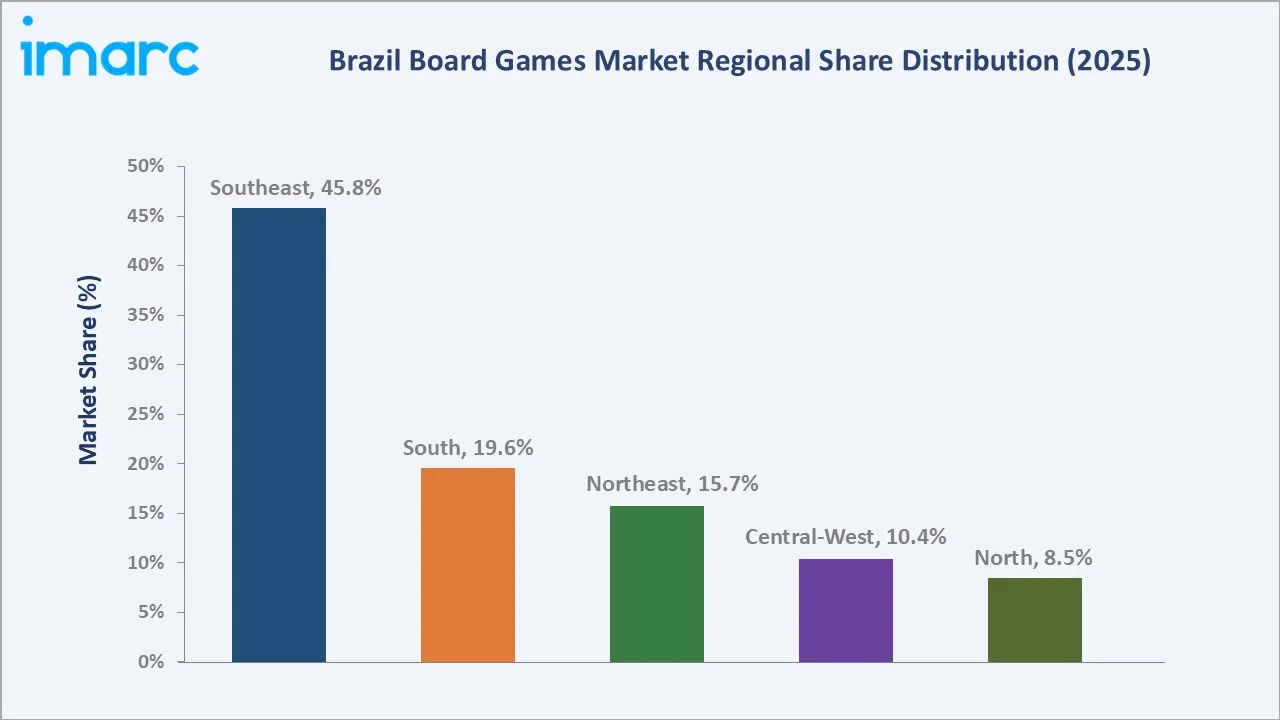
Southeast Brazil commands a 45.8% revenue share in 2025, anchored by São Paulo as Latin America's largest hobbyist market. The region hosts headquarters for both Galápagos Jogos and Grok Games, with retail density supporting more than 60 specialty hobby stores within metropolitan corridors. The South region holds 19.6% in 2025, supported by Curitiba's gaming community and Porto Alegre's strategy-game culture influenced by European immigrant heritage. The Northeast at 15.7% is the fastest-growing region, with e-commerce extending hobbyist titles into Salvador, Recife, and Fortaleza through Mercado Livre and Amazon logistics networks. Central – West and North together contribute 18.9% Share in 2025.
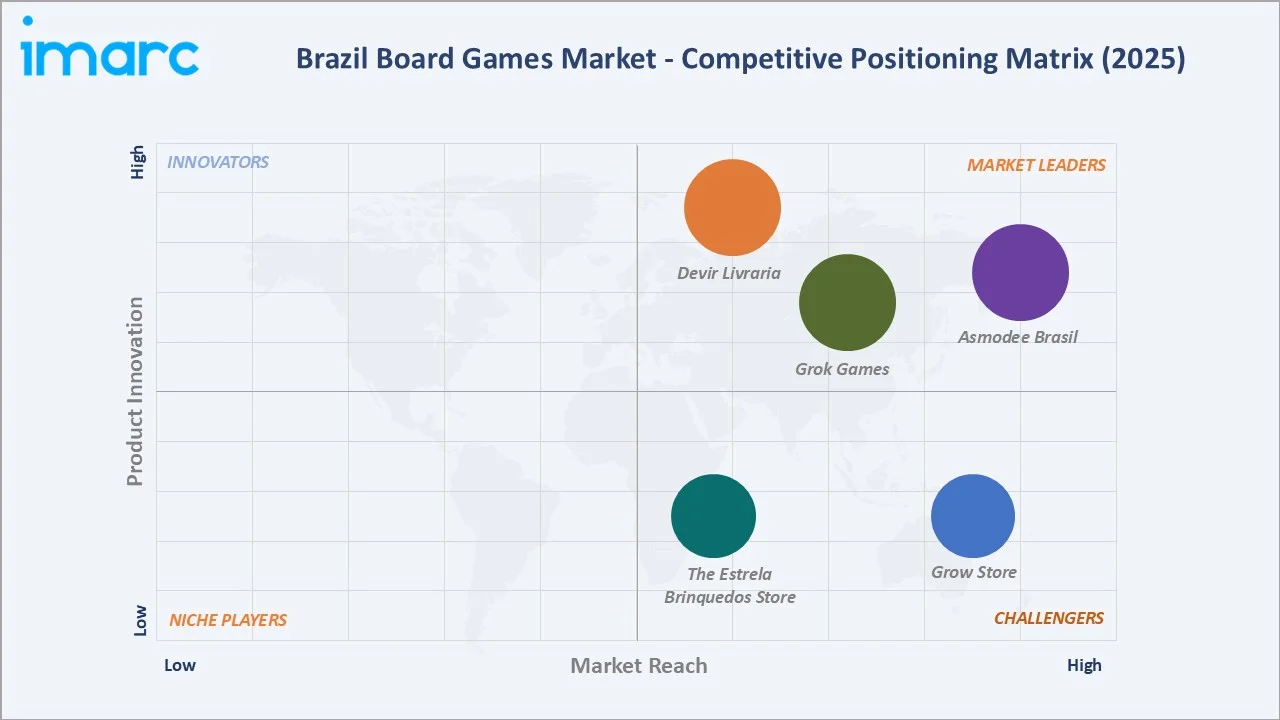
Competitive Landscape
|
Company |
Key Brand / Portfolio |
Position |
Core Strength |
|
Asmodee Brasil |
Munchkin, Daybreak, Catan, Ticket to Ride, Zombicide |
Leader |
Asmodee subsidiary; broadest licensed catalog; PT localization scale |
|
Grok Games |
Terra Nova, Slay the Spire, Cartógrafos |
Leader |
Original Brazilian IP exporter; merged Mandala–Grow heritage |
|
Devir Livraria |
Emberheart, Carcassonne Expansion, Devir |
Leader |
Iberian-LatAm publishing network; strong RPG and family lines |
|
The Estrela Brinquedos Store |
Banco Imobiliário, Cara a Cara |
Established |
Mass-market dominance; supermarket distribution at scale |
|
Grow Store |
War, Imagem & Ação |
Established |
Iconic Brazilian classics; strong supermarket and hypermarket presence |
The Brazil board games market combines a few scale leaders with a long tail of emerging publishers competing on niche IP and crowdfunded launches. Galápagos Jogos – acquired by Asmodee has consolidated leadership through licensed catalog depth and Portuguese localization scale.
Key Company Profiles
Asmodee Brasil
Asmodee Brasil operates through Galápagos Jogos, a São Paulo–based publisher founded in 2009. Acquired by Asmodee Group, it is a leading distributor of hobby board games in Brazil, focusing on localizing international titles and expanding access to premium tabletop gaming experiences.
- Product & Service Portfolio: Asmodee Brasil publishes and distributes localized editions of major global titles such as Catan, Ticket to Ride, Dixit, 7 Wonders, Zombicide, Munchkin, and King of Tokyo, along with RPG systems like Dungeons & Dragons through partnerships with Wizards of the Coast.
- Recent Developments: Asmodee Brasil acquired Sheriff of Nottingham from CMON in February 2026, marking its third IP purchase from CMON within eight months. The title will be integrated into Z-Man Games, strengthening its social and bluffing game portfolio. The deal follows earlier acquisitions of Zombicide and Cthulhu: Death May Die, as CMON restructures amid financial losses.
- Strategic Focus: The company focuses on expanding localized international IPs, strengthening omnichannel distribution, and growing Brazil’s hobby gaming ecosystem through premium titles and retail partnerships.
Grok Games
Grok Games is a São Paulo–based board game publisher formed in 2018 through the merger of Mandala Jogos and the hobby games division of Grow Jogos. The company focuses on publishing localized international titles alongside developing and exporting original Brazilian-designed board games.
- Product & Service Portfolio: Grok Games publishes localized versions of international hobby titles and develops original games, including involvement in distributing titles like Cartographers (by Thunderworks Games) and supporting Brazilian designers through its in-house development and publishing initiatives.
- Recent Developments: Grok Games released Shackleton Base, Uma Jornada para a Lua in Brazil in 2026, introducing a complex euro-style strategy game focused on lunar base development. The launch strengthens its premium portfolio and reinforces its focus on localizing advanced international titles for hobby gamers in Brazil.
- Strategic Focus: Original Brazilian IP development, hobbyist segment penetration, and selective licensing partnerships balancing local designs with international localization.
Devir Brasil
Devir Livraria, part of Devir Group, has operated in Brazil since the 1990s with a strong presence in São Paulo. It is a leading publisher of board games, role-playing games, comics, and pop culture content, playing a key role in developing Brazil’s tabletop gaming ecosystem.
- Product & Service Portfolio: Devir Livraria publishes and distributes board games such as Bang!, Sushi Go!, and Tokaido, alongside a strong RPG portfolio including Tormenta20, one of Brazil’s most prominent domestically developed fantasy role-playing systems.
- Recent Developments: Devir Livraria continued localizing internationally popular titles such as Sushi Go! and Tokaido, maintaining a steady release pipeline in Brazil. These accessible, family-friendly games strengthened its position in the gateway segment while complementing its strong RPG portfolio and expanding reach among casual and new tabletop players.
- Strategic Focus: RPG-led portfolio strategy, original Brazilian IP cultivation, and integration with Devir's broader Iberian and Latin American distribution network.
Market Concentration Analysis
The Brazil board games market exhibits moderate concentration at the top, with Asmodee Brasil, Grok Games, Devir Livraria, The Estrela Brinquedos Store, and Grow Store collectively accounting for approximately 55–60% of the 2025 market by revenue. Concentration is highest in hobbyist and licensed-title categories, where catalog depth and licensing relationships create entry barriers.
Below the top tier, the market is fragmented across active publishers, with emerging crowdfunded labels and specialty importers competing on niche thematic positioning. This long tail is most pronounced in original Brazilian IP and hobbyist niches such as miniatures, narrative games, and indie strategy titles.
Consolidation accelerated following Asmodee's acquisition of Galápagos Jogos, integrating the Brazilian leader into a global publishing network. Further consolidation is expected through 2030 as scale advantages in licensing, manufacturing, and digital marketing favor larger operators over independent crowdfunded entrants.
Investment & Growth Opportunities
Fastest-Growing Segments
Online retail is the fastest-growing distribution channel, driven by expanding e-commerce platforms, improved logistics, and increasing consumer preference for convenience. Specialized hobby stores and marketplaces are accelerating digital sales growth across urban and semi-urban regions in Brazil.
Hobbyist titles targeting players above 12 years generate higher value due to premium pricing and repeat purchases. Strategy games, RPGs, and collectible formats drive stronger engagement, supporting higher lifetime value compared to mass-market family-oriented board games.
Emerging Market Expansion
Brazil’s Northeast region shows strong growth potential due to improving logistics, rising digital access, and increasing disposable income. Key cities such as Salvador, Recife, and Fortaleza are emerging consumption hubs for hobby games.
Venture and Strategic Investment Trends
Strategic investment activity is intensifying. Asmodee's acquisition of Galápagos and Panda Manufacturing's 2025 Kawagraf JV signal continued international capital deployment. Crowdfunding via Catarse channels tens of millions of BRL annually into original Brazilian designs and small-print premium reissues.
Future Market Outlook (2026-2034)
The Brazil board games market is projected to expand from USD 344.97 Million in 2025 to USD 377.88 Million in 2026, reaching USD 783.31 Million by 2034, at a 9.54% CAGR – representing incremental value creation of approximately USD 438 Million across the forecast period. Growth will be driven by hobbyist segment maturation, e-commerce expansion, and local manufacturing investment that reduces import-tax exposure.
Three transformational trends will reshape the market through 2034. Local component manufacturing, anchored by the Panda-Kawagraf joint venture, will reduce reliance on Chinese imports. Hybrid digital-physical formats with companion apps will expand category appeal beyond hobbyist cores. E-commerce-driven distribution will extend hobbyist title access into Tier-2 and Tier-3 cities currently underserved by specialty retail.
By 2034, the market is expected to evolve into a more diversified structure, with original Brazilian-designed titles capturing a larger share of hobbyist sales and locally manufactured components reducing dependency on import-driven cost volatility. Operators investing in licensing depth, e-commerce capability, and local production will gain competitive advantage.
Research Methodology
Primary Research
Primary research included structured interviews and surveys conducted in 2024–2025 with publishing executives, specialty retailers in São Paulo and Curitiba, e-commerce category managers, and hobbyist community leaders across Southeast, South, and Northeast Brazil.
Secondary Research
Secondary sources include Asmodee and Estrela financial reports, BoardGameGeek market data, Catarse crowdfunding statistics, INMETRO certification filings, IBGE consumer expenditure surveys, B3 disclosures, and trade media including Tabula Quadrada and BoardGameWire.
Forecasting Models
Market sizing combined top-down and bottom-up modeling, incorporating GDP growth, household disposable income, e-commerce penetration curves, and hobbyist-community estimates. Forecasts reflect base, optimistic, and conservative macroeconomic scenarios across 2026–2034.
Brazil Board Games Market Report Coverage:
| Report Features | Details |
|---|---|
| Base Year of the Analysis | 2025 |
| Historical Period | 2020-2025 |
| Forecast Period | 2026-2034 |
| Units | Million USD |
| Scope of the Report |
Exploration of Historical Trends and Market Outlook, Industry Catalysts and Challenges, Segment-Wise Historical and Future Market Assessment:
|
| Product Types Covered | Tabletop Games, Card and Dice Games, Collectible Card Games, Miniature Games, RPG Games |
| Game Types Covered | Strategy and War Games, Educational Games, Fantasy Games, Sport Games, Others |
| Age Groups Covered | 0-2 Years, 2-5 Years, 5-12 Years, Above 12 Years |
| Distribution Channels Covered | Supermarkets and Hypermarkets, Specialty Stores, Online Stores, Others |
| Regions Covered | Southeast, South, Northeast, North, Central-West |
| Companies Covered | Asmodee Brasil, Grok Games, Devir Livraria, The Estrela Brinquedos Store, Grow Store, etc. |
| Customization Scope | 10% Free Customization |
| Post-Sale Analyst Support | 10-12 Weeks |
| Delivery Format | PDF and Excel through Email (We can also provide the editable version of the report in PPT/Word format on special request) |
Key Benefits for Stakeholders:
- IMARC’s industry report offers a comprehensive quantitative analysis of various market segments, historical and current market trends, market forecasts, and dynamics of the Brazil board games market from 2020-2034.
- The research report provides the latest information on the market drivers, challenges, and opportunities in the Brazil board games market.
- Porter's five forces analysis assist stakeholders in assessing the impact of new entrants, competitive rivalry, supplier power, buyer power, and the threat of substitution. It helps stakeholders to analyze the level of competition within the Brazil board games industry and its attractiveness.
- Competitive landscape allows stakeholders to understand their competitive environment and provides an insight into the current positions of key players in the market.
Frequently Asked Questions About the Brazil Board Games Market Report
The Brazil board games market size is estimated at USD 377.88 Million in 2026, supported by hobbyist culture expansion, e-commerce growth, and rising local-language publishing of premium titles.
The market is projected to reach USD 783.31 Million by 2034, growing at a 9.54% CAGR during 2026-2034, fueled by digital retail expansion and local manufacturing investments.
Specialty stores lead with a 33.4% share in 2025, supported by curated hobbyist catalogs, in-store demos, and tournament programs across São Paulo, Curitiba, and Rio de Janeiro.
The Above 12 Years cohort dominates with a 46.3% share in 2025, reflecting Brazil's mature hobbyist base for strategy games, RPGs, and collectible miniature systems.
The Southeast leads with a 45.8% share in 2025, anchored by São Paulo and Rio de Janeiro retail density, hobbyist communities, and disposable income above the national average.
Key drivers include expanding hobbyist culture, e-commerce growth, family gaming demand, Portuguese-language localization, and crowdfunding-led original Brazilian designs.
The Northeast is the fastest-growing region, supported by e-commerce penetration in Salvador, Recife, and Fortaleza, plus rising middle-class disposable income across coastal metros.
Leading companies include Asmodee Brasil, Grok Games, Devir Livraria, The Estrela Brinquedos Store, and Grow Store.
Online stores hold a 25.7% share in 2025 and are the fastest-growing channel, with Mercado Livre, Amazon Brazil, and specialty hobby e-tailers driving sustained category migration.
E-commerce growth is driven by wider catalog access, competitive pricing on imports, hobbyist e-tailers, and improved last-mile logistics extending reach into Tier-2 and Tier-3 cities.
Companion apps, hybrid digital-physical formats, e-commerce personalization, and print-on-demand production are improving discovery and reducing setup friction across categories.
Above 12 Years is the largest segment with 46.3% in 2025, driven by hobbyist strategy titles, RPGs including Dungeons & Dragons, and miniature systems with premium average values.
Need more help?
- Speak to our experienced analysts for insights on the current market scenarios.
- Include additional segments and countries to customize the report as per your requirement.
- Gain an unparalleled competitive advantage in your domain by understanding how to utilize the report and positively impacting your operations and revenue.
- For further assistance, please connect with our analysts.
 Request Customization
 Speak to an Analyst
 Request Brochure
 Inquire Before Buying
Benefits of Customization
- Personalize this research
- Triangulate with your data
- Get data as per your format and definition
- Gain a deeper dive into a specific application, geography, customer, or competitor
- Any level of personalization
Get in Touch With Us
UNITED STATES
Phone: +1-201-971-6302
INDIA
Phone: +91-120-433-0800
UNITED KINGDOM
Phone: +44-753-714-6104
Email: [email protected]
Client Testimonials




.webp)




.webp)













Related Reports

Choose your plan
*Please note that the prices mentioned below are starting prices for each bundle type. Kindly contact our team for further details.*
Single User License
- 1 User License, Access on 2 Devices
- PDF Report + Excel Dataset (Password Protected)
- Lifetime Access
- No Printing Rights
- 10% Free Report Customization
- 10–12 Weeks of Analyst Support
Five User License
- Access for 5 Users, 2 Devices per User
- PDF Report + Excel Dataset (Password Protected)
- Lifetime Access
- Dedicated Account Manager
- 12–14 Weeks of Analyst Support
- No Printing Rights
- 15% Free Report Customization
- 25% Discount on Your Next Purchase
Corporate User License
- Unlimited User Access (Within Your Organization)
- PDF Report + Excel Dataset
- Lifetime Access
- Dedicated Account Manager
- 14–20 Weeks of Analyst Support
- No Printing Rights
- 20% Free Report Customization
- 30% Discount on Your Next Purchase
Essential Insights
What's included:
3 reports
- Lifetime Access
- PDF Reports
- Excel Datasets
- 2 Weeks of Free Analyst Support
- 2 User Licenses
- Access on 2 Devices
- Printing Rights
- Complimentary PowerPoint (PPT) Version
- Complimentary License Upgrade
Professional Access
What's included:
5 reports
- Lifetime Access
- PDF Reports
- Excel Datasets
- 8 Weeks of Free Analyst Support
- 2 User Licenses
- Access on 2 Devices
- Printing Rights
- Complimentary PowerPoint (PPT) Version
- Complimentary License Upgrade
Business Advantage
What's included:
8 reports
- Lifetime Access
- PDF Reports
- Excel Datasets
- 14 Weeks of Free Analyst Support
- 2 User Licenses
- Access on 2 Devices
- Printing Rights
- Complimentary PowerPoint (PPT) Version
- Complimentary License Upgrade
Enterprise Intelligence
What's included:
10 reports
- Lifetime Access
- PDF Reports
- Excel Datasets
- 20 Weeks of Free Analyst Support
- 2 User Licenses
- Access on 2 Devices
- Printing Rights
- Complimentary PowerPoint (PPT) Version
- Complimentary License Upgrade