
Brazil Life and Non-Life Insurance Market Size, Share, Trends and Forecast by Insurance Type, Distribution Channel, and Region, 2026-2034
Brazil Life and Non-Life Insurance Market Size, Share, Trends & Forecast (2026-2034)
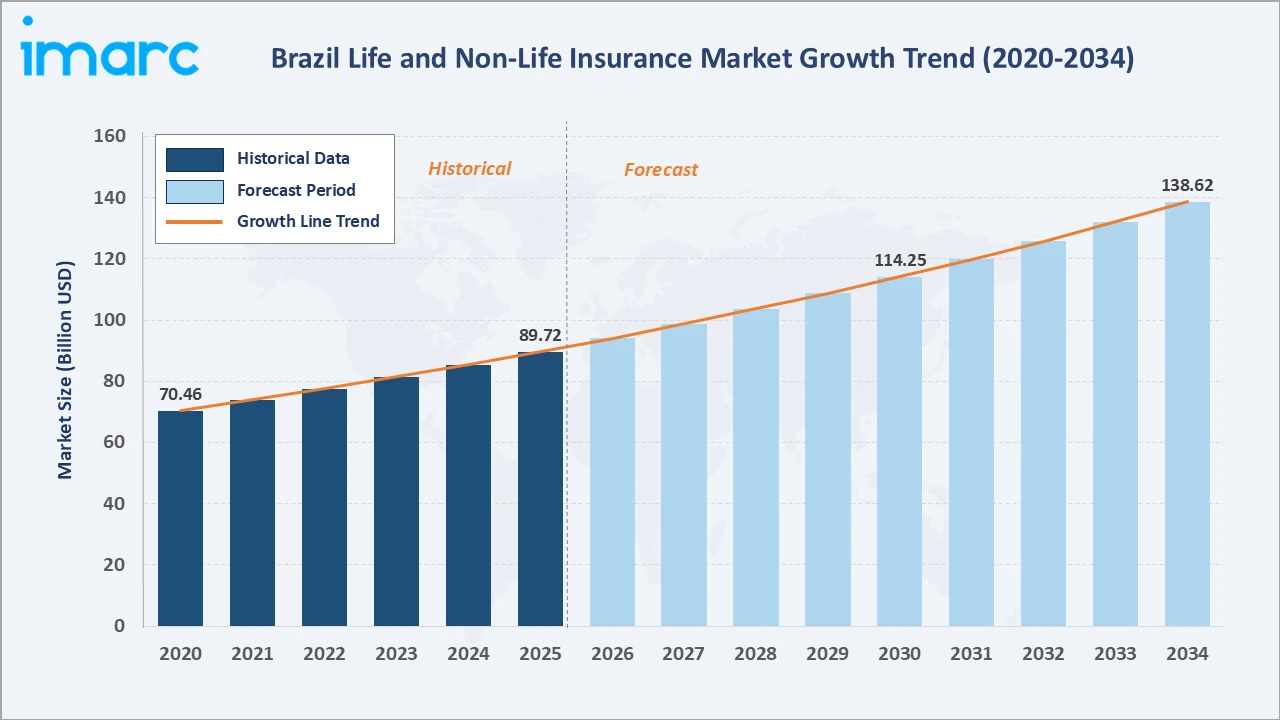
The Brazil life and non-life insurance market grew from USD 89.72 Billion in 2025 to USD 94.16 Billion in 2026 and is projected to reach USD 138.62 Billion by 2034, growing at a CAGR of 4.95% during 2026-2034. Growth is driven by rising financial security awareness, increasing healthcare costs, a growing middle class, and supportive regulatory reforms. Non-Life Insurance dominates insurance type at 61.4% share, while Banks lead distribution at 36.8%. Southeast leads regionally with 45.7% of total market share, anchored by Sao Paulo and Rio de Janeiro's dense commercial and industrial base.
Market Snapshot
|
Metric |
Value |
|
Base Year Market Size (2025) |
USD 89.72 Billion |
|
Market Size (2026) |
USD 94.16 Billion |
|
Forecast Market Size (2034) |
USD 138.62 Billion |
|
CAGR (2026-2034) |
4.95% |
|
Base Year |
2025 |
|
Historical Period |
2020-2025 |
|
Forecast Period |
2026-2034 |
|
Dominant Insurance Type |
Non-Life Insurance (61.4%, 2025) |
|
Dominant Distribution Channel |
Banks (36.8%, 2025) |
|
Leading Region |
Southeast (45.7%, 2025) |
The market expanded from USD 70.46 Billion in 2020 to USD 89.72 Billion in 2025 and an estimated USD 94.16 Billion in 2026, anchored at USD 114.25 Billion in 2030 and forecast to reach USD 138.62 Billion by 2034. Regulatory modernization under Bill No. 2,597/2024 and rising reinsurance activity are reinforcing structural stability across both life and non-life lines through the forecast period.
To get more information on this market, Request Sample
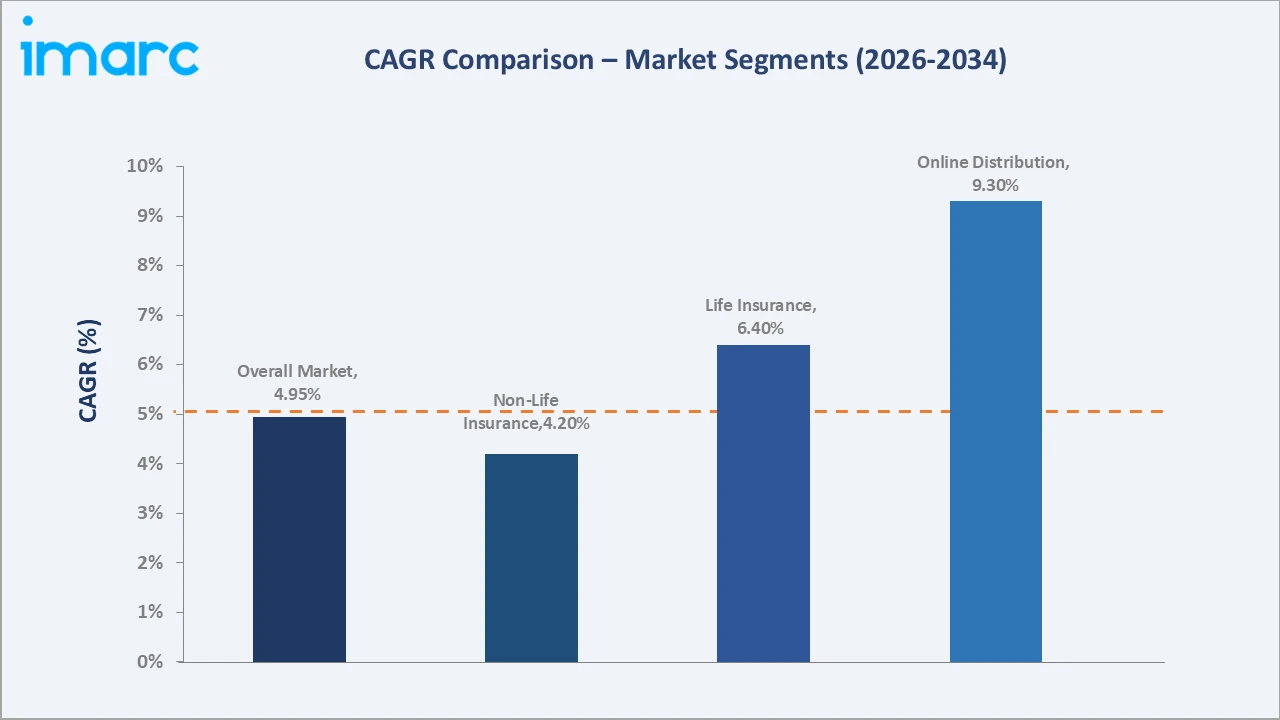
Non-Life Insurance grows steadily at a ~4.2% CAGR on mandatory and credit-linked motor and property covers, while Life Insurance is expanding faster at ~6.4% CAGR as mortality and critical-illness awareness rises among urban formal workers. Among distribution channels, Online distribution is the fastest-growing at ~9.3% CAGR from a small base, while Banks continue to anchor volume through bancassurance partnerships.
Executive Summary
The Brazil life and non-life insurance market, which is increased from USD 89.72 Billion in 2025 to an estimated USD 94.16 Billion in 2026, positioning Brazil as Latin America's largest insurance market. The industry is anchored by mandatory motor and credit-linked non-life covers alongside an expanding life insurance base driven by payroll-linked group policies and rising individual mortality-protection awareness. The market is projected to reach USD 138.62 Billion by 2034.
Non-Life Insurance at 61.4% dominates through motor, home, health, and credit-linked coverage demand. Banks at 36.8% lead distribution through bancassurance partnerships with major retail lenders. Southeast at 45.7% leads regionally through Sao Paulo and Rio de Janeiro's concentrated commercial, industrial, and high-income consumer base.
Key Market Insights
|
Insight |
Data |
|
Dominant Insurance Type |
Non-Life Insurance - 61.4% share (2025) |
|
Dominant Distribution Channel |
Banks - 36.8% share (2025) |
|
Leading Region |
Southeast - 45.7% share (2025) |
|
Market Opportunity |
Bancassurance expansion; Insurtech platforms; Open-insurance data sharing; rural micro-insurance penetration |
Key Analytical Observations Supporting the Above Data:
- Non-Life Insurance at 61.4%: Non-Life Insurance dominates due to mandatory motor liability covers, mortgage-linked home insurance, and rising vehicle ownership. Major insurers such as Porto Seguro and Bradesco Seguros sustain segment leadership through nationwide distribution networks.
- Banks at 36.8%: The Banks channel leads as leading lenders such as Banco do Brasil and Bradesco cross-sell insurance at loan origination, leveraging large retail customer bases and integrated digital banking platforms.
- Southeast at 45.7%: The Southeast region dominates due to its concentrated industrial base, higher disposable incomes, and dense urban population across Sao Paulo, Rio de Janeiro, and Minas Gerais, sustaining the highest premium volumes nationally.
Brazil Life and Non-Life Insurance Market Overview
The Brazil life and non-life insurance market encompasses individual and group life policies alongside home, motor, health, and other non-life covers distributed across direct, agency, bank, online, and other channels nationwide.
The ecosystem integrates domestic and multinational insurers, reinsurers, bancassurance partners, insurance brokers, insurtech platforms, and the regulatory body SUSEP (Superintendencia de Seguros Privados), which governs licensing, solvency, and consumer-protection standards across the industry. Macroeconomic factors include rising disposable incomes, urbanization, credit expansion, and growing awareness of financial protection needs.
Market Dynamics
To evaluate market opportunities, Request Sample
Market Drivers
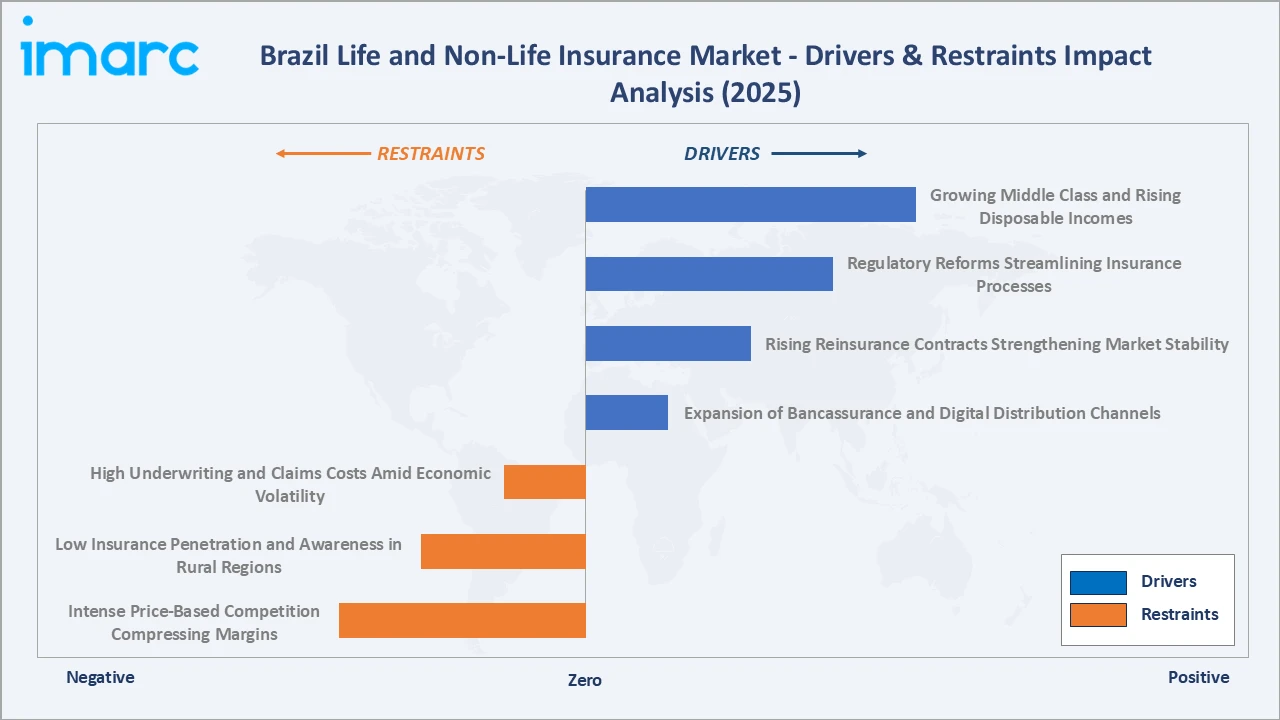
- Growing Middle Class and Rising Disposable Incomes: Brazil's expanding middle class is increasing demand for both life protection and non-life asset coverage as consumers gain access to disposable income, encouraging broader insurance adoption across urban and semi-urban households. Higher household savings capacity is enabling consumers to allocate a larger share of income toward long-term financial protection products. As formal employment expands, payroll-linked group life and health policies are becoming more widely accessible, further reinforcing structural demand across income brackets.
- Regulatory Reforms Streamlining Insurance Processes: Bill No. 2,597/2024, standardizes mass-market and large-risk policy treatment and clarifies reinsurance matters, improving claims processing efficiency and strengthening insurer confidence to expand coverage offerings. The reform reduces bureaucratic friction in policy administration and enhances transparency around claims settlement timelines. This regulatory clarity is encouraging both domestic and multinational insurers to introduce new product lines with greater confidence in the underlying legal framework.
- Rising Reinsurance Contracts Strengthening Market Stability: Brazilian insurers contracted USD 22.3 Billion in reinsurance agreements as of October 2024, a 5% rise over 2023, enabling insurers to manage large-volume risks while maintaining financial stability and supporting premium growth. Deeper reinsurance capacity allows primary insurers to underwrite larger commercial and catastrophe-exposed risks without compromising solvency. This growing reinsurance depth is also attracting new capital into the Brazilian market, broadening the pool of risk-bearing capacity available to insurers.
- Expansion of Bancassurance and Digital Distribution Channels: Banks and digital platforms are increasingly cross-selling insurance products at loan origination and through mobile applications, lowering acquisition costs and extending insurance access to previously underserved consumer segments. Integration of insurance offers directly within banking apps is shortening the sales cycle and improving conversion rates. This channel expansion is particularly effective at reaching younger, digitally native consumers who prefer self-service purchase journeys over traditional agency interactions.
Market Restraints
- High Underwriting and Claims Costs Amid Economic Volatility: Currency fluctuations and inflationary pressure raise claims payouts and reinsurance costs, squeezing underwriting margins and limiting insurers' capacity to price policies competitively across price-sensitive consumer segments. Volatile interest rates further complicate long-duration life insurance reserving, requiring insurers to hold higher capital buffers. These cost pressures are prompting some insurers to tighten underwriting criteria, which can slow policy issuance growth in higher-risk categories.
- Low Insurance Penetration and Awareness in Rural Regions: Limited financial literacy and distribution infrastructure outside major metropolitan areas constrain insurance uptake in North and Northeast regions, slowing overall market penetration relative to developed insurance markets. Sparse agency and bank branch networks in rural areas increase the cost of customer acquisition and policy servicing. Addressing this gap requires sustained investment in financial-literacy programs and low-cost digital distribution models tailored to lower-income households.
- Intense Price-Based Competition Compressing Margins: A fragmented competitive landscape with numerous domestic and multinational insurers drives aggressive premium discounting, particularly in motor insurance, compressing profitability across the non-life segment. Price wars are most pronounced in high-volume, commoditized product lines where differentiation is limited. This dynamic is pushing insurers to invest in value-added services and loyalty programs as alternative levers for customer retention beyond price competition.
Market Opportunities
- Bancassurance Expansion Into Underserved Regions: Extending bancassurance partnerships into regional banks across North and Northeast Brazil can unlock incremental cross-sell volume among previously underserved, lower-penetration consumer segments. Partnering with regional and cooperative banks provides insurers with established local trust networks that are difficult to replicate through direct agency expansion. This approach also allows insurers to tailor product bundles to regional income profiles and risk exposures.
- Open-Insurance Data Sharing Platforms: Open-insurance frameworks enabling secure data sharing between insurers and banks can improve underwriting precision and personalized product design, creating new growth avenues for digitally native insurers. Access to richer customer data supports more accurate risk segmentation and dynamic pricing models. Early movers in open-insurance adoption are also positioned to capture partnership opportunities with fintech and insurtech platforms seeking embedded-insurance integrations.
Market Challenges
- Legacy IT Infrastructure Slowing Digital Transformation: Many established insurers operate on legacy policy administration systems, slowing the pace of digital claims processing and personalized underwriting adoption relative to insurtech challengers. Migrating core systems involves significant capital investment and operational risk, causing some incumbents to delay modernization initiatives. This technology gap is widening the competitive divide between digitally mature insurers and slower-moving legacy carriers.
- Rising Fraud Risk in Digital Claims Processing: The shift toward digital claims submission is increasing exposure to fraudulent claims, requiring insurers to invest in advanced verification and analytics systems to protect underwriting profitability. Fraudulent activity is particularly concentrated in motor and health claims, where digital documentation can be more easily manipulated. Combating this trend requires ongoing investment in AI-based anomaly detection and stronger identity-verification protocols at the point of claims filing.
Emerging Market Trends
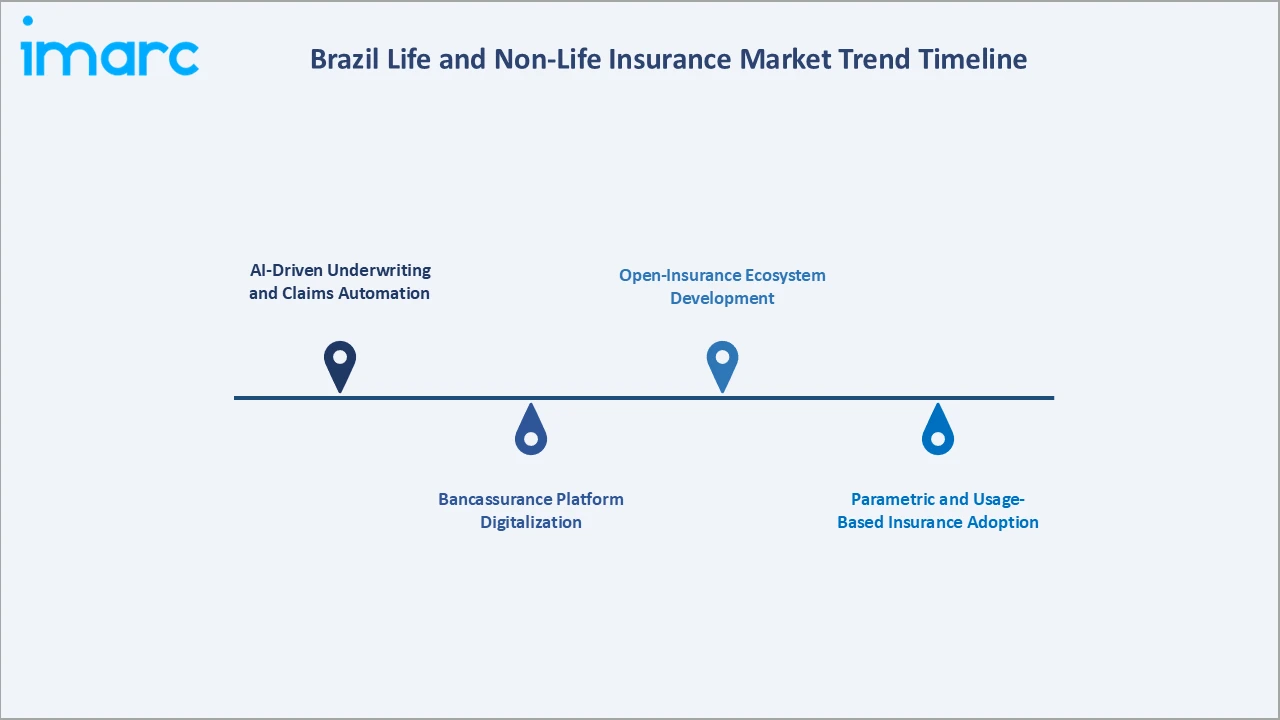
1. AI-Driven Underwriting and Claims Automation
Insurers are adopting AI-based underwriting models and automated claims triage to reduce processing time and improve risk-pricing accuracy. This is enabling faster policy issuance and improved loss-ratio management across motor and health insurance lines.
2. Bancassurance Platform Digitalization
Banks are digitizing bancassurance journeys through mobile-first policy issuance and Pix-based recurring premium collection, lowering onboarding friction for lower-income customer segments and expanding life insurance penetration.
3. Open-Insurance Ecosystem Development
Brazil's open-insurance regulatory framework is enabling secure data sharing between insurers, banks, and insurtechs, supporting more personalized product design and improved cross-sell targeting across life and non-lifelines.
4. Parametric and Usage-Based Insurance Adoption
Usage-based motor insurance and parametric agricultural covers are gaining traction as insurers seek to align premiums more closely with actual risk exposure, particularly across the Central-West region's agribusiness sector.
Industry Value Chain Analysis
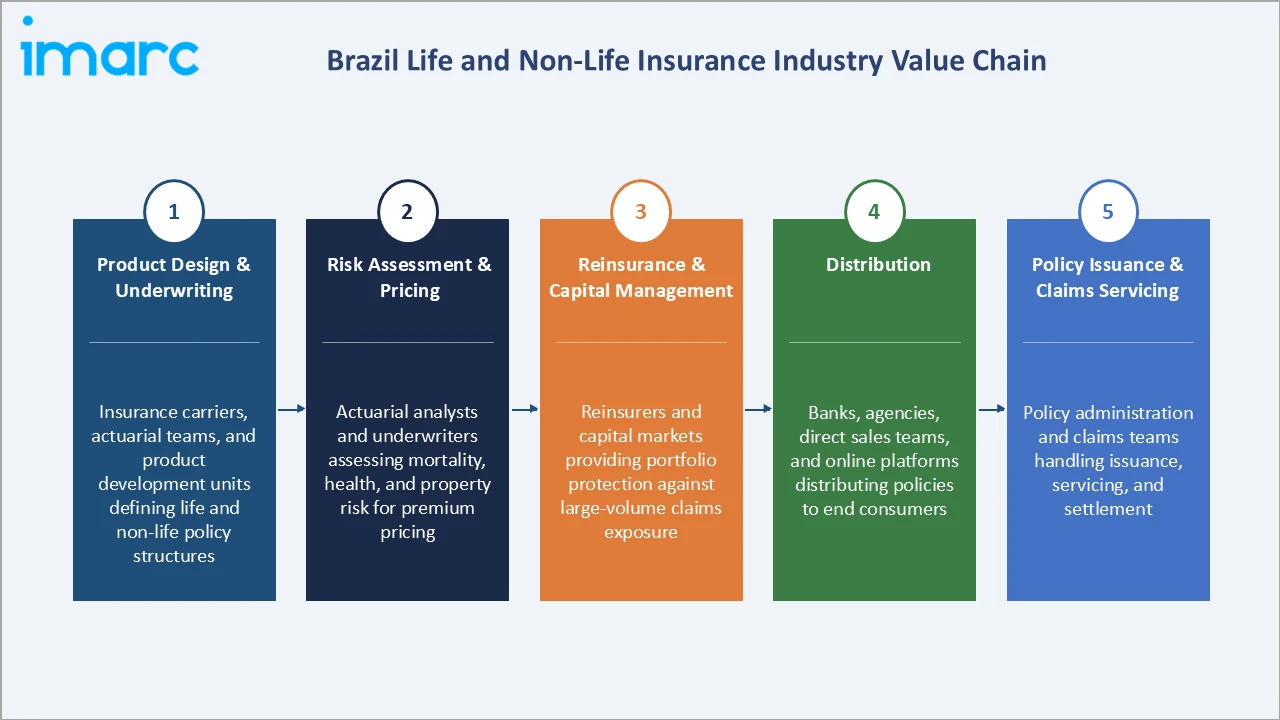
The Brazil life and non-life insurance value chain integrates product design and underwriting, actuarial risk assessment, reinsurance and capital management, multi-channel distribution, and policy issuance and claims servicing.
|
Stage |
Key Participants |
|
Product Design & Underwriting |
Insurance carriers, actuarial teams, and product development units defining life and non-life policy structures |
|
Risk Assessment & Pricing |
Actuarial analysts and underwriters assessing mortality, health, and property risk for premium pricing |
|
Reinsurance & Capital Management |
Reinsurers and capital markets providing portfolio protection against large-volume claims exposure |
|
Distribution |
Banks, agencies, direct sales teams, and online platforms distributing policies to end consumers |
|
Policy Issuance & Claims Servicing |
Policy administration and claims teams handling issuance, servicing, and settlement |
The distribution tier is the value chain's most rapidly evolving stage, as bancassurance and online channels progressively capture share from traditional agency-based distribution across both life and non-lifelines.
Technology Landscape in the Brazil Life and Non-Life Insurance Industry
AI-Driven Underwriting Platforms
AI-driven underwriting platforms improve risk-pricing accuracy and reduce policy issuance time by automating data analysis across health, motor, and life insurance applications, enabling insurers to compete more effectively on speed and precision.
Bancassurance Digital Integration
Bancassurance digital integration embeds insurance offerings directly within mobile banking applications, enabling seamless cross-sell at loan origination and account opening, expanding distribution reach at low incremental cost.
Open-Insurance Data Infrastructure
Open-insurance data infrastructure enables secure, standardized data exchange between insurers, banks, and third-party platforms, supporting personalized product design and improved underwriting across the industry.
Telematics and Usage-Based Pricing Systems
Telematics and usage-based pricing systems capture real-time driving and risk behavior data, enabling insurers to offer dynamically priced motor and health policies that align premiums more closely with individual risk exposure, improving both affordability and loss-ratio management.
Market Segmentation Analysis
The report covers the following segments:
|
Segment Category |
Leading Segment |
Market Share |
Year |
|
Insurance Type |
Non-Life Insurance |
61.4% |
2025 |
|
Distribution Channel |
Banks |
36.8% |
2025 |
|
Region |
Southeast |
45.7% |
2025 |

By Insurance Type
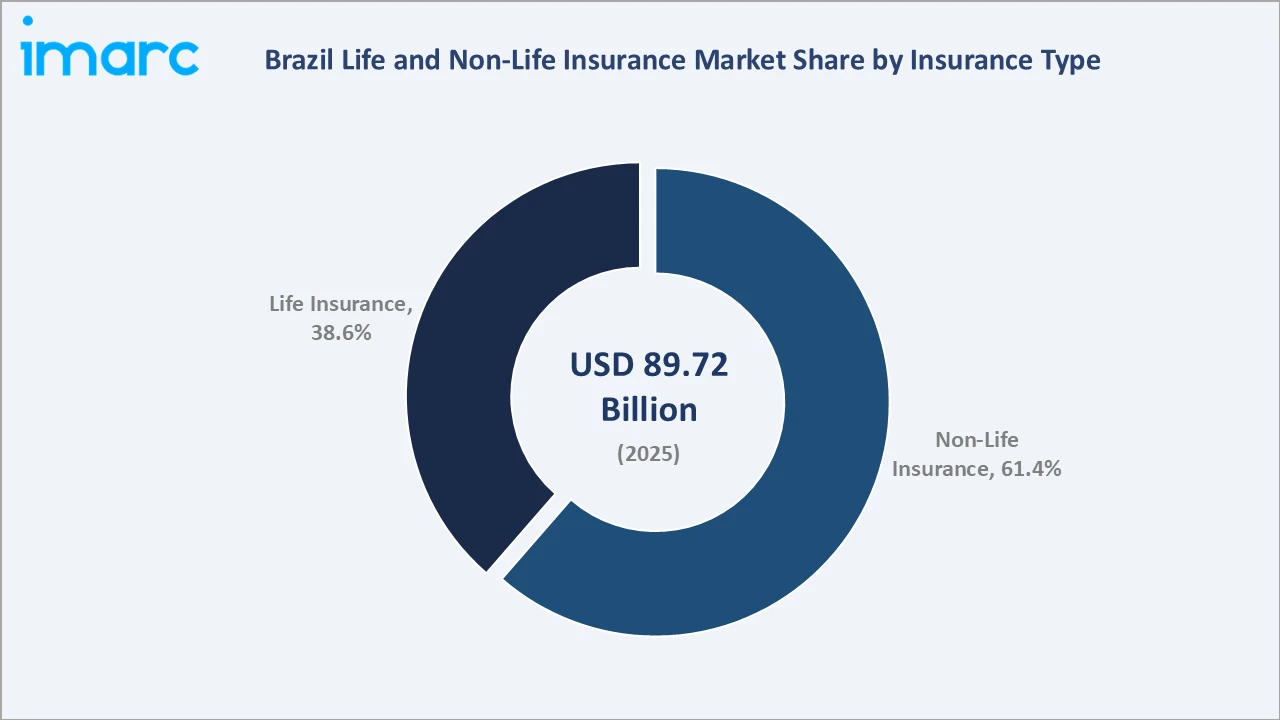
Non-Life Insurance leads at 61.4% in 2025, driven by mandatory motor liability covers, mortgage-linked home insurance, and rising commercial property coverage demand across Brazil's industrial and urban corridors.
To access detailed market analysis, Request Sample
Life Insurance at 38.6% is growing faster on a relative basis, supported by payroll-linked group policies and rising individual demand for mortality and critical-illness protection among aging urban households.
By Distribution Channel
Banks lead distribution at 36.8% in 2025, leveraging bancassurance partnerships with major retail lenders to cross-sell life and non-life products at loan origination and through digital banking platforms.
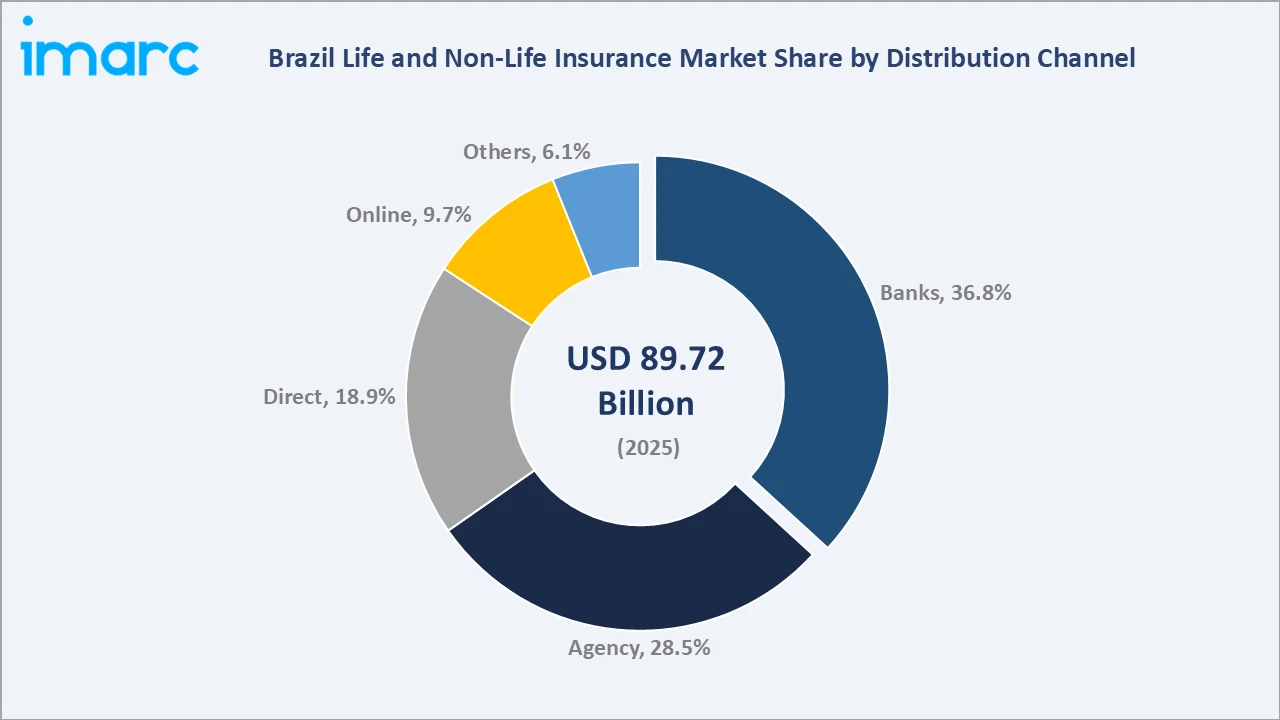
Agency at 28.5% remains significant through localized broker relationships, while Direct at 18.9% and Online at 9.7% are expanding as insurers invest in digital quoting and self-service platforms; Others account for the remaining 6.1%.
Regional Market Insights
|
Region |
Share (2025) |
Key Market Drivers & Characteristics |
|
Southeast |
45.7% |
Driven by a dense commercial and industrial base, high disposable incomes, and strong concentration of corporate and retail insurance demand |
|
South |
21.9% |
Supported by robust agribusiness activity, high vehicle ownership, and steady demand for property and health coverage |
|
Northeast |
15.4% |
Growing on rising urbanization, expanding middle-class households, and increasing insurance awareness |
|
Central-West |
9.2% |
Driven by agribusiness expansion and rising demand for commercial property and crop-linked insurance products |
|
North |
7.8% |
Emerging region supported by infrastructure development and gradually improving insurance distribution access |
Southeast, at 45.7%, leads through Sao Paulo and Rio de Janeiro's concentrated commercial and industrial activity, high asset ownership, and elevated income levels driving comprehensive coverage demand across both life and non-life lines.
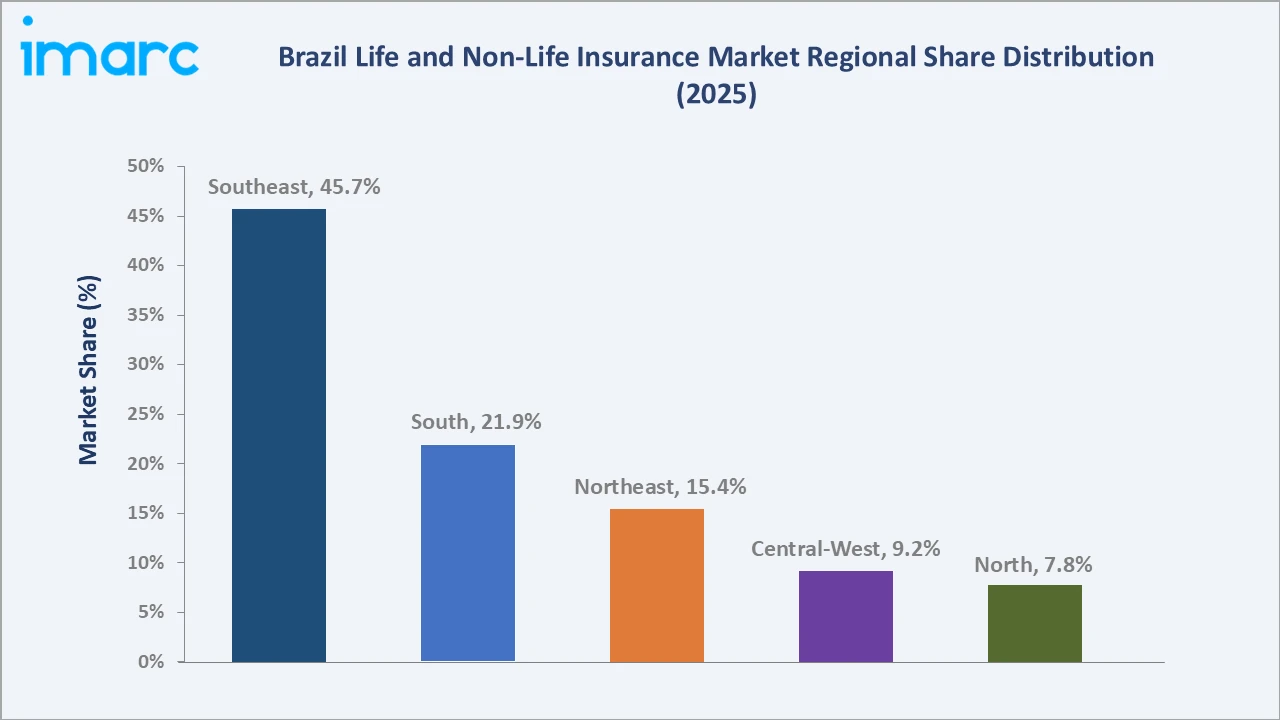
South, at 21.9%, benefits from strong agribusiness and vehicle ownership, while Northeast, at 15.4%, is expanding rapidly on urbanization in Salvador, Recife, and Fortaleza. Central-West and North, at 9.2% and 7.8% respectively, remain early-stage but growing markets.
Competitive Landscape
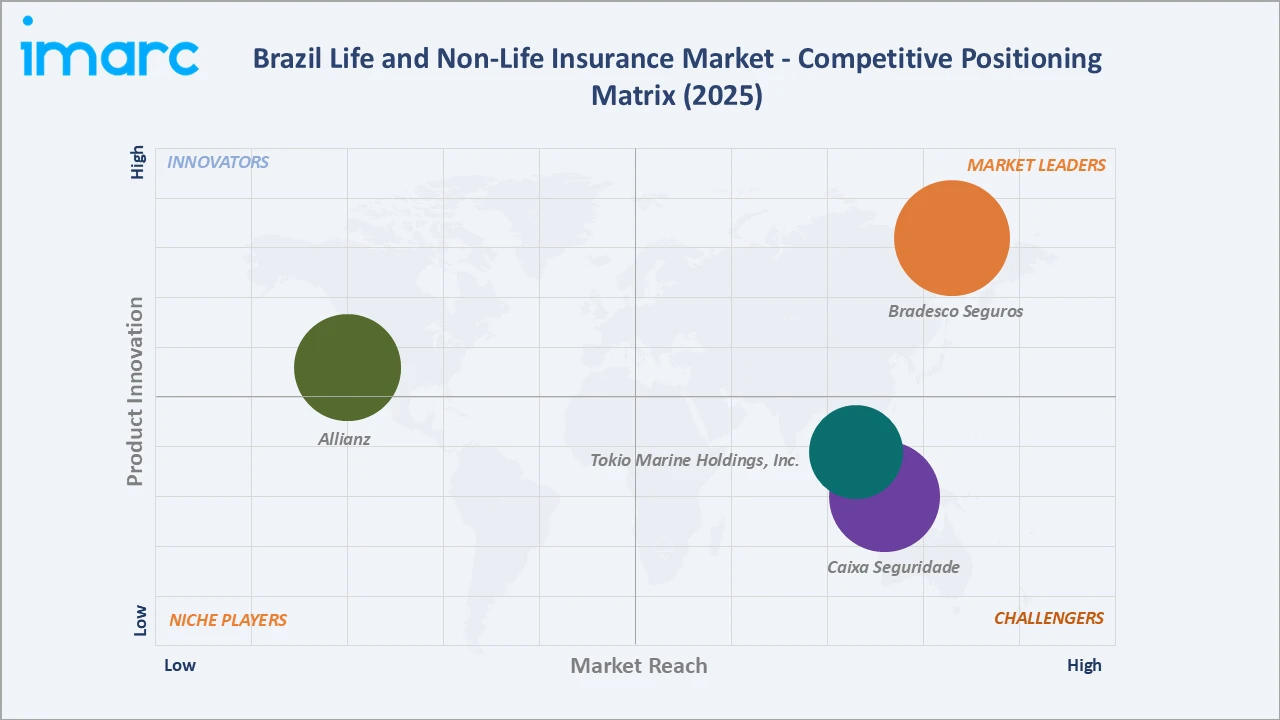
The Brazil life and non-life insurance market competitive landscape is moderately concentrated, with the top ten insurers accounting for over half of total premium volume across bancassurance-led leaders, diversified domestic groups, and multinational carriers.
|
Company Name |
Key Products |
Market Position |
Core Strength |
|
Bradesco Seguros |
Life, Home, Car, Health Insurance |
Market Leader |
Integrated bancassurance model leveraging Bradesco's large retail banking customer base |
|
Caixa Seguridade |
Life, Credit-Linked, Pension Products |
Strong Challenger |
Bancassurance arm of Caixa Economica Federal with wide public-sector reach |
|
Tokio Marine Holdings, Inc. |
Auto, Property, Life Insurance |
Strong Challenger |
Multinational carrier with strengthening presence across auto and property lines |
|
Allianz |
Auto, Property, Life Insurance |
Emerging Player |
Global insurer expanding motor and property coverage through broker partnerships |
Key players include Bradesco Seguros, Caixa Seguridade, Tokio Marine Holdings, Inc., Allianz, and others.
Key Company Profiles
Bradesco Seguros
Bradesco Seguros is a leading Brazilian insurance group and the insurance arm of Banco Bradesco, offering a diversified portfolio spanning life, auto, and health insurance products.
- Key Products: Life Insurance, Auto Insurance, Health Insurance
- Strategic Focus: Strengthening its bancassurance model and expanding health insurance coverage amid rising healthcare cost awareness among Brazilian consumers. Bradesco Seguros is investing in telematics-based auto insurance pricing and digital claims automation to improve loss-ratio management and customer experience. The company is also expanding group life insurance offerings through employer partnerships and broadening its health insurance network to include more preventive-care services.
Caixa Seguridade
Caixa Seguridade Participações S.A. is a leading Brazilian insurance and pension holding company operating a predominantly bancassurance-driven model, leveraging the nationwide branch and digital network to reach a large base of retail and corporate clients across the country.
- Key Products: Life, Credit-Linked, Pension Products
- Strategic Focus: Deepening its exclusive bancassurance partnership with Caixa Econômica Federal to expand distribution of life, credit-linked, and pension products through the bank's nationwide branch and digital network. Caixa Seguridade is prioritizing capital-efficient growth by retaining distribution control while ceding underwriting risk to specialized partners, supporting high-margin, fee-based revenue streams. The company is also focused on deepening cross-sell penetration across mortgage-linked insurance and private pension plans to align with Brazil's expanding housing finance and retirement-savings markets.
Market Concentration Analysis
The Brazil life and non-life insurance market is moderately concentrated, with the key players collectively accounting for a substantial share of total premium volume. The top ten insurers represent over half of the market, while numerous regional and specialty insurers compete across niche non-life and life product lines. Market concentration is expected to gradually shift as digital-native insurtech entrants and multinational carriers expand distribution reach through the forecast period.
Investment & Growth Opportunities
Highest Growth Segments
Life Insurance (~6.4% CAGR), Online distribution (~9.3% CAGR from a small base), and Southeast regional premium growth represent the highest-growth investment vectors through 2034, supported by rising financial-protection awareness and digital distribution scale-up.
Investment Themes
- Bancassurance deepening across regional banks: Expanding bancassurance partnerships beyond major national banks into regional lenders can unlock incremental cross-sell volume across underserved Northeast and North markets.
- Insurtech and open-insurance data platforms: Investment in open-insurance data-sharing infrastructure can improve underwriting precision and reduce quoting friction, supporting faster digital policy issuance across life and non-life lines.
Future Market Outlook (2026-2034)
The Brazil life and non-life insurance market is projected to grow from USD 89.72 Billion in 2025 to USD 94.16 Billion in 2026 and further to USD 138.62 Billion by 2034, delivering a 4.95% CAGR over the forecast period. The market's anchor value of USD 114.25 Billion in 2030 reflects continued bancassurance-led distribution expansion, regulatory modernization under Bill No. 2,597/2024, and rising reinsurance market depth strengthening financial stability across both life and non-life segments through the forecast horizon.
Research Methodology
Primary Research
Primary research comprised structured interviews with industry stakeholders including insurance executives, bancassurance partnership leads, actuarial analysts, and regulatory experts across Brazil's life and non-life insurance sector.
Secondary Research
Secondary research encompassed SUSEP regulatory filings, company annual reports, reinsurance market data, and industry association publications covering Brazil's life and non-life insurance landscape.
Forecasting Models
Market revenue forecasts were developed using a premium-based bottom-up model incorporating historical premium growth by insurance type, distribution channel penetration trends, and regional GDP and income growth projections.
Brazil Life and Non-Life Insurance Market Report Coverage:
| Report Features | Details |
|---|---|
| Base Year of the Analysis | 2025 |
| Historical Period | 2020-2025 |
| Forecast Period | 2026-2034 |
| Units | Billion USD |
| Scope of the Report |
Exploration of Historical Trends and Market Outlook, Industry Catalysts and Challenges, Segment-Wise Historical and Future Market Assessment:
|
| Insurance Types Covered |
|
| Distribution Channels Covered | Direct, Agency, Banks, Online, Others |
| Regions Covered | North India, South India, East India, West India |
| Companies Covered | Bradesco Seguros, Caixa Seguridade, Tokio Marine Holdings Inc., Allianz, etc. |
| Customization Scope | 10% Free Customization |
| Post-Sale Analyst Support | 10-12 Weeks |
| Delivery Format | PDF and Excel through Email (We can also provide the editable version of the report in PPT/Word format on special request) |
Key Benefits for Stakeholders:
- IMARC’s industry report offers a comprehensive quantitative analysis of various market segments, historical and current market trends, market forecasts, and dynamics of the Brazil life and non-life insurance market from 2020-2034.
- The research report provides the latest information on the market drivers, challenges, and opportunities in the Brazil life and non-life insurance market.
- Porter's five forces analysis assist stakeholders in assessing the impact of new entrants, competitive rivalry, supplier power, buyer power, and the threat of substitution. It helps stakeholders to analyze the level of competition within the Brazil life and non-life insurance industry and its attractiveness.
- Competitive landscape allows stakeholders to understand their competitive environment and provides an insight into the current positions of key players in the market.
Frequently Asked Questions About the Brazil Life and Non-Life Insurance Market Report
The Brazil life and non-life insurance market size is estimated at USD 94.16 Billion in 2026, driven by Non-Life Insurance's 61.4% share, Banks leading distribution at 36.8%, and Southeast commanding 45.7% of regional market share.
The market grows at a 4.95% CAGR during 2026-2034, reaching USD 138.62 Billion by 2034, supported by rising financial-security awareness and regulatory modernization.
Non-Life Insurance leads at 61.4% in 2025, driven by mandatory motor covers and mortgage-linked home insurance demand.
Banks lead at 36.8% through bancassurance partnerships with major Brazilian retail lenders.
Southeast leads at 45.7%, anchored by Sao Paulo and Rio de Janeiro's concentrated commercial and industrial base.
Leading companies include Bradesco Seguros, Caixa Seguridade, Tokio Marine Holdings, Inc., Allianz, and others.
The market is projected to reach approximately USD 114.25 Billion by 2030, supported by continued bancassurance expansion and reinsurance market depth.
Priority opportunities include bancassurance deepening across regional banks and investment in insurtech and open-insurance data platforms.
Need more help?
- Speak to our experienced analysts for insights on the current market scenarios.
- Include additional segments and countries to customize the report as per your requirement.
- Gain an unparalleled competitive advantage in your domain by understanding how to utilize the report and positively impacting your operations and revenue.
- For further assistance, please connect with our analysts.
 Request Customization
 Speak to an Analyst
 Request Brochure
 Inquire Before Buying
Benefits of Customization
- Personalize this research
- Triangulate with your data
- Get data as per your format and definition
- Gain a deeper dive into a specific application, geography, customer, or competitor
- Any level of personalization
Get in Touch With Us
UNITED STATES
Phone: +1-201-971-6302
INDIA
Phone: +91-120-433-0800
UNITED KINGDOM
Phone: +44-753-714-6104
Email: [email protected]
Client Testimonials




.webp)




.webp)













Related Reports

Choose your plan
*Please note that the prices mentioned below are starting prices for each bundle type. Kindly contact our team for further details.*
Single User License
- 1 User License, Access on 2 Devices
- PDF Report + Excel Dataset (Password Protected)
- Lifetime Access
- No Printing Rights
- 10% Free Report Customization
- 10–12 Weeks of Analyst Support
Five User License
- Access for 5 Users, 2 Devices per User
- PDF Report + Excel Dataset (Password Protected)
- Lifetime Access
- Dedicated Account Manager
- 12–14 Weeks of Analyst Support
- No Printing Rights
- 15% Free Report Customization
- 25% Discount on Your Next Purchase
Corporate User License
- Unlimited User Access (Within Your Organization)
- PDF Report + Excel Dataset
- Lifetime Access
- Dedicated Account Manager
- 14–20 Weeks of Analyst Support
- No Printing Rights
- 20% Free Report Customization
- 30% Discount on Your Next Purchase
Essential Insights
What's included:
3 reports
- Lifetime Access
- PDF Reports
- Excel Datasets
- 2 Weeks of Free Analyst Support
- 2 User Licenses
- Access on 2 Devices
- Printing Rights
- Complimentary PowerPoint (PPT) Version
- Complimentary License Upgrade
Professional Access
What's included:
5 reports
- Lifetime Access
- PDF Reports
- Excel Datasets
- 8 Weeks of Free Analyst Support
- 2 User Licenses
- Access on 2 Devices
- Printing Rights
- Complimentary PowerPoint (PPT) Version
- Complimentary License Upgrade
Business Advantage
What's included:
8 reports
- Lifetime Access
- PDF Reports
- Excel Datasets
- 14 Weeks of Free Analyst Support
- 2 User Licenses
- Access on 2 Devices
- Printing Rights
- Complimentary PowerPoint (PPT) Version
- Complimentary License Upgrade
Enterprise Intelligence
What's included:
10 reports
- Lifetime Access
- PDF Reports
- Excel Datasets
- 20 Weeks of Free Analyst Support
- 2 User Licenses
- Access on 2 Devices
- Printing Rights
- Complimentary PowerPoint (PPT) Version
- Complimentary License Upgrade