
Canada Methanol Market Size, Share, Trends and Forecast by Application and Region, 2026-2034
Canada Methanol Market Size, Share, Trends & Forecast (2026-2034)
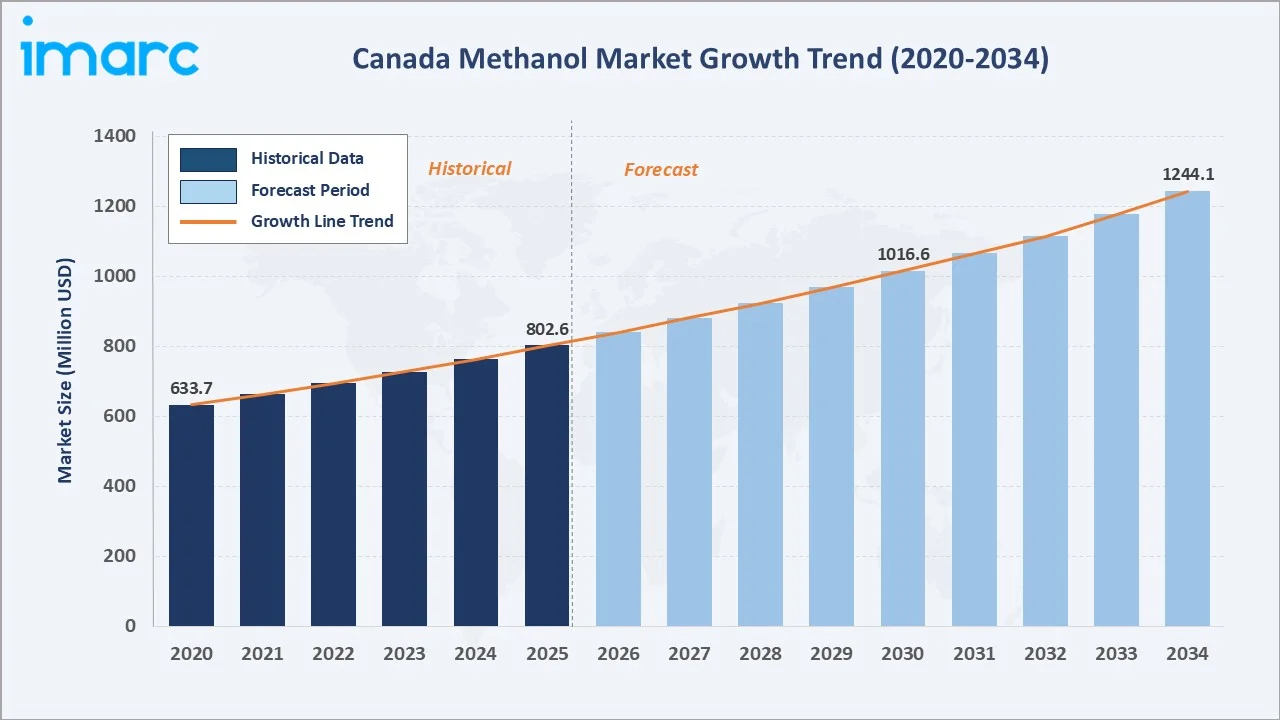
The Canada methanol market grew from USD 802.6 Million in 2025 to USD 852.4 Million in 2026 and is projected to reach USD 1,244.1 Million by 2034, exhibiting a CAGR of 4.84% during 2026-2034. The market is primarily driven by abundant natural gas feedstock availability, growing downstream demand from the formaldehyde and acetic acid industries, rising interest in methanol as a low-emission marine and transportation fuel, and Canada's expanding clean fuels regulatory framework.
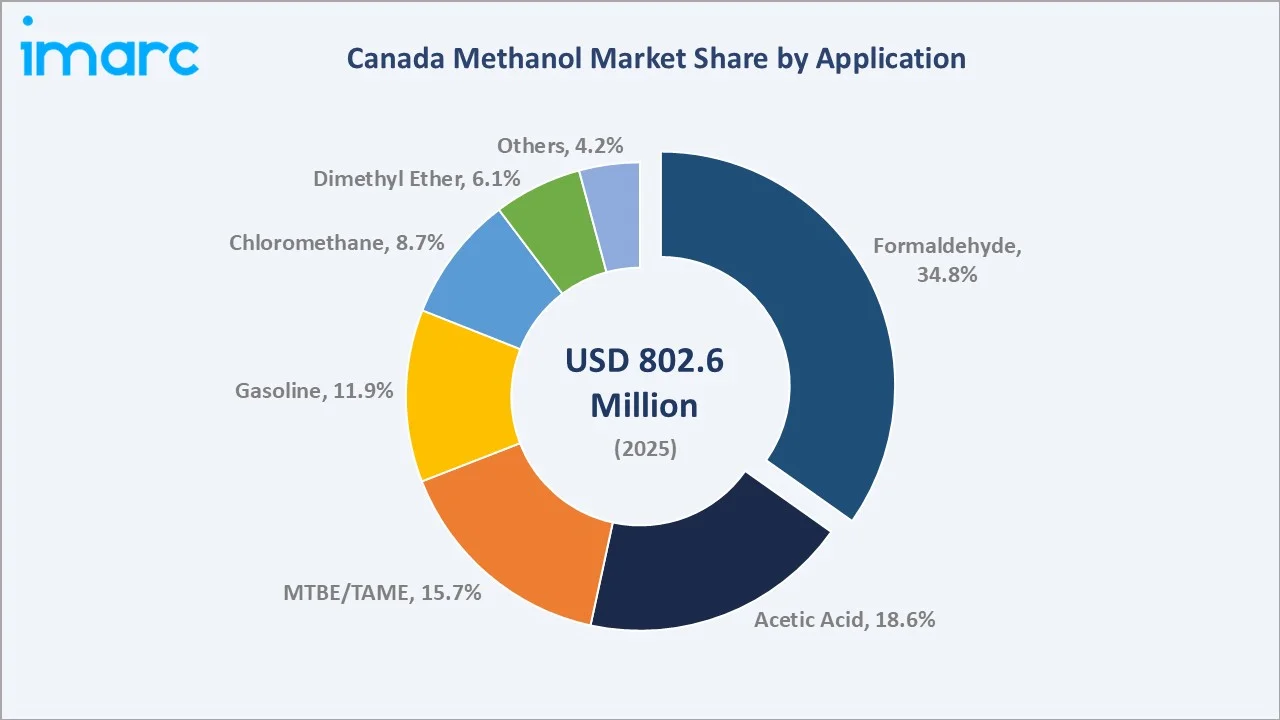
Formaldehyde leads the application segment at 34.8% and Ontario commands 36.9% of the regional market share in 2025.
Market Snapshot
|
Metric |
Value |
|
Base Year Market Size (2025) |
USD 802.6 Million |
|
Market Size (2026) |
USD 852.4 Million |
|
Forecast Market Size (2034) |
USD 1,244.1 Million |
|
CAGR (2026-2034) |
4.84% |
|
Base Year |
2025 |
|
Historical Period |
2020-2025 |
|
Forecast Period |
2026-2034 |
|
Largest Region |
Ontario (36.9%, 2025) |
|
Second Largest Region |
Quebec (24.3%, 2025) |
|
Leading Application |
Formaldehyde (34.8%, 2025) |
The Canada methanol market expanded from USD 633.7 Million in 2020 to USD 802.6 Million in 2025 and an estimated USD 852.4 Million in 2026, supported by consistent demand from the chemical derivatives sector, growing formaldehyde capacity for wood-products and resins, and increasing interest in methanol blending under clean fuel mandates. Anchored at USD 1016.6 Million in 2030, the forecast to USD 1,244.1 Million by 2034 is underpinned by accelerating adoption of methanol as a marine fuel, expansion of bio-methanol and e-methanol production, and rising export opportunities to international markets.
To get more information on this market, Request Sample
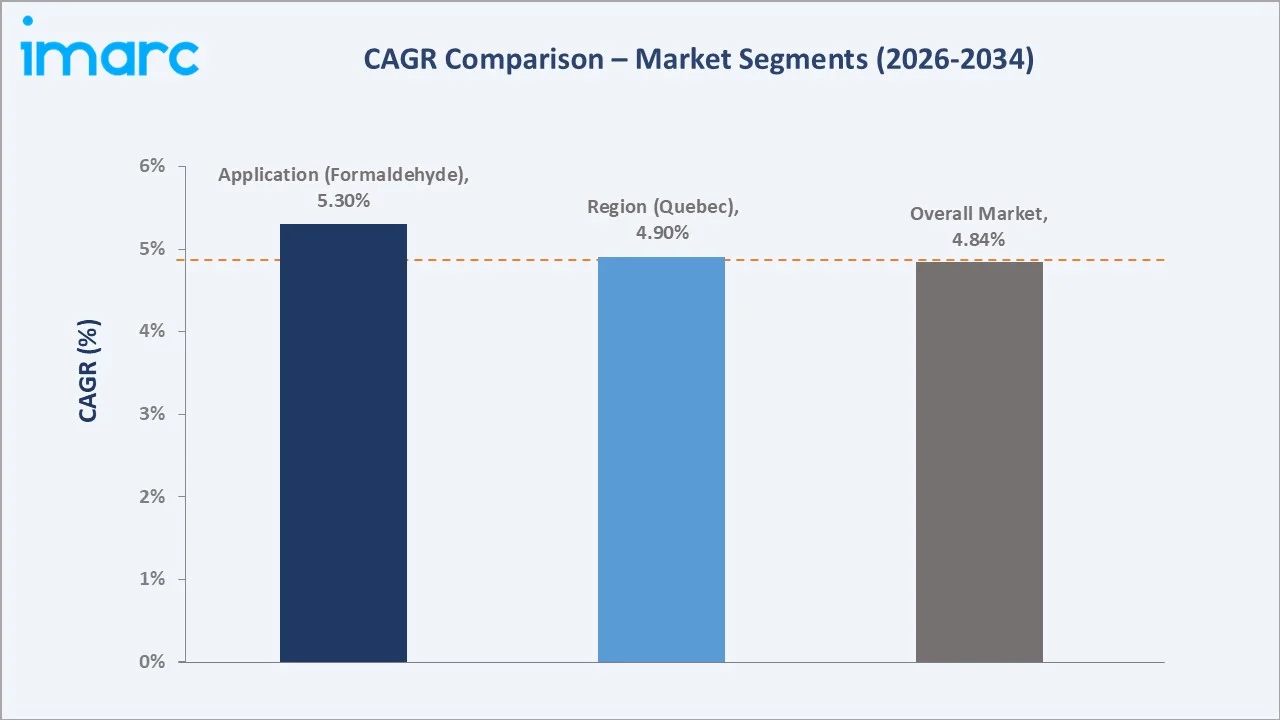
CAGR trajectories across application sub-segments show dimethyl ether and MTBE/TAME growing faster than the overall 4.84% market CAGR, driven by expanding clean fuel adoption, rising automotive blending mandates, and growing interest in methanol-to-chemicals pathways across Canadian industrial sectors.
Executive Summary
The Canada methanol market is on a sustained growth trajectory, rising from USD 633.7 Million in 2020 to an estimated USD 852.4 Million in 2026 and is projected to reach USD 1,244.1 Million by 2034. The market has evolved from a commodity-chemical supply model to a diversified platform spanning chemical derivatives, clean fuel blending, and emerging green methanol applications.
Formaldehyde commands the dominant application share at 34.8% in 2025, driven by robust demand from construction, wood-composites, and resin manufacturing. Ontario leads the regional breakdown at 36.9% in 2025, anchored by its dense concentration of chemical processing facilities and downstream end-use industries.
Key Market Insights
|
Insight |
Data |
|
Leading Application |
Formaldehyde – 34.8% share (2025) |
|
Second Largest Application |
Acetic Acid – 18.6% share (2025) |
|
Leading Region |
Ontario – 36.9% share (2025) |
|
Second Largest Region |
Quebec – 24.3% share (2025) |
|
Top Companies |
Methanex Corporation, Celanese Corporation, Proman |
Key Analytical Observations Expanding On The Data Above:
- Formaldehyde leadership at 34.8% is underpinned by Canada's large wood-products, resins, and construction chemicals sector, where formaldehyde-based adhesives and binders are essential inputs. Demand is closely tied to residential and commercial construction activities. As per IMARC Group, the Canada construction market size was valued at USD 280.30 Billion in 2025.
- Acetic acid at 18.6% serves as a key intermediate for vinyl acetate monomer, purified terephthalic acid, and acetate ester solvents. Growth is supported by Canada's expanding plastics and coatings industries and by acetic acid export demand from United States-based chemical manufacturers.
- Ontario at 36.9% dominates regional consumption, driven by its dense chemical processing cluster, proximity to major end-use industries, and well-developed logistics and distribution infrastructure across the Greater Toronto and Hamilton corridor.
Canada Methanol Market Overview
Methanol is a versatile primary chemical produced predominantly from natural gas through steam methane reforming, serving as a fundamental feedstock for formaldehyde, acetic acid, MTBE, dimethyl ether (DME), chloromethanes, and a wide range of chemical derivatives. In Canada, the methanol market spans production, distribution, storage, chemical derivatives manufacturing, fuel blending, and export supply chains, supported by one of the most abundant natural gas resource bases in the world.
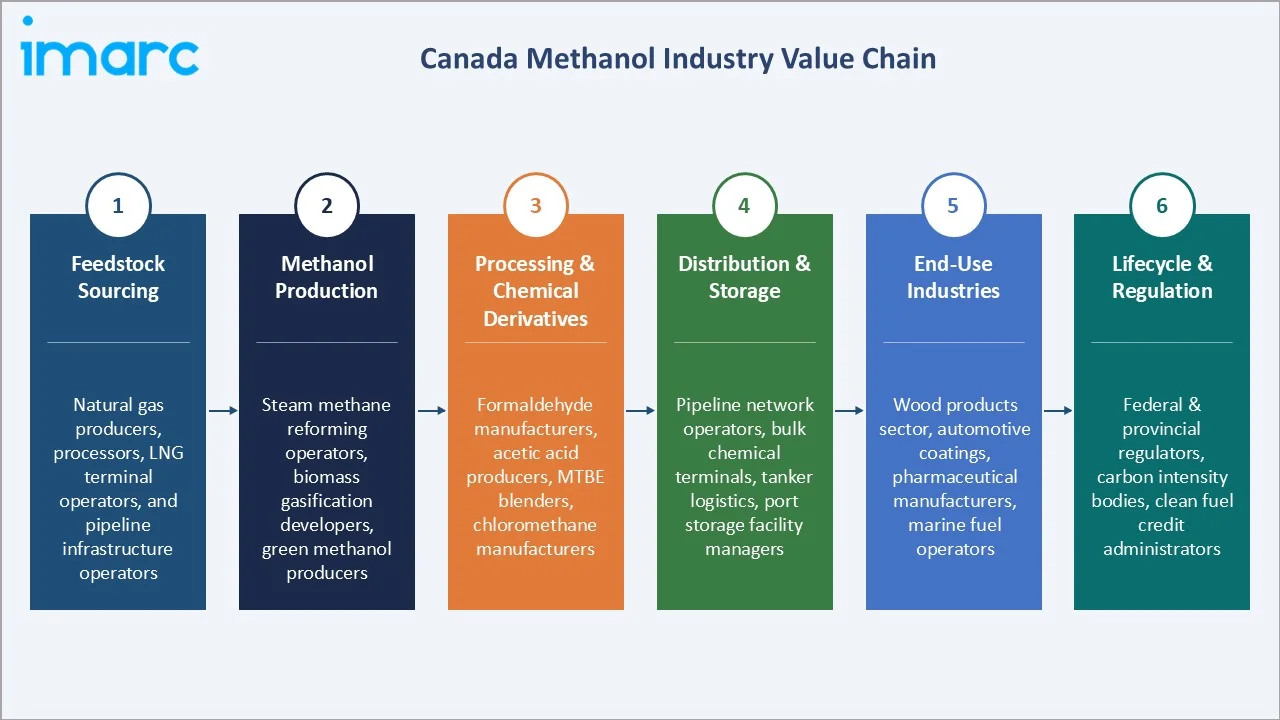
The ecosystem integrates natural gas producers and processors, methanol manufacturers, chemical derivatives producers, pipeline and logistics operators, downstream industrial consumers, regulatory bodies at federal and provincial levels, and emerging green methanol technology developers. Together, these participants form a well-integrated value chain capable of serving both domestic demand and international export requirements across chemical, energy, and specialty applications.
Market Dynamics
To evaluate market opportunities, Request Sample
Market Drivers
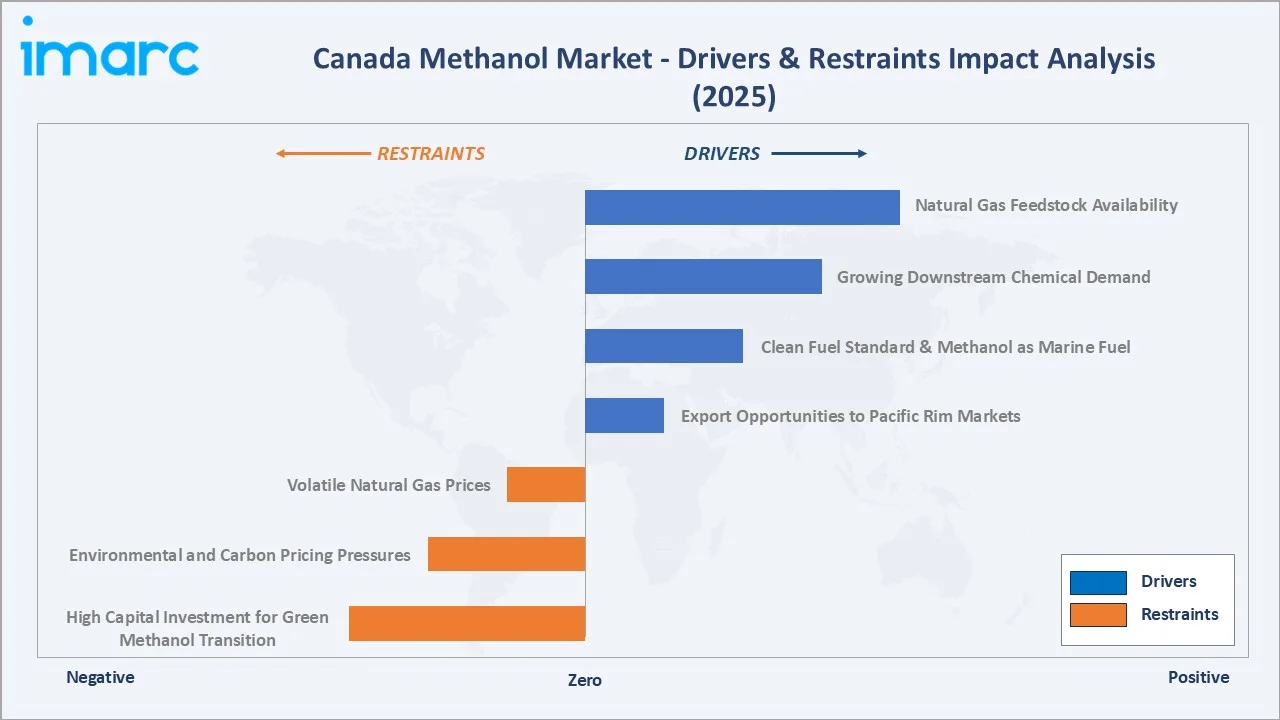
- Natural Gas Feedstock Availability: Canada's vast natural gas reserves in Alberta and British Columbia provide methanol producers with a reliable, cost-competitive feedstock base. Access to low-cost natural gas through extensive pipeline infrastructure supports continuous production at globally competitive economics.
- Growing Downstream Chemical Demand: Expanding formaldehyde, acetic acid, and chloromethane production across Canada's chemical industry is sustaining robust methanol consumption. Rising demand from wood-products, automotive coatings, plastics, and pharmaceutical applications is directly translating into increased methanol offtake across Ontario's and Quebec's industrial clusters.
- Clean Fuel Standard and Methanol as a Marine Fuel: Canada's Clean Fuel Standard mandates a reduction in the lifecycle carbon intensity of liquid fuels like gasoline and diesel by 14 grams CO₂e/MJ by 2030, directly stimulating demand for methanol-derived low-carbon blendstocks and positioning methanol as a viable transition fuel for the marine and heavy transport sectors.
- Export Opportunities to Pacific Rim Markets: Canada's Pacific coastline provides strategic access to high-demand methanol markets in Japan, South Korea, and China. Growing Asian demand for methanol-to-olefins, methanol-to-power, and marine fuel applications is creating incremental export pull for Canadian producers with port access through British Columbia.
Market Restraints
- Volatile Natural Gas Prices: Methanol production economics are closely tied to natural gas input costs, which are subject to commodity price volatility driven by weather events, export demand, and pipeline capacity constraints. Significant feedstock cost fluctuations compress producer margins and can delay capacity investment decisions.
- Environmental and Carbon Pricing Pressures: Tightening emissions regulations and carbon management requirements are increasing compliance costs for conventional methanol production facilities. Producers are facing growing pressure to invest in cleaner production technologies, improve energy efficiency, and reduce greenhouse gas emissions to remain competitive in an evolving regulatory environment.
- High Capital Investment for Green Methanol Transition: Transitioning from conventional to green or bio-methanol production requires significant capital investment in electrolysis, carbon capture, biomass processing, and plant integration. The high upfront costs and long payback periods create barriers for mid-sized producers without access to concessional financing or long-term offtake agreements.
Market Opportunities
- Methanol-to-Chemicals Capacity Expansion: Rising global demand for methanol-to-olefins and methanol-to-aromatics intermediates creates an opportunity for Canadian producers to supply high-value chemical feedstocks to international manufacturers, diversifying revenue streams beyond traditional formaldehyde and acetic acid markets.
- Indigenous and Remote Community Energy Access: Methanol's suitability as a clean cooking and heating fuel for remote and Indigenous communities not connected to natural gas grids represents an emerging domestic market supported by federal and provincial energy access programs.
Market Challenges
- Global Methanol Oversupply Risks: Large-scale capacity additions in the Middle East, China, and the United States are periodically creating oversupply conditions that suppress international methanol prices, limiting Canadian producers' export pricing power and margin expansion opportunities.
- Regulatory Complexity Across Provinces: Varying provincial regulations governing fuel additives, chemical handling, environmental emissions, and Indigenous consultation requirements create compliance complexity for producers and distributors operating across multiple Canadian provinces.
Emerging Market Trends
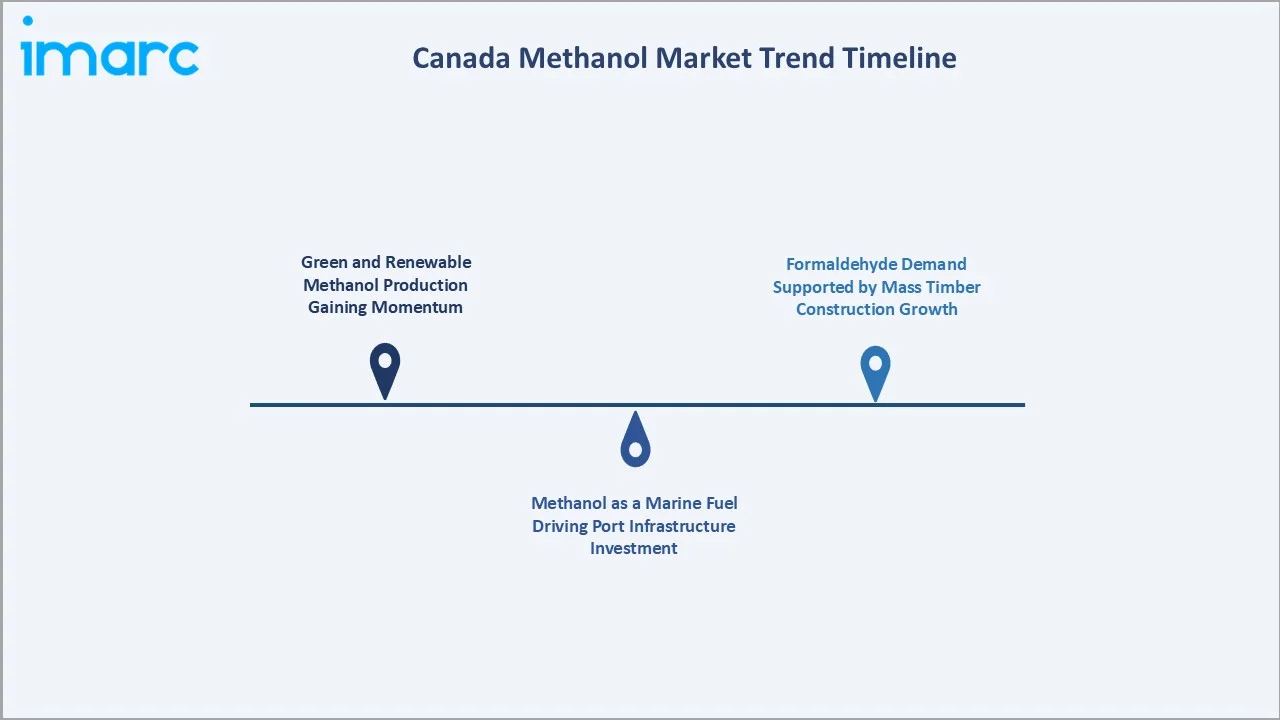
1. Green and Renewable Methanol Production Gaining Momentum
Canadian producers and technology developers are actively investing in green methanol pathways, combining renewable electricity with carbon dioxide capture or biomass gasification to produce net-low or net-zero carbon methanol. Federal clean investment incentives and long-term marine fuel offtake agreements are accelerating project development in Alberta and British Columbia, positioning Canada as a future supplier of certified green methanol to Pacific Rim shipping lines.
2. Methanol as a Marine Fuel Driving Port Infrastructure Investment
The adoption of methanol as a marine fuel is reshaping port infrastructure requirements across Canada's Pacific and Atlantic terminals. Shipping companies operating methanol-compatible dual-fuel vessels are working with port authorities to establish bunkering facilities, storage tanks, and safety protocols. This transition is creating structured, long-term demand for methanol volumes from Canadian producers with coastal access, particularly in British Columbia's port cluster.
3. Formaldehyde Demand Supported by Mass Timber Construction Growth
Canada's growing adoption of mass timber and engineered wood products in commercial and mid-rise residential construction is sustaining robust demand for formaldehyde-based adhesive resins. Provincial green building codes, particularly in British Columbia and Ontario, are promoting greater use of sustainably certified wood-composite materials, which rely heavily on urea-formaldehyde and phenol-formaldehyde resins, directly supporting domestic methanol demand through the formaldehyde segment.
Industry Value Chain Analysis
The Canada methanol value chain spans six integrated stages from feedstock sourcing through lifecycle and regulatory compliance. Methanol production, chemical processing, and clean fuel blending capture the highest value-add, while feedstock access and logistics competitiveness form the core structural advantages for Canadian market participants.
|
Stage |
Key Players / Examples |
|
Feedstock Sourcing |
Natural gas producers, natural gas processors, LNG terminal operators, and pipeline infrastructure operators supplying methane feedstock to methanol production facilities |
|
Methanol Production |
Steam methane reforming plant operators, biomass gasification project developers, electrolytic green methanol producers, and integrated natural gas-to-methanol conversion facilities |
|
Processing & Chemical Derivatives |
Formaldehyde and resin manufacturers, acetic acid and vinyl acetate producers, MTBE blenders, chloromethane manufacturers, and dimethyl ether synthesis facilities |
|
Distribution & Storage |
Pipeline network operators, bulk chemical terminal operators, tanker logistics providers, port storage facility managers, and domestic road and rail methanol distributors |
|
End-Use Industries |
Wood products and resins sector, automotive and coatings industry, pharmaceutical manufacturers, marine fuel operators, and export customers in Pacific Rim markets |
|
Lifecycle & Regulation |
Federal and provincial regulators, carbon intensity certification bodies, clean fuel credit administrators, environmental compliance specialists, and sustainability auditors |
Vertically integrated producers with proprietary feedstock access, owned distribution infrastructure, and long-term offtake agreements with downstream chemical and fuel customers are best positioned to sustain competitive margins through commodity price cycles.
Technology Landscape in the Canada Methanol Industry
Steam Methane Reforming and Process Optimization
Steam methane reforming remains the dominant production technology for Canadian methanol manufacturers, with ongoing investments in catalyst efficiency, heat recovery, and energy integration reducing production costs and emission intensities. Advanced process control systems and digital twin implementations are enabling real-time optimization of conversion rates and feedstock utilization across large-scale production facilities.
Green Hydrogen and Power-to-Methanol Pathways
Electrolytic green hydrogen, combined with captured carbon dioxide from industrial flue gases or direct air capture, is enabling the production of e-methanol with near-zero lifecycle carbon intensity. Canadian projects leveraging low-cost hydroelectric power in Quebec and British Columbia are evaluating power-to-methanol conversion as a grid-balancing and energy storage mechanism alongside dedicated methanol production.
Biomass Gasification and Waste-to-Methanol
Canada's abundant forestry residues, agricultural waste streams, and municipal solid waste are being evaluated as feedstocks for bio-methanol production through thermochemical gasification. Growing interest in circular economy initiatives and low-carbon fuels is encouraging investment in technologies that convert waste materials into value-added methanol products.
Market Segmentation Analysis
The report covers the following segments:
|
Segment Category |
Leading Segment |
Market Share |
Year |
|
Application |
Formaldehyde |
34.8% |
2025 |
|
Region |
Ontario |
36.9% |
2025 |

By Application
Formaldehyde commands a dominant 34.8% majority share in 2025, driven by robust demand from Canada's construction materials, engineered wood products, resins, and adhesives industries. The segment benefits from stable long-term demand tied to housing construction activity, commercial renovation, and mass timber building code adoption across Canadian provinces.
To access detailed market analysis, Request Sample
Acetic acid at 18.6% in 2025 covers methanol-derived production of vinyl acetate monomer, purified terephthalic acid, and acetate solvents for coatings, adhesives, and packaging applications.
Regional Market Insights
|
Region |
Share (2025) |
Key Growth Drivers |
|
Ontario |
36.9% |
Large chemical manufacturing base, strong construction activity, well-developed logistics infrastructure, and high formaldehyde and acetic acid consumption from industrial clusters |
|
Quebec |
24.3% |
Abundant hydroelectric power supporting green methanol potential, established chemical processing facilities, and growing mass timber construction |
|
Alberta |
18.4% |
Proximity to natural gas feedstock, active carbon capture investment, petrochemical cluster development, and provincial support for clean energy transition in the energy sector |
|
British Columbia |
12.1% |
Strategic Pacific port access for export, growing marine fuel bunkering infrastructure, bio-methanol production potential from forestry residues, and clean fuel regulatory alignment |
|
Others |
8.3% |
Emerging industrial demand, growing energy access programs for remote communities, provincial economic diversification initiatives, and expanding clean fuel distribution networks |
Ontario at 36.9% in 2025 leads the regional landscape, anchored by its dense chemical processing cluster, large downstream formaldehyde and acetic acid consumers, and well-connected road, rail, and pipeline logistics infrastructure supporting efficient methanol distribution across the province.
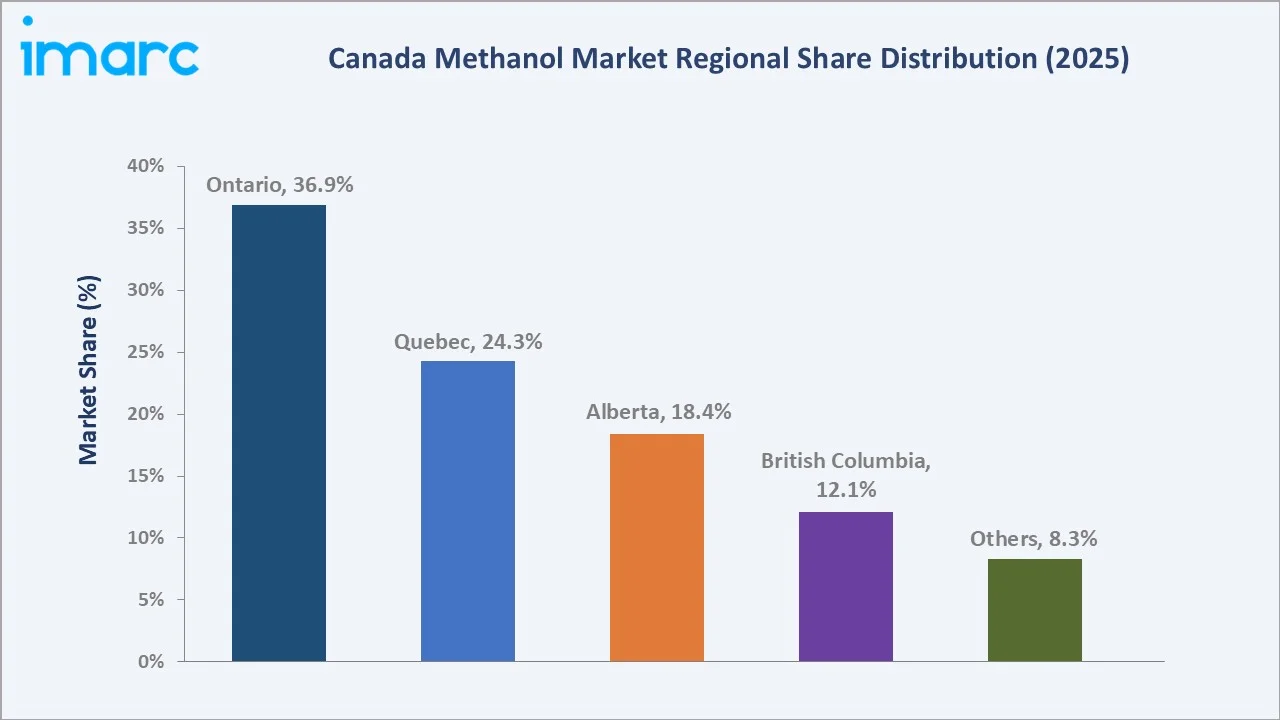
Quebec at 24.3% is the second largest region, supported by its strong industrial manufacturing base, growing chemical processing activity, and access to well-developed transportation and export infrastructure.
Competitive Landscape
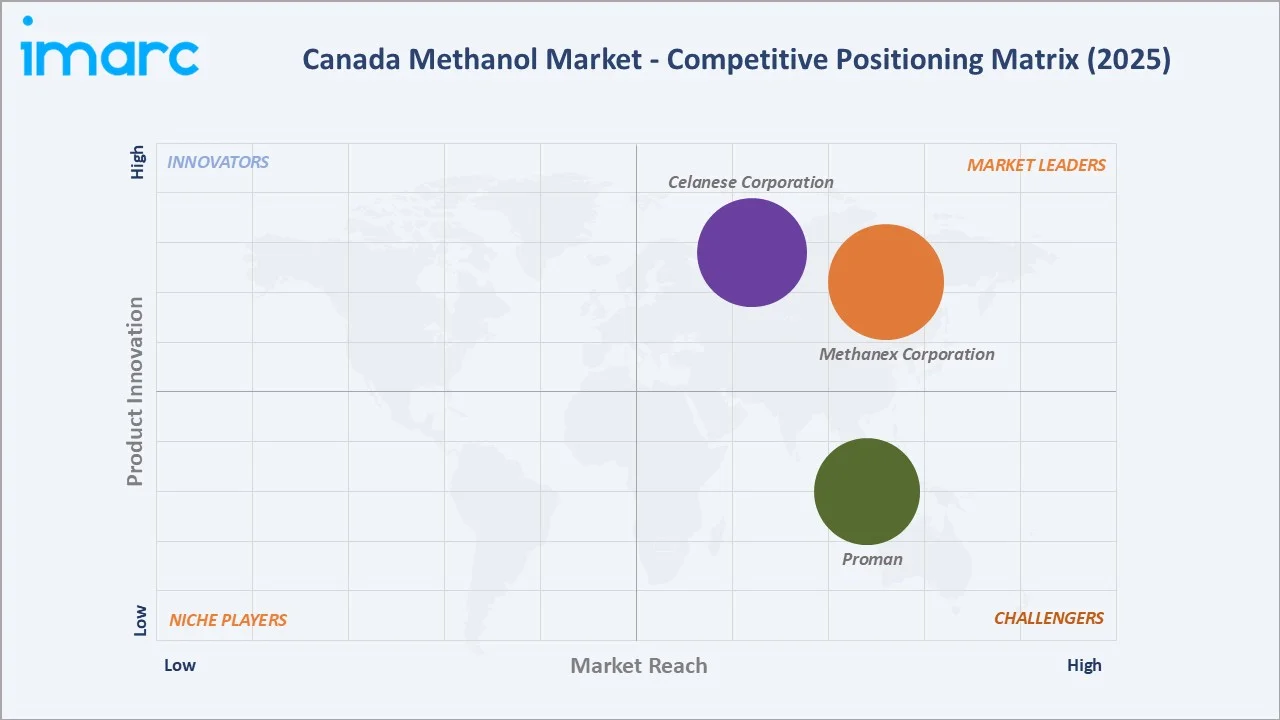
The Canada methanol market is moderately concentrated, with large integrated producers dominating output capacity while specialized green methanol developers and chemical derivatives manufacturers compete on product differentiation and sustainability credentials. Feedstock access, production scale, logistics infrastructure, and clean fuel certification are the primary competitive moats in the current market environment.
|
Company Name |
Brand / Key Product |
Position |
Strategic Focus |
|
Methanex Corporation |
Methanol |
Leader |
Global methanol production and distribution with integrated logistics and offtake networks |
|
Celanese Corporation |
Low Carbon CCU Methanol |
Leader |
Integrated methanol-to-acetyls production with North American focus and clean supply chain strategy |
|
Proman |
Methanol |
Challenger |
Large-scale methanol production and North American supply with a focus on marine fuel transition and green methanol development |
Key players include Methanex Corporation, Celanese Corporation, and Proman, among others.
Key Company Profiles
Methanex Corporation
Methanex Corporation is a Vancouver, British Columbia-based company and the world's leading producer and supplier of methanol. The company operates an integrated global production and distribution network, serving customers across the energy, chemical, transportation, and industrial end-use sectors.
- Product Portfolio: Methanol produced via natural gas-based steam methane reforming across a global multi-plant network, supplying chemical derivatives manufacturers, formaldehyde and acetic acid producers, MTBE blenders, and energy sector customers across North America and international markets through an integrated logistics and distribution infrastructure.
- Recent Developments: The company has continued to strengthen its global methanol supply network, enhance operational efficiency across production facilities, and support the growing adoption of methanol in chemical manufacturing and emerging fuel applications.
- Strategic Focus: Sustaining competitive natural-gas-based methanol production globally, expanding marine fuel methanol supply, advancing low-carbon methanol certification, and optimizing its integrated global asset base and supply chain to serve growing chemical and clean fuel demand.
Celanese Corporation
Celanese Corporation is a global chemical and specialty materials company headquartered in Irving, Texas, and a leading consumer of methanol as a feedstock for its integrated acetyls value chain.
- Product Portfolio: Low Carbon CCU Methanol, along with methanol-derived acetic acid, vinyl acetate monomer, emulsion polymers, and specialty acetyls products serving coatings, adhesives, packaging, and pharmaceutical markets across North America and globally.
- Recent Developments: The company has continued to expand its portfolio of low-carbon and sustainable chemical solutions, strengthen feedstock integration strategies, and invest in initiatives that support emissions reduction and resource efficiency across its acetyls value chain.
- Strategic Focus: Advancing low-carbon methanol supply and expanding specialty chemical offerings to serve high-growth end markets including electric vehicles, sustainable packaging, and clean chemistry applications.
Proman
Proman is a Switzerland-headquartered integrated energy company with significant operations across methanol production, marketing, logistics, and downstream value-added chemical products.
- Product Portfolio: Methanol produced from natural gas.
- Recent Developments: Proman continues to develop its methanol and marine fuel supply network, expanding its methanol bunkering capabilities and advancing the use of methanol as a marine fuel in partnership with major shipping companies.
- Strategic Focus: Large-scale methanol production and North American supply with a focus on marine fuel transition and green methanol development, leveraging an integrated value chain from production through logistics to serve chemical, industrial, and energy transition customers globally.
Market Concentration Analysis
The Canada methanol market is moderately concentrated. The broader market includes significant participation from international methanol traders and distributors, chemical derivatives producers consuming methanol as a feedstock, and clean technology companies developing green and e-methanol pathways for future Canadian production.
Barriers to entry in Canadian methanol production include the high capital cost of steam methane reforming plants, the need for long-term natural gas supply agreements, regulatory approvals for large industrial facilities, and the growing requirement for carbon intensity certification under clean fuel standards. These factors favor well-capitalized incumbents and specialized green technology developers with access to renewable electricity or waste feedstocks.
Consolidation trends are emerging in the green methanol segment, as traditional methanol producers acquire or partner with green methanol technology developers to build certified low-carbon supply chains. Strategic partnerships between chemical companies, technology providers, and energy companies are reshaping competitive positioning in anticipation of tightening carbon intensity requirements through 2034.
Investment & Growth Opportunities
Fastest-Growing Segments
Dimethyl ether is the fastest-growing application segment, driven by its suitability as a clean LPG substitute, diesel blendstock, and clean cooking fuel for remote communities not served by natural gas distribution networks. MTBE/TAME is also experiencing growth as clean fuel blending mandates expand the oxygenate requirements for Canadian gasoline pools.
Emerging Markets
Alberta is the fastest-growing region, driven by active petrochemical cluster investment, proximity to natural gas feedstock, and provincial support for carbon capture and clean energy transition. British Columbia represents a significant emerging market for methanol marine fuel bunkering and green methanol export infrastructure development through its Pacific port cluster.
Venture & Investment Trends
Investment is flowing into green and bio-methanol production technology, carbon capture integration for existing methanol plants, and marine fuel methanol distribution infrastructure. Federal and provincial clean technology investment incentives are mobilizing private capital toward low-carbon methanol projects with certified emission reduction credentials.
Future Market Outlook (2026-2034)
The Canada methanol market expand from USD 802.6 Million in 2025 to an estimated USD 852.4 Million in 2026 and further to reach USD 1,244.1 Million by 2034, at a CAGR of 4.84%, adding approximately USD 441.5 Million in incremental market value over the forecast period.
Four structural forces will shape the market through 2034: the deepening integration of methanol into Canada's clean fuel regulatory framework; the accelerating transition toward green and bio-methanol production pathways; the emergence of methanol as a marine fuel bunkering product at Canadian Pacific ports; and expanding downstream chemical derivatives demand tied to construction, automotive, and specialty materials growth.
By 2034, the Canada methanol market is expected to be defined by a dual-track structure: established conventional natural-gas-based production serving stable chemical derivatives demand, alongside a rapidly growing green methanol segment serving marine fuel, transportation blending, and premium low-carbon chemical feedstock markets. Federal carbon pricing trajectories, clean fuel credit economics, and international marine fuel adoption rates will be the key variables determining the pace of this structural transition through the forecast period.
Research Methodology
Primary Research
Primary research included structured interviews with methanol plant operators, natural gas processors, chemical derivatives manufacturers, clean fuel technology developers, provincial and federal regulatory specialists, and port and logistics infrastructure operators, validating market sizing, application segment shares, regional demand patterns, and clean fuel transition timelines.
Secondary Research
Secondary sources included Natural Resources Canada energy statistics, Environment and Climate Change Canada Clean Fuel Regulations documentation, Statistics Canada industrial production data, Alberta Petrochemicals Incentive Program filings, Canadian Chemical Producers' Association industry data, Methanol Institute market reports, and annual reports and investor presentations from major methanol producers and derivatives manufacturers.
Forecasting Models
Market forecasts were developed using top-down and bottom-up models combining natural gas production trajectories, methanol plant capacity utilization rates, downstream application demand modeling, clean fuel regulatory scenario analysis, and macroeconomic growth variables for Canada's construction, automotive, and chemical manufacturing sectors.
Canada Methanol Market Report Coverage:
| Report Features | Details |
|---|---|
| Base Year of the Analysis | 2025 |
| Historical Period | 2020-2025 |
| Forecast Period | 2026-2034 |
| Units | Million USD |
| Scope of the Report | Exploration of Historical Trends and Market Outlook, Industry Catalysts and Challenges, Segment-Wise Historical and Future Market Assessment:
|
| Applications Covered | Formaldehyde, Dimethyl Ether, Gasoline, Chloromethane, MTBE/TAME, Acetic Acid, Others |
| Regions Covered | Ontario, Quebec, Alberta, British Columbia, Others |
| Companies Covered | Methanex Corporation, Celanese Corporation, Proman, etc. |
| Customization Scope | 10% Free Customization |
| Post-Sale Analyst Support | 10-12 Weeks |
| Delivery Format | PDF and Excel through Email (We can also provide the editable version of the report in PPT/Word format on special request) |
Key Benefits for Stakeholders:
- IMARC’s industry report offers a comprehensive quantitative analysis of various market segments, historical and current market trends, market forecasts, and dynamics of the Canada methanol market from 2020-2034.
- The research report provides the latest information on the market drivers, challenges, and opportunities in the Canada methanol market.
- Porter's five forces analysis assist stakeholders in assessing the impact of new entrants, competitive rivalry, supplier power, buyer power, and the threat of substitution. It helps stakeholders to analyze the level of competition within the Canada methanol industry and its attractiveness.
- A competitive landscape allows stakeholders to understand their competitive environment and provides an insight into the current positions of key players in the market.
Frequently Asked Questions About the Canada Methanol Market Report
The Canada methanol market size is estimated at USD 852.4 Million in 2026, driven by formaldehyde production demand, acetic acid derivatives, and growing interest in methanol as a clean transportation and marine fuel.
The market is projected to grow at a CAGR of 4.84% from 2026 to 2034, reaching USD 1,244.1 Million, supported by clean fuel regulations, green methanol adoption, and expanding downstream chemical demand.
Formaldehyde leads at 34.8% in 2025, driven by demand from construction materials, engineered wood products, resins, and adhesives manufacturing across Ontario and Quebec.
Ontario leads at 36.9% in 2025, anchored by its dense chemical processing cluster, large formaldehyde and acetic acid consumers, and well-developed logistics infrastructure.
Leading players include Methanex Corporation, Celanese Corporation, and Proman, among others.
Green methanol is produced using renewable electricity and captured carbon dioxide or biomass feedstocks, achieving significantly lower lifecycle carbon intensity. Canada's clean fuel regulations and federal investment incentives are accelerating green methanol project development in Alberta and British Columbia.
Methanol is increasingly being adopted as a lower-emission marine fuel in Canada, supported by growing interest in cleaner shipping solutions and decarbonization initiatives within the maritime sector. Its use is encouraging investment in fuel supply infrastructure and supporting the transition toward more sustainable marine transportation.
Key challenges include natural gas price volatility, the high capital cost of green methanol transition, global methanol oversupply risk, and complex provincial regulatory environments affecting production and distribution operations.
Need more help?
- Speak to our experienced analysts for insights on the current market scenarios.
- Include additional segments and countries to customize the report as per your requirement.
- Gain an unparalleled competitive advantage in your domain by understanding how to utilize the report and positively impacting your operations and revenue.
- For further assistance, please connect with our analysts.
 Request Customization
 Speak to an Analyst
 Request Brochure
 Inquire Before Buying
Benefits of Customization
- Personalize this research
- Triangulate with your data
- Get data as per your format and definition
- Gain a deeper dive into a specific application, geography, customer, or competitor
- Any level of personalization
Get in Touch With Us
UNITED STATES
Phone: +1-201-971-6302
INDIA
Phone: +91-120-433-0800
UNITED KINGDOM
Phone: +44-753-714-6104
Email: [email protected]
Client Testimonials




.webp)




.webp)













Related Reports

Choose your plan
*Please note that the prices mentioned below are starting prices for each bundle type. Kindly contact our team for further details.*
Single User License
- 1 User License, Access on 2 Devices
- PDF Report + Excel Dataset (Password Protected)
- Lifetime Access
- No Printing Rights
- 10% Free Report Customization
- 10–12 Weeks of Analyst Support
Five User License
- Access for 5 Users, 2 Devices per User
- PDF Report + Excel Dataset (Password Protected)
- Lifetime Access
- Dedicated Account Manager
- 12–14 Weeks of Analyst Support
- No Printing Rights
- 15% Free Report Customization
- 25% Discount on Your Next Purchase
Corporate User License
- Unlimited User Access (Within Your Organization)
- PDF Report + Excel Dataset
- Lifetime Access
- Dedicated Account Manager
- 14–20 Weeks of Analyst Support
- No Printing Rights
- 20% Free Report Customization
- 30% Discount on Your Next Purchase
Essential Insights
What's included:
3 reports
- Lifetime Access
- PDF Reports
- Excel Datasets
- 2 Weeks of Free Analyst Support
- 2 User Licenses
- Access on 2 Devices
- Printing Rights
- Complimentary PowerPoint (PPT) Version
- Complimentary License Upgrade
Professional Access
What's included:
5 reports
- Lifetime Access
- PDF Reports
- Excel Datasets
- 8 Weeks of Free Analyst Support
- 2 User Licenses
- Access on 2 Devices
- Printing Rights
- Complimentary PowerPoint (PPT) Version
- Complimentary License Upgrade
Business Advantage
What's included:
8 reports
- Lifetime Access
- PDF Reports
- Excel Datasets
- 14 Weeks of Free Analyst Support
- 2 User Licenses
- Access on 2 Devices
- Printing Rights
- Complimentary PowerPoint (PPT) Version
- Complimentary License Upgrade
Enterprise Intelligence
What's included:
10 reports
- Lifetime Access
- PDF Reports
- Excel Datasets
- 20 Weeks of Free Analyst Support
- 2 User Licenses
- Access on 2 Devices
- Printing Rights
- Complimentary PowerPoint (PPT) Version
- Complimentary License Upgrade