
Cloud System Management Market Size, Share, Trends and Forecast by Component, Deployment Model, Enterprise Size, End Use Industry, and Region, 2026-2034
Cloud System Management Market Size, Share, Trends & Forecast (2026-2034)
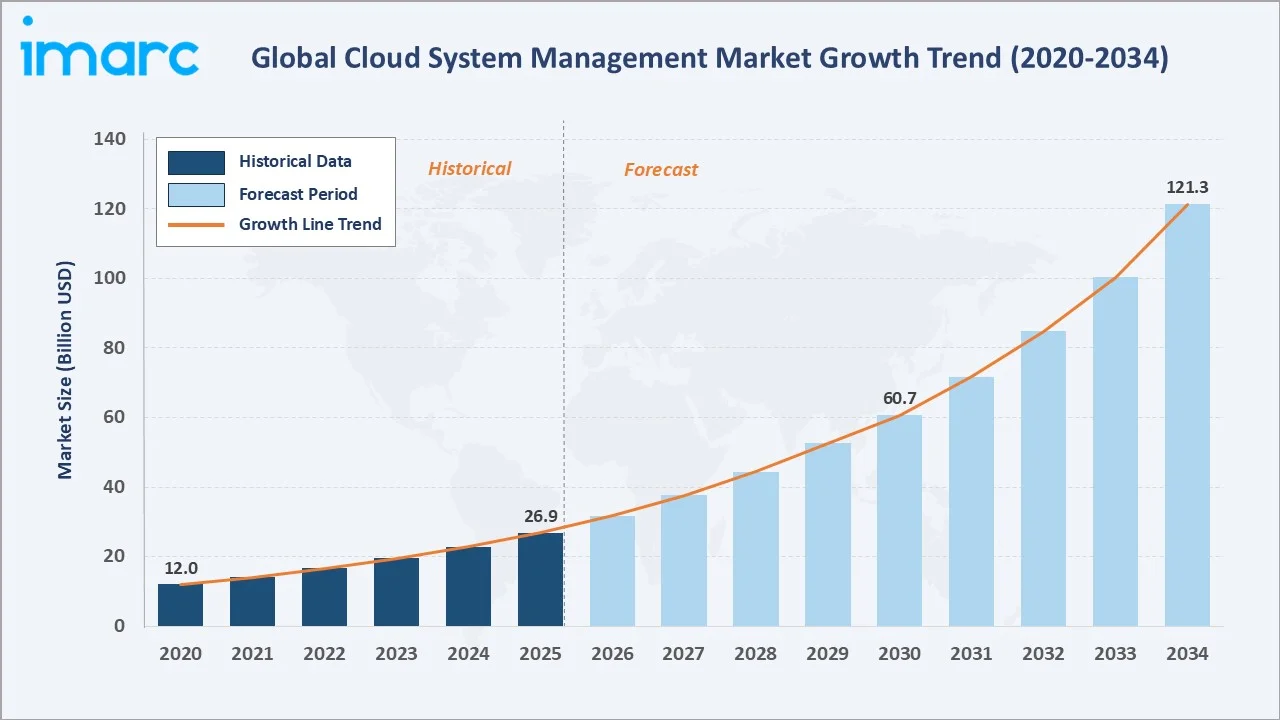
The global cloud system management market reached USD 26.9 Billion in 2025 and is projected to reach USD 121.3 Billion by 2034, growing at a CAGR of 17.65% during 2026-2034. The market is driven by accelerating enterprise cloud adoption, growing complexity of multi-cloud and hybrid cloud environments, and rising demand for AIOps and automated IT operations management. As of 2026, around 94% of enterprises globally use cloud services, while 72% of workloads were hosted in the cloud in 2025 and 66% of enterprises adopted hybrid cloud environments. This widespread cloud adoption is driving the market by increasing demand for centralized monitoring, workload optimization, automated resource management, security, and seamless management of complex hybrid and multi-cloud infrastructures. Large enterprises lead enterprise size at 67.4%. BFSI leads end-use industry at 28.6%. North America leads regionally at 38.2%.
Market Snapshot
|
Metric |
Value |
|
Market Size (2025) |
USD 26.9 Billion |
|
Forecast Market Size (2034) |
USD 121.3 Billion |
|
CAGR (2026-2034) |
17.65% |
|
Base Year |
2025 |
|
Historical Period |
2020-2025 |
|
Forecast Period |
2026-2034 |
|
Dominant Enterprise Size |
Large Enterprise (67.4%, 2025) |
|
Dominant End Use Industry |
BFSI (28.6%, 2025) |
|
Leading Region |
North America (38.2%, 2025) |
The global cloud system management market has demonstrated exceptionally strong growth, increasing from USD 12.0 Billion in 2020 to USD 26.9 Billion in 2025, reflecting accelerating enterprise cloud transformation across all major verticals. The market is projected to reach USD 60.7 Billion by 2030 and further grow to USD 121.3 Billion by 2034, supported by the adoption of AIOps, FinOps, and autonomous cloud operations platforms.
To get more information on this market, Request Sample
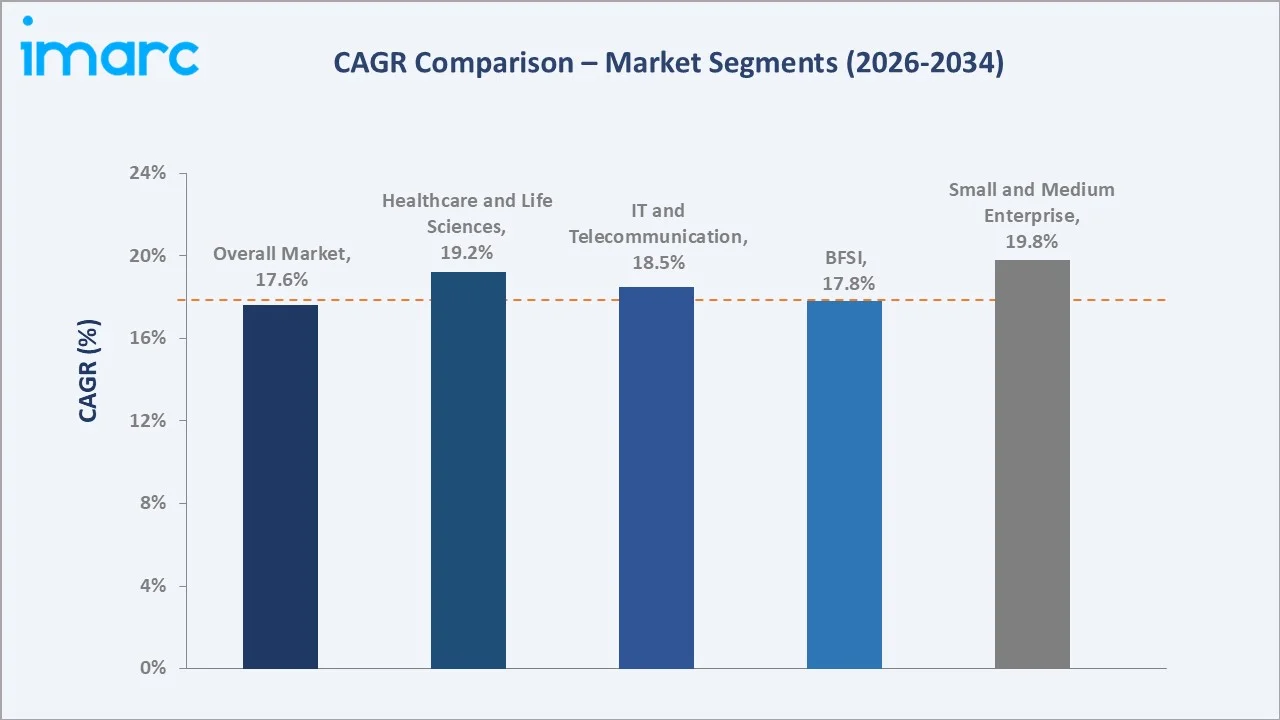
Healthcare & life sciences lead the segment CAGR at ~19.2% through cloud-driven clinical data management and digital health platform adoption. Small & medium enterprises grow at ~19.8% CAGR through accessible cloud management tooling. IT & telecommunications grow at ~18.5% CAGR through network function virtualization and cloud-native telecom architecture.
Executive Summary
The global cloud system management market is experiencing exceptional growth, supported by the rapid enterprise migration to cloud infrastructure, proliferation of multi-cloud and hybrid cloud architectures, and increasing adoption of AI-powered IT operations (AIOps) platforms. Growing enterprise requirements for unified cloud governance, cost optimization (FinOps), security posture management, and real-time observability across distributed cloud environments are strengthening demand for comprehensive cloud system management solutions.
Large enterprises lead at 67.4% through complex multi-cloud portfolio management requirements. BFSI leads at 28.6% end-use through regulatory compliance and cloud security governance mandates. North America leads regionally at 38.2%.
Key Market Insights
|
Insight |
Data |
|
Dominant Enterprise Size |
Large Enterprise – 67.4% share (2025) |
|
Leading End Use Industry |
BFSI – 28.6% market share (2025) |
|
Leading Region |
North America – 38.2% share (2025) |
|
Market Opportunity |
AIOps platform adoption; FinOps cost optimization tooling; cloud security posture management (CSPM); edge cloud management; multi-cloud governance and visibility platforms |
Key Analytical Observations Supporting the Above Data:
- Large Enterprise at 67.4%: Large enterprises dominate cloud system management adoption due to their complex, multi-cloud infrastructure spanning AWS, Azure, and GCP simultaneously. Managing workload performance, security compliance, cost allocation, and governance across hundreds of cloud accounts and thousands of services requires sophisticated management platforms that large enterprises can justify economically.
- BFSI at 28.6%: BFSI leads end-use industries due to the sector's intensive cloud adoption for core banking modernization, digital payments infrastructure, insurance claims processing, and capital markets analytics.
- North America at 38.2%: North America leads due to the concentration of cloud-first technology enterprises, the earliest adoption of hyperscaler cloud services, and the presence of the market's leading platform vendors.
Cloud System Management Market Overview
The global cloud system management market encompasses software solutions and professional services that enable enterprises to provision, monitor, optimize, govern, and secure their cloud infrastructure, platforms, and applications. It includes solutions for cloud performance monitoring, capacity planning, configuration management, cost optimization, security posture management (CSPM), compliance governance, and IT service management (ITSM) across public, private, and hybrid cloud environments.
The market serves enterprises across BFSI, healthcare, retail, IT, telecom, and government sectors, spanning deployment models including public cloud, private cloud, and hybrid cloud architectures. Growing adoption of Kubernetes container orchestration, serverless computing, and edge cloud infrastructure is expanding the scope and technical complexity of cloud system management, driving demand for increasingly sophisticated and AI-powered management platforms.
Market Dynamics
To evaluate market opportunities, Request Sample
Market Drivers
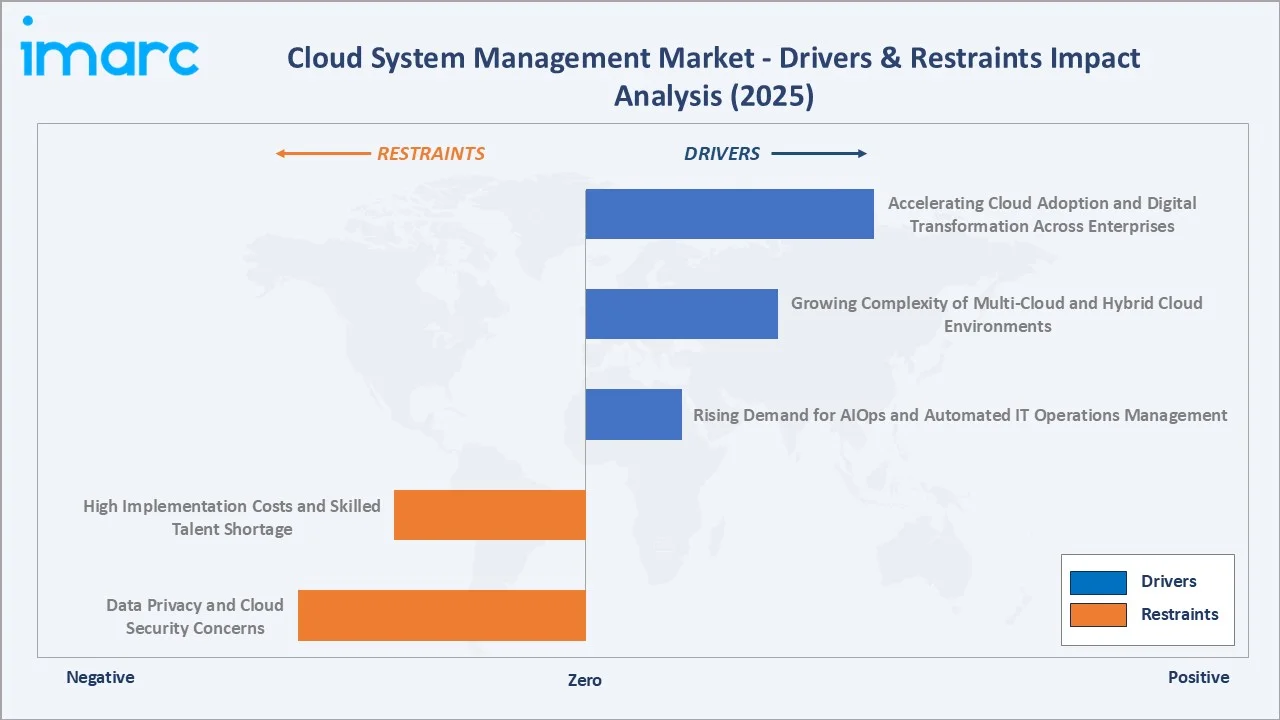
- Accelerating Cloud Adoption and Digital Transformation Across Enterprises: According to the World Intellectual Property Organization (WIPO), global software spending reached USD 675 billion in 2024, representing an increase of nearly 50% from USD 454 billion in 2020. The sharp rise in global software spending reflects enterprises’ increasing investment in cloud-based applications, digital platforms, automation, and modern IT infrastructure. This trend is accelerating cloud adoption and digital transformation, thereby increasing demand for cloud system management solutions to monitor, optimize, and secure expanding cloud environments.
- Growing Complexity of Multi-Cloud and Hybrid Cloud Environments: 94% of enterprises worldwide use cloud services as of 2026. Managing workload performance, security, compliance, and cost across multiple cloud providers with different APIs, pricing models, and governance frameworks has created a critical management complexity gap that specialized cloud system management platforms are uniquely positioned to address.
- Rising Demand for AIOps and Automated IT Operations Management: AI-powered IT operations (AIOps) platforms are transforming cloud management from manual, reactive processes to autonomous, predictive operations. Leading vendors are embedding machine learning models that automatically detect performance anomalies, predict capacity constraints, and trigger automated remediation workflows, significantly reducing mean time to resolution (MTTR) and operational overhead for large-scale cloud environments.
Market Restraints
- High Implementation Costs and Skilled Talent Shortage: Comprehensive cloud system management platform implementation requires significant upfront investment in licensing, integration, and professional services, creating cost barriers for mid-market enterprises. The global cloud skills shortage limits the speed at which enterprises can deploy and optimize cloud management solutions, constraining market penetration beyond large enterprise segments.
- Data Privacy and Cloud Security Concerns: Enterprises in regulated industries remain cautious about centralizing operational data, including security logs, configuration states, and performance metrics, within third-party cloud management platforms. Data sovereignty concerns, particularly in EU and Asia Pacific markets under local data localization regulations, create compliance complexity for cloud management platform providers seeking to aggregate multi-cloud operational data in centralized analytics platforms.
Market Opportunities
- FinOps and Cloud Cost Optimization Tooling: In April 2026, Apps Associates introduced Apps FinOps, a cloud financial management solution that provides organizations with real-time visibility and greater control over cloud expenditures. The platform is designed to help enterprises monitor and optimize costs across complex hybrid and multi-cloud environments. The growing FinOps discipline is driving strong demand for cloud cost intelligence, rightsizing recommendations, and commitment-based discount management tools across enterprises of all sizes.
- Edge Cloud and 5G Infrastructure Management: The proliferation of edge computing infrastructure, driven by 5G network buildout, IoT deployment, and real-time processing requirements, is creating a new frontier of cloud system management complexity. Managing distributed edge nodes, ensuring consistent security and compliance, and maintaining observability across thousands of geographically dispersed edge locations requires purpose-built edge cloud management capabilities that represent a significant growth opportunity.
Market Challenges
- Vendor Lock-In and Integration Complexity: Enterprises adopting proprietary cloud management platforms from hyperscaler vendors risk deep integration lock-in that limits multi-cloud portability. Integrating management data from multiple cloud providers, on-premises infrastructure, and SaaS applications into unified observability platforms requires significant engineering investment and ongoing maintenance.
- Rapid Technology Evolution Outpacing Management Capabilities: Cloud infrastructure technology is evolving faster than management platform capabilities, with new compute paradigms including serverless functions, WebAssembly, and specialized AI accelerator instances continuously expanding the management surface. Platform vendors must invest continuously in supporting new cloud services and infrastructure types, creating R&D intensity challenges that favor well-resourced incumbents over smaller market entrants.
Emerging Market Trends
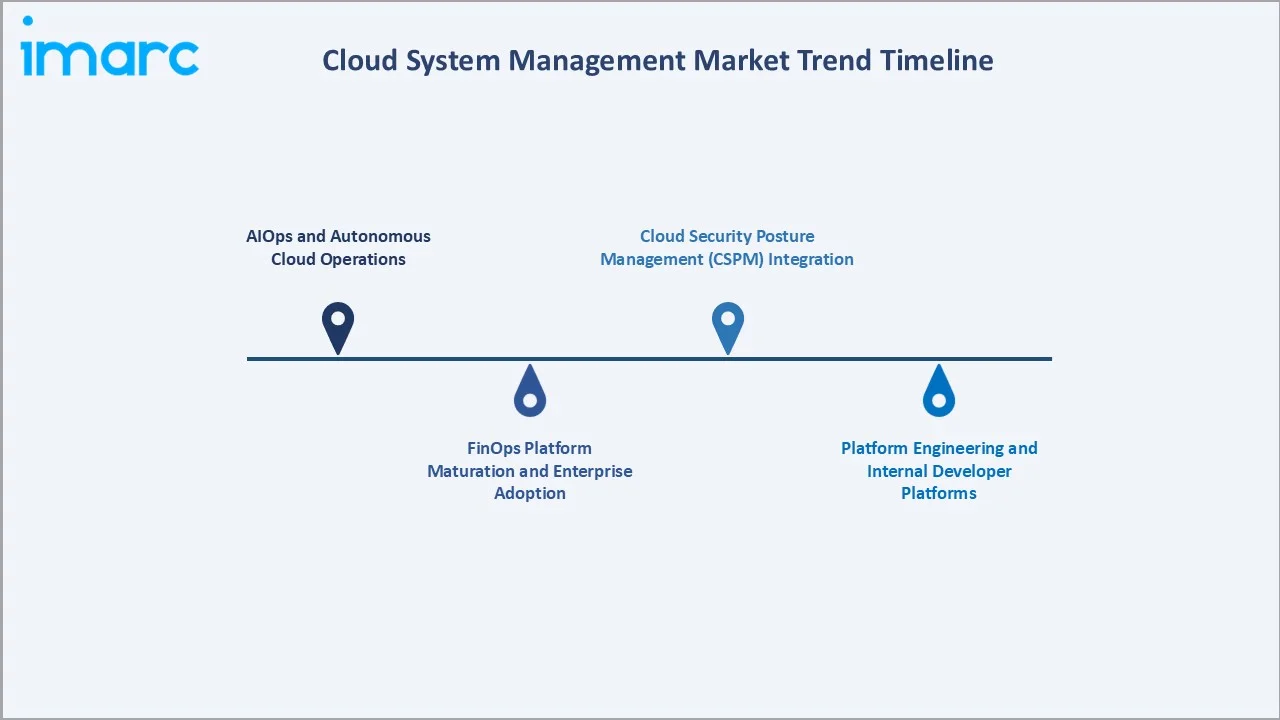
1. AIOps and Autonomous Cloud Operations
AI-powered operations (AIOps) platforms are fundamentally transforming cloud system management from rule-based alerting to predictive, self-healing operations. In May 2025, Digitate made its flagship ignio AIOps platform generally available on AWS Marketplace, enabling enterprises to more easily discover, purchase, and deploy the solution within their AWS environments. The move expands access to Digitate’s SaaS-based IT and business operations capabilities through AWS’s digital software catalog. Leading platforms are deploying foundation models trained on cloud operational data to automatically correlate incidents, identify root causes, and trigger remediation workflows without human intervention.
2. FinOps Platform Maturation and Enterprise Adoption
The FinOps discipline, which applies financial accountability and engineering optimization to cloud spending, is maturing from grassroots initiatives to enterprise-mandated programs. Dedicated FinOps platforms are being integrated with procurement, chargeback, and capacity planning workflows.
3. Cloud Security Posture Management (CSPM) Integration
Cloud security posture management (CSPM) is rapidly becoming a core component of cloud system management platforms rather than a standalone security tool. Leading vendors are integrating CSPM capabilities with performance monitoring, compliance governance, and incident response workflows. This convergence is enabling security-aware cloud operations where misconfigurations are automatically detected and remediated as part of standard cloud management workflows.
4. Platform Engineering and Internal Developer Platforms
Platform engineering, the discipline of building internal developer platforms (IDPs) that abstract cloud infrastructure complexity, is emerging as a strategic cloud management approach for enterprises seeking to accelerate developer productivity. Organizations are deploying golden path tooling, self-service infrastructure provisioning portals, and software delivery platforms. This trend is shifting cloud management investment toward developer experience and internal platform product development.
Industry Value Chain Analysis
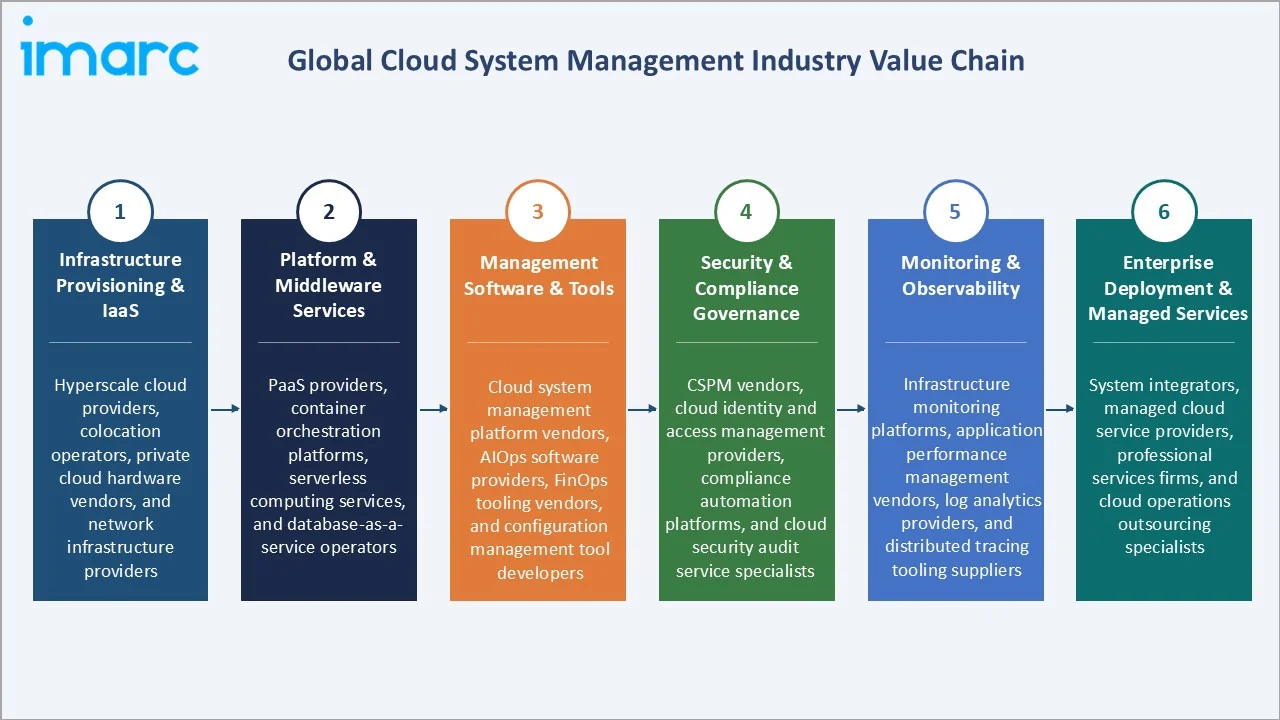
The cloud system management value chain integrates infrastructure provisioning, platform and middleware services, management software, security and compliance governance, monitoring and observability, and enterprise deployment and managed services.
|
Stage |
Key Participants |
|
Infrastructure Provisioning & IaaS |
Hyperscale cloud providers, colocation operators, private cloud hardware vendors, and network infrastructure providers. |
|
Platform & Middleware Services |
PaaS providers, container orchestration platforms, serverless computing services, and database-as-a-service operators. |
|
Management Software & Tools |
Cloud system management platform vendors, AIOps software providers, FinOps tooling vendors, and configuration management tool developers. |
|
Security & Compliance Governance |
CSPM vendors, cloud identity and access management providers, compliance automation platforms, and cloud security audit service specialists. |
|
Monitoring & Observability |
Infrastructure monitoring platforms, application performance management vendors, log analytics providers, and distributed tracing tooling suppliers. |
|
Enterprise Deployment & Managed Services |
System integrators, managed cloud service providers, professional services firms, and cloud operations outsourcing specialists. |
Management software and tools represent the most value-added stage in the cloud system management value chain, as it directly determines operational efficiency, cost optimization effectiveness, security posture visibility, and compliance governance quality across enterprise cloud environments. This phase encompasses AIOps intelligence, multi-cloud orchestration, FinOps analytics, and policy enforcement, making it the most commercially differentiated and innovation-intensive segment.
Technology Landscape in the Cloud System Management Industry
AI-Powered Observability and AIOps Platforms
AI-powered observability platforms represent the most rapidly evolving technology category in cloud system management. These platforms ingest petabytes of metrics, logs, traces, and events from distributed cloud environments to provide real-time performance insights, anomaly detection, and automated root cause analysis. In May 2026, Selector expanded its AI-powered network observability platform with new multi-cloud capabilities, enabling enterprises to monitor and correlate signals across hybrid environments. By integrating telemetry from cloud, network, and infrastructure systems into a unified intelligence layer, the platform helps teams improve incident visibility and identify root causes more effectively.
Multi-Cloud Management and Governance Platforms
Multi-cloud management platforms provide unified visibility, policy enforcement, and operational control across heterogeneous cloud environments. These platforms normalize cloud-specific APIs and resource models into unified management abstractions, enabling consistent governance regardless of the underlying cloud provider.
Cloud Cost Intelligence and FinOps Tooling
Cloud cost intelligence platforms provide granular visibility into cloud spending at the resource, team, and project levels, enabling enterprises to identify waste, right-size workloads, and optimize pricing commitments (reserved instances, savings plans, spot instances). These tools integrate with enterprise financial planning and procurement systems to embed cloud cost accountability into engineering team workflows. AI-driven cost anomaly detection is increasingly enabling real-time identification of unexpected spend before it materializes into significant cost overruns.
Market Segmentation Analysis
The report covers the following segments:
|
Segment Category |
Leading Segment |
Market Share |
Year |
|
Component |
🔒 |
🔒 |
2025 |
|
Deployment Model |
🔒 |
🔒 |
2025 |
|
Enterprise Size |
Large Enterprise |
67.4% |
2025 |
|
End Use Industry |
BFSI |
28.6% |
2025 |
|
Region |
North America |
38.2% |
2025 |

By Enterprise Size
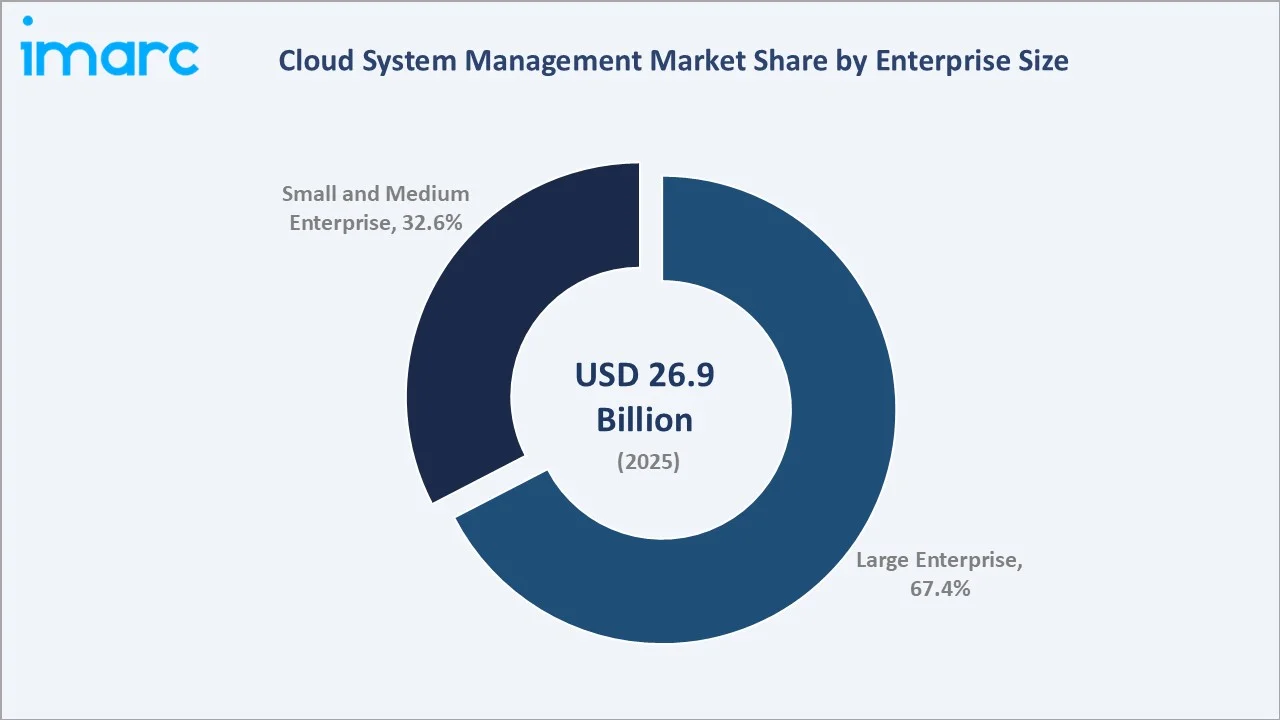
Large enterprise leads at 67.4% (2025), reflecting the segment's complex multi-cloud infrastructure requirements and greater budget capacity for comprehensive cloud management platform investment. Large enterprises managing hundreds of cloud accounts, thousands of services, and billions of dollars in annual cloud spend require enterprise-grade management platforms with advanced governance, cost optimization, and security capabilities that justify significant licensing investments.
To access detailed market analysis, Request Sample
Small and medium enterprises account for 32.6% (2025) and represent the fastest-growing enterprise size segment, driven by accessible SaaS-delivered management platforms with consumption-based pricing models. As SMEs accelerate cloud adoption, demand for right-sized cloud cost visibility, security posture monitoring, and automated compliance tooling is creating a rapidly expanding addressable market for cloud management vendors targeting the mid-market.
By End Use Industry
BFSI leads at 28.6% (2025), driven by the sector's intensive cloud adoption for core banking modernization, digital payments infrastructure, and capital markets analytics, combined with stringent regulatory compliance requirements mandating rigorous cloud governance and security management. BFSI enterprises invest significantly in cloud security posture management, compliance automation, and financial operations tooling to meet regulatory obligations while optimizing the economics of cloud infrastructure.
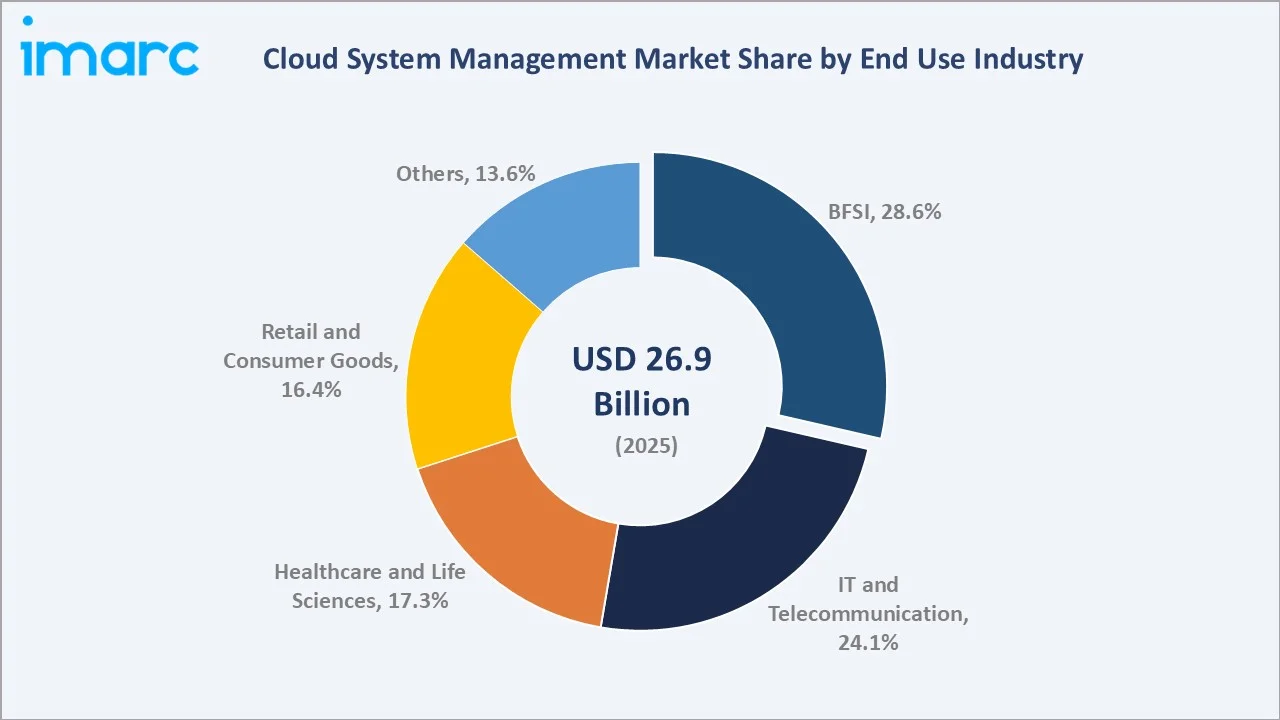
IT and telecommunications hold 24.1% (2025), driven by telecom cloud-native network function adoption and IT sector cloud-first service delivery. Healthcare and life sciences account for 17.3% (2025), growing through EHR cloud migration and clinical analytics platforms. Retail and consumer goods represent 16.4% (2025), driven by e-commerce infrastructure scaling. Others account for 13.6% (2025).
Regional Market Insights
|
Region |
Share (2025) |
Key Cloud System Management Market Drivers & Characteristics |
|
North America |
38.2% |
Largest market driven by highest enterprise cloud adoption rates, concentration of leading cloud management platform vendors, and intensive BFSI and technology sector cloud infrastructure investment. |
|
Asia Pacific |
30.8% |
Fastest-growing region driven by accelerating cloud adoption in China, India, Japan, and South Korea, large-scale digital government cloud initiatives, and increasing domestic cloud management platform vendor investment. |
|
Europe |
20.4% |
Strong market driven by high enterprise cloud adoption, growing multi-cloud strategy adoption, and EU digital sovereignty cloud initiatives driving demand for compliant management platforms. |
|
Latin America |
6.1% |
Growing market with expanding cloud adoption in Brazil and Mexico, increasing financial services and retail cloud migration. |
|
Middle East and Africa |
4.5% |
Emerging market with high-growth government cloud modernization, expanding financial services and telecom cloud infrastructure investment. |
North America's 38.2% dominance reflects the region's unparalleled cloud infrastructure maturity, the presence of all leading cloud management platform vendors, and the highest enterprise cloud spending per organization globally. Asia Pacific's 30.8% positions it as the fastest-growing region, with China's domestic cloud ecosystem expansion, India's digital transformation initiatives, and Japan and South Korea's enterprise cloud modernization programs collectively driving exceptional market growth.
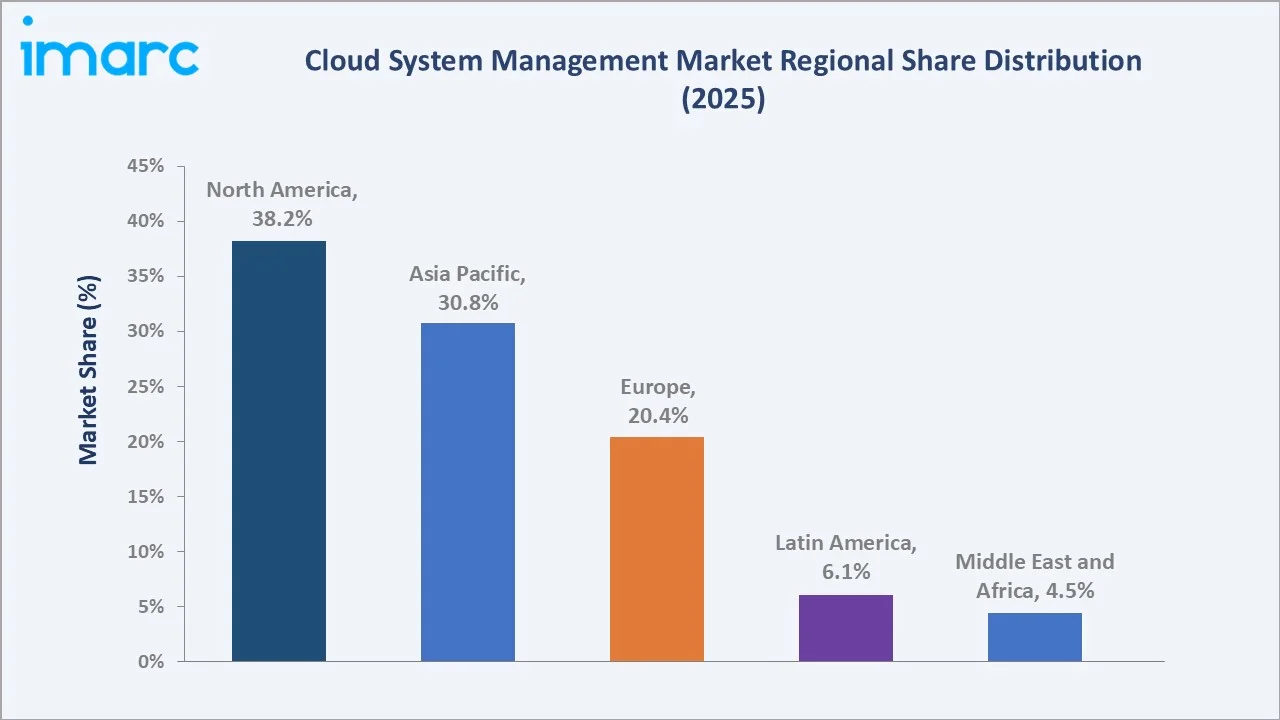
Europe's 20.4% is driven by cloud governance requirements and multi-cloud strategy adoption across major enterprise markets. Latin America at 6.1% and the Middle East and Africa at 4.5% represent high-potential growth markets, with government cloud modernization programs and financial services digital transformation initiatives creating strong foundations for cloud management platform adoption through the forecast period.
Competitive Landscape
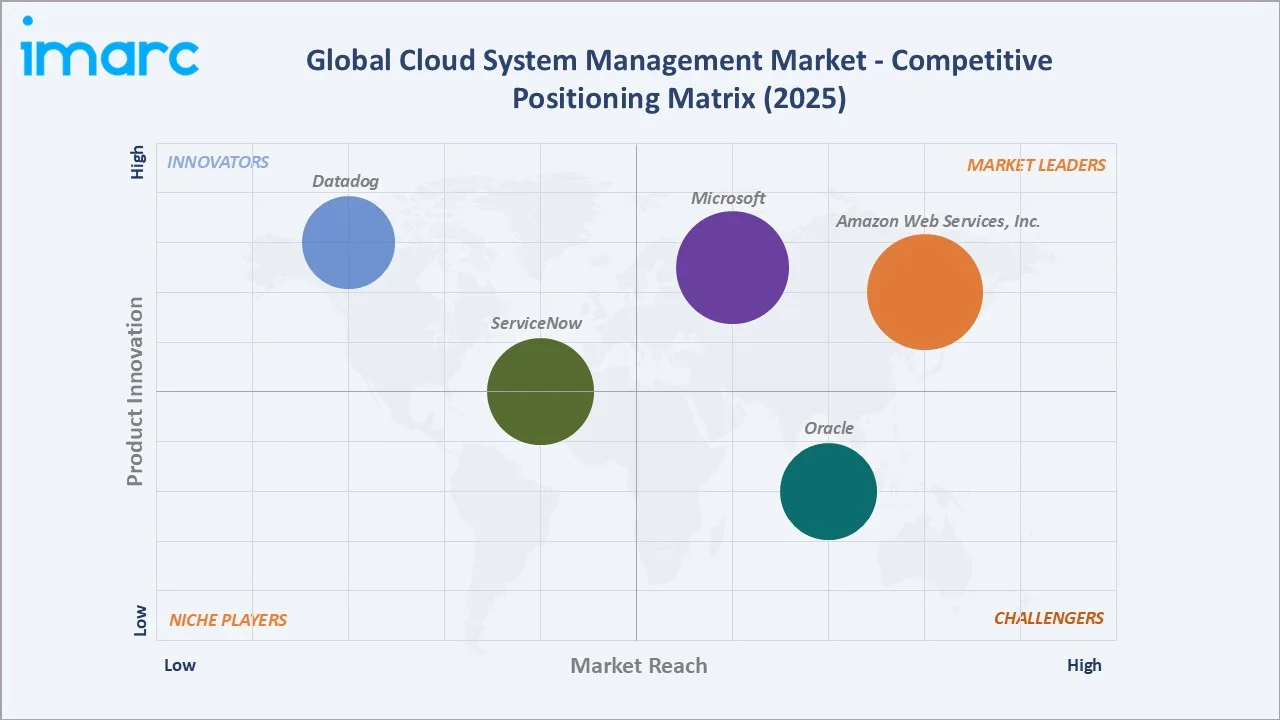
The global cloud system management market is moderately concentrated, with hyperscaler-native management tools, independent software vendors, and specialized observability and governance platforms competing across enterprise segments. Market participants compete on multi-cloud platform coverage, AIOps intelligence depth, compliance framework breadth, integration ecosystem, pricing flexibility, and enterprise customer success capabilities. AI-powered automation, unified multi-cloud governance, and FinOps tooling integration are key competitive differentiators.
|
Company |
Key Offerings |
Market Position |
Core Strength |
|
Amazon Web Services, Inc. |
AWS Systems Manager |
Market Leader |
In cloud system management, AWS serves as a comprehensive infrastructure provider. |
|
Microsoft |
Azure Arc |
Market Leader |
Microsoft plays a central role in cloud system management by providing tools to control, monitor, and organize computing resources. |
|
ServiceNow |
Cloud Accelerate |
Established Player |
ServiceNow acts as an orchestration and governance layer sitting above the technical infrastructure. |
|
Datadog |
Datadog Cloud SIEM |
Innovator |
Datadog is a comprehensive monitoring and security platform designed for cloud-scale applications. |
|
Oracle |
Oracle Cloud Observability and Management Platform |
Challenger |
Provides enterprises with platforms to automate database administration, monitor system performance, enforce security, and orchestrate multicloud environments |
Companies are also investing in generative AI-powered cloud operations assistants, multi-cloud policy-as-code governance, edge cloud management capabilities, and sustainability dashboards to differentiate in the rapidly evolving cloud management platform market. The market is expected to see further consolidation through platform acquisitions as leading vendors seek to offer comprehensive, unified cloud management suites covering performance, security, cost, and governance in integrated platforms.
Key Company Profiles
Amazon Web Services Inc.
Amazon Web Services Inc. is one of the largest cloud computing providers and offers the most comprehensive native cloud management ecosystem for AWS environments. AWS cloud system management capabilities span infrastructure monitoring, compliance governance, cost intelligence, security management, and operational automation.
- Key Offerings: AWS Systems Manager.
- Strategic Focus: Generative AI integration into cloud operations, AIOps automation for self-healing cloud environments, FinOps tooling enhancement through a cost optimization hub, government cloud management expansion.
Microsoft
Microsoft delivers comprehensive cloud system management through Azure, addressing hybrid and multi-cloud management requirements for enterprises across on-premises, Azure, and third-party cloud environments. Azure Arc extends Azure management policies and security controls to other resources, providing a unified governance plane across heterogeneous cloud estates.
- Key Offerings: Azure Arc.
- Strategic Focus: Copilot AI-powered cloud management automation, Azure Arc hybrid and multi-cloud governance expansion, SIEM integration for security operations, deep Microsoft 365 and Dynamics integration for enterprise workflow unification.
Market Concentration Analysis
The global cloud system management market is moderately concentrated. Hyperscaler-native management tools dominate within their respective cloud ecosystems, while independent observability and governance platforms capture revenue from multi-cloud and hybrid cloud management requirements. Fragmentation persists across use case specializations geographic regions, and enterprise size segments, creating a competitive landscape where platform breadth, AI capability maturity, and ecosystem integration depth determine enterprise platform selection. The market is expected to see continued consolidation through strategic acquisitions as leading vendors seek to offer comprehensive, unified cloud management suites that eliminate the need for multiple point solutions.
Investment & Growth Opportunities
Highest Growth Segments
Small and medium enterprise cloud management (~19.8% CAGR), healthcare and life sciences cloud governance (~19.2% CAGR), IT and telecom cloud-native management (~18.5% CAGR), Asia Pacific platform expansion, and specialized AIOps and FinOps tooling vendors represent the highest-growth investment vectors in the cloud system management market through 2034.
Investment Themes
- AIOps platform development: AI-powered operations platforms with autonomous remediation, predictive capacity management, and natural language cloud operations interfaces are commanding premium enterprise pricing and high customer retention rates. Investment in foundational AI models trained on cloud operational data creates defensible differentiation in an increasingly commoditized monitoring and observability market.
- Asia Pacific market entry and expansion: The Asia Pacific cloud management market represents the most significant geographic expansion opportunity. Establishing local data residency capabilities, regulatory compliance certifications, and regional system integrator partnerships is critical for capturing enterprise cloud management market share in this high-growth region.
Future Market Outlook (2026-2034)
The global cloud system management market is projected to grow from USD 26.9 Billion in 2025 to USD 121.3 Billion by 2034, delivering a 17.65% CAGR over the forecast period through accelerating enterprise multi-cloud adoption, AIOps platform maturation, FinOps discipline mainstream deployment, and expanding cloud management requirements across healthcare, BFSI, and government sectors. The market's anchor value of USD 60.7 Billion in 2030 represents the cloud system management ecosystem at the AIOps autonomous operations inflection and FinOps enterprise-standard deployment.
Three structural forces are expected to define the growth of the global cloud system management market through 2034. First, the accelerating migration of enterprise workloads from on-premises data centers to multi-cloud and hybrid cloud architectures will create exponentially growing cloud management complexity that necessitates increasingly sophisticated and AI-powered management platforms across all enterprise verticals. Second, the maturation of AIOps, FinOps, and platform engineering disciplines from early-adopter to mainstream enterprise practices will drive broad platform adoption as organizations establish dedicated cloud operations, financial governance, and developer platform teams with specific tooling requirements and budget allocations. Third, the emergence of new cloud management frontiers will continuously expand the total addressable market for cloud system management, sustaining high growth rates well into the 2030s as enterprises invest in managing increasingly complex and strategically critical cloud infrastructure ecosystems.
Research Methodology
Primary Research
Primary research comprised in-depth interviews with senior executives from cloud system management platform vendors, enterprise cloud architects, chief information officers, cloud operations leaders, regulatory compliance specialists, and technology industry analysts. Discussions validated market size estimates, assessed AIOps and FinOps adoption trends, evaluated competitive dynamics, and provided insights into enterprise cloud management platform selection criteria, investment priorities, and long-term growth opportunities across global markets.
Secondary Research
Secondary research encompassed company financial reports, hyperscaler cloud revenue disclosures, cloud management platform assessments, cloud market data, regulatory framework publications, enterprise cloud adoption surveys, and credible technology industry analyst reports. These sources supported market trend analysis, competitive positioning assessment, regional cloud adoption data, and enterprise segment analysis across the global cloud system management market.
Forecasting Models
Forecasting models were developed using historical market revenue data, enterprise cloud infrastructure spending growth rates, cloud management platform adoption velocity, and macroeconomic indicators. Both top-down and bottom-up approaches were applied and validated through primary expert consultations. AIOps and FinOps adoption timelines, competitive platform consolidation dynamics, Asia Pacific market development trajectories, and emerging cloud management use case expansion were incorporated to generate reliable forecasts through 2034.
Cloud System Management Market Report Coverage:
| Report Features | Details |
|---|---|
| Base Year of the Analysis | 2025 |
| Historical Period | 2020-2025 |
| Forecast Period | 2026-2034 |
| Units | Billion USD |
| Scope of the Report | Exploration of Historical Trends and Market Outlook, Industry Catalysts and Challenges, Segment-Wise Historical and Future Market Assessment:
|
| Components Covered | Solution, Services |
| Deployment Models Covered | Public, Private, Hybrid |
| Enterprise Sizes Covered | Small and Medium Enterprise, Large Enterprise |
| End Use Industries Covered | BFSI, Healthcare and Life Sciences, Retail and Consumer Goods, IT and Telecommunication, and Others |
| Regions Covered | Asia Pacific, Europe, North America, Latin America, Middle East and Africa |
| Countries Covered | United States, Canada, Germany, France, United Kingdom, Italy, Spain, Russia, China, Japan, India, South Korea, Australia, Indonesia, Brazil, Mexico |
| Companies Covered | Amazon Web Services, Inc., Microsoft, ServiceNow, Datadog, Oracle, etc. |
| Customization Scope | 10% Free Customization |
| Post-Sale Analyst Support | 10-12 Weeks |
| Delivery Format | PDF and Excel through Email (We can also provide the editable version of the report in PPT/Word format on special request) |
Frequently Asked Questions About the Cloud System Management Market Report
The global cloud system management market reached USD 26.9 Billion in 2025, driven by accelerating enterprise multi-cloud adoption, growing AI-powered operations platform deployment, and rising regulatory compliance requirements for cloud governance. Increasing cloud infrastructure complexity across BFSI, healthcare, and government sectors is further supporting market growth.
The global cloud system management market grows at 17.65% CAGR during 2026-2034, reaching USD 121.3 Billion by 2034. The CAGR reflects accelerating enterprise cloud adoption, AIOps platform mainstream deployment, FinOps discipline expansion, and emerging cloud management requirements in healthcare, edge computing, and AI infrastructure management.
Large enterprise leads at 67.4% (2025), driven by complex multi-cloud infrastructure requirements, higher budget capacity for enterprise management platforms, and mandatory governance, compliance, and security management requirements across hundreds of cloud accounts and thousands of cloud services in large enterprise environments.
BFSI dominates at 28.6% (2025), driven by intensive cloud adoption for core banking modernization and digital payments infrastructure, combined with stringent regulatory compliance requirements mandating rigorous cloud governance, security management, and audit trail capabilities across financial services cloud deployments.
North America leads at 38.2% (2025), supported by the highest enterprise cloud adoption rates globally, concentration of leading cloud management platform vendors, US federal cloud-first mandate with compliance requirements, and intensive cloud investment by the technology and financial services sectors.
Leading companies include Amazon Web Services, Inc., Microsoft, ServiceNow, Datadog, and Oracle, among others.
The market is projected to reach approximately USD 60.7 Billion by 2030, representing the ecosystem at the AIOps autonomous operations inflection and FinOps enterprise-standard deployment. Growth will be driven by expanding AI infrastructure management requirements, edge cloud governance complexity, and healthcare and government sector cloud modernization acceleration.
Priority investment opportunities include AIOps platform development with autonomous remediation capabilities, FinOps tooling for cloud cost intelligence and waste elimination, Asia Pacific market entry through local compliance capabilities and system integrator partnerships, and SME-targeted SaaS cloud management platforms with consumption-based pricing models.
Need more help?
- Speak to our experienced analysts for insights on the current market scenarios.
- Include additional segments and countries to customize the report as per your requirement.
- Gain an unparalleled competitive advantage in your domain by understanding how to utilize the report and positively impacting your operations and revenue.
- For further assistance, please connect with our analysts.
 Request Customization
 Speak to an Analyst
 Request Brochure
 Inquire Before Buying
Benefits of Customization
- Personalize this research
- Triangulate with your data
- Get data as per your format and definition
- Gain a deeper dive into a specific application, geography, customer, or competitor
- Any level of personalization
Get in Touch With Us
UNITED STATES
Phone: +1-201-971-6302
INDIA
Phone: +91-120-433-0800
UNITED KINGDOM
Phone: +44-753-714-6104
Email: [email protected]
Client Testimonials




.webp)




.webp)













Related Reports

Choose your plan
*Please note that the prices mentioned below are starting prices for each bundle type. Kindly contact our team for further details.*
Single User License
- 1 User License, Access on 2 Devices
- PDF Report + Excel Dataset (Password Protected)
- Lifetime Access
- No Printing Rights
- 10% Free Report Customization
- 10–12 Weeks of Analyst Support
Five User License
- Access for 5 Users, 2 Devices per User
- PDF Report + Excel Dataset (Password Protected)
- Lifetime Access
- Dedicated Account Manager
- 12–14 Weeks of Analyst Support
- No Printing Rights
- 15% Free Report Customization
- 25% Discount on Your Next Purchase
Corporate User License
- Unlimited User Access (Within Your Organization)
- PDF Report + Excel Dataset
- Lifetime Access
- Dedicated Account Manager
- 14–20 Weeks of Analyst Support
- No Printing Rights
- 20% Free Report Customization
- 30% Discount on Your Next Purchase
Essential Insights
What's included:
3 reports
- Lifetime Access
- PDF Reports
- Excel Datasets
- 2 Weeks of Free Analyst Support
- 2 User Licenses
- Access on 2 Devices
- Printing Rights
- Complimentary PowerPoint (PPT) Version
- Complimentary License Upgrade
Professional Access
What's included:
5 reports
- Lifetime Access
- PDF Reports
- Excel Datasets
- 8 Weeks of Free Analyst Support
- 2 User Licenses
- Access on 2 Devices
- Printing Rights
- Complimentary PowerPoint (PPT) Version
- Complimentary License Upgrade
Business Advantage
What's included:
8 reports
- Lifetime Access
- PDF Reports
- Excel Datasets
- 14 Weeks of Free Analyst Support
- 2 User Licenses
- Access on 2 Devices
- Printing Rights
- Complimentary PowerPoint (PPT) Version
- Complimentary License Upgrade
Enterprise Intelligence
What's included:
10 reports
- Lifetime Access
- PDF Reports
- Excel Datasets
- 20 Weeks of Free Analyst Support
- 2 User Licenses
- Access on 2 Devices
- Printing Rights
- Complimentary PowerPoint (PPT) Version
- Complimentary License Upgrade