
Cold Plunge Tub Market Size, Share, Trends and Forecast by Application and Region, 2026-2034
Cold Plunge Tub Market Size, Share, Trends & Forecast (2026-2034)
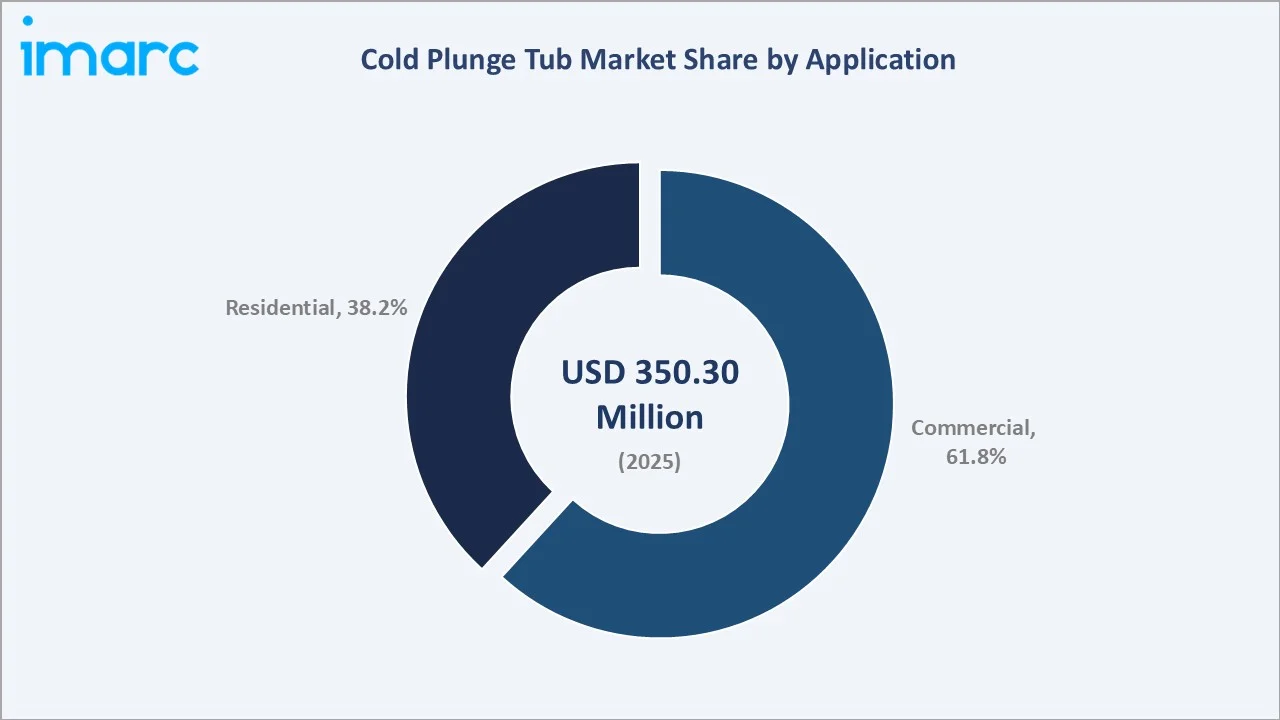
The global cold plunge tub market grew from USD 350.3 Million in 2025 and is estimated to reach USD 363.5 Million in 2026. It is further projected to attain USD 488.5 Million by 2034, exhibiting a CAGR of 3.76% during 2026-2034. Growth in the cold plunge tub market is driven by rising biohacking and holistic wellness adoption, expanding incorporation of smart, app-connected hydrotherapy technology, and growing integration of cold therapy into spa, hotel, and sports recovery facilities. Commercial applications account for the largest cold plunge tub market share, at 61.8% in 2025, supported by wellness centers, gyms, and hospitality venues. North America leads regionally with a 35.6% share, aided by a strong fitness culture and high disposable income.
Market Snapshot
|
Metric |
Value |
|
Base Year Market Size (2025) |
USD 350.3 Million |
|
Market Size (2026) |
USD 363.5 Million |
|
Forecast Market Size (2034) |
USD 488.5 Million |
|
CAGR (2026-2034) |
3.76% |
|
Base Year |
2025 |
|
Historical Period |
2020-2025 |
|
Forecast Period |
2026-2034 |
|
Dominant Application |
Commercial (61.8%, 2025) |
|
Leading Region |
North America (35.6%, 2025) |
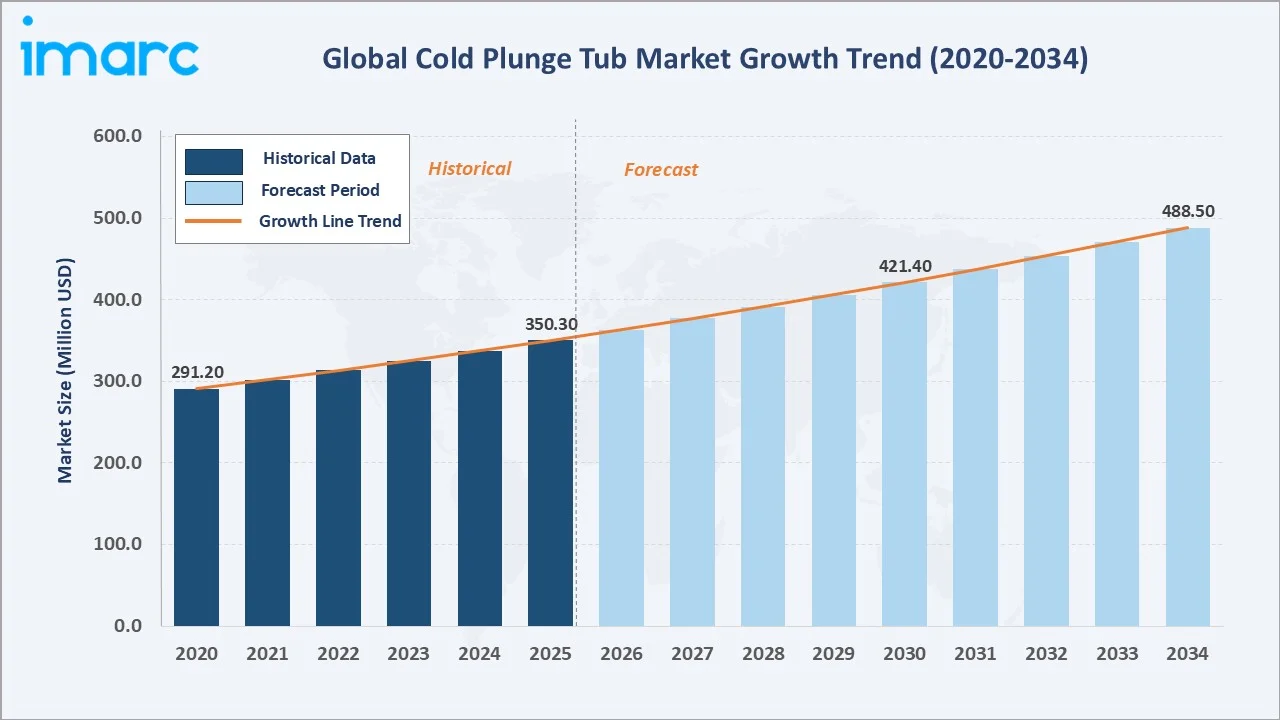
The global cold plunge tub market expanded from USD 291.2 Million in 2020 to USD 350.3 Million in 2025, reaching an estimated USD 363.5 Million in 2026. The market is projected to attain USD 421.4 Million by 2030 and further expand to USD 488.5 Million by 2034. The post-pandemic shift toward home-based wellness routines and preventive self-care accelerated cold plunge tub market growth through 2021-2023, as consumers increasingly sought accessible recovery tools outside traditional gym settings.
To get more information on this market, Request Sample
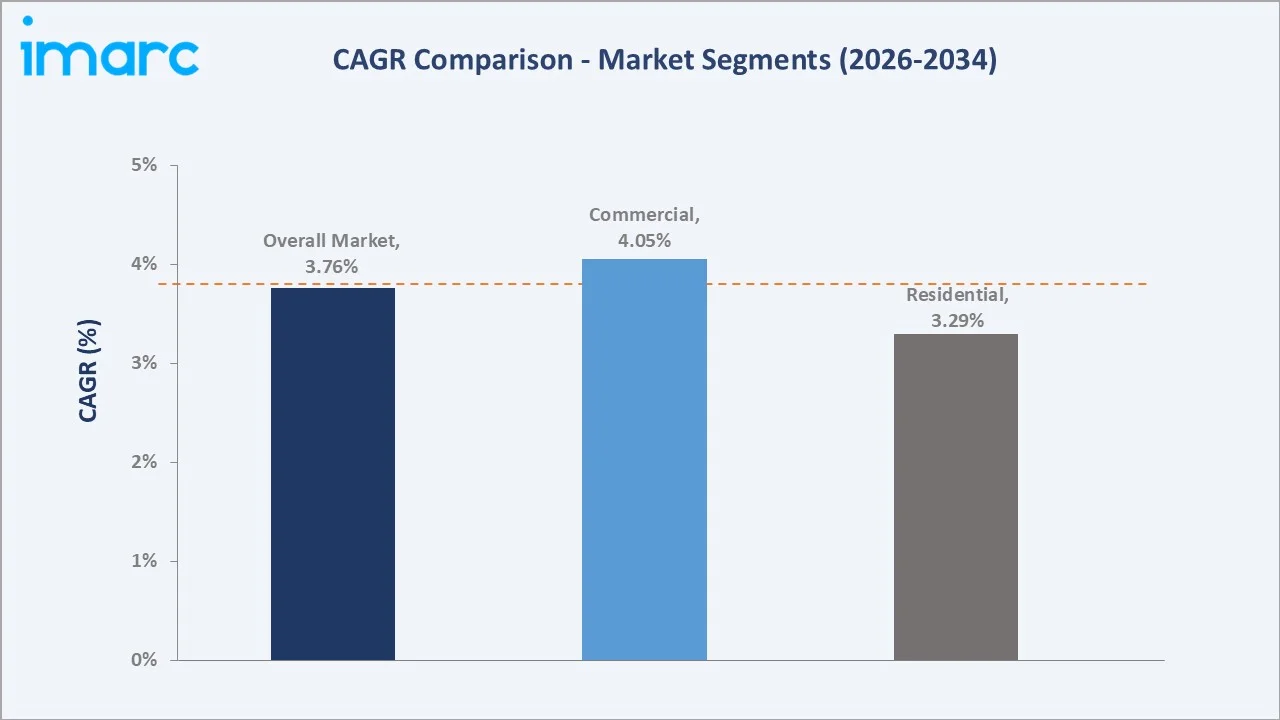
Commercial applications are estimated to grow at a ~4.05% CAGR through 2034, outpacing residential use as wellness centers, spas, and hospitality operators scale cold therapy offerings. Residential adoption follows at an estimated ~3.29% CAGR, moderated by relatively higher upfront equipment cost versus shared commercial-use economics.
Executive Summary
The global cold plunge tub market, which increased from USD 350.3 Million in 2025 to an estimated USD 363.5 Million in 2026, reflecting the convergence of wellness culture, hydrotherapy engineering, and connected consumer technology. The market spans tub construction, chiller and temperature-control systems, filtration and sanitation equipment, and app-based software that converts a basic tub into a monitored wellness platform used for recovery, inflammation management, and stress reduction.
Commercial applications, at 61.8% share in 2025, dominate through adoption across wellness centers, spas, gyms, and hotels seeking to broaden recovery-focused service menus. Residential applications, at 38.2%, are expanding as biohacking culture and at-home wellness routines encourage direct consumer ownership of cold plunge tub systems, aided by improving affordability and product design.
North America, at 35.6% share, leads the cold plunge tub market on the back of an established fitness and recovery culture, high disposable income, and strong social media-driven awareness. Europe and Asia Pacific follow, while the Middle East and Africa represents the smallest but structurally promising base. The market outlook through 2034 remains constructive, supported by continued technology upgrades and expanding commercial deployment.
Key Market Insights
|
Insight |
Data |
|
Dominant Application |
Commercial - 61.8% share (2025) |
|
Leading Region |
North America - 35.6% market share (2025) |
|
Fastest Growing Application |
Commercial - ~4.05% CAGR (2026-2034) |
|
Top Companies |
Plunge, Sunlighten, Renu Therapy, LLC, and Diamond Spas, Inc. |
|
Market Opportunity |
Smart app-connected chillers; hospitality and spa integration; hot-cold contrast therapy bundles; residential biohacking adoption |
Key Analytical Observations Supporting The Above Data:
- Commercial at 61.8%: The commercial segment leads because wellness centers, spas, sports rehabilitation clinics, and luxury hotels increasingly bundle cold therapy into recovery and hospitality service offerings, generating repeat facility-level usage.
- Residential at 38.2%: Residential adoption is rising as improving affordability, compact product design, and biohacking-driven DIY wellness routines encourage homeowners to invest directly in personal cold plunge tub systems.
- North America at 35.6%: North America leads through a deep-rooted fitness and sports-recovery culture, high consumer disposable income, and strong influencer-driven visibility across social media wellness content.
- Smart Technology Adoption: Growing integration of app-based temperature control, remote monitoring, and self-cleaning filtration is elevating average selling prices and reinforcing premiumization across both applications.
- Hospitality Channel Expansion: Luxury hotels and resorts are incorporating cold plunge tubs into spa and wellness amenity packages, widening commercial-channel deployment beyond dedicated recovery clinics.
Global Cold Plunge Tub Market Overview
A cold plunge tub is hydrotherapy equipment engineered for controlled cold-water immersion, typically maintained between 50°F and 59°F, used to trigger vasoconstriction, accelerate metabolic response, and support natural anti-inflammatory recovery. The cold plunge tub market ecosystem spans component and material suppliers, tub and chiller manufacturers, software and connectivity providers, and distribution channels serving both commercial facilities and residential households. Macroeconomic tailwinds, including rising healthcare and wellness spending, urbanization, and expanding disposable income, are reinforcing category visibility across developed and emerging economies alike.
Market Dynamics
To evaluate market opportunities, Request Sample
Market Drivers
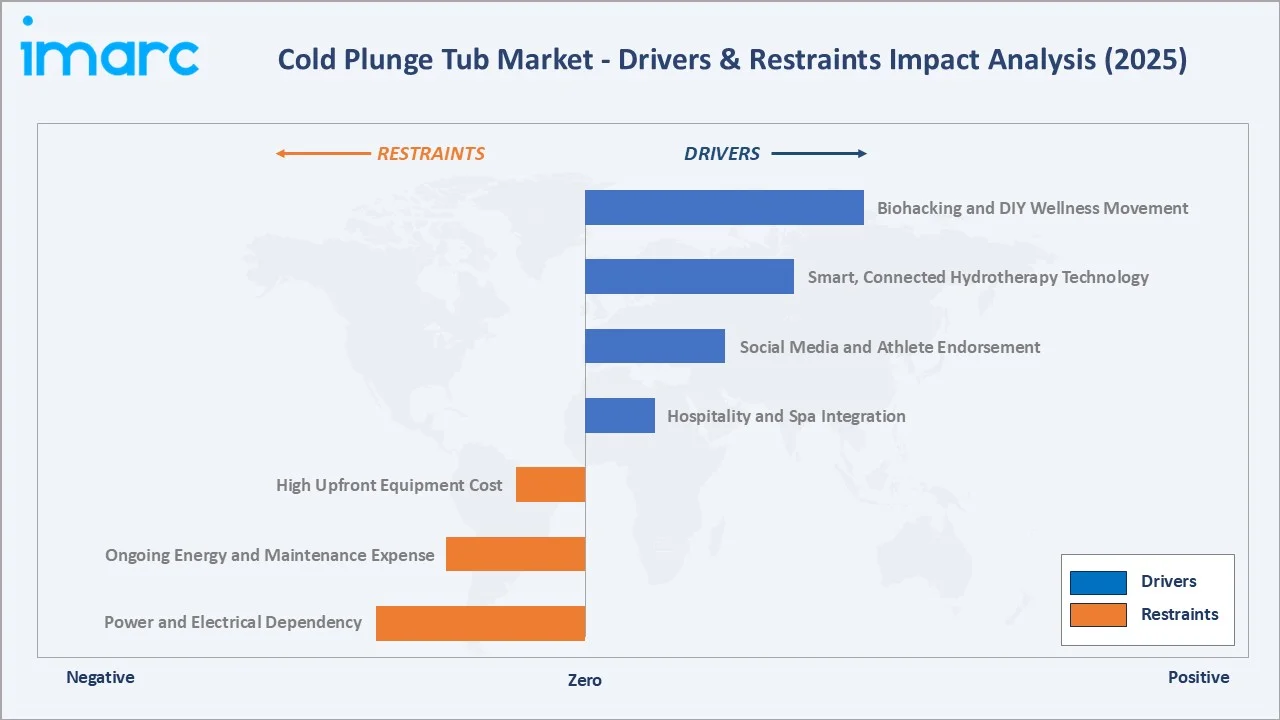
- Biohacking and DIY Wellness Movement: The rise of biohacking encourages individuals to self-experiment with lifestyle interventions, positioning cold plunge tubs as accessible, personalizable recovery tools that fit naturally into self-directed wellness routines.
- Smart, Connected Hydrotherapy Technology: Digital temperature control, app-based scheduling, and automated filtration are increasing consumer appeal, mirroring the broader smart-home device adoption trend across wellness categories.
- Social Media and Athlete Endorsement: Widespread coverage on platforms such as Instagram and YouTube, alongside celebrity and athlete endorsements, is translating into direct consumer demand for immersion-based cold therapy products.
- Hospitality and Spa Integration: Hotels and resorts are incorporating cold plunge tubs into premium wellness amenities, broadening the commercial application base and reinforcing category normalization.
Market Restraints
- High Upfront Equipment Cost: Premium chiller-equipped tubs carry high upfront pricing, which can restrict adoption among price-sensitive residential buyers and smaller commercial operators.
- Ongoing Energy and Maintenance Expense: Continuous chiller operation adds recurring electricity and filter-maintenance costs, which can weigh on total cost of ownership for frequent users.
Market Opportunities
- Contrast Therapy Bundling: Combining cold plunge tubs with infrared sauna or hot-tub systems for hot-cold contrast therapy is opening new premium product bundles for both commercial and residential buyers.
- Emerging Market Wellness Tourism: Expanding wellness tourism and premium hospitality infrastructure in emerging regions present untapped commercial deployment opportunities for cold plunge tub manufacturers.
Market Challenges
- Power and Electrical Dependency: Chiller-equipped systems require dedicated electrical circuits, creating installation friction in older residential properties and regions with inconsistent power infrastructure.
- Water Quality and Sanitation Management: Maintaining clean, well-filtered water requires consistent upkeep, and inadequate sanitation practices can affect user experience and long-term product satisfaction.
Emerging Market Trends
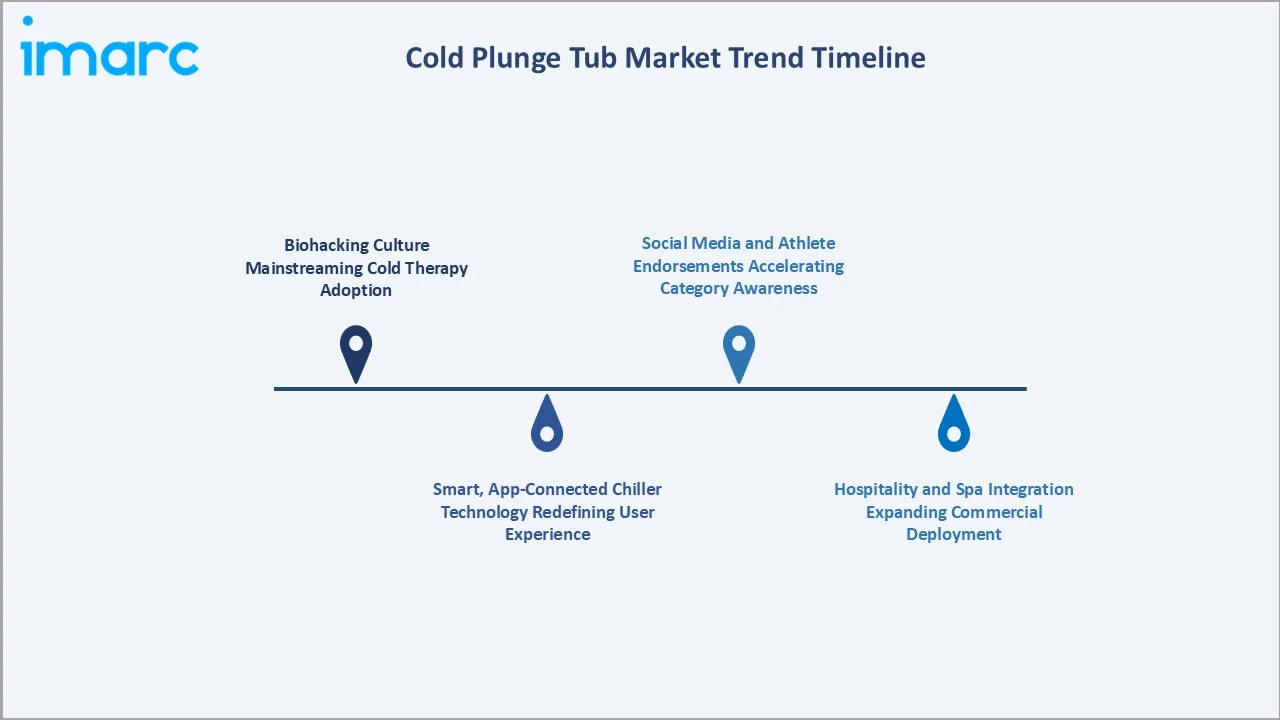
1. Biohacking Culture Mainstreaming Cold Therapy Adoption
The biohacking movement is normalizing self-directed cold water immersion as a lifestyle intervention rather than a niche athletic recovery tool. This trend is drawing new residential buyers who view cold plunge tubs as personal wellness infrastructure, extending category demand beyond dedicated sports and rehabilitation users.
2. Smart, App-Connected Chiller Technology Redefining User Experience
Manufacturers are embedding Wi-Fi connectivity, precise digital temperature control, and remote scheduling into chiller units, allowing users to manage sessions from a smartphone. This convenience layer is becoming a key purchase differentiator, particularly in the premium residential and boutique commercial segments.
3. Social Media and Athlete Endorsements Accelerating Category Awareness
Influencer and athlete-driven content on social platforms continues to introduce cold plunge tubs to new audiences, compressing the traditional awareness-to-purchase cycle. This channel is proving especially effective in driving first-time residential buyers toward entry-level and mid-tier product configurations.
4. Hospitality and Spa Integration Expanding Commercial Deployment
Hotels, resorts, and boutique spas are positioning cold plunge tubs as differentiated wellness amenities, integrating them alongside sauna and contrast-therapy offerings. This hospitality-channel expansion is reinforcing the commercial application's leading position within the broader cold plunge tub market.
Industry Value Chain Analysis
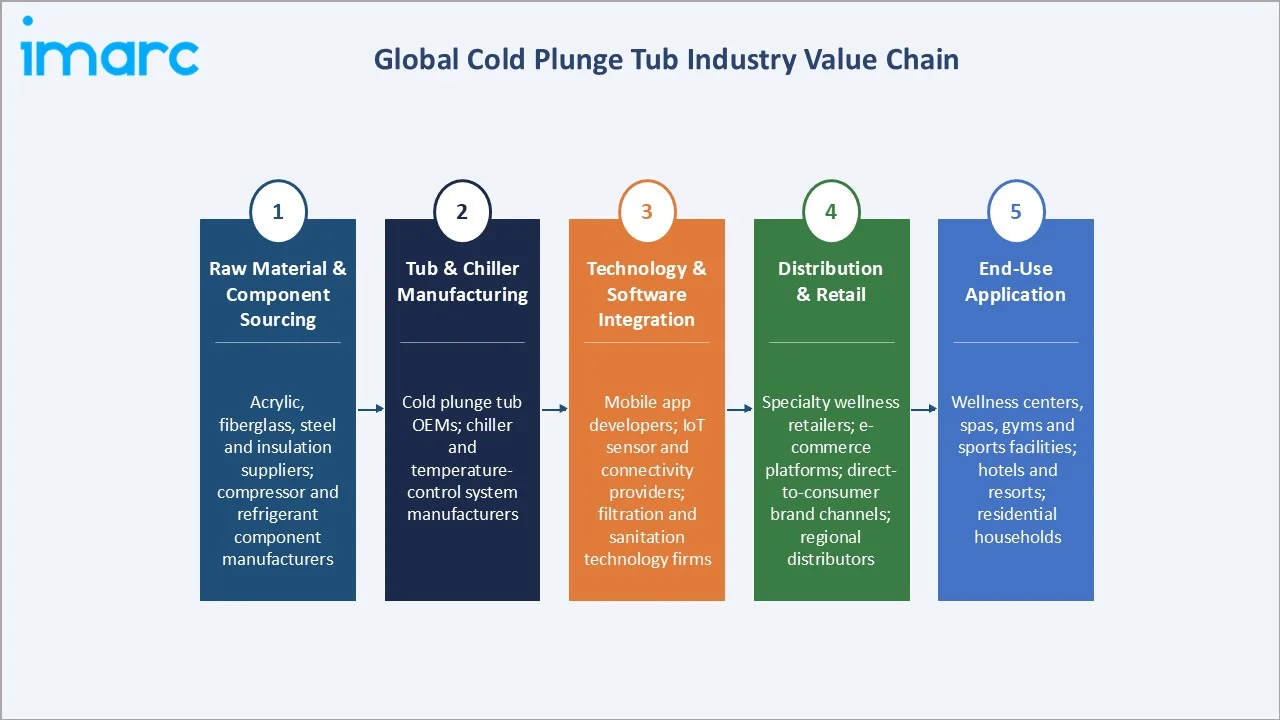
The cold plunge tub value chain integrates raw material and component sourcing, tub and chiller manufacturing, technology and software integration, distribution and retail, and end-use application across commercial and residential settings.
|
Stage |
Key Participants |
|
Raw Material & Component Sourcing |
Acrylic, fiberglass, steel and insulation suppliers; compressor and refrigerant component manufacturers |
|
Tub & Chiller Manufacturing |
Cold plunge tub OEMs; chiller and temperature-control system manufacturers |
|
Technology & Software Integration |
Mobile app developers; IoT sensor and connectivity providers; filtration and sanitation technology firms |
|
Distribution & Retail |
Specialty wellness retailers; e-commerce platforms; direct-to-consumer brand channels; regional distributors |
|
End-Use Application |
Wellness centers, spas, gyms and sports facilities; hotels and resorts; residential households |
The technology and software integration stage is emerging as the value chain's most differentiated layer, as smart connectivity increasingly determines premium positioning. Distribution economics also matter meaningfully, since direct-to-consumer channels allow residential brands to maintain higher margins than traditional wholesale-retail models.
Technology Landscape in the Cold Plunge Tub Industry
Chiller & Temperature Control Technology
Modern chiller units use compressor-based refrigeration to hold water within a precise 37°F-59°F range, replacing manual ice-based cooling. Energy-efficient compressors and improved insulation are reducing operating costs, which is a key factor in expanding residential affordability.
Materials Innovation
Manufacturers are shifting toward acrylic, fiberglass, and marine-grade stainless steel construction for improved durability, insulation, and aesthetic customization, supporting premiumization across both commercial and residential product tiers.
Smart Connectivity
App-based controls now allow users to set temperature, track session history, and receive maintenance alerts remotely. This connectivity layer is increasingly bundled with subscription-style customer engagement, extending brand relationships beyond the initial purchase.
Automation & Sanitation
Automated multi-stage filtration, ozone treatment, and UV sanitation are reducing manual water-maintenance burden, a critical factor for both high-traffic commercial installations and convenience-focused residential buyers.
Market Segmentation Analysis
The report covers the following segments:
|
Segment Category |
Leading Segment |
Market Share |
Year |
|
Application |
Commercial |
61.8% |
2025 |
|
Region |
North America |
35.6% |
2025 |

By Application
Commercial applications lead at 61.8% share (2025), encompassing wellness centers, spas, sports rehabilitation clinics, gyms, and hotels that deploy cold plunge tubs as part of recovery and hospitality service offerings. Commercial demand benefits from corporate wellness programs and shared-use economics that lower the effective cost per session.
To access detailed market analysis, Request Sample
Residential applications, at 38.2% share and an estimated ~3.29% CAGR, are expanding as at-home wellness investment rises alongside improving product affordability. Rising disposable income and growing biohacking-driven DIY health interest are encouraging homeowners to install personal cold plunge systems.
Regional Market Insights
|
Region |
Share (2025) |
Key Cold Plunge Tub Market Drivers & Characteristics |
|
North America |
35.6% |
Driven by a strong fitness and sports-recovery culture, high disposable income, and widespread social media and celebrity wellness influence. |
|
Europe |
27.4% |
Supported by growing holistic wellness adoption, hospitality-sector integration, and expanding sports rehabilitation infrastructure. |
|
Asia Pacific |
22.8% |
Driven by rising urban disposable income, expanding premium fitness and spa infrastructure, and growing wellness tourism. |
|
Latin America |
8.1% |
Supported by gradually expanding wellness and fitness culture and increasing hospitality-sector adoption of recovery amenities. |
|
Middle East and Africa |
6.1% |
Driven by expanding luxury hospitality and wellness tourism infrastructure in premium urban markets. |
North America's 35.6% leadership reflects the region's deep-rooted fitness and recovery culture, high household disposable income, and the outsized influence of athlete and celebrity wellness endorsements on consumer purchasing behavior.
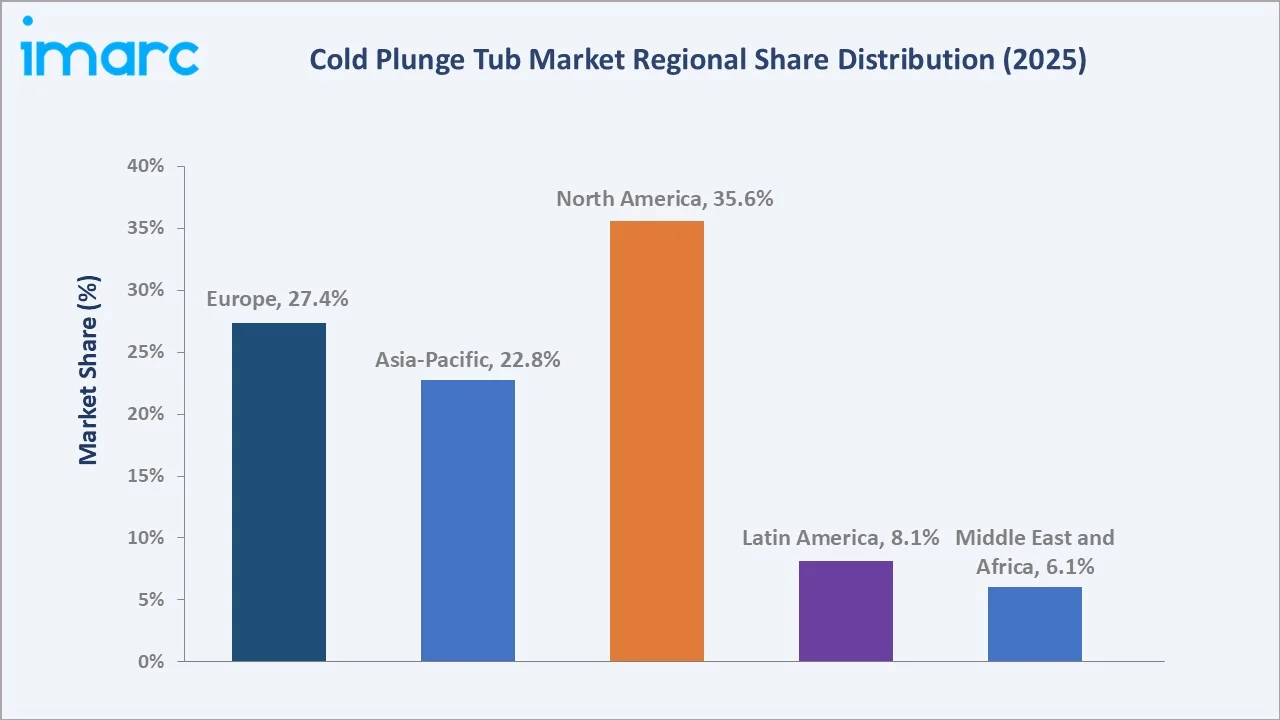
Europe's 27.4% share benefits from established hospitality and spa infrastructure, while Asia Pacific's 22.8% reflects rising urban wellness spending. The Middle East and Africa, though smallest at 6.1%, is positioned for above-average long-term growth as premium hospitality investment expands.
Competitive Landscape
The global cold plunge tub market competitive landscape spans direct-to-consumer wellness technology brands, specialty hydrotherapy manufacturers, and artisanal or custom tub makers, reflecting the category's blend of consumer technology and traditional wellness-equipment manufacturing.
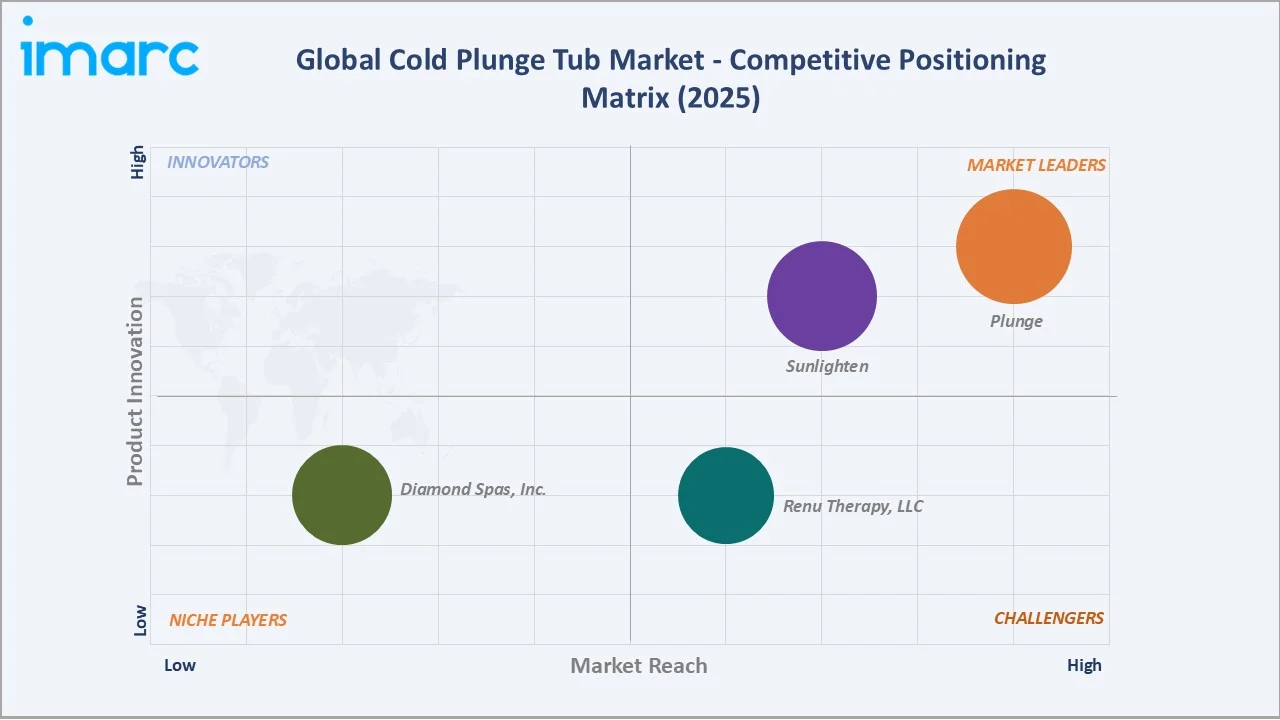
|
Company Name |
Product Portfolio |
Market Position |
Core Strength |
|
Plunge |
Plunge All-In, Plunge Commercial, Plunge Evolve XL |
Market Leader |
Plunge plays a central role in the cold plunge tub market through app-connected chillers, advanced filtration, and a strong direct-to-consumer residential brand presence. |
|
Sunlighten |
Ice Barrel 300, Ice Barrel 500, Ice Barrel Chiller |
Market Leader |
Operates Ice Barrel, LLC, which is known for durable, US-manufactured upright barrel-style tubs with chiller-ready ports, appealing to both ice-based and chiller-equipped users. |
|
Renu Therapy, LLC |
Cold Stoic 3.0, Vero, Aurelius |
Strong Challenger |
Renu Therapy differentiates through handcrafted wood-construction tubs and customizable finishes targeted at premium residential wellness spaces. |
|
Diamond Spas, Inc. |
Fraser |
Niche Player |
Diamond Spas specializes in custom-fabricated stainless steel and copper hydrotherapy vessels for premium residential and hospitality installations. |
Competitive intensity is increasing as consumer technology brands expand into commercial-grade offerings, while established spa-equipment manufacturers add smart connectivity to defend their institutional customer base.
Key Company Profiles
Plunge
Plunge is a US-based direct-to-consumer wellness technology company specializing in chiller-equipped cold plunge tubs and companion sauna systems for residential recovery.
- Key Products: Plunge All-In, Plunge Commercial, Plunge Evolve XL
- Strategic Focus: Centered on engineering reliability, filtration performance, and expanding its direct-to-consumer footprint across the residential cold plunge tub market.
Sunlighten
Ice Barrel, LLC, which is a wholly owned subsidiary of Sunlighten, manufactures upright, fully insulated barrel-style cold therapy tubs designed for compact placement in homes, apartments, and gyms.
- Key Products: Ice Barrel 300, Ice Barrel 500, Ice Barrel Chiller
- Strategic Focus: Focused on accessible entry-level cold therapy, sustainable domestic manufacturing, and expanding chiller-compatible product lines.
Renu Therapy, LLC
Renu Therapy handcrafts premium wood-construction cold plunge tubs in the United States, positioning its products as design-forward centerpieces for home wellness spaces.
- Key Products: Cold Stoic 3.0, Vero, Aurelius
- Strategic Focus: Centered on craftsmanship, natural materials, and premium residential positioning distinct from mass-manufactured stainless steel competitors.
Market Concentration Analysis
The global cold plunge tub market is moderately fragmented, with direct-to-consumer technology brands, specialty hydrotherapy manufacturers, and artisanal producers each competing for distinct customer segments. No single company holds a dominant global share, as regional manufacturing, brand positioning, and price-tier specialization sustain a wide competitive field. Consolidation is most likely at the technology layer, where app connectivity and chiller engineering create scale advantages, while artisanal and custom-fabrication players are expected to remain fragmented given their design-led, lower-volume business models.
Investment & Growth Opportunities
Highest Growth Segments
Commercial applications (~4.05% CAGR), smart app-connected chiller systems, and hot-cold contrast therapy bundles represent the fastest-growing investment vectors within the cold plunge tub market through 2034.
Emerging Investment Opportunities
The Middle East and Africa's expanding luxury hospitality and wellness tourism infrastructure represents a significant near-term commercial opportunity. Manufacturers and technology providers that establish early distribution and hospitality partnerships in this region are positioned for above-market growth as premium wellness real estate development accelerates.
Investment Themes
- Smart Chiller Platform Development: Investment in app-connected chiller platforms with subscription-based maintenance and monitoring services creates recurring revenue potential beyond the initial hardware sale.
- Hospitality Channel Partnerships: Building direct supply relationships with hotel and spa chains offers manufacturers a scalable path to commercial-segment volume growth.
Future Market Outlook (2026-2034)
The global cold plunge tub market is projected to grow from USD 350.3 Million in 2025 to USD 363.5 Million in 2026 and further to reach USD 488.5 Million by 2034, registering a CAGR of 3.76% during 2026-2034. The market's anchor value of USD 421.4 Million in 2030 reflects a category transitioning from early wellness-trend adoption toward mainstream commercial and residential integration. By the end of the forecast period, smart chiller technology is expected to become a standard rather than premium feature, hospitality-sector integration will likely deepen further, and contrast therapy bundling is expected to reshape how both commercial operators and residential buyers approach product selection.
Two structural forces underpin this outlook with high confidence. First, wellness culture's shift from occasional indulgence to routine self-care is creating durable, recurring demand rather than one-time purchase behavior. Second, continued technology cost reduction is making premium chiller-equipped systems progressively more accessible to mainstream residential buyers, broadening the addressable market beyond early-adopter segments.
Research Methodology
Primary Research
Primary research comprised structured interviews with cold plunge tub manufacturers, wellness facility operators, and distribution partners to validate demand trends, pricing dynamics, and regional adoption patterns.
Secondary Research
Secondary research encompassed company websites and product documentation, wellness industry publications, hospitality and spa trade data, and government economic and demographic statistics relevant to regional wellness spending patterns.
Forecasting Models
Market revenue forecasts were developed using a segment-based bottom-up model incorporating application-level and regional demand components, cross-validated against historical 2020-2025 trend data.
Cold Plunge Tub Market Report Scope:
| Report Features | Details |
|---|---|
| Base Year of the Analysis | 2025 |
| Historical Period | 2020-2025 |
| Forecast Period | 2026-2034 |
| Units | Million USD |
| Scope of the Report |
Exploration of Historical and Forecast Trends, Industry Catalysts and Challenges, Segment-Wise Historical and Predictive Market Assessment:
|
| Applications Covered | Commercial, Residential |
| Regions Covered | Asia Pacific, Europe, North America, Latin America, Middle East and Africa |
| Countries Covered | United States, Canada, Germany, France, United Kingdom, Italy, Spain, China, Japan, India, South Korea, Australia, Indonesia, Brazil, Mexico |
| Companies Covered | Plunge, Sunlighten, Renu Therapy LLC, Diamond Spas Inc., etc. |
| Customization Scope | 10% Free Customization |
| Post-Sale Analyst Support | 10-12 Weeks |
| Delivery Format | PDF and Excel through Email (We can also provide the editable version of the report in PPT/Word format on special request) |
Key Benefits for Stakeholders:
- IMARC’s report offers a comprehensive quantitative analysis of various market segments, historical and current market trends, market forecasts, and dynamics of the cold plunge tub market from 2020-2034.
- The research study provides the latest information on the market drivers, challenges, and opportunities in the global cold plunge tub market.
- The study maps the leading, as well as the fastest-growing, regional markets. It further enables stakeholders to identify the key country-level markets within each region.
- Porter's five forces analysis assist stakeholders in assessing the impact of new entrants, competitive rivalry, supplier power, buyer power, and the threat of substitution. It helps stakeholders to analyze the level of competition within the cold plunge tub industry and its attractiveness.
- Competitive landscape allows stakeholders to understand their competitive environment and provides an insight into the current positions of key players in the market.
Frequently Asked Questions About the Cold Plunge Tub Market Report
The global cold plunge tub market size is estimated at USD 363.5 Million in 2026, driven by rising wellness awareness, biohacking culture, and growing adoption of smart hydrotherapy equipment across commercial and residential settings.
The cold plunge tub market is projected to grow at a CAGR of 3.76% during 2026-2034, reaching USD 488.5 Million by 2034, supported by expanding commercial and residential adoption.
Commercial applications lead the cold plunge tub market at 61.8% share in 2025, driven by adoption across wellness centers, spas, gyms, and hospitality venues.
North America leads the cold plunge tub market at 35.6% share in 2025, supported by a strong fitness and recovery culture and high consumer disposable income.
Leading companies include Plunge, Sunlighten, Renu Therapy, LLC, and Diamond Spas, Inc., among others.
The cold plunge tub market is projected to reach approximately USD 421.4 Million by 2030, reflecting steady progression toward the 2034 forecast of USD 488.5 Million.
Key trends include biohacking-driven residential adoption, smart app-connected chiller technology, social media and athlete endorsements, and expanding hospitality and spa integration.
Residential adoption is driven by improving product affordability, rising disposable income, biohacking and DIY wellness culture, and demand for at-home recovery convenience.
High upfront equipment costs and ongoing chiller energy and maintenance expenses are the primary restraints affecting broader adoption, particularly among price-sensitive residential buyers.
Smart technology, including app-based temperature control and remote monitoring, is elevating average selling prices and becoming a key purchase differentiator across commercial and residential tiers.
Need more help?
- Speak to our experienced analysts for insights on the current market scenarios.
- Include additional segments and countries to customize the report as per your requirement.
- Gain an unparalleled competitive advantage in your domain by understanding how to utilize the report and positively impacting your operations and revenue.
- For further assistance, please connect with our analysts.
 Request Customization
 Speak to an Analyst
 Request Brochure
 Inquire Before Buying
Benefits of Customization
- Personalize this research
- Triangulate with your data
- Get data as per your format and definition
- Gain a deeper dive into a specific application, geography, customer, or competitor
- Any level of personalization
Get in Touch With Us
UNITED STATES
Phone: +1-201-971-6302
INDIA
Phone: +91-120-433-0800
UNITED KINGDOM
Phone: +44-753-714-6104
Email: [email protected]
Client Testimonials




.webp)




.webp)













Related Reports

Choose your plan
*Please note that the prices mentioned below are starting prices for each bundle type. Kindly contact our team for further details.*
Single User License
- 1 User License, Access on 2 Devices
- PDF Report + Excel Dataset (Password Protected)
- Lifetime Access
- No Printing Rights
- 10% Free Report Customization
- 10–12 Weeks of Analyst Support
Five User License
- Access for 5 Users, 2 Devices per User
- PDF Report + Excel Dataset (Password Protected)
- Lifetime Access
- Dedicated Account Manager
- 12–14 Weeks of Analyst Support
- No Printing Rights
- 15% Free Report Customization
- 25% Discount on Your Next Purchase
Corporate User License
- Unlimited User Access (Within Your Organization)
- PDF Report + Excel Dataset
- Lifetime Access
- Dedicated Account Manager
- 14–20 Weeks of Analyst Support
- No Printing Rights
- 20% Free Report Customization
- 30% Discount on Your Next Purchase
Essential Insights
What's included:
3 reports
- Lifetime Access
- PDF Reports
- Excel Datasets
- 2 Weeks of Free Analyst Support
- 2 User Licenses
- Access on 2 Devices
- Printing Rights
- Complimentary PowerPoint (PPT) Version
- Complimentary License Upgrade
Professional Access
What's included:
5 reports
- Lifetime Access
- PDF Reports
- Excel Datasets
- 8 Weeks of Free Analyst Support
- 2 User Licenses
- Access on 2 Devices
- Printing Rights
- Complimentary PowerPoint (PPT) Version
- Complimentary License Upgrade
Business Advantage
What's included:
8 reports
- Lifetime Access
- PDF Reports
- Excel Datasets
- 14 Weeks of Free Analyst Support
- 2 User Licenses
- Access on 2 Devices
- Printing Rights
- Complimentary PowerPoint (PPT) Version
- Complimentary License Upgrade
Enterprise Intelligence
What's included:
10 reports
- Lifetime Access
- PDF Reports
- Excel Datasets
- 20 Weeks of Free Analyst Support
- 2 User Licenses
- Access on 2 Devices
- Printing Rights
- Complimentary PowerPoint (PPT) Version
- Complimentary License Upgrade