
DOC and DPF Market Size, Share, Trends and Forecast by Type, Application, and Region, 2026-2034
DOC and DPF Market Size, Share, Trends & Forecast (2026-2034)
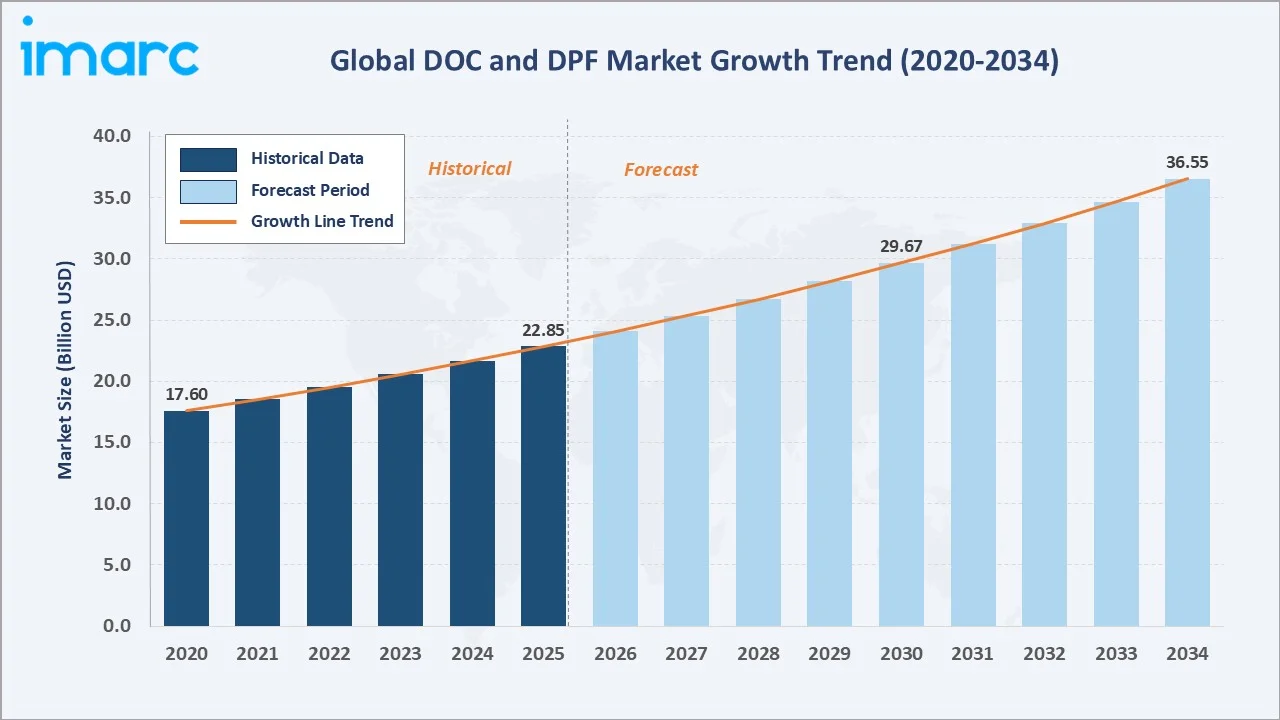
The global DOC and DPF market reached USD 22.85 Billion in 2025 and is projected to reach USD 36.55 Billion by 2034, growing at a CAGR of 5.36% during 2026-2034. Stringent global emission regulations, rising diesel commercial vehicle sales, and expanding aftertreatment system adoption across passenger and commercial vehicle platforms are collectively driving sustained long-term market growth worldwide, even as select regions gradually transition toward electrified powertrains.
DPF leads the type segment at 56.0% share, while HCVs dominate deployment at 27.0%, reflecting heavy-duty diesel fleets’ continued reliance on particulate filtration technology to meet regulatory compliance obligations.
Market Snapshot
|
Metric |
Value |
|
Market Size (2025) |
USD 22.85 Billion |
|
Forecast Market Size (2034) |
USD 36.55 Billion |
|
CAGR (2026-2034) |
5.36% |
|
Base Year |
2025 |
|
Historical Period |
2020-2025 |
|
Forecast Period |
2026-2034 |
|
Dominant Type |
DPF (56.0%, 2025) |
|
Dominant Application |
HCVs (27.0%, 2025) |
|
Leading Region |
Asia-Pacific (32.0%, 2025) |
The market expanded from USD 17.60 Billion in 2020 to USD 22.85 Billion in 2025, growing steadily at a historical CAGR of approximately 5.36%, and is anchored to reach USD 29.67 Billion by 2030 and USD 36.55 Billion by 2034.
To get more information on this market, Request Sample
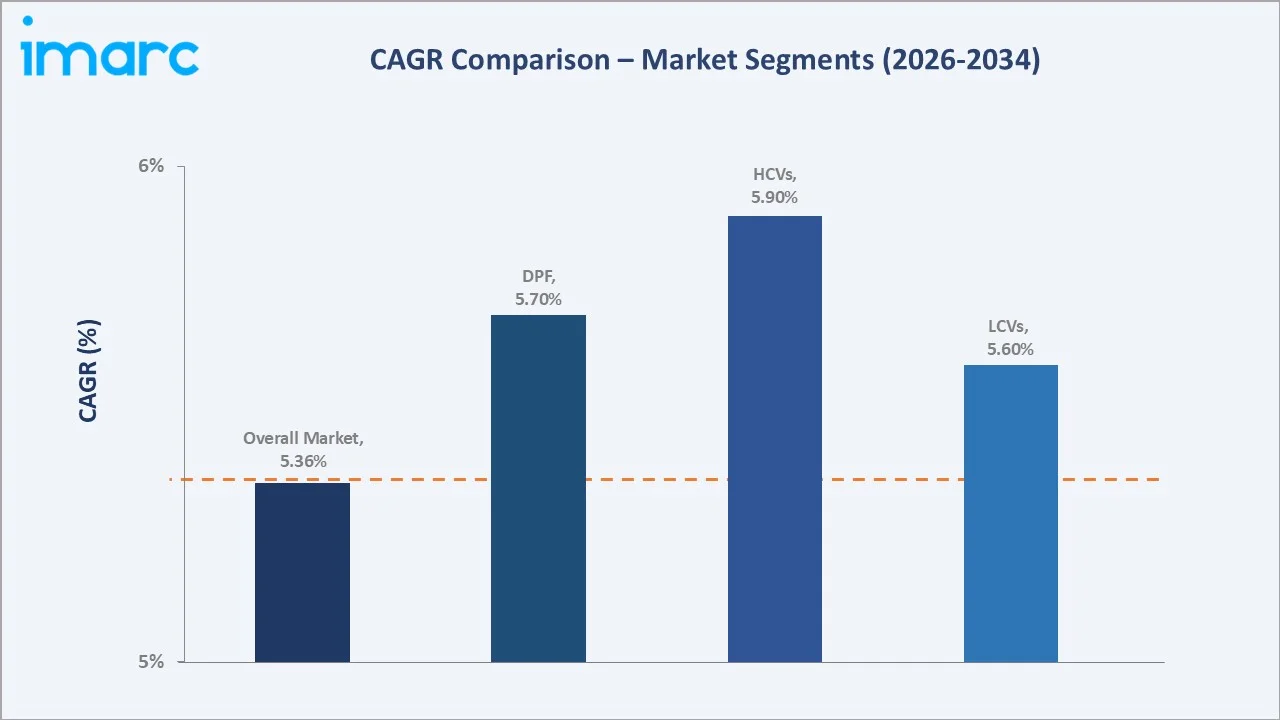
HCVs deployment grows steadily at approximately 5.9% CAGR as heavy-duty diesel fleets face tightening particulate matter and NOx limits across major regulatory jurisdictions. DPF technology grows fastest among the two types at approximately 5.7% CAGR, driven by mandatory soot filtration requirements across on-road and off-road diesel applications in both emerging and developed markets, while DOC maintains steady demand as a complementary oxidation technology.
Executive Summary
The global DOC and DPF market reached USD 22.85 Billion in 2025, representing a critical emission-control segment within the broader automotive aftertreatment industry. Regulatory tightening under Euro VI, EPA, China 6, and Bharat Stage VI norms continues to mandate DOC and DPF adoption across diesel-powered commercial and passenger vehicles worldwide, sustaining consistent OEM-fitment and aftermarket replacement demand across nearly every major automotive-producing region.
DPF at 56.0% dominates by capturing mandatory particulate filtration requirements across diesel platforms, while DOC remains an essential complementary technology for oxidizing carbon monoxide and hydrocarbon emissions. HCVs at 27.0% lead by deployment due to high per-unit filter value, larger engine displacement, and extended vehicle duty cycles. Asia-Pacific at 32.0% leads regionally, supported by large diesel commercial vehicle fleets, expanding manufacturing investment, and increasingly stringent regional compliance infrastructure.
Key Market Insights
|
Insight |
Data |
|
Dominant Type |
DPF - 56.0% revenue share (2025) |
|
Dominant Application |
HCVs - 27.0% market share (2025) |
|
Leading Region |
Asia-Pacific - 32.0% market share (2025) |
|
Market Opportunity |
Low-PGM catalyst washcoats; SCR-integrated combination systems; diesel retrofit programs; aftermarket replacement demand |
Key Analytical Observations Supporting The Above Data:
- DPF at 56.0%: The DPF segment dominates as stringent particulate matter regulations make filtration mandatory across nearly all new diesel vehicles, unlike DOC, which primarily addresses gaseous pollutants rather than particulate soot capture.
- HCVs at 27.0%: Heavy commercial vehicles dominate deployment due to larger engine displacement, higher soot generation, and stricter emission compliance requirements under global heavy-duty diesel regulations, sustaining premium filter specification demand.
- Asia-Pacific at 32.0%: Asia-Pacific leads through China and India’s large diesel commercial vehicle fleets, an expanding manufacturing base, and increasingly stringent regional emission-control mandates that continue to widen the addressable market.
DOC and DPF Market Overview
The global DOC and DPF market encompasses the design, manufacture, and supply of diesel oxidation catalysts and diesel particulate filters used to reduce harmful exhaust emissions from diesel-powered vehicles. These aftertreatment components convert carbon monoxide and hydrocarbons into safer substances while trapping particulate soot before release into the atmosphere, forming a core pillar of modern diesel emission-compliance architecture across both on-road and off-road applications.
The ecosystem integrates ceramic substrate manufacturers, catalyst coating specialists, and Tier-1 exhaust system integrators supplying OEMs across passenger and commercial vehicle segments. Rising diesel engine sales in emerging markets, combined with regulatory tightening in developed regions, continues to sustain long-term demand for DOC and DPF systems, even as the industry gradually adapts to a slower but persistent diesel powertrain base over the coming decade. Component standardization and modular system design are also helping suppliers manage cost pressure while meeting increasingly diverse regional regulatory requirements.
Market Dynamics
To evaluate market opportunities, Request Sample
Market Drivers
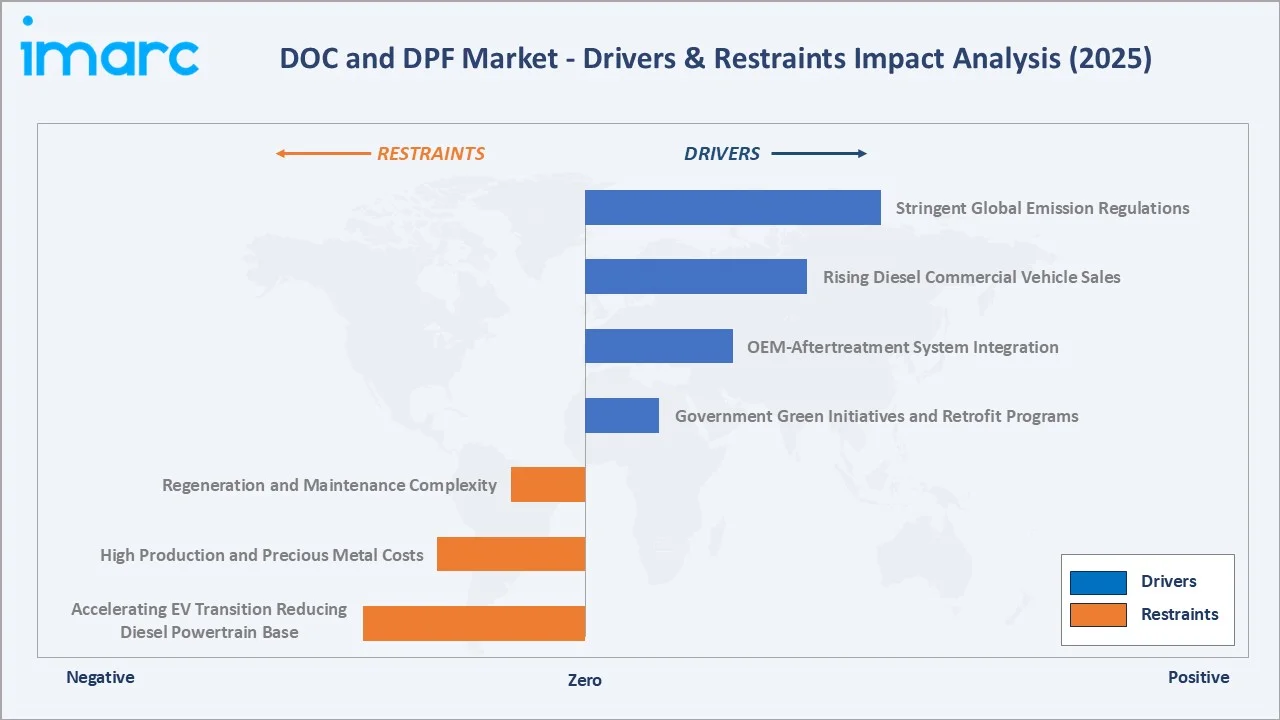
- Stringent Global Emission Regulations: Euro VI, EPA Tier 4, China 6, and Bharat Stage VI norms mandate particulate and NOx reduction, making DOC and DPF installation compulsory across new diesel vehicle platforms worldwide, sustaining consistent replacement and OEM demand. Regulators in multiple regions continue to lower permissible particulate thresholds, requiring higher-efficiency filtration media across successive vehicle model years. This continuous tightening cycle ensures that DOC and DPF specification upgrades remain a recurring engineering requirement for OEMs and Tier-1 suppliers alike.
- Rising Diesel Commercial Vehicle Sales: Growing freight and logistics activity is boosting HCV and MCV production, particularly across Asia-Pacific and Latin America, directly increasing demand for diesel oxidation catalysts and particulate filters across new vehicle fleets. Expanding e-commerce-driven logistics networks and infrastructure investment programs are further accelerating commercial diesel fleet additions in emerging economies. This sustained fleet expansion translates into recurring OEM-fitment volume for aftertreatment component suppliers over the forecast period.
- OEM-Aftertreatment System Integration: Automakers increasingly integrate DOC and DPF with SCR systems into compact modular aftertreatment units, improving performance while creating steady component demand from Tier-1 exhaust system suppliers globally. This integration trend simplifies vehicle packaging and reduces total system weight, supporting broader adoption across diverse commercial and passenger vehicle architectures. Suppliers offering pre-validated combination systems are increasingly favored in OEM sourcing decisions.
- Government Green Initiatives and Retrofit Programs: Government-led retrofit programs for older diesel fleets and green initiatives promoting cleaner air are expanding aftermarket demand for replacement DOC and DPF units across major economies. Several municipal and national authorities now offer subsidies or mandates requiring retrofit compliance for high-mileage commercial fleets. This regulatory push is creating a durable secondary revenue stream for filter and catalyst manufacturers beyond original equipment supply.
Market Restraints
- Accelerating EV Transition Reducing Diesel Powertrain Base: The growing shift toward battery electric and hybrid vehicles is gradually shrinking the diesel-powered vehicle base in passenger and light commercial segments, limiting long-term volume growth potential. This transition is most pronounced in developed markets with strong charging infrastructure and supportive policy incentives. Suppliers reliant primarily on passenger diesel platforms face the greatest long-term exposure to this structural shift.
- High Production and Precious Metal Costs: DOC and DPF manufacturing requires costly platinum-group catalytic coatings and ceramic substrates, raising component costs and pressuring supplier margins amid raw material price volatility. Platinum, palladium, and rhodium prices remain subject to significant fluctuation driven by mining supply constraints and broader industrial demand. This cost exposure complicates long-term pricing agreements between component suppliers and OEM customers.
- Regeneration and Maintenance Complexity: DPF soot regeneration cycles and periodic ash cleaning add operational complexity and downtime costs for fleet operators, occasionally prompting resistance to filter-equipped diesel vehicle adoption. Fleet operators in some regions report increased maintenance scheduling burden compared with earlier non-filtered diesel platforms. This perceived complexity can slow voluntary retrofit uptake absent regulatory mandates.
Market Opportunities
- Low-PGM Catalyst Washcoat Development: Development of catalyst washcoats requiring lower platinum-group metal loading reduces production cost while maintaining filtration efficiency, creating margin-expansion opportunities for substrate and catalyst manufacturers. Advances in coating chemistry and precious-metal dispersion techniques are enabling comparable performance at meaningfully lower precious-metal content. Suppliers that commercialize these formulations first stand to gain a durable cost advantage over competitors.
- Diesel Retrofit Program Expansion: Government-backed retrofit programs across Asia-Pacific and Latin America create sustained aftermarket replacement demand for compliant DOC and DPF units on aging diesel commercial fleets. These programs are frequently paired with financing or subsidy mechanisms that lower the adoption barrier for smaller fleet operators. Suppliers with established aftermarket distribution networks are well positioned to capture this expanding replacement volume.
Market Challenges
- Long-Term Diesel Powertrain Decline in Developed Markets: Rapid growth of battery electric and hybrid commercial vehicle platforms in developed markets is gradually narrowing the addressable diesel vehicle base for long-term DOC and DPF suppliers. This structural narrowing requires suppliers to diversify into emerging markets and aftermarket retrofit segments to sustain long-term volume. Companies slow to diversify their regional exposure face heightened revenue concentration risk.
- Continuous Emission Standard Escalation Requiring Product Redesign: Suppliers must continuously re-engineer substrate and catalyst formulations to meet successive Euro VII, EPA27, and Bharat Stage VII emission thresholds without significantly raising component costs. Each regulatory cycle compresses development timelines and increases validation testing requirements across multiple vehicle platforms. This continuous redesign burden favors well-capitalized suppliers with strong in-house research and development capabilities.
Emerging Market Trends
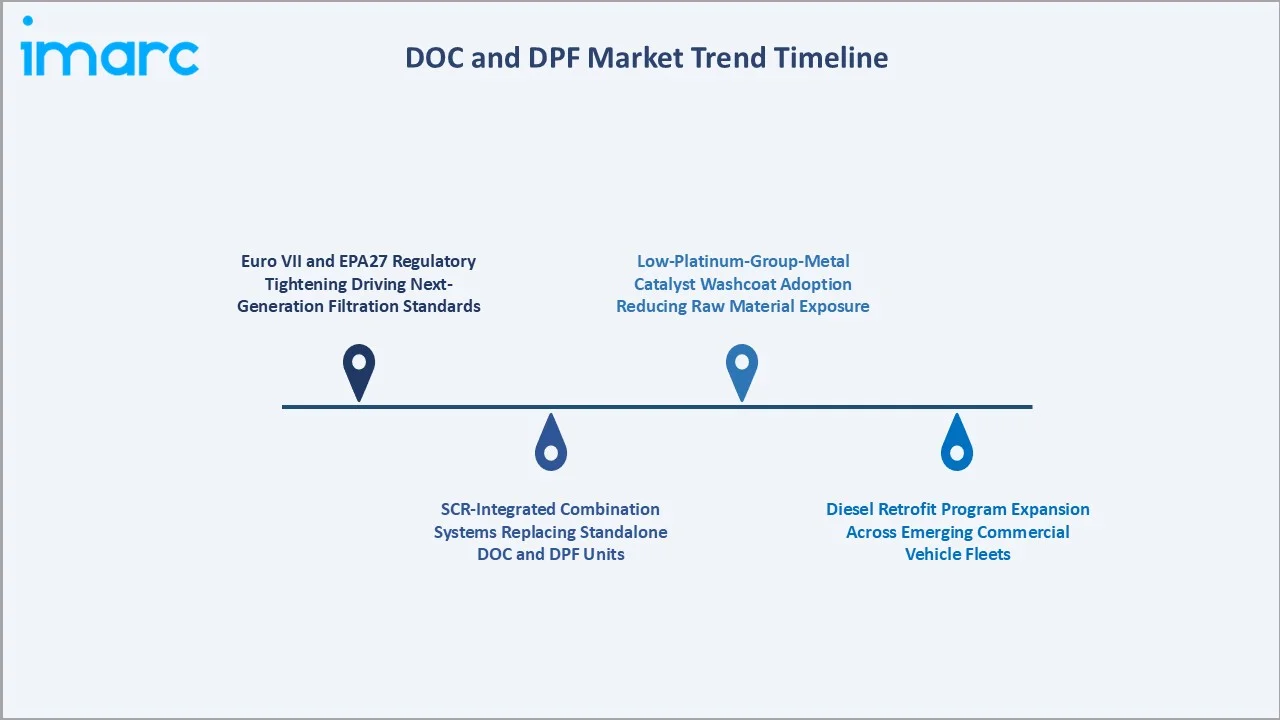
1. Euro VII and EPA27 Regulatory Tightening Driving Next-Generation Filtration Standards
Upcoming Euro VII and EPA27 emission rules are pushing suppliers toward higher-efficiency DPF media and lower-temperature-activation DOC catalysts, requiring substrate and washcoat redesigns across on-road and off-road diesel platforms globally. These evolving standards are also prompting closer collaboration between substrate manufacturers and OEM emission-engineering teams during early vehicle development stages.
2. SCR-Integrated Combination Systems Replacing Standalone DOC and DPF Units
OEMs are increasingly adopting compact combination systems that integrate DOC, DPF, and SCR into a single housing, reducing packaging space and improving thermal management for heavy-duty diesel vehicle platforms. This consolidation trend is reshaping supplier relationships, favoring companies capable of delivering fully validated multi-technology aftertreatment modules.
3. Low-Platinum-Group-Metal Catalyst Washcoat Adoption Reducing Raw Material Exposure
Catalyst manufacturers are developing washcoat formulations requiring less platinum, palladium, and rhodium loading, reducing exposure to precious-metal price volatility while sustaining oxidation and filtration performance. Early commercial adoption is concentrated among Tier-1 suppliers with strong catalyst chemistry research capabilities.
4. Diesel Retrofit Program Expansion Across Emerging Commercial Vehicle Fleets
Government-backed retrofit initiatives are equipping older diesel trucks and buses with compliant DOC and DPF systems across Asia-Pacific and Latin America, creating sustained aftermarket replacement volume. These programs are increasingly bundled with vehicle inspection and certification requirements to accelerate fleet-wide compliance.
Industry Value Chain Analysis
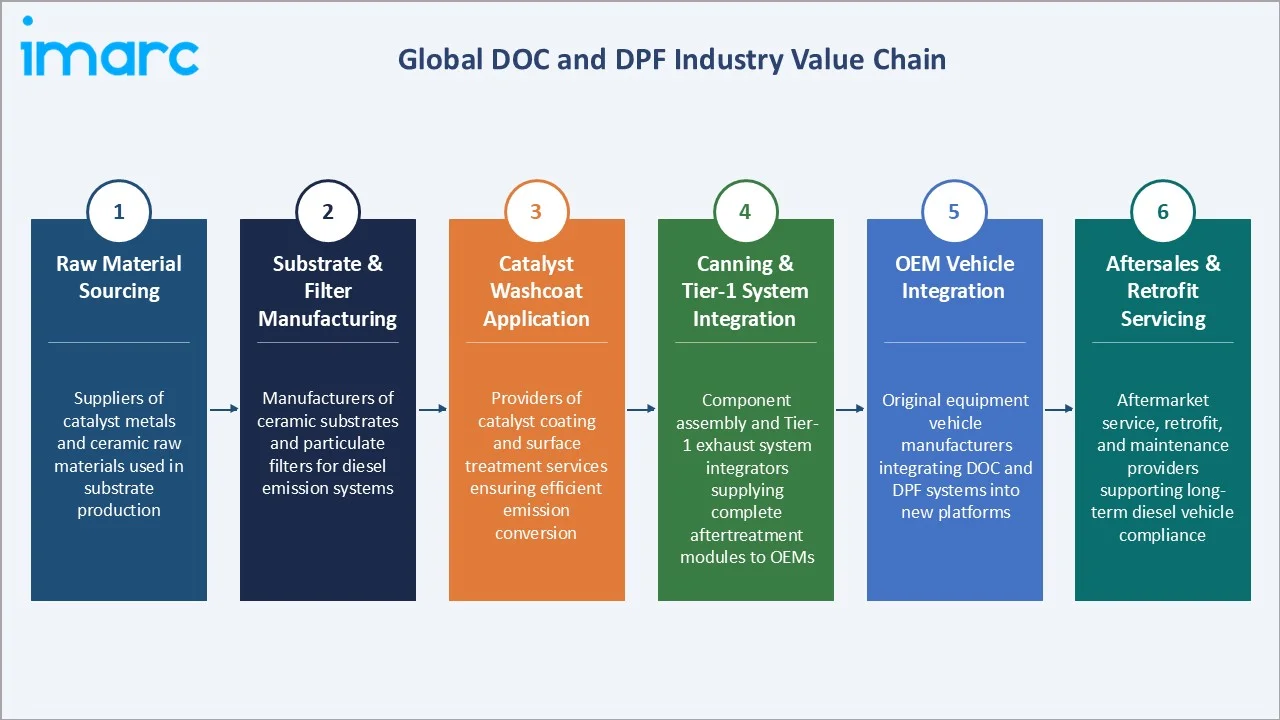
The DOC and DPF value chain integrates raw material sourcing, ceramic substrate and filter manufacturing, catalyst washcoat application, canning and system assembly, and OEM and aftermarket integration, each stage shaping cost, quality, and emission-compliance performance across the finished aftertreatment system.
|
Stage |
Key Participants |
|
Raw Material Sourcing |
Suppliers of catalyst metals and ceramic raw materials used in substrate production |
|
Substrate & Filter Manufacturing |
Manufacturers of ceramic substrates and particulate filters for diesel emission systems |
|
Catalyst Washcoat Application |
Providers of catalyst coating and surface treatment services ensuring efficient emission conversion |
|
Canning & Tier-1 System Integration |
Component assembly and Tier-1 exhaust system integrators supplying complete aftertreatment modules to OEMs |
|
OEM Vehicle Integration |
Original equipment vehicle manufacturers integrating DOC and DPF systems into new platforms |
|
Aftersales & Retrofit Servicing |
Aftermarket service, retrofit, and maintenance providers supporting long-term diesel vehicle compliance |
The raw material sourcing tier is the DOC and DPF value chain’s most commercially critical stage, as catalyst metal price movements directly influence production cost and supplier margin across the industry, making upstream procurement strategy a key competitive differentiator among leading suppliers.
Technology Landscape in the DOC and DPF Industry
Cordierite Ceramic Substrate Technology
Cordierite substrate technology offers low thermal expansion, cost efficiency, and reliable filtration performance, making it the most widely used base material for both DOC and DPF units across passenger and light commercial diesel vehicles. Its established manufacturing base and predictable performance characteristics continue to support broad OEM adoption across cost-sensitive vehicle segments.
Silicon Carbide (SiC) Substrate Technology
Silicon carbide substrates provide superior thermal conductivity and durability under high regeneration temperatures, making them the preferred choice for heavy-duty diesel applications requiring long service life and robust filtration efficiency. Their higher manufacturing cost is generally offset by extended service intervals in demanding commercial vehicle duty cycles.
Platinum-Group Metal (PGM) Catalyst Washcoat Technology
Platinum-group metal washcoat technology enables the oxidation of carbon monoxide and hydrocarbons at lower exhaust temperatures, with manufacturers increasingly optimizing platinum, palladium, and rhodium loading to balance performance and raw material cost. Ongoing formulation research continues to target reduced precious-metal intensity without compromising conversion efficiency.
In 2025, catalyst manufacturers accelerated development of high thermal-stability substrate and washcoat formulations to meet next-generation Euro VII and EPA27 particulate and NOx limits while reducing platinum-group metal loading requirements, reflecting an industry-wide shift toward more resource-efficient emission-control technology.
Market Segmentation Analysis
The report covers the following segments:
|
Segment Category |
Leading Segment |
Market Share |
Year |
|
Type |
DPF |
56.0% |
2025 |
|
Application |
HCVs |
27.0% |
2025 |
|
Region |
Asia-Pacific |
32.0% |
2025 |

By Type
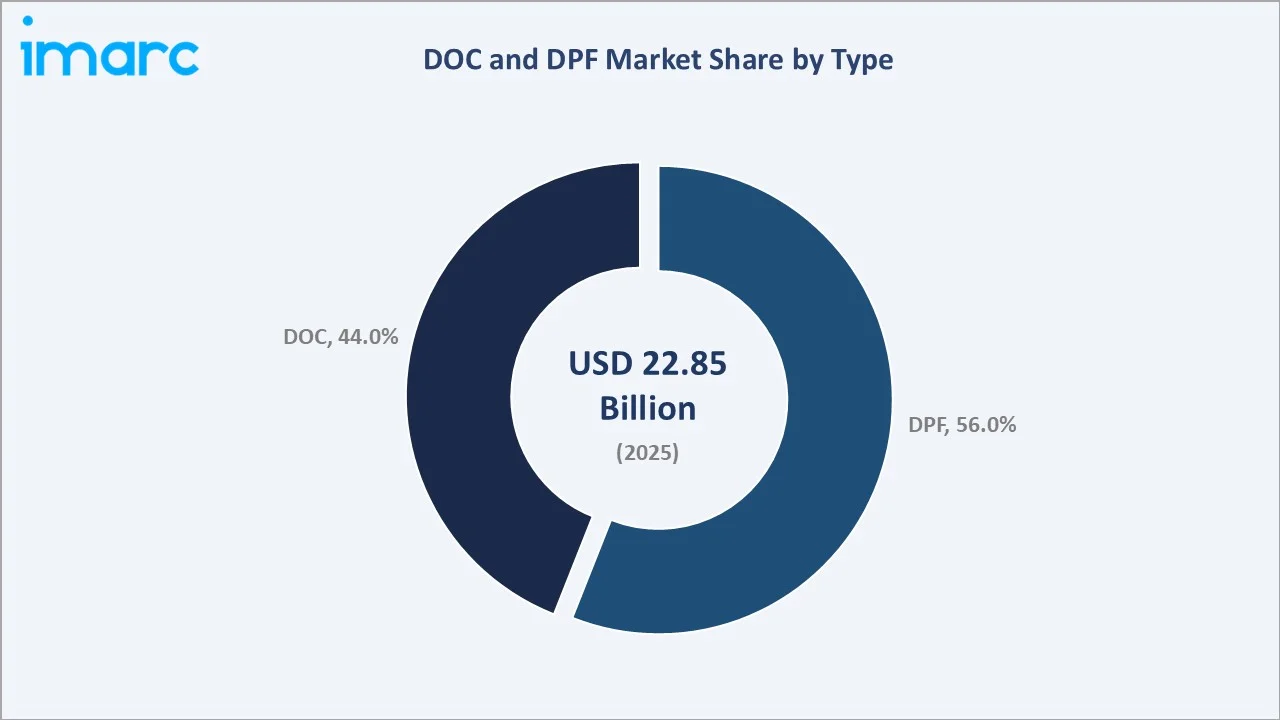
DPF leads at 56.0% in 2025, reflecting mandatory particulate filtration requirements across nearly all new diesel vehicles under global emission standards. It is the larger and faster-growing of the two type segments through 2034, benefiting from successive rounds of particulate matter regulatory tightening across major automotive markets.
To access detailed market analysis, Request Sample
DOC accounts for the remaining 44.0% share in 2025, remaining essential for oxidizing carbon monoxide and hydrocarbons, particularly in combination systems paired with SCR and DPF technology for comprehensive emission control across both light-duty and heavy-duty diesel vehicle platforms.
By Application
HCVs lead deployment at 27.0%, driven by larger engines and higher particulate output requiring robust filtration systems, followed by LCVs at 25.0% supported by rising last-mile diesel delivery fleets and expanding urban logistics networks across developing economies.
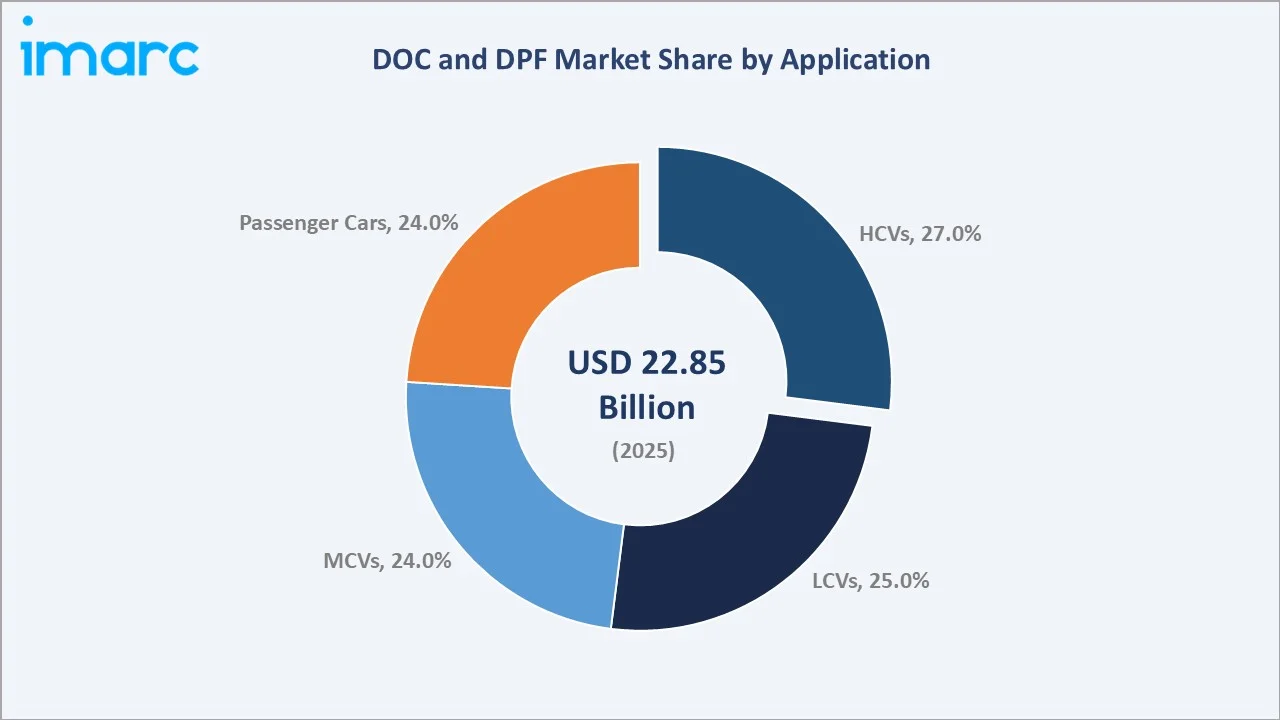
Passenger Cars and MCVs each hold 24.0% share, reflecting balanced diesel aftertreatment demand across the commercial and passenger vehicle spectrum, with steady replacement and OEM-fitment volumes across both categories supporting consistent long-term component demand.
Regional Market Insights
|
Region |
Share (2025) |
Key Characteristics |
|
Asia-Pacific |
32.0% |
Large diesel vehicle base and expanding emission-compliance regulations. |
|
Europe |
28.0% |
Established diesel vehicle fleet and stringent regional emission standards. |
|
North America |
24.0% |
Steady replacement demand supported by ongoing emission enforcement. |
|
Latin America |
9.0% |
Growing commercial vehicle fleet and gradually tightening emission norms. |
|
Middle East and Africa |
7.0% |
Emerging market with rising infrastructure and regulatory investment. |
Asia-Pacific, at 32.0%, leads through China’s vast diesel commercial vehicle production, India’s expanding Bharat Stage VI compliance mandates, and growing manufacturing investment across the region. Europe follows at 28.0%, supported by strict Euro VI regulations and an established diesel vehicle base spanning both passenger and commercial segments.
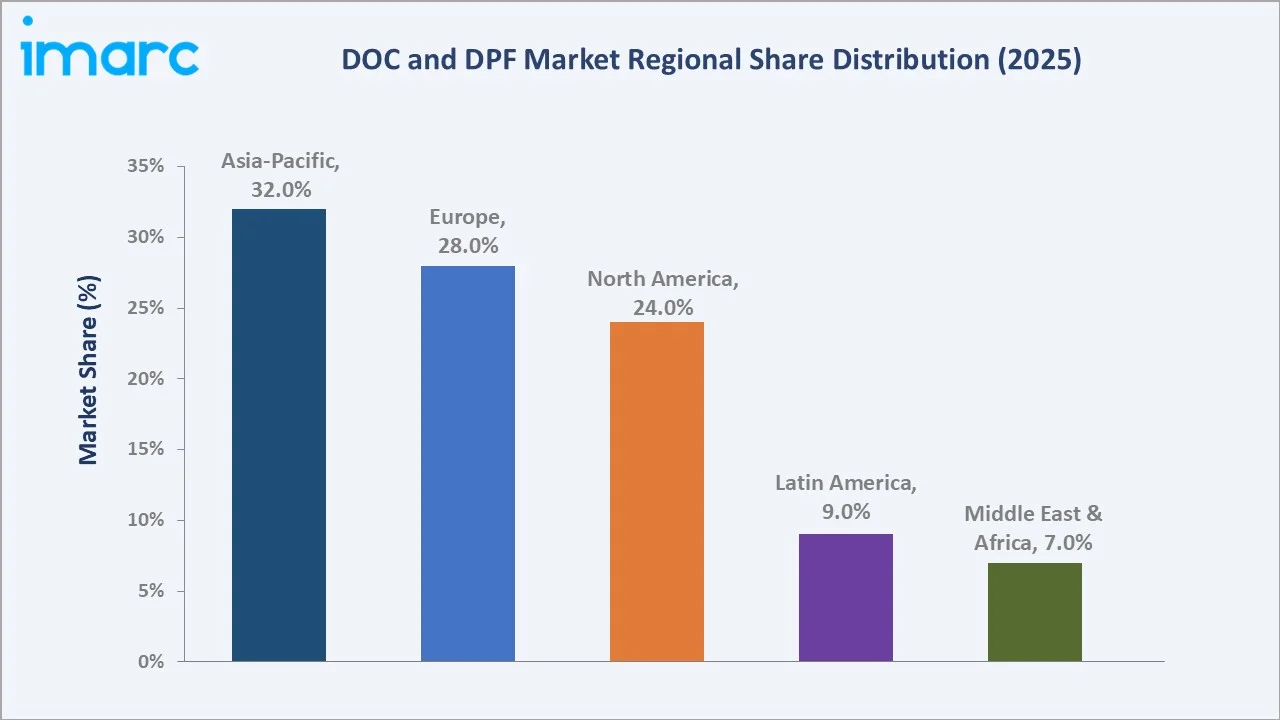
North America, at 24.0%, reflects EPA emission enforcement and steady heavy-duty diesel fleet replacement demand. Latin America, at 9.0%, and Middle East and Africa, at 7.0%, represent emerging markets where tightening regulations and expanding commercial vehicle fleets are gradually increasing DOC and DPF adoption over the forecast period.
Competitive Landscape
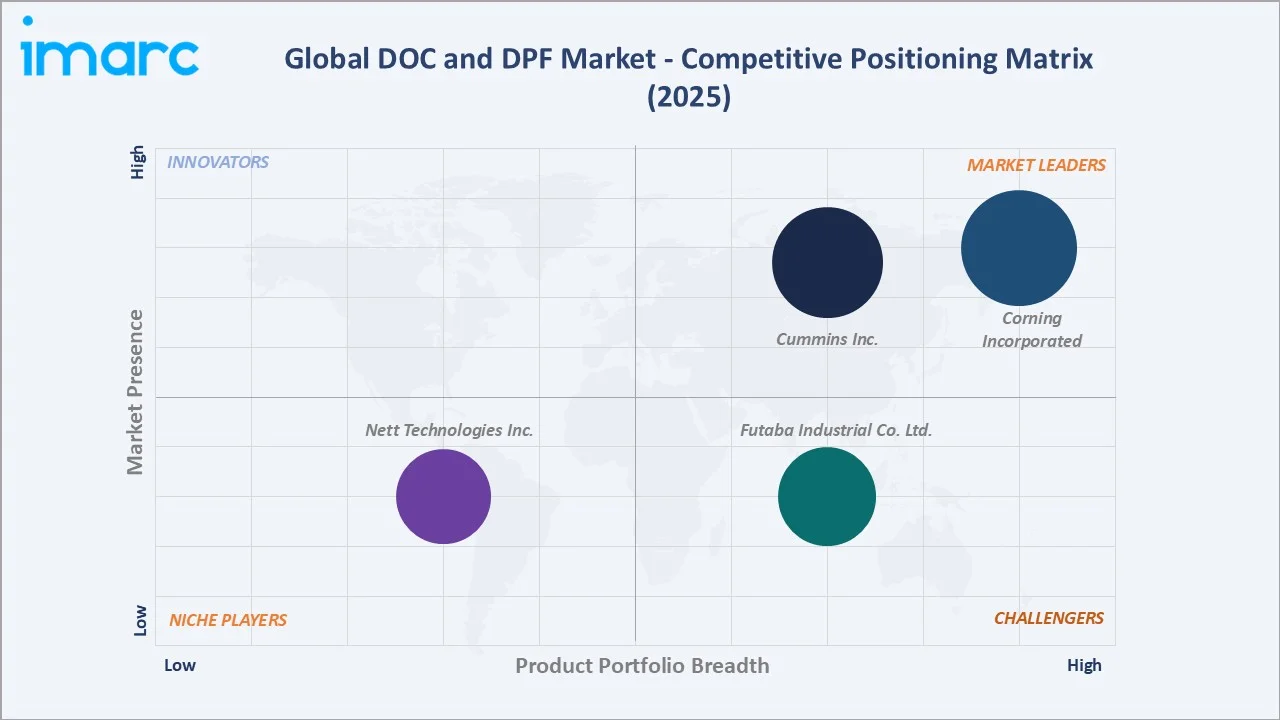
The global DOC and DPF market competitive landscape is moderately consolidated, led by established ceramic substrate manufacturers, catalyst technology specialists, and Tier-1 exhaust system integrators. Companies compete on filtration efficiency, thermal durability, catalyst coating technology, and long-term OEM supply relationships across passenger and commercial vehicle platforms worldwide.
|
Company Name |
Key Products |
Market Position |
Core Strength |
|
Corning Incorporated |
DuraTrap AT/AC/RC filters, Celcor substrates |
Market Leader |
Corning Incorporated specializes in advanced ceramic substrate and diesel particulate filter materials science. |
|
Cummins Inc. |
Cummins Particulate Filter, Modular Aftertreatment System |
Market Leader |
Cummins Inc. is a leading integrator of complete DOC, DPF, and SCR aftertreatment systems for diesel engines. |
|
Futaba Industrial Co. Ltd. |
Exhaust manifolds, catalytic converters |
Strong Challenger |
Futaba Industrial Co. Ltd. specializes in exhaust manifold and catalytic converter manufacturing for OEMs. |
|
Nett Technologies Inc. |
Diesel oxidation catalysts, retrofit DPF systems |
Niche Player |
Nett Technologies Inc. focuses on retrofit diesel oxidation catalyst and particulate filter solutions. |
Key players include Corning Incorporated, Cummins Inc., Futaba Industrial Co. Ltd., Nett Technologies Inc., and others.
Key Company Profiles
Corning Incorporated
Corning Incorporated is a US-based materials science company and a leading global supplier of ceramic substrates and diesel particulate filters for automotive emission-control applications.
- Key Products: DuraTrap AT, DuraTrap AC, and DuraTrap RC diesel particulate filters; Celcor ceramic substrates.
- Strategic Focus: Advancing thermally durable filter materials and expanding manufacturing footprint across North America, Europe, and Asia to meet rising DOC and DPF demand.
Cummins Inc.
Cummins Inc. is a US-based power solutions company whose Cummins Emission Solutions division designs integrated diesel oxidation catalyst and particulate filter aftertreatment systems for on- and off-highway diesel engines.
- Key Products: Cummins Particulate Filter, Modular Aftertreatment System, DOC and DPF combination units.
- Strategic Focus: Expanding electric-heater-assisted aftertreatment technology to improve DOC and DPF performance under stricter future diesel emission regulations.
Market Concentration Analysis
The DOC and DPF market is moderately concentrated at the Tier-1 supply level, with the top three key players holding leading positions through established OEM relationships and advanced catalyst technology. Smaller regional players compete through cost-competitive manufacturing and aftermarket retrofit supply, particularly across price-sensitive emerging markets where localized production offers a distinct cost advantage. Consolidation activity is expected to continue as leading suppliers seek to broaden their technology portfolios and regional manufacturing footprints ahead of successive emission-standard transitions.
Investment & Growth Opportunities
Highest Growth Segments
DPF technology (~5.7% CAGR) and HCV deployment (~5.9% CAGR) represent the highest-growth segments through 2034, driven by mandatory particulate filtration mandates and sustained heavy-duty diesel fleet expansion across Asia-Pacific and Latin America commercial vehicle markets.
Emerging Investment Opportunities
Aftermarket retrofit programs for aging diesel fleets represent a high-value opportunity, particularly across Asia-Pacific and Latin America, where regulatory tightening is driving replacement demand for compliant DOC and DPF emission-control components.
Investment Themes
- Low-PGM catalyst washcoat innovation: Reducing platinum-group metal loading through advanced washcoat formulation as a structural cost advantage through 2034, protecting supplier margins against raw material price volatility while sustaining regulatory-compliant filtration and oxidation performance across vehicle platforms.
- Emerging market retrofit program investment: Government-backed diesel fleet retrofit programs across Asia-Pacific and Latin America, capturing the world’s fastest-growing aftermarket DOC and DPF replacement volume as regulatory bodies expand mandatory compliance timelines for in-use commercial fleets.
Future Market Outlook (2026-2034)
The global DOC and DPF market is projected to grow from USD 22.85 Billion in 2025 to USD 29.67 Billion by 2030 and USD 36.55 Billion by 2034, delivering a 5.36% CAGR. Continued tightening of global diesel emission standards, combined with sustained commercial vehicle demand, will support steady long-term market expansion despite gradual electrification in select developed markets.
Three structural forces define DOC and DPF market growth through 2034: sustained heavy-duty diesel commercial vehicle production in emerging markets, successive tightening of global particulate and NOx emission standards, and expanding aftermarket retrofit demand for aging diesel fleets across Asia-Pacific and Latin America. Together, these forces are expected to outweigh the gradual erosion of the diesel passenger vehicle base in developed economies, sustaining a mid-single-digit growth trajectory for the market through the end of the forecast period.
Suppliers that combine cost-competitive manufacturing scale with advanced low-PGM catalyst formulation capability are best positioned to capture disproportionate share of this growth, particularly as OEMs consolidate their aftertreatment sourcing around fewer, more technologically capable Tier-1 partners over the coming decade.
Research Methodology
Primary Research
Primary research comprised structured interviews with industry stakeholders, including OEM engineers, Tier-1 exhaust system suppliers, and regulatory compliance experts across major diesel vehicle-producing regions worldwide, providing qualitative validation of segment-level growth assumptions.
Secondary Research
Secondary research encompassed company annual reports, regulatory agency publications including EPA and Euro emission standards, industry association data, and trade publications covering diesel aftertreatment technology and regional vehicle production trends. Historical shipment and fitment-rate data were cross-verified across multiple independent sources to ensure consistency before being incorporated into the final market model.
Forecasting Models
Market revenue forecasts were developed using a vehicle production-based bottom-up model, incorporating global diesel vehicle production forecasts by deployment category, DOC and DPF fitment rates, and regional emission-regulation timelines to derive segment- and region-level projections through 2034.
Report Coverage:
| Report Features | Details |
|---|---|
| Base Year of the Analysis | 2025 |
| Historical Period | 2020-2025 |
| Forecast Period | 2026-2034 |
| Units | Billion USD |
| Scope of the Report | Exploration of Historical Trends and Market Outlook, Industry Catalysts and Challenges, Segment-Wise Historical and Predictive Market Assessment:
|
| Types Covered | DOC, DPF |
| Applications Covered | HCVs, MCVs, LCVs, Passenger Cars |
| Regions Covered | North America, Asia Pacific, Europe, Latin America, Middle East and Africa |
| Countries Covered | United States, Canada, Germany, France, United Kingdom, Italy, Spain, Russia, China, Japan, India, South Korea, Australia, Indonesia, Brazil, Mexico |
| Companies Covered | Corning Incorporated, Cummins Inc., Futaba Industrial Co. Ltd., Nett Technologies Inc., etc. |
| Customization Scope | 10% Free Customization |
| Post-Sale Analyst Support | 10-12 Weeks |
| Delivery Format | PDF and Excel through Email (We can also provide the editable version of the report in PPT/Word format on special request) |
Key Benefits for Stakeholders:
- IMARC’s report offers a comprehensive quantitative analysis of various market segments, historical and current market trends, market forecasts, and dynamics of the DOC and DPF market from 2020-2034.
- The research study provides the latest information on the market drivers, challenges, and opportunities in the global DOC and DPF market.
- The study maps the leading as well as the fastest growing regional markets. It further enables stakeholders to identify the key country-level markets within each region.
- Porter's five forces analysis assist stakeholders in assessing the impact of new entrants, competitive rivalry, supplier power, buyer power, and the threat of substitution. It helps stakeholders to analyze the level of competition within the DOC and DPF industry and its attractiveness.
- Competitive landscape allows stakeholders to understand their competitive environment and provides an insight into the current positions of key players in the market.
Frequently Asked Questions About the DOC and DPF Market Report
The global DOC and DPF market reached USD 22.85 Billion in 2025, driven by mandatory particulate filtration and emission-control regulations across diesel commercial and passenger vehicle platforms worldwide.
The DOC and DPF market grows at a 5.36% CAGR during 2026-2034, reaching USD 36.55 Billion by 2034, reflecting sustained diesel emission-control regulatory tightening globally.
DPF leads at 56.0% share, reflecting mandatory particulate filtration requirements across nearly all new diesel vehicles under global emission compliance standards.
HCVs lead at 27.0% share due to larger engine displacement, higher soot output, and stricter heavy-duty diesel emission compliance requirements globally.
Asia-Pacific leads at 32.0% share through China and India’s large diesel commercial vehicle fleets and expanding regional emission-compliance infrastructure investment.
Leading companies include Corning Incorporated, Cummins Inc., Futaba Industrial Co. Ltd., Nett Technologies Inc., and others.
The DOC and DPF market is projected to reach approximately USD 29.67 Billion by 2030, with SCR-integrated combination systems becoming a standard specification across heavy-duty diesel platforms.
Two priority investment opportunities: low-PGM catalyst washcoat innovation to reduce raw material cost exposure, and emerging-market diesel fleet retrofit program investment across Asia-Pacific and Latin America.
Need more help?
- Speak to our experienced analysts for insights on the current market scenarios.
- Include additional segments and countries to customize the report as per your requirement.
- Gain an unparalleled competitive advantage in your domain by understanding how to utilize the report and positively impacting your operations and revenue.
- For further assistance, please connect with our analysts.
 Request Customization
 Speak to an Analyst
 Request Brochure
 Inquire Before Buying
Benefits of Customization
- Personalize this research
- Triangulate with your data
- Get data as per your format and definition
- Gain a deeper dive into a specific application, geography, customer, or competitor
- Any level of personalization
Get in Touch With Us
UNITED STATES
Phone: +1-201-971-6302
INDIA
Phone: +91-120-433-0800
UNITED KINGDOM
Phone: +44-753-714-6104
Email: [email protected]
Client Testimonials




.webp)




.webp)













Related Reports

Choose your plan
*Please note that the prices mentioned below are starting prices for each bundle type. Kindly contact our team for further details.*
Single User License
- 1 User License, Access on 2 Devices
- PDF Report + Excel Dataset (Password Protected)
- Lifetime Access
- No Printing Rights
- 10% Free Report Customization
- 10–12 Weeks of Analyst Support
Five User License
- Access for 5 Users, 2 Devices per User
- PDF Report + Excel Dataset (Password Protected)
- Lifetime Access
- Dedicated Account Manager
- 12–14 Weeks of Analyst Support
- No Printing Rights
- 15% Free Report Customization
- 25% Discount on Your Next Purchase
Corporate User License
- Unlimited User Access (Within Your Organization)
- PDF Report + Excel Dataset
- Lifetime Access
- Dedicated Account Manager
- 14–20 Weeks of Analyst Support
- No Printing Rights
- 20% Free Report Customization
- 30% Discount on Your Next Purchase
Essential Insights
What's included:
3 reports
- Lifetime Access
- PDF Reports
- Excel Datasets
- 2 Weeks of Free Analyst Support
- 2 User Licenses
- Access on 2 Devices
- Printing Rights
- Complimentary PowerPoint (PPT) Version
- Complimentary License Upgrade
Professional Access
What's included:
5 reports
- Lifetime Access
- PDF Reports
- Excel Datasets
- 8 Weeks of Free Analyst Support
- 2 User Licenses
- Access on 2 Devices
- Printing Rights
- Complimentary PowerPoint (PPT) Version
- Complimentary License Upgrade
Business Advantage
What's included:
8 reports
- Lifetime Access
- PDF Reports
- Excel Datasets
- 14 Weeks of Free Analyst Support
- 2 User Licenses
- Access on 2 Devices
- Printing Rights
- Complimentary PowerPoint (PPT) Version
- Complimentary License Upgrade
Enterprise Intelligence
What's included:
10 reports
- Lifetime Access
- PDF Reports
- Excel Datasets
- 20 Weeks of Free Analyst Support
- 2 User Licenses
- Access on 2 Devices
- Printing Rights
- Complimentary PowerPoint (PPT) Version
- Complimentary License Upgrade