
Europe Aluminium Cans Market Size, Share, Trends and Forecast by Application and Country, 2026-2034
Europe Aluminium Cans Market Size, Share, Trends & Forecast (2026-2034)
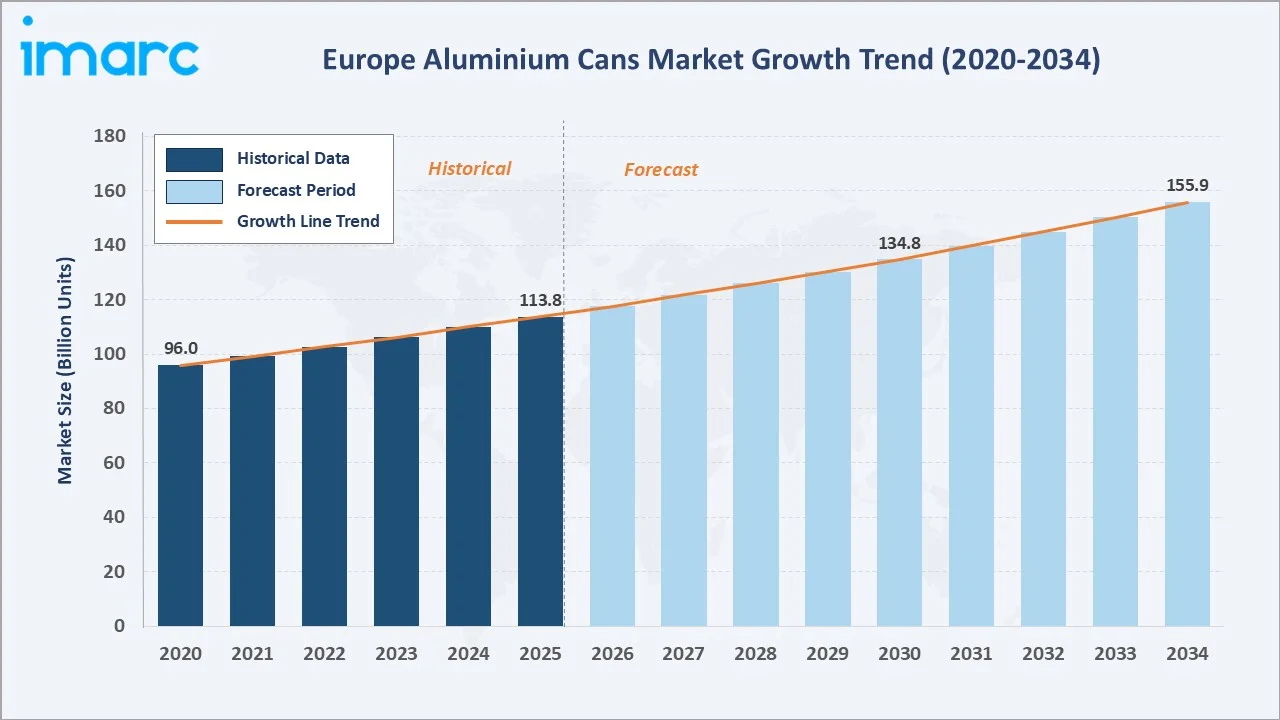
The Europe aluminium cans market reached 113.8 Billion Units in 2025 and is projected to reach 155.9 Billion Units by 2034, expanding at a CAGR of 3.46% during 2026-2034. Rising preference for sustainable and infinitely recyclable packaging, coupled with growing canned beverage consumption across Europe, and product innovation in easy-open and resealable can formats are the primary growth catalysts.
Market Snapshot
|
Metric |
Value |
|
Market Size (2025) |
113.8 Billion Units |
|
Forecast Market Size (2034) |
155.9 Billion Units |
|
CAGR (2026-2034) |
3.46% |
|
Base Year |
2025 |
|
Historical Period |
2020-2025 |
|
Forecast Period |
2026-2034 |
Germany leads the Europe aluminium cans landscape, holding a 24.8% share in 2025, anchored by the country's large beverage manufacturing base and strong recycling infrastructure. Beverages command the largest share of the application segment at 82.6%, reflecting sustained demand for canned carbonated soft drinks, beer, and energy drinks across the region.
To get more information on this market, Request Sample
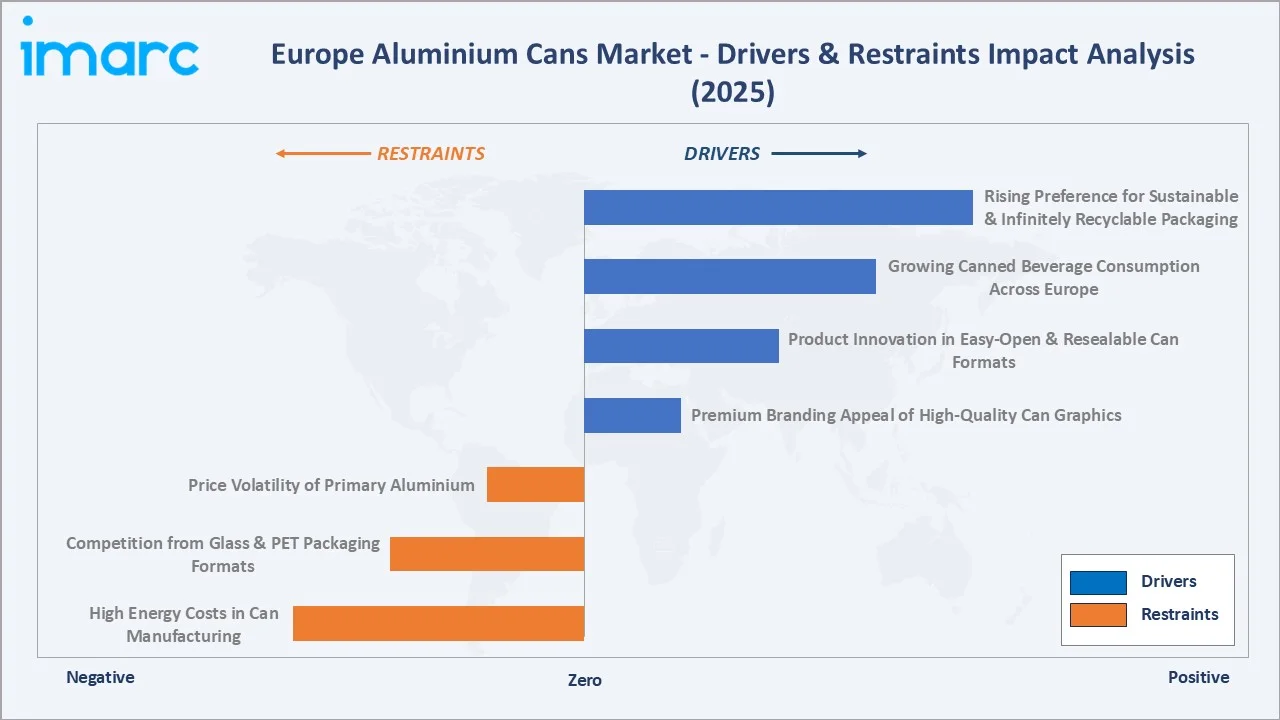
The Europe aluminium cans market is underpinned by three structural forces: rising preference for sustainable and infinitely recyclable packaging, growing canned beverage consumption across Europe, and product innovation in easy-open and resealable can formats. Each force independently reinforces category growth, sustaining steady CAGR expansion through 2034 despite price volatility of primary aluminium.
Executive Summary
The Europe aluminium cans market is experiencing steady expansion, driven by rising sustainability preferences, growing canned beverage consumption, and continuous packaging innovation. The market was valued at 113.8 Billion Units in 2025 and is forecast to reach 155.9 Billion Units by 2034, growing at a CAGR of 3.46%.
Beverages dominate the application segment with an 82.6% share in 2025, encompassing carbonated soft drinks, beer, juices, and energy drinks, while food accounts for 11.4% and others 6.0%, reflecting aluminium cans' broader use across vegetables, soups, and pet food packaging.
Germany leads at 24.8%, anchored by the country's large beverage manufacturing base and strong recycling infrastructure, followed by the United Kingdom (19.6%), France (15.8%), Italy (12.4%), Spain (10.2%), and Others (17.2%). Leading manufacturers collectively shaping the industry's innovation roadmap through continuous capacity expansion and sustainability investment.
Key Market Insights
|
Insight |
Data |
|
Largest Application Segment |
Beverages – 82.6% share (2025) |
|
Fastest Growing Application Segment |
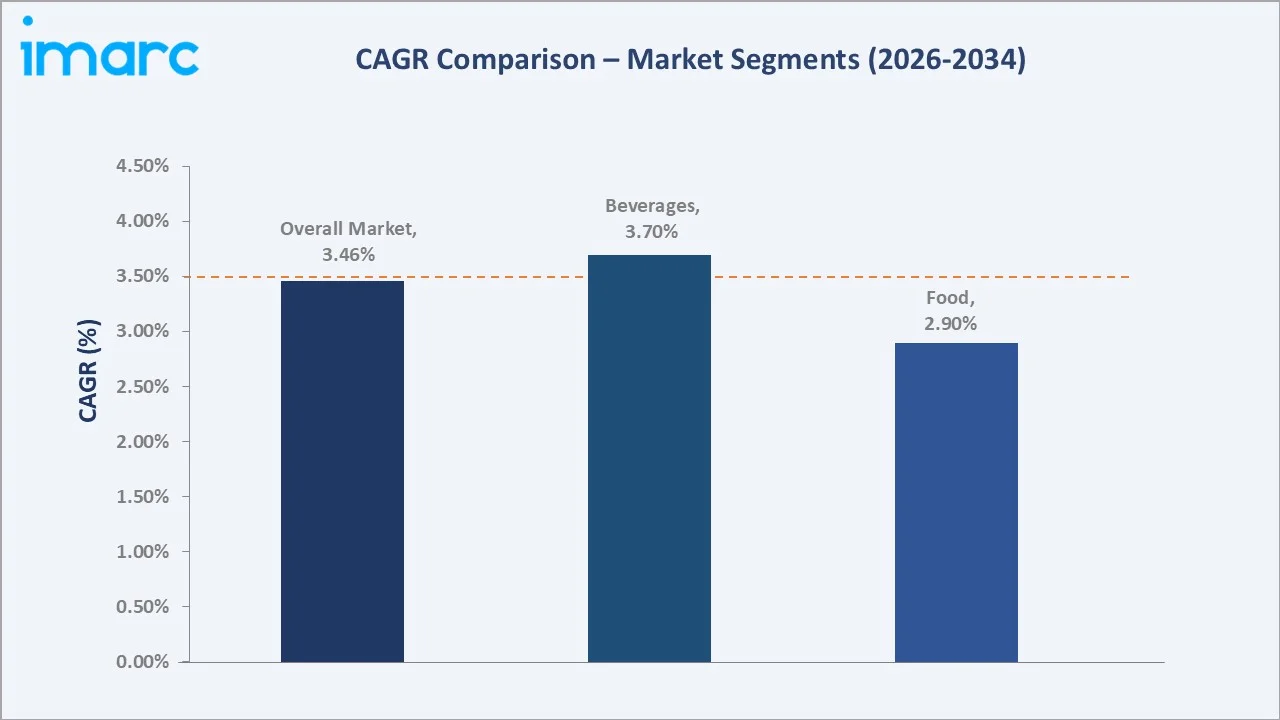
Beverages – ~3.7% CAGR (2026-2034) |
|
Leading Country |
Germany – 24.8% share (2025) |
|
Top Companies |
Ball Corporation, Crown Holdings, Inc., Ardagh Holdings S.A., CANPACK S.A., Trivium Packaging |
Key Analytical Observations Supporting The Above Data:
- Beverages account for 82.6% of the Europe aluminium cans market in 2025. This dominance reflects sustained demand for canned carbonated soft drinks, beer, and energy drinks.
- Food application is expanding steadily at 11.4% share (2025), as canned vegetables, soups, and pet food gain traction for their shelf stability and convenience.
- Germany's 24.8% share (2025) reflects the country's large beverage manufacturing base and strong recycling infrastructure supporting a circular packaging economy.
- The United Kingdom's 19.6% share (2025) positions it as the second-largest market, supported by strong canned beverage retail demand.
- Rising adoption of sustainable, infinitely recyclable packaging is broadening the addressable market across beverage, food, and specialty applications.
Europe Aluminium Cans Market Overview
The Europe aluminium cans market encompasses beverage, food, and other application cans built from primary and recycled aluminium sheet, offering lightweight, durable, and infinitely recyclable packaging solutions for beverage, food, and specialty consumer products. The aluminium cans ecosystem spans raw material suppliers, can body and end manufacturers, and an expanding distribution network across wholesalers, retailers, and direct-to-brand supply channels.
Macroeconomic drivers include rising preference for sustainable and infinitely recyclable packaging, growing canned beverage consumption across Europe, and product innovation in easy-open and resealable can formats. Manufacturers are simultaneously investing in premium branding capabilities and lightweight can design to improve product appeal, positioning the Europe aluminium cans sector for continued innovation-led growth through 2034 despite price volatility of primary aluminium.
Market Dynamics
To evaluate market opportunities, Request Sample
Market Drivers
- Rising Preference for Sustainable & Infinitely Recyclable Packaging: Growing consumer and regulatory emphasis on circular-economy packaging is driving sustained aluminium can adoption throughout beverage and food sectors. The Circular Economy Act in EU is expected to improve resource security, competitiveness, and decarbonization, with circular measures potentially delivering 20–25% of the emissions reductions required for climate neutrality by 2050.
- Growing Canned Beverage Consumption Across Europe: Rising demand for carbonated soft drinks, beer, and energy drinks in convenient can formats is accelerating market growth across the region. The United Kingdom soft drinks market recorded a strong performance in 2025, reaching a record value of GBP 26.3 billion, according to the British Soft Drinks Association’s Annual Industry Insights Report.
- Product Innovation in Easy-Open & Resealable Can Formats: Manufacturers are developing consumer-friendly can designs that improve convenience and reduce spillage, broadening adoption across use cases.
- Premium Branding Appeal of High-Quality Can Graphics: Rising brand investment in high-quality can printing and decoration is enhancing shelf appeal and driving premiumization across the category.
Market Restraints
- Price Volatility of Primary Aluminium: European aluminum premiums rose sharply amid high energy costs, reduced smelter output, and supply disruptions, despite continued weakness in downstream demand. North German billet premiums increased to USD 1,175–1,250 per ton in May 2026 from USD 560–600 in February, while Rotterdam P1020A premiums climbed to USD 565–605 per ton.
- Competition from Glass & PET Packaging Formats: Alternative packaging materials continue to compete for beverage and food packaging share, constraining aluminium cans' addressable market in certain segments.
- High Energy Costs in Can Manufacturing: Europe’s heatwave sharply increased electricity demand, with prices exceeded EUR 545/MWh in Germany and EUR 268/MWh in France, while Britain paid about GBP 470/MWh for imported electricity during peak hours. Elevated energy prices across Europe are increasing production costs for can manufacturers, creating cost pressure amid competitive pricing dynamics.
Market Opportunities
- EU Circular Economy Policy Support Expansion: Rising regulatory support for recyclable packaging presents opportunities for aluminium can manufacturers to capture share from less sustainable formats.
- Premium Can Branding & Graphics Innovation: Growing brand demand for differentiated can designs creates opportunities for specialty printing and decoration technology providers.
- Food Can Application Expansion: Rising food packaging adoption of aluminium cans for vegetables, soups, and pet food offers manufacturers new category diversification opportunities.
Market Challenges
- Balancing Cost and Sustainability: Manufacturers must balance raw material and energy costs with the need to deliver sustainable, high-quality can packaging.
- Addressing Recycling Infrastructure Consistency: Ensuring consistent, high-capture recycling infrastructure across diverse European markets requires ongoing investment and coordination.
Emerging Market Trends
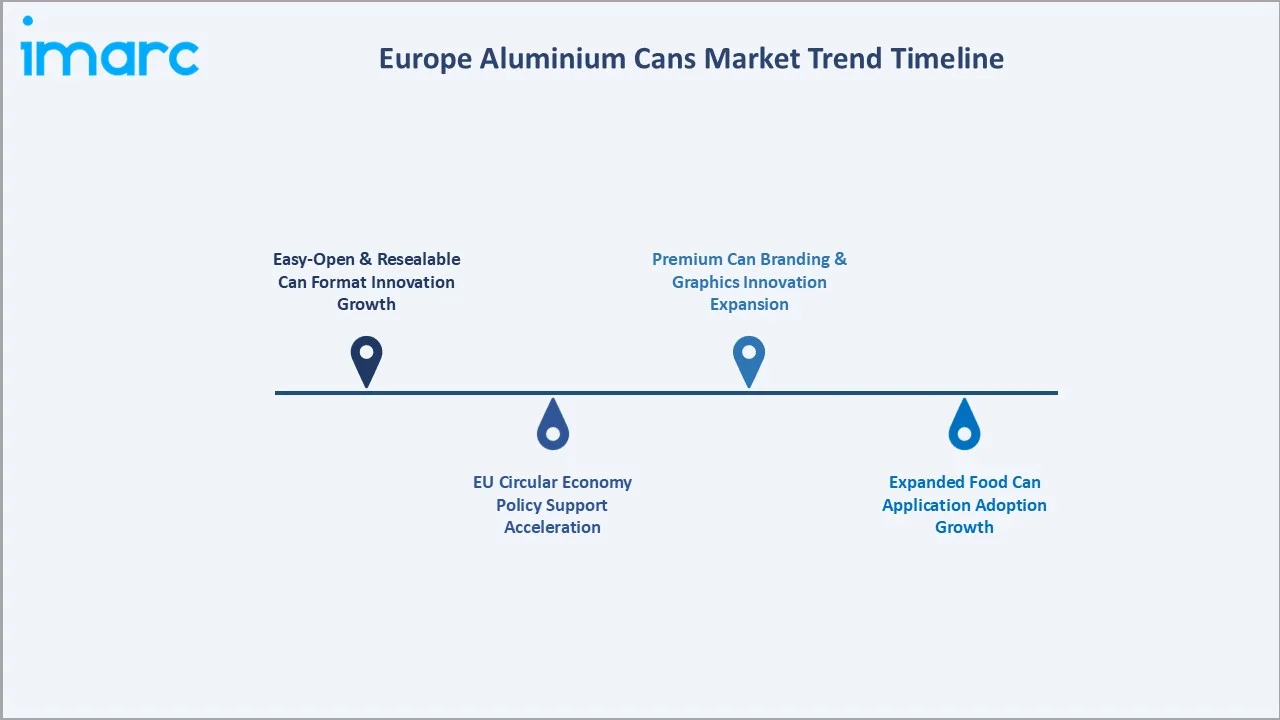
1. Easy-Open & Resealable Can Format Innovation Growth
Manufacturers are increasingly developing easy-open and resealable can formats, responding to rising consumer demand for convenience and reduced product spillage. In June 2026, Canovation and CANPACK announced a collaboration to advance the patented CanReseal all-aluminum, resealable can-end technology toward pilot-line production and commercial readiness.
2. EU Circular Economy Policy Support Acceleration
The EU’s Packaging and Packaging Waste Regulation establishes lifecycle-wide requirements for packaging design, composition, reuse, recycling, and waste prevention, with general application beginning on August 12, 2026. It aims to make all packaging placed on the EU market economically recyclable by 2030, increase recycled plastic use, and reduce reliance on virgin raw materials.
3. Premium Can Branding & Graphics Innovation Expansion
The high-quality lithographic printing combined with embossing and debossing directly on aluminum surfaces, enables premium, design-led packaging with strong shelf appeal. Advanced decoration technologies, including full-color digital printing, special varnishes, tactile finishes, and high-definition graphics, are helping brands create differentiated and personalized can designs.
4. Expanded Food Can Application Adoption Growth
Growing food packaging sector adoption of aluminium cans for vegetables, soups, and pet food is broadening market reach beyond traditional beverage applications. In September 2025, Dozz launched the UK’s first chilled, ready-to-eat soup packaged in a 100% recyclable aluminum can, designed for consumption straight from the pack without heating or utensils.
Industry Value Chain Analysis
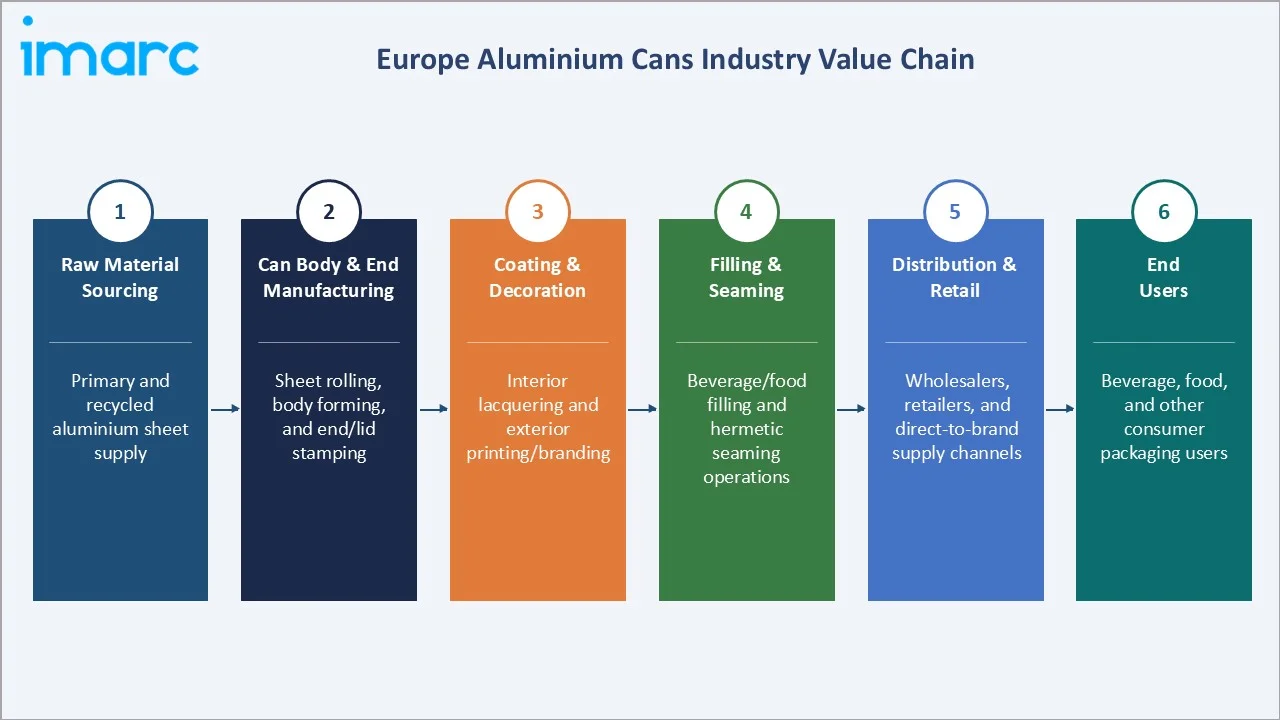
The Europe aluminium cans value chain spans raw material sourcing through end-user delivery, with each stage occupied by specialized aluminium suppliers, can manufacturing specialists, and distribution partners whose performance directly influences packaging quality, cost efficiency, and sustainability outcomes.
|
Stage |
Key Activities |
|
Raw Material Sourcing |
Primary and recycled aluminium sheet supply |
|
Can Body & End Manufacturing |
Sheet rolling, body forming, and end/lid stamping |
|
Coating & Decoration |
Interior lacquering and exterior printing/branding |
|
Filling & Seaming |
Beverage/food filling and hermetic seaming operations |
|
Distribution & Retail |
Wholesalers, retailers, and direct-to-brand supply channels |
|
End Users |
Beverage, food, and other consumer packaging users |
Technology Landscape in the Europe Aluminium Cans Industry
Advanced Lightweighting & Material Efficiency Technology
Manufacturers are advancing lightweighting technology to reduce aluminium content per can while maintaining structural integrity, supporting broader sustainability and cost-efficiency objectives. Thinner gauge alloy development using AA3004 and AA3104 aluminium series with optimized temper specifications is enabling European can manufacturers to reduce body wall thickness below 0.095 mm and end gauge below 0.200 mm.
Sustainable Coating & Lacquer Development
Growing investment in BPA-free and eco-friendly interior coating technology is expanding regulatory compliance capabilities, addressing rising consumer and brand demand for safer packaging materials. Acrylic and polyester-based BPA-NI (non-intent) interior lacquer systems and water-based exterior coating formulations are being qualified across European can lines in compliance with EU Regulation 10/2011 on plastic materials in food contact.
Premium Printing & Decoration Systems
Providers are engineering advanced digital and offset printing systems to extend adoption across demanding premium branding and limited-edition packaging applications. High-definition 8-colour wet-on-wet UV offset printing technology and tactile varnish application systems are enabling European can decorators to achieve photographic image resolution, metallic finish effects, and textured surface treatments.
Recycling & Circular Economy Infrastructure Innovation
Expanding investment in recycling infrastructure and closed-loop aluminium sourcing is strengthening the category's sustainability credentials, supporting premium positioning across environmentally conscious brand portfolios. Deposit return scheme expansion across Germany, Sweden, the Netherlands, and emerging EU member state implementations is driving aluminium can collection rates above 90% in leading markets.
Market Segmentation Analysis
The report covers the following segments:
|
Segment Category |
Leading Segment |
Market Share |
Year |
|
Application |
Beverages |
82.6% |
2025 |
|
Country |
Germany |
24.8% |
2025 |

By Application
Beverages dominate with a 82.6% share in 2025. This segment encompasses carbonated soft drinks, beer, juices, and energy drinks, supported by sustained demand for aluminium cans' portability, chill retention, and recyclability.
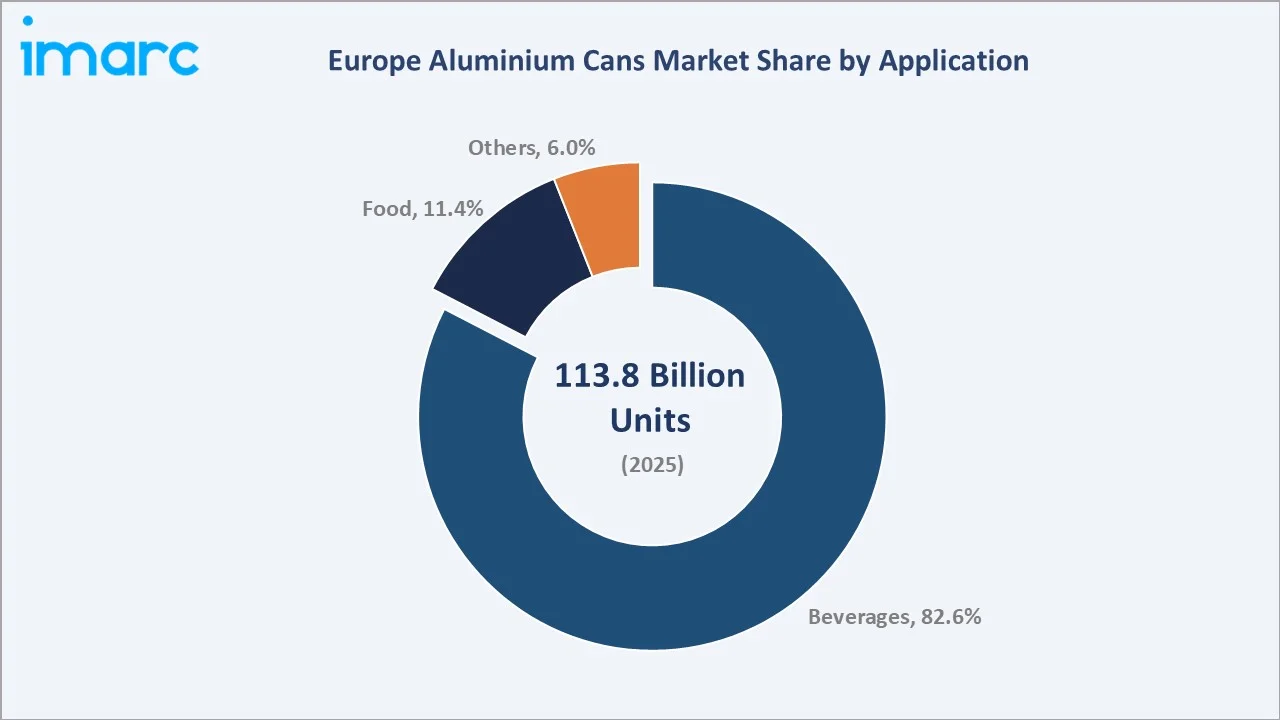
Food represents 11.4% (2025) of the market, followed by others at 6.0%, reflecting aluminium cans' growing use across vegetables, soups, pet food, and specialty non-beverage packaging applications.
Regional Market Insights
Germany's market leadership (24.8%, 2025) reflects the country's large beverage manufacturing base, strong recycling infrastructure, and supportive circular economy policy environment. Growing canned beverage consumption and expanding sustainable packaging investment combine to sustain its dominant position through 2034.
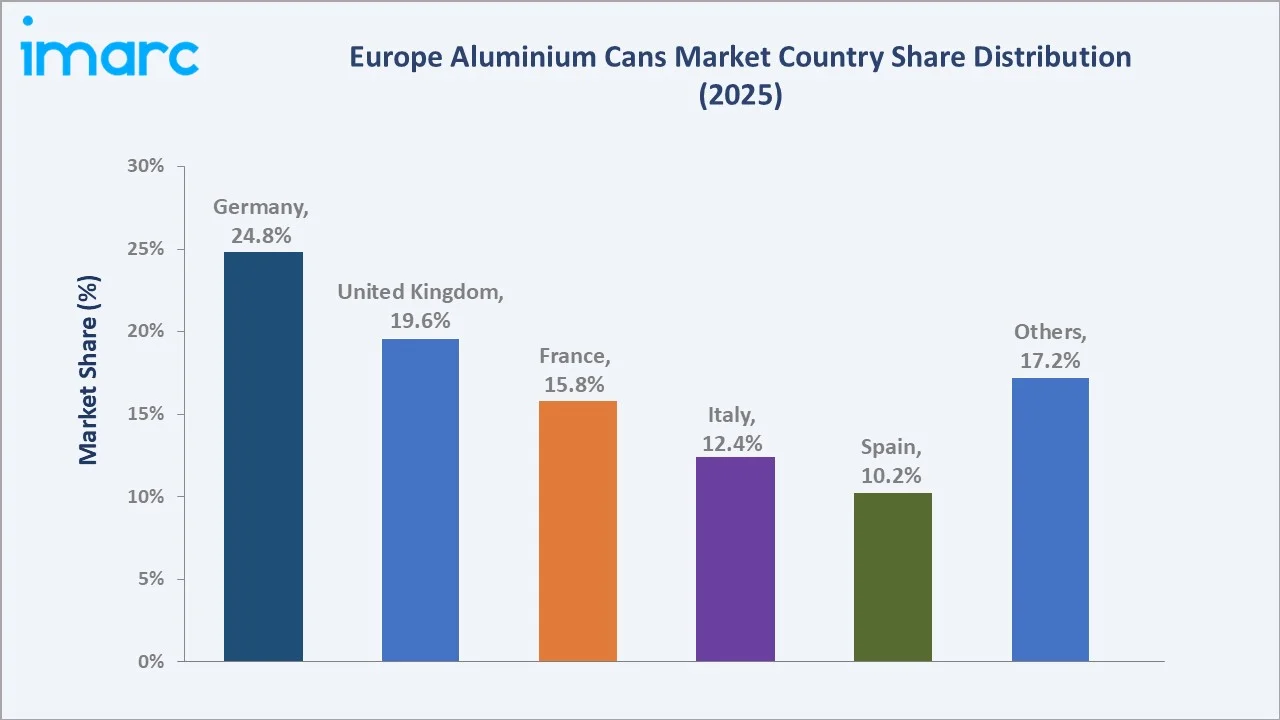
The United Kingdom at 19.6% (2025) represents the second-largest aluminium cans market regionally. Strong canned beverage retail demand and expanding sustainable packaging adoption are sustaining steady growth, positioning the country as a key contributor alongside Germany through the forecast period.
|
Country |
Share (2025) |
Key Growth Drivers |
|
Germany |
24.8% |
Large beverage manufacturing base and strong recycling infrastructure |
|
United Kingdom |
19.6% |
Strong canned beverage retail demand and expanding sustainable packaging adoption |
|
France |
15.8% |
Growing premium beverage packaging demand and supportive recycling policy |
|
Italy |
12.4% |
Rising canned beverage consumption and expanding food can applications |
|
Spain |
10.2% |
Growing beverage export capacity and expanding domestic can manufacturing |
|
Others |
17.2% |
Emerging Central and Eastern European beverage and food packaging demand |
Competitive Landscape
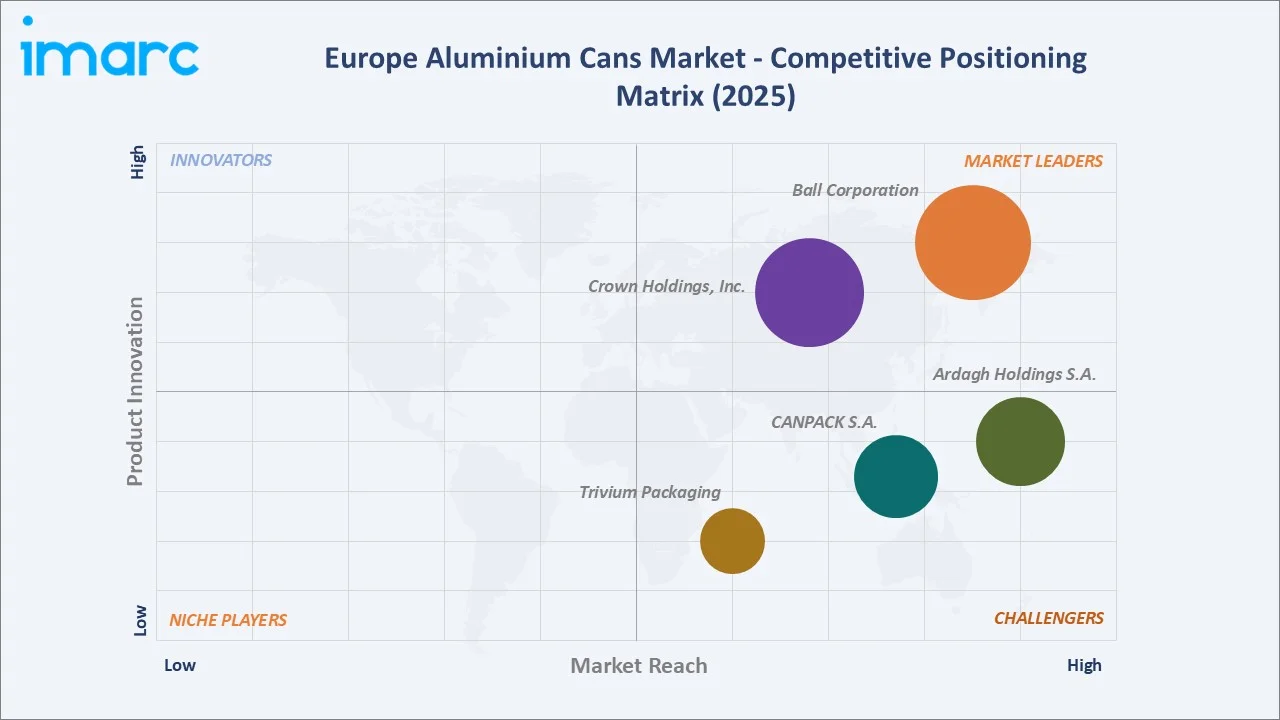
The Europe aluminium cans market exhibits moderate to high concentration, with leading manufacturers collectively holding a significant share of market volume in 2025, reflecting sustained investment in capacity expansion and distribution reach.
|
Company Name |
Brand Name |
Market Position |
Core Strength |
|
Ball Corporation |
Ball |
Market Leader |
Global can manufacturing leadership and extensive European production footprint |
|
Crown Holdings, Inc. |
Crown |
Market Leader |
Diversified metal packaging platform and integrated beverage can capabilities |
|
Ardagh Holdings S.A. |
Ardagh |
Strong Challenger |
Advanced metal and glass packaging expertise and broad European presence |
|
CANPACK S.A. |
Canpack |
Strong Challenger |
Specialty can manufacturing and regional distribution strength |
|
Trivium Packaging |
Trivium |
Challenger |
Diversified metal packaging portfolio and sustainability positioning |
Ball Corporation and Crown Holdings, Inc. dominate through comprehensive global product portfolios and extensive European distribution capacity, supported by continuous capacity investment. Ardagh Holdings S.A., CANPACK S.A., and Trivium Packaging compete through targeted premium positioning, regional manufacturing strength, and sustainable material supply differentiation, respectively.
Key Company Profiles
Ball Corporation
Ball Corporation is one of the leading global aluminium can manufacturers with an extensive European production footprint spanning beverage and specialty can formats distributed across a vast regional and global customer base.
- Product Portfolio: Beverage cans including standard, sleek, slim, and king; specialty can formats; and integrated sustainable packaging solutions under the Ball brand.
- Recent Developments: In December 2025, Ball Corporation agreed to acquire an 80% stake in Benepack’s European beverage-can business for approximately EUR 184 million, covering production facilities in Belgium and Hungary. The acquisition strengthens Ball’s manufacturing footprint across Western and Eastern Europe and supports growing demand for recyclable aluminum beverage packaging.
- Strategic Focus: Strengthening lightweighting and recycling innovation; expanding can production capacity across emerging application segments.
Crown Holdings, Inc.
Crown Holdings, Inc. is one of the leading diversified metal packaging companies with a strong integrated beverage can platform serving retail, food, and beverage markets across Europe and globally.
- Product Portfolio: Beverage cans, round food cans, and integrated metal packaging solutions.
- Recent Developments: In July 2026, Crown Holdings, Inc. reported second-quarter net sales of USD 3.67 billion, supported by a 5% rise in global beverage can volumes. Global beverage can volumes increased 5% in Q2 2026, supported by gains of 7% in Europe.
- Strategic Focus: Scaling integrated metal packaging capabilities; deepening beverage and food distribution partnerships.
Market Concentration Analysis
The Europe aluminium cans market exhibits moderate to high concentration, with Ball Corporation, Crown Holdings, Inc., and Ardagh Holdings S.A. collectively accounting for a significant share of total category volume in 2025, reflecting sustained capacity investment, brand loyalty, and extensive distribution infrastructure across the region.
Consolidation pressure remains moderate as leading manufacturers maintain distinct strategic positioning: Ball Corporation and Crown Holdings, Inc. through comprehensive multi-category portfolios, Ardagh Holdings S.A. and CANPACK S.A. through regional manufacturing and metal-glass diversification positioning, and Trivium Packaging through specialty and sustainable material differentiation, alongside selective M&A activity strengthening regional production capacity.
Investment & Growth Opportunities
Fastest Growing Segments
Beverages (~3.7% CAGR) represent the highest-growth investment vector through 2034, driven by expanding canned beverage consumption and continuous innovation across easy-open and resealable can formats. This subcategory addresses a rapidly expanding addressable market within the Europe aluminium cans ecosystem.
Emerging Market Expansion
Central and Eastern European markets collectively represent an incremental growth opportunity beyond Germany, the United Kingdom, France, Italy, and Spain by 2034, as rising beverage consumption and expanding recycling infrastructure accelerate category penetration in these regional markets.
Venture and Institutional Investment Trends
- Manufacturer investment toward lightweighting and recycling technology is creating opportunities for technology vendors serving the aluminium cans sector.
- Growing food can application demand is sustaining institutional interest in specialty can manufacturing platforms.
- Sustainable coating and printing innovation, led by major manufacturers, is opening opportunities for component and technology vendors serving the Europe aluminium cans industry.
Future Market Outlook (2026-2034)
The Europe aluminium cans market is positioned for steady, sustainability-driven expansion through 2034. From a base of 113.8 Billion Units in 2025, the market is projected to reach 155.9 Billion Units by 2034, representing substantial incremental volume growth at a CAGR of 3.46%. This growth is underpinned by rising sustainability preferences, growing canned beverage consumption, and continuous packaging innovation.
The application segment will continue evolving through 2034, with beverages gaining further share as sustainable packaging preferences and can format innovation accelerate. This shift creates opportunities for manufacturers investing in lightweighting technology, recycling infrastructure, and premium branding capabilities to capture the next phase of the Europe aluminium cans market growth.
Research Methodology
Primary Research
Primary research comprised structured interviews with industry participants across 2024-2025, including can manufacturer executives, beverage and food packaging procurement managers, sustainability specialists, and recycling infrastructure analysts across major European markets. Expert input validated market sizing, segmentation trends, and regional consumption patterns.
Secondary Research
Secondary research encompassed manufacturer annual reports, metal packaging industry association publications, and sustainability trade press covering packaging innovation, regulatory trends, and regional market dynamics across major markets.
Forecasting Models
Market size estimations were derived using top-down and bottom-up forecasting, incorporating application segment transitions and manufacturer capacity disclosures. A base-case CAGR of 3.46% reflects consensus estimates validated against announced capacity investment timelines and manufacturer strategic development plans.
Europe Aluminium Cans Market Report Coverage:
| Report Features | Details |
|---|---|
| Base Year of the Analysis | 2025 |
| Historical Period | 2020-2025 |
| Forecast Period | 2026-2034 |
| Units | Billion Units |
| Scope of the Report | Exploration of Historical Trends and Market Outlook, Industry Catalysts and Challenges, Segment-Wise Historical and Future Market Assessment:
|
| Applications Covered | Beverages, Food, and Others |
| Countries Covered | Germany, France, United Kingdom, Italy, Spain, Others |
| Companies Covered | Ball Corporation, Crown Holdings, Inc., Ardagh Holdings S.A., CANPACK S.A., Trivium Packaging, etc. |
| Customization Scope | 10% Free Customization |
| Post-Sale Analyst Support | 10-12 Weeks |
| Delivery Format | PDF and Excel through Email (We can also provide the editable version of the report in PPT/Word format on special request) |
Key Benefits for Stakeholders:
- IMARC’s report offers a comprehensive quantitative analysis of various market segments, historical and current market trends, market forecasts, and dynamics of the Europe aluminium cans market from 2020-2034.
- The research study provides the latest information on the market drivers, challenges, and opportunities in the Europe aluminium cans market.
- The study maps the leading, as well as the fastest-growing, regional markets.
- Porter's five forces analysis assists stakeholders in assessing the impact of new entrants, competitive rivalry, supplier power, buyer power, and the threat of substitution. It helps stakeholders to analyze the level of competition within the Europe aluminium cans industry and its attractiveness.
- Competitive landscape allows stakeholders to understand their competitive environment and provides an insight into the current positions of key players in the market.
Frequently Asked Questions About the Europe Aluminium Cans Market Report
The Europe aluminium cans market reached 113.8 Billion Units in 2025 and is projected to reach 155.9 Billion Units by 2034.
The market is expected to grow at a CAGR of 3.46% during 2026-2034, driven by rising sustainability preferences and growing canned beverage consumption.
Germany leads with a 24.8% share in 2025, anchored by the country's large beverage manufacturing base and strong recycling infrastructure.
Beverages dominate with a 82.6% share in 2025, driven by sustained demand for canned carbonated soft drinks, beer, and energy drinks.
Some of the key players include Ball Corporation, Crown Holdings, Inc., Ardagh Holdings S.A., CANPACK S.A., and Trivium Packaging.
Beverages are growing fastest at an estimated 3.7% CAGR as canned beverage consumption and format innovation accelerate.
Key challenges include price volatility of primary aluminium, competition from glass and PET packaging formats, and high energy costs in can manufacturing.
EU circular economy policy support expansion, premium can branding and graphics innovation, and food can application expansion represent leading investment opportunities.
Need more help?
- Speak to our experienced analysts for insights on the current market scenarios.
- Include additional segments and countries to customize the report as per your requirement.
- Gain an unparalleled competitive advantage in your domain by understanding how to utilize the report and positively impacting your operations and revenue.
- For further assistance, please connect with our analysts.
 Request Customization
 Speak to an Analyst
 Request Brochure
 Inquire Before Buying
Benefits of Customization
- Personalize this research
- Triangulate with your data
- Get data as per your format and definition
- Gain a deeper dive into a specific application, geography, customer, or competitor
- Any level of personalization
Get in Touch With Us
UNITED STATES
Phone: +1-201-971-6302
INDIA
Phone: +91-120-433-0800
UNITED KINGDOM
Phone: +44-753-714-6104
Email: [email protected]
Client Testimonials




.webp)




.webp)













Related Reports

Choose your plan
*Please note that the prices mentioned below are starting prices for each bundle type. Kindly contact our team for further details.*
Single User License
- 1 User License, Access on 2 Devices
- PDF Report + Excel Dataset (Password Protected)
- Lifetime Access
- No Printing Rights
- 10% Free Report Customization
- 10–12 Weeks of Analyst Support
Five User License
- Access for 5 Users, 2 Devices per User
- PDF Report + Excel Dataset (Password Protected)
- Lifetime Access
- Dedicated Account Manager
- 12–14 Weeks of Analyst Support
- No Printing Rights
- 15% Free Report Customization
- 25% Discount on Your Next Purchase
Corporate User License
- Unlimited User Access (Within Your Organization)
- PDF Report + Excel Dataset
- Lifetime Access
- Dedicated Account Manager
- 14–20 Weeks of Analyst Support
- No Printing Rights
- 20% Free Report Customization
- 30% Discount on Your Next Purchase
Essential Insights
What's included:
3 reports
- Lifetime Access
- PDF Reports
- Excel Datasets
- 2 Weeks of Free Analyst Support
- 2 User Licenses
- Access on 2 Devices
- Printing Rights
- Complimentary PowerPoint (PPT) Version
- Complimentary License Upgrade
Professional Access
What's included:
5 reports
- Lifetime Access
- PDF Reports
- Excel Datasets
- 8 Weeks of Free Analyst Support
- 2 User Licenses
- Access on 2 Devices
- Printing Rights
- Complimentary PowerPoint (PPT) Version
- Complimentary License Upgrade
Business Advantage
What's included:
8 reports
- Lifetime Access
- PDF Reports
- Excel Datasets
- 14 Weeks of Free Analyst Support
- 2 User Licenses
- Access on 2 Devices
- Printing Rights
- Complimentary PowerPoint (PPT) Version
- Complimentary License Upgrade
Enterprise Intelligence
What's included:
10 reports
- Lifetime Access
- PDF Reports
- Excel Datasets
- 20 Weeks of Free Analyst Support
- 2 User Licenses
- Access on 2 Devices
- Printing Rights
- Complimentary PowerPoint (PPT) Version
- Complimentary License Upgrade