
Europe Chatbot Market Size, Share, Trends and Forecast by Type, Product, Application, Organization Size, Vertical, and Country, 2026-2034
Europe Chatbot Market Summary:
The Europe chatbot market size was valued at USD 2.1 Billion in 2025 and is projected to reach USD 9.2 Billion by 2034, growing at a compound annual growth rate of 17.6% from 2026-2034.
The market is driven by the increasing adoption of artificial intelligence (AI) powered conversational solutions across diverse industry verticals, rising demand for automated customer engagement platforms, and the growing emphasis on personalized digital interactions. Enterprises are leveraging advanced natural language processing capabilities to enhance operational efficiency and deliver seamless omnichannel experiences. Additionally, the expanding integration of chatbots within messaging platforms and the growing preference for self-service digital communication channels are collectively strengthening the Europe chatbot market share.
Key Takeaways and Insights:
- By Type: Web‑based dominates the market with a share of 48% in 2025, driven by seamless deployment across existing digital infrastructure, minimal integration requirements, and real-time browser-based customer support delivery.
- By Product: Artificial intelligence leads the market with a share of 64% in 2025, owing to superior capabilities in understanding complex queries, delivering contextually relevant responses, and continuous improvement through machine learning algorithms.
- By Application: Bots for service represents the largest segment with a market share of 41% in 2025, driven by the increasing need for round-the-clock customer support automation and handling high-volume service inquiries simultaneously.
- By Organization Size: Large enterprises dominate the market with a share of 60% in 2025, owing to substantial technology budgets, complex multi-departmental interaction management, and strategic deployment of enterprise-grade conversational AI solutions.
- By Vertical: Banking, financial services, and insurance dominate the market with a share of 28% in 2025, driven by the critical need for secure automated interactions, regulatory compliance, and intelligent virtual financial assistants.
- Key Players: The Europe chatbot market exhibits a highly competitive landscape, with established technology providers competing alongside specialized conversational AI vendors across multiple deployment models. Market participants are focusing on strategic partnerships, product innovation, and vertical-specific solutions to strengthen their competitive positioning.
The Europe chatbot market is experiencing robust growth, propelled by a convergence of technological advancements, evolving consumer expectations, and supportive regulatory frameworks. The rapid proliferation of digital communication channels has compelled businesses across the region to adopt intelligent conversational interfaces that can deliver personalized, real-time engagement at scale. In March 2025, Meta rolled out its AI chatbot across the European Union in six languages, expanding intelligent conversational tools on major social platforms like Facebook and WhatsApp. The increasing sophistication of natural language processing and machine learning technologies has significantly enhanced chatbot capabilities, enabling more nuanced and contextually aware interactions. Furthermore, the rising emphasis on operational cost optimization, coupled with the growing preference for self-service digital solutions among European consumers, is creating substantial demand for advanced chatbot deployments across both customer-facing and internal enterprise applications.
Europe Chatbot Market Trends:
Integration of Generative AI and Large Language Models in Conversational Platforms
The European chatbot landscape is undergoing a transformative shift with the integration of generative AI and large language models into conversational platforms. These advanced capabilities enable chatbots to generate human-like responses, understand complex multi-turn conversations, and provide contextually rich interactions that go beyond traditional rule-based frameworks. In May 2024, Amazon‑backed Anthropic launched its Claude AI chatbot across Europe, offering multilingual generative AI access via web and mobile apps for individuals and businesses. European enterprises are increasingly embedding these technologies into their customer engagement strategies to deliver more natural and intuitive dialogue experiences, handling sophisticated inquiries and drafting personalized recommendations across diverse industry applications.
Expansion of Multilingual and Culturally Adaptive Chatbot Solutions
Europe's linguistic diversity is driving the development of multilingual chatbot solutions capable of seamlessly transitioning between languages and adapting to regional cultural nuances. Organizations operating across multiple European markets are prioritizing chatbot platforms that support localized interactions in native languages, ensuring higher engagement rates and improved customer satisfaction. In July 2025, a consortium of European media organizations launched ChatEurope, a multilingual AI chatbot backed by the European Commission that answers queries in all EU languages to combat disinformation.The demand for culturally sensitive conversational interfaces extends beyond simple translation, encompassing regional idioms, communication preferences, and regulatory terminology specific to individual markets across the pan-European landscape.
Rising Adoption of Voice-Enabled and Multimodal Chatbot Interfaces
The growing prevalence of voice-activated devices and smart assistants across European households and workplaces is fueling the adoption of voice-enabled chatbot interfaces. Businesses are increasingly integrating voice capabilities into their chatbot ecosystems to accommodate consumer preferences for hands-free, conversational interactions. This trend is further complemented by the emergence of multimodal chatbots that combine text, voice, visual elements, and interactive media to create immersive engagement experiences across industries such as healthcare, hospitality, and financial services.
Market Outlook 2026-2034:
The Europe chatbot market revenue is projected to witness significant expansion during the forecast period, driven by the sustained integration of conversational AI technologies across enterprise operations. The increasing digital transformation initiatives undertaken by organizations across the region, coupled with the growing demand for automated customer engagement solutions, are expected to fuel substantial revenue growth. The market is anticipated to benefit from continued investments in AI research, the expansion of cloud-based deployment models, and the rising adoption of chatbot solutions across emerging verticals including government services and education. The market generated a revenue of USD 2.1 Billion in 2025 and is projected to reach a revenue of USD 9.2 Billion by 2034, growing at a compound annual growth rate of 17.6% from 2026-2034.
.webp)
Europe Chatbot Market Report Segmentation:
|
Segment Category |
Leading Segment |
Market Share |
|
Type |
Web‑based |
48% |
|
Product |
Artificial Intelligence |
64% |
|
Application |
Bots for Service |
41% |
|
Organization Size |
Large Enterprises |
60% |
|
Vertical |
Banking, Financial Services, and Insurance |
28% |
Type Insights:
To get detailed segment analysis of this market, Request Sample
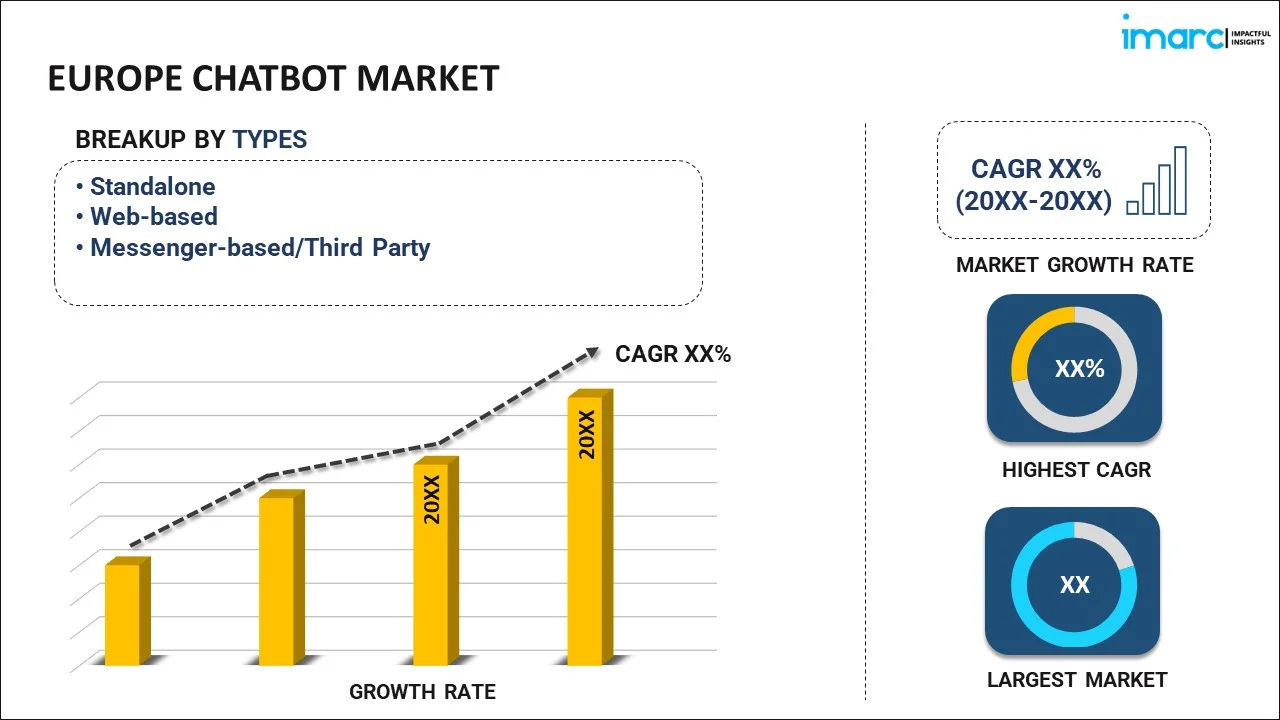
- Standalone
- Web-based
- Messenger-based/Third Party
The Web‑based dominates with a market share of 48% of the total Europe chatbot market in 2025.
The web-based holds the leading position in the Europe chatbot market. This prominence is achieved largely due to the pervasiveness of browser-based chatbot systems, which are easily integrated with existing websites. Web-based chatbots offer organizations a cost-effective and rapidly deployable solution for automating customer interactions without requiring users to download additional applications or software. In March 2025, NatWest partnered with OpenAI, deploying over 25 AI use cases including Cora+ GenAI, improving customer satisfaction by 150% and streamlining colleague interventions.
The continued dominance of the web-based segment is further reinforced by the growing e-commerce activity across Europe and the increasing consumer preference for instant online support. Organizations are leveraging web-based chatbots to provide real-time assistance during the purchase journey, reducing cart abandonment and improving conversion metrics. The ability to embed conversational interfaces directly into landing pages, product catalogs, and checkout processes creates a seamless user experience that drives higher engagement across diverse digital touchpoints.
Product Insights:
- Artificial Intelligence
- Marketing
- Human Intelligence
Artificial intelligence leads with a share of 64% of the total Europe chatbot market in 2025.
The artificial intelligence dominates the Europe chatbot market, holding the largest revenue share. AI-powered chatbots leverage sophisticated machine learning algorithms, natural language processing, and deep learning frameworks to deliver intelligent, contextually aware conversational experiences. In May 2025, French AI startup Mistral AI launched its enterprise chatbot Le Chat, tripling its revenue in just 100 days due to strong demand across European businesses and integrations with platforms like SharePoint and Google Drive. These advanced systems continuously learn from user interactions, enabling them to improve response accuracy, understand user intent, and handle complex multi-turn dialogues with increasing proficiency.
The leadership of the segment is further strengthened by the increasing investment in AI research and development across European technology ecosystems. Organizations are prioritizing AI-driven chatbots for their ability to analyze customer sentiment, predict user needs, and provide proactive recommendations that enhance the overall service experience. The integration of advanced AI capabilities such as entity recognition, knowledge graph reasoning, and transfer learning enables these chatbots to serve as intelligent virtual advisors across specialized domains including financial planning, medical triage, and technical support.
Application Insights:
- Bots for Service
- Bots for Social Media
- Bots for Payments/Order Processing
- Bots for Marketing
- Others
Bots for service exhibits a clear dominance with a 41% share of the total Europe chatbot market in 2025.
The bots for service leads the Europe chatbot market, reflecting the critical importance of automated customer support in the digital-first era. Service-oriented chatbots are deployed to handle a wide range of customer inquiries, including order tracking, troubleshooting, account management, and general information requests. As per the sources, Belgian rail operator SNCB launched Mobi 2.0, a generative AI virtual assistant, achieving over 99% question understanding across four languages and supporting 24 hours a day, seven days a week customer service, reducing human agent workload.
The sustained dominance of service bots is driven by the increasing consumer expectation for immediate and accurate responses across all communication touchpoints. European businesses are deploying service chatbots across websites, mobile applications, and messaging platforms to create unified support experiences that reduce friction in the customer journey. The integration of advanced capabilities such as automated ticket creation, real-time knowledge base retrieval, and predictive issue resolution enables these bots to handle increasingly sophisticated service scenarios.
Organization Size Insights:
- Small Enterprises
- Medium Enterprises
- Large Enterprises
Large enterprises lead with a market share of 60% of the total Europe chatbot market in 2025.
The large enterprises command the dominant share in the Europe chatbot market, driven by substantial technology investments and complex operational requirements of major corporations. Large organizations deploy chatbot solutions at scale across multiple departments, geographies, and customer touchpoints, necessitating enterprise-grade platforms with robust security, compliance, and integration capabilities. In April 2025, AI firm Anthropic announced expansion in Europe, with its Claude chatbot deployed by major corporations including BMW, WPP, and Novo Nordisk, reflecting growing enterprise adoption of conversational AI.
The leadership of large enterprises in chatbot adoption is further reinforced by their strategic focus on digital transformation and competitive differentiation. These organizations possess the resources and infrastructure to implement sophisticated AI-powered conversational platforms that integrate with existing enterprise systems such as customer relationship management, enterprise resource planning, and supply chain management solutions. The ability to deploy multilingual chatbots across pan-European operations, combined with the need for advanced analytics and reporting capabilities, drives the preference for comprehensive enterprise chatbot solutions that deliver measurable return on investment and support long-term strategic objectives.
Vertical Insights:
- Healthcare
- Retail
- Banking, Financial Services, and Insurance
- Media and Entertainment
- Travel and Tourism
- E-Commerce
- Others
Banking, Financial Services, and Insurance dominates with a market share of 28% of the total Europe chatbot market in 2025.
Banking, financial services, and insurance holds the leading position in the Europe chatbot market by vertical, reflecting the sector's pioneering adoption of conversational AI technologies. Financial institutions across Europe are deploying chatbots to automate routine banking inquiries, facilitate secure transaction processing, and provide personalized financial guidance to customers. According to reports, Banco Santander partnered with OpenAI to become an “AI‑native” bank, deploying ChatGPT Enterprise across nearly 15,000 European employees to automate interactions and streamline workflows.
The continued dominance of the BFSI vertical is supported by the sector's ongoing digital transformation efforts and the growing consumer demand for convenient, always-available banking services. European financial institutions are leveraging chatbots for diverse applications including loan processing assistance, insurance claim management, fraud detection alerts, and investment portfolio inquiries. The integration of chatbots with open banking frameworks and payment processing systems enables seamless transactional capabilities within conversational interfaces, reinforcing the sector's leading position.
Country Insights:
To get detailed regional analysis of this market, Request Sample
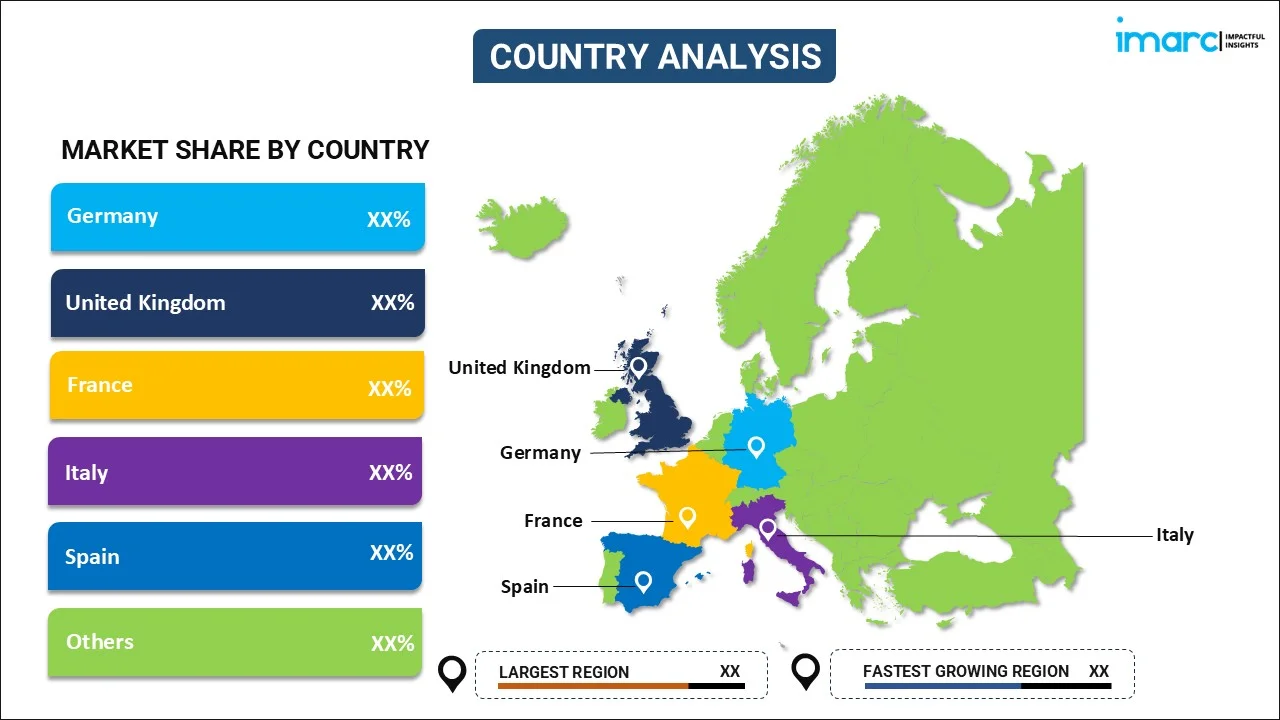
- Germany
- France
- United Kingdom
- Italy
- Spain
- Others
Germany represents a leading position in the Europe chatbot market, driven by its strong industrial base and advanced digital infrastructure. The country's thriving manufacturing, automotive, and financial services sectors are actively deploying chatbot solutions to streamline customer interactions and optimize operational workflows. Germany's emphasis on technological innovation and robust enterprise software ecosystem further accelerates the adoption of conversational AI platforms.
France holds a significant share in the Europe chatbot market, supported by the country's expanding digital economy and growing emphasis on customer experience transformation. French enterprises across retail, banking, and telecommunications are increasingly integrating chatbot solutions to deliver personalized consumer engagement. The government's proactive stance on AI development and digital innovation initiatives further strengthens chatbot adoption across public and private sectors.
United Kingdom represents a prominent market for chatbot solutions in Europe, driven by its mature financial services sector and advanced digital commerce landscape. British enterprises are at the forefront of deploying conversational AI technologies to enhance customer service delivery and operational efficiency. The country's strong fintech ecosystem and high digital literacy rates among consumers create a favorable environment for widespread chatbot implementation.
Italy is witnessing growing adoption of chatbot solutions, propelled by the country's accelerating digital transformation across banking, retail, and tourism industries. Italian businesses are increasingly leveraging conversational AI platforms to address multilingual customer engagement needs and enhance service accessibility. The expanding e-commerce sector and rising consumer preference for digital-first interaction channels are driving increased investment in chatbot technologies across Italian enterprises.
Spain is emerging as a notable market for chatbot solutions in Europe, fueled by the country's expanding digital services landscape and thriving tourism sector. Spanish enterprises are deploying conversational AI platforms to manage high volumes of customer inquiries across hospitality, banking, and telecommunications industries. The growing smartphone penetration and increasing consumer adoption of messaging-based communication channels further support chatbot market expansion.
Others collectively contribute a meaningful share to the regional chatbot market, driven by accelerating digitalization efforts across diverse economies. Nations across Scandinavia, Benelux, and Central Europe are witnessing rising chatbot adoption supported by high internet connectivity, advanced technology infrastructure, and growing enterprise demand for automated customer engagement solutions that cater to linguistically diverse consumer bases across multiple markets.
Market Dynamics:
Growth Drivers:
Why is the Europe Chatbot Market Growing?
Accelerating Digital Transformation Across European Enterprises
The comprehensive digital transformation wave sweeping across European industries is serving as a fundamental catalyst for chatbot market growth. Organizations across the region are systematically modernizing their customer engagement infrastructure, transitioning from traditional communication channels to intelligent, automated conversational platforms. In 2025, a report found that 63 % of Irish startups have adopted AI with 36% embedding it at the core of their business models, significantly above the European average illustrating widespread enterprise AI integration across sectors. The increasing maturity of cloud computing infrastructure and the growing availability of sophisticated AI development tools are lowering barriers to enterprise chatbot adoption across the region.
Favorable Regulatory Environment and Data Privacy Frameworks
Europe's progressive regulatory landscape is creating a conducive environment for responsible chatbot deployment and innovation. The region's comprehensive data protection regulations, including stringent requirements for transparency, user consent, and data handling, are driving the development of privacy-compliant chatbot solutions that build consumer trust. The evolving AI regulatory framework establishes clear guidelines for conversational AI deployment, ensuring that chatbot interactions meet high standards of fairness, accountability, and explainability. Organizations aligning their chatbot strategies with regulatory requirements gain competitive advantages through enhanced consumer confidence.
Growing Consumer Preference for Self-Service Digital Interactions
The shifting consumer behavior across Europe toward self-service digital engagement is driving sustained demand for chatbot solutions. European consumers increasingly prefer to resolve inquiries, access information, and complete transactions through automated conversational interfaces rather than traditional human-mediated channels. As per sources, 58% of European consumers bypass traditional search engines for product recommendations, relying instead on AI assistants like ChatGPT for shopping, signaling a major shift in retail behavior. This preference is particularly pronounced among digitally native demographics who expect seamless, instantaneous responses across all communication touchpoints. The proliferation of messaging applications and social media platforms as primary communication channels further amplifies demand for chatbot solutions delivering consistent experiences across preferred interaction mediums.
Market Restraints:
What Challenges the Europe Chatbot Market is Facing?
Complexity of Multilingual Natural Language Understanding
The linguistic diversity across European markets presents significant technical challenges for chatbot developers seeking to deliver accurate and culturally appropriate conversational experiences. Developing natural language understanding capabilities that effectively comprehend regional dialects, idiomatic expressions, and language-specific grammatical structures requires substantial investment in training data and computational resources, which can slow deployment timelines.
Data Privacy and Compliance Constraints
Europe's stringent data handling requirements create operational complexities for chatbot implementations across multiple jurisdictions. Organizations must navigate intricate compliance obligations regarding data storage, cross-border data transfer, and user consent management that vary across different European countries. The requirement to implement robust data anonymization, retention policies, and audit trails adds layers of technical complexity and cost.
Integration Challenges with Legacy Enterprise Systems
Many European organizations continue to rely on legacy technology infrastructures that pose significant integration barriers for modern chatbot platforms. The complexity of connecting conversational AI solutions with outdated customer relationship management systems and proprietary databases creates technical bottlenecks that extend implementation timelines. The absence of standardized application programming interfaces increases deployment costs and limits functional capabilities.
Competitive Landscape:
The Europe chatbot market exhibits a dynamic and highly competitive landscape characterized by the presence of both established global technology providers and specialized regional conversational AI vendors. Market participants are actively pursuing strategies centered on product innovation, strategic partnerships, and vertical-specific solution development to capture growing demand across diverse industry segments. The competitive environment is further shaped by the emergence of open-source conversational AI frameworks that are democratizing access to advanced chatbot development tools and intensifying competition. Key differentiators among market players include the sophistication of natural language processing capabilities, multilingual support breadth, regulatory compliance features, and the depth of industry-specific knowledge bases.
Recent Developments:
- In May 2025, Dentons launched its proprietary generative AI tool, DAISY, across Europe. The platform provides secure AI chat capabilities, including document summarization, drafting, translation, and policy browsing, enhancing productivity for lawyers and business professionals while reinforcing Dentons’ leadership in legal innovation and AI adoption across European offices.
Europe Chatbot Market Report Coverage:
| Report Features | Details |
|---|---|
| Base Year of the Analysis | 2025 |
| Historical Period | 2020-2025 |
| Forecast Period | 2026-2034 |
| Units | Billion USD |
| Scope of the Report | Exploration of Historical and Forecast Trends, Industry Catalysts and Challenges, Segment-Wise Historical and Predictive Market Assessment:
|
| Types Covered | Standalone, Web-based, Messenger-based/Third Party |
| Products Covered | Artificial Intelligence, Marketing, Human Intelligence |
| Applications Covered | Bots for Service, Bots for Social Media, Bots for Payments/Order Processing, Bots for Marketing, Others |
| Organization Sizes Covered | Small Enterprises, Medium Enterprises, Large Enterprises |
| Verticals Covered | Healthcare, Retail, Banking, Financial Services, and Insurance, Media and Entertainment, Travel and Tourism, E-Commerce, Others |
| Countries Covered | Germany, France, United Kingdom, Italy, Spain, Others |
| Customization Scope | 10% Free Customization |
| Post-Sale Analyst Support | 10-12 Weeks |
| Delivery Format | PDF and Excel through Email (We can also provide the editable version of the report in PPT/Word format on special request) |
Frequently Asked Questions About the Europe Chatbot Market Report
The Europe chatbot market size was valued at USD 2.1 Billion in 2025.
The Europe chatbot market is expected to grow at a compound annual growth rate of 17.6% from 2026-2034 to reach USD 9.2 Billion by 2034.
Web-based held the largest share, driven by seamless browser-based deployment, universal accessibility, cost-effective integration with existing digital infrastructure, minimal software installation requirements, and the ability to deliver real-time automated customer support directly through standard web browsers across European enterprises.
Key factors driving the Europe chatbot market include accelerating digital transformation across enterprises, favorable regulatory frameworks promoting responsible AI deployment, growing consumer preference for self-service digital interactions, and continuously advancing AI and natural language processing capabilities.
Major challenges include the complexity of multilingual natural language understanding across diverse European languages, stringent data privacy and compliance constraints across multiple jurisdictions, integration difficulties with legacy enterprise systems, and the need for culturally adaptive conversational experiences tailored to regional markets.
Need more help?
- Speak to our experienced analysts for insights on the current market scenarios.
- Include additional segments and countries to customize the report as per your requirement.
- Gain an unparalleled competitive advantage in your domain by understanding how to utilize the report and positively impacting your operations and revenue.
- For further assistance, please connect with our analysts.
 Request Customization
 Speak to an Analyst
 Request Brochure
 Inquire Before Buying
Benefits of Customization
- Personalize this research
- Triangulate with your data
- Get data as per your format and definition
- Gain a deeper dive into a specific application, geography, customer, or competitor
- Any level of personalization
Get in Touch With Us
UNITED STATES
Phone: +1-201-971-6302
INDIA
Phone: +91-120-433-0800
UNITED KINGDOM
Phone: +44-753-714-6104
Email: [email protected]
Client Testimonials




.webp)




.webp)













Related Reports

Choose your plan
*Please note that the prices mentioned below are starting prices for each bundle type. Kindly contact our team for further details.*
Single User License
- 1 User License, Access on 2 Devices
- PDF Report + Excel Dataset (Password Protected)
- Lifetime Access
- No Printing Rights
- 10% Free Report Customization
- 10–12 Weeks of Analyst Support
Five User License
- Access for 5 Users, 2 Devices per User
- PDF Report + Excel Dataset (Password Protected)
- Lifetime Access
- Dedicated Account Manager
- 12–14 Weeks of Analyst Support
- No Printing Rights
- 15% Free Report Customization
- 25% Discount on Your Next Purchase
Corporate User License
- Unlimited User Access (Within Your Organization)
- PDF Report + Excel Dataset
- Lifetime Access
- Dedicated Account Manager
- 14–20 Weeks of Analyst Support
- No Printing Rights
- 20% Free Report Customization
- 30% Discount on Your Next Purchase
Essential Insights
What's included:
3 reports
- Lifetime Access
- PDF Reports
- Excel Datasets
- 2 Weeks of Free Analyst Support
- 2 User Licenses
- Access on 2 Devices
- Printing Rights
- Complimentary PowerPoint (PPT) Version
- Complimentary License Upgrade
Professional Access
What's included:
5 reports
- Lifetime Access
- PDF Reports
- Excel Datasets
- 8 Weeks of Free Analyst Support
- 2 User Licenses
- Access on 2 Devices
- Printing Rights
- Complimentary PowerPoint (PPT) Version
- Complimentary License Upgrade
Business Advantage
What's included:
8 reports
- Lifetime Access
- PDF Reports
- Excel Datasets
- 14 Weeks of Free Analyst Support
- 2 User Licenses
- Access on 2 Devices
- Printing Rights
- Complimentary PowerPoint (PPT) Version
- Complimentary License Upgrade
Enterprise Intelligence
What's included:
10 reports
- Lifetime Access
- PDF Reports
- Excel Datasets
- 20 Weeks of Free Analyst Support
- 2 User Licenses
- Access on 2 Devices
- Printing Rights
- Complimentary PowerPoint (PPT) Version
- Complimentary License Upgrade