
Europe E-Commerce Market Size, Share, Trends and Forecast by Type, Transaction, and Country, 2026-2034
Europe E-Commerce Market Size, Share, Trends & Forecast (2026-2034)
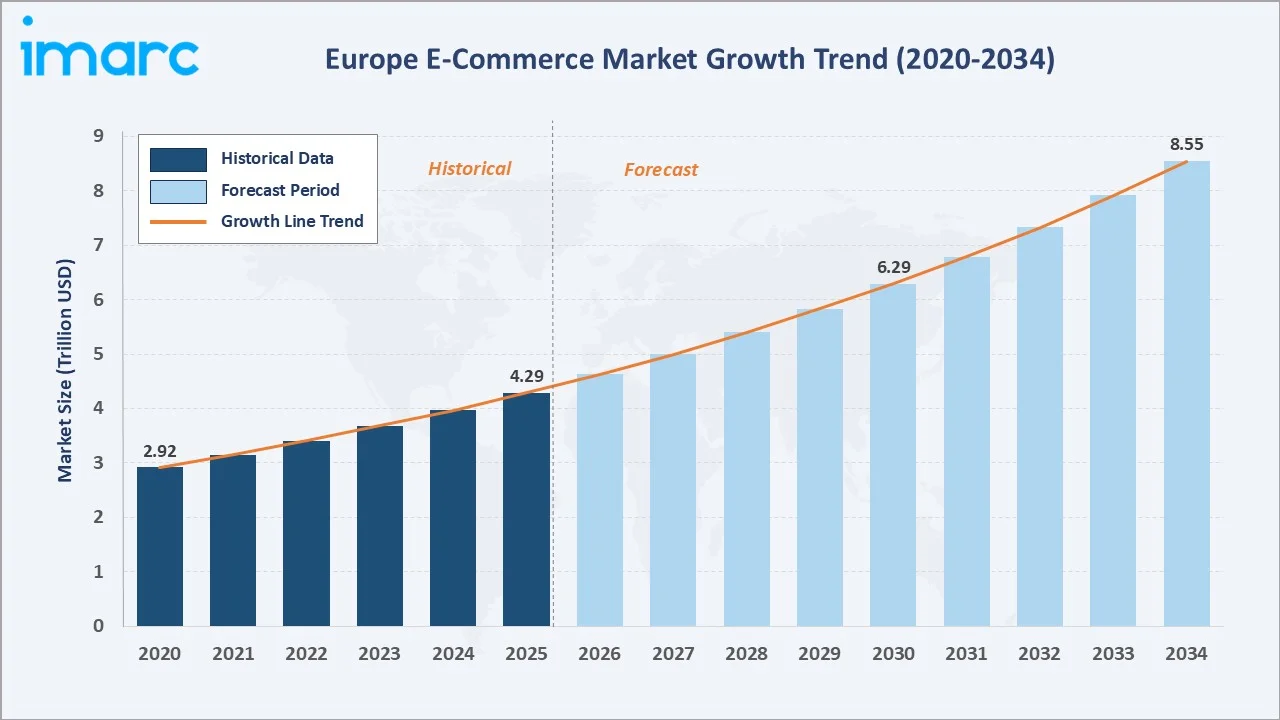
The Europe e-commerce market was valued at USD 4.29 Trillion in 2025 and is projected to reach USD 8.55 Trillion by 2034, exhibiting a CAGR of 7.97% during 2026-2034. Expanding cross-border marketplace access, rising mobile-first shopping habits, and continued fulfilment infrastructure investment are the primary drivers shaping the market growth.
Groceries lead the type segment at 23.09%, business-to-business (B2B) dominates the transaction segment at 78.05%, and Germany commands 29.00% country share.
Market Snapshot
|
Metric |
Value |
|
Market Size (2025) |
USD 4.29 Trillion |
|
Forecast Market Size (2034) |
USD 8.55 Trillion |
|
CAGR (2026-2034) |
7.97% |
|
Base Year |
2025 |
|
Historical Period |
2020-2025 |
|
Forecast Period |
2026-2034 |
|
Largest Country |
Germany (29.00%, 2025) |
|
Second Largest Country |
United Kingdom (22.60%, 2025) |
|
Leading Type |
Groceries (23.09%, 2025) |
|
Leading Transaction |
Business-to-Business (B2B) (78.05%, 2025) |
The Europe e-commerce market expanded from USD 2.92 Trillion in 2020 to USD 4.29 Trillion in 2025, driven by wider marketplace adoption, accelerating cross-border trade among member states, and steady digitalization of small and mid-sized retailers. Anchored at USD 6.29 Trillion in 2030, the forecast to USD 8.55 Trillion by 2034 is supported by deepening mobile commerce penetration, maturing payment infrastructure, and expanding fulfilment networks across the region.
To get more information on this market, Request Sample
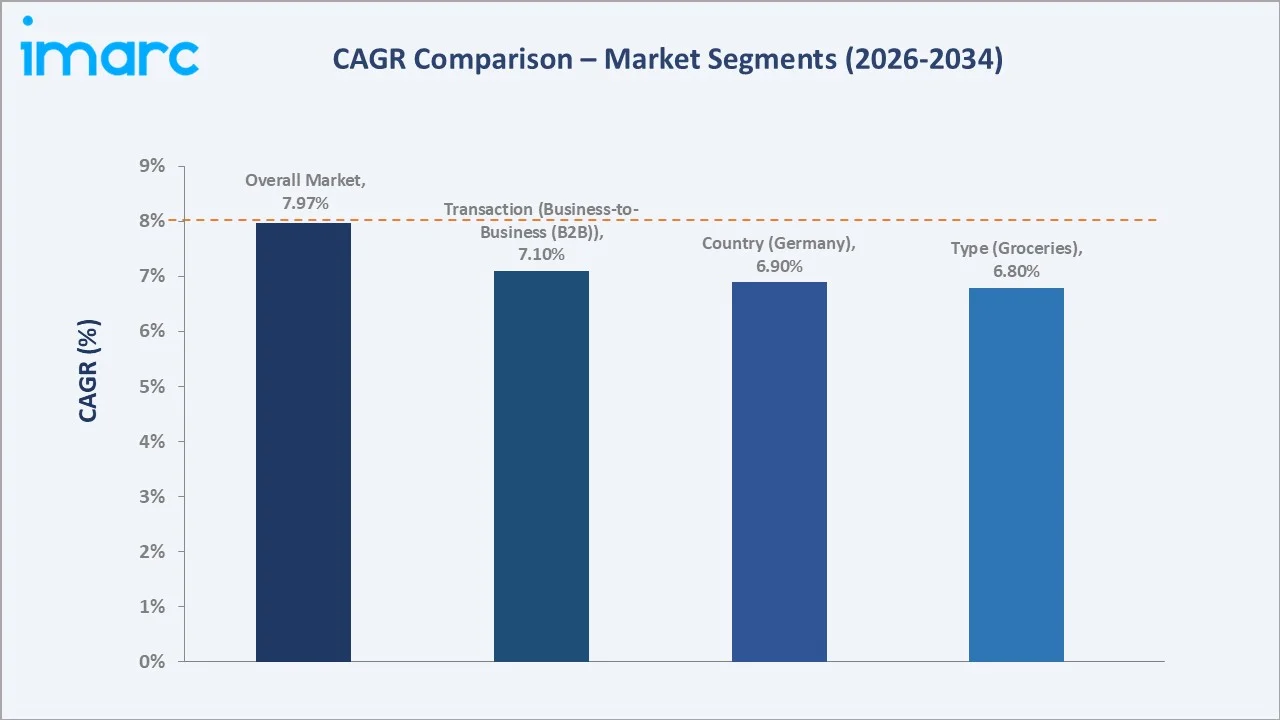
CAGR trajectories across type and transaction sub-segments show consumer-to-consumer (C2C) and cosmetics expanding faster than the overall 7.97% market CAGR, driven by peer-to-peer resale platforms, beauty-focused social commerce, and rising discretionary spending across the bloc.
Executive Summary
The Europe e-commerce market is on a steady growth trajectory from USD 2.92 Trillion in 2020 to USD 8.55 Trillion by 2034. The market has moved from single-country online retail toward a deeply interconnected, cross-border digital marketplace spanning groceries, apparel, footwear and accessories, home appliances, cosmetics, books, and other categories. Expanding smartphone penetration, faster last-mile delivery, and seamless digital payments are encouraging consumers and businesses alike to transact online at scale.
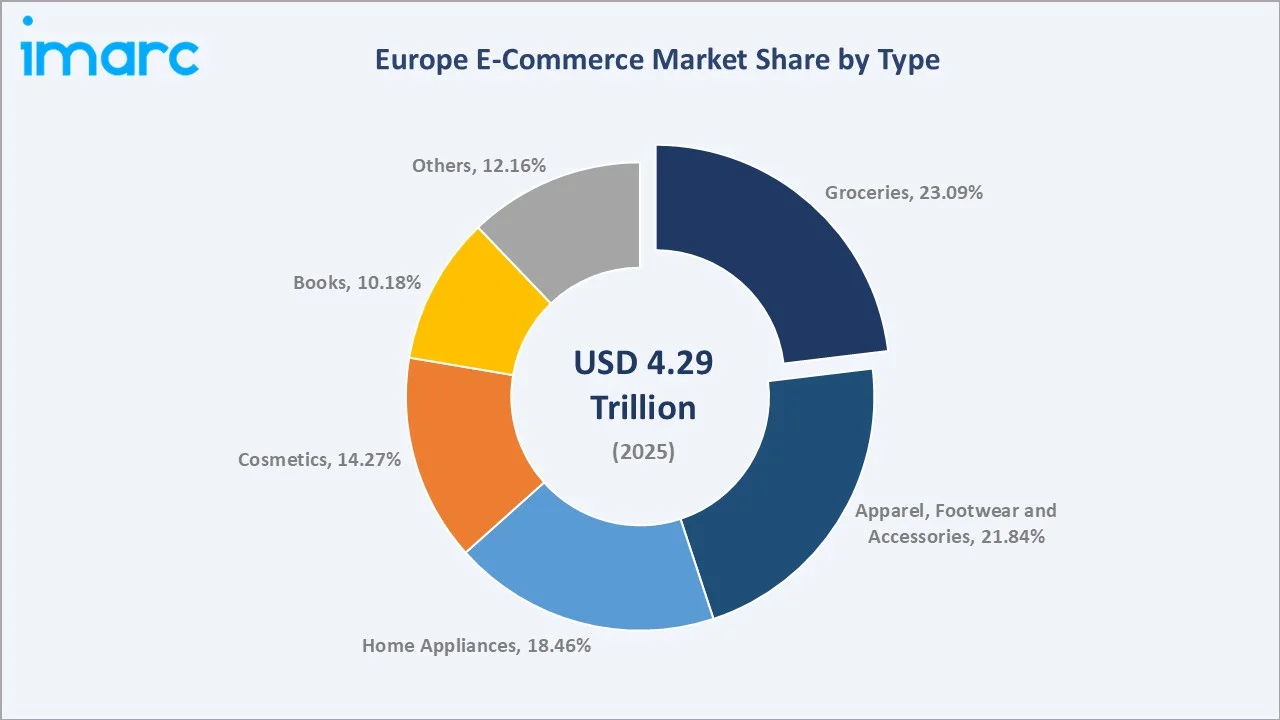
Groceries lead the type segment at 23.09% in 2025, supported by expanding online grocery delivery networks and quick-commerce formats. Business-to-business (B2B) dominates the transaction segment at 78.05%, reflecting deep wholesale and enterprise procurement digitization across the bloc. Germany commands 29.00% of the country share, led by mature digital infrastructure and high consumer purchasing power.
Key Market Insights
|
Insight |
Data |
|
Leading Type |
Groceries - 23.09% share (2025) |
|
Second Largest Type |
Apparel, Footwear and Accessories - 21.84% share (2025) |
|
Leading Transaction |
Business-to-Business (B2B) - 78.05% share (2025) |
|
Second Largest Transaction |
Business-to-Consumer (B2C) - 14.85% share (2025) |
|
Leading Country |
Germany - 29.00% share (2025) |
|
Second Largest Country |
United Kingdom - 22.60% share (2025) |
|
Top Companies |
Amazon.com, Inc., Zalando SE, Allegro.eu S.A., Otto Group, ASOS plc |
Key Analytical Observations Expanding On the Data Above:
- Groceries dominance at 23.09% is supported by expanding online grocery delivery networks, subscription-based replenishment models, and the rapid rollout of quick-commerce dark stores across major European cities.
- Apparel, footwear and accessories at 21.84% remains a close second. According to Eurostat, 45% of EU internet users who shopped online in 2024 purchased clothing, footwear, or accessories, making it the most frequently bought online product category across the bloc.
- Business-to-business (B2B) share at 78.05% reflects deep digitization of wholesale procurement, enterprise resource planning integration, and recurring supplier-to-retailer trading across the region.
- Business-to-consumer (B2C) at 14.85% continues to expand as direct-to-consumer brands and marketplace sellers scale mobile-first storefronts and app-based checkout experiences.
- Germany at 29.00% dominates country share, anchored by mature logistics networks, high digital payment penetration, and dense concentration of leading online retailers.
Global Europe E-Commerce Market Overview
E-commerce refers to the buying and selling of goods and services over the internet, encompassing online retail, digital marketplaces, subscription commerce, and business-to-business trading conducted through websites, mobile applications, and social platforms. The Europe e-commerce market spans groceries, apparel, footwear and accessories, home appliances, cosmetics, books, and other consumer and business categories, transacted across business-to-business (B2B), business-to-consumer (B2C), consumer-to-consumer (C2C), and other formats.
The European ecosystem integrates online retailers and marketplaces, payment service providers, logistics and fulfilment networks, regulatory bodies at EU and national levels, marketing and affiliate partners, and customer support and returns infrastructure. Macroeconomic factors, such as consumer purchasing power, cross-border trade policy, and digital infrastructure investment, continue to shape the pace of market expansion across member states.
Market Dynamics
To evaluate market opportunities, Request Sample
Market Drivers
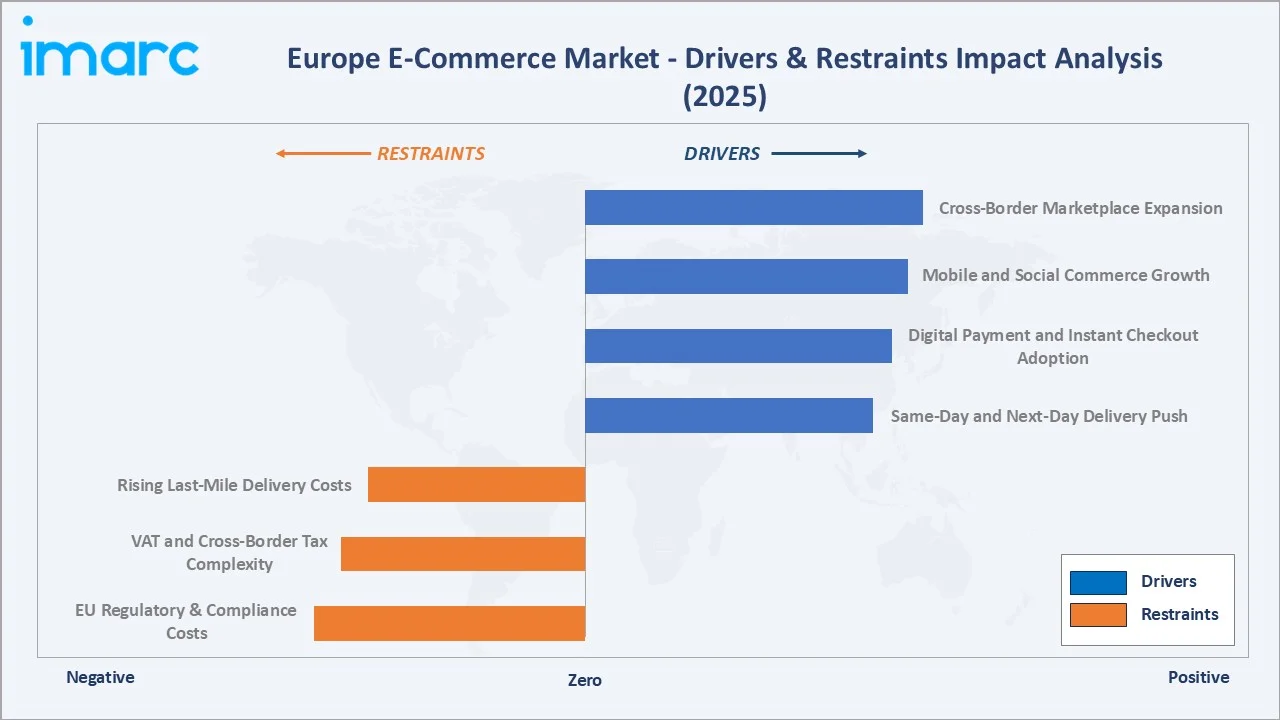
- Cross-Border Marketplace Expansion: Growing consumer willingness to purchase from sellers in other EU member states, supported by harmonized consumer protection rules, is widening addressable demand for online retailers and marketplace operators across the region.
- Mobile and Social Commerce Growth: Rising smartphone penetration, app-based shopping, and increasing product discovery through social media platforms are encouraging higher online spending and improving customer engagement across multiple retail categories.
- Digital Payment and Instant Checkout Adoption: As per IMARC Group, the Europe mobile payment market size was valued at USD 766.1 Billion in 2025. Expanding acceptance of digital wallets, instant bank transfers, and buy-now-pay-later options is reducing checkout friction and lifting online conversion rates across both marketplaces and direct-to-consumer stores.
- Same-Day and Next-Day Delivery Push: Investment in urban micro-fulfilment centers and last-mile courier networks is shortening delivery windows, encouraging higher order frequency across groceries and other time-sensitive categories.
Market Restraints
- EU Regulatory and Compliance Costs: Compliance with evolving digital commerce regulations, consumer protection requirements, data privacy laws, and sustainability reporting obligations increases operational complexity and raises compliance costs for online retailers and marketplace operators.
- VAT and Cross-Border Tax Complexity: Differing value-added tax treatment and reporting obligations across member states add administrative overhead for sellers operating multi-country storefronts.
- Rising Last-Mile Delivery Costs: Fuel prices, urban congestion charges, and driver wage inflation are pushing up fulfilment costs, compressing margins for retailers offering free or low-cost shipping.
Market Opportunities
- AI-Led Personalization: Retailers adopting recommendation engines and dynamic pricing tools stand to capture higher basket values and stronger repeat-purchase rates across categories such as apparel and cosmetics.
- Marketplace Consolidation and Private-Label Expansion: Established marketplaces expanding private-label assortments and third-party seller programs create new revenue pools beyond traditional first-party retail.
Market Challenges
- Counterfeit Goods and Marketplace Trust: Rising volumes of third-party listings increase the risk of counterfeit or misrepresented products, requiring sustained investment in seller verification and content moderation.
- Fragmented National Regulations: Divergent consumer protection, packaging, and advertising rules across member states complicate unified pan-European operating models for retailers and marketplaces.
Emerging Market Trends
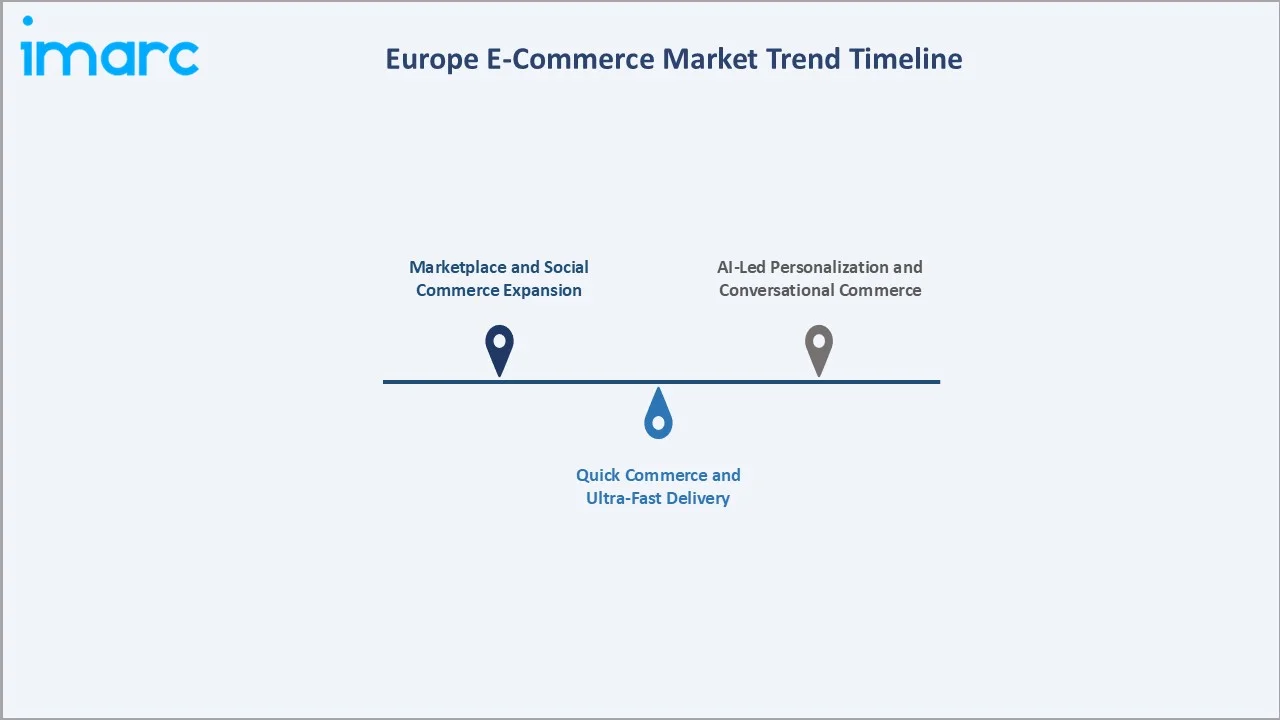
1. Marketplace and Social Commerce Expansion
Retailers are increasingly selling through third-party marketplaces and social platforms alongside their own websites and apps. The shift is broadening discovery and lowering entry barriers for smaller sellers.
2. Quick Commerce and Ultra-Fast Delivery
Urban micro-fulfilment and dark-store formats are compressing delivery windows for groceries and daily essentials to under an hour in major cities, supporting the Europe e-commerce market growth through higher order frequency and stronger customer retention.
3. AI-Led Personalization and Conversational Commerce
Retailers are deploying generative AI-based product discovery, chat-based shopping assistants, and dynamic recommendation engines to shorten purchase journeys and improve conversion across apparel, cosmetics, and home appliance categories.
Industry Value Chain Analysis
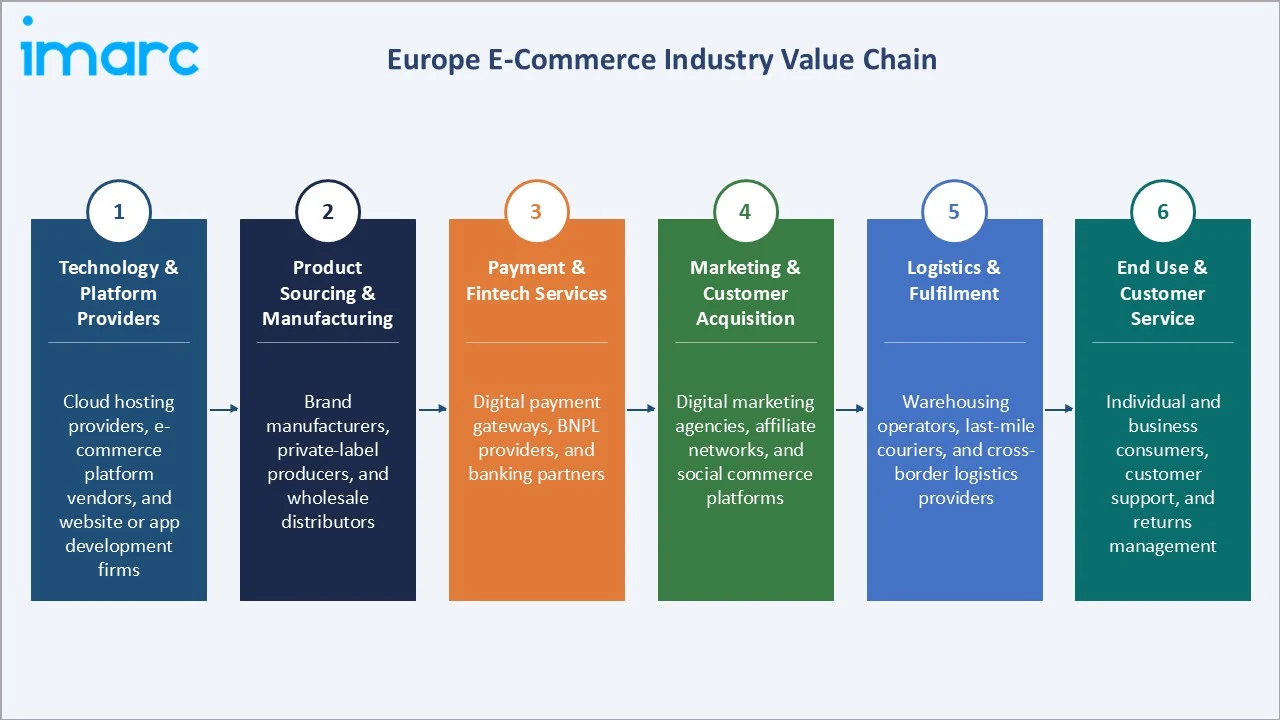
The Europe e-commerce value chain spans six stages, from technology and platform provision through end-use and customer service. Platform development, payment infrastructure, and logistics capture the highest value-add, while compliance and customer protection capabilities increasingly determine sustainable competitive position across the region.
|
Stage |
Key Players / Examples |
|
Technology & Platform Providers |
Cloud hosting providers, e-commerce platform vendors, and website or app development firms enabling online storefronts |
|
Product Sourcing & Manufacturing |
Brand manufacturers, private-label producers, and wholesale distributors supplying inventory |
|
Payment & Fintech Services |
Digital payment gateways, buy-now-pay-later providers, and banking partners enabling secure transactions |
|
Marketing & Customer Acquisition |
Digital marketing agencies, affiliate networks, and social commerce platforms driving traffic |
|
Logistics & Fulfilment |
Warehousing operators, last-mile delivery couriers, and cross-border logistics providers |
|
End Use & Customer Service |
Individual and business consumers, customer support providers, and returns management services |
Vertically integrated players, especially those owning proprietary logistics networks, payment infrastructure, and direct customer relationships, are positioned to capture greater value than partners reliant on third-party infrastructure.
Technology Landscape in the Europe E-Commerce Industry
AI-Powered Personalization and Recommendation Engines
Retailers are deploying machine learning (ML) models that analyze browsing history, purchase patterns, and real-time behavior to surface tailored product recommendations, dynamic pricing, and personalized search results. These tools are lifting conversion rates and average order value across apparel, cosmetics, and home appliance categories, while chat-based shopping assistants are beginning to shorten the path from discovery to checkout.
Payment Technology and Digital Wallet Integration
Instant bank transfers, digital wallets, and buy-now-pay-later options are becoming standard checkout features across European storefronts, reducing cart abandonment and supporting seamless cross-border transactions across multiple currencies and payment preferences.
Logistics Automation and Smart Fulfilment
Automated warehousing, robotics-assisted picking, and route-optimization software are shortening delivery windows and reducing per-order fulfilment costs across urban and suburban markets, enabling retailers to compete on speed alongside price and assortment.
Mobile Commerce and Progressive Web Applications
Lightweight mobile-first storefronts and progressive web apps are improving load times and checkout completion rates, supporting the region's growing base of smartphone-led shoppers and narrowing the gap between app-based and browser-based buying experiences.
Market Segmentation Analysis
The report covers the following segments:
|
Segment Category |
Leading Segment |
Market Share |
Year |
|
Type |
Groceries |
23.09% |
2025 |
|
Transaction |
Business-to-Business (B2B) |
78.05% |
2025 |
|
Country |
Germany |
29.00% |
2025 |

By Type
Groceries lead the type segment with 23.09% share in 2025, reflecting steady replenishment demand, expanding online grocery delivery networks, and growing adoption of subscription-based ordering across urban and suburban households. The segment benefits from high purchase frequency and strong customer retention.
To access detailed market analysis, Request Sample
Apparel, footwear and accessories follow closely at 21.84%, driven by fast-fashion cycles, influencer-led social commerce, and frequent seasonal collections.
By Transaction
Business-to-business (B2B) dominates the transaction segment with 78.05% share in 2025, reflecting deep digitization of wholesale procurement, recurring supplier contracts, and enterprise resource planning integration across European industries. The segment's scale reflects the region's dense network of manufacturers, distributors, and retailers trading digitally.
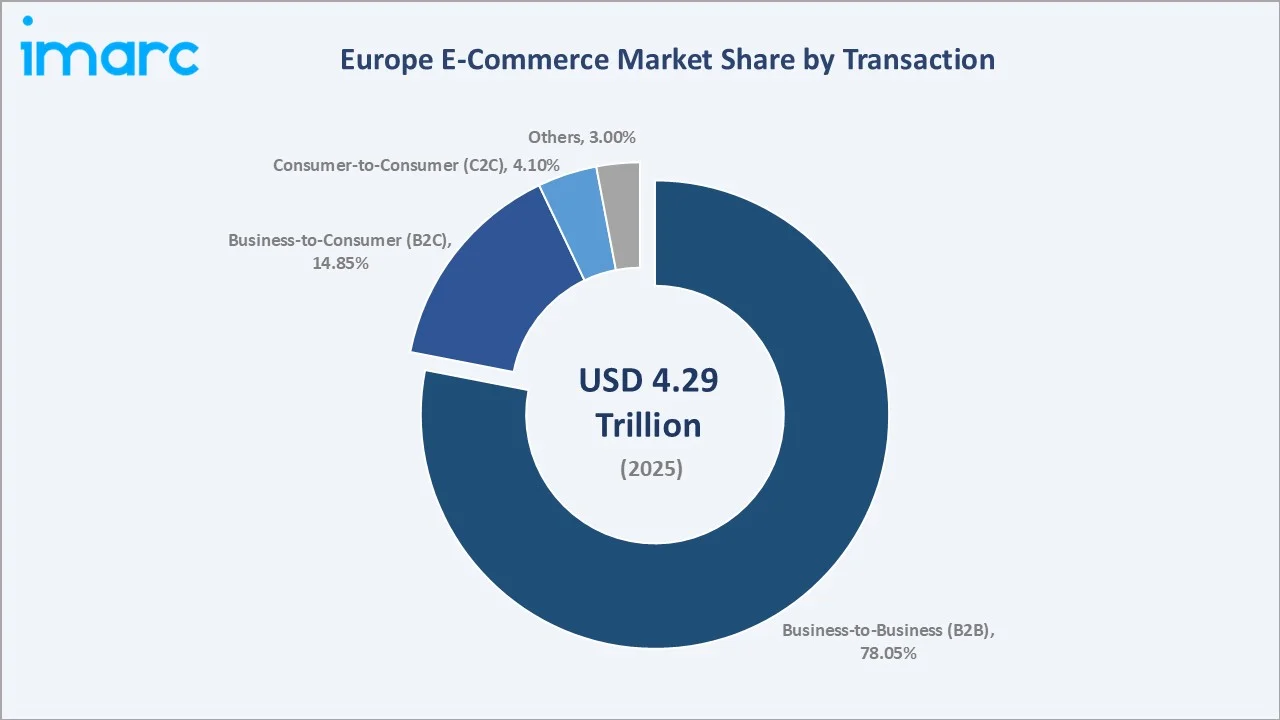
Business-to-consumer (B2C) holds 14.85% share, supported by direct-to-consumer brands and marketplace sellers.
Regional Market Insights
|
Country |
Share (2025) |
Key Growth Drivers |
|
Germany |
29.00% |
Mature digital infrastructure, high consumer purchasing power, dense logistics networks, and strong presence of leading online retailers |
|
United Kingdom |
22.60% |
High broadband and mobile connectivity, strong digital payment adoption, and a mature e-commerce regulatory framework |
|
France |
16.80% |
Large consumer base, growing marketplace adoption, and expanding last-mile delivery coverage |
|
Italy |
11.90% |
Rising smartphone penetration, growing consumer confidence in online payments, and expanding logistics investment |
|
Spain |
8.70% |
Fast-growing internet user base, improving delivery infrastructure, and increasing marketplace penetration among small retailers |
|
Others |
11.00% |
Emerging digital adoption across remaining European markets, improving cross-border logistics, and expanding payment access |
Germany at 29.00% in 2025 leads the country landscape, anchored by well-established digital infrastructure, dense last-mile logistics coverage, and a concentration of leading online retailers and marketplaces. High consumer purchasing power and mature payment ecosystems support sustained country leadership.
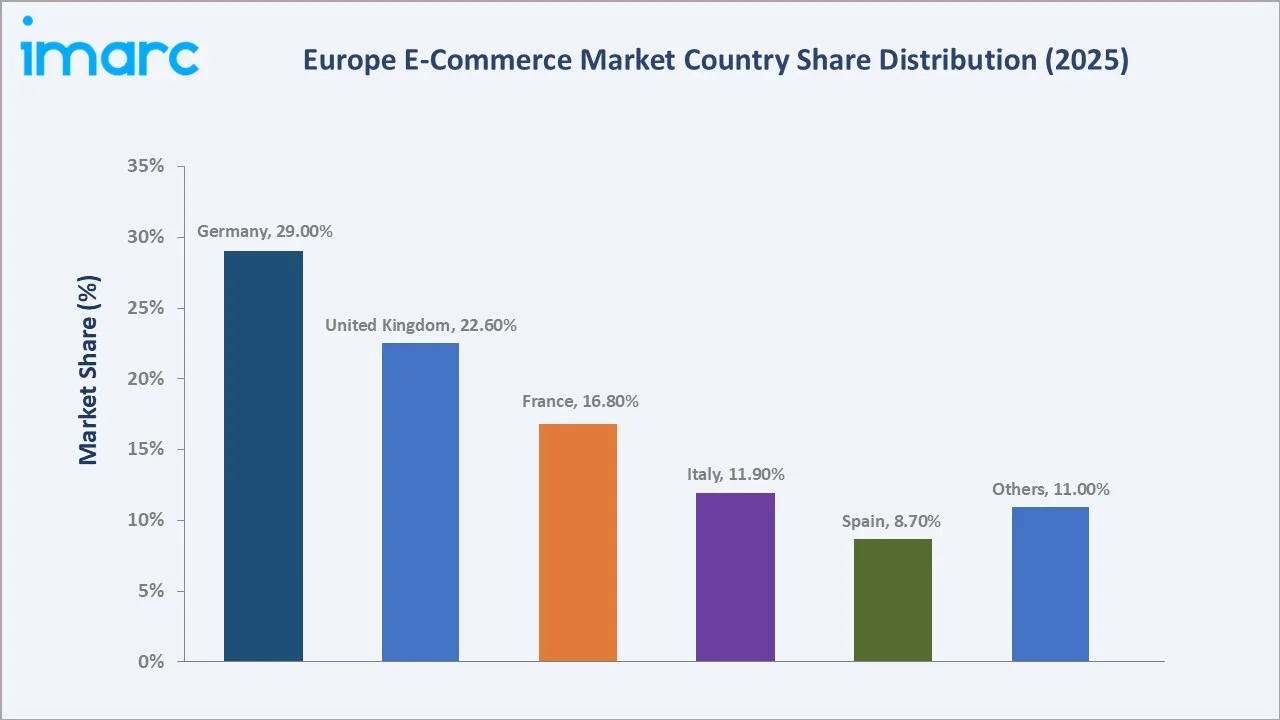
Spain at 8.70% is the fastest growing major country market. Rising smartphone and internet penetration, improving delivery infrastructure, and increasing consumer trust in digital payments are accelerating its expansion through 2034.
Competitive Landscape
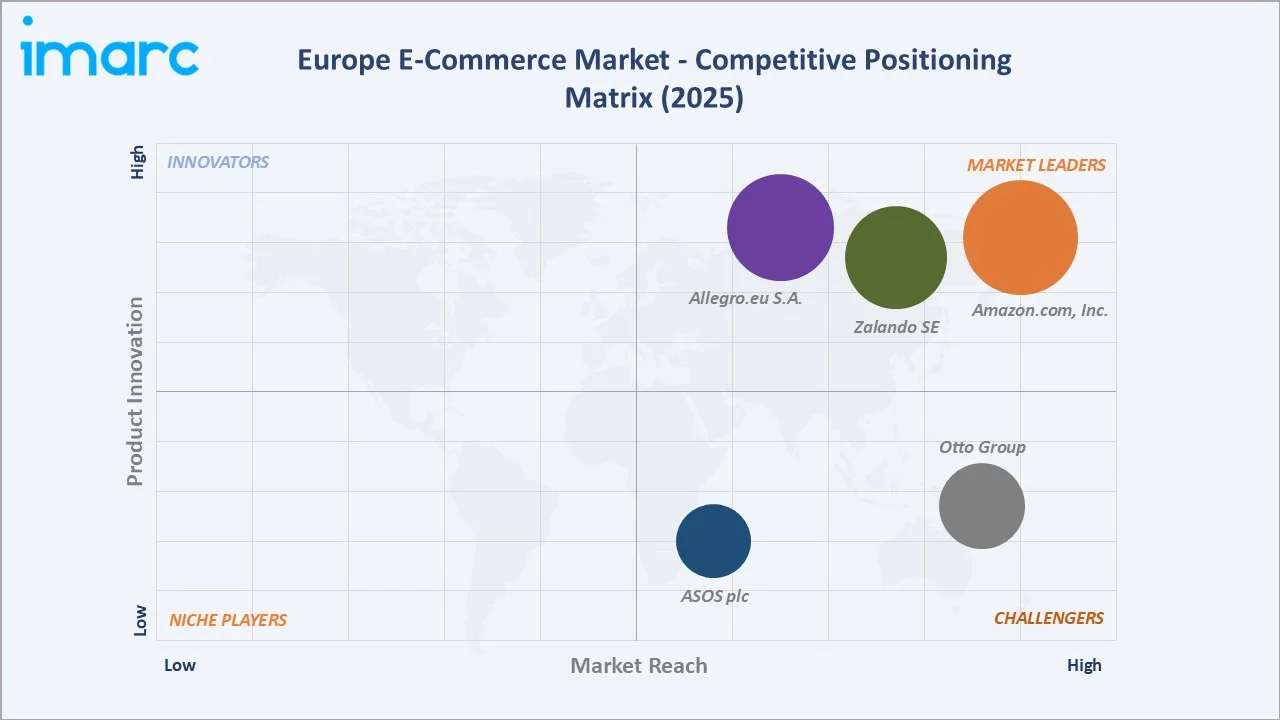
The Europe e-commerce market is moderately fragmented, with established marketplaces and multi-category retailers leading user reach and product depth while regional and category-focused operators compete on niche assortments and localized service. Brand strength, logistics capability, and technology investment form the key competitive moats across the region.
|
Company Name |
Brand / Key Product |
Position |
Strategic Focus |
|
Amazon.com, Inc. |
Amazon |
Leader |
Broad marketplace expansion with fast fulfilment and diversified category depth |
|
Zalando SE |
Zalando |
Leader |
Fashion-focused platform growth through partner integration and logistics investment |
|
Allegro.eu S.A. |
Allegro |
Leader |
Regional marketplace leadership with expanding cross-border seller network |
|
Otto Group |
Otto |
Challenger |
Multi-brand retail portfolio with continued digital platform modernization |
|
ASOS plc |
ASOS |
Challenger |
Fashion-focused online retail with data-led personalization initiatives |
Key players include Amazon.com, Inc., Zalando SE, Allegro.eu S.A., Otto Group, and ASOS plc, among others.
Key Company Profiles
Amazon.com, Inc.
Amazon.com, Inc. is a global technology and e-commerce company headquartered in Seattle, United States. The company operates online retail marketplaces across multiple European countries, supported by an extensive fulfilment and logistics network and a large third-party seller ecosystem.
- Product Portfolio: Online retail marketplace offering a broad range of product categories, supported by membership and delivery services.
- Recent Developments: The company has continued to expand its European fulfilment center footprint, invest in same-day and next-day delivery coverage, and adjust its cross-border logistics network in response to evolving EU customs and import regulations.
- Strategic Focus: Strengthening fulfilment capability, broadening marketplace participation, and reinforcing its position as a leading online retailer.
Allegro.eu S.A.
Allegro.eu S.A. is a Poland-based online marketplace operator headquartered in Poznan. The company operates a digital commerce platform connecting millions of buyers and sellers across a broad range of product categories while supporting transactions through integrated logistics and payment solutions.
- Product Portfolio: Online marketplace offering a broad range of consumer product categories, supported by logistics and payment services.
- Recent Developments: The company has continued to expand its marketplace offerings and strengthen its logistics and seller support capabilities.
- Strategic Focus: Consolidating marketplace leadership and expanding value-added services for sellers.
Otto Group
Otto Group is a Germany-based multi-brand retail and services company. The group operates online retail platforms spanning fashion, home goods, and general merchandise alongside logistics and financial services businesses.
- Product Portfolio: Multi-brand online retail platform offering apparel, home goods, and general merchandise.
- Recent Developments: The company has continued to modernize its digital platform and expand its marketplace offerings.
- Strategic Focus: Strengthening its multi-brand retail portfolio and expanding digital platform capabilities.
Market Concentration Analysis
The Europe e-commerce market is moderately concentrated, with the top players including Amazon.com, Inc., Zalando SE, and Allegro.eu S.A. accounting for a meaningful share of online retail activity across groceries, fashion, and general merchandise categories.
Barriers to entry include the scale of fulfilment infrastructure required to compete on delivery speed, the need for multi-country regulatory compliance capability, and the marketing investment required to build cross-border brand trust. These factors favor well-capitalized incumbents with established logistics networks and diversified category portfolios.
Consolidation is continuing as smaller regional retailers partner with or list on larger marketplaces to access broader customer bases, while larger operators invest in logistics, payments, and technology capabilities that reinforce competitive positioning across the structured segments of the market.
Investment & Growth Opportunities
Fastest-Growing Segments
Consumer-to-consumer (C2C) expands fastest within the transaction segment, driven by peer-to-peer resale platforms and growing consumer interest in circular commerce. Cosmetics is the next-fastest growing type category, supported by beauty-focused social commerce and influencer-led discovery.
Emerging Markets
Spain is the fastest growing major country market, anchored by rising smartphone adoption, improving delivery infrastructure, and expanding marketplace penetration among small and mid-sized retailers. The market represents significant untapped opportunity for operators able to deliver localized content and language-specific experiences.
Venture & Investment Trends
Investment is concentrated in last-mile logistics technology, cross-border payment infrastructure, and AI-led personalization tools. Capital is also flowing into circular commerce and resale platforms that align with growing consumer interest in sustainable purchasing.
Future Market Outlook (2026-2034)
The Europe e-commerce market is forecast to expand from USD 4.29 Trillion in 2025 to USD 8.55 Trillion by 2034 at a CAGR of 7.97%, adding roughly USD 4.26 Trillion in incremental market value over the forecast period.
Four forces will shape the market through 2034: continued maturation of cross-border regulatory frameworks; the rise of quick commerce and AI-led personalization; deeper integration between payments, logistics, and marketplace ecosystems; and the gradual reshaping of low-cost cross-border trade following recent EU customs reform.
By 2034, e-commerce in Europe is expected to be defined by highly localized fulfilment, AI-guided shopping journeys, and a more level playing field between domestic retailers and international sellers. Continued investment in logistics automation and digital payments is expected to further accelerate the evolution of the region's e-commerce ecosystem.
Research Methodology
Primary Research
Primary research included structured interviews with retail platform executives, logistics providers, payment service providers, and regulatory specialists, validating market sizing, country-level demand, segment mix, and transaction-type evolution.
Secondary Research
Secondary sources included Eurostat and European Commission publications, national statistical agency data, European Data Protection Board reports, and annual reports, press releases, and investor presentations from listed retailers and marketplaces.
Forecasting Models
Market forecasts used top-down and bottom-up models combining online buyer penetration, average spend per shopper, segment mix evolution, and macroeconomic variables. Scenario analysis addressed regulatory pace, cross-border trade policy, and logistics cost trends.
Europe E-Commerce Market Report Scope:
| Report Features | Details |
|---|---|
| Base Year of the Analysis | 2025 |
| Historical Period | 2020-2025 |
| Forecast Period | 2026-2034 |
| Units | Trillion USD |
| Scope of the Report |
Exploration of Historical Trends and Market Outlook, Industry Catalysts and Challenges, Segment-Wise Historical and Future Market Assessment:
|
| Types Covered | Home Appliances, Apparel, Footwear, and Accessories, Books, Cosmetics, Groceries, Others |
| Transactions Covered | Business-to-Consumer, Business-to-Business, Consumer-to-Consumer, Others |
| Countries Covered | Germany, France, United Kingdom, Italy, Spain, Others |
| Companies Covered | Amazon.com, Inc., Zalando SE, Allegro.eu S.A., Otto Group, ASOS plc, etc. |
| Customization Scope | 10% Free Customization |
| Post-Sale Analyst Support | 10-12 Weeks |
| Delivery Format | PDF and Excel through Email (We can also provide the editable version of the report in PPT/Word format on special request) |
Key Benefits for Stakeholders:
- IMARC’s report offers a comprehensive quantitative analysis of various market segments, historical and current market trends, market forecasts, and dynamics of the Europe e-commerce market from 2020-2034.
- The research study provides the latest information on the market drivers, challenges, and opportunities in the Europe e-commerce market.
- Porter's Five Forces analysis assists stakeholders in assessing the impact of new entrants, competitive rivalry, supplier power, buyer power, and the threat of substitution. It helps stakeholders to analyze the level of competition within the Europe e-commerce industry and its attractiveness.
- Competitive landscape allows stakeholders to understand their competitive environment and provides an insight into the current positions of key players in the market.
Frequently Asked Questions About the Europe E-Commerce Market Report
The Europe e-commerce market was valued at USD 4.29 Trillion in 2025, driven by expanding cross-border marketplace access, digital payment adoption, and mobile-first shopping behavior.
The market is projected to grow at a CAGR of 7.97% from 2026 to 2034, reaching USD 8.55 Trillion, supported by continued marketplace expansion and logistics investment.
Groceries lead the type segment at 23.09% in 2025, driven by expanding online grocery delivery networks and growing adoption of subscription-based ordering.
Business-to-business (B2B) dominates at 78.05% in 2025, reflecting deep digitization of wholesale procurement and enterprise trading across the region.
Germany commands 29.00% in 2025, led by mature digital infrastructure, high purchasing power, and dense logistics networks.
Spain at 8.70% is the fastest growing major country market, supported by rising smartphone adoption and improving delivery infrastructure.
Leading players include Amazon.com, Inc., Zalando SE, Allegro.eu S.A., Otto Group, and ASOS plc, among others.
AI-led personalization, logistics automation, and digital payment integration are enabling retailers to offer faster delivery, tailored recommendations, and smoother checkout experiences.
Need more help?
- Speak to our experienced analysts for insights on the current market scenarios.
- Include additional segments and countries to customize the report as per your requirement.
- Gain an unparalleled competitive advantage in your domain by understanding how to utilize the report and positively impacting your operations and revenue.
- For further assistance, please connect with our analysts.
 Request Customization
 Speak to an Analyst
 Request Brochure
 Inquire Before Buying
Benefits of Customization
- Personalize this research
- Triangulate with your data
- Get data as per your format and definition
- Gain a deeper dive into a specific application, geography, customer, or competitor
- Any level of personalization
Get in Touch With Us
UNITED STATES
Phone: +1-201-971-6302
INDIA
Phone: +91-120-433-0800
UNITED KINGDOM
Phone: +44-753-714-6104
Email: [email protected]
Client Testimonials




.webp)




.webp)













Related Reports

Choose your plan
*Please note that the prices mentioned below are starting prices for each bundle type. Kindly contact our team for further details.*
Single User License
- 1 User License, Access on 2 Devices
- PDF Report + Excel Dataset (Password Protected)
- Lifetime Access
- No Printing Rights
- 10% Free Report Customization
- 10–12 Weeks of Analyst Support
Five User License
- Access for 5 Users, 2 Devices per User
- PDF Report + Excel Dataset (Password Protected)
- Lifetime Access
- Dedicated Account Manager
- 12–14 Weeks of Analyst Support
- No Printing Rights
- 15% Free Report Customization
- 25% Discount on Your Next Purchase
Corporate User License
- Unlimited User Access (Within Your Organization)
- PDF Report + Excel Dataset
- Lifetime Access
- Dedicated Account Manager
- 14–20 Weeks of Analyst Support
- No Printing Rights
- 20% Free Report Customization
- 30% Discount on Your Next Purchase
Essential Insights
What's included:
3 reports
- Lifetime Access
- PDF Reports
- Excel Datasets
- 2 Weeks of Free Analyst Support
- 2 User Licenses
- Access on 2 Devices
- Printing Rights
- Complimentary PowerPoint (PPT) Version
- Complimentary License Upgrade
Professional Access
What's included:
5 reports
- Lifetime Access
- PDF Reports
- Excel Datasets
- 8 Weeks of Free Analyst Support
- 2 User Licenses
- Access on 2 Devices
- Printing Rights
- Complimentary PowerPoint (PPT) Version
- Complimentary License Upgrade
Business Advantage
What's included:
8 reports
- Lifetime Access
- PDF Reports
- Excel Datasets
- 14 Weeks of Free Analyst Support
- 2 User Licenses
- Access on 2 Devices
- Printing Rights
- Complimentary PowerPoint (PPT) Version
- Complimentary License Upgrade
Enterprise Intelligence
What's included:
10 reports
- Lifetime Access
- PDF Reports
- Excel Datasets
- 20 Weeks of Free Analyst Support
- 2 User Licenses
- Access on 2 Devices
- Printing Rights
- Complimentary PowerPoint (PPT) Version
- Complimentary License Upgrade