
Europe Metal Casting Market Size, Share, Trends and Forecast by Process, Material Type, End Use, Component, Vehicle Type, Electric and Hybrid Type, Application, and Country, 2026-2034
Europe Metal Casting Market Size, Share, Trends & Forecast (2026-2034)
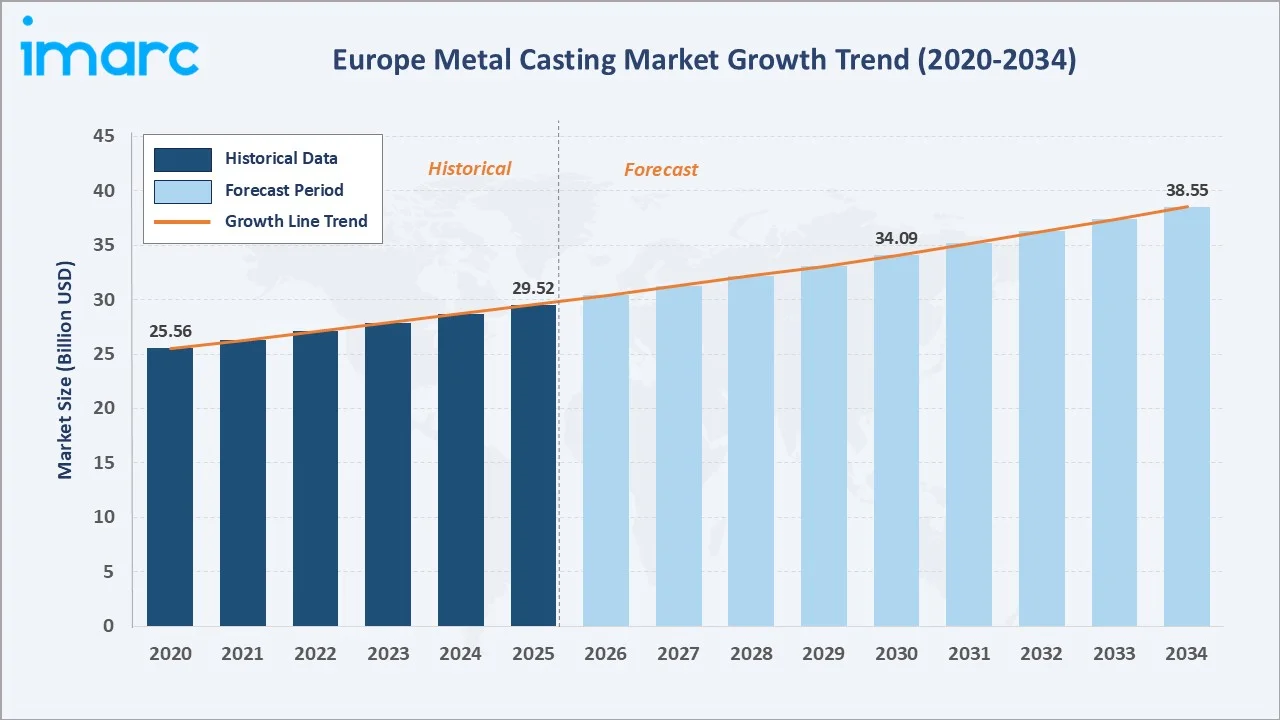
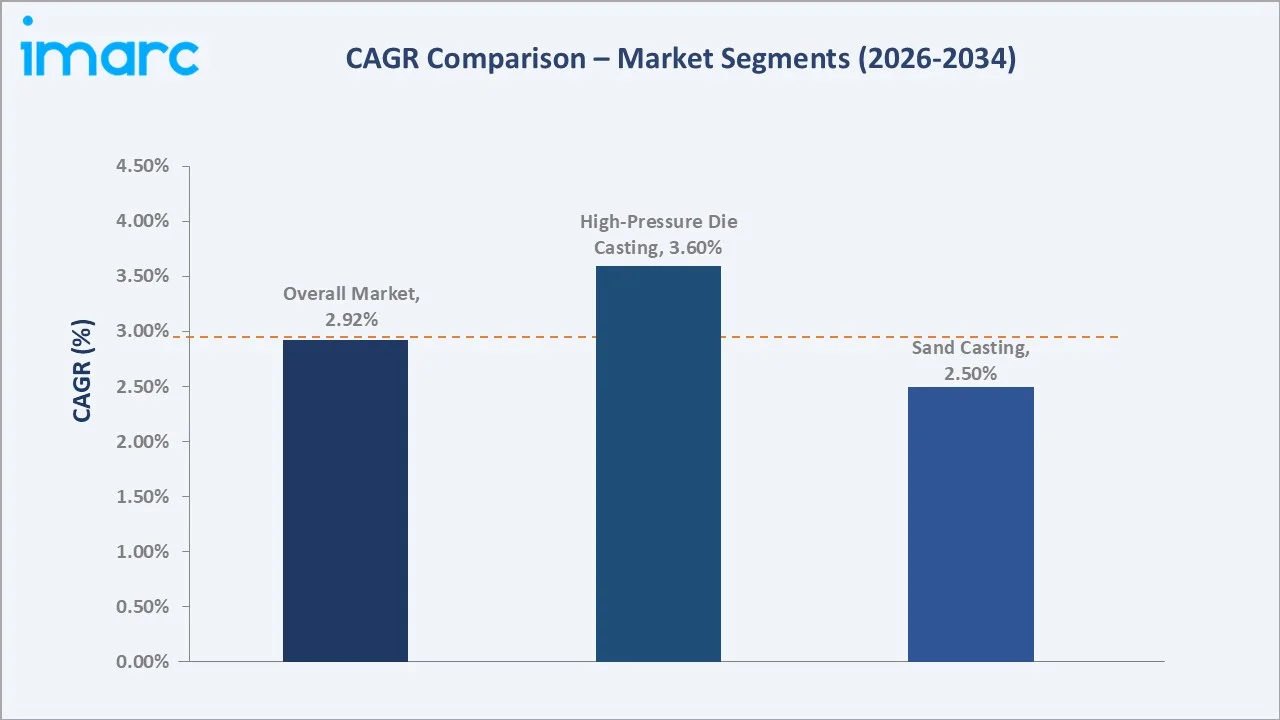
The Europe metal casting market grew from USD 29.52 Billion in 2025 to USD 30.60 Billion in 2026 and is projected to reach USD 38.55 Billion by 2034, expanding at a CAGR of 2.92% during 2026-2034. Rising demand for lightweight automotive components, coupled with growing adoption of high-pressure die casting technology and increasing investment in electric vehicle manufacturing, are the primary growth catalysts.
Market Snapshot
|
Metric |
Value |
|
Base Year Market Size (2025) |
USD 29.52 Billion |
| Market Size (2026) | USD 30.60 Billion |
|
Forecast Market Size (2034) |
USD 38.55 Billion |
|
CAGR (2026-2034) |
2.92% |
|
Base Year |
2025 |
|
Historical Period |
2020-2025 |
|
Forecast Period |
2026-2034 |
Germany leads the Europe metal casting landscape, holding a 28.6% share in 2025, anchored by the country's strong automotive manufacturing base and advanced foundry technology infrastructure. Sand casting commands the largest share of the process segment at 36.8%, reflecting sustained demand for cost-effective, versatile casting solutions across diverse end-use applications.
To get more information on this market, Request Sample
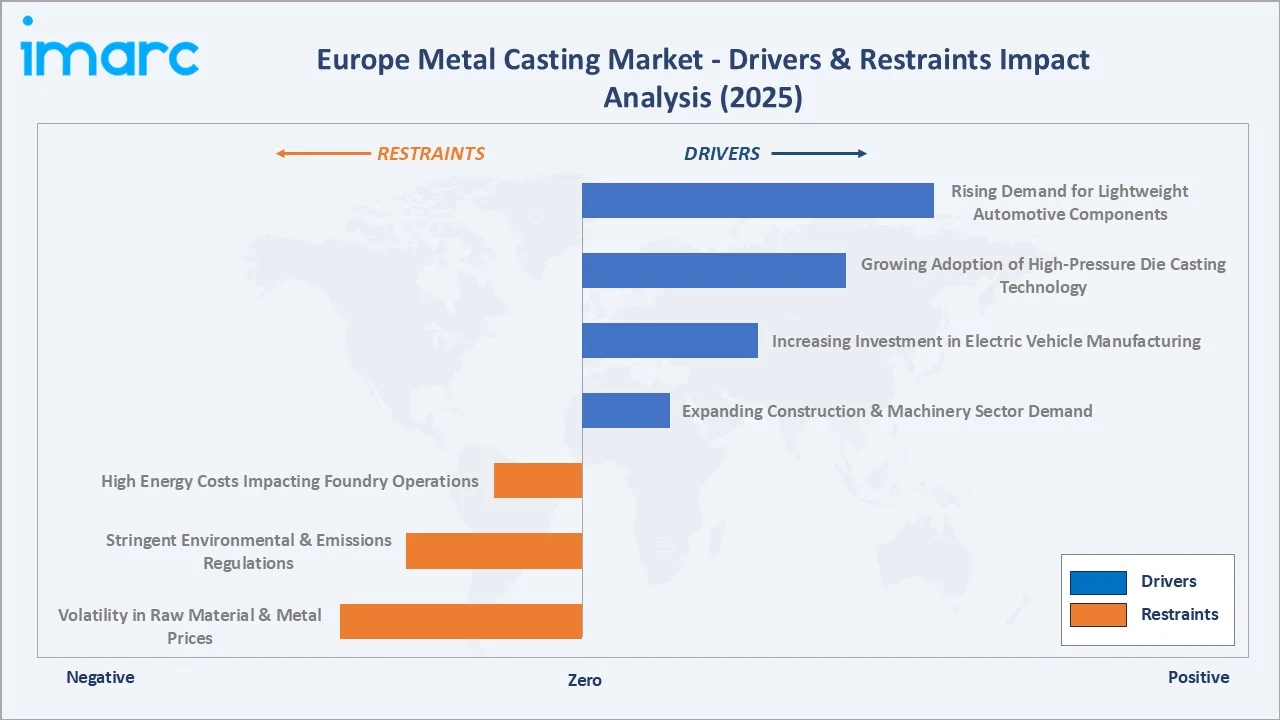
The Europe metal casting market is underpinned by three structural forces: rising demand for lightweight automotive components, growing adoption of high-pressure die casting technology, and increasing investment in electric vehicle manufacturing. Each force independently reinforces category growth, sustaining steady CAGR expansion through 2034 despite high energy costs impacting foundry operations.
Executive Summary
The Europe metal casting market is experiencing steady expansion, driven by rising lightweight automotive component demand, growing high-pressure die casting adoption, and increasing electric vehicle manufacturing investment. The market expanded from USD 29.52 Billion in 2025 to USD 30.60 Billion in 2026 and is projected to reach USD 38.55 Billion by 2034, growing at a CAGR of 2.92%.
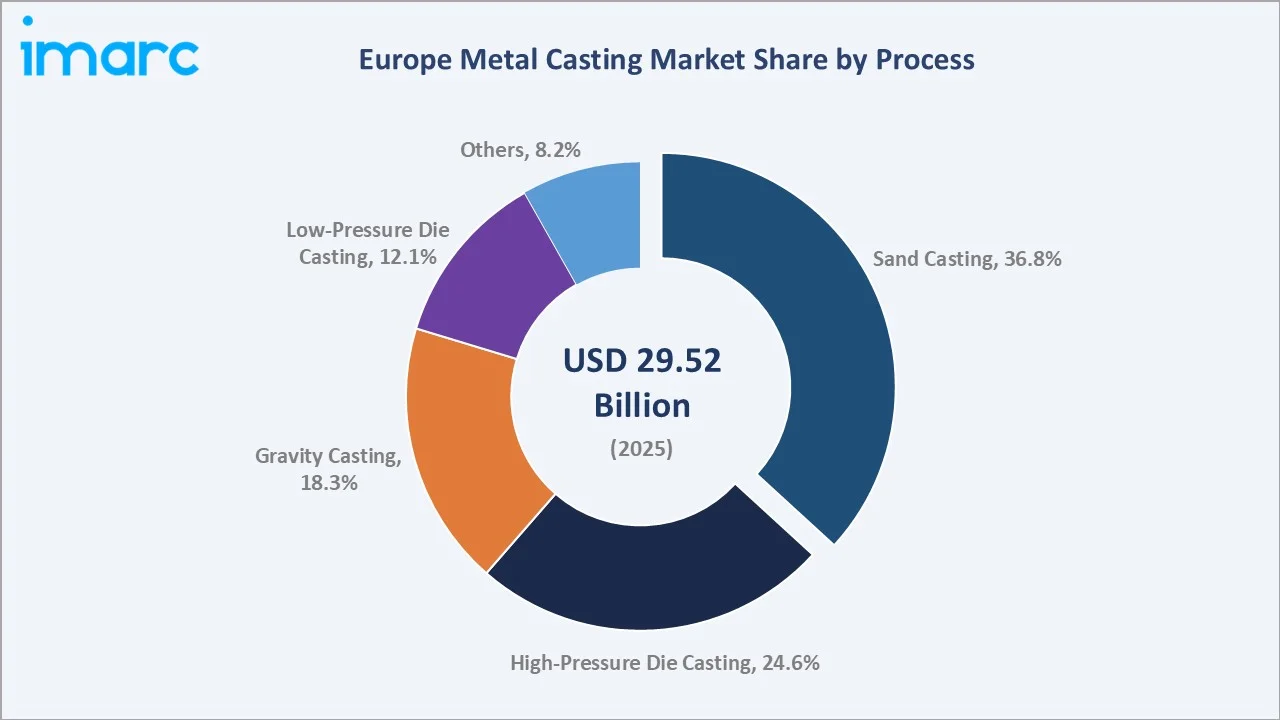
Sand casting dominates the process segment with a 36.8% share in 2025, encompassing cost-effective, versatile molding techniques for large and complex components, while high-pressure die casting accounts for 24.6%, gravity casting for 18.3%, low-pressure die casting for 12.1%, and other processes for 8.2%, reflecting the market's broad technological diversity.
Automotive and transportation leads the end use segment at 46.2% share, supported by sustained lightweighting and EV component demand, followed by equipment and machine at 23.1%, building and construction at 15.8%, aerospace and military at 8.4%, and others at 6.5%. Germany leads regionally at 28.6%, anchored by the country's strong automotive manufacturing base and advanced foundry technology infrastructure.
Key Market Insights
|
Insight |
Data |
|
Largest Process Segment |
Sand Casting – 36.8% share (2025) |
|
Fastest Growing Process Segment |
High-Pressure Die Casting – ~3.6% CAGR (2026-2034) |
|
Largest End Use Sector Segment |
Automotive and Transportation – 46.2% share (2025) |
|
Leading Region |
Germany – 28.6% share (2025) |
|
Top Companies |
thyssenkrupp AG, Alcoa Corporation, Magna International Inc., Proterial, Ltd. |
Key Analytical Observations Supporting the Above Data:
- Sand casting accounts for 36.8% of the Europe metal casting market in 2025. This dominance reflects sustained demand for cost-effective, versatile molding solutions across diverse component sizes.
- Automotive and transportation remains the leading end-use sector at 46.2% share (2025), supported by sustained lightweighting and electric vehicle component demand.
- High-pressure die casting is expanding steadily at 24.6% share (2025), as growing demand for precision, high-volume aluminum components continues to drive category growth.
- Germany's 28.6% share (2025) reflects its strong automotive manufacturing base and advanced foundry technology infrastructure.
- Rising convergence of metal casting with digital foundry automation and sustainable casting technology is broadening the addressable market across automotive, machinery, and construction applications.
Europe Metal Casting Market Overview
The Europe metal casting market encompasses sand casting, high-pressure die casting, gravity casting, low-pressure die casting, and other process categories delivered across automotive and transportation, equipment and machine, building and construction, aerospace and military, and other end-use sectors, offering precision-engineered metal components for a wide range of industrial applications. The metal casting ecosystem spans raw material and alloy suppliers, foundry equipment manufacturers, and an expanding network of finishing and quality inspection partners.
Macroeconomic drivers include rising demand for lightweight automotive components, growing adoption of high-pressure die casting technology, and increasing investment in electric vehicle manufacturing. Foundries are simultaneously investing in digital foundry automation, sustainable and low-emission casting technology, and expanded circular economy recycled alloy adoption to improve operational efficiency, positioning the Europe metal casting sector for continued steady growth through 2034 despite high energy costs impacting foundry operations.
Market Dynamics
To evaluate market opportunities, Request Sample
Market Drivers
- Rising Demand for Lightweight Automotive Components: Growing automotive industry focus on fuel efficiency and emissions reduction is driving sustained lightweight casting component adoption.
- Growing Adoption of High-Pressure Die Casting Technology: Novelis stated that Europe’s aluminum demand is projected to increase by approximately 30% by 2040, driven by rising demand from electric vehicles, renewable energy infrastructure, construction, and sustainable packaging applications. Thus, rising demand for precision, high-volume aluminum components is accelerating adoption of high-pressure die casting across automotive applications.
- Increasing Investment in Electric Vehicle Manufacturing: Countries across the European Economic Area and Switzerland have committed nearly EUR 200 billion (USD 235 billion) toward developing their electric vehicle (EV) ecosystems, according to research group New Automotive. Rising EV production investment is increasing demand for specialized lightweight casting components, including battery housings and structural parts.
- Expanding Construction & Machinery Sector Demand: Rising construction and industrial machinery activity is broadening the addressable market for structural and component casting applications. In 2025, the European construction equipment market recorded moderate growth, with sales increasing by 4.6% year-over-year.
Market Restraints
- High Energy Costs Impacting Foundry Operations: Energy costs represent up to 60% of production expenses for smelters, creating significant cost pressures as global aluminum prices limit the ability to pass higher energy costs onto customers. Significant energy costs associated with melting and casting processes can constrain smaller foundries and limit price competitiveness.
- Stringent Environmental & Emissions Regulations: Persistent regulatory pressure around foundry emissions and waste management can complicate compliance and increase operational costs.
- Volatility in Raw Material & Metal Prices: Fluctuating prices for aluminum, steel, and other casting alloys can complicate cost forecasting and margin management for foundries. For instance, European secondary aluminum prices have strengthened amid tightening scrap availability, with prices increased by around EUR 50– EUR 100 per ton in 2025 due to limited scrap supply and strong demand.
Market Opportunities
- Digital Foundry & Automation Integration: Growing adoption of digital foundry automation presents opportunities for manufacturers seeking improved process efficiency and quality control.
- Circular Economy Recycled Alloy Adoption: Rising demand for sustainable, recycled casting materials offers opportunities for foundries expanding their circular economy material portfolios.
- Aerospace & Military Application Expansion: Growing interest in precision aerospace and military casting applications creates opportunities for manufacturers entering underpenetrated high-value segments.
Market Challenges
- Balancing Cost Efficiency and Sustainability: Foundries must balance sustainable, low-emission casting technology investment with the need to maintain cost competitiveness.
- Addressing Skilled Labor Shortages: Ensuring sufficient skilled foundry labor and technical expertise requires ongoing investment in training and workforce development.
Emerging Market Trends
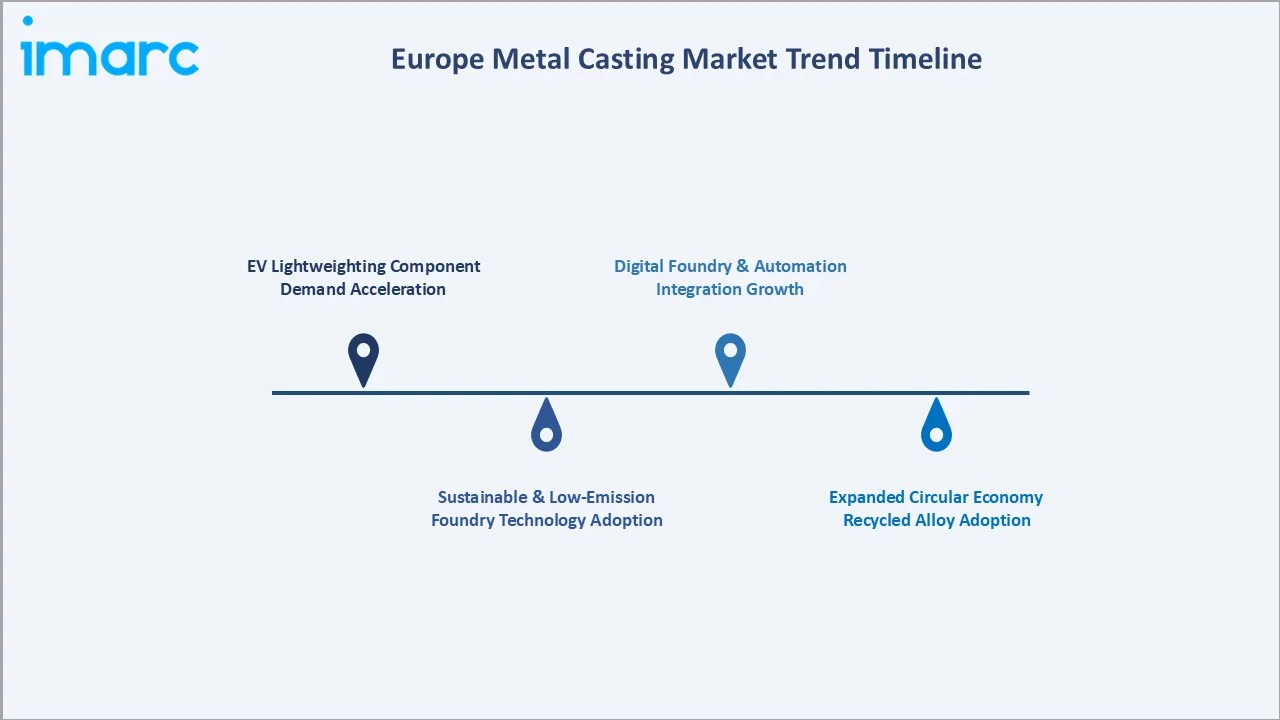
1. EV Lightweighting Component Demand Acceleration
Manufacturers are increasingly producing lightweight casting components for electric vehicles, driving demand for advanced aluminum and magnesium alloy casting technologies. Fraunhofer IFAM is developing advanced casting technologies for electromobility applications, focusing on lightweight, cost-efficient components for electric vehicles, including structural parts, battery systems, and electric motor components.
2. Sustainable & Low-Emission Foundry Technology Adoption
Growing adoption of sustainable and low-emission foundry technology is expanding compliance capacity and reducing the environmental footprint of casting operations across the region. Matthies Druckguss GmbH & Co. KG is advancing toward carbon neutrality by investing over EUR 1.2 million in upgraded casting equipment, energy-efficient technologies, and process optimization, reducing electricity costs by nearly 40%
3. Digital Foundry & Automation Integration Growth
Rising integration of digital automation and process monitoring technology is accelerating quality control and operational efficiency across European foundry operations. The adoption of Industry 4.0 solutions, including AI-based predictive maintenance, robotics, and real-time data analytics, is enabling smarter and more flexible casting processes.
4. Expanded Circular Economy Recycled Alloy Adoption
Growing foundry adoption of recycled and circular economy alloy sourcing is driving expansion of sustainable material sourcing practices across the metal casting industry. Increasing regulatory focus on carbon reduction and resource efficiency is encouraging European foundries to increase the use of recycled aluminum, steel, and other secondary alloys.
Industry Value Chain Analysis
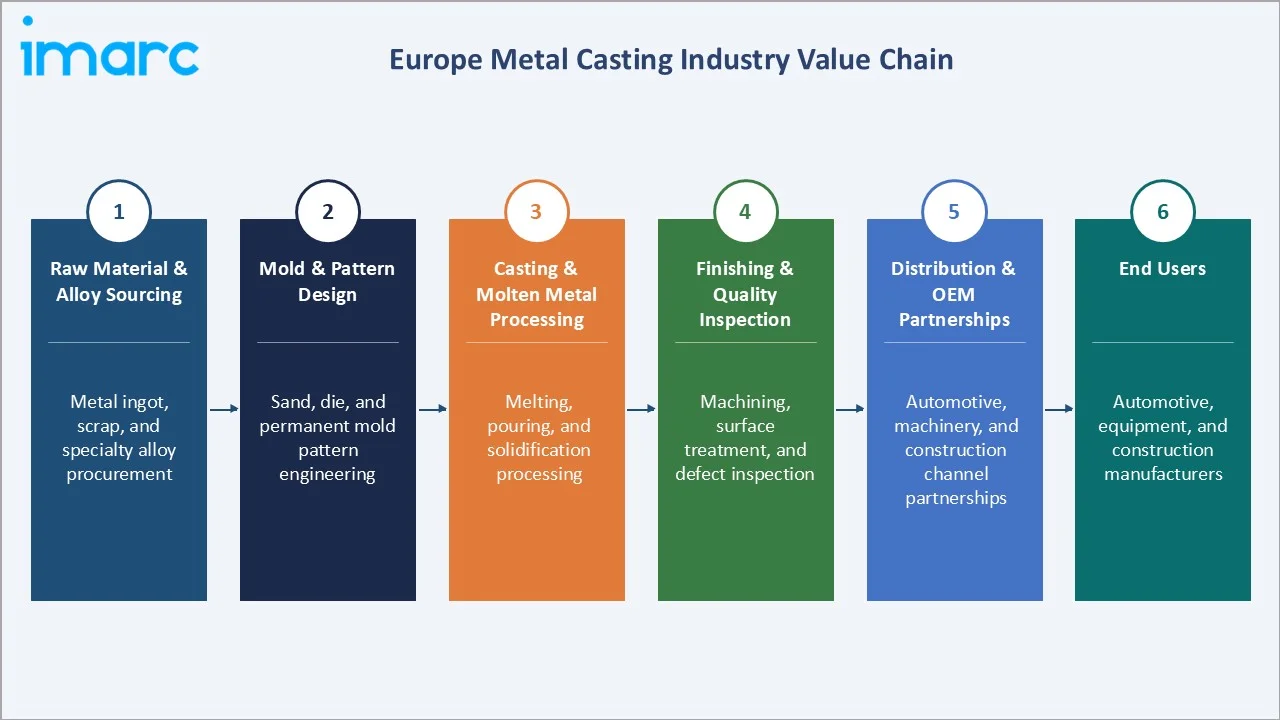
The Europe metal casting value chain spans raw material sourcing through end-user delivery, with each stage occupied by specialized alloy suppliers, foundry equipment manufacturers, and OEM partnership providers whose performance directly influences component quality, durability, and cost-effectiveness.
|
Stage |
Key Activities |
|
Raw Material & Alloy Sourcing |
Metal ingot, scrap, and specialty alloy procurement |
|
Mold & Pattern Design |
Sand, die, and permanent mold pattern engineering |
|
Casting & Molten Metal Processing |
Melting, pouring, and solidification processing |
|
Finishing & Quality Inspection |
Machining, surface treatment, and defect inspection |
|
Distribution & OEM Partnerships |
Automotive, machinery, and construction channel partnerships |
|
End Users |
Automotive, equipment, and construction manufacturers |
Technology Landscape in the Europe Metal Casting Industry
Advanced High-Pressure Die Casting Technology
Manufacturers are advancing high-pressure die casting technology to improve dimensional accuracy and production speed, supporting broader adoption among automotive and electronics applications. Growing use of vacuum-assisted die casting is further reducing porosity defects in structural components.
Sustainable & Low-Emission Foundry Development
Growing investment in low-emission foundry technology is expanding compliance capacity, addressing rising regulatory demand for environmentally responsible casting operations. Increasing adoption of induction melting and recycled metal feedstock is further reducing energy consumption and carbon footprint.
Digital Foundry Automation Systems
Manufacturers are engineering advanced digital automation and process monitoring systems to extend quality control across demanding automotive and aerospace customer segments. Real-time sensor-based defect detection is further enabling predictive maintenance and reduced scrap rates.
Lightweight Alloy Innovation
Expanding research into lightweight aluminum and magnesium alloy technology is strengthening EV component reliability, supporting premium positioning across performance and structural casting segments. Development of high-strength, thin-wall casting alloys is further supporting weight reduction goals in next-generation vehicle platforms.
Market Segmentation Analysis
The report covers the following segments:
|
Segment Category |
Leading Segment |
Market Share |
Year |
|
Process |
Sand Casting |
36.8% |
2025 |
|
End Use |
Automotive and Transportation |
46.2% |
2025 |
|
Material Type |
Aluminum |
🔒 |
2025 |
|
Component |
🔒 |
🔒 |
2025 |
|
Vehicle Type |
🔒 |
🔒 |
2025 |
|
Electric and Hybrid Type |
🔒 |
🔒 |
2025 |
|
Application |
Engine Parts |
🔒 |
2025 |
|
Region |
Germany |
28.6% |
2025 |

By Process
Sand casting dominates with a 36.8% share in 2025. This segment encompasses cost-effective, versatile molding techniques for large and complex components, supported by sustained demand across diverse industrial applications.
To access detailed market analysis, Request Sample
High-pressure die casting represents 24.6% of the market (2025), followed by gravity casting at 18.3%, low-pressure die casting at 12.1%, and others at 8.2%, reflecting the market's broad technological diversity across casting applications.
By End Use Sector
Automotive and transportation leads the end use segment at 46.2% share (2025), supported by sustained lightweighting and electric vehicle component demand across the region.
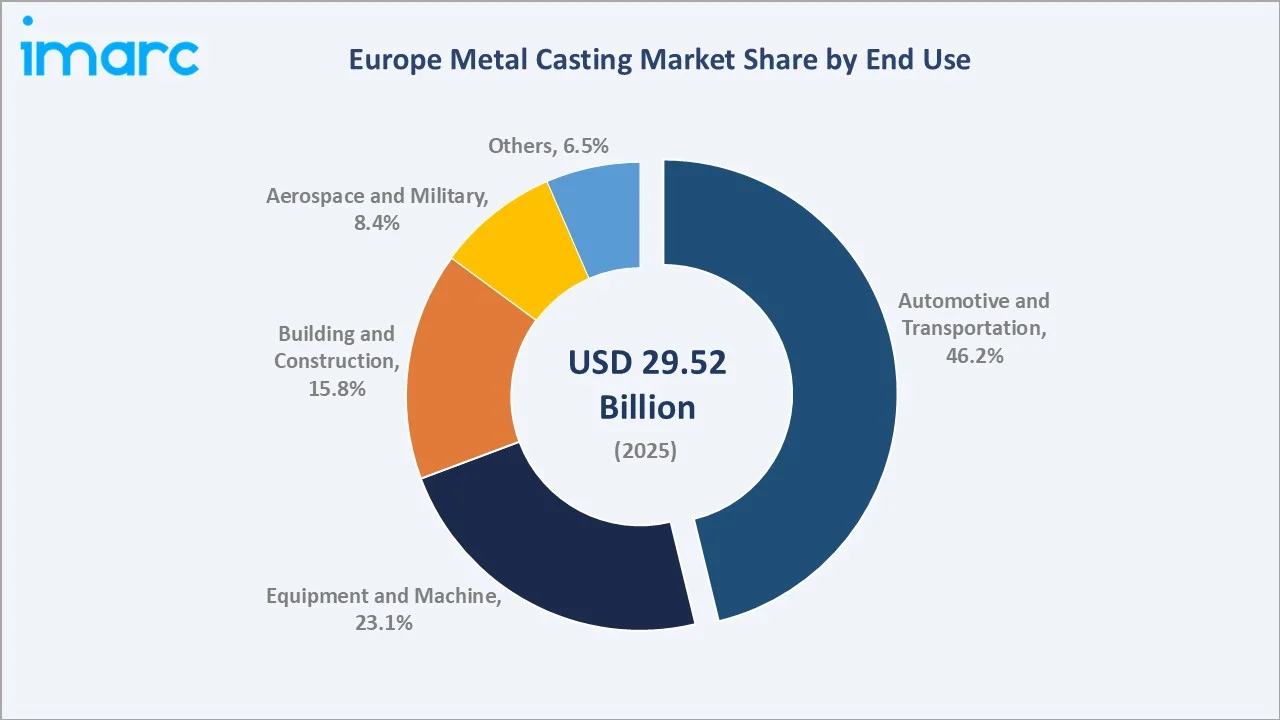
Equipment and machine (23.1%), building and construction (15.8%), aerospace and military (8.4%), and other sectors (6.5%) continue to broaden the market's application diversity across industrial, commercial, and defense segments.
Regional Market Insights
Germany's market leadership (28.6%, 2025) reflects its strong automotive manufacturing base and advanced foundry technology infrastructure. Growing high-pressure die casting capacity and expanding EV lightweighting component demand combine to sustain its dominant position through 2034.
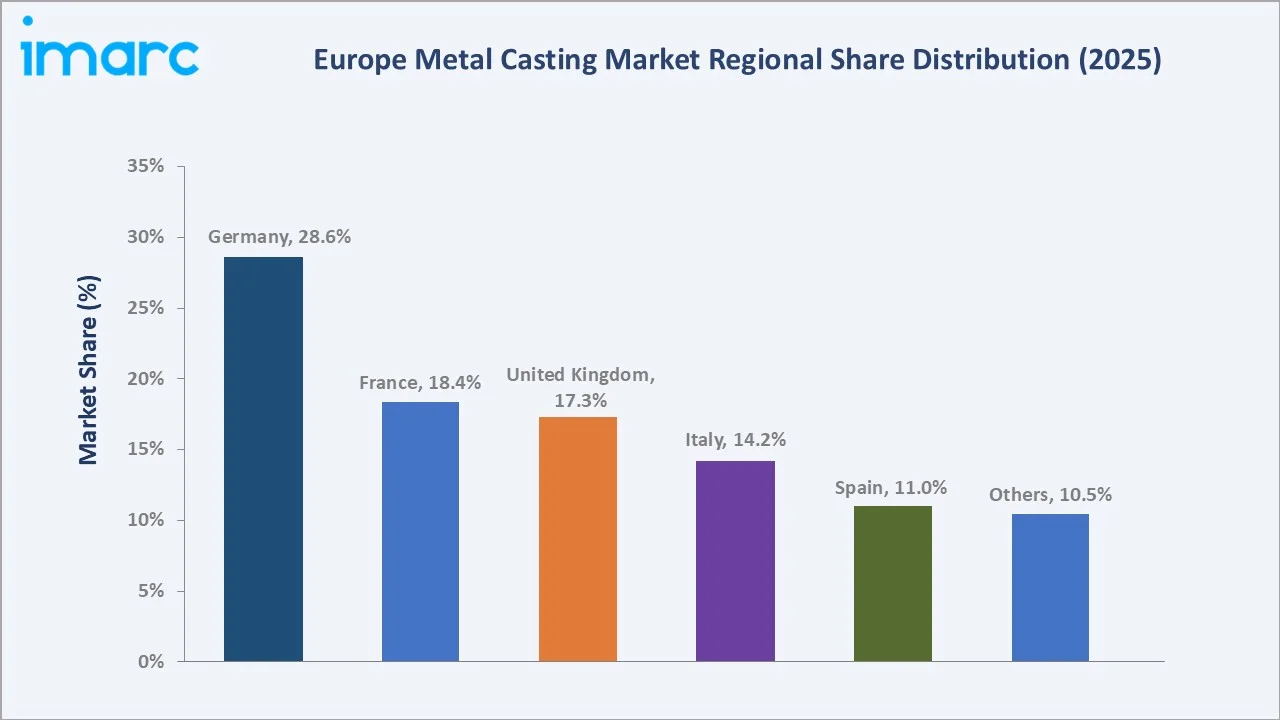
France at 18.4% represents the second-largest Europe metal casting market regionally. Growing aerospace and automotive casting demand and expanding foundry modernization are sustaining steady growth, positioning the country as a key contributor alongside Germany through the forecast period.
|
Region |
Share (2025) |
Key Growth Drivers |
|
Germany |
28.6% |
Strong automotive manufacturing base and advanced foundry technology infrastructure |
|
France |
18.4% |
Growing aerospace and automotive casting demand and expanding foundry modernization |
|
United Kingdom |
17.3% |
Rising precision casting adoption and expanding machinery sector demand |
|
Italy |
14.2% |
Established foundry manufacturing base and growing equipment sector applications |
|
Spain |
11.0% |
Emerging automotive casting adoption and expanding construction sector demand |
|
Others |
10.5% |
Gradual foundry modernization and expanding regional industrial applications |
Competitive Landscape
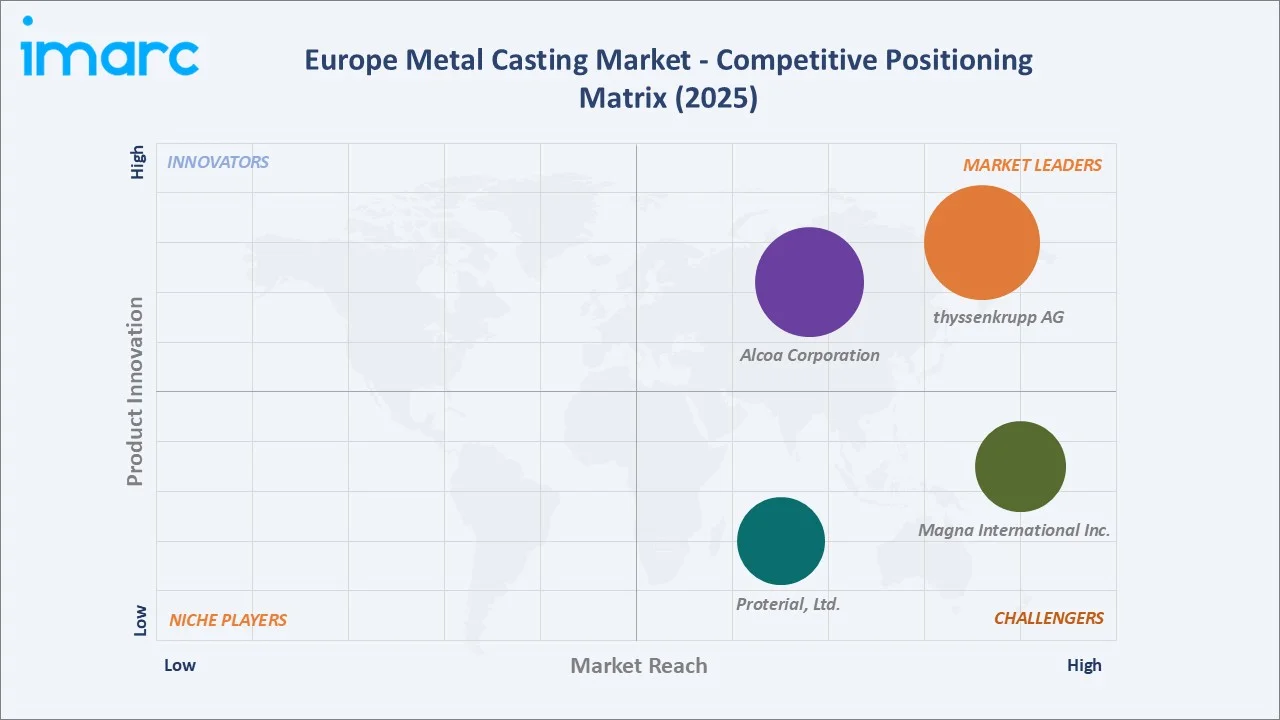
The Europe metal casting market exhibits moderate concentration, with leading manufacturers collectively holding a significant share of market revenue in 2025, reflecting sustained investment in process innovation and application reach.
|
Company Name |
Brand Name |
Market Position |
Core Strength |
|
thyssenkrupp AG |
thyssenkrupp Steel |
Market Leader |
Leading industrial manufacturer with extensive metal casting and digital foundry technology portfolio |
|
Alcoa Corporation |
Alcoa |
Market Leader |
Established aluminum casting provider with strong lightweight component capabilities |
|
Magna International Inc. |
Magna |
Strong Challenger |
Specialized automotive component manufacturer with strong lightweighting casting presence |
|
Proterial, Ltd. |
Proterial |
Challenger |
Diversified metal manufacturing provider with strong specialty alloy casting applications |
thyssenkrupp AG and Alcoa Corporation dominate through comprehensive process portfolios and extensive automotive and industrial application reach, supported by continuous investment. Magna International Inc. and Proterial, Ltd. compete through targeted lightweighting specialization and powertrain application scale, respectively.
Key Company Profiles
thyssenkrupp AG
thyssenkrupp AG is one of the leading global industrial manufacturers with an extensive metal casting and digital foundry technology portfolio serving automotive and industrial applications.
- Product Portfolio: Precision casting components, digital foundry automation systems, and industrial metal processing solutions under the thyssenkrupp Steel brand.
- Recent Developments: In June 2026, thyssenkrupp AG owned thyssenkrupp Steel resumed trial operations at its Hot Strip Mill 4 in Duisburg after extensive repair work following a fire in October 2025, along with technical upgrades to improve production stability and efficiency.
- Strategic Focus: Strengthening digital foundry automation capacity; expanding sustainable casting technology across emerging application segments.
Alcoa Corporation
Alcoa Corporation is one of the leading aluminum casting providers with a strong presence across automotive lightweighting and industrial component applications.
- Product Portfolio: Aluminum casting components, lightweight automotive parts, and specialty alloy solutions under the Alcoa brand.
- Recent Developments: In May 2026, Alcoa Corporation announced a USD 65 million capital investment at its Mosjøen smelter in Norway to expand foundry capabilities, integrate recycled aluminum into casting operations, and strengthen low-carbon aluminum production.
- Strategic Focus: Scaling lightweight aluminum casting capabilities; deepening automotive manufacturer partnerships.
Market Concentration Analysis
The Europe metal casting market exhibits moderate concentration, with thyssenkrupp AG, Alcoa Corporation, and Magna International Inc. collectively accounting for a significant share of total category revenue in 2025, reflecting sustained process investment, customer loyalty, and extensive application reach across the industry.
Consolidation pressure remains limited as leading manufacturers maintain distinct strategic positioning: thyssenkrupp AG and Alcoa Corporation through comprehensive digital foundry and aluminum casting portfolios, Magna International Inc. through lightweighting, and Proterial, Ltd. through diversified precision and specialty alloy differentiation, rather than pursuing direct M&A consolidation.
Investment & Growth Opportunities
Fastest Growing Segments
High-pressure die casting (~3.6% CAGR) represents the highest-growth investment vector through 2034, driven by expanding precision aluminum component demand and continuous innovation across EV lightweighting technologies. This subcategory addresses a rapidly expanding addressable market within the Europe metal casting ecosystem.
Emerging Market Expansion
Spain and other regional markets collectively represent an incremental growth opportunity beyond Germany, France, the United Kingdom, and Italy by 2034, as rising automotive casting adoption and expanding construction sector demand accelerate category penetration in these emerging markets.
Venture and Institutional Investment Trends
- Manufacturer investment toward digital foundry automation and sustainable casting technology is creating opportunities for technology vendors serving the metal casting sector.
- Growing EV lightweighting demand is sustaining institutional interest in specialty aluminum casting platform providers.
- Circular economy recycled alloy innovation, led by major manufacturers, is opening opportunities for material and technology vendors serving the Europe metal casting industry.
Future Market Outlook (2026-2034)
The Europe metal casting market is positioned for steady, technology-driven expansion through 2034. From a base of USD 29.52 Billion in 2025 to USD 30.60 Billion in 2026, the market is projected to reach USD 38.55 Billion by 2034, representing substantial incremental value creation at a CAGR of 2.92%. This growth is structurally supported by rising lightweight automotive component demand, growing high-pressure die casting adoption, and increasing electric vehicle manufacturing investment.
The process segment will continue evolving through 2034, with high-pressure die casting gaining further share as EV lightweighting and precision component innovation accelerate. This shift creates opportunities for manufacturers investing in digital foundry automation, sustainable casting technology, and expanded circular economy recycled alloy capabilities to capture the next phase of the Europe metal casting market growth.
Research Methodology
Primary Research
Primary research comprised structured interviews with industry participants across 2024-2025, including foundry executives, automotive OEM procurement specialists, casting technology engineers, and industrial manufacturing experts across major European regions. Expert input validated market sizing, segmentation trends, and regional consumption patterns.
Secondary Research
Secondary research encompassed manufacturer annual reports, foundry industry association publications, and trade press covering process innovation, regulatory trends, and regional market dynamics across major European markets.
Forecasting Models
Market size estimations were derived using top-down and bottom-up forecasting, incorporating process and end use segment transitions and manufacturer product disclosures. A base-case CAGR of 2.92% reflects consensus estimates validated against announced capacity investment timelines and manufacturer strategic development plans.
Report Coverage:
| Report Features | Details |
|---|---|
| Base Year of the Analysis | 2025 |
| Historical Period | 2020-2025 |
| Forecast Period | 2026-2034 |
| Units | Billion USD |
| Scope of the Report | Exploration of Historical Trends and Market Outlook, Industry Catalysts and Challenges, Segment-Wise Historical and Future Market Assessment:
|
| Processes Covered | Sand Casting, Gravity Casting, High-Pressure Die Casting, Low-Pressure Die Casting, Others |
| Material Types Covered | Cast Iron, Aluminum, Steel, Zinc, Magnesium, Others |
| End Uses Covered | Automotive and Transportation, Equipment and Machine, Building and Construction, Aerospace and Military, Others |
| Components Covered | Alloy Wheels, Clutch Casing, Cylinder Head, Cross Car Beam, Crank Case, Battery Housing, Others |
| Vehicle Types Covered | Passenger Cars, Light Commercial Vehicles, Heavy Commercial Vehicles |
| Electric and Hybrid Types Covered | Hybrid Electric Vehicles, Battery Electric Vehicles, Plug-In Hybrid Electric Vehicles |
| Applications Covered | Body Assemblies, Engine Parts, Transmission Parts, Others |
| Countries Covered | Germany, France, United Kingdom, Italy, Spain, Others |
| Companies Covered | thyssenkrupp AG, Alcoa Corporation, Magna International Inc., Proterial, Ltd., etc. |
| Customization Scope | 10% Free Customization |
| Post-Sale Analyst Support | 10-12 Weeks |
| Delivery Format | PDF and Excel through Email (We can also provide the editable version of the report in PPT/Word format on special request) |
Frequently Asked Questions About the Europe Metal Casting Market Report
The Europe metal casting market size is estimated at USD 30.60 Billion in 2026.
The market is expected to grow at a CAGR of 2.92% during 2026-2034, driven by rising lightweight automotive component demand and growing high-pressure die casting adoption.
Germany leads with a 28.6% share in 2025, anchored by its strong automotive manufacturing base and advanced foundry technology infrastructure.
Sand casting dominates with a 36.8% share in 2025, driven by sustained demand for cost-effective, versatile molding solutions.
Automotive and transportation leads with a 46.2% share in 2025, supported by sustained lightweighting and electric vehicle component demand.
Some of the key players include thyssenkrupp AG, Alcoa Corporation, Magna International Inc., and Proterial, Ltd.
High-pressure die casting is growing fastest at an estimated 3.6% CAGR as precision aluminum component demand accelerates.
Key challenges include high energy costs impacting foundry operations, stringent environmental and emissions regulations, and volatility in raw material and metal prices.
Digital foundry and automation integration, circular economy recycled alloy adoption, and aerospace and military application expansion represent leading investment opportunities.
Aerospace and military, at 8.4% share, continues to serve precision, high-value casting applications, supporting premium positioning across specialized manufacturing segments.
Need more help?
- Speak to our experienced analysts for insights on the current market scenarios.
- Include additional segments and countries to customize the report as per your requirement.
- Gain an unparalleled competitive advantage in your domain by understanding how to utilize the report and positively impacting your operations and revenue.
- For further assistance, please connect with our analysts.
 Request Customization
 Speak to an Analyst
 Request Brochure
 Inquire Before Buying
Benefits of Customization
- Personalize this research
- Triangulate with your data
- Get data as per your format and definition
- Gain a deeper dive into a specific application, geography, customer, or competitor
- Any level of personalization
Get in Touch With Us
UNITED STATES
Phone: +1-201-971-6302
INDIA
Phone: +91-120-433-0800
UNITED KINGDOM
Phone: +44-753-714-6104
Email: [email protected]
Client Testimonials




.webp)




.webp)













Related Reports

Choose your plan
*Please note that the prices mentioned below are starting prices for each bundle type. Kindly contact our team for further details.*
Single User License
- 1 User License, Access on 2 Devices
- PDF Report + Excel Dataset (Password Protected)
- Lifetime Access
- No Printing Rights
- 10% Free Report Customization
- 10–12 Weeks of Analyst Support
Five User License
- Access for 5 Users, 2 Devices per User
- PDF Report + Excel Dataset (Password Protected)
- Lifetime Access
- Dedicated Account Manager
- 12–14 Weeks of Analyst Support
- No Printing Rights
- 15% Free Report Customization
- 25% Discount on Your Next Purchase
Corporate User License
- Unlimited User Access (Within Your Organization)
- PDF Report + Excel Dataset
- Lifetime Access
- Dedicated Account Manager
- 14–20 Weeks of Analyst Support
- No Printing Rights
- 20% Free Report Customization
- 30% Discount on Your Next Purchase
Essential Insights
What's included:
3 reports
- Lifetime Access
- PDF Reports
- Excel Datasets
- 2 Weeks of Free Analyst Support
- 2 User Licenses
- Access on 2 Devices
- Printing Rights
- Complimentary PowerPoint (PPT) Version
- Complimentary License Upgrade
Professional Access
What's included:
5 reports
- Lifetime Access
- PDF Reports
- Excel Datasets
- 8 Weeks of Free Analyst Support
- 2 User Licenses
- Access on 2 Devices
- Printing Rights
- Complimentary PowerPoint (PPT) Version
- Complimentary License Upgrade
Business Advantage
What's included:
8 reports
- Lifetime Access
- PDF Reports
- Excel Datasets
- 14 Weeks of Free Analyst Support
- 2 User Licenses
- Access on 2 Devices
- Printing Rights
- Complimentary PowerPoint (PPT) Version
- Complimentary License Upgrade
Enterprise Intelligence
What's included:
10 reports
- Lifetime Access
- PDF Reports
- Excel Datasets
- 20 Weeks of Free Analyst Support
- 2 User Licenses
- Access on 2 Devices
- Printing Rights
- Complimentary PowerPoint (PPT) Version
- Complimentary License Upgrade