
Europe Oral Hygiene Market Size, Share, Trends and Forecast by Product, Distribution Channel, Application, and Country, 2026-2034
Europe Oral Hygiene Market Size, Share, Trends & Forecast (2026-2034)
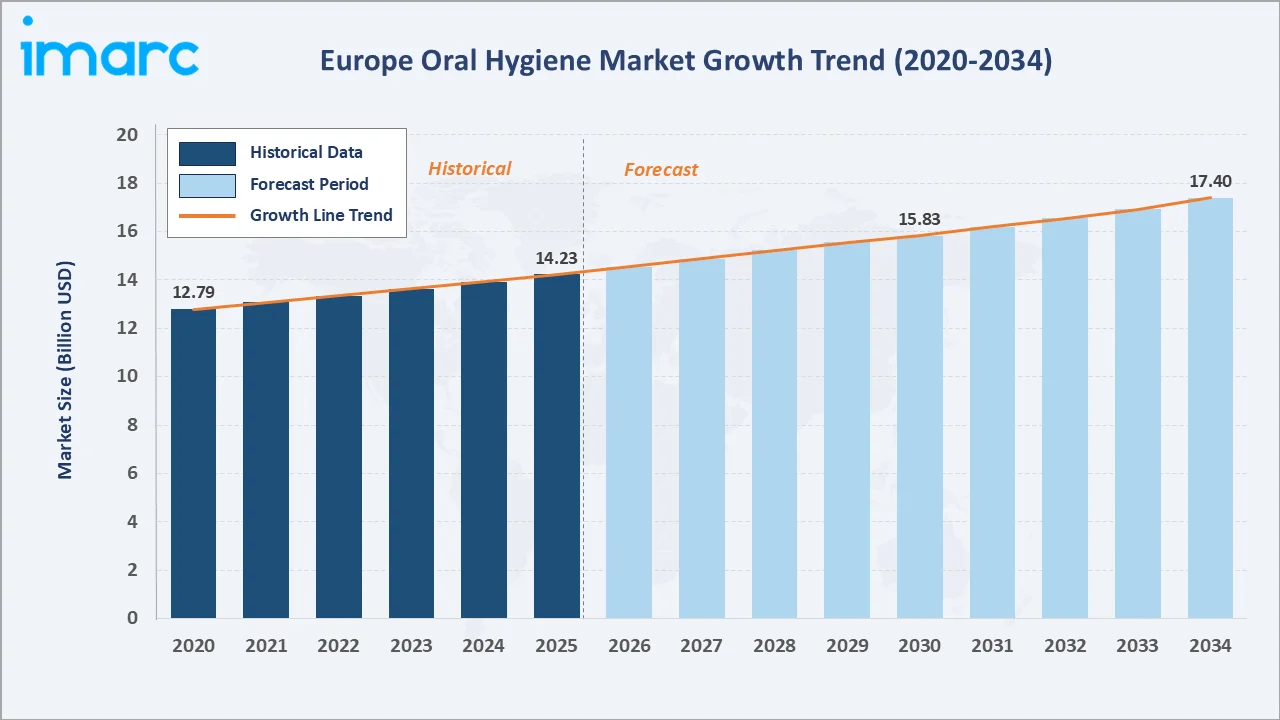
The Europe oral hygiene market grew from USD 14.23 Billion in 2025 to USD 14.54 Billion in 2026 and is projected to reach USD 17.40 Billion by 2034, growing at a CAGR of 2.15% during 2026-2034. The European oral hygiene market serves a population with deeply ingrained twice-daily brushing habits, high dental professional engagement, and one of the most developed pharmacy-driven oral health care cultures, generating a high-value, stable consumption base that supports consistent premium innovation from multinational brands and independent dental specialist labels alike. Toothpaste leads product share at 41.6%, supermarkets and hypermarkets dominate distribution at 38.7%, and Germany commands the largest country share at 28.6%.
Market Snapshot
|
Metric |
Value |
|
Base Year Market Size (2025) |
USD 14.23 Billion |
|
Market Size (2026) |
USD 14.54 Billion |
|
Forecast Market Size (2034) |
USD 17.40 Billion |
|
CAGR (2026-2034) |
2.15% |
|
Base Year |
2025 |
|
Historical Period |
2020-2025 |
|
Forecast Period |
2026-2034 |
|
Dominant Product |
Toothpaste (41.6%, 2025) |
|
Dominant Distribution Channel |
Supermarkets & Hypermarkets (38.7%, 2025) |
|
Leading Country |
Germany (28.6%, 2025) |
The Europe oral hygiene market grew from USD 12.79 Billion in 2020 to USD 14.23 Billion by 2025 and is estimated to reach USD 14.54 Billion in 2026. The market is projected to reach USD 15.83 Billion by 2030 and USD 17.40 Billion by 2034.
To get more information on this market, Request Sample
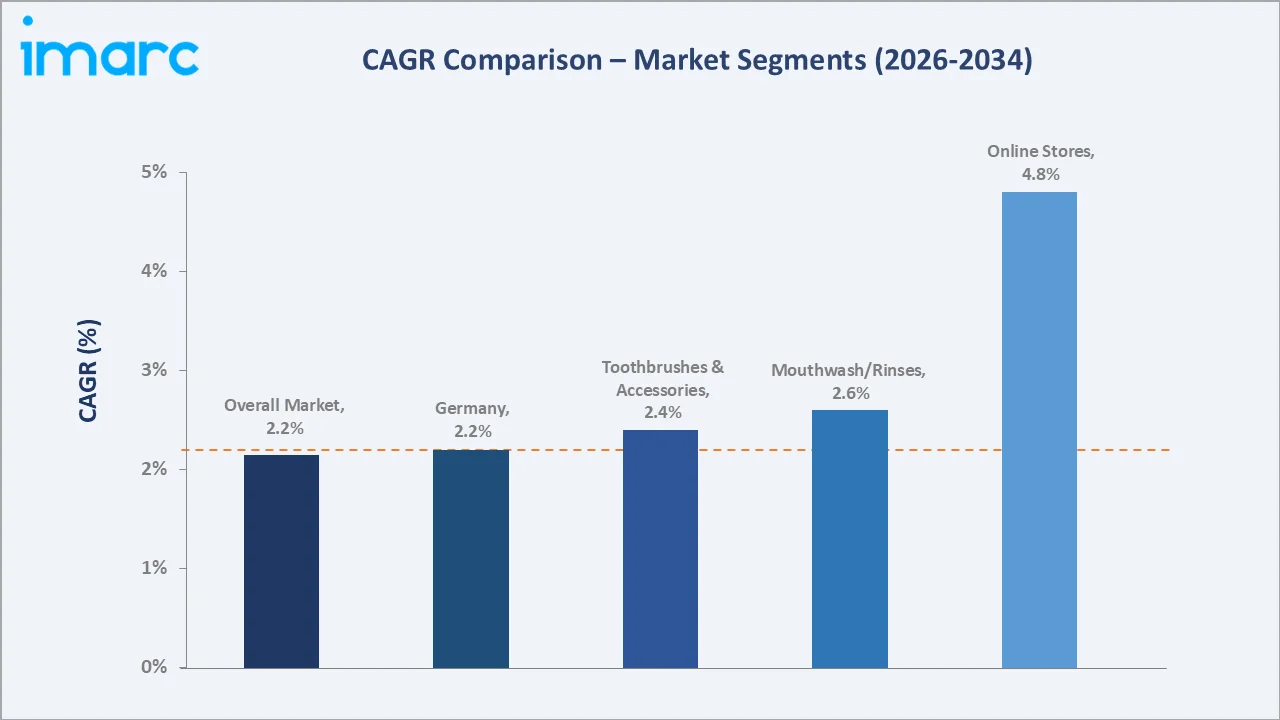
Online stores grow fastest at ~4.8% CAGR through subscription toothbrush services and DTC oral care brand expansion. Mouthwash/rinses expand at ~2.6% CAGR through therapeutic and cosmetic rinse premiumization. Germany leads country growth at ~2.2% CAGR through premium category adoption and electric toothbrush market penetration.
Executive Summary
The Europe oral hygiene market is a mature, steadily growing segment of the personal care industry, underpinned by high consumer awareness of dental health, consistent daily product consumption patterns, and continuous premiumization through functional toothpaste, smart electric toothbrushes, and therapeutic mouthwash product innovation. Toothpaste commands 41.6% product share as the largest and most consumed category. Supermarkets and hypermarkets lead distribution at 38.7%, with online stores growing fastest at ~4.8% CAGR. Germany holds 28.6% of European market share through high premium oral care product adoption and pharmacy channel strength.
Key Market Insights
|
Insight |
Data |
|
Dominant Product |
Toothpaste - 41.6% share (2025) |
|
Dominant Distribution Channel |
Supermarkets & Hypermarkets - 38.7% share (2025) |
|
Leading Country |
Germany - 28.6% (2025) |
|
Key Market Opportunity |
The convergence of Europe's aging population and expanding denture and prosthesis cleaning product categories represents an incremental addressable premium product opportunity as the over-50 demographic drives demand for specialist dental care solutions through pharmacy and online channels. |
Key Analytical Observations Supporting the Above Data:
- Toothpaste at 41.6%: Toothpaste is the foundational oral hygiene product consumed twice daily by the vast majority of European adults, generating the highest purchase frequency and most predictable revenue stream of any oral care category. European toothpaste consumption is characterized by strong premiumization, with sensitive toothpaste, whitening variants, and therapeutic formulations commanding significant price premiums.
- Supermarkets and Hypermarkets at 38.7%: Supermarkets and hypermarkets represent the primary oral hygiene purchase channel in Europe through their combination of convenience, competitive pricing, broad assortment coverage, and promotional activity that drives consumer trial across mainstream and premium product segments.
- Germany at 28.6%: Germany leads the European oral hygiene market through the convergence of Europe's largest consumer economy, Germans' above-average dental health investment culture, high electric toothbrush penetration, and Germany's pharmacy channel generating above-average premium toothpaste and mouthwash sales through dental professional recommendation.
Europe Oral Hygiene Market Overview
The Europe oral hygiene market encompasses consumer products for the daily cleaning, protection, and cosmetic maintenance of teeth, gums, tongue, and oral cavity, spanning toothpastes, toothbrushes (manual and electric), mouthwashes/rinses, dental accessories (dental floss, interdental brushes, tongue cleaners, water flossers), denture products (adhesive creams, fixing powders, cushions), and dental prosthesis cleaning solutions (effervescent tablets, soaking solutions, cleaning brushes).
Market Dynamics
To evaluate market opportunities, Request Sample
Market Drivers
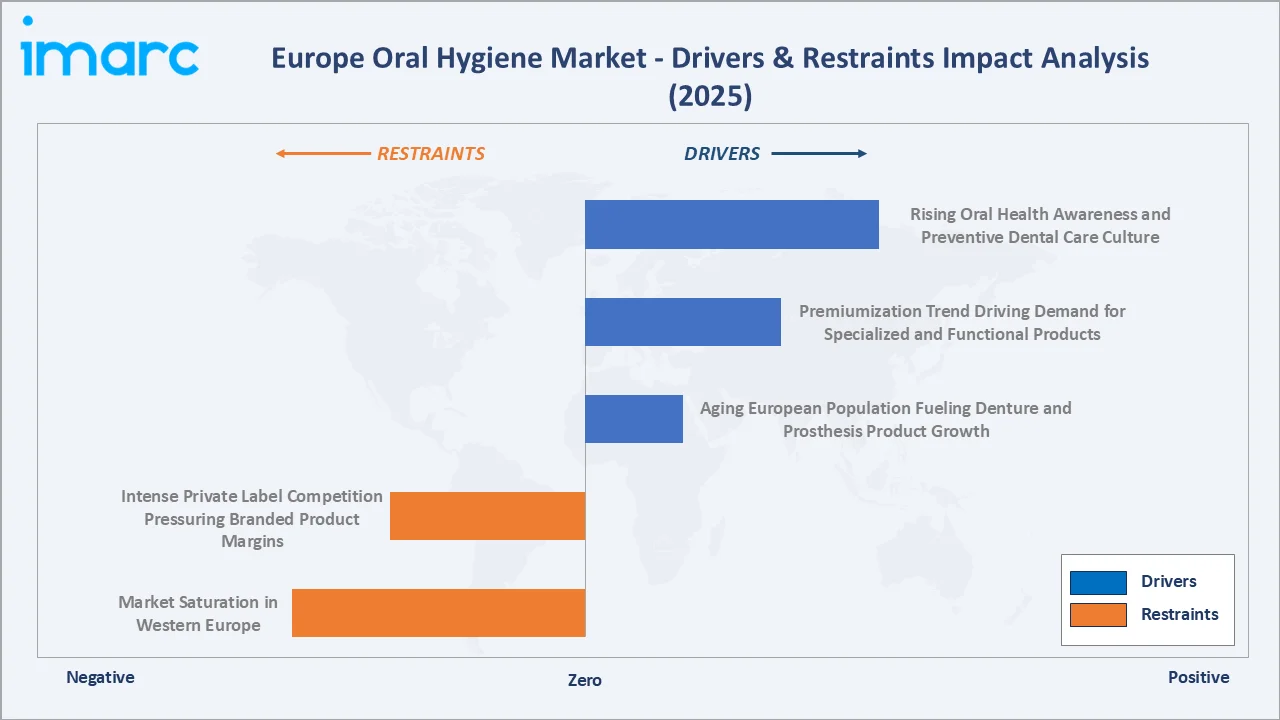
- Rising Oral Health Awareness and Preventive Dental Care Culture: European consumers are increasingly adopting preventive oral health behaviors, regular professional dental cleaning (prophylaxis), daily interdental cleaning with floss or interdental brushes, and therapeutic mouthwash use, driven by dental association awareness campaigns, public health communications emphasizing the links between oral health and systemic conditions, and digital health media normalizing specialist dental care product use beyond basic brushing.
- Premiumization Trend Driving Demand for Specialized and Functional Products: European oral care consumers are consistently trading up from standard fluoride toothpastes to functional premium variants including sensitive toothpastes, enamel protection formulations, charcoal and activated bamboo toothpastes, and next-generation and subscription-model electric toothbrushes. In July 2026, Royal Philips launched the next-generation Sonicare DiamondClean range, including the 8000, 8500, 9000, and 9900 Prestige models, across select European and U.S. retailers. The advanced 9900 Prestige features intelligent technology that provides real-time brushing feedback and personalized oral care guidance.
- Aging European Population Fueling Denture and Prosthesis Product Growth: The population aged 60 years and older in the WHO European Region is projected to increase from 215 million in 2021 to 247 million by 2030, exceeding 300 million by 2050, creating structural growth demand for denture adhesive products, denture cleaning solutions, and specialist toothpastes and brushes designed for implant and crown maintenance. Germany and Italy, with Europe's oldest demographic profiles, are the primary growth markets for denture and prosthesis care products.
Market Restraints
- Market Saturation in Western Europe: Western European oral hygiene markets, particularly Germany, the UK, and France, have near-universal toothpaste and toothbrush penetration among adult consumers, with product use driven by replacement cycles rather than category entry. Category volume growth is therefore structurally constrained to population growth plus incremental add-on product adoption, limiting volume revenue expansion.
- Intense Private Label Competition Pressuring Branded Product Margins: European supermarket and drug store private label oral care products offer quality-equivalent toothpastes at price discounts versus branded equivalents. Private label oral care share in European food retail exceeds 25% in several markets, compelling branded manufacturers to invest in meaningful product differentiation to justify price premiums in price-conscious consumer segments.
Market Opportunities
- Natural and Sustainable Oral Care Product Development: European consumer demand for natural ingredient oral care is creating a premium niche that neither traditional branded manufacturers nor private label products currently serve fully. Major brands are growing through pharmacy and health food specialty retail channels by offering genuinely differentiated natural oral care formulations that command a premium over conventional supermarket toothpaste.
- Children's Oral Hygiene Market Development: European parents are increasingly seeking fun, effective oral care products for children aged 2-12 that encourage brushing compliance and instill oral hygiene habits early. Character-branded toothbrushes, fruit-flavored children's toothpastes with lower fluoride concentrations, electric toothbrushes with built-in timers and animated brushing apps, and subscription toothbrush replacement services targeting parents are creating a growing premium children's oral care category above the traditional commodity brush and paste positioning.
Market Challenges
- EU Hydrogen Peroxide Restriction Limiting Whitening Product Claims: EU regulation restricts hydrogen peroxide to a maximum in consumer oral care products. This regulatory constraint limits the whitening efficacy that consumer toothpastes and strips can deliver, creating consumer frustration when marketed whitening products fail to deliver dramatic results and constraining the European consumer whitening category well below its US market equivalent, where higher H2O2 concentrations are permitted in some product formats.
- Currency and Inflation Pressure on Consumer Trade-Down Risk: European consumer purchasing power pressure has driven some consumer trade-down from premium branded oral care products to private label alternatives, particularly in price-sensitive Eastern European markets and among lower-income consumer segments in Western Europe. Inflationary cost pressures have also challenged manufacturers' raw material costs while retailers resist price increase pass-through, compressing oral care brand manufacturer margins.
Emerging Market Trends
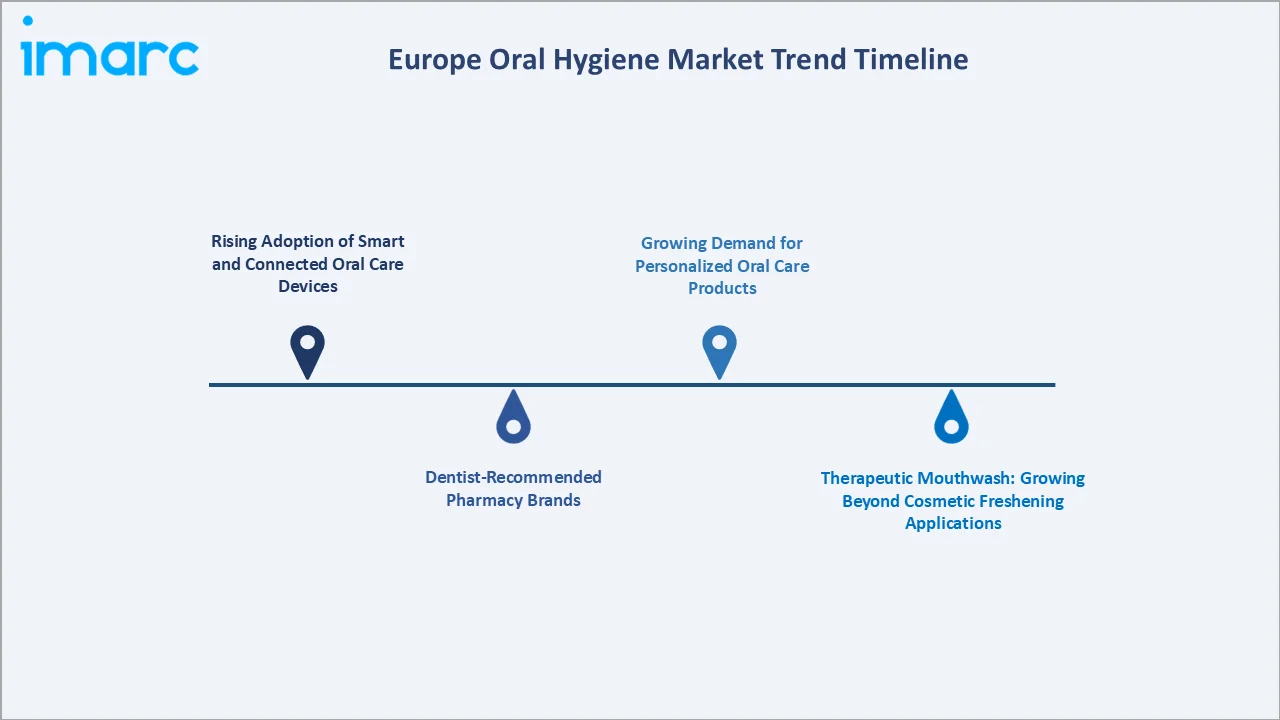
1. Rising Adoption of Smart and Connected Oral Care Devices
Manufacturers are integrating personalized guidance and advanced cleaning technologies to improve brushing effectiveness and user engagement. Growing consumer interest in premium, technology-driven oral care solutions is further supporting product innovation and market expansion. In September 2026, Dyson introduced a premium connected toothbrush priced at £420, integrating a built-in camera, machine learning, advanced brushing technology, and targeted mouthwash jets. The device provides visual guidance on brushing coverage while helping users address plaque buildup between teeth.
2. Dentist-Recommended Pharmacy Brands
Colgate-Palmolive brands, Sensodyne, and other professional range brands are growing through dentist and dental hygienist recommendation programs that position pharmacy-exclusive oral care brands as clinically superior to standard supermarket alternatives. In France and Southern Europe, where pharmacy channels are the primary oral health care advice touchpoints for consumers, brands with established dental professional recommendation credentials command toothpaste premiums that significantly exceed mass market equivalents. This professional recommendation pipeline is creating a sustainable competitive moat for brands that invest in EU dental congress presence, clinical publication programs, and dental school professional education initiatives.
3. Growing Demand for Personalized Oral Care Products
Companies are increasingly combining clinically supported ingredients with improved sensory experiences to encourage regular usage. This trend is driving product diversification and innovation across mouth rinses and other daily oral hygiene categories. In January 2026, Listerine launched a new mouth rinse range in the UK featuring three flavor intensities: extra mild, mild, and intense. The range uses its established essential-oil formulation and is positioned as an adjunct to mechanical cleaning for supporting plaque biofilm management.
4. Therapeutic Mouthwash: Growing Beyond Cosmetic Freshening Applications
European mouthwash consumption is evolving from purely cosmetic (breath-freshening) toward therapeutic applications, with antimicrobial chlorhexidine mouthwashes, fluoride mouthwashes, and gum-care targeted rinses growing through pharmacy recommendations for consumers with specific dental health conditions. EU dental health awareness campaigns highlighting gingivitis prevention and periodontal disease management are creating a consumer education foundation that supports therapeutic mouthwash trial and repeat adoption above purely cosmetic rinse behavior.
Industry Value Chain Analysis
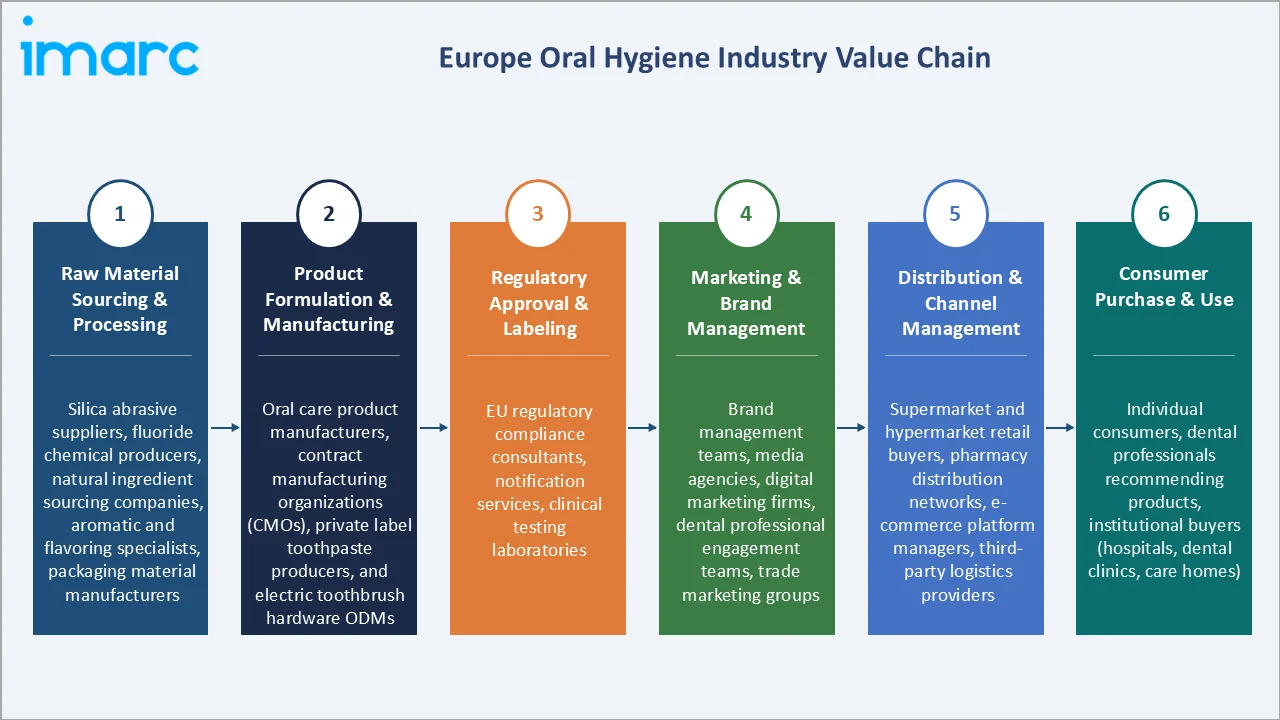
The Europe oral hygiene market value chain encompasses raw material sourcing and processing, product formulation and manufacturing, regulatory approval and labeling compliance, marketing and brand management, distribution and channel management, and consumer purchase and use.
|
Stage |
Key Players |
|
Raw Material Sourcing & Processing |
Silica abrasive suppliers, fluoride chemical producers, natural ingredient sourcing companies, aromatic and flavoring specialists, packaging material manufacturers. |
|
Product Formulation & Manufacturing |
Oral care product manufacturers, contract manufacturing organizations (CMOs), private label toothpaste producers, and electric toothbrush hardware ODMs. |
|
Regulatory Approval & Labeling |
EU regulatory compliance consultants, notification services, clinical testing laboratories. |
|
Marketing & Brand Management |
Brand management teams, media agencies, digital marketing firms, dental professional engagement teams, trade marketing groups. |
|
Distribution & Channel Management |
Supermarket and hypermarket retail buyers, pharmacy distribution networks, e-commerce platform managers, third-party logistics providers. |
|
Consumer Purchase & Use |
Individual consumers, dental professionals recommending products, institutional buyers (hospitals, dental clinics, care homes). |
Marketing and brand management represents the highest competitive value-creation stage in the European oral hygiene market, where brand equity built through decades of dental professional endorsement, consumer advertising investment, and pharmacy channel category management creates durable consumer preference that private label alternatives cannot replicate through ingredient or packaging alone.
Technology Landscape in the Europe Oral Hygiene Industry
Smart Electric Toothbrush Technology
Smart electric toothbrushes integrate sensors, Bluetooth connectivity, artificial intelligence, and mobile applications to monitor brushing habits and provide real-time feedback. Advanced models can track brushing coverage, pressure, duration, and technique to deliver personalized oral care guidance. Growing integration of connected features is enhancing user engagement and supporting preventive dental care.
Advanced Toothpaste Formulation Science
European toothpaste formulation science is advancing through several parallel innovation vectors. Stannous fluoride formulations are gaining traction over conventional sodium fluoride as clinical evidence demonstrates superior anti-sensitivity and anti-plaque efficacy. Nano-hydroxyapatite toothpastes are growing as fluoride-free alternatives, positioned for consumers seeking biomimetic remineralization that closely replicates tooth enamel mineral chemistry. L-arginine technology uses the amino acid to physically block dentinal tubules for immediate and lasting sensitivity relief that clinical trials demonstrate is superior to potassium nitrate alternatives.
Digital and Tele-Dentistry Integration with Consumer Oral Care Products
European dental technology companies are integrating consumer oral care products with digital dentistry platforms, including AI-powered intraoral camera apps that enable consumers to photograph their oral health between dental appointments and receive AI-driven health assessments. European tele-dentistry platforms are creating digital consultation touchpoints where dentists recommend specific consumer oral care products as part of remote treatment planning, creating new professional recommendation digital channels that oral care brands are beginning to engage.
Market Segmentation Analysis
The report covers the following segments:
|
Segment Category |
Leading Segment |
Market Share |
Year |
|
Product |
Toothpaste |
41.6% |
2025 |
|
Distribution Channel |
Supermarkets and Hypermarkets |
38.7% |
2025 |
|
Application |
Adults |
🔒 |
2025 |
|
Country |
Germany |
28.6% |
2025 |
.webp)
By Product
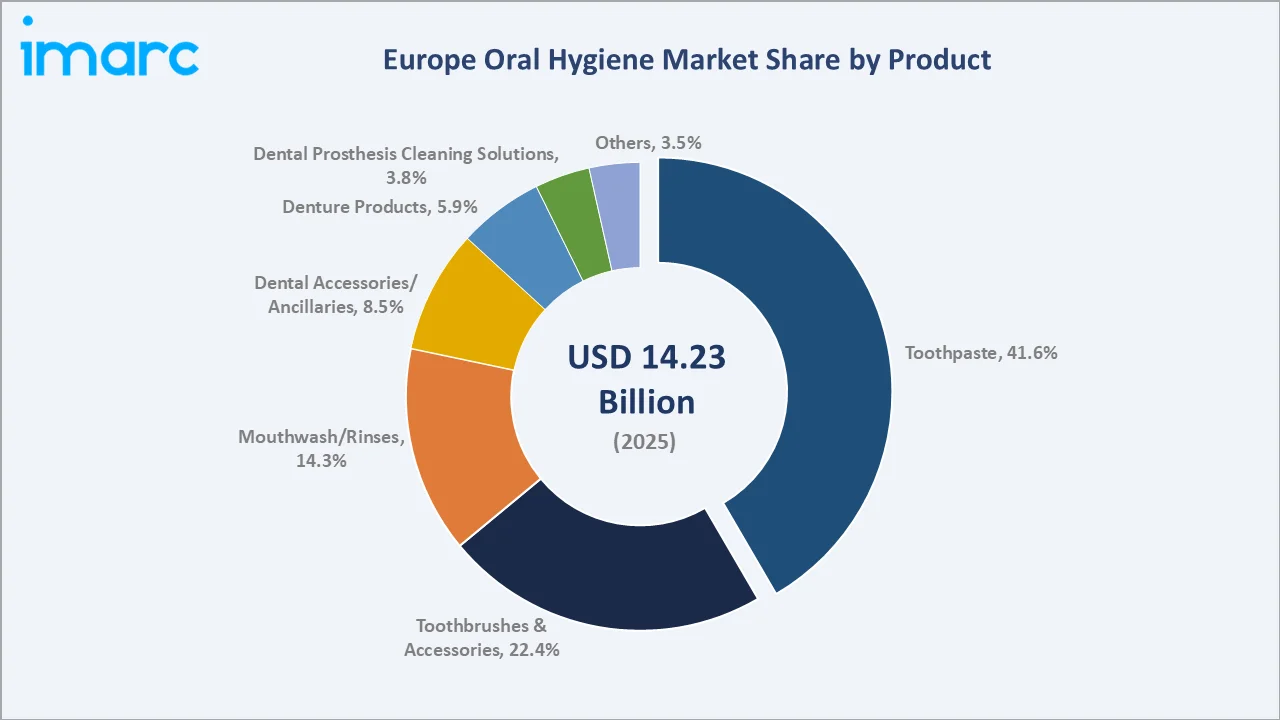
Toothpaste commands 41.6% in 2025, driven by universal daily usage among European adults, consistent product innovation across sensitive, whitening, complete care, and natural positioning tiers, and pharmacy channel expansion that elevates average selling prices through premium brand concentration.
To access detailed market analysis, Request Sample
Toothbrushes and accessories at 22.4% are growing through electric toothbrush category premiumization. Mouthwash/rinses at 14.3% are expanding through therapeutic positioning. Dental accessories/ancillaries at 8.5% include interdental brushes, dental floss, water flossers, and tongue cleaners, growing through dental professional recommendation. Denture products at 5.9% grow through Europe's aging demographic. Dental prosthesis cleaning solutions at 3.8% serve the prosthesis-wearing population with specialist daily cleaning products.
By Distribution Channel
Supermarkets and hypermarkets lead at 38.7% through their role as Europe's primary fast-moving consumer goods retail channel, providing broad oral care assortment coverage at competitive price points across mainstream to premium brand tiers.
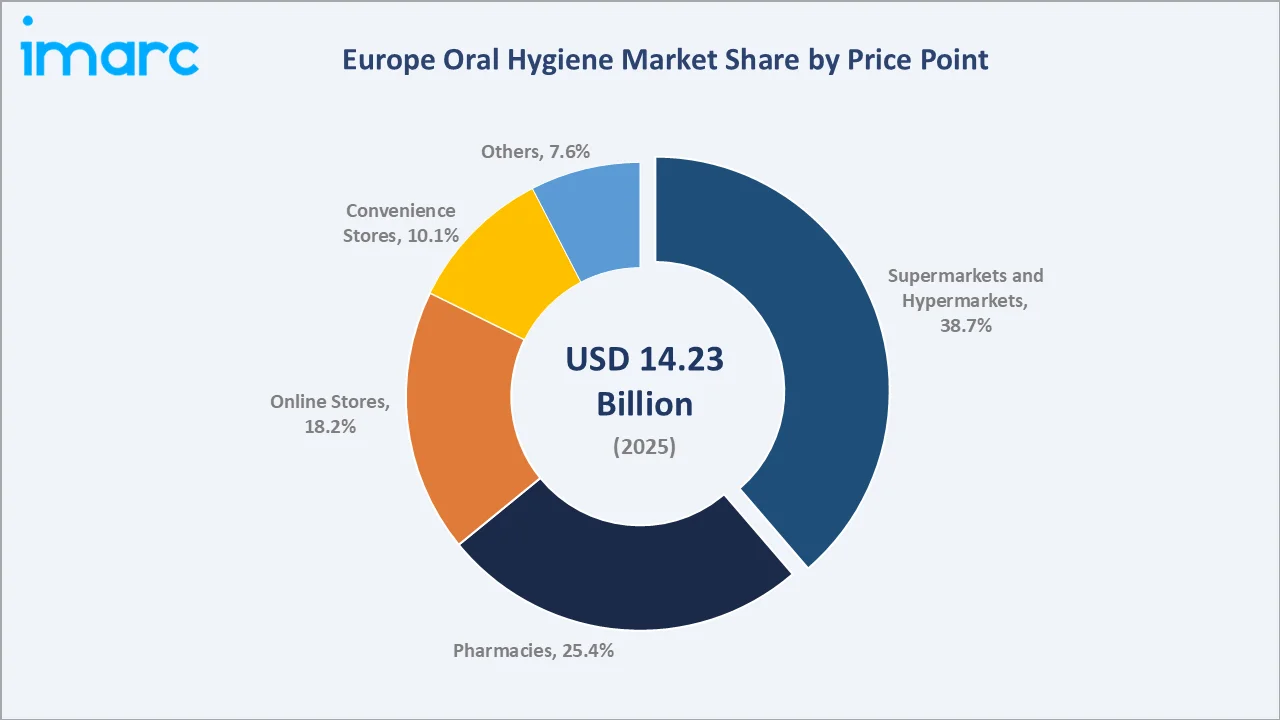
Pharmacies at 25.4% are the critical premium oral care channel in France, Italy, Spain, and Germany, where pharmacy-exclusive brands generate above-average revenue per product unit and drive total pharmacy oral care category value disproportionate to their volume share. Online stores at 18.2% are growing fastest at ~4.8% CAGR through electric toothbrush subscriptions. Convenience stores at 10.1% serve travel, impulse, and top-up occasions.
Regional Market Insights
|
Country |
Share (2025) |
Key Europe Oral Hygiene Market Drivers & Characteristics |
|
Germany |
28.6% |
Reflecting Germany's position as Europe's largest oral hygiene market, underpinned by high consumer spending on personal care, Germany's systematic public dental health programs, and high penetration of premium electric toothbrush adoption. |
|
France |
18.3% |
Reflecting France's strong pharmacy culture as the primary oral hygiene distribution channel combined with French consumers' above-average mouthwash adoption rates and high engagement with dental professional recommendation-driven product selection. |
|
United Kingdom |
17.4% |
Reflecting the UK's large consumer market, high supermarket channel concentration, strong electric toothbrush penetration, and direct-to-consumer challenger brands. |
|
Italy |
13.2% |
Reflecting Italy's significant personal care spending tradition, above-average Italian consumer willingness to pay for premium cosmetic oral care, a strong pharmacy distribution culture. |
|
Spain |
10.6% |
Reflecting Spain's growing preventive dental health awareness driven by public dental health communication campaigns, expanding pharmacy oral care category, increasing premium toothpaste adoption, and Spain's growing e-commerce penetration. |
|
Others |
11.9% |
Reflecting other European markets generating distributed oral hygiene demand, with high-value electric toothbrush and premium oral care adoption, and Eastern European markets exhibiting the fastest growth rates as organized retail expansion improves product availability and consumer incomes rise. |
Germany's 28.6% share reflects its structural advantages as Europe's largest economy with the most developed drugstore oral care channel, including exclusive private label and premium pharmacy brands that other European markets do not have equivalent access to. German consumers' above-average dental consciousness, high electric toothbrush ownership, and willingness to purchase premium therapeutic oral care products create the highest per-capita oral hygiene spending in continental Europe.
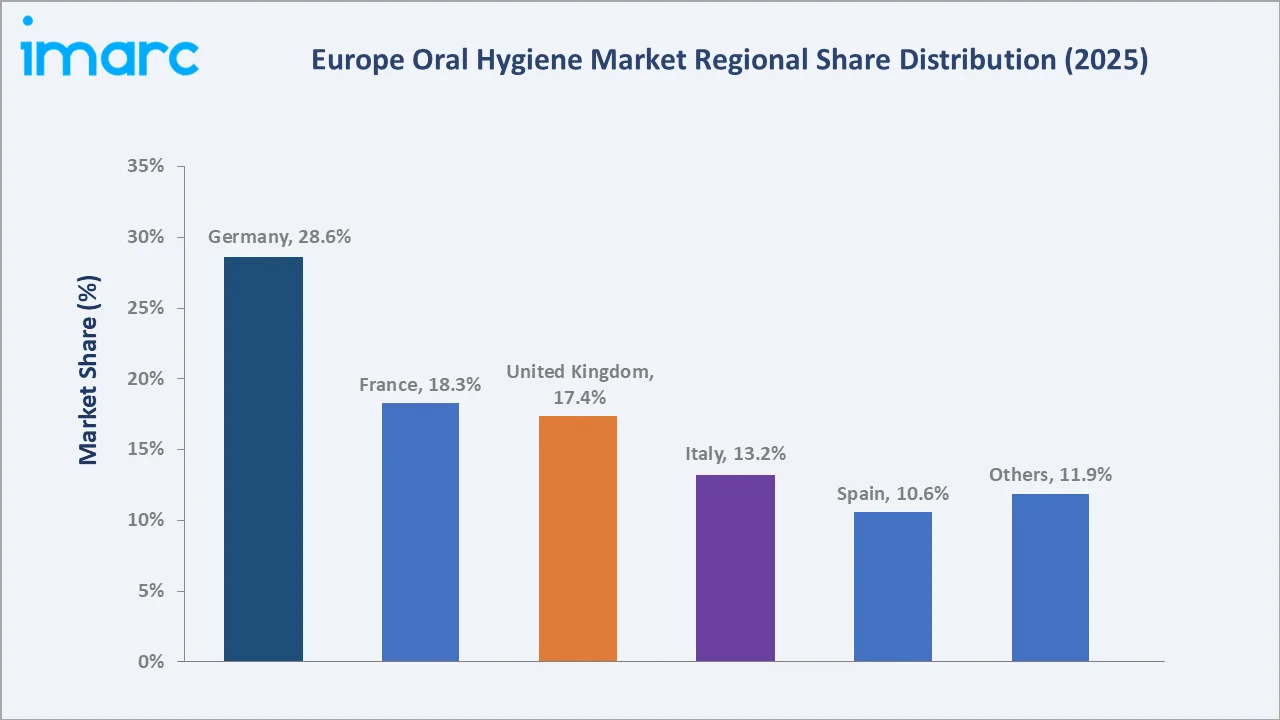
France at 18.3% reflects the unique pharmacy channel dominance. The UK at 17.4% is notable for its high pharmacy oral care category and growing DTC challenger brand activity. Italy at 13.2% and Spain at 10.6% reflect Southern European markets with growing premium adoption and significant pharmacy channel oral care cultures.
Competitive Landscape
The Europe oral hygiene market features a competitive landscape dominated by global multinationals that collectively account for the majority of European oral care revenue, alongside specialty dental health brands with strong dental professional recommendation credentials, regional heritage brands, and a growing tier of sustainability-positioned challenger DTC brands.
|
Company |
Key Brands |
Market Position |
Core Strength |
|
Colgate-Palmolive Company |
Colgate, Hello |
Market Leader |
Colgate-Palmolive plays a leading role in European oral hygiene through market-shaping product launches, strategic acquisitions, and prominent public health partnerships. |
|
Procter & Gamble |
Fixodent, Oral-B |
Market Leader |
Procter & Gamble plays a major role in Europe's oral hygiene market through advanced product innovation, localized research, and strong sustainability commitments. |
|
Unilever |
Pepsodent, Closeup |
Established Player |
Unilever maintains a highly localized brand portfolio across Europe, engineering its presence based on consumer preferences in different nations. |
|
Church & Dwight Co., Inc. |
TheraBreath, Arm & Hammer, Orajel |
Established Player |
Church & Dwight Co., Inc. acts as a recognized niche and competitive participant in the European oral care and oral hygiene market, driven primarily by its established specialty brands. |
|
Dentaid |
VITIS, Interprox, PERIO·AID, Desensin, Dentaid Xeros, Halita, PHB, Waterpik, Fluor·aid, Fittydent, Plac control |
Innovator |
Dentaid plays a major role in European oral hygiene through science-driven product innovation, professional training, and public awareness campaigns. |
Competitive dynamics in European oral care are being shaped by the premium segment's expansion, with sensitive, therapeutic, and natural positioning driving above-market growth, and the online channel's rapid scaling that is reducing incumbents' distribution moat advantages. Dental professional recommendation is becoming an increasingly critical competitive differentiator as European consumers' health consciousness drives preference for dentist-endorsed products over pure consumer advertising-driven brand choices.
Key Company Profiles
Colgate-Palmolive Company
Colgate-Palmolive Company is a global consumer products company with a well-established presence in the European oral hygiene market. The company offers a broad portfolio of toothpastes, manual and electric toothbrushes, mouthwashes, and specialized oral care products. Its strong brand presence, extensive distribution network, and focus on oral care innovation support its position across European markets.
- Key Brands: Colgate, Hello.
- Strategic Focus: Focuses on product innovation, premiumization, and science-backed oral care solutions to strengthen its presence across Europe. The company emphasizes specialized formulations, sustainable packaging, digital consumer engagement, and broad distribution to address evolving oral hygiene needs.
Procter & Gamble
Procter & Gamble (P&G) is a global consumer goods company with a significant presence in the European oral hygiene market through its established oral care portfolio, including the Oral-B brand. The company offers electric and manual toothbrushes, toothpastes, replacement brush heads, and other oral care solutions. Its strong brand recognition, extensive distribution network, and focus on technology-driven product innovation support its presence across Europe.
- Key Brands: Fixodent, Oral-B.
- Strategic Focus: Focuses on premiumization, smart oral care technologies, and consumer-centric product innovation to strengthen its position across Europe. The company emphasizes connected electric toothbrushes, personalized cleaning solutions, professional dental partnerships, and continuous product development to address evolving oral hygiene needs.
Market Concentration Analysis
The Europe oral hygiene market is moderately concentrated, with Colgate-Palmolive, Procter & Gamble, and Unilever collectively accounting for an estimated 55-65% of total European oral hygiene revenue. These three companies dominate through complementary category leadership: Colgate-Palmolive leads in toothpaste; Procter & Gamble dominates electric toothbrushes through Oral-B; and Unilever commands through Pepsodent and Closeup. The remaining 35-45% market share is distributed among other specialist brands, and a growing tier of DTC challenger brands primarily operating through online channels.
Market consolidation at the top is offset by fragmentation at the specialty and challenger brand level, where natural oral care brands, dental professional specialty labels, and subscription DTC brands are creating competitive pressure on the mainstream branded segment from both the premium and value ends. Private label oral care share has been growing steadily in European supermarket channels, providing structural consolidation pressure on mid-market branded toothpaste and toothbrush revenues.
Investment & Growth Opportunities
Highest Growth Segments
Online stores channel (~4.8% CAGR) through subscription brushes and DTC brands, mouthwash/rinses premiumization (~2.6% CAGR), electric toothbrush smart subscription models, natural and sustainable oral care innovation, pediatric oral hygiene premium pharmacy segment, denture and prosthesis products for aging demographics, and Eastern European market distribution expansion represent the highest-return investment vectors in the Europe oral hygiene market through 2034.
Investment Themes
- Natural and Certified Sustainable Oral Care Brand Building: The European premium natural oral care market remains underserved by multinational brands whose natural claims are often perceived as greenwashing by European Millennial and Gen-Z consumers. Genuinely certified natural oral care brands with credible sustainability communication and minimally packaged product formats can command 3-5x average toothpaste price points through pharmacy and health food specialty channels.
- Electric Toothbrush Subscription and Connected Health Platform Investment: The European electric toothbrush market value is growing faster than any other oral care category segment, and subscription models create customer relationships with high switching costs once consumers invest in a brush handle. Investment in next-generation connectivity, oral health AI coaching, and dental professional data-sharing platforms that transform toothbrushes into oral health monitoring devices can build significant consumer data assets alongside recurring hardware and accessory revenue.
Future Market Outlook (2026-2034)
The Europe oral hygiene market is projected to grow from USD 14.23 Billion in 2025 to USD 14.54 Billion in 2026, reaching USD 17.40 Billion by 2034, exhibiting a CAGR of 2.15% during 2026-2034. The market is projected to reach an anchor value of USD 15.83 Billion by 2030, representing the mid-period milestone of smart toothbrush penetration, sustainable oral care packaging becoming the European industry standard, and online stores surpassing convenience stores to become the fourth-largest oral care distribution channel across the European market.
Three structural forces will define the Europe oral hygiene market through 2034. First, the premiumization trajectory will sustain above-population-growth market value expansion even as volume growth remains constrained by mature market penetration dynamics and will be the primary mechanism through which all major European oral care brands deliver revenue growth to investors. Second, the digital channel transformation will shift European oral care distribution and consumer relationships from transactional retail purchase events to ongoing digital health engagement relationships that create superior consumer data, higher switching costs, and more predictable recurring revenues. Third, Europe's demographic evolution will create structural demand growth for denture adhesive and prosthesis care products, specialist elderly oral care toothpastes, and electric toothbrushes designed for arthritic hand mobility constraints, creating targeted growth opportunities within the broader stable market trajectory.
Research Methodology
Primary Research
Primary research comprised in-depth interviews with European oral care brand marketing directors, retail pharmacy category buyers, dental professional KOLs (key opinion leaders), dental hygienist association representatives, e-commerce oral care brand founders, and private label oral care product development managers. These discussions validated market size estimates, product and distribution channel demand dynamics, country market characteristics, and technology and consumer trend trajectories for the 2026-2034 forecast period.
Secondary Research
Secondary research encompassed notification database analysis, opinions on oral care ingredient safety, oral health reports, national pharmacy association oral care category data, IMARC Group proprietary personal care and oral hygiene databases, company annual reports and investor presentations, and consumer retail sales data on oral care category performance through 2025.
Forecasting Models
Forecasting models incorporated historical oral hygiene market revenue correlations with European consumer spending indices, dental health public expenditure trends, electric toothbrush penetration S-curve modeling by country, e-commerce oral care share trajectory projections, demographic-driven denture product demand modeling, and macroeconomic indicators. Both bottom-up product category and distribution channel revenue modeling and top-down country-level per-capita spending approaches were cross-validated for forecast consistency.
Europe Oral Hygiene Market Report Coverage:
| Report Features | Details |
|---|---|
| Base Year of the Analysis | 2025 |
| Historical Period | 2020-2025 |
| Forecast Period | 2026-2034 |
| Units | Billion USD |
| Segment Coverage | Product, Distribution Channel, Application, Country |
| Countries Covered | Germany, France, United Kingdom, Italy, Spain, Others |
| Companies Covered | Colgate-Palmolive Company, Procter & Gamble, Unilever, Church & Dwight Co., Inc., Dentaid, etc. |
| Customization Scope | 10% Free Customization |
| Post-Sale Analyst Support | 10-12 Weeks |
| Delivery Format | PDF and Excel through Email (We can also provide the editable version of the report in PPT/Word format on special request) |
Frequently Asked Questions About the Europe Oral Hygiene Market Report
The Europe oral hygiene market reached USD 14.54 Billion in 2026, driven by toothpaste premiumization, electric toothbrush smart category expansion, therapeutic mouthwash adoption, and online channel growth through subscription electric toothbrush and DTC brand models.
The Europe oral hygiene market is projected to grow at a CAGR of 2.15% during 2026-2034, driven by value premiumization across sensitive and natural toothpaste, smart electric toothbrush subscription model adoption, online channel growth at ~4.8% CAGR, therapeutic mouthwash expansion, and aging demographic denture and prosthesis product demand.
The market is projected to reach USD 15.83 Billion by 2030, with the mid-period milestone of smart toothbrush subscription penetration, sustainable EU packaging standards taking effect, and online stores surpassing convenience stores as the fourth-largest European oral care distribution channel.
Toothpaste leads with a 41.6% share in 2025, through universal twice-daily consumption, strong premiumization through sensitive, therapeutic, and natural positioning, and pharmacy channel expansion driving average selling price elevation above mainstream supermarket standard variants.
Supermarkets and hypermarkets lead with a 38.7% share in 2025, through their role as primary fast-moving consumer goods retail destinations for daily personal care replenishment, with particularly strong oral care sections in supermarket chains.
Germany leads with a 28.6% share in 2025, through Europe's largest consumer economy, highest per-capita oral care spending, most developed drug store oral care channel, high electric toothbrush penetration, and strong pharmacy channel premium brand adoption.
Key players include Colgate-Palmolive Company, Procter & Gamble, Unilever, Church & Dwight Co., Inc., and Dentaid, among others.
The market is projected to reach USD 17.40 Billion by 2034, driven by compound premiumization across all product categories, smart toothbrush platform subscription maturity, natural and sustainable oral care mainstream adoption, Eastern European market development, and structural denture and prosthesis product demand from Europe's growing 65+ population.
Key opportunities include natural and certified sustainable oral care brand building, smart electric toothbrush subscription and connected health platform development, Eastern European distribution expansion, and denture and prosthesis care product innovation targeting Europe's growing 65+ demographic.
Need more help?
- Speak to our experienced analysts for insights on the current market scenarios.
- Include additional segments and countries to customize the report as per your requirement.
- Gain an unparalleled competitive advantage in your domain by understanding how to utilize the report and positively impacting your operations and revenue.
- For further assistance, please connect with our analysts.
 Request Customization
 Speak to an Analyst
 Request Brochure
 Inquire Before Buying
Benefits of Customization
- Personalize this research
- Triangulate with your data
- Get data as per your format and definition
- Gain a deeper dive into a specific application, geography, customer, or competitor
- Any level of personalization
Get in Touch With Us
UNITED STATES
Phone: +1-201-971-6302
INDIA
Phone: +91-120-433-0800
UNITED KINGDOM
Phone: +44-753-714-6104
Email: [email protected]
Client Testimonials




.webp)




.webp)













Related Reports

Choose your plan
*Please note that the prices mentioned below are starting prices for each bundle type. Kindly contact our team for further details.*
Single User License
- 1 User License, Access on 2 Devices
- PDF Report + Excel Dataset (Password Protected)
- Lifetime Access
- No Printing Rights
- 10% Free Report Customization
- 10–12 Weeks of Analyst Support
Five User License
- Access for 5 Users, 2 Devices per User
- PDF Report + Excel Dataset (Password Protected)
- Lifetime Access
- Dedicated Account Manager
- 12–14 Weeks of Analyst Support
- No Printing Rights
- 15% Free Report Customization
- 25% Discount on Your Next Purchase
Corporate User License
- Unlimited User Access (Within Your Organization)
- PDF Report + Excel Dataset
- Lifetime Access
- Dedicated Account Manager
- 14–20 Weeks of Analyst Support
- No Printing Rights
- 20% Free Report Customization
- 30% Discount on Your Next Purchase
Essential Insights
What's included:
3 reports
- Lifetime Access
- PDF Reports
- Excel Datasets
- 2 Weeks of Free Analyst Support
- 2 User Licenses
- Access on 2 Devices
- Printing Rights
- Complimentary PowerPoint (PPT) Version
- Complimentary License Upgrade
Professional Access
What's included:
5 reports
- Lifetime Access
- PDF Reports
- Excel Datasets
- 8 Weeks of Free Analyst Support
- 2 User Licenses
- Access on 2 Devices
- Printing Rights
- Complimentary PowerPoint (PPT) Version
- Complimentary License Upgrade
Business Advantage
What's included:
8 reports
- Lifetime Access
- PDF Reports
- Excel Datasets
- 14 Weeks of Free Analyst Support
- 2 User Licenses
- Access on 2 Devices
- Printing Rights
- Complimentary PowerPoint (PPT) Version
- Complimentary License Upgrade
Enterprise Intelligence
What's included:
10 reports
- Lifetime Access
- PDF Reports
- Excel Datasets
- 20 Weeks of Free Analyst Support
- 2 User Licenses
- Access on 2 Devices
- Printing Rights
- Complimentary PowerPoint (PPT) Version
- Complimentary License Upgrade