
Europe SCADA Market Size, Share, Trends and Forecast by Component, Architecture, End User, and Country, 2026-2034
Europe SCADA Market Size, Share, Trends & Forecast (2026-2034)
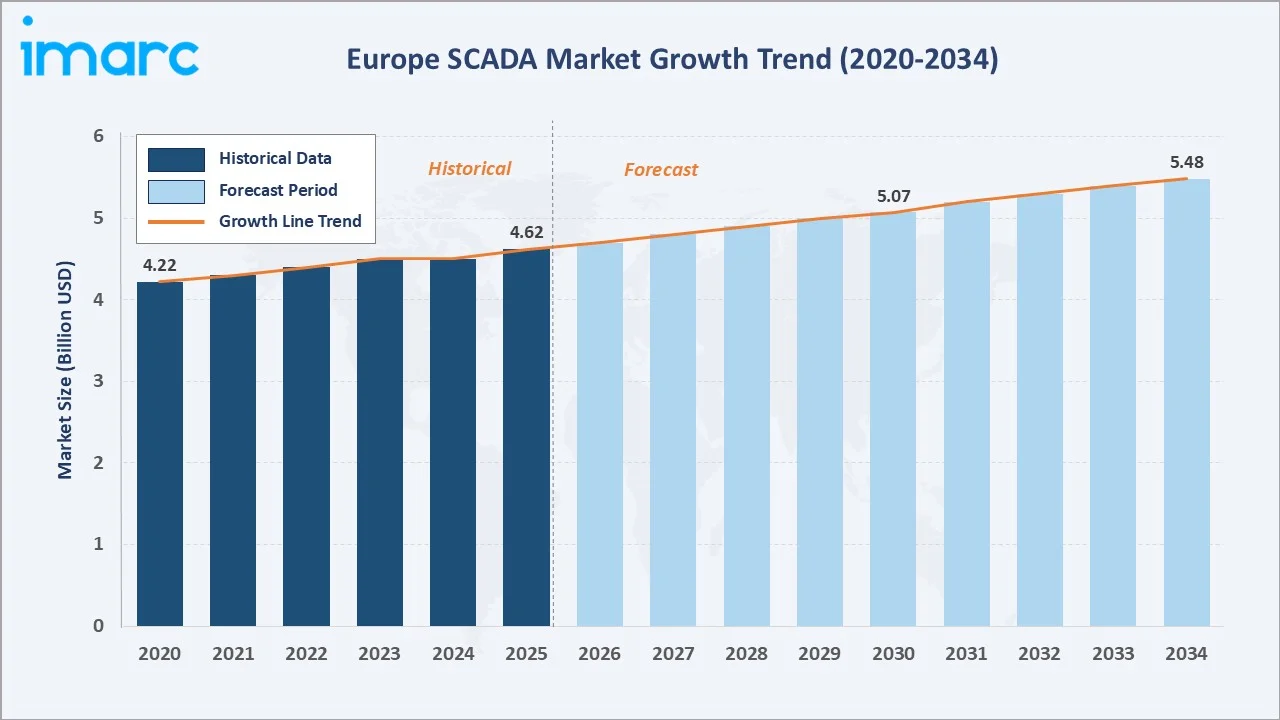
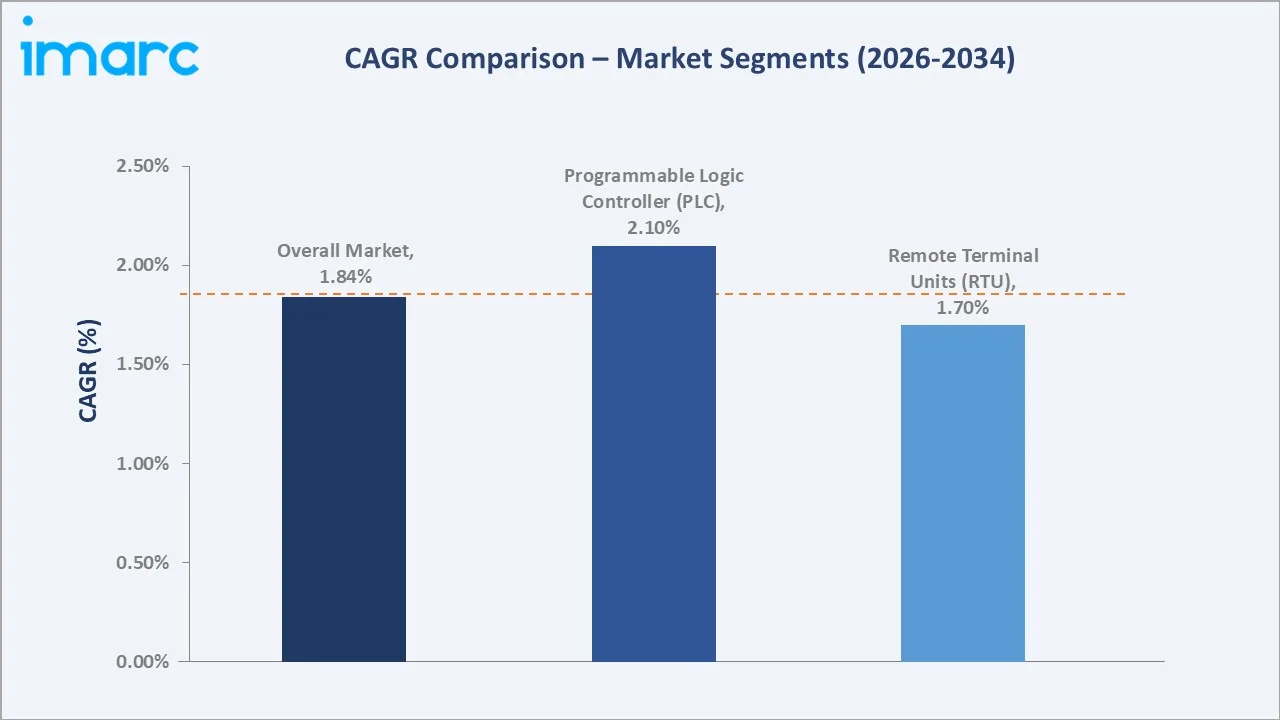
The Europe SCADA market size increased from USD 4.62 Billion in 2025 to USD 4.70 Billion in 2026 and is projected to reach USD 5.48 Billion by 2034, growing at a CAGR of 1.84% during 2026-2034. Rising investment in intelligent and smart grid systems, coupled with growing industrial automation demand for operational efficiency and security, and EU renewable energy regulatory mandates are the primary growth catalysts.
Market Snapshot
|
Metric |
Value |
|
Base Year Market Size (2025) |
USD 4.62 Billion |
|
Market Size (2026) |
USD 4.70 Billion |
|
Forecast Market Size (2034) |
USD 5.48 Billion |
|
CAGR (2026-2034) |
1.84% |
|
Base Year |
2025 |
|
Historical Period |
2020-2025 |
|
Forecast Period |
2026-2034 |
Germany leads the Europe SCADA landscape, holding a 28.4% share in 2025, anchored by the country's large industrial manufacturing base and advanced utility infrastructure. Programmable Logic Controllers (PLC) command the largest share of the component segment at 31.8%, reflecting sustained demand for their central role in industrial process control and automation.
To get more information on this market, Request Sample
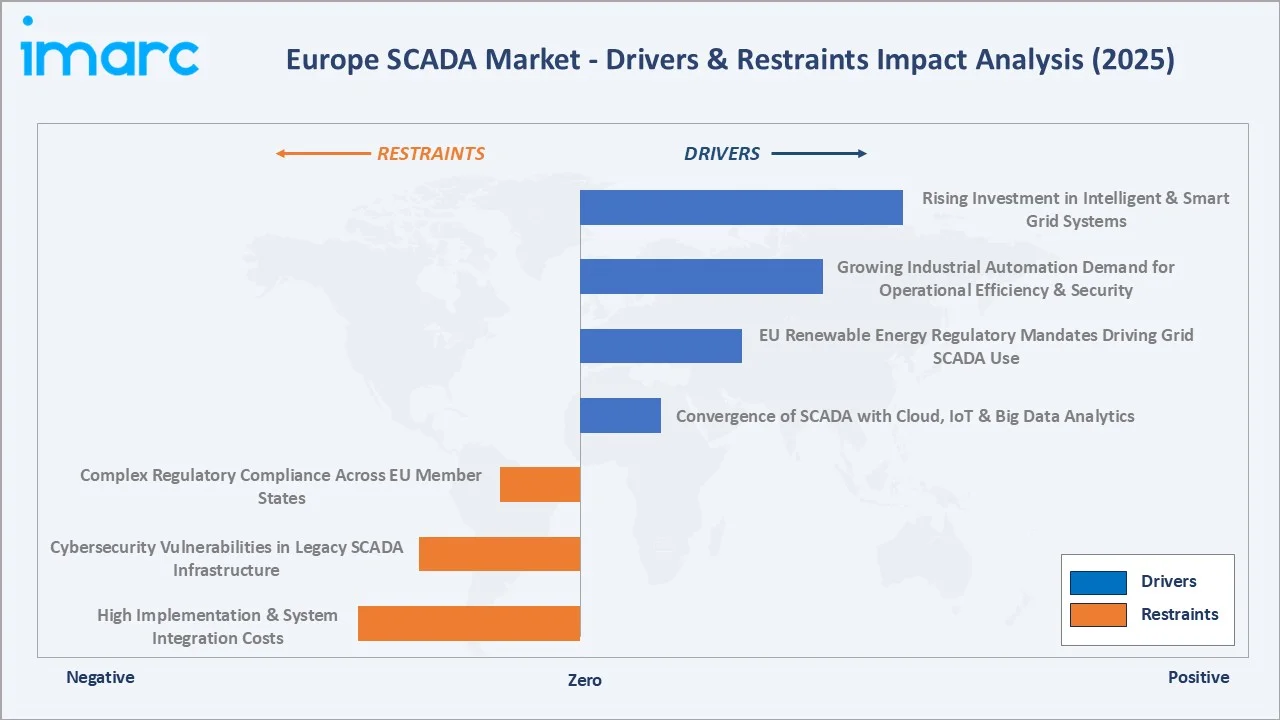
The Europe SCADA market is underpinned by three structural forces: rising investment in intelligent and smart grid systems, growing industrial automation demand for operational efficiency and security, and EU renewable energy regulatory mandates driving grid SCADA use. Each force independently reinforces category growth, sustaining steady CAGR expansion through 2034 despite high implementation and system integration costs.
Executive Summary
The Europe SCADA market is experiencing steady expansion, driven by rising smart grid investment, growing industrial automation demand, and supportive EU renewable energy policy. The market grew from USD 4.62 Billion in 2025 to USD 4.70 Billion in 2026 and is forecast to reach USD 5.48 Billion by 2034, growing at a CAGR of 1.84%.
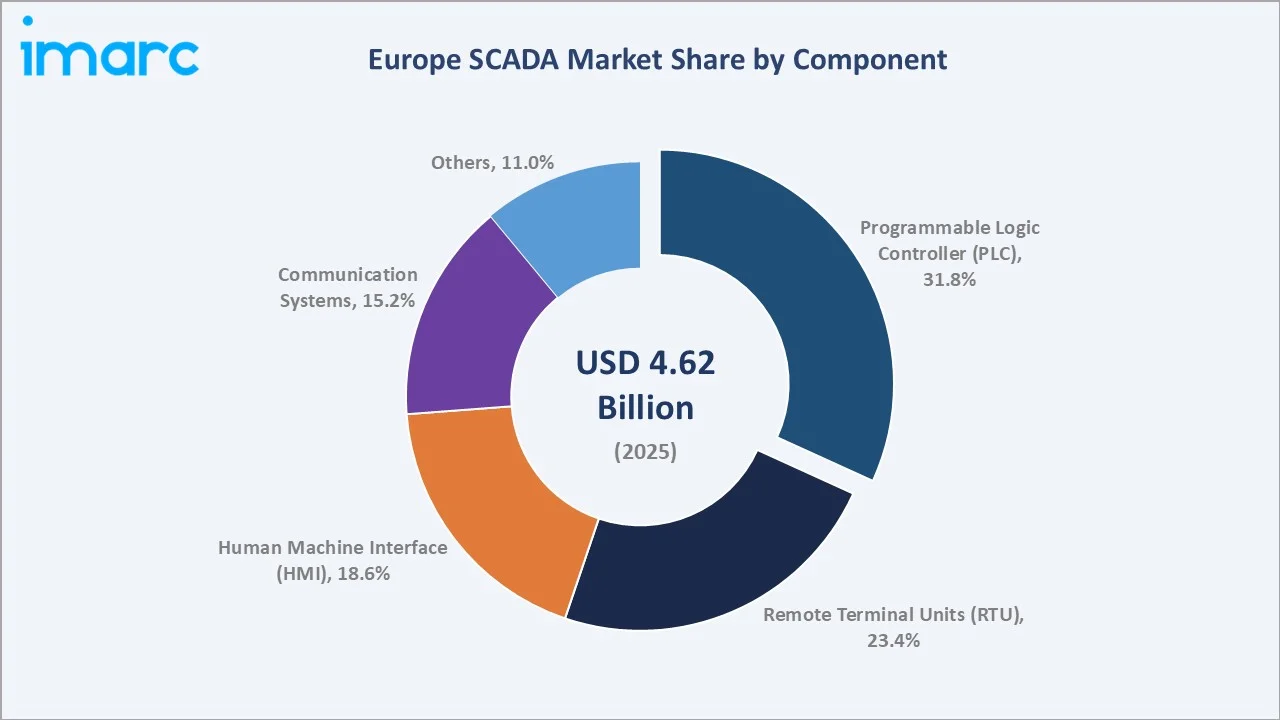
Programmable Logic Controllers (PLC) dominate the component segment with a 31.8% share in 2025, encompassing core industrial process control hardware, while Remote Terminal Units (RTU) account for 23.4%, Human Machine Interface (HMI) 18.6%, communication systems 15.2%, and others 11.0%, reflecting the market's broad component diversity.
Services lead the architecture segment at 40.6% share, supported by their central role in system integration, maintenance, and consulting, while hardware (34.8%) and software (24.6%) continue to serve varied deployment needs. Germany leads with 28.4%, anchored by the country's large industrial manufacturing base and advanced utility infrastructure. Leading manufacturers collectively shaping the industry's innovation roadmap through continuous R&D investment and capacity expansion.
Key Market Insights
|
Insight |
Data |
|
Largest Component Segment |
PLC – 31.8% share (2025) |
|
Fastest Growing Component Segment |
PLC – ~2.1% CAGR (2026-2034) |
|
Largest Architecture Segment |
Services – 40.6% share (2025) |
|
Leading Country |
Germany – 28.4% share (2025) |
|
Top Companies |
Siemens Aktiengesellschaft, Schneider Electric SE, ABB Ltd, Honeywell International Inc, Emerson Electric Co. |
Key Analytical Observations Supporting The Above Data:
- Programmable Logic Controllers (PLC) account for 31.8% of the Europe SCADA market in 2025. This dominance reflects sustained demand for their central role in industrial process control and automation.
- Services remain the leading architecture segment at 40.6% share (2025), supported by their central role in system integration, consulting, and ongoing maintenance.
- Hardware is expanding steadily at 34.8% share (2025), as industrial facilities continue to invest in physical control and monitoring infrastructure.
- Germany's 28.4% share (2025) reflects the country's large industrial manufacturing base and advanced utility infrastructure.
- Rising convergence of SCADA with cloud computing and IoT is broadening the addressable market across utilities, oil and gas, and manufacturing applications.
Europe SCADA Market Overview
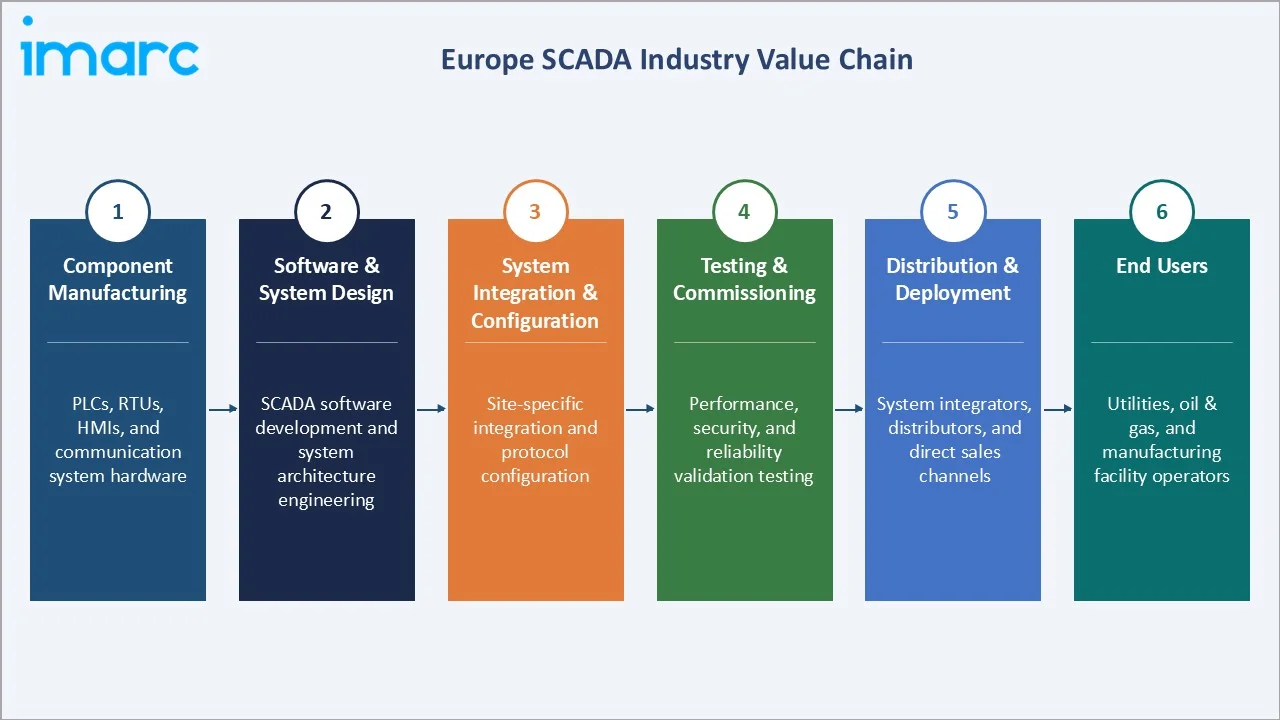
The Europe SCADA market encompasses PLC, RTU, HMI, and communication system components delivered through hardware, software, and services architectures, offering supervisory control and data acquisition solutions for utilities, oil and gas, water treatment, and manufacturing applications. The SCADA ecosystem spans component manufacturers, software and system design specialists, and an expanding distribution network across system integrators and direct sales channels.
Macroeconomic drivers include rising investment in intelligent and smart grid systems, growing industrial automation demand for operational efficiency and security, and EU renewable energy regulatory mandates driving grid SCADA use. Manufacturers are simultaneously investing in cloud, IoT, and big data analytics integration to improve system performance, positioning the Europe SCADA sector for continued innovation-led growth through 2034 despite high implementation and system integration costs.
Market Dynamics
To evaluate market opportunities, Request Sample
Market Drivers
- Rising Investment in Intelligent & Smart Grid Systems: Siemens Aktiengesellschaft and other European industry stakeholders emphasize that the electrification rate must reach at least 35% by 2030 to achieve the objectives outlined under the REPowerEU initiative. Growing utility investment in intelligent grid infrastructure is driving sustained SCADA adoption throughout power generation and distribution sectors.
- Growing Industrial Automation Demand for Operational Efficiency & Security: Warehouse automation is increasing demand for modern logistics facilities across Europe, with automated space rising to about 30% in 2025 and potentially reaching 50% by 2035. Rising demand for automated process control and monitoring is accelerating SCADA deployment across Europe's industrial base.
- EU Renewable Energy Regulatory Mandates Driving Grid SCADA Use: Supportive EU policies targeting renewable energy expansion are accelerating SCADA adoption for grid management and integration. The EU targets renewables to account for at least 42.5% of energy consumption by 2030, with an ambition to reach 45%.
- Convergence of SCADA with Cloud, IoT & Big Data Analytics: Growing integration of SCADA with modern IT infrastructure is broadening system capability and driving upgrade cycles across legacy installations.
Market Restraints
- High Implementation & System Integration Costs: Significant upfront investment required for SCADA hardware and software integration can limit adoption among cost-sensitive small and mid-size operators.
- Cybersecurity Vulnerabilities in Legacy SCADA Infrastructure: Persistent security risks associated with aging SCADA systems can undermine operational confidence and require substantial security investment.
- Complex Regulatory Compliance Across EU Member States: Navigating diverse regulatory requirements across European markets requires ongoing compliance management and adds operational complexity.
Market Opportunities
- Cybersecurity-Hardened SCADA Upgrade Expansion: Rising demand for secure, modernized SCADA systems presents opportunities for providers offering hardened, cyber-resilient solutions.
- Renewable Energy Grid Integration Growth: Growing renewable energy infrastructure investment creates opportunities for SCADA providers serving grid integration and management applications.
- Cloud & Big Data Analytics Technology Integration: Rising demand for cloud-based, analytics-driven SCADA capabilities offers providers new technology integration opportunities.
Market Challenges
- Balancing Cost and Security: Providers must balance component and integration costs with the need to deliver secure, high-performance SCADA systems.
- Addressing Legacy System Modernization: Ensuring consistent, safe modernization of aging SCADA infrastructure across diverse industrial environments requires ongoing investment and coordination.
Emerging Market Trends
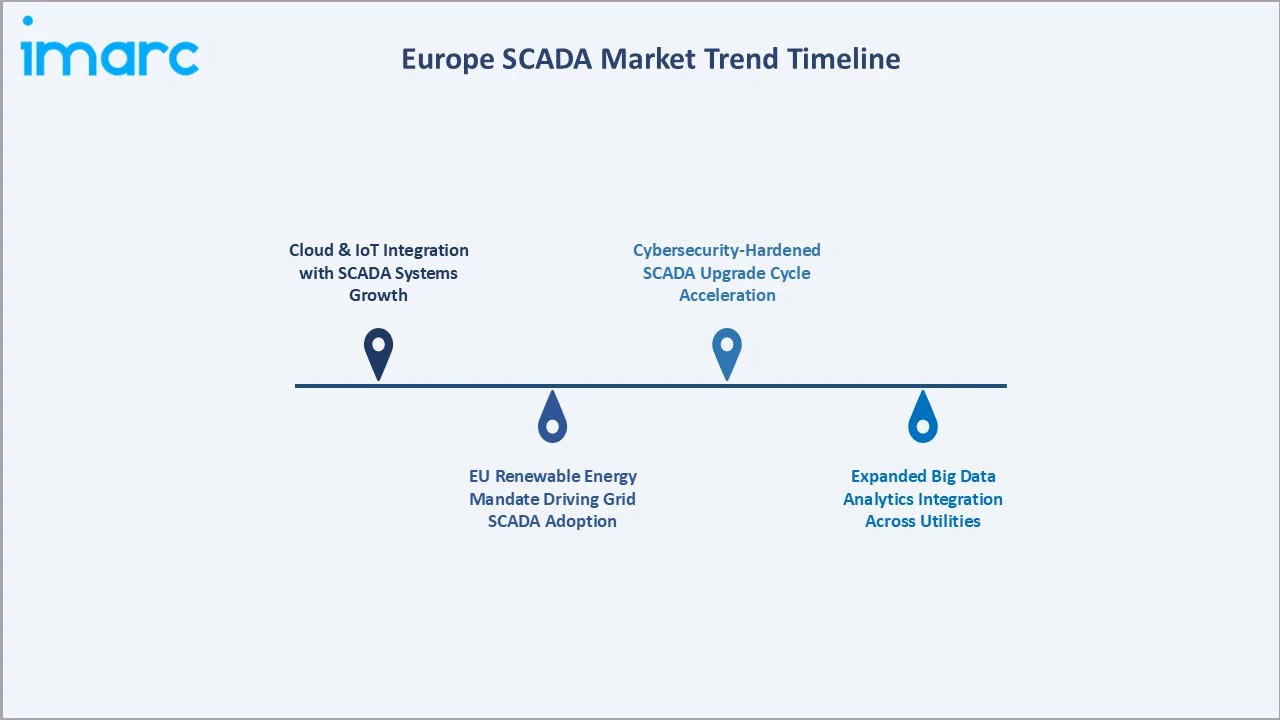
1. Cloud & IoT Integration with SCADA Systems Growth
Manufacturers are increasingly integrating SCADA systems with cloud computing and IoT platforms, enabling improved remote monitoring and real-time decision-making capabilities. A Serbian IT provider offers a modular, cloud-native SCADA/IIoT platform that integrates machines, sensors, and enterprise systems for real-time monitoring, analytics, and industrial process control.
2. EU Renewable Energy Mandate Driving Grid SCADA Adoption
Growing regulatory support for renewable energy expansion is accelerating SCADA adoption for grid management and distributed energy integration. The REPowerEU plan accelerates renewable energy deployment through faster permitting, greater clean-energy investment, improved infrastructure, and expanded domestic production to reduce reliance on imported fossil fuels. EU policy sets a binding renewable energy target of at least 42.5% by 2030, with an ambition to reach 45%, strengthening energy security and supporting decarbonization.
3. Cybersecurity-Hardened SCADA Upgrade Cycle Acceleration
Rising security concerns are driving accelerated upgrade cycles toward cybersecurity-hardened SCADA systems across utility and industrial installations. Stricter European cybersecurity regulations and increasing IT–OT integration are further encouraging operators to replace legacy platforms with secure, remotely manageable, and continuously monitored SCADA architectures.
4. Expanded Big Data Analytics Integration Across Utilities
Growing utility sector adoption of big data analytics within SCADA platforms is broadening system capability for predictive maintenance and operational optimization. A Turkish software company offers a modular platform combining IoT data acquisition, SCADA monitoring, and AI-assisted analytics for smart infrastructure and healthcare systems.
Industry Value Chain Analysis
The Europe SCADA value chain spans component manufacturing through end-user delivery, with each stage occupied by specialized hardware manufacturers, software and system design specialists, and integration partners whose performance directly influences system reliability, security, and cost effectiveness.
|
Stage |
Key Activities |
|
Component Manufacturing |
PLCs, RTUs, HMIs, and communication system hardware |
|
Software & System Design |
SCADA software development and system architecture engineering |
|
System Integration & Configuration |
Site-specific integration and protocol configuration |
|
Testing & Commissioning |
Performance, security, and reliability validation testing |
|
Distribution & Deployment |
System integrators, distributors, and direct sales channels |
|
End Users |
Utilities, oil & gas, and manufacturing facility operators |
Technology Landscape in the Europe SCADA Industry
Advanced PLC & Process Control Technology
Manufacturers are advancing PLC technology to improve process control precision and reliability, supporting broader adoption among industrial automation and utility applications. Modular, scalable PLC architectures are also enabling faster integration into legacy plant environments.
Remote Terminal Unit & Field Monitoring Development
Growing investment in RTU technology is expanding remote monitoring capabilities, addressing rising demand for reliable, real-time field data collection across distributed infrastructure. Compact, low-power RTU designs are further enabling deployment in harsh and remote field conditions.
Human Machine Interface & Visualization Systems
Providers are engineering advanced HMI and visualization systems to extend adoption across demanding operator monitoring and control room applications. Increasing use of intuitive, touch-based interfaces is further improving operator response times and situational awareness.
Cloud-Native & Cybersecurity-Hardened SCADA Innovation
Expanding research into cloud-native architecture and cybersecurity-hardened SCADA technology is strengthening system resilience, supporting premium positioning across critical infrastructure use cases. Integration of AI-driven threat detection is also emerging as a key differentiator among leading vendors.
Market Segmentation Analysis
The report covers the following segments:
|
Segment Category |
Leading Segment |
Market Share |
Year |
|
Component |
Programmable Logic Controller (PLC) |
31.8% |
2025 |
|
Architecture |
Services |
40.6% |
2025 |
|
End User |
Oil and Gas |
🔒 |
2025 |
|
Country |
Germany |
28.4% |
2025 |

By Component
Programmable Logic Controllers (PLC) dominate with a 31.8% share in 2025. This segment encompasses core industrial process control hardware, supported by sustained demand for their reliability across automation and utility applications.
To access detailed market analysis, Request Sample
Remote Terminal Units (RTU) represent 23.4% (2025) of the market, followed by Human Machine Interface (HMI) at 18.6%, communication systems at 15.2%, and others at 11.0%, reflecting the market's broad component diversity across control and monitoring functions.
By Architecture
Services lead the architecture segment at 40.6% share (2025), supported by their central role in system integration, consulting, and ongoing maintenance across SCADA installations.
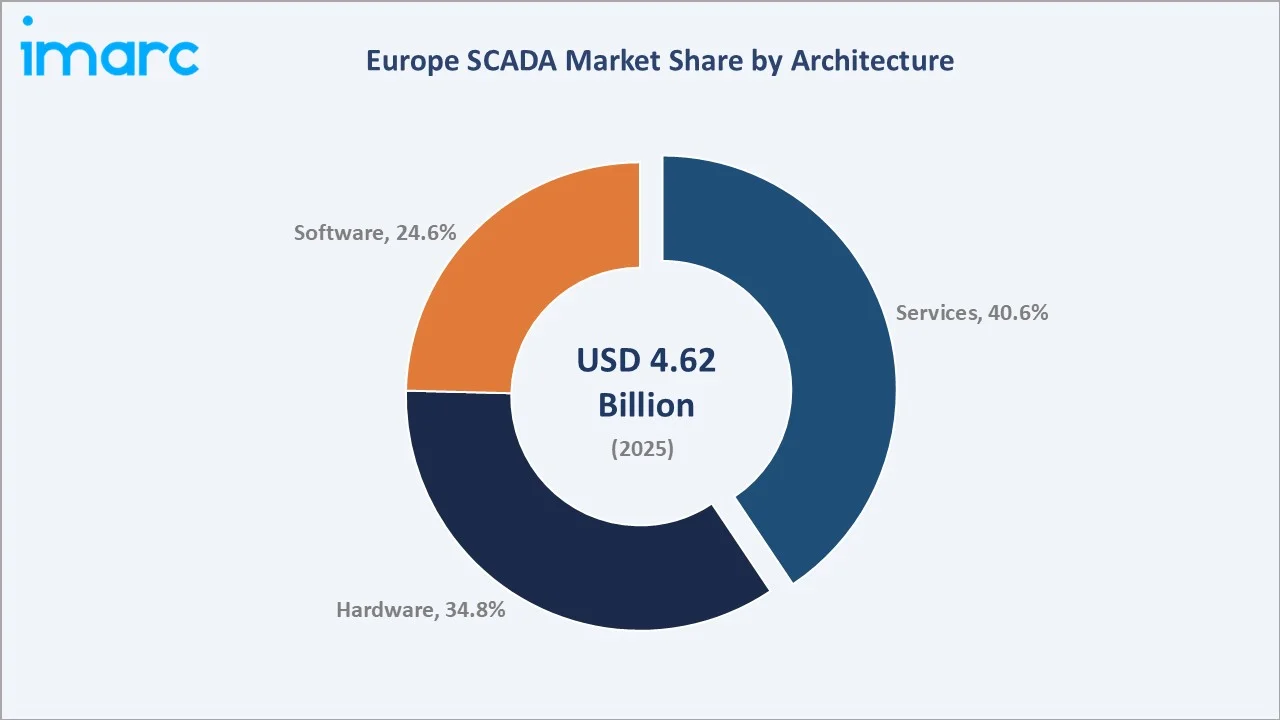
Hardware (34.8%) and software (24.6%) continue to serve varied deployment needs, with software expanding steadily as SCADA systems increasingly rely on advanced analytics and cloud-based capabilities.
Regional Market Insights
Germany's market leadership (28.4%, 2025) reflects the country's large industrial manufacturing base, advanced utility infrastructure, and strong smart grid investment. Growing renewable energy integration and expanding industrial automation demand combine to sustain its dominant position through 2034.
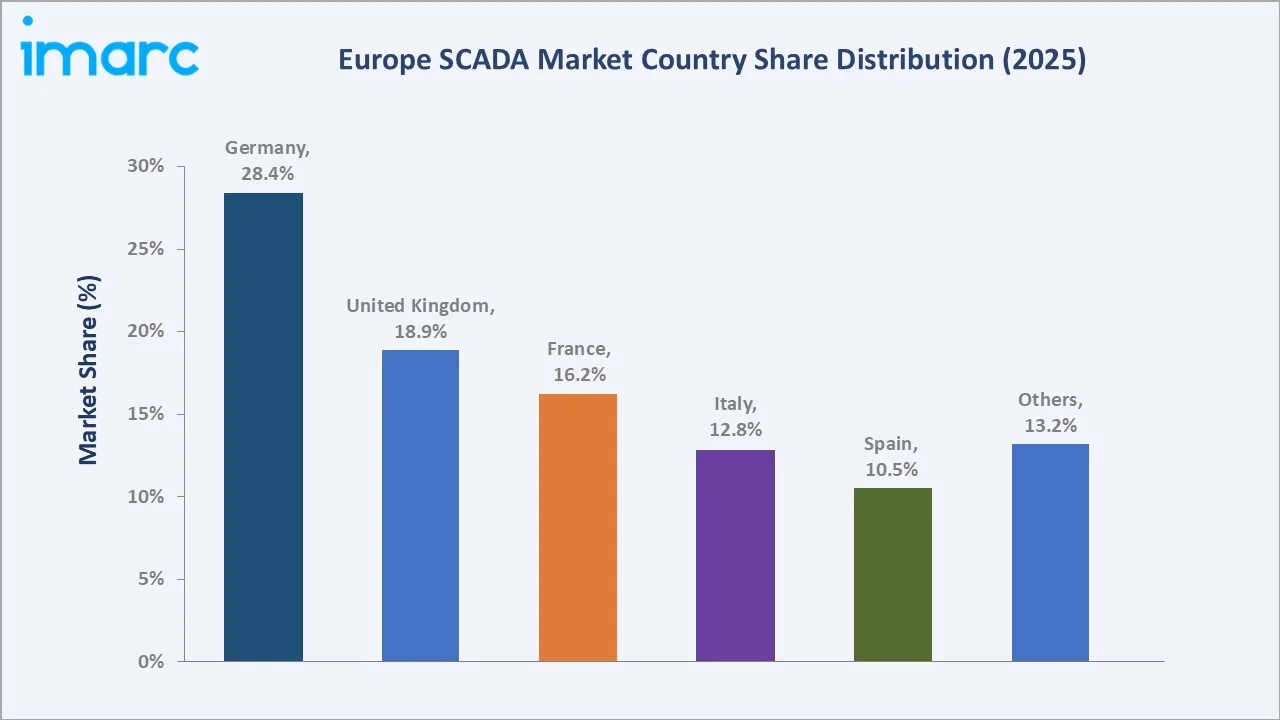
The United Kingdom at 18.9% (2025) represents the second-largest SCADA market regionally. Strong smart grid investment and expanding renewable energy integration are sustaining steady growth, positioning the country as a key contributor alongside Germany through the forecast period.
|
Country |
Share (2025) |
Key Growth Drivers |
|
Germany |
28.4% |
Large industrial manufacturing base and advanced utility infrastructure |
|
United Kingdom |
18.9% |
Strong smart grid investment and expanding renewable energy integration |
|
France |
16.2% |
Growing nuclear and renewable energy grid management demand |
|
Italy |
12.8% |
Rising industrial automation adoption and expanding utility modernization |
|
Spain |
10.5% |
Growing renewable energy capacity and expanding grid infrastructure investment |
|
Others |
13.2% |
Emerging Central and Eastern European industrial automation demand |
Competitive Landscape
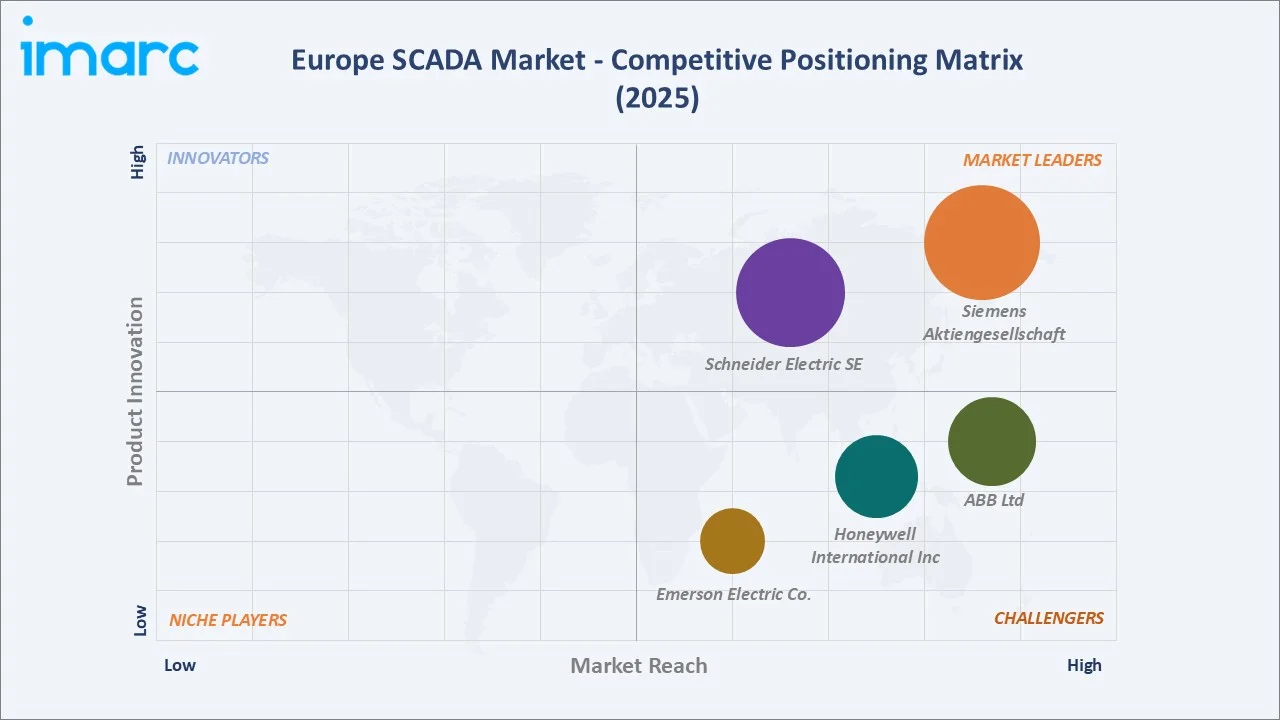
The Europe SCADA market exhibits moderate concentration, with leading manufacturers collectively holding a significant share of market revenue in 2025, reflecting sustained investment in product innovation and distribution reach.
|
Company Name |
Brands/Products |
Market Position |
Core Strength |
|
Siemens Aktiengesellschaft |
SIMATIC SCADA Systems |
Market Leader |
Global industrial automation leadership and extensive SCADA product portfolio |
|
Schneider Electric SE |
EcoStruxure |
Market Leader |
Diversified energy management platform and integrated SCADA capabilities |
|
ABB Ltd |
ABB Ability Symphony Plus SCADA |
Strong Challenger |
Global electrification and automation technology leadership |
|
Honeywell International Inc |
Honeywell |
Strong Challenger |
Broad industrial control systems and process automation expertise |
|
Emerson Electric Co. |
Emerson |
Challenger |
Advanced automation technology and industrial software expertise |
Siemens Aktiengesellschaft and Schneider Electric SE dominate through comprehensive global product portfolios and extensive distribution capacity, supported by continuous R&D investment. ABB Ltd, Honeywell International Inc, and Emerson Electric Co. compete through targeted premium positioning, process automation expertise, and specialty instrumentation differentiation, respectively.
Key Company Profiles
Siemens Aktiengesellschaft
Siemens Aktiengesellschaft is one of the leading global industrial automation companies with an extensive SCADA product portfolio spanning PLCs, RTUs, and HMI systems distributed across a vast European and global customer base.
- Product Portfolio: SIMATIC SCADA systems software and integrated industrial automation solutions under the Siemens brand.
- Recent Developments: In May 2026, Siemens Aktiengesellschaft expanded its Industrial Edge ecosystem with generally available AI and decentralized SCADA capabilities, enabling scalable predictive maintenance, visual inspection, and closer IT–OT integration.
- Strategic Focus: Strengthening cloud and IoT integration innovation; expanding SCADA component capacity across emerging application segments.
ABB Ltd
ABB Ltd is a prominent electrification and automation technology provider known for its advanced engineering and innovation-driven presence across industrial and utility application segments.
- Product Portfolio: ABB Ability Symphony Plus SCADA systems, automation controllers, and integrated electrification solutions under the ABB brand.
- Recent Developments: In May 2026, ABB Ltd completed its acquisition of North European grid automation specialist Netcontrol, integrating the company into its Distribution Solutions division.
The deal strengthens ABB’s digital grid portfolio, enabling utilities to improve network visibility, remote control, cybersecurity, and operational resilience. - Strategic Focus: Expanding advanced automation innovation; strengthening industrial and utility distribution presence globally.
Market Concentration Analysis
The Europe SCADA market exhibits moderate concentration, with Siemens Aktiengesellschaft, Schneider Electric SE, and ABB Ltd collectively accounting for a significant share of total category revenue in 2025, reflecting sustained R&D investment, brand loyalty, and extensive distribution infrastructure across the region.
Consolidation pressure remains limited as leading manufacturers maintain distinct strategic positioning: Siemens Aktiengesellschaft and Schneider Electric SE through comprehensive multi-category portfolios, ABB Ltd and Honeywell International Inc through electrification and process automation positioning, and Emerson Electric Co. through diversified automation and instrumentation differentiation, rather than pursuing direct M&A consolidation.
Investment & Growth Opportunities
Fastest Growing Segments
Programmable Logic Controller (PLC) (~2.1% CAGR) represents the highest-growth investment vector through 2034, driven by expanding industrial automation demand and continuous innovation across process control technologies. This subcategory addresses a rapidly expanding addressable market within the Europe SCADA ecosystem.
Emerging Market Expansion
Central and Eastern European markets collectively represent an incremental growth opportunity beyond Germany, the United Kingdom, France, Italy, and Spain by 2034, as rising industrial automation investment and expanding utility modernization accelerate category penetration in these regional markets.
Venture and Institutional Investment Trends
- Manufacturer investment toward cloud and IoT integration technology is creating opportunities for technology vendors serving the SCADA sector.
- Growing renewable energy grid integration demand is sustaining institutional interest in specialty SCADA manufacturing platforms.
- Cybersecurity and big data analytics innovation, led by major manufacturers, is opening opportunities for component and technology vendors serving the Europe SCADA industry.
Future Market Outlook (2026-2034)
The Europe SCADA market is positioned for steady, technology-driven expansion through 2034. From a base of USD 4.62 Billion in 2025 to USD 4.70 Billion in 2026, the market is projected to reach USD 5.48 Billion by 2034, representing incremental value creation at a CAGR of 1.84%. This growth is underpinned by rising smart grid investment, growing industrial automation demand, and supportive EU renewable energy policy.
The component segment will continue evolving through 2034, with PLC gaining further share as industrial automation demand and process control innovation accelerate. This shift creates opportunities for manufacturers investing in cloud integration, cybersecurity-hardened architecture, and modular system design to capture the next phase of the Europe SCADA market growth.
Research Methodology
Primary Research
Primary research comprised structured interviews with industry participants across 2024-2025, including SCADA manufacturer executives, utility infrastructure procurement managers, industrial automation specialists, and cybersecurity analysts across major European markets. Expert input validated market sizing, segmentation trends, and regional consumption patterns.
Secondary Research
Secondary research encompassed manufacturer annual reports, industrial automation association publications, and utility trade press covering technology innovation, regulatory trends, and regional market dynamics across major markets.
Forecasting Models
Market size estimations were derived using top-down and bottom-up forecasting, incorporating component and architecture segment transitions and manufacturer capacity disclosures. A base-case CAGR of 1.84% reflects consensus estimates validated against announced technology investment timelines and manufacturer strategic development plans.
Report Coverage:
| Report Features | Details |
|---|---|
| Base Year of the Analysis | 2025 |
| Historical Period | 2020-2025 |
| Forecast Period | 2026-2034 |
| Units | Billion USD |
| Scope of the Report | Exploration of Historical Trends and Market Outlook, Industry Catalysts and Challenges, Segment-Wise Historical and Future Market Assessment:
|
| Components Covered | Programmable Logic Controller (PLC), Remote Terminal Units (RTU), Human Machine Interface (HMI), Communication Systems, Others |
| Architectures Covered | Hardware, Software, Services |
| End Users Covered | Oil and Gas, Power, Water and Wastewater, Manufacturing, Chemicals and Petrochemicals, Pharmaceutical, Others |
| Countries Covered | Germany, France, United Kingdom, Italy, Spain, Others |
| Companies Covered | Siemens Aktiengesellschaft, Schneider Electric SE, ABB Ltd, Honeywell International Inc, Emerson Electric Co., etc. |
| Customization Scope | 10% Free Customization |
| Post-Sale Analyst Support | 10-12 Weeks |
| Delivery Format | PDF and Excel through Email (We can also provide the editable version of the report in PPT/Word format on special request) |
Frequently Asked Questions About the Europe SCADA Market Report
The Europe SCADA market size is estimated at USD 4.70 Billion in 2026.
The market is expected to grow at a CAGR of 1.84% during 2026-2034, and reaching USD 5.48 Billion by 2034, driven by rising smart grid investment and growing industrial automation demand.
Germany leads with a 28.4% share in 2025, anchored by the country's large industrial manufacturing base and advanced utility infrastructure.
Programmable Logic Controllers (PLC) dominate with a 31.8% share in 2025, driven by sustained demand for their central role in process control.
Services lead with a 40.6% share in 2025, supported by their central role in system integration, consulting, and ongoing maintenance.
Some of the key players include Siemens Aktiengesellschaft, Schneider Electric SE, ABB Ltd, Honeywell International Inc, and Emerson Electric Co.
Programmable Logic Controller (PLC) is growing fastest at an estimated 2.1% CAGR as industrial automation demand and process control innovation accelerate.
Key challenges include high implementation and system integration costs, cybersecurity vulnerabilities in legacy infrastructure, and complex regulatory compliance across EU member states.
Cybersecurity-hardened SCADA upgrade expansion, renewable energy grid integration growth, and cloud and big data analytics technology integration represent leading investment opportunities.
Hardware, at 34.8% share, is expanding steadily as industrial facilities continue to invest in physical control and monitoring infrastructure.
Need more help?
- Speak to our experienced analysts for insights on the current market scenarios.
- Include additional segments and countries to customize the report as per your requirement.
- Gain an unparalleled competitive advantage in your domain by understanding how to utilize the report and positively impacting your operations and revenue.
- For further assistance, please connect with our analysts.
 Request Customization
 Speak to an Analyst
 Request Brochure
 Inquire Before Buying
Benefits of Customization
- Personalize this research
- Triangulate with your data
- Get data as per your format and definition
- Gain a deeper dive into a specific application, geography, customer, or competitor
- Any level of personalization
Get in Touch With Us
UNITED STATES
Phone: +1-201-971-6302
INDIA
Phone: +91-120-433-0800
UNITED KINGDOM
Phone: +44-753-714-6104
Email: [email protected]
Client Testimonials




.webp)




.webp)













Related Reports

Choose your plan
*Please note that the prices mentioned below are starting prices for each bundle type. Kindly contact our team for further details.*
Single User License
- 1 User License, Access on 2 Devices
- PDF Report + Excel Dataset (Password Protected)
- Lifetime Access
- No Printing Rights
- 10% Free Report Customization
- 10–12 Weeks of Analyst Support
Five User License
- Access for 5 Users, 2 Devices per User
- PDF Report + Excel Dataset (Password Protected)
- Lifetime Access
- Dedicated Account Manager
- 12–14 Weeks of Analyst Support
- No Printing Rights
- 15% Free Report Customization
- 25% Discount on Your Next Purchase
Corporate User License
- Unlimited User Access (Within Your Organization)
- PDF Report + Excel Dataset
- Lifetime Access
- Dedicated Account Manager
- 14–20 Weeks of Analyst Support
- No Printing Rights
- 20% Free Report Customization
- 30% Discount on Your Next Purchase
Essential Insights
What's included:
3 reports
- Lifetime Access
- PDF Reports
- Excel Datasets
- 2 Weeks of Free Analyst Support
- 2 User Licenses
- Access on 2 Devices
- Printing Rights
- Complimentary PowerPoint (PPT) Version
- Complimentary License Upgrade
Professional Access
What's included:
5 reports
- Lifetime Access
- PDF Reports
- Excel Datasets
- 8 Weeks of Free Analyst Support
- 2 User Licenses
- Access on 2 Devices
- Printing Rights
- Complimentary PowerPoint (PPT) Version
- Complimentary License Upgrade
Business Advantage
What's included:
8 reports
- Lifetime Access
- PDF Reports
- Excel Datasets
- 14 Weeks of Free Analyst Support
- 2 User Licenses
- Access on 2 Devices
- Printing Rights
- Complimentary PowerPoint (PPT) Version
- Complimentary License Upgrade
Enterprise Intelligence
What's included:
10 reports
- Lifetime Access
- PDF Reports
- Excel Datasets
- 20 Weeks of Free Analyst Support
- 2 User Licenses
- Access on 2 Devices
- Printing Rights
- Complimentary PowerPoint (PPT) Version
- Complimentary License Upgrade