
Europe Welding Consumables Market Size, Share, Trends and Forecast by Product, Welding Technique, End Use Industries, and Country 2026-2034
Europe Welding Consumables Market Size, Share, Trends & Forecast (2026-2034)
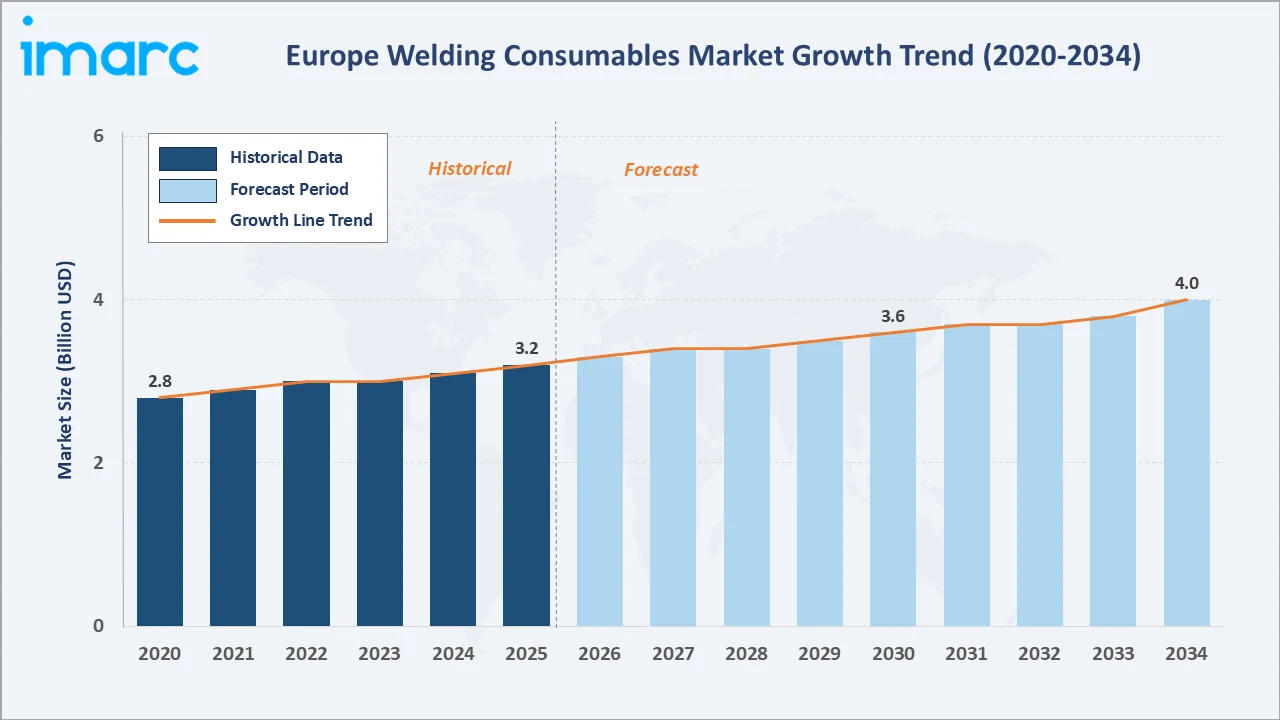
The Europe welding consumables market grew from USD 3.2 Billion in 2025 to USD 3.3 Billion in 2026 and is projected to reach USD 4.0 Billion by 2034, growing at a CAGR of 2.43% during 2026-2034. The market is driven by infrastructure expansion, automotive lightweighting requirements, and accelerating adoption of automated welding technologies across Europe's major industrial economies.
Stick Electrodes dominate at 32.8%. Construction leads end-use sectors at 28.6%. Germany commands 29.4% of the regional market share, reflecting its advanced industrial and automotive manufacturing base.
Market Snapshot
|
Metric |
Value |
|
Base Year Market Size (2025) |
USD 3.2 Billion |
|
Market Size (2026) |
USD 3.3 Billion |
|
Forecast Market Size (2034) |
USD 4.0 Billion |
|
CAGR (2026-2034) |
2.43% |
|
Base Year |
2025 |
|
Historical Period |
2020-2025 |
|
Forecast Period |
2026-2034 |
|
Dominant Product |
Stick Electrodes (32.8%, 2025) |
|
Leading End Use Industry |
Construction (28.6%, 2025) |
|
Leading Country |
Germany (29.4%, 2025) |
The Europe welding consumables market size increased from USD 2.8 Billion in 2020 to USD 3.2 Billion in 2025 and is estimated to reach USD 3.3 Billion in 2026. The market is further expected to grow to USD 3.6 Billion by 2030 and USD 4.0 Billion by 2034. Europe's welding consumables market benefits from a well-established industrial manufacturing base, stringent quality standards, and growing investments in renewable energy infrastructure.
To get more information on this market, Request Sample
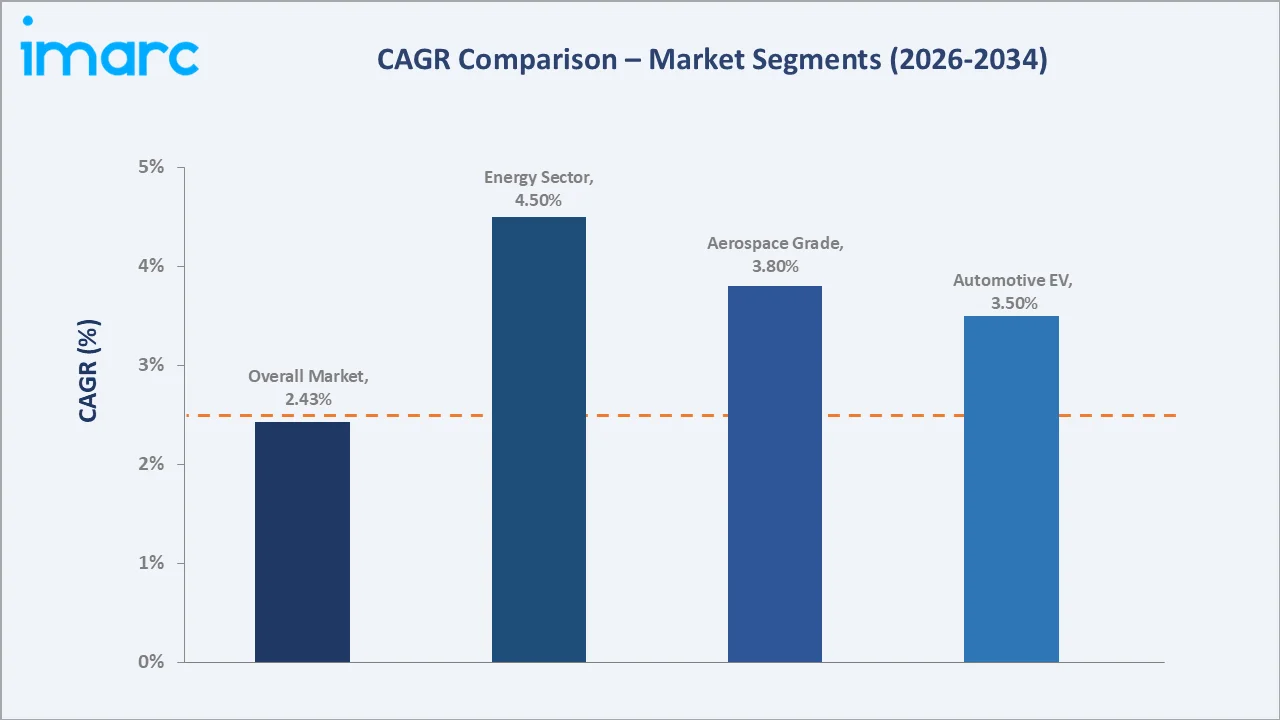
The energy sector consumables segment grows fastest at ~4.5% CAGR through offshore wind and hydrogen infrastructure. Aerospace-grade specialty consumables grow at ~3.8% CAGR. Automotive EV-compatible solid wires grow at ~3.5% CAGR through rapid electrification of European automotive production.
Executive Summary
The Europe welding consumables market expanded from USD 3.2 Billion in 2025 to an estimated USD 3.3 Billion in 2026, positioning it among the world's most technically advanced regional welding consumables markets. The market's scale is underpinned by Europe's vast manufacturing base encompassing automotive, construction, aerospace, and energy sectors. The market is projected to reach USD 4.0 Billion by 2034. Stick Electrodes at 32.8% lead through widespread industrial applications. Construction at 28.6% reflects Europe's infrastructure investment programs. Germany leads regionally at 29.4%.
Key Market Insights
|
Insight |
Data |
|
Dominant Product |
Stick Electrodes – 32.8% share (2025) |
|
Leading End Use Industry |
Construction – 28.6% market share (2025) |
|
Leading Country |
Germany – 29.4% share (2025) |
|
Market Opportunity |
Renewable energy infrastructure; EV-compatible welding wires; low-fume premium products; automation-compatible consumables |
Key Analytical Observations Supporting the Above Data:
- Stick Electrodes at 32.8%: Stick electrodes dominate due to versatility, ease of use in field applications, and strong demand across construction and industrial equipment manufacturing sectors. Their compatibility with a wide range of steel grades makes them the preferred choice for diverse European industrial applications requiring portable, certification-compliant welding solutions.
- Construction at 28.6%: Construction dominates end-use due to Europe's sustained investment in residential, commercial, and infrastructure projects. EU programs and urban renewal initiatives require extensive steel fabrication, generating consistent high-volume demand for welding consumables across the continent.
- Germany at 29.4%: Germany leads regionally due to its world-class automotive manufacturing, advanced machinery industry, and headquarters of global welding companies. Strong technical standards and skilled welding workforce drive consistent demand for premium-grade consumables across all product categories.
Europe Welding Consumables Market Overview
The Europe welding consumables market is positioned at the intersection of industrial heritage and technological innovation. The region hosts some of the world's most advanced manufacturing industries, including automotive OEMs, aerospace manufacturers, and precision engineering companies that demand the highest quality welding consumables.
Europe's welding consumables ecosystem integrates domestic manufacturing, international imports, multi-brand industrial distribution, and direct OEM supply chains. Macroeconomic factors include sustained EU infrastructure investment programs, automotive electrification trends, energy transition projects, and growing demand for precision welding in aerospace applications.
Market Dynamics
To evaluate market opportunities, Request Sample
Market Drivers
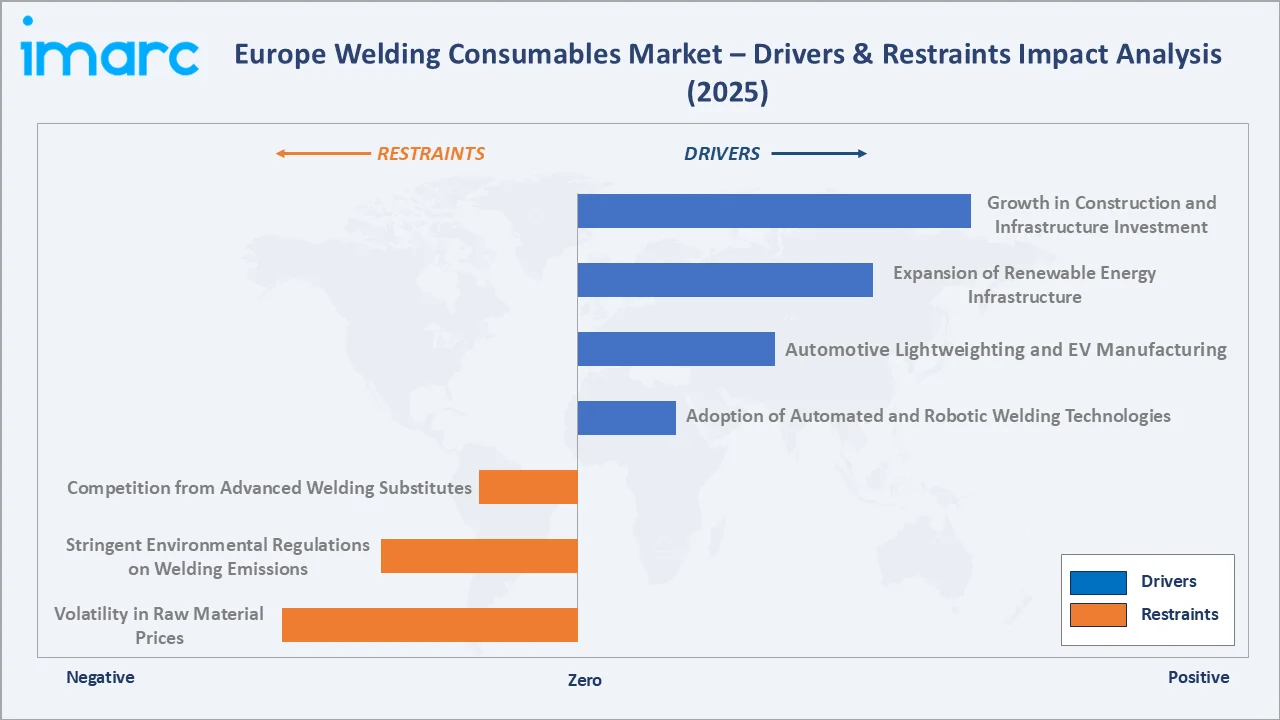
- Growth in Construction and Infrastructure Investment: Europe's sustained residential, commercial, and infrastructure construction activities drive significant demand for welding consumables. EU infrastructure programs require extensive use of stick electrodes and flux cored wires for steel fabrication, with construction remaining the largest end-use sector. European construction output is expected to grow at approximately 2.5% annually, directly supporting sustained consumable volume demand. The EU's TEN-T transport network expansion and national infrastructure renewal programs are creating multi-year demand visibility for construction-grade welding consumables.
- Expansion of Renewable Energy Infrastructure: Europe's transition to renewable energy is creating substantial demand for specialized welding consumables. Offshore wind turbine fabrication, solar mounting structures, and hydrogen pipeline construction require SAW wires, flux cored wires, and solid wires. Offshore wind alone requires tonnes of SAW-grade consumables per monopile unit fabricated. The European Green Deal's infrastructure targets through 2034 represent the single largest structural demand catalyst for premium SAW and flux cored wire segments in the European market.
- Automotive Lightweighting and EV Manufacturing: The rapid growth of electric vehicle production in Europe is reshaping welding consumables demand, with manufacturers adopting AHSS welding techniques driving demand for specialized solid wires and flux cored wires supporting the automobile segment. Germany, France, and the Czech Republic as leading EV production hubs require high-volume precision-grade consumables for battery housings, structural components, and body-in-white manufacturing. As EV production scales, automotive consumable demand is expected to shift toward higher-specification products commanding price premiums over standard automotive-grade consumables.
- Adoption of Automated and Robotic Welding Technologies: The growing adoption of robotic welding systems across European manufacturing facilities is driving demand for high-quality, consistent welding consumables, with solid wires and flux cored wires for robotic applications experiencing increased demand particularly in automotive and industrial equipment manufacturing. Industry 4.0 adoption is accelerating integration of welding process control systems with consumable specification management. The cobot welding segment is growing particularly rapidly in mid-sized European manufacturers seeking to automate without full industrial robot infrastructure.
Market Restraints
- Volatility in Raw Material Prices: Welding consumables rely on key raw materials including low-alloy steel, copper, rutile, and ilmenite, all subject to significant price volatility creating margin pressure for manufacturers with limited hedging capacity. Geopolitical events, supply chain disruptions, and energy price fluctuations can simultaneously impact multiple input costs, compounding margin pressure on consumable producers and distributors. The interconnected nature of global commodity markets means that regional disruptions in mineral supply can cause disproportionate cost impacts on European consumable production economics.
- Stringent Environmental Regulations on Welding Emissions: EU REACH regulations and workplace safety directives impose strict limits on hazardous substances in welding fumes, requiring manufacturers to invest in reformulating consumables and increasing product development costs. The European Chemicals Agency is continuously reviewing welding fume component classifications, creating ongoing regulatory uncertainty that raises compliance costs for all market participants. Smaller manufacturers face challenges meeting evolving standards, potentially consolidating market share toward larger, more resourced global players with dedicated regulatory compliance teams.
- Competition from Advanced Welding Substitutes: Alternative joining technologies including laser welding, friction stir welding, and adhesive bonding are increasingly adopted in precision manufacturing in Europe, reducing the need for traditional welding consumables in aerospace and high-end automotive segments. While substitution remains limited to premium segments due to higher capital costs, the long-term trend toward laser and hybrid welding in new automotive and aerospace platforms represents a structural headwind for consumable volume growth. Investment in substitute technologies is accelerating, particularly among Tier 1 automotive suppliers.
Market Opportunities
- Shipbuilding Sector Recovery and Expansion: European shipbuilding, particularly in Poland, Germany, and the Nordic countries, is experiencing a resurgence driven by naval defense investment and LNG carrier orders, with the sector at 8.9% of end-use demand expected to grow as defense budgets increase. SAW wires and flux cored wires are critical for ship hull and structural fabrication. Green shipping vessel construction further supports demand through new alloy welding requirements. The European defense shipbuilding backlog has grown substantially as NATO member states increase naval investment, creating multi-year visibility for high-volume welding consumable demand.
- Aerospace Manufacturing Growth: Europe's aerospace sector centered on Airbus production in France, Germany, and the UK drives demand for specialized high-performance welding consumables requiring exceptional precision and corrosion resistance. Space economy expansion in Europe, including satellite manufacturing and launch vehicle production, creates additional demand for precision-grade specialty consumables commanding significant price premiums over standard industrial products.
Market Challenges
- Skilled Welder Shortage and Workforce Demographics: Europe faces a significant skilled welder shortage driven by aging workforce demographics and insufficient training pipeline replenishment, reducing effective demand in segments where projects are delayed due to labor constraints. Professional welding training programs are struggling to attract younger workers, creating a structural demographic challenge through 2034 that will intensify as experienced welders retire. While automation partially offsets this trend, SME manufacturers in construction and industrial equipment are particularly affected by inability to scale welding operations when skilled labor is unavailable.
- Supply Chain Fragility and Geopolitical Disruptions: Europe's welding consumables supply chain is exposed to geopolitical disruptions affecting raw material availability and logistics networks, with dependence on specific mineral imports creating vulnerability to trade disputes and freight cost volatility. European manufacturers are investing in supply chain resilience through near-shoring and dual-sourcing strategies, but transition costs create short-term disruptions. Energy cost differentials between Europe and Asian manufacturing hubs also create competitive pressure on European consumable producers serving cost-sensitive market segments.
Emerging Market Trends
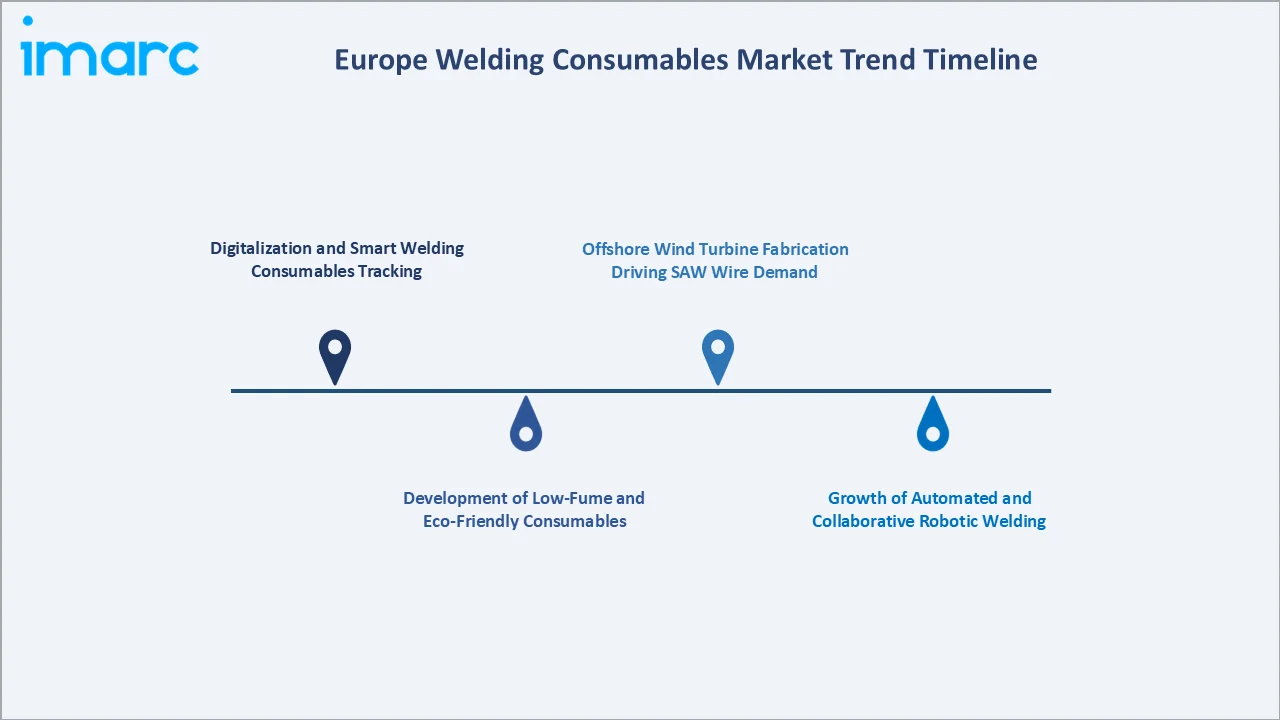
1. Digitalization and Smart Welding Consumables Tracking
European manufacturers are adopting digital traceability solutions for welding consumables, linking specific consumable batches to weld quality data to support quality assurance in aerospace and energy applications where full documentation is a regulatory requirement. Smart packaging with QR codes and RFID tracking is gaining adoption among leading European distributors, enabling real-time inventory management and process optimization across manufacturing operations.
2. Development of Low-Fume and Eco-Friendly Consumables
Environmental and health regulations are driving development of low-fume welding consumables across Europe, with manufacturers investing in reformulated flux and coating compositions that reduce hazardous welding fume emissions without compromising mechanical properties. This trend is particularly accelerating in Germany and Scandinavia where worker health standards are most stringent, creating a premium product tier within the consumables market that commands price premiums of 15–25% over standard industrial-grade products.
3. Growth of Automated and Collaborative Robotic Welding
Europe's manufacturers are rapidly deploying collaborative robots for welding applications, driving demand for high-wire-feed-speed solid wires and flux cored wires designed for automated arc processes. The integration of welding process control systems with consumable specification management is creating new value-added service opportunities for consumables suppliers, enabling performance guarantees linked to specific consumable-machine-procedure combinations that support quality certification requirements.
4. Offshore Wind Turbine Fabrication Driving SAW Wire Demand
Europe's leading position in offshore wind energy is creating sustained demand for submerged arc welding (SAW) wires and fluxes used in monopile and transition piece fabrication, with countries including the UK, Germany, Denmark, and the Netherlands as significant demand sources. SAW wires and fluxes are expected to benefit disproportionately from the energy transition through 2034, as each offshore wind monopile requires several tonnes of certified SAW-grade consumables.
Industry Value Chain Analysis
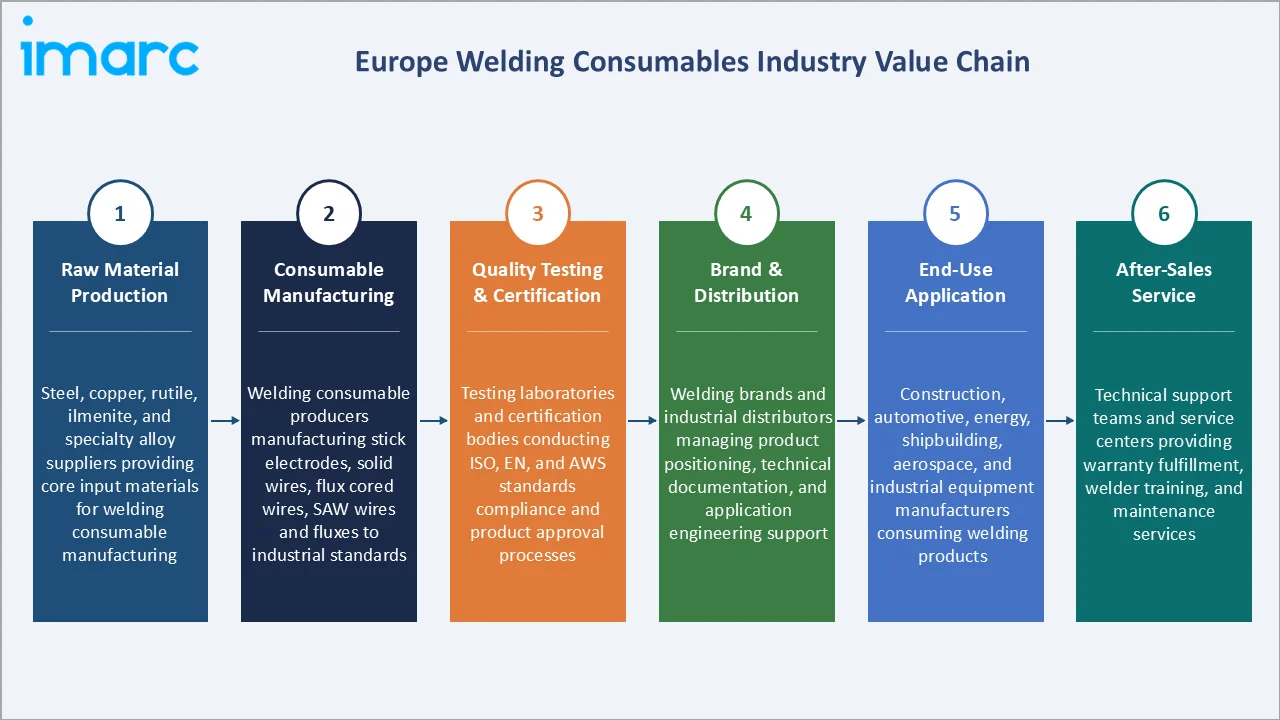
The Europe welding consumables value chain is one of the most technically integrated of any industrial materials category. The value chain's commercial structure creates the region's unique welding market dynamic, where domestic value addition competes alongside globally sourced consumables, serving highly demanding end-use applications requiring full certification traceability and documented performance compliance.
|
Stage |
Key Participants |
|
Raw Material Production |
Steel, copper, rutile, ilmenite, and specialty alloy suppliers providing core input materials for welding consumable manufacturing |
|
Consumable Manufacturing |
Welding consumable producers manufacturing stick electrodes, solid wires, flux cored wires, SAW wires and fluxes to industrial standards |
|
Quality Testing & Certification |
Testing laboratories and certification bodies conducting ISO, EN, and AWS standards compliance and product approval processes |
|
Brand & Distribution |
Welding brands and industrial distributors managing product positioning, technical documentation, and application engineering support |
|
End-Use Application |
Construction, automotive, energy, shipbuilding, aerospace, and industrial equipment manufacturers consuming welding products |
|
After-Sales Service |
Technical support teams and service centers providing warranty fulfillment, welder training, and maintenance services |
The quality testing and certification stage is the most commercially consequential regulatory stage in Europe's welding consumables value chain, where brands investing 10–20% of European revenue in technical documentation and certification maintenance are required to maintain market access across the continent's demanding industrial sectors. Regulatory compliance creates a meaningful barrier to entry for non-European suppliers in premium segment applications.
Technology Landscape in the Europe Welding Consumables Industry
Stick Electrode and Wire Technologies
Stick electrode and wire technologies provide diverse options across application requirements and automation compatibility levels. Stick electrodes offer field-flexible, certification-compliant welding for construction and maintenance applications, while solid and flux cored wires deliver higher deposition rates and automation compatibility required for modern European manufacturing. These technologies enable consumable manufacturers to differentiate products and support innovation in deposition efficiency, all-position welding capability, and fume reduction chemistry.
Submerged Arc Welding (SAW) Technology
Submerged arc welding consumables are integral to Europe's most demanding heavy fabrication applications, including offshore wind monopiles, pressure vessels, and shipbuilding. SAW wires and fluxes combine high deposition rates with excellent mechanical property control for thick-section structural components meeting stringent European structural standards. Twin-wire and tandem SAW configurations are increasing productivity in high-volume fabrication environments, driving demand for premium SAW consumables.
Low-Fume and Environmental Welding Technologies
Low-fume and environmental welding technologies are transforming consumable formulation requirements across Europe. Manufacturers are developing next-generation flux and coating systems that reduce chromium VI, manganese, and other regulated fume components while maintaining deposition efficiency. This innovation creates product segmentation between standard industrial consumables and premium low-fume variants, with the premium segment growing at above-average rates driven by regulatory compliance requirements and occupational health standards.
Market Segmentation Analysis
The report covers the following segments:
|
Segment Category |
Leading Segment |
Market Share |
Year |
|
Product |
Stick Electrodes |
32.8% |
2025 |
|
Welding Technique |
Arc Welding |
🔒 |
2025 |
|
End Use Industry |
Construction |
28.6% |
2025 |
|
Country |
Germany |
29.4% |
2025 |
.webp)
By Product
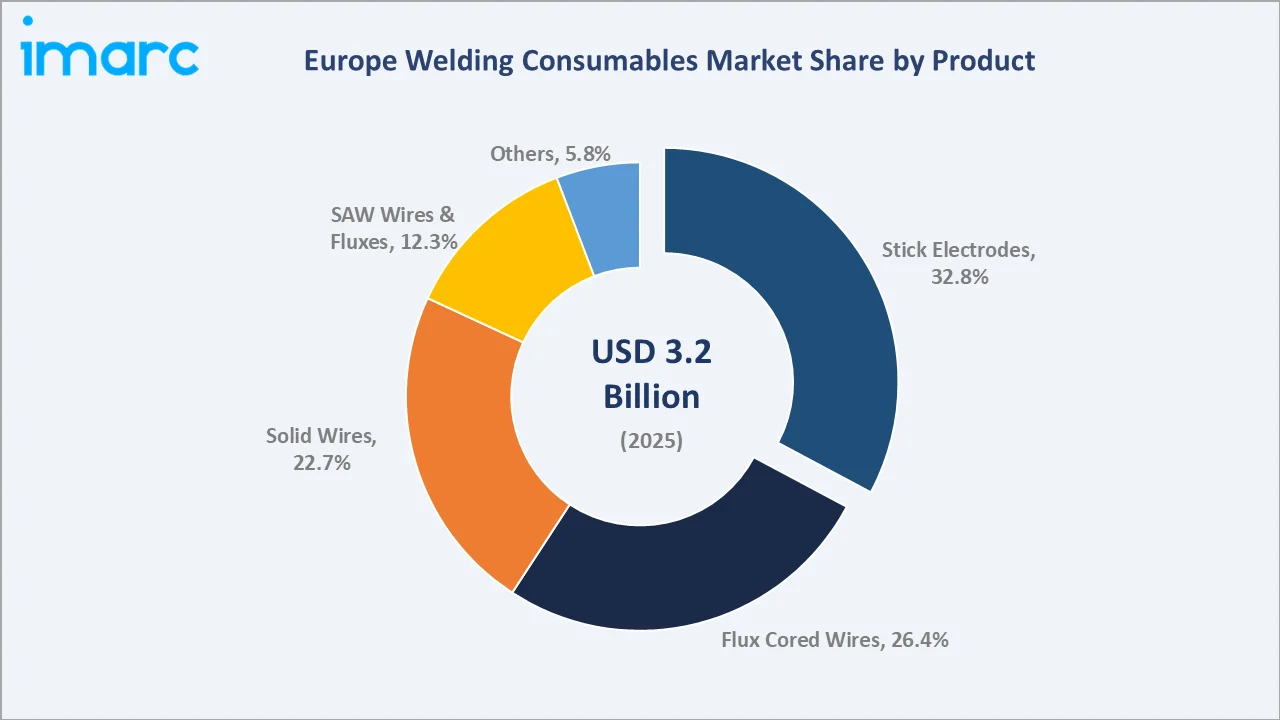
Stick Electrodes lead at 32.8% (2025). This segment encompasses the widest range of European industrial welding applications, from heavy-duty structural fabrication to precision maintenance welding. Stick electrodes remain the preferred choice for construction site welding, pipeline maintenance, and general fabrication due to portability, versatility, and performance across diverse steel grades and positions.
To access detailed market analysis, Request Sample
Flux Cored Wires at 26.4% grow through superior deposition rates and performance in heavy fabrication. Solid Wires at 22.7% benefit from growing robotic welding adoption. SAW Wires and Fluxes at 12.3% are driven by large-scale energy and shipbuilding projects. Others at 5.8% include specialty alloy and hardfacing consumables.
By End Use Industry
Construction leads at 28.6% (2025). This segment serves Europe's large-scale residential, commercial, and infrastructure construction sectors requiring extensive steel fabrication. EU infrastructure programs and urban renewal projects provide sustained structural demand for construction-grade consumables across all major European markets.
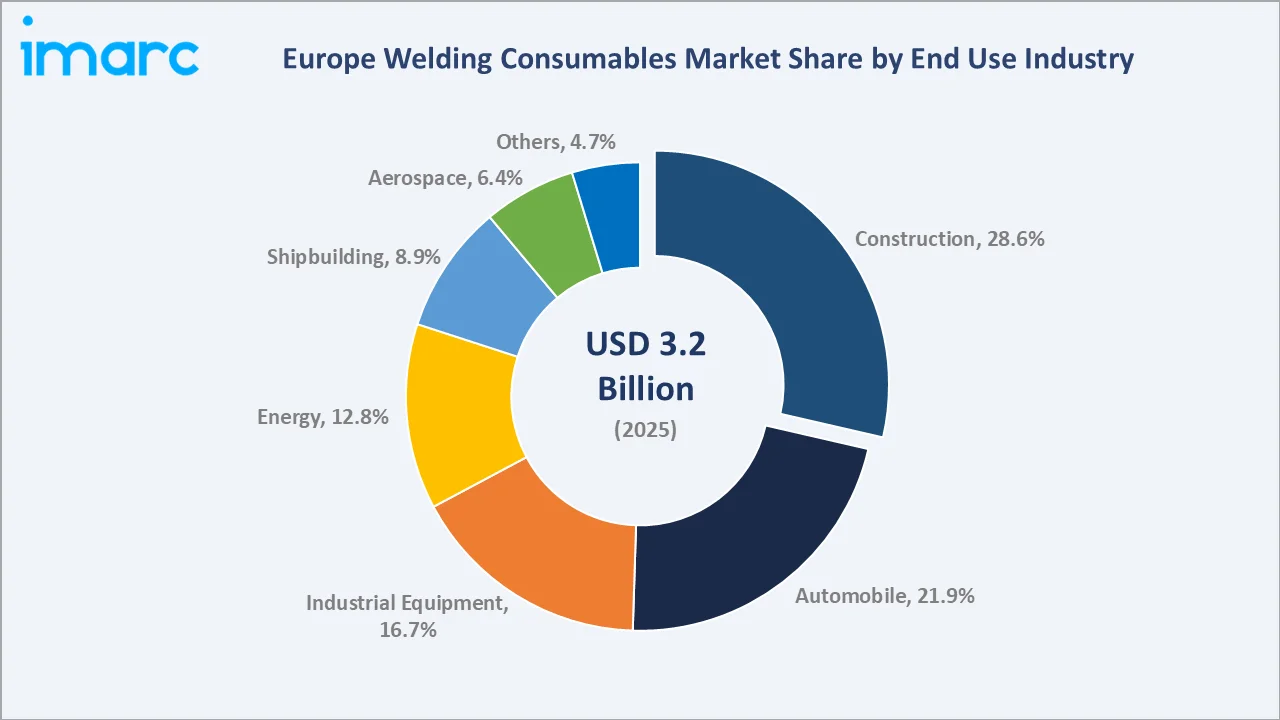
Automobile at 21.9% is growing through EV manufacturing. Industrial Equipment at 16.7% reflects Europe's capital goods base. Energy at 12.8% is driven by renewable infrastructure. Shipbuilding at 8.9%, Aerospace at 6.4%, and Others at 4.7% complete the end-use breakdown.
Regional Market Insights
|
Country |
Share (2025) |
Key Drivers & Characteristics |
|
Germany |
29.4% |
Advanced automotive and industrial manufacturing; headquarters of global welding companies; high automation adoption rate. |
|
France |
21.8% |
Aerospace and energy sectors; government-backed infrastructure programs; precision welding consumables demand. |
|
United Kingdom |
18.6% |
Robust construction and offshore energy activity; naval defense and shipbuilding investment driving demand. |
|
Italy |
13.5% |
Large industrial equipment and automotive cluster; growing SME metalworking manufacturing base. |
|
Spain |
9.7% |
Expanding construction sector; renewable energy pipeline; wind turbine fabrication driving SAW demand. |
|
Others |
7.0% |
Growing Eastern European demand from Poland, Czech Republic, and Romania industrial expansion. |
Germany's 29.4% market leadership reflects its world-class automotive manufacturing cluster, advanced machinery industry, and headquarters of several leading global welding companies. France at 21.8% is supported by its aerospace manufacturing in Toulouse and Paris, nuclear energy maintenance requirements, and ongoing infrastructure investment programs. The United Kingdom at 18.6% reflects its active construction and offshore energy sectors, alongside naval defense investment.
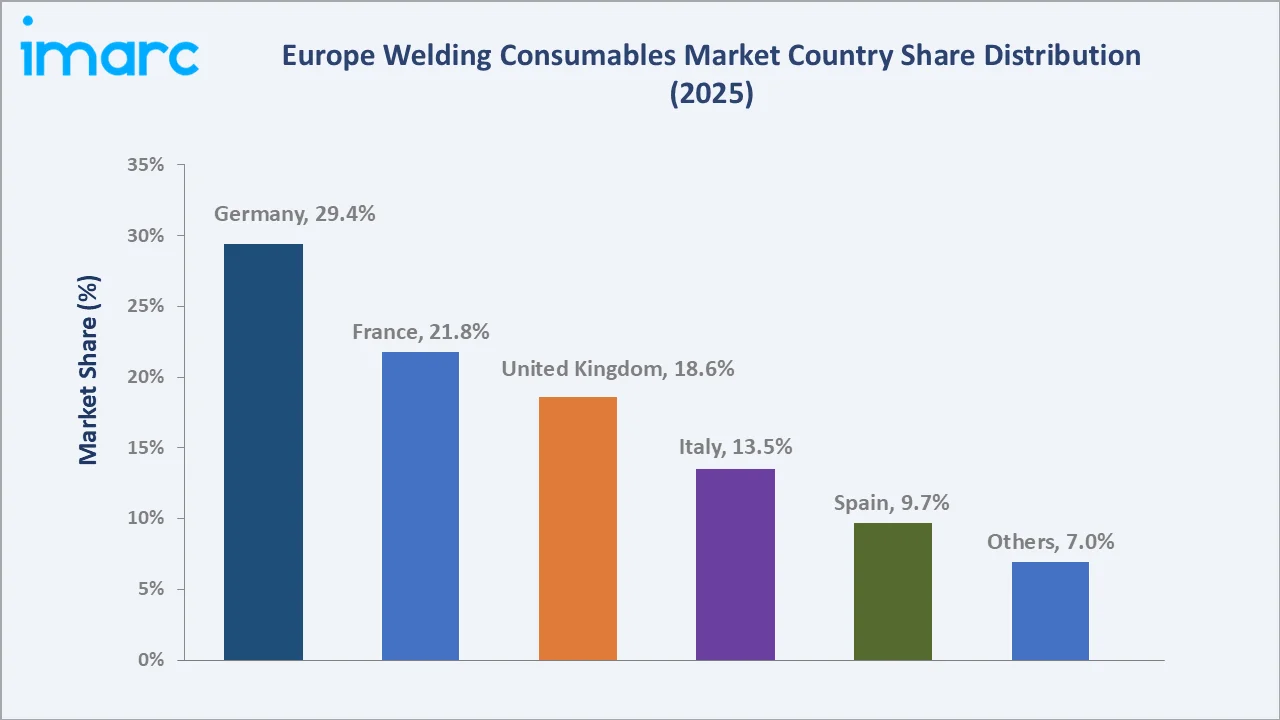
Italy's 13.5% reflects its extensive SME manufacturing base in metalworking, machinery, and automotive components. Spain at 9.7% is driven by construction expansion and renewable energy investment. The Others category at 7.0% captures growing demand from Eastern European industrial markets, particularly Poland, the Czech Republic, and Romania.
Competitive Landscape
The Europe welding consumables market competitive landscape is characterized by the presence of global leaders alongside strong regional specialists. Competition is intensifying through product innovation, automation compatibility, and sustainability-driven product development.
|
Company |
Key Brands |
Market Position |
Core Strength |
|
Lincoln Electric |
Flux Cored Wire, Metal Cored Wire, MIG Wire, Stick electrode, Submerged Arc Flex, Submerged Arc Wire, TIG Cut Length |
Market Leader |
World's largest welding products manufacturer; broad portfolio of stick electrodes, solid wires, flux cored wires, and SAW consumables across all European industrial applications. |
|
ESAB Corporation |
Conductor tubes, gas nozzles, contact tips, gas diffusers, liners/conduits, spatter protection |
Strong Challenger |
Global fabrication technology leader; comprehensive European consumables range covering all welding techniques and major industrial application segments. |
|
voestalpine AG |
Stick Electrodes, TIG Rods, Solid Wires, FCAW-G, Gas-Shielded Flux-Cored Wires, Self Shielded Flux Cored Wires, Submerged Arc Wires & Fluxes, Strip Cladding, Metal Powders, Arc Spraying Cored Wires, Ceramic Weld Backing |
Key Innovator |
Austria-based specialist in high-performance consumables; strong presence in energy, aerospace, and automotive sectors across Europe. |
|
Illinois Tool Works Inc. |
Hobart, Miller, Tregaskiss, Bernard |
Strong Challenger |
Diversified industrial manufacturer; welding segment covers Hobart and other brands with extensive European distribution networks. |
|
Fronius International GmbH |
Fronius, TransSteel, MagicWave |
Niche Player |
Austrian innovator in automated welding solutions; growing precision welding consumables presence in European markets. |
|
Kemppi Oy |
MIG/MAG Welding, TIG Welding, Stick Welding |
Niche Player |
Finnish welding company with advanced equipment and consumables; strong in Nordic and Eastern European markets. |
Key players include Lincoln Electric, ESAB Corporation, voestalpine AG, Illinois Tool Works Inc., Fronius International GmbH, Kemppi Oy, and others.
Key Company Profiles
Lincoln Electric
Lincoln Electric is the world's largest manufacturer of welding products and one of the leading players in the European welding consumables market, known for its extensive product portfolio, global technical expertise, and broad European manufacturing and distribution footprint.
- Key Products: Stick electrodes, MIG/MAG solid wires, flux cored wires, and SAW wires and fluxes
- Strategic Focus: Maintaining market leadership through automated welding system integration, application-specific consumable development, and expansion of its European distribution network. Lincoln Electric is investing in digital platform capabilities linking consumable specifications to weld quality tracking systems, positioning itself as a complete welding productivity partner.
ESAB Corporation
ESAB Corporation is a global leader in fabrication technology with a strong European presence, offering a comprehensive range of welding consumables under its well-established brand portfolio, serving industries from heavy fabrication to precision manufacturing across the continent.
- Key Products: Solid wires, flux cored wires, stick electrodes, and SAW consumables for heavy fabrication, offshore, and pipeline applications
- Strategic Focus: Leveraging global R&D capabilities to develop next-generation consumables for automated welding, EV manufacturing, and renewable energy applications in Europe. ESAB's European strategy centers on growing its premium flux cored wire portfolio for the offshore wind and shipbuilding sectors where technical performance requirements create defensible price premiums.
Market Concentration Analysis
The Europe welding consumables market is moderately concentrated, with the top three players collectively accounting for an estimated 45–50% of the regional market by value. Regional specialists and local manufacturers hold significant shares in specific country markets, particularly in Germany, Italy, and Eastern Europe.
Market concentration is evolving through two opposing forces: continued product innovation and geographic expansion by global leaders increasing top-tier concentration, and growing demand for application-specific consumables that favor specialized suppliers with deep technical capabilities. The increasing adoption of automated welding systems is gradually consolidating purchasing toward tier-one certified suppliers.
Investment & Growth Opportunities
Highest Growth Segments
Energy sector (~4.5% CAGR), aerospace (~3.8% CAGR), automotive (~3.5% CAGR), and flux cored wires (~2.8% CAGR) represent Europe's highest-growth welding consumables investment vectors through 2034.
Emerging Investment Opportunities
Europe's renewable energy infrastructure buildout, particularly offshore wind, represents the most structurally significant growth opportunity for SAW wires and fluxes through 2034. The North Sea offshore wind capacity pipeline requires large-scale monopile fabrication, generating high-volume demand for certified SAW-grade consumables meeting offshore structural standards and commanding significant price premiums.
Investment Themes
- Renewable Energy Infrastructure Consumables: Investment in SAW wire and flux production capacity aligned with the European offshore wind pipeline represents the highest-volume growth opportunity in European welding consumables through 2034, with certified offshore-grade products commanding significant price premiums over standard industrial consumables.
- Low-Fume and Eco-Compliant Product Development: Growing regulatory pressure on welding fume emissions creates strong demand for premium low-fume consumables commanding price premiums of 15–25% over standard products, with pan-European regulatory enforcement ensuring consistent addressable market growth across all major country markets.
Future Market Outlook (2026-2034)
The Europe welding consumables market is projected to grow from USD 3.2 Billion in 2025 to USD 3.3 Billion in 2026, reaching USD 4.0 Billion by 2034, registering a CAGR of 2.43% during 2026–2034. The market's anchor value of USD 3.6 Billion in 2030 represents a structural inflection driven by accelerating renewable energy construction and automotive EV platform manufacturing transformation across the continent.
Three structural forces define Europe's welding consumables market through 2034: the continent's energy transition creating the largest infrastructure construction program in decades; automotive electrification reshaping welding technique and consumable requirements; and progressive automation driving quality standardization and premium product adoption across all major end-use sectors.
Research Methodology
Primary Research
Primary research comprised structured interviews with European welding consumables industry stakeholders, including Procurement Directors, Technical Managers, Welding Engineers, CEO and Managing Partners across construction, automotive, energy, and industrial equipment manufacturing sectors, and distribution channel managers across key European markets including Germany, France, the United Kingdom, and Italy.
Secondary Research
Secondary research encompassed European welding consumables import-export data, EU industrial production statistics, company annual reports, European Welding Federation (EWF) publications, investor presentations, and market analysis from over 50 secondary sources including trade publications and government infrastructure investment databases.
Forecasting Models
Market revenue forecasts were developed using an end-use demand aggregation model: European industrial production indices by sector multiplied by welding intensity coefficients and average consumable price per application, creating total market revenue by segment aggregation, with infrastructure investment multiplier applied across construction and energy segments.
Europe Welding Consumables Market Report Coverage:
| Report Features | Details |
|---|---|
| Base Year of the Analysis | 2025 |
| Historical Period | 2020-2025 |
| Forecast Period | 2026-2034 |
| Units | Billion USD |
| Scope of the Report |
Exploration of Historical Trends and Market Outlook, Industry Catalysts and Challenges, Segment-Wise Historical and Future Market Assessment:
|
| Products Covered | Stick Electrodes, Solid Wires, Flux Cored Wires, SAW Wires and Fluxes, Others |
| Welding Technique Covered | Arc Welding, Resistance Welding, Oxyfuel Welding, Ultrasonic Welding, Others |
| End Use Industries Covered | Construction, Automobile, Energy, Shipbuilding, Aerospace, Industrial Equipment, Others |
| Countries Covered | Germany, France, United Kingdom, Italy, Spain, Others |
| Companies Covered | Lincoln Electric, ESAB Corporation, voestalpine AG, Illinois Tool Works Inc., Fronius International GmbH, Kemppi Oy, etc |
| Customization Scope | 10% Free Customization |
| Post-Sale Analyst Support | 10-12 Weeks |
| Delivery Format | PDF and Excel through Email (We can also provide the editable version of the report in PPT/Word format on special request) |
Frequently Asked Questions About the Europe Welding Consumables Market Report
The Europe welding consumables market size is estimated at USD 3.3 Billion in 2026, driven by construction activity, automotive manufacturing, and growing renewable energy infrastructure investment across key European economies.
The Europe welding consumables market grows at a CAGR of 2.43% during 2026-2034, reaching USD 4.0 Billion by 2034, supported by energy transition infrastructure, automotive electrification, and industrial automation investment.
Stick Electrodes lead at 32.8% through widespread industrial and construction applications, offering versatility, portability, and performance across diverse European steel manufacturing and fabrication applications requiring field-deployable, certification-compliant welding solutions.
Construction leads at 28.6% through Europe's sustained residential, commercial, and infrastructure development activity, supported by EU investment programs and urban renewal projects requiring large-scale structural steel fabrication across the continent.
Germany leads at 29.4% through its advanced automotive and industrial manufacturing base, headquarters of global welding companies, and leading adoption of automated welding technologies in high-volume production environments.
Leading companies include Lincoln Electric, ESAB Corporation, voestalpine AG, Illinois Tool Works Inc., Fronius International GmbH, Kemppi Oy, and others.
The Europe welding consumables market is projected to reach approximately USD 3.6 Billion by 2030, with the energy sector growing through offshore wind and hydrogen infrastructure, automotive segment adapting to EV manufacturing requirements, and industrial automation driving premium consumable adoption.
Need more help?
- Speak to our experienced analysts for insights on the current market scenarios.
- Include additional segments and countries to customize the report as per your requirement.
- Gain an unparalleled competitive advantage in your domain by understanding how to utilize the report and positively impacting your operations and revenue.
- For further assistance, please connect with our analysts.
 Request Customization
 Speak to an Analyst
 Request Brochure
 Inquire Before Buying
Benefits of Customization
- Personalize this research
- Triangulate with your data
- Get data as per your format and definition
- Gain a deeper dive into a specific application, geography, customer, or competitor
- Any level of personalization
Get in Touch With Us
UNITED STATES
Phone: +1-201-971-6302
INDIA
Phone: +91-120-433-0800
UNITED KINGDOM
Phone: +44-753-714-6104
Email: [email protected]
Client Testimonials




.webp)




.webp)













Related Reports

Choose your plan
*Please note that the prices mentioned below are starting prices for each bundle type. Kindly contact our team for further details.*
Single User License
- 1 User License, Access on 2 Devices
- PDF Report + Excel Dataset (Password Protected)
- Lifetime Access
- No Printing Rights
- 10% Free Report Customization
- 10–12 Weeks of Analyst Support
Five User License
- Access for 5 Users, 2 Devices per User
- PDF Report + Excel Dataset (Password Protected)
- Lifetime Access
- Dedicated Account Manager
- 12–14 Weeks of Analyst Support
- No Printing Rights
- 15% Free Report Customization
- 25% Discount on Your Next Purchase
Corporate User License
- Unlimited User Access (Within Your Organization)
- PDF Report + Excel Dataset
- Lifetime Access
- Dedicated Account Manager
- 14–20 Weeks of Analyst Support
- No Printing Rights
- 20% Free Report Customization
- 30% Discount on Your Next Purchase
Essential Insights
What's included:
3 reports
- Lifetime Access
- PDF Reports
- Excel Datasets
- 2 Weeks of Free Analyst Support
- 2 User Licenses
- Access on 2 Devices
- Printing Rights
- Complimentary PowerPoint (PPT) Version
- Complimentary License Upgrade
Professional Access
What's included:
5 reports
- Lifetime Access
- PDF Reports
- Excel Datasets
- 8 Weeks of Free Analyst Support
- 2 User Licenses
- Access on 2 Devices
- Printing Rights
- Complimentary PowerPoint (PPT) Version
- Complimentary License Upgrade
Business Advantage
What's included:
8 reports
- Lifetime Access
- PDF Reports
- Excel Datasets
- 14 Weeks of Free Analyst Support
- 2 User Licenses
- Access on 2 Devices
- Printing Rights
- Complimentary PowerPoint (PPT) Version
- Complimentary License Upgrade
Enterprise Intelligence
What's included:
10 reports
- Lifetime Access
- PDF Reports
- Excel Datasets
- 20 Weeks of Free Analyst Support
- 2 User Licenses
- Access on 2 Devices
- Printing Rights
- Complimentary PowerPoint (PPT) Version
- Complimentary License Upgrade