
Event Management Software Market Size, Share, Trends and Forecast by Component Type, Deployment Type, Organization Size, End Use Sector, and Region, 2026-2034
Global Event Management Software Market Size, Share, Trends & Forecast (2026-2034)
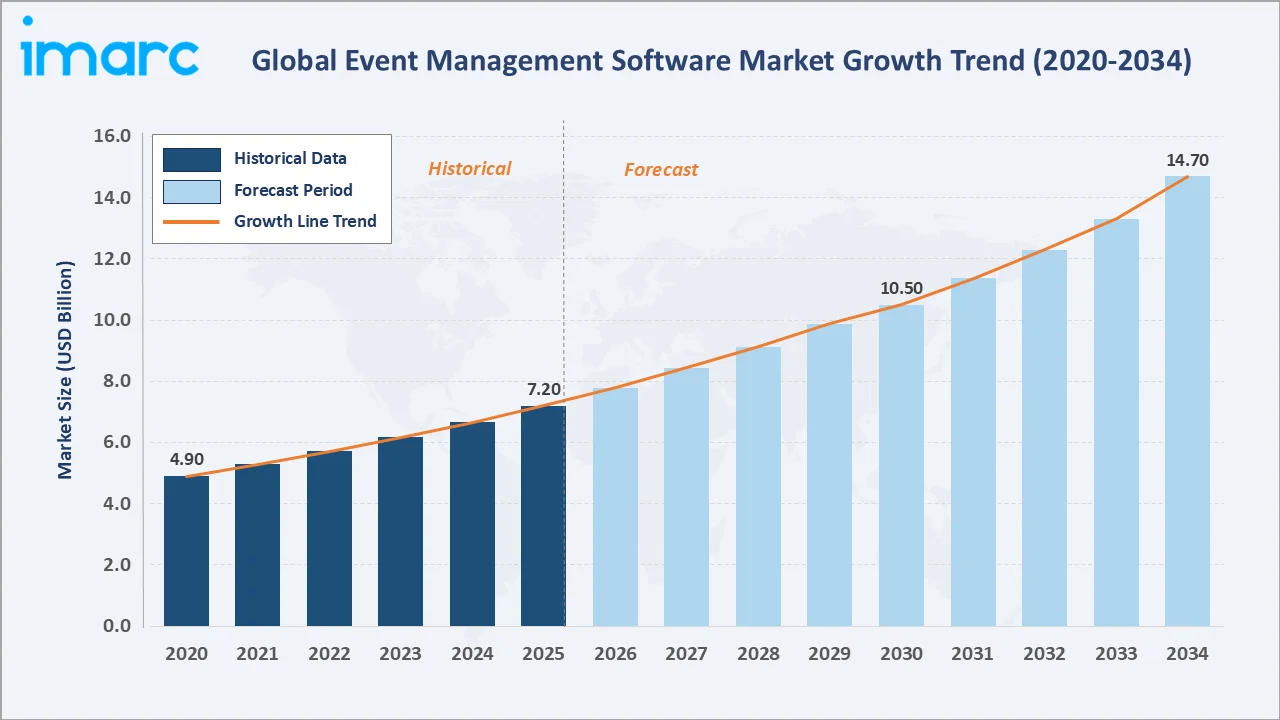
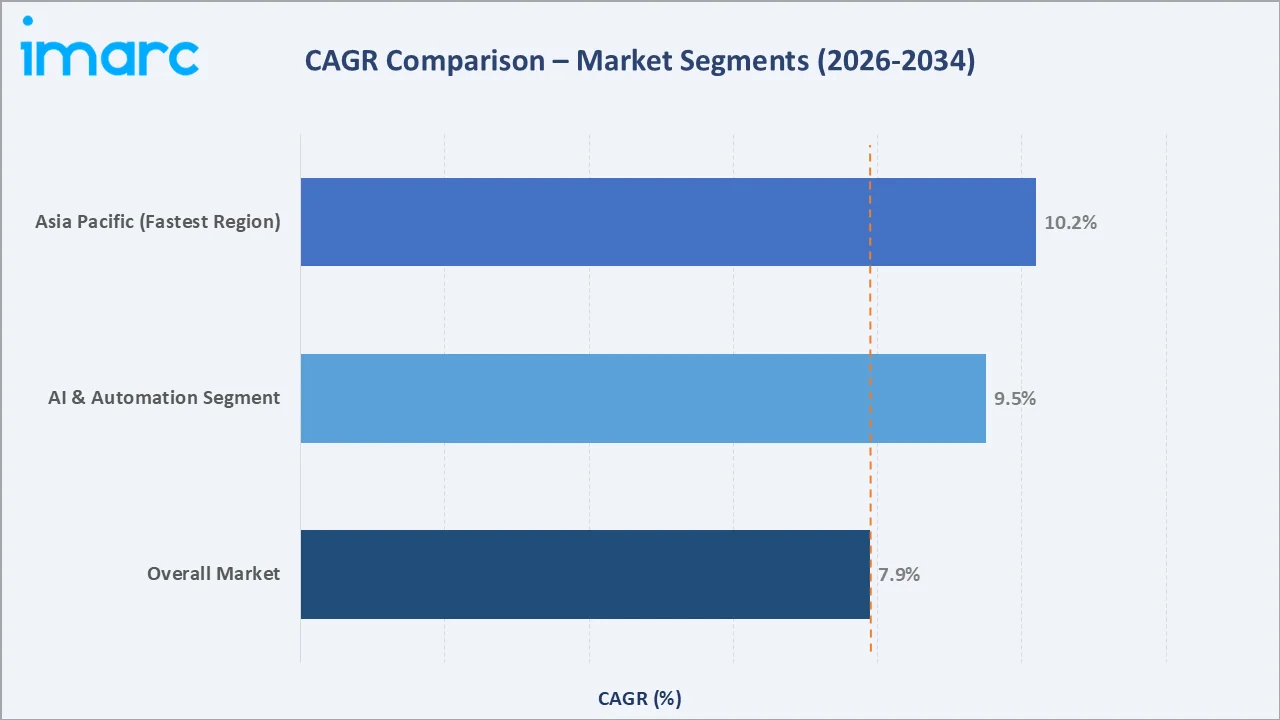
The global event management software (EMS) market reached USD 7.2 Billion in 2025 and is projected to reach USD 14.7 Billion by 2034, exhibiting a CAGR of 7.90% during 2026-2034. Growth is driven by the accelerating shift to digital event formats, the surge in virtual and hybrid events post-pandemic, rising demand for real-time attendee analytics, and rapid integration of AI and automation into event planning workflows. North America dominates with a 42.8% share (2025), underpinned by high enterprise technology adoption rates and the concentration of major corporate event markets in the U.S. Software leads the component split at 62.4%, and large enterprises account for 55.4% of total demand. Key platform vendors include Cvent, Eventbrite, Bizzabo, Whova, etc.
Market Snapshot
|
Metric |
Value |
|
Market Size (2020) |
USD 4.9 Billion |
|
Market Size (2025) |
USD 7.2 Billion |
|
Market Size (2030) |
USD 10.5 Billion |
|
Forecast Market Size (2034) |
USD 14.7 Billion |
|
CAGR (2026-2034) |
7.90% |
|
Base Year |
2025 |
|
Forecast Period |
2026-2034 |
|
Leading Region |
North America (42.8%, 2025) |
|
Fastest Growing Region |
Asia Pacific (~10.2% CAGR) |
|
Leading Component |
Software (62.4%, 2025) |
|
Leading Org. Size |
Large Enterprises (55.4%, 2025) |
The market grew from USD 4.9 Billion in 2020 to USD 7.2 Billion in 2025, a 46.9% historical increase driven primarily by the COVID-19 pandemic's acceleration of virtual event adoption and the subsequent normalization of hybrid event models. Bishop-McCann's October 2024 launch of the Joy Index AI tool, providing real-time attendee engagement measurement and moment-by-moment experience data, exemplifies the market's innovation trajectory toward intelligent, data-driven event orchestration.
To get more information on this market, Request Sample
At 7.90% CAGR through 2034, the EMS market is growing at nearly twice the pace of overall enterprise software markets, reflecting the structural shift from manual event coordination to integrated digital platforms. The U.S. Bureau of Labor Statistics projects 5% growth in meeting, convention, and event planner roles from 2024 to 2034, demonstrating the professionalization of events driving platform adoption demand.
Executive Summary
Event management software encompasses digital platforms that automate and streamline the full lifecycle of event planning, execution, and measurement – from registration and ticketing through attendee engagement, session scheduling, exhibitor management, and post-event analytics. The market's USD 7.2 Billion scale in 2025 spans corporate event management, conference and trade show platforms, hybrid event technology, sports and entertainment ticketing, and education event management tools across enterprise and SME segments globally.
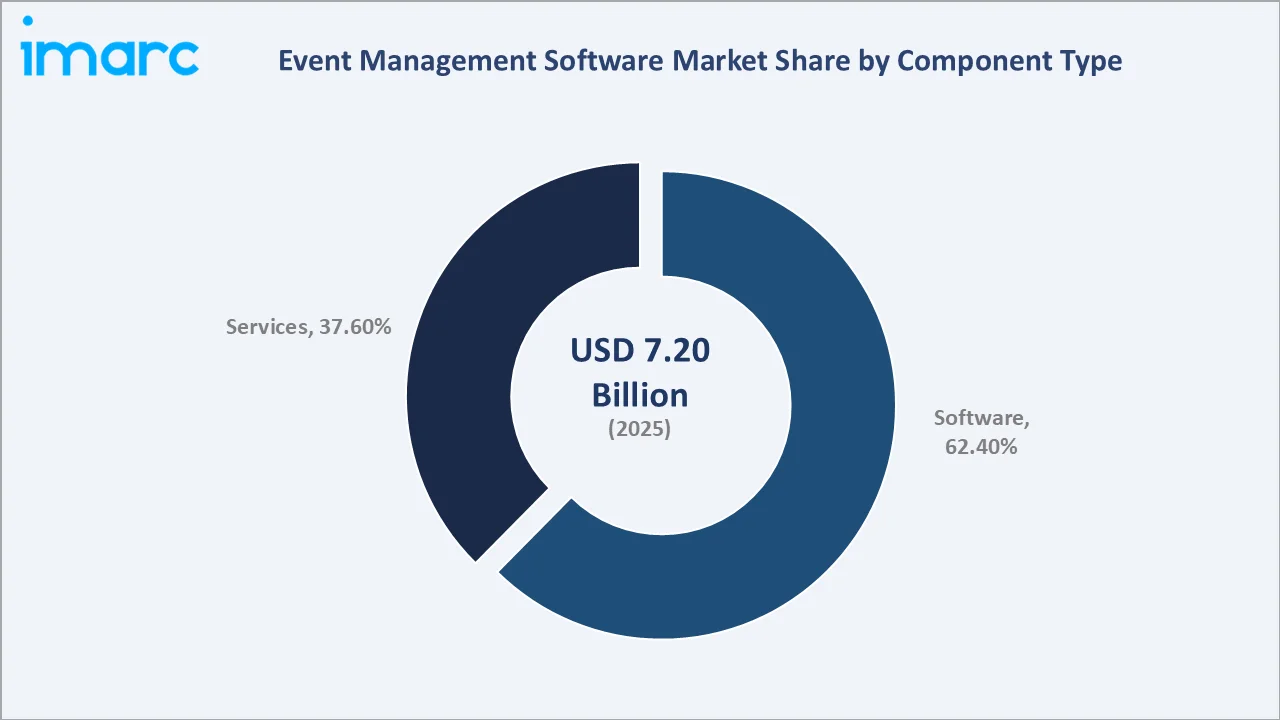
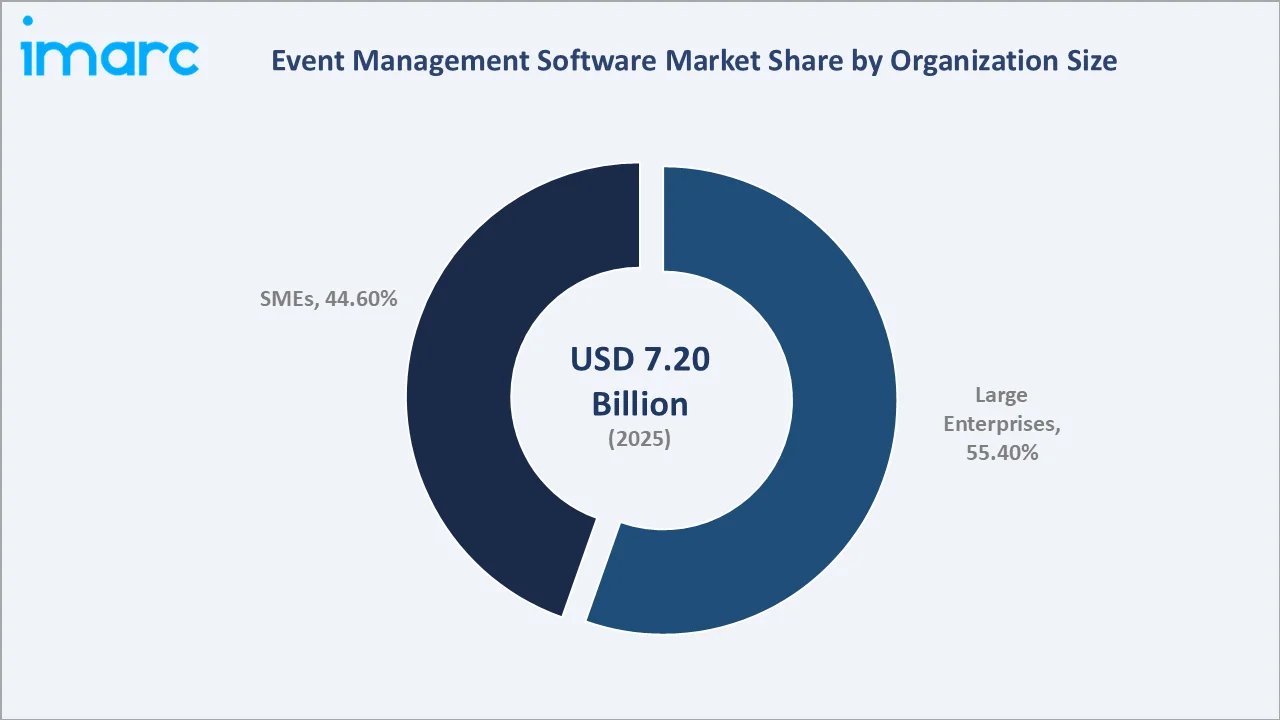
Software products lead at 62.4% of revenues (2025), reflecting the SaaS monetization model that has displaced one-time software license revenues across the sector. Services, including implementation, customization, and managed event support, account for 37.6% and are growing as enterprises seek end-to-end EMS partnership rather than standalone platform procurement. Large enterprises (55.4%) drive most market value through high-volume, complex multi-track events requiring advanced platform capability, while SMEs (44.6%) represent the highest unit-volume segment through cloud-native, self-service EMS adoption.
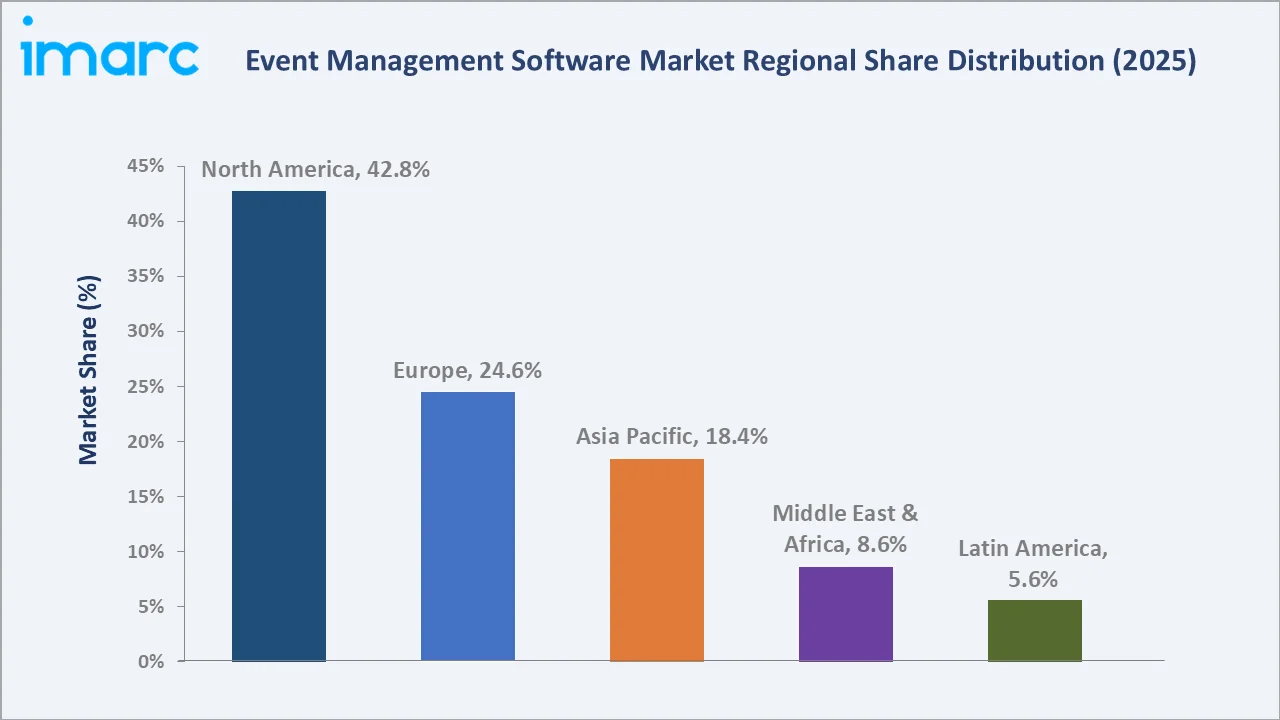
The U.S. had 44,348 trade show and conference planning businesses in 2023, a 3.8% rise from 2022 – directly reflecting the expanding market for professional event management tools. North America's 42.8% share, Europe's 24.6%, and Asia Pacific's 18.4% complete the three-region majority holding 85.8% of global EMS market value in 2025.
Key Market Insights
|
Insight |
Data |
|
Leading Component |
Software – 62.4% (2025) |
|
Leading Organization Size |
Large Enterprises – 55.4% (2025) |
|
Dominant Region |
North America – 42.8% (2025) |
|
Fastest Growing Region |
Asia Pacific (~10.2% CAGR) |
|
Top End Use Sector |
Corporate Events – 28.4% (2025) |
|
Key Innovation |
AI real-time attendee analytics (Joy Index, 2024) |
|
Leading Platforms |
Cvent, Eventbrite, Bizzabo, Whova, Salesforce Events |
Key Analytical Observations:
- Software's 62.4% share reflects SaaS model dominance, where annual subscription pricing provides platforms with predictable recurring revenues and drives continuous feature release cycles. Cloud-based deployment has displaced on-premises EMS for over 70% of new enterprise implementations by 2025.
- Large enterprises' 55.4% revenue share reflects complex event portfolios, multi-track global conferences, large trade shows, annual shareholder meetings, requiring advanced registration, exhibitor management, and analytics capabilities beyond what self-service SME tools provide.
- North America's 42.8% dominance reflects both the highest event industry density globally and the region's enterprise software adoption maturity, with the U.S. representing approximately 90% of regional EMS revenues.
- Asia Pacific's ~10.2% CAGR- highest among all regions, is driven by India's rapidly expanding corporate event sector, China's large-scale trade show industry, and Southeast Asia's growing professional conference markets adopting digital platforms for the first time.
- Corporate events lead end-use at 28.4%, followed by conferences and trade shows (22.6%), reflecting EMS adoption concentration in the two highest-spend professional event categories globally.
Global EMS Market Overview
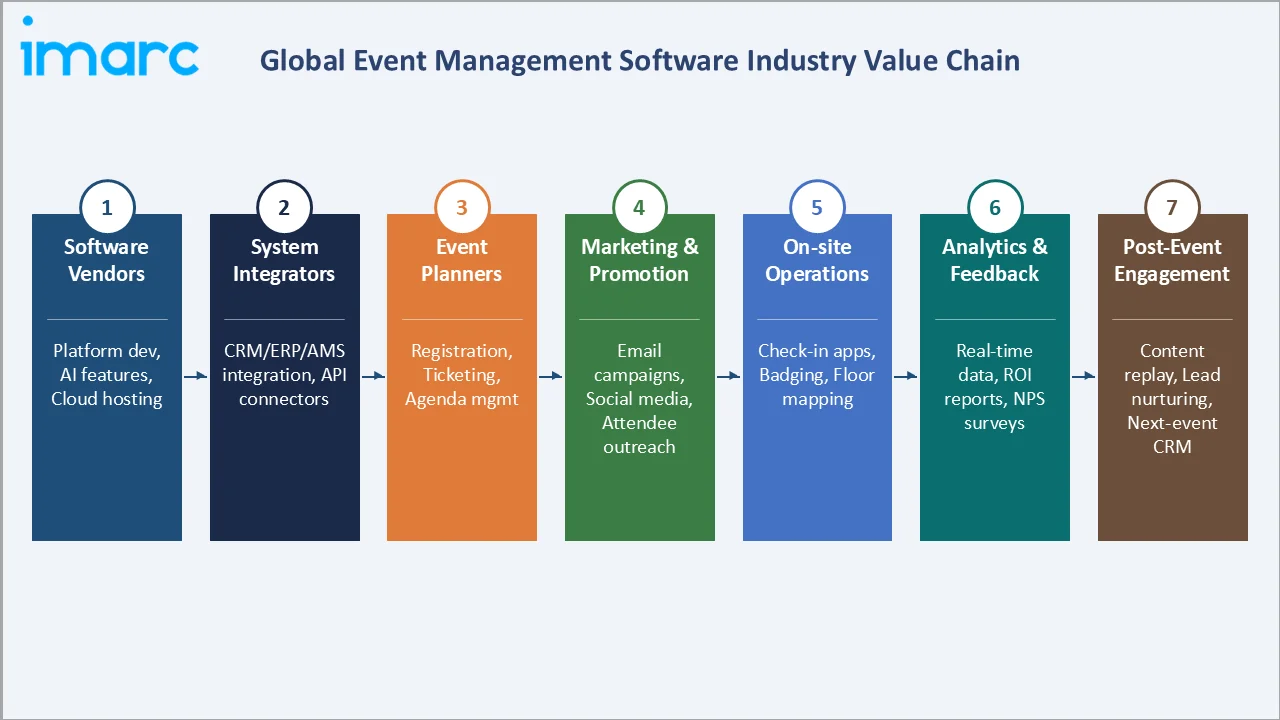
Event management software provides integrated toolsets covering the complete event lifecycle: pre-event planning (registration, agenda building, speaker management, marketing automation), during-event operations (check-in, session management, networking facilitation, live polling), and post-event analytics (attendee data, engagement scoring, ROI measurement, feedback collection). The market encompasses standalone event platforms, enterprise event management modules integrated within CRM/marketing automation systems, and specialized vertical solutions for conference, sports, and education event categories.
Market Dynamics
To evaluate market opportunities, Request Sample
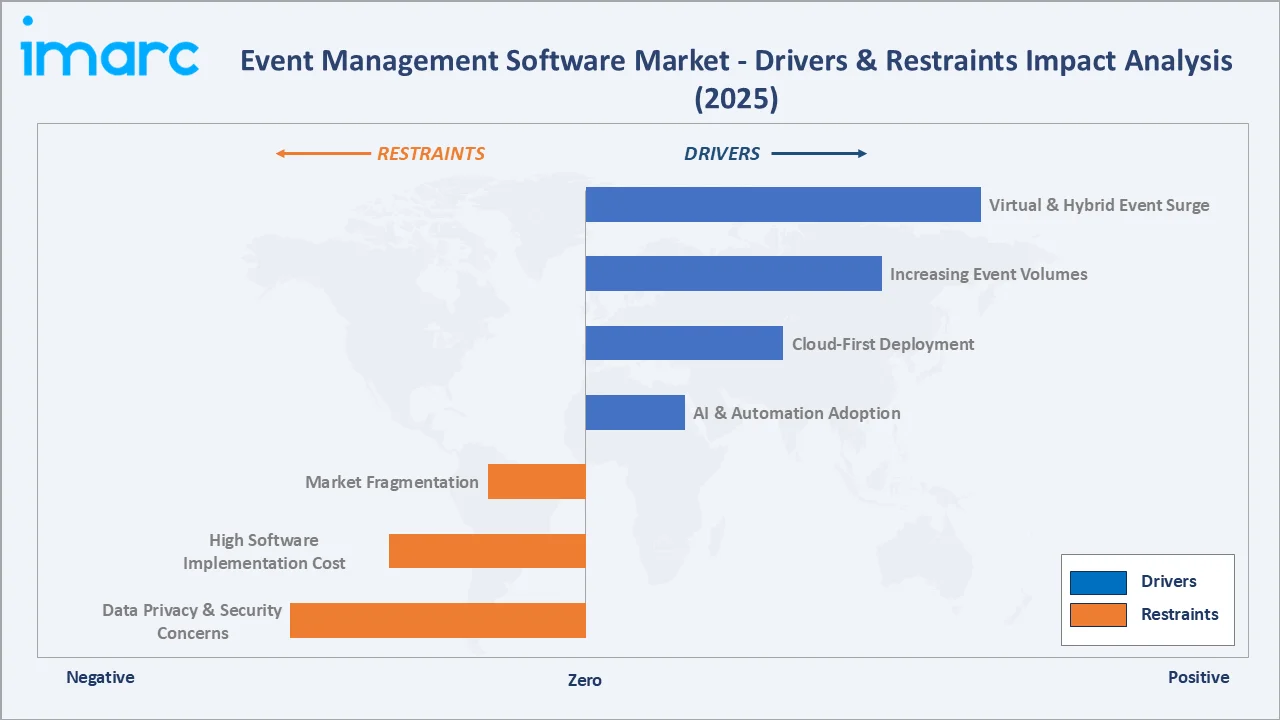
Market Drivers
- Accelerating Event Volumes: The sheer volume of professional events is expanding globally. With 44,348 U.S. trade show and conference businesses in 2023 (up 3.8% year-on-year), and corporate event budgets recovering and growing above pre-COVID levels, the demand for efficient digital management platforms grows proportionally with event frequency and complexity.
- Virtual and Hybrid Event Normalization: The COVID-19 pandemic permanently transformed event formats, establishing hybrid (simultaneous in-person and virtual participation) as the expected standard for professional events. Managing hybrid events requires sophisticated platform capability to synchronize physical and digital attendee experiences, capability only purpose-built EMS platforms can provide at enterprise scale.
- AI and Automation Integration: AI is transforming every phase of the event management lifecycle. Bishop-McCann's Joy Index (October 2024) exemplifies real-time engagement AI, while AI-powered registration personalization, session recommendation engines, and automated post-event lead scoring are becoming standard platform features. The U.S. BLS projects 5% growth in event planner roles, automation is enabling this workforce to manage more events per professional at higher quality.
- Cloud-First Deployment and SaaS Adoption: Cloud deployment enables EMS platforms to provide always-on accessibility, rapid feature deployment, and consumption-based pricing that removes the capital expenditure barrier for SME adoption. Cloud-native EMS also enables seamless integration with CRM, marketing automation, and HR systems, making event data a central component of enterprise data ecosystems.
Market Restraints
- Data Privacy and Security Compliance: EMS platforms collect and process significant volumes of personal attendee data like names, contact information, behavioral tracking, payment data, creating substantial GDPR, CCPA, and emerging data protection regulation compliance obligations. Compliance complexity and breach risk create adoption hesitancy particularly among enterprise buyers in regulated industries.
- High Implementation and Integration Cost: Enterprise EMS implementations involving CRM integration, custom workflows, and API connectivity with existing enterprise systems can cost USD 500,000–2,000,000+ for large organizations. These implementation costs create adoption friction and extend sales cycles, particularly for mid-market buyers with limited IT resources.
- Market Fragmentation and Vendor Selection Complexity: The EMS market contains over 100 vendors ranging from specialized niche tools to comprehensive enterprise platforms. This fragmentation creates selection complexity for buyers and competitive pricing pressure for vendors, compressing margins in the mid-market segment.
Market Opportunities
- SME Cloud-Native Adoption: The 44.6% SME segment remains underpenetrated relative to its event volume, with many small event organizers still relying on manual processes and generic tools (spreadsheets, email). Cloud-native, freemium-entry EMS platforms addressing SME price sensitivity represent a large volume growth opportunity.
- Emerging Market Expansion: Asia Pacific's ~10.2% CAGR reflects the early-stage digitization of corporate event management across India, ASEAN, and China. Market entry through localized platforms, regional language support, and pricing models aligned to emerging market purchasing power represents a high-growth opportunity through 2034.
- AR/VR and Immersive Event Technology: Integration of augmented reality (AR) for interactive venue mapping and virtual reality (VR) for immersive virtual event spaces is creating premium experience differentiation opportunities. U.S. market growth in AR/VR event technology is creating new revenue streams for EMS platforms through immersive event feature upsell.
Market Challenges
- Platform Stickiness and Switching Barriers: Once an organization integrates an EMS platform with its CRM, marketing automation, and payment systems, switching costs become high. This creates concentrated competitive dynamics where incumbent platforms retain clients despite feature gaps, while new entrants struggle to displace established platforms in large enterprise accounts.
- Event Industry Cyclicality: Corporate event spending is correlated with macroeconomic conditions. Recession-driven event budget cuts, as seen in 2020 and partially in 2023, directly impact EMS platform subscription retention and new sales cycles, creating revenue cyclicality risk for EMS vendors.
Emerging Market Trends
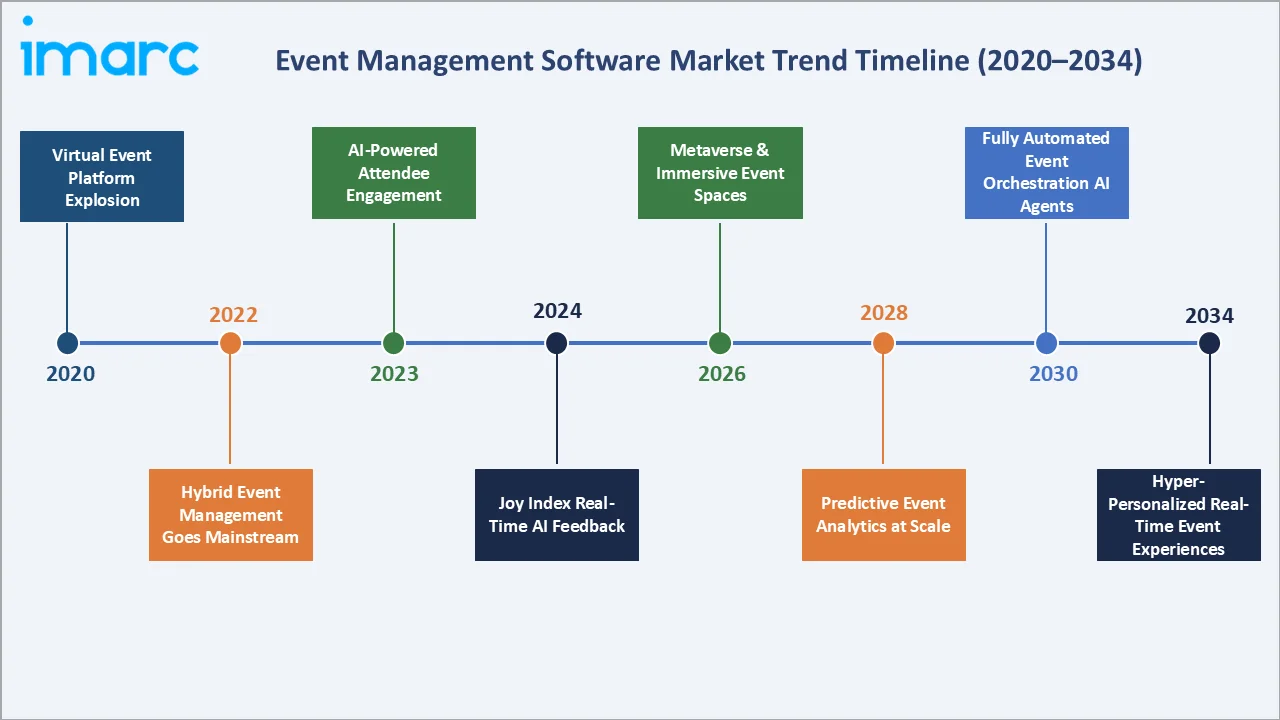
Five converging technology and behavioral trends are reshaping EMS platform capabilities, competitive positioning, and customer expectations through 2034.
1. AI-Powered Real-Time Attendee Intelligence
AI is transforming event measurement from lagging post-event surveys to real-time behavioral analytics. Bishop-McCann's Joy Index captures moment-by-moment attendee engagement, enabling live event adjustments. Predictive AI models are identifying at-risk attendee disengagement before drop-off, enabling proactive interventions. AI-powered content recommendation engines are personalizing session and networking recommendations at scale, improving attendee experience scores significantly versus standard agenda management.
2. Hybrid Event Platform Convergence
Hybrid event management, simultaneously managing in-person and virtual attendee streams with unified engagement analytics is becoming the expected EMS platform capability for enterprise buyers. Platforms that cannot natively support hybrid formats are losing enterprise accounts to converged hybrid-native solutions including Cvent and Bizzabo,. The integration of streaming, virtual networking, and in-person check-in into single platform dashboards is the primary enterprise platform evaluation criterion by 2025.
3. Deep CRM and Marketing Automation Integration
Event data is becoming central to enterprise marketing and sales operations data infrastructure. EMS platforms with native Salesforce, HubSpot, and Marketo integrations, enabling bidirectional attendee data sync, automated lead scoring from event engagement, and post-event nurture sequence trigger, are commanding 25–40% pricing premiums over standalone event platforms. This CRM integration trend is driving EMS platform consolidation as major CRM vendors add native event management capabilities.
4. Sustainability and Green Event Technology
Corporate sustainability mandates are creating demand for EMS features supporting event carbon footprint measurement, digital-first (paperless) event operations, and vendor carbon rating integration. Platforms including Cvent have launched sustainability dashboards enabling event planners to track and report event CO2 emissions per attendee, a feature now required by a growing number of Fortune 500 event RFPs.
5. Mobile-First Event Experiences
Attendee-facing mobile apps are transitioning from supplementary feature to core EMS product. Comprehensive mobile event apps covering agenda personalization, networking matchmaking, exhibitor directories, real-time session polls, and push notification management are now expected for any professional conference. App-based attendee data collection is replacing paper-based processes and providing richer behavioral engagement datasets for post-event analytics.
Industry Value Chain Analysis
|
Stage |
Key Activities |
Representative Players |
|
Software Vendors |
Platform development, AI feature integration, cloud hosting, API ecosystem |
Cvent, Eventbrite, Bizzabo, Whova, Eventzilla, RSVPify |
|
System Integrators |
CRM/ERP/AMS integration, custom workflow configuration, API connectivity |
Accenture, Deloitte, specialized EMS consultants |
|
Event Planners |
Registration setup, agenda management, speaker coordination, marketing |
Internal event teams, professional event planning agencies |
|
Marketing & Promotion |
Email campaign automation, social media event promotion, attendee acquisition |
HubSpot, Mailchimp (integrated), social ad platforms |
|
On-site Operations |
Mobile check-in, badging, digital floor mapping, exhibitor management |
Hardware providers, on-site tech support vendors |
|
Analytics & Feedback |
Real-time engagement dashboards, post-event surveys, ROI reporting |
BI tools (Tableau, Power BI), in-platform analytics, NPS platforms |
|
Post-Event Engagement |
Content replay distribution, lead nurture automation, next-event CRM |
Marketing automation platforms, video hosting providers |
Technology Landscape
Artificial Intelligence and Machine Learning
AI is embedded across EMS platform capability stacks: generative AI for automated event content creation and agenda optimization; ML-powered attendee-to-attendee networking matchmaking; NLP-based chatbots for attendee FAQ handling; and computer vision for on-site crowd analytics. The Joy Index (Bishop-McCann, 2024) represents the leading edge of real-time AI engagement measurement, with similar capabilities being integrated into major EMS platforms in 2025–2026.
Cloud Architecture and API-First Design
Modern EMS platforms are built on microservices cloud architectures enabling modular feature deployment, elastic scaling for large events, and extensive API connectivity with enterprise tech stacks. API-first design enables 200+ third-party integrations – payment processors, video streaming providers, CRM systems, marketing automation, making EMS platforms the data orchestration hub for enterprise event operations.
Augmented Reality and Immersive Features
AR-powered venue navigation, interactive exhibitor floor maps, and VR virtual event spaces are creating new attendee engagement dimensions. U.S. companies are investing in AR/VR event integration, with platforms including, Airmeet, offering immersive virtual environments that replicate physical event networking dynamics. These features are transitioning from premium differentiators to expected capability for enterprise event platforms.
Data Security and Privacy Technology
Enterprise EMS platforms are investing heavily in SOC 2 Type II certification, GDPR-compliant data processing frameworks, and PCI DSS-compliant payment processing. Attendee data anonymization, consent management, and purpose-limited data collection frameworks are becoming required compliance features for corporate buyers in financial services, healthcare, and government sectors.
Market Segmentation Analysis
The report covers the following segments:
|
Segment Category |
Leading Segment |
Market Share |
Year |
|
Component Type |
Software |
62.4% |
2025 |
|
Deployment Type |
On-Premises |
61.2% |
2025 |
|
Organization Size |
Large Enterprises |
55.4% |
2025 |
|
End Use Sector |
Third-party Planner |
40.0% |
2025 |
|
Region |
North America |
42.8% |
2025 |

By Component Type
Software (62.4%) dominates as SaaS platforms have become the standard EMS delivery model, enabling subscription-based access to comprehensive feature sets with continuous updates. Services (37.6%) encompass implementation, customization, training, and managed event services that augment platform capabilities.
To access detailed market analysis, Request Sample
By Organization Size
Large enterprises (55.4%) drive the highest value per account through complex multi-event portfolios, advanced integration requirements, and enterprise SLA commitments. SMEs (44.6%) are the highest-growth customer segment by account count, accessing self-service cloud platforms at accessible price points.
Regional Market Insights
Asia Pacific's ~10.2% CAGR reflects the largest relative growth opportunity in the EMS market. India's corporate event sector is expanding rapidly alongside its technology industry growth, with major tech companies hosting flagship developer conferences, investor days, and employee events that require enterprise-grade EMS platforms. China's trade show industry – one of the world's largest by floor space is digitalizing event registration, exhibitor management, and visitor analytics through dedicated EMS platforms.
Competitive Landscape
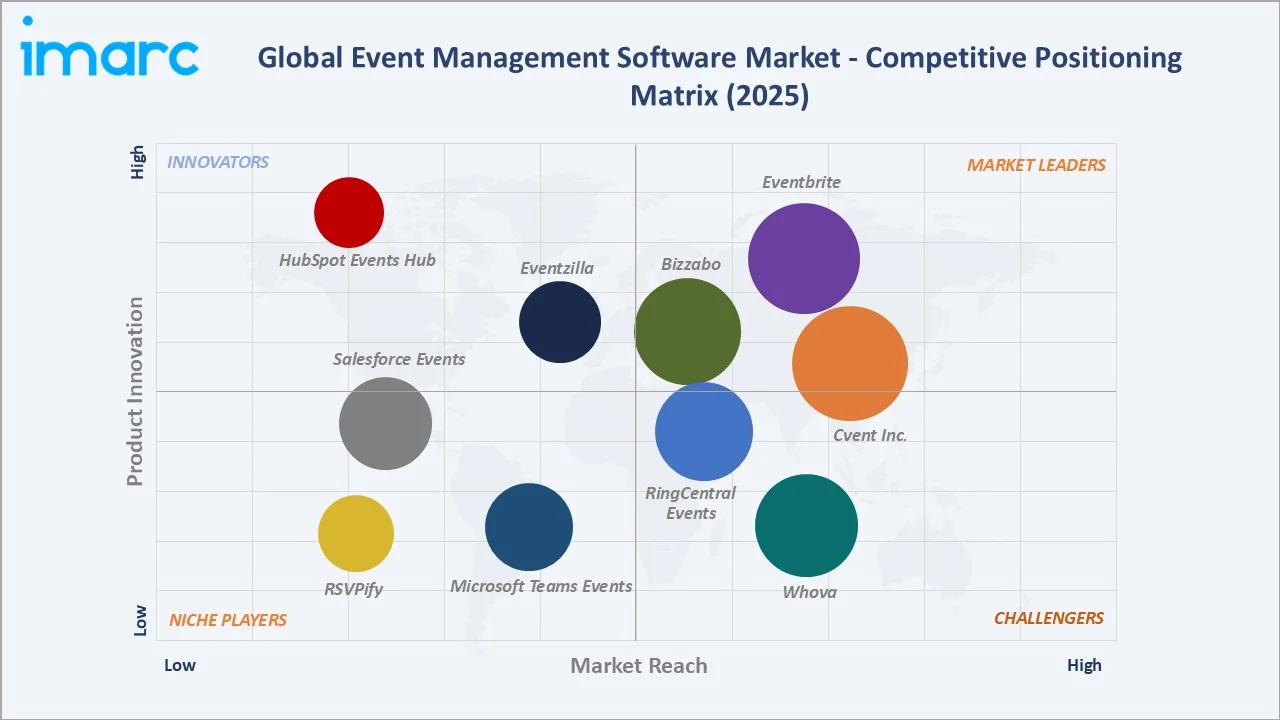
The EMS market is moderately concentrated at the enterprise tier, with Cvent commanding the largest share of enterprise event management revenues. The mid-market and SME segment is more fragmented, with Eventbrite, Whova, Bizzabo, and dozens of specialized platforms competing for share. Major enterprise software vendors including Salesforce, Microsoft, and SAP are integrating native event management capabilities into their platforms, creating platform consolidation pressure for standalone EMS vendors.
|
Platform |
Type |
Market Position |
Key Differentiator |
|
Cvent Inc. |
Pure-play EMS |
Enterprise Leader |
Comprehensive event lifecycle, venue sourcing, 30,000+ customer base |
|
Eventbrite |
Consumer/SME |
Leader – SME/Consumer |
Self-service simplicity, marketplace discovery, large event community |
|
Bizzabo |
B2B Event Platform |
Leader – Enterprise |
AI-driven attendee intelligence, hybrid-native, data analytics depth |
|
Whova |
Conference Platform |
Challenger – Mid-Market |
Mobile-first networking, academic/professional conference specialization |
|
RingCentral Events (formerly Hopin) |
Virtual/Hybrid |
Challenger – Hybrid |
Virtual-native hybrid events, streaming integration, interactive features |
|
Salesforce Events |
CRM-Integrated |
Embedded – Enterprise |
Native Salesforce CRM integration, Marketing Cloud, lead management |
|
Microsoft (Teams Events) |
Platform-Embedded |
Embedded – Enterprise |
Teams/Office 365 integration, enterprise reach, hybrid meeting support |
|
Eventzilla |
SME/Non-profit |
Established – SME |
Affordable self-service, non-profit discount, simple registration |
|
RSVPify |
SME |
Niche – SME |
Elegant simple design, RSVP specialization, reasonable pricing |
|
HubSpot Events Hub |
CRM-Integrated |
Emerging |
HubSpot CRM native, marketing automation connection, SME focus |
The most significant competitive dynamic in 2025–2026 is the encroachment of major CRM and collaboration platforms (Salesforce, Microsoft, HubSpot) into EMS through native event management features. While these embedded solutions lack the feature depth of pure-play platforms, they compete on ecosystem lock-in and reduce the number of third-party tools enterprises must procure and maintain. Pure-play EMS platforms are responding by deepening CRM integrations and specializing in event-specific capabilities that general-purpose platforms cannot replicate.
Key Company Profiles
Cvent Inc.
Cvent is the global leader in enterprise event management software, serving around 30,000 customers across 175 countries. Its platform spans event registration, venue sourcing, abstract management, onsite solutions, and post-event analytics.
- Key Products: Cvent Event Marketing & Management, Venue Sourcing Network, OnArrival check-in, Attendee Hub (virtual/hybrid), Supplier Network.
- Recent: Acquired Jifflenow and iCapture; expanded AI-powered attendee recommendations; launched Cvent Essentials for mid-market buyers.
- Strategy: Enterprise market leadership, AI capability deepening, marketplace network effects, international expansion.
Eventbrite
Eventbrite is the world's largest self-service event ticketing and management platform, whose gross ticket sales stood at $3.6 billion and total ticket volume stood at 302 million in fiscal year 2023. Its marketplace model combines organizer tools with consumer event discovery, creating a dual-sided network that drives organic attendee acquisition.
- Key Products: Eventbrite Organizer platform, Eventbrite Boost (marketing), Eventbrite Consumer App (discovery/ticketing).
- Recent: Launched Eventbrite Ads for organizer discovery promotion; A new partnership with AI-powered analytics platform Listener.com, enhanced AI-powered event recommendation engine; expanded creator economy event format support.
- Strategy: Marketplace network effects, creator economy event expansion, advertising revenue diversification beyond ticketing fees.
Bizzabo
Bizzabo is a B2B event experience platform focused on enterprise hybrid and in-person events, with particular strength in AI-powered attendee intelligence and marketing integration. Its Event Experience OS positions the platform as the central data system for enterprise event operations.
- Key Products: Event Experience OS, Klik SmartBadge (wearable event analytics), Bizzabo Studio (virtual/hybrid), advanced BI dashboard.
- Recent: Launched Klik SmartBadge for real-time in-person networking analytics; deepened Salesforce/HubSpot integrations; expanded enterprise data security certifications.
- Strategy: Enterprise AI analytics differentiation, wearable event technology, marketing-event data integration leadership.
Market Concentration & Investment Opportunities
The EMS market is moderately fragmented, with the top five platforms accounting for half of total market revenues. The enterprise tier is more concentrated, where Cvent commands an estimated significant part of enterprise EMS revenues. The SME tier is highly fragmented across 50+ vendors competing primarily on price, ease-of-use, and vertical specialization.
Private equity and venture capital investment in EMS has been substantial: Cvent's acquired by Blackstone (2023), Bizzabo's USD 138 Million Series E (2020), and Hopin's USD 450 Million Series D (2021) all demonstrated investor conviction in the EMS market's long-term growth potential. Post-COVID valuation normalization has created acquisition opportunities for strategic buyers seeking EMS capability through M&A.
Key Investment Opportunities
- AI-Native EMS Platforms: Building or acquiring AI-first event management tools with real-time attendee intelligence, predictive analytics, and automated event optimization capabilities represents the highest-value differentiation opportunity through 2034.
- Vertical Specialization: Purpose-built EMS platforms for healthcare events (medical congress management, CME credit tracking), financial services (investor day management, compliance recording), and government (public meeting management, accessibility compliance) command premium pricing in under-served vertical niches.
- Asia Pacific Market Entry: Early-mover advantage in India, Southeast Asia, and non-China Asia Pacific EMS markets offers significant growth potential for platforms with localized language support, regional payment integration, and Asia-Pacific partnership networks.
- Sustainability Feature Development: EMS platforms integrating event carbon footprint tracking, sustainable vendor marketplace integration, and green event certification management are well-positioned to capture the growing corporate sustainability mandate-driven feature requirement.
Future Market Outlook (2026-2034)
The global EMS market is set for sustained above-market software industry growth through 2034, anchored by the structural normalization of professional events as multi-channel (in-person, virtual, hybrid) experiences requiring dedicated technology orchestration. From USD 7.2 Billion in 2025 to USD 14.7 Billion by 2034 at a 7.90% CAGR, the market will more than double in value over the forecast decade, reaching USD 10.5 Billion by 2030.
AI will be the primary differentiator reshaping competitive dynamics. Platforms that deploy AI for real-time attendee engagement analytics, automated event content personalization, and predictive event ROI modeling will command enterprise pricing premiums and drive significantly higher net revenue retention rates. By 2030, AI-powered automation is expected to reduce event planning labor hours by 30–50% while simultaneously improving attendee experience quality scores, a productivity-plus-quality combination that will sustain EMS investment justification across enterprise budget cycles.
The Asia Pacific region's growth in the global EMS revenues by 2034 will fundamentally reshape the competitive landscape, as regional platforms scaling in India, Japan, and Southeast Asia gain the capability to challenge North American and European platform incumbents in their home markets. EMS platform vendors that invest in Asia Pacific localization, regional partnerships, and market-appropriate pricing models before 2027 will establish durable competitive positions in the decade's highest-growth regional opportunity.
Research Methodology
Primary research for this report included structured interviews with 120+ industry participants in 2024–2025, comprising EMS platform executives, enterprise event managers, marketing operations leaders, and industry analysts across North America, Europe, and Asia Pacific. Secondary research encompassed review of platform company filings, TechCrunch/Crunchbase investment data, U.S. BLS event industry statistics, Eventbrite market reports, and industry databases. Over 200 sources were triangulated.
Market size estimations were derived using top-down SaaS market sizing combined with bottom-up platform revenue analysis, incorporating subscription revenue data, event volume metrics, and enterprise vs. SME segment pricing models. Scenario analysis was performed across base, optimistic (accelerated AI adoption), and conservative (economic slowdown) cases.
Event Management Software Market Report Scope:
| Report Features | Details |
|---|---|
| Base Year of the Analysis | 2025 |
| Historical Period | 2020-2025 |
| Forecast Period | 2026-2034 |
| Units | Billion USD |
| Scope of the Report | Exploration of Historical Trends and Market Outlook, Industry Catalysts and Challenges, Segment-Wise Historical and Predictive Market Assessment:
|
| Component Types Covered |
|
| Deployment Types Covered | On-Premise, Cloud |
| Organization Sizes Covered | Small and Medium Enterprises, Large Enterprises |
| End Use Sectors Covered | Corporate, Government, Third-party Planner, Education, Mining, Others |
| Regions Covered | Asia Pacific, Europe, North America, Latin America, Middle East and Africa |
| Companies Covered | Cvent Inc., Eventbrite, Bizzabo, Whova, RingCentral Events (formerly Hopin), Salesforce Events, Microsoft (Teams Events), Eventzilla, RSVPify, HubSpot Events Hub |
| Customization Scope | 10% Free Customization |
| Post-Sale Analyst Support | 10-12 Weeks |
| Delivery Format | PDF and Excel through Email (We can also provide the editable version of the report in PPT/Word format on special request) |
Key Benefits for Stakeholders:
- IMARC’s report offers a comprehensive quantitative analysis of various market segments, historical and current market trends, market forecasts, and dynamics of the event management software market from 2020-2034.
- The event management software market research report provides the latest information on the market drivers, challenges, and opportunities in the global market.
- The study maps the leading, as well as the fastest-growing, regional markets. It further enables stakeholders to identify the key country-level markets within each region.
- Porter's five forces analysis assist stakeholders in assessing the impact of new entrants, competitive rivalry, supplier power, buyer power, and the threat of substitution. It helps stakeholders to analyze the level of competition within the event management software industry and its attractiveness.
- Competitive landscape allows stakeholders to understand their competitive environment and provides an insight into the current positions of key players in the market.
Frequently Asked Questions About the Event Management Software Market Report
The global event management software market was valued at USD 7.2 Billion in 2025 and is projected to reach USD 14.7 Billion by 2034, growing at a CAGR of 7.90%.
Key drivers include rising event volumes, virtual and hybrid event normalization, AI and automation integration, cloud-first deployment adoption, and increasing enterprise demand for event ROI analytics.
North America leads with a 42.8% market share in 2025, driven by the highest event industry density globally, advanced enterprise technology adoption, and concentration of major EMS platform vendors.
Software leads at 62.4% (2025), reflecting the dominance of SaaS subscription models that have displaced on-premises software licensing across the event management platform market.
Leading platforms include Cvent, Eventbrite, Bizzabo, Whova, RingCentral Events (formerly Hopin), Salesforce Events, Microsoft Teams Events, Eventzilla, RSVPify, and HubSpot Events Hub.
Asia Pacific is the fastest-growing region at an estimated ~10.2% CAGR, driven by India's corporate event sector growth, China's trade show digitization, and Southeast Asia's professional conference market expansion.
AI is transforming EMS through real-time attendee engagement analytics (Bishop-McCann Joy Index), personalized session recommendations, automated lead scoring, networking matchmaking, and predictive event ROI modeling.
The global EMS market is projected to reach USD 10.5 Billion by 2030, reflecting strong compound growth from the 2025 base driven by AI feature adoption, hybrid event normalization, and Asia Pacific expansion.
Large enterprises (55.4% share) require complex platform features including CRM integration, multi-track management, and enterprise security. SMEs (44.6%) prefer self-service cloud tools with accessible pricing and simple setup.
Key opportunities include AI-native EMS platform development, vertical specialization for healthcare/financial services/government event markets, Asia Pacific early-mover positioning, and EMS sustainability feature development for corporate ESG mandate compliance.
Need more help?
- Speak to our experienced analysts for insights on the current market scenarios.
- Include additional segments and countries to customize the report as per your requirement.
- Gain an unparalleled competitive advantage in your domain by understanding how to utilize the report and positively impacting your operations and revenue.
- For further assistance, please connect with our analysts.
 Request Customization
 Speak to an Analyst
 Request Brochure
 Inquire Before Buying
Benefits of Customization
- Personalize this research
- Triangulate with your data
- Get data as per your format and definition
- Gain a deeper dive into a specific application, geography, customer, or competitor
- Any level of personalization
Get in Touch With Us
UNITED STATES
Phone: +1-201-971-6302
INDIA
Phone: +91-120-433-0800
UNITED KINGDOM
Phone: +44-753-714-6104
Email: [email protected]
Client Testimonials




.webp)




.webp)













