
Family Offices Market Size, Share, Trends, and Forecast by Type, Office Type, Asset Class, Service Type, and Region 2026-2034
Family Offices Market Size and Share:
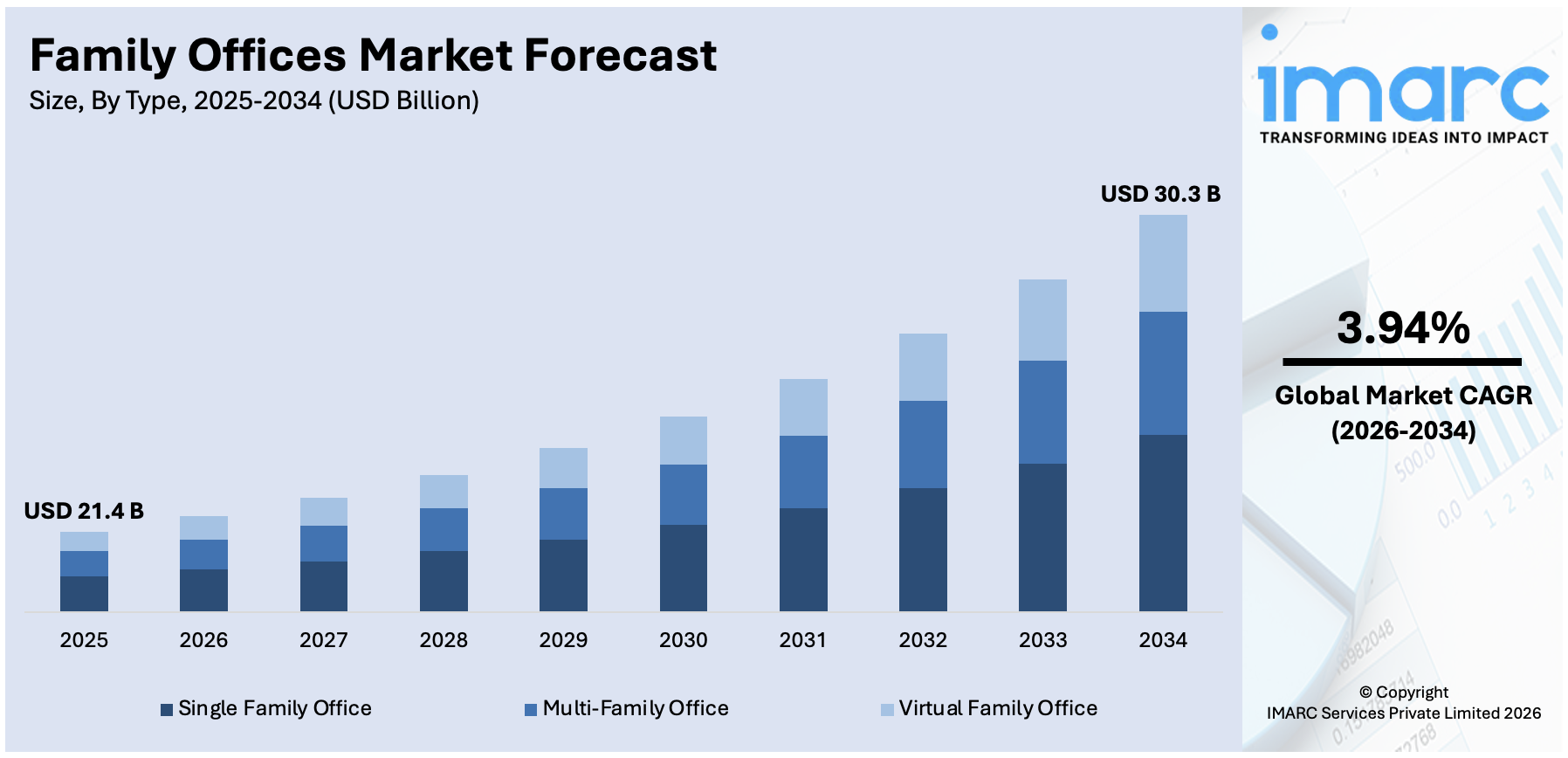
The global family offices market size was valued at USD 21.4 Billion in 2025. Looking forward, the market is projected to reach USD 30.3 Billion by 2034, exhibiting a CAGR of 3.94% during 2026-2034. In 2025, the US accounted for around 94% of the total North America Family Offices market. The demand for personalized financial solutions is driven by ultra-high net worth individuals' growing interest in succession planning and wealth preservation. Families are forced to look for expert management services covering estate planning, philanthropy, and alternative investment strategies due to the increasing complexity of international investments, tax structures, and regulatory environments, which is supporting the family offices market share.
|
Report Attribute
|
Key Statistics
|
|---|---|
|
Base Year
|
2025
|
|
Forecast Years
|
2026-2034
|
|
Historical Years
|
2020-2025
|
|
Market Size in 2025
|
USD 21.4 Billion |
|
Market Forecast in 2034
|
USD 30.3 Billion |
| Market Growth Rate 2026-2034 | 3.94% |
The rising level of interest in wealth preservation, estate management, and succession planning is proving to be one of the major market growth drivers across the globe. The growing wealth of high-net-worth individuals (HNWIs) and ultra-high-net-worth individuals (UHNWIs) is facilitating the need for customized financial solution, which, in turn, is acting as a major growth-inducing factor in the family offices industry market. The rising demand for philanthropic planning, private equity management, and impact investing contributes to the growth of this market. This is in line with the increasing intricacy in global investments, tax structures, and regulatory environments compelling families to seek professional management, thereby further facilitating the market growth.
To get more information on this market Request Sample
The United States stands out as a key market disruptor, driven by the increasing emphasis on wealth preservation, succession management, and wealth management, coupled with the growing demand for personalized financial services. For instance, in November 2024, The Goldman Sachs Group, Inc. announced an evolved family office platform that offers its private wealth clients flexibility, choice, and simplicity. The firm has integrated its Ayco and Private Wealth Management (PWM) family office offerings, leveraging decades of experience providing an advisor-led outsourced family office. As a part of the new platform, the firm is also building an à la carte service solution, designed to meet targeted client needs and preferences.
Family Offices Market Trends:
Digital Transformation and AI-Powered Wealth Management
Family offices are experiencing unprecedented technological evolution through artificial intelligence integration that revolutionizes investment analytics and decision-making processes. Advanced algorithms process vast market datasets in real-time, enabling sophisticated pattern recognition and predictive modeling that enhances portfolio optimization across diverse asset classes. Machine learning applications streamline due diligence workflows, identifying investment opportunities and risk factors with speed and accuracy surpassing traditional methodologies. Automation extends beyond portfolio management to encompass comprehensive reporting systems that provide family members with intuitive dashboards displaying real-time wealth positions and performance metrics. Cloud-based platforms facilitate seamless collaboration among geographically dispersed family members, advisors, and investment partners while maintaining stringent security protocols. Blockchain technology adoption enhances transparency in ownership tracking and transaction verification, particularly valuable for alternative investments and private holdings requiring detailed audit trails. These technological advancements not only improve operational efficiency but fundamentally transform the client experience through enhanced accessibility and data-driven insights that empower informed decision-making across generations.
Socially Responsible Investing and Impact Integration
Family offices increasingly prioritize investments generating measurable social and environmental benefits alongside financial returns, reflecting broader societal shifts toward responsible wealth stewardship. This trend encompasses diverse strategies from negative screening excluding industries misaligned with family values to positive investments in renewable energy infrastructure, sustainable agriculture, and social enterprises addressing pressing global challenges. Impact investing frameworks enable families to quantify contributions toward United Nations Sustainable Development Goals while maintaining fiduciary responsibilities for wealth preservation and growth. Philanthropic integration within investment portfolios creates synergies between charitable foundations and for-profit ventures, maximizing total impact through coordinated capital deployment strategies. Environmental, social, and governance criteria now feature prominently in investment evaluation processes, with specialized teams assessing corporate practices, supply chain ethics, and climate risk exposures. This evolution extends beyond portfolio construction to active ownership engagement where family offices leverage shareholder positions to influence corporate behavior toward sustainability objectives. Younger generation leadership particularly drives this transformation, bringing fresh perspectives on wealth purpose and societal responsibility that reshape family office missions toward legacy definitions encompassing positive global impact.
Multi-Jurisdictional Expansion and Global Diversification
Family offices demonstrate accelerating internationalization trends through establishing operations across multiple financial centers to capitalize on regulatory advantages and geographic investment opportunities. Singapore, Hong Kong, London, and Dubai emerge as prominent hubs attracting family office formations through favorable tax regimes, political stability, and sophisticated financial infrastructure supporting complex wealth structures. This geographic diversification extends beyond administrative efficiency to strategic positioning for accessing regional investment markets, private equity opportunities, and emerging market exposures unavailable through single-jurisdiction operations. Families increasingly maintain residences across multiple countries, necessitating coordinated wealth management spanning diverse legal, tax, and regulatory frameworks requiring specialized cross-border expertise. International expansion also addresses succession planning considerations where family members reside globally, demanding accessible service delivery and seamless coordination across time zones and jurisdictions. Currency diversification motivations drive multi-market presence as families seek protection against single-currency exposure through distributed asset holdings and banking relationships. The trend toward global footprint establishment reflects both defensive risk management strategies and offensive opportunity capture in an increasingly interconnected financial landscape where wealth preservation requires sophisticated international structures navigating complex regulatory environments.
Global Family Offices Industry Segmentation:
IMARC Group provides an analysis of the key trends in each segment of the market, along with forecasts at the global, regional, and country levels for 2026-2034. Our report has categorized the market based on type, office type, asset class, and service type.
Analysis by Type:
- Single Family Office
- Multi-Family Office
- Virtual Family Office
Single family offices stand as the largest component in 2025, holding around 53.2% of the market. According to the family offices industry overview, the single-family offices segment is driven by the demand for personalized financial management and the need for a centralized focus on a particular family’s wealth. The intent for control and confidentiality, coupled with targeted investment strategies and estate planning lies in line with the goals and values of the family. The single-family office model also captures a more unified perspective in dealing with other financial needs while placing the thread of tax optimization, legal matters, philanthropy, and succession planning together, thus enhancing the overall cohesion and direction of a family's financial trajectory. For instance, in July 2024, Eton Solutions, a global cloud-based services provider for future family offices, launched AtlasFive, its ERP platform for family offices, in India. It can enable single offices firms to reimagine the value they can provide to their clients.
Analysis by Office Type:
Access the comprehensive market breakdown Request Sample
- Founders’ Office
- Multi-Generational Office
- Investment Office
- Trustee Office
- Compliance Office
- Philanthropy Office
- Shareholder’s Office
- Others
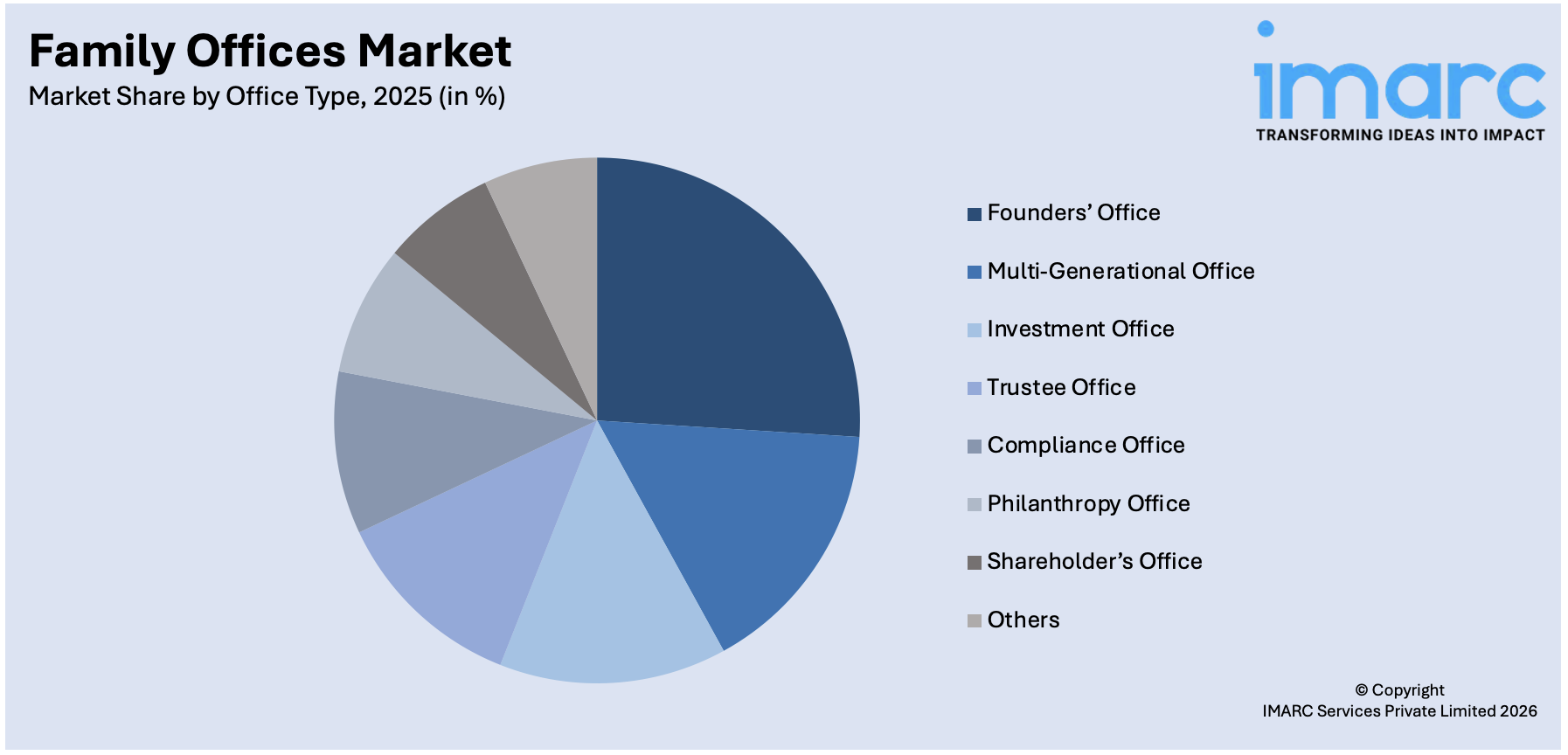
Founders’ office leads the market with around 21.5% of the market share in 2025. The founders' office segment is influenced by the need to manage and preserve the wealth generated by business founders. These offices tend to offer customized solutions and involvement in decision-making. They are thus organized to cater for the different financial needs of entrepreneurs, ranging from tax optimization and succession planning to investment strategies that make sense given the founders' business interests and legacy goals. Additionally, they address specialized expertise, in the context of sustainable investment and philanthropic pursuits, where many founders now are reportedly focusing. The growth of high-net-worth entrepreneurship globally only adds another layer of strength to the founders' offices domination of this space. For instance, in October 2024, The Family Office Resource Group (FORG) officially announced its launch, along with a growth equity investment from 4100FS. FORG offers a comprehensive, white-labeled family-office solution to wealth management and professional services firms that want to meet the often complex and ever-growing needs of ultra-high-net-worth (UHNW) individuals and families. The platform includes outsourced CFO and accounting services, as well as business legacy planning, risk management, philanthropy consulting, concierge services, family governance, and advisory firm resources.
Analysis by Asset Class:
- Bonds
- Equities
- Alternative Investments
- Commodities
- Cash or Cash Equivalents
Alternative investments lead the market with around 40.8% of the market share in 2025. The alternative investments segment is driven by the pursuit of returns uncorrelated with traditional markets, portfolio diversification, and hedging against market volatility. This segment includes investments like hedge funds, private equity, and real estate, each having unique driving factors. They are aligned with long-term wealth-building strategies, offering protection against market volatility and inflation. The ability of alternative investments to provide unique opportunities tailored to the specific goals and values of wealthy families further solidifies their prominence in this segment. For instance, in October 2024, The Bank of Singapore announced its collaboration with the global fintech firm iCapital to launch an alternative investment digital platform, FIM Alternatives Select, dedicated to the bank’s financial intermediary partners, also known as independent asset managers.
Analysis by Service Type:
- Financial Planning
- Strategy
- Governance
- Advisory
- Others
Financial planning leads the market with around 66.6% of the market share in 2025. According to the report, the financial planning segment is propelled by the comprehensive need for budgeting, risk management, tax planning, and retirement planning. A holistic approach to financial well-being and alignment with short-term and long-term family goals are key drivers for this segment. The integration of these elements allows for a more robust and flexible financial strategy, catering to the specific needs and preferences of the family, and fostering stability and growth in their financial landscape.
Regional Analysis:
To get more information on the regional analysis of this market Request Sample
- North America
- United States
- Canada
- Asia Pacific
- China
- Japan
- India
- South Korea
- Australia
- Indonesia
- Others
- Europe
- Germany
- France
- United Kingdom
- Italy
- Spain
- Russia
- Others
- Latin America
- Brazil
- Mexico
- Others
- Middle East and Africa
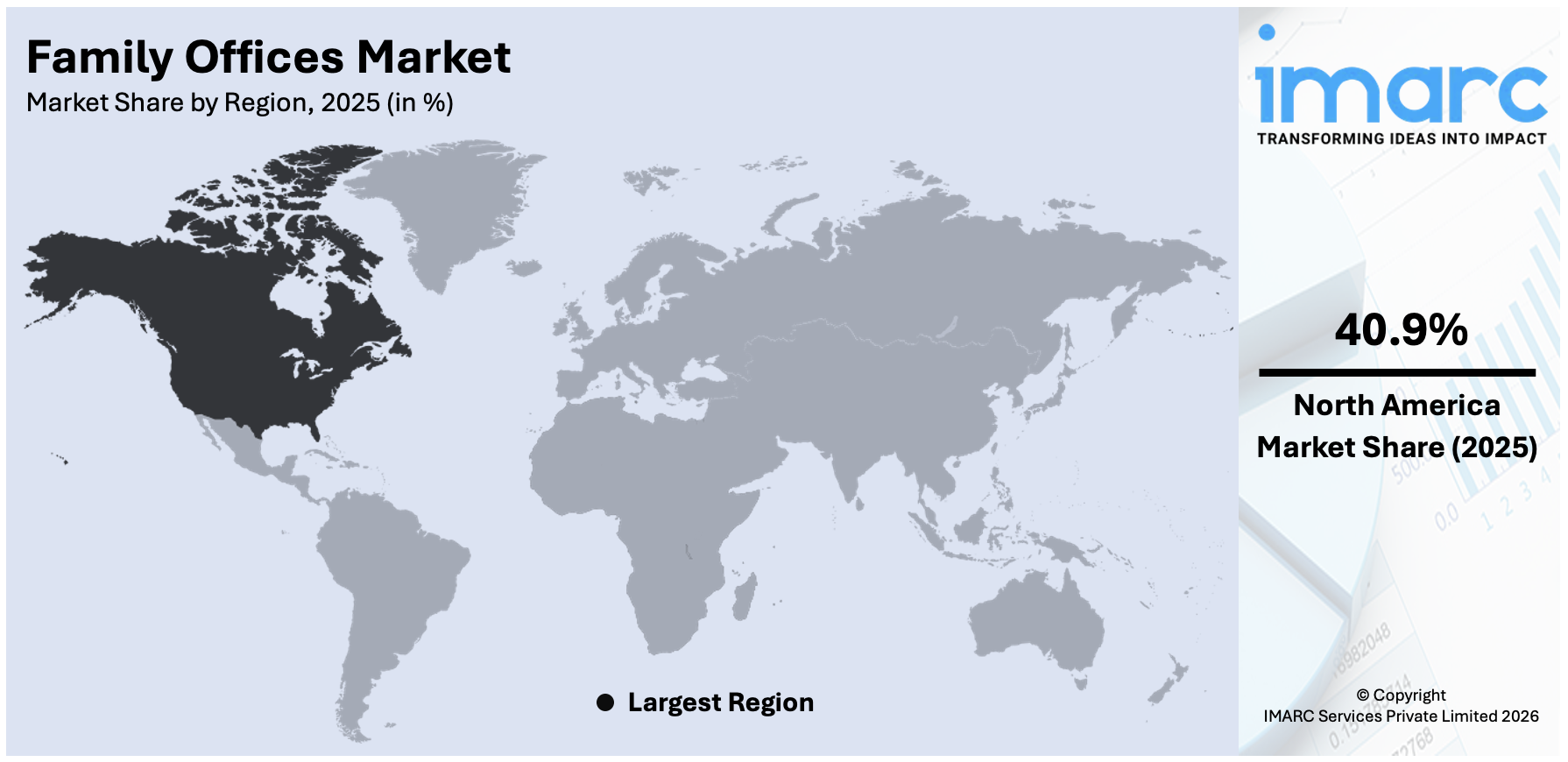
In 2025, North America accounted for the largest market share of over 40.9%. According to the family offices industry outlook, the market in the North American region is influenced by a robust financial infrastructure, regulatory environment, economic policies, and technological advancements. The concentration of wealth, entrepreneurial growth, and a stable political system contribute to the attractiveness of the region for family offices. The increasing number of high-net-worth individuals in the region is also acting as one of the key factors driving the family offices market growth. For instance, according to Statista, in 2021, there were around about 7.4 Million high-net-worth individuals in North America.
Key Regional Takeaways:
United States Family Offices Market Analysis
The United States dominates the global family offices landscape through concentration of ultra-high-net-worth individuals, robust financial infrastructure, and sophisticated wealth management ecosystems. Silicon Valley's entrepreneurial wealth creation generates substantial demand as technology founders transition from business building to wealth preservation, establishing single-family offices managing billion-dollar portfolios. New York and California lead in family office density, benefiting from proximity to financial centers, legal expertise, and investment opportunities across public markets, venture capital, and real estate sectors. Texas emerges as a growing hub attracted by favorable state tax policies eliminating personal income taxation, appealing to families prioritizing cost-efficient wealth structures. The regulatory environment provides flexibility in family office operations while maintaining investor protections through securities laws governing investment advisory activities. Philanthropic integration characterizes American family offices where charitable foundations complement wealth management activities, enabled by tax incentives encouraging charitable giving. Technological adoption rates exceed global averages as families embrace digital platforms for portfolio monitoring, cybersecurity protection, and family governance facilitation across distributed family networks.
Asia Pacific Family Offices Market Analysis
Asia Pacific experiences rapid family office proliferation driven by explosive wealth creation in technology, manufacturing, and financial services sectors across China, India, and Southeast Asia. Singapore establishes itself as the region's preeminent hub through deliberate government policies incentivizing family office establishment via tax exemptions, streamlined licensing frameworks, and political stability attracting international capital flows. Hong Kong maintains competitive positioning despite geopolitical uncertainties, leveraging proximity to mainland China markets and established legal infrastructure based on common law traditions familiar to international investors. Wealth transfer dynamics accelerate as first-generation entrepreneurs approach retirement, prompting succession planning initiatives requiring professional family office structures to navigate complex family dynamics and business ownership transitions. Cultural emphasis on multi-generational wealth preservation aligns naturally with family office models emphasizing long-term thinking over quarterly performance metrics. Private equity and venture capital investments dominate portfolios as families maintain entrepreneurial mindsets seeking growth-oriented opportunities in emerging sectors. Regional expansion sees increased interest beyond Singapore-Hong Kong duopoly toward Mumbai, Taipei, and Jakarta as local wealth accumulation reaches thresholds justifying dedicated family office establishments.
Europe Family Offices Market Analysis
Europe hosts sophisticated family office ecosystems rooted in centuries of wealth management tradition, with Switzerland, Monaco, and London serving as established centers attracting international families. Switzerland's political neutrality, banking secrecy traditions, and stable regulatory environment position it as preferred jurisdiction for privacy-conscious families seeking discretion alongside professional wealth management services. Germany maintains substantial family office presence reflecting the country's Mittelstand entrepreneurial culture where family businesses generate multi-generational wealth requiring specialized management beyond traditional banking relationships. United Kingdom benefits from common law legal framework, English language advantage, and London's position as global financial center facilitating investment access across asset classes and geographic markets. Regulatory complexity varies significantly across European jurisdictions, requiring specialized expertise navigating European Union directives alongside national regulations governing investment activities and tax obligations. Family governance structures emphasize formality with documented family constitutions, investment policy statements, and decision-making frameworks reflecting European preferences for structured approaches. Alternative investments including private equity, real estate, and art collections feature prominently as families leverage continental networks for deal sourcing and specialized knowledge in niche sectors.
Latin America Family Offices Market Analysis
Latin America witnesses growing family office adoption as regional wealth accumulation reaches critical mass justifying professional wealth management infrastructure dedicated to individual family needs. Brazil leads regional development reflecting its economic scale and concentration of billionaire families generated through industrial, financial, and commodity sectors requiring sophisticated asset management approaches. Political and economic volatility characteristic of the region heightens emphasis on offshore diversification strategies where families establish parallel structures in stable jurisdictions protecting wealth from domestic uncertainties. Miami emerges as de facto family office hub for Latin American families seeking U.S. dollar exposure, political stability, and geographic proximity enabling convenient oversight while maintaining cultural connections through substantial expatriate communities. Currency risk management dominates strategic considerations as families navigate devaluation threats through international asset allocation and multi-currency banking relationships protecting purchasing power across generations. Succession planning complexity intensifies given larger average family sizes and cultural dynamics favoring inclusive wealth distribution among numerous heirs requiring careful planning preventing wealth fragmentation. Philanthropy gains traction as wealth concentration prompts social responsibility considerations with families establishing foundations addressing regional challenges in education, healthcare, and poverty alleviation.
Middle East and Africa Family Offices Market Analysis
The Middle East experiences rapid family office growth propelled by oil wealth diversification imperatives and sovereign ambitions establishing international financial centers competing for global capital flows. United Arab Emirates leads regional development through Dubai and Abu Dhabi positioning as wealth management hubs offering tax advantages, modern infrastructure, and strategic location bridging East-West capital movements. Family office structures in the region often intertwine with sovereign wealth concepts given close relationships between ruling families and state investment vehicles managing hydrocarbon revenues for future generations. Asset allocation emphasizes real estate, private equity, and alternative investments reflecting preferences for tangible assets and direct investment control rather than passive public market exposures. Younger generation involvement increases as Western-educated heirs return bringing contemporary wealth management perspectives emphasizing professional governance, technology adoption, and diversification beyond traditional family business holdings. Africa remains nascent in family office development despite growing billionaire populations in Nigeria, South Africa, and Egypt, with infrastructure limitations and regulatory uncertainties constraining institutional development compared to more established markets globally.

Competitive Landscape:
The market is highly competitive with a mix of single-family offices (SFOs) and multi-family offices (MFOs). Established players include prominent wealth management firms, boutique advisory services, and traditional private banks entering this space. MFOs are gaining traction due to their cost-efficiency and ability to serve multiple clients while SFOs cater to ultra-high-net-worth families seeking personalized solutions. It focuses on tailoring services such as investment management, estate planning, and impact investing. For instance, in October 2024, HK Family Offices, one of Hong Kong’s biggest property agencies ramped up its family office business by partnering with China’s leading mutual fund to facilitate wealth management products amid a real estate entity, Centaline Wealth Management Ltd., a subsidiary of Centaline Group. The latter will start offering products including fixed-income, money market funds, and exchange-traded funds with China Asset Management.
The report has also analysed the competitive landscape of the market with some of the key players being:
- BMO Financial Group
- Cambridge Associates LLC
- Citigroup Inc.
- HSBC Private Banking (HSBC Holdings plc)
- Northern Trust Corporation
- Silvercrest Asset Management Group Inc.
- Stonehage Fleming Family & Partners Limited
- The Bank of New York Mellon Corporation
- The Bessemer Group Incorporated
- The Glenmede Corporation
- UBS Group AG
- Wells Fargo & Company
Family Offices Market News:
- April 2025: Northern Trust launched Family Office Solutions, a specialized service under its Global Family and Private Investment Offices division to cater to ultra-high-net-worth families seeking institutional-grade financial management without the complexity of a standalone office. The initiative builds on Northern Trust's history of serving 30% of the Forbes 400 and managing USD 450.7 Billion in assets as of December 31, 2024, highlighting the growing demand for flexible, bespoke family office solutions amid rising global wealth.
- June 2025: Several prominent Indian family offices, including those backed by leaders in the automotive and IT sectors, are structuring Alternative Investment Fund (AIF)-like vehicles at GIFT City’s International Financial Services Centre (IFSC) to navigate regulatory hurdles on overseas investments. Despite over a dozen Single Family Offices (SFOs) receiving licenses, ambiguity regarding the Overseas Portfolio Investment (OPI) and Overseas Direct Investment (ODI) routes has prevented the operationalization of foreign investments.
- February 2025: Aquiline Capital Partners announced the acquisition of SEI's Family Office Services business for USD 120 Million, with plans to rebrand the operation as Archway, leveraging its strong position in the family office sector. SEI's Family Office Services, through its Archway Platform, currently manages USD 723 Billion in assets, providing advanced accounting and reporting solutions to ultra-high-net-worth families, demonstrating continued consolidation and investment in the family office services sector.
Family Offices Market Report Scope:
| Report Features | Details |
|---|---|
| Base Year of the Analysis | 2025 |
| Historical Period | 2020-2025 |
| Forecast Period | 2026-2034 |
| Units | Billion USD |
| Scope of the Report | Exploration of Historical Trends and Market Outlook, Industry Catalysts and Challenges, Segment-Wise Historical and Future Market Assessment:
|
| Types Covered | Single Family Office, Multi-Family Office, Virtual Family Office |
| Office Types Covered | Founders’ Office, Multi-Generational Office, Investment Office, Trustee Office, Compliance Office, Philanthropy Office, Shareholder’s Office, Others |
| Asset Classes Covered | Bonds, Equities, Alternative Investments, Commodities, Cash or Cash Equivalents |
| Service Types Covered | Financial Planning, Strategy, Governance, Advisory, Others |
| Regions Covered | Asia Pacific, Europe, North America, Latin America, Middle East and Africa |
| Countries Covered | United States, Canada, Germany, France, United Kingdom, Italy, Spain, Russia, China, Japan, India, South Korea, Australia, Indonesia, Brazil, Mexico |
| Companies Covered | BMO Financial Group, Cambridge Associates LLC, Citigroup Inc., HSBC Private Banking (HSBC Holdings plc), Northern Trust Corporation, Silvercrest Asset Management Group Inc., Stonehage Fleming Family & Partners Limited, The Bank of New York Mellon Corporation, The Bessemer Group Incorporated, The Glenmede Corporation, UBS Group AG, Wells Fargo & Company, etc. |
| Customization Scope | 10% Free Customization |
| Post-Sale Analyst Support | 10-12 Weeks |
| Delivery Format | PDF and Excel through Email (We can also provide the editable version of the report in PPT/Word format on special request) |
Key Benefits for Stakeholders:
- IMARC’s report offers a comprehensive quantitative analysis of various market segments, historical and current market trends, market forecasts, and dynamics of the family offices market from 2020-2034.
- The family offices market research report provides the latest information on the market drivers, challenges, and opportunities in the global market.
- The study maps the leading, as well as the fastest-growing, regional markets. It further enables stakeholders to identify the key country-level markets within each region.
- Porter's five forces analysis assist stakeholders in assessing the impact of new entrants, competitive rivalry, supplier power, buyer power, and the threat of substitution. It helps stakeholders to analyze the level of competition within the family offices industry and its attractiveness.
- Competitive landscape allows stakeholders to understand their competitive environment and provides an insight into the current positions of key players in the market.
Frequently Asked Questions About the Family Offices Market Report
The family offices market was valued at USD 21.4 Billion in 2025.
The family offices market is projected to exhibit a CAGR of 3.94% during 2026-2034, reaching a value of USD 30.3 Billion by 2034.
Rising interest in wealth preservation and succession planning among ultra-high-net-worth individuals drives demand for customized financial solutions. Growing complexity in global investments, tax structures, and regulatory environments compels families to seek professional management services encompassing estate planning, philanthropy, and alternative investment strategies.
North America currently dominates the family offices market, accounting for a share of over 40.9%, driven by its high concentration of ultra-high-net-worth individuals, well-established financial infrastructure, robust investment opportunities, and growing adoption of professional wealth management services.
Some of the major players in the family offices market include BMO Financial Group, Cambridge Associates LLC, Citigroup Inc., HSBC Private Banking (HSBC Holdings plc), Northern Trust Corporation, Silvercrest Asset Management Group Inc., Stonehage Fleming Family & Partners Limited, The Bank of New York Mellon Corporation, The Bessemer Group Incorporated, The Glenmede Corporation, UBS Group AG, and Wells Fargo & Company, among others.
Need more help?
- Speak to our experienced analysts for insights on the current market scenarios.
- Include additional segments and countries to customize the report as per your requirement.
- Gain an unparalleled competitive advantage in your domain by understanding how to utilize the report and positively impacting your operations and revenue.
- For further assistance, please connect with our analysts.
 Request Customization
 Speak to an Analyst
 Request Brochure
 Inquire Before Buying
Benefits of Customization
- Personalize this research
- Triangulate with your data
- Get data as per your format and definition
- Gain a deeper dive into a specific application, geography, customer, or competitor
- Any level of personalization
Get in Touch With Us
UNITED STATES
Phone: +1-201-971-6302
INDIA
Phone: +91-120-433-0800
UNITED KINGDOM
Phone: +44-753-714-6104
Email: [email protected]
Client Testimonials




.webp)




.webp)













Related Reports

Choose your plan
*Please note that the prices mentioned below are starting prices for each bundle type. Kindly contact our team for further details.*
Single User License
- 1 User License, Access on 2 Devices
- PDF Report + Excel Dataset (Password Protected)
- Lifetime Access
- No Printing Rights
- 10% Free Report Customization
- 10–12 Weeks of Analyst Support
Five User License
- Access for 5 Users, 2 Devices per User
- PDF Report + Excel Dataset (Password Protected)
- Lifetime Access
- Dedicated Account Manager
- 12–14 Weeks of Analyst Support
- No Printing Rights
- 15% Free Report Customization
- 25% Discount on Your Next Purchase
Corporate User License
- Unlimited User Access (Within Your Organization)
- PDF Report + Excel Dataset
- Lifetime Access
- Dedicated Account Manager
- 14–20 Weeks of Analyst Support
- No Printing Rights
- 20% Free Report Customization
- 30% Discount on Your Next Purchase
Essential Insights
What's included:
3 reports
- Lifetime Access
- PDF Reports
- Excel Datasets
- 2 Weeks of Free Analyst Support
- 2 User Licenses
- Access on 2 Devices
- Printing Rights
- Complimentary PowerPoint (PPT) Version
- Complimentary License Upgrade
Professional Access
What's included:
5 reports
- Lifetime Access
- PDF Reports
- Excel Datasets
- 8 Weeks of Free Analyst Support
- 2 User Licenses
- Access on 2 Devices
- Printing Rights
- Complimentary PowerPoint (PPT) Version
- Complimentary License Upgrade
Business Advantage
What's included:
8 reports
- Lifetime Access
- PDF Reports
- Excel Datasets
- 14 Weeks of Free Analyst Support
- 2 User Licenses
- Access on 2 Devices
- Printing Rights
- Complimentary PowerPoint (PPT) Version
- Complimentary License Upgrade
Enterprise Intelligence
What's included:
10 reports
- Lifetime Access
- PDF Reports
- Excel Datasets
- 20 Weeks of Free Analyst Support
- 2 User Licenses
- Access on 2 Devices
- Printing Rights
- Complimentary PowerPoint (PPT) Version
- Complimentary License Upgrade