
Fire Hydrants Market Size, Share, Trends and Forecast by Product Type, Operating Type, Construction, End User, and Region, 2026-2034
Fire Hydrants Market Size, Share, Trends & Forecast (2026-2034)
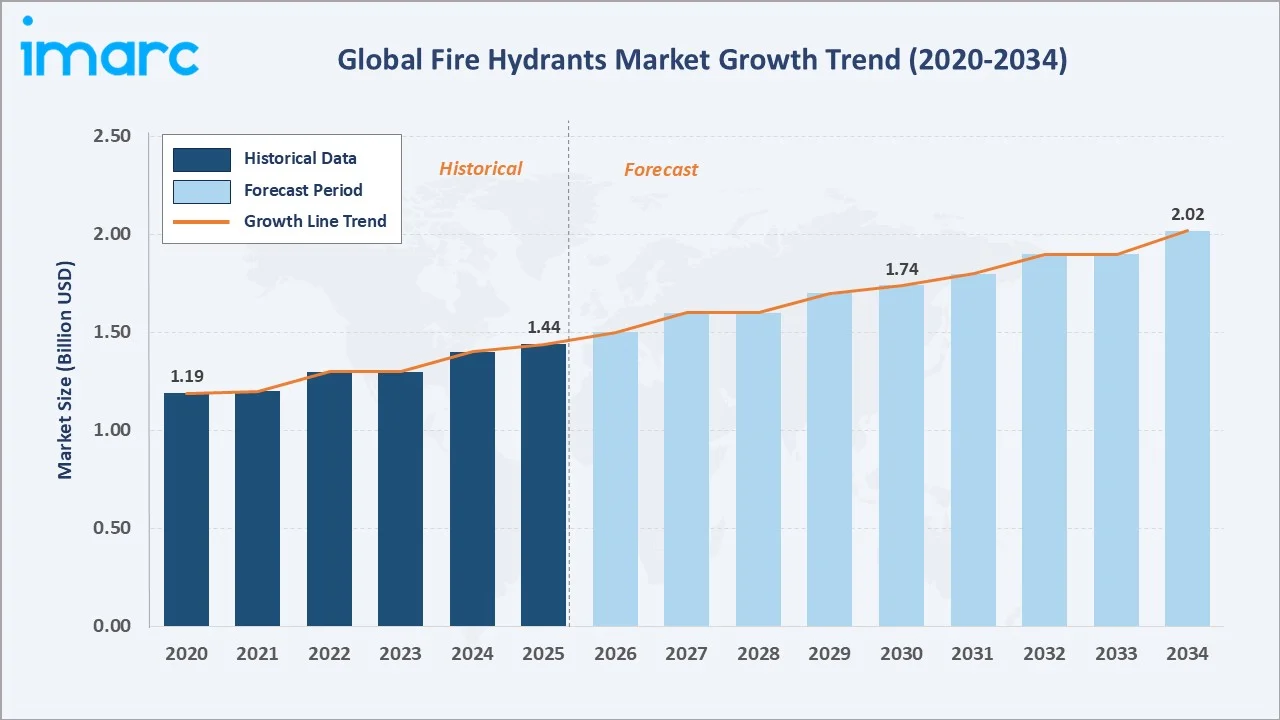
The fire hydrants market reached USD 1.44 Billion in 2025 and is projected to reach USD 2.02 Billion by 2034, expanding at a CAGR of 3.88% during 2026-2034. Expanding residential and commercial infrastructure development, rising government regulatory enforcement on fire protection systems, and growing adoption across manufacturing and oil and gas industries are the primary growth catalysts.
Market Snapshot
|
Metric |
Value |
|
Market Size (2025) |
USD 1.44 Billion |
|
Forecast Market Size (2034) |
USD 2.02 Billion |
|
CAGR (2026-2034) |
3.88% |
|
Base Year |
2025 |
|
Historical Period |
2020-2025 |
|
Forecast Period |
2026-2034 |
North America leads the global fire hydrants landscape, holding a 31.0% share in 2025, anchored by the region's stringent fire safety regulations and extensive municipal water infrastructure. Dry barrel hydrants command the largest share of the product segment at 54.0%, reflecting their widespread use in cold-climate regions prone to freezing conditions.
To get more information on this market, Request Sample
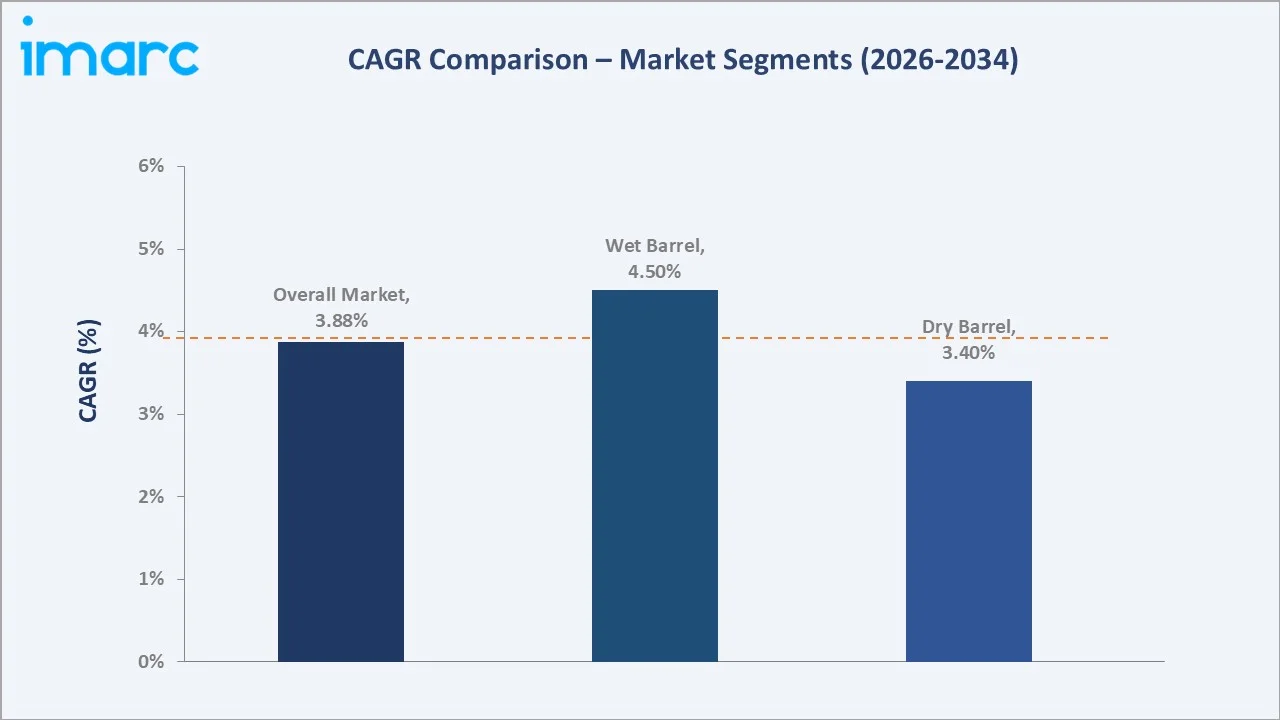
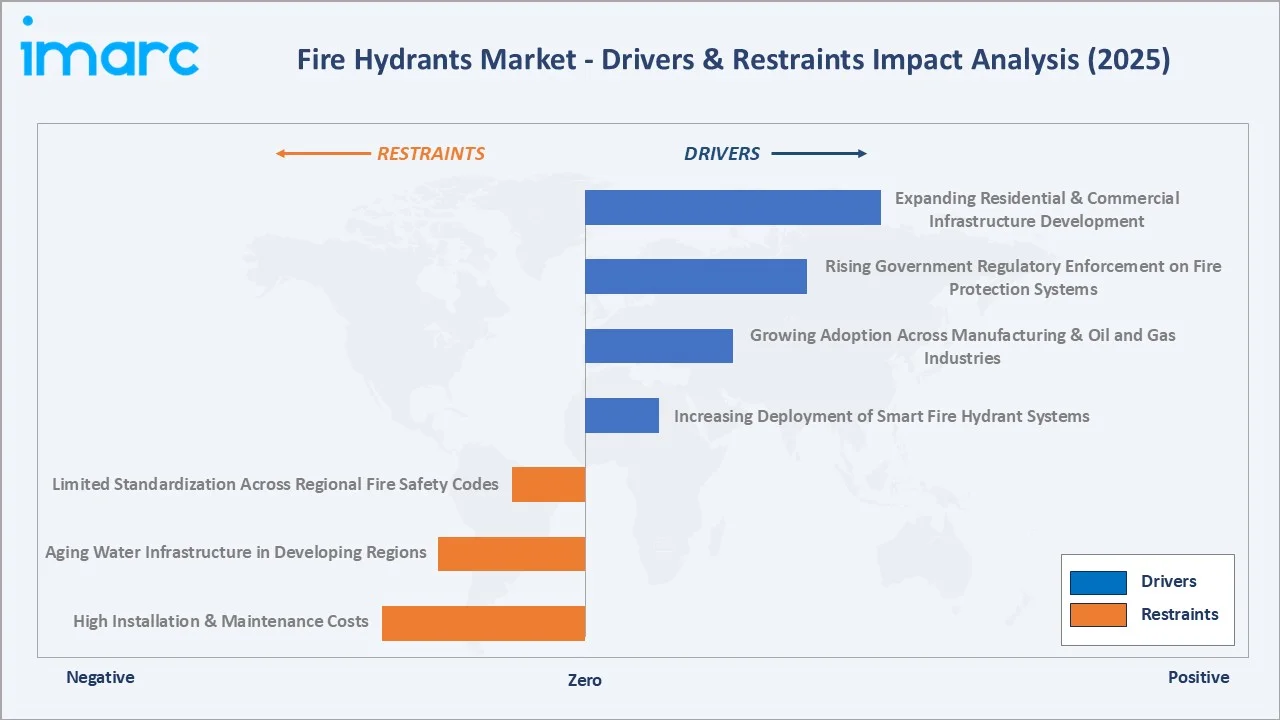
The fire hydrants market is underpinned by three structural forces: expanding residential and commercial infrastructure development, rising government regulatory enforcement on fire protection systems, and growing adoption across manufacturing and oil and gas industries. Each force independently reinforces category growth, sustaining steady CAGR expansion through 2034 despite high installation and maintenance costs.
Executive Summary
The fire hydrants market is experiencing steady expansion, driven by rising infrastructure spending, growing regulatory enforcement, and increasing deployment of smart fire hydrant systems for enhanced water management. The market was valued at USD 1.44 Billion in 2025 and is forecast to reach USD 2.02 Billion by 2034, growing at a CAGR of 3.88%.
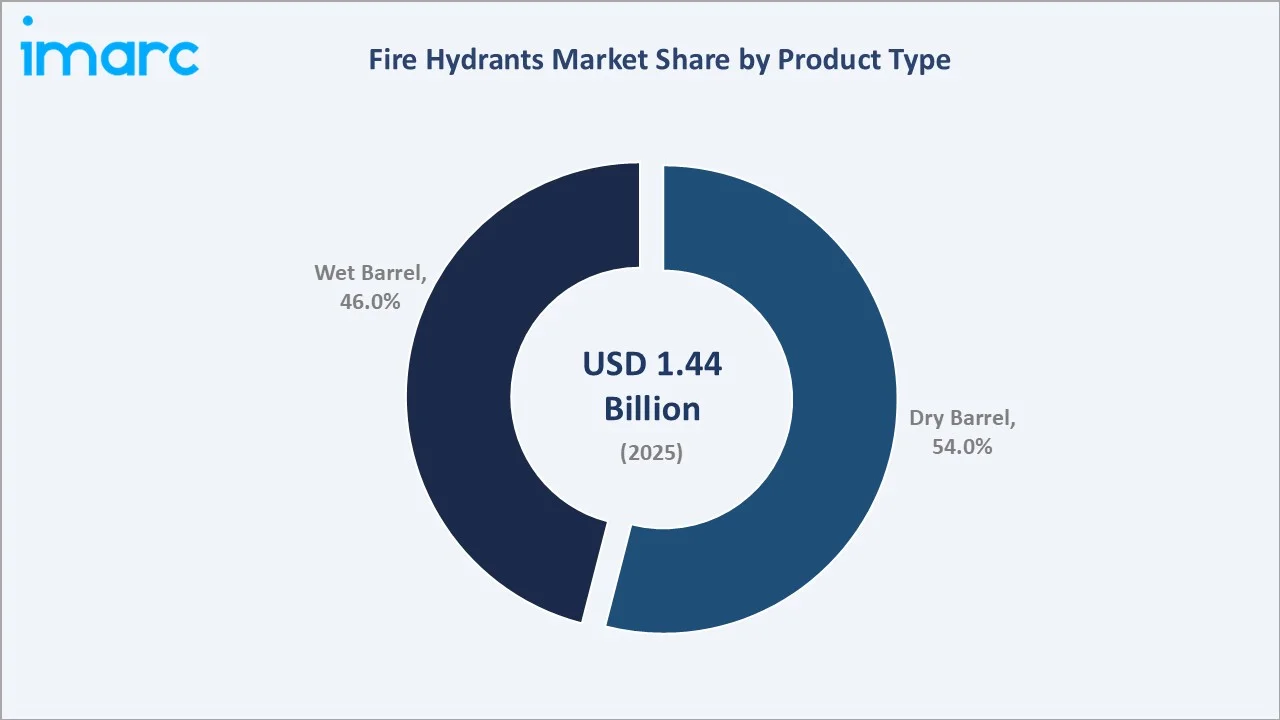
Dry barrel dominates the product type segment with a 54.0% share in 2025, encompassing hydrants suited for cold-climate and freezing conditions, while wet barrel accounts for 46.0%, reflecting the market's balanced product diversity across regional climate requirements.
Conventional hydrants lead the operating type segment at 70.0% share, supported by established municipal procurement standards, while smart hydrants account for 30.0%, driven by rising deployment of IoT-enabled monitoring capabilities. North America leads regionally at 31.0%, anchored by the region's stringent fire safety regulations and extensive municipal water infrastructure.
Key Market Insights
|
Insight |
Data |
|
Largest Product Segment |
Dry Barrel – 54.0% share (2025) |
|
Fastest Growing Product Segment |
Wet Barrel – ~4.5% CAGR (2026-2034) |
|
Largest Operating Type Segment |
Conventional – 70.0% share (2025) |
|
Leading Region |
North America – 31.0% share (2025) |
|
Top Companies |
Mueller Water Products, Inc., AVK Holding A/S, AMERICAN Cast Iron Pipe Company, EJ Group, Inc., NAFFCO FZCO |
Key Analytical Observations Supporting the Above Data:
- Dry barrel accounts for 54.0% of the fire hydrants market in 2025. This dominance reflects widespread use in cold-climate regions prone to freezing conditions.
- Conventional hydrants remain the leading operating type at 70.0% share (2025), supported by established municipal procurement standards and infrastructure compatibility.
- Smart hydrants are expanding steadily at a 30.0% share (2025), as growing demand for IoT-enabled water management continues to drive category growth.
- North America's 31.0% share (2025) reflects its stringent fire safety regulations and extensive municipal water infrastructure investment.
- Rising convergence of fire protection infrastructure with smart monitoring technology and regulatory enforcement is broadening the addressable market across municipal, industrial, and commercial applications.
Fire Hydrants Market Overview
The fire hydrants market encompasses dry barrel and wet barrel product categories delivered across conventional and smart operating types, offering fire protection infrastructure for a wide range of municipal, industrial, and commercial applications. The fire hydrants ecosystem spans raw material sourcing providers, casting and manufacturing facilities, and an expanding network of installation and contracting service providers.
Macroeconomic drivers include expanding residential and commercial infrastructure development, rising government regulatory enforcement on fire protection systems, and growing adoption across manufacturing and oil and gas industries. Manufacturers are simultaneously investing in IoT-enabled hydrant monitoring, municipal infrastructure upgrade partnerships, and advanced coating and finishing technology to improve product durability, positioning the fire hydrants sector for continued steady growth through 2034 despite high installation and maintenance costs.
Market Dynamics
To evaluate market opportunities, Request Sample
Market Drivers
- Expanding Residential & Commercial Infrastructure Development: Growing global construction and urban development activity is driving sustained fire hydrant procurement and installation investment. Urbanization continues to accelerate globally, with 55% of the world’s population currently residing in urban areas, a share projected to increase to 68% by 2050, driving greater demand for infrastructure, housing, and urban services.
- Rising Government Regulatory Enforcement on Fire Protection Systems: Tightening fire safety codes and building regulations are accelerating demand for compliant hydrant infrastructure. For example, the European Union’s Construction Products Regulation (CPR) established strict fire performance requirements for construction materials to improve building safety.
- Growing Adoption Across Manufacturing & Oil and Gas Industries: Rising industrial facility construction is increasing demand for fire protection infrastructure across manufacturing and energy sector sites. U.S. warehouse construction activity increased significantly, with industrial real estate development expanding 18% year-over-year and total industrial space surpassing 305 million sq ft in Q2 2026.
- Increasing Deployment of Smart Fire Hydrant Systems: The number of connected IoT devices worldwide is projected to reach 39 billion by 2030, growing at a CAGR of 13.2% from 2025. Rising adoption of IoT-enabled monitoring is broadening the addressable market for enhanced water management solutions.
Market Restraints
- High Installation & Maintenance Costs: Significant upfront installation and ongoing maintenance costs can constrain procurement, particularly in budget-limited municipal settings.
- Aging Water Infrastructure in Developing Regions: Outdated water distribution networks in developing markets can limit compatible hydrant deployment and increase installation complexity.
- Limited Standardization Across Regional Fire Safety Codes: Variation in regional fire safety standards can complicate product design and cross-market manufacturing scalability.
Market Opportunities
- IoT-Enabled Hydrant Monitoring Expansion: Growing demand for real-time water pressure and flow monitoring presents opportunities for manufacturers expanding smart hydrant portfolios. In June 2026, McWane launched iHydrantPlus, a smart water monitoring platform that uses IoT-enabled sensors and real-time data analytics to improve hydrant performance, water system visibility, and infrastructure management.
- Municipal Infrastructure Upgrade Programs: Rising municipal water infrastructure modernization initiatives offer opportunities for manufacturers supplying upgraded hydrant systems.
- Emerging Market Infrastructure Expansion: Growing infrastructure investment across developing regions creates opportunities for manufacturers expanding regional distribution and installation capabilities.
Market Challenges
- Balancing Cost and Technology Adoption: Manufacturers must balance smart hydrant technology investment with the need to maintain cost-competitive product offerings for municipal buyers.
- Addressing Installation Complexity: Ensuring compatibility with varied municipal water infrastructure requires ongoing product design flexibility and installation service investment.
Emerging Market Trends
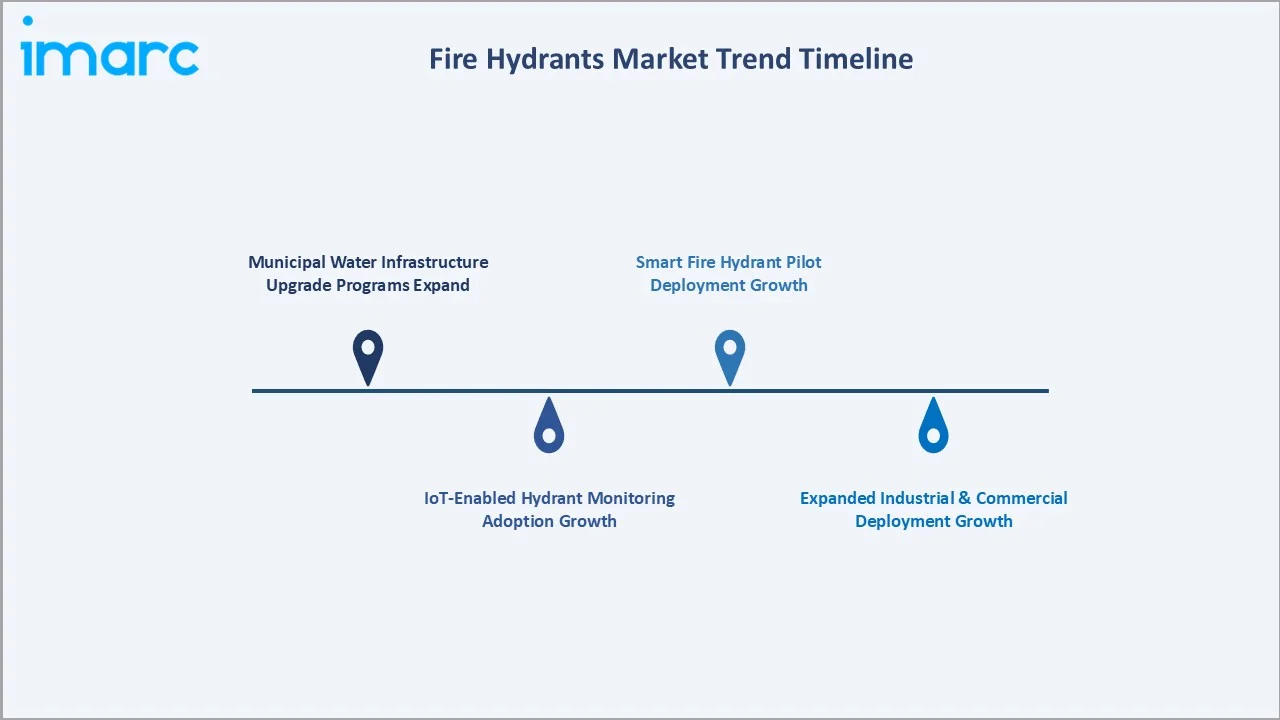
1. Municipal Water Infrastructure Upgrade Programs Expand
Municipalities are increasingly investing in water infrastructure modernization, driving replacement and upgrade demand for compliant, durable fire hydrant systems worldwide. In July 2026, the European Union approved a EUR 14 million grant to modernize water infrastructure in the Ústí nad Labem region of the Czech Republic, improving wastewater treatment capacity and network efficiency.
2. IoT-Enabled Hydrant Monitoring Adoption Growth
Growing adoption of IoT-enabled monitoring technology is expanding real-time water pressure and flow visibility, supporting proactive maintenance and enhanced water management. In February 2023, Seoul adopted an IoT-based fire hydrant monitoring system to enable real-time status tracking, improve maintenance efficiency, and ensure reliable availability of firefighting infrastructure.
3. Smart Fire Hydrant Pilot Deployment Growth
Rising pilot deployment of smart fire hydrant systems is accelerating technology validation and adoption across leading municipal and industrial procurement programs. Growing collaboration between municipalities and technology vendors is further supporting real-world testing of IoT-enabled leak detection and pressure monitoring capabilities.
4. Expanded Industrial & Commercial Deployment Growth
Growing industrial and commercial facility construction activity is driving expansion of fire hydrant demand across the global manufacturing and energy sector ecosystem. Rising investment in warehouse, data center, and logistics hub construction is further boosting demand for compliant, high-flow fire hydrant installations.
Industry Value Chain Analysis
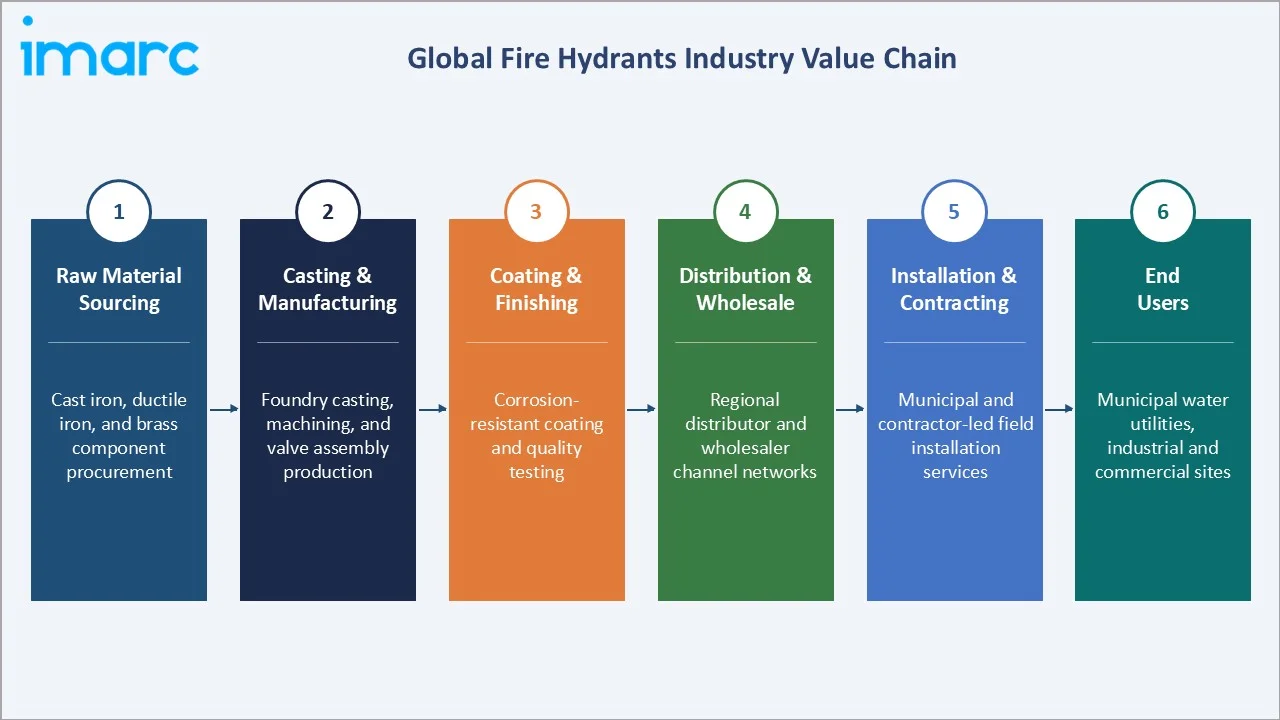
The fire hydrants value chain spans raw material sourcing through end-user delivery, with each stage occupied by specialized foundry operators, coating and finishing facilities, and installation and contracting service providers whose performance directly influences product durability, code compliance, and cost-effectiveness.
|
Stage |
Key Activities |
|
Raw Material Sourcing |
Cast iron, ductile iron, and brass component procurement |
|
Casting & Manufacturing |
Foundry casting, machining, and valve assembly production |
|
Coating & Finishing |
Corrosion-resistant coating and quality testing |
|
Distribution & Wholesale |
Regional distributor and wholesaler channel networks |
|
Installation & Contracting |
Municipal and contractor-led field installation services |
|
End Users |
Municipal water utilities, industrial and commercial sites |
Technology Landscape in the Fire Hydrants Industry
Smart Monitoring Technology
Manufacturers are advancing smart monitoring technology to improve real-time water pressure and flow visibility, supporting broader adoption among municipal and industrial applications. Growing integration of IoT sensors and cloud connectivity is further enabling remote diagnostics and predictive maintenance alerts.
Corrosion-Resistant Coating Development
Growing investment in advanced corrosion-resistant coating technology is extending product lifespan, addressing rising demand for durable, low-maintenance hydrant infrastructure. Increasing use of epoxy and powder-coating formulations is further improving resistance to soil chemicals and freeze-thaw cycles.
Underground & Above Ground Design Innovation
Manufacturers are engineering advanced underground and above-ground hydrant designs to extend product suitability across demanding climate and regulatory application requirements. Enhanced dry-barrel and wet-barrel configurations are further improving freeze protection and operational reliability across varied climate zones.
Municipal Infrastructure Ecosystem Integration
Expanding investment in municipal infrastructure ecosystem integration is strengthening fire protection value chain reliability, supporting premium positioning across leading regulatory jurisdictions. Deeper coordination with GIS-based water network mapping is further improving maintenance planning and emergency response readiness.
Market Segmentation Analysis
The report covers the following segments:
|
Segment Category |
Leading Segment |
Market Share |
Year |
|
Product Type |
Dry Barrel |
54.0% |
2025 |
|
Operating Type |
Conventional |
70.0% |
2025 |
|
Construction |
Underground |
56.0% |
2025 |
|
End User |
Industrial |
51.0% |
2025 |
|
Region |
North America |
31.0% |
2025 |

By Product Type
Dry barrel dominates with a 54.0% share in 2025. This segment encompasses hydrants suited for cold-climate and freezing conditions, supported by sustained demand across regions with harsh winter climates.
To access detailed market analysis, Request Sample
Wet barrel represents 46.0% of the market (2025), reflecting sustained demand across warmer climate regions where freezing is not a primary design consideration.
By Operating Type
Conventional hydrants lead the operating type segment at 70.0% share (2025), supported by established municipal procurement standards and infrastructure compatibility.
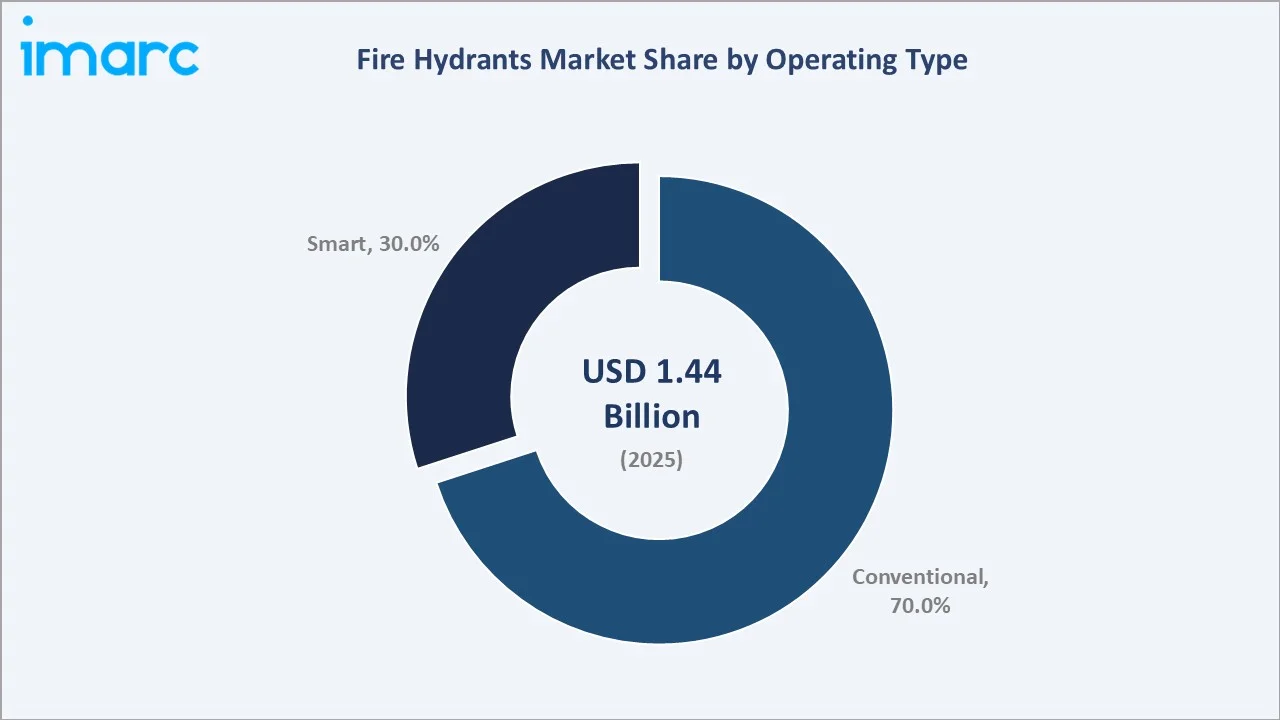
Smart hydrants account for 30.0% of the market (2025), continuing to broaden the market's technology diversity as IoT-enabled monitoring adoption accelerates across municipal and industrial procurement programs.
Regional Market Insights
North America's market leadership (31.0%, 2025) reflects the region's stringent fire safety regulations and extensive municipal water infrastructure. Growing municipal infrastructure upgrade programs and expanding IoT-enabled hydrant monitoring investment combine to sustain its dominant position through 2034.
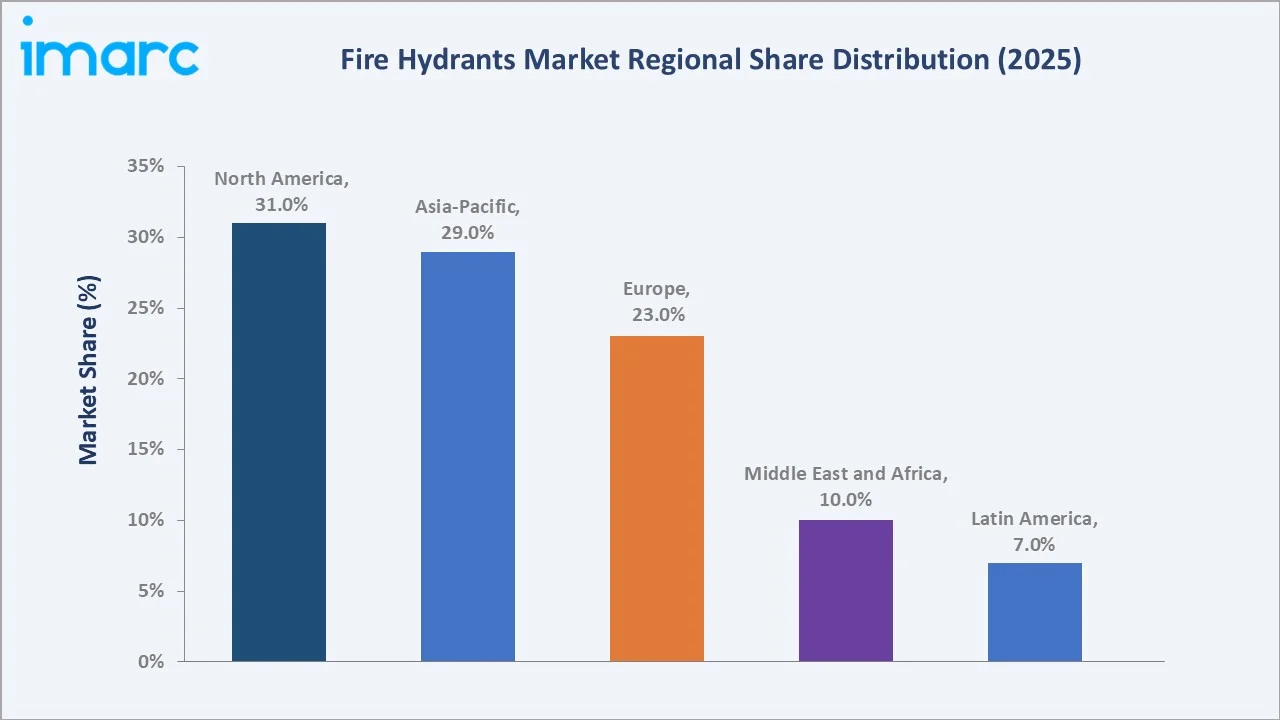
Asia-Pacific at 29.0% (2025) represents the second-largest fire hydrants market regionally. Rapid urbanization and expanding infrastructure investment across developing economies are sustaining steady growth, positioning the region as a key contributor alongside North America through the forecast period.
|
Region |
Share (2025) |
Key Growth Drivers |
|
North America |
31.0% |
Stringent fire safety regulations and extensive municipal water infrastructure |
|
Asia-Pacific |
29.0% |
Rapid urbanization and expanding infrastructure investment across developing economies |
|
Europe |
23.0% |
Established regulatory framework and ongoing municipal infrastructure upgrade programs |
|
Middle East and Africa |
10.0% |
Growing industrial development and expanding commercial construction activity |
|
Latin America |
7.0% |
Emerging municipal infrastructure investment and gradual regulatory standardization |
Competitive Landscape
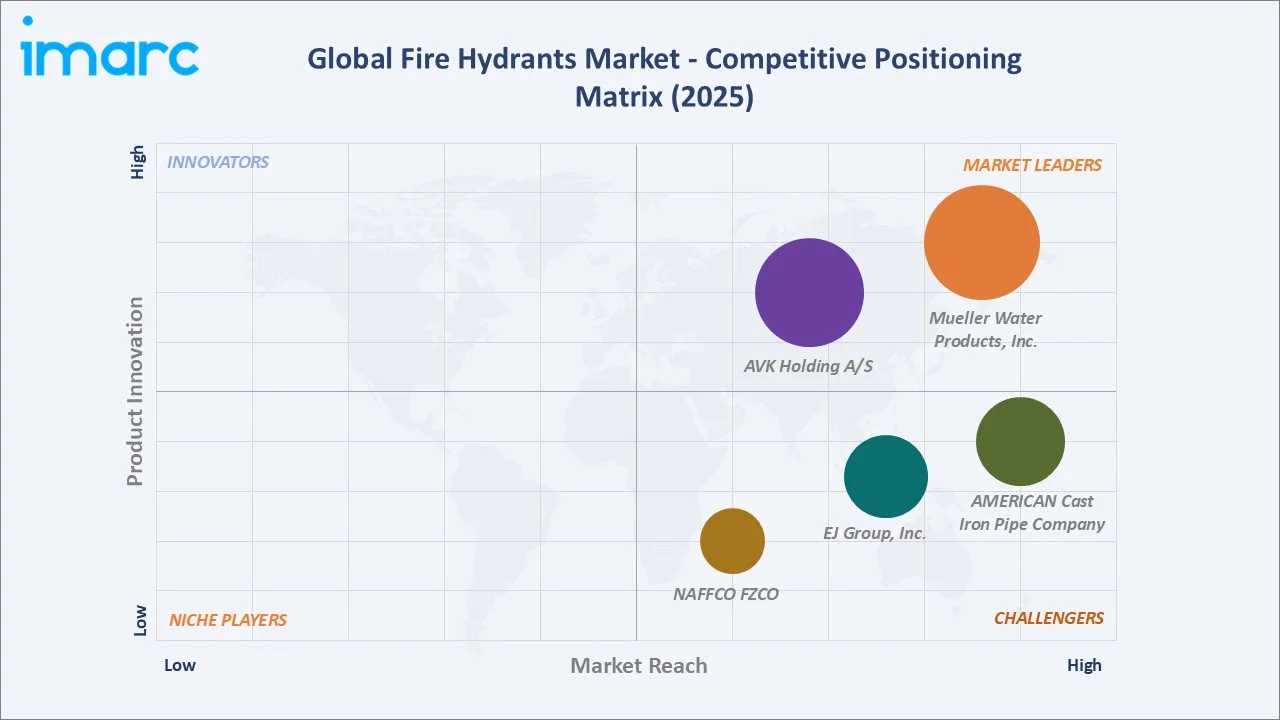
The fire hydrants market exhibits moderate concentration, with leading manufacturers collectively holding a significant share of market revenue in 2025, reflecting sustained investment in product innovation and supply chain reach.
|
Company Name |
Brand Name |
Market Position |
Core Strength |
|
Mueller Water Products, Inc. |
Mueller |
Market Leader |
One of the leading North American hydrant manufacturers with extensive municipal water infrastructure integration |
|
AVK Holding A/S |
AVK |
Market Leader |
One of the global valve and hydrant manufacturers with broad European and international distribution reach |
|
AMERICAN Cast Iron Pipe Company |
American-Darling & Waterous Hydrants |
Strong Challenger |
Established foundry-based manufacturer with long-standing municipal procurement relationships |
|
EJ Group, Inc. |
EJ |
Strong Challenger |
Diversified infrastructure products manufacturer with global fire hydrant distribution capabilities |
|
NAFFCO FZCO |
NAFFCO |
Challenger |
Middle East-based fire protection specialist with advanced firefighting equipment portfolio |
Mueller Water Products, Inc. and AVK Holding A/S dominate through comprehensive product portfolios and extensive global distribution reach, supported by continuous investment. AMERICAN Cast Iron Pipe Company, EJ Group, Inc., and NAFFCO FZCO compete through targeted foundry heritage, diversified infrastructure integration, and regional specialization differentiation, respectively.
Key Company Profiles
Mueller Water Products, Inc.
Mueller Water Products, Inc.’s subsidiary Mueller Co. LLC is a leading North American fire hydrant manufacturer with extensive municipal water infrastructure integration serving utilities across the region.
- Product Portfolio: Dry barrel and wet barrel fire hydrants, valves, and water infrastructure products under the Mueller brand.
- Recent Developments: In May 2026, Mueller Water Products, Inc. reported Q2 FY2026 net sales of USD 384.4 million, up 5.5% year-over-year, supported by strong demand for water transmission, distribution, and measurement solutions. The company continues to strengthen its fire protection portfolio through advanced fire hydrant solutions, including reliable hydrant systems designed for water distribution networks and emergency response applications.
- Strategic Focus: Strengthening municipal distribution reach; expanding smart, IoT-enabled hydrant technology across emerging application segments.
AMERICAN Cast Iron Pipe Company
AMERICAN Cast Iron Pipe Company is one of the leading established foundry-based manufacturers with long-standing municipal procurement relationships across North America.
- Product Portfolio: Cast iron and ductile iron fire hydrants and water infrastructure products under the American-Darling & Waterous Hydrant brands.
- Recent Developments: In June 2024, AMERICAN Cast Iron Pipe Company owned AMERICAN Flow Control introduced the SEQUOIA Wet Barrel Hydrant, a next-generation fire hydrant featuring a 350 psi pressure rating, easy internal component access, and an exclusive nozzle retention design for improved maintenance efficiency.
- Strategic Focus: Expanding foundry-based manufacturing capabilities; strengthening domestic municipal procurement presence.
Market Concentration Analysis
The fire hydrants market exhibits moderate concentration, with Mueller Water Products, Inc., AVK Holding A/S, and AMERICAN Cast Iron Pipe Company collectively accounting for a significant share of total category revenue in 2025, reflecting sustained product investment, supply chain loyalty, and extensive application reach across the industry.
Consolidation pressure remains limited as leading manufacturers maintain distinct strategic positioning: Mueller Water Products, Inc. and AVK Holding A/S through comprehensive product and distribution portfolios, AMERICAN Cast Iron Pipe Company and EJ Group, Inc. through foundry heritage and infrastructure integration scale positioning, and NAFFCO FZCO through diversified regional specialization and export differentiation, rather than pursuing direct M&A consolidation.
Investment & Growth Opportunities
Fastest Growing Segments
Wet barrel (~4.5% CAGR) represents the highest-growth investment vector through 2034, driven by expanding warmer-climate infrastructure demand and continuous innovation across smart hydrant technologies. This subcategory addresses a rapidly expanding addressable market within the fire hydrants ecosystem.
Emerging Market Expansion
The Middle East and Africa and Latin America regional markets collectively represent an incremental growth opportunity beyond North America and Asia-Pacific by 2034, as rising infrastructure investment and expanding regulatory standardization accelerate category penetration in these emerging markets.
Venture and Institutional Investment Trends
- Manufacturer investment toward IoT-enabled hydrant monitoring infrastructure and smart technology is creating opportunities for technology vendors serving the fire hydrants sector.
- Growing municipal water infrastructure upgrade demand is sustaining institutional interest in specialty foundry and coating facility providers.
- Regulatory-led fire protection innovation, led by major manufacturers, is opening opportunities for technology and monitoring vendors serving the fire hydrants industry.
Future Market Outlook (2026-2034)
The fire hydrants market is positioned for steady, regulation-driven expansion through 2034. From a base of USD 1.44 Billion in 2025, the market is projected to reach USD 2.02 Billion by 2034, representing substantial incremental value creation at a CAGR of 3.88%. This growth is underpinned by expanding residential and commercial infrastructure development, rising government regulatory enforcement, and growing adoption across manufacturing and oil and gas industries.
The product and operating type segment will continue evolving through 2034, with smart hydrants gaining further share as IoT-enabled monitoring demand and advanced sensor technology innovation accelerate. This shift creates opportunities for manufacturers investing in municipal infrastructure upgrade partnerships, smart hydrant ecosystem expansion, and advanced coating capabilities to capture the next phase of the fire hydrants market growth.
Research Methodology
Primary Research
Primary research comprised structured interviews with industry participants across 2024-2025, including fire hydrant manufacturer executives, municipal water utility procurement specialists, fire protection contractors, and regulatory compliance experts across major global regions. Expert input validated market sizing, segmentation trends, and regional consumption patterns.
Secondary Research
Secondary research encompassed manufacturer annual reports, fire protection industry association publications, and trade press covering product innovation, regulatory trends, and regional market dynamics across major economies.
Forecasting Models
Market size estimations were derived using top-down and bottom-up forecasting, incorporating product and operating type segment transitions and manufacturer capacity disclosures. A base-case CAGR of 3.88% reflects consensus estimates validated against announced infrastructure investment timelines and manufacturer strategic development plans.
Report Coverage:
| Report Features | Details |
|---|---|
| Base Year of the Analysis | 2025 |
| Historical Period | 2020-2025 |
| Forecast Period | 2026-2034 |
| Units | Billion USD |
| Scope of the Report | Exploration of Historical Trends and Market Outlook, Industry Catalysts and Challenges, Segment-Wise Historical and Future Market Assessment:
|
| Product Types Covered | Dry Barrel, Wet Barrel |
| Operating Types Covered | Conventional, Smart |
| Constructions Covered | Underground, Above Ground |
| End Users Covered | Commercial, Industrial |
| Regions Covered | Asia Pacific, Europe, North America, Latin America, Middle East and Africa |
| Countries Covered | United States, Canada, Germany, France, United Kingdom, Italy, Spain, Russia, China, Japan, India, South Korea, Australia, Indonesia, Brazil, Mexico |
| Companies Covered | Mueller Water Products, Inc., AVK Holding A/S, AMERICAN Cast Iron Pipe Company, EJ Group, Inc., NAFFCO FZCO, etc. |
| Customization Scope | 10% Free Customization |
| Post-Sale Analyst Support | 10-12 Weeks |
| Delivery Format | PDF and Excel through Email (We can also provide the editable version of the report in PPT/Word format on special request) |
Frequently Asked Questions About the Fire Hydrants Market Report
The fire hydrants market reached USD 1.44 Billion in 2025 and is projected to reach USD 2.02 Billion by 2034.
The market is expected to grow at a CAGR of 3.88% during 2026-2034, driven by expanding infrastructure development and rising regulatory enforcement.
North America leads with a 31.0% share in 2025, anchored by the region's stringent fire safety regulations and extensive municipal water infrastructure.
Dry barrel dominates with a 54.0% share in 2025, driven by widespread use in cold-climate regions prone to freezing conditions.
Conventional hydrants lead with a 70.0% share in 2025, supported by established municipal procurement standards and infrastructure compatibility.
Key players include Mueller Water Products, Inc., AVK Holding A/S, AMERICAN Cast Iron Pipe Company, EJ Group, Inc., and NAFFCO FZCO.
Wet barrel is growing fastest at an estimated 4.5% CAGR as demand across warmer-climate regions accelerates.
Key challenges include high installation and maintenance costs, aging water infrastructure in developing regions, and limited standardization across regional fire safety codes.
IoT-enabled hydrant monitoring expansion, municipal infrastructure upgrade programs, and emerging market infrastructure expansion represent leading investment opportunities.
Smart hydrants, at 30.0% share, continue to reflect growing demand for IoT-enabled water management, complementing conventional hydrant demand.
Need more help?
- Speak to our experienced analysts for insights on the current market scenarios.
- Include additional segments and countries to customize the report as per your requirement.
- Gain an unparalleled competitive advantage in your domain by understanding how to utilize the report and positively impacting your operations and revenue.
- For further assistance, please connect with our analysts.
 Request Customization
 Speak to an Analyst
 Request Brochure
 Inquire Before Buying
Benefits of Customization
- Personalize this research
- Triangulate with your data
- Get data as per your format and definition
- Gain a deeper dive into a specific application, geography, customer, or competitor
- Any level of personalization
Get in Touch With Us
UNITED STATES
Phone: +1-201-971-6302
INDIA
Phone: +91-120-433-0800
UNITED KINGDOM
Phone: +44-753-714-6104
Email: [email protected]
Client Testimonials




.webp)




.webp)













Related Reports

Choose your plan
*Please note that the prices mentioned below are starting prices for each bundle type. Kindly contact our team for further details.*
Single User License
- 1 User License, Access on 2 Devices
- PDF Report + Excel Dataset (Password Protected)
- Lifetime Access
- No Printing Rights
- 10% Free Report Customization
- 10–12 Weeks of Analyst Support
Five User License
- Access for 5 Users, 2 Devices per User
- PDF Report + Excel Dataset (Password Protected)
- Lifetime Access
- Dedicated Account Manager
- 12–14 Weeks of Analyst Support
- No Printing Rights
- 15% Free Report Customization
- 25% Discount on Your Next Purchase
Corporate User License
- Unlimited User Access (Within Your Organization)
- PDF Report + Excel Dataset
- Lifetime Access
- Dedicated Account Manager
- 14–20 Weeks of Analyst Support
- No Printing Rights
- 20% Free Report Customization
- 30% Discount on Your Next Purchase
Essential Insights
What's included:
3 reports
- Lifetime Access
- PDF Reports
- Excel Datasets
- 2 Weeks of Free Analyst Support
- 2 User Licenses
- Access on 2 Devices
- Printing Rights
- Complimentary PowerPoint (PPT) Version
- Complimentary License Upgrade
Professional Access
What's included:
5 reports
- Lifetime Access
- PDF Reports
- Excel Datasets
- 8 Weeks of Free Analyst Support
- 2 User Licenses
- Access on 2 Devices
- Printing Rights
- Complimentary PowerPoint (PPT) Version
- Complimentary License Upgrade
Business Advantage
What's included:
8 reports
- Lifetime Access
- PDF Reports
- Excel Datasets
- 14 Weeks of Free Analyst Support
- 2 User Licenses
- Access on 2 Devices
- Printing Rights
- Complimentary PowerPoint (PPT) Version
- Complimentary License Upgrade
Enterprise Intelligence
What's included:
10 reports
- Lifetime Access
- PDF Reports
- Excel Datasets
- 20 Weeks of Free Analyst Support
- 2 User Licenses
- Access on 2 Devices
- Printing Rights
- Complimentary PowerPoint (PPT) Version
- Complimentary License Upgrade