
Gas Dryer Market Size, Share, Trends and Forecast by Product Type, Capacity, Price Range, Distribution Channel, End Use, and Region, 2026-2034
Gas Dryer Market Size and Share:
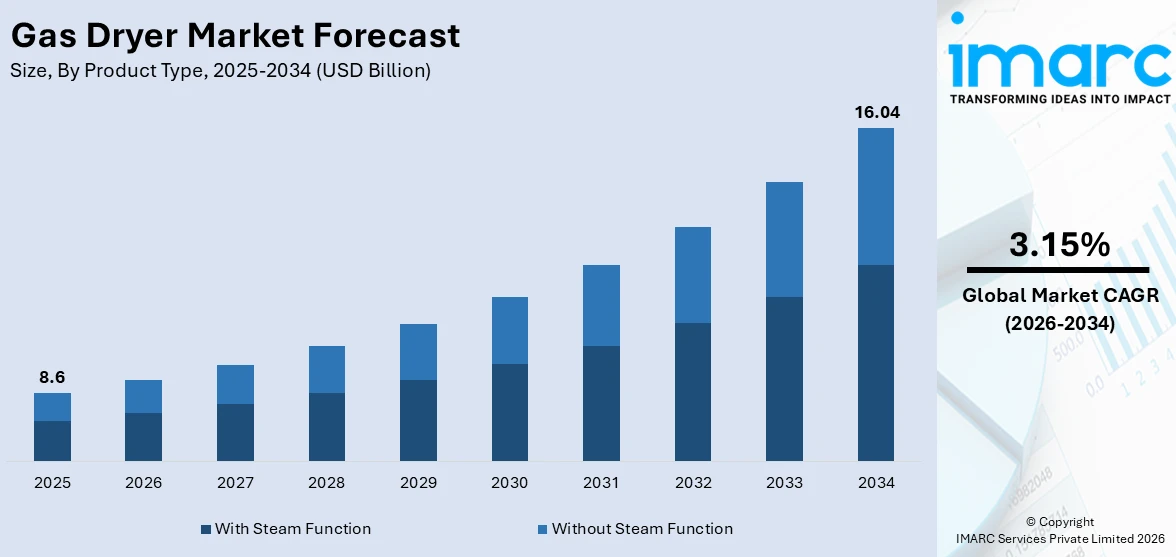
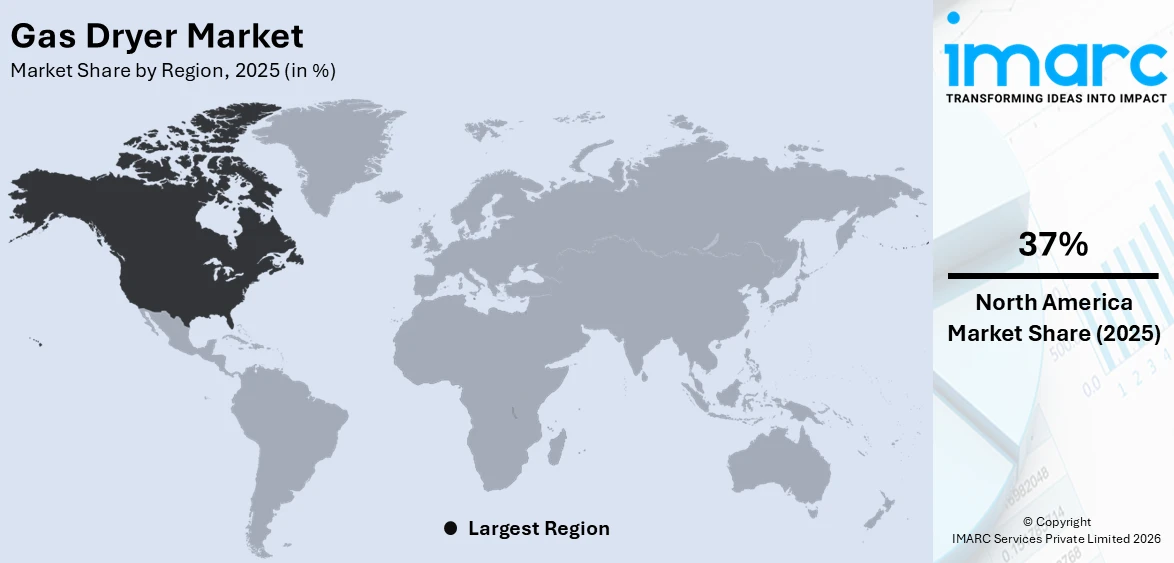
The global gas dryer market size was valued at USD 8.6 Billion in 2025. Looking forward, IMARC Group estimates the market to reach USD 16.04 Billion by 2034, exhibiting a CAGR of 3.15% from 2026-2034. North America currently dominates the market, holding a market share of 37% in 2025. The region benefits from well-established residential gas infrastructure, high household penetration of laundry appliances, and strong consumer preference for gas-powered drying solutions driven by lower operational costs and faster drying cycles, all contributing to the gas dryer market share.
The gas dryer market is being driven by a number of factors that are interlinked and are thus contributing to the growing demand for gas dryers across various geographies. The growing urbanization and rise in the global middle-class population are thus contributing to the growing demand for gas dryers, as more and more households are looking for efficient laundry solutions. The growing demand for on-demand laundry and dry-cleaning services, which offer doorstep pick-up and delivery services, is thus contributing to the growing demand for gas dryers. The growing demand for gas dryers is also being driven by the growing research and development activities of manufacturers, who are thus incorporating innovative features such as moisture sensors, steam refresh, and sanitize cycles in gas dryers. The growing real estate sector and construction of residential complexes and luxury housing projects across various geographies are thus contributing to the gas dryer market growth.
The United States has emerged as a major region in the market owing to many factors. The widespread availability of natural gas infrastructure across American households makes gas dryers a practical and cost-effective choice for residential consumers. Increasing consumer awareness regarding the lower operational costs of gas dryers compared to electric alternatives is driving product adoption, as gas models typically offer faster drying times and reduced energy expenditure per cycle. Furthermore, the growing number of laundromats and commercial laundry facilities across the country is catalyzing demand for high-capacity gas dryers. For instance, in October 2025, Whirlpool announced a USD 300 million investment in two of its laundry manufacturing facilities in Ohio, including its Marion factory that produces dryers, expected to create up to 600 new jobs. The rising trend of smart home integration and connected appliances is further propelling consumer interest in advanced gas dryer models.
To get more information on this market Request Sample
Gas Dryer Market Trends:
Smart Technology and IoT Integration
The integration of smart technology and the Internet of Things into gas dryers is transforming the consumer laundry experience. Modern gas dryers are equipped with advanced sensors, Wi-Fi connectivity, and smartphone application controls that allow users to remotely start, stop, and monitor drying cycles from anywhere. Artificial intelligence-powered features automatically detect fabric type, load weight, and moisture levels to optimize drying settings, preventing over-drying and reducing energy waste. Voice assistant compatibility through platforms such as Google Assistant and Amazon Alexa further enhances convenience and accessibility for tech-savvy consumers. For instance, in January 2026, Samsung unveiled its upgraded Bespoke AI Laundry Combo at CES 2026, featuring AI Wash and Dry technology that uses multiple sensors to detect load weight, identify five fabric types including outdoor and denim, and monitor soil levels in real time. The growing consumer preference for connected home ecosystems is accelerating the adoption of smart-enabled gas dryers across residential and commercial segments.
Rising Energy Efficiency Standards
Energy efficiency has emerged as a defining trend in the gas dryer market, driven by stringent regulatory standards and heightened consumer environmental awareness. Governments and regulatory bodies across major economies are implementing updated ecodesign requirements and energy labelling frameworks that compel manufacturers to develop more efficient drying technologies. Consumers are increasingly prioritizing ENERGY STAR-certified appliances that deliver superior performance while minimizing energy consumption and reducing utility costs over the product lifecycle. The gas dryer market outlook is strengthened by this accelerating shift toward sustainable appliance solutions. For instance, from July 2025, the European Union implemented updated ecodesign and energy labelling measures for household tumble dryers, with estimates indicating cumulative energy savings of 15 TWh and potential consumer savings of EUR 2.8 billion by 2040. Manufacturers are responding by incorporating advanced heat management systems, improved insulation, and precision burner assemblies that maximize thermal efficiency. These innovations not only align with global sustainability goals but also resonate with the growing segment of eco-conscious consumers seeking cost-effective and environmentally responsible drying solutions.
Expanding Commercial Laundry Sector
The rapid expansion of the commercial laundry sector is emerging as a significant trend driving the gas dryer market. Laundromats, dry-cleaning centers, hotels, hospitals, and nursing homes are increasingly deploying high-capacity gas dryers to meet the growing volume of textile care requirements. The rising demand for professional laundry services, fueled by busy urban lifestyles, dual-income households, and growing hospitality and healthcare industries, is propelling gas dryer market forecast. Wash-and-fold services, along with pick-up and delivery options, are becoming major revenue drivers for commercial laundry operators, requiring reliable and high-throughput drying equipment. Commercial operators prefer gas dryers for their faster drying capabilities, lower per-load operating costs, and ability to handle heavy-duty continuous cycles, making them the preferred choice for high-volume laundry environments. In 2025, LG Electronics USA, considered the swiftest-growing appliance contender in the U.S. commercial laundry sector, has launched a new line of top-load washers utilizing the direct-drive motor technology developed by the company. Displayed for the first time this week at North America's largest commercial laundry exhibition, The Clean Show, the 27-inch high-efficiency top-load models enhance LG's status as America's most dependable and top appliance brand.
.webp)
Gas Dryer Industry Segmentation:
IMARC Group provides an analysis of the key trends in each segment of the global gas dryer market, along with forecast at the global, regional, and country levels from 2026-2034. The market has been categorized based on product type, capacity, price range, distribution channel, and end use.
Analysis by Product Type:
- With Steam Function
- Without Steam Function
With steam function holds 58% of the market share. Gas dryers equipped with steam functionality have gained widespread consumer preference owing to their ability to deliver enhanced fabric care through wrinkle reduction, odor removal, and gentle sanitization of garments. Steam-enabled dryers utilize moisture-infused heat to relax fabric fibers, resulting in fewer creases and eliminating the need for extensive ironing. This advanced feature is particularly valued by households seeking convenience and time-saving laundry solutions that preserve the quality and appearance of diverse textile types. Additionally, the steam function provides antimicrobial benefits by eliminating common household bacteria, making these models especially attractive for families with young children and health-conscious consumers. For instance, in February 2025, Whirlpool showcased its 7.4 cu. ft. Smart Front Load ENERGY STAR Gas Dryer with Steam Capabilities at the Kitchen and Bath Industry Show, featuring steam-enhanced cycles designed to prevent wrinkles, refresh clothes, and reduce static. The versatility and premium performance attributes of steam-equipped gas dryers are sustaining their dominance across both residential and commercial applications.
Analysis by Capacity:
- Less Than 7 Cu.ft.
- 7 – 8 Cu.ft.
- More Than 8 Cu.ft.
7 to 8 Cu.ft. leads the market with a share of 52%. This capacity range represents the optimal balance between load size and space efficiency, making it the most popular choice among both residential and commercial users of gas dryers. Dryers within the 7 to 8 cubic feet range can accommodate large household loads, including bedding, towels, and bulky items, without requiring excessive floor space, which is critical for standard-sized laundry rooms. The capacity aligns well with the output of matching washers in this size category, ensuring seamless laundry pair compatibility and efficient cycle management. Consumers value the versatility of these mid-to-large capacity dryers for their ability to handle diverse fabric types and load sizes in a single cycle, reducing overall drying time and energy consumption.
Analysis by Price Range:
- Less Than US$ 300
- US$ 300 – US$ 500
- US$ 500 – US$ 700
- US$ 700 – US$ 900
- More Than US$ 900
Less than USD 300 dominates the market, with a share of 28%. The affordability of gas dryers priced below USD 300 makes them accessible to a broad consumer base, particularly price-sensitive households, first-time buyers, and consumers in developing economies seeking cost-effective laundry solutions. Despite their lower price point, these entry-level models deliver reliable drying performance with essential features including multiple heat settings, timed drying cycles, and lint filtration systems that meet fundamental consumer expectations. The strong demand in this segment is further supported by the wide availability of budget-friendly gas dryers through both online and offline retail channels, enabling convenient purchasing options for diverse customer demographics. The continued focus of manufacturers on delivering value-oriented products that balance essential functionality with competitive pricing is sustaining the dominance of this segment.
Analysis by Distribution Channel:
Access the comprehensive market breakdown Request Sample
- Online
- E-Commerce Websites
- Company-Owned Websites
- Offline
- Hypermarkets and Supermarkets
- Departmental Stores
- Others
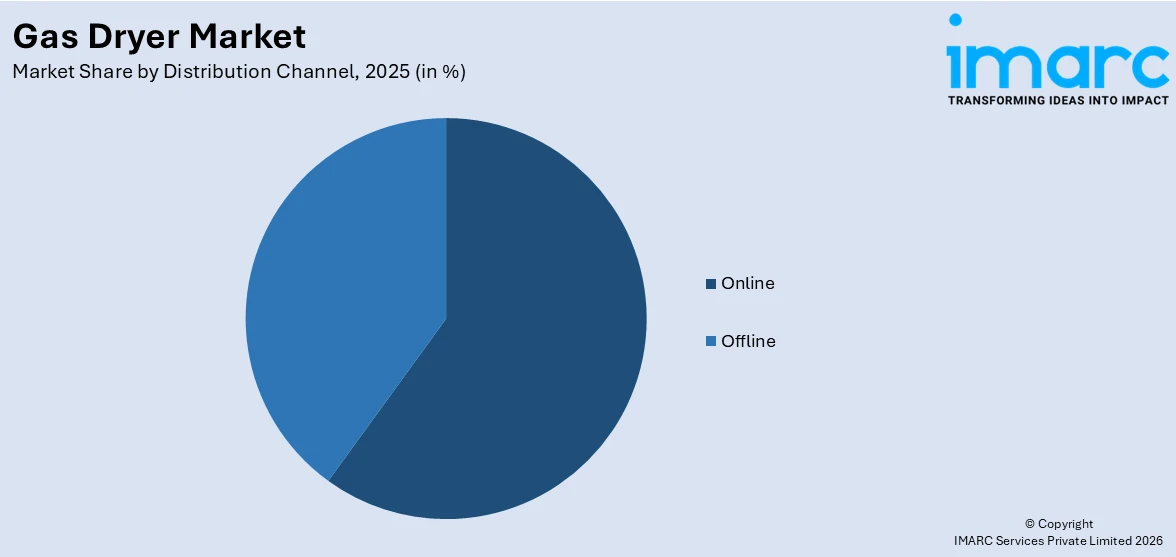
Online distribution channels are gaining significant traction in the gas dryer market as consumers increasingly prefer the convenience of digital platforms for researching and purchasing home appliances. E-commerce websites offer extensive product comparisons, customer reviews, and competitive pricing that empower informed decision-making. Company-owned websites provide direct access to full product catalogs, exclusive promotions, and after-sales support. The growing penetration of smartphones, improved logistics infrastructure, and the availability of flexible payment options such as installment plans and digital wallets are further accelerating online appliance sales globally.
Offline retail channels continue to hold substantial relevance in the gas dryer market, as many consumers prefer hands-on product evaluation before committing to a purchase. Hypermarkets and supermarkets provide the advantage of wide product visibility, immediate availability, and bundled promotional offers alongside other home appliances. Departmental stores cater to consumers seeking premium shopping experiences with knowledgeable sales staff who can demonstrate features and assist with product selection. Physical retail outlets remain essential for customers who prioritize instant delivery and in-person after-sales service arrangements.
Analysis by End Use:
- Residential
- Commercial
- Laundry Services
- Washing and Dry-Cleaning Centers
- Hotels
- Hospitals and Nursing Homes
Residential represents the leading segment, with a market share of 55%. The residential segment dominates the gas dryer market as households across the globe increasingly prioritize in-home laundry solutions that offer convenience, faster drying times, and reduced utility costs compared to electric alternatives. The growing number of single-family homes, apartments, and multi-family residential complexes equipped with natural gas connections directly supports the adoption of gas dryers at the household level. Consumers in regions with established natural gas infrastructure favor these appliances for their cost-effective operation and superior drying performance, particularly for large and heavy fabric loads. For instance, according to ENERGY STAR, approximately 80 percent of American homes have a clothes dryer, and if all dryers sold in the US were ENERGY STAR certified, Americans could save more than USD 1.5 billion annually in utility costs. The rising influence of smart home technology, combined with growing awareness about fabric care and hygiene, is further strengthening residential demand for advanced gas dryer models that integrate automation and connectivity features.
Regional Analysis:
To get more information on the regional analysis of this market Request Sample
- North America
- United States
- Canada
- Asia Pacific
- China
- Japan
- India
- South Korea
- Australia
- Indonesia
- Others
- Europe
- Germany
- France
- United Kingdom
- Italy
- Spain
- Russia
- Others
- Latin America
- Brazil
- Mexico
- Others
- Middle East and Africa
North America, accounting for 37% of the share, enjoys the leading position in the market. The region benefits from a well-established residential gas infrastructure, high household penetration of laundry appliances, and strong consumer preference for gas-powered drying solutions driven by lower operational costs and faster drying cycles. The presence of major appliance manufacturers with extensive product portfolios and robust distribution networks further strengthens market dominance. Additionally, growing investments in commercial laundry infrastructure and the expansion of laundromat chains across metropolitan areas contribute to sustained demand. For instance, in 2025, the US market for laundry dryers is experiencing rapid growth, reflecting strong consumer spending on home appliance products driven by surging housing construction and technological upgrades. The continued introduction of innovative product features including smart connectivity, steam capabilities, and energy-efficient technologies is reinforcing the regional market position.
Key Regional Takeaways:
United States Gas Dryer Market Analysis
The United States represents the dominant force in the gas dryer market, driven by the extensive penetration of natural gas lines in residential properties and the well-established consumer preference for gas-powered home appliances. The country's mature housing market, combined with ongoing new construction activity and renovation projects, sustains a steady replacement and upgrade cycle for household laundry appliances. American consumers increasingly value advanced features including smart connectivity, moisture sensing technology, and steam-enhanced cycles that deliver superior fabric care and operational convenience. The growing trend of connected home ecosystems, where laundry appliances integrate seamlessly with other smart devices through centralized applications, is further accelerating product adoption. For instance, in August 2025, GE Appliances announced plans to invest more than USD 3 billion in its US operations over the next five years, including a USD 490 million project at its Appliance Park manufacturing campus in Louisville, Kentucky, aimed at expanding washer and dryer production and reshoring manufacturing from China. The expanding commercial laundry sector, including the proliferation of laundromats and professional fabric care services in urban centers, is generating additional demand for high-capacity gas drying equipment that delivers reliable throughput and cost-effective operation.
Europe Gas Dryer Market Analysis
Europe represents a significant market for gas dryers, driven by growing consumer awareness of energy efficiency, evolving regulatory standards, and increasing investment in premium household appliances. The region's well-developed residential infrastructure and high standard of living support consistent demand for advanced laundry solutions that combine performance with sustainability. European consumers are particularly responsive to innovations in energy-efficient drying technologies, influenced by stringent regulatory frameworks that incentivize the adoption of compliant and eco-friendly appliances. The presence of established appliance manufacturers and a strong retail network facilitates broad market access and consumer education regarding the benefits of gas drying solutions. For instance, the European Commission reported that approximately 60 million household dryers are currently in use across the EU, with updated ecodesign measures from July 2025 expected to save consumers approximately EUR 2.8 billion through improved energy efficiency standards. The growing emphasis on appliance longevity, repairability, and circular economy principles is shaping product development strategies across the European gas dryer market.
Asia-Pacific Gas Dryer Market Analysis
The Asia-Pacific region is emerging as a high-growth market for gas dryers, fueled by rapid urbanization, expanding middle-class populations, and rising disposable incomes across major economies. The transition toward modern living standards in densely populated urban centers is increasing consumer demand for time-saving home appliances, including efficient clothes dryers. Manufacturers are targeting this region with a range of affordable and feature-rich models designed to meet diverse consumer preferences. For instance, China's cloth dryer penetration rate is rising, providing an emerging opportunity for global manufacturers to expand as household spending on home appliances continues to rise. The growing influence of e-commerce platforms and digital retail channels is further facilitating market penetration and consumer access to gas drying solutions across the region. In February 2026, Roborock has revealed two new washer-dryer combinations in China, the Z1 Ultra and M1S Ultra, both featuring its unique Super Hydrolysis technology. These can now be pre-ordered on JD.com.
Latin America Gas Dryer Market Analysis
Latin America presents growing opportunities for the gas dryer market, supported by increasing urbanization, rising consumer spending on household goods, and the expanding penetration of online retail channels. The region is witnessing a gradual shift in consumer preferences toward modern laundry appliances driven by improving economic conditions and growing awareness of the benefits of gas-powered drying solutions. For instance, in 2025, the laundry dryer market in South America is driven by rising demand fueled by expanding e-commerce platforms, digital payment adoption, and improved logistics infrastructure. The presence of major appliance brands expanding their distribution networks is enhancing product accessibility across the region.
Middle East and Africa Gas Dryer Market Analysis
The Middle East and Africa region is experiencing gradual growth in the gas dryer market, driven by accelerating urbanization, rising household formation, and increasing investment in commercial laundry infrastructure. The expanding hospitality and healthcare sectors across the region are generating demand for high-capacity commercial drying equipment to manage large textile volumes efficiently. For instance, in the Middle East and Africa, dryers are used in numerous of households in major cities, with ventless and compact models gaining preference in apartment-style residential settings. The growing availability of gas dryers through both traditional retail outlets and emerging online platforms is supporting market expansion across the region.
Competitive Landscape:
The global gas dryer market features intense competition among established appliance manufacturers and emerging regional players who are pursuing diverse strategies to strengthen their market positions. Leading companies are investing significantly in research and development to introduce innovative products that incorporate smart connectivity, advanced sensor technologies, steam functionality, and improved energy efficiency features. Strategic partnerships, mergers, and acquisitions are enabling market participants to expand their production capabilities, diversify product portfolios, and extend distribution reach across key geographic markets. Furthermore, manufacturers are focusing on reshoring production activities and strengthening domestic manufacturing infrastructure to mitigate supply chain vulnerabilities and align with evolving trade policies. Companies are also leveraging digital marketing strategies, celebrity endorsements, and social media campaigns to enhance brand visibility and engage with increasingly tech-savvy consumer demographics seeking premium laundry solutions.
The report provides a comprehensive analysis of the competitive landscape in the gas dryer market with detailed profiles of all major companies, including:
- Alliance Laundry Systems LLC
- Electrolux AB
- GE Appliances (Haier Group Corporation)
- LG Electronics Inc. (LG Corporation)
- Rinnai Corporation
- Samsung Electronics Co. Ltd.
- Transform SR Brands LLC
- Whirlpool Corporation
Latest News and Developments:
- February 2026: PSB Industries, an expert in the design and manufacturing of systems for gas and liquid dehydrating and purifying, showcased its variety of Specialty Gas Dryers. Created to fulfill the stringent needs of electronic manufacturing sites, these cutting-edge dryers provide exceptional performance in refining argon, helium, nitrogen, and hydrogen gases, guaranteeing optimal purity and efficiency for essential processes in electronics manufacturing.
- November 2025: Global Standard Air / Gas (GSA), a prominent supplier of compressed air and gas treatment systems, has effectively supplied its hydrogen dryer, which is engineered and produced using proprietary technology. The system establishes a new standard for hydrogen purification, merging efficiency, safety, and sustainability.
Gas Dryer Market Report Scope:
| Report Features | Details |
|---|---|
| Base Year of the Analysis | 2025 |
| Historical Period | 2020-2025 |
| Forecast Period | 2026-2034 |
| Units | Billion USD |
| Scope of the Report |
Exploration of Historical Trends and Market Outlook, Industry Catalysts and Challenges, Segment-Wise Historical and Future Market Assessment:
|
| Product Types Covered | With Steam Function, Without Steam Function |
| Capacities Covered | Less Than 7 Cu.ft., 7 – 8 Cu.ft., More Than 8 Cu.ft. |
| Price Ranges Covered | Less Than US$ 300, US$ 300 – US$ 500, US$ 500 – US$ 700, US$ 700 – US$ 900, More Than US$ 900 |
| Distribution Channels Covered |
|
| End Uses Covered |
|
| Regions Covered | Asia Pacific, Europe, North America, Latin America, Middle East and Africa |
| Countries Covered | United States, Canada, Germany, France, United Kingdom, Italy, Spain, Russia, China, Japan, India, South Korea, Australia, Indonesia, Brazil, Mexico |
| Companies Covered | Alliance Laundry Systems LLC, Electrolux AB, GE Appliances (Haier Group Corporation), LG Electronics Inc. (LG Corporation), Rinnai Corporation, Samsung Electronics Co. Ltd., Transform SR Brands LLC, Whirlpool Corporation, etc. |
| Customization Scope | 10% Free Customization |
| Post-Sale Analyst Support | 10-12 Weeks |
| Delivery Format | PDF and Excel through Email (We can also provide the editable version of the report in PPT/Word format on special request) |
Key Benefits for Stakeholders:
- IMARC’s report offers a comprehensive quantitative analysis of various market segments, historical and current market trends, market forecasts, and dynamics of the gas dryer market from 2020-2034.
- The research study provides the latest information on the market drivers, challenges, and opportunities in the global gas dryer market.
- The study maps the leading, as well as the fastest-growing, regional markets. It further enables stakeholders to identify the key country-level markets within each region.
- Porter's Five Forces analysis assists stakeholders in assessing the impact of new entrants, competitive rivalry, supplier power, buyer power, and the threat of substitution. It helps stakeholders to analyze the level of competition within the gas dryer industry and its attractiveness.
- Competitive landscape allows stakeholders to understand their competitive environment and provides an insight into the current positions of key players in the market.
Frequently Asked Questions About the Gas Dryer Market Size Report
The gas dryer market was valued at USD 8.6 Billion in 2025.
The gas dryer market is projected to exhibit a CAGR of 3.15% during 2026-2034, reaching a value of USD 16.04 Billion by 2034.
The gas dryer market is driven by the increasing adoption of smart and energy-efficient laundry appliances, the growing commercial laundry sector including laundromats and hospitality services, expanding residential construction activities globally, and rising consumer preference for gas-powered drying solutions that offer faster cycles and lower operational costs.
North America currently dominates the gas dryer market, accounting for a share of 37% in 2025. The region benefits from well-established residential gas infrastructure, high household appliance penetration, and strong consumer demand for advanced gas drying solutions.
Some of the major players in the gas dryer market include Alliance Laundry Systems LLC, Electrolux AB, GE Appliances (Haier Group Corporation), LG Electronics Inc. (LG Corporation), Rinnai Corporation, Samsung Electronics Co. Ltd., Transform SR Brands LLC, Whirlpool Corporation, etc.
Need more help?
- Speak to our experienced analysts for insights on the current market scenarios.
- Include additional segments and countries to customize the report as per your requirement.
- Gain an unparalleled competitive advantage in your domain by understanding how to utilize the report and positively impacting your operations and revenue.
- For further assistance, please connect with our analysts.
 Request Customization
 Speak to an Analyst
 Request Brochure
 Inquire Before Buying
Benefits of Customization
- Personalize this research
- Triangulate with your data
- Get data as per your format and definition
- Gain a deeper dive into a specific application, geography, customer, or competitor
- Any level of personalization
Get in Touch With Us
UNITED STATES
Phone: +1-201-971-6302
INDIA
Phone: +91-120-433-0800
UNITED KINGDOM
Phone: +44-753-714-6104
Email: [email protected]
Client Testimonials




.webp)




.webp)













Related Reports

Choose your plan
*Please note that the prices mentioned below are starting prices for each bundle type. Kindly contact our team for further details.*
Single User License
- 1 User License, Access on 2 Devices
- PDF Report + Excel Dataset (Password Protected)
- Lifetime Access
- No Printing Rights
- 10% Free Report Customization
- 10–12 Weeks of Analyst Support
Five User License
- Access for 5 Users, 2 Devices per User
- PDF Report + Excel Dataset (Password Protected)
- Lifetime Access
- Dedicated Account Manager
- 12–14 Weeks of Analyst Support
- No Printing Rights
- 15% Free Report Customization
- 25% Discount on Your Next Purchase
Corporate User License
- Unlimited User Access (Within Your Organization)
- PDF Report + Excel Dataset
- Lifetime Access
- Dedicated Account Manager
- 14–20 Weeks of Analyst Support
- No Printing Rights
- 20% Free Report Customization
- 30% Discount on Your Next Purchase
Essential Insights
What's included:
3 reports
- Lifetime Access
- PDF Reports
- Excel Datasets
- 2 Weeks of Free Analyst Support
- 2 User Licenses
- Access on 2 Devices
- Printing Rights
- Complimentary PowerPoint (PPT) Version
- Complimentary License Upgrade
Professional Access
What's included:
5 reports
- Lifetime Access
- PDF Reports
- Excel Datasets
- 8 Weeks of Free Analyst Support
- 2 User Licenses
- Access on 2 Devices
- Printing Rights
- Complimentary PowerPoint (PPT) Version
- Complimentary License Upgrade
Business Advantage
What's included:
8 reports
- Lifetime Access
- PDF Reports
- Excel Datasets
- 14 Weeks of Free Analyst Support
- 2 User Licenses
- Access on 2 Devices
- Printing Rights
- Complimentary PowerPoint (PPT) Version
- Complimentary License Upgrade
Enterprise Intelligence
What's included:
10 reports
- Lifetime Access
- PDF Reports
- Excel Datasets
- 20 Weeks of Free Analyst Support
- 2 User Licenses
- Access on 2 Devices
- Printing Rights
- Complimentary PowerPoint (PPT) Version
- Complimentary License Upgrade