
GCC Concrete Admixtures Construction Chemical Market Size, Share, Trends and Forecast by Type, Application, and Country, 2026-2034
GCC Concrete Admixtures Construction Chemical Market Size, Share, Trends & Forecast (2026-2034)
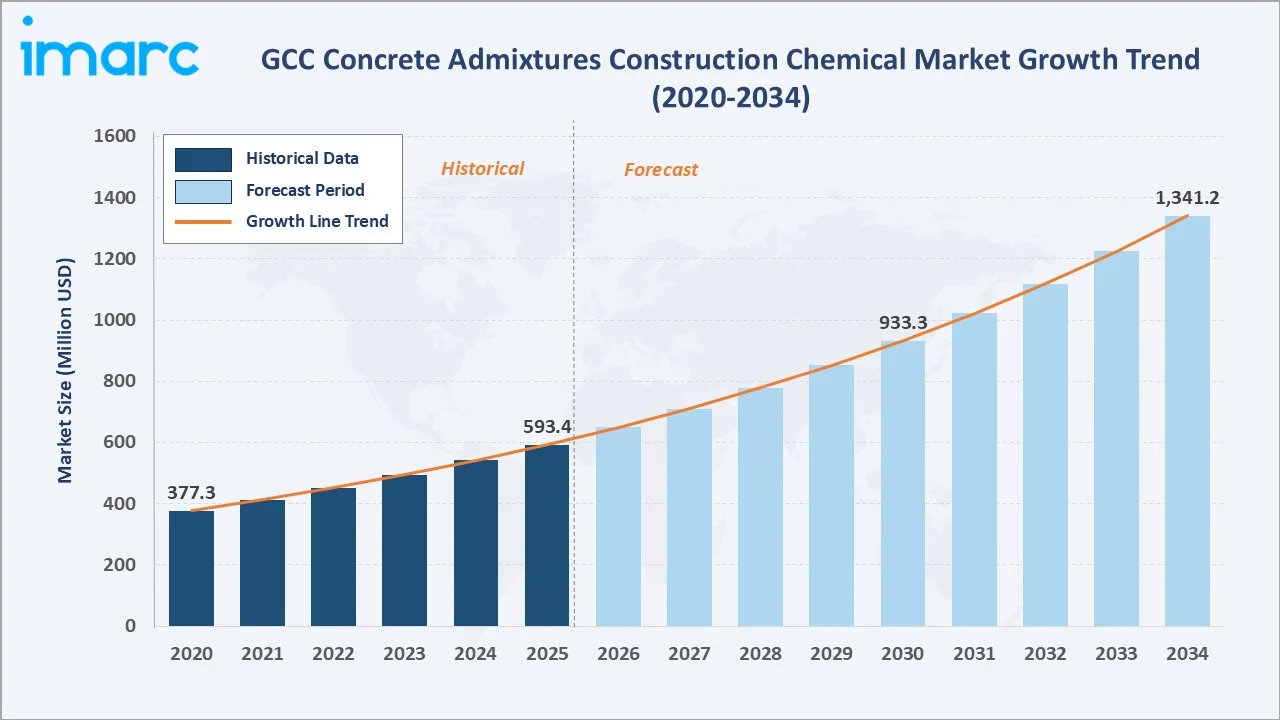
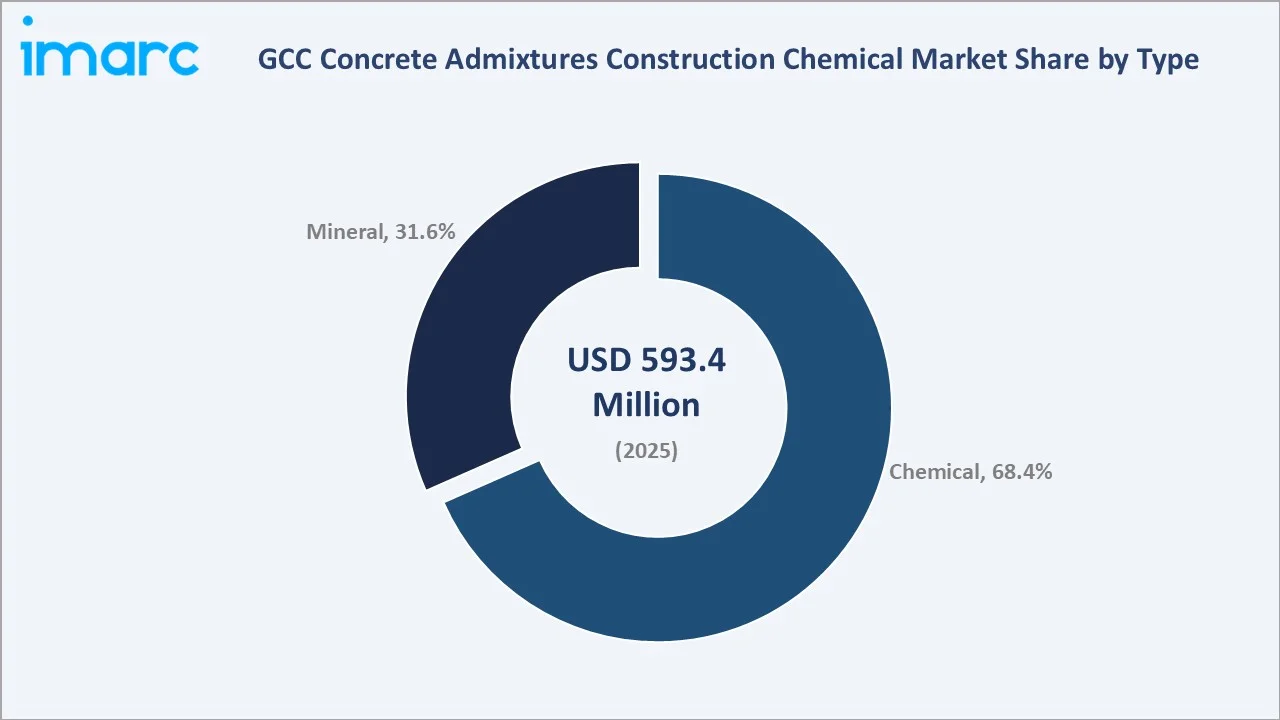
The GCC concrete admixtures construction chemical market reached USD 593.4 Million in 2025 and is projected to reach USD 1,341.2 Million by 2034, growing at a CAGR of 9.48% during 2026-2034. The market is driven by rising investments in infrastructure, commercial, and residential construction, along with increasing adoption of high-performance and durable concrete solutions. Saudi Arabia’s construction sector is strongly supported by the Public Investment Fund (PIF), which acts as a key financier and sponsor of major giga-projects, including NEOM, a USD 500 Billion futuristic city, Red Sea Global, a USD 23.6 Billion sustainable luxury tourism project along the Red Sea Coast, and Qiddiya, a USD 9.8 Billion entertainment and leisure city. These large-scale developments are driving the market by increasing demand for concrete admixtures, waterproofing systems, repair materials, sealants, and durability-enhancing solutions required for complex infrastructure and high-performance buildings. Chemical leads type at 68.4%. Infrastructure leads application at 39.7%. Saudi Arabia leads regionally at 38.8%.
Market Snapshot
|
Metric |
Value |
|
Market Size (2025) |
USD 593.4 Million |
|
Forecast Market Size (2034) |
USD 1,341.2 Million |
|
CAGR (2026-2034) |
9.48% |
|
Base Year |
2025 |
|
Historical Period |
2020-2025 |
|
Forecast Period |
2026-2034 |
|
Dominant Type |
Chemical Admixtures (68.4%, 2025) |
|
Dominant Application |
Infrastructure (39.7%, 2025) |
|
Leading Country |
Saudi Arabia (38.8%, 2025) |
The GCC concrete admixtures construction chemical market grew from USD 377.3 Million in 2020 to USD 593.4 Million in 2025, driven by strong construction activity and giga-project development. It is expected to reach USD 933.3 Million by 2030 as infrastructure, tourism, residential, and commercial projects accelerate. By 2034, the market is forecast to reach USD 1,341.2 Million, reflecting robust long-term demand. Growth will be supported by high-performance concrete, waterproofing, repair, and durability-enhancing solutions across GCC construction projects.
To get more information on this market, Request Sample
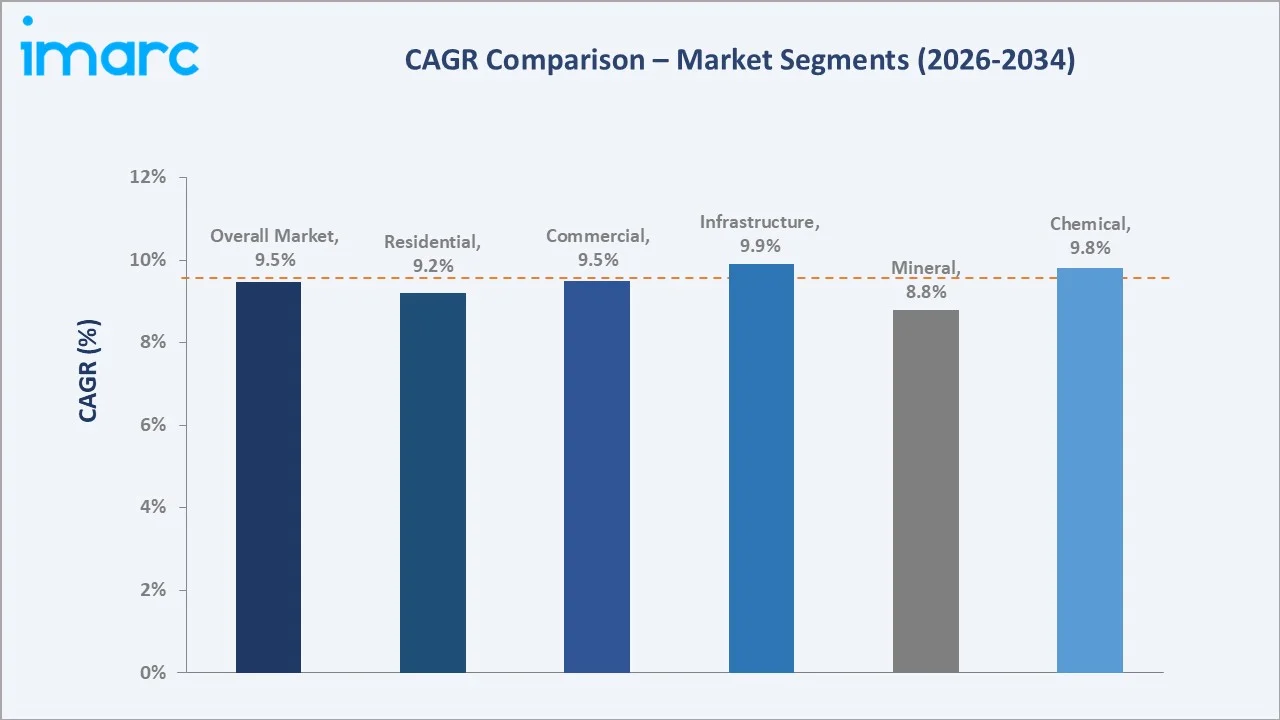
Chemical admixtures grow fastest at ~9.8% CAGR through PCE superplasticizer NEOM UHPC demand. Infrastructure grows at ~9.9% CAGR through NEOM The Line, Riyadh Metro, and UAE highway. Repair structure at ~9.6% CAGR through UAE and Qatar aging infrastructure maintenance.
Executive Summary
The GCC concrete admixtures construction chemical market is witnessing strong growth, supported by large-scale infrastructure, tourism, residential, and commercial developments across the region. Saudi Arabia remains a key demand center, driven by PIF-backed giga-projects such as NEOM, Red Sea Global, and Qiddiya. Rising use of concrete admixtures, waterproofing systems, sealants, and repair materials is improving building durability and construction efficiency. Demand is further strengthened by sustainable construction practices and high-performance concrete requirements. Chemical at 68.4% leads through PCE superplasticizer and set retarder. Infrastructure at 39.7% leads through roads, bridges, and metro. Saudi Arabia leads regionally at 38.8%.
Key Market Insights
|
Insight |
Data |
|
Dominant Type |
Chemical - 68.4% share (2025) |
|
Dominant Application |
Infrastructure - 39.7% market share (2025) |
|
Leading Country |
Saudi Arabia - 38.8% share (2025) |
|
Market Opportunity |
Saudi GIGA project infrastructure; GCC green concrete low-carbon admixture; superplasticizer extreme heat GCC; repair waterproofing aging infrastructure; UAE Abu Dhabi highway; ready-mix concrete chemical |
Key Analytical Observations Supporting The Above Data:
- Chemical at 68.4%: The chemical dominates due to its wide use in concrete admixtures, waterproofing, sealants, repair compounds, and protective coatings. These products are essential for improving durability, strength, and performance in GCC construction projects.
- Infrastructure at 39.7%: Infrastructure dominates the market due to large-scale investments in roads, bridges, airports, metros, utilities, and smart city projects across the GCC. These projects require high-performance construction chemicals to enhance concrete strength, durability, waterproofing, and long-term structural performance.
- Saudi Arabia at 38.8%: Saudi Arabia dominates regionally due to its massive pipeline of infrastructure, housing, tourism, and industrial projects under Vision 2030. Large giga-projects such as NEOM, Red Sea Global, and Qiddiya continue to drive demand for concrete admixtures, waterproofing, sealants, and repair chemicals.
GCC Concrete Admixtures Construction Chemical Market Overview
The GCC concrete admixtures construction chemical market encompasses admixtures, waterproofing chemicals, repair compounds, sealants, adhesives, protective coatings, and flooring chemicals used across infrastructure, residential, commercial, and industrial construction. Demand is supported by high-performance concrete requirements, durability improvement, faster curing, and harsh climate resistance. The market serves roads, bridges, airports, metros, ports, smart cities, and giga-projects. It also includes suppliers, applicators, contractors, and construction chemical manufacturers. Growth is strongly linked to Saudi Vision 2030 projects, urban development, and sustainable construction practices across the GCC. Macroeconomic factors include sustained government spending on infrastructure, economic diversification under Vision 2030 and similar national strategies, and rising foreign direct investment across the GCC.
Market Dynamics
To evaluate market opportunities, Request Sample
Market Drivers
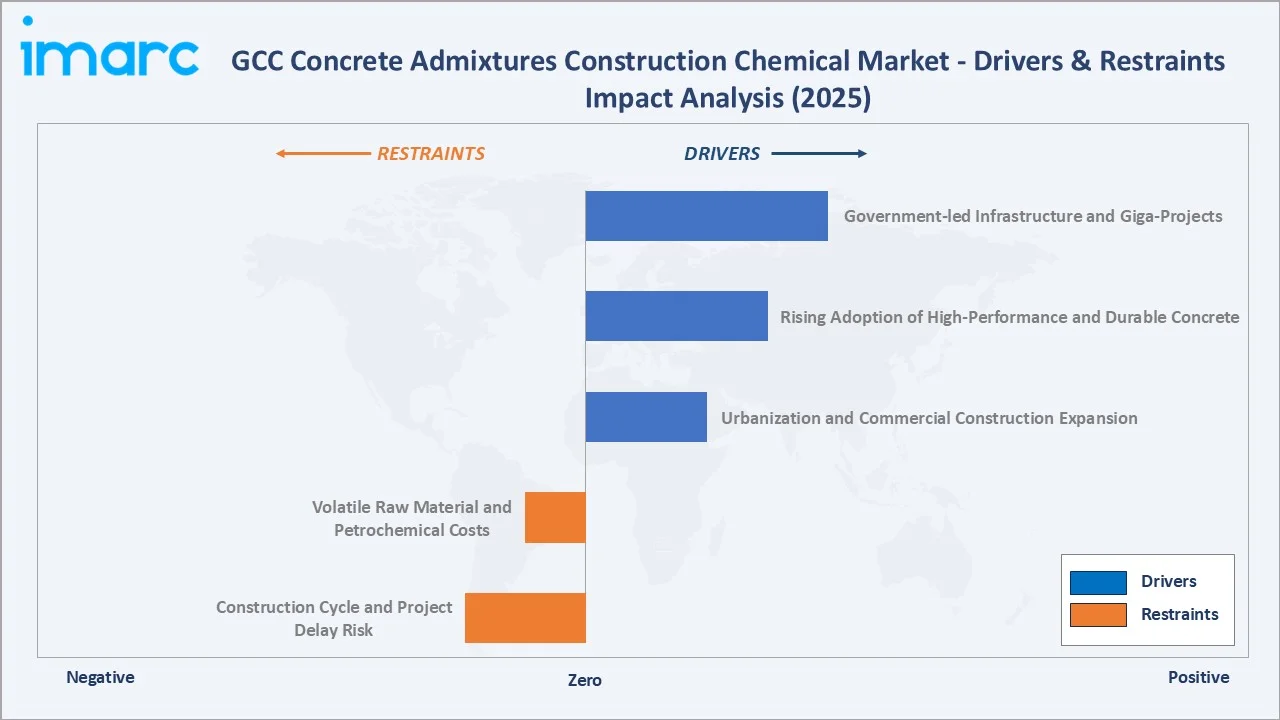
- Government-led Infrastructure and Giga-Projects: Government-led infrastructure and giga-projects are creating strong demand for high-performance concrete and durability-enhancing solutions. Large projects such as NEOM, Red Sea Global, Qiddiya, airports, metros, ports, and smart cities require admixtures for strength, workability, faster curing, and long service life. NEOM’s public updates became more measured during 2025, with THE LINE Phase 1 timelines now shifting toward 2030–2032. The initial 2030 target appears to have narrowed to a 2.4-kilometre Stage 1 module, instead of the originally planned 5-kilometre section. For workforce planning, this suggests a slower but longer construction ramp-up. NEOM’s active workforce of 245,000 in 2025 is expected to peak at 320,000–360,000 during 2028–2029, below earlier 500,000+ projections, while remaining above 250,000 through 2032. As public investment continues, construction chemical consumption is expected to rise steadily.
- Rising Adoption of High-Performance and Durable Concrete: Rising adoption of high-performance and durable concrete is driving demand for advanced admixtures that improve strength, workability, setting time, and long-term structural life. GCC projects require concrete that can withstand heat, humidity, salinity, and heavy infrastructure loads. Admixtures such as superplasticizers, accelerators, retarders, and corrosion inhibitors help meet these performance needs. As builders prioritize durability and lifecycle cost reduction, construction chemical consumption continues to grow.
- Urbanization and Commercial Construction Expansion: Urbanization and commercial construction expansion are driving demand for concrete admixtures and construction chemicals across the GCC. According to the Ministry of Municipal and Rural Affairs, around 82.1% of the total population lives in urban areas, while 17.9% resides in rural areas. At the regional level, six regions report urbanization rates above 80%, including the Eastern Province (93.2%), Riyadh (90.9%), Makkah (87.6%), Northern Borders (86.7%), Tabuk (85.9%), and Jouf (84.5%). Among Saudi nationals, about 76% live in urban areas and 24% in rural areas. As urban infrastructure becomes larger and more complex, construction chemical usage continues to grow steadily.
Market Restraints
- Volatile Raw Material and Petrochemical Costs: Volatile raw material and petrochemical costs are increasing production expenses for additives, polymers, resins, and specialty chemicals. Price fluctuations can reduce supplier margins and create uncertainty in project procurement budgets. Since many formulations depend on petrochemical-based inputs, changes in oil, energy, and logistics costs directly affect pricing. This may delay bulk purchases or push contractors toward lower-cost alternatives.
- Construction Cycle and Project Delay Risk: Construction cycle and project delay risk hamper the market as construction chemical demand is directly linked to project execution timelines. Delays caused by financing issues, approvals, design changes, contractor shortages, or supply disruptions can postpone admixture and chemical consumption. This creates uncertainty for suppliers in production planning, inventory management, and revenue forecasting. Prolonged delays may also intensify price competition as suppliers compete for fewer active projects.
Market Opportunities
- Adoption of Low-Carbon and Sustainable Construction Chemicals: The adoption of low-carbon and sustainable construction chemicals presents a significant opportunity as governments increasingly promote green building practices and net-zero carbon initiatives. Demand is rising for eco-friendly admixtures that reduce cement consumption, lower embodied carbon, improve durability, and extend the service life of structures. Green building certifications and sustainable procurement standards are further encouraging the use of environmentally responsible construction materials. Manufacturers investing in innovative, low-emission formulations are well positioned to capitalize on the region's expanding sustainable construction pipeline.
- Increasing Renovation and Infrastructure Rehabilitation Activities: Increasing renovation and infrastructure rehabilitation activities create opportunities for construction chemicals used in concrete repair, waterproofing, grouting, sealants, and protective coatings. Aging roads, bridges, ports, utilities, and commercial buildings require durable repair solutions to extend service life and reduce maintenance costs. Harsh GCC climatic conditions also increase the need for corrosion protection and moisture-resistant materials. As governments prioritize asset maintenance alongside new construction, demand for rehabilitation-focused construction chemicals is expected to rise.
Market Challenges
- Maintaining Product Performance Under Extreme GCC Climatic Conditions: Maintaining product performance under extreme GCC climatic conditions is challenging as construction chemicals must withstand high temperatures, humidity, salinity, and thermal stress. These conditions can affect setting time, workability, bonding strength, waterproofing performance, and long-term durability. Manufacturers must develop formulations suitable for harsh environments and varying cement or aggregate types. This increases testing requirements, technical complexity, and product development costs.
- Technical Compatibility of Construction Chemicals: Technical compatibility of construction chemicals is a key challenge as admixtures and specialty chemicals must perform consistently with different cement types, aggregates, supplementary cementitious materials, and local mix designs. Incompatible formulations can adversely affect workability, setting time, strength development, and long-term durability. Extensive laboratory testing and on-site validation are therefore required before large-scale application. This increases project complexity, qualification timelines, and overall implementation costs.
Emerging Market Trends
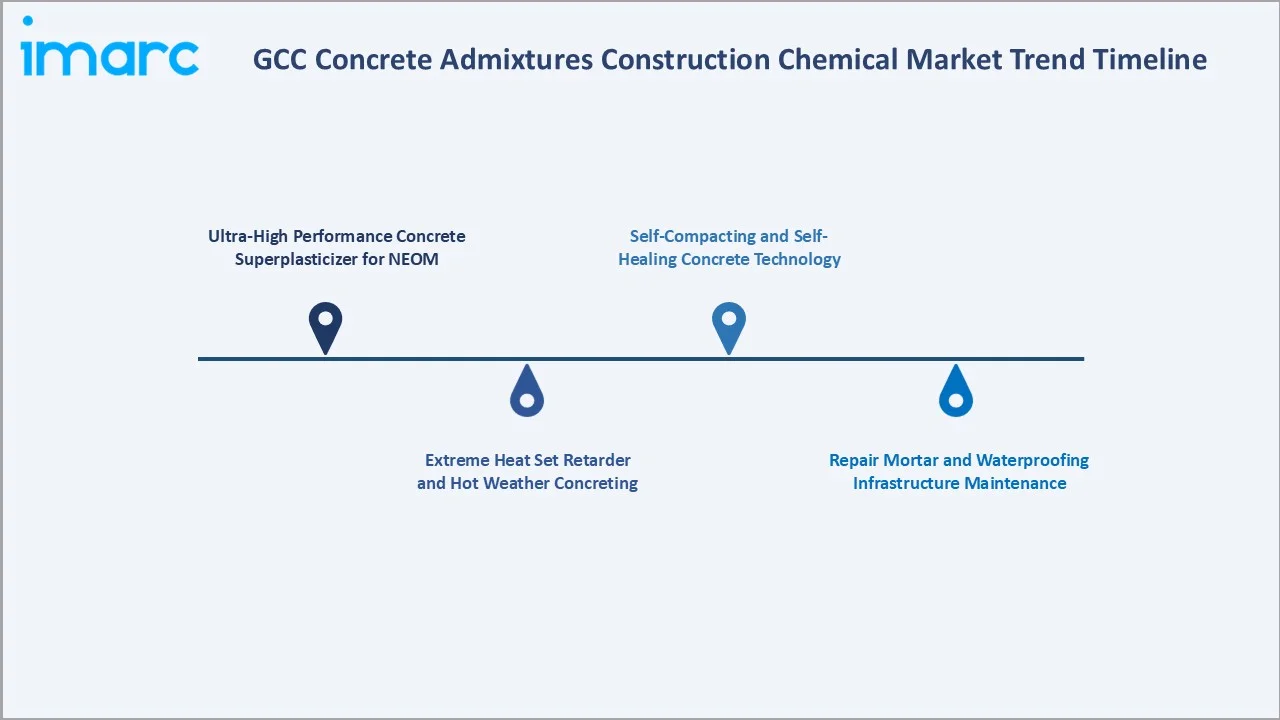
1. Ultra-High Performance Concrete Superplasticizer for NEOM
Saudi Arabia’s futuristic USD 1.5 trillion NEOM development is envisioned as one of the largest and most ambitious construction projects in modern history. Its flagship component, originally targeted for completion by 2030, includes THE LINE, a planned desert city featuring a long stretch of 500-meter-high skyscrapers. Ultra-high performance concrete superplasticizers for NEOM are emerging as mega projects require high-strength, durable, and highly workable concrete for complex structures. These admixtures reduce water demand while improving flowability, early strength, and long-term performance. NEOM’s advanced infrastructure, tunnels, high-rise modules, and harsh desert environment increase the need for specialized concrete technologies. This creates strong demand for premium superplasticizers and performance-enhancing admixtures across GCC giga-projects.
2. Extreme Heat Set Retarder and Hot Weather Concreting
Extreme heat set retarder and hot weather concreting are emerging due to the region's prolonged high temperatures and rapid moisture evaporation during concrete placement. Advanced set retarders and hot-weather admixtures help maintain workability, reduce the risk of cold joints, and minimize thermal cracking. They also improve concrete quality, placement efficiency, and long-term durability in challenging climatic conditions. As infrastructure and giga-project construction accelerates, demand for specialized hot-weather concreting solutions continues to increase.
3. Repair Mortar and Waterproofing Infrastructure Maintenance
Repair mortar and waterproofing infrastructure maintenance is emerging as GCC countries focus on extending the life of roads, bridges, tunnels, utilities, ports, and commercial buildings. Harsh heat, salinity, humidity, and sand exposure increase the need for durable repair and moisture-protection systems. Specialized mortars, waterproofing membranes, and protective coatings help reduce structural deterioration and maintenance costs. As asset rehabilitation rises alongside new construction, demand for these construction chemicals is expected to grow steadily.
4. Self-Compacting and Self-Healing Concrete Technology
Self-compacting and self-healing concrete technology is emerging due to its ability to improve construction efficiency and extend infrastructure lifespan. Self-compacting concrete enhances flowability and eliminates the need for vibration, making it ideal for complex structures and congested reinforcement. Self-healing concrete minimizes crack formation by autonomously sealing microcracks, reducing maintenance costs and improving durability. These technologies are gaining traction in mega infrastructure projects, tunnels, bridges, and high-rise developments where long-term structural performance is a priority.
Industry Value Chain Analysis
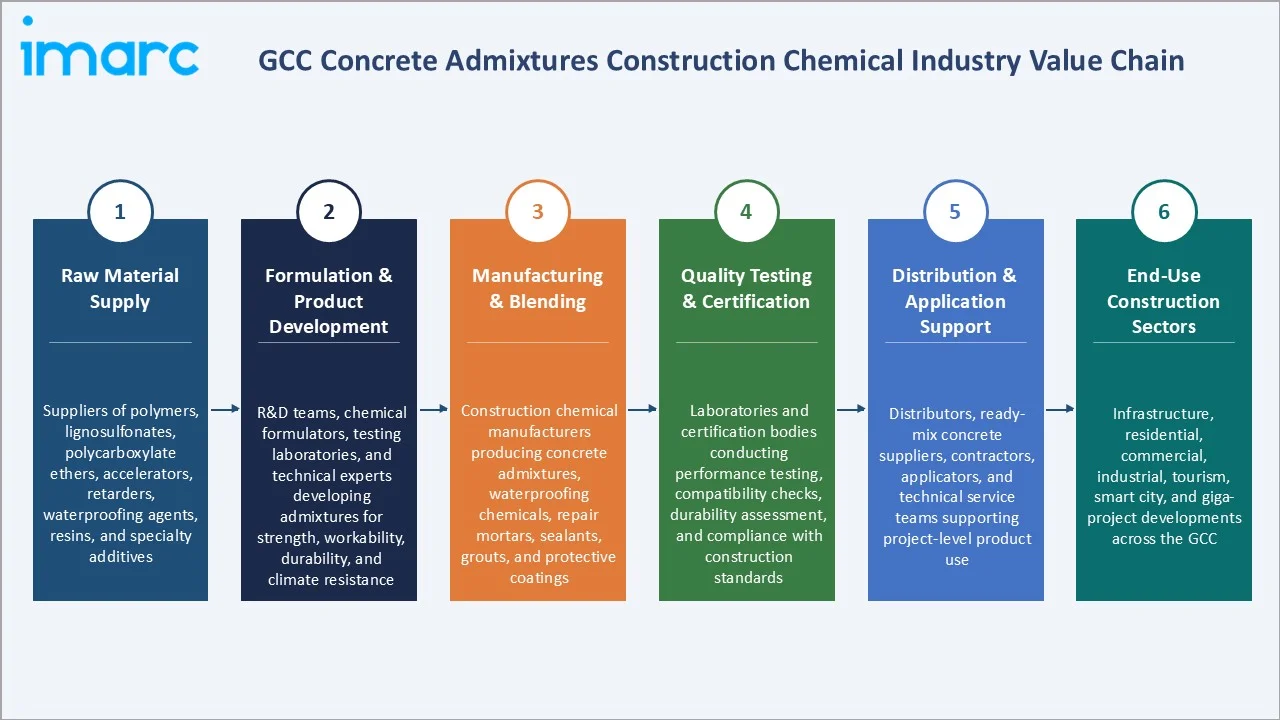
The GCC concrete admixtures construction chemical value chain integrates raw material supply, formulation & product development, manufacturing & blending, quality testing & certification, distribution & application support, and end-use construction sectors.
|
Stage |
Key Participants |
|
Raw Material Supply |
Suppliers of polymers, lignosulfonates, polycarboxylate ethers, accelerators, retarders, waterproofing agents, resins, and specialty additives. |
|
Formulation & Product Development |
R&D teams, chemical formulators, testing laboratories, and technical experts developing admixtures for strength, workability, durability, and climate resistance. |
|
Manufacturing & Blending |
Construction chemical manufacturers producing concrete admixtures, waterproofing chemicals, repair mortars, sealants, grouts, and protective coatings. |
|
Quality Testing & Certification |
Laboratories and certification bodies conducting performance testing, compatibility checks, durability assessment, and compliance with construction standards. |
|
Distribution & Application Support |
Distributors, ready-mix concrete suppliers, contractors, applicators, and technical service teams supporting project-level product use. |
|
End-Use Construction Sectors |
Infrastructure, residential, commercial, industrial, tourism, smart city, and giga-project developments across the GCC. |
The formulation and product development stage is the most value-added stage in the GCC concrete admixtures construction chemical value chain. This stage determines product performance, compatibility, durability, and sustainability through advanced chemical formulations, enabling manufacturers to differentiate their products and command higher margins while meeting the demanding requirements of GCC construction projects.
Technology Landscape in the GCC Concrete Admixtures Construction Chemical Industry
Polycarboxylate Ether Superplasticizer Technology
PCE (Polycarboxylate Ether) superplasticizer technology enables the production of high-strength, low water-to-cement ratio concrete with superior workability. The technology supports self-compacting and ultra-high-performance concrete required for mega projects, high-rise buildings, and infrastructure developments. PCE-based admixtures also improve durability, reduce cement consumption, and lower the carbon footprint of concrete, aligning with sustainable construction objectives. Their excellent performance under GCC hot-weather concreting conditions is accelerating adoption across large-scale construction projects.
Smart and Digital Concrete Technology
Smart and digital concrete technology is reshaping the market through the integration of IoT sensors, AI-based quality monitoring, and real-time concrete performance analytics. These technologies enable continuous monitoring of temperature, strength development, curing conditions, and structural health, improving construction quality and reducing rework. When combined with advanced admixtures, digital concrete solutions optimize mix design, material usage, and project efficiency. Adoption is increasing across smart cities, mega infrastructure projects, and high-rise developments throughout the GCC.
Self-Healing Concrete Technology
Self-healing concrete technology enables concrete to autonomously seal microcracks, thereby extending the service life of structures. The technology reduces water ingress, corrosion risks, and maintenance requirements, making it well suited for the region's harsh climate. It is gaining adoption in tunnels, bridges, marine infrastructure, and giga-projects where long-term durability is critical. As infrastructure owners increasingly prioritize lifecycle cost optimization and sustainable construction, demand for self-healing concrete technologies is expected to grow.
Market Segmentation Analysis
The report covers the following segments:
|
Segment Category |
Leading Segment |
Market Share |
Year |
|
Type |
Chemical |
68.4% |
2025 |
|
Application |
Infrastructure |
39.7% |
2025 |
|
Country |
Saudi Arabia |
38.8% |
2025 |

By Type
Chemical lead at 68.4% (2025), through PCE polycarboxylate ether superplasticizers, set retarders for extreme heat concreting above 50°C, water reducers, accelerators, and air-entraining agents for durability.
To access detailed market analysis, Request Sample
Mineral at 31.6% due to its ability to enhance concrete strength, durability, and long-term performance while reducing cement consumption and construction costs. Materials such as fly ash, ground granulated blast furnace slag, and silica fume are widely used in GCC infrastructure projects to improve resistance to heat, chloride attack, and aggressive environmental conditions, supporting more sustainable construction.
By Application
Infrastructure leads at 39.7% (2025) due to heavy GCC investments in roads, bridges, airports, metros, ports, utilities, and smart city projects. These large-scale assets require concrete admixtures and construction chemicals to improve strength, durability, waterproofing, corrosion resistance, and long-term structural performance.
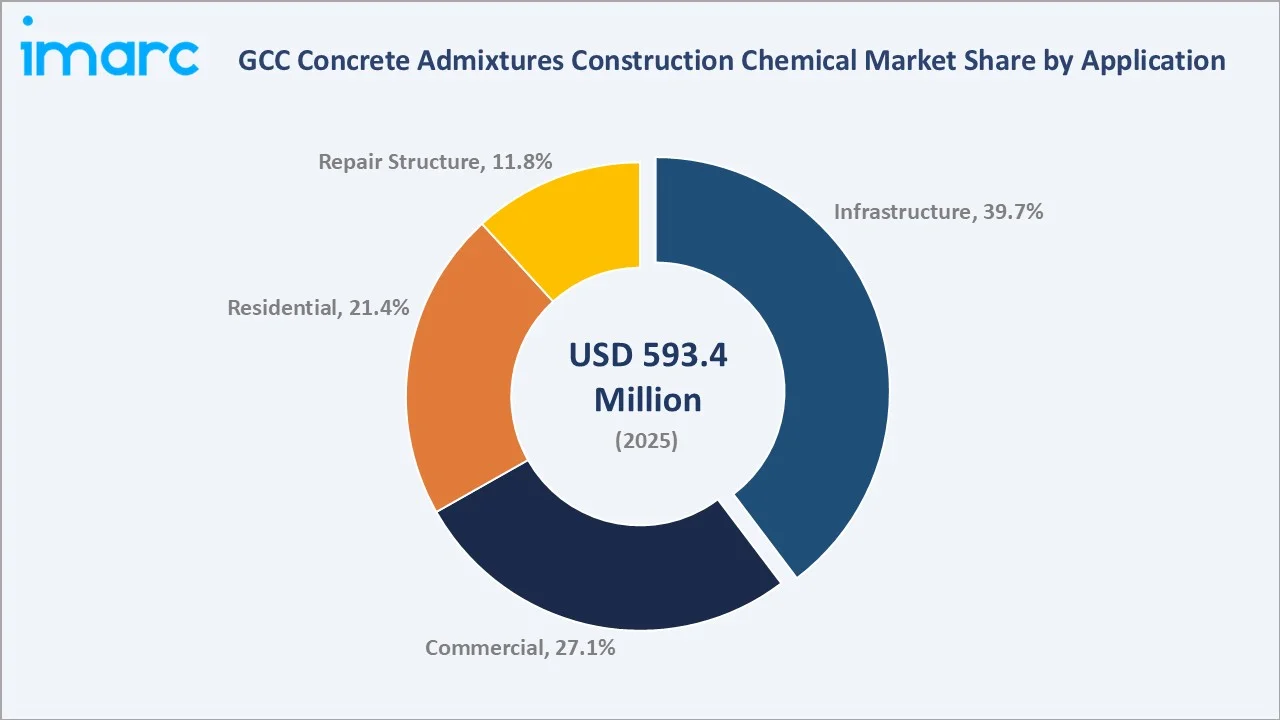
Commercial at 27.1% reflects Dubai and Abu Dhabi high-rise office tower superplasticizer, Saudi Vision 2030 hotel and resort admixture, and mall construction. Residential at 21.4% reflects the Saudi housing program, NEOM smart residential, and UAE luxury villa. Repair structure at 11.8% reflects UAE and Qatar aging infrastructure repair mortar, crystalline waterproofing, and corrosion inhibitor growing.
Regional Market Insights
|
Country |
Share (2025) |
Key GCC Concrete Admixtures Construction Chemical Market Drivers & Characteristics |
|
Saudi Arabia |
38.8% |
Reflecting strong demand from Vision 2030 giga-projects, infrastructure expansion, industrial development, and large-scale residential and commercial construction. |
|
United Arab Emirates |
24.3% |
Reflecting sustained investments in commercial real estate, tourism infrastructure, smart cities, and premium residential developments. |
|
Qatar |
11.6% |
Reflecting ongoing infrastructure upgrades, urban development, transportation projects, and building maintenance activities. |
|
Kuwait |
9.3% |
Reflecting growing public infrastructure investment, housing projects, and modernization of utilities and transport networks. |
|
Oman |
8.9% |
Reflecting investments in industrial zones, ports, logistics infrastructure, tourism developments, and economic diversification projects. |
|
Bahrain |
7.1% |
Reflecting demand from mixed-use developments, commercial construction, infrastructure rehabilitation, and urban renewal initiatives. |
Saudi Arabia's 38.8% dominance is supported by Vision 2030 giga-projects, large-scale infrastructure investments, and rapid urban development. UAE's 24.3% follows with strong demand from commercial construction, tourism projects, smart cities, and premium real estate developments.
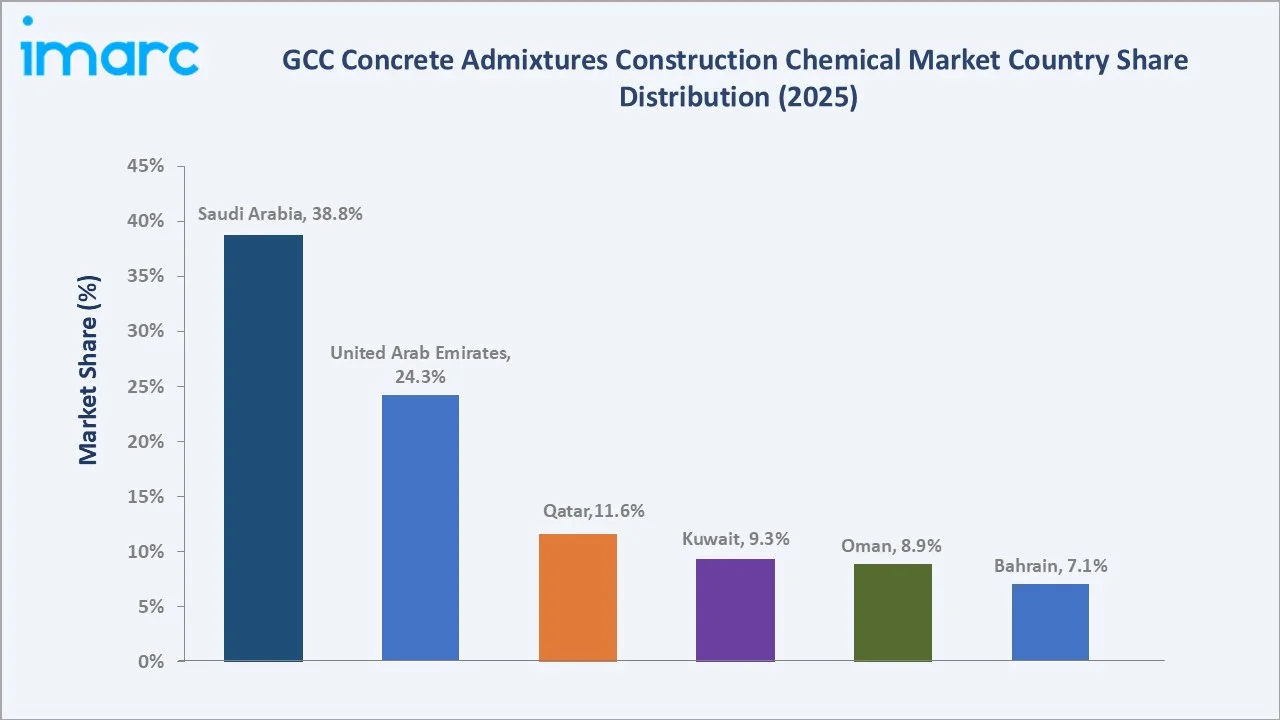
Qatar's 11.6% continues to witness steady growth through transport infrastructure, urban expansion, and public investment programs. Kuwait's 9.3%, Oman's 8.9%, and Bahrain's 7.1% are increasing consumption through industrial diversification, housing developments, logistics infrastructure, and rehabilitation of existing assets.
Competitive Landscape
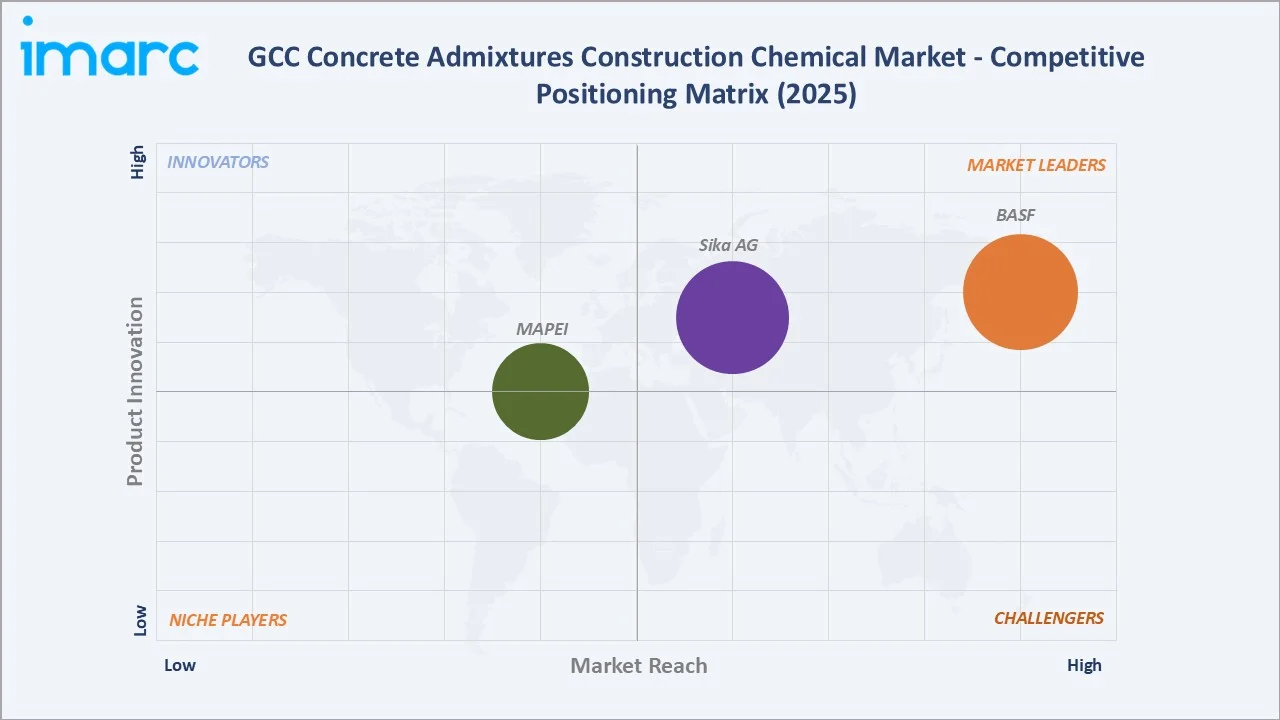
The GCC concrete admixtures construction chemical market is moderately concentrated, with competition led by global construction chemical manufacturers alongside regional producers and specialized local suppliers. Companies compete on product performance, technical support, innovation, pricing, and the ability to deliver customized solutions for harsh GCC climatic conditions. Market participants are expanding portfolios of high-performance admixtures, waterproofing systems, repair mortars, and sustainable construction chemicals to address evolving project requirements.
|
Company |
Key Products |
Market Position |
Core Strength |
|
BASF |
Dispersant – Melflux C, Defoamers – Vinapor C DF |
Market Leader |
BASF has historically played a transformative role in the GCC concrete admixtures construction chemicals market. The company set industry standards for concrete durability, sustainability, and strength across the Middle East. |
|
Sika AG |
Sika ViscoCrete, SikaPlast, Sika ViscoFlow, Sikament, Sika Plastiment, Sika Stabilizer, SikaRapid |
Market Leader |
Sika AG plays a foundational role in the GCC's construction chemicals sector. As the undisputed leader in specialty chemicals, Sika GCC dominates the concrete admixtures market. They provide vital high-performance formulations that enable sustainable, durable, and temperature-resistant infrastructure across the region. |
|
MAPEI |
MAPEPLAST UW, MAPETARD, MAPEFLUID N200 |
Established Player |
MAPEI plays a critical role in the GCC construction sector by providing specialized concrete admixtures that overcome the region's extreme climatic conditions and support large-scale infrastructure and precast projects. Their formulations help prevent thermal cracking, control setting times, and improve overall concrete durability in desert environments. |
Strategic partnerships with ready-mix concrete producers, contractors, EPC firms, and infrastructure developers play a key role in securing large-scale projects. Continuous investment in R&D, local manufacturing capabilities, and environmentally friendly product formulations is further intensifying competition across the GCC.
Key Company Profiles
BASF
BASF is a leading specialty chemicals company with a strong presence in the GCC construction chemicals market through its comprehensive portfolio of concrete admixtures and performance-enhancing construction solutions. The company supplies superplasticizers, accelerators, retarders, waterproofing systems, grouts, repair mortars, sealants, and protective coatings for infrastructure, commercial, residential, and industrial projects. BASF's technologies are widely used to improve concrete strength, workability, durability, and sustainability under the GCC's demanding climatic conditions.
- Key Products: Dispersant – Melflux C, Defoamers – Vinapor C DF.
- Strategic Focus: Centers on delivering high-performance, sustainable, and climate-resilient construction solutions for infrastructure and giga-projects. The company is expanding the adoption of advanced polycarboxylate ether (PCE) superplasticizers, low-carbon concrete technologies, and durability-enhancing admixtures to improve strength, workability, and service life.
Sika AG
Sika AG is a leading specialty chemicals company and one of the major suppliers of construction chemicals in the GCC market. The company offers a comprehensive portfolio of concrete admixtures, waterproofing systems, repair mortars, grouts, sealants, bonding agents, flooring solutions, and protective coatings for infrastructure, commercial, residential, and industrial projects. Sika's products are designed to improve concrete workability, strength, durability, and resistance to the GCC's harsh climatic conditions.
- Key Products: Sika ViscoCrete, SikaPlast, Sika ViscoFlow, Sikament, Sika Plastiment, Sika Stabilizer, SikaRapid.
- Strategic Focus: Centered on providing innovative, sustainable, and high-performance solutions for mega infrastructure and urban development projects. The company is expanding its portfolio of polycarboxylate ether (PCE)-based superplasticizers, waterproofing systems, repair materials, and low-carbon concrete technologies to enhance concrete durability and reduce environmental impact.
Market Concentration Analysis
The GCC concrete admixtures construction chemical market is moderately concentrated, with a mix of global specialty chemical companies and regional manufacturers competing across key product categories. Leading players differentiate themselves through advanced admixture technologies, broad product portfolios, strong technical support, and established distribution networks. Competition is increasingly focused on sustainable formulations, polycarboxylate ether (PCE)-based superplasticizers, and customized solutions for hot-weather concreting and mega infrastructure projects. Strategic partnerships with ready-mix concrete producers, contractors, and government-backed project developers remain critical for securing large contracts. Continued investments in local manufacturing, R&D, and low-carbon construction technologies are expected to intensify competition across the GCC market.
Investment & Growth Opportunities
Highest Growth Segments
NEOM superplasticizer (~12% CAGR from mega-project), infrastructure Saudi GIGA (~9.9% CAGR), repair structure (~9.6% CAGR), GGBS green concrete (~10% CAGR through GSAS mandate), self-compacting concrete GCC (~10% CAGR), and digital dosing AI-optimized concrete (~11% CAGR from emerging base) represent GCC concrete admixtures construction chemical highest-growth investment vectors through 2034.
Investment Themes
- GGBS and green concrete sustainable admixture: Growing emphasis on low-carbon construction and green building certifications is driving investment in GGBS-compatible admixtures that reduce cement consumption, lower embodied carbon, and improve long-term concrete durability.
- Repair mortar and waterproofing aging infrastructure: Rising rehabilitation of roads, bridges, tunnels, ports, and commercial buildings is creating investment opportunities in high-performance repair mortars, waterproofing systems, and protective coatings that extend asset life and reduce maintenance costs.
Future Market Outlook (2026-2034)
The GCC concrete admixtures construction chemical market is projected to grow from USD 593.4 Million in 2025 to USD 1,341.2 Million by 2034, delivering a 9.48% CAGR over the forecast period through NEOM The Line structural demand, Saudi Vision 2030 GIGA infrastructure admixture scale, green concrete GGBS and SCM mandate, repair waterproofing aging infrastructure UAE and Qatar, and AI-optimized digital concrete mix design. The market's anchor value of USD 933.3 Million in 2030 represents GCC concrete admixtures construction chemicals at NEOM Phase 1 operational and GGBS mainstream inflection.
Three structural forces define GCC concrete admixtures construction chemical growth through 2034: government-backed giga-projects, rising demand for durable high-performance concrete, and increasing focus on sustainable construction. Rapid urbanization, infrastructure expansion, and tourism-led developments are driving large-scale use of admixtures, waterproofing, sealants, and repair chemicals. Harsh GCC climatic conditions further increase demand for heat-resistant, corrosion-protective, and long-life construction solutions.
Research Methodology
Primary Research
Primary research comprised interviews with construction chemical manufacturers, concrete admixture suppliers, ready-mix concrete producers, EPC contractors, distributors, and infrastructure developers across the GCC. Discussions focused on product demand, pricing trends, technology adoption, procurement practices, and project pipelines. Insights from industry experts were used to validate market sizing, segment shares, and long-term growth projections.
Secondary Research
Secondary research encompassed company annual reports, investor presentations, government publications, construction industry databases, trade associations, and technical literature on construction chemicals. It also covered infrastructure investment plans, giga-project developments, green building initiatives, and cement and concrete industry trends across the GCC. These sources were used to validate market size, competitive positioning, technology trends, and long-term demand forecasts.
Forecasting Models
Forecasting models combined historical market trends with construction activity, infrastructure spending, giga-project pipelines, and concrete admixture demand across the GCC. The analysis incorporated macroeconomic indicators, urbanization, green building adoption, and raw material price trends. Scenario-based forecasting and data triangulation were applied to estimate market growth through 2034.
GCC Concrete Admixtures Construction Chemical Market Report Coverage:
| Report Features | Details |
|---|---|
| Base Year of the Analysis | 2025 |
| Historical Period | 2020-2025 |
| Forecast Period | 2026-2034 |
| Units | Million USD |
| Scope of the Report | Exploration of Historical Trends and Market Outlook, Industry Catalysts and Challenges, Segment-Wise Historical and Future Market Assessment:
|
| Types Covered | Mineral, Chemical |
| Applications Covered | Residential, Commercial, Infrastructure, Repair Structure |
| Countries Covered | Saudi Arabia, United Arab Emirates, Qatar, Kuwait, Oman, Bahrain |
| Companies Covered | BASF, Sika AG, MAPEI, etc. |
| Customization Scope | 10% Free Customization |
| Post-Sale Analyst Support | 10-12 Weeks |
| Delivery Format | PDF and Excel through Email (We can also provide the editable version of the report in PPT/Word format on special request) |
Key Benefits for Stakeholders:
- IMARC’s industry report offers a comprehensive quantitative analysis of various market segments, historical and current market trends, market forecasts, and dynamics of the GCC concrete admixtures construction chemical market from 2020-2034.
- The research report provides the latest information on the market drivers, challenges, and opportunities in the GCC concrete admixtures construction chemical market.
- Porter's five forces analysis assist stakeholders in assessing the impact of new entrants, competitive rivalry, supplier power, buyer power, and the threat of substitution. It helps stakeholders to analyze the level of competition within the GCC concrete admixtures construction chemical industry and its attractiveness.
- Competitive landscape allows stakeholders to understand their competitive environment and provides an insight into the current positions of key players in the market.
Frequently Asked Questions About the GCC Concrete Admixtures Construction Chemical Market Report
The GCC concrete admixtures construction chemical market reached USD 593.4 Million in 2025, driven by large-scale infrastructure, giga-projects, and urban development across the region. Rising demand for high-performance concrete, waterproofing, repair systems, and sustainable construction solutions further supports market growth.
The GCC concrete admixtures construction chemical market grows at 9.48% CAGR during 2026-2034, reaching USD 1,341.2 Million by 2034. The CAGR reflects extreme heat admixture, green building GGBS, GIGA infrastructure, and Vision 2030 construction boom structural demand.
Chemical lead at 68.4% due to its wide use in concrete admixtures, waterproofing agents, sealants, repair mortars, grouts, and protective coatings. These products are essential for improving strength, durability, workability, and climate resistance in GCC construction projects.
Infrastructure leads at 39.7% due to extensive GCC investments in roads, bridges, metros, airports, ports, utilities, and smart city projects. These large-scale assets require concrete admixtures and construction chemicals to improve strength, durability, waterproofing, and long-term performance.
Saudi Arabia leads at 38.8% due to its large-scale infrastructure pipeline, Vision 2030 giga-projects, and strong public investment in tourism, housing, transport, and industrial developments. These projects create high demand for concrete admixtures, waterproofing, repair chemicals, and durability-enhancing construction solutions.
Leading companies BASF, Sika AG, and MAPEI, among others.
The concrete admixtures construction chemical market is projected to reach approximately USD 933.3 Million by 2030, supported by infrastructure expansion, giga-projects, and rising demand for durable concrete solutions. Growth will also be driven by sustainable construction practices and wider use of advanced admixtures across major GCC projects.
Three priority investment opportunities in the GCC concrete admixtures construction chemical market include low-carbon and sustainable construction chemicals, infrastructure rehabilitation solutions, and advanced admixtures for mega projects. Increasing adoption of green building standards is accelerating demand for eco-friendly admixtures that reduce cement consumption and carbon emissions. At the same time, growing investment in the repair and waterproofing of aging infrastructure is creating opportunities for high-performance repair mortars and protective systems. Furthermore, large-scale developments such as NEOM, Red Sea Global, and Qiddiya continue to drive demand for premium concrete admixtures and specialized construction chemicals designed for high-strength, durable, and climate-resilient structures.
Need more help?
- Speak to our experienced analysts for insights on the current market scenarios.
- Include additional segments and countries to customize the report as per your requirement.
- Gain an unparalleled competitive advantage in your domain by understanding how to utilize the report and positively impacting your operations and revenue.
- For further assistance, please connect with our analysts.
 Request Customization
 Speak to an Analyst
 Request Brochure
 Inquire Before Buying
Benefits of Customization
- Personalize this research
- Triangulate with your data
- Get data as per your format and definition
- Gain a deeper dive into a specific application, geography, customer, or competitor
- Any level of personalization
Get in Touch With Us
UNITED STATES
Phone: +1-201-971-6302
INDIA
Phone: +91-120-433-0800
UNITED KINGDOM
Phone: +44-753-714-6104
Email: [email protected]
Client Testimonials




.webp)




.webp)













Related Reports

Choose your plan
*Please note that the prices mentioned below are starting prices for each bundle type. Kindly contact our team for further details.*
Single User License
- 1 User License, Access on 2 Devices
- PDF Report + Excel Dataset (Password Protected)
- Lifetime Access
- No Printing Rights
- 10% Free Report Customization
- 10–12 Weeks of Analyst Support
Five User License
- Access for 5 Users, 2 Devices per User
- PDF Report + Excel Dataset (Password Protected)
- Lifetime Access
- Dedicated Account Manager
- 12–14 Weeks of Analyst Support
- No Printing Rights
- 15% Free Report Customization
- 25% Discount on Your Next Purchase
Corporate User License
- Unlimited User Access (Within Your Organization)
- PDF Report + Excel Dataset
- Lifetime Access
- Dedicated Account Manager
- 14–20 Weeks of Analyst Support
- No Printing Rights
- 20% Free Report Customization
- 30% Discount on Your Next Purchase
Essential Insights
What's included:
3 reports
- Lifetime Access
- PDF Reports
- Excel Datasets
- 2 Weeks of Free Analyst Support
- 2 User Licenses
- Access on 2 Devices
- Printing Rights
- Complimentary PowerPoint (PPT) Version
- Complimentary License Upgrade
Professional Access
What's included:
5 reports
- Lifetime Access
- PDF Reports
- Excel Datasets
- 8 Weeks of Free Analyst Support
- 2 User Licenses
- Access on 2 Devices
- Printing Rights
- Complimentary PowerPoint (PPT) Version
- Complimentary License Upgrade
Business Advantage
What's included:
8 reports
- Lifetime Access
- PDF Reports
- Excel Datasets
- 14 Weeks of Free Analyst Support
- 2 User Licenses
- Access on 2 Devices
- Printing Rights
- Complimentary PowerPoint (PPT) Version
- Complimentary License Upgrade
Enterprise Intelligence
What's included:
10 reports
- Lifetime Access
- PDF Reports
- Excel Datasets
- 20 Weeks of Free Analyst Support
- 2 User Licenses
- Access on 2 Devices
- Printing Rights
- Complimentary PowerPoint (PPT) Version
- Complimentary License Upgrade