
GCC Customer Relationship Management (CRM) Market Size, Share, Trends and Forecast by Component, Deployment, Enterprise Size, Application, Industry Vertical, and Country, 2026-2034
GCC Customer Relationship Management (CRM) Market Summary:
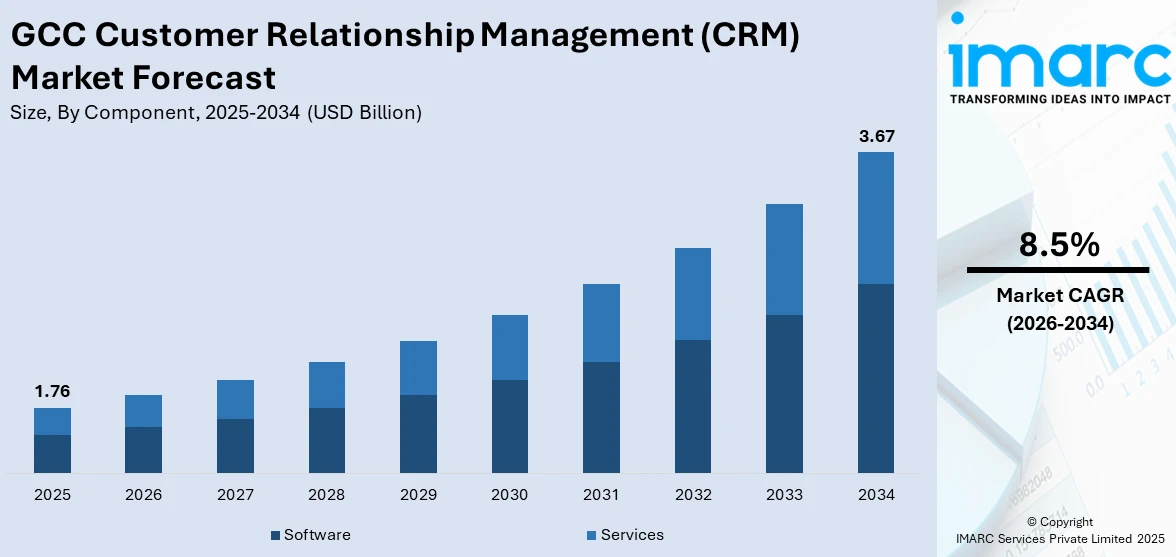
The GCC customer relationship management (CRM) market size was valued at USD 1.76 Billion in 2025 and is projected to reach USD 3.67 Billion by 2034, growing at a compound annual growth rate of 8.5% from 2026-2034.
The GCC customer relationship management (CRM) market is expanding steadily as enterprises across the region accelerate digital transformation and prioritize customer-centric strategies. Increasing cloud adoption, growing e-commerce penetration, and evolving consumer expectations are fueling demand for advanced CRM platforms. Government-led modernization programs, rising investments in artificial intelligence, and the expansion of omnichannel engagement models are collectively strengthening the GCC customer relationship management (CRM) market share.
Key Takeaways and Insights:
- By Component: Software dominates the market with a share of 62% in 2025, because contemporary CRM software platforms' scalability, flexibility in integration, and sophisticated analytics capabilities allow businesses to consolidate customer data and improve engagement tactics throughout the area.
- By Deployment: Cloud-based leads the market with a share of 75% in 2025, driven by the GCC's growing organizational preference for subscription-based SaaS delivery models, cheaper upfront costs, real-time accessibility, and quick expansion of cloud infrastructure.
- By Enterprise Size: Large enterprises hold the largest share with 53% in 2025, reflecting substantial technology budgets, complex multi-department CRM requirements, and ongoing digital transformation programs that demand enterprise-grade customer management solutions.
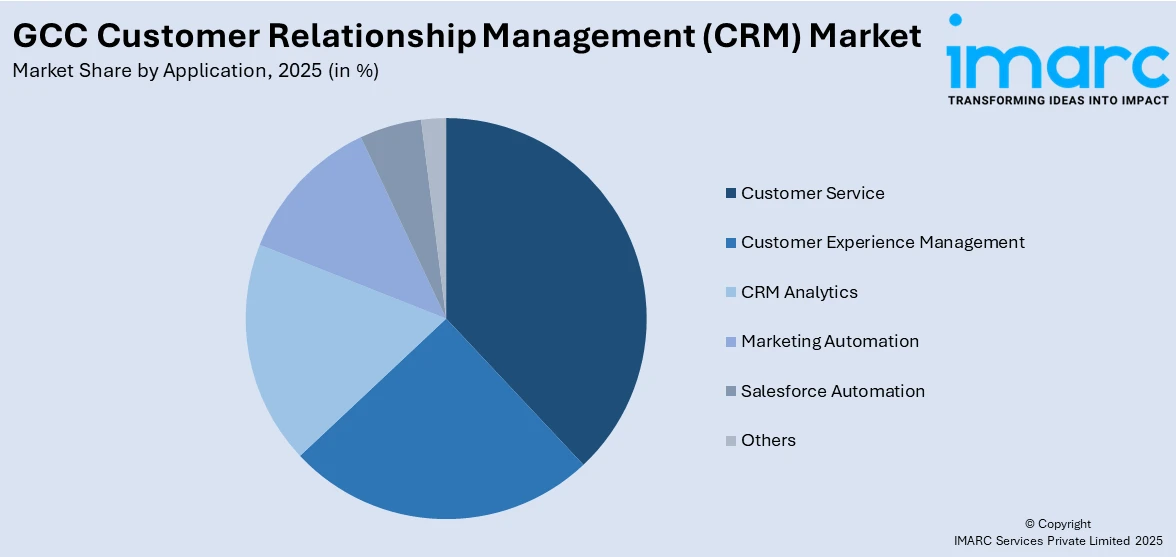
- By Application: Customer service represents the largest segment with a share of 28% in 2025, driven by growing customer demands for real-time inquiry resolution, smooth omnichannel support, and AI-powered service automation in a variety of industries.
- By Industry Vertical: BFSI leads the market with a share of 25% in 2025, propelled by regulations requiring strong customer interaction platforms, the e
- By Country: Saudi Arabia is the largest country with 30% share in 2025, which can be accredited to the creation of a global technology headquarters in Riyadh, technological investments by governing agencies, escalating enterprise ecosystems, and Vision 2030 digital activities.
- Key Players: In order to meet growing enterprise demand and promote digital customer engagement, leading CRM providers in the GCC market are bolstering their regional presence through the expansion of cloud infrastructure, the development of AI-powered capabilities, the formation of strategic partnerships with government agencies, and the funding of localized talent development initiatives.
To get more information on this market Request Sample
As digital transformation transforms corporate operations throughout the Gulf Cooperation Council (GCC), the CRM market is expanding rapidly. CRM solutions are being used more and more by businesses in the banking, retail, healthcare, and government sectors in order to automate service workflows, provide individualized engagement at scale, and unify customer data. Predictive analytics, intelligent lead scoring, and automated customer interactions that improve operational efficiency are made possible by the use of AI and machine learning into CRM systems. The GCC's growing data center infrastructure and sovereign cloud efforts are helping cloud-based deployment paradigms gain popularity. Government programs such as Saudi Arabia’s Vision 2030 and the UAE’s digital economy strategies are catalyzing enterprise technology adoption and creating favorable conditions for CRM market expansion. For instance, in January 2025, Salesforce announced plans to expand its presence in Saudi Arabia with a new regional headquarters in Riyadh and committed a USD 500 Million investment to support AI innovation, cloud adoption, and digital skills development in the Kingdom. Rising consumer expectations for seamless omnichannel experiences are further accelerating demand for comprehensive CRM platforms.
GCC Customer Relationship Management (CRM) Market Trends:
Accelerating Integration of Artificial Intelligence in CRM Platforms
The GCC region is witnessing rapid adoption of AI-powered CRM functionalities as enterprises seek to enhance customer insights and automate routine interactions. Intelligent chatbots, predictive analytics, and generative AI features are being embedded into CRM workflows to deliver hyper-personalized experiences. For instance, Abu Dhabi’s Digital Strategy 2025–2027 allocates AED 13 Billion to deploy AI-driven solutions across government services, reflecting the commitment to AI-native operations that support GCC customer relationship management (CRM) market growth.
Rising Adoption of Cloud-First CRM Deployment Strategies
Enterprises across the GCC are transitioning from on-premises to cloud-based CRM solutions, driven by the need for scalability, cost efficiency, and remote accessibility. Sovereign cloud initiatives and expanding hyperscaler presence are strengthening regional cloud infrastructure. For example, Saudi Arabia’s public cloud spending is forecast to surpass USD 2.4 Billion in 2024 and reach USD 4.7 Billion by 2027 according to the International Data Corporation, creating a robust foundation for cloud-native CRM deployments across government and private sectors.
Government-Led Digital Transformation Driving Enterprise CRM Adoption
As governments in the Gulf Cooperation Council (GCC) require digitized service delivery and customer engagement frameworks, national digital strategies are accelerating enterprise-wide CRM adoption. CRM solutions are becoming more and more in demand throughout partner ecosystems and supply chains as a result of public sector modernization initiatives. Private sector businesses are being encouraged to invest in advanced customer management platforms by the increasingly digitally mature environments created by the progressive digitization of government services. Organizations must use cutting-edge CRM solutions to stay competitive and in line with changing national transformation agendas as regulatory bodies increasingly demand digital compliance and transparent consumer interactions.
Market Outlook 2026-2034:
Underpinned by expanding cloud infrastructure, greater AI integration across enterprise operations, and accelerated digital transformation objectives, the GCC customer relationship management (CRM) market is poised for continuous growth during the forecast period. The region's governments continue to place a high priority on technology-driven economic diversification, which makes it easier for CRM solution providers to expand their business. The market generated a revenue of USD 1.76 Billion in 2025 and is projected to reach a revenue of USD 3.67 Billion by 2034, growing at a compound annual growth rate of 8.5% from 2026-2034. The rise of domestic CRM innovators and the growing number of international technology companies setting up regional headquarters are driving competition and encouraging the localization of products to meet local business needs. Strong demand is expected to be sustained by the proliferation of multichannel communication strategies, growing customer expectations for personalized engagement, and growing digitization of small and medium-sized businesses. Furthermore, investments in safe, compliant CRM architectures are being propelled by data localization laws and sovereign cloud obligations, establishing the GCC as a high-growth CRM industry.
GCC Customer Relationship Management (CRM) Market Report Segmentation:
|
Segment Category |
Leading Segment |
Market Share |
|
Component |
Software |
62% |
|
Deployment |
Cloud-Based |
75% |
|
Enterprise Size |
Large Enterprises |
53% |
|
Application |
Customer Service |
28% |
|
Industry Vertical |
BFSI |
25% |
|
Country |
Saudi Arabia |
30% |
Component Insights:
- Software
- Services
Software dominates the GCC customer relationship management (CRM) market with a share of 62% in 2025.
The software segment leads the GCC CRM market, driven by enterprises increasingly investing in comprehensive CRM software suites that offer integrated sales automation, marketing management, customer analytics, and service delivery modules within unified platforms. Organizations across the GCC are prioritizing software solutions that enable real-time data visualization, workflow customization, and seamless integration with existing enterprise resource planning systems. The growing availability of AI-embedded CRM software is enhancing lead scoring, customer segmentation, and campaign optimization capabilities. The rising enterprise preference for accessible, feature-rich CRM software that supports mobile-first business environments is further reinforcing this segment's dominance across the region.
The rising demand for industry-specific CRM software configurations is further propelling this segment's growth across the GCC. Financial institutions, healthcare providers, and retail enterprises are adopting vertically tailored CRM software solutions that address sector-specific compliance requirements, patient management protocols, and omnichannel retail engagement workflows. Subscription-based licensing models are reducing barriers to adoption for organizations of all sizes, enabling continuous access to platform updates, security patches, and emerging functionalities. The strong enterprise trust in software-centric customer relationship management approaches continues to underpin sustained investment and adoption momentum throughout the region.
Deployment Insights:
- On-Premises
- Cloud-Based
Cloud-based leads the GCC customer relationship management (CRM) market with a share of 75% in 2025.
Cloud-based CRM deployment dominates the GCC market as enterprises increasingly favor scalable, subscription-driven platforms that eliminate heavy upfront infrastructure investments and offer rapid implementation timelines. The cloud delivery model enables organizations to access advanced CRM functionalities from any location, supporting the region's growing remote and hybrid work environments. Cloud-based solutions also facilitate seamless software updates, enhanced data security through provider-managed infrastructure, and elastic scalability to accommodate business growth. The expansion of hyperscaler data centers across the GCC is reinforcing this trend, providing enterprises with locally hosted computing environments that reduce latency and strengthen performance.
Sovereign cloud initiatives across GCC nations are further accelerating cloud-based CRM deployments by addressing data residency and regulatory compliance concerns that previously constrained adoption. Governments in Saudi Arabia, the UAE, and other member states are mandating data localization for sensitive customer information, prompting CRM vendors to establish in-country cloud infrastructure. Hybrid cloud architectures are gaining traction as organizations seek to balance data sovereignty requirements with the flexibility of public cloud services, creating a dynamic deployment landscape throughout the region.
Enterprise Size Insights:
- Large Enterprises
- Small and Medium-sized Enterprises
Large enterprises hold the largest share at 53% of the total GCC customer relationship management (CRM) market in 2025.
Large enterprises represent the dominant adopters of CRM solutions in the GCC, driven by their complex organizational structures, multi-departmental customer engagement requirements, and substantial technology investment budgets. These organizations deploy enterprise-grade CRM platforms to manage extensive customer databases, coordinate cross-functional sales and marketing efforts, and generate actionable business intelligence across diverse product lines and geographic markets.
The scale of large enterprise operations necessitates robust CRM architectures capable of processing high transaction volumes and supporting thousands of concurrent users. Their significant investment capacity in technology-driven transformation initiatives, including CRM modernization, positions them as the primary revenue contributors within this segment. Large enterprises also benefit from dedicated implementation teams, longer procurement cycles that allow thorough vendor evaluation, and the financial resources to engage specialized consulting partners for customized CRM deployments. The breadth of their customer portfolios and the complexity of their service delivery models require advanced platform capabilities, including role-based access controls, multi-currency support, hierarchical reporting structures, and enterprise-wide data governance frameworks that ensure consistency across regional operations.
Application Insights:
Access the comprehensive market breakdown Request Sample
- Customer Service
- Customer Experience Management
- CRM Analytics
- Marketing Automation
- Salesforce Automation
- Others
Customer service accounts for the highest revenue share of 28% of the total GCC customer relationship management (CRM) market in 2025.
The customer service application segment leads the GCC CRM market as organizations across the region prioritize delivering superior, responsive, and consistent support experiences to meet rising consumer expectations. Enterprises are deploying CRM-powered service platforms that integrate ticketing systems, knowledge bases, and AI-driven chatbots to enable efficient multi-channel customer query resolution. The growing emphasis on reducing response times, improving first-contact resolution rates, and personalizing service interactions is driving sustained investment in customer service CRM functionalities.
The universal priority placed on service excellence as a key competitive differentiator continues to strengthen this segment's leadership position. Organizations are also investing in self-service portals and intelligent virtual assistants that empower customers to resolve routine inquiries independently, reducing operational costs while maintaining high satisfaction levels. The integration of sentiment analysis and real-time feedback mechanisms within customer service CRM modules is enabling enterprises to proactively identify dissatisfaction patterns and implement corrective measures before customer relationships deteriorate. This proactive approach to service management is becoming increasingly important as competitive pressures intensify and customer loyalty becomes more challenging to sustain across the GCC.
Industry Vertical Insights:
- BFSI
- Retail
- Healthcare
- IT and Telecom
- Discrete Manufacturing
- Government and Education
- Others
BFSI represents the leading industry vertical with 25% share of the total GCC customer relationship management (CRM) market in 2025.
The banking, financial services, and insurance sector leads CRM adoption in the GCC, driven by intensifying digital banking competition, regulatory mandates for enhanced customer due diligence, and the imperative to deliver personalized financial products across diverse customer segments. Financial institutions are leveraging CRM platforms to manage complex client portfolios, automate compliance workflows, and enable relationship managers to provide data-driven advisory services. Open-banking API frameworks are accelerating CRM integration with external financial platforms, expanding the scope of customer data available for personalization.
The industry's significant commitment to cloud-enabled customer management technologies underscores the sustained investment trajectory within this vertical. Additionally, the growing emphasis on wealth management digitization and private banking personalization is driving financial institutions to deploy specialized CRM modules that support portfolio tracking, client risk profiling, and tailored investment recommendation workflows. Insurance companies across the GCC are similarly adopting CRM solutions to streamline policy management, claims processing, and customer retention programs, recognizing that seamless digital interactions are essential for maintaining competitive positioning in an increasingly saturated financial services landscape.
Country Insights:
- Saudi Arabia
- UAE
- Qatar
- Bahrain
- Kuwait
- Oman
Saudi Arabia comprises the largest country with 30% share of the total GCC customer relationship management (CRM) market in 2025.
Saudi Arabia leads the GCC CRM market, underpinned by Vision 2030’s comprehensive digital transformation agenda and substantial government technology investments that are driving enterprise-wide CRM adoption. The Kingdom’s Regional Headquarters Program has attracted over 500 global companies to establish operations in Riyadh, expanding the addressable market for CRM solutions. In 2024, Saudi Arabia allocated over USD 10 Billion to its ICT sector, representing an 18.75 percent increase from the previous year, creating a robust foundation for technology adoption including advanced customer relationship management platforms.
The Kingdom's growing focus on customer-centric digital strategies is driving widespread CRM deployment across both public and private sectors. Government digitization initiatives have transformed service delivery models, with an increasing proportion of government services now accessible through digital channels. A significant share of medium and large businesses in Saudi Arabia have identified improving customer satisfaction as their primary digital transformation goal, directly fueling demand for CRM platform deployments across key commercial centers. The convergence of public sector modernization and private enterprise digitization is creating a mutually reinforcing ecosystem that sustains robust CRM adoption throughout the Kingdom.
Market Dynamics:
Growth Drivers:
Why is the GCC Customer Relationship Management (CRM) Market Growing?
Vision 2030 and Government-Led Digital Transformation Initiatives
The GCC customer relationship management (CRM) market is experiencing significant growth momentum driven by ambitious national digital transformation programs that are fundamentally reshaping how enterprises engage with customers. Saudi Arabia’s Vision 2030 strategy has positioned the Kingdom as the region’s largest digital economy, with government-led initiatives creating cascading demand for enterprise technology solutions including CRM platforms. The digitization of public services and the establishment of digital-first government operations are creating demonstration effects that encourage private sector enterprises to adopt similar customer-centric technology frameworks. The ripple effects of these government programs extend across the entire enterprise technology ecosystem, as businesses seeking government contracts or operating within digitized supply chains must adopt compatible CRM and customer management solutions.
Expansion of Cloud Infrastructure and Data Center Ecosystem
The rapid expansion of cloud infrastructure across the GCC is serving as a fundamental enabler for CRM market growth, providing enterprises with the scalable, secure, and locally hosted computing environments necessary to deploy modern customer relationship management platforms. Major global cloud providers including Amazon Web Services, Microsoft Azure, Oracle Cloud, and Google Cloud have established or announced dedicated cloud regions across Saudi Arabia, the UAE, Qatar, and Bahrain, bringing enterprise-grade cloud services closer to regional businesses and addressing data sovereignty requirements. This expanding cloud ecosystem is directly facilitating CRM adoption by reducing latency, ensuring regulatory compliance, and enabling organizations to leverage cloud-native CRM functionalities without the capital expenditure associated with on-premises infrastructure. The availability of sovereign cloud options is addressing the data localization concerns that previously constrained CRM deployments in regulated industries, particularly in banking, healthcare, and government sectors where customer data sensitivity demands stringent compliance measures.
Growing Integration of Artificial Intelligence and Automation Technologies
The integration of artificial intelligence and automation capabilities into CRM platforms is creating compelling value propositions that are driving adoption across the GCC. Enterprises are leveraging AI-powered CRM features including predictive customer analytics, intelligent lead scoring, automated service workflows, and generative AI-driven content personalization to enhance operational efficiency and customer engagement quality. These advanced capabilities are transforming CRM systems from passive data repositories into proactive business intelligence platforms that anticipate customer needs and recommend optimal engagement strategies. The GCC’s commitment to AI leadership is further accelerating this trend, with governments investing substantially in AI ecosystems that support enterprise technology innovation.
Market Restraints:
What Challenges the GCC Customer Relationship Management (CRM) Market is Facing?
Data Privacy, Security, and Regulatory Compliance Concerns
The increasing volume and sensitivity of customer data managed through CRM platforms are raising significant data privacy and cybersecurity concerns across the GCC. Organizations face mounting challenges in navigating complex and evolving data protection regulations, including stringent data localization requirements that mandate customer information be stored and processed within national borders. Divergent national data governance frameworks across GCC member states add compliance complexity for multinational enterprises operating across the region, requiring customized CRM configurations and increasing implementation costs and timelines.
Shortage of Skilled Technology Professionals
The GCC region faces persistent shortages of qualified technology professionals with specialized expertise in CRM implementation, customization, and management. The rapid pace of digital transformation has created intense competition for bilingual, cloud-native professionals skilled in AI, data analytics, and enterprise software configuration. Organizations are experiencing difficulty recruiting and retaining CRM specialists, which delays implementation timelines, increases project costs, and constrains the full utilization of advanced platform capabilities, ultimately affecting the pace of CRM market expansion across the region.
Legacy System Integration and Migration Complexity
Many enterprises across the GCC operate legacy technology environments that present significant integration challenges when deploying modern CRM platforms. The complexity of migrating historical customer data, aligning disparate data formats, and ensuring interoperability between legacy infrastructure and cloud-native CRM architectures creates substantial barriers to adoption. Organizations frequently encounter extended implementation timelines and budget overruns when attempting to integrate CRM systems with existing enterprise resource planning, billing, and communication platforms, particularly in sectors with complex legacy technology stacks.
Competitive Landscape:
The GCC customer relationship management (CRM) market is characterized by intense competition among established global technology providers and emerging regional players. Market leaders are strengthening their competitive positions through strategic regional expansion, localized product development, and partnerships with government entities to align with national digital transformation agendas. Companies are differentiating their offerings through AI-powered analytics capabilities, industry-specific solution configurations, and sovereign cloud deployment options that address regional data residency requirements. The competitive landscape is further intensified by the entry of homegrown CRM startups that cater to Arabic-language requirements and region-specific business processes. Strategic collaborations between global CRM vendors and local systems integrators, consulting firms, and cloud infrastructure providers are shaping the market’s evolution, as companies seek to build comprehensive ecosystem partnerships that accelerate customer acquisition and deepen market penetration across the GCC.
GCC Customer Relationship Management (CRM) Market Report Coverage:
| Report Features | Details |
|---|---|
| Base Year of the Analysis | 2025 |
| Historical Period | 2020-2025 |
| Forecast Period | 2026-2034 |
| Units | Billion USD |
| Scope of the Report | Exploration of Historical and Forecast Trends, Industry Catalysts and Challenges, Segment-Wise Historical and Predictive Market Assessment:
|
| Components Covered | Software, Services |
| Deployments Covered | On Trade, Off-Trade |
| Enterprise Sizes Covered | Large Enterprises, Small & Medium-sized Enterprise |
| Applications Covered | Customer Service, Customer Experience Management, CRM Analytics, Marketing Automation, Salesforce Automation, Others |
| Industry Verticals Covered | BFSI, Retail, Healthcare, IT & Telecom, Discrete Manufacturing, Government & Education, Others |
| Countries Covered | Saudi Arabia, the UAE, Qatar, Bahrain, Kuwait, Oman |
| Customization Scope | 10% Free Customization |
| Post-Sale Analyst Support | 10-12 Weeks |
| Delivery Format | PDF and Excel through Email (We can also provide the editable version of the report in PPT/Word format on special request) |
Frequently Asked Questions About the GCC Customer Relationship Management (CRM) Market Report
The GCC customer relationship management (CRM) market size was valued at USD 1.76 Billion in 2025.
The GCC customer relationship management (CRM) market is expected to grow at a compound annual growth rate of 8.5% from 2026-2034 to reach USD 3.67 Billion by 2034.
Software dominated the market with a share of 62%, driven by enterprise demand for integrated CRM platforms offering sales automation, analytics, marketing management, and customer service functionalities within unified, scalable software ecosystems.
Key factors driving the GCC customer relationship management (CRM) market include government-led digital transformation programs, expanding cloud infrastructure, growing AI integration in enterprise platforms, rising customer expectations for personalized engagement, and increasing e-commerce penetration.
Major challenges include data privacy and regulatory compliance complexities across divergent national frameworks, persistent shortages of skilled technology professionals, legacy system integration difficulties, high customization costs, and cybersecurity vulnerabilities associated with expanding cloud deployments.
Need more help?
- Speak to our experienced analysts for insights on the current market scenarios.
- Include additional segments and countries to customize the report as per your requirement.
- Gain an unparalleled competitive advantage in your domain by understanding how to utilize the report and positively impacting your operations and revenue.
- For further assistance, please connect with our analysts.
 Request Customization
 Speak to an Analyst
 Request Brochure
 Inquire Before Buying
Benefits of Customization
- Personalize this research
- Triangulate with your data
- Get data as per your format and definition
- Gain a deeper dive into a specific application, geography, customer, or competitor
- Any level of personalization
Get in Touch With Us
UNITED STATES
Phone: +1-201-971-6302
INDIA
Phone: +91-120-433-0800
UNITED KINGDOM
Phone: +44-753-714-6104
Email: [email protected]
Client Testimonials




.webp)




.webp)













Related Reports

Choose your plan
*Please note that the prices mentioned below are starting prices for each bundle type. Kindly contact our team for further details.*
Single User License
- 1 User License, Access on 2 Devices
- PDF Report + Excel Dataset (Password Protected)
- Lifetime Access
- No Printing Rights
- 10% Free Report Customization
- 10–12 Weeks of Analyst Support
Five User License
- Access for 5 Users, 2 Devices per User
- PDF Report + Excel Dataset (Password Protected)
- Lifetime Access
- Dedicated Account Manager
- 12–14 Weeks of Analyst Support
- No Printing Rights
- 15% Free Report Customization
- 25% Discount on Your Next Purchase
Corporate User License
- Unlimited User Access (Within Your Organization)
- PDF Report + Excel Dataset
- Lifetime Access
- Dedicated Account Manager
- 14–20 Weeks of Analyst Support
- No Printing Rights
- 20% Free Report Customization
- 30% Discount on Your Next Purchase
Essential Insights
What's included:
3 reports
- Lifetime Access
- PDF Reports
- Excel Datasets
- 2 Weeks of Free Analyst Support
- 2 User Licenses
- Access on 2 Devices
- Printing Rights
- Complimentary PowerPoint (PPT) Version
- Complimentary License Upgrade
Professional Access
What's included:
5 reports
- Lifetime Access
- PDF Reports
- Excel Datasets
- 8 Weeks of Free Analyst Support
- 2 User Licenses
- Access on 2 Devices
- Printing Rights
- Complimentary PowerPoint (PPT) Version
- Complimentary License Upgrade
Business Advantage
What's included:
8 reports
- Lifetime Access
- PDF Reports
- Excel Datasets
- 14 Weeks of Free Analyst Support
- 2 User Licenses
- Access on 2 Devices
- Printing Rights
- Complimentary PowerPoint (PPT) Version
- Complimentary License Upgrade
Enterprise Intelligence
What's included:
10 reports
- Lifetime Access
- PDF Reports
- Excel Datasets
- 20 Weeks of Free Analyst Support
- 2 User Licenses
- Access on 2 Devices
- Printing Rights
- Complimentary PowerPoint (PPT) Version
- Complimentary License Upgrade