
GCC Paper Packaging Market Size, Share, Trends and Forecast by Product Type, Grade, Packaging Level, End Use Industry, and Country, 2026-2034
GCC Paper Packaging Market Size, Share, Trends & Forecast (2026-2034)
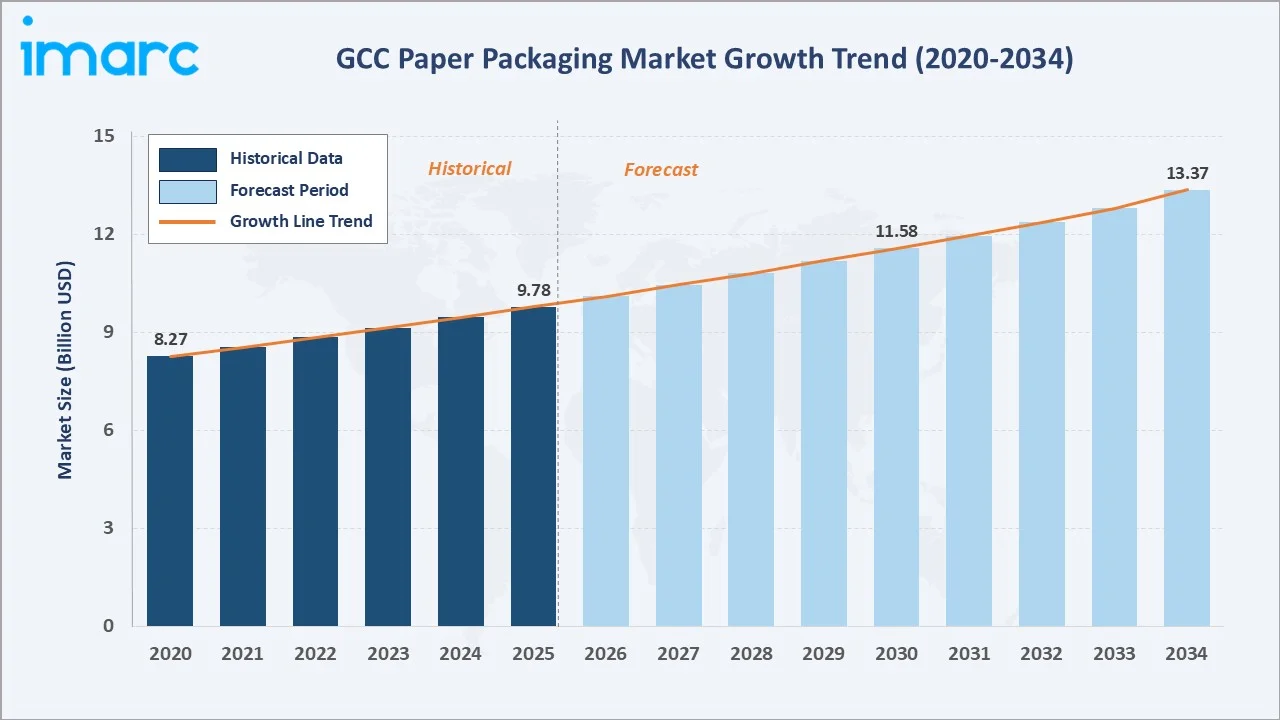
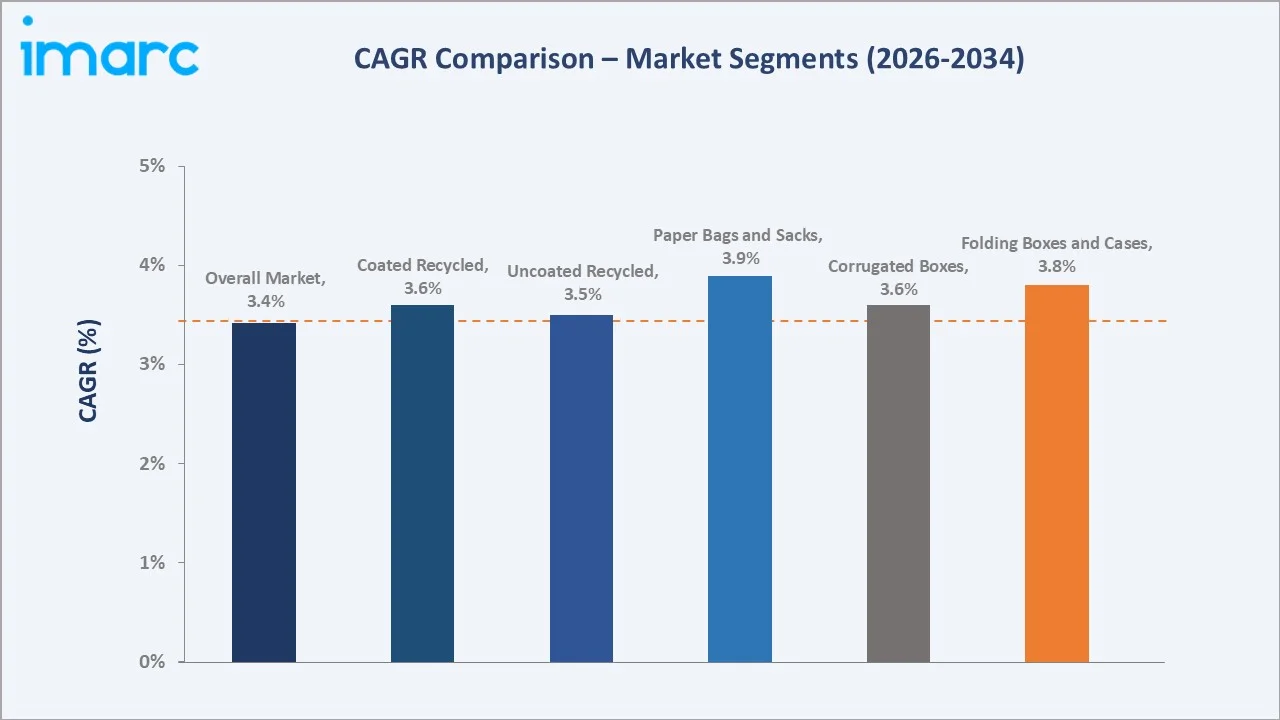
The GCC paper packaging market size increased from USD 9.78 Billion in 2025 to USD 10.21 Billion in 2026 and is projected to reach USD 13.37 Billion by 2034, growing at a CAGR of 3.42% during 2026-2034. The market is driven by rising demand for sustainable and recyclable packaging solutions, supported by growing environmental awareness and government initiatives to reduce plastic waste. The GCC generates approximately 9 million tonnes of packaging waste each year, while only around 10% is currently recycled, highlighting a significant need for improved waste management and sustainable packaging solutions. This is driving the GCC paper packaging market as governments and businesses increasingly replace plastic packaging with recyclable paper-based alternatives to reduce landfill waste, improve recycling rates, and meet sustainability and circular economy objectives. Folding boxes and cases lead the product type at 31.8%. Uncoated recycled leads grade at 36.4%. Saudi Arabia leads regionally at 38.6%.
Market Snapshot
|
Metric |
Value |
|
Base Year Market Size (2025) |
USD 9.78 Billion |
| Market Size (2026) | USD 10.21 Billion |
|
Forecast Market Size (2034) |
USD 13.37 Billion |
|
CAGR (2026-2034) |
3.42% |
|
Base Year |
2025 |
|
Historical Period |
2020-2025 |
|
Forecast Period |
2026-2034 |
|
Dominant Product Type |
Folding Boxes and Cases (31.8%, 2025) |
|
Dominant Grade |
Uncoated Recycled (36.4%, 2025) |
|
Leading Country |
Saudi Arabia (38.6%, 2025) |
The GCC paper packaging market has grown steadily from USD 8.27 Billion in 2020 to USD 9.78 Billion in 2025 and an estimated USD 10.21 Billion in 2026, supported by rising demand for sustainable, recyclable, and plastic-free packaging solutions. The market is expected to reach USD 11.58 Billion by 2030, driven by growth in food and beverage, e-commerce, retail, and consumer goods sectors. Increasing environmental regulations and corporate sustainability commitments are encouraging businesses to shift toward paper-based packaging formats. By 2034, the market is forecast to reach USD 13.37 Billion, reflecting continued adoption of corrugated boxes, paper bags, cartons, and flexible paper packaging across the GCC.
To get more information on this market, Request Sample
Paper bags and sacks grow fastest at ~3.9% CAGR through the GCC plastic ban and retail grocery shift. Solid bleached grade grows at ~4.2% CAGR through pharmaceutical and premium food service. Corrugated boxes grow at ~3.6% CAGR through e-commerce and GCC import packaging.
Executive Summary
The GCC paper packaging market is gaining momentum as businesses shift toward recyclable, biodegradable, and plastic-free packaging formats. Growth is supported by rising packaging demand from food and beverage, e-commerce, retail, healthcare, and consumer goods sectors. Increasing packaging waste concerns and low recycling rates are encouraging governments and companies to adopt paper-based alternatives. Corrugated boxes, paper bags, folding cartons, and paperboard packaging are witnessing strong demand across distribution and retail channels. Folding boxes and cases at 31.8% lead through FMCG and pharmaceutical. Uncoated recycled at 36.4% leads through corrugated and industrial. Saudi Arabia leads regionally at 38.6%.
Key Market Insights
|
Insight |
Data |
|
Dominant Product Type |
Folding Boxes and Cases - 31.8% share (2025) |
|
Dominant Grade |
Uncoated Recycled - 36.4% market share (2025) |
|
Leading Country |
Saudi Arabia - 38.6% share (2025) |
|
Market Opportunity |
GCC plastic ban paper bag shift; Vision 2030 FMCG and retail; Tetra Pak dairy liquid paperboard; e-commerce corrugated box; halal food export corrugated; recycled content regulation; pharmaceutical folding carton |
Key Analytical Observations Supporting The Above Data:
- Folding Boxes and Cases at 31.8%: Folding boxes and cases dominate due to their wide use in food, beverages, pharmaceuticals, personal care, retail, and consumer goods packaging. Their lightweight, printable, recyclable, and cost-effective nature makes them suitable for both branding and product protection.
- Uncoated Recycled at 36.4%: Uncoated recycled paper dominates due to its cost-effectiveness, recyclability, and wide use in cartons, boxes, bags, and corrugated packaging. Its eco-friendly profile supports rising demand from brands seeking sustainable packaging alternatives.
- Saudi Arabia at 38.6%: Saudi Arabia dominates due to its large food and beverage, retail, e-commerce, and industrial base, which creates strong demand for cartons, corrugated boxes, bags, and paperboard packaging.
GCC Paper Packaging Market Overview
The GCC paper packaging market encompasses folding cartons, corrugated boxes, paper bags, paperboard containers, wrapping paper, and other recyclable packaging formats. It serves key industries such as food and beverage, e-commerce, retail, healthcare, personal care, and consumer goods. The market includes both virgin and recycled paper-based materials used for product protection, branding, storage, and transportation. Its scope is expanding as companies shift from plastic packaging toward sustainable, biodegradable, and circular packaging solutions. Macroeconomic factors include rising population, urbanization, and increasing disposable incomes, which are driving demand for packaged food, consumer goods, and retail products across the GCC. Government sustainability initiatives, economic diversification, expanding manufacturing, and growth in e-commerce are further supporting the adoption of paper-based packaging solutions.
Market Dynamics
To evaluate market opportunities, Request Sample
Market Drivers
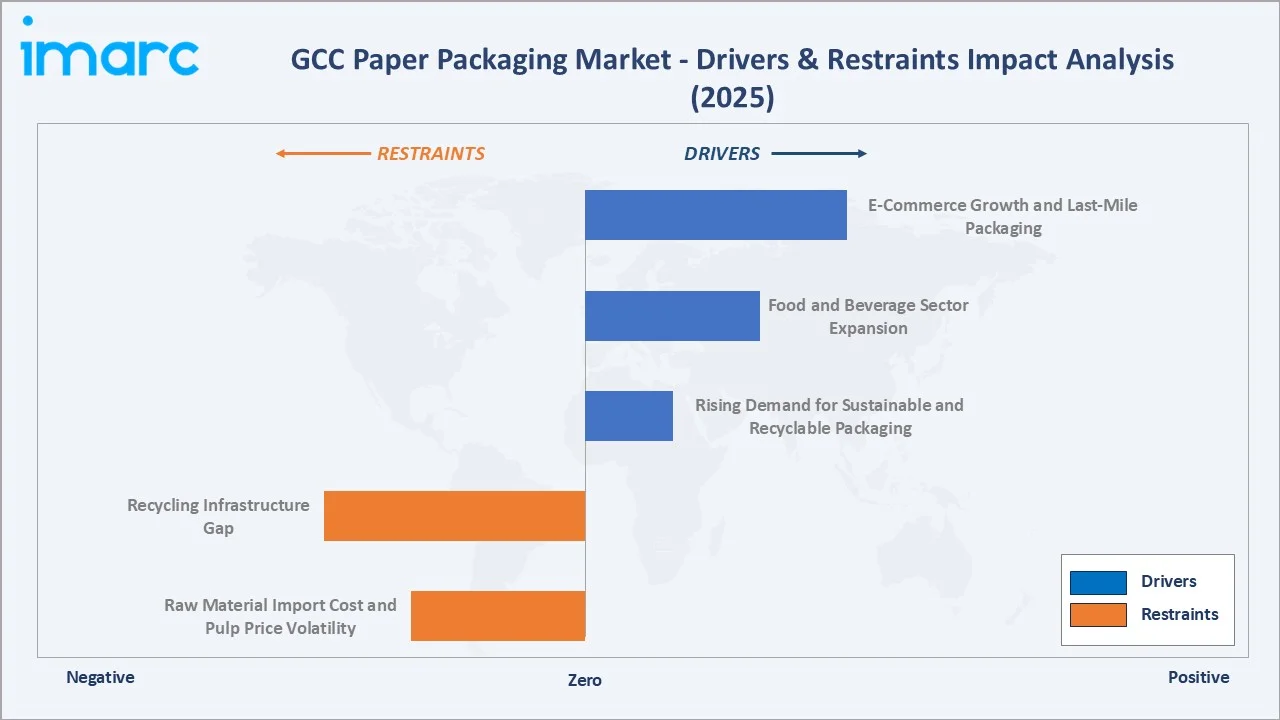
- E-Commerce Growth and Last-Mile Packaging: E-commerce growth and last-mile packaging are increasing demand for corrugated boxes, paper mailers, cartons, labels, and protective paper-based packaging. Rising online shopping and quick-commerce deliveries require lightweight, durable, and recyclable packaging that can protect products during frequent handling and transportation. Retailers and logistics providers are adopting paper packaging to improve brand presentation while meeting sustainability expectations. This trend is strengthening demand for customized, printable, and eco-friendly packaging formats across the region.
- Food and Beverage Sector Expansion: Food and beverage sector expansion is increasing demand for cartons, paperboard containers, wraps, trays, cups, and takeaway packaging. Rising consumption of packaged foods, ready-to-eat meals, beverages, and food delivery services is creating a strong need for safe, lightweight, and recyclable packaging formats. Saudi Arabia’s consumer spending totaled SR 11.8 billion (USD 3.14 billion) during the week of December 15–21, 2024, with the food and beverage sector remaining the leading contributor to sales. This is strengthening demand for grease-resistant, moisture-protective, and printable paper packaging across the region.
- Rising Demand for Sustainable and Recyclable Packaging: Rising demand for sustainable and recyclable packaging is driving the market as companies shift away from plastic-based materials to meet environmental goals and regulatory requirements. In October 2025, Saudi Paper Manufacturing Company (SPM) launched its new Paper Machine 5 (PM5), significantly strengthening its production capacity. The advanced machine supports SPM’s regional leadership in paper manufacturing while reflecting its focus on sustainable growth, technology advancement, and operational efficiency. Consumers are increasingly preferring eco-friendly packaging, encouraging brands to adopt paper bags, cartons, corrugated boxes, and recyclable paperboard formats.
Market Restraints
- Raw Material Import Cost and Pulp Price Volatility: Raw material import costs and pulp price volatility are increasing production expenses for manufacturers that depend heavily on imported pulp, paperboard, and recycled fiber. Fluctuating global pulp prices, freight rates, and currency movements make cost planning difficult and affect profit margins. These cost pressures can lead to higher packaging prices for end users in food, retail, and e-commerce sectors. As a result, manufacturers face challenges in maintaining competitive pricing while meeting sustainability and quality requirements.
- Recycling Infrastructure Gap: Recycling infrastructure gaps are limiting the collection, sorting, and processing of used paper and packaging waste. Inadequate recycling capacity reduces the availability of quality recycled fiber, increasing dependence on imported raw materials. This raises production costs and weakens circular economy progress. As a result, manufacturers face challenges in scaling recycled paper packaging while meeting sustainability targets and customer demand.
Market Opportunities
- Development of Biodegradable and Fiber-based Packaging: The development of biodegradable and fiber-based packaging creates strong opportunities as brands seek alternatives to plastic and foam packaging. Fiber-based trays, molded pulp, paperboard containers, and compostable paper formats support sustainability goals while meeting consumer demand for eco-friendly products. These solutions are especially relevant for food delivery, retail, healthcare, and e-commerce packaging. As regulations and corporate ESG commitments strengthen, demand for innovative biodegradable paper packaging is expected to rise across the GCC.
- Increasing Demand from Pharmaceutical and Healthcare Packaging: Increasing demand from pharmaceutical and healthcare packaging is creating opportunities as medicines, medical devices, diagnostics, and wellness products require safe, reliable, and compliant packaging. Paperboard cartons, labels, inserts, and secondary packaging are widely used for product protection, branding, and regulatory information. Growth in healthcare infrastructure, pharmaceutical distribution, and e-commerce pharmacy services is further increasing packaging demand. This supports opportunities for high-quality, tamper-evident, recyclable, and customized paper-based healthcare packaging solutions.
Market Challenges
- Managing Packaging Waste Collection: Managing packaging waste collection is challenging due to limited segregation, collection, and recycling infrastructure across several areas. Inefficient waste sorting reduces the availability of clean recycled paper fiber for packaging production. This increases dependence on imported raw materials and raises manufacturing costs. As paper packaging consumption grows, stronger collection systems and recycling networks are needed to support circular economy goals.
- Maintaining Strength and Moisture Resistance of Paper Packaging: Maintaining strength and moisture resistance is challenging as paper-based materials can weaken when exposed to humidity, heat, liquids, or heavy loads. Food delivery, beverage, frozen food, and industrial packaging often require coatings, barriers, or reinforced paperboard to ensure durability and product protection. However, these enhancements can increase costs and may affect recyclability. Manufacturers must balance performance, sustainability, and affordability to meet end-user requirements.
Emerging Market Trends
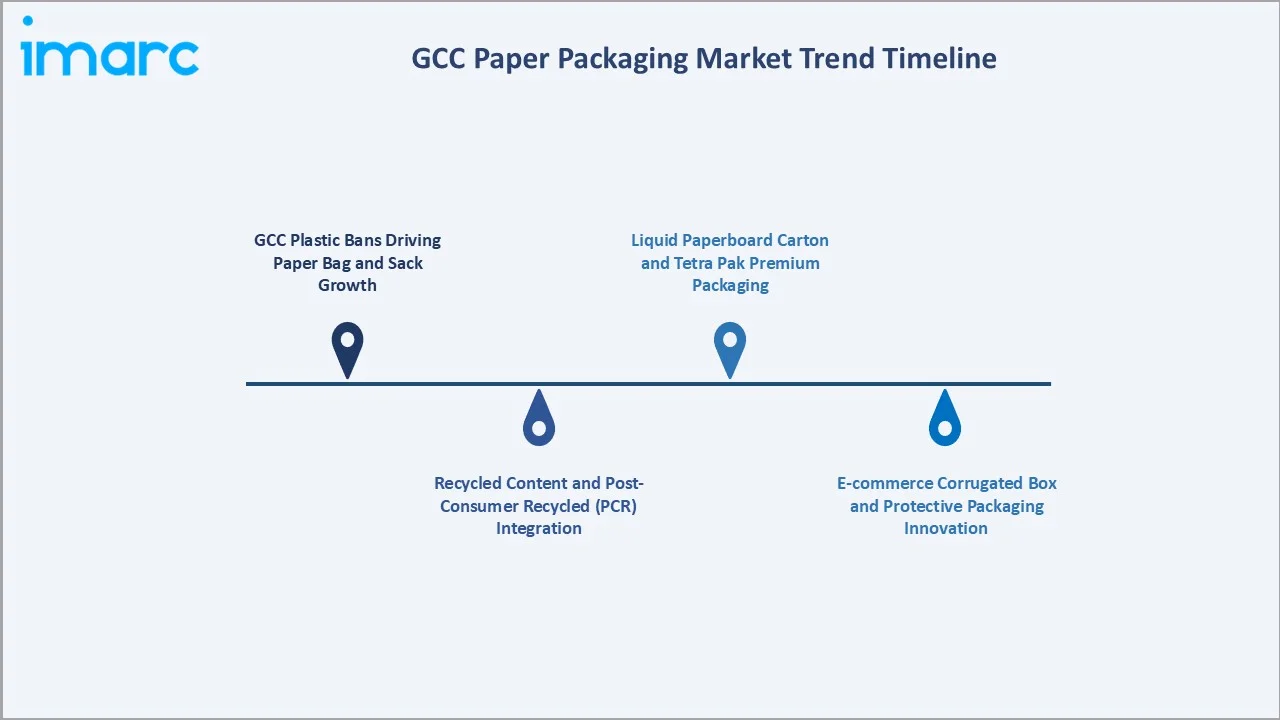
1. GCC Plastic Bans Driving Paper Bag and Sack Growth
GCC plastic bans are driving paper bag and sack growth as retailers, foodservice operators, and consumer brands shift away from single-use plastic packaging. Paper bags and sacks offer recyclable, biodegradable, and brand-friendly alternatives for shopping, takeaway food, groceries, and industrial packaging. Abu Dhabi’s 2022 ban on single-use plastic bags demonstrates the impact of strong regulation, with 364 million bags eliminated within two years, saving 2,400 tonnes of plastic and reducing greenhouse gas emissions equivalent to removing 130,000 cars from the road. As sustainability regulations strengthen, paper-based bags and sacks are becoming a preferred packaging solution in the GCC.
2. Recycled Content and Post-Consumer Recycled (PCR) Integration
Recycled content and post-consumer recycled (PCR) integration are emerging as brands seek to reduce dependence on virgin fiber and improve sustainability performance. Packaging manufacturers are increasingly using recovered paper and recycled paperboard to produce cartons, bags, corrugated boxes, and sacks. This supports circular economy goals, lowers waste generation, and helps companies meet ESG commitments. As recycling systems improve, PCR-based paper packaging is expected to gain wider adoption across retail, foodservice, e-commerce, and consumer goods sectors.
3. E-commerce Corrugated Box and Protective Packaging Innovation
E-commerce corrugated box and protective packaging innovation is emerging as online retail requires durable, lightweight, and recyclable packaging for frequent handling and last-mile delivery. Brands are adopting right-sized corrugated boxes, paper-based cushioning, molded pulp inserts, and tamper-evident cartons to improve product protection and reduce material waste. These solutions also support better branding through printable surfaces and customized designs. As e-commerce volumes rise across the GCC, demand for efficient and sustainable paper-based shipping packaging is increasing.
4. Liquid Paperboard Carton and Tetra Pak Premium Packaging
Liquid paperboard cartons and Tetra Pak-style premium packaging are emerging due to rising demand for safe, lightweight, and convenient packaging for dairy, juices, beverages, and liquid foods. These formats offer strong product protection, longer shelf life, easy handling, and attractive branding opportunities. Growing consumption of ready-to-drink beverages and packaged food products is supporting wider adoption. As brands focus on sustainability and premium presentation, paperboard-based liquid cartons are gaining importance across the GCC.
Industry Value Chain Analysis
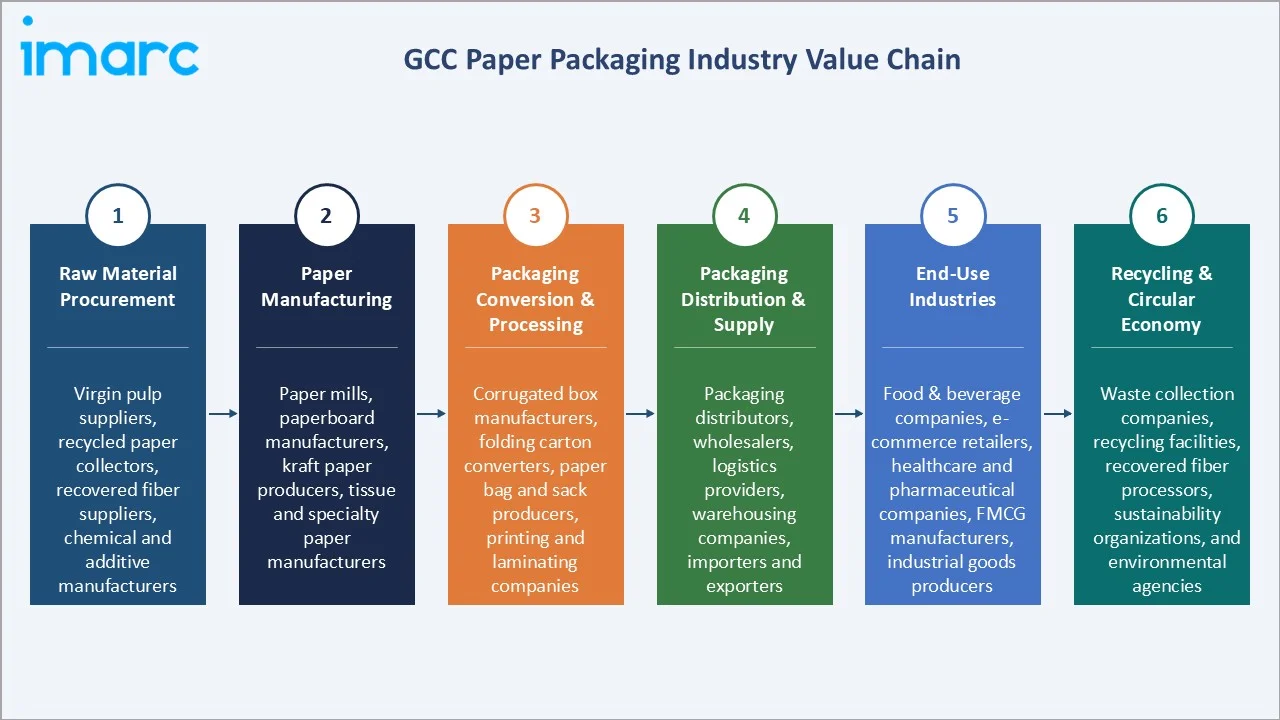
The GCC paper packaging value chain integrates
|
Stage |
Key Participants |
|
Raw Material Procurement |
Virgin pulp suppliers, recycled paper collectors, recovered fiber suppliers, chemical and additive manufacturers |
|
Paper Manufacturing |
Paper mills, paperboard manufacturers, kraft paper producers, tissue and specialty paper manufacturers |
|
Packaging Conversion & Processing |
Corrugated box manufacturers, folding carton converters, paper bag and sack producers, printing and laminating companies |
|
Packaging Distribution & Supply |
Packaging distributors, wholesalers, logistics providers, warehousing companies, importers and exporters |
|
End-Use Industries |
Food & beverage companies, e-commerce retailers, healthcare and pharmaceutical companies, FMCG manufacturers, industrial goods producers |
|
Recycling & Circular Economy |
Waste collection companies, recycling facilities, recovered fiber processors, sustainability organizations, and environmental agencies |
The packaging conversion and processing stage is the most value-added stage in the GCC paper packaging value chain. This stage transforms paper and paperboard into customized products such as corrugated boxes, folding cartons, paper bags, and specialty packaging through printing, die-cutting, coating, and finishing processes. It delivers the highest value by enhancing product functionality, branding, shelf appeal, and sustainability while meeting the specific packaging requirements of end-use industries.
Technology Landscape in the GCC Paper Packaging Industry
Manufacturing and Converting Technology
Manufacturing and converting technology improve production efficiency, reduce material waste, and enable faster manufacturing of customized packaging solutions. Advanced quality inspection, precision cutting, and smart factory systems further enhance product consistency and operational performance. As demand for sustainable and premium packaging grows, manufacturers are increasingly investing in modern converting technologies to improve competitiveness and production flexibility.
Sustainable and Recycled Material Technology
Sustainable and recycled material technology increases the use of recycled fiber, post-consumer recycled (PCR) paper, biodegradable coatings, and fiber-based packaging materials. Advanced recycling and pulping technologies are improving the quality and performance of recycled paper while reducing dependence on virgin pulp. Manufacturers are also adopting eco-friendly barrier coatings and lightweight paperboard to enhance recyclability without compromising functionality. These innovations support circular economy initiatives, regulatory compliance, and growing demand for sustainable packaging solutions across the GCC.
Waste Paper Recycling Technology
Waste paper recycling technology converts recovered paper into high-quality recycled fiber for containerboard, cartons, and corrugated packaging. Advanced pulping, cleaning, screening, and de-inking systems improve fiber quality while reducing dependence on virgin pulp. In May 2026, UAE Minister Dr. Sultan Ahmed Al Jaber inaugurated Star Paper Mill’s AED 200 Million (USD 54.4 Million) recycled containerboard facility at KEZAD, Abu Dhabi, during Make it in the Emirates 2026. The 90,000 sq m plant will convert locally collected waste paper into high-quality recycled containerboard and jumbo reels used for corrugated boxes and paper-based packaging. With an annual capacity of 135,000 tonnes, the facility will support rising packaging demand while reducing landfill pressure by recycling up to 80% of domestically sourced waste paper. These technologies help lower landfill waste, improve resource efficiency, and support circular economy initiatives.
Market Segmentation Analysis
The Report Covers The Following Segments:
|
Segment Category |
Leading Segment |
Market Share |
Year |
|
Product Type |
Folding Boxes and Cases |
31.8% |
2025 |
|
Grade |
Uncoated Recycled |
36.4% |
2025 |
|
Packaging Level |
Primary Packaging |
🔒 |
2025 |
|
End Use Industry |
Food |
🔒 |
2025 |
|
Country |
Saudi Arabia |
38.6% |
2025 |

By Product Type
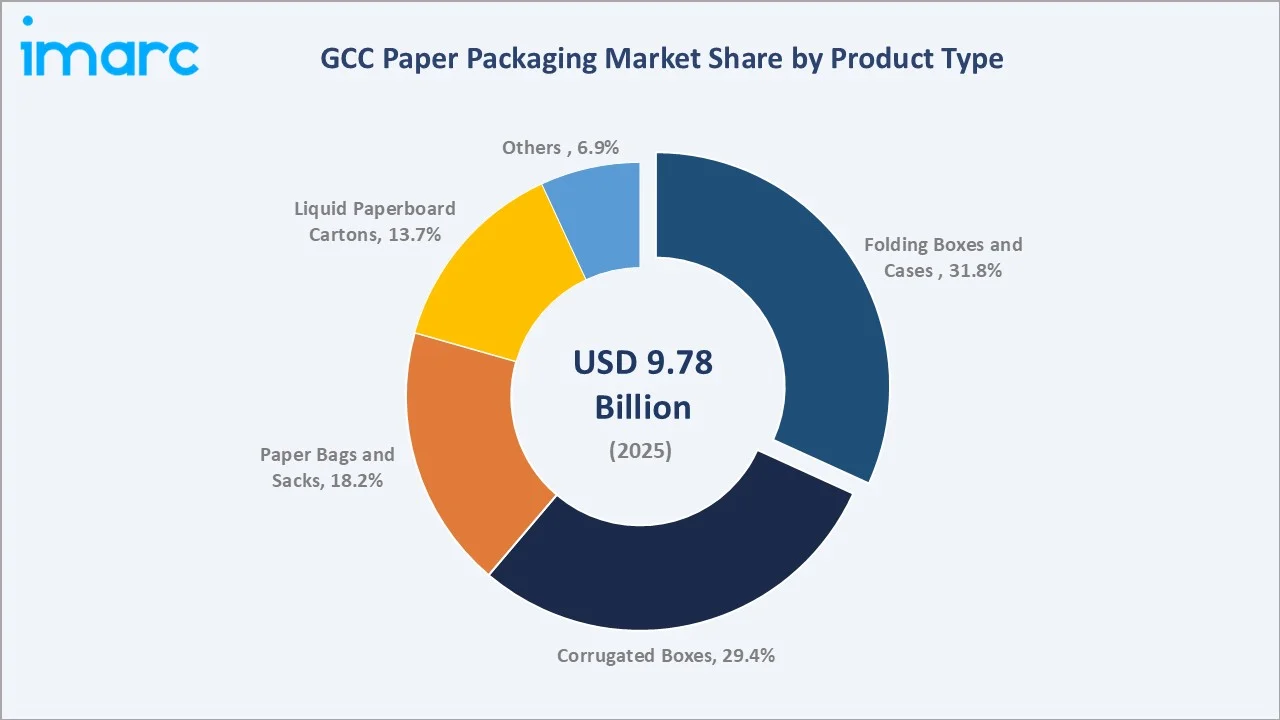
Folding boxes and cases lead at 31.8% (2025), through FMCG folding cartons, pharmaceutical folding cartons, retail consumer electronics folding boxes, and food shelf-ready folding cartons.
To access detailed market analysis, Request Sample
Corrugated boxes at 29.4% reflect GCC import packaging, e-commerce delivery boxes, and Saudi agri-food export corrugated. Paper bags and sacks at 18.2% grow fastest at ~3.9% CAGR through the GCC plastic ban, grocery retail paper bags, cement and chemical paper sacks, and food service bags. Liquid paperboard cartons at 13.7% reflect Tetra Pak aseptic dairy and juice cartons. Others at 6.9%.
By Grade
Uncoated recycled leads at 36.4% (2025), through OCC-based corrugated boxes, testliner and fluting for corrugated board, and uncoated industrial kraft sacks for cement and chemicals.
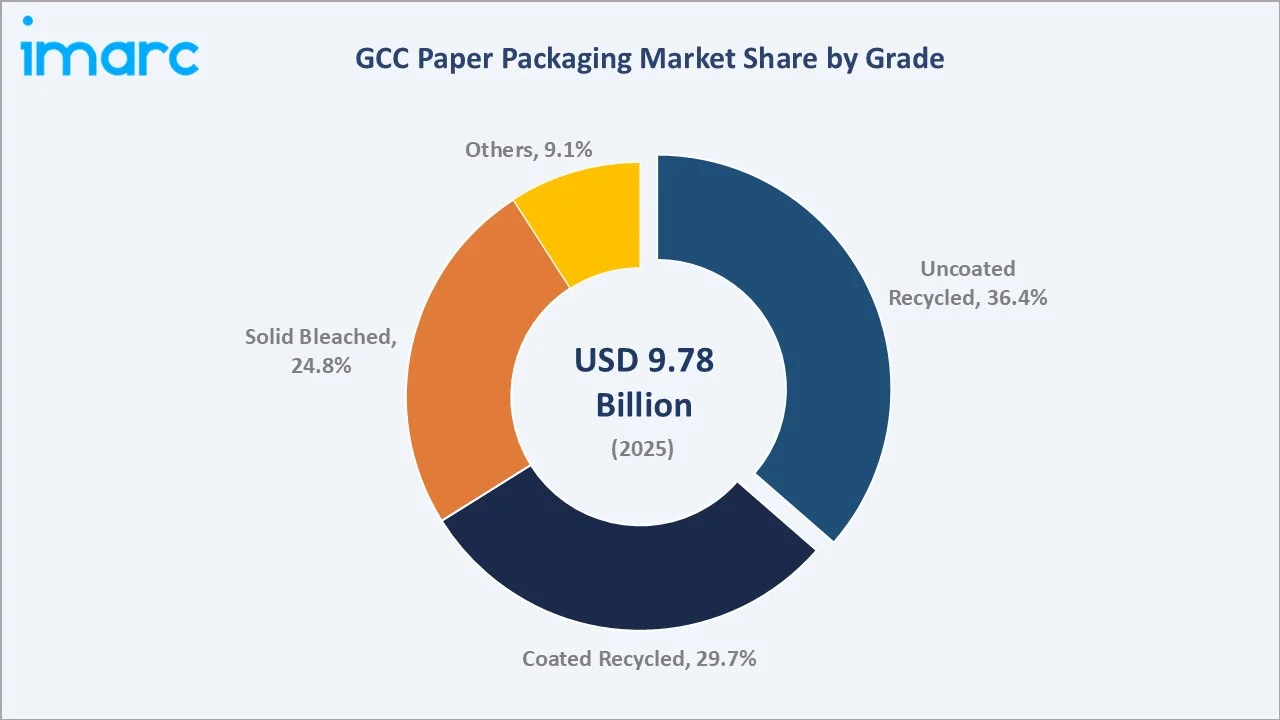
Coated recycled at 29.7% reflects CRB (coated recycled board) and WLC (white lined chipboard) for folding cartons and retail packaging boxes. Solid bleached at 24.8% grows at ~4.2% CAGR through SBS (solid bleached sulfate) pharmaceutical folding cartons, premium food service cups and plates (Tetra Pak aseptic), and luxury retail folding boxes. Others at 9.1% include virgin kraft, mechanical grades, and specialty papers.
Regional Market Insights
|
Region |
Share (2025) |
Key GCC Paper Packaging Market Drivers & Characteristics |
|
Saudi Arabia |
38.6% |
Reflecting its large food and beverage industry, expanding e-commerce sector, strong manufacturing base, and government initiatives promoting sustainable packaging and plastic waste reduction. |
|
UAE |
29.4% |
Reflecting high demand from retail, logistics, tourism, and foodservice industries, supported by investments in recycling infrastructure and circular economy initiatives. |
|
Qatar |
10.3% |
Reflecting growth in packaged food consumption, retail expansion, infrastructure development, and increasing adoption of eco-friendly packaging solutions. |
|
Oman |
8.5% |
Reflecting expanding industrial activity, food processing, logistics development, and growing demand for recyclable paper-based packaging. |
|
Kuwait |
7.4% |
Reflecting increasing consumer goods demand, modern retail growth, rising environmental awareness, and wider adoption of sustainable packaging materials. |
|
Bahrain |
5.8% |
Reflecting demand from the food, retail, and hospitality sectors, supported by sustainability initiatives and growing preference for recyclable paper packaging. |
Saudi Arabia's 38.6% dominance reflects its large food and beverage, retail, e-commerce, and industrial packaging demand. The UAE's 29.4% is supported by strong retail activity, logistics, foodservice demand, and recycling investments.
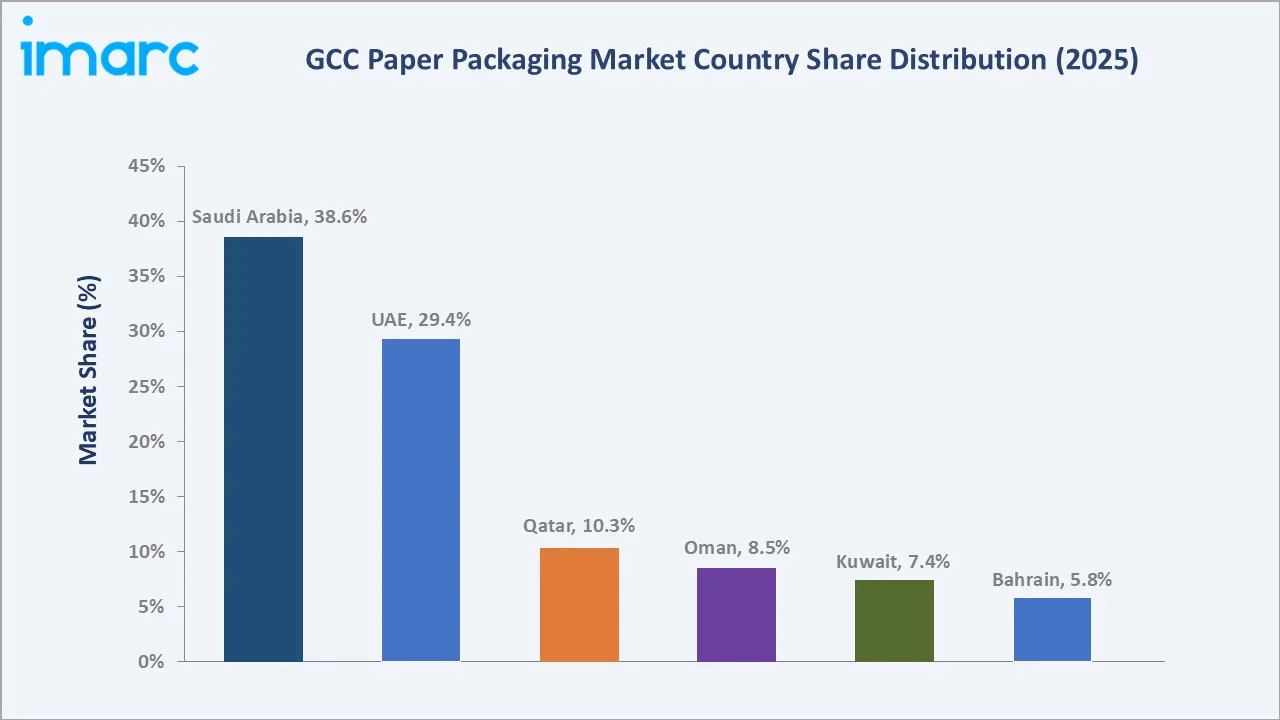
Qatar's 10.3% and Oman's 8.5% are expanding steadily with growth in packaged foods, infrastructure, and eco-friendly packaging adoption. Kuwait's 7.4% benefits from rising consumer goods demand and modern retail expansion. Bahrain's 5.8% is supported by foodservice, hospitality, and sustainable packaging initiatives.
Competitive Landscape
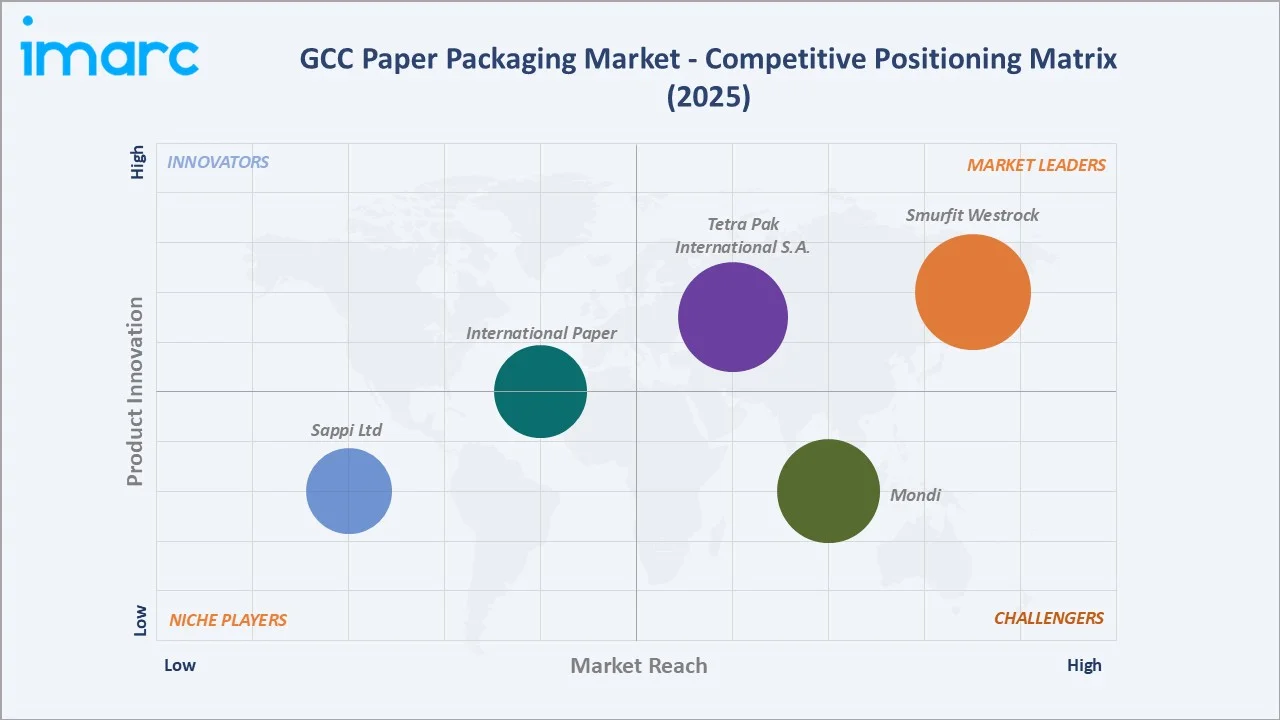
The GCC paper packaging market is moderately consolidated, with competition among regional paper manufacturers, packaging converters, and global packaging companies. Leading players compete through product quality, production capacity, sustainable packaging solutions, and long-term supply agreements with food, retail, healthcare, and industrial customers. Companies are investing in recycled paper production, advanced converting technologies, digital printing, and automation to improve operational efficiency and expand product portfolios.
|
Company |
Key Products |
Market Position |
Core Strength |
|
Smurfit Westrock |
Corrugated Packaging Solutions, Paperboard Packaging |
Market Leader |
Smurfit Westrock, formed by the 2024 merger of Smurfit Kappa and WestRock, is a dominant global player in sustainable paper and packaging. In the GCC, it drives the market by supplying premium recycled containerboard, custom corrugated boxes, and fiber-based replacements for single-use plastics across key sectors like food and beverage, retail, and industrial shipping. |
|
International Paper |
Corrugated Packaging Solutions |
Established Player |
International Paper operates as a prominent leader of sustainable, fiber-based packaging rather than a domestic manufacturer within the GCC. The company supports the region by supplying premium corrugated packaging, containerboard, and sustainable pulp for downstream converters, catering to the Gulf's rising food security and industrial demands. |
|
Tetra Pak International S.A. |
Tetra Pak Carton Packages |
Market Leader |
Tetra Pak International S.A. acts as a driving force in the GCC’s paper packaging sector, spearheading a shift toward a circular, low-carbon economy. The company leads the regional market by supplying aseptic carton packaging, localizing production to strengthen food security, and building out comprehensive local recycling infrastructure. |
|
Mondi |
Containerboard Paper, Corrugated and solid board packaging solutions, Industrial paper bags |
Strong Challenger |
Mondi acts as a key supplier of sustainable kraft papers, containerboard, and functional barrier papers in the GCC region. Operating primarily through regional sales partners across the Middle East and North Africa (MENA), the company provides high-performance, eco-friendly packaging materials to major regional industries. |
|
Sappi Ltd |
Paperboard, Containerboard, Standard flexible packaging papers, Functional flexible packaging papers |
Niche Player |
Sappi Ltd. is a leader in woodfibre-based products, driving the shift toward sustainable paper packaging in the GCC region. Their primary role is supplying eco-friendly, heat-sealable, and high-barrier flexible papers, allowing brands to replace traditional, hard-to-recycle plastic and multilayer foils. |
Capacity expansions, strategic partnerships, and sustainability-focused investments are strengthening competitive positioning across the region. Innovation in recyclable, biodegradable, and high-performance paper packaging continues to be a key differentiator among market participants.
Key Company Profiles
Smurfit Westrock
Smurfit Westrock is one of the largest paper-based packaging companies, offering a broad portfolio of corrugated packaging, containerboard, folding cartons, paper bags, and sustainable packaging solutions. The company serves customers across the food and beverage, e-commerce, retail, healthcare, industrial, and consumer goods sectors through its global manufacturing and supply chain network. In the GCC, Smurfit Westrock supports multinational and regional customers with innovative, recyclable, and fiber-based packaging solutions tailored to local market requirements.
- Key Products: Corrugated Packaging Solutions, Paperboard Packaging.
- Strategic Focus: Expanding its presence in the GCC through sustainable paper-based packaging solutions for the food and beverage, e-commerce, retail, healthcare, and industrial sectors. The company is investing in recyclable and fiber-based packaging, advanced corrugated packaging technologies, digital printing, and automated converting operations to improve efficiency and product customization.
Mondi
Mondi is a leader in sustainable paper and packaging solutions, offering a comprehensive portfolio that includes corrugated packaging, kraft paper, paper bags, containerboard, flexible paper packaging, and specialty paper products. The company serves key industries such as food and beverage, e-commerce, consumer goods, industrial, healthcare, and retail through an integrated network of paper mills and converting facilities. In the GCC, Mondi supports regional customers with innovative, recyclable, and fiber-based packaging solutions that enhance product protection and supply chain efficiency.
- Key Products: Containerboard Paper, Corrugated and solid board packaging solutions, Industrial paper bags.
- Strategic Focus: Strengthening its position in the GCC by expanding sustainable paper-based packaging solutions for the food and beverage, e-commerce, retail, industrial, and consumer goods sectors. The company is investing in recyclable and fiber-based packaging, lightweight paper materials, advanced converting technologies, and digital printing to improve product performance and reduce environmental impact.
Market Concentration Analysis
The GCC paper packaging market is moderately consolidated, with competition among multinational packaging companies, regional paper manufacturers, and local converting firms. Leading players compete through production capacity, product innovation, sustainable packaging solutions, and long-term partnerships with food, beverage, retail, healthcare, and e-commerce customers. Investments in recycled paper production, advanced converting technologies, digital printing, and automation are strengthening competitive positioning. Companies are also expanding manufacturing capabilities and developing fiber-based alternatives to replace plastic packaging in response to evolving regulations. As sustainability and circular economy initiatives accelerate, market participants are increasingly differentiating themselves through recyclable materials, customized packaging, and value-added design solutions.
Investment & Growth Opportunities
Highest Growth Segments
Paper bags and sacks (~3.9% CAGR through plastic ban), solid bleached pharmaceutical (~4.2% CAGR through pharma expansion), Oman fisheries export corrugated (~4.5% CAGR from growing base), halal food export corrugated (~4% CAGR), sustainable PCR corrugated (~3.8% CAGR), and smart packaging QR code (~5% CAGR from emerging base) represent GCC paper packaging highest-growth investment vectors through 2034.
Investment Themes
- Pharmaceutical folding carton solid bleached premium: Rising pharmaceutical production and healthcare spending are driving investments in premium solid bleached board (SBB) folding cartons that offer superior print quality, product protection, regulatory compliance, and sustainability.
- E-commerce corrugated innovation: Rapid growth in online retail is encouraging investments in lightweight, right-sized corrugated boxes, paper-based protective packaging, and automated box-making technologies to improve shipping efficiency, reduce material usage, and support sustainable delivery.
Future Market Outlook (2026-2034)
The GCC paper packaging market is projected to grow from USD 9.78 Billion in 2025 to USD 10.21 Billion in 2026, reaching USD 13.37 Billion by 2034, delivering a 3.42% CAGR over the forecast period through GCC plastic ban paper shift structural scale, e-commerce corrugated box growth, Vision 2030 retail and hospitality packaging, pharmaceutical solid bleached premium, and sustainable PCR recycled content integration. The market's anchor value of USD 11.58 Billion in 2030 represents GCC paper packaging at the plastic ban mainstream and sustainable grade inflection.
Three structural forces define GCC paper packaging growth through 2034. First, tightening environmental regulations and plastic reduction initiatives are accelerating the shift toward recyclable and fiber-based packaging solutions. Second, the rapid expansion of e-commerce, food and beverage, and healthcare industries is driving sustained demand for corrugated boxes, folding cartons, and paper bags. Third, continuous investments in recycling infrastructure, advanced paper manufacturing, and converting technologies are improving production efficiency and supporting circular economy objectives.
Research Methodology
Primary Research
Primary research comprised structured interviews with paper manufacturers, packaging converters, raw material suppliers, distributors, brand owners, retailers, and industry experts across the GCC. These discussions were used to validate market size, product demand, pricing trends, technology adoption, competitive dynamics, and future growth opportunities across key paper packaging segments.
Secondary Research
Secondary research encompassed company reports, industry publications, government regulations, trade statistics, sustainability reports, and packaging association data. These sources were used to assess market trends, recycling initiatives, raw material dynamics, competitive positioning, and demand patterns across food, retail, e-commerce, healthcare, and industrial packaging sectors.
Forecasting Models
Forecasting models combined historical market trends with demand forecasting, econometric analysis, and scenario-based modeling to estimate future market growth. The assessment incorporated macroeconomic indicators, packaging consumption, sustainability regulations, e-commerce expansion, and food and beverage production trends. Technology adoption, recycling capacity additions, and raw material supply dynamics were also evaluated to project the GCC paper packaging market through 2034.
Report Coverage:
| Report Features | Details |
|---|---|
| Base Year of the Analysis | 2025 |
| Historical Period | 2020-2025 |
| Forecast Period | 2026-2034 |
| Units | Billion USD |
| Scope of the Report | Exploration of Historical Trends and Market Outlook, Industry Catalysts and Challenges, Segment-Wise Historical and Predictive Market Assessment:
|
| Product Types Covered | Corrugated Boxes, Folding Boxes and Cases, Liquid Paperboard Cartons, Paper Bags and Sacks, Others |
| Grades Covered | Solid Bleached, Coated Recycled, Uncoated Recycled, Others |
| Packaging Levels Covered | Primary Packaging, Secondary Packaging, Tertiary Packaging |
| End Use Industries Covered | Food, Beverages, Personal Care and Home Care, Healthcare, Others |
| Countries Covered | Saudi Arabia, UAE, Qatar, Oman, Kuwait, Bahrain |
| Companies Covered | Smurfit Westrock, International Paper, Tetra Pak International S.A., Mondi, Sappi Ltd, etc. |
| Customization Scope | 10% Free Customization |
| Post-Sale Analyst Support | 10-12 Weeks |
| Delivery Format | PDF and Excel through Email (We can also provide the editable version of the report in PPT/Word format on special request) |
Frequently Asked Questions About the GCC Paper Packaging Market Report
The GCC paper packaging market size is estimated at USD 10.21 Billion in 2026, driven by rising demand for sustainable, recyclable, and plastic-free packaging solutions across food and beverage, retail, e-commerce, and healthcare sectors. Growth is further supported by plastic reduction regulations, increasing packaging waste concerns, and investments in recycled paper and fiber-based packaging production.
The GCC paper packaging market grows at 3.42% CAGR during 2026-2034, reaching USD 13.37 Billion by 2034. The CAGR reflects e-commerce corrugated, GCC plastic ban paper shift, food and beverage sector, and Vision 2030 retail and hospitality structural demand.
Folding boxes and cases lead at 31.8% due to their wide use in food, beverage, pharmaceuticals, personal care, retail, and consumer goods packaging. Their recyclable, lightweight, printable, and cost-effective nature makes them ideal for both product protection and brand presentation.
Uncoated recycled leads at 36.4% due to its affordability, recyclability, and wide application in cartons, corrugated boxes, paper bags, and sacks. Its sustainable profile supports growing demand from brands shifting toward eco-friendly and circular packaging solutions.
Saudi Arabia leads at 38.6% due to its large food and beverage, retail, e-commerce, and industrial manufacturing base. Strong demand for cartons, corrugated boxes, paper bags, and sustainable packaging solutions further supports its regional dominance.
Leading companies include Smurfit Westrock, International Paper, Tetra Pak International S.A., Mondi, and Sappi Ltd, among others.
The market is projected to reach approximately USD 11.58 Billion by 2030, driven by rising demand for recyclable and plastic-free packaging. Growth will be supported by expanding food and beverage, e-commerce, retail, and healthcare packaging applications.
Three priority investment opportunities are emerging across the GCC paper packaging market. First, expanding recycled paper and fiber-based packaging production offers strong potential as sustainability regulations and plastic reduction initiatives accelerate. Second, rapid e-commerce growth is driving investments in advanced corrugated boxes, paper mailers, and protective paper-based packaging solutions. Third, increasing demand from the food, beverage, and pharmaceutical sectors is creating opportunities for premium folding cartons, paperboard packaging, and high-performance sustainable packaging materials.
Need more help?
- Speak to our experienced analysts for insights on the current market scenarios.
- Include additional segments and countries to customize the report as per your requirement.
- Gain an unparalleled competitive advantage in your domain by understanding how to utilize the report and positively impacting your operations and revenue.
- For further assistance, please connect with our analysts.
 Request Customization
 Speak to an Analyst
 Request Brochure
 Inquire Before Buying
Benefits of Customization
- Personalize this research
- Triangulate with your data
- Get data as per your format and definition
- Gain a deeper dive into a specific application, geography, customer, or competitor
- Any level of personalization
Get in Touch With Us
UNITED STATES
Phone: +1-201-971-6302
INDIA
Phone: +91-120-433-0800
UNITED KINGDOM
Phone: +44-753-714-6104
Email: [email protected]
Client Testimonials




.webp)




.webp)













Related Reports

Choose your plan
*Please note that the prices mentioned below are starting prices for each bundle type. Kindly contact our team for further details.*
Single User License
- 1 User License, Access on 2 Devices
- PDF Report + Excel Dataset (Password Protected)
- Lifetime Access
- No Printing Rights
- 10% Free Report Customization
- 10–12 Weeks of Analyst Support
Five User License
- Access for 5 Users, 2 Devices per User
- PDF Report + Excel Dataset (Password Protected)
- Lifetime Access
- Dedicated Account Manager
- 12–14 Weeks of Analyst Support
- No Printing Rights
- 15% Free Report Customization
- 25% Discount on Your Next Purchase
Corporate User License
- Unlimited User Access (Within Your Organization)
- PDF Report + Excel Dataset
- Lifetime Access
- Dedicated Account Manager
- 14–20 Weeks of Analyst Support
- No Printing Rights
- 20% Free Report Customization
- 30% Discount on Your Next Purchase
Essential Insights
What's included:
3 reports
- Lifetime Access
- PDF Reports
- Excel Datasets
- 2 Weeks of Free Analyst Support
- 2 User Licenses
- Access on 2 Devices
- Printing Rights
- Complimentary PowerPoint (PPT) Version
- Complimentary License Upgrade
Professional Access
What's included:
5 reports
- Lifetime Access
- PDF Reports
- Excel Datasets
- 8 Weeks of Free Analyst Support
- 2 User Licenses
- Access on 2 Devices
- Printing Rights
- Complimentary PowerPoint (PPT) Version
- Complimentary License Upgrade
Business Advantage
What's included:
8 reports
- Lifetime Access
- PDF Reports
- Excel Datasets
- 14 Weeks of Free Analyst Support
- 2 User Licenses
- Access on 2 Devices
- Printing Rights
- Complimentary PowerPoint (PPT) Version
- Complimentary License Upgrade
Enterprise Intelligence
What's included:
10 reports
- Lifetime Access
- PDF Reports
- Excel Datasets
- 20 Weeks of Free Analyst Support
- 2 User Licenses
- Access on 2 Devices
- Printing Rights
- Complimentary PowerPoint (PPT) Version
- Complimentary License Upgrade